
DD-滴滴
345 Posts

DD-滴滴
 Square Verified
推特同名: rtk17025 喜欢随意分享
144 Following
10.0K+ Followers
2.9K+ Liked
Posts
All
Quotes
Videos
Live
PINNED
StableStock
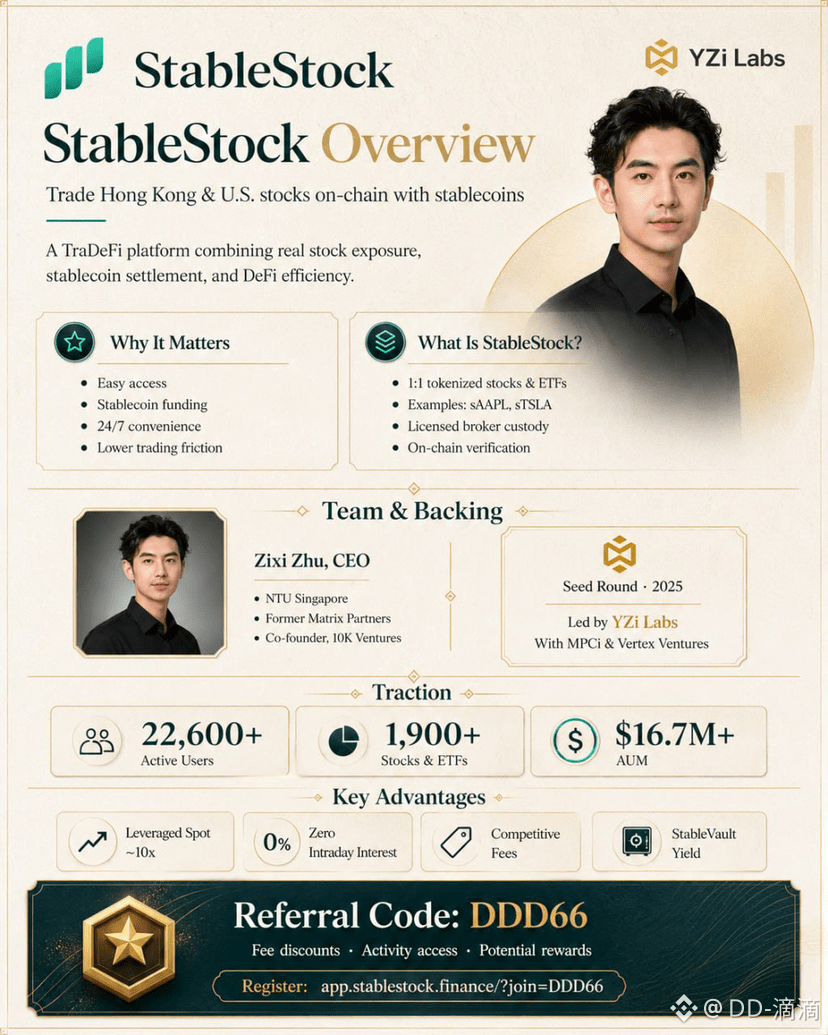
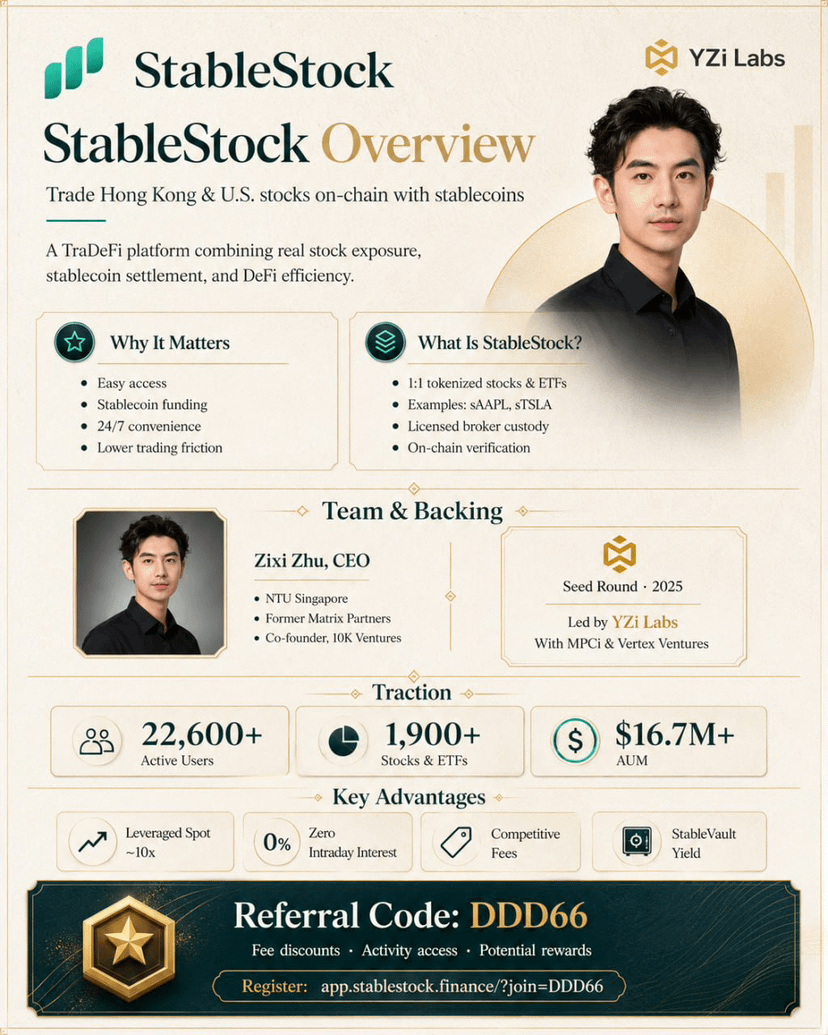
StableStock is a TraDeFi platform that lets users trade real U.S. and Hong Kong stocks directly with stablecoins (USDT/USDC). It tokenizes stocks 1:1 into on-chain assets (e.g. $AAPL , $TSLA ) backed by licensed brokers.
### Why It Exists
Traditional stock investing has high barriers: complicated overseas account opening, slow and expensive deposits, limited trading hours, high fees, and poor integration with crypto/DeFi.
StableStock solves these issues by enabling stablecoin-based trading with on-chain transparency.
### Key Features
- Leveraged Spot tradingup to ~10x
- Zero intraday interest— no financing fees if positions are closed the same day
- Competitive fees (extra discounts available via referral)
- StableVault— stake idle assets to earn DeFi yield while holding stock exposure
### Team & Backing
- **CEO**: Zixi Zhu (ex-Matrix Partners crypto investment head)
- **Funding**: 2025 seed round led by YZi Labs, with Matrix Partners and Vertex Ventures
- Current traction: 22,600+ users and $16.7M+ AUM
### How to Register
1. Go to: <https://app.stablestock.finance/?join=DDD66>
2. Sign up with email or wallet
3. Enter referral code: **DDD66**
Using the code gives top-tier fee discounts and access to promotions.
After registration, deposit stablecoins and start trading U.S. & Hong Kong stocks instantly.
StableStock is a TraDeFi platform that lets users trade real U.S. and Hong Kong stocks directly with stablecoins (USDT/USDC). It tokenizes stocks 1:1 into on-chain assets (e.g. $AAPL , $TSLA ) backed by licensed brokers.
### Why It Exists
Traditional stock investing has high barriers: complicated overseas account opening, slow and expensive deposits, limited trading hours, high fees, and poor integration with crypto/DeFi.
StableStock solves these issues by enabling stablecoin-based trading with on-chain transparency.
### Key Features
- Leveraged Spot tradingup to ~10x
- Zero intraday interest— no financing fees if positions are closed the same day
- Competitive fees (extra discounts available via referral)
- StableVault— stake idle assets to earn DeFi yield while holding stock exposure
### Team & Backing
- **CEO**: Zixi Zhu (ex-Matrix Partners crypto investment head)
- **Funding**: 2025 seed round led by YZi Labs, with Matrix Partners and Vertex Ventures
- Current traction: 22,600+ users and $16.7M+ AUM
### How to Register
1. Go to: <https://app.stablestock.finance/?join=DDD66>
2. Sign up with email or wallet
3. Enter referral code: **DDD66**
Using the code gives top-tier fee discounts and access to promotions.
After registration, deposit stablecoins and start trading U.S. & Hong Kong stocks instantly.
AAPLonAlpha
TSLAUS-0.10%
PINNED
It's already 2026 now, yet many people still have no idea about the progress of the RWA crypto market. They don’t know where perps are being “printed” and where you can buy them; they don’t even know how to buy heavily before the pre-IPO—let alone things like behavioral finance, etc.
All of it is compiled into <Encryption Newcomers’ First Lesson>
Send/Link, https://cryptofirstclass.notion.site/
All of it is compiled into <Encryption Newcomers’ First Lesson>
Send/Link, https://cryptofirstclass.notion.site/
Verified
Many people who see the news about $WLFI “opening a bank” may think at first that the Trump family is planning to set up a traditional bank.
What’s actually more worth paying attention to is that $USD1 is filling in its financial infrastructure.
On August 14, the U.S. OCC preliminarily and conditionally approved the establishment of a national trust bank by World Liberty Trust Company, a subsidiary of World Liberty Financial.
The business scope of this license is very clear: it will focus on issuing, redeeming, managing reserves, digital-asset custody, and stablecoin conversions—primarily serving exchanges, market makers, and investment institutions.
It cannot accept deposits from the public, nor can it conduct traditional lending business, so it is completely a different model from commercial banks like JPMorgan and Bank of America.
What’s truly important is that if $USD1 ultimately completes the conditions to begin operations, in the future it can gradually integrate key steps—issuance, custody, and exchange—into entities regulated by the OCC, taking over certain core functions from BitGo.
The regulatory requirements are also not light.
At least $20 million in Tier 1 capital, maintaining qualifying liquid assets that cover 180 days of operating expenses; any material changes to business must be notified to the OCC in advance; senior executives and directors must receive a regulatory “no objection” determination; and it must comply with the GENIUS Act, AML, and sanctions requirements.
The OCC also draws a clear line: the bank must not conduct business related to the $WLFI token.
So the significance of this news for $WLFI and $USD1 can be understood as an important compliance milestone.
From submitting the application in January 2026 to receiving an initial conditional approval in August, World Liberty Financial is trying to push $USD1 from a stablecoin product further into U.S. federally regulated payment, custody, and settlement infrastructure.
What’s actually more worth paying attention to is that $USD1 is filling in its financial infrastructure.
On August 14, the U.S. OCC preliminarily and conditionally approved the establishment of a national trust bank by World Liberty Trust Company, a subsidiary of World Liberty Financial.
The business scope of this license is very clear: it will focus on issuing, redeeming, managing reserves, digital-asset custody, and stablecoin conversions—primarily serving exchanges, market makers, and investment institutions.
It cannot accept deposits from the public, nor can it conduct traditional lending business, so it is completely a different model from commercial banks like JPMorgan and Bank of America.
What’s truly important is that if $USD1 ultimately completes the conditions to begin operations, in the future it can gradually integrate key steps—issuance, custody, and exchange—into entities regulated by the OCC, taking over certain core functions from BitGo.
The regulatory requirements are also not light.
At least $20 million in Tier 1 capital, maintaining qualifying liquid assets that cover 180 days of operating expenses; any material changes to business must be notified to the OCC in advance; senior executives and directors must receive a regulatory “no objection” determination; and it must comply with the GENIUS Act, AML, and sanctions requirements.
The OCC also draws a clear line: the bank must not conduct business related to the $WLFI token.
So the significance of this news for $WLFI and $USD1 can be understood as an important compliance milestone.
From submitting the application in January 2026 to receiving an initial conditional approval in August, World Liberty Financial is trying to push $USD1 from a stablecoin product further into U.S. federally regulated payment, custody, and settlement infrastructure.
Verified
$WLFI is really “opening a bank.”
On August 14, the U.S. Office of the Comptroller of the Currency (OCC) formally granted World Liberty Financial subsidiary World Liberty Trust Company a preliminary conditional approval, allowing it to establish a nationwide trust bank.
What’s most worth paying attention to this time is actually $USD1.
According to the application plan, in the future the new bank will directly handle the issuance, redemption, reserve management, and digital asset custody of $USD1, and gradually take over related business from BitGo. In the initial phase, it even plans to offer free exchanges between USD and $USD1, mainly for customers such as exchanges, market makers, and investment institutions.
However, we need to clarify what “opening a bank” really means.
WLFI is applying for a National Trust Bank—that is, a nationwide trust bank—not a traditional commercial bank. It cannot accept deposits from the public, nor can it lend like an ordinary bank. Its core positioning is very clear: to build a set of financial infrastructure under U.S. federal regulation centered on stablecoins and digital asset custody.
The OCC also set explicit conditions, including at least $20 million in Tier 1 capital, meeting liquidity requirements, executive and director appointments subject to regulatory review, and full compliance with the GENIUS Act, AML, and sanctions regulations. The bank is also not allowed to engage in $WLFI token-related business.
The timeline is also quick:
- Application submitted on January 7, 2026
- Preliminary conditional approval granted by the OCC on August 14, 2026
- Capital raising must be completed within the next 12 months
- Must meet opening requirements no later than 18 months from now
The next key focus for $WLFI and $USD1 is already moving beyond being just a Crypto project and further extending into stablecoin financial infrastructure under U.S. federal regulation.
On August 14, the U.S. Office of the Comptroller of the Currency (OCC) formally granted World Liberty Financial subsidiary World Liberty Trust Company a preliminary conditional approval, allowing it to establish a nationwide trust bank.
What’s most worth paying attention to this time is actually $USD1.
According to the application plan, in the future the new bank will directly handle the issuance, redemption, reserve management, and digital asset custody of $USD1, and gradually take over related business from BitGo. In the initial phase, it even plans to offer free exchanges between USD and $USD1, mainly for customers such as exchanges, market makers, and investment institutions.
However, we need to clarify what “opening a bank” really means.
WLFI is applying for a National Trust Bank—that is, a nationwide trust bank—not a traditional commercial bank. It cannot accept deposits from the public, nor can it lend like an ordinary bank. Its core positioning is very clear: to build a set of financial infrastructure under U.S. federal regulation centered on stablecoins and digital asset custody.
The OCC also set explicit conditions, including at least $20 million in Tier 1 capital, meeting liquidity requirements, executive and director appointments subject to regulatory review, and full compliance with the GENIUS Act, AML, and sanctions regulations. The bank is also not allowed to engage in $WLFI token-related business.
The timeline is also quick:
- Application submitted on January 7, 2026
- Preliminary conditional approval granted by the OCC on August 14, 2026
- Capital raising must be completed within the next 12 months
- Must meet opening requirements no later than 18 months from now
The next key focus for $WLFI and $USD1 is already moving beyond being just a Crypto project and further extending into stablecoin financial infrastructure under U.S. federal regulation.
VSHUS-0.43%
KNUS+0.00%
$CYS feels so good!
DD-滴滴
·
--
$CYS Yesterday's live stream discussed how CYS keeps erupting, and the rest will follow—$LYN
SNDK and SPCX: Trading Structure Analysis
$SNDK Profit remains strong, but the market begins to trade at a slower growth pace
The latest quarterly revenue and earnings have surged significantly. Guidance for the next quarter is still above market norms, but the stock reaction has been relatively weak. The reason is that market attention has shifted from absolute earnings to the growth slope.
In the prior quarter, most of the revenue increase came from rising NAND prices, which indicates the company’s profitability is highly cyclical. When prices move upward, gross margin and EPS expand rapidly; once quotes level off, even if revenue continues to grow, valuation may contract earlier.
The current low P/E includes peak-earnings assumptions, so it cannot be taken as straightforwardly undervalued. The true core of pricing is how long the high gross margin can be sustained, and whether data center demand can offset weakness in the consumer end.
Technically, $1,187–$1,226 is the main demand zone, and $1,120 is the next layer of support. Only after reclaiming $1,288 can we call it an initial repair. A break above $1,350 would be needed to possibly return to a more bullish structure. If the price falls below $1,187 and the retest fails, it may test $1,120 again.
SNDK is suitable for waiting to absorb selling pressure after an earnings-related gap move; it is not suitable to try to catch the knife directly during the first leg of a sharp drop.
$SPCXB : High growth still can’t offset capital expenditure pressure
$SPCX Revenue remains on a high-growth trajectory, but AI and space businesses still require substantial capital investment. Single-quarter capital expenditures are far higher than revenue, meaning valuation depends on future asset utilization, cash conversion capability, and the investment payback cycle.
The connectivity business has already demonstrated profitability, but the AI and space businesses are still in a long-term investment phase. In the past, the market was willing to award a high valuation to the group narrative; now it is beginning to demand that each business prove capital efficiency.
After large-scale share unlocks, potential float supply increases. Unlocking doesn’t necessarily mean shareholders will sell, but it can amplify share-lending supply, trading volume, and price volatility.
$104.8–$108 is the key short-term defensive zone. If it breaks below $104.8, the price will enter a discovery area lacking historical trade support. Resistance overhead is, in sequence, $114–$115, $125, and $131–$135.
Only if it breaks below $104.8 and quickly reclaims $108, then moves above $114.5, would it form a true setup of supply absorption and a failed breakdown. Without a recovery above $125, rallies are still likely to be more like oversold rebounds.
Conclusion
SNDK trades the memory-price cycle and earnings growth pace. SPCX trades capital expenditures, valuation duration, and unlocked-supply dynamics.
$SNDK Profit remains strong, but the market begins to trade at a slower growth pace
The latest quarterly revenue and earnings have surged significantly. Guidance for the next quarter is still above market norms, but the stock reaction has been relatively weak. The reason is that market attention has shifted from absolute earnings to the growth slope.
In the prior quarter, most of the revenue increase came from rising NAND prices, which indicates the company’s profitability is highly cyclical. When prices move upward, gross margin and EPS expand rapidly; once quotes level off, even if revenue continues to grow, valuation may contract earlier.
The current low P/E includes peak-earnings assumptions, so it cannot be taken as straightforwardly undervalued. The true core of pricing is how long the high gross margin can be sustained, and whether data center demand can offset weakness in the consumer end.
Technically, $1,187–$1,226 is the main demand zone, and $1,120 is the next layer of support. Only after reclaiming $1,288 can we call it an initial repair. A break above $1,350 would be needed to possibly return to a more bullish structure. If the price falls below $1,187 and the retest fails, it may test $1,120 again.
SNDK is suitable for waiting to absorb selling pressure after an earnings-related gap move; it is not suitable to try to catch the knife directly during the first leg of a sharp drop.
$SPCXB : High growth still can’t offset capital expenditure pressure
$SPCX Revenue remains on a high-growth trajectory, but AI and space businesses still require substantial capital investment. Single-quarter capital expenditures are far higher than revenue, meaning valuation depends on future asset utilization, cash conversion capability, and the investment payback cycle.
The connectivity business has already demonstrated profitability, but the AI and space businesses are still in a long-term investment phase. In the past, the market was willing to award a high valuation to the group narrative; now it is beginning to demand that each business prove capital efficiency.
After large-scale share unlocks, potential float supply increases. Unlocking doesn’t necessarily mean shareholders will sell, but it can amplify share-lending supply, trading volume, and price volatility.
$104.8–$108 is the key short-term defensive zone. If it breaks below $104.8, the price will enter a discovery area lacking historical trade support. Resistance overhead is, in sequence, $114–$115, $125, and $131–$135.
Only if it breaks below $104.8 and quickly reclaims $108, then moves above $114.5, would it form a true setup of supply absorption and a failed breakdown. Without a recovery above $125, rallies are still likely to be more like oversold rebounds.
Conclusion
SNDK trades the memory-price cycle and earnings growth pace. SPCX trades capital expenditures, valuation duration, and unlocked-supply dynamics.
$CYS Yesterday's live stream discussed how CYS keeps erupting, and the rest will follow—$LYN
After I posted the video yesterday, I received quite a few DMs.
Why not open a long-overdue Ask Me Anything?
Ask me anything.
Tonight at 8:30
Binance Square livestream
Let’s chat
The next steps for stablecoins
$WLFI X $USD1
@Jiayi Li
Why not open a long-overdue Ask Me Anything?
Ask me anything.
Tonight at 8:30
Binance Square livestream
Let’s chat
The next steps for stablecoins
$WLFI X $USD1
@Jiayi Li

·
--
🎙️ Let's talk with everyone about this week's market outlook and some trading tips
End
01 h 11 m 04 s
451
0
Professional investors are quietly rotating. Retail is still asleep
While global headlines obsess over US mega-caps, Greater China just delivered one of the most explosive equity events of 2026:
CXMT (ChangXin Memory / 长鑫存储)
– Asia’s largest IPO this year: raised US$8.6 billion
– Debuted on Shanghai STAR Market
– +465% to +500% on day one
– Instantly became China’s most valuable listed company
– Market cap pushed past US$480–540 billion
– World’s 4th-largest DRAM maker, pure AI-server memory play
– Homegrown semiconductor self-sufficiency thesis fully validated
Market backdrop (as of 28 July 2026):
– Hang Seng Index closed 25,311, up +10% in the past month (recovered sharply from the June low of 22,518)
– Foreign holdings of onshore A-shares have already exceeded 4 trillion yuan
– China’s industrial profits +18.7% in H1 2026, led by high-tech & AI equipment
Names moving right now in Hong Kong:
– Horizon Robotics: +8.9%
– Xiaomi: +2.0%
– Tencent: +1.0%
– Meituan: +0.9–1.1%
– Lenovo & SMIC also seeing sustained AI-related bids
Shein is next in the pipeline (targeting US$40–50 billion valuation for its Hong Kong listing).
This is classic late-stage FOMO setup:
Massive primary market absorption + secondary market recovery + policy-backed AI/chip theme + real foreign capital inflows.
The smart money has already started positioning.
The ones still waiting for “confirmation” will be the ones explaining their underperformance in Q4.
Still on the sidelines?
Capital doesn’t wait for perfect narratives.
#ChinaEquities #AShares #HangSeng #CXMT #AIChips #Semiconductor #FOMO
While global headlines obsess over US mega-caps, Greater China just delivered one of the most explosive equity events of 2026:
CXMT (ChangXin Memory / 长鑫存储)
– Asia’s largest IPO this year: raised US$8.6 billion
– Debuted on Shanghai STAR Market
– +465% to +500% on day one
– Instantly became China’s most valuable listed company
– Market cap pushed past US$480–540 billion
– World’s 4th-largest DRAM maker, pure AI-server memory play
– Homegrown semiconductor self-sufficiency thesis fully validated
Market backdrop (as of 28 July 2026):
– Hang Seng Index closed 25,311, up +10% in the past month (recovered sharply from the June low of 22,518)
– Foreign holdings of onshore A-shares have already exceeded 4 trillion yuan
– China’s industrial profits +18.7% in H1 2026, led by high-tech & AI equipment
Names moving right now in Hong Kong:
– Horizon Robotics: +8.9%
– Xiaomi: +2.0%
– Tencent: +1.0%
– Meituan: +0.9–1.1%
– Lenovo & SMIC also seeing sustained AI-related bids
Shein is next in the pipeline (targeting US$40–50 billion valuation for its Hong Kong listing).
This is classic late-stage FOMO setup:
Massive primary market absorption + secondary market recovery + policy-backed AI/chip theme + real foreign capital inflows.
The smart money has already started positioning.
The ones still waiting for “confirmation” will be the ones explaining their underperformance in Q4.
Still on the sidelines?
Capital doesn’t wait for perfect narratives.
#ChinaEquities #AShares #HangSeng #CXMT #AIChips #Semiconductor #FOMO
DD-滴滴
·
--
StableStock
StableStock is a TraDeFi platform that lets users trade real U.S. and Hong Kong stocks directly with stablecoins (USDT/USDC). It tokenizes stocks 1:1 into on-chain assets (e.g. $AAPL , $TSLA ) backed by licensed brokers.
### Why It Exists
Traditional stock investing has high barriers: complicated overseas account opening, slow and expensive deposits, limited trading hours, high fees, and poor integration with crypto/DeFi.
StableStock solves these issues by enabling stablecoin-based trading with on-chain transparency.
### Key Features
- Leveraged Spot tradingup to ~10x
- Zero intraday interest— no financing fees if positions are closed the same day
- Competitive fees (extra discounts available via referral)
- StableVault— stake idle assets to earn DeFi yield while holding stock exposure
### Team & Backing
- **CEO**: Zixi Zhu (ex-Matrix Partners crypto investment head)
- **Funding**: 2025 seed round led by YZi Labs, with Matrix Partners and Vertex Ventures
- Current traction: 22,600+ users and $16.7M+ AUM
### How to Register
1. Go to: <https://app.stablestock.finance/?join=DDD66>
2. Sign up with email or wallet
3. Enter referral code: **DDD66**
Using the code gives top-tier fee discounts and access to promotions.
After registration, deposit stablecoins and start trading U.S. & Hong Kong stocks instantly.
StableStock is a TraDeFi platform that lets users trade real U.S. and Hong Kong stocks directly with stablecoins (USDT/USDC). It tokenizes stocks 1:1 into on-chain assets (e.g. $AAPL , $TSLA ) backed by licensed brokers.
### Why It Exists
Traditional stock investing has high barriers: complicated overseas account opening, slow and expensive deposits, limited trading hours, high fees, and poor integration with crypto/DeFi.
StableStock solves these issues by enabling stablecoin-based trading with on-chain transparency.
### Key Features
- Leveraged Spot tradingup to ~10x
- Zero intraday interest— no financing fees if positions are closed the same day
- Competitive fees (extra discounts available via referral)
- StableVault— stake idle assets to earn DeFi yield while holding stock exposure
### Team & Backing
- **CEO**: Zixi Zhu (ex-Matrix Partners crypto investment head)
- **Funding**: 2025 seed round led by YZi Labs, with Matrix Partners and Vertex Ventures
- Current traction: 22,600+ users and $16.7M+ AUM
### How to Register
1. Go to: <https://app.stablestock.finance/?join=DDD66>
2. Sign up with email or wallet
3. Enter referral code: **DDD66**
Using the code gives top-tier fee discounts and access to promotions.
After registration, deposit stablecoins and start trading U.S. & Hong Kong stocks instantly.
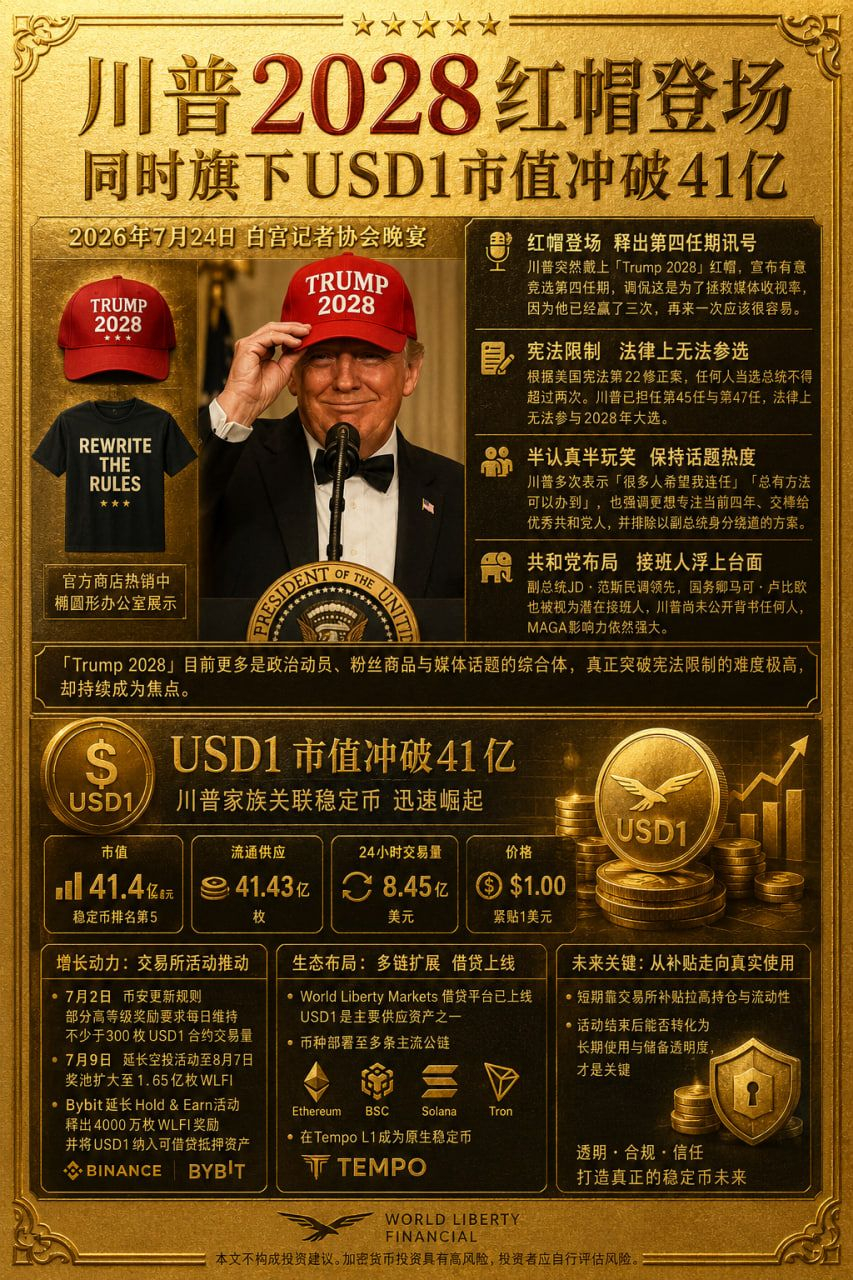
Trump 2028 Red Hat Makes an Appearance, While His USD1 With a Market Cap of $410M+ Breaks Through
At the White House Correspondents’ Association dinner on July 24, 2026, Trump suddenly pulled out a “Trump 2028” red cap, put it on, and announced—using the tone of an exclusive scoop—that he intends to seek a fourth term. He joked that it was to save media ratings, since he had already won three times and “one more” should be easy. There was laughter and applause on site, but some reactions were muted.
Under the U.S. Constitution’s 22nd Amendment, anyone elected president may not serve more than two terms. Trump has served as the 45th and 47th president, so he is legally unable to run in the 2028 election. But since early 2025, he has not stopped talking about related topics. His official store has stocked the “Trump 2028” red cap and T-shirts bearing “Rewrite the Rules,” and the merchandise has even been displayed in the Oval Office.
He has repeatedly said—half-seriously, half-jokingly—“A lot of people want me to run again” and “There’s always a way to make it happen,” while also emphasizing that he would rather focus on the current four years, hand the torch to strong Republican leaders, and rule out any workaround by running under a vice-presidential route.
Within the Republican Party, planning for 2028 has already begun. Vice President JD Vance leads in polls, and Secretary of State Marco Rubio is also seen as a potential successor. Trump himself has not publicly endorsed anyone yet, and MAGA’s influence remains strong. “Trump 2028” is currently more of a combination of political mobilization, fan merchandise, and media talking points. The challenge of truly breaking through the constitutional limit is extremely high, yet it continues to draw attention.
Meanwhile, USD1, a stablecoin issued by World Liberty Financial—highly associated with the Trump family—has reached a market cap of about $410 million, ranking as the #5 stablecoin. Circulating supply is approximately 4.143 billion coins, 24-hour trading volume is about $845 million, and the price stays closely tied to $1.
The main growth drivers come from interest-and-reward activities on centralized exchanges such as Binance. On July 2, Binance updated its rules: some high-tier rewards require maintaining at least 300 USD1 contract trading volume per day. On July 9, the airdrop campaign was further extended to August 7, and the prize pool was expanded to 165 million WLFI.
At the White House Correspondents’ Association dinner on July 24, 2026, Trump suddenly pulled out a “Trump 2028” red cap, put it on, and announced—using the tone of an exclusive scoop—that he intends to seek a fourth term. He joked that it was to save media ratings, since he had already won three times and “one more” should be easy. There was laughter and applause on site, but some reactions were muted.
Under the U.S. Constitution’s 22nd Amendment, anyone elected president may not serve more than two terms. Trump has served as the 45th and 47th president, so he is legally unable to run in the 2028 election. But since early 2025, he has not stopped talking about related topics. His official store has stocked the “Trump 2028” red cap and T-shirts bearing “Rewrite the Rules,” and the merchandise has even been displayed in the Oval Office.
He has repeatedly said—half-seriously, half-jokingly—“A lot of people want me to run again” and “There’s always a way to make it happen,” while also emphasizing that he would rather focus on the current four years, hand the torch to strong Republican leaders, and rule out any workaround by running under a vice-presidential route.
Within the Republican Party, planning for 2028 has already begun. Vice President JD Vance leads in polls, and Secretary of State Marco Rubio is also seen as a potential successor. Trump himself has not publicly endorsed anyone yet, and MAGA’s influence remains strong. “Trump 2028” is currently more of a combination of political mobilization, fan merchandise, and media talking points. The challenge of truly breaking through the constitutional limit is extremely high, yet it continues to draw attention.
Meanwhile, USD1, a stablecoin issued by World Liberty Financial—highly associated with the Trump family—has reached a market cap of about $410 million, ranking as the #5 stablecoin. Circulating supply is approximately 4.143 billion coins, 24-hour trading volume is about $845 million, and the price stays closely tied to $1.
The main growth drivers come from interest-and-reward activities on centralized exchanges such as Binance. On July 2, Binance updated its rules: some high-tier rewards require maintaining at least 300 USD1 contract trading volume per day. On July 9, the airdrop campaign was further extended to August 7, and the prize pool was expanded to 165 million WLFI.
Verified
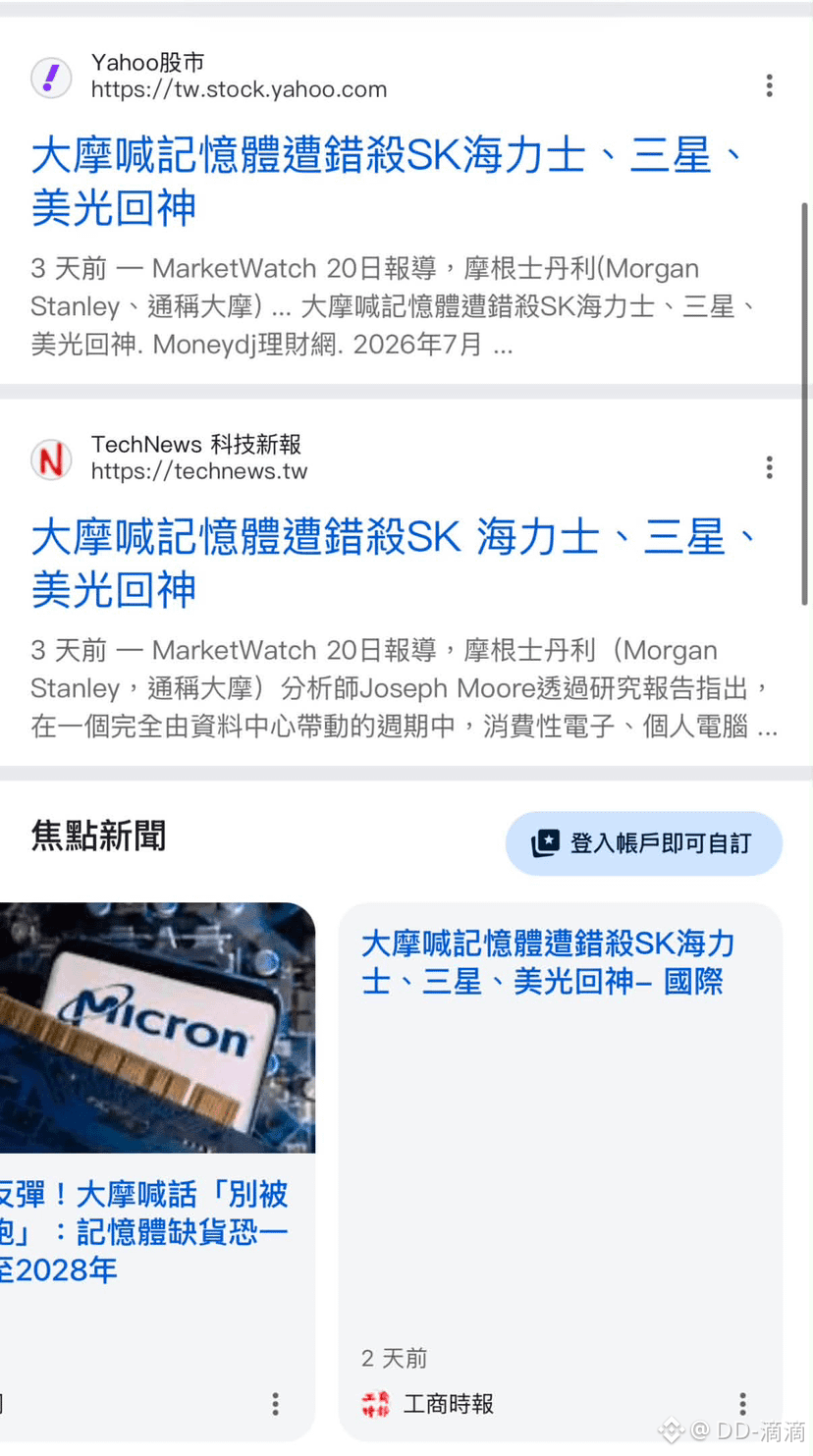
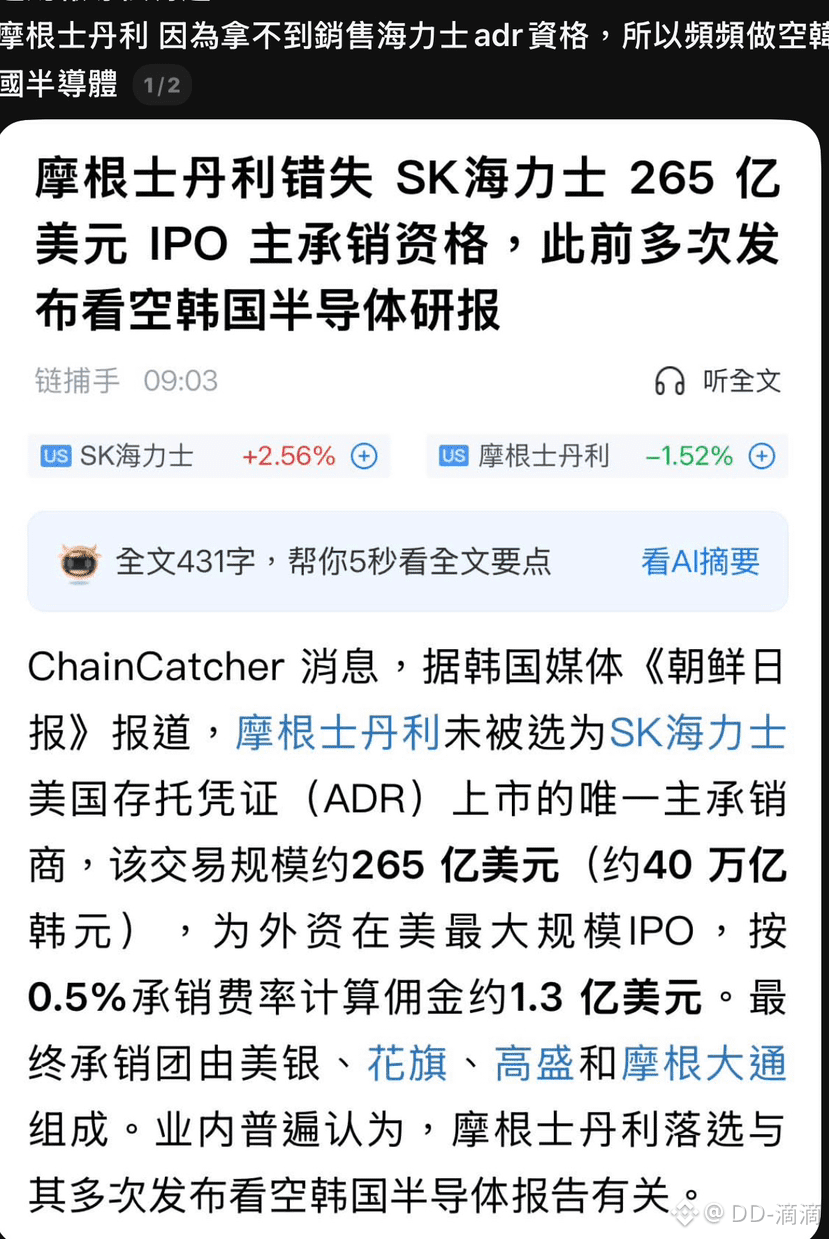
After losing SK Hynix' (SK海力士) underwriting qualification, Morgan Stanley released a report saying that memory prices in Q3 will increase by 25% more than in Q2.
Bullish on the memory sector going forward
Looks good
$SKHYNIX
Bullish on the memory sector going forward
Looks good
$SKHYNIX
Fighting code for a month, mocking code for a year
Is this embodied intelligence? $OUST.US
Is this embodied intelligence? $OUST.US
OUSTUS+0.54%
Verified
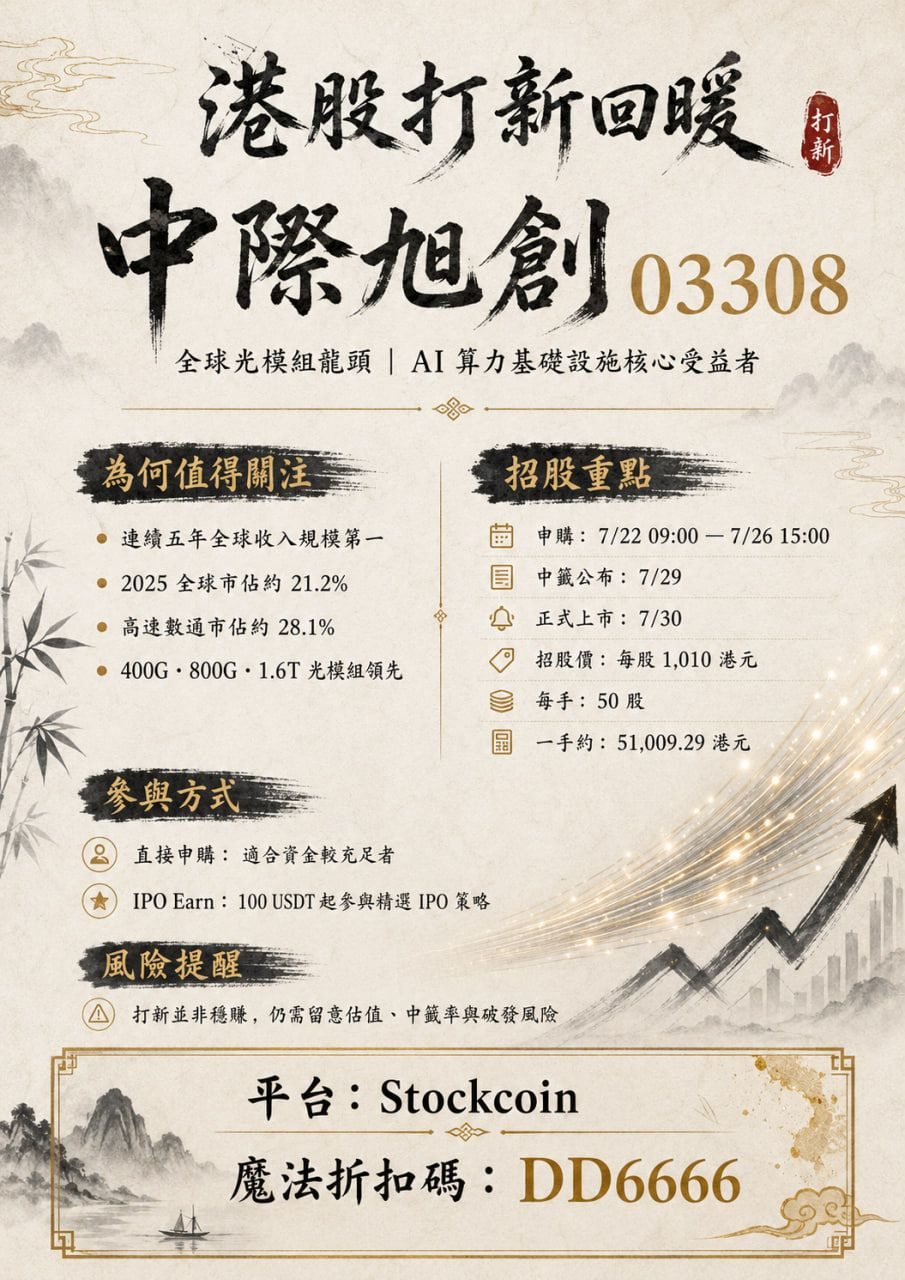
Hong Kong stock IPO applications are heating up again. This time, the one worth paying attention to is Jitliy Xuchuang, the global leader in optical modules.
Jitliy Xuchuang is set to list on the Hong Kong Stock Exchange under stock code 03308. The company carries multiple labels at once—AI, data center, global leadership, and scarcity—making it an important target in the recent HK new-issue market.
## What does Jitliy Xuchuang do?
Jitliy Xuchuang mainly provides high-speed optical modules and optical interconnect solutions.
In AI data centers, GPUs handle computing, while optical modules enable high-speed data transmission between servers, switches, and large numbers of GPUs. As demand for AI compute power continues to grow, the importance of high-speed, low-latency, and energy-saving connectivity is also increasing.
According to the prospectus, the company has ranked first globally for five consecutive years since 2021 in terms of revenue for optical interconnect solutions.
Its market share in 2025 is approximately:
Global optical interconnect market: 21.2%
High-speed data-center optical interconnect market: 28.1%
The company holds leading positions across high-speed optical modules in the 400G, 800G, and 1.6T ranges, and is a direct beneficiary of the expansion of AI compute infrastructure.
## Two ways to participate
### Direct subscription
Suitable for investors with sufficient funds who want to decide the subscription quantity and the timing to sell on their own.
For each board lot, Jitliy Xuchuang requires about HK$51,000, so the threshold is relatively high. Also, submitting an application does not guarantee an allocation.
### IPO Earn
Users with smaller amounts of capital can also participate via the IPO Earn strategy to select HK IPOs.
The minimum subscription amount is 100 USDT. After subscribing, it will be converted 1:1 into USDS, and the strategy will participate in HK IPOs in a unified manner.
The product lock-up period is 30 days. After it is released, redemption typically requires T+5 settlement.
Returns come from the actual gains and losses of the IPO strategy, not a fixed interest rate. The positive-return portion will be charged a 15% performance fee according to the rules; if the strategy incurs losses, the product net asset value may also decline.
If you have plenty of funds and want to pick stocks yourself, you can consider direct subscription. If you have a smaller amount of funds and can accept the lock-up period and net value fluctuations, you can look into IPO Earn.
## How to participate?
Stockcoin official portal: https://stockcoin.ai/zh-tw/register?ref=DD6666
DD6666
After completing registration, you can enter the new-issue subscription page to review the actual subscription requirements, funding requirements, and fee discounts for Jitliy Xuchuang 03308.
Subscriptions will close at 15:00 on July 26, 2026
Jitliy Xuchuang is set to list on the Hong Kong Stock Exchange under stock code 03308. The company carries multiple labels at once—AI, data center, global leadership, and scarcity—making it an important target in the recent HK new-issue market.
## What does Jitliy Xuchuang do?
Jitliy Xuchuang mainly provides high-speed optical modules and optical interconnect solutions.
In AI data centers, GPUs handle computing, while optical modules enable high-speed data transmission between servers, switches, and large numbers of GPUs. As demand for AI compute power continues to grow, the importance of high-speed, low-latency, and energy-saving connectivity is also increasing.
According to the prospectus, the company has ranked first globally for five consecutive years since 2021 in terms of revenue for optical interconnect solutions.
Its market share in 2025 is approximately:
Global optical interconnect market: 21.2%
High-speed data-center optical interconnect market: 28.1%
The company holds leading positions across high-speed optical modules in the 400G, 800G, and 1.6T ranges, and is a direct beneficiary of the expansion of AI compute infrastructure.
## Two ways to participate
### Direct subscription
Suitable for investors with sufficient funds who want to decide the subscription quantity and the timing to sell on their own.
For each board lot, Jitliy Xuchuang requires about HK$51,000, so the threshold is relatively high. Also, submitting an application does not guarantee an allocation.
### IPO Earn
Users with smaller amounts of capital can also participate via the IPO Earn strategy to select HK IPOs.
The minimum subscription amount is 100 USDT. After subscribing, it will be converted 1:1 into USDS, and the strategy will participate in HK IPOs in a unified manner.
The product lock-up period is 30 days. After it is released, redemption typically requires T+5 settlement.
Returns come from the actual gains and losses of the IPO strategy, not a fixed interest rate. The positive-return portion will be charged a 15% performance fee according to the rules; if the strategy incurs losses, the product net asset value may also decline.
If you have plenty of funds and want to pick stocks yourself, you can consider direct subscription. If you have a smaller amount of funds and can accept the lock-up period and net value fluctuations, you can look into IPO Earn.
## How to participate?
Stockcoin official portal: https://stockcoin.ai/zh-tw/register?ref=DD6666
DD6666
After completing registration, you can enter the new-issue subscription page to review the actual subscription requirements, funding requirements, and fee discounts for Jitliy Xuchuang 03308.
Subscriptions will close at 15:00 on July 26, 2026
Log in to explore more content