
Ricardo Paul
11.9k Posts

Ricardo Paul
 Square Verified+
Report
Block User
Crypto enthusiast sharing market insights, Web3 trends, and real-time narratives. Always watching the next big move.(X Gilded Block )
6 Following
42.8K+ Followers
30.3K+ Liked
Posts
All
Live
·
--
XAU₮ at $4,328: Gold’s Next Move Could Depend on the Fed
XAU₮ is sitting at an interesting level. The chart shows $4,328.20, down 0.47%, with a 24-hour range of $4,323–$4,354.30 and about $15.26M turnover. Price previously pushed toward $4,399 but failed to hold there. For now, $4,295–$4,323 looks like the key support zone, while $4,347–$4,399 remains the area bulls need to reclaim.
Reuters: Gold slipped to around $4,327/oz on September 14, as rising oil prices revived inflation concerns and lifted expectations for a Fed rate hike. Markets were pricing about an 87% chance of a 25bp hike, up sharply from before the latest inflation data. That keeps pressure on non-yielding gold in the short term.
Oil & macro: Brent jumped above $107, while WTI moved above $102, after fresh Middle East supply and shipping disruptions. The problem for gold is that expensive oil can keep inflation elevated, giving central banks another reason to stay hawkish.
World Gold Council: The longer-term gold story is still strong. Central banks bought 289 tonnes in Q2 2026, five times Q1's revised figure of 57 tonnes. Poland and China remained important buyers, showing that reserve diversification continues even while gold prices remain volatile.
Central-bank update: July brought another 23 tonnes of net official-sector buying. China added 20 tonnes, extending its buying streak to 21 consecutive months, while Poland remained one of the year's largest accumulators.
XAU₮ update: Tether's gold token is also developing beyond simple trading. XAU₮ has been added as collateral for crypto-backed lending, with Arch Lending offering loans against the token at LTVs of up to 75%. That gives tokenized gold another use case: accessing liquidity without directly selling the gold exposure.
Alloy update: Tether is winding down the Alloy/aUSDT route. Existing users have until September 17, 2026 to unwind positions and recover the underlying XAU₮ through the platform. This does not mean XAU₮ itself is being shut down; the change is specific to the Alloy product.
$XAUT
XAU₮ at $4,328: Gold’s Next Move Could Depend on the Fed
XAU₮ is sitting at an interesting level. The chart shows $4,328.20, down 0.47%, with a 24-hour range of $4,323–$4,354.30 and about $15.26M turnover. Price previously pushed toward $4,399 but failed to hold there. For now, $4,295–$4,323 looks like the key support zone, while $4,347–$4,399 remains the area bulls need to reclaim.
Reuters: Gold slipped to around $4,327/oz on September 14, as rising oil prices revived inflation concerns and lifted expectations for a Fed rate hike. Markets were pricing about an 87% chance of a 25bp hike, up sharply from before the latest inflation data. That keeps pressure on non-yielding gold in the short term.
Oil & macro: Brent jumped above $107, while WTI moved above $102, after fresh Middle East supply and shipping disruptions. The problem for gold is that expensive oil can keep inflation elevated, giving central banks another reason to stay hawkish.
World Gold Council: The longer-term gold story is still strong. Central banks bought 289 tonnes in Q2 2026, five times Q1's revised figure of 57 tonnes. Poland and China remained important buyers, showing that reserve diversification continues even while gold prices remain volatile.
Central-bank update: July brought another 23 tonnes of net official-sector buying. China added 20 tonnes, extending its buying streak to 21 consecutive months, while Poland remained one of the year's largest accumulators.
XAU₮ update: Tether's gold token is also developing beyond simple trading. XAU₮ has been added as collateral for crypto-backed lending, with Arch Lending offering loans against the token at LTVs of up to 75%. That gives tokenized gold another use case: accessing liquidity without directly selling the gold exposure.
Alloy update: Tether is winding down the Alloy/aUSDT route. Existing users have until September 17, 2026 to unwind positions and recover the underlying XAU₮ through the platform. This does not mean XAU₮ itself is being shut down; the change is specific to the Alloy product.
$XAUT
XAU₮ is sitting at an interesting level. The chart shows $4,328.20, down 0.47%, with a 24-hour range of $4,323–$4,354.30 and about $15.26M turnover. Price previously pushed toward $4,399 but failed to hold there. For now, $4,295–$4,323 looks like the key support zone, while $4,347–$4,399 remains the area bulls need to reclaim.
Reuters: Gold slipped to around $4,327/oz on September 14, as rising oil prices revived inflation concerns and lifted expectations for a Fed rate hike. Markets were pricing about an 87% chance of a 25bp hike, up sharply from before the latest inflation data. That keeps pressure on non-yielding gold in the short term.
Oil & macro: Brent jumped above $107, while WTI moved above $102, after fresh Middle East supply and shipping disruptions. The problem for gold is that expensive oil can keep inflation elevated, giving central banks another reason to stay hawkish.
World Gold Council: The longer-term gold story is still strong. Central banks bought 289 tonnes in Q2 2026, five times Q1's revised figure of 57 tonnes. Poland and China remained important buyers, showing that reserve diversification continues even while gold prices remain volatile.
Central-bank update: July brought another 23 tonnes of net official-sector buying. China added 20 tonnes, extending its buying streak to 21 consecutive months, while Poland remained one of the year's largest accumulators.
XAU₮ update: Tether's gold token is also developing beyond simple trading. XAU₮ has been added as collateral for crypto-backed lending, with Arch Lending offering loans against the token at LTVs of up to 75%. That gives tokenized gold another use case: accessing liquidity without directly selling the gold exposure.
Alloy update: Tether is winding down the Alloy/aUSDT route. Existing users have until September 17, 2026 to unwind positions and recover the underlying XAU₮ through the platform. This does not mean XAU₮ itself is being shut down; the change is specific to the Alloy product.
$XAUT

45
·
--
Ethereum: $2,535 Is Where the Story Gets Interesting
ETH is back around $2,535, up 2.48% on the 1H chart after a sharp move from $2,405 to $2,669. The rejection was aggressive, but buyers have managed to reclaim $2,500. Now the question is whether ETH can build enough momentum for another run toward $2,669, or if this recovery starts losing steam.
ETF demand remains one of the stronger parts of the story. U.S. spot Ethereum ETFs saw roughly $49.3M in net inflows on September 11, while tracked funds hold around 5.93M ETH worth $23.42B. Thirty-day inflows are near $1.75B, showing that institutional demand hasn't disappeared.
Bitmine is adding another layer to the supply story. The company recently acquired 28,086 ETH, bringing its treasury to approximately 5.93M ETH, around 4.9% of total supply. More than 5.06M ETH is also staked, meaning a significant amount of ETH isn't immediately available for selling.
On the development side, Ethereum's Glamsterdam upgrade is moving through devnet testing, with the Sepolia fork targeted for October 6. Mainnet is currently targeted for Q4 2026, although the final date remains unconfirmed. The upgrade is part of Ethereum's broader scaling push.
Longer term, Ethereum is also working toward making its L1 quantum-resistant by 2029, covering execution, consensus and data layers. That's not an immediate price catalyst, but it highlights how seriously the network is preparing for its next phase.
The macro picture remains mixed. Inflation concerns, higher oil prices and elevated Treasury yields continue to pressure risk assets. ETH is holding up, but the chart still needs confirmation.
For me, $2,500 is the key line. Holding it keeps $2,669 in play. Losing it could send ETH toward $2,470–$2,480, followed by $2,433 and $2,405.
Above $2,669 is where the real breakout confirmation begins. Until then, ETH is recovering—but the market still needs to prove the move.
$ETH
Ethereum: $2,535 Is Where the Story Gets Interesting
ETH is back around $2,535, up 2.48% on the 1H chart after a sharp move from $2,405 to $2,669. The rejection was aggressive, but buyers have managed to reclaim $2,500. Now the question is whether ETH can build enough momentum for another run toward $2,669, or if this recovery starts losing steam.
ETF demand remains one of the stronger parts of the story. U.S. spot Ethereum ETFs saw roughly $49.3M in net inflows on September 11, while tracked funds hold around 5.93M ETH worth $23.42B. Thirty-day inflows are near $1.75B, showing that institutional demand hasn't disappeared.
Bitmine is adding another layer to the supply story. The company recently acquired 28,086 ETH, bringing its treasury to approximately 5.93M ETH, around 4.9% of total supply. More than 5.06M ETH is also staked, meaning a significant amount of ETH isn't immediately available for selling.
On the development side, Ethereum's Glamsterdam upgrade is moving through devnet testing, with the Sepolia fork targeted for October 6. Mainnet is currently targeted for Q4 2026, although the final date remains unconfirmed. The upgrade is part of Ethereum's broader scaling push.
Longer term, Ethereum is also working toward making its L1 quantum-resistant by 2029, covering execution, consensus and data layers. That's not an immediate price catalyst, but it highlights how seriously the network is preparing for its next phase.
The macro picture remains mixed. Inflation concerns, higher oil prices and elevated Treasury yields continue to pressure risk assets. ETH is holding up, but the chart still needs confirmation.
For me, $2,500 is the key line. Holding it keeps $2,669 in play. Losing it could send ETH toward $2,470–$2,480, followed by $2,433 and $2,405.
Above $2,669 is where the real breakout confirmation begins. Until then, ETH is recovering—but the market still needs to prove the move.
$ETH
ETH is back around $2,535, up 2.48% on the 1H chart after a sharp move from $2,405 to $2,669. The rejection was aggressive, but buyers have managed to reclaim $2,500. Now the question is whether ETH can build enough momentum for another run toward $2,669, or if this recovery starts losing steam.
ETF demand remains one of the stronger parts of the story. U.S. spot Ethereum ETFs saw roughly $49.3M in net inflows on September 11, while tracked funds hold around 5.93M ETH worth $23.42B. Thirty-day inflows are near $1.75B, showing that institutional demand hasn't disappeared.
Bitmine is adding another layer to the supply story. The company recently acquired 28,086 ETH, bringing its treasury to approximately 5.93M ETH, around 4.9% of total supply. More than 5.06M ETH is also staked, meaning a significant amount of ETH isn't immediately available for selling.
On the development side, Ethereum's Glamsterdam upgrade is moving through devnet testing, with the Sepolia fork targeted for October 6. Mainnet is currently targeted for Q4 2026, although the final date remains unconfirmed. The upgrade is part of Ethereum's broader scaling push.
Longer term, Ethereum is also working toward making its L1 quantum-resistant by 2029, covering execution, consensus and data layers. That's not an immediate price catalyst, but it highlights how seriously the network is preparing for its next phase.
The macro picture remains mixed. Inflation concerns, higher oil prices and elevated Treasury yields continue to pressure risk assets. ETH is holding up, but the chart still needs confirmation.
For me, $2,500 is the key line. Holding it keeps $2,669 in play. Losing it could send ETH toward $2,470–$2,480, followed by $2,433 and $2,405.
Above $2,669 is where the real breakout confirmation begins. Until then, ETH is recovering—but the market still needs to prove the move.
$ETH
2
156
·
--
Verified
#CPIWatch
Today’s CPI isn’t just another inflation report. It could set the tone for Bitcoin, stocks, gold, DXY and bonds heading into the Fed’s September meeting.
The market is expecting roughly 0.4% MoM headline CPI and 0.2% MoM core CPI.
But the headline isn’t everything.
I’m watching Core CPI, Shelter, Services and Energy — especially whether higher oil/gas prices are creating broader inflation pressure.
A cooler CPI could mean lower rate expectations, falling yields and better liquidity → potentially bullish for BTC and equities.
A hotter core CPI could push yields and DXY higher, strengthen the case for tighter Fed policy and put pressure on risk assets.
The key isn’t just the number.
It’s the surprise vs expectations.
My CPI checklist:
📌 Headline CPI
📌 Core CPI
📌 Shelter
📌 Services
📌 Energy
📌 Treasury yields
📌 DXY
📌 BTC
📌 Nasdaq
Remember:
CPI → Fed expectations → Yields → Dollar → Liquidity → Risk assets.
The first candle may be noise.
The reaction after the dust settles is what matters.
$BTC
#BTC #Inflation #Macro #Markets
#CPIWatch
Today’s CPI isn’t just another inflation report. It could set the tone for Bitcoin, stocks, gold, DXY and bonds heading into the Fed’s September meeting.
The market is expecting roughly 0.4% MoM headline CPI and 0.2% MoM core CPI.
But the headline isn’t everything.
I’m watching Core CPI, Shelter, Services and Energy — especially whether higher oil/gas prices are creating broader inflation pressure.
A cooler CPI could mean lower rate expectations, falling yields and better liquidity → potentially bullish for BTC and equities.
A hotter core CPI could push yields and DXY higher, strengthen the case for tighter Fed policy and put pressure on risk assets.
The key isn’t just the number.
It’s the surprise vs expectations.
My CPI checklist:
📌 Headline CPI
📌 Core CPI
📌 Shelter
📌 Services
📌 Energy
📌 Treasury yields
📌 DXY
📌 BTC
📌 Nasdaq
Remember:
CPI → Fed expectations → Yields → Dollar → Liquidity → Risk assets.
The first candle may be noise.
The reaction after the dust settles is what matters.
$BTC
#BTC #Inflation #Macro #Markets
Today’s CPI isn’t just another inflation report. It could set the tone for Bitcoin, stocks, gold, DXY and bonds heading into the Fed’s September meeting.
The market is expecting roughly 0.4% MoM headline CPI and 0.2% MoM core CPI.
But the headline isn’t everything.
I’m watching Core CPI, Shelter, Services and Energy — especially whether higher oil/gas prices are creating broader inflation pressure.
A cooler CPI could mean lower rate expectations, falling yields and better liquidity → potentially bullish for BTC and equities.
A hotter core CPI could push yields and DXY higher, strengthen the case for tighter Fed policy and put pressure on risk assets.
The key isn’t just the number.
It’s the surprise vs expectations.
My CPI checklist:
📌 Headline CPI
📌 Core CPI
📌 Shelter
📌 Services
📌 Energy
📌 Treasury yields
📌 DXY
📌 BTC
📌 Nasdaq
Remember:
CPI → Fed expectations → Yields → Dollar → Liquidity → Risk assets.
The first candle may be noise.
The reaction after the dust settles is what matters.
$BTC
#BTC #Inflation #Macro #Markets

40
49
6.8k
·
--
Ethereum might be making one of the most important changes to how people use crypto.
Not just faster transactions.
Less friction.
EIP-8141, or Frame Transactions, is designed to separate transaction authorization from gas payment.
Imagine holding USDC but not having ETH.
Today, you may still need ETH just to move your own money.
With Frames, another party could handle the gas while you authorize the transaction.
You have the asset. You can actually use it.
And the bigger idea goes beyond gasless payments.
Frames could make Ethereum accounts more flexible, supporting different authentication methods, key management, and more programmable transactions.
The latest Ethereum Foundation update also lists EIP-8141 as an S-tier, locked-in execution-layer headliner for Hegotá, alongside Keyed Nonces and Recent Roots.
That’s a meaningful step forward.
But one important detail: EIP-8141 is still a Draft. The implementation can change, and Frame Transactions are not yet available on Ethereum’s live network.
Still, the direction is clear.
Ethereum is trying to make users think less about gas, signatures, and transaction mechanics—and more about what they actually want to do.
The best crypto UX might be the one where you barely notice the blockchain.
$ETH
Ethereum might be making one of the most important changes to how people use crypto.
Not just faster transactions.
Less friction.
EIP-8141, or Frame Transactions, is designed to separate transaction authorization from gas payment.
Imagine holding USDC but not having ETH.
Today, you may still need ETH just to move your own money.
With Frames, another party could handle the gas while you authorize the transaction.
You have the asset. You can actually use it.
And the bigger idea goes beyond gasless payments.
Frames could make Ethereum accounts more flexible, supporting different authentication methods, key management, and more programmable transactions.
The latest Ethereum Foundation update also lists EIP-8141 as an S-tier, locked-in execution-layer headliner for Hegotá, alongside Keyed Nonces and Recent Roots.
That’s a meaningful step forward.
But one important detail: EIP-8141 is still a Draft. The implementation can change, and Frame Transactions are not yet available on Ethereum’s live network.
Still, the direction is clear.
Ethereum is trying to make users think less about gas, signatures, and transaction mechanics—and more about what they actually want to do.
The best crypto UX might be the one where you barely notice the blockchain.
$ETH
Not just faster transactions.
Less friction.
EIP-8141, or Frame Transactions, is designed to separate transaction authorization from gas payment.
Imagine holding USDC but not having ETH.
Today, you may still need ETH just to move your own money.
With Frames, another party could handle the gas while you authorize the transaction.
You have the asset. You can actually use it.
And the bigger idea goes beyond gasless payments.
Frames could make Ethereum accounts more flexible, supporting different authentication methods, key management, and more programmable transactions.
The latest Ethereum Foundation update also lists EIP-8141 as an S-tier, locked-in execution-layer headliner for Hegotá, alongside Keyed Nonces and Recent Roots.
That’s a meaningful step forward.
But one important detail: EIP-8141 is still a Draft. The implementation can change, and Frame Transactions are not yet available on Ethereum’s live network.
Still, the direction is clear.
Ethereum is trying to make users think less about gas, signatures, and transaction mechanics—and more about what they actually want to do.
The best crypto UX might be the one where you barely notice the blockchain.
$ETH
1
174
·
--
$BTC
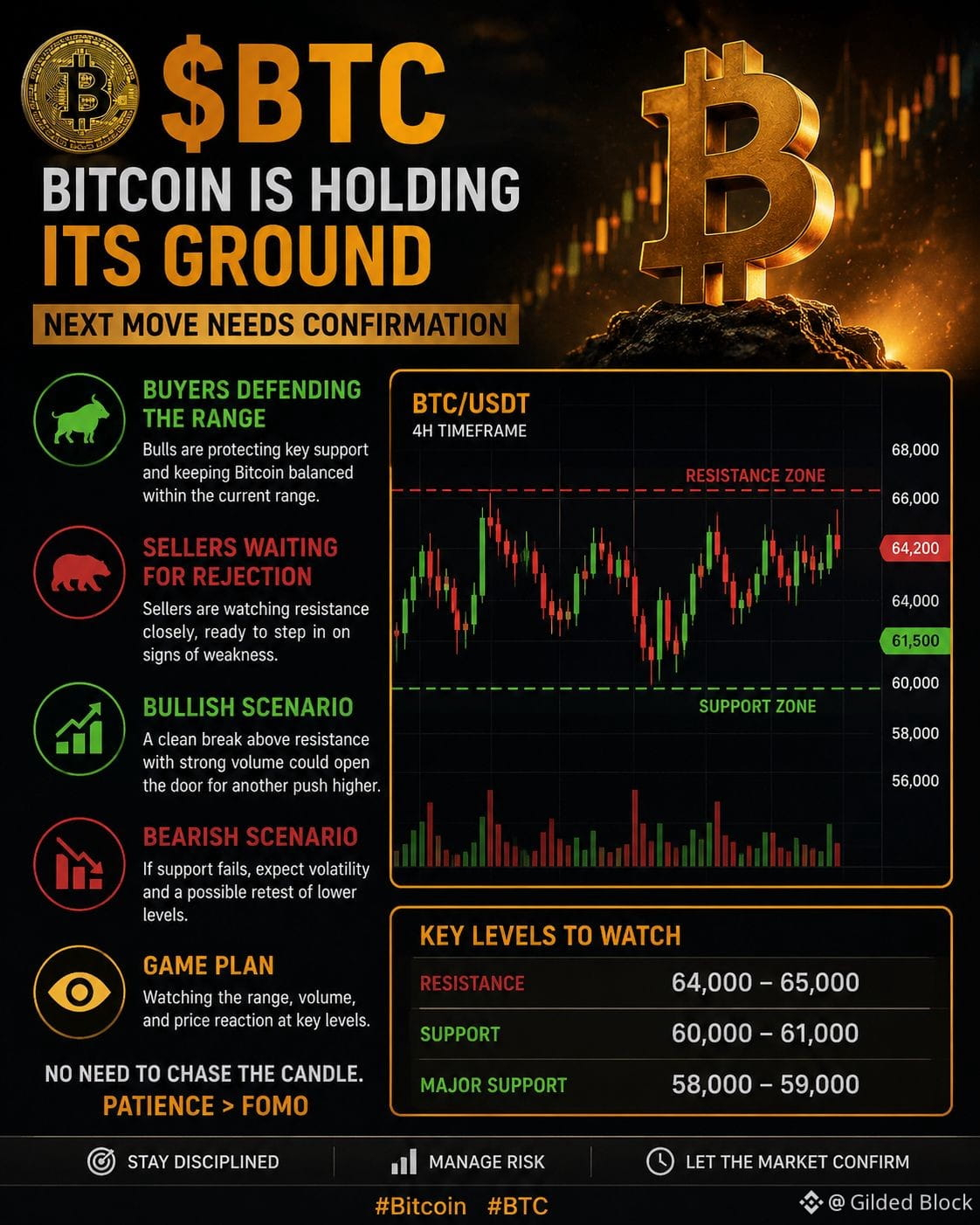
Bitcoin is holding its ground, but the next move still needs confirmation. Buyers are defending the current range, while sellers are waiting for a clear rejection.
A clean break above resistance with strong volume could open the door to another push higher. If support fails, expect volatility and a possible retest of lower levels.
For now, I’m watching the range, volume, and how price reacts at key levels. No need to chase the candle.
#Bitcoin #BTC
$BTC
Bitcoin is holding its ground, but the next move still needs confirmation. Buyers are defending the current range, while sellers are waiting for a clear rejection.
A clean break above resistance with strong volume could open the door to another push higher. If support fails, expect volatility and a possible retest of lower levels.
For now, I’m watching the range, volume, and how price reacts at key levels. No need to chase the candle.
#Bitcoin #BTC
Bitcoin is holding its ground, but the next move still needs confirmation. Buyers are defending the current range, while sellers are waiting for a clear rejection.
A clean break above resistance with strong volume could open the door to another push higher. If support fails, expect volatility and a possible retest of lower levels.
For now, I’m watching the range, volume, and how price reacts at key levels. No need to chase the candle.
#Bitcoin #BTC
1
130
·
--
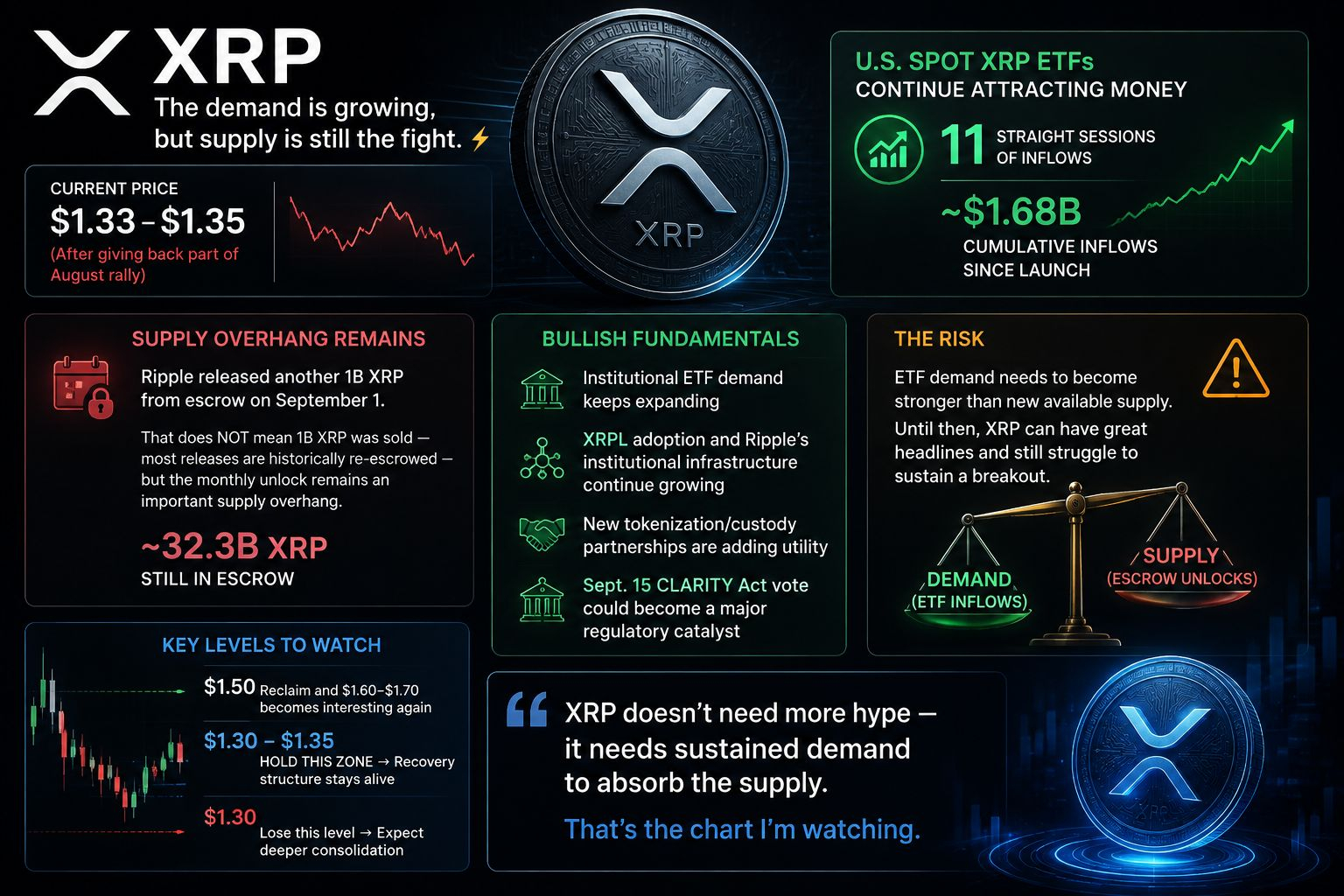
$XRP — The demand is growing, but supply is still the fight. ⚡
XRP is sitting around $1.33–$1.35 after giving back part of its August rally. What catches my attention is that the price is cooling while U.S. spot XRP ETFs continue attracting money. The ETFs have now seen 11 straight sessions of inflows, with roughly $1.68B cumulative inflows since launch.
But then comes the other side of the equation…
Ripple released another 1B XRP from escrow on September 1. That does NOT mean 1B XRP was sold — most releases are historically re-escrowed — but the monthly unlock remains an important supply overhang. Around 32.3B XRP is still reported in escrow.
The bullish side is getting interesting:
• Institutional ETF demand keeps expanding
• XRPL adoption and Ripple’s institutional infrastructure continue growing
• New tokenization/custody partnerships are adding utility
• Sept. 15 CLARITY Act vote could become a major regulatory catalyst
The risk? ETF demand needs to become stronger than new available supply. Until then, XRP can have great headlines and still struggle to sustain a breakout.
For me, the key zone is $1.30–$1.35. Hold it and the recovery structure stays alive. Reclaim $1.50, and $1.60–$1.70 becomes interesting again. Lose $1.30 and I’d expect deeper consolidation.
XRP doesn’t need more hype — it needs sustained demand to absorb the supply. That’s the chart I’m watching. 👀
#XRP #Ripple #Crypto #XRPL #Altcoins
$XRP — The demand is growing, but supply is still the fight. ⚡
XRP is sitting around $1.33–$1.35 after giving back part of its August rally. What catches my attention is that the price is cooling while U.S. spot XRP ETFs continue attracting money. The ETFs have now seen 11 straight sessions of inflows, with roughly $1.68B cumulative inflows since launch.
But then comes the other side of the equation…
Ripple released another 1B XRP from escrow on September 1. That does NOT mean 1B XRP was sold — most releases are historically re-escrowed — but the monthly unlock remains an important supply overhang. Around 32.3B XRP is still reported in escrow.
The bullish side is getting interesting:
• Institutional ETF demand keeps expanding
• XRPL adoption and Ripple’s institutional infrastructure continue growing
• New tokenization/custody partnerships are adding utility
• Sept. 15 CLARITY Act vote could become a major regulatory catalyst
The risk? ETF demand needs to become stronger than new available supply. Until then, XRP can have great headlines and still struggle to sustain a breakout.
For me, the key zone is $1.30–$1.35. Hold it and the recovery structure stays alive. Reclaim $1.50, and $1.60–$1.70 becomes interesting again. Lose $1.30 and I’d expect deeper consolidation.
XRP doesn’t need more hype — it needs sustained demand to absorb the supply. That’s the chart I’m watching. 👀
#XRP #Ripple #Crypto #XRPL #Altcoins
XRP is sitting around $1.33–$1.35 after giving back part of its August rally. What catches my attention is that the price is cooling while U.S. spot XRP ETFs continue attracting money. The ETFs have now seen 11 straight sessions of inflows, with roughly $1.68B cumulative inflows since launch.
But then comes the other side of the equation…
Ripple released another 1B XRP from escrow on September 1. That does NOT mean 1B XRP was sold — most releases are historically re-escrowed — but the monthly unlock remains an important supply overhang. Around 32.3B XRP is still reported in escrow.
The bullish side is getting interesting:
• Institutional ETF demand keeps expanding
• XRPL adoption and Ripple’s institutional infrastructure continue growing
• New tokenization/custody partnerships are adding utility
• Sept. 15 CLARITY Act vote could become a major regulatory catalyst
The risk? ETF demand needs to become stronger than new available supply. Until then, XRP can have great headlines and still struggle to sustain a breakout.
For me, the key zone is $1.30–$1.35. Hold it and the recovery structure stays alive. Reclaim $1.50, and $1.60–$1.70 becomes interesting again. Lose $1.30 and I’d expect deeper consolidation.
XRP doesn’t need more hype — it needs sustained demand to absorb the supply. That’s the chart I’m watching. 👀
#XRP #Ripple #Crypto #XRPL #Altcoins
2
212
·
--
$XRP — the price pulled back, but something underneath it is getting harder to ignore
XRP pushed close to $1.70 in August before dropping back toward $1.35–$1.40.
That looks like a failed breakout on the chart.
But then you look at the money moving underneath it.
U.S. spot XRP ETFs brought in roughly $153.5M during August, with $110.5M arriving in the final week alone. Cumulative ETF inflows have now reached around $1.67B, while the funds hold roughly 1.1B XRP.
So while price was giving back gains…
ETF demand was doing the opposite.
That’s the divergence I’m watching.
Now comes the supply side.
XRP has a fixed 100B total supply. Around 32.28B XRP remains in Ripple escrow, while tracked exchange wallets hold roughly 15.5B.
And September’s scheduled escrow release is up to 1B XRP.
But the headline number can be misleading.
Ripple has repeatedly re-locked unused XRP, so the net new supply entering the market can be much smaller than the 1B headline.
That’s important because the real question isn't:
“How much XRP gets unlocked?”
It’s:
“How much actually gets absorbed by the market?”
And right now, ETF demand is giving that supply a serious counterweight.
There’s another piece of the ecosystem growing too.
Ripple’s RLUSD has reached around $1.87B circulating supply according to Ripple’s latest transparency report, with reserves held in segregated accounts.
But I wouldn’t automatically count RLUSD growth as XRP demand.
That connection still needs to prove itself.
For XRP, I’m watching whether ETF accumulation + whale activity + XRPL usage eventually become strong enough to overpower profit-taking and new supply.
For the chart:
$1.35–$1.40 → key support
$1.50 → first reclaim
$1.60 → momentum returns
$1.70 → major breakout level
If XRP gets back above $1.60–$1.70 with strong volume, the recent pullback starts looking much healthier.
If $1.35 breaks while ETF inflows weaken, I’d rather wait.
Because XRP doesn't need another prediction.
It needs real demand to keep absorbing available supply.
$XRP — the price pulled back, but something underneath it is getting harder to ignore
XRP pushed close to $1.70 in August before dropping back toward $1.35–$1.40.
That looks like a failed breakout on the chart.
But then you look at the money moving underneath it.
U.S. spot XRP ETFs brought in roughly $153.5M during August, with $110.5M arriving in the final week alone. Cumulative ETF inflows have now reached around $1.67B, while the funds hold roughly 1.1B XRP.
So while price was giving back gains…
ETF demand was doing the opposite.
That’s the divergence I’m watching.
Now comes the supply side.
XRP has a fixed 100B total supply. Around 32.28B XRP remains in Ripple escrow, while tracked exchange wallets hold roughly 15.5B.
And September’s scheduled escrow release is up to 1B XRP.
But the headline number can be misleading.
Ripple has repeatedly re-locked unused XRP, so the net new supply entering the market can be much smaller than the 1B headline.
That’s important because the real question isn't:
“How much XRP gets unlocked?”
It’s:
“How much actually gets absorbed by the market?”
And right now, ETF demand is giving that supply a serious counterweight.
There’s another piece of the ecosystem growing too.
Ripple’s RLUSD has reached around $1.87B circulating supply according to Ripple’s latest transparency report, with reserves held in segregated accounts.
But I wouldn’t automatically count RLUSD growth as XRP demand.
That connection still needs to prove itself.
For XRP, I’m watching whether ETF accumulation + whale activity + XRPL usage eventually become strong enough to overpower profit-taking and new supply.
For the chart:
$1.35–$1.40 → key support
$1.50 → first reclaim
$1.60 → momentum returns
$1.70 → major breakout level
If XRP gets back above $1.60–$1.70 with strong volume, the recent pullback starts looking much healthier.
If $1.35 breaks while ETF inflows weaken, I’d rather wait.
Because XRP doesn't need another prediction.
It needs real demand to keep absorbing available supply.
XRP pushed close to $1.70 in August before dropping back toward $1.35–$1.40.
That looks like a failed breakout on the chart.
But then you look at the money moving underneath it.
U.S. spot XRP ETFs brought in roughly $153.5M during August, with $110.5M arriving in the final week alone. Cumulative ETF inflows have now reached around $1.67B, while the funds hold roughly 1.1B XRP.
So while price was giving back gains…
ETF demand was doing the opposite.
That’s the divergence I’m watching.
Now comes the supply side.
XRP has a fixed 100B total supply. Around 32.28B XRP remains in Ripple escrow, while tracked exchange wallets hold roughly 15.5B.
And September’s scheduled escrow release is up to 1B XRP.
But the headline number can be misleading.
Ripple has repeatedly re-locked unused XRP, so the net new supply entering the market can be much smaller than the 1B headline.
That’s important because the real question isn't:
“How much XRP gets unlocked?”
It’s:
“How much actually gets absorbed by the market?”
And right now, ETF demand is giving that supply a serious counterweight.
There’s another piece of the ecosystem growing too.
Ripple’s RLUSD has reached around $1.87B circulating supply according to Ripple’s latest transparency report, with reserves held in segregated accounts.
But I wouldn’t automatically count RLUSD growth as XRP demand.
That connection still needs to prove itself.
For XRP, I’m watching whether ETF accumulation + whale activity + XRPL usage eventually become strong enough to overpower profit-taking and new supply.
For the chart:
$1.35–$1.40 → key support
$1.50 → first reclaim
$1.60 → momentum returns
$1.70 → major breakout level
If XRP gets back above $1.60–$1.70 with strong volume, the recent pullback starts looking much healthier.
If $1.35 breaks while ETF inflows weaken, I’d rather wait.
Because XRP doesn't need another prediction.
It needs real demand to keep absorbing available supply.
1
140
·
--
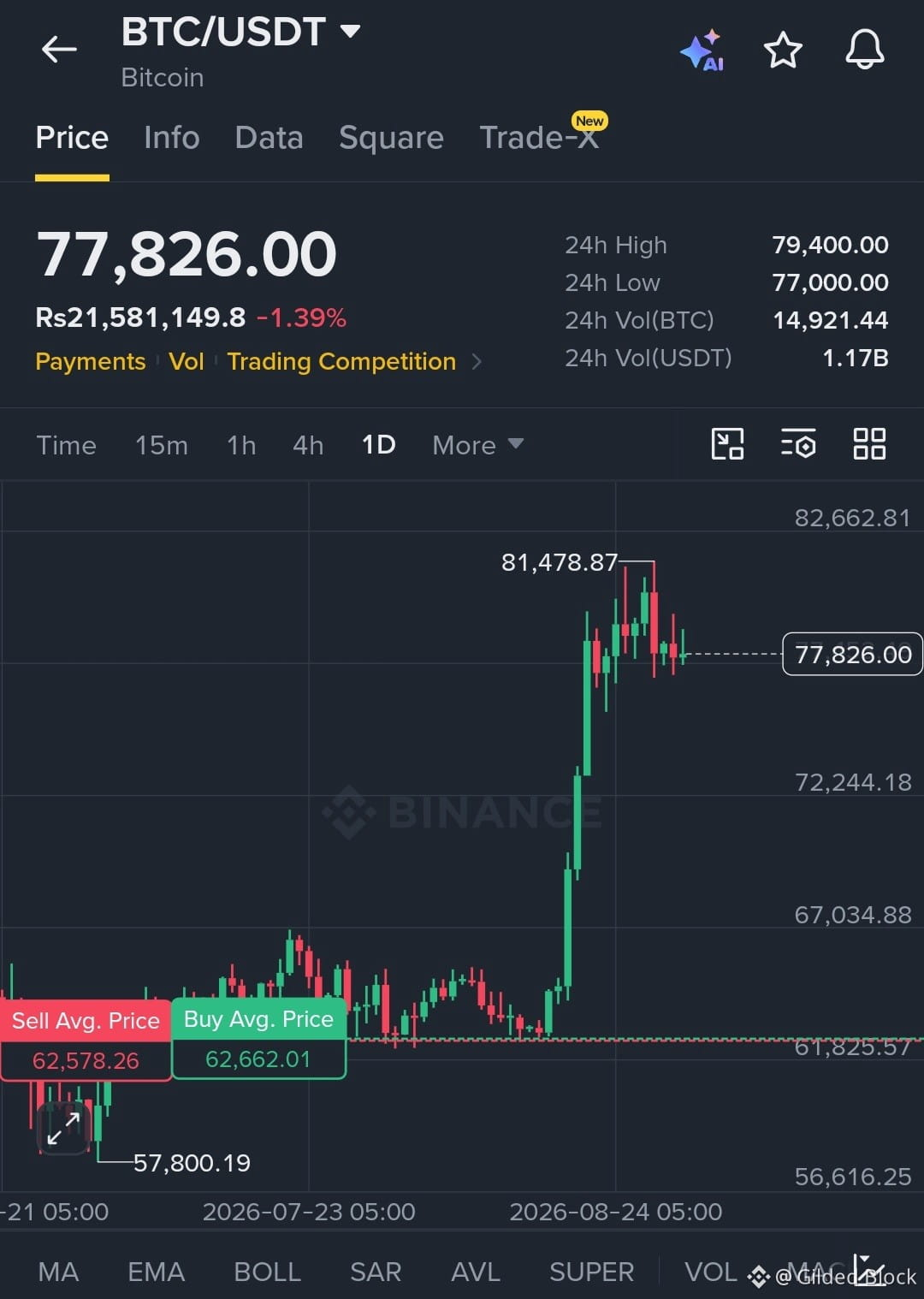
$BTC — the chart is getting interesting 👀
Bitcoin is sitting around $77.8K, after a sharp move from the $61.8K area to a recent high of $81,478. The chart now shows consolidation just below the $80K psychological level.
📌 Key levels
Resistance: $79.3K–$80K
Major breakout: $81.48K
Support: $77K
Deeper support: $72.2K / $67K
The bigger picture is still strong: BTC gained roughly 24% in August, while corporate demand remains notable — Strategy recently added 4,603 BTC.
And the supply story hasn't changed: Bitcoin is capped at 21M BTC, with 95%+ already issued. The next halving is estimated for April 2028, cutting the block reward from 3.125 → 1.5625 BTC.
My take: BTC is at a decision zone.
🔥 $80K+ breakout → $81.5K becomes the first major test.
⚠️ Lose $77K → $72K could come back into focus.
Not financial advice — just watching the levels.
$BTC — the chart is getting interesting 👀
Bitcoin is sitting around $77.8K, after a sharp move from the $61.8K area to a recent high of $81,478. The chart now shows consolidation just below the $80K psychological level.
📌 Key levels
Resistance: $79.3K–$80K
Major breakout: $81.48K
Support: $77K
Deeper support: $72.2K / $67K
The bigger picture is still strong: BTC gained roughly 24% in August, while corporate demand remains notable — Strategy recently added 4,603 BTC.
And the supply story hasn't changed: Bitcoin is capped at 21M BTC, with 95%+ already issued. The next halving is estimated for April 2028, cutting the block reward from 3.125 → 1.5625 BTC.
My take: BTC is at a decision zone.
🔥 $80K+ breakout → $81.5K becomes the first major test.
⚠️ Lose $77K → $72K could come back into focus.
Not financial advice — just watching the levels.
Bitcoin is sitting around $77.8K, after a sharp move from the $61.8K area to a recent high of $81,478. The chart now shows consolidation just below the $80K psychological level.
📌 Key levels
Resistance: $79.3K–$80K
Major breakout: $81.48K
Support: $77K
Deeper support: $72.2K / $67K
The bigger picture is still strong: BTC gained roughly 24% in August, while corporate demand remains notable — Strategy recently added 4,603 BTC.
And the supply story hasn't changed: Bitcoin is capped at 21M BTC, with 95%+ already issued. The next halving is estimated for April 2028, cutting the block reward from 3.125 → 1.5625 BTC.
My take: BTC is at a decision zone.
🔥 $80K+ breakout → $81.5K becomes the first major test.
⚠️ Lose $77K → $72K could come back into focus.
Not financial advice — just watching the levels.
112
·
--
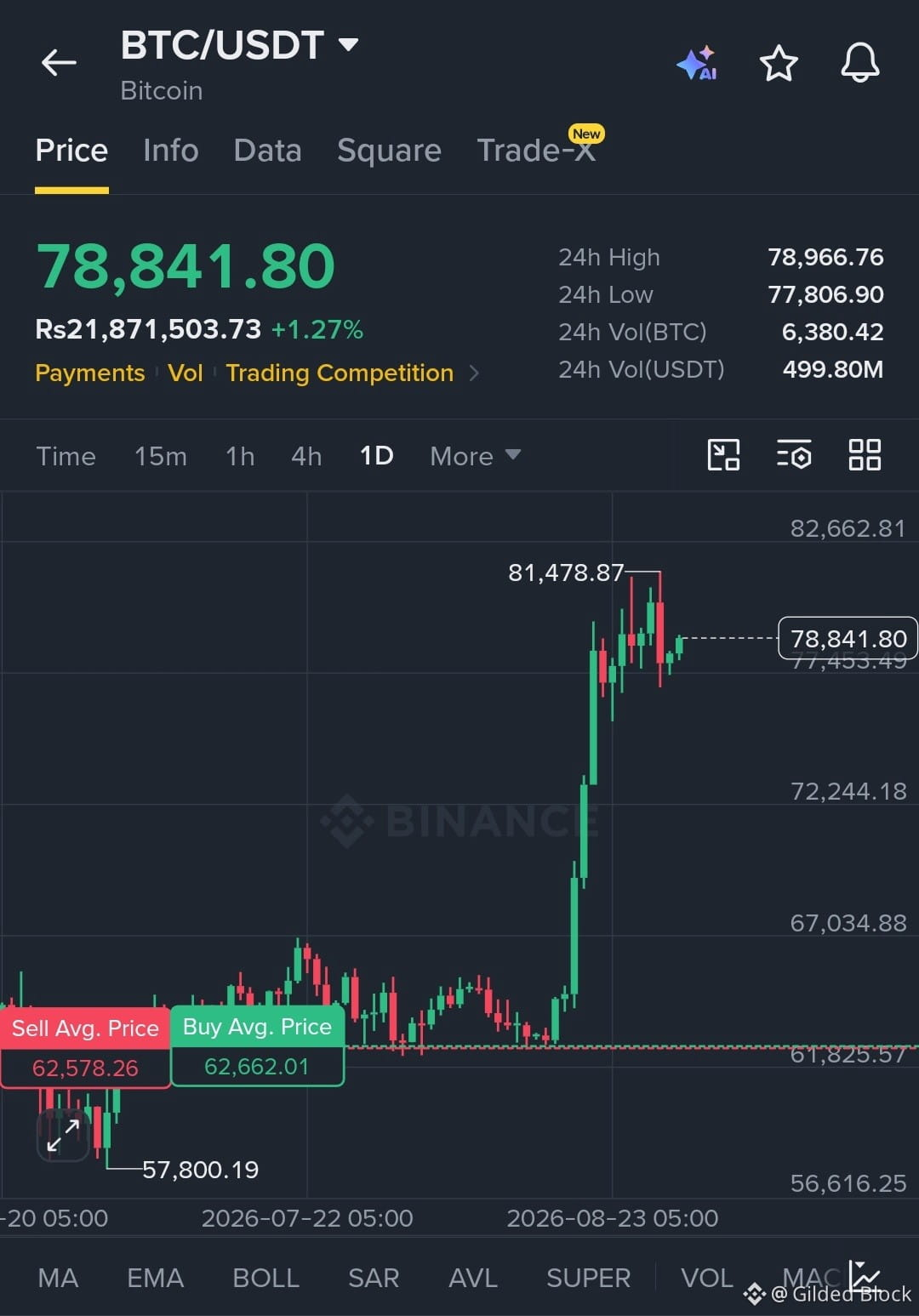
$BTC — The Calm After the Explosion?
Bitcoin is around $78,841, up +1.27%, after a powerful move from the $61.8K zone to a recent $81,478 high.
Current setup: • Price: $78,841.80
• 24H High: $78,966.76
• 24H Low: $77,806.90
• 24H Volume: 6,380 BTC / $499.8M
• Support: $77.45K
• Resistance: $81.48K
BTC is consolidating near the highs after a major breakout. Holding $77K–$77.5K keeps the bullish structure alive, while a break above $81.5K could open the door toward $85K.
With Bitcoin’s supply capped at 21 million, scarcity remains a major part of the long-term story.
BTC is not far from the breakout zone — now the question is whether bulls can finish the move. 👀
#Bitcoin #BTC #Crypto #BTCUSDT #CryptoTrading
$BTC — The Calm After the Explosion?
Bitcoin is around $78,841, up +1.27%, after a powerful move from the $61.8K zone to a recent $81,478 high.
Current setup: • Price: $78,841.80
• 24H High: $78,966.76
• 24H Low: $77,806.90
• 24H Volume: 6,380 BTC / $499.8M
• Support: $77.45K
• Resistance: $81.48K
BTC is consolidating near the highs after a major breakout. Holding $77K–$77.5K keeps the bullish structure alive, while a break above $81.5K could open the door toward $85K.
With Bitcoin’s supply capped at 21 million, scarcity remains a major part of the long-term story.
BTC is not far from the breakout zone — now the question is whether bulls can finish the move. 👀
#Bitcoin #BTC #Crypto #BTCUSDT #CryptoTrading
Bitcoin is around $78,841, up +1.27%, after a powerful move from the $61.8K zone to a recent $81,478 high.
Current setup: • Price: $78,841.80
• 24H High: $78,966.76
• 24H Low: $77,806.90
• 24H Volume: 6,380 BTC / $499.8M
• Support: $77.45K
• Resistance: $81.48K
BTC is consolidating near the highs after a major breakout. Holding $77K–$77.5K keeps the bullish structure alive, while a break above $81.5K could open the door toward $85K.
With Bitcoin’s supply capped at 21 million, scarcity remains a major part of the long-term story.
BTC is not far from the breakout zone — now the question is whether bulls can finish the move. 👀
#Bitcoin #BTC #Crypto #BTCUSDT #CryptoTrading
118
·
--
Bitcoin — the move isn’t dead, but the easy part might beBTC just gave the market a reminder of how quickly sentiment can flip.
After pushing above $81K earlier this week, Bitcoin is now back around the $77K–$78K area. The interesting part is that this pullback came after a very strong run, not before it.
Bitcoin gained roughly 23% in seven days into the recent high, while U.S. spot ETFs were pulling in billions. At one point, the ETF streak reached nine sessions and roughly $3B of inflows.
So the demand was real.
But then Friday changed the tone.
The latest data showed around $202M of ETF outflows, ending that nine-day inflow streak. BTC also dropped from above $81K toward the high-$70Ks.
That’s the part I’m watching.
Because if ETF demand immediately disappears every time BTC approaches $80K, then $80K isn’t just resistance on the chart — it’s becoming a liquidity test.
There’s another factor here too.
The recent rally wasn’t purely organic spot buying. A large amount of short positioning was forced out as BTC moved higher, adding fuel to the move.
And that matters because forced buying can make a breakout look stronger than it really is.
Once those shorts are gone, Bitcoin needs new buyers to keep pushing.
That’s why I’m less interested in predicting the next candle and more interested in what happens around $76K–$77K.
If BTC holds that area and starts reclaiming $80K, the recent rejection could simply be a healthy reset.
But if $76K breaks decisively, the market may start looking back toward the lower support zones rather than immediately expecting another $81K breakout.
The macro picture is also getting complicated.
Bitcoin had been benefiting from a weaker dollar and the broader “debasement trade,” but the latest hawkish tone from the Fed pushed Treasury yields higher and put pressure on risk assets.
So right now I see two forces fighting each other:
ETF/institutional demand ↗️
vs.
higher yields + profit-taking + leverage unwinding ↘️
That’s why this pullback is actually more interesting to me than the pump.
If buyers step in around support without needing another massive short squeeze, that would be a much healthier signal.
And if BTC eventually reclaims $80K–$81K with strong spot demand, the recent high stops looking like a rejection and starts looking like the first test of a larger recovery.
For now:
$76K–$77K → area I want bulls to defend
$80K → key reclaim
$81K+ → breakout confirmation
Below $76K → caution
I’m not calling this a guaranteed breakout.
I’m watching to see whether real demand replaces forced buying.
Because that’s what would make the next Bitcoin move believable.
BTC doesn’t need another squeeze.
It needs buyers who actually want the coins.
#Bitcoin #BTC #Crypto $BTC
Bitcoin — the move isn’t dead, but the easy part might be
BTC just gave the market a reminder of how quickly sentiment can flip.
After pushing above $81K earlier this week, Bitcoin is now back around the $77K–$78K area. The interesting part is that this pullback came after a very strong run, not before it.
Bitcoin gained roughly 23% in seven days into the recent high, while U.S. spot ETFs were pulling in billions. At one point, the ETF streak reached nine sessions and roughly $3B of inflows.
So the demand was real.
But then Friday changed the tone.
The latest data showed around $202M of ETF outflows, ending that nine-day inflow streak. BTC also dropped from above $81K toward the high-$70Ks.
That’s the part I’m watching.
Because if ETF demand immediately disappears every time BTC approaches $80K, then $80K isn’t just resistance on the chart — it’s becoming a liquidity test.
There’s another factor here too.
The recent rally wasn’t purely organic spot buying. A large amount of short positioning was forced out as BTC moved higher, adding fuel to the move.
And that matters because forced buying can make a breakout look stronger than it really is.
Once those shorts are gone, Bitcoin needs new buyers to keep pushing.
That’s why I’m less interested in predicting the next candle and more interested in what happens around $76K–$77K.
If BTC holds that area and starts reclaiming $80K, the recent rejection could simply be a healthy reset.
But if $76K breaks decisively, the market may start looking back toward the lower support zones rather than immediately expecting another $81K breakout.
The macro picture is also getting complicated.
Bitcoin had been benefiting from a weaker dollar and the broader “debasement trade,” but the latest hawkish tone from the Fed pushed Treasury yields higher and put pressure on risk assets.
So right now I see two forces fighting each other:
ETF/institutional demand ↗️
vs.
higher yields + profit-taking + leverage unwinding ↘️
That’s why this pullback is actually more interesting to me than the pump.
If buyers step in around support without needing another massive short squeeze, that would be a much healthier signal.
And if BTC eventually reclaims $80K–$81K with strong spot demand, the recent high stops looking like a rejection and starts looking like the first test of a larger recovery.
For now:
$76K–$77K → area I want bulls to defend
$80K → key reclaim
$81K+ → breakout confirmation
Below $76K → caution
I’m not calling this a guaranteed breakout.
I’m watching to see whether real demand replaces forced buying.
Because that’s what would make the next Bitcoin move believable.
BTC doesn’t need another squeeze.
It needs buyers who actually want the coins.
#Bitcoin #BTC #Crypto $BTC
After pushing above $81K earlier this week, Bitcoin is now back around the $77K–$78K area. The interesting part is that this pullback came after a very strong run, not before it.
Bitcoin gained roughly 23% in seven days into the recent high, while U.S. spot ETFs were pulling in billions. At one point, the ETF streak reached nine sessions and roughly $3B of inflows.
So the demand was real.
But then Friday changed the tone.
The latest data showed around $202M of ETF outflows, ending that nine-day inflow streak. BTC also dropped from above $81K toward the high-$70Ks.
That’s the part I’m watching.
Because if ETF demand immediately disappears every time BTC approaches $80K, then $80K isn’t just resistance on the chart — it’s becoming a liquidity test.
There’s another factor here too.
The recent rally wasn’t purely organic spot buying. A large amount of short positioning was forced out as BTC moved higher, adding fuel to the move.
And that matters because forced buying can make a breakout look stronger than it really is.
Once those shorts are gone, Bitcoin needs new buyers to keep pushing.
That’s why I’m less interested in predicting the next candle and more interested in what happens around $76K–$77K.
If BTC holds that area and starts reclaiming $80K, the recent rejection could simply be a healthy reset.
But if $76K breaks decisively, the market may start looking back toward the lower support zones rather than immediately expecting another $81K breakout.
The macro picture is also getting complicated.
Bitcoin had been benefiting from a weaker dollar and the broader “debasement trade,” but the latest hawkish tone from the Fed pushed Treasury yields higher and put pressure on risk assets.
So right now I see two forces fighting each other:
ETF/institutional demand ↗️
vs.
higher yields + profit-taking + leverage unwinding ↘️
That’s why this pullback is actually more interesting to me than the pump.
If buyers step in around support without needing another massive short squeeze, that would be a much healthier signal.
And if BTC eventually reclaims $80K–$81K with strong spot demand, the recent high stops looking like a rejection and starts looking like the first test of a larger recovery.
For now:
$76K–$77K → area I want bulls to defend
$80K → key reclaim
$81K+ → breakout confirmation
Below $76K → caution
I’m not calling this a guaranteed breakout.
I’m watching to see whether real demand replaces forced buying.
Because that’s what would make the next Bitcoin move believable.
BTC doesn’t need another squeeze.
It needs buyers who actually want the coins.
#Bitcoin #BTC #Crypto $BTC
197
·
--
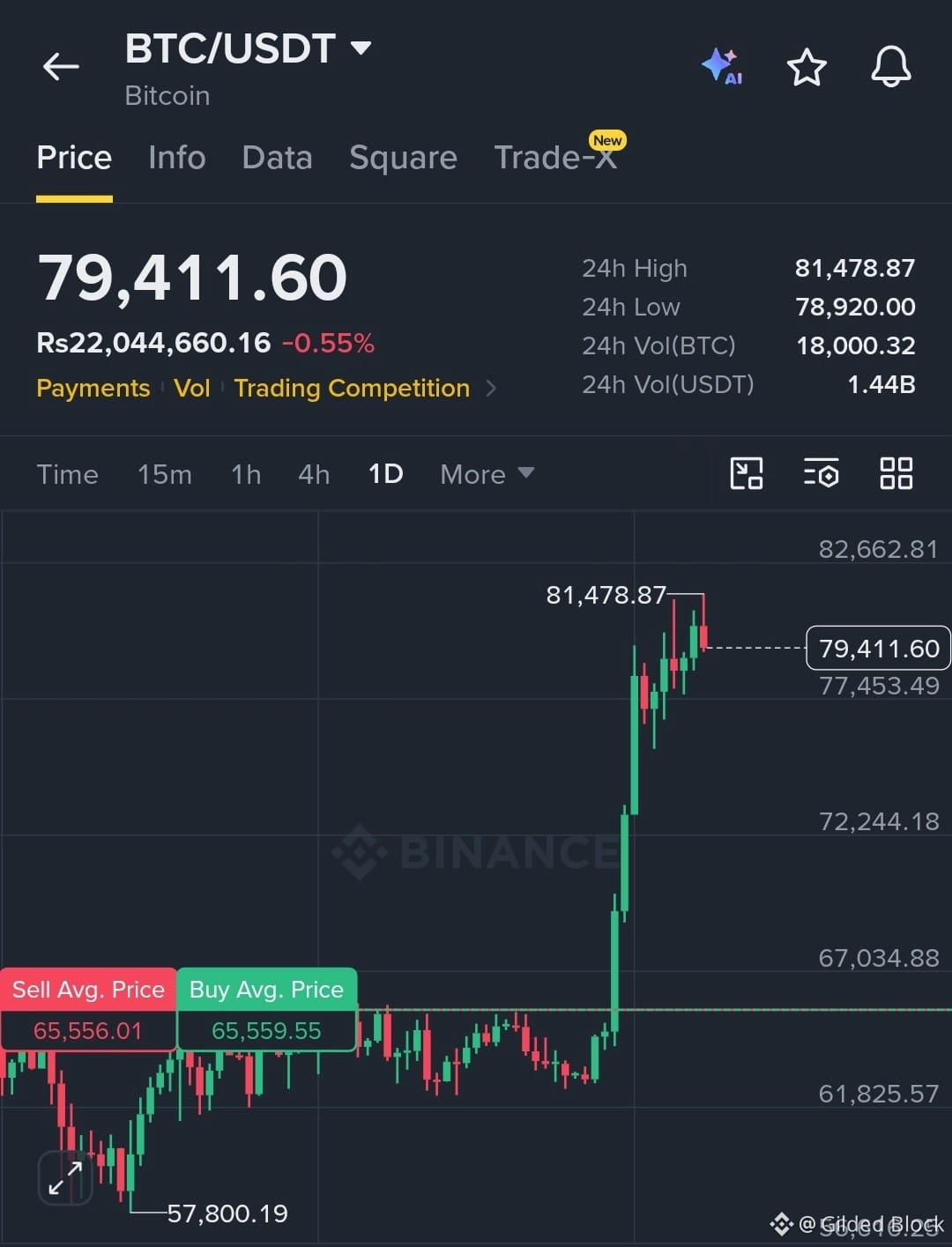
🚀 $BTC /USDT — HOLDERS, STAY PATIENT! 🐂
Bitcoin is showing strong bullish momentum after a powerful breakout from the ~$65.5K area. The chart shows BTC reaching $81,478, with price currently holding around $79.4K.
📈 Key levels to watch:
Resistance: $81.5K → $82.6K
Support: $77.45K → $72.24K
Bullish continuation above $81.5K could open the door toward $85K+
If you're already holding BTC, don't let short-term volatility shake your conviction.
The trend is still looking strong—but manage risk and protect your capital. 🧠🔥
HODL smart. Stay patient. Let the trend work. 🚀
#Bitcoin #BTC #BTCUSDT #Crypto #Bullish
🚀 $BTC /USDT — HOLDERS, STAY PATIENT! 🐂
Bitcoin is showing strong bullish momentum after a powerful breakout from the ~$65.5K area. The chart shows BTC reaching $81,478, with price currently holding around $79.4K.
📈 Key levels to watch:
Resistance: $81.5K → $82.6K
Support: $77.45K → $72.24K
Bullish continuation above $81.5K could open the door toward $85K+
If you're already holding BTC, don't let short-term volatility shake your conviction.
The trend is still looking strong—but manage risk and protect your capital. 🧠🔥
HODL smart. Stay patient. Let the trend work. 🚀
#Bitcoin #BTC #BTCUSDT #Crypto #Bullish
Bitcoin is showing strong bullish momentum after a powerful breakout from the ~$65.5K area. The chart shows BTC reaching $81,478, with price currently holding around $79.4K.
📈 Key levels to watch:
Resistance: $81.5K → $82.6K
Support: $77.45K → $72.24K
Bullish continuation above $81.5K could open the door toward $85K+
If you're already holding BTC, don't let short-term volatility shake your conviction.
The trend is still looking strong—but manage risk and protect your capital. 🧠🔥
HODL smart. Stay patient. Let the trend work. 🚀
#Bitcoin #BTC #BTCUSDT #Crypto #Bullish
147
·
--
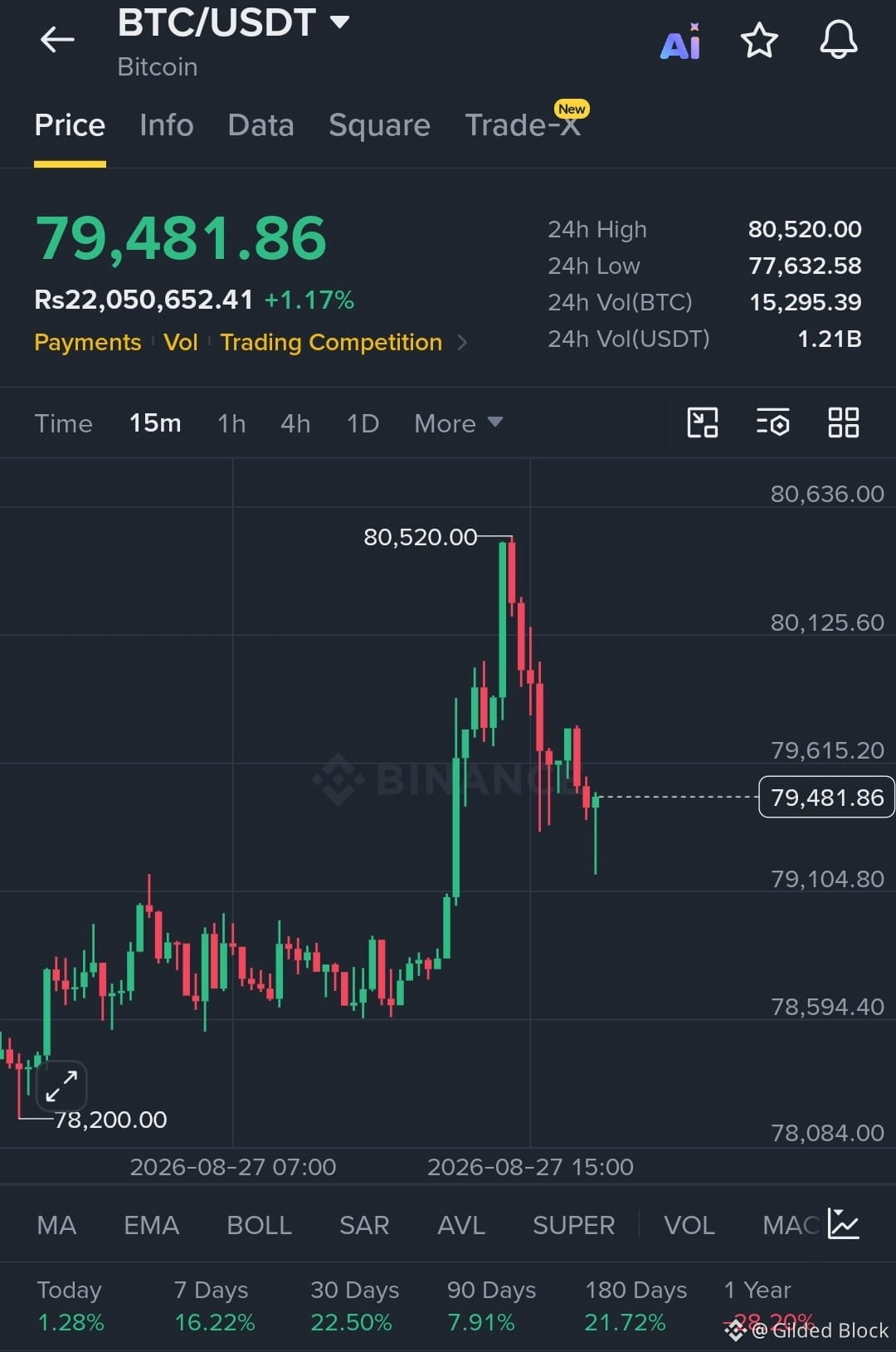
$BTC is currently trading around 79,482 after a strong move from the 78,200 area toward 80,520.
For the bullish setup, the key support zone is 79,100–79,300. If BTC holds this area and gives a bullish confirmation, upside targets are 79,900 → 80,200 → 80,520.
A clean 15M breakout and hold above 80,520 could open the door for further upside.
On the bearish side, a 15M close below 79,100 followed by a failed reclaim would weaken the structure. Downside levels to watch are 78,800 → 78,600 → 78,200.
The main decision level is 79,100. Holding it keeps the short-term bullish structure alive, while losing it increases bearish pressure.
Trade with confirmation and controlled risk. Watching the 79,100 support and 80,520 resistance is the key next step.
{spot}(BTCUSDT)
$BTC is currently trading around 79,482 after a strong move from the 78,200 area toward 80,520.
For the bullish setup, the key support zone is 79,100–79,300. If BTC holds this area and gives a bullish confirmation, upside targets are 79,900 → 80,200 → 80,520.
A clean 15M breakout and hold above 80,520 could open the door for further upside.
On the bearish side, a 15M close below 79,100 followed by a failed reclaim would weaken the structure. Downside levels to watch are 78,800 → 78,600 → 78,200.
The main decision level is 79,100. Holding it keeps the short-term bullish structure alive, while losing it increases bearish pressure.
Trade with confirmation and controlled risk. Watching the 79,100 support and 80,520 resistance is the key next step.
For the bullish setup, the key support zone is 79,100–79,300. If BTC holds this area and gives a bullish confirmation, upside targets are 79,900 → 80,200 → 80,520.
A clean 15M breakout and hold above 80,520 could open the door for further upside.
On the bearish side, a 15M close below 79,100 followed by a failed reclaim would weaken the structure. Downside levels to watch are 78,800 → 78,600 → 78,200.
The main decision level is 79,100. Holding it keeps the short-term bullish structure alive, while losing it increases bearish pressure.
Trade with confirmation and controlled risk. Watching the 79,100 support and 80,520 resistance is the key next step.
1
92
·
--
#dusk $DUSK Honestly, this stopped me mid-snack.
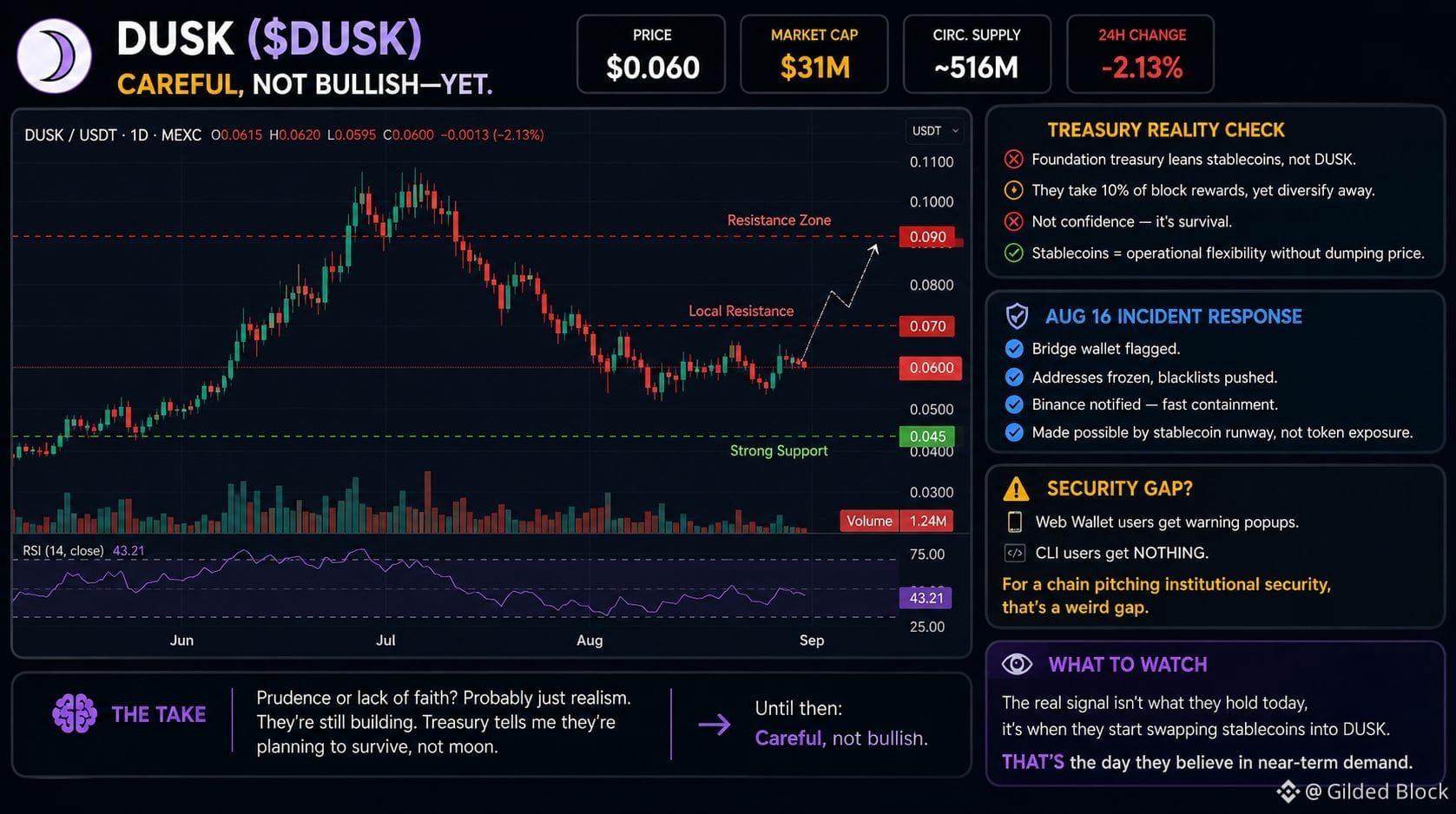
Dusk pitches itself as the MiCA-compliant TradFi on-ramp, but their foundation treasury leans stablecoins, not DUSK. That's a weird look for a team telling you to hold their token.
Then I remembered August 16. Bridge wallet got flagged, they froze addresses, pushed blacklists, called Binance — fast containment. What made that possible? They weren't scrambling to hedge their own token while handling security. DUSK at ~$0.06, $31M mcap — if treasury was full of it, every operational payout would tank the price. Stablecoins let them act without playing portfolio manager.
Smart, right? But it also undercuts the "buy to align" narrative. They take 10% of each block's rewards passively, yet they diversify away. That's not confidence — that's survival.
What bugs me more: the fix added a warning popup for Web Wallet users, but CLI users get nothing. Zero guardrails. For a chain claiming institutional-grade security, that's a weird gap.
So is this prudence or a quiet lack of faith? I think it's just realism — they know they're still building. The real signal isn't whether they hold DUSK today, but when they start swapping stablecoins into DUSK. That's the day they actually believe in near-term demand.
Until then, this reads as careful, not bullish. Still chewing on it.
@Dusk_Foundation
#dusk $DUSK Honestly, this stopped me mid-snack.
Dusk pitches itself as the MiCA-compliant TradFi on-ramp, but their foundation treasury leans stablecoins, not DUSK. That's a weird look for a team telling you to hold their token.
Then I remembered August 16. Bridge wallet got flagged, they froze addresses, pushed blacklists, called Binance — fast containment. What made that possible? They weren't scrambling to hedge their own token while handling security. DUSK at ~$0.06, $31M mcap — if treasury was full of it, every operational payout would tank the price. Stablecoins let them act without playing portfolio manager.
Smart, right? But it also undercuts the "buy to align" narrative. They take 10% of each block's rewards passively, yet they diversify away. That's not confidence — that's survival.
What bugs me more: the fix added a warning popup for Web Wallet users, but CLI users get nothing. Zero guardrails. For a chain claiming institutional-grade security, that's a weird gap.
So is this prudence or a quiet lack of faith? I think it's just realism — they know they're still building. The real signal isn't whether they hold DUSK today, but when they start swapping stablecoins into DUSK. That's the day they actually believe in near-term demand.
Until then, this reads as careful, not bullish. Still chewing on it.
@Dusk
Dusk pitches itself as the MiCA-compliant TradFi on-ramp, but their foundation treasury leans stablecoins, not DUSK. That's a weird look for a team telling you to hold their token.
Then I remembered August 16. Bridge wallet got flagged, they froze addresses, pushed blacklists, called Binance — fast containment. What made that possible? They weren't scrambling to hedge their own token while handling security. DUSK at ~$0.06, $31M mcap — if treasury was full of it, every operational payout would tank the price. Stablecoins let them act without playing portfolio manager.
Smart, right? But it also undercuts the "buy to align" narrative. They take 10% of each block's rewards passively, yet they diversify away. That's not confidence — that's survival.
What bugs me more: the fix added a warning popup for Web Wallet users, but CLI users get nothing. Zero guardrails. For a chain claiming institutional-grade security, that's a weird gap.
So is this prudence or a quiet lack of faith? I think it's just realism — they know they're still building. The real signal isn't whether they hold DUSK today, but when they start swapping stablecoins into DUSK. That's the day they actually believe in near-term demand.
Until then, this reads as careful, not bullish. Still chewing on it.
@Dusk
1
3
170
·
--
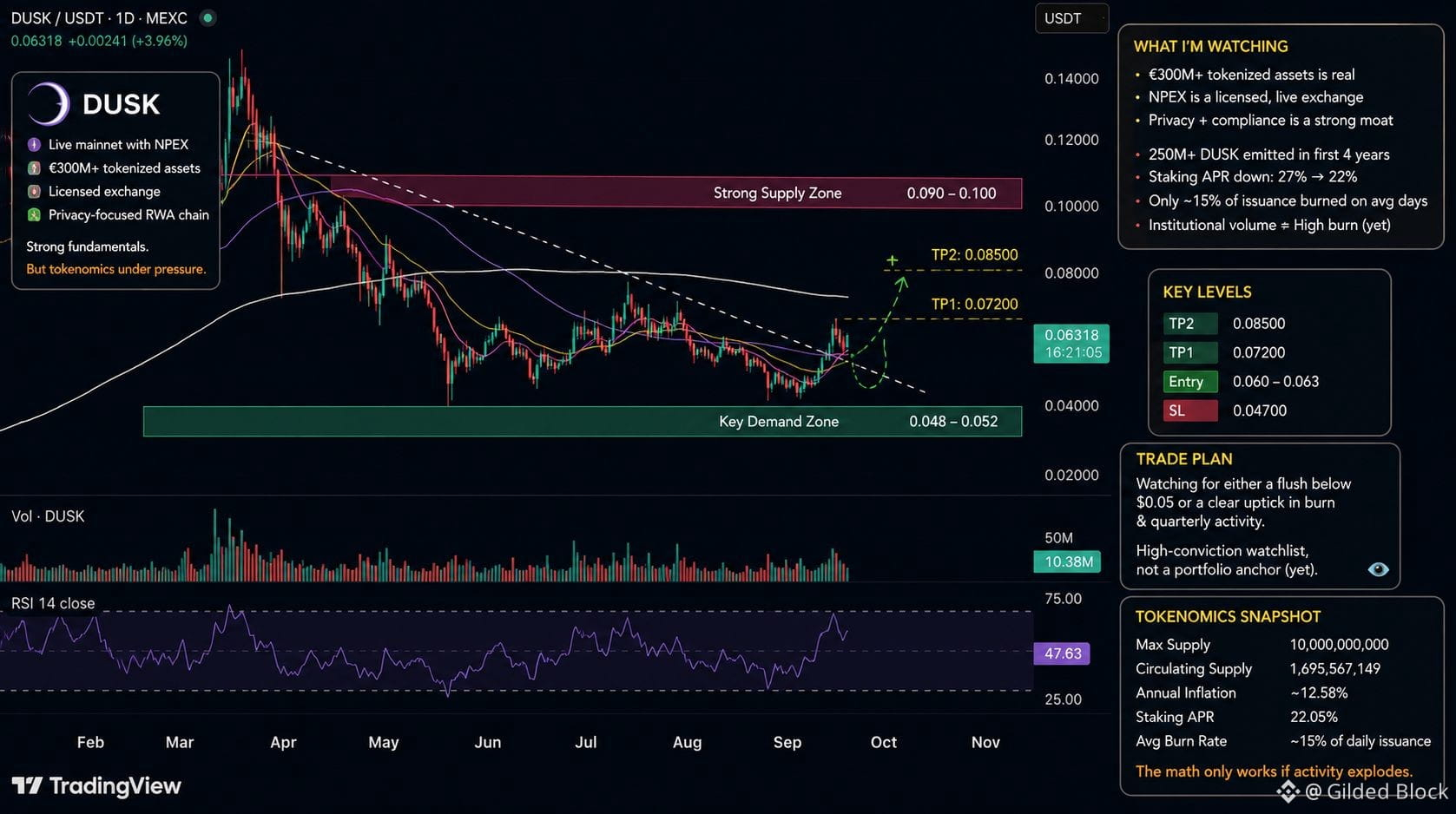
#dusk $DUSK Honestly, I keep going back and forth on Dusk. €300 million in tokenized assets on a live mainnet with a licensed exchange is legit—most RWA projects can't say that. But then I look at the tokenomics: 250 million new DUSK emitted in the first four years alone, staking APR slipping from 27% to 22% in a few months, and only about 15% of issuance getting burned on average days. That math doesn't work unless activity explodes.
And that's the catch—institutional volume isn't retail volume. A bond trade might burn a few hundred DUSK, but you need thousands of those daily to outrun emissions. The privacy features that make Dusk attractive for regulated finance also make it less appealing for the degen activity that actually drives gas burn.
So I'm sitting here with a small bag, down a bit, not adding more until I see either a real washout below $0.05 or a clear uptick in quarterly burn data. The tech is solid, the partnership is real, but the token is fighting an uphill dilution battle. Watch the staking APR trend and whether NPEX expands beyond that €300M—that's the real tell. Right now, it's a high-conviction watchlist item, not a portfolio anchor.
@Dusk_Foundation
#dusk $DUSK Honestly, I keep going back and forth on Dusk. €300 million in tokenized assets on a live mainnet with a licensed exchange is legit—most RWA projects can't say that. But then I look at the tokenomics: 250 million new DUSK emitted in the first four years alone, staking APR slipping from 27% to 22% in a few months, and only about 15% of issuance getting burned on average days. That math doesn't work unless activity explodes.
And that's the catch—institutional volume isn't retail volume. A bond trade might burn a few hundred DUSK, but you need thousands of those daily to outrun emissions. The privacy features that make Dusk attractive for regulated finance also make it less appealing for the degen activity that actually drives gas burn.
So I'm sitting here with a small bag, down a bit, not adding more until I see either a real washout below $0.05 or a clear uptick in quarterly burn data. The tech is solid, the partnership is real, but the token is fighting an uphill dilution battle. Watch the staking APR trend and whether NPEX expands beyond that €300M—that's the real tell. Right now, it's a high-conviction watchlist item, not a portfolio anchor.
@Dusk
And that's the catch—institutional volume isn't retail volume. A bond trade might burn a few hundred DUSK, but you need thousands of those daily to outrun emissions. The privacy features that make Dusk attractive for regulated finance also make it less appealing for the degen activity that actually drives gas burn.
So I'm sitting here with a small bag, down a bit, not adding more until I see either a real washout below $0.05 or a clear uptick in quarterly burn data. The tech is solid, the partnership is real, but the token is fighting an uphill dilution battle. Watch the staking APR trend and whether NPEX expands beyond that €300M—that's the real tell. Right now, it's a high-conviction watchlist item, not a portfolio anchor.
@Dusk
3
282
·
--
#dusk $DUSK Spent the week down a Khovratovich rabbit hole—Argon2, Equihash, the PLONK work under Dusk. Felt like I was actually learning something.
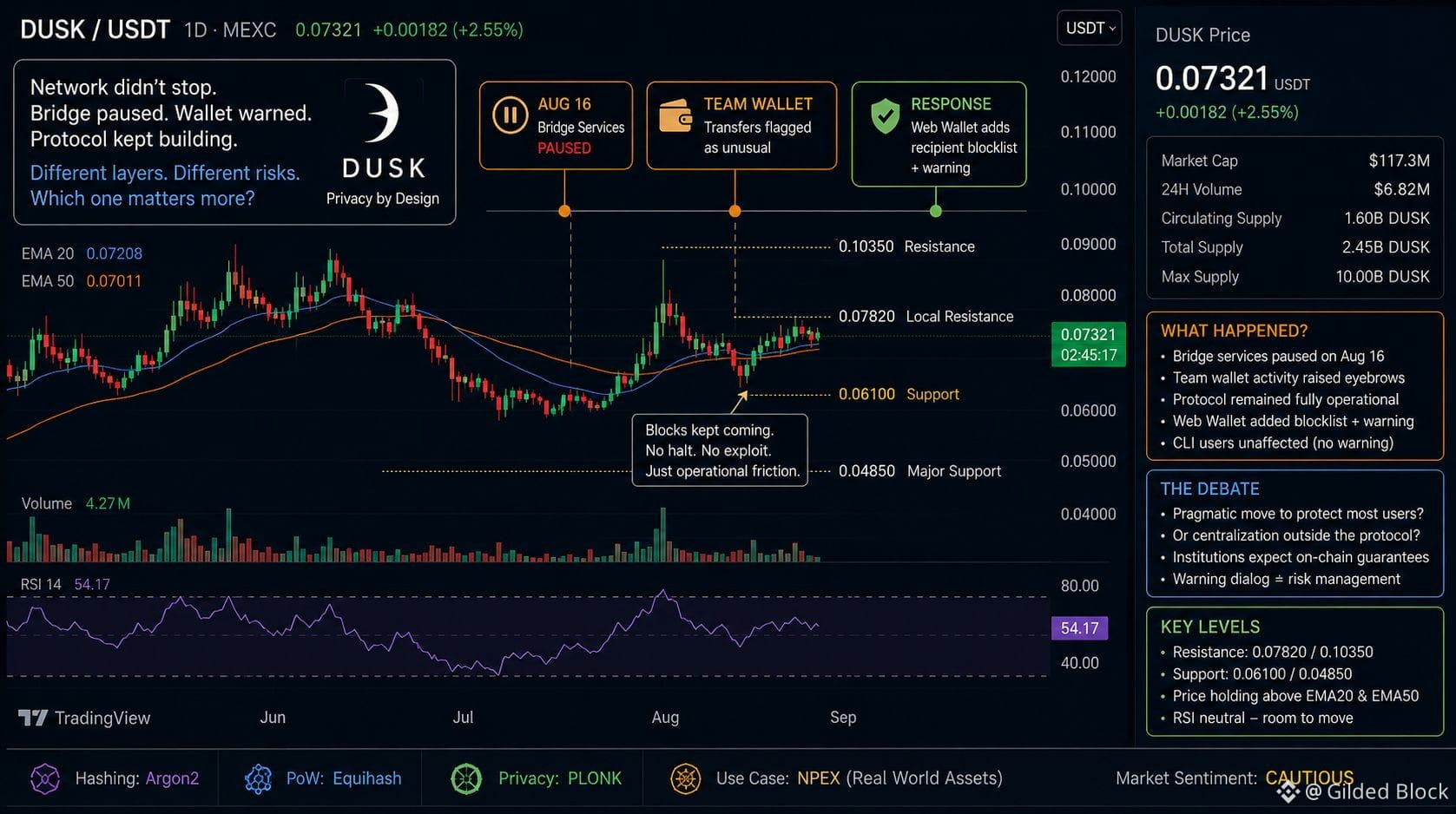
Then I checked the network. Bridge services paused August 16. Team wallet acting weird. Protocol fine—blocks kept coming. The fix? A recipient blocklist in the Web Wallet. That's it. A warning if you try to send to a flagged address.
CLI users? No warning. Full sovereignty, zero seatbelt.
Keep flipping on this. Half of me respects the pragmatism—cover most users fast. Other half remembers this chain is supposed to be for institutions. NPEX is talking hundreds of millions in assets. And the most visible safety control lives outside the protocol.
The cryptography is legit. But the risk this week wasn't the math—it was operational slop. And the response was a pop-up that doesn't even apply to power users.
Market shrugged. DUSK around $0.073. Maybe that's right—no funds lost.
But when institutions do their diligence, what are they actually trusting? The PLONK circuits, or a warning dialog that only catches the default user?
Still watching. Less convinced the heavy math is the part that actually matters when things go sideways.
@Dusk_Foundation
#dusk $DUSK Spent the week down a Khovratovich rabbit hole—Argon2, Equihash, the PLONK work under Dusk. Felt like I was actually learning something.
Then I checked the network. Bridge services paused August 16. Team wallet acting weird. Protocol fine—blocks kept coming. The fix? A recipient blocklist in the Web Wallet. That's it. A warning if you try to send to a flagged address.
CLI users? No warning. Full sovereignty, zero seatbelt.
Keep flipping on this. Half of me respects the pragmatism—cover most users fast. Other half remembers this chain is supposed to be for institutions. NPEX is talking hundreds of millions in assets. And the most visible safety control lives outside the protocol.
The cryptography is legit. But the risk this week wasn't the math—it was operational slop. And the response was a pop-up that doesn't even apply to power users.
Market shrugged. DUSK around $0.073. Maybe that's right—no funds lost.
But when institutions do their diligence, what are they actually trusting? The PLONK circuits, or a warning dialog that only catches the default user?
Still watching. Less convinced the heavy math is the part that actually matters when things go sideways.
@Dusk
Then I checked the network. Bridge services paused August 16. Team wallet acting weird. Protocol fine—blocks kept coming. The fix? A recipient blocklist in the Web Wallet. That's it. A warning if you try to send to a flagged address.
CLI users? No warning. Full sovereignty, zero seatbelt.
Keep flipping on this. Half of me respects the pragmatism—cover most users fast. Other half remembers this chain is supposed to be for institutions. NPEX is talking hundreds of millions in assets. And the most visible safety control lives outside the protocol.
The cryptography is legit. But the risk this week wasn't the math—it was operational slop. And the response was a pop-up that doesn't even apply to power users.
Market shrugged. DUSK around $0.073. Maybe that's right—no funds lost.
But when institutions do their diligence, what are they actually trusting? The PLONK circuits, or a warning dialog that only catches the default user?
Still watching. Less convinced the heavy math is the part that actually matters when things go sideways.
@Dusk
2
3
204
·
--
30D trade $DUSK 217.4 USDT
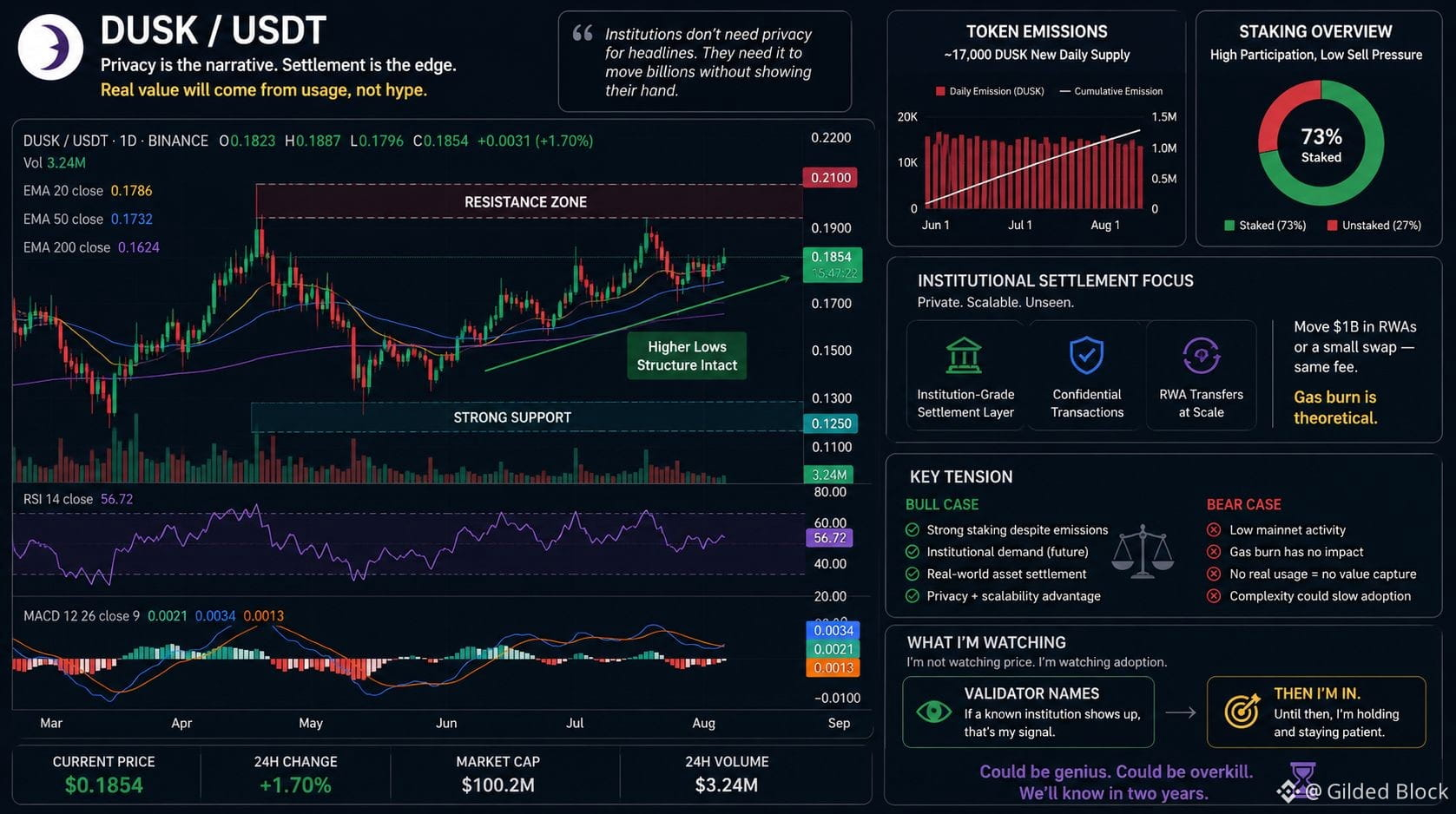
#dusk $DUSK Honestly, I stopped caring about Dusk’s privacy narrative. What keeps me holding is the settlement layer for institutions who can't show their hand. That's the real edge.
But here's the tension I can't shake: ~17k new DUSK hit the market daily from emissions, yet staking stays sticky. That tells me holders aren't yield farmers—they're betting on a future that isn't here yet.
Meanwhile, mainnet is quiet. Gas burn is theoretical. Moving a billion dollars in RWAs burns the same fee as a tiny swap—so where's the value capture? If usage stays low, this is just expensive infrastructure for no one.
What I'm watching isn't price. It's validator names. If a known institution shows up, I'm in. Until then, I'm just sitting on a bag that's doing nothing, hoping the complexity pays off. Could be genius. Could be overkill. We'll know in two years.
@Dusk_Foundation
#dusk $DUSK Honestly, I stopped caring about Dusk’s privacy narrative. What keeps me holding is the settlement layer for institutions who can't show their hand. That's the real edge.
But here's the tension I can't shake: ~17k new DUSK hit the market daily from emissions, yet staking stays sticky. That tells me holders aren't yield farmers—they're betting on a future that isn't here yet.
Meanwhile, mainnet is quiet. Gas burn is theoretical. Moving a billion dollars in RWAs burns the same fee as a tiny swap—so where's the value capture? If usage stays low, this is just expensive infrastructure for no one.
What I'm watching isn't price. It's validator names. If a known institution shows up, I'm in. Until then, I'm just sitting on a bag that's doing nothing, hoping the complexity pays off. Could be genius. Could be overkill. We'll know in two years.
@Dusk
But here's the tension I can't shake: ~17k new DUSK hit the market daily from emissions, yet staking stays sticky. That tells me holders aren't yield farmers—they're betting on a future that isn't here yet.
Meanwhile, mainnet is quiet. Gas burn is theoretical. Moving a billion dollars in RWAs burns the same fee as a tiny swap—so where's the value capture? If usage stays low, this is just expensive infrastructure for no one.
What I'm watching isn't price. It's validator names. If a known institution shows up, I'm in. Until then, I'm just sitting on a bag that's doing nothing, hoping the complexity pays off. Could be genius. Could be overkill. We'll know in two years.
@Dusk
1
2
226
·
--
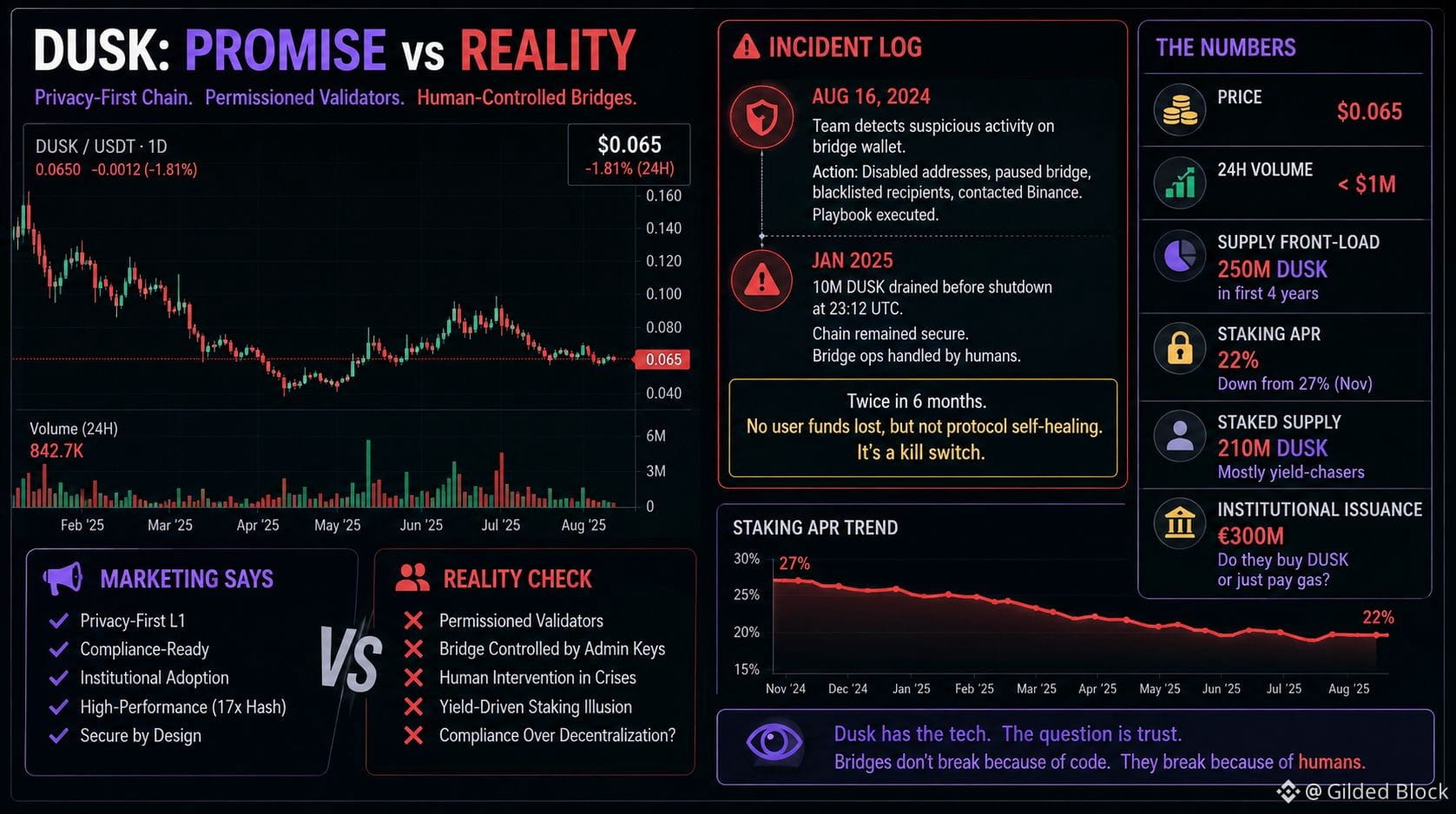
#dusk $DUSK So I finally read that Dusk Creatorpad thing. The 17x hash stats? Cool, but whatever made me re-read was the August 16 incident log. Team spots something off on a bridge wallet. Response: disable addresses, pause bridge, blacklist recipients, call Binance. Reads like a compliance SOP, not "trustless privacy L1." Then January—someone drained 10M DUSK before they yanked the plug at 23:12 UTC. Chain held. Consensus fine. But the bridge? Humans scrambling with admin keys and phone calls.
Twice in six months. No user funds lost, good. But that's not the protocol saving itself—it's a kill switch.
Then the token. $0.065, volume under $1M. Supply front-loads 250M new DUSK in the first four years. APR dropped 27% to 22% since November. €300M institutional issuance sounds huge, but do those institutions actually need to buy DUSK or just pay gas that gets recycled? 210M staked looks nice until you realize most is yield-chasers. Locking from inflation ≠ locking from cash flow.
I'm not hating—cryptography is legit, compliance angle makes sense for banks. But the tension is weird: privacy-first chain with permissioned validators, yet bridge ops look like a traditional fintech memo. Two companies under one hood.
Maybe DuskEVM launches and prints. But watching that gap between marketing and where admin keys actually live makes me uneasy. We're betting on code to fix a human custody problem—and that's a tough one. Not writing it off. Just watching that bridge closely, wondering how long that gap stays open.
@Dusk_Foundation
#dusk $DUSK So I finally read that Dusk Creatorpad thing. The 17x hash stats? Cool, but whatever made me re-read was the August 16 incident log. Team spots something off on a bridge wallet. Response: disable addresses, pause bridge, blacklist recipients, call Binance. Reads like a compliance SOP, not "trustless privacy L1." Then January—someone drained 10M DUSK before they yanked the plug at 23:12 UTC. Chain held. Consensus fine. But the bridge? Humans scrambling with admin keys and phone calls.
Twice in six months. No user funds lost, good. But that's not the protocol saving itself—it's a kill switch.
Then the token. $0.065, volume under $1M. Supply front-loads 250M new DUSK in the first four years. APR dropped 27% to 22% since November. €300M institutional issuance sounds huge, but do those institutions actually need to buy DUSK or just pay gas that gets recycled? 210M staked looks nice until you realize most is yield-chasers. Locking from inflation ≠ locking from cash flow.
I'm not hating—cryptography is legit, compliance angle makes sense for banks. But the tension is weird: privacy-first chain with permissioned validators, yet bridge ops look like a traditional fintech memo. Two companies under one hood.
Maybe DuskEVM launches and prints. But watching that gap between marketing and where admin keys actually live makes me uneasy. We're betting on code to fix a human custody problem—and that's a tough one. Not writing it off. Just watching that bridge closely, wondering how long that gap stays open.
@Dusk
Twice in six months. No user funds lost, good. But that's not the protocol saving itself—it's a kill switch.
Then the token. $0.065, volume under $1M. Supply front-loads 250M new DUSK in the first four years. APR dropped 27% to 22% since November. €300M institutional issuance sounds huge, but do those institutions actually need to buy DUSK or just pay gas that gets recycled? 210M staked looks nice until you realize most is yield-chasers. Locking from inflation ≠ locking from cash flow.
I'm not hating—cryptography is legit, compliance angle makes sense for banks. But the tension is weird: privacy-first chain with permissioned validators, yet bridge ops look like a traditional fintech memo. Two companies under one hood.
Maybe DuskEVM launches and prints. But watching that gap between marketing and where admin keys actually live makes me uneasy. We're betting on code to fix a human custody problem—and that's a tough one. Not writing it off. Just watching that bridge closely, wondering how long that gap stays open.
@Dusk
2
122
·
--
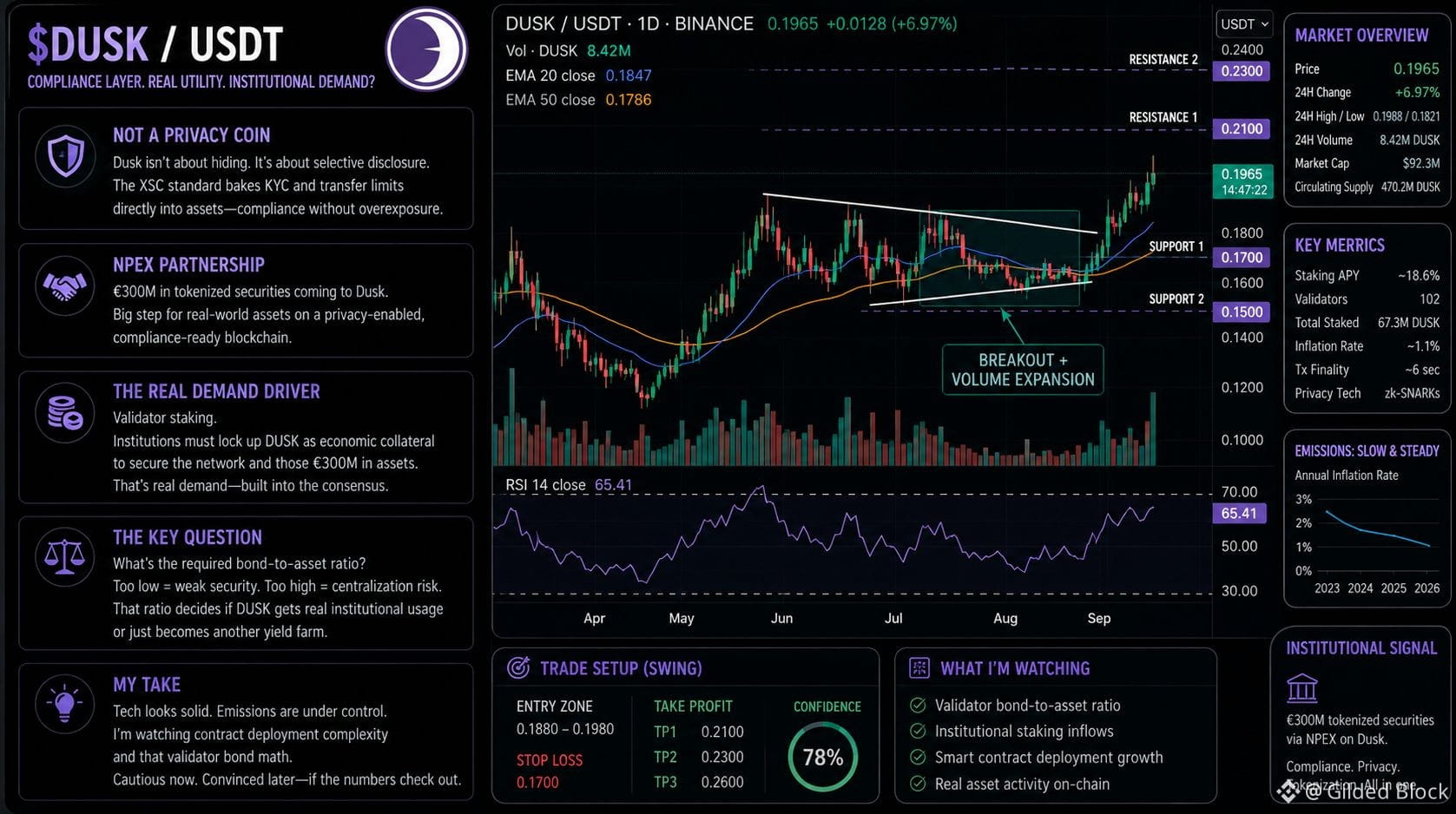
#dusk $DUSK I spent a while trying to figure out what Dusk actually is, and I think most people get it wrong. It's not a privacy coin. It's a compliance layer that happens to use privacy tech to make compliance less intrusive. The XSC standard bakes KYC and transfer limits directly into assets—regulators get what they need without seeing everyone's entire financial history.
The NPEX partnership is interesting. €300 million in tokenized securities. But then I started asking what that actually means for DUSK. Gas fees are small relative to asset values. That's not driving real demand.
The thing that caught my attention was the validator staking requirement. The consensus mechanism needs validators to lock up DUSK as economic collateral. If institutions need to stake significant amounts to secure those €300 million in assets, that creates genuine demand. Not speculative, actual collateral demand.
But nobody's really talking about the required bond-to-asset ratio. If it's too low, security is performative. Too high, only the biggest players can participate. That ratio would tell me whether institutional validators are actually using DUSK seriously or just farming rewards.
The tech is solid and the emissions are slow, but I'm watching contract deployment complexity more than price. Privacy only matters when the use case gets complicated enough to justify the overhead. Right now I'm cautious but curious. If that validator bond math checks out, I'd start paying closer attention.
@Dusk_Foundation
#dusk $DUSK I spent a while trying to figure out what Dusk actually is, and I think most people get it wrong. It's not a privacy coin. It's a compliance layer that happens to use privacy tech to make compliance less intrusive. The XSC standard bakes KYC and transfer limits directly into assets—regulators get what they need without seeing everyone's entire financial history.
The NPEX partnership is interesting. €300 million in tokenized securities. But then I started asking what that actually means for DUSK. Gas fees are small relative to asset values. That's not driving real demand.
The thing that caught my attention was the validator staking requirement. The consensus mechanism needs validators to lock up DUSK as economic collateral. If institutions need to stake significant amounts to secure those €300 million in assets, that creates genuine demand. Not speculative, actual collateral demand.
But nobody's really talking about the required bond-to-asset ratio. If it's too low, security is performative. Too high, only the biggest players can participate. That ratio would tell me whether institutional validators are actually using DUSK seriously or just farming rewards.
The tech is solid and the emissions are slow, but I'm watching contract deployment complexity more than price. Privacy only matters when the use case gets complicated enough to justify the overhead. Right now I'm cautious but curious. If that validator bond math checks out, I'd start paying closer attention.
@Dusk
The NPEX partnership is interesting. €300 million in tokenized securities. But then I started asking what that actually means for DUSK. Gas fees are small relative to asset values. That's not driving real demand.
The thing that caught my attention was the validator staking requirement. The consensus mechanism needs validators to lock up DUSK as economic collateral. If institutions need to stake significant amounts to secure those €300 million in assets, that creates genuine demand. Not speculative, actual collateral demand.
But nobody's really talking about the required bond-to-asset ratio. If it's too low, security is performative. Too high, only the biggest players can participate. That ratio would tell me whether institutional validators are actually using DUSK seriously or just farming rewards.
The tech is solid and the emissions are slow, but I'm watching contract deployment complexity more than price. Privacy only matters when the use case gets complicated enough to justify the overhead. Right now I'm cautious but curious. If that validator bond math checks out, I'd start paying closer attention.
@Dusk
4
5
176
·
--
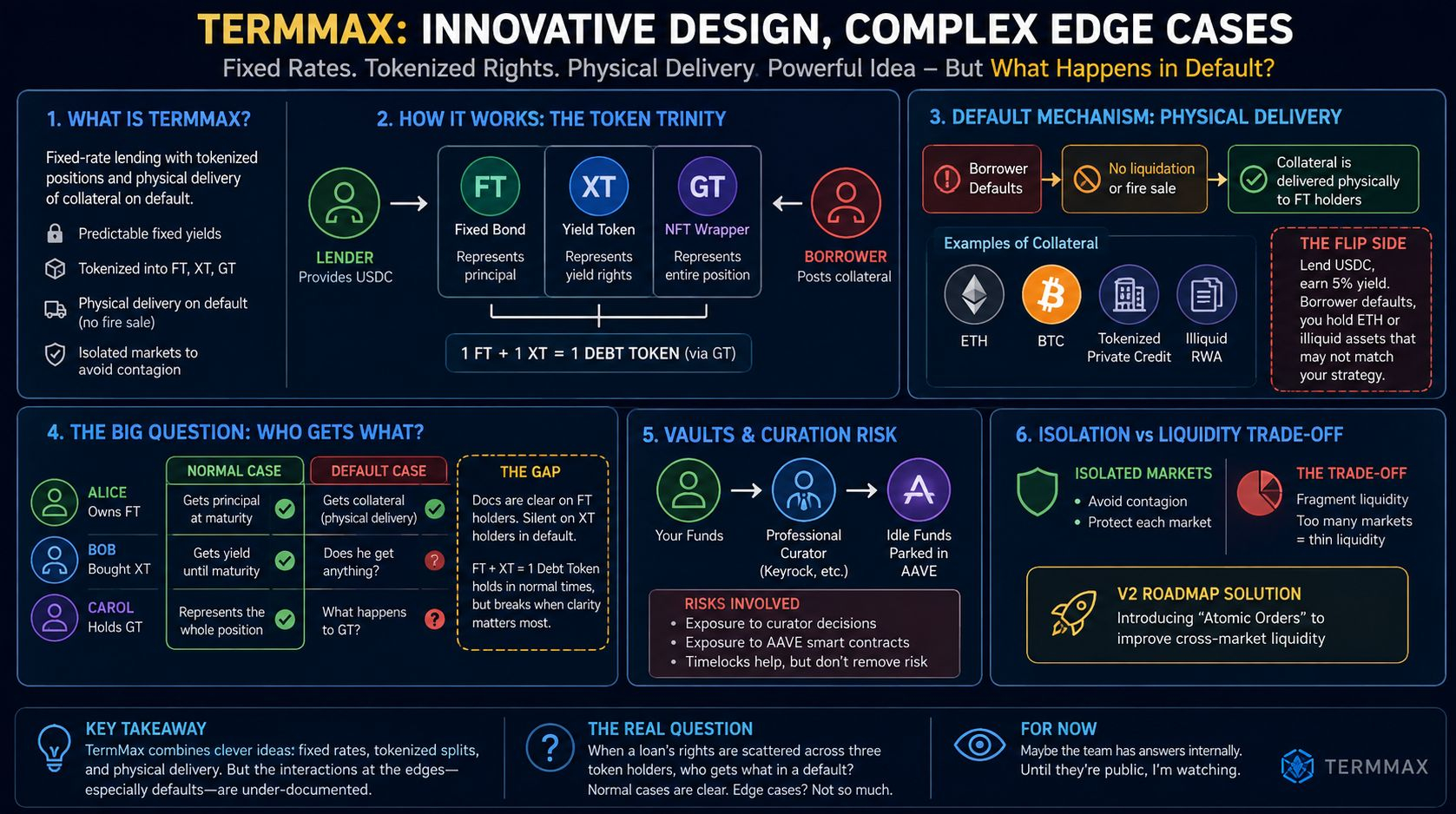
#termmax TermMax looked like fixed-rate lending. Then I saw the liquidation mechanism and did a double take.
Most protocols sell collateral for stablecoins and give you your money back. TermMax does physical delivery: default means you get the actual collateral—ETH, BTC, maybe an illiquid RWA. No fire sale. Sounds clean.
Flip it. I lend USDC for 5% yield. Borrower defaults, I now hold ETH. That's not my trade. And if the collateral is tokenized private credit, I'm stuck with something I can't sell. The same feature that unlocks RWAs turns lenders into forced holders of random assets.
Then there's the splitting: each position is FT (fixed bond), XT (yield token), GT (NFT wrapper). 1 FT + 1 XT = 1 debt token. Pretty.
Now connect them. Default triggers physical delivery, but Alice owns the FT, Bob bought the XT, borrower holds the GT. Docs say FT holders get collateral—fine. But Bob paid cash for XT before it decayed. Does he get anything? The docs don't say. The FT+XT identity holds in normal times, but breaks precisely when you need clarity.
Also: vaults run by professional curators (Keyrock etc.), who park idle funds in Aave—so your money gets exposed to their calls and Aave's contracts. Timelocks help but don't remove risk.
Isolated markets avoid contagion, but fragment liquidity so badly that V2's roadmap literally adds "Atomic Orders" to patch it.
Bottom line: TermMax is genuinely novel—fixed rates, tokenized splits, physical delivery. Each part is clever. But their interactions at the edges are under-documented.
The real question isn't "is it safe?" It's: when a loan's rights are scattered across three token holders, who gets what in a default? Normal cases are clear. Edge cases? Not so much. Maybe the team has answers internally. Until they're public, I'm watching.
@termmax
#termmax TermMax looked like fixed-rate lending. Then I saw the liquidation mechanism and did a double take.
Most protocols sell collateral for stablecoins and give you your money back. TermMax does physical delivery: default means you get the actual collateral—ETH, BTC, maybe an illiquid RWA. No fire sale. Sounds clean.
Flip it. I lend USDC for 5% yield. Borrower defaults, I now hold ETH. That's not my trade. And if the collateral is tokenized private credit, I'm stuck with something I can't sell. The same feature that unlocks RWAs turns lenders into forced holders of random assets.
Then there's the splitting: each position is FT (fixed bond), XT (yield token), GT (NFT wrapper). 1 FT + 1 XT = 1 debt token. Pretty.
Now connect them. Default triggers physical delivery, but Alice owns the FT, Bob bought the XT, borrower holds the GT. Docs say FT holders get collateral—fine. But Bob paid cash for XT before it decayed. Does he get anything? The docs don't say. The FT+XT identity holds in normal times, but breaks precisely when you need clarity.
Also: vaults run by professional curators (Keyrock etc.), who park idle funds in Aave—so your money gets exposed to their calls and Aave's contracts. Timelocks help but don't remove risk.
Isolated markets avoid contagion, but fragment liquidity so badly that V2's roadmap literally adds "Atomic Orders" to patch it.
Bottom line: TermMax is genuinely novel—fixed rates, tokenized splits, physical delivery. Each part is clever. But their interactions at the edges are under-documented.
The real question isn't "is it safe?" It's: when a loan's rights are scattered across three token holders, who gets what in a default? Normal cases are clear. Edge cases? Not so much. Maybe the team has answers internally. Until they're public, I'm watching.
@TermMax
Most protocols sell collateral for stablecoins and give you your money back. TermMax does physical delivery: default means you get the actual collateral—ETH, BTC, maybe an illiquid RWA. No fire sale. Sounds clean.
Flip it. I lend USDC for 5% yield. Borrower defaults, I now hold ETH. That's not my trade. And if the collateral is tokenized private credit, I'm stuck with something I can't sell. The same feature that unlocks RWAs turns lenders into forced holders of random assets.
Then there's the splitting: each position is FT (fixed bond), XT (yield token), GT (NFT wrapper). 1 FT + 1 XT = 1 debt token. Pretty.
Now connect them. Default triggers physical delivery, but Alice owns the FT, Bob bought the XT, borrower holds the GT. Docs say FT holders get collateral—fine. But Bob paid cash for XT before it decayed. Does he get anything? The docs don't say. The FT+XT identity holds in normal times, but breaks precisely when you need clarity.
Also: vaults run by professional curators (Keyrock etc.), who park idle funds in Aave—so your money gets exposed to their calls and Aave's contracts. Timelocks help but don't remove risk.
Isolated markets avoid contagion, but fragment liquidity so badly that V2's roadmap literally adds "Atomic Orders" to patch it.
Bottom line: TermMax is genuinely novel—fixed rates, tokenized splits, physical delivery. Each part is clever. But their interactions at the edges are under-documented.
The real question isn't "is it safe?" It's: when a loan's rights are scattered across three token holders, who gets what in a default? Normal cases are clear. Edge cases? Not so much. Maybe the team has answers internally. Until they're public, I'm watching.
@TermMax
1
6
1.1k
·
--
#dusk $DUSK Honestly, I used to scroll past Dusk every time. Another privacy L1? Been there, seen them burn.
Then a compliance friend said: "We don't need to hide money. We need to prove we have it, without showing the guy across the table our numbers." That flipped something.
Dusk's real trick isn't stronger privacy—it's splitting settlement from execution. The chain never sees your raw data, just verifies a proof. That's not a feature, it's architectural.
Dual models (Moonlight transparent, Phoenix shielded) let you pick public or private per transaction. XSC bakes KYC and transfer rules into the asset itself—rules are public, data stays hidden.
Sounds clean. But community threads show the Moonlight/Phoenix switch isn't actually seamless—stake with the wrong mode and things break. Small for retail, huge red flag for institutions.
NPEX, a licensed Dutch exchange with €300M+ in assets, has their CTO as Dusk's co-founder. That's real. But "pilot" to "live settlement" is a long road—regulatory approvals, integrations, user training. The starting gun hasn't fired yet.
TVL is low after 8 months. But is that nobody using it, or people using it and not wanting to be seen? Can't tell. That's the design working, or crickets.
If that €300M actually moves, it's stress-test overnight. What I really want to know: when the first auditor knocks and asks for transaction details—is it a one-click compliance report, or days of legal back-and-forth?
Because "audit when asked" sounds nice. The "when asked" part is where real-world friction lives.
@Dusk_Foundation
#dusk $DUSK Honestly, I used to scroll past Dusk every time. Another privacy L1? Been there, seen them burn.
Then a compliance friend said: "We don't need to hide money. We need to prove we have it, without showing the guy across the table our numbers." That flipped something.
Dusk's real trick isn't stronger privacy—it's splitting settlement from execution. The chain never sees your raw data, just verifies a proof. That's not a feature, it's architectural.
Dual models (Moonlight transparent, Phoenix shielded) let you pick public or private per transaction. XSC bakes KYC and transfer rules into the asset itself—rules are public, data stays hidden.
Sounds clean. But community threads show the Moonlight/Phoenix switch isn't actually seamless—stake with the wrong mode and things break. Small for retail, huge red flag for institutions.
NPEX, a licensed Dutch exchange with €300M+ in assets, has their CTO as Dusk's co-founder. That's real. But "pilot" to "live settlement" is a long road—regulatory approvals, integrations, user training. The starting gun hasn't fired yet.
TVL is low after 8 months. But is that nobody using it, or people using it and not wanting to be seen? Can't tell. That's the design working, or crickets.
If that €300M actually moves, it's stress-test overnight. What I really want to know: when the first auditor knocks and asks for transaction details—is it a one-click compliance report, or days of legal back-and-forth?
Because "audit when asked" sounds nice. The "when asked" part is where real-world friction lives.
@Dusk
Then a compliance friend said: "We don't need to hide money. We need to prove we have it, without showing the guy across the table our numbers." That flipped something.
Dusk's real trick isn't stronger privacy—it's splitting settlement from execution. The chain never sees your raw data, just verifies a proof. That's not a feature, it's architectural.
Dual models (Moonlight transparent, Phoenix shielded) let you pick public or private per transaction. XSC bakes KYC and transfer rules into the asset itself—rules are public, data stays hidden.
Sounds clean. But community threads show the Moonlight/Phoenix switch isn't actually seamless—stake with the wrong mode and things break. Small for retail, huge red flag for institutions.
NPEX, a licensed Dutch exchange with €300M+ in assets, has their CTO as Dusk's co-founder. That's real. But "pilot" to "live settlement" is a long road—regulatory approvals, integrations, user training. The starting gun hasn't fired yet.
TVL is low after 8 months. But is that nobody using it, or people using it and not wanting to be seen? Can't tell. That's the design working, or crickets.
If that €300M actually moves, it's stress-test overnight. What I really want to know: when the first auditor knocks and asks for transaction details—is it a one-click compliance report, or days of legal back-and-forth?
Because "audit when asked" sounds nice. The "when asked" part is where real-world friction lives.
@Dusk
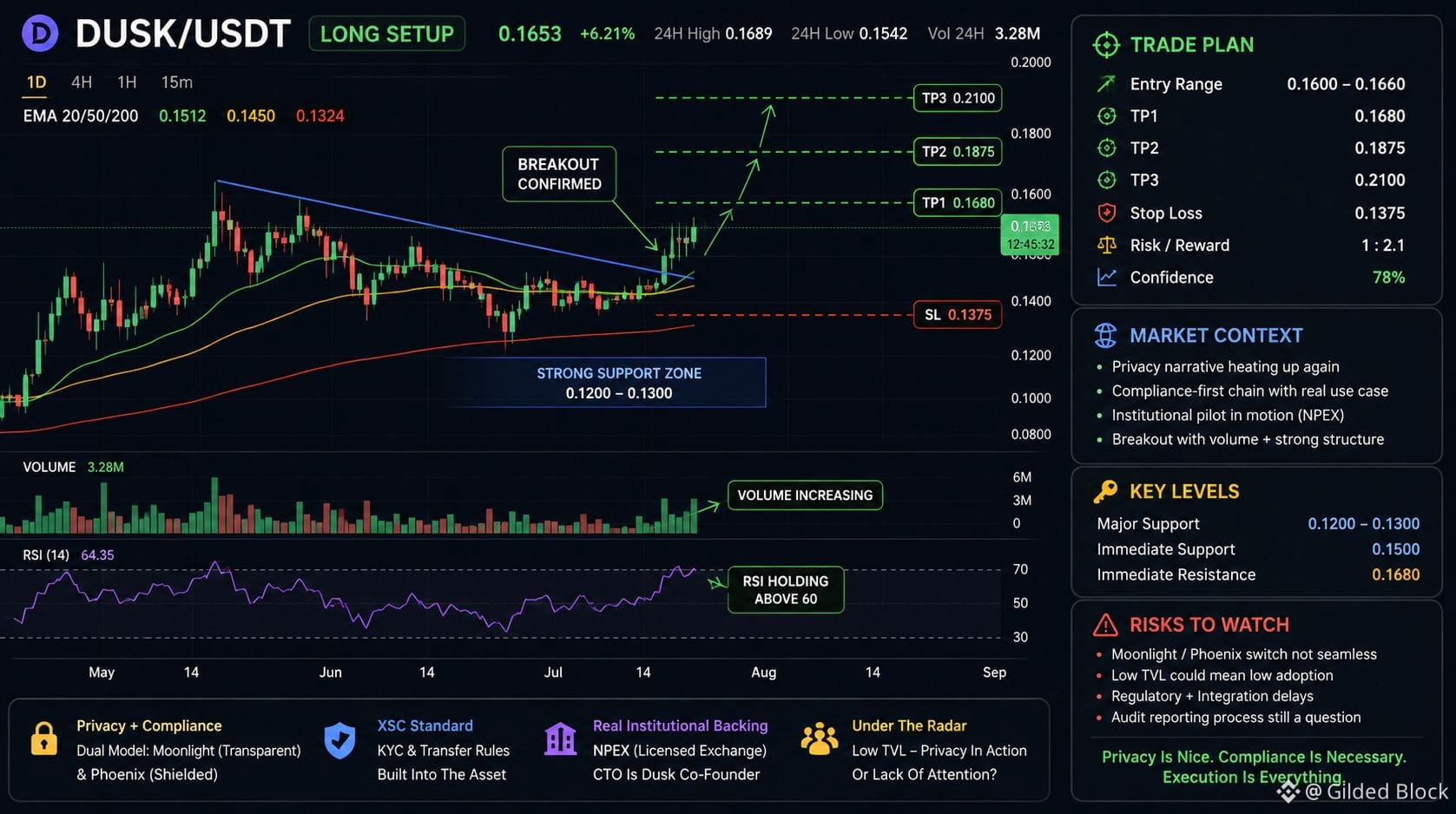
5
3
282
Log in to explore more content
Join global crypto users on Binance Square
⚡️ Get latest and useful information about crypto.
💬 Trusted by the world’s largest crypto exchange.
👍 Discover real insights from verified creators.
Email / Phone number
Trending Topics
BitcoinReboundsTo$79K
2,793 views
60 Discussing
🚨 $BTC is pushing higher.
Bitcoin is trading around $78,804, up roughly 1.9%, after reclaiming the $78K area. The next level to watch is the intraday high near $78,905.
A clean break above that level could open the way toward $79K–$80K. If BTC gets rejected, support sits around $78,300, then $77,975.
Bulls have momentum, but BTC needs to hold above $78K.
#Bitcoin #BTC #CryptoTrading #CryptoMarket #CryptoAnalysis
PulseON
·5 Likes
·3.3k views
FedHikeOddsRiseTo89%
54,458 views
894 Discussing
RLUSDSupplyHitsRecord$2.442B
2,795 views
52 Discussing