
Moonlight 月光
436 Posts

Moonlight 月光
 Square Verified
Report
Block User
54.9Million Likes & 634K Followers on BinanceLive: https://www.binance.com/en/live/u/27615912 💎130K Followers on X: https://x.com/Moon1ightSt 💎 DM for collabs

BNB Holder
Occasional Trader
4.1 Years
30 Following
16.2K+ Followers
3.1K+ Liked
Posts
All
Quotes
Videos
Live
·
--
Bullish
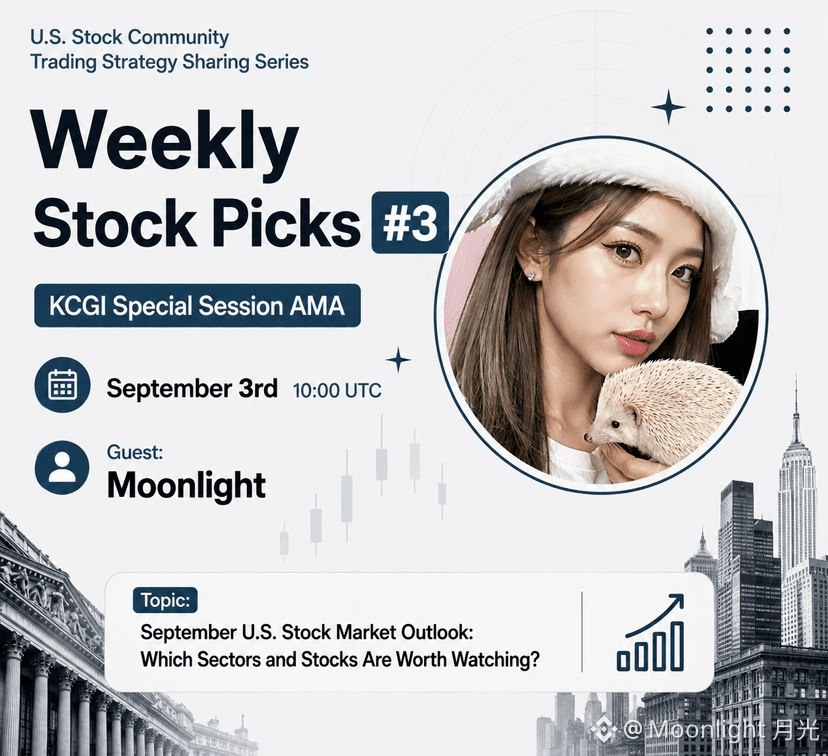
Dear, let’s talk about my thoughts on US stocks in September
Overall, I’m still leaning bullish, but I don’t think September will be particularly easy to trade
In August, the S&P 500 rose 2.6% and the Nasdaq gained 3.9%. The market has already run up ahead of time, so in September I actually don’t expect to just chase stocks higher
Right now, I’m focused on three things
First, US Treasury yields
If the 10-year US Treasury yield continues rising, the pressure on high-valuation tech stocks will be quite evident
If inflation keeps cooling and yields move lower, then there’s room for tech growth stocks
Second, whether the money spent on AI can be recouped
Nvidia, Microsoft, Amazon, and Broadcom all still have very strong results, and AI demand hasn’t really gone out
But going forward, the market will care more and more about one question
If so much money is spent building AI data centers, in the end how much revenue and cash flow can it actually generate?
So in September, I still see AI as bullish, but I won’t only focus on Nvidia
I’ll continue to watch NVDA, MSFT, AMZN, AVGO, AMD, and TSM
I also really like the AI infrastructure theme
GE Vernova, Eaton, Vertiv
AI needs GPUs, but it also needs power, cooling, the power grid, data centers, and networking equipment
I think there will still be many opportunities along this industrial chain
Third is sector rotation
If tech stays strong, then I’ll keep looking at tech
But if tech valuations get too expensive, then capital may very likely rotate into financials, industrials, energy, and healthcare
JPM, GS, XOM, LLY—I’ll put these into my September watchlist
Also, a few dates everyone can note
September 4: employment data
September 10: PPI
September 11: CPI
September 15–16: Fed meeting
Around these dates, I think volatility could become noticeably amplified
So my September strategy is very simple
Bullish, but don’t chase
Track US Treasury yields
Track inflation
Track AI profitability
Track capital rotation
If the market pulls back, but the fundamentals haven’t worsened, I’d actually start looking for opportunities
September may not be a month where all stocks rise together
Stock selection and timing will matter more than simply betting on a direction
$NVDAB
Dear, let’s talk about my thoughts on US stocks in September
Overall, I’m still leaning bullish, but I don’t think September will be particularly easy to trade
In August, the S&P 500 rose 2.6% and the Nasdaq gained 3.9%. The market has already run up ahead of time, so in September I actually don’t expect to just chase stocks higher
Right now, I’m focused on three things
First, US Treasury yields
If the 10-year US Treasury yield continues rising, the pressure on high-valuation tech stocks will be quite evident
If inflation keeps cooling and yields move lower, then there’s room for tech growth stocks
Second, whether the money spent on AI can be recouped
Nvidia, Microsoft, Amazon, and Broadcom all still have very strong results, and AI demand hasn’t really gone out
But going forward, the market will care more and more about one question
If so much money is spent building AI data centers, in the end how much revenue and cash flow can it actually generate?
So in September, I still see AI as bullish, but I won’t only focus on Nvidia
I’ll continue to watch NVDA, MSFT, AMZN, AVGO, AMD, and TSM
I also really like the AI infrastructure theme
GE Vernova, Eaton, Vertiv
AI needs GPUs, but it also needs power, cooling, the power grid, data centers, and networking equipment
I think there will still be many opportunities along this industrial chain
Third is sector rotation
If tech stays strong, then I’ll keep looking at tech
But if tech valuations get too expensive, then capital may very likely rotate into financials, industrials, energy, and healthcare
JPM, GS, XOM, LLY—I’ll put these into my September watchlist
Also, a few dates everyone can note
September 4: employment data
September 10: PPI
September 11: CPI
September 15–16: Fed meeting
Around these dates, I think volatility could become noticeably amplified
So my September strategy is very simple
Bullish, but don’t chase
Track US Treasury yields
Track inflation
Track AI profitability
Track capital rotation
If the market pulls back, but the fundamentals haven’t worsened, I’d actually start looking for opportunities
September may not be a month where all stocks rise together
Stock selection and timing will matter more than simply betting on a direction
$NVDAB
Overall, I’m still leaning bullish, but I don’t think September will be particularly easy to trade
In August, the S&P 500 rose 2.6% and the Nasdaq gained 3.9%. The market has already run up ahead of time, so in September I actually don’t expect to just chase stocks higher
Right now, I’m focused on three things
First, US Treasury yields
If the 10-year US Treasury yield continues rising, the pressure on high-valuation tech stocks will be quite evident
If inflation keeps cooling and yields move lower, then there’s room for tech growth stocks
Second, whether the money spent on AI can be recouped
Nvidia, Microsoft, Amazon, and Broadcom all still have very strong results, and AI demand hasn’t really gone out
But going forward, the market will care more and more about one question
If so much money is spent building AI data centers, in the end how much revenue and cash flow can it actually generate?
So in September, I still see AI as bullish, but I won’t only focus on Nvidia
I’ll continue to watch NVDA, MSFT, AMZN, AVGO, AMD, and TSM
I also really like the AI infrastructure theme
GE Vernova, Eaton, Vertiv
AI needs GPUs, but it also needs power, cooling, the power grid, data centers, and networking equipment
I think there will still be many opportunities along this industrial chain
Third is sector rotation
If tech stays strong, then I’ll keep looking at tech
But if tech valuations get too expensive, then capital may very likely rotate into financials, industrials, energy, and healthcare
JPM, GS, XOM, LLY—I’ll put these into my September watchlist
Also, a few dates everyone can note
September 4: employment data
September 10: PPI
September 11: CPI
September 15–16: Fed meeting
Around these dates, I think volatility could become noticeably amplified
So my September strategy is very simple
Bullish, but don’t chase
Track US Treasury yields
Track inflation
Track AI profitability
Track capital rotation
If the market pulls back, but the fundamentals haven’t worsened, I’d actually start looking for opportunities
September may not be a month where all stocks rise together
Stock selection and timing will matter more than simply betting on a direction
$NVDAB
25
1
21
1.2k
·
--
🎙️ Pay Without Boundaries: How Does TITANPAY Reshape Global Payments for Businesses and Individuals?

End
04 h 33 m 21 s
11.9k
58
8
·
--
🎙️ Payments Without Boundaries: How is TITANPAY reshaping global payments for businesses and individuals?
Tomorrow evening at 9 PM, join us for the AMA and get红包
Guests:
Leo @Fil-Jamil , Chinese Community Representative
Ryka, TitanPay CMO
Binance Live Stream Link:
[https://app.binance.com/uni-qr/cspa/45199724219753?r=I2RYLH6W&l=en&source=host_share&uc=app_square_share_link&us=copylink](https://app.binance.com/uni-qr/cspa/45199724219753?r=I2RYLH6W&l=en&source=host_share&uc=app_square_share_link&us=copylink)
🎙️ Payments Without Boundaries: How is TITANPAY reshaping global payments for businesses and individuals?
Tomorrow evening at 9 PM, join us for the AMA and get红包
Guests:
Leo @TITANPAY TECH , Chinese Community Representative
Ryka, TitanPay CMO
Binance Live Stream Link:
https://app.binance.com/uni-qr/cspa/45199724219753?r=I2RYLH6W&l=en&source=host_share&uc=app_square_share_link&us=copylink
Tomorrow evening at 9 PM, join us for the AMA and get红包
Guests:
Leo @TITANPAY TECH , Chinese Community Representative
Ryka, TitanPay CMO
Binance Live Stream Link:
https://app.binance.com/uni-qr/cspa/45199724219753?r=I2RYLH6W&l=en&source=host_share&uc=app_square_share_link&us=copylink

15
14
68
474
·
--
Produced "Niu Lai"
Definitely didn't expect
That even the white-haired stock god and Sun Yuchen
Could use this joke too 🐮
Mom~
$BTC
Produced "Niu Lai"
Definitely didn't expect
That even the white-haired stock god and Sun Yuchen
Could use this joke too 🐮
Mom~
$BTC
Definitely didn't expect
That even the white-haired stock god and Sun Yuchen
Could use this joke too 🐮
Mom~
$BTC

1
10
463
·
--
Sun Yuchen seems like every one or two years, he has to stir up a big event to remind the whole world that he’s still here.
In 2019, he paid $4.57 million to buy Warren Buffett’s lunch, flaking on the old man—though thankfully it ended up that he did eat with him 🐦
In 2021, he splashed $28 million on a space-ship ticket, waited four years, and then, really, he went to space.
In 2024, he spent $6.2 million to buy a banana that had been taped to a wall, and then—right in front of the entire world—ate the banana 🍌.
In 2025, again, as the biggest holder of the most coins, he attended Trump’s crypto dinner.
By 2026, bro Sun’s marketing strategy suddenly entered the “asset-light era.”
No need to buy meals, no need to buy bananas, and no need to ride a rocket.
Just write a piece titled “My Girlfriend Jing Tian.”
Who doesn’t love gossip about a domineering CEO and a female celebrity?
Using the pen that won a New Concept Literature award, he writes all the way through—then finally, lightly adds one more line:
“This article is purely fictional.”
In just a few hours, tens of millions of views.
This time, the costs are low and the reach is high.
And he can even go ask Jing Tian’s mom for a refund 😂
Sun Yuchen seems like every one or two years, he has to stir up a big event to remind the whole world that he’s still here.
In 2019, he paid $4.57 million to buy Warren Buffett’s lunch, flaking on the old man—though thankfully it ended up that he did eat with him 🐦
In 2021, he splashed $28 million on a space-ship ticket, waited four years, and then, really, he went to space.
In 2024, he spent $6.2 million to buy a banana that had been taped to a wall, and then—right in front of the entire world—ate the banana 🍌.
In 2025, again, as the biggest holder of the most coins, he attended Trump’s crypto dinner.
By 2026, bro Sun’s marketing strategy suddenly entered the “asset-light era.”
No need to buy meals, no need to buy bananas, and no need to ride a rocket.
Just write a piece titled “My Girlfriend Jing Tian.”
Who doesn’t love gossip about a domineering CEO and a female celebrity?
Using the pen that won a New Concept Literature award, he writes all the way through—then finally, lightly adds one more line:
“This article is purely fictional.”
In just a few hours, tens of millions of views.
This time, the costs are low and the reach is high.
And he can even go ask Jing Tian’s mom for a refund 😂
In 2019, he paid $4.57 million to buy Warren Buffett’s lunch, flaking on the old man—though thankfully it ended up that he did eat with him 🐦
In 2021, he splashed $28 million on a space-ship ticket, waited four years, and then, really, he went to space.
In 2024, he spent $6.2 million to buy a banana that had been taped to a wall, and then—right in front of the entire world—ate the banana 🍌.
In 2025, again, as the biggest holder of the most coins, he attended Trump’s crypto dinner.
By 2026, bro Sun’s marketing strategy suddenly entered the “asset-light era.”
No need to buy meals, no need to buy bananas, and no need to ride a rocket.
Just write a piece titled “My Girlfriend Jing Tian.”
Who doesn’t love gossip about a domineering CEO and a female celebrity?
Using the pen that won a New Concept Literature award, he writes all the way through—then finally, lightly adds one more line:
“This article is purely fictional.”
In just a few hours, tens of millions of views.
This time, the costs are low and the reach is high.
And he can even go ask Jing Tian’s mom for a refund 😂

2
8
424
·
--
Shocking! Japanese art master Yayoi Kusama passes away at 97
Known worldwide for her iconic Pumpkin 🎃 works, Japanese avant-garde artist and recipient of the Order of Cultural Merit, Yayoi Kusama
She died in a hospital in Tokyo due to multiple organ failure at the age of 97
The news was just confirmed today, sending shockwaves through the international art world
The master whose unique artistic style was defined by polka dots, infinity mirror rooms, and pumpkin works left behind many unforgettable classics
🕯️
Shocking! Japanese art master Yayoi Kusama passes away at 97
Known worldwide for her iconic Pumpkin 🎃 works, Japanese avant-garde artist and recipient of the Order of Cultural Merit, Yayoi Kusama
She died in a hospital in Tokyo due to multiple organ failure at the age of 97
The news was just confirmed today, sending shockwaves through the international art world
The master whose unique artistic style was defined by polka dots, infinity mirror rooms, and pumpkin works left behind many unforgettable classics
🕯️
Known worldwide for her iconic Pumpkin 🎃 works, Japanese avant-garde artist and recipient of the Order of Cultural Merit, Yayoi Kusama
She died in a hospital in Tokyo due to multiple organ failure at the age of 97
The news was just confirmed today, sending shockwaves through the international art world
The master whose unique artistic style was defined by polka dots, infinity mirror rooms, and pumpkin works left behind many unforgettable classics
🕯️

6
219
·
--
Bullish
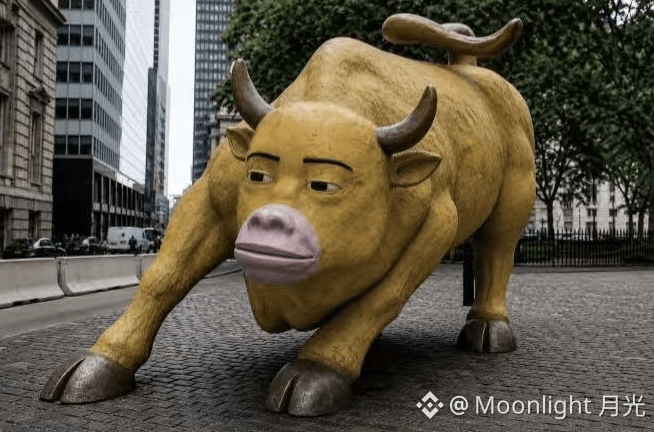
How does it feel like after watching Niu Lai, the bull really came?
Even foreigners understand this movie.
Using AI to turn the Wall Street bronze bull into a bull 🐂
$BTC
How does it feel like after watching Niu Lai, the bull really came?
Even foreigners understand this movie.
Using AI to turn the Wall Street bronze bull into a bull 🐂
$BTC
Even foreigners understand this movie.
Using AI to turn the Wall Street bronze bull into a bull 🐂
$BTC
6
399
·
--
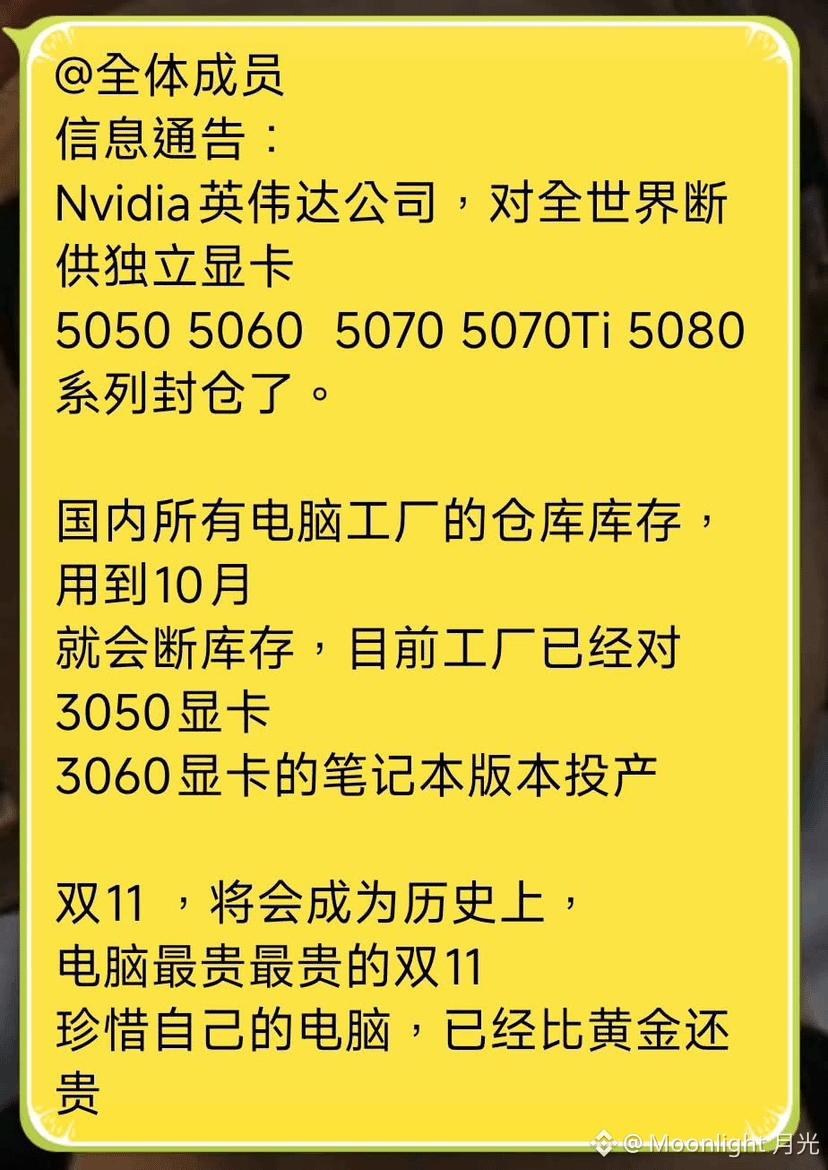
Is this news about NVIDIA really true?
Laptop computers are getting more and more expensive
Sobbing 😭
$NVDAB
Is this news about NVIDIA really true?
Laptop computers are getting more and more expensive
Sobbing 😭
$NVDAB
Laptop computers are getting more and more expensive
Sobbing 😭
$NVDAB
2
3
304
·
--
Bullish
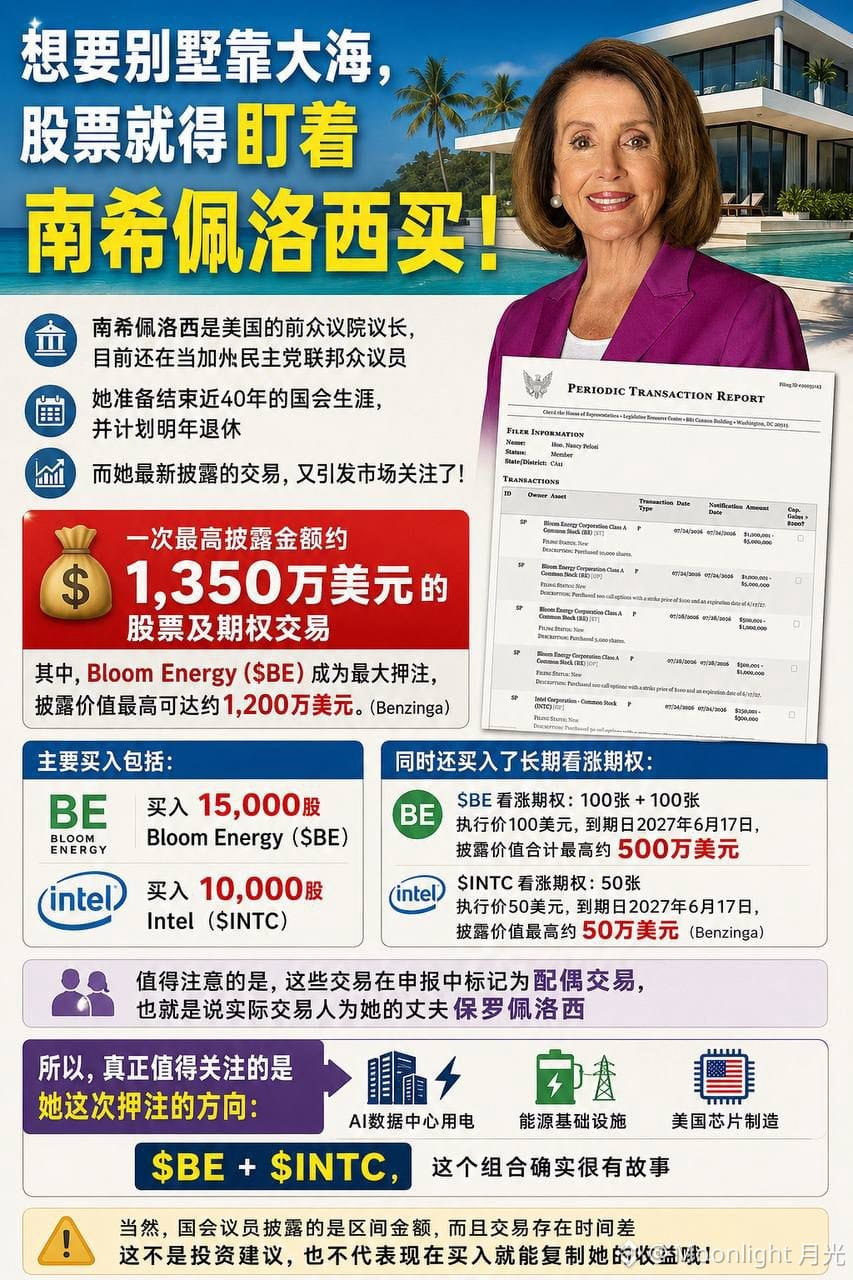
Want a villa by the sea? Then the stock market has to be watched as Nancy Pelosi buys!
Nancy Pelosi is the former Speaker of the U.S. House of Representatives, and she is currently serving as a Democratic member of the U.S. House from California.
And her most recently disclosed trades have again drawn market attention!
Stock and options transactions totaling about $13.5 million.
Among them, Bloom Energy ($BE) became the biggest bet, with disclosed value potentially as high as $12 million.
Key purchases include:
• Bought 15,000 shares of Bloom Energy ($BE)
• Bought 10,000 shares of Intel ($INTC)
She also bought long-term call options at the same time:
• $BE call options: 100 contracts + 100 contracts, strike price $100, expiration date June 17, 2027, disclosed value totaling up to about $5 million
• $INTC call options: 50 contracts, strike price $50, expiration date June 17, 2027, disclosed value up to $500,000
It’s worth noting that these trades were marked in the filing as spouse transactions—meaning the actual trader was her husband, Paul Pelosi.
So, what’s truly worth watching is the direction of her bet this time.
AI data center power usage + energy infrastructure + U.S. chip manufacturing.
Of course, members of Congress disclose transaction amounts in ranges, and there may be timing gaps between the trades.
This is not investment advice, and it doesn’t mean you can replicate her returns by buying now!
$INTCB
Want a villa by the sea? Then the stock market has to be watched as Nancy Pelosi buys!
Nancy Pelosi is the former Speaker of the U.S. House of Representatives, and she is currently serving as a Democratic member of the U.S. House from California.
And her most recently disclosed trades have again drawn market attention!
Stock and options transactions totaling about $13.5 million.
Among them, Bloom Energy ($BE) became the biggest bet, with disclosed value potentially as high as $12 million.
Key purchases include:
• Bought 15,000 shares of Bloom Energy ($BE)
• Bought 10,000 shares of Intel ($INTC)
She also bought long-term call options at the same time:
• $BE call options: 100 contracts + 100 contracts, strike price $100, expiration date June 17, 2027, disclosed value totaling up to about $5 million
• $INTC call options: 50 contracts, strike price $50, expiration date June 17, 2027, disclosed value up to $500,000
It’s worth noting that these trades were marked in the filing as spouse transactions—meaning the actual trader was her husband, Paul Pelosi.
So, what’s truly worth watching is the direction of her bet this time.
AI data center power usage + energy infrastructure + U.S. chip manufacturing.
Of course, members of Congress disclose transaction amounts in ranges, and there may be timing gaps between the trades.
This is not investment advice, and it doesn’t mean you can replicate her returns by buying now!
$INTCB
Nancy Pelosi is the former Speaker of the U.S. House of Representatives, and she is currently serving as a Democratic member of the U.S. House from California.
And her most recently disclosed trades have again drawn market attention!
Stock and options transactions totaling about $13.5 million.
Among them, Bloom Energy ($BE) became the biggest bet, with disclosed value potentially as high as $12 million.
Key purchases include:
• Bought 15,000 shares of Bloom Energy ($BE)
• Bought 10,000 shares of Intel ($INTC)
She also bought long-term call options at the same time:
• $BE call options: 100 contracts + 100 contracts, strike price $100, expiration date June 17, 2027, disclosed value totaling up to about $5 million
• $INTC call options: 50 contracts, strike price $50, expiration date June 17, 2027, disclosed value up to $500,000
It’s worth noting that these trades were marked in the filing as spouse transactions—meaning the actual trader was her husband, Paul Pelosi.
So, what’s truly worth watching is the direction of her bet this time.
AI data center power usage + energy infrastructure + U.S. chip manufacturing.
Of course, members of Congress disclose transaction amounts in ranges, and there may be timing gaps between the trades.
This is not investment advice, and it doesn’t mean you can replicate her returns by buying now!
$INTCB
5
303
·
--
Bullish
Dear, is life only about “studying hard and working diligently” as the single correct path?
Just look at the numbers!
Over the past 60 years, the #US stock market—S&P 500—has risen by about 100 times
But American wages have only increased by about 10 times
So I’ve always felt that financial intelligence education should really start earlier
When I was a kid, in the gifted math program at the American elementary school I attended, starting around grades four or five, they taught the basic concepts of stock investing and personal finance, and then did simulated trading
In several classes, we would spend a bit of time reviewing and reflecting: why those individual stocks went up, why they went down, and what factors influenced them
I also remember that the teacher asked us to choose the stock we wanted to buy ourselves, and then share with the class why we picked it
The ones I chose were probably Amazon, McDonald’s, and Google
I chose Amazon because our family had started working with Amazon very early on
My first programming robot with my younger brother was also bought with the money we earned from Amazon
The other two, on the other hand, were because they were brands we encountered in everyday life
Looking back now, what we learned back then wasn’t just “how to trade stocks”—it was about understanding early on that
wages are a fixed cash flow
And we also need the skills to manage money and build assets, so we can potentially grow our income
Working hard is certainly important, but if your whole life has only wages as an income source, it may truly be not enough to retire early or achieve financial freedom
$NVDAB
Dear, is life only about “studying hard and working diligently” as the single correct path?
Just look at the numbers!
Over the past 60 years, the #US stock market—S&P 500—has risen by about 100 times
But American wages have only increased by about 10 times
So I’ve always felt that financial intelligence education should really start earlier
When I was a kid, in the gifted math program at the American elementary school I attended, starting around grades four or five, they taught the basic concepts of stock investing and personal finance, and then did simulated trading
In several classes, we would spend a bit of time reviewing and reflecting: why those individual stocks went up, why they went down, and what factors influenced them
I also remember that the teacher asked us to choose the stock we wanted to buy ourselves, and then share with the class why we picked it
The ones I chose were probably Amazon, McDonald’s, and Google
I chose Amazon because our family had started working with Amazon very early on
My first programming robot with my younger brother was also bought with the money we earned from Amazon
The other two, on the other hand, were because they were brands we encountered in everyday life
Looking back now, what we learned back then wasn’t just “how to trade stocks”—it was about understanding early on that
wages are a fixed cash flow
And we also need the skills to manage money and build assets, so we can potentially grow our income
Working hard is certainly important, but if your whole life has only wages as an income source, it may truly be not enough to retire early or achieve financial freedom
$NVDAB
Just look at the numbers!
Over the past 60 years, the #US stock market—S&P 500—has risen by about 100 times
But American wages have only increased by about 10 times
So I’ve always felt that financial intelligence education should really start earlier
When I was a kid, in the gifted math program at the American elementary school I attended, starting around grades four or five, they taught the basic concepts of stock investing and personal finance, and then did simulated trading
In several classes, we would spend a bit of time reviewing and reflecting: why those individual stocks went up, why they went down, and what factors influenced them
I also remember that the teacher asked us to choose the stock we wanted to buy ourselves, and then share with the class why we picked it
The ones I chose were probably Amazon, McDonald’s, and Google
I chose Amazon because our family had started working with Amazon very early on
My first programming robot with my younger brother was also bought with the money we earned from Amazon
The other two, on the other hand, were because they were brands we encountered in everyday life
Looking back now, what we learned back then wasn’t just “how to trade stocks”—it was about understanding early on that
wages are a fixed cash flow
And we also need the skills to manage money and build assets, so we can potentially grow our income
Working hard is certainly important, but if your whole life has only wages as an income source, it may truly be not enough to retire early or achieve financial freedom
$NVDAB

1
5
252
·
--
Bearish
Dear, Moonlight took a look at the market under the moonlight today and found that
This AI line is dropping.
Before the bell, chips, cloud, optical modules, and storage all weakened together.
Many people think it’s just profit-taking after a big run.
But actually, the market may be pricing in the earnings report from Nvidia on August 26 in advance.
In the past four consecutive earnings reports, Nvidia’s results have always beaten expectations—yet after the reports, the stock price has fallen again and again.
Because what the market wants now is no longer just a “Beat.”
Instead, it’s whether the next quarter can still keep revising expectations upward.
And at this level, it’s getting harder and harder to keep offering even higher growth expectations.
On top of that, we’re seeing storage, AI hardware costs, long-term bond yields, and the market’s discussion about “circular financing” all emerging at the same time.
As a result, valuation pressure on the AI industry chain naturally increases.
However, demand is still strong—data center revenue and cloud providers’ CapEx are still growing.
So Moonlight believes that for this correction, the key thing to study is:
Will this AI track keep growing?
But then—how much is this growth actually worth?
On August 26, let’s find out together!
$NVDAB
Dear, Moonlight took a look at the market under the moonlight today and found that
This AI line is dropping.
Before the bell, chips, cloud, optical modules, and storage all weakened together.
Many people think it’s just profit-taking after a big run.
But actually, the market may be pricing in the earnings report from Nvidia on August 26 in advance.
In the past four consecutive earnings reports, Nvidia’s results have always beaten expectations—yet after the reports, the stock price has fallen again and again.
Because what the market wants now is no longer just a “Beat.”
Instead, it’s whether the next quarter can still keep revising expectations upward.
And at this level, it’s getting harder and harder to keep offering even higher growth expectations.
On top of that, we’re seeing storage, AI hardware costs, long-term bond yields, and the market’s discussion about “circular financing” all emerging at the same time.
As a result, valuation pressure on the AI industry chain naturally increases.
However, demand is still strong—data center revenue and cloud providers’ CapEx are still growing.
So Moonlight believes that for this correction, the key thing to study is:
Will this AI track keep growing?
But then—how much is this growth actually worth?
On August 26, let’s find out together!
$NVDAB
This AI line is dropping.
Before the bell, chips, cloud, optical modules, and storage all weakened together.
Many people think it’s just profit-taking after a big run.
But actually, the market may be pricing in the earnings report from Nvidia on August 26 in advance.
In the past four consecutive earnings reports, Nvidia’s results have always beaten expectations—yet after the reports, the stock price has fallen again and again.
Because what the market wants now is no longer just a “Beat.”
Instead, it’s whether the next quarter can still keep revising expectations upward.
And at this level, it’s getting harder and harder to keep offering even higher growth expectations.
On top of that, we’re seeing storage, AI hardware costs, long-term bond yields, and the market’s discussion about “circular financing” all emerging at the same time.
As a result, valuation pressure on the AI industry chain naturally increases.
However, demand is still strong—data center revenue and cloud providers’ CapEx are still growing.
So Moonlight believes that for this correction, the key thing to study is:
Will this AI track keep growing?
But then—how much is this growth actually worth?
On August 26, let’s find out together!
$NVDAB

1
3
474
·
--
Has the semiconductor sector cooled down?
Recently, when watching the market, I feel like the semiconductor I’ve been watching for a long time has started to lose some of its heat.
If you look at the Taiwan stocks in the semiconductor industry supply chain, you can feel it a lot.
Tech blue-chip stocks aren’t as strong as they were a while ago. Instead, capital has started flowing into sectors like plastics and chemicals and shipping. Even some traditional industries have started running ahead.
The U.S. market has a similar flavor too.
Energy stocks have been more resilient than the overall market lately, and medical stocks are slowly starting to get noticed as well.
I think this kind of rotation is definitely worth watching.
Because after an industry has risen for a long stretch, the market’s money will eventually start looking elsewhere for opportunities.
In the past, you might have wondered:
What exactly is there that’s good to buy about this company?
Then after some time, you realize:
It didn’t disappear, and it didn’t stop making money.
It’s just that, before, everyone’s attention was focused on other places.
So Moonlight has also been searching for new targets lately.
In your view, which industry will be the next one that the market starts to see again?
Has the semiconductor sector cooled down?
Recently, when watching the market, I feel like the semiconductor I’ve been watching for a long time has started to lose some of its heat.
If you look at the Taiwan stocks in the semiconductor industry supply chain, you can feel it a lot.
Tech blue-chip stocks aren’t as strong as they were a while ago. Instead, capital has started flowing into sectors like plastics and chemicals and shipping. Even some traditional industries have started running ahead.
The U.S. market has a similar flavor too.
Energy stocks have been more resilient than the overall market lately, and medical stocks are slowly starting to get noticed as well.
I think this kind of rotation is definitely worth watching.
Because after an industry has risen for a long stretch, the market’s money will eventually start looking elsewhere for opportunities.
In the past, you might have wondered:
What exactly is there that’s good to buy about this company?
Then after some time, you realize:
It didn’t disappear, and it didn’t stop making money.
It’s just that, before, everyone’s attention was focused on other places.
So Moonlight has also been searching for new targets lately.
In your view, which industry will be the next one that the market starts to see again?
Recently, when watching the market, I feel like the semiconductor I’ve been watching for a long time has started to lose some of its heat.
If you look at the Taiwan stocks in the semiconductor industry supply chain, you can feel it a lot.
Tech blue-chip stocks aren’t as strong as they were a while ago. Instead, capital has started flowing into sectors like plastics and chemicals and shipping. Even some traditional industries have started running ahead.
The U.S. market has a similar flavor too.
Energy stocks have been more resilient than the overall market lately, and medical stocks are slowly starting to get noticed as well.
I think this kind of rotation is definitely worth watching.
Because after an industry has risen for a long stretch, the market’s money will eventually start looking elsewhere for opportunities.
In the past, you might have wondered:
What exactly is there that’s good to buy about this company?
Then after some time, you realize:
It didn’t disappear, and it didn’t stop making money.
It’s just that, before, everyone’s attention was focused on other places.
So Moonlight has also been searching for new targets lately.
In your view, which industry will be the next one that the market starts to see again?

3
216
·
--
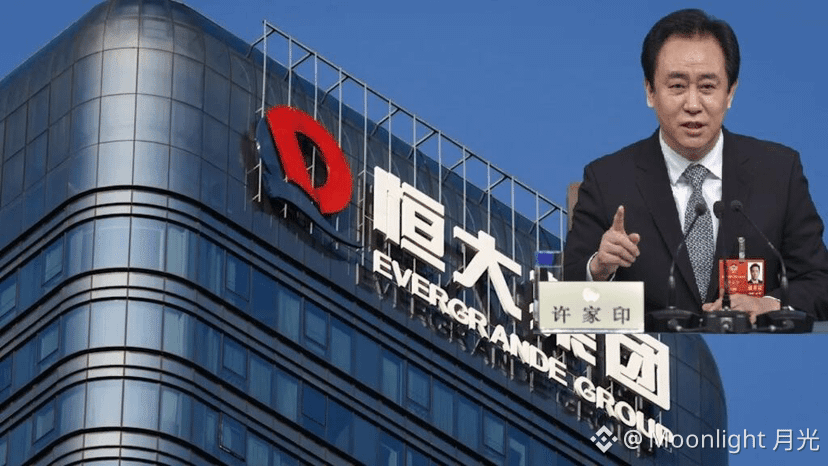
Tell a shocking opinion!
If you really need to find someone
who, with their own personal wealth,
can pay off all the debts left behind by Xu JiaYin
and look across the whole world,
perhaps only Elon Musk can do it
Tell a shocking opinion!
If you really need to find someone
who, with their own personal wealth,
can pay off all the debts left behind by Xu JiaYin
and look across the whole world,
perhaps only Elon Musk can do it
If you really need to find someone
who, with their own personal wealth,
can pay off all the debts left behind by Xu JiaYin
and look across the whole world,
perhaps only Elon Musk can do it
5
556
·
--
TGE is happening today—baby, remember to check the airdrop!
TGE is happening today—baby, remember to check the airdrop!
2
178
·
--
TGE is happening today—baby, remember to check the airdrop!
TGE is happening today—baby, remember to check the airdrop!
3
195
·
--
Verified
Dear, $ALIGN officially enters TGE today
Aligned Layer’s native token $ALIGN from @alignedlayer will be listed today, August 20 at 15:00 UTC
A few key numbers that Moonlight is paying close attention to this time:
Total supply: 10 billion tokens
Initial circulating supply: ~16%
Airdrops can be checked now
And small airdrops of ≤10,000 tokens can be fully unlocked immediately; larger amounts will also have a portion released at TGE
What’s even more worth noting: Coinbase has already officially announced support for $ALIGN. You can generate a deposit address in advance, and then transfers will be available once the official rollout opens
What Aligned Layer wants to do is also pretty exciting
Building core infrastructure around Ethereum—such as ZK proof aggregation, RaaS, WaaS, and more—so that Ethereum can become the underlying backend for global financial applications
So for today’s TGE, I think it’s more like a real new starting point for market validation
If you participated in the airdrop before, remember to check your eligible amount first!
👉 community.alignedlayer.com
$ALIGN officially enters circulation—now we’ll see what the market has to say
Dear, $ALIGN officially enters TGE today
Aligned Layer’s native token $ALIGN from @alignedlayer will be listed today, August 20 at 15:00 UTC
A few key numbers that Moonlight is paying close attention to this time:
Total supply: 10 billion tokens
Initial circulating supply: ~16%
Airdrops can be checked now
And small airdrops of ≤10,000 tokens can be fully unlocked immediately; larger amounts will also have a portion released at TGE
What’s even more worth noting: Coinbase has already officially announced support for $ALIGN. You can generate a deposit address in advance, and then transfers will be available once the official rollout opens
What Aligned Layer wants to do is also pretty exciting
Building core infrastructure around Ethereum—such as ZK proof aggregation, RaaS, WaaS, and more—so that Ethereum can become the underlying backend for global financial applications
So for today’s TGE, I think it’s more like a real new starting point for market validation
If you participated in the airdrop before, remember to check your eligible amount first!
👉 community.alignedlayer.com
$ALIGN officially enters circulation—now we’ll see what the market has to say
Aligned Layer’s native token $ALIGN from @alignedlayer will be listed today, August 20 at 15:00 UTC
A few key numbers that Moonlight is paying close attention to this time:
Total supply: 10 billion tokens
Initial circulating supply: ~16%
Airdrops can be checked now
And small airdrops of ≤10,000 tokens can be fully unlocked immediately; larger amounts will also have a portion released at TGE
What’s even more worth noting: Coinbase has already officially announced support for $ALIGN. You can generate a deposit address in advance, and then transfers will be available once the official rollout opens
What Aligned Layer wants to do is also pretty exciting
Building core infrastructure around Ethereum—such as ZK proof aggregation, RaaS, WaaS, and more—so that Ethereum can become the underlying backend for global financial applications
So for today’s TGE, I think it’s more like a real new starting point for market validation
If you participated in the airdrop before, remember to check your eligible amount first!
👉 community.alignedlayer.com
$ALIGN officially enters circulation—now we’ll see what the market has to say

9
13
557
·
--
Top U.S. universities collectively “bet right” on SpaceX—what’s the story?
Harvard holds about $2.2 billion outright, the UC system also has about $1 billion, and universities like the University of North Carolina and Washington University in St. Louis are also listed among the shareholders.
The key point is that many of these schools laid the groundwork for SpaceX years ago through private equity funds.
Back then, they bought private assets that other people couldn’t quite make sense of.
Now it’s gone public, turning into massive wealth on the books.
This one really feels like, “students pay for school with scholarships, while the universities make tuition money from investments” 😂
Top U.S. universities collectively “bet right” on SpaceX—what’s the story?
Harvard holds about $2.2 billion outright, the UC system also has about $1 billion, and universities like the University of North Carolina and Washington University in St. Louis are also listed among the shareholders.
The key point is that many of these schools laid the groundwork for SpaceX years ago through private equity funds.
Back then, they bought private assets that other people couldn’t quite make sense of.
Now it’s gone public, turning into massive wealth on the books.
This one really feels like, “students pay for school with scholarships, while the universities make tuition money from investments” 😂
Harvard holds about $2.2 billion outright, the UC system also has about $1 billion, and universities like the University of North Carolina and Washington University in St. Louis are also listed among the shareholders.
The key point is that many of these schools laid the groundwork for SpaceX years ago through private equity funds.
Back then, they bought private assets that other people couldn’t quite make sense of.
Now it’s gone public, turning into massive wealth on the books.
This one really feels like, “students pay for school with scholarships, while the universities make tuition money from investments” 😂

2
3
387
Log in to explore more content
Join global crypto users on Binance Square
⚡️ Get latest and useful information about crypto.
💬 Trusted by the world’s largest crypto exchange.
👍 Discover real insights from verified creators.
Email / Phone number
Trending Topics
NEARRisesNearly80%InAWeek
1,145 views
177 Discussing
#nearrisesnearly80%inaweek
NEAR Protocol is on absolute fire this week — here’s what’s driving the surge 🔥
What a week for NEAR! 🚀 Scoring an almost 80% gain in just 7 days isn't just luck; it highlights massive momentum building around NEAR's chain abstraction vision and AI integration. When tech efficiency meets retail hype, this is the exact kind of price action we get.
Are you holding NEAR for the long run, or taking profits at these levels? Drop your strategy below! 👇
$NEAR
#BitcoinHits$85K #Near #crypto
Lily星星
·2 Likes
·2.1k views
MultiversXPlansHardForkRecovery
2,017 views
222 Discussing
CircleLaunchesInstitutionalBTCBackedBorrowing
4,432 views
364 Discussing