
MrSattarking
8.5k Posts

MrSattarking
 Square Verified
Report
Block User
BNB Chain Lover 链上旅程继续中 | Web3 内容创作者
Open Trade
High-Frequency Trader
1.7 Years
736 Following
33.1K+ Followers
13.2K+ Liked
Posts
Portfolio
All
Quotes
Videos
Live
PINNED
·
--
Verified

Article
An Engineering Observation: Why Newton Reaches Consensus Before Producing BLS SignaturesWhile reading Newton Protocol's Consensus & Security documentation, one implementation detail stood out. Many distributed systems focus on how signatures are verified, but Newton places equal importance on ensuring every operator signs the same data in the first place.
The documentation describes a two-phase consensus process consisting of a Prepare phase followed by a Commit phase.
During the Prepare phase, operators do not immediately evaluate policies or produce BLS signatures. Instead, each operator independently fetches external policy data, such as numeric values returned by PolicyData oracles, and sends unsigned responses back to the Gateway.
At this stage, no consensus proof exists.
Instead of allowing each operator to continue with slightly different inputs, the Gateway computes the median value for each numeric field and verifies that every operator's response remains within the configured tolerance. If any value exceeds the allowed tolerance, consensus fails with a ToleranceExceeded error rather than silently excluding the outlier.
Only after a canonical set of input values has been established does the protocol enter the Commit phase.
The Gateway broadcasts the consensus data back to operators. Because every operator now evaluates the policy using the same normalized inputs, they produce BLS signatures over an identical message. The Gateway then aggregates those signatures once quorum has been reached.
The documentation also explains why this sequence matters.
Newton uses two different digest types. Operators generate individual ECDSA attestations that naturally differ between participants, but BLS aggregation requires every signer to sign exactly the same message. To satisfy that requirement, operators BLS-sign a consensus digest that excludes the unique attestations, while a separate full digest containing those attestations is stored on-chain for challenge verification.
From an engineering perspective, this ordering reduces disagreement before cryptographic consensus even begins.
Rather than asking operators to sign first and reconcile differences later, Newton first standardizes the evaluation inputs, then performs policy evaluation, and only afterward produces aggregate BLS signatures.
This approach separates data consensus from signature consensus, making the final proof depend on a shared view of external data instead of independent interpretations of it.
The result is a workflow where consensus is built in stages. Operators first agree on the inputs, then evaluate the policy, then sign the same digest, and finally produce a single aggregated proof for on-chain verification.
That sequencing is one of the more interesting engineering decisions documented in Newton Protocol's Consensus & Security design.
Question for builders: When external data comes from multiple independent sources, is it better to standardize the inputs before policy evaluation, or should each operator evaluate independently and let consensus emerge only at the signature layer?@NewtonProtocol #Newt $NEWT
An Engineering Observation: Why Newton Reaches Consensus Before Producing BLS Signatures
While reading Newton Protocol's Consensus & Security documentation, one implementation detail stood out. Many distributed systems focus on how signatures are verified, but Newton places equal importance on ensuring every operator signs the same data in the first place.
The documentation describes a two-phase consensus process consisting of a Prepare phase followed by a Commit phase.
During the Prepare phase, operators do not immediately evaluate policies or produce BLS signatures. Instead, each operator independently fetches external policy data, such as numeric values returned by PolicyData oracles, and sends unsigned responses back to the Gateway.
At this stage, no consensus proof exists.
Instead of allowing each operator to continue with slightly different inputs, the Gateway computes the median value for each numeric field and verifies that every operator's response remains within the configured tolerance. If any value exceeds the allowed tolerance, consensus fails with a ToleranceExceeded error rather than silently excluding the outlier.
Only after a canonical set of input values has been established does the protocol enter the Commit phase.
The Gateway broadcasts the consensus data back to operators. Because every operator now evaluates the policy using the same normalized inputs, they produce BLS signatures over an identical message. The Gateway then aggregates those signatures once quorum has been reached.
The documentation also explains why this sequence matters.
Newton uses two different digest types. Operators generate individual ECDSA attestations that naturally differ between participants, but BLS aggregation requires every signer to sign exactly the same message. To satisfy that requirement, operators BLS-sign a consensus digest that excludes the unique attestations, while a separate full digest containing those attestations is stored on-chain for challenge verification.
From an engineering perspective, this ordering reduces disagreement before cryptographic consensus even begins.
Rather than asking operators to sign first and reconcile differences later, Newton first standardizes the evaluation inputs, then performs policy evaluation, and only afterward produces aggregate BLS signatures.
This approach separates data consensus from signature consensus, making the final proof depend on a shared view of external data instead of independent interpretations of it.
The result is a workflow where consensus is built in stages. Operators first agree on the inputs, then evaluate the policy, then sign the same digest, and finally produce a single aggregated proof for on-chain verification.
That sequencing is one of the more interesting engineering decisions documented in Newton Protocol's Consensus & Security design.
Question for builders: When external data comes from multiple independent sources, is it better to standardize the inputs before policy evaluation, or should each operator evaluate independently and let consensus emerge only at the signature layer?@NewtonProtocol #Newt $NEWT
2
2
148
·
--
🚨 BREAKING NEWS: The Central Bank of Nigeria has made new rules for crypto.
Companies that want to issue stablecoins tied to foreign money (like US dollars, such as USDT or USDC) must have at least ₦15 billion already paid into their company before they can operate in Nigeria. 🇳🇬
At the same time, the CBN is making it harder for people to buy and sell crypto directly with each other on platforms (called P2P trading). Platforms will need stricter approval, and they must carefully check and verify the identity of everyone involved in these trades.
The Question now on everybody's lips is Does P2P need approval from the federal government before carrying out its operations?
SpaeMedia #CBN #crypto #fyp

1
139
·
--
#BinancePick Binance Pick Season 1 is here!
I'm ready to participate, make smart market predictions, and climb the leaderboard. Consistency, research, and patience are the keys to success!
Let's learn, participate, and grow together. Who's joining me?
#BinancePick #BinanceSquare #CryptoCommunity #Bitcoin
I'm ready to participate, make smart market predictions, and climb the leaderboard. Consistency, research, and patience are the keys to success!
Let's learn, participate, and grow together. Who's joining me?
#BinancePick #BinanceSquare #CryptoCommunity #Bitcoin

149

·
--
Meta Earnings: Can AI Turn Investment Into Real Growth?
Meta is investing heavily in AI, but the real question is whether that investment will deliver measurable business results.
AI could help improve advertising efficiency, user engagement, and long-term growth. However, rising infrastructure and development costs cannot be ignored.
For $META, I’m cautiously optimistic, but I want to see the earnings report before drawing conclusions. Revenue growth, operating costs, and management’s future outlook will be the key things I watch.
Strong technology is important, but sustainable business results matter more.
What matters more to you: Meta’s AI growth or the cost of building it?
#EarningsSeason $META
Meta Earnings: Can AI Turn Investment Into Real Growth?
Meta is investing heavily in AI, but the real question is whether that investment will deliver measurable business results.
AI could help improve advertising efficiency, user engagement, and long-term growth. However, rising infrastructure and development costs cannot be ignored.
For $META , I’m cautiously optimistic, but I want to see the earnings report before drawing conclusions. Revenue growth, operating costs, and management’s future outlook will be the key things I watch.
Strong technology is important, but sustainable business results matter more.
What matters more to you: Meta’s AI growth or the cost of building it?
#EarningsSeason $META
2
159
·
--
I am nominating myself for my ongoing contribution to the Binance Square community through crypto-related content and information sharing. My goal is to help readers better understand blockchain technology, digital assets, trading concepts, and the importance of responsible decision-making in the crypto market.
I aim to create useful content that encourages learning, independent research, and thoughtful discussion rather than unrealistic promises or unnecessary hype. I believe that a strong crypto community grows when creators share information responsibly and help users become more aware of both opportunities and risks.
I would be grateful for the opportunity to have my contributions considered for The Blockchain 100, 2026. My Binance Square profile and representative posts can be reviewed to evaluate my content, consistency, and community engagement.
#BinanceCommunityTips #blockchain
1
400
·
--
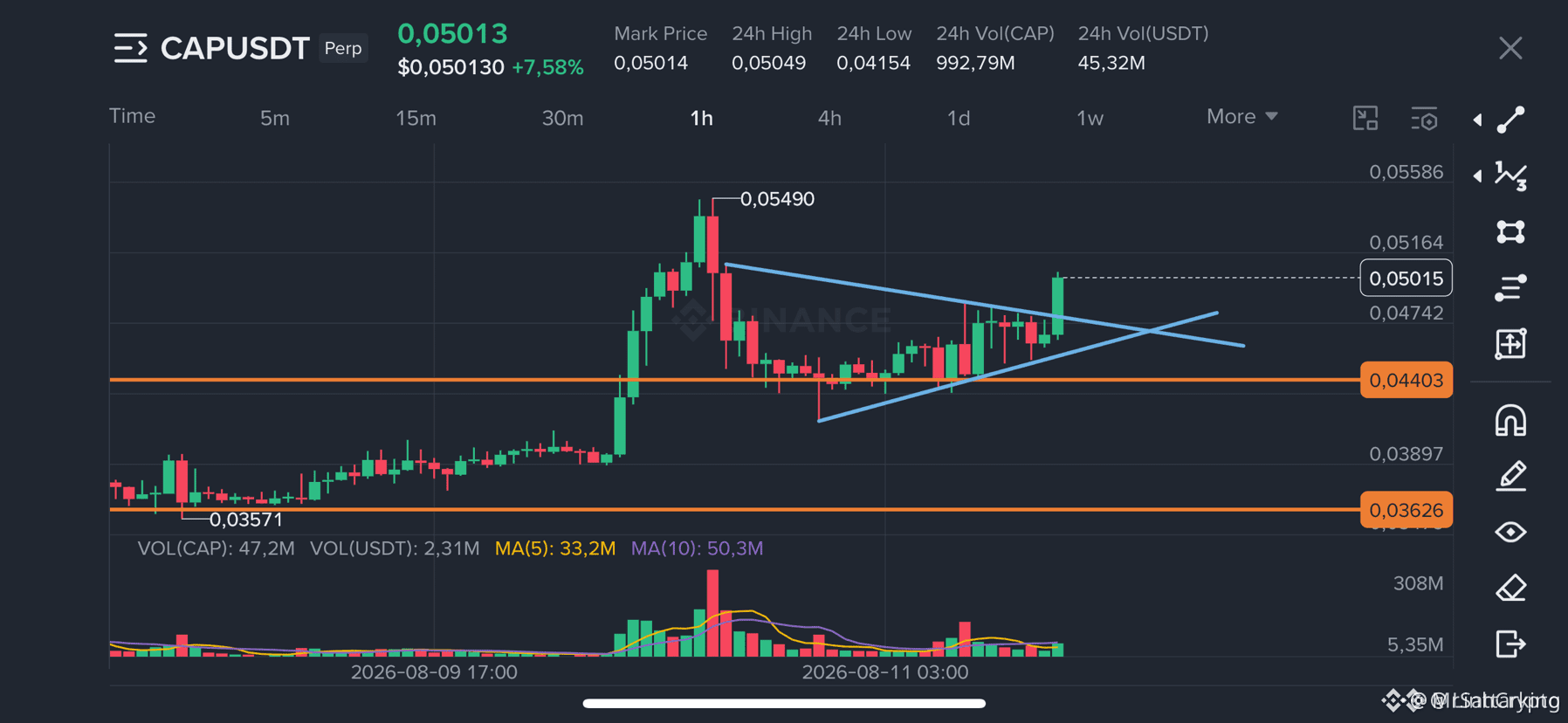
$CAP Breakout! CAP is getting ready to make another new ATH. Let’s wait and see! Long setup.
Entry: $0.48 - $0.49
TP: $0.51 - $0.53 - $0.55 - $0.57 - $0.6
SL: $0.435
{future}(CAPUSDT)
$CAP Breakout! CAP is getting ready to make another new ATH. Let’s wait and see! Long setup.
Entry: $0.48 - $0.49
TP: $0.51 - $0.53 - $0.55 - $0.57 - $0.6
SL: $0.435
Entry: $0.48 - $0.49
TP: $0.51 - $0.53 - $0.55 - $0.57 - $0.6
SL: $0.435
125
·
--
$CL
{future}(CLUSDT)
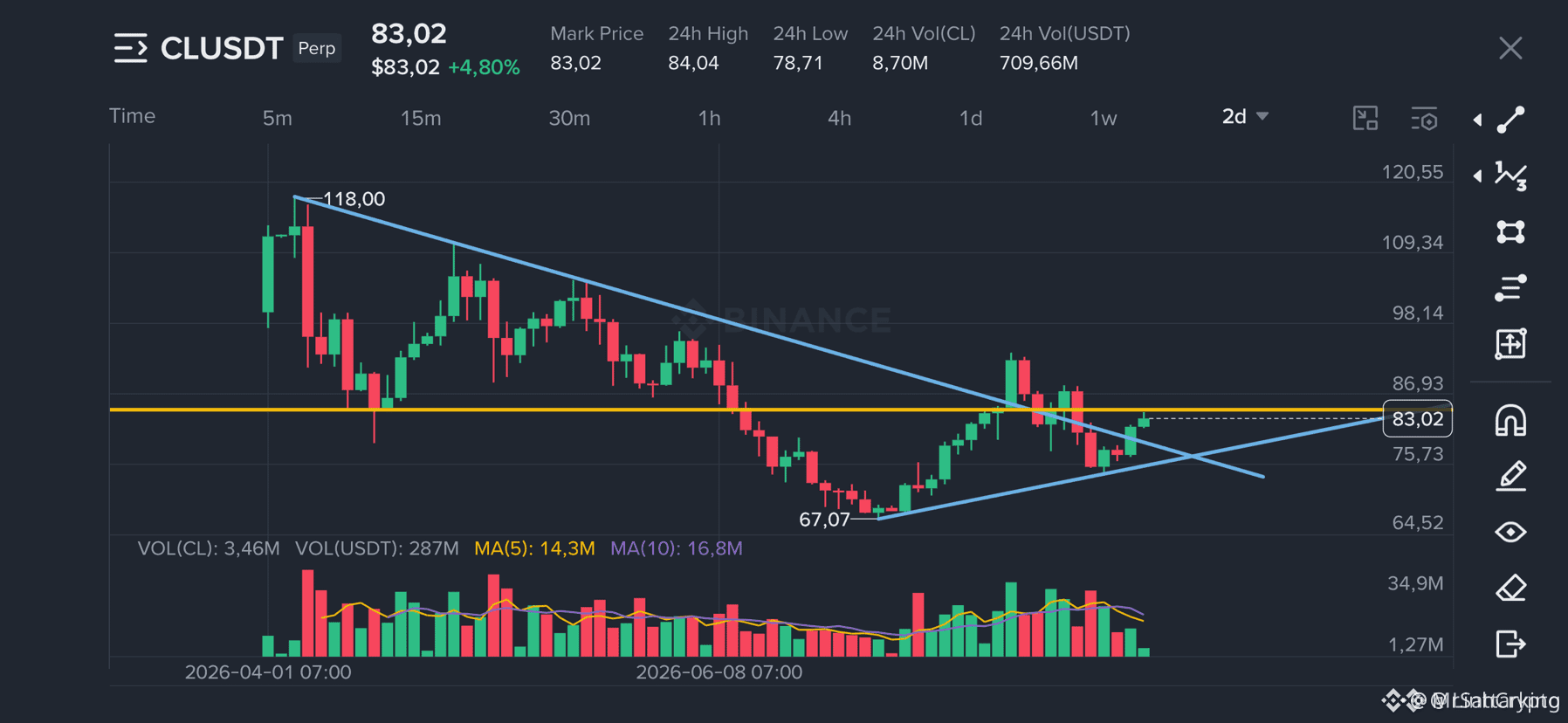
Resistance here! It’s time to short! Short setup.
Entry: $84 - $83
TP: $80 - $77 - $74
SL: $90
$CL
Resistance here! It’s time to short! Short setup.
Entry: $84 - $83
TP: $80 - $77 - $74
SL: $90
Resistance here! It’s time to short! Short setup.
Entry: $84 - $83
TP: $80 - $77 - $74
SL: $90
193

·
--
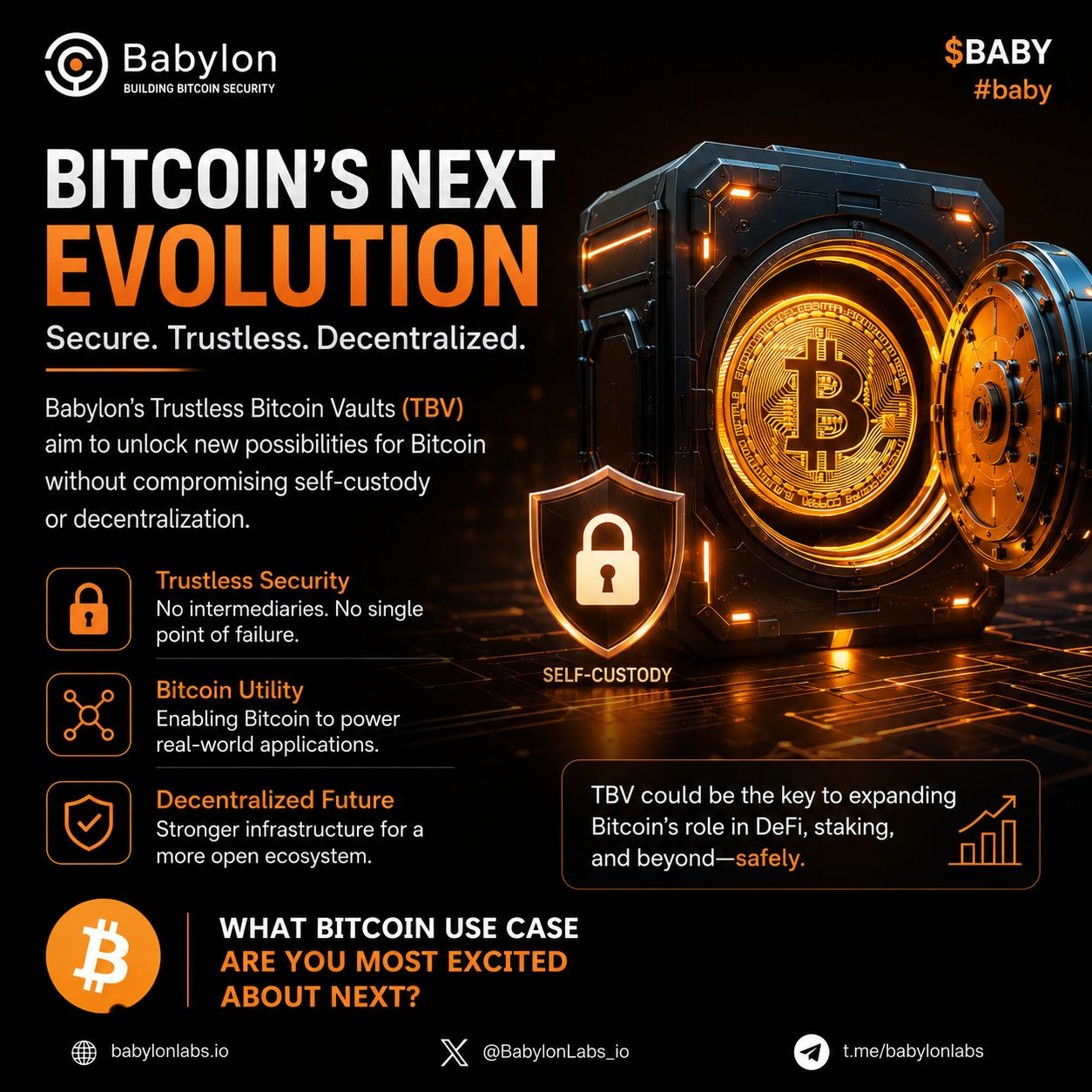
Bitcoin is entering a new era.
Most people see BTC as an asset to hold. The next evolution is using Bitcoin securely without sacrificing self-custody or decentralization.
That's why Babylon's Trustless Bitcoin Vaults (TBV) stand out. They aim to unlock new possibilities for Bitcoin while keeping security and trust minimization at the core.
If this infrastructure succeeds, Bitcoin could power far more than simple transfers—without compromising its strongest principles.
What Bitcoin use case are you most excited about next?
@babylonlabs_io $BABY #baby #bitcoin #BTC #Crypto
Bitcoin is entering a new era.
Most people see BTC as an asset to hold. The next evolution is using Bitcoin securely without sacrificing self-custody or decentralization.
That's why Babylon's Trustless Bitcoin Vaults (TBV) stand out. They aim to unlock new possibilities for Bitcoin while keeping security and trust minimization at the core.
If this infrastructure succeeds, Bitcoin could power far more than simple transfers—without compromising its strongest principles.
What Bitcoin use case are you most excited about next?
@BabylonLabs_io $BABY #baby #bitcoin #BTC #Crypto
141
·
--
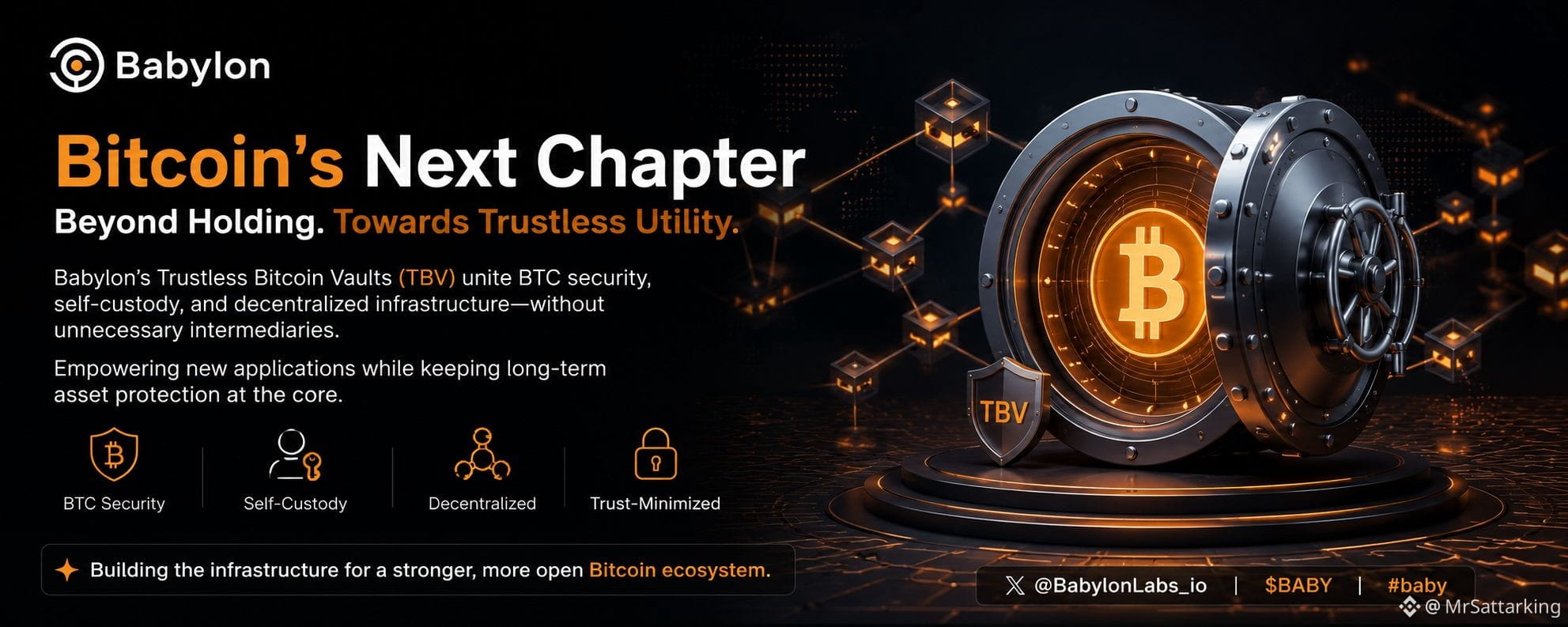
Bitcoin’s next chapter may depend on how safely it can be used beyond simple holding. Babylon’s Trustless Bitcoin Vaults (TBV) explore a model where BTC security, self-custody, and decentralized infrastructure work together without relying on unnecessary intermediaries. By strengthening trust-minimized access to Bitcoin, TBV could support new applications while keeping long-term asset protection at the center. This is the kind of infrastructure innovation that can expand the Bitcoin ecosystem responsibly. @babylonlabs_io $BABY #BABY
Bitcoin’s next chapter may depend on how safely it can be used beyond simple holding. Babylon’s Trustless Bitcoin Vaults (TBV) explore a model where BTC security, self-custody, and decentralized infrastructure work together without relying on unnecessary intermediaries. By strengthening trust-minimized access to Bitcoin, TBV could support new applications while keeping long-term asset protection at the center. This is the kind of infrastructure innovation that can expand the Bitcoin ecosystem responsibly. @BabylonLabs_io $BABY #BABY
2
1
118
·
--
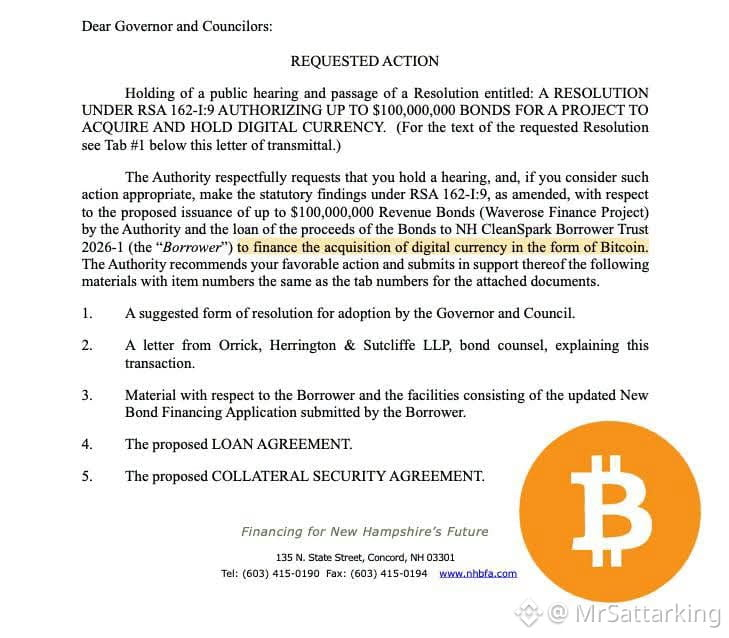
JUST IN: 🇺🇸NEW HAMPSHIRE REJECTS $100M BITCOIN-BACKED BOND PLAN
The Executive Council voted 3-2 against the proposal, citing $BTC volatility and legitimacy concerns.
Governor Ayotte supported the bill and still believes Bitcoin is "something that we really need to think about."
Unfortunately, when faced with the choice to either innovate or watch from the sidelines, the state chose the latter. #bitcoin $BTC
1
158
·
--
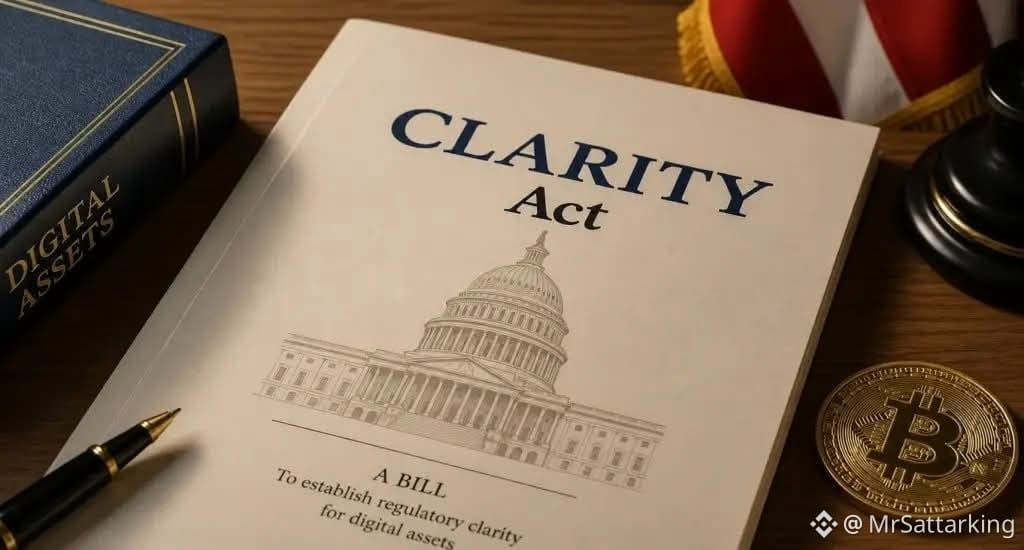
LATEST: NEW CLARITY ACT DRAFT COULD DROP NEXT WEEK 🇺🇸
Senate lawmakers are reportedly preparing a revised version of the CLARITY Act as they work to bridge key differences between Republicans and Democrats.
The updated draft is expected to include changes on consumer protections, DeFi, and ethics provisions in an effort to build enough bipartisan support to move the bill forward before Congress' August recess.#Clarity #ACT $BTC

1
145
·
--
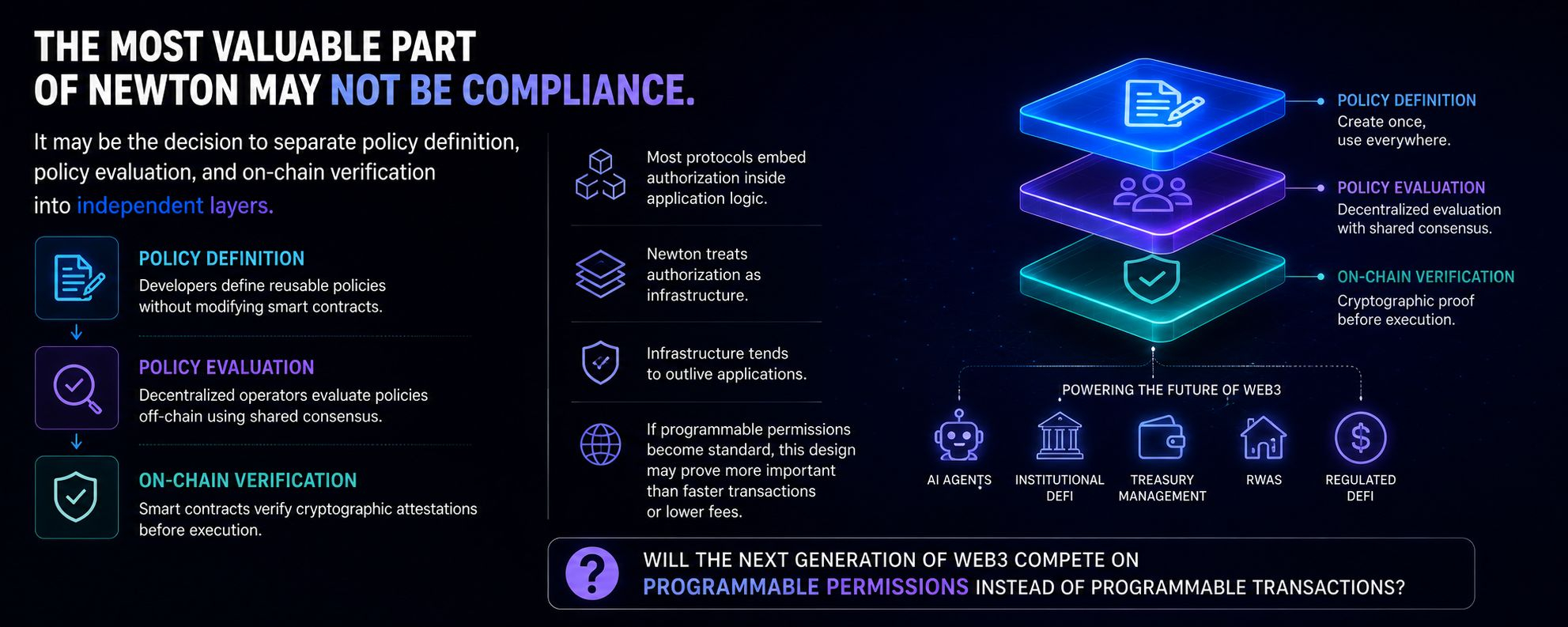
The most valuable part of Newton may not be compliance.
It may be the decision to separate policy definition, policy evaluation, and on-chain verification into independent layers.
Most protocols embed authorization inside application logic.
Newton treats authorization as infrastructure.
That architectural choice could matter more than any single feature because infrastructure tends to outlive applications.
If programmable permissions become standard, this design may prove more important than faster transactions or lower fees.
Question: Will the next generation of Web3 compete on programmable permissions instead of programmable transactions?
@NewtonProtocol #Newt $NEWT
127
·
--

Article
The Compliance Layer Isn't the Product. It's the InfrastructureMost crypto builders focus on faster transactions, lower fees, or better user interfaces.
Newton takes a different direction.
It assumes the next challenge isn't moving assets faster—it's deciding which transactions should be allowed in the first place.
Reading the documentation, one architectural decision stood out to me.
Newton separates policy definition, policy evaluation, privacy, consensus, and on-chain verification into independent components. That isn't just modular engineering. It reflects a different philosophy.
The protocol treats authorization as infrastructure rather than application logic.
Instead of embedding compliance rules inside every smart contract, developers define reusable policies, operators evaluate them off-chain using shared consensus, and smart contracts verify cryptographic attestations before execution.
That separation could matter far beyond compliance.
AI agents, institutional wallets, treasury management, RWAs, and regulated DeFi all face the same question:
Who decides whether a transaction should execute?
Most current systems answer that question inside application code.
Newton attempts to answer it through a reusable authorization layer backed by decentralized consensus.
Whether this becomes an industry standard remains to be seen.
But if programmable permissions become as important as programmable money, the infrastructure behind authorization may become just as valuable as the blockchain itself.
Question: If smart contracts already execute code deterministically, will the next generation of Web3 compete on programmable permissions rather than programmable transactions @NewtonProtocol #Newt $NEWT
The Compliance Layer Isn't the Product. It's the Infrastructure
Most crypto builders focus on faster transactions, lower fees, or better user interfaces.
Newton takes a different direction.
It assumes the next challenge isn't moving assets faster—it's deciding which transactions should be allowed in the first place.
Reading the documentation, one architectural decision stood out to me.
Newton separates policy definition, policy evaluation, privacy, consensus, and on-chain verification into independent components. That isn't just modular engineering. It reflects a different philosophy.
The protocol treats authorization as infrastructure rather than application logic.
Instead of embedding compliance rules inside every smart contract, developers define reusable policies, operators evaluate them off-chain using shared consensus, and smart contracts verify cryptographic attestations before execution.
That separation could matter far beyond compliance.
AI agents, institutional wallets, treasury management, RWAs, and regulated DeFi all face the same question:
Who decides whether a transaction should execute?
Most current systems answer that question inside application code.
Newton attempts to answer it through a reusable authorization layer backed by decentralized consensus.
Whether this becomes an industry standard remains to be seen.
But if programmable permissions become as important as programmable money, the infrastructure behind authorization may become just as valuable as the blockchain itself.
Question: If smart contracts already execute code deterministically, will the next generation of Web3 compete on programmable permissions rather than programmable transactions @NewtonProtocol #Newt $NEWT
116
·
--
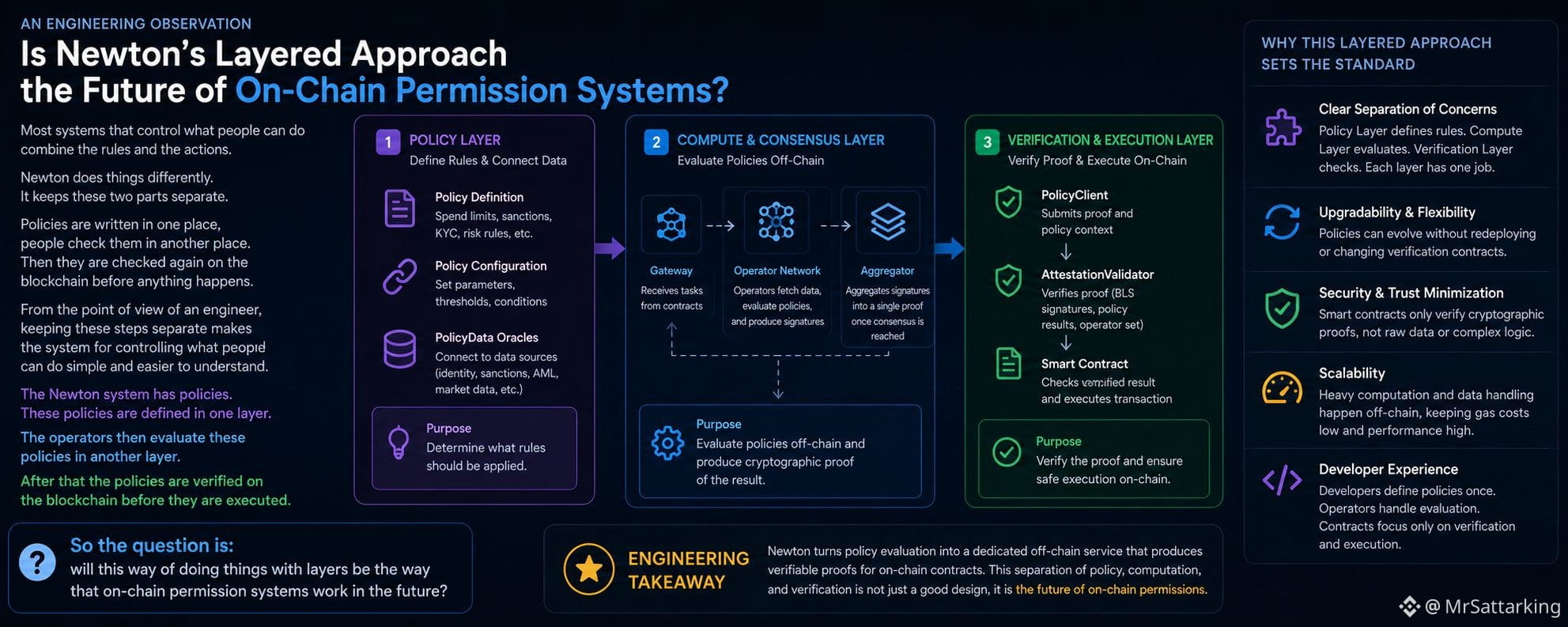
An Engineering Observation
Most systems that control what people can do combine the rules and the actions.
Newton does things differently.
It keeps these two parts separate.
Policies are written in one place people check them in another place. Then they are checked again on the blockchain before anything happens.
From the point of view of an engineer keeping these steps separate makes the system for controlling what people can do simple and easier to understand.
The Newton system has policies. These policies are defined in one layer.
The operators then evaluate these policies in another layer.
After that the policies are verified on the blockchain before they are executed.
So the question is: will this way of doing things with layers be the way that on-chain permission systems work in the future?
Is the approach used by Newton the future of, on-chain permission systems@NewtonProtocol #Newt $NEWT
150
Log in to explore more content
Join global crypto users on Binance Square
⚡️ Get latest and useful information about crypto.
💬 Trusted by the world’s largest crypto exchange.
👍 Discover real insights from verified creators.
Email / Phone number
Trending Topics
BitcoinFiveWeeklyLosses
11,537 views
399 Discussing
Bitcoin News | Bitcoin Slides for Five Straight Weeks as AI Stock Rout Spills Into Crypto
Binance News
·7 Likes
·9.4k views
AIChipSlumpNasdaq
6,536 views
217 Discussing
NvidiaInvestigatesAfterHuang’sAffairApology
4,251 views
108 Discussing