
MAxiomView
145 Posts

MAxiomView
Report
Block User
Взгляды на жизнь задают поведение в любой ситуации. Смотрю, как внутренние установки и допущения управляют решениями людей.
5 Following
19 Followers
60 Liked
Posts
All
Quotes
·
--

Article
“Your Own Million in 2 Minutes”: The Illusion of Easy Money and the Psychology of Creating “Air”Modern crypto platforms and tools with automated bonding curves have truly revolutionized accessibility. Today, you don’t need to assemble a team of developers, write complex code, or negotiate with exchanges to get listed to launch your own token—you can launch your own coin in just a couple of minutes, right from your smartphone.
“Your Own Million in 2 Minutes”: The Illusion of Easy Money and the Psychology of Creating “Air”
Modern crypto platforms and tools with automated bonding curves have truly revolutionized accessibility. Today, you don’t need to assemble a team of developers, write complex code, or negotiate with exchanges to get listed to launch your own token—you can launch your own coin in just a couple of minutes, right from your smartphone.
185
·
--

Article
Tulips and Memecoins: Why Speculation Leaves a Foundation Behind—and Why the Exchange Can’t Save You from GreedEvery new crypto cycle is invariably accompanied by heated debates. When another memecoin skyrockets a thousandfold and the crowd snaps up “thin air” at the peak of FOMO, conservative analysts are quick to pull out the classic comparisons from the archives: “This is pure 17th-century tulip mania!” or “Another gold rush where only the shovel sellers get rich!”
Tulips and Memecoins: Why Speculation Leaves a Foundation Behind—and Why the Exchange Can’t Save You from Greed
Every new crypto cycle is invariably accompanied by heated debates. When another memecoin skyrockets a thousandfold and the crowd snaps up “thin air” at the peak of FOMO, conservative analysts are quick to pull out the classic comparisons from the archives: “This is pure 17th-century tulip mania!” or “Another gold rush where only the shovel sellers get rich!”
2
375
·
--

Article
The Anatomy of Temporary Success: Why Do the Most “Brilliant” System Workarounds Always End the Same Way?Every trader sooner or later faces the temptation to cut corners: bypass strict risk management rules, use a questionable “gray” scheme on an illiquid instrument, go all-in while ignoring their own stop-loss, or trust an “exclusive loophole” whispered about in private chats.
The Anatomy of Temporary Success: Why Do the Most “Brilliant” System Workarounds Always End the Same Way?
Every trader sooner or later faces the temptation to cut corners: bypass strict risk management rules, use a questionable “gray” scheme on an illiquid instrument, go all-in while ignoring their own stop-loss, or trust an “exclusive loophole” whispered about in private chats.
76
·
--

Article
The Bulletproof Vest Illusion: Why Do Traders Believe in Myths Instead of Risk Management?Every trader sooner or later faces the ruthless reality of today’s market: market makers’ high-frequency algorithms seem to read your mind, triggering stop-losses with pinpoint precision just a second before the price reverses. At that point, people start actively searching chats and forums for “magic protection”—secret indicator settings, paid “anti-liquidation” bots, elaborate custom scripts, or proprietary filters that supposedly can fool exchange algorithms.
The Bulletproof Vest Illusion: Why Do Traders Believe in Myths Instead of Risk Management?
Every trader sooner or later faces the ruthless reality of today’s market: market makers’ high-frequency algorithms seem to read your mind, triggering stop-losses with pinpoint precision just a second before the price reverses. At that point, people start actively searching chats and forums for “magic protection”—secret indicator settings, paid “anti-liquidation” bots, elaborate custom scripts, or proprietary filters that supposedly can fool exchange algorithms.
66
·
--

Article
Survivorship Bias: Why “Nothing ventured, nothing gained” can wipe out your trading accountEvery beginner—and even experienced traders—has heard this catchphrase at least once in their life, a phrase used to justify all kinds of reckless behavior. In popular culture and market-adjacent chats, it has been elevated to the status of absolute truth: want to make a fortune? Go all in, use maximum leverage, ignore stop-losses, because “Nothing ventured, nothing gained.” It sounds bold, daring, and inspiring.
Survivorship Bias: Why “Nothing ventured, nothing gained” can wipe out your trading account
Every beginner—and even experienced traders—has heard this catchphrase at least once in their life, a phrase used to justify all kinds of reckless behavior. In popular culture and market-adjacent chats, it has been elevated to the status of absolute truth: want to make a fortune? Go all in, use maximum leverage, ignore stop-losses, because “Nothing ventured, nothing gained.” It sounds bold, daring, and inspiring.
69
·
--

Article
The Cost of One Hasty Decision: How Investors Lose Millions Without ChecklistsIt seems that with five million dollars in your account, you can afford to relax, make trades on instinct, and not waste time on boring routines like checklists. In the public imagination, enormous wealth is associated with absolute freedom and carte blanche: why should an experienced investor with a substantial balance painstakingly check every step against a list when they have years of experience behind them?
The Cost of One Hasty Decision: How Investors Lose Millions Without Checklists
It seems that with five million dollars in your account, you can afford to relax, make trades on instinct, and not waste time on boring routines like checklists. In the public imagination, enormous wealth is associated with absolute freedom and carte blanche: why should an experienced investor with a substantial balance painstakingly check every step against a list when they have years of experience behind them?
69
·
--

Article
RWAs and Institutional Players: How Is Tokenization Changing the Gray Market?Until just yesterday, any attempt to tie cryptocurrency to the physical world—whether buying a plot of land with stablecoins or informally arranging ownership stakes through dubious chat groups—looked like a makeshift gray-market scheme. Investors were pleased by the illusion of bypassing banks and taxes, unaware that they were playing Russian roulette with not the slightest legal protection. But while crypto enthusiasts debated privacy in a legal gray area, heavyweight players entered the market.
RWAs and Institutional Players: How Is Tokenization Changing the Gray Market?
Until just yesterday, any attempt to tie cryptocurrency to the physical world—whether buying a plot of land with stablecoins or informally arranging ownership stakes through dubious chat groups—looked like a makeshift gray-market scheme. Investors were pleased by the illusion of bypassing banks and taxes, unaware that they were playing Russian roulette with not the slightest legal protection. But while crypto enthusiasts debated privacy in a legal gray area, heavyweight players entered the market.
97
·
--

Article
Crypto Millionaires at 18: Why You Shouldn’t Compare Yourself to Other People’s Success—and What’s the Catch?Every day, crypto-community feeds serve up portraits of the “heroes of our time”: an 18-year-old guy poses in front of a rented supercar, telling the story of how he made a fortune on memecoins; a recent graduate boasts about a portfolio with seven zeros; and stories about early crypto enthusiasts like Vitalik Buterin are presented as if achieving billionaire status before getting a passport were a normal life plan.
Crypto Millionaires at 18: Why You Shouldn’t Compare Yourself to Other People’s Success—and What’s the Catch?
Every day, crypto-community feeds serve up portraits of the “heroes of our time”: an 18-year-old guy poses in front of a rented supercar, telling the story of how he made a fortune on memecoins; a recent graduate boasts about a portfolio with seven zeros; and stories about early crypto enthusiasts like Vitalik Buterin are presented as if achieving billionaire status before getting a passport were a normal life plan.
84
·
--

Article
The Two Sides of the Online Education Business: Why Trading Courses Don’t Reveal the “Big Secrets”Every beginner starting out in crypto trading inevitably faces the temptation to buy a “magic pill”—an expensive course from a successful guru who promises to teach them how to “read the market at a glance” and build a money-making machine in just a couple of weeks. The online education business thrives on promises of easy freedom, seaside villas, and never having to dread Mondays. On one hand, the industry is full of outright scammers selling nothing but hot air. On the other, it would be foolish to deny the value of basic education—after all, someone has to explain to beginners the difference between a limit order and a market order.
The Two Sides of the Online Education Business: Why Trading Courses Don’t Reveal the “Big Secrets”
Every beginner starting out in crypto trading inevitably faces the temptation to buy a “magic pill”—an expensive course from a successful guru who promises to teach them how to “read the market at a glance” and build a money-making machine in just a couple of weeks. The online education business thrives on promises of easy freedom, seaside villas, and never having to dread Mondays. On one hand, the industry is full of outright scammers selling nothing but hot air. On the other, it would be foolish to deny the value of basic education—after all, someone has to explain to beginners the difference between a limit order and a market order.
1
86
·
--

Article
Notes from an Old Notebook: Why Forex-Era Candlestick Patterns Break Down in the Crypto MarketEveryone who comes to crypto trading from the traditional school of technical analysis inevitably brings along a battered notebook filled with sketches of the “hammer,” the “evening star,” and the “engulfing pattern.” I used to painstakingly draw these figures myself, back in the days when people only whispered timidly about Bitcoin on forums and some madman had just spent thousands of coins on pizza, naively convinced I’d found a universal key to the market. Our TA books drilled it into us: charts are fractal, crowd psychology never changes, and therefore old patterns from Wall Street or the traditional Forex market would keep delivering easy profits on any timeframe, forever. Armed with a ruler, a pencil, and a guide to Japanese candlesticks, the freshly minted “strategist” sits down in front of the monitor, certain that the market simply has to obey their drawings.
Notes from an Old Notebook: Why Forex-Era Candlestick Patterns Break Down in the Crypto Market
Everyone who comes to crypto trading from the traditional school of technical analysis inevitably brings along a battered notebook filled with sketches of the “hammer,” the “evening star,” and the “engulfing pattern.” I used to painstakingly draw these figures myself, back in the days when people only whispered timidly about Bitcoin on forums and some madman had just spent thousands of coins on pizza, naively convinced I’d found a universal key to the market. Our TA books drilled it into us: charts are fractal, crowd psychology never changes, and therefore old patterns from Wall Street or the traditional Forex market would keep delivering easy profits on any timeframe, forever. Armed with a ruler, a pencil, and a guide to Japanese candlesticks, the freshly minted “strategist” sits down in front of the monitor, certain that the market simply has to obey their drawings.
86
·
--
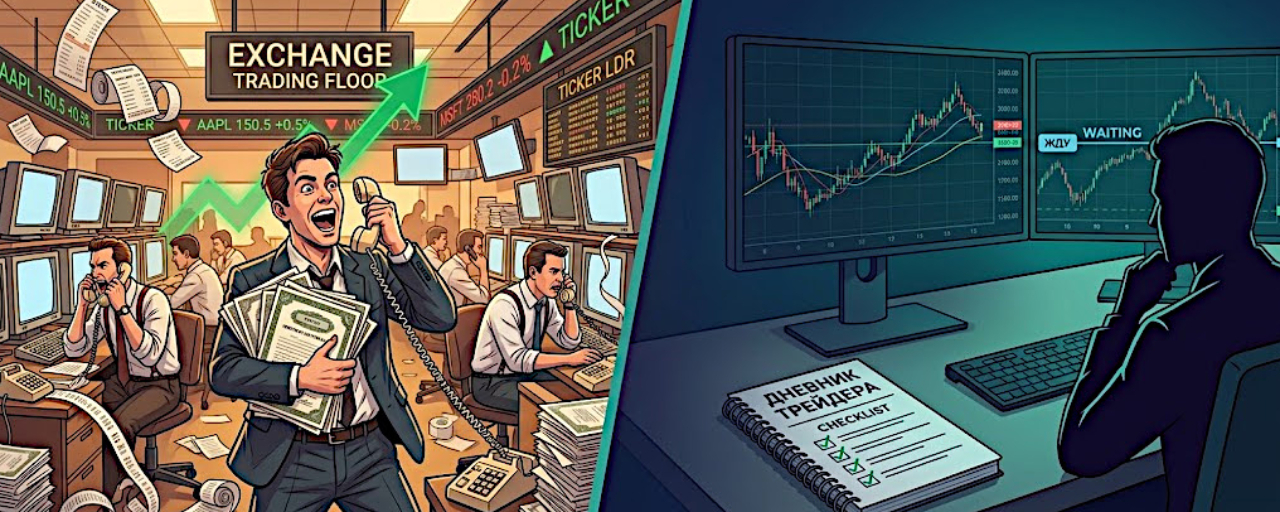
Article
Boring Trading: Why Is Real Work in the Market Routine, Not a Movie?Everyone opening a trading terminal for the first time subconsciously expects the atmosphere of a Hollywood blockbuster: brokers shouting, champagne glasses clinking, split-second decisions making millions, and adrenaline sending their pulse through the roof. Cinema has conditioned us to see trading as a wild carousel of emotions and one endless celebration of life.
Boring Trading: Why Is Real Work in the Market Routine, Not a Movie?
Everyone opening a trading terminal for the first time subconsciously expects the atmosphere of a Hollywood blockbuster: brokers shouting, champagne glasses clinking, split-second decisions making millions, and adrenaline sending their pulse through the roof. Cinema has conditioned us to see trading as a wild carousel of emotions and one endless celebration of life.
90
·
--

Article
The Anatomy of Public Challenges: From Turning $50 into a Camry 70 to Silence on the ProfileAnyone subscribed to even a couple of crypto channels has witnessed this epic spectacle at least once: “Turning $50 into $50,000 live! Day 1: jumped in with 50x leverage, goal — a new Camry by the end of the month!”
For the first three days, the profile is literally buzzing with rockets, flames, and ecstatic comments. Then, on the fifth day, a ringing silence sets in. No posts, no analysis, no updates — just an abandoned account and awkward questions from followers disappearing into the void.
The Anatomy of Public Challenges: From Turning $50 into a Camry 70 to Silence on the Profile
Anyone subscribed to even a couple of crypto channels has witnessed this epic spectacle at least once: “Turning $50 into $50,000 live! Day 1: jumped in with 50x leverage, goal — a new Camry by the end of the month!”
For the first three days, the profile is literally buzzing with rockets, flames, and ecstatic comments. Then, on the fifth day, a ringing silence sets in. No posts, no analysis, no updates — just an abandoned account and awkward questions from followers disappearing into the void.
84
·
--

Article
The “Phantom Capital” Trap: How Numbers on a Screen Drive You CrazyAnyone who has spent even a couple of days dabbling in trading has experienced this fascinating bout of self-deception. You opened a trade, the chart happily started climbing, and the screen displayed a beautiful green profit: +$5,000. At that very moment, your brain does something monumentally stupid—it’s already spent the money. You’re mentally updating your wardrobe, eyeing a shiny new MacBook, and figuring out how many more winning trades stand between you and a sports car.
The “Phantom Capital” Trap: How Numbers on a Screen Drive You Crazy
Anyone who has spent even a couple of days dabbling in trading has experienced this fascinating bout of self-deception. You opened a trade, the chart happily started climbing, and the screen displayed a beautiful green profit: +$5,000. At that very moment, your brain does something monumentally stupid—it’s already spent the money. You’re mentally updating your wardrobe, eyeing a shiny new MacBook, and figuring out how many more winning trades stand between you and a sports car.
102
·
--

Article
The Psychology of Drawdowns: How to Survive a Drawdown and Avoid the Biggest Mistakes?The first serious drawdown is the moment when romantic trading—with dreams of effortless passive income—turns into a harsh drama. Yesterday your portfolio was blooming and smelling sweet; you were imagining yourself as a young Wall Street genius. And today the charts have turned crimson, while an unrealized loss is devouring the profit from the last two months.
The Psychology of Drawdowns: How to Survive a Drawdown and Avoid the Biggest Mistakes?
The first serious drawdown is the moment when romantic trading—with dreams of effortless passive income—turns into a harsh drama. Yesterday your portfolio was blooming and smelling sweet; you were imagining yourself as a young Wall Street genius. And today the charts have turned crimson, while an unrealized loss is devouring the profit from the last two months.
103
·
--
Article
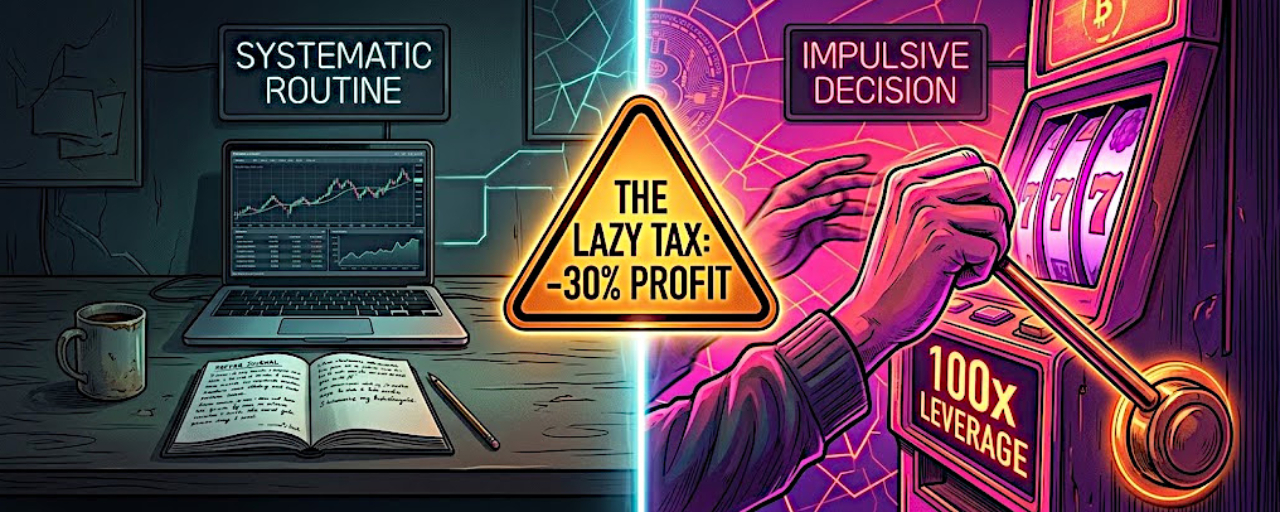
Declining Profits and the “Tax on Laziness”: How Avoiding Routine Turns a Trader into a Gambler?Every trader goes through this classic life cycle. In the first month of trading, you embody discipline: you keep a neat spreadsheet in Excel, calculate Risk/Reward down to the cent, and with an air of intelligence analyze charts in the evenings.
But once you grab a couple of successful take-profits, a dangerous thought clicks in your head: “I already feel this market! Why spend time on this dull bureaucracy?”
Declining Profits and the “Tax on Laziness”: How Avoiding Routine Turns a Trader into a Gambler?
Every trader goes through this classic life cycle. In the first month of trading, you embody discipline: you keep a neat spreadsheet in Excel, calculate Risk/Reward down to the cent, and with an air of intelligence analyze charts in the evenings.
But once you grab a couple of successful take-profits, a dangerous thought clicks in your head: “I already feel this market! Why spend time on this dull bureaucracy?”
111
·
--

Article
The Percent Trap and Hidden PnL: Why Huge ROI on Social Media Is a Scam for Beginners?Everyone who has ever opened crypto social media has choked on their own saliva at the sight of dazzling green badges: “+2500% ROI”, “+5000% on futures in 10 minutes!”. The authors of these posts present themselves as reincarnated Wall Street geniuses, while the comments gather hundreds of admiring viewers with questions like: “Bro, what channel should I join?”, “What leverage are you using?”, “Take me to your training!”.
The Percent Trap and Hidden PnL: Why Huge ROI on Social Media Is a Scam for Beginners?
Everyone who has ever opened crypto social media has choked on their own saliva at the sight of dazzling green badges: “+2500% ROI”, “+5000% on futures in 10 minutes!”. The authors of these posts present themselves as reincarnated Wall Street geniuses, while the comments gather hundreds of admiring viewers with questions like: “Bro, what channel should I join?”, “What leverage are you using?”, “Take me to your training!”.
104
·
--
Article
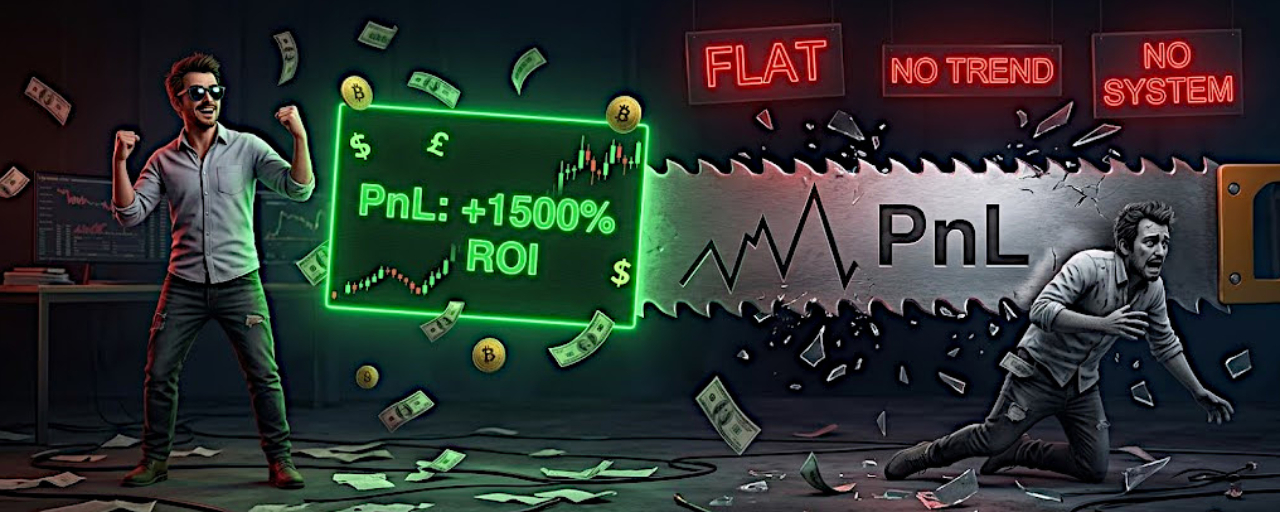
The illusion of genius: Why a beautiful PnL in a bull market burns out at the first consolidation?Each bullish cycle creates hundreds of new “financial geniuses.” The social feed immediately fills with green screenshots showing a +1500% profit, boastful reports about buying in within the first hours, and pompous trading tips from gurus with a three-week track record. At this moment, a newcomer genuinely thinks they’ve cracked the market, while Warren Buffett in the background is just a grandfather stuck in the past.
The illusion of genius: Why a beautiful PnL in a bull market burns out at the first consolidation?
Each bullish cycle creates hundreds of new “financial geniuses.” The social feed immediately fills with green screenshots showing a +1500% profit, boastful reports about buying in within the first hours, and pompous trading tips from gurus with a three-week track record. At this moment, a newcomer genuinely thinks they’ve cracked the market, while Warren Buffett in the background is just a grandfather stuck in the past.
99
·
--

Article
The “green candle” syndrome: How FOMO and the chase for instant x100 burn a deposit?In the history of cryptocurrencies, there’s a legendary monument to human impatience: in 2010, programmer Laszlo Hanyecz traded 10,000 BTC for two pizzas. Today, this story inspires either respectful awe or a nervous tic. But it clearly shows how the market has changed. In the early days of crypto, people saw it as a fundamental technology and were willing to pay with thousands of coins for a real meal—whereas today the market is overrun by hunters of “easy x100 in 15 minutes,” ready to put up their apartment for a coin with an avatar of a sad toad.
The “green candle” syndrome: How FOMO and the chase for instant x100 burn a deposit?
In the history of cryptocurrencies, there’s a legendary monument to human impatience: in 2010, programmer Laszlo Hanyecz traded 10,000 BTC for two pizzas. Today, this story inspires either respectful awe or a nervous tic. But it clearly shows how the market has changed. In the early days of crypto, people saw it as a fundamental technology and were willing to pay with thousands of coins for a real meal—whereas today the market is overrun by hunters of “easy x100 in 15 minutes,” ready to put up their apartment for a coin with an avatar of a sad toad.
98
·
--
Article
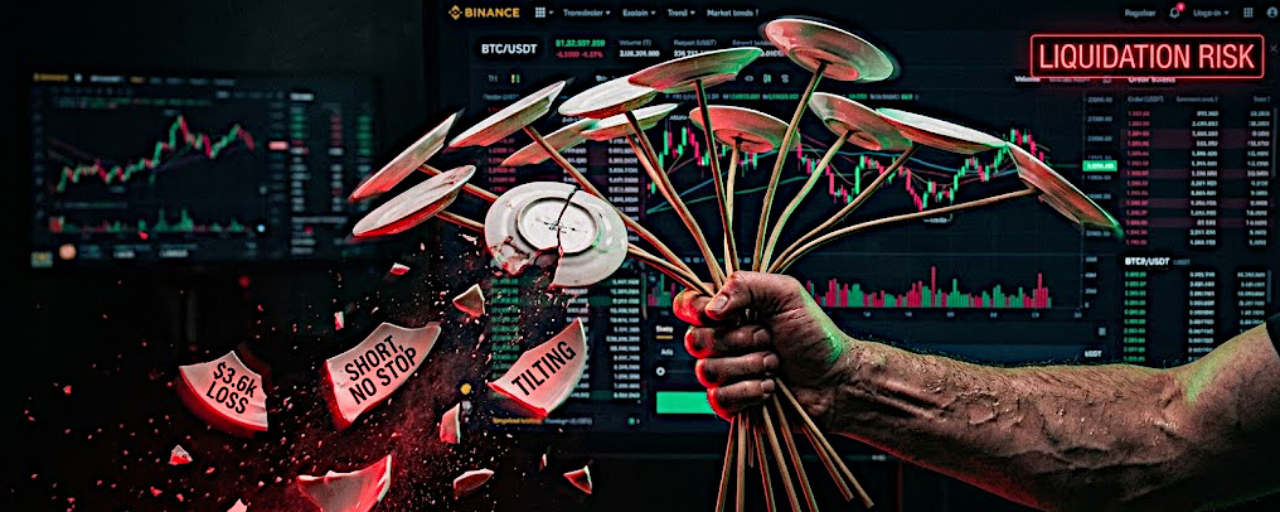
The illusion of easy money: Why chasing 16 “hares” and being driven by emotions turns a trader into a gambler?The crypto community “tape” is an endless showcase of fairy-tale riches, where every first person who showed up ends up at the very bottom, and every second one grabs +500% on 50x leverage starting from a $5 deposit. Against this backdrop, a newcomer develops the most dangerous illusion: the market is an easy video game with withdrawals, and trading is a fun amusement ride where all you have to do is press the green and red buttons at just the right time.
The illusion of easy money: Why chasing 16 “hares” and being driven by emotions turns a trader into a gambler?
The crypto community “tape” is an endless showcase of fairy-tale riches, where every first person who showed up ends up at the very bottom, and every second one grabs +500% on 50x leverage starting from a $5 deposit. Against this backdrop, a newcomer develops the most dangerous illusion: the market is an easy video game with withdrawals, and trading is a fun amusement ride where all you have to do is press the green and red buttons at just the right time.
110
·
--
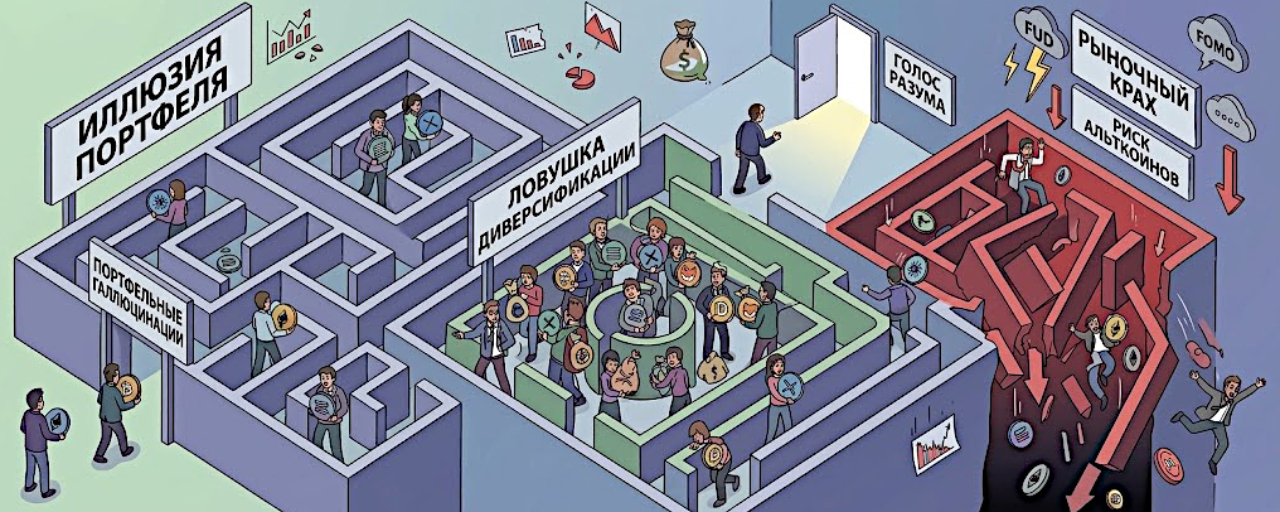
Article
Portfolio Delusions: The Illusion of Diversification and How Newcomers Get Taken During Alt SeasonsWhen a beginner hears the wise word “diversification” for the first time, an image instantly flashes in their mind: a seasoned investor from Wall Street in a perfect suit. They open a terminal and, with a proud air, smear their modest deposit across 10–15 different altcoins from the top 50, showing off as if they were Warren Buffett. They genuinely believe they’ve built an impregnable financial fortress: the projects are different, the names are loud, the logos are even prettier than one another!
Portfolio Delusions: The Illusion of Diversification and How Newcomers Get Taken During Alt Seasons
When a beginner hears the wise word “diversification” for the first time, an image instantly flashes in their mind: a seasoned investor from Wall Street in a perfect suit. They open a terminal and, with a proud air, smear their modest deposit across 10–15 different altcoins from the top 50, showing off as if they were Warren Buffett. They genuinely believe they’ve built an impregnable financial fortress: the projects are different, the names are loud, the logos are even prettier than one another!
94
Log in to explore more content
Join global crypto users on Binance Square
⚡️ Get latest and useful information about crypto.
💬 Trusted by the world’s largest crypto exchange.
👍 Discover real insights from verified creators.
Email / Phone number
Trending Topics
BitcoinAndStocksSlipAgainAmidTrump’sTariffPlans
50,098 views
698 Discussing
U.S. Plans New Tariffs on China, EU and Others; Bitcoin Slips Below $60,000 and Nasdaq Falls 1.5%
Binance News
·13 Likes
·12.1k views
WillOctCorePCEShiftFedHikeExpectations?
350,576 views
2,311 Discussing
JensenHuangSaysNvidiaDoesn’tNeedASuccessionPlan
33,009 views
434 Discussing