

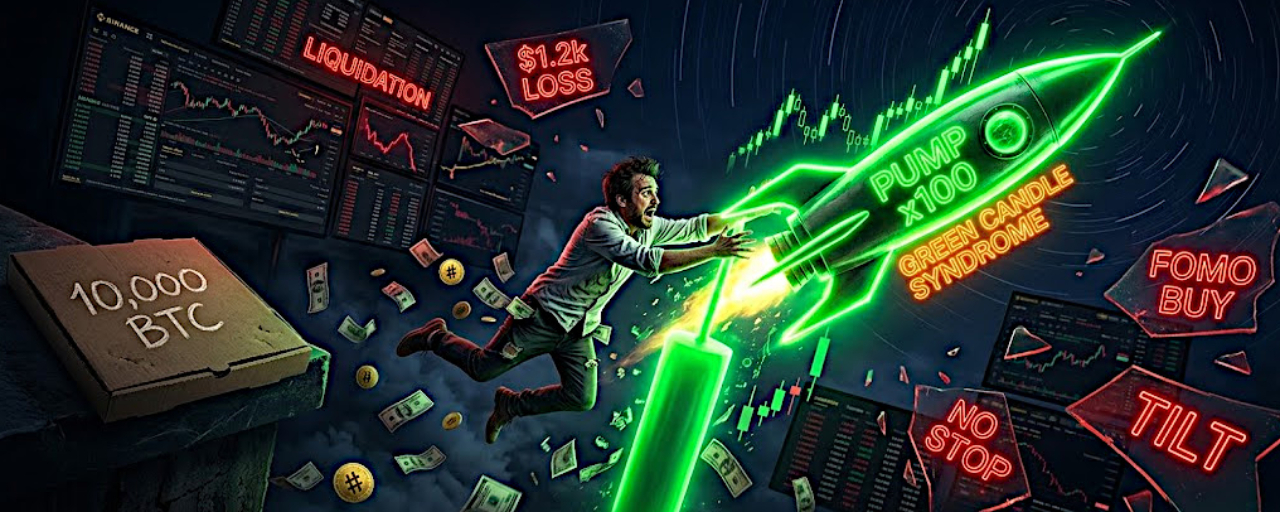

In the history of cryptocurrencies, there’s a legendary monument to human impatience: in 2010, programmer Laszlo Hanyecz traded 10,000 BTC for two pizzas. Today, this story inspires either respectful awe or a nervous tic. But it clearly shows how the market has changed. In the early days of crypto, people saw it as a fundamental technology and were willing to pay with thousands of coins for a real meal—whereas today the market is overrun by hunters of “easy x100 in 15 minutes,” ready to put up their apartment for a coin with an avatar of a sad toad.
Let’s break down three psychological shifts that turn mindful trading into a frantic chase for a green candle at its very peak.
1. The “moving train” effect (FOMO) and buying at the absolute highs
The main trigger for an emotional beginner is seeing a vertical green candle that has already drawn +80% in just a couple of hours. In an instant, a panic siren goes off in their head: “Everyone is getting rich while I’m eating instant noodles!”
Psychology: The brain creates the illusion that this growth is an endless engine, and that the one who doesn’t buy right now will be left out of life.
Reality: An impulsive vertical column is not “the beginning of a great journey,” but the moment when major capital happily unloads its wagons onto the shoulders of an enthusiastic crowd. Entering the position at the very peak of media noise and without a stop-loss, the trader is buying not a future, but someone else’s guaranteed profit. And as soon as the fuel of other people’s hopes runs out, a refreshing drip follows—turning the “successful investor” into a miserable long-term holder.
2. Misplaced priorities: From technology to plain old gambling
Once, crypto attracted enthusiasts with the idea of decentralization and financial freedom. Today, though, the community feed is overflowing with stories about how yet another avatar-hamster memecoin made x1000 overnight while its creator slept.
Psychology: Distortion of the perception of normal. When a person sees abnormal spikes on shitcoins every day, system-wide returns of 5–10% per month start to seem like “boring little routine for old folks.”
Reality: Chasing super-profits, the trader completely ignores fundamentals and risks, pouring deposits into utterly empty one-day tokens. But math is unforgiving: out of a thousand memecoins, one fires off, and the other 999 quietly go under with the money of gullible participants. Treating crypto like going to a casino always ends the same way—with obedient surrender of your deposit in favor of the venue.
3. The “quick dopamine” trap and the rejection of patience
The modern crypto market has trained participants to expect instant results. If the position doesn’t deliver +20% within the first 15 minutes after entry, the emotional trader starts to feel an uncontrollable itch—closing the trade for a tiny loss and frantically jumping into another “faster” asset.
Psychology: Dependence on quick dopamine. Trading gets confused with a video game, where mouse clicks should immediately be met with a fireworks display of golden coins on the screen.
Reality: Real professional trading is the ability to tediously wait for your setup and hold to planned goals for hours. Constant fuss, chaotic re-entries, and trying to jump onto any moving chart lead only to the exchange getting richer on commissions and to the regular locking in of losses at every whim of the price.
Voice of reason:
A green candle on the chart isn’t a call to buy—it’s a signal that it’s already too late to enter the trade.
Missed the move—forget it: On the market, dozens of new setups appear every day. Trying to chase after a rocket that’s taking off on pure enthusiasm is a surefire way to get burned.
Calculate risks, not future millions: Before you press the “Buy” button, don’t determine the price of a new sports car—determine the amount you’re willing to lose painlessly in a negative scenario.
Don’t confuse investing with gambling: If a project survives only on hype and memes, treat it like a lottery ticket—not as the foundation of your financial future.
#Трейдинг #BinanceSquare #ПсихологияТрейдинга #УправлениеРисками #Write2Earn