

ON _THE_MOVE
1.3k Posts

ON _THE_MOVE
Report
Block User
2 Following
2.3K+ Followers
882 Liked
Posts
All
Live
·
--
Bullish
I’ve been around crypto long enough to know that a big green candle can make everyone suddenly sound certain. That’s exactly why I’m trying not to get carried away with $ZETA right now.
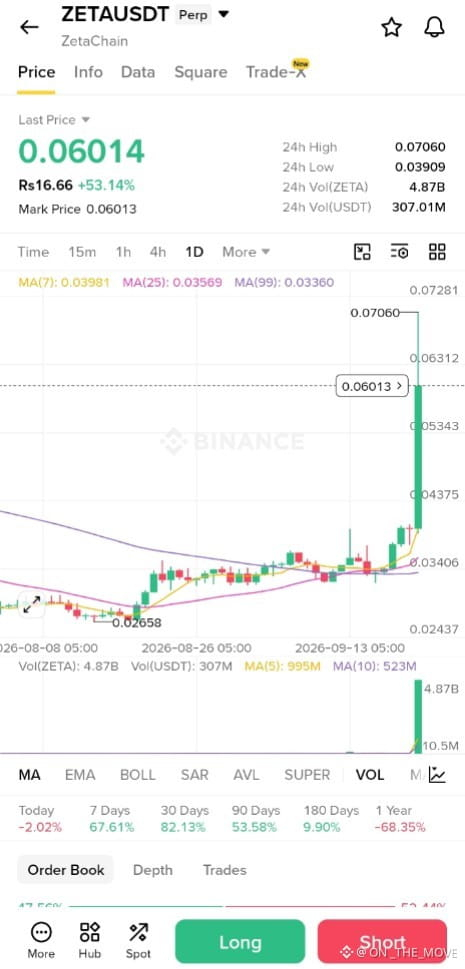
Still, I keep coming back to this chart. ZETAUSDT is sitting around $0.06014, up 53.14% in 24 hours, after dropping as low as $0.03909 and touching $0.07060. What really caught my eye wasn’t the percentage alone. It was the volume — around 4.87B ZETA, with roughly $307M in USDT volume. That’s not something I can casually ignore.
I’ve seen these moves before. Price spends weeks going nowhere, then suddenly one candle changes the entire mood. People rush in with explanations, targets, and narratives, usually after the move has already happened.
And yet, I’m not completely dismissing this one. The chart shows ZETA still well above its recent moving averages, while the bigger picture is much less comfortable. It’s up 67.61% over seven days, but still down 68.35% over a year.
That contrast tells me to stay grounded. I’m not sure what comes next, and I don’t fully trust a move this sharp. But something about the volume and sudden change in momentum feels worth watching. Not chasing. Just watching.$ZETA
{future}(ZETAUSDT)
#NEARRisesNearly80%InAWeek #ECBStartsBlockchainEuroSettlement #SouthAfricaProposesCryptoExchangeControls #SolanaCutsTargetSlotTimeTo250ms #CanaryFilesSecondAmendmentForStakedSEIETF
I’ve been around crypto long enough to know that a big green candle can make everyone suddenly sound certain. That’s exactly why I’m trying not to get carried away with $ZETA right now.
Still, I keep coming back to this chart. ZETAUSDT is sitting around $0.06014, up 53.14% in 24 hours, after dropping as low as $0.03909 and touching $0.07060. What really caught my eye wasn’t the percentage alone. It was the volume — around 4.87B ZETA, with roughly $307M in USDT volume. That’s not something I can casually ignore.
I’ve seen these moves before. Price spends weeks going nowhere, then suddenly one candle changes the entire mood. People rush in with explanations, targets, and narratives, usually after the move has already happened.
And yet, I’m not completely dismissing this one. The chart shows ZETA still well above its recent moving averages, while the bigger picture is much less comfortable. It’s up 67.61% over seven days, but still down 68.35% over a year.
That contrast tells me to stay grounded. I’m not sure what comes next, and I don’t fully trust a move this sharp. But something about the volume and sudden change in momentum feels worth watching. Not chasing. Just watching.$ZETA
#NEARRisesNearly80%InAWeek #ECBStartsBlockchainEuroSettlement #SouthAfricaProposesCryptoExchangeControls #SolanaCutsTargetSlotTimeTo250ms #CanaryFilesSecondAmendmentForStakedSEIETF
Still, I keep coming back to this chart. ZETAUSDT is sitting around $0.06014, up 53.14% in 24 hours, after dropping as low as $0.03909 and touching $0.07060. What really caught my eye wasn’t the percentage alone. It was the volume — around 4.87B ZETA, with roughly $307M in USDT volume. That’s not something I can casually ignore.
I’ve seen these moves before. Price spends weeks going nowhere, then suddenly one candle changes the entire mood. People rush in with explanations, targets, and narratives, usually after the move has already happened.
And yet, I’m not completely dismissing this one. The chart shows ZETA still well above its recent moving averages, while the bigger picture is much less comfortable. It’s up 67.61% over seven days, but still down 68.35% over a year.
That contrast tells me to stay grounded. I’m not sure what comes next, and I don’t fully trust a move this sharp. But something about the volume and sudden change in momentum feels worth watching. Not chasing. Just watching.$ZETA
#NEARRisesNearly80%InAWeek #ECBStartsBlockchainEuroSettlement #SouthAfricaProposesCryptoExchangeControls #SolanaCutsTargetSlotTimeTo250ms #CanaryFilesSecondAmendmentForStakedSEIETF
222
·
--
Bullish
I've been around crypto long enough to know that a big green candle can make everyone suddenly sound certain. $SYN is one of those charts that makes me slow down instead.
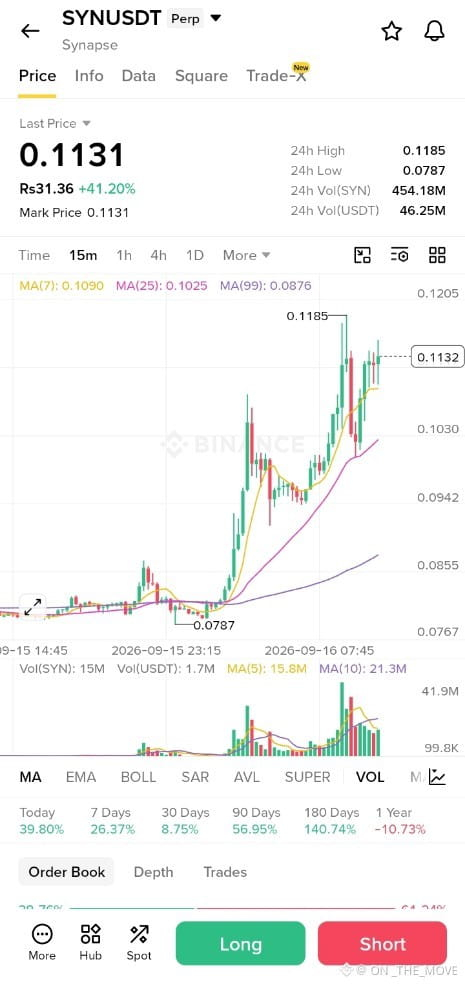
The move is hard to ignore. The screenshot shows SYN around $0.1131, up more than 41% in 24 hours, after dropping as low as $0.0787 and pushing up to $0.1185. Volume has also jumped, and the price is sitting above the short-term moving averages.
But honestly, I've seen this movie before. A sharp move creates excitement, people start explaining it, and suddenly a few candles become a whole narrative. Then the market pulls back and reminds everyone that crypto doesn't owe us a clean story.
What interests me is what happens next. Can SYN hold these levels when the initial rush fades? Or was this simply another burst of liquidity and attention?
I'm not sure yet. I don't fully trust the move, but I also don't want to dismiss it. After watching enough cycles, I've learned that sometimes the most useful thing to do is simply keep watching.
{spot}(SYNUSDT)
$AKE
{future}(AKEUSDT)
$LSK
{spot}(LSKUSDT)
#FedRateWatch #StrategyMarketCapPassesFord #ClarityActOddsHalveOnPolymarket #USSenateBlocksClarityAct #ArgentinaCommitsToOECDCryptoReportingBy2029
I've been around crypto long enough to know that a big green candle can make everyone suddenly sound certain. $SYN is one of those charts that makes me slow down instead.
The move is hard to ignore. The screenshot shows SYN around $0.1131, up more than 41% in 24 hours, after dropping as low as $0.0787 and pushing up to $0.1185. Volume has also jumped, and the price is sitting above the short-term moving averages.
But honestly, I've seen this movie before. A sharp move creates excitement, people start explaining it, and suddenly a few candles become a whole narrative. Then the market pulls back and reminds everyone that crypto doesn't owe us a clean story.
What interests me is what happens next. Can SYN hold these levels when the initial rush fades? Or was this simply another burst of liquidity and attention?
I'm not sure yet. I don't fully trust the move, but I also don't want to dismiss it. After watching enough cycles, I've learned that sometimes the most useful thing to do is simply keep watching.
$AKE
$LSK
#FedRateWatch #StrategyMarketCapPassesFord #ClarityActOddsHalveOnPolymarket #USSenateBlocksClarityAct #ArgentinaCommitsToOECDCryptoReportingBy2029
The move is hard to ignore. The screenshot shows SYN around $0.1131, up more than 41% in 24 hours, after dropping as low as $0.0787 and pushing up to $0.1185. Volume has also jumped, and the price is sitting above the short-term moving averages.
But honestly, I've seen this movie before. A sharp move creates excitement, people start explaining it, and suddenly a few candles become a whole narrative. Then the market pulls back and reminds everyone that crypto doesn't owe us a clean story.
What interests me is what happens next. Can SYN hold these levels when the initial rush fades? Or was this simply another burst of liquidity and attention?
I'm not sure yet. I don't fully trust the move, but I also don't want to dismiss it. After watching enough cycles, I've learned that sometimes the most useful thing to do is simply keep watching.
$AKE
$LSK
#FedRateWatch #StrategyMarketCapPassesFord #ClarityActOddsHalveOnPolymarket #USSenateBlocksClarityAct #ArgentinaCommitsToOECDCryptoReportingBy2029
257
·
--
Bullish
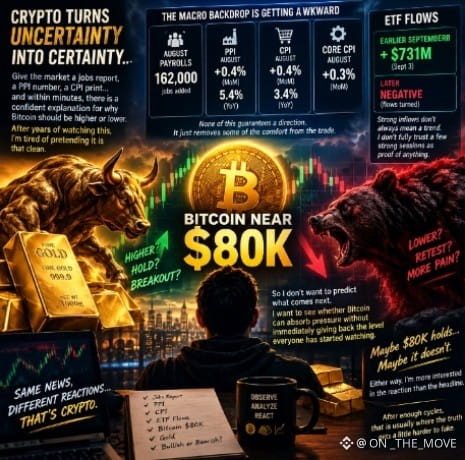
I keep noticing how quickly crypto turns uncertainty into certainty. Give the market a jobs report, a PPI number, a CPI print, and within minutes there is a confident explanation for why Bitcoin should be higher or lower. After years of watching this, I’m tired of pretending it is that clean.
Bitcoin sitting near $80K is what interests me. The macro backdrop is getting awkward: August payrolls came in at 162,000, PPI rose 0.4% in August and was 5.4% higher year over year, and August CPI rose 0.4% monthly and 3.4% annually. Core CPI also picked up 0.3% for the month. None of this guarantees a direction. It just removes some of the comfort from the trade.
I've seen markets rally on bad news, fall on good news, and reverse both moves before lunch. So I don't want to predict what comes next. I want to see whether Bitcoin can absorb pressure without immediately giving back the level everyone has started watching.
The ETF data is another reason I'm staying cautious. Strong inflows showed up earlier in September, including about $731 million on September 3, but flows later turned negative. I don't fully trust a few strong sessions as proof of anything.
Maybe $80K holds and the market quietly absorbs all this. Maybe it doesn't. Either way, I'm more interested in the reaction than the headline. After enough cycles, that is usually where the truth gets a little harder to fake.
$牛来
{spot}(牛来USDT)
$LAB
{future}(LABUSDT)
$4Stock
{alpha}(560xd270d4e1ec6e6e0d28c0ecb8be966ec75997ffff)
#CPIWatch #CLARITYActRevisionToRuleNonDeFiControllers #USToSanctionBigBankMonday #BlockstreamRefusesToPayRansomToLiquidAttacker #OracleJumpsOver6%OnEarningsBeat
I keep noticing how quickly crypto turns uncertainty into certainty. Give the market a jobs report, a PPI number, a CPI print, and within minutes there is a confident explanation for why Bitcoin should be higher or lower. After years of watching this, I’m tired of pretending it is that clean.
Bitcoin sitting near $80K is what interests me. The macro backdrop is getting awkward: August payrolls came in at 162,000, PPI rose 0.4% in August and was 5.4% higher year over year, and August CPI rose 0.4% monthly and 3.4% annually. Core CPI also picked up 0.3% for the month. None of this guarantees a direction. It just removes some of the comfort from the trade.
I've seen markets rally on bad news, fall on good news, and reverse both moves before lunch. So I don't want to predict what comes next. I want to see whether Bitcoin can absorb pressure without immediately giving back the level everyone has started watching.
The ETF data is another reason I'm staying cautious. Strong inflows showed up earlier in September, including about $731 million on September 3, but flows later turned negative. I don't fully trust a few strong sessions as proof of anything.
Maybe $80K holds and the market quietly absorbs all this. Maybe it doesn't. Either way, I'm more interested in the reaction than the headline. After enough cycles, that is usually where the truth gets a little harder to fake.
$牛来
$LAB
$4Stock
#CPIWatch #CLARITYActRevisionToRuleNonDeFiControllers #USToSanctionBigBankMonday #BlockstreamRefusesToPayRansomToLiquidAttacker #OracleJumpsOver6%OnEarningsBeat
Bitcoin sitting near $80K is what interests me. The macro backdrop is getting awkward: August payrolls came in at 162,000, PPI rose 0.4% in August and was 5.4% higher year over year, and August CPI rose 0.4% monthly and 3.4% annually. Core CPI also picked up 0.3% for the month. None of this guarantees a direction. It just removes some of the comfort from the trade.
I've seen markets rally on bad news, fall on good news, and reverse both moves before lunch. So I don't want to predict what comes next. I want to see whether Bitcoin can absorb pressure without immediately giving back the level everyone has started watching.
The ETF data is another reason I'm staying cautious. Strong inflows showed up earlier in September, including about $731 million on September 3, but flows later turned negative. I don't fully trust a few strong sessions as proof of anything.
Maybe $80K holds and the market quietly absorbs all this. Maybe it doesn't. Either way, I'm more interested in the reaction than the headline. After enough cycles, that is usually where the truth gets a little harder to fake.
$牛来
$LAB
$4Stock
#CPIWatch #CLARITYActRevisionToRuleNonDeFiControllers #USToSanctionBigBankMonday #BlockstreamRefusesToPayRansomToLiquidAttacker #OracleJumpsOver6%OnEarningsBeat
1
3
901
·
--
Bullish
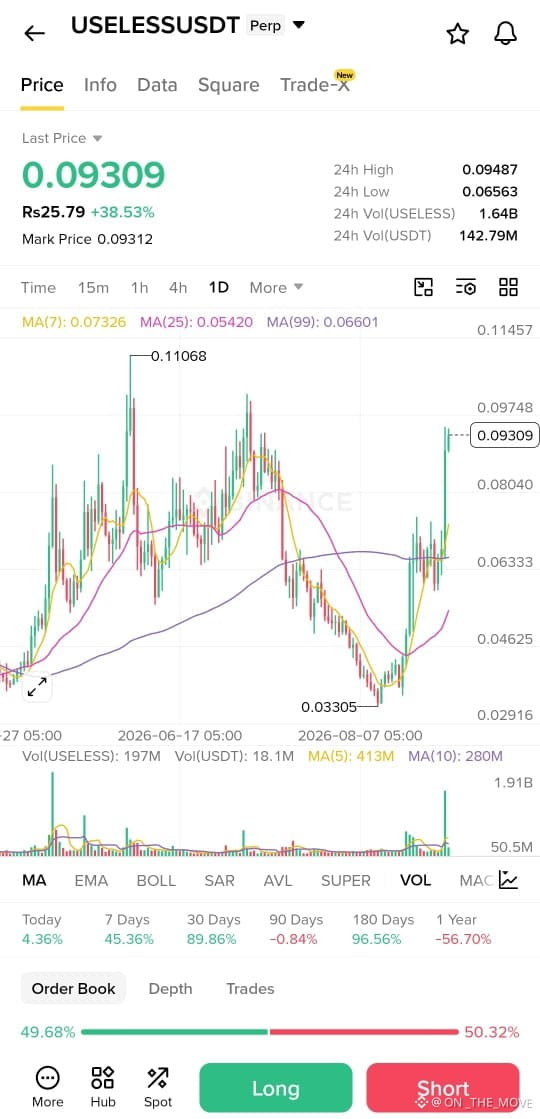
$USELESS USDT Perpetual is showing strong bullish momentum. Price is 0.09309, up 38.53% in 24 hours, with a Mark Price of 0.09312. The 24h high is 0.09487 and low is 0.06563, while volume reached 1.64B USELESS and 142.79M USDT. On the 1D chart, MA(7) is 0.07326, MA(25) is 0.05420, and MA(99) is 0.06601, placing price above all major moving averages. The chart shows a recent breakout from the 0.03305 low toward the 0.11068 historical high, with a major volume spike supporting the move. Performance is +4.36% today, +45.36% over 7 days, +89.86% over 30 days, -0.84% over 90 days, +96.56% over 180 days, and -56.70% over 1 year. Order-book balance is nearly neutral: 49.68% buy versus 50.32% sell. Traders should watch 0.09487 resistance and 0.08040, 0.06601, and 0.06333 support levels, while managing volatility and risk carefully closely.
{future}(USELESSUSDT)
#RussiaStartsLargeScaleDigitalRubleRolloutSep1 #BitcoinUp23%InAugustOutperformingGoldAndStocks #SaylorHintsStrategyBitcoinBuy #IranStrikesUSBasesInJordan #USFundsAlcoaGalliumPlantInAustralia
$USELESS USDT Perpetual is showing strong bullish momentum. Price is 0.09309, up 38.53% in 24 hours, with a Mark Price of 0.09312. The 24h high is 0.09487 and low is 0.06563, while volume reached 1.64B USELESS and 142.79M USDT. On the 1D chart, MA(7) is 0.07326, MA(25) is 0.05420, and MA(99) is 0.06601, placing price above all major moving averages. The chart shows a recent breakout from the 0.03305 low toward the 0.11068 historical high, with a major volume spike supporting the move. Performance is +4.36% today, +45.36% over 7 days, +89.86% over 30 days, -0.84% over 90 days, +96.56% over 180 days, and -56.70% over 1 year. Order-book balance is nearly neutral: 49.68% buy versus 50.32% sell. Traders should watch 0.09487 resistance and 0.08040, 0.06601, and 0.06333 support levels, while managing volatility and risk carefully closely.
#RussiaStartsLargeScaleDigitalRubleRolloutSep1 #BitcoinUp23%InAugustOutperformingGoldAndStocks #SaylorHintsStrategyBitcoinBuy #IranStrikesUSBasesInJordan #USFundsAlcoaGalliumPlantInAustralia
#RussiaStartsLargeScaleDigitalRubleRolloutSep1 #BitcoinUp23%InAugustOutperformingGoldAndStocks #SaylorHintsStrategyBitcoinBuy #IranStrikesUSBasesInJordan #USFundsAlcoaGalliumPlantInAustralia
158
·
--
Bullish
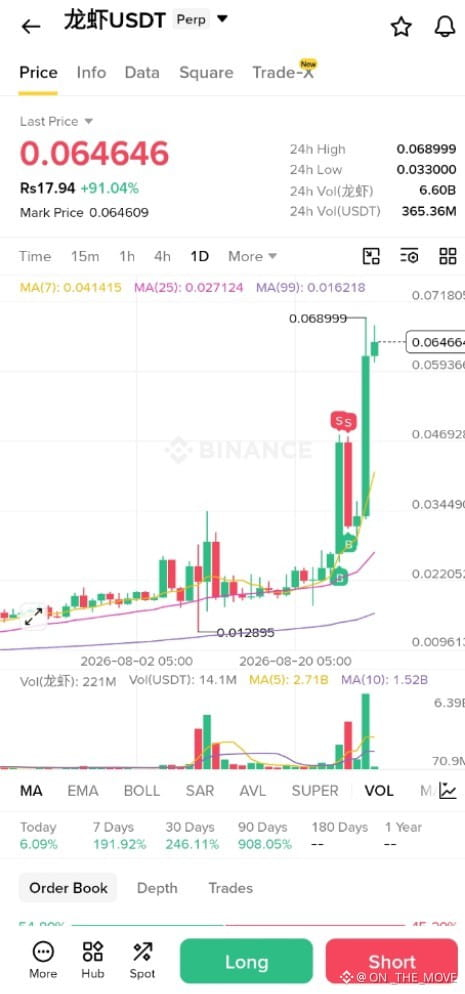
🚨 $龙虾 USDT Perpetual is making noise!
The chart shows a last price of 0.064646 USDT, up a massive 91.04% in 24 hours, with a 24h high of 0.068999 and low of 0.033000. Trading activity is explosive: 6.60B DragonFly volume, equivalent to 365.36M USDT. Price is trading far above the MA(7) at 0.041415, MA(25) at 0.027124, and MA(99) at 0.016218, signaling powerful momentum—but also extreme volatility.
The daily chart shows a sharp breakout from the 0.02–0.03 area toward 0.069, while volume has surged dramatically. Performance is equally wild: +6.09% today, +191.92% over 7 days, +246.11% over 30 days, and +908.05% over 90 days.
🔥 Momentum is undeniable, but risk is huge. Trade carefully and manage leverage. Watch resistance near 0.069 and avoid chasing candles after parabolic moves.
{future}(龙虾USDT)
#SOLJumps20%OnTheWeek #CaliforniaBillWouldBarOfficialMemeCoins #GoldRisesAbout14%InAugust #QatarExtendsLNGForceMajeureByOneMonth #WarshSaysInflationIsFedTopFocus
🚨 $龙虾 USDT Perpetual is making noise!
The chart shows a last price of 0.064646 USDT, up a massive 91.04% in 24 hours, with a 24h high of 0.068999 and low of 0.033000. Trading activity is explosive: 6.60B DragonFly volume, equivalent to 365.36M USDT. Price is trading far above the MA(7) at 0.041415, MA(25) at 0.027124, and MA(99) at 0.016218, signaling powerful momentum—but also extreme volatility.
The daily chart shows a sharp breakout from the 0.02–0.03 area toward 0.069, while volume has surged dramatically. Performance is equally wild: +6.09% today, +191.92% over 7 days, +246.11% over 30 days, and +908.05% over 90 days.
🔥 Momentum is undeniable, but risk is huge. Trade carefully and manage leverage. Watch resistance near 0.069 and avoid chasing candles after parabolic moves.
#SOLJumps20%OnTheWeek #CaliforniaBillWouldBarOfficialMemeCoins #GoldRisesAbout14%InAugust #QatarExtendsLNGForceMajeureByOneMonth #WarshSaysInflationIsFedTopFocus
The chart shows a last price of 0.064646 USDT, up a massive 91.04% in 24 hours, with a 24h high of 0.068999 and low of 0.033000. Trading activity is explosive: 6.60B DragonFly volume, equivalent to 365.36M USDT. Price is trading far above the MA(7) at 0.041415, MA(25) at 0.027124, and MA(99) at 0.016218, signaling powerful momentum—but also extreme volatility.
The daily chart shows a sharp breakout from the 0.02–0.03 area toward 0.069, while volume has surged dramatically. Performance is equally wild: +6.09% today, +191.92% over 7 days, +246.11% over 30 days, and +908.05% over 90 days.
🔥 Momentum is undeniable, but risk is huge. Trade carefully and manage leverage. Watch resistance near 0.069 and avoid chasing candles after parabolic moves.
#SOLJumps20%OnTheWeek #CaliforniaBillWouldBarOfficialMemeCoins #GoldRisesAbout14%InAugust #QatarExtendsLNGForceMajeureByOneMonth #WarshSaysInflationIsFedTopFocus
1
596
·
--
Bullish
Verified
I've been watching crypto long enough to know that “consensus” often gets explained like a clean rule on a whiteboard, while the real network is usually much messier.
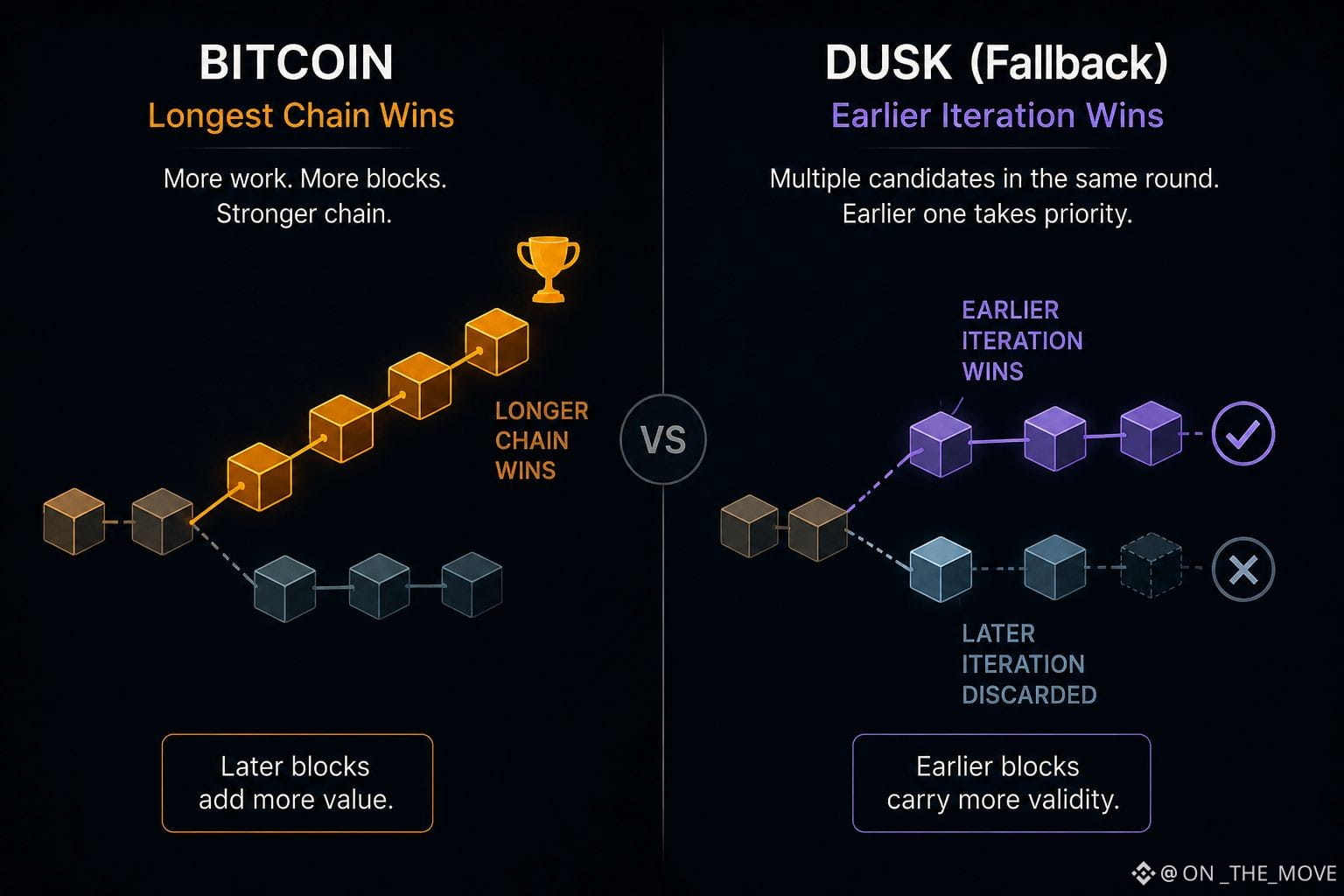
That’s why Dusk’s Fallback caught my attention. Bitcoin’s familiar instinct is to let more cumulative proof of work settle a fork: the chain with more work wins. Dusk is dealing with a different problem. Because messages can arrive late or out of order, multiple candidates can reach consensus in the same round. When that happens, the lower iteration gets priority, and nodes can roll back and discard blocks built on the later candidate.
I keep coming back to that. It feels almost backwards after years of hearing that every extra block makes a chain stronger. Here, a later block can end up being the one you regret keeping.
And I don’t think that choice is just about engineering. It seems tied to incentives. If later iterations could win simply by surviving longer, future block producers might have room to gamble on extending a fork. Prioritizing the earlier iteration cuts down that game.
I’m not sure I’d call it purely “the opposite of longest chain wins.” Dusk isn’t measuring goodness by length; it uses iteration priority, with separate finality rules. Still, something about it feels different.
After enough cycles, I don’t trust claims that blockchains “always” resolve forks the same way. They don’t. The fork rule is part of the incentive system.
@Dusk_Foundation #dusk $DUSK
I've been watching crypto long enough to know that “consensus” often gets explained like a clean rule on a whiteboard, while the real network is usually much messier.
That’s why Dusk’s Fallback caught my attention. Bitcoin’s familiar instinct is to let more cumulative proof of work settle a fork: the chain with more work wins. Dusk is dealing with a different problem. Because messages can arrive late or out of order, multiple candidates can reach consensus in the same round. When that happens, the lower iteration gets priority, and nodes can roll back and discard blocks built on the later candidate.
I keep coming back to that. It feels almost backwards after years of hearing that every extra block makes a chain stronger. Here, a later block can end up being the one you regret keeping.
And I don’t think that choice is just about engineering. It seems tied to incentives. If later iterations could win simply by surviving longer, future block producers might have room to gamble on extending a fork. Prioritizing the earlier iteration cuts down that game.
I’m not sure I’d call it purely “the opposite of longest chain wins.” Dusk isn’t measuring goodness by length; it uses iteration priority, with separate finality rules. Still, something about it feels different.
After enough cycles, I don’t trust claims that blockchains “always” resolve forks the same way. They don’t. The fork rule is part of the incentive system.
@Dusk #dusk $DUSK
That’s why Dusk’s Fallback caught my attention. Bitcoin’s familiar instinct is to let more cumulative proof of work settle a fork: the chain with more work wins. Dusk is dealing with a different problem. Because messages can arrive late or out of order, multiple candidates can reach consensus in the same round. When that happens, the lower iteration gets priority, and nodes can roll back and discard blocks built on the later candidate.
I keep coming back to that. It feels almost backwards after years of hearing that every extra block makes a chain stronger. Here, a later block can end up being the one you regret keeping.
And I don’t think that choice is just about engineering. It seems tied to incentives. If later iterations could win simply by surviving longer, future block producers might have room to gamble on extending a fork. Prioritizing the earlier iteration cuts down that game.
I’m not sure I’d call it purely “the opposite of longest chain wins.” Dusk isn’t measuring goodness by length; it uses iteration priority, with separate finality rules. Still, something about it feels different.
After enough cycles, I don’t trust claims that blockchains “always” resolve forks the same way. They don’t. The fork rule is part of the incentive system.
@Dusk #dusk $DUSK
1
223
·
--
Bullish
Verified
I've watched enough crypto cycles to know that decentralization usually comes with an asterisk somewhere. You just have to read far enough to find it.
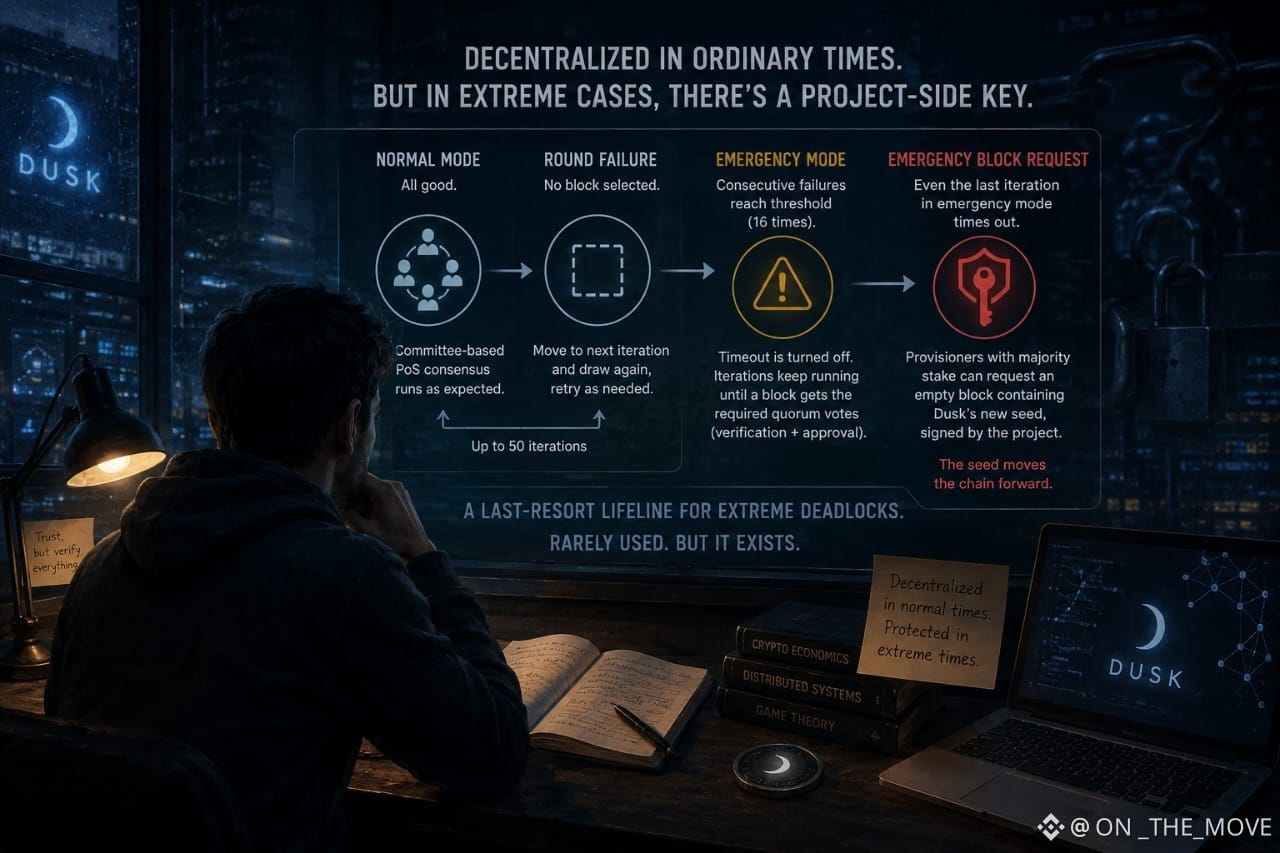
That’s what caught my attention with Dusk. I started looking at its consensus design expecting the usual story: if a round fails, you just try again. And yes, that happens. But after enough consecutive failures, the protocol enters emergency mode and keeps the iterations going until a block finally gets the quorum it needs. The interesting part is what happens when even that fails.
The final fallback is an emergency block. Provisioners holding a majority of stake can request it, and the empty block carries a new seed signed by Dusk itself, verifiable through a global public key.
I’ve seen this kind of compromise before. People call systems decentralized when everything works normally, then quietly accept a special escape hatch for the moment when everything breaks. I don’t automatically think that makes Dusk centralized. Honestly, refusing to have a last-resort mechanism could be worse.
But I’m not sure yet how comfortable I am with that boundary. Who controls the emergency path in practice? How transparent are those requests? Can outsiders independently audit when and why it was triggered?
That’s where my skepticism starts. Not because the fallback exists, but because the most important part of decentralization is often what happens when the normal rules stop working.
And that’s exactly when I start paying closer attention.
@Dusk_Foundation #dusk $DUSK
I've watched enough crypto cycles to know that decentralization usually comes with an asterisk somewhere. You just have to read far enough to find it.
That’s what caught my attention with Dusk. I started looking at its consensus design expecting the usual story: if a round fails, you just try again. And yes, that happens. But after enough consecutive failures, the protocol enters emergency mode and keeps the iterations going until a block finally gets the quorum it needs. The interesting part is what happens when even that fails.
The final fallback is an emergency block. Provisioners holding a majority of stake can request it, and the empty block carries a new seed signed by Dusk itself, verifiable through a global public key.
I’ve seen this kind of compromise before. People call systems decentralized when everything works normally, then quietly accept a special escape hatch for the moment when everything breaks. I don’t automatically think that makes Dusk centralized. Honestly, refusing to have a last-resort mechanism could be worse.
But I’m not sure yet how comfortable I am with that boundary. Who controls the emergency path in practice? How transparent are those requests? Can outsiders independently audit when and why it was triggered?
That’s where my skepticism starts. Not because the fallback exists, but because the most important part of decentralization is often what happens when the normal rules stop working.
And that’s exactly when I start paying closer attention.
@Dusk #dusk $DUSK
That’s what caught my attention with Dusk. I started looking at its consensus design expecting the usual story: if a round fails, you just try again. And yes, that happens. But after enough consecutive failures, the protocol enters emergency mode and keeps the iterations going until a block finally gets the quorum it needs. The interesting part is what happens when even that fails.
The final fallback is an emergency block. Provisioners holding a majority of stake can request it, and the empty block carries a new seed signed by Dusk itself, verifiable through a global public key.
I’ve seen this kind of compromise before. People call systems decentralized when everything works normally, then quietly accept a special escape hatch for the moment when everything breaks. I don’t automatically think that makes Dusk centralized. Honestly, refusing to have a last-resort mechanism could be worse.
But I’m not sure yet how comfortable I am with that boundary. Who controls the emergency path in practice? How transparent are those requests? Can outsiders independently audit when and why it was triggered?
That’s where my skepticism starts. Not because the fallback exists, but because the most important part of decentralization is often what happens when the normal rules stop working.
And that’s exactly when I start paying closer attention.
@Dusk #dusk $DUSK
40
21
325
·
--
Bullish
Verified
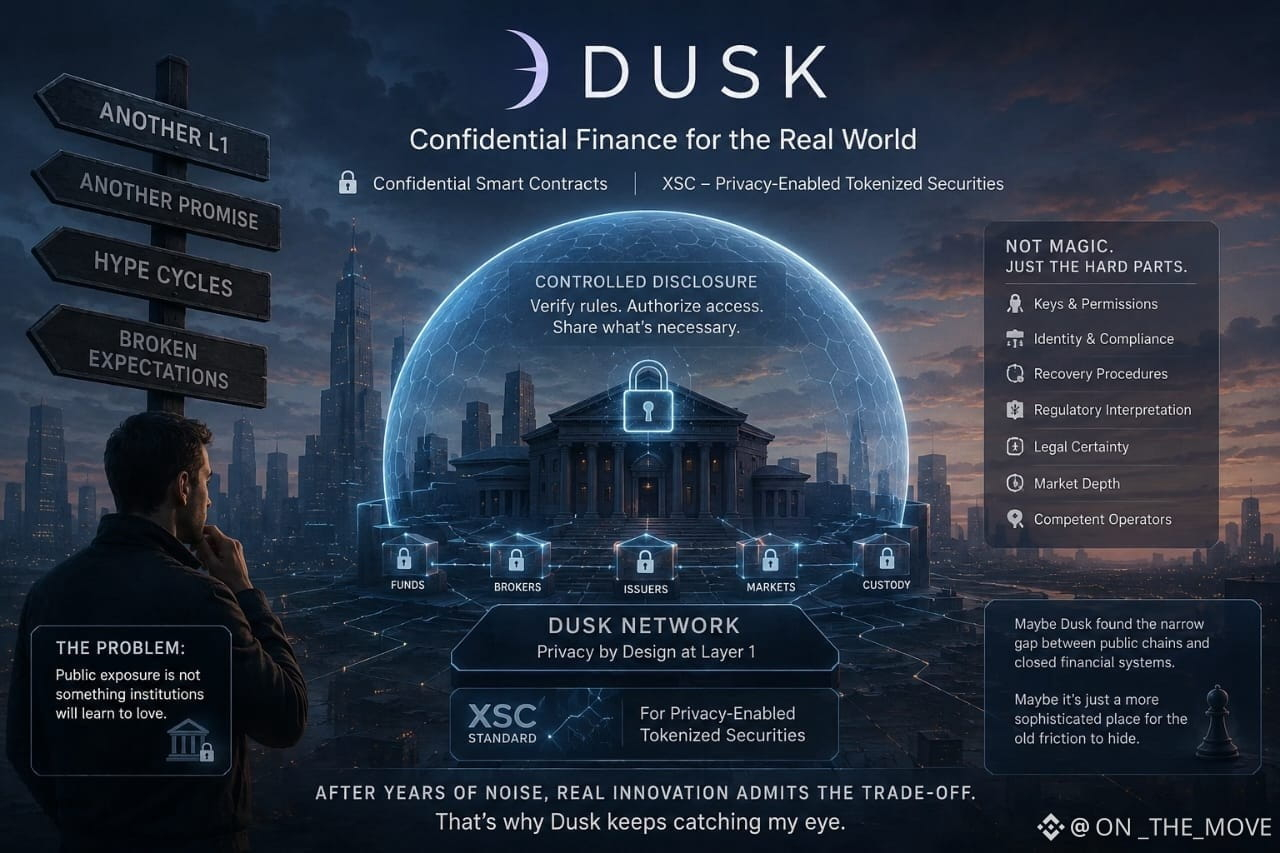
I’m noticing Dusk Network when I would normally stop listening. Another Layer 1, another promise to rebuild finance—I’ve watched that sentence burn through whole market cycles. Most chains act as if public exposure is a feature institutions will learn to love. I doubt it. Funds, brokers and issuers do not want every balance, position and counterparty exposed because settlement moved on-chain.
That is why Dusk keeps catching my eye. It puts confidential smart contracts at the base layer, with the XSC standard for privacy-enabled tokenized securities. The idea is not total secrecy; it is controlled disclosure, where rules can be verified and authorized parties see what they must. Something about this feels different, mainly because the problem is boring and painfully real.
Still, I don’t fully trust it. Financial privacy comes with keys, permissions, identity checks, recovery procedures and regulators who may read the same transaction differently. Code can enforce a transfer rule, but it cannot create legal certainty, market depth or competent operators. I’ve seen this before: elegant infrastructure arrives long before anyone is willing to use it.
Maybe Dusk found the narrow gap between public chains and closed financial systems. Maybe it built a more sophisticated place for the old friction to hide. I’m not sure yet. But after years of noise, I keep noticing projects that admit the trade-off instead of pretending it disappeared.
@Dusk_Foundation #dusk $DUSK
I’m noticing Dusk Network when I would normally stop listening. Another Layer 1, another promise to rebuild finance—I’ve watched that sentence burn through whole market cycles. Most chains act as if public exposure is a feature institutions will learn to love. I doubt it. Funds, brokers and issuers do not want every balance, position and counterparty exposed because settlement moved on-chain.
That is why Dusk keeps catching my eye. It puts confidential smart contracts at the base layer, with the XSC standard for privacy-enabled tokenized securities. The idea is not total secrecy; it is controlled disclosure, where rules can be verified and authorized parties see what they must. Something about this feels different, mainly because the problem is boring and painfully real.
Still, I don’t fully trust it. Financial privacy comes with keys, permissions, identity checks, recovery procedures and regulators who may read the same transaction differently. Code can enforce a transfer rule, but it cannot create legal certainty, market depth or competent operators. I’ve seen this before: elegant infrastructure arrives long before anyone is willing to use it.
Maybe Dusk found the narrow gap between public chains and closed financial systems. Maybe it built a more sophisticated place for the old friction to hide. I’m not sure yet. But after years of noise, I keep noticing projects that admit the trade-off instead of pretending it disappeared.
@Dusk #dusk $DUSK
That is why Dusk keeps catching my eye. It puts confidential smart contracts at the base layer, with the XSC standard for privacy-enabled tokenized securities. The idea is not total secrecy; it is controlled disclosure, where rules can be verified and authorized parties see what they must. Something about this feels different, mainly because the problem is boring and painfully real.
Still, I don’t fully trust it. Financial privacy comes with keys, permissions, identity checks, recovery procedures and regulators who may read the same transaction differently. Code can enforce a transfer rule, but it cannot create legal certainty, market depth or competent operators. I’ve seen this before: elegant infrastructure arrives long before anyone is willing to use it.
Maybe Dusk found the narrow gap between public chains and closed financial systems. Maybe it built a more sophisticated place for the old friction to hide. I’m not sure yet. But after years of noise, I keep noticing projects that admit the trade-off instead of pretending it disappeared.
@Dusk #dusk $DUSK
51
32
1.1k
·
--
Bullish
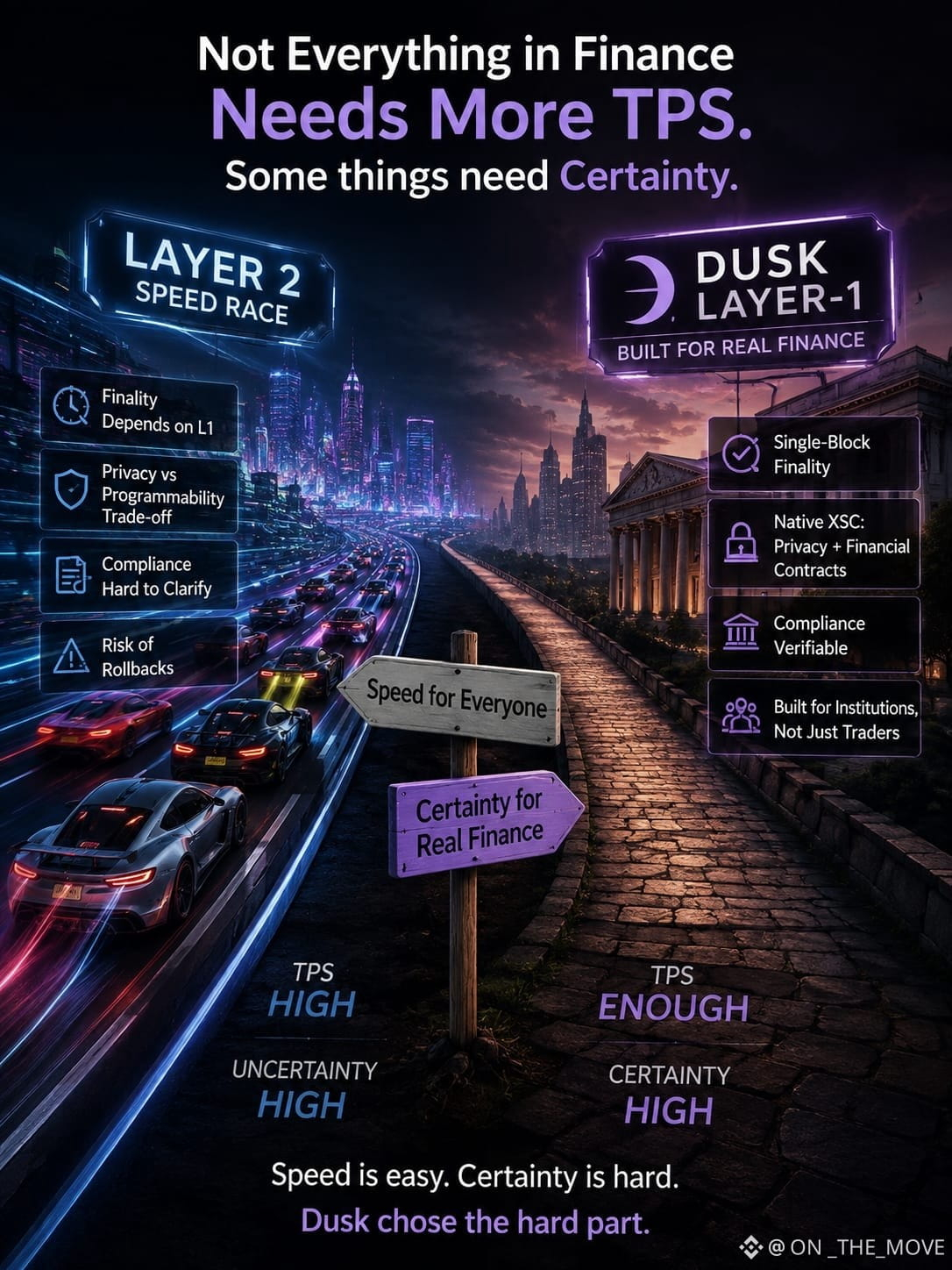
I’ve seen this cycle before. A new chain appears, everyone starts talking about TPS and ecosystem growth, and then most of the noise slowly disappears. So when I first saw Dusk insisting on its own Layer-1, I honestly wondered: why make things harder?
The more I looked into it, the less stubborn it felt. Dusk isn’t really rejecting speed. It seems to be solving for a different problem. In regulated finance, predictable settlement can matter a lot more than another impressive benchmark. Its base layer is built around deterministic finality, while sensitive activity can stay private with selective disclosure when verification is needed.
That part caught my attention. Securities aren’t just tokens sitting in wallets. There are issuance rules, eligibility, transfers, redemptions and audits. Dusk’s XSC design tries to keep those things close to the chain instead of adding privacy and compliance as an afterthought.
I’m still not convinced the market will care, though. Crypto loves things that fit neatly on a chart, and TPS is perfect for that. But I’ve watched enough cycles to know that “fast” doesn’t mean much when custody and settlement still have to be sorted out somewhere else.
So the independent L1 choice makes more sense to me now. Not because Layer 2 is wrong, and definitely not because Dusk is guaranteed to win, but because it looks like Dusk is optimizing for certainty around financial assets rather than simply joining another speed race.
Maybe that’s the part I find interesting: keeping finality, privacy and compliance close to the actual settlement.
That feels more useful to me than another TPS headline.
@Dusk_Foundation #dusk $DUSK
I’ve seen this cycle before. A new chain appears, everyone starts talking about TPS and ecosystem growth, and then most of the noise slowly disappears. So when I first saw Dusk insisting on its own Layer-1, I honestly wondered: why make things harder?
The more I looked into it, the less stubborn it felt. Dusk isn’t really rejecting speed. It seems to be solving for a different problem. In regulated finance, predictable settlement can matter a lot more than another impressive benchmark. Its base layer is built around deterministic finality, while sensitive activity can stay private with selective disclosure when verification is needed.
That part caught my attention. Securities aren’t just tokens sitting in wallets. There are issuance rules, eligibility, transfers, redemptions and audits. Dusk’s XSC design tries to keep those things close to the chain instead of adding privacy and compliance as an afterthought.
I’m still not convinced the market will care, though. Crypto loves things that fit neatly on a chart, and TPS is perfect for that. But I’ve watched enough cycles to know that “fast” doesn’t mean much when custody and settlement still have to be sorted out somewhere else.
So the independent L1 choice makes more sense to me now. Not because Layer 2 is wrong, and definitely not because Dusk is guaranteed to win, but because it looks like Dusk is optimizing for certainty around financial assets rather than simply joining another speed race.
Maybe that’s the part I find interesting: keeping finality, privacy and compliance close to the actual settlement.
That feels more useful to me than another TPS headline.
@Dusk #dusk $DUSK
The more I looked into it, the less stubborn it felt. Dusk isn’t really rejecting speed. It seems to be solving for a different problem. In regulated finance, predictable settlement can matter a lot more than another impressive benchmark. Its base layer is built around deterministic finality, while sensitive activity can stay private with selective disclosure when verification is needed.
That part caught my attention. Securities aren’t just tokens sitting in wallets. There are issuance rules, eligibility, transfers, redemptions and audits. Dusk’s XSC design tries to keep those things close to the chain instead of adding privacy and compliance as an afterthought.
I’m still not convinced the market will care, though. Crypto loves things that fit neatly on a chart, and TPS is perfect for that. But I’ve watched enough cycles to know that “fast” doesn’t mean much when custody and settlement still have to be sorted out somewhere else.
So the independent L1 choice makes more sense to me now. Not because Layer 2 is wrong, and definitely not because Dusk is guaranteed to win, but because it looks like Dusk is optimizing for certainty around financial assets rather than simply joining another speed race.
Maybe that’s the part I find interesting: keeping finality, privacy and compliance close to the actual settlement.
That feels more useful to me than another TPS headline.
@Dusk #dusk $DUSK
5
8
1k
·
--
Bullish
I’m noticing something about TermMax that feels easy to misunderstand, especially after enough DeFi cycles to know that “protection” can hide a very different equation.
The part that caught me is physical delivery. TermMax says that when liquidation fails to fully recover a loan, the remaining pool can be delivered to FT holders, with the underlying and collateral distributed according to each holder’s share of the outstanding FTs. That is a real backstop. You’re not simply handed a bad-debt receipt.
But I keep thinking about “proportional distribution.” Proportional to what, when it actually happens? Not the price I paid. Not necessarily how early I entered. It comes down to my FT share versus the total outstanding supply at that moment.
That distinction matters. I’ve seen this before in crypto: a mechanism can be real, transparent, and still protect you far less than the headline suggests. If a market gets crowded and several holders reach for the same collateral after a failed liquidation, everyone’s slice gets thinner. The protection doesn’t disappear; the recovery gets shared.
I’m not calling that a flaw. It may actually be more honest than pretending bad debt can just vanish. But I’m not sure yet how this looks in practice. I haven’t seen enough public data showing what FT holders actually recovered in real delivery events. Maybe that’s the missing piece.
@termmax #termmax
I’m noticing something about TermMax that feels easy to misunderstand, especially after enough DeFi cycles to know that “protection” can hide a very different equation.
The part that caught me is physical delivery. TermMax says that when liquidation fails to fully recover a loan, the remaining pool can be delivered to FT holders, with the underlying and collateral distributed according to each holder’s share of the outstanding FTs. That is a real backstop. You’re not simply handed a bad-debt receipt.
But I keep thinking about “proportional distribution.” Proportional to what, when it actually happens? Not the price I paid. Not necessarily how early I entered. It comes down to my FT share versus the total outstanding supply at that moment.
That distinction matters. I’ve seen this before in crypto: a mechanism can be real, transparent, and still protect you far less than the headline suggests. If a market gets crowded and several holders reach for the same collateral after a failed liquidation, everyone’s slice gets thinner. The protection doesn’t disappear; the recovery gets shared.
I’m not calling that a flaw. It may actually be more honest than pretending bad debt can just vanish. But I’m not sure yet how this looks in practice. I haven’t seen enough public data showing what FT holders actually recovered in real delivery events. Maybe that’s the missing piece.
@TermMax #termmax
The part that caught me is physical delivery. TermMax says that when liquidation fails to fully recover a loan, the remaining pool can be delivered to FT holders, with the underlying and collateral distributed according to each holder’s share of the outstanding FTs. That is a real backstop. You’re not simply handed a bad-debt receipt.
But I keep thinking about “proportional distribution.” Proportional to what, when it actually happens? Not the price I paid. Not necessarily how early I entered. It comes down to my FT share versus the total outstanding supply at that moment.
That distinction matters. I’ve seen this before in crypto: a mechanism can be real, transparent, and still protect you far less than the headline suggests. If a market gets crowded and several holders reach for the same collateral after a failed liquidation, everyone’s slice gets thinner. The protection doesn’t disappear; the recovery gets shared.
I’m not calling that a flaw. It may actually be more honest than pretending bad debt can just vanish. But I’m not sure yet how this looks in practice. I haven’t seen enough public data showing what FT holders actually recovered in real delivery events. Maybe that’s the missing piece.
@TermMax #termmax

1
1
379
·
--
Bullish
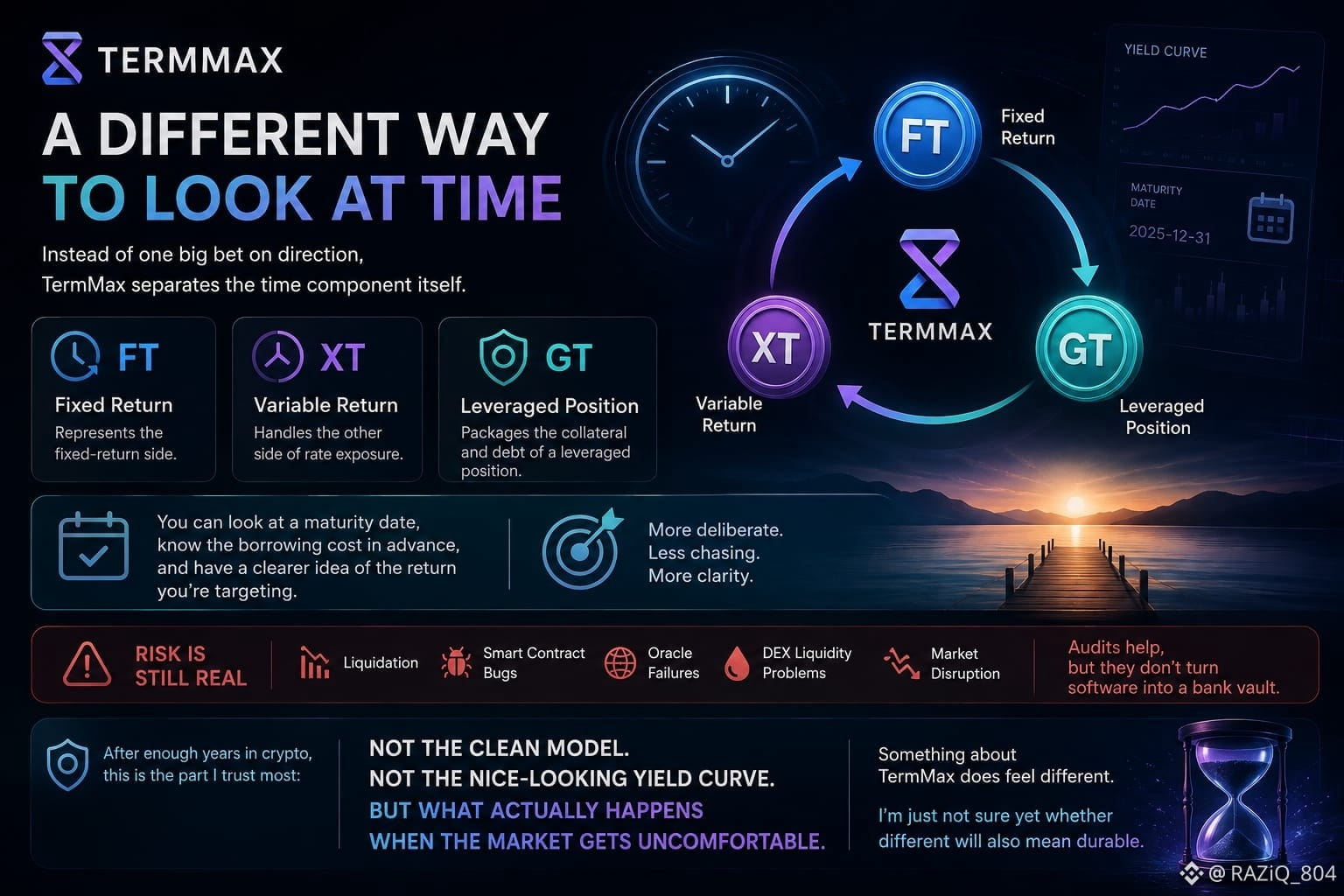
I’ve watched enough DeFi cycles to get a little suspicious whenever a protocol says it has found a cleaner way to make money. Usually, the same story comes back in different clothes: leverage, yield, points, incentives, and then a liquidity crunch that nobody saw coming.
That’s why TermMax caught my attention. Not because I think it has somehow escaped the usual rules, but because the idea is different enough to make me stop for a second. Instead of treating everything as one big bet on direction, it separates the time component itself. FT represents the fixed-return side, XT handles the other side of that rate exposure, while GT packages the collateral and debt of a leveraged position.
I actually like how straightforward the idea feels. You can look at a maturity date, know the borrowing cost in advance, and have a clearer idea of the return you’re targeting instead of constantly chasing whatever the floating market happens to offer. That feels more deliberate than a lot of the DeFi products I’ve seen.
But I’ve seen this before: elegant mechanics can make risk look smaller than it really is.
A fixed rate still isn’t the same thing as guaranteed principal. TermMax itself points to liquidation, smart-contract bugs, oracle failures, DEX liquidity problems, and market disruption as real risks. Audits help, obviously, but they don’t turn software into a bank vault.
So I’m not ready to call this reliable yet. I’d rather put a small amount through the entire cycle, watch how entry, liquidity, collateral, maturity, and settlement actually behave, and see whether the numbers hold up in the real market.
After enough years in crypto, that’s probably the part I trust most: not the clean model, not the nice-looking yield curve, but what actually happens when the market gets uncomfortable.
Something about TermMax does feel different. I’m just not sure yet whether different will also mean durable.
@termmax #termmax
I’ve watched enough DeFi cycles to get a little suspicious whenever a protocol says it has found a cleaner way to make money. Usually, the same story comes back in different clothes: leverage, yield, points, incentives, and then a liquidity crunch that nobody saw coming.
That’s why TermMax caught my attention. Not because I think it has somehow escaped the usual rules, but because the idea is different enough to make me stop for a second. Instead of treating everything as one big bet on direction, it separates the time component itself. FT represents the fixed-return side, XT handles the other side of that rate exposure, while GT packages the collateral and debt of a leveraged position.
I actually like how straightforward the idea feels. You can look at a maturity date, know the borrowing cost in advance, and have a clearer idea of the return you’re targeting instead of constantly chasing whatever the floating market happens to offer. That feels more deliberate than a lot of the DeFi products I’ve seen.
But I’ve seen this before: elegant mechanics can make risk look smaller than it really is.
A fixed rate still isn’t the same thing as guaranteed principal. TermMax itself points to liquidation, smart-contract bugs, oracle failures, DEX liquidity problems, and market disruption as real risks. Audits help, obviously, but they don’t turn software into a bank vault.
So I’m not ready to call this reliable yet. I’d rather put a small amount through the entire cycle, watch how entry, liquidity, collateral, maturity, and settlement actually behave, and see whether the numbers hold up in the real market.
After enough years in crypto, that’s probably the part I trust most: not the clean model, not the nice-looking yield curve, but what actually happens when the market gets uncomfortable.
Something about TermMax does feel different. I’m just not sure yet whether different will also mean durable.
@TermMax #termmax
That’s why TermMax caught my attention. Not because I think it has somehow escaped the usual rules, but because the idea is different enough to make me stop for a second. Instead of treating everything as one big bet on direction, it separates the time component itself. FT represents the fixed-return side, XT handles the other side of that rate exposure, while GT packages the collateral and debt of a leveraged position.
I actually like how straightforward the idea feels. You can look at a maturity date, know the borrowing cost in advance, and have a clearer idea of the return you’re targeting instead of constantly chasing whatever the floating market happens to offer. That feels more deliberate than a lot of the DeFi products I’ve seen.
But I’ve seen this before: elegant mechanics can make risk look smaller than it really is.
A fixed rate still isn’t the same thing as guaranteed principal. TermMax itself points to liquidation, smart-contract bugs, oracle failures, DEX liquidity problems, and market disruption as real risks. Audits help, obviously, but they don’t turn software into a bank vault.
So I’m not ready to call this reliable yet. I’d rather put a small amount through the entire cycle, watch how entry, liquidity, collateral, maturity, and settlement actually behave, and see whether the numbers hold up in the real market.
After enough years in crypto, that’s probably the part I trust most: not the clean model, not the nice-looking yield curve, but what actually happens when the market gets uncomfortable.
Something about TermMax does feel different. I’m just not sure yet whether different will also mean durable.
@TermMax #termmax
5
4
202
·
--
Bullish
I've been around crypto long enough to get tired of the word “privacy.” Every cycle, that label seems to pull people straight into the same arguments about anonymous money and regulation. DUSK feels different to me because the question seems less about hiding payments and more about whether financial assets can stay confidential without becoming impossible to audit.
That’s why I keep watching it. The design is aimed at regulated markets, selective disclosure, and on-chain settlement, not privacy for privacy’s sake. The tech story is still evolving, and honestly, I prefer that over pretending everything is already figured out.
Then there’s the token model. Emissions are stretched across decades, but that alone doesn’t make an asset valuable. I’ve seen carefully designed token economies fail simply because there wasn’t enough real activity underneath them.
The partnerships caught my attention too. But I’ve seen this before: a press release can arrive long before meaningful usage does. What matters is the boring stuff — actual settlement, contract activity, organic users, governance participation, and demand that survives without incentives doing all the work.
I’m not convinced yet, and I don’t fully trust the narrative. But I also don’t want to dismiss DUSK just because “privacy” has become such an overloaded word.
For me, DUSK has one real test: do regulated assets keep coming back to issue, trade, and settle?
That’s what I’m watching.
@Dusk_Foundation #dusk $DUSK
{spot}(DUSKUSDT)
$BOME
{spot}(BOMEUSDT)
$MAGMA
{future}(MAGMAUSDT)
#FedMinutesShowNoSupportForRateCuts
#CryptoRally
#FOMCWatch
#UAEEndsEconomicTiesWithIran
I've been around crypto long enough to get tired of the word “privacy.” Every cycle, that label seems to pull people straight into the same arguments about anonymous money and regulation. DUSK feels different to me because the question seems less about hiding payments and more about whether financial assets can stay confidential without becoming impossible to audit.
That’s why I keep watching it. The design is aimed at regulated markets, selective disclosure, and on-chain settlement, not privacy for privacy’s sake. The tech story is still evolving, and honestly, I prefer that over pretending everything is already figured out.
Then there’s the token model. Emissions are stretched across decades, but that alone doesn’t make an asset valuable. I’ve seen carefully designed token economies fail simply because there wasn’t enough real activity underneath them.
The partnerships caught my attention too. But I’ve seen this before: a press release can arrive long before meaningful usage does. What matters is the boring stuff — actual settlement, contract activity, organic users, governance participation, and demand that survives without incentives doing all the work.
I’m not convinced yet, and I don’t fully trust the narrative. But I also don’t want to dismiss DUSK just because “privacy” has become such an overloaded word.
For me, DUSK has one real test: do regulated assets keep coming back to issue, trade, and settle?
That’s what I’m watching.
@Dusk #dusk $DUSK
$BOME
$MAGMA
#FedMinutesShowNoSupportForRateCuts
#CryptoRally
#FOMCWatch
#UAEEndsEconomicTiesWithIran
That’s why I keep watching it. The design is aimed at regulated markets, selective disclosure, and on-chain settlement, not privacy for privacy’s sake. The tech story is still evolving, and honestly, I prefer that over pretending everything is already figured out.
Then there’s the token model. Emissions are stretched across decades, but that alone doesn’t make an asset valuable. I’ve seen carefully designed token economies fail simply because there wasn’t enough real activity underneath them.
The partnerships caught my attention too. But I’ve seen this before: a press release can arrive long before meaningful usage does. What matters is the boring stuff — actual settlement, contract activity, organic users, governance participation, and demand that survives without incentives doing all the work.
I’m not convinced yet, and I don’t fully trust the narrative. But I also don’t want to dismiss DUSK just because “privacy” has become such an overloaded word.
For me, DUSK has one real test: do regulated assets keep coming back to issue, trade, and settle?
That’s what I’m watching.
@Dusk #dusk $DUSK
$BOME
$MAGMA
#FedMinutesShowNoSupportForRateCuts
#CryptoRally
#FOMCWatch
#UAEEndsEconomicTiesWithIran
🚀 DUSK for the long run?
75%
👀 Real use or hype?
25%
🔐 Privacy + regulation?
0%
4 votes • Voting closed
7
6
339
·
--
Bullish
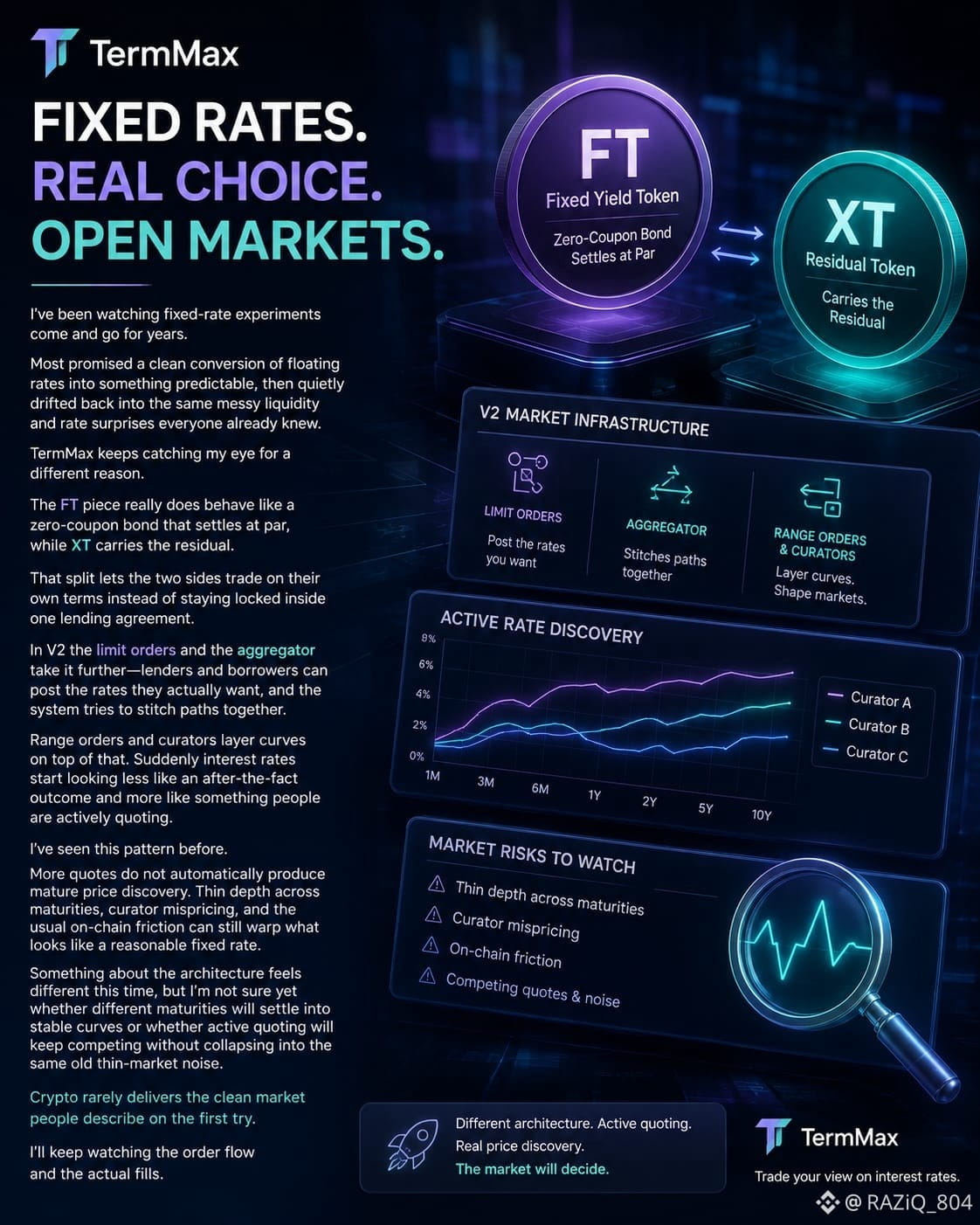
I’ve been watching fixed-rate experiments come and go for years. Most of them promised a clean conversion of floating rates into something predictable, then quietly drifted back into the same messy liquidity and rate surprises everyone already knew.
TermMax keeps catching my eye for a different reason. The FT piece really does behave like a zero-coupon bond that settles at par, while XT carries the residual. That split lets the two sides trade on their own terms instead of staying locked inside one lending agreement. In V2 the limit orders and the aggregator take it further—lenders and borrowers can post the rates they actually want, and the system tries to stitch paths together. Range orders and curators layer curves on top of that. Suddenly interest rates start looking less like an after-the-fact outcome and more like something people are actively quoting.
I’ve seen this pattern before. More quotes do not automatically produce mature price discovery. Thin depth across maturities, curator mispricing, and the usual on-chain friction can still warp what looks like a reasonable fixed rate. Something about the architecture feels different this time, but I’m not sure yet whether different maturities will settle into stable curves or whether active quoting will keep competing without collapsing into the same old thin-market noise. Crypto rarely delivers the clean market people describe on the first try. I’ll keep watching the order flow and the actual fills.
#termmax @termmax
I’ve been watching fixed-rate experiments come and go for years. Most of them promised a clean conversion of floating rates into something predictable, then quietly drifted back into the same messy liquidity and rate surprises everyone already knew.
TermMax keeps catching my eye for a different reason. The FT piece really does behave like a zero-coupon bond that settles at par, while XT carries the residual. That split lets the two sides trade on their own terms instead of staying locked inside one lending agreement. In V2 the limit orders and the aggregator take it further—lenders and borrowers can post the rates they actually want, and the system tries to stitch paths together. Range orders and curators layer curves on top of that. Suddenly interest rates start looking less like an after-the-fact outcome and more like something people are actively quoting.
I’ve seen this pattern before. More quotes do not automatically produce mature price discovery. Thin depth across maturities, curator mispricing, and the usual on-chain friction can still warp what looks like a reasonable fixed rate. Something about the architecture feels different this time, but I’m not sure yet whether different maturities will settle into stable curves or whether active quoting will keep competing without collapsing into the same old thin-market noise. Crypto rarely delivers the clean market people describe on the first try. I’ll keep watching the order flow and the actual fills.
#termmax @TermMax
TermMax keeps catching my eye for a different reason. The FT piece really does behave like a zero-coupon bond that settles at par, while XT carries the residual. That split lets the two sides trade on their own terms instead of staying locked inside one lending agreement. In V2 the limit orders and the aggregator take it further—lenders and borrowers can post the rates they actually want, and the system tries to stitch paths together. Range orders and curators layer curves on top of that. Suddenly interest rates start looking less like an after-the-fact outcome and more like something people are actively quoting.
I’ve seen this pattern before. More quotes do not automatically produce mature price discovery. Thin depth across maturities, curator mispricing, and the usual on-chain friction can still warp what looks like a reasonable fixed rate. Something about the architecture feels different this time, but I’m not sure yet whether different maturities will settle into stable curves or whether active quoting will keep competing without collapsing into the same old thin-market noise. Crypto rarely delivers the clean market people describe on the first try. I’ll keep watching the order flow and the actual fills.
#termmax @TermMax
10
9
686
·
--
Bullish
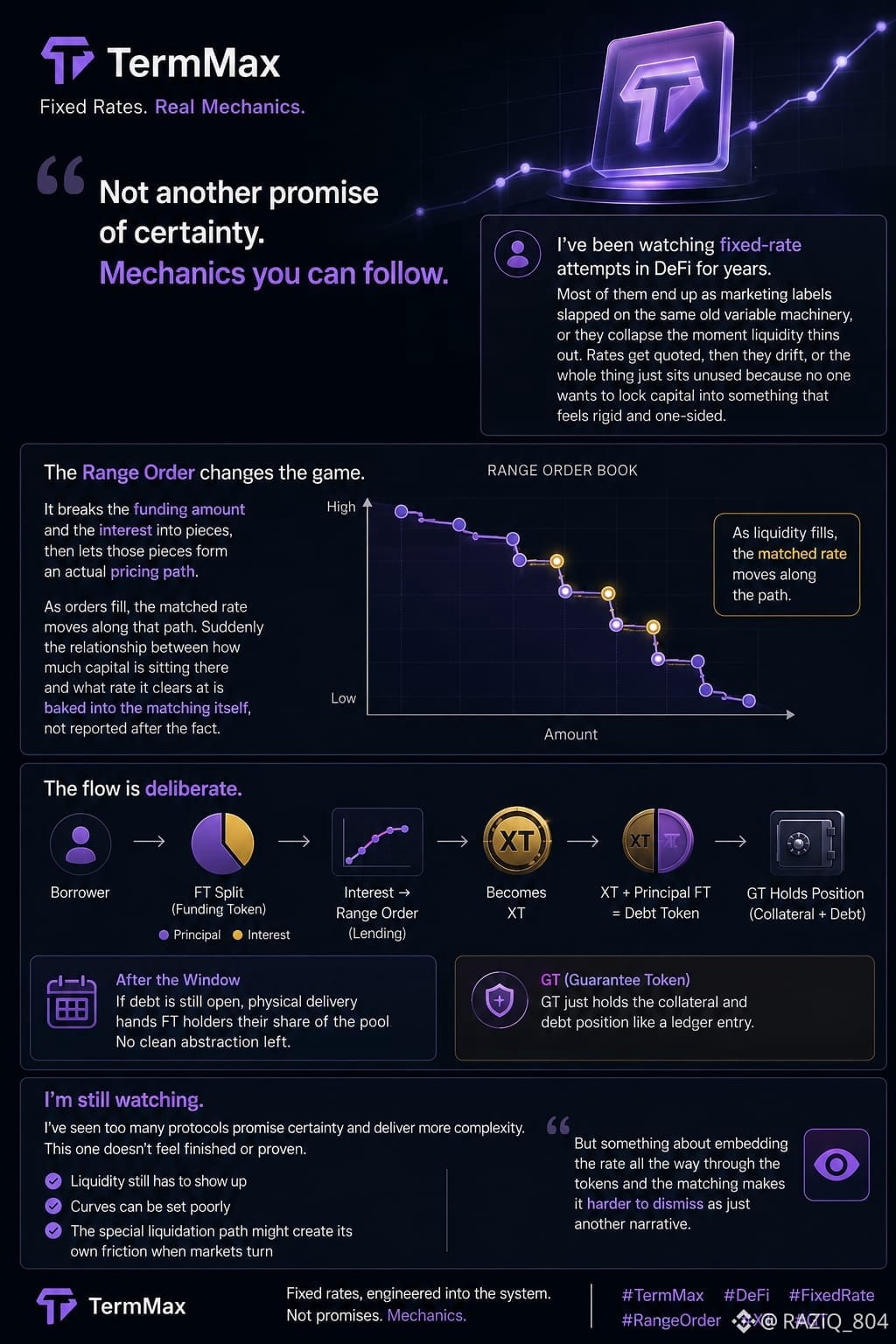
I’ve been watching fixed-rate attempts in DeFi for years. Most of them end up as marketing labels slapped on the same old variable machinery, or they collapse the moment liquidity thins out. Rates get quoted, then they drift, or the whole thing just sits unused because no one wants to lock capital into something that feels rigid and one-sided.
TermMax keeps pulling me back for a different reason. The Range Order isn’t just another curve. It breaks the funding amount and the interest into pieces, then lets those pieces form an actual pricing path. As orders fill, the matched rate moves along that path. Suddenly the relationship between how much capital is sitting there and what rate it clears at is baked into the matching itself, not reported after the fact.
When you borrow, the FT gets split—principal one way, interest another. The interest side goes through the lending Range Order and becomes XT. Then XT and the principal FT sit together as the debt token. That part feels deliberate. The fixed cost isn’t a parameter you hope holds; it enters the tokens and the order flow. GT just holds the collateral and debt position like a ledger entry. And if debt is still open after the window, physical delivery hands FT holders their share of the pool. No clean abstraction left.
I’ve seen too many protocols promise certainty and deliver more complexity. This one doesn’t feel finished or proven. Liquidity still has to show up, curves can be set poorly, and the special liquidation path might create its own friction when markets turn. But something about embedding the rate all the way through the tokens and the matching makes it harder to dismiss as just another narrative. I’m still watching.
@termmax #termmax
I’ve been watching fixed-rate attempts in DeFi for years. Most of them end up as marketing labels slapped on the same old variable machinery, or they collapse the moment liquidity thins out. Rates get quoted, then they drift, or the whole thing just sits unused because no one wants to lock capital into something that feels rigid and one-sided.
TermMax keeps pulling me back for a different reason. The Range Order isn’t just another curve. It breaks the funding amount and the interest into pieces, then lets those pieces form an actual pricing path. As orders fill, the matched rate moves along that path. Suddenly the relationship between how much capital is sitting there and what rate it clears at is baked into the matching itself, not reported after the fact.
When you borrow, the FT gets split—principal one way, interest another. The interest side goes through the lending Range Order and becomes XT. Then XT and the principal FT sit together as the debt token. That part feels deliberate. The fixed cost isn’t a parameter you hope holds; it enters the tokens and the order flow. GT just holds the collateral and debt position like a ledger entry. And if debt is still open after the window, physical delivery hands FT holders their share of the pool. No clean abstraction left.
I’ve seen too many protocols promise certainty and deliver more complexity. This one doesn’t feel finished or proven. Liquidity still has to show up, curves can be set poorly, and the special liquidation path might create its own friction when markets turn. But something about embedding the rate all the way through the tokens and the matching makes it harder to dismiss as just another narrative. I’m still watching.
@TermMax #termmax
TermMax keeps pulling me back for a different reason. The Range Order isn’t just another curve. It breaks the funding amount and the interest into pieces, then lets those pieces form an actual pricing path. As orders fill, the matched rate moves along that path. Suddenly the relationship between how much capital is sitting there and what rate it clears at is baked into the matching itself, not reported after the fact.
When you borrow, the FT gets split—principal one way, interest another. The interest side goes through the lending Range Order and becomes XT. Then XT and the principal FT sit together as the debt token. That part feels deliberate. The fixed cost isn’t a parameter you hope holds; it enters the tokens and the order flow. GT just holds the collateral and debt position like a ledger entry. And if debt is still open after the window, physical delivery hands FT holders their share of the pool. No clean abstraction left.
I’ve seen too many protocols promise certainty and deliver more complexity. This one doesn’t feel finished or proven. Liquidity still has to show up, curves can be set poorly, and the special liquidation path might create its own friction when markets turn. But something about embedding the rate all the way through the tokens and the matching makes it harder to dismiss as just another narrative. I’m still watching.
@TermMax #termmax
57
25
1.4k
·
--
Bullish
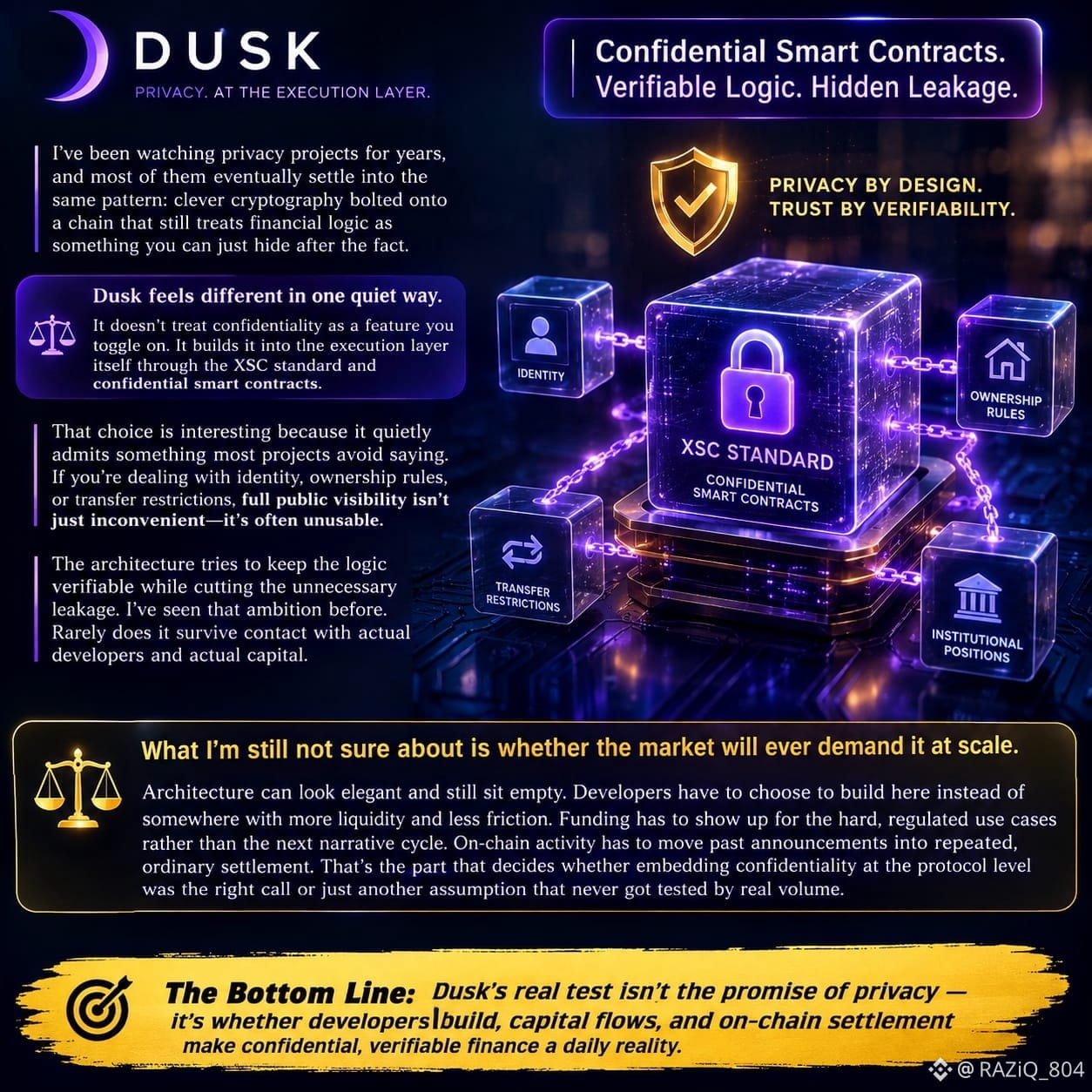
I’ve been watching privacy projects for years, and most of them eventually settle into the same pattern: clever cryptography bolted onto a chain that still treats financial logic as something you can just hide after the fact. Dusk feels different in one quiet way. It doesn’t treat confidentiality as a feature you toggle on. It builds it into the execution layer itself through the XSC standard and confidential smart contracts.
That choice is interesting because it quietly admits something most projects avoid saying. If you’re dealing with identity, ownership rules, transfer restrictions, or institutional positions, full public visibility isn’t just inconvenient—it’s often unusable. The architecture tries to keep the logic verifiable while cutting the unnecessary leakage. I’ve seen that ambition before. Rarely does it survive contact with actual developers and actual capital.
What I’m still not sure about is whether the market will ever demand it at scale. Architecture can look elegant and still sit empty. Developers have to choose to build here instead of somewhere with more liquidity and less friction. Funding has to show up for the hard, regulated use cases rather than the next narrative cycle. On-chain activity has to move past announcements into repeated, ordinary settlement. That’s the part that decides whether embedding confidentiality at the protocol level was the right call or just another assumption that never got tested by real volume.
@Dusk_Foundation #dusk $DUSK
I’ve been watching privacy projects for years, and most of them eventually settle into the same pattern: clever cryptography bolted onto a chain that still treats financial logic as something you can just hide after the fact. Dusk feels different in one quiet way. It doesn’t treat confidentiality as a feature you toggle on. It builds it into the execution layer itself through the XSC standard and confidential smart contracts.
That choice is interesting because it quietly admits something most projects avoid saying. If you’re dealing with identity, ownership rules, transfer restrictions, or institutional positions, full public visibility isn’t just inconvenient—it’s often unusable. The architecture tries to keep the logic verifiable while cutting the unnecessary leakage. I’ve seen that ambition before. Rarely does it survive contact with actual developers and actual capital.
What I’m still not sure about is whether the market will ever demand it at scale. Architecture can look elegant and still sit empty. Developers have to choose to build here instead of somewhere with more liquidity and less friction. Funding has to show up for the hard, regulated use cases rather than the next narrative cycle. On-chain activity has to move past announcements into repeated, ordinary settlement. That’s the part that decides whether embedding confidentiality at the protocol level was the right call or just another assumption that never got tested by real volume.
@Dusk #dusk $DUSK
That choice is interesting because it quietly admits something most projects avoid saying. If you’re dealing with identity, ownership rules, transfer restrictions, or institutional positions, full public visibility isn’t just inconvenient—it’s often unusable. The architecture tries to keep the logic verifiable while cutting the unnecessary leakage. I’ve seen that ambition before. Rarely does it survive contact with actual developers and actual capital.
What I’m still not sure about is whether the market will ever demand it at scale. Architecture can look elegant and still sit empty. Developers have to choose to build here instead of somewhere with more liquidity and less friction. Funding has to show up for the hard, regulated use cases rather than the next narrative cycle. On-chain activity has to move past announcements into repeated, ordinary settlement. That’s the part that decides whether embedding confidentiality at the protocol level was the right call or just another assumption that never got tested by real volume.
@Dusk #dusk $DUSK
25
8
1.1k
·
--
Bullish
I've been watching fixed-rate experiments in DeFi for years. Most never get past the marketing deck. Rates get sold as fixed, then the matching ends up feeling like another floating market with extra steps. Liquidity sits there unused, or the curve never really shows the depth.
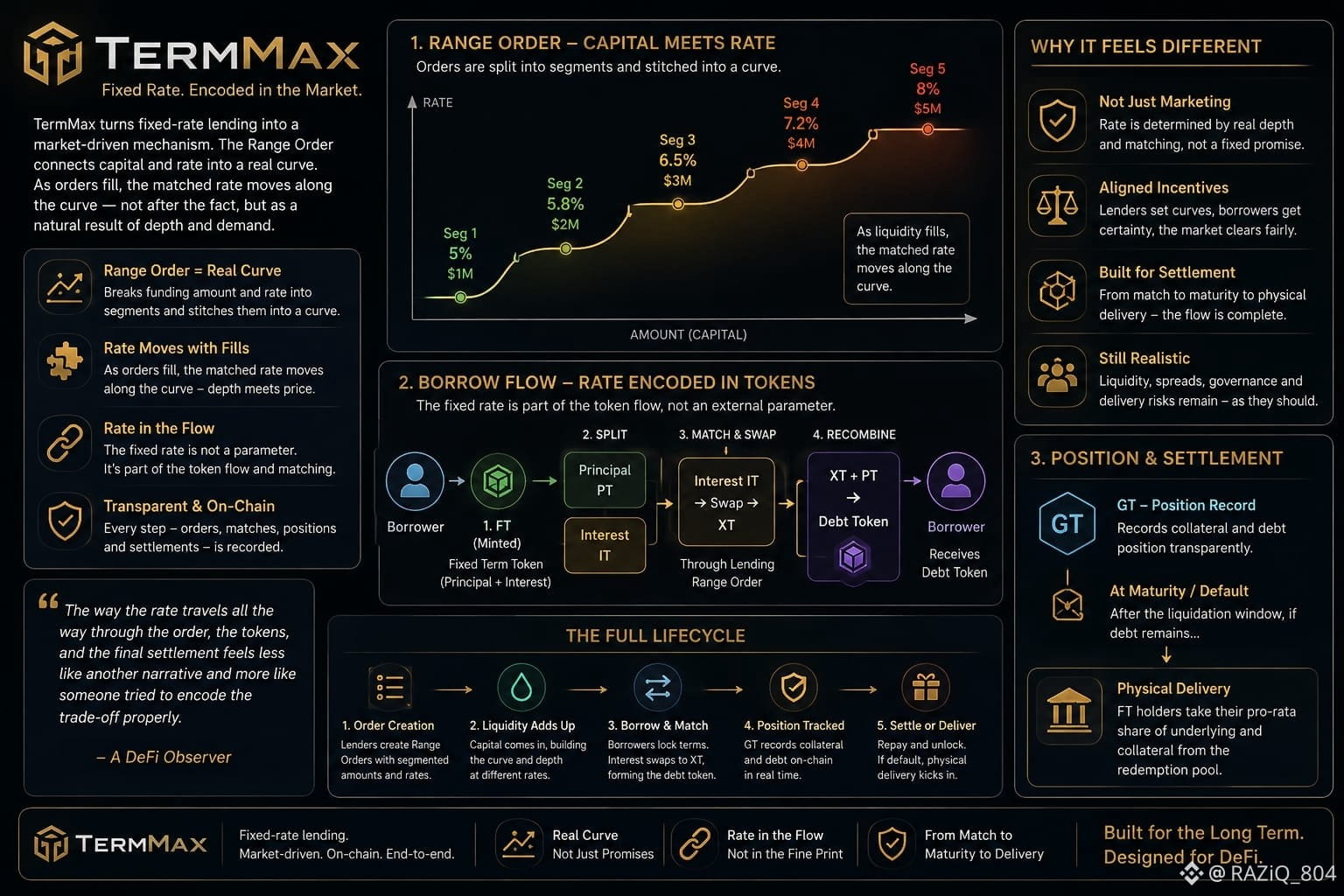
TermMax keeps pulling me back for a different reason. The Range Order isn't just a name. It breaks the funding amount and the rate into segments and stitches them into a curve. As orders fill, the matched rate actually moves along that curve. The link between how much capital is sitting there and what rate clears gets baked straight into the mechanism, not just reported afterward.
When you borrow, the FT splits into principal and interest pieces. The interest side gets swapped for XT through the lending Range Order, then XT and the principal FT recombine into the debt token. That sequence matters. The fixed rate stops being a parameter and becomes part of the token flow and the matching itself. GT just records the collateral and debt position. If debt is still left after the liquidation window, physical delivery lets FT holders take their pro-rata share of the underlying and collateral from the redemption pool.
I've seen too many systems that claim to fix interest-rate uncertainty and then quietly put it back through thin liquidity or messy defaults. This one still carries all the usual frictions—liquidity has to actually show up, someone has to set the curves who cares about the spread, and physical delivery is never as clean as people hope. But the way the rate travels all the way through the order, the tokens, and the final settlement feels less like another narrative and more like someone tried to encode the trade-off properly. I'm not sure yet if the market will keep showing up for it. Something about the structure still feels different from the last few cycles.
@termmax #termmax
I've been watching fixed-rate experiments in DeFi for years. Most never get past the marketing deck. Rates get sold as fixed, then the matching ends up feeling like another floating market with extra steps. Liquidity sits there unused, or the curve never really shows the depth.
TermMax keeps pulling me back for a different reason. The Range Order isn't just a name. It breaks the funding amount and the rate into segments and stitches them into a curve. As orders fill, the matched rate actually moves along that curve. The link between how much capital is sitting there and what rate clears gets baked straight into the mechanism, not just reported afterward.
When you borrow, the FT splits into principal and interest pieces. The interest side gets swapped for XT through the lending Range Order, then XT and the principal FT recombine into the debt token. That sequence matters. The fixed rate stops being a parameter and becomes part of the token flow and the matching itself. GT just records the collateral and debt position. If debt is still left after the liquidation window, physical delivery lets FT holders take their pro-rata share of the underlying and collateral from the redemption pool.
I've seen too many systems that claim to fix interest-rate uncertainty and then quietly put it back through thin liquidity or messy defaults. This one still carries all the usual frictions—liquidity has to actually show up, someone has to set the curves who cares about the spread, and physical delivery is never as clean as people hope. But the way the rate travels all the way through the order, the tokens, and the final settlement feels less like another narrative and more like someone tried to encode the trade-off properly. I'm not sure yet if the market will keep showing up for it. Something about the structure still feels different from the last few cycles.
@TermMax #termmax
TermMax keeps pulling me back for a different reason. The Range Order isn't just a name. It breaks the funding amount and the rate into segments and stitches them into a curve. As orders fill, the matched rate actually moves along that curve. The link between how much capital is sitting there and what rate clears gets baked straight into the mechanism, not just reported afterward.
When you borrow, the FT splits into principal and interest pieces. The interest side gets swapped for XT through the lending Range Order, then XT and the principal FT recombine into the debt token. That sequence matters. The fixed rate stops being a parameter and becomes part of the token flow and the matching itself. GT just records the collateral and debt position. If debt is still left after the liquidation window, physical delivery lets FT holders take their pro-rata share of the underlying and collateral from the redemption pool.
I've seen too many systems that claim to fix interest-rate uncertainty and then quietly put it back through thin liquidity or messy defaults. This one still carries all the usual frictions—liquidity has to actually show up, someone has to set the curves who cares about the spread, and physical delivery is never as clean as people hope. But the way the rate travels all the way through the order, the tokens, and the final settlement feels less like another narrative and more like someone tried to encode the trade-off properly. I'm not sure yet if the market will keep showing up for it. Something about the structure still feels different from the last few cycles.
@TermMax #termmax
5
6
460
·
--
Bullish
I've been watching this space long enough to know that most privacy stories end the same way. They sound clean on paper, then collide with the messy reality of capital that actually has something to lose.
Last night I went back through Dusk’s architecture docs again. Confidential Security Contracts, Phoenix, the whole selective-disclosure setup. On the surface it looks like they’ve tried to solve the real contradiction: institutions need their positions, counterparties, and flows hidden, yet the network still has to prove everything settled correctly. Most chains treat privacy as an add-on. Dusk seems to have built it into the foundation instead of bolting it on later.
I’ve seen this before, though. Beautiful cryptography, careful design, and still the market never shows up in the volumes that matter. Technology can be elegant. Liquidity and sustained demand are harder. Privacy only becomes infrastructure when real capital starts treating it as non-negotiable rather than optional.
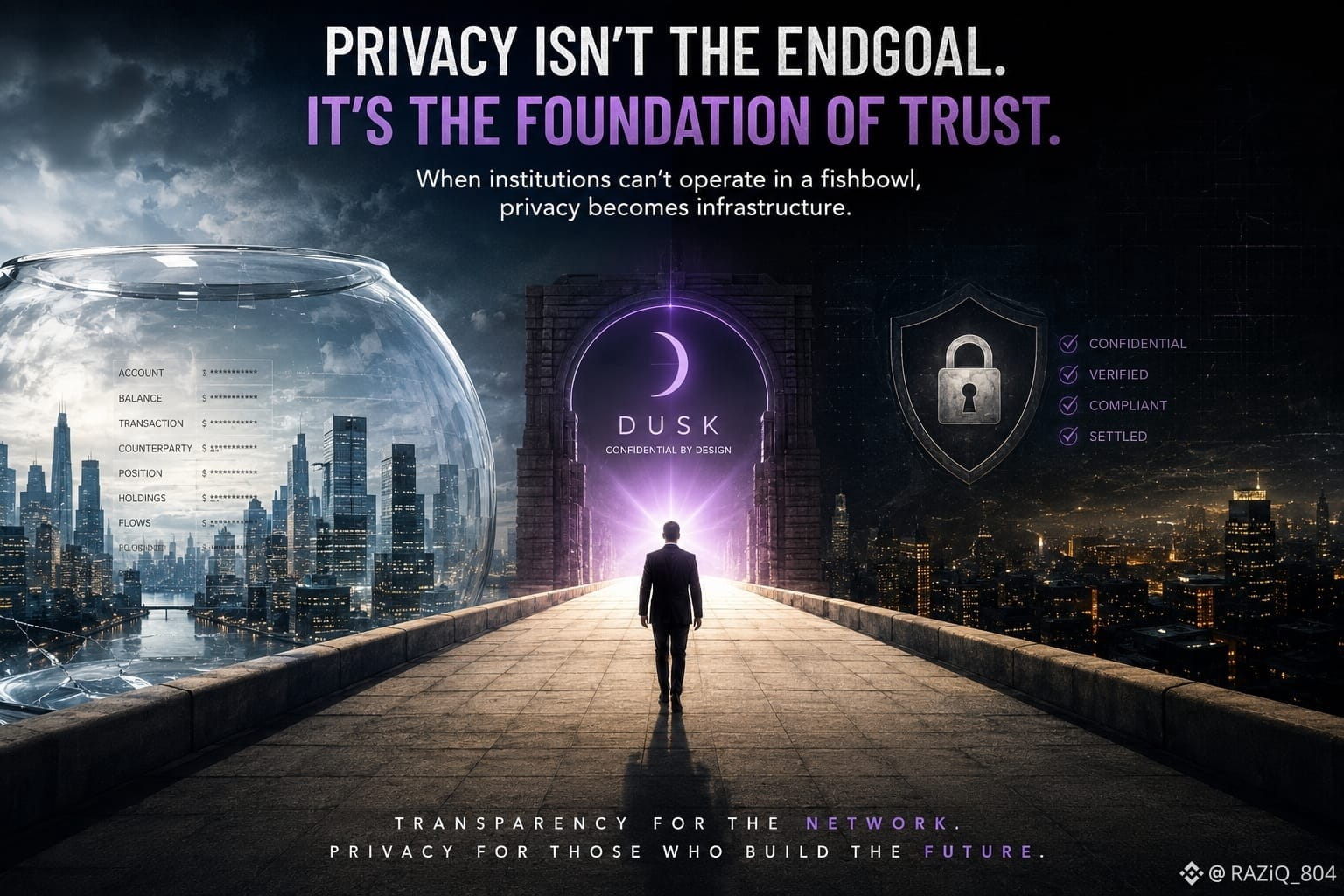
I’m not sure yet whether that moment is approaching or whether confidentiality will stay confined to narrow, regulated corners. Something about the way Dusk approaches the trade-off feels different from the usual cycle of privacy narratives. But different has failed before. The question that keeps returning is simple: when institutions finally decide they cannot operate in a transparent fishbowl, will the rails be ready, or will we just get another round of promising documents and quiet ledgers?
@Dusk_Foundation $DUSK #dusk
I've been watching this space long enough to know that most privacy stories end the same way. They sound clean on paper, then collide with the messy reality of capital that actually has something to lose.
Last night I went back through Dusk’s architecture docs again. Confidential Security Contracts, Phoenix, the whole selective-disclosure setup. On the surface it looks like they’ve tried to solve the real contradiction: institutions need their positions, counterparties, and flows hidden, yet the network still has to prove everything settled correctly. Most chains treat privacy as an add-on. Dusk seems to have built it into the foundation instead of bolting it on later.
I’ve seen this before, though. Beautiful cryptography, careful design, and still the market never shows up in the volumes that matter. Technology can be elegant. Liquidity and sustained demand are harder. Privacy only becomes infrastructure when real capital starts treating it as non-negotiable rather than optional.
I’m not sure yet whether that moment is approaching or whether confidentiality will stay confined to narrow, regulated corners. Something about the way Dusk approaches the trade-off feels different from the usual cycle of privacy narratives. But different has failed before. The question that keeps returning is simple: when institutions finally decide they cannot operate in a transparent fishbowl, will the rails be ready, or will we just get another round of promising documents and quiet ledgers?
@Dusk $DUSK #dusk
Last night I went back through Dusk’s architecture docs again. Confidential Security Contracts, Phoenix, the whole selective-disclosure setup. On the surface it looks like they’ve tried to solve the real contradiction: institutions need their positions, counterparties, and flows hidden, yet the network still has to prove everything settled correctly. Most chains treat privacy as an add-on. Dusk seems to have built it into the foundation instead of bolting it on later.
I’ve seen this before, though. Beautiful cryptography, careful design, and still the market never shows up in the volumes that matter. Technology can be elegant. Liquidity and sustained demand are harder. Privacy only becomes infrastructure when real capital starts treating it as non-negotiable rather than optional.
I’m not sure yet whether that moment is approaching or whether confidentiality will stay confined to narrow, regulated corners. Something about the way Dusk approaches the trade-off feels different from the usual cycle of privacy narratives. But different has failed before. The question that keeps returning is simple: when institutions finally decide they cannot operate in a transparent fishbowl, will the rails be ready, or will we just get another round of promising documents and quiet ledgers?
@Dusk $DUSK #dusk
52
18
632
·
--
Bullish
Verified
I’ve spent years watching tokens get dressed up with utility after the fact. Most of them never carry real weight. This morning I was reading about Dusk Trade and the NPEX link, and something about the setup caught me differently.
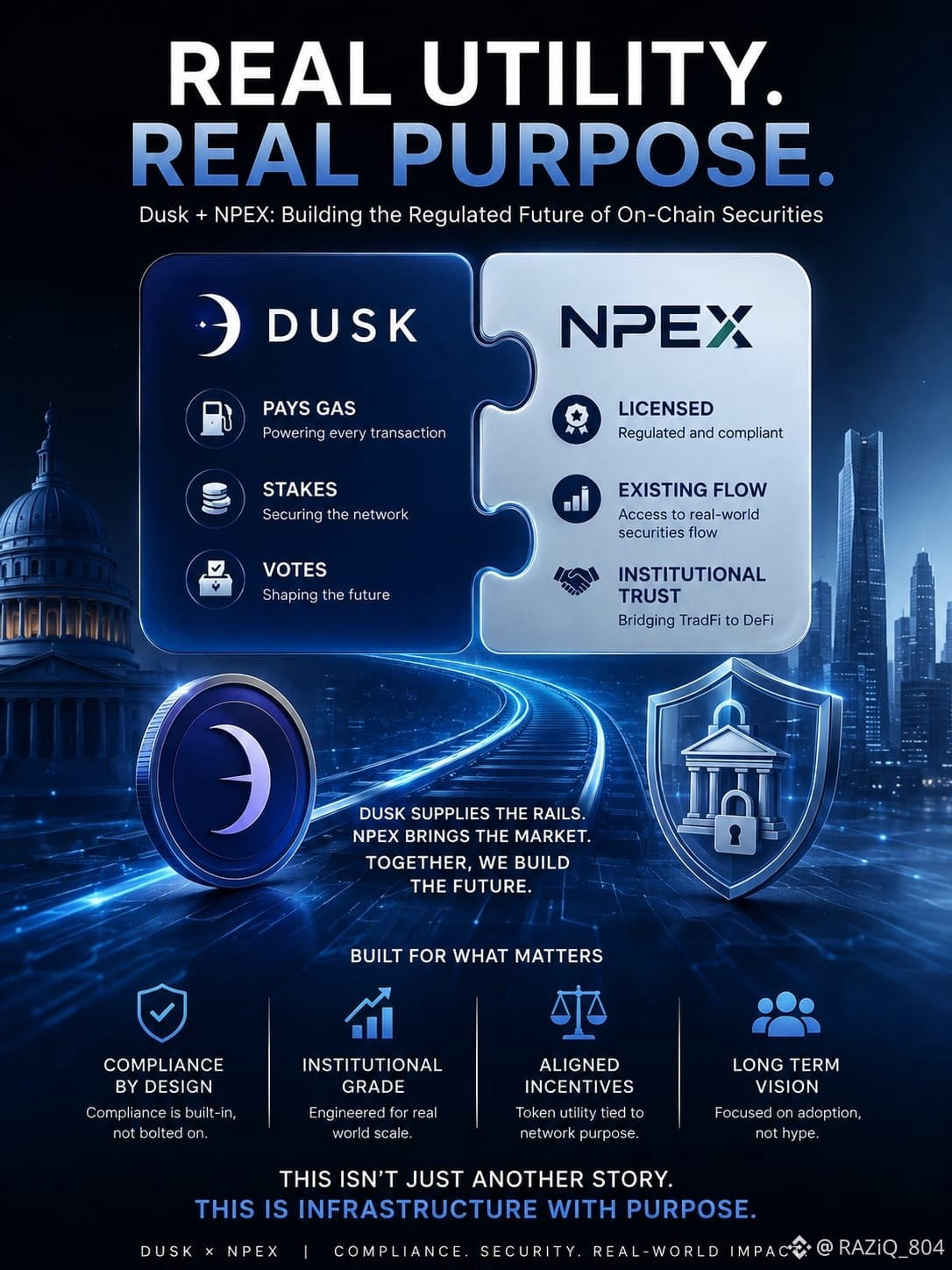
DUSK isn’t just sitting there waiting for a story. It pays the gas, it stakes to secure a network built for regulated assets, and it votes on the rules. Three jobs that actually matter on a chain designed from the start to handle compliance, not bolt it on later. NPEX brings the licenses and the existing flow of securities; Dusk supplies the rails. The token’s role and the chain’s purpose seem to line up in a way I don’t see often.
Still, I’ve seen this pattern before. Partnerships open doors. They don’t guarantee the traffic walks through them. Staking economics that look clean at modest volume can buckle when real institutional size arrives. Utility on paper is easy. Utility under load is the part that usually breaks.
I’m not sure yet if the alignment holds. Something about the way they built the compliance layer into the token’s function feels less forced than the usual narrative. But crypto has taught me not to trust the clean stories. I’m watching this one carefully, without the usual noise.
@Dusk_Foundation #dusk $DUSK
I’ve spent years watching tokens get dressed up with utility after the fact. Most of them never carry real weight. This morning I was reading about Dusk Trade and the NPEX link, and something about the setup caught me differently.
DUSK isn’t just sitting there waiting for a story. It pays the gas, it stakes to secure a network built for regulated assets, and it votes on the rules. Three jobs that actually matter on a chain designed from the start to handle compliance, not bolt it on later. NPEX brings the licenses and the existing flow of securities; Dusk supplies the rails. The token’s role and the chain’s purpose seem to line up in a way I don’t see often.
Still, I’ve seen this pattern before. Partnerships open doors. They don’t guarantee the traffic walks through them. Staking economics that look clean at modest volume can buckle when real institutional size arrives. Utility on paper is easy. Utility under load is the part that usually breaks.
I’m not sure yet if the alignment holds. Something about the way they built the compliance layer into the token’s function feels less forced than the usual narrative. But crypto has taught me not to trust the clean stories. I’m watching this one carefully, without the usual noise.
@Dusk #dusk $DUSK
DUSK isn’t just sitting there waiting for a story. It pays the gas, it stakes to secure a network built for regulated assets, and it votes on the rules. Three jobs that actually matter on a chain designed from the start to handle compliance, not bolt it on later. NPEX brings the licenses and the existing flow of securities; Dusk supplies the rails. The token’s role and the chain’s purpose seem to line up in a way I don’t see often.
Still, I’ve seen this pattern before. Partnerships open doors. They don’t guarantee the traffic walks through them. Staking economics that look clean at modest volume can buckle when real institutional size arrives. Utility on paper is easy. Utility under load is the part that usually breaks.
I’m not sure yet if the alignment holds. Something about the way they built the compliance layer into the token’s function feels less forced than the usual narrative. But crypto has taught me not to trust the clean stories. I’m watching this one carefully, without the usual noise.
@Dusk #dusk $DUSK
58
30
664
·
--
Bullish
I’ve been watching this space long enough to know the stories always sound cleaner than the actual plumbing.
Today I skipped the price chart on Dusk and opened the security scorecard instead. Bug bounty sitting at zero. Insurance at zero. Audit coverage stuck around the high twenties. For a chain that keeps talking about institutional-grade rails, MiCA alignment, selective disclosure, and partnerships with licensed venues, that gap just sits there quietly, unanswered.
I’ve seen this order of things before. Lead with the narrative—confidential transactions, ZK proofs that let the right people look when they need to, an EVM layer so developers feel at home—then figure the hardened security pieces will catch up later. Sometimes they do. More often the money moves on the story while the real pressure-testing stays thin. Audits exist, of course. They always do. But zero public bounty and no real insurance fund still tell me what actual institutions check hasn’t been fully stress-tested yet.
Price was hovering near six cents with quiet volume. None of that really matters. What stays with me is the familiar friction: solid architecture on paper, compliance language that sounds right, and the quieter numbers that don’t quite line up. I’m not sure yet if this is just early-stage reality or a genuine mismatch. I’ve watched too many cycles to trust the pitch alone. Still watching.
@Dusk_Foundation #dusk $DUSK
I’ve been watching this space long enough to know the stories always sound cleaner than the actual plumbing.
Today I skipped the price chart on Dusk and opened the security scorecard instead. Bug bounty sitting at zero. Insurance at zero. Audit coverage stuck around the high twenties. For a chain that keeps talking about institutional-grade rails, MiCA alignment, selective disclosure, and partnerships with licensed venues, that gap just sits there quietly, unanswered.
I’ve seen this order of things before. Lead with the narrative—confidential transactions, ZK proofs that let the right people look when they need to, an EVM layer so developers feel at home—then figure the hardened security pieces will catch up later. Sometimes they do. More often the money moves on the story while the real pressure-testing stays thin. Audits exist, of course. They always do. But zero public bounty and no real insurance fund still tell me what actual institutions check hasn’t been fully stress-tested yet.
Price was hovering near six cents with quiet volume. None of that really matters. What stays with me is the familiar friction: solid architecture on paper, compliance language that sounds right, and the quieter numbers that don’t quite line up. I’m not sure yet if this is just early-stage reality or a genuine mismatch. I’ve watched too many cycles to trust the pitch alone. Still watching.
@Dusk #dusk $DUSK
Today I skipped the price chart on Dusk and opened the security scorecard instead. Bug bounty sitting at zero. Insurance at zero. Audit coverage stuck around the high twenties. For a chain that keeps talking about institutional-grade rails, MiCA alignment, selective disclosure, and partnerships with licensed venues, that gap just sits there quietly, unanswered.
I’ve seen this order of things before. Lead with the narrative—confidential transactions, ZK proofs that let the right people look when they need to, an EVM layer so developers feel at home—then figure the hardened security pieces will catch up later. Sometimes they do. More often the money moves on the story while the real pressure-testing stays thin. Audits exist, of course. They always do. But zero public bounty and no real insurance fund still tell me what actual institutions check hasn’t been fully stress-tested yet.
Price was hovering near six cents with quiet volume. None of that really matters. What stays with me is the familiar friction: solid architecture on paper, compliance language that sounds right, and the quieter numbers that don’t quite line up. I’m not sure yet if this is just early-stage reality or a genuine mismatch. I’ve watched too many cycles to trust the pitch alone. Still watching.
@Dusk #dusk $DUSK
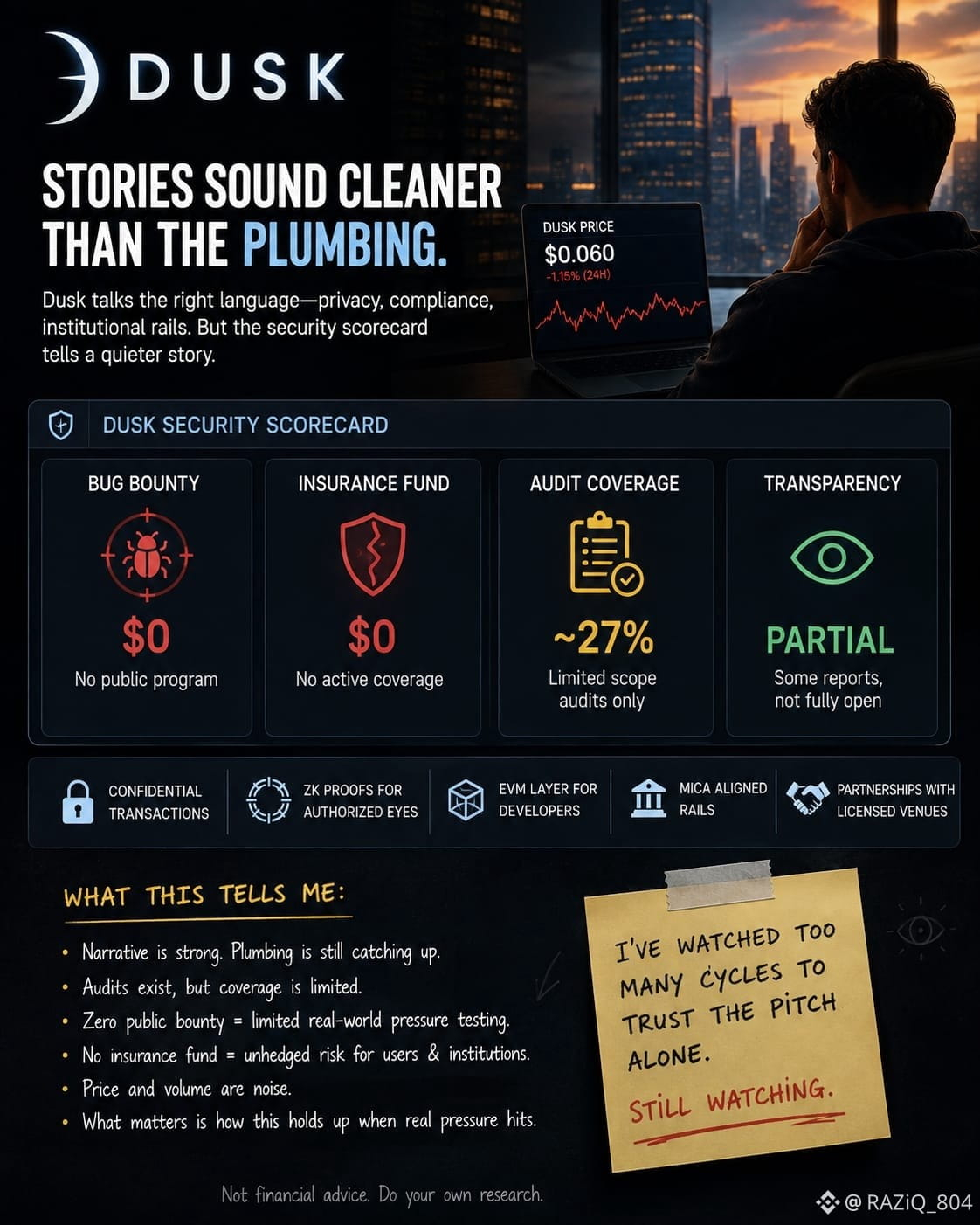
5
6
452
·
--
I've been around crypto long enough to know that the things people ignore are often where the real problems end up living.
I keep noticing the same pattern over and over. A new system shows something impressive, people focus on the cryptography, the privacy, the speed, and the clean story around it. Then reality shows up with questions that are much harder to answer.
That’s what stood out to me while reading through Dusk’s docs about shielded transfers. The word “proof” naturally makes people think of full verification. But the reality is more specific. A receiver can prove the connection between a payment and a sender wallet. That’s real, and it has value.
But I’ve seen this before in crypto. A technical achievement gets interpreted as something bigger than it actually proves.
A cryptographic link is not the same as knowing who controls a wallet. It doesn’t tell you everything about the person or organization behind it. It doesn’t decide whether the funds are clean. Those questions still exist outside the math.
The part I find interesting is what happens after the proof.
The chain can provide the evidence. Selective disclosure can reveal the right information. But eventually, someone has to make the real-world decision. Someone has to connect that wallet to identity checks, sanctions screening, and compliance processes.
I’m not sure yet how that behaves when the scale changes. One wallet is easy to imagine. A few thousand wallets arriving at the same time is where things get interesting.
I’ve watched enough cycles to know that the technology is usually not the only challenge. The friction between systems, people, and institutions is where things get tested.
Something about this feels different because the question may not be whether the proof works.
The bigger question is whether everything built around that proof is ready when the pressure arrives.
I don’t fully trust the assumption that “auditable when required” automatically scales the same way the ZK proof does.
#dusk
@Dusk_Foundation
$DUSK
I've been around crypto long enough to know that the things people ignore are often where the real problems end up living.
I keep noticing the same pattern over and over. A new system shows something impressive, people focus on the cryptography, the privacy, the speed, and the clean story around it. Then reality shows up with questions that are much harder to answer.
That’s what stood out to me while reading through Dusk’s docs about shielded transfers. The word “proof” naturally makes people think of full verification. But the reality is more specific. A receiver can prove the connection between a payment and a sender wallet. That’s real, and it has value.
But I’ve seen this before in crypto. A technical achievement gets interpreted as something bigger than it actually proves.
A cryptographic link is not the same as knowing who controls a wallet. It doesn’t tell you everything about the person or organization behind it. It doesn’t decide whether the funds are clean. Those questions still exist outside the math.
The part I find interesting is what happens after the proof.
The chain can provide the evidence. Selective disclosure can reveal the right information. But eventually, someone has to make the real-world decision. Someone has to connect that wallet to identity checks, sanctions screening, and compliance processes.
I’m not sure yet how that behaves when the scale changes. One wallet is easy to imagine. A few thousand wallets arriving at the same time is where things get interesting.
I’ve watched enough cycles to know that the technology is usually not the only challenge. The friction between systems, people, and institutions is where things get tested.
Something about this feels different because the question may not be whether the proof works.
The bigger question is whether everything built around that proof is ready when the pressure arrives.
I don’t fully trust the assumption that “auditable when required” automatically scales the same way the ZK proof does.
#dusk
@Dusk
$DUSK
I keep noticing the same pattern over and over. A new system shows something impressive, people focus on the cryptography, the privacy, the speed, and the clean story around it. Then reality shows up with questions that are much harder to answer.
That’s what stood out to me while reading through Dusk’s docs about shielded transfers. The word “proof” naturally makes people think of full verification. But the reality is more specific. A receiver can prove the connection between a payment and a sender wallet. That’s real, and it has value.
But I’ve seen this before in crypto. A technical achievement gets interpreted as something bigger than it actually proves.
A cryptographic link is not the same as knowing who controls a wallet. It doesn’t tell you everything about the person or organization behind it. It doesn’t decide whether the funds are clean. Those questions still exist outside the math.
The part I find interesting is what happens after the proof.
The chain can provide the evidence. Selective disclosure can reveal the right information. But eventually, someone has to make the real-world decision. Someone has to connect that wallet to identity checks, sanctions screening, and compliance processes.
I’m not sure yet how that behaves when the scale changes. One wallet is easy to imagine. A few thousand wallets arriving at the same time is where things get interesting.
I’ve watched enough cycles to know that the technology is usually not the only challenge. The friction between systems, people, and institutions is where things get tested.
Something about this feels different because the question may not be whether the proof works.
The bigger question is whether everything built around that proof is ready when the pressure arrives.
I don’t fully trust the assumption that “auditable when required” automatically scales the same way the ZK proof does.
#dusk
@Dusk
$DUSK
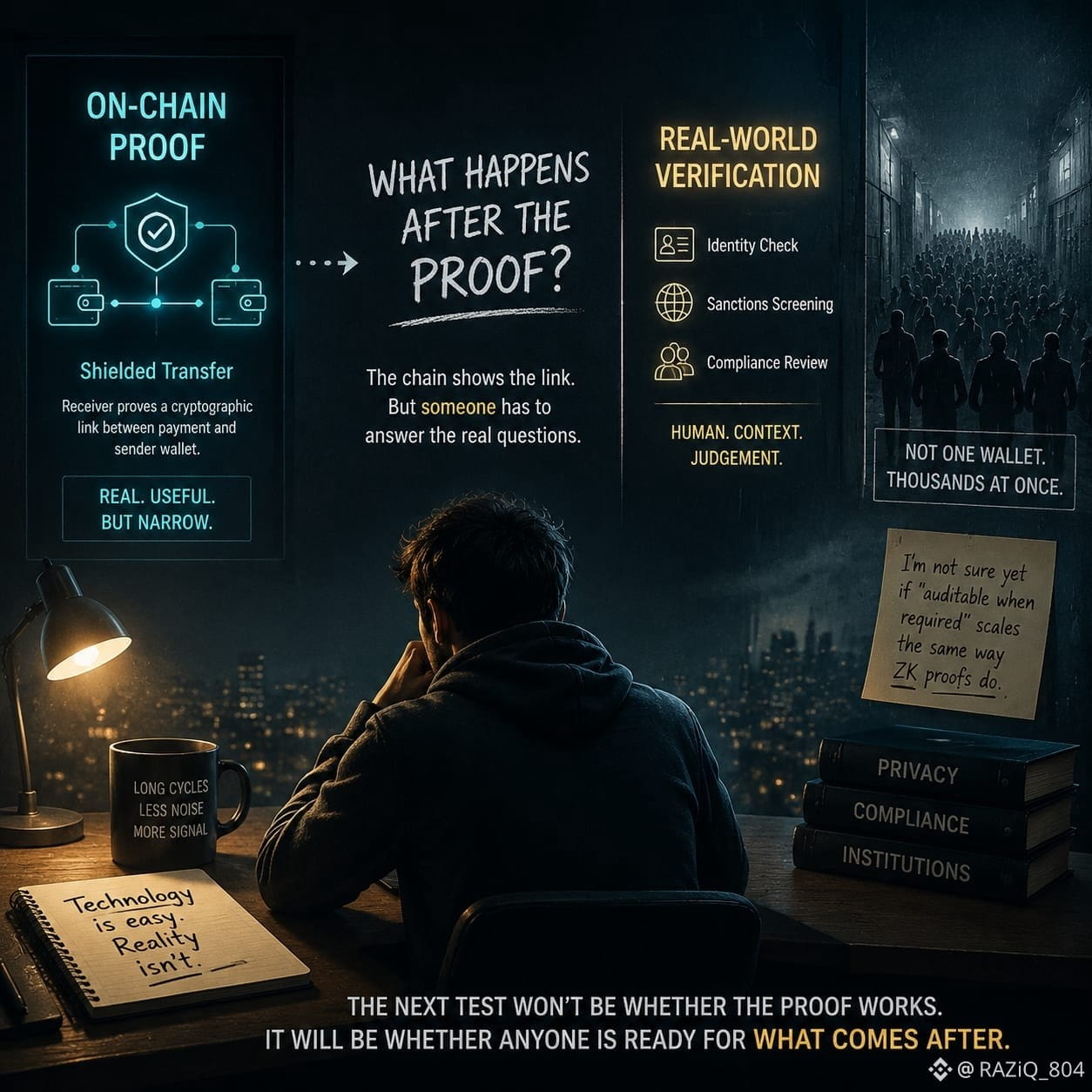
3
4
333
Log in to explore more content
Join global crypto users on Binance Square
⚡️ Get latest and useful information about crypto.
💬 Trusted by the world’s largest crypto exchange.
👍 Discover real insights from verified creators.
Email / Phone number
Trending Topics
ADAGains10%Above$0.27
12,598 views
171 Discussing
$ADA is making a strong move today jumping over 10 percent to around 027 and breaking into a new 90 day high
Trading volume has also surged above 1 billion showing strong market activity
The move comes as $ADA continues its recovery from the June lows while its recent technical structure has turned more bullish
The 027 to 028 zone is now the key area to watch A sustained breakout could open the door toward higher resistance levels
But after such a sharp daily move volatility could remain high
#ADAGains10%Above$0.27 #crypto #ADA #Cardano #crypto #Write2Earn
AbdullahAbid_7
·0 Likes
·351 views
ETHUp70%InQ3ButLiquidityFalls
142,968 views
1,005 Discussing
EthStakingExitQueueHits2026High
50,062 views
728 Discussing