

Just_Mike
39 Posts

Just_Mike
Report
Block User
7 Following
22 Followers
41 Liked
Posts
All
Quotes
·
--
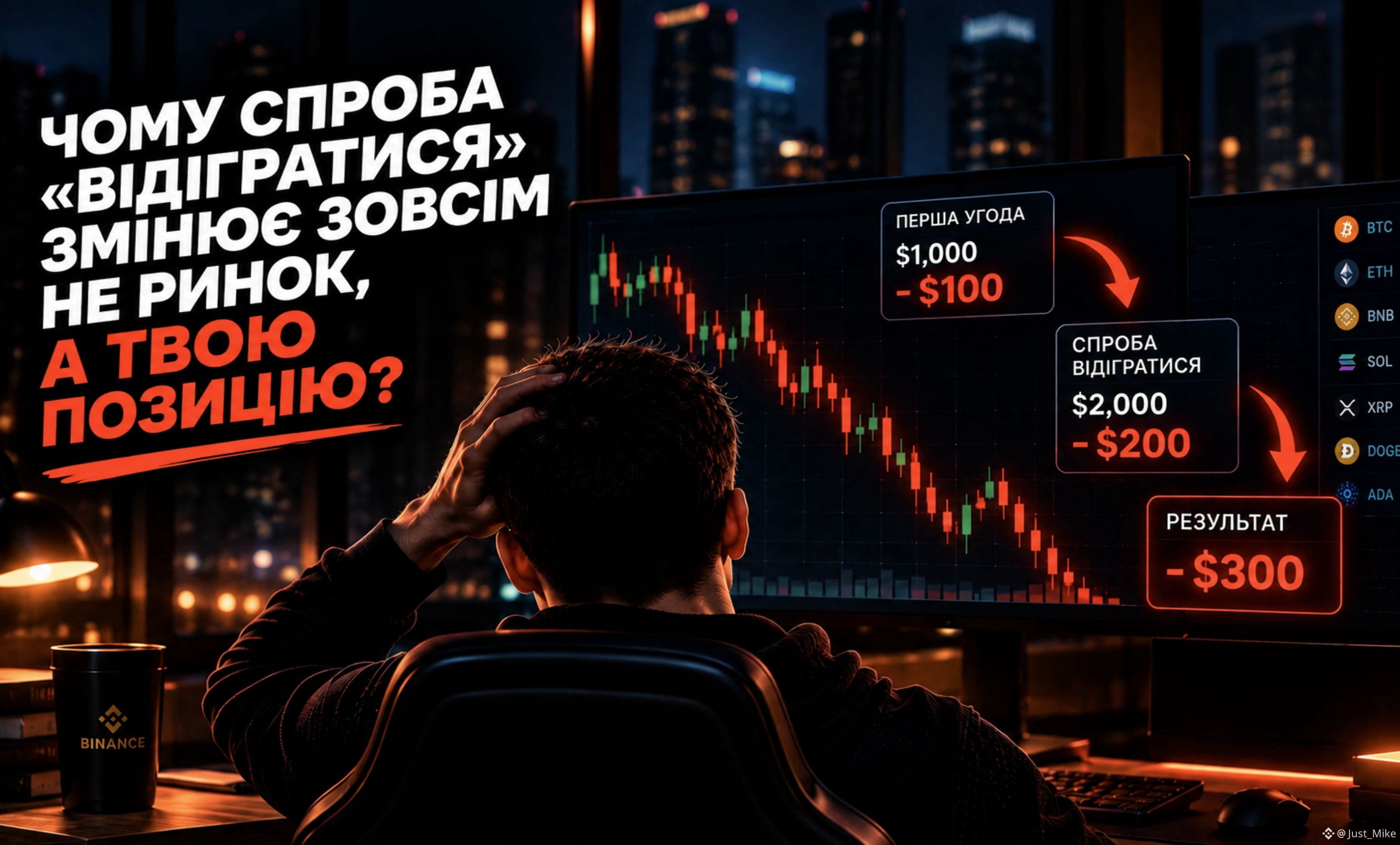
Why does the attempt to "make up" affect not the market at all, but your position?
Let’s imagine:
You opened a deal for $1,000 and lost $100.
The first thought could be:
"I need to get those $100 back with the next trade."
And here, often, it’s not the market that changes, but your behavior.
Instead of a $1,000 position, you open one for $2,000.
Meanwhile, the market knows nothing about your previous losses.
But your risk has changed.
If the next position also goes against you by 10%:
−$100 → another −$200 = −$300.
So the desire to "make up" doesn’t increase your chances of recovering the loss. It may simply increase the amount you’re willing to lose in the next trade.
And here it’s important to distinguish:
market → moves independently of your previous trade;
position → changes depending on how you decide to trade next.
So after a loss, the key question is not:
"How can I get these money back faster?"
but:
"Did my risk change because I want to get them back?"
#Trading #RiskManagement
Why does the attempt to "make up" affect not the market at all, but your position?
Let’s imagine:
You opened a deal for $1,000 and lost $100.
The first thought could be:
"I need to get those $100 back with the next trade."
And here, often, it’s not the market that changes, but your behavior.
Instead of a $1,000 position, you open one for $2,000.
Meanwhile, the market knows nothing about your previous losses.
But your risk has changed.
If the next position also goes against you by 10%:
−$100 → another −$200 = −$300.
So the desire to "make up" doesn’t increase your chances of recovering the loss. It may simply increase the amount you’re willing to lose in the next trade.
And here it’s important to distinguish:
market → moves independently of your previous trade;
position → changes depending on how you decide to trade next.
So after a loss, the key question is not:
"How can I get these money back faster?"
but:
"Did my risk change because I want to get them back?"
#Trading #RiskManagement
Let’s imagine:
You opened a deal for $1,000 and lost $100.
The first thought could be:
"I need to get those $100 back with the next trade."
And here, often, it’s not the market that changes, but your behavior.
Instead of a $1,000 position, you open one for $2,000.
Meanwhile, the market knows nothing about your previous losses.
But your risk has changed.
If the next position also goes against you by 10%:
−$100 → another −$200 = −$300.
So the desire to "make up" doesn’t increase your chances of recovering the loss. It may simply increase the amount you’re willing to lose in the next trade.
And here it’s important to distinguish:
market → moves independently of your previous trade;
position → changes depending on how you decide to trade next.
So after a loss, the key question is not:
"How can I get these money back faster?"
but:
"Did my risk change because I want to get them back?"
#Trading #RiskManagement
100
·
--
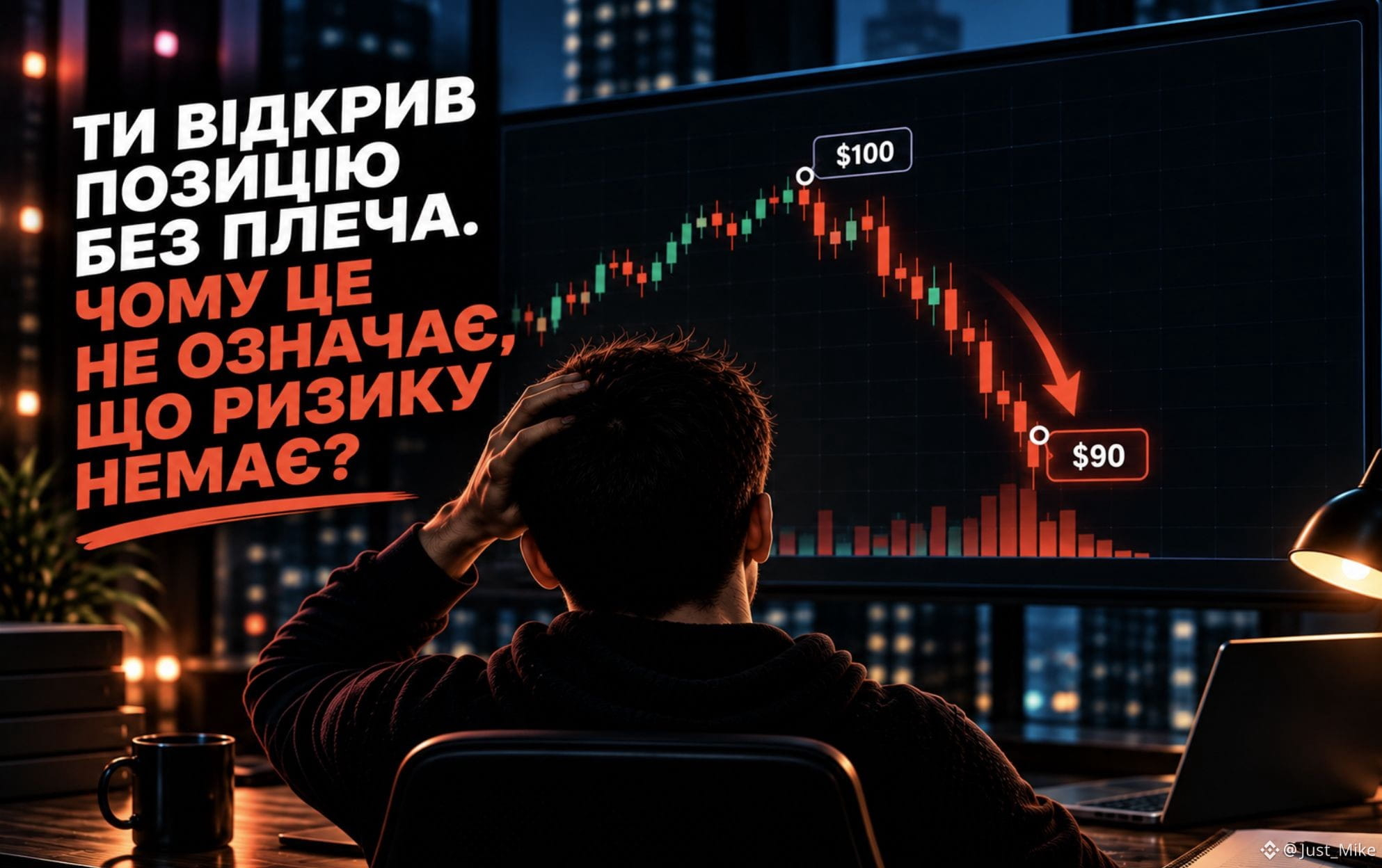
You opened a position without leverage. Why doesn’t that mean there’s no risk?
Many people think:
“ I’m not using leverage → so I can’t be liquidated → so there’s almost no risk.”
The first part of this logic is indeed correct: without leverage, there’s no liquidation risk typical of leveraged futures positions. But that doesn’t mean the position itself is safe.
Let’s imagine:
You bought assets worth $1,000.
The asset drops by 10% → your position is now worth $900.
There was no leverage. There’s no liquidation. But you still lost $100 of the position’s value.
And here are the other risks that remain:
🔹 Price risk — the asset can keep falling.
🔹 Position size risk — 10% of $100 and 10% of $10,000 are completely different amounts.
🔹 Liquidity risk — with a large position, it may be harder to exit at the price you want, which can lead to slippage.
So “without leverage” ≠ “without risk.”
Leverage adds another layer of risk: it increases exposure relative to your own capital and can bring liquidation closer.
But even without it, you should still ask yourself:
how much can I lose if the price moves against me?
#Trading #RiskManagement
You opened a position without leverage. Why doesn’t that mean there’s no risk?
Many people think:
“ I’m not using leverage → so I can’t be liquidated → so there’s almost no risk.”
The first part of this logic is indeed correct: without leverage, there’s no liquidation risk typical of leveraged futures positions. But that doesn’t mean the position itself is safe.
Let’s imagine:
You bought assets worth $1,000.
The asset drops by 10% → your position is now worth $900.
There was no leverage. There’s no liquidation. But you still lost $100 of the position’s value.
And here are the other risks that remain:
🔹 Price risk — the asset can keep falling.
🔹 Position size risk — 10% of $100 and 10% of $10,000 are completely different amounts.
🔹 Liquidity risk — with a large position, it may be harder to exit at the price you want, which can lead to slippage.
So “without leverage” ≠ “without risk.”
Leverage adds another layer of risk: it increases exposure relative to your own capital and can bring liquidation closer.
But even without it, you should still ask yourself:
how much can I lose if the price moves against me?
#Trading #RiskManagement
Many people think:
“ I’m not using leverage → so I can’t be liquidated → so there’s almost no risk.”
The first part of this logic is indeed correct: without leverage, there’s no liquidation risk typical of leveraged futures positions. But that doesn’t mean the position itself is safe.
Let’s imagine:
You bought assets worth $1,000.
The asset drops by 10% → your position is now worth $900.
There was no leverage. There’s no liquidation. But you still lost $100 of the position’s value.
And here are the other risks that remain:
🔹 Price risk — the asset can keep falling.
🔹 Position size risk — 10% of $100 and 10% of $10,000 are completely different amounts.
🔹 Liquidity risk — with a large position, it may be harder to exit at the price you want, which can lead to slippage.
So “without leverage” ≠ “without risk.”
Leverage adds another layer of risk: it increases exposure relative to your own capital and can bring liquidation closer.
But even without it, you should still ask yourself:
how much can I lose if the price moves against me?
#Trading #RiskManagement
599
·
--
What happens if everyone wants to sell at the same time?
Imagine this situation:
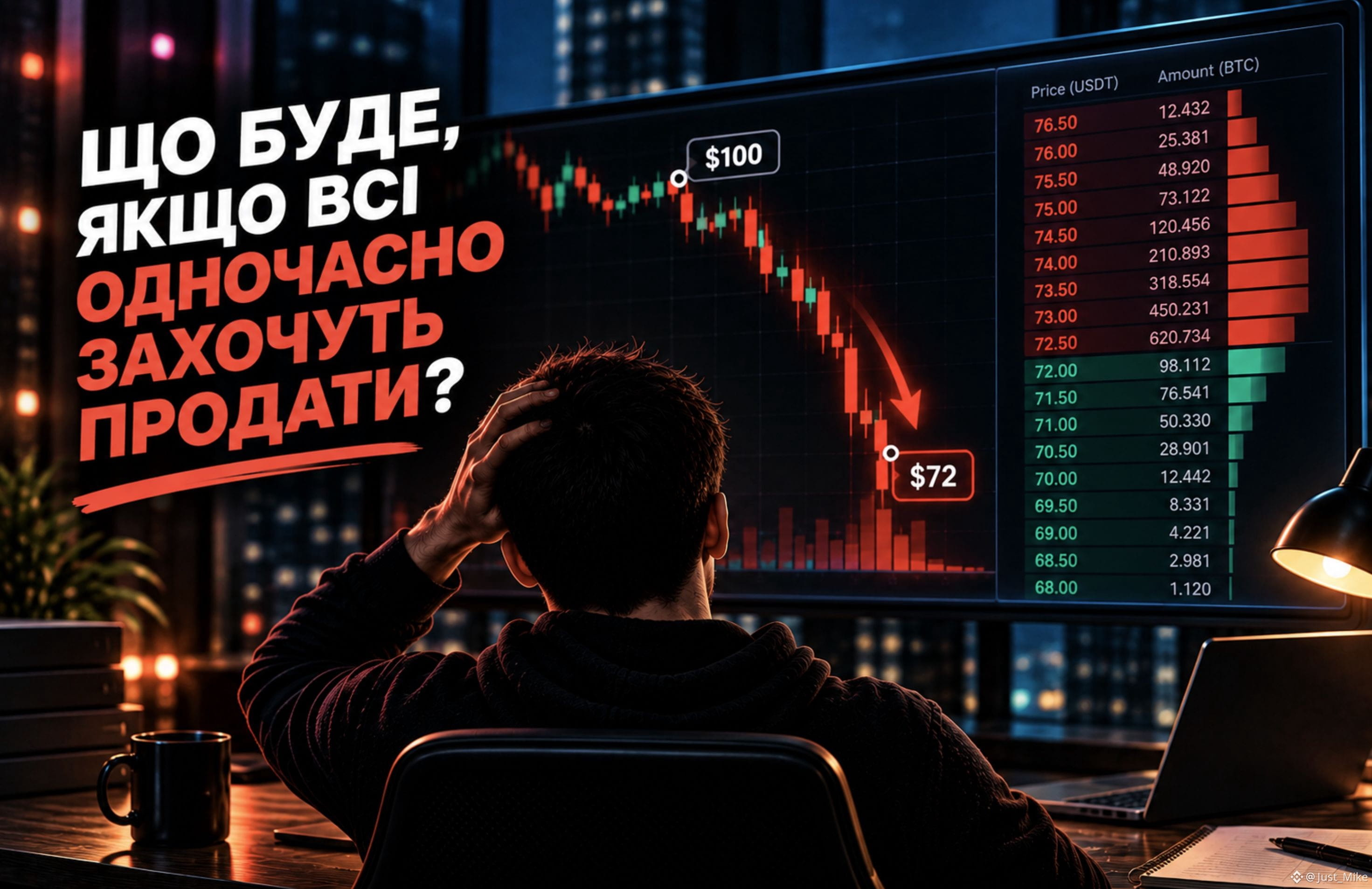
you bought an asset for $100.
Then, in the market, a large number of sellers appear at the same time.
What happens?
There may simply not be enough buyers at the $100 price to fill the entire volume of sales.
Then sellers start taking buy orders at lower prices:
$100 → $99 → $98 → $95…
And the price can drop very quickly.
This is where liquidity matters.
Liquidity shows how easy it is to buy or sell an asset without significantly affecting its price.
📉 High liquidity → many orders in the market, a large volume can be processed with less impact on the price.
📉 Low liquidity → fewer orders, so even a relatively large order can move the price a lot.
So a sudden drop does not always mean that the asset suddenly became “worse.”
Sometimes the issue is different:
there are far more sellers than buyers willing to buy at current prices.
That’s why during sharp moves it’s important to look not only at the asset’s price, but also at how much liquidity there is in the market.
#Trading #Liquidity
What happens if everyone wants to sell at the same time?
Imagine this situation:
you bought an asset for $100.
Then, in the market, a large number of sellers appear at the same time.
What happens?
There may simply not be enough buyers at the $100 price to fill the entire volume of sales.
Then sellers start taking buy orders at lower prices:
$100 → $99 → $98 → $95…
And the price can drop very quickly.
This is where liquidity matters.
Liquidity shows how easy it is to buy or sell an asset without significantly affecting its price.
📉 High liquidity → many orders in the market, a large volume can be processed with less impact on the price.
📉 Low liquidity → fewer orders, so even a relatively large order can move the price a lot.
So a sudden drop does not always mean that the asset suddenly became “worse.”
Sometimes the issue is different:
there are far more sellers than buyers willing to buy at current prices.
That’s why during sharp moves it’s important to look not only at the asset’s price, but also at how much liquidity there is in the market.
#Trading #Liquidity
Imagine this situation:
you bought an asset for $100.
Then, in the market, a large number of sellers appear at the same time.
What happens?
There may simply not be enough buyers at the $100 price to fill the entire volume of sales.
Then sellers start taking buy orders at lower prices:
$100 → $99 → $98 → $95…
And the price can drop very quickly.
This is where liquidity matters.
Liquidity shows how easy it is to buy or sell an asset without significantly affecting its price.
📉 High liquidity → many orders in the market, a large volume can be processed with less impact on the price.
📉 Low liquidity → fewer orders, so even a relatively large order can move the price a lot.
So a sudden drop does not always mean that the asset suddenly became “worse.”
Sometimes the issue is different:
there are far more sellers than buyers willing to buy at current prices.
That’s why during sharp moves it’s important to look not only at the asset’s price, but also at how much liquidity there is in the market.
#Trading #Liquidity
143
·
--
I set a stop-loss. Why can I still lose more than I expected?
Let’s imagine:
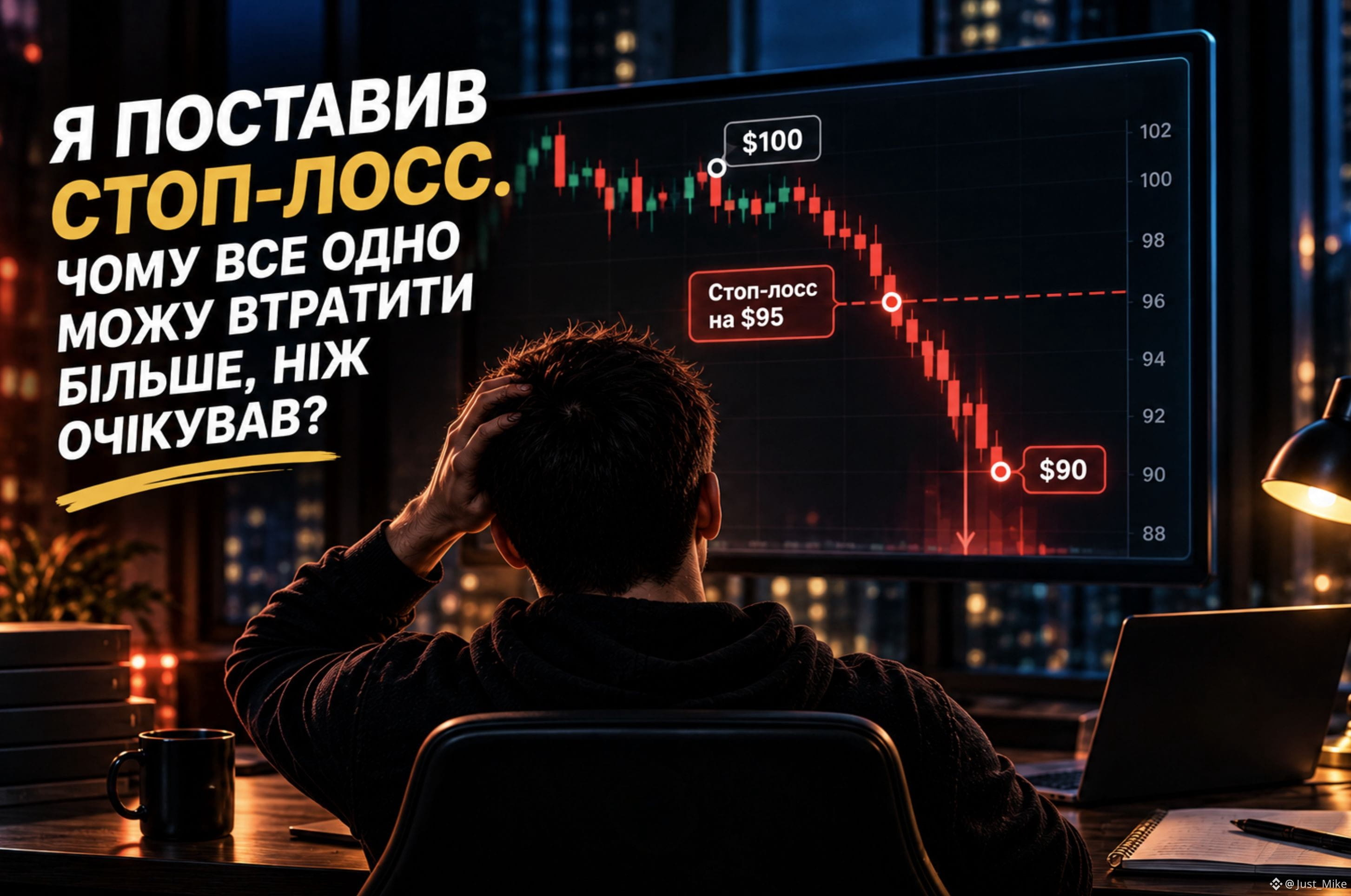
You bought an asset for $100 and set a stop-loss at $95.
The logic is simple:
“I expect to lose about 5%.”
But the market doesn’t always move smoothly.
If the price drops sharply:
$100 → $95 → $90
the stop may trigger not at $95.
With a stop-market order, after the order is triggered, it is filled at available prices. With high volatility, slippage can occur between the trigger price and the actual fill price.
And with a stop-limit order, it’s different: you control the execution price, but with a very fast move the order may not get filled.
So a stop-loss is not a guarantee:
“I will definitely lose no more than 5%.”
It’s a risk-management tool, but the way the order is executed also matters.
That’s why before setting a stop, you should understand not only:
“Where will I exit?”
but also:
“What happens if the price crosses this level in a second?”
#Trading #RiskManagement
I set a stop-loss. Why can I still lose more than I expected?
Let’s imagine:
You bought an asset for $100 and set a stop-loss at $95.
The logic is simple:
“I expect to lose about 5%.”
But the market doesn’t always move smoothly.
If the price drops sharply:
$100 → $95 → $90
the stop may trigger not at $95.
With a stop-market order, after the order is triggered, it is filled at available prices. With high volatility, slippage can occur between the trigger price and the actual fill price.
And with a stop-limit order, it’s different: you control the execution price, but with a very fast move the order may not get filled.
So a stop-loss is not a guarantee:
“I will definitely lose no more than 5%.”
It’s a risk-management tool, but the way the order is executed also matters.
That’s why before setting a stop, you should understand not only:
“Where will I exit?”
but also:
“What happens if the price crosses this level in a second?”
#Trading #RiskManagement
Let’s imagine:
You bought an asset for $100 and set a stop-loss at $95.
The logic is simple:
“I expect to lose about 5%.”
But the market doesn’t always move smoothly.
If the price drops sharply:
$100 → $95 → $90
the stop may trigger not at $95.
With a stop-market order, after the order is triggered, it is filled at available prices. With high volatility, slippage can occur between the trigger price and the actual fill price.
And with a stop-limit order, it’s different: you control the execution price, but with a very fast move the order may not get filled.
So a stop-loss is not a guarantee:
“I will definitely lose no more than 5%.”
It’s a risk-management tool, but the way the order is executed also matters.
That’s why before setting a stop, you should understand not only:
“Where will I exit?”
but also:
“What happens if the price crosses this level in a second?”
#Trading #RiskManagement
139
·
--
If perpetual follows the stock price, why does it need funding?
At first glance, funding looks like just an additional fee.
But its role is completely different.
TradFi Perpetual tracks the price of the underlying asset, but the contract itself trades separately. That’s why its price can deviate from the underlying.
And this raises a question:
how do you bring these two prices closer if the perpetual has no expiration date?
That’s exactly what funding is for.
If the perpetual trades above the underlying price, funding becomes positive—long positions pay short positions.
If it trades below, funding can become negative—shorts pay longs.
The logic is simple:
price is too high → the short gets paid → an incentive to sell appears
price is too low → the long gets paid → an incentive to buy appears
So funding helps keep the perpetual price closer to the underlying.
And there’s one important thing here:
funding is not a payment to Binance for holding a position.
It’s a settlement mechanism between longs and shorts that helps maintain the link to the underlying asset.
Binance states that funding payments transfer between traders and are not collected by the exchange as a commission.
So the perpetual has no expiration, but funding helps keep it connected to the underlying.
#TradFi
If perpetual follows the stock price, why does it need funding?
At first glance, funding looks like just an additional fee.
But its role is completely different.
TradFi Perpetual tracks the price of the underlying asset, but the contract itself trades separately. That’s why its price can deviate from the underlying.
And this raises a question:
how do you bring these two prices closer if the perpetual has no expiration date?
That’s exactly what funding is for.
If the perpetual trades above the underlying price, funding becomes positive—long positions pay short positions.
If it trades below, funding can become negative—shorts pay longs.
The logic is simple:
price is too high → the short gets paid → an incentive to sell appears
price is too low → the long gets paid → an incentive to buy appears
So funding helps keep the perpetual price closer to the underlying.
And there’s one important thing here:
funding is not a payment to Binance for holding a position.
It’s a settlement mechanism between longs and shorts that helps maintain the link to the underlying asset.
Binance states that funding payments transfer between traders and are not collected by the exchange as a commission.
So the perpetual has no expiration, but funding helps keep it connected to the underlying.
#TradFi
At first glance, funding looks like just an additional fee.
But its role is completely different.
TradFi Perpetual tracks the price of the underlying asset, but the contract itself trades separately. That’s why its price can deviate from the underlying.
And this raises a question:
how do you bring these two prices closer if the perpetual has no expiration date?
That’s exactly what funding is for.
If the perpetual trades above the underlying price, funding becomes positive—long positions pay short positions.
If it trades below, funding can become negative—shorts pay longs.
The logic is simple:
price is too high → the short gets paid → an incentive to sell appears
price is too low → the long gets paid → an incentive to buy appears
So funding helps keep the perpetual price closer to the underlying.
And there’s one important thing here:
funding is not a payment to Binance for holding a position.
It’s a settlement mechanism between longs and shorts that helps maintain the link to the underlying asset.
Binance states that funding payments transfer between traders and are not collected by the exchange as a commission.
So the perpetual has no expiration, but funding helps keep it connected to the underlying.
#TradFi

77
·
--
If an asset in Flexible can be settled without a fixed term,
why does its APR change every minute?
Earlier, I perceived Earn quite simply:
I deposited an asset ➞ I receive yield ➞ when needed, I withdraw the asset.
But Flexible Products has an interesting detail.
Binance calls this rate the Real-Time APR — it can change every minute, and rewards are calculated every minute.
And here I had a question:
if the term isn’t fixed, what does the current yield depend on?
It turns out the mechanics are more interesting than simply “Binance pays an interest rate for holding an asset.”
According to Binance, assets in Flexible Products can be used for operations, in particular for lending via Margin and Loan. The Real-Time APR for a token takes into account its demand, supply, and other factors.
So, the APR here is not a promise of a fixed rate.
It’s a current indicator of reward that can change along with the conditions affecting how the assets are used.
And that’s exactly what seems most interesting to me about Flexible:
gflexibility relates to the availability of the asset, and APR relates to the current reward conditions.
So it’s not enough to look at only the APR number.
It’s more important to understand where it comes from and why it might change soon after you see it.
#BinanceEarn #SimpleEarn
If an asset in Flexible can be settled without a fixed term,
why does its APR change every minute?
Earlier, I perceived Earn quite simply:
I deposited an asset ➞ I receive yield ➞ when needed, I withdraw the asset.
But Flexible Products has an interesting detail.
Binance calls this rate the Real-Time APR — it can change every minute, and rewards are calculated every minute.
And here I had a question:
if the term isn’t fixed, what does the current yield depend on?
It turns out the mechanics are more interesting than simply “Binance pays an interest rate for holding an asset.”
According to Binance, assets in Flexible Products can be used for operations, in particular for lending via Margin and Loan. The Real-Time APR for a token takes into account its demand, supply, and other factors.
So, the APR here is not a promise of a fixed rate.
It’s a current indicator of reward that can change along with the conditions affecting how the assets are used.
And that’s exactly what seems most interesting to me about Flexible:
gflexibility relates to the availability of the asset, and APR relates to the current reward conditions.
So it’s not enough to look at only the APR number.
It’s more important to understand where it comes from and why it might change soon after you see it.
#BinanceEarn #SimpleEarn
why does its APR change every minute?
Earlier, I perceived Earn quite simply:
I deposited an asset ➞ I receive yield ➞ when needed, I withdraw the asset.
But Flexible Products has an interesting detail.
Binance calls this rate the Real-Time APR — it can change every minute, and rewards are calculated every minute.
And here I had a question:
if the term isn’t fixed, what does the current yield depend on?
It turns out the mechanics are more interesting than simply “Binance pays an interest rate for holding an asset.”
According to Binance, assets in Flexible Products can be used for operations, in particular for lending via Margin and Loan. The Real-Time APR for a token takes into account its demand, supply, and other factors.
So, the APR here is not a promise of a fixed rate.
It’s a current indicator of reward that can change along with the conditions affecting how the assets are used.
And that’s exactly what seems most interesting to me about Flexible:
gflexibility relates to the availability of the asset, and APR relates to the current reward conditions.
So it’s not enough to look at only the APR number.
It’s more important to understand where it comes from and why it might change soon after you see it.
#BinanceEarn #SimpleEarn

152
·
--
A curator may look like the person deciding where Vault capital goes.
But how much of that decision is actually made before the curator chooses a market?
A multi-market Vault does not start with an unlimited list of markets.
Its architecture already places a condition on which markets can be connected: markets in the same Vault must use the same Debt Token.
The market whitelist then further defines which of those markets can actually be used for orders.
Only after those boundaries exist does the curator make the specific allocation decision.
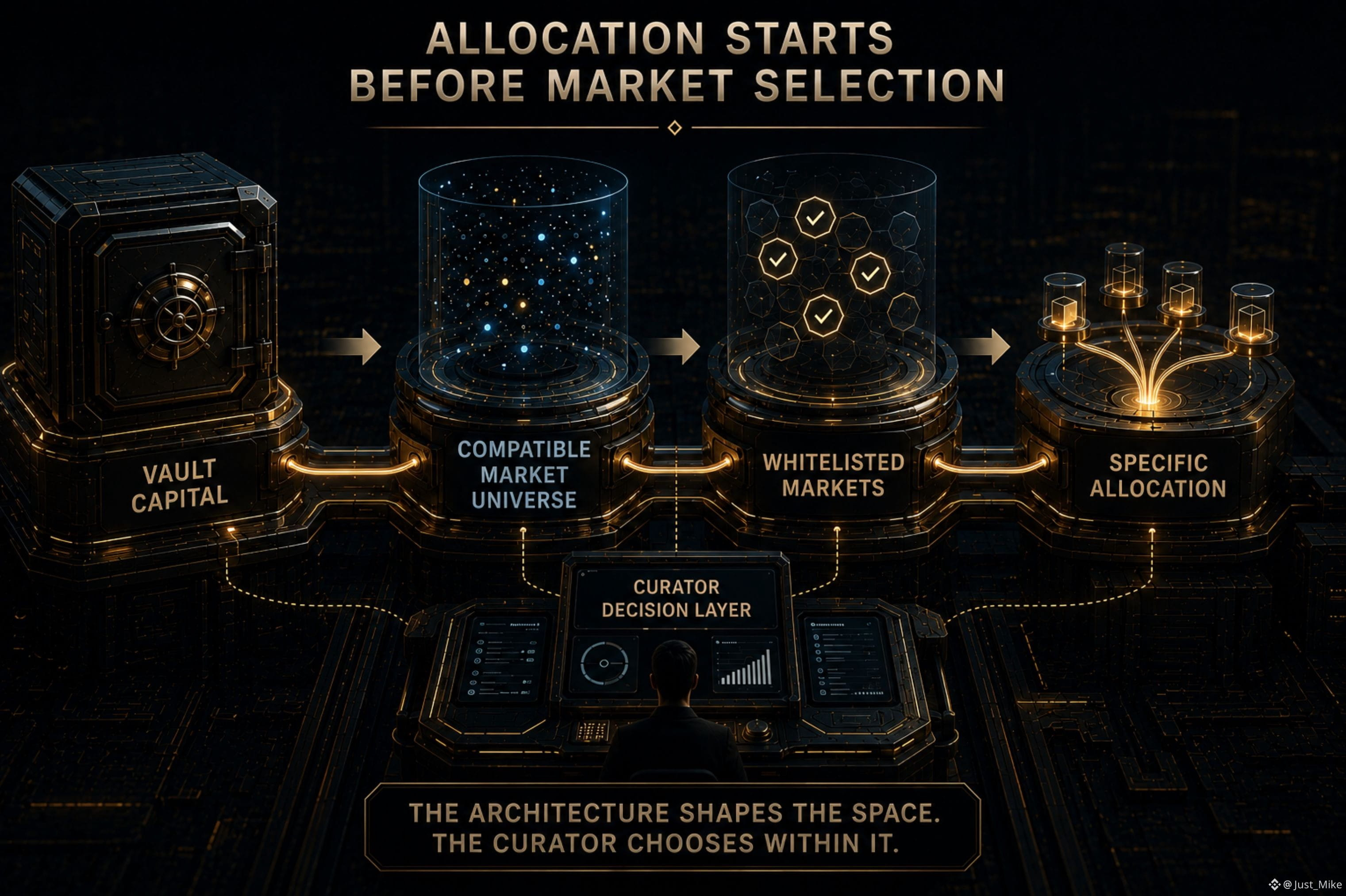
So the process is closer to:
Vault capital
→ compatible market universe
→ whitelisted markets
→ specific allocation
That changes how I think about Vault allocation.
The curator still chooses where capital goes.
But that choice is made inside a market universe that the protocol architecture has already partially defined.
In other words:
Allocation ≠ simply choosing a market.
Allocation = choosing within an architecture-defined market universe.
Maybe the more interesting question isn't only where a curator puts capital.
It's how much of that choice already exists before the choice is made.
#termmax @termmax
A curator may look like the person deciding where Vault capital goes.
But how much of that decision is actually made before the curator chooses a market?
A multi-market Vault does not start with an unlimited list of markets.
Its architecture already places a condition on which markets can be connected: markets in the same Vault must use the same Debt Token.
The market whitelist then further defines which of those markets can actually be used for orders.
Only after those boundaries exist does the curator make the specific allocation decision.
So the process is closer to:
Vault capital
→ compatible market universe
→ whitelisted markets
→ specific allocation
That changes how I think about Vault allocation.
The curator still chooses where capital goes.
But that choice is made inside a market universe that the protocol architecture has already partially defined.
In other words:
Allocation ≠ simply choosing a market.
Allocation = choosing within an architecture-defined market universe.
Maybe the more interesting question isn't only where a curator puts capital.
It's how much of that choice already exists before the choice is made.
#termmax @TermMax
But how much of that decision is actually made before the curator chooses a market?
A multi-market Vault does not start with an unlimited list of markets.
Its architecture already places a condition on which markets can be connected: markets in the same Vault must use the same Debt Token.
The market whitelist then further defines which of those markets can actually be used for orders.
Only after those boundaries exist does the curator make the specific allocation decision.
So the process is closer to:
Vault capital
→ compatible market universe
→ whitelisted markets
→ specific allocation
That changes how I think about Vault allocation.
The curator still chooses where capital goes.
But that choice is made inside a market universe that the protocol architecture has already partially defined.
In other words:
Allocation ≠ simply choosing a market.
Allocation = choosing within an architecture-defined market universe.
Maybe the more interesting question isn't only where a curator puts capital.
It's how much of that choice already exists before the choice is made.
#termmax @TermMax
93
·
--
Who gets to make which decision?
A fixed-rate market can look like a simple relationship:
lender ↔ borrower
But TermMax separates more decisions than that.
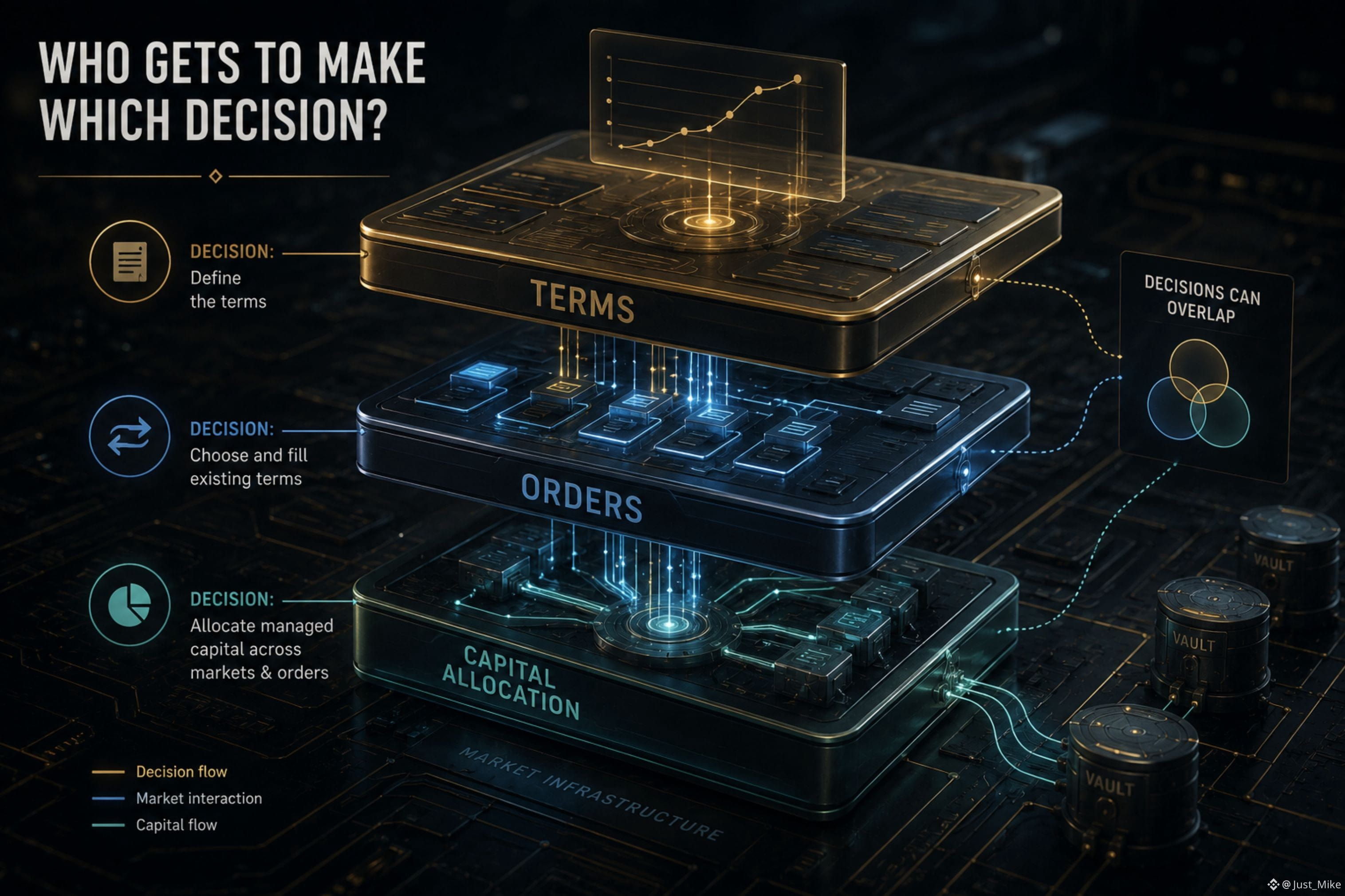
One participant can define the terms of a Range Order. Another can choose to fill those existing terms. And a Vault curator can decide where managed capital is deployed across markets and orders.
That distinction matters because these are different decisions.
Setting terms is not the same as accepting terms.
And neither is the same as deciding where pooled capital should be deployed.
The interesting part is that these functions are separated conceptually, but not necessarily between three completely independent actors.
A curator, for example, can manage Vault capital while also creating and managing supported orders.
So I wouldn't think about TermMax simply as:
lender meets borrower.
I'd think about it as several decision layers interacting:
terms are defined
↓
orders are filled
↓
managed capital is allocated
That creates a different way to read the market.
The key question isn't only who provides liquidity.
It's:
who gets to decide the terms, who decides whether to take them, and who decides where managed capital goes?
That separation of decisions may be one of the more interesting pieces of TermMax's market structure.
#termmax @termmax
Who gets to make which decision?
A fixed-rate market can look like a simple relationship:
lender ↔ borrower
But TermMax separates more decisions than that.
One participant can define the terms of a Range Order. Another can choose to fill those existing terms. And a Vault curator can decide where managed capital is deployed across markets and orders.
That distinction matters because these are different decisions.
Setting terms is not the same as accepting terms.
And neither is the same as deciding where pooled capital should be deployed.
The interesting part is that these functions are separated conceptually, but not necessarily between three completely independent actors.
A curator, for example, can manage Vault capital while also creating and managing supported orders.
So I wouldn't think about TermMax simply as:
lender meets borrower.
I'd think about it as several decision layers interacting:
terms are defined
↓
orders are filled
↓
managed capital is allocated
That creates a different way to read the market.
The key question isn't only who provides liquidity.
It's:
who gets to decide the terms, who decides whether to take them, and who decides where managed capital goes?
That separation of decisions may be one of the more interesting pieces of TermMax's market structure.
#termmax @TermMax
A fixed-rate market can look like a simple relationship:
lender ↔ borrower
But TermMax separates more decisions than that.
One participant can define the terms of a Range Order. Another can choose to fill those existing terms. And a Vault curator can decide where managed capital is deployed across markets and orders.
That distinction matters because these are different decisions.
Setting terms is not the same as accepting terms.
And neither is the same as deciding where pooled capital should be deployed.
The interesting part is that these functions are separated conceptually, but not necessarily between three completely independent actors.
A curator, for example, can manage Vault capital while also creating and managing supported orders.
So I wouldn't think about TermMax simply as:
lender meets borrower.
I'd think about it as several decision layers interacting:
terms are defined
↓
orders are filled
↓
managed capital is allocated
That creates a different way to read the market.
The key question isn't only who provides liquidity.
It's:
who gets to decide the terms, who decides whether to take them, and who decides where managed capital goes?
That separation of decisions may be one of the more interesting pieces of TermMax's market structure.
#termmax @TermMax
86
·
--
The interesting part of a TermMax Vault may not be what the curator can do.
It may be what the curator cannot do.
A curator manages the strategy, but that control is not unlimited.
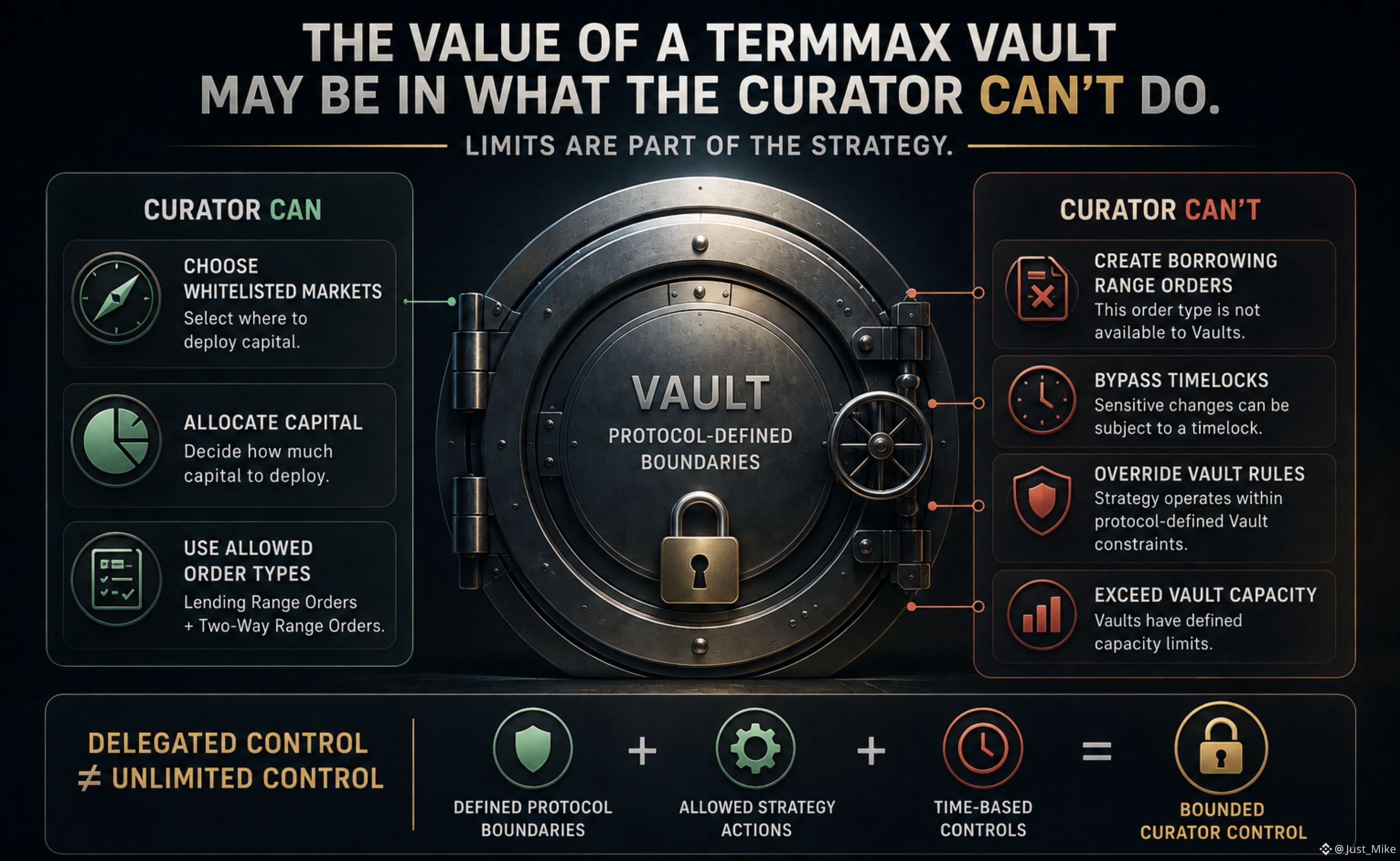
First, the capital can only be deployed into whitelisted markets.
Then there is a capacity limit, which caps how much capital the Vault can accept and helps prevent over-concentration.
The more interesting constraint is what the Vault can actually do inside those markets.
Vaults can use Lending Range Orders and Two-Way Range Orders, but they cannot create Borrowing Range Orders.
And even in a Two-Way Order, the Vault cannot simply collateralize its assets and borrow. It must lend first, then it can borrow by selling the FT acquired through that lending activity.
Finally, sensitive changes do not necessarily happen immediately. They can go through a timelock, giving the Guardian time to review and cancel a pending change.
Put together, these aren't just separate Vault features.
They define a bounded decision space for the curator:
→ where capital can go
→ how much can be deployed
→ what kind of orders can be created
→ how quickly strategy parameters can change
My takeaway is that a curator-managed Vault isn't simply delegated control.
It's delegated control inside a set of protocol-defined boundaries.
And that may be the more interesting way to think about Vault design.
#termmax @termmax
The interesting part of a TermMax Vault may not be what the curator can do.
It may be what the curator cannot do.
A curator manages the strategy, but that control is not unlimited.
First, the capital can only be deployed into whitelisted markets.
Then there is a capacity limit, which caps how much capital the Vault can accept and helps prevent over-concentration.
The more interesting constraint is what the Vault can actually do inside those markets.
Vaults can use Lending Range Orders and Two-Way Range Orders, but they cannot create Borrowing Range Orders.
And even in a Two-Way Order, the Vault cannot simply collateralize its assets and borrow. It must lend first, then it can borrow by selling the FT acquired through that lending activity.
Finally, sensitive changes do not necessarily happen immediately. They can go through a timelock, giving the Guardian time to review and cancel a pending change.
Put together, these aren't just separate Vault features.
They define a bounded decision space for the curator:
→ where capital can go
→ how much can be deployed
→ what kind of orders can be created
→ how quickly strategy parameters can change
My takeaway is that a curator-managed Vault isn't simply delegated control.
It's delegated control inside a set of protocol-defined boundaries.
And that may be the more interesting way to think about Vault design.
#termmax @TermMax
It may be what the curator cannot do.
A curator manages the strategy, but that control is not unlimited.
First, the capital can only be deployed into whitelisted markets.
Then there is a capacity limit, which caps how much capital the Vault can accept and helps prevent over-concentration.
The more interesting constraint is what the Vault can actually do inside those markets.
Vaults can use Lending Range Orders and Two-Way Range Orders, but they cannot create Borrowing Range Orders.
And even in a Two-Way Order, the Vault cannot simply collateralize its assets and borrow. It must lend first, then it can borrow by selling the FT acquired through that lending activity.
Finally, sensitive changes do not necessarily happen immediately. They can go through a timelock, giving the Guardian time to review and cancel a pending change.
Put together, these aren't just separate Vault features.
They define a bounded decision space for the curator:
→ where capital can go
→ how much can be deployed
→ what kind of orders can be created
→ how quickly strategy parameters can change
My takeaway is that a curator-managed Vault isn't simply delegated control.
It's delegated control inside a set of protocol-defined boundaries.
And that may be the more interesting way to think about Vault design.
#termmax @TermMax
89
·
--
I thought SK Hynix had one share. Then I looked at the US listing.
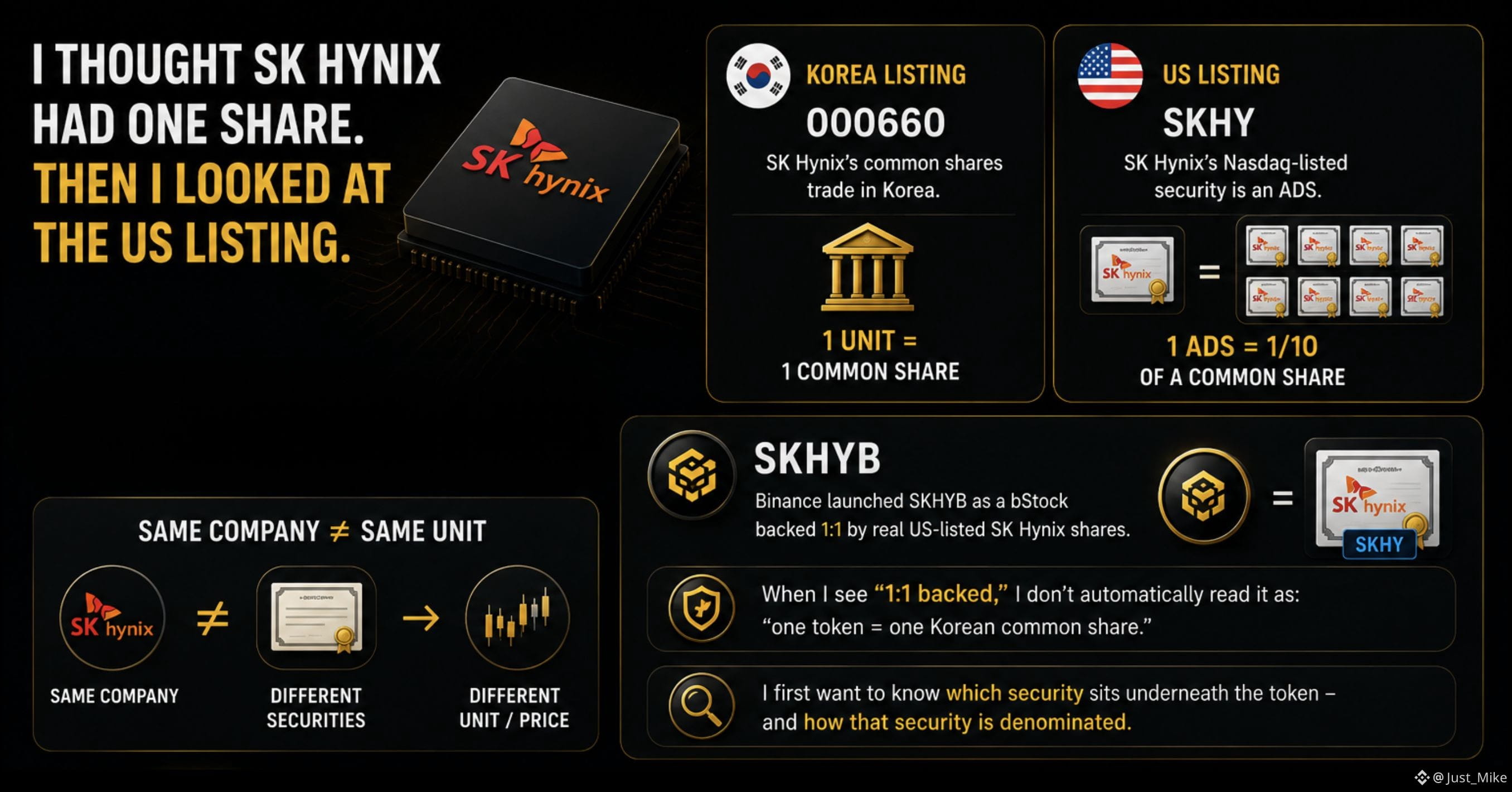
SK Hynix’s common shares trade in Korea under 000660.
Its Nasdaq-listed security, SKHY, is an ADS — and 1 ADS represents 1/10 of a common share.
That sounds like a technical detail.
But it changes how I read prices.
A price only makes sense once I know what one unit represents.
Then there is SKHYB.
Binance launched SKHYB as a bStock backed 1:1 by real US-listed SK Hynix shares.
So when I see “1:1 backed,” I don’t automatically read it as:
“one token = one Korean common share.”
That’s why “1:1 backed” is only the starting point for me — I also want to know what security that 1 actually refers to.
I first want to know which security sits underneath the token — and how that security is denominated.
Same company ≠ same unit.
That’s the useful check for me:
before comparing prices, check what one unit actually represents.
#bstockscis @BinanceCIS
I thought SK Hynix had one share. Then I looked at the US listing.
SK Hynix’s common shares trade in Korea under 000660.
Its Nasdaq-listed security, SKHY, is an ADS — and 1 ADS represents 1/10 of a common share.
That sounds like a technical detail.
But it changes how I read prices.
A price only makes sense once I know what one unit represents.
Then there is SKHYB.
Binance launched SKHYB as a bStock backed 1:1 by real US-listed SK Hynix shares.
So when I see “1:1 backed,” I don’t automatically read it as:
“one token = one Korean common share.”
That’s why “1:1 backed” is only the starting point for me — I also want to know what security that 1 actually refers to.
I first want to know which security sits underneath the token — and how that security is denominated.
Same company ≠ same unit.
That’s the useful check for me:
before comparing prices, check what one unit actually represents.
#bstockscis @BinanceCIS
SK Hynix’s common shares trade in Korea under 000660.
Its Nasdaq-listed security, SKHY, is an ADS — and 1 ADS represents 1/10 of a common share.
That sounds like a technical detail.
But it changes how I read prices.
A price only makes sense once I know what one unit represents.
Then there is SKHYB.
Binance launched SKHYB as a bStock backed 1:1 by real US-listed SK Hynix shares.
So when I see “1:1 backed,” I don’t automatically read it as:
“one token = one Korean common share.”
That’s why “1:1 backed” is only the starting point for me — I also want to know what security that 1 actually refers to.
I first want to know which security sits underneath the token — and how that security is denominated.
Same company ≠ same unit.
That’s the useful check for me:
before comparing prices, check what one unit actually represents.
#bstockscis @BinanceCIS
72
·
--
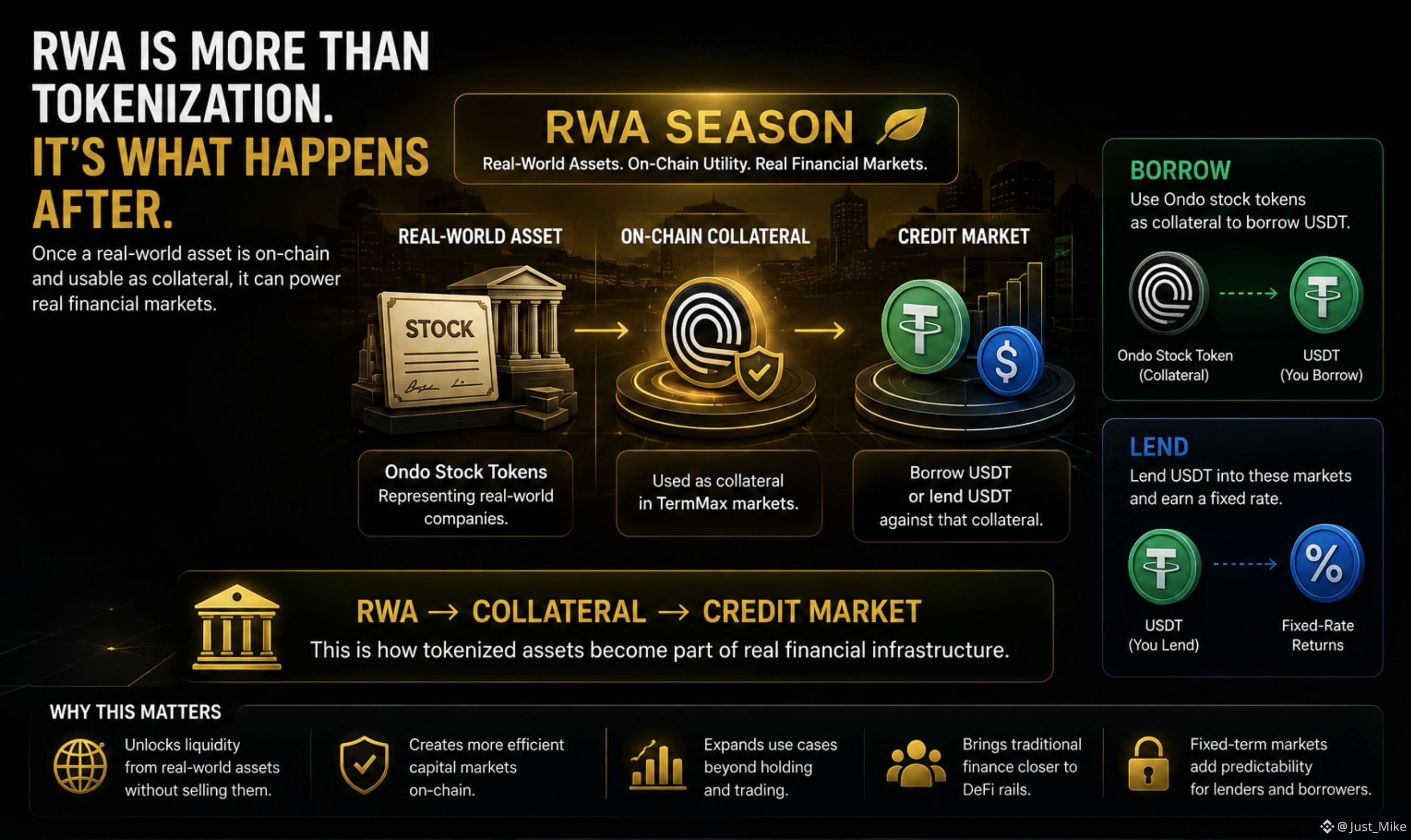
Tokenizing a real-world asset is only the beginning.
The more interesting question is what you can actually do with it once it's on-chain.
TermMax's current RWA Season gives a pretty practical example.
Ondo stock tokens can be used as collateral to borrow USDT on BNB Chain.
And on the other side, users can lend USDT into those markets.
So the structure becomes:
RWA → collateral → credit market
That is a much bigger idea than simply putting a tokenized stock into a wallet.
Once an asset becomes usable collateral, it can become part of an actual financial market.
And that's where I think RWA gets interesting.
Not:
“Can we tokenize this asset?”
But:
“What can the asset do after it is tokenized?”
TermMax is experimenting with one possible answer: fixed-term borrowing and lending around tokenized assets.
#termmax @termmax
Tokenizing a real-world asset is only the beginning.
The more interesting question is what you can actually do with it once it's on-chain.
TermMax's current RWA Season gives a pretty practical example.
Ondo stock tokens can be used as collateral to borrow USDT on BNB Chain.
And on the other side, users can lend USDT into those markets.
So the structure becomes:
RWA → collateral → credit market
That is a much bigger idea than simply putting a tokenized stock into a wallet.
Once an asset becomes usable collateral, it can become part of an actual financial market.
And that's where I think RWA gets interesting.
Not:
“Can we tokenize this asset?”
But:
“What can the asset do after it is tokenized?”
TermMax is experimenting with one possible answer: fixed-term borrowing and lending around tokenized assets.
#termmax @TermMax
The more interesting question is what you can actually do with it once it's on-chain.
TermMax's current RWA Season gives a pretty practical example.
Ondo stock tokens can be used as collateral to borrow USDT on BNB Chain.
And on the other side, users can lend USDT into those markets.
So the structure becomes:
RWA → collateral → credit market
That is a much bigger idea than simply putting a tokenized stock into a wallet.
Once an asset becomes usable collateral, it can become part of an actual financial market.
And that's where I think RWA gets interesting.
Not:
“Can we tokenize this asset?”
But:
“What can the asset do after it is tokenized?”
TermMax is experimenting with one possible answer: fixed-term borrowing and lending around tokenized assets.
#termmax @TermMax
107
·
--
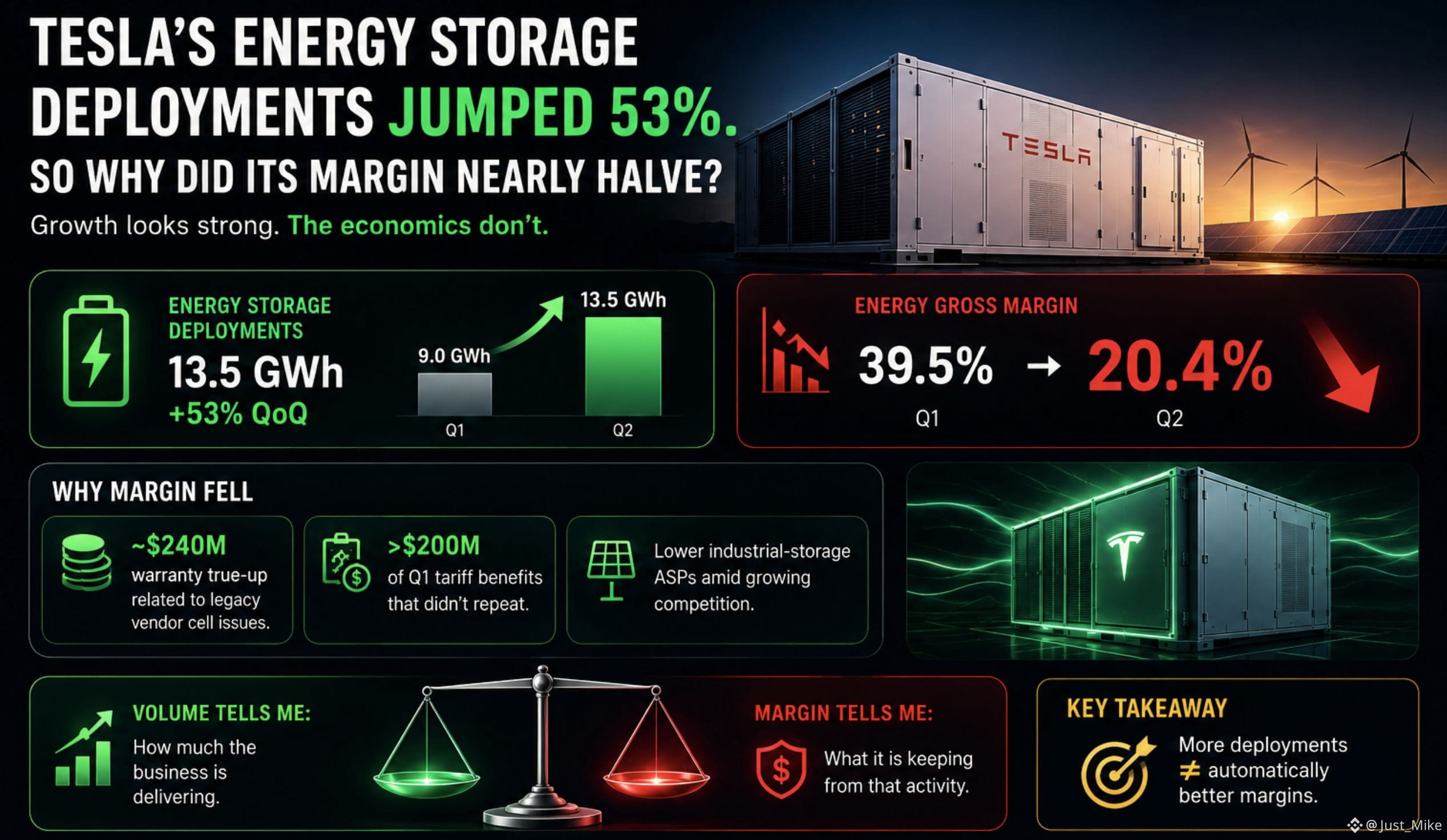
Tesla's energy storage deployments jumped 53%. So why did its margin nearly halve?
Tesla's energy business caught my attention for a reason that wasn't obvious from the headline growth.
In Q2, Tesla deployed 13.5 GWh of energy storage, up 53% QoQ.
That sounds like exactly what you want to see from a growing business.
Then I looked at the margin.
Energy gross margin fell from 39.5% to 20.4%.
That changed how I read the deployment number.
The explanation wasn't simply “growth is expensive.”
Tesla pointed to several factors:
a roughly $240M warranty true-up related to legacy vendor cell issues,
more than $200M of Q1 tariff benefits that didn't repeat,
and lower industrial-storage ASPs amid growing competition.
So the business deployed significantly more storage, while the economics of each dollar of that business became less favorable in the quarter.
That's what I find interesting about TSLAB as a bStock.
The obvious question is:
“How fast is Tesla's energy business growing?”
I'd also ask:
“What is happening to the economics of that growth?”
For me:
More deployments ≠ automatically better margins.
Volume tells me how much the business is delivering.
Margin tells me what it is keeping from that activity.
#bstockscis @BinanceCIS
Tesla's energy storage deployments jumped 53%. So why did its margin nearly halve?
Tesla's energy business caught my attention for a reason that wasn't obvious from the headline growth.
In Q2, Tesla deployed 13.5 GWh of energy storage, up 53% QoQ.
That sounds like exactly what you want to see from a growing business.
Then I looked at the margin.
Energy gross margin fell from 39.5% to 20.4%.
That changed how I read the deployment number.
The explanation wasn't simply “growth is expensive.”
Tesla pointed to several factors:
a roughly $240M warranty true-up related to legacy vendor cell issues,
more than $200M of Q1 tariff benefits that didn't repeat,
and lower industrial-storage ASPs amid growing competition.
So the business deployed significantly more storage, while the economics of each dollar of that business became less favorable in the quarter.
That's what I find interesting about TSLAB as a bStock.
The obvious question is:
“How fast is Tesla's energy business growing?”
I'd also ask:
“What is happening to the economics of that growth?”
For me:
More deployments ≠ automatically better margins.
Volume tells me how much the business is delivering.
Margin tells me what it is keeping from that activity.
#bstockscis @BinanceCIS
Tesla's energy business caught my attention for a reason that wasn't obvious from the headline growth.
In Q2, Tesla deployed 13.5 GWh of energy storage, up 53% QoQ.
That sounds like exactly what you want to see from a growing business.
Then I looked at the margin.
Energy gross margin fell from 39.5% to 20.4%.
That changed how I read the deployment number.
The explanation wasn't simply “growth is expensive.”
Tesla pointed to several factors:
a roughly $240M warranty true-up related to legacy vendor cell issues,
more than $200M of Q1 tariff benefits that didn't repeat,
and lower industrial-storage ASPs amid growing competition.
So the business deployed significantly more storage, while the economics of each dollar of that business became less favorable in the quarter.
That's what I find interesting about TSLAB as a bStock.
The obvious question is:
“How fast is Tesla's energy business growing?”
I'd also ask:
“What is happening to the economics of that growth?”
For me:
More deployments ≠ automatically better margins.
Volume tells me how much the business is delivering.
Margin tells me what it is keeping from that activity.
#bstockscis @BinanceCIS
3
3
110
·
--
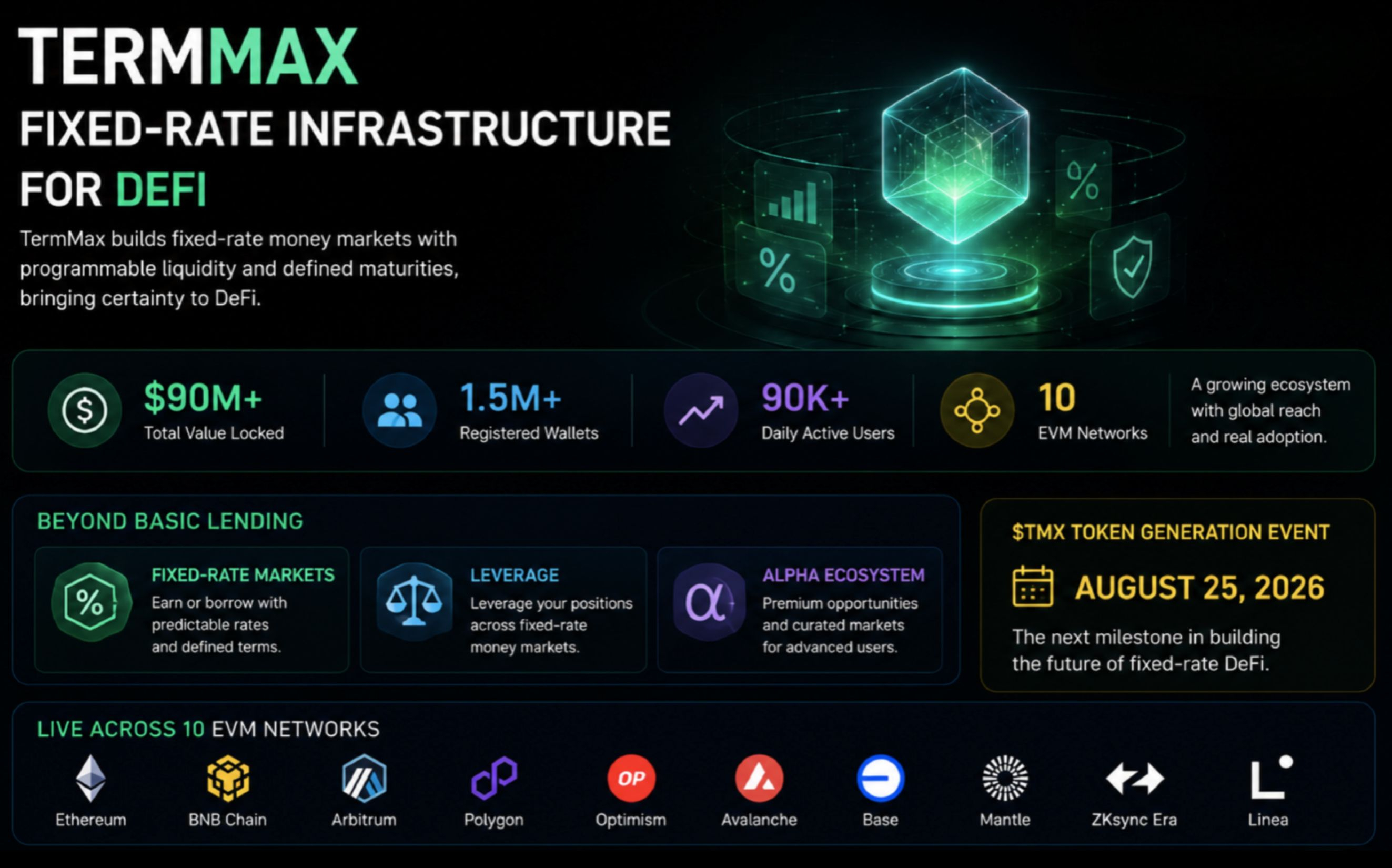
I’ve been looking at TermMax beyond the usual “another DeFi lending protocol” narrative.
The bigger idea is fixed-rate infrastructure for DeFi: markets built around defined maturities, fixed-rate positions and programmable liquidity.
Some numbers from the project currently stand out:
• $90M+ TVL
• 1.5M+ registered wallets
• 90K+ daily active users
• deployed across 10 EVM networks
And the product goes beyond basic lending, with fixed-rate markets, leverage and its Alpha ecosystem.
Another date worth watching: TermMax has announced its $TMX TGE for August 25.
What interests me most is whether fixed-rate markets can become a meaningful layer of DeFi infrastructure rather than just another lending product.
#termmax @termmax
I’ve been looking at TermMax beyond the usual “another DeFi lending protocol” narrative.
The bigger idea is fixed-rate infrastructure for DeFi: markets built around defined maturities, fixed-rate positions and programmable liquidity.
Some numbers from the project currently stand out:
• $90M+ TVL
• 1.5M+ registered wallets
• 90K+ daily active users
• deployed across 10 EVM networks
And the product goes beyond basic lending, with fixed-rate markets, leverage and its Alpha ecosystem.
Another date worth watching: TermMax has announced its $TMX TGE for August 25.
What interests me most is whether fixed-rate markets can become a meaningful layer of DeFi infrastructure rather than just another lending product.
#termmax @TermMax
The bigger idea is fixed-rate infrastructure for DeFi: markets built around defined maturities, fixed-rate positions and programmable liquidity.
Some numbers from the project currently stand out:
• $90M+ TVL
• 1.5M+ registered wallets
• 90K+ daily active users
• deployed across 10 EVM networks
And the product goes beyond basic lending, with fixed-rate markets, leverage and its Alpha ecosystem.
Another date worth watching: TermMax has announced its $TMX TGE for August 25.
What interests me most is whether fixed-rate markets can become a meaningful layer of DeFi infrastructure rather than just another lending product.
#termmax @TermMax
92
·
--
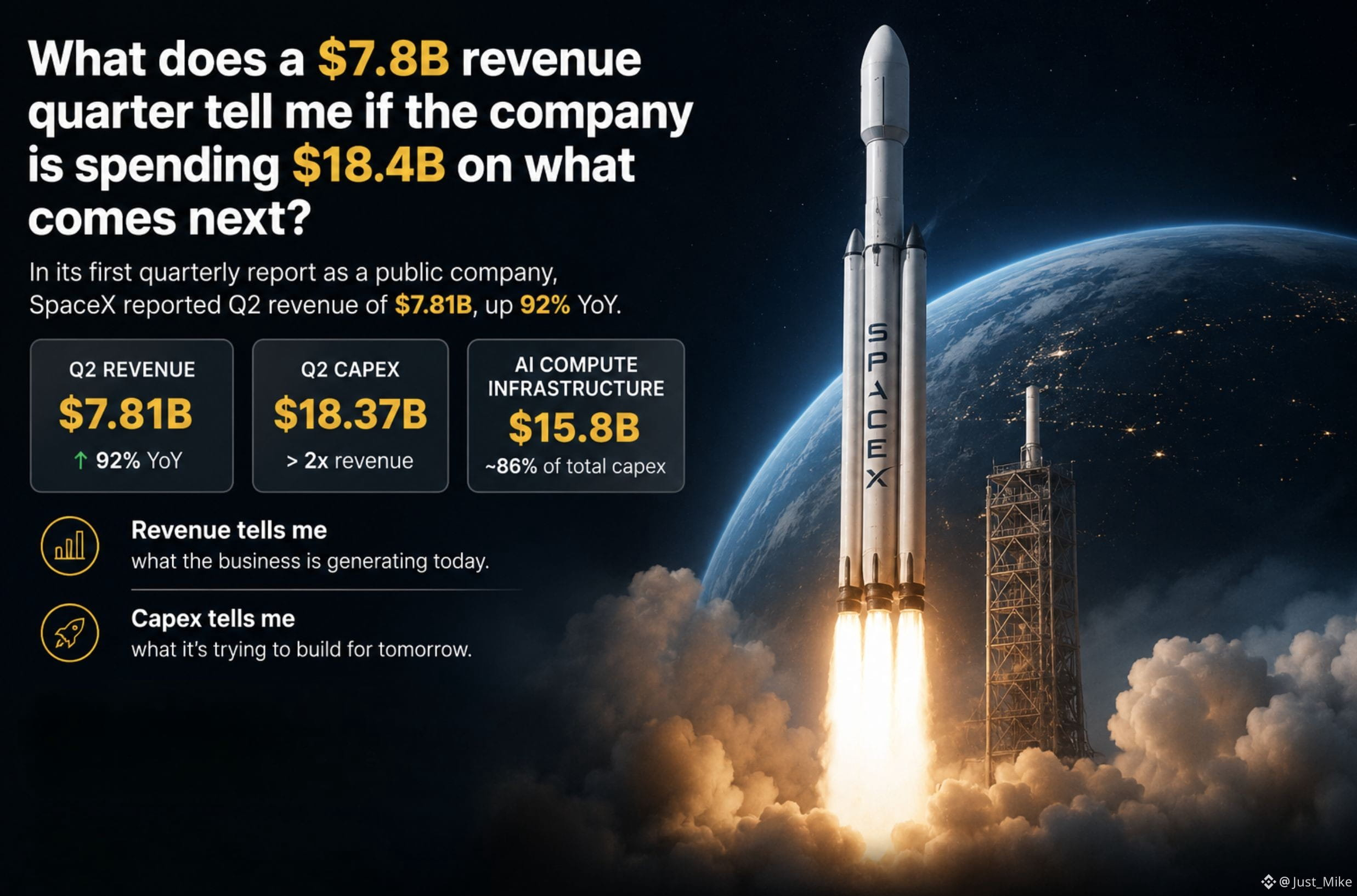
What does a $7.8B revenue quarter tell me if the company is spending $18.4B on what comes next?
In its first quarterly report as a public company, SpaceX reported Q2 revenue of $7.81B, up 92% YoY.
Then I looked at capex:
$18.37B for the quarter.
That's more than twice the company's quarterly revenue.
And it changed how I read the first number.
Revenue tells me the scale of the business today.
Capex tells me how much capital the company is committing to build for the next stage of growth.
About $15.8B of that Q2 capex went toward AI infrastructure.
That doesn't automatically mean the spending is inefficient — capex is an investment, not an expense.
But it does tell me something revenue growth alone doesn't:
how aggressively the company is investing behind its next stage of growth.
That's what I find interesting about SPCXB as a bStock.
The ticker gives me exposure to SpaceX.
But instead of asking only:
“How fast is revenue growing?”
I'd also ask:
“What is the company spending to make the next stage of growth possible?”
For me:
Revenue tells me what the business is generating today.
Capex tells me what it's trying to build for tomorrow.
#bstockscis @BinanceCIS
What does a $7.8B revenue quarter tell me if the company is spending $18.4B on what comes next?
In its first quarterly report as a public company, SpaceX reported Q2 revenue of $7.81B, up 92% YoY.
Then I looked at capex:
$18.37B for the quarter.
That's more than twice the company's quarterly revenue.
And it changed how I read the first number.
Revenue tells me the scale of the business today.
Capex tells me how much capital the company is committing to build for the next stage of growth.
About $15.8B of that Q2 capex went toward AI infrastructure.
That doesn't automatically mean the spending is inefficient — capex is an investment, not an expense.
But it does tell me something revenue growth alone doesn't:
how aggressively the company is investing behind its next stage of growth.
That's what I find interesting about SPCXB as a bStock.
The ticker gives me exposure to SpaceX.
But instead of asking only:
“How fast is revenue growing?”
I'd also ask:
“What is the company spending to make the next stage of growth possible?”
For me:
Revenue tells me what the business is generating today.
Capex tells me what it's trying to build for tomorrow.
#bstockscis @BinanceCIS
In its first quarterly report as a public company, SpaceX reported Q2 revenue of $7.81B, up 92% YoY.
Then I looked at capex:
$18.37B for the quarter.
That's more than twice the company's quarterly revenue.
And it changed how I read the first number.
Revenue tells me the scale of the business today.
Capex tells me how much capital the company is committing to build for the next stage of growth.
About $15.8B of that Q2 capex went toward AI infrastructure.
That doesn't automatically mean the spending is inefficient — capex is an investment, not an expense.
But it does tell me something revenue growth alone doesn't:
how aggressively the company is investing behind its next stage of growth.
That's what I find interesting about SPCXB as a bStock.
The ticker gives me exposure to SpaceX.
But instead of asking only:
“How fast is revenue growing?”
I'd also ask:
“What is the company spending to make the next stage of growth possible?”
For me:
Revenue tells me what the business is generating today.
Capex tells me what it's trying to build for tomorrow.
#bstockscis @BinanceCIS
2
1
124
·
--
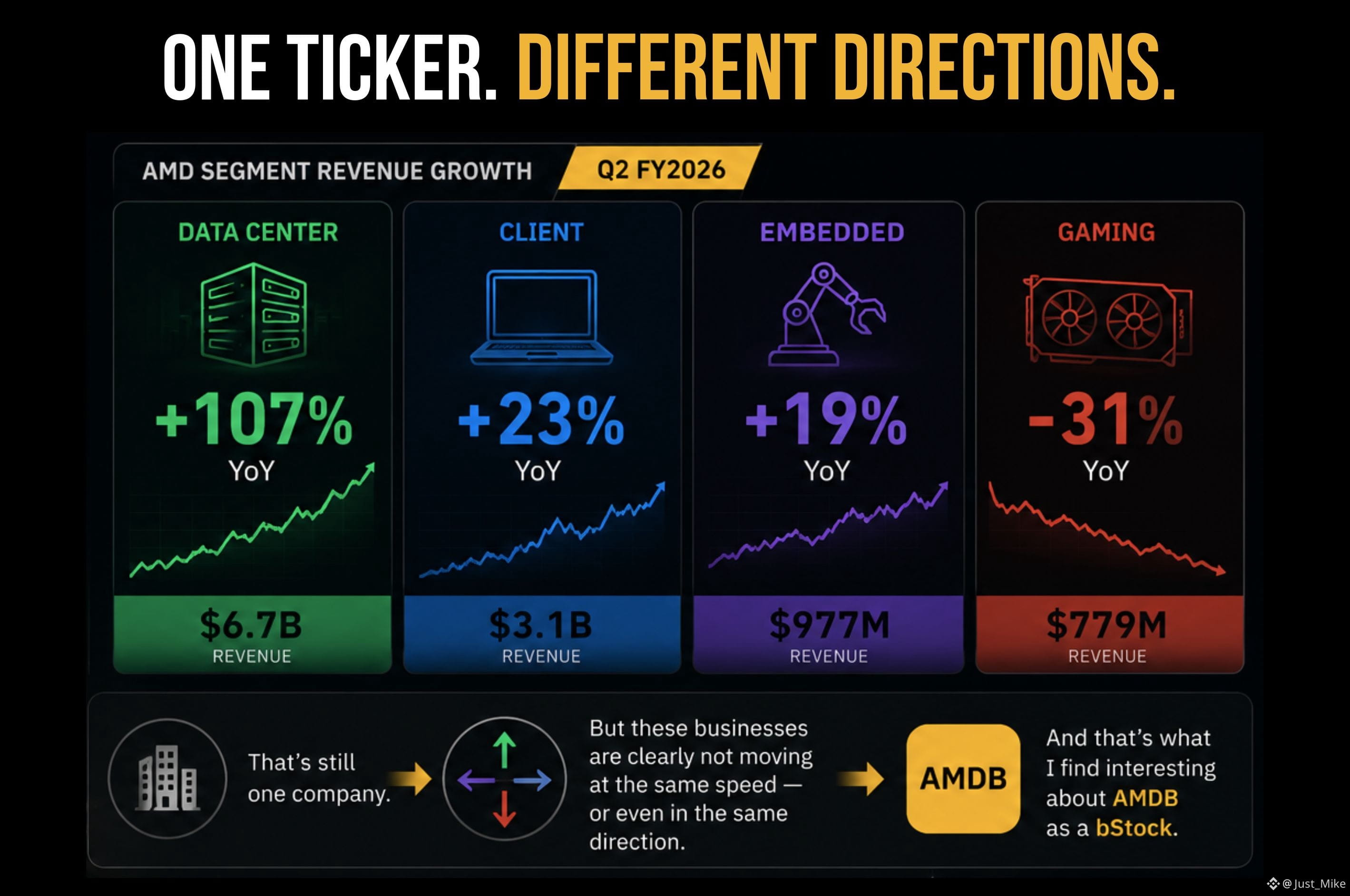
One ticker can contain businesses moving in opposite directions.
When I see AMDB, it’s tempting to think of it as one big AMD growth story.
But AMD’s latest numbers made me look at the ticker differently.
In Q2 FY2026:
Data Center: +107% YoY
Client: +23%
Embedded: +19%
Gaming: −31%
That’s still one company.
But these businesses are clearly not moving at the same speed — or even in the same direction.
And that’s what I find interesting about AMDB as a bStock.
The ticker tells me which company I’m getting exposure to.
The business mix tells me what is actually driving that exposure.
So when I see “AMD growth”, I don’t want to stop at the headline.
I want to ask:
Which part of AMD is actually growing?
For me, that’s a much more useful way to read a single ticker.
#bstockscis @BinanceCIS
One ticker can contain businesses moving in opposite directions.
When I see AMDB, it’s tempting to think of it as one big AMD growth story.
But AMD’s latest numbers made me look at the ticker differently.
In Q2 FY2026:
Data Center: +107% YoY
Client: +23%
Embedded: +19%
Gaming: −31%
That’s still one company.
But these businesses are clearly not moving at the same speed — or even in the same direction.
And that’s what I find interesting about AMDB as a bStock.
The ticker tells me which company I’m getting exposure to.
The business mix tells me what is actually driving that exposure.
So when I see “AMD growth”, I don’t want to stop at the headline.
I want to ask:
Which part of AMD is actually growing?
For me, that’s a much more useful way to read a single ticker.
#bstockscis @BinanceCIS
When I see AMDB, it’s tempting to think of it as one big AMD growth story.
But AMD’s latest numbers made me look at the ticker differently.
In Q2 FY2026:
Data Center: +107% YoY
Client: +23%
Embedded: +19%
Gaming: −31%
That’s still one company.
But these businesses are clearly not moving at the same speed — or even in the same direction.
And that’s what I find interesting about AMDB as a bStock.
The ticker tells me which company I’m getting exposure to.
The business mix tells me what is actually driving that exposure.
So when I see “AMD growth”, I don’t want to stop at the headline.
I want to ask:
Which part of AMD is actually growing?
For me, that’s a much more useful way to read a single ticker.
#bstockscis @BinanceCIS
4
3
105
·
--
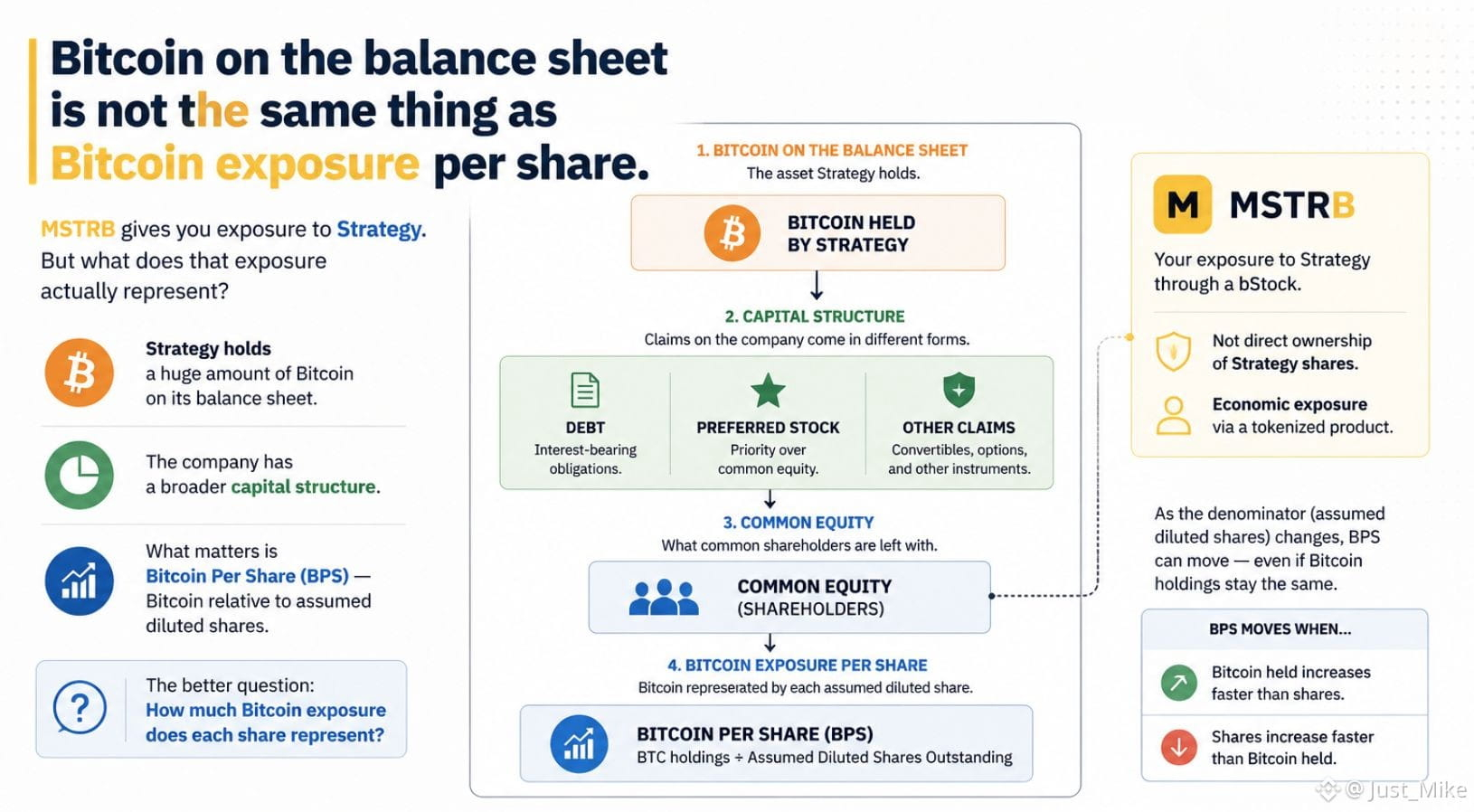
Bitcoin on the balance sheet is not the same thing as Bitcoin exposure per share.
Strategy holds a huge amount of Bitcoin on its balance sheet.
So at first glance, owning MSTRB might look like a simple way to get Bitcoin exposure through a company.
But there is another layer to look at.
Strategy itself measures Bitcoin Per Share (BPS) — the amount of Bitcoin represented per assumed diluted share.
And that ratio matters because the numerator and denominator can move independently.
If Strategy adds Bitcoin, BPS can increase.
But if the company increases its assumed diluted share count without adding Bitcoin at the same pace, BPS can move in the other direction.
That's why I find MSTRB more interesting than simply saying:
“Strategy owns a lot of Bitcoin.”
The better question is:
How much Bitcoin exposure does each share actually represent?
And this is also what makes tokenized exposure interesting to me.
With a bStock like MSTRB, you're getting exposure to the underlying company through a tokenized product — not directly owning the Bitcoin that sits on Strategy's balance sheet.
So there are really two layers to think about:
Bitcoin held by the company.
Bitcoin exposure represented by the security.
The headline asset is only the first layer.
When a company becomes a vehicle for an asset, look at the structure between you and it.
#bstockscis @BinanceCIS
Bitcoin on the balance sheet is not the same thing as Bitcoin exposure per share.
Strategy holds a huge amount of Bitcoin on its balance sheet.
So at first glance, owning MSTRB might look like a simple way to get Bitcoin exposure through a company.
But there is another layer to look at.
Strategy itself measures Bitcoin Per Share (BPS) — the amount of Bitcoin represented per assumed diluted share.
And that ratio matters because the numerator and denominator can move independently.
If Strategy adds Bitcoin, BPS can increase.
But if the company increases its assumed diluted share count without adding Bitcoin at the same pace, BPS can move in the other direction.
That's why I find MSTRB more interesting than simply saying:
“Strategy owns a lot of Bitcoin.”
The better question is:
How much Bitcoin exposure does each share actually represent?
And this is also what makes tokenized exposure interesting to me.
With a bStock like MSTRB, you're getting exposure to the underlying company through a tokenized product — not directly owning the Bitcoin that sits on Strategy's balance sheet.
So there are really two layers to think about:
Bitcoin held by the company.
Bitcoin exposure represented by the security.
The headline asset is only the first layer.
When a company becomes a vehicle for an asset, look at the structure between you and it.
#bstockscis @BinanceCIS
Strategy holds a huge amount of Bitcoin on its balance sheet.
So at first glance, owning MSTRB might look like a simple way to get Bitcoin exposure through a company.
But there is another layer to look at.
Strategy itself measures Bitcoin Per Share (BPS) — the amount of Bitcoin represented per assumed diluted share.
And that ratio matters because the numerator and denominator can move independently.
If Strategy adds Bitcoin, BPS can increase.
But if the company increases its assumed diluted share count without adding Bitcoin at the same pace, BPS can move in the other direction.
That's why I find MSTRB more interesting than simply saying:
“Strategy owns a lot of Bitcoin.”
The better question is:
How much Bitcoin exposure does each share actually represent?
And this is also what makes tokenized exposure interesting to me.
With a bStock like MSTRB, you're getting exposure to the underlying company through a tokenized product — not directly owning the Bitcoin that sits on Strategy's balance sheet.
So there are really two layers to think about:
Bitcoin held by the company.
Bitcoin exposure represented by the security.
The headline asset is only the first layer.
When a company becomes a vehicle for an asset, look at the structure between you and it.
#bstockscis @BinanceCIS
102
·
--
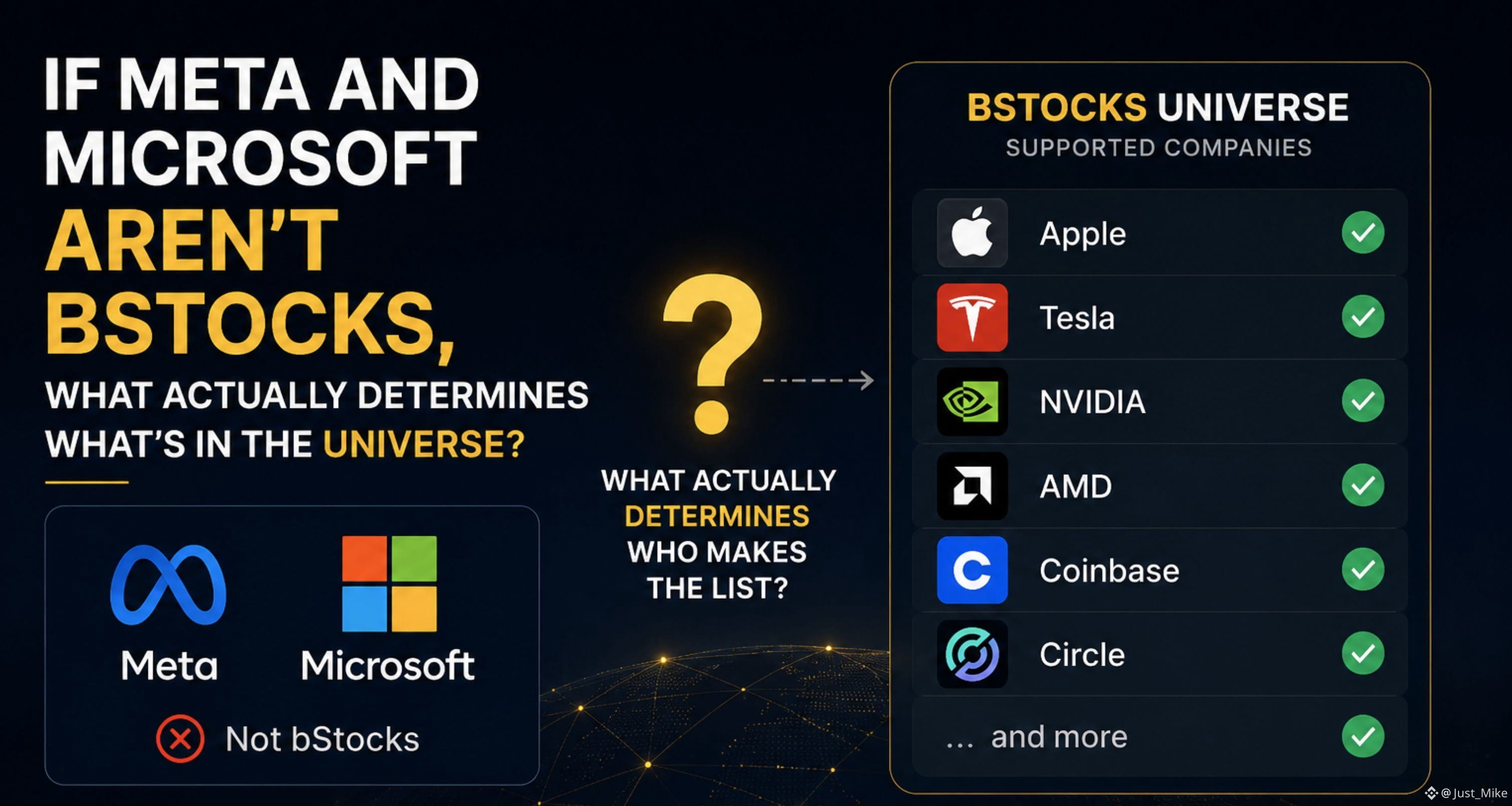
If Meta and Microsoft aren't bStocks, what actually determines who makes the list?
When I first looked at the bStocks universe, I made a simple assumption.
If a company is a large, well-known public company, I expected it to be available as a bStock.
Then I noticed something that challenged that assumption:
Meta and Microsoft aren't bStocks.
Both are major public companies.
But being a major public company and being an available bStock are clearly not the same thing.
That made me look at the Supported Companies list differently.
Instead of asking:
“Why isn't Meta here?”
I started asking:
“What actually determines whether an asset becomes part of the bStocks universe?”
Because the list isn't simply a mirror of the companies I already know from the US stock market.
It's a specific set of supported tokenized stock exposures.
And I think that distinction matters.
When I look at a bStock now, I don't want to assume that familiarity with the underlying company tells me whether that exposure is available.
I'd rather start with a simpler question:
Is this asset actually supported as a bStock?
#bstockscis @BinanceCIS
If Meta and Microsoft aren't bStocks, what actually determines who makes the list?
When I first looked at the bStocks universe, I made a simple assumption.
If a company is a large, well-known public company, I expected it to be available as a bStock.
Then I noticed something that challenged that assumption:
Meta and Microsoft aren't bStocks.
Both are major public companies.
But being a major public company and being an available bStock are clearly not the same thing.
That made me look at the Supported Companies list differently.
Instead of asking:
“Why isn't Meta here?”
I started asking:
“What actually determines whether an asset becomes part of the bStocks universe?”
Because the list isn't simply a mirror of the companies I already know from the US stock market.
It's a specific set of supported tokenized stock exposures.
And I think that distinction matters.
When I look at a bStock now, I don't want to assume that familiarity with the underlying company tells me whether that exposure is available.
I'd rather start with a simpler question:
Is this asset actually supported as a bStock?
#bstockscis @BinanceCIS
When I first looked at the bStocks universe, I made a simple assumption.
If a company is a large, well-known public company, I expected it to be available as a bStock.
Then I noticed something that challenged that assumption:
Meta and Microsoft aren't bStocks.
Both are major public companies.
But being a major public company and being an available bStock are clearly not the same thing.
That made me look at the Supported Companies list differently.
Instead of asking:
“Why isn't Meta here?”
I started asking:
“What actually determines whether an asset becomes part of the bStocks universe?”
Because the list isn't simply a mirror of the companies I already know from the US stock market.
It's a specific set of supported tokenized stock exposures.
And I think that distinction matters.
When I look at a bStock now, I don't want to assume that familiarity with the underlying company tells me whether that exposure is available.
I'd rather start with a simpler question:
Is this asset actually supported as a bStock?
#bstockscis @BinanceCIS
1
110
·
--
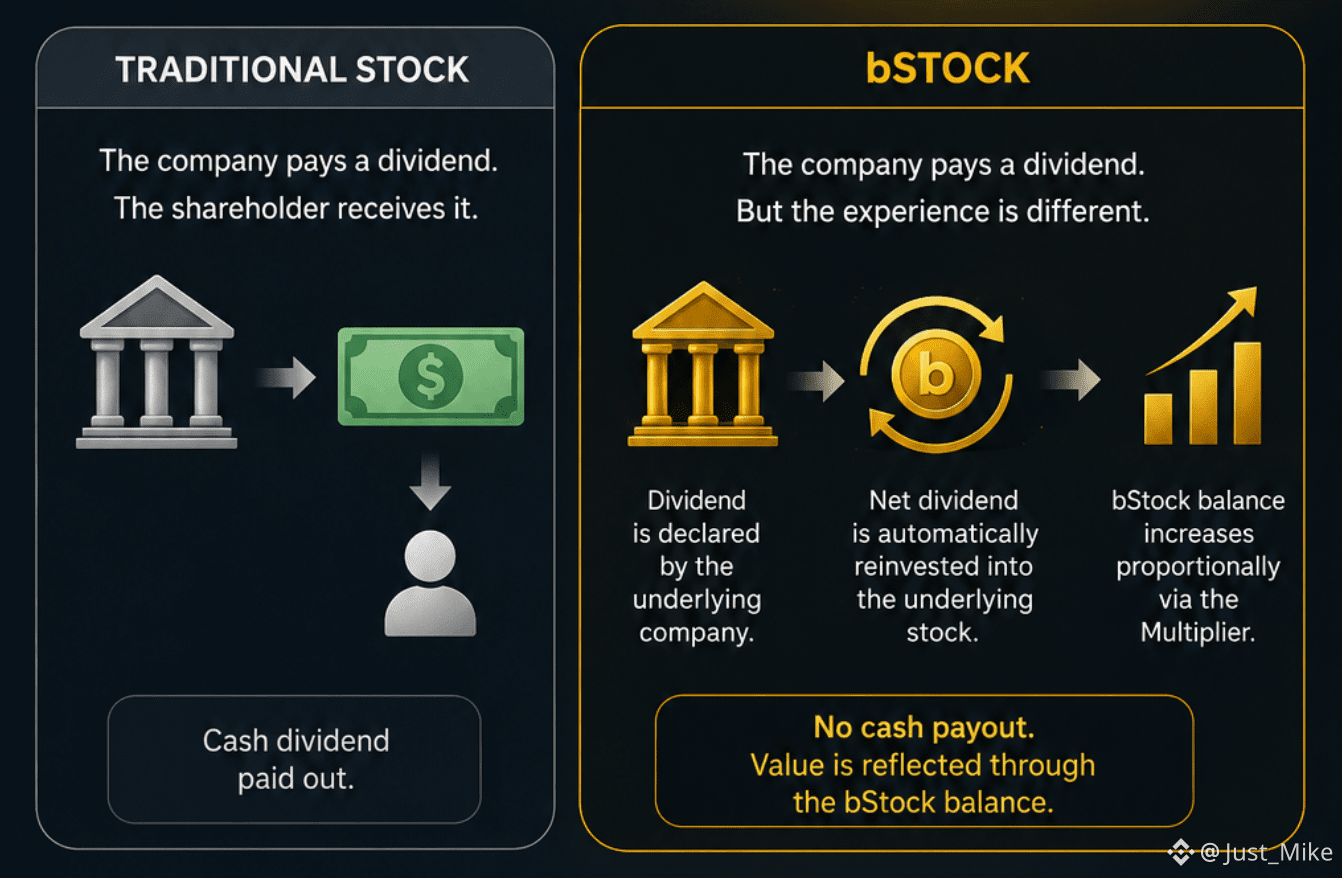
What happens when the stock behind a bStock pays a dividend?
I used to think of dividends as one of the simplest parts of owning a stock.
The company pays a dividend.
The shareholder receives it.
Simple.
But then I started looking at how dividends work with bStocks.
The underlying stock can still pay a dividend, but the experience isn't the same as holding the stock directly.
With bStocks, the net dividend isn't paid out as cash.
Instead, it's automatically reinvested into the underlying stock, and the value is reflected through a proportional increase in the bStock balance via the Multiplier.
That made me think about something I hadn't considered before.
Having exposure to the same company doesn't necessarily mean experiencing every corporate event in the same way.
The underlying company can be the same.
The economic benefit can still be reflected.
But the way that benefit reaches me can be completely different.
And I think that's one of the more interesting things about tokenized assets.
Same underlying company doesn't necessarily mean the same investor experience.
#bstockscis @BinanceCIS
What happens when the stock behind a bStock pays a dividend?
I used to think of dividends as one of the simplest parts of owning a stock.
The company pays a dividend.
The shareholder receives it.
Simple.
But then I started looking at how dividends work with bStocks.
The underlying stock can still pay a dividend, but the experience isn't the same as holding the stock directly.
With bStocks, the net dividend isn't paid out as cash.
Instead, it's automatically reinvested into the underlying stock, and the value is reflected through a proportional increase in the bStock balance via the Multiplier.
That made me think about something I hadn't considered before.
Having exposure to the same company doesn't necessarily mean experiencing every corporate event in the same way.
The underlying company can be the same.
The economic benefit can still be reflected.
But the way that benefit reaches me can be completely different.
And I think that's one of the more interesting things about tokenized assets.
Same underlying company doesn't necessarily mean the same investor experience.
#bstockscis @BinanceCIS
I used to think of dividends as one of the simplest parts of owning a stock.
The company pays a dividend.
The shareholder receives it.
Simple.
But then I started looking at how dividends work with bStocks.
The underlying stock can still pay a dividend, but the experience isn't the same as holding the stock directly.
With bStocks, the net dividend isn't paid out as cash.
Instead, it's automatically reinvested into the underlying stock, and the value is reflected through a proportional increase in the bStock balance via the Multiplier.
That made me think about something I hadn't considered before.
Having exposure to the same company doesn't necessarily mean experiencing every corporate event in the same way.
The underlying company can be the same.
The economic benefit can still be reflected.
But the way that benefit reaches me can be completely different.
And I think that's one of the more interesting things about tokenized assets.
Same underlying company doesn't necessarily mean the same investor experience.
#bstockscis @BinanceCIS
72
·
--
If I trade a bStock on Binance, who actually issues it?
When I first looked at bStocks, I naturally connected the product to Binance.
I see the ticker on Binance.
I trade it on Binance.
I manage the position through Binance.
So I started wondering:
Who is actually issuing the certificate I'm holding?
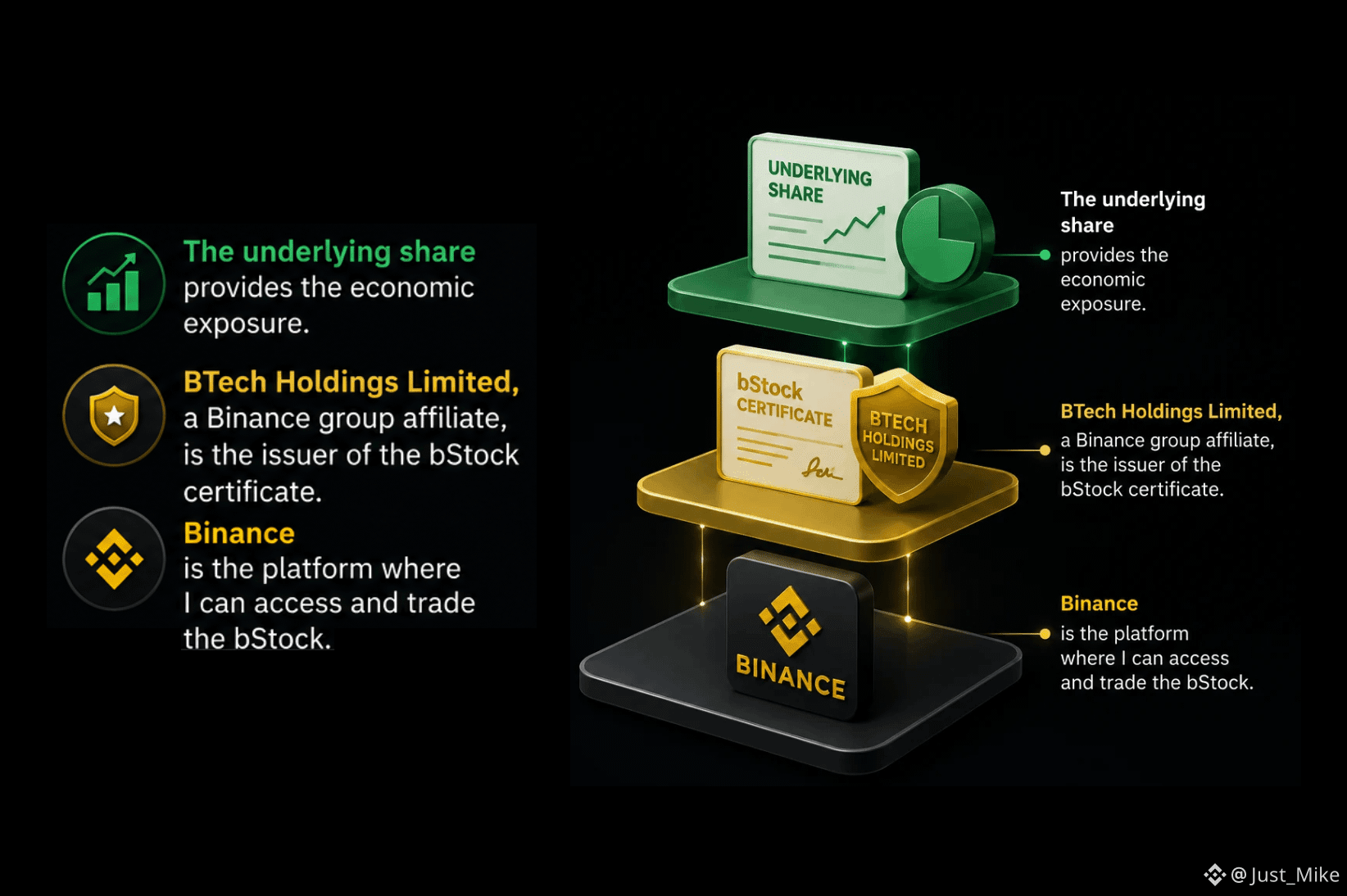
The answer surprised me a little: BTech Holdings Limited, a Binance group affiliate, is the issuer.
And that distinction caught my attention.
Binance is where I access and trade the asset.
BTech Holdings is the issuer of the bStock certificate.
Those two things are easy to mentally merge when everything appears inside the same interface.
But they describe different parts of the structure.
And I think that's an important question when looking at tokenized assets.
When I see an asset inside an exchange, I shouldn't automatically assume that the exchange itself is the issuer.
So now, alongside:
“What is this token backed by?”
I'm also asking:
“Who actually issued the certificate I'm holding?”
For me, that adds another layer to understanding what a tokenized asset really is.
The ticker tells me what exposure I'm looking at.
The issuer tells me who issued the certificate representing that exposure.
#bstockscis @BinanceCIS
If I trade a bStock on Binance, who actually issues it?
When I first looked at bStocks, I naturally connected the product to Binance.
I see the ticker on Binance.
I trade it on Binance.
I manage the position through Binance.
So I started wondering:
Who is actually issuing the certificate I'm holding?
The answer surprised me a little: BTech Holdings Limited, a Binance group affiliate, is the issuer.
And that distinction caught my attention.
Binance is where I access and trade the asset.
BTech Holdings is the issuer of the bStock certificate.
Those two things are easy to mentally merge when everything appears inside the same interface.
But they describe different parts of the structure.
And I think that's an important question when looking at tokenized assets.
When I see an asset inside an exchange, I shouldn't automatically assume that the exchange itself is the issuer.
So now, alongside:
“What is this token backed by?”
I'm also asking:
“Who actually issued the certificate I'm holding?”
For me, that adds another layer to understanding what a tokenized asset really is.
The ticker tells me what exposure I'm looking at.
The issuer tells me who issued the certificate representing that exposure.
#bstockscis @BinanceCIS
When I first looked at bStocks, I naturally connected the product to Binance.
I see the ticker on Binance.
I trade it on Binance.
I manage the position through Binance.
So I started wondering:
Who is actually issuing the certificate I'm holding?
The answer surprised me a little: BTech Holdings Limited, a Binance group affiliate, is the issuer.
And that distinction caught my attention.
Binance is where I access and trade the asset.
BTech Holdings is the issuer of the bStock certificate.
Those two things are easy to mentally merge when everything appears inside the same interface.
But they describe different parts of the structure.
And I think that's an important question when looking at tokenized assets.
When I see an asset inside an exchange, I shouldn't automatically assume that the exchange itself is the issuer.
So now, alongside:
“What is this token backed by?”
I'm also asking:
“Who actually issued the certificate I'm holding?”
For me, that adds another layer to understanding what a tokenized asset really is.
The ticker tells me what exposure I'm looking at.
The issuer tells me who issued the certificate representing that exposure.
#bstockscis @BinanceCIS
1
1
101
·
--
If roughly 73% of stockholders in Binance's broader stock-trading push are from emerging markets, should equity access work the same way everywhere?
One number in the bStocks materials caught my attention:
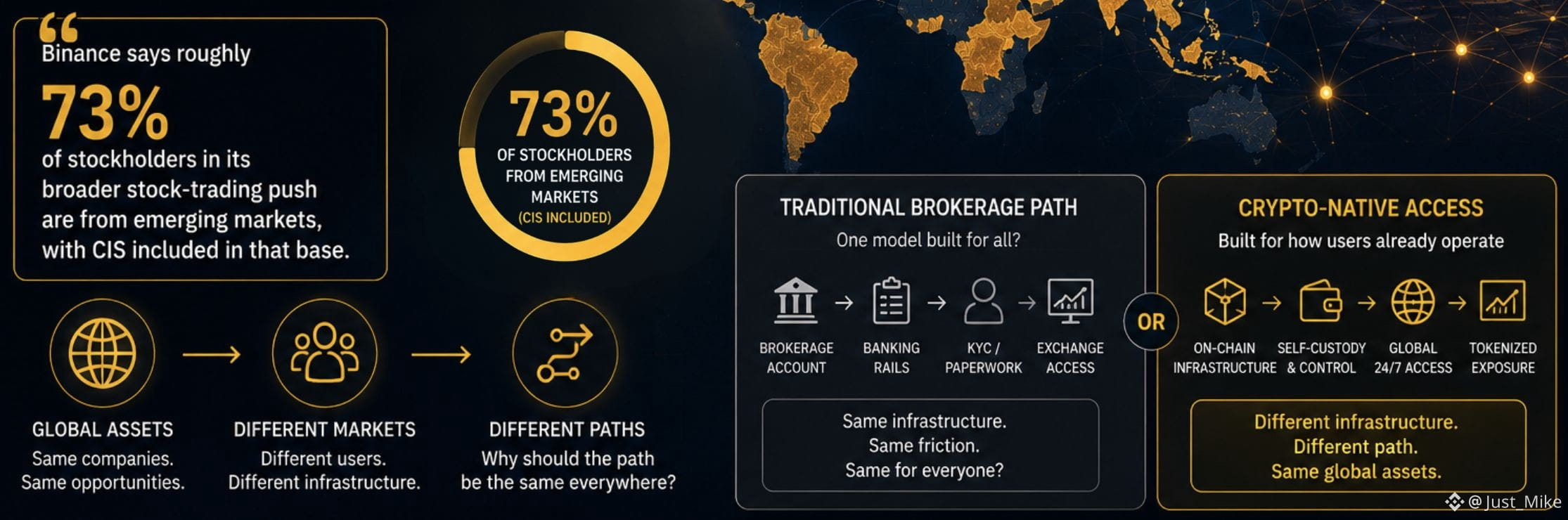
Binance says roughly 73% of stockholders in its broader stock-trading push are from emerging markets, with CIS included in that base.
That made me think about tokenization differently.
We often treat access to global stocks as if the infrastructure behind that access should look the same everywhere.
I'm not convinced it should.
If users already operate through crypto infrastructure, why should equity access necessarily follow the same path as it does in a traditional brokerage market?
So the interesting question isn't only:
“Can stocks be put on-chain?”
It's also:
“Why should the path to global equities be the same everywhere?”
And I think the 73% figure makes that question more interesting.
Maybe the future of equity access won't be one universal model.
Maybe different markets will use different paths to reach the same global assets.
#bstockscis @BinanceCIS
If roughly 73% of stockholders in Binance's broader stock-trading push are from emerging markets, should equity access work the same way everywhere?
One number in the bStocks materials caught my attention:
Binance says roughly 73% of stockholders in its broader stock-trading push are from emerging markets, with CIS included in that base.
That made me think about tokenization differently.
We often treat access to global stocks as if the infrastructure behind that access should look the same everywhere.
I'm not convinced it should.
If users already operate through crypto infrastructure, why should equity access necessarily follow the same path as it does in a traditional brokerage market?
So the interesting question isn't only:
“Can stocks be put on-chain?”
It's also:
“Why should the path to global equities be the same everywhere?”
And I think the 73% figure makes that question more interesting.
Maybe the future of equity access won't be one universal model.
Maybe different markets will use different paths to reach the same global assets.
#bstockscis @BinanceCIS
One number in the bStocks materials caught my attention:
Binance says roughly 73% of stockholders in its broader stock-trading push are from emerging markets, with CIS included in that base.
That made me think about tokenization differently.
We often treat access to global stocks as if the infrastructure behind that access should look the same everywhere.
I'm not convinced it should.
If users already operate through crypto infrastructure, why should equity access necessarily follow the same path as it does in a traditional brokerage market?
So the interesting question isn't only:
“Can stocks be put on-chain?”
It's also:
“Why should the path to global equities be the same everywhere?”
And I think the 73% figure makes that question more interesting.
Maybe the future of equity access won't be one universal model.
Maybe different markets will use different paths to reach the same global assets.
#bstockscis @BinanceCIS
2
1
104
Log in to explore more content
Join global crypto users on Binance Square
⚡️ Get latest and useful information about crypto.
💬 Trusted by the world’s largest crypto exchange.
👍 Discover real insights from verified creators.
Email / Phone number
Trending Topics
AnthropicIPOProspectusCouldValueItOver$2T
23 views
20 Discussing
$QNT is having a moment and it's real news, not just hype.
The Clearing House (runs $2T/day in US bank payments) just picked Quant as the tech partner for its tokenized deposit network, backed by 25 major banks. That's on top of Quant already powering the UK's tokenized deposit pilot with Barclays, HSBC, and Lloyds which just processed its first live customer payments.
Price reaction: QNT jumped ~58% in a day, now trading near $173 up ~160% in a week, after sitting at $61 just weeks ago.
Worth remembering: the deal is with the company, not a guarantee the token itself captures the upside. And technically, QNT is deep in overbought territory (RSI ~82) while the rest of crypto is pulling back so don't be shocked by a sharp cooldown.
Real infrastructure win. Just don't chase the candle. Not financial advice.
#QNT/USDT
Sofia Ellen
·1 Likes
·1.2k views
HackersDrainOver12.4MXRPFromDCENTWallets
22 views
17 Discussing
SECSaysDecentralizedTokenBuybacksNotInvestmentContracts
0 views
1 Discussing