

汉卿 hanqing
730 Posts
汉卿 hanqing
Report
Block User
财经 | A股 | 美股 | 科技 | 比特币 | 互动乃交友之道 | 互粉
Finance | US Stocks | AI | Bitcoin | Web3
Tài chính | Cổ phiếu Mỹ | Web3 | Tương tác là con đường kết bạn
Open Trade
Frequent Trader
8.8 Years
62 Following
95 Followers
125 Liked
Posts
Portfolio
All
Quotes
Videos
·
--
🔥 Copycat coins surge collectively by 50%~300%! Meanwhile, BTC only rose 50%—there’s no doubt that this is the golden window for retail investors to stage a comeback and take big profits!
The market is currently in the 「second wave」 of building momentum, and the truly thrilling 「third wave—main rally」 is already on its way! This is absolutely the best time to turn things around and double up this year—don’t regret it when you bang your head, go all-in with full focus, and make the most of this wealth train!🚀💰
#Cryptocurrency #Altcoins #Altseason #Bitcoin #BullMarket
🔥 Copycat coins surge collectively by 50%~300%! Meanwhile, BTC only rose 50%—there’s no doubt that this is the golden window for retail investors to stage a comeback and take big profits!
The market is currently in the 「second wave」 of building momentum, and the truly thrilling 「third wave—main rally」 is already on its way! This is absolutely the best time to turn things around and double up this year—don’t regret it when you bang your head, go all-in with full focus, and make the most of this wealth train!🚀💰
#Cryptocurrency #Altcoins #Altseason #Bitcoin #BullMarket
The market is currently in the 「second wave」 of building momentum, and the truly thrilling 「third wave—main rally」 is already on its way! This is absolutely the best time to turn things around and double up this year—don’t regret it when you bang your head, go all-in with full focus, and make the most of this wealth train!🚀💰
#Cryptocurrency #Altcoins #Altseason #Bitcoin #BullMarket
98
·
--
The US-Iran talks send a de-escalation signal, sparking a synchronized rebound in global assets
On the afternoon of September 25, European and US stock markets rose across the board. Major indexes in the UK, France, and Germany gained 0.5% to 0.8%, Nasdaq futures were up 0.45%, and in US pre-market trading, the storage and semiconductor sectors led the gains. International oil prices plunged, with WTI crude falling by more than 2.3% intraday.
The catalyst is a subtle easing in the geopolitical tug-of-war. Citing reports, Bloomberg said the US and Iran are exploring a phased agreement: Tehran would commit to reopening the Strait of Hormuz in exchange for Washington lifting its blockade of Iranian ports. However, whether the deal can ultimately be implemented remains uncertain. On September 24, Iranian President Masoud Pezeshkian reiterated that Iran is “completely” not seeking nuclear weapons, is willing to reduce enrichment levels within the framework of international law, and to accept inspections. He also confirmed that the earlier signed memorandum of understanding remains valid, and said progress can be made based on that foundation.
The market is voting with its feet: geopolitical risk premia are clearing quickly, risk appetite is recovering, and tech growth and energy sectors are showing a pronounced “see-saw” effect. But with the negotiation details still unclear, whether the rebound can sustain will depend on how quickly the subsequent steps are carried out.
#Follow4Follow# #I’llReplyIfYouFollow#
The US-Iran talks send a de-escalation signal, sparking a synchronized rebound in global assets
On the afternoon of September 25, European and US stock markets rose across the board. Major indexes in the UK, France, and Germany gained 0.5% to 0.8%, Nasdaq futures were up 0.45%, and in US pre-market trading, the storage and semiconductor sectors led the gains. International oil prices plunged, with WTI crude falling by more than 2.3% intraday.
The catalyst is a subtle easing in the geopolitical tug-of-war. Citing reports, Bloomberg said the US and Iran are exploring a phased agreement: Tehran would commit to reopening the Strait of Hormuz in exchange for Washington lifting its blockade of Iranian ports. However, whether the deal can ultimately be implemented remains uncertain. On September 24, Iranian President Masoud Pezeshkian reiterated that Iran is “completely” not seeking nuclear weapons, is willing to reduce enrichment levels within the framework of international law, and to accept inspections. He also confirmed that the earlier signed memorandum of understanding remains valid, and said progress can be made based on that foundation.
The market is voting with its feet: geopolitical risk premia are clearing quickly, risk appetite is recovering, and tech growth and energy sectors are showing a pronounced “see-saw” effect. But with the negotiation details still unclear, whether the rebound can sustain will depend on how quickly the subsequent steps are carried out.
#Follow4Follow# #I’llReplyIfYouFollow#
On the afternoon of September 25, European and US stock markets rose across the board. Major indexes in the UK, France, and Germany gained 0.5% to 0.8%, Nasdaq futures were up 0.45%, and in US pre-market trading, the storage and semiconductor sectors led the gains. International oil prices plunged, with WTI crude falling by more than 2.3% intraday.
The catalyst is a subtle easing in the geopolitical tug-of-war. Citing reports, Bloomberg said the US and Iran are exploring a phased agreement: Tehran would commit to reopening the Strait of Hormuz in exchange for Washington lifting its blockade of Iranian ports. However, whether the deal can ultimately be implemented remains uncertain. On September 24, Iranian President Masoud Pezeshkian reiterated that Iran is “completely” not seeking nuclear weapons, is willing to reduce enrichment levels within the framework of international law, and to accept inspections. He also confirmed that the earlier signed memorandum of understanding remains valid, and said progress can be made based on that foundation.
The market is voting with its feet: geopolitical risk premia are clearing quickly, risk appetite is recovering, and tech growth and energy sectors are showing a pronounced “see-saw” effect. But with the negotiation details still unclear, whether the rebound can sustain will depend on how quickly the subsequent steps are carried out.
#Follow4Follow# #I’llReplyIfYouFollow#
168
·
--
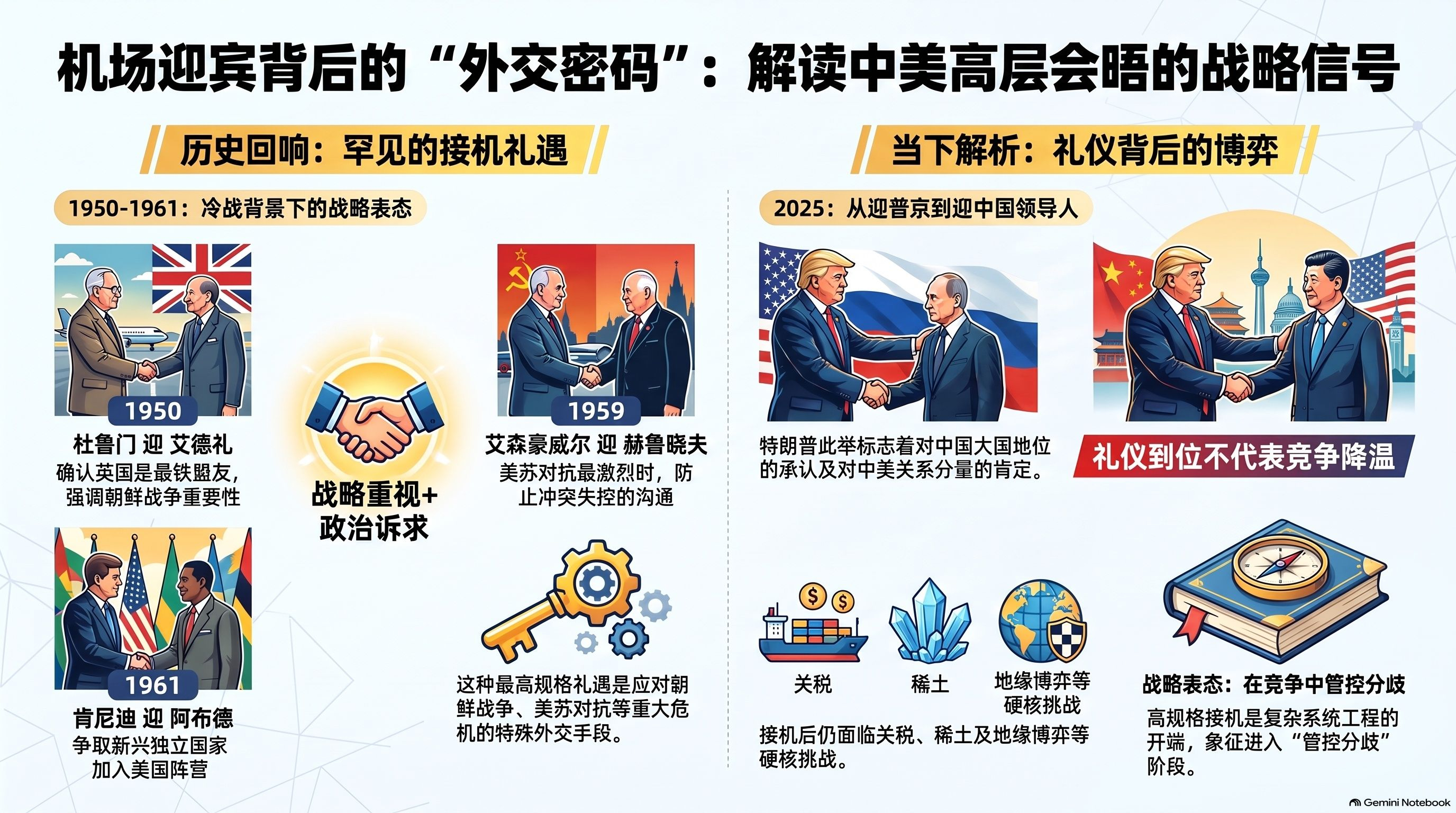
A summit that draws worldwide attention: Trump greeted the visiting leader at the airport—what diplomatic code is hidden in it? 🛬
Do you know? After World War II, it is rare indeed for a US president to personally go to the airport to welcome a foreign leader. Every time, it sends a heavy signal.
📌 In 1950, Truman welcomed British Prime Minister Clement Attlee—while the Korean War was in full swing, the US wanted the world to know: this war is crucial, and Britain is my staunchest ally.
📌 In 1957, Eisenhower welcomed South Vietnamese leader Ngô Đình Diệm—on the Cold War chessboard, openly giving a platform to the government in the South.
📌 In 1959, Eisenhower welcomed Khrushchev—when US-Soviet confrontation was at its fiercest, using face-to-face communication to prevent the situation from spiraling out of control.
📌 In 1961, Kennedy welcomed Sudanese President Abboud—sending a message to newly independent states: welcome to join the US camp.
The pattern is clear: airport greetings = strategic emphasis + political demands.
Now look at today:
🔹 In August 2025, Trump will welcome Putin in Alaska—his goal is to provide some resolution for the Russia-Ukraine conflict as soon as possible.
🔹 This time, he personally greeted China’s leadership—the weight is completely different. US-China relations have become the top priority in America’s global strategy. Economics, technology, security, and geopolitics are all intertwined across the board. This deep bow is an acknowledgment of China’s status as a major power, and also a statement on "managing differences in competition".
But don’t be too optimistic yet. Being at the airport doesn’t mean the temperature will cool. US-China relations are a three-dimensional and complex systems project—tariffs, rare earths, critical minerals, and geopolitical maneuvering. Each is a tough battle.
With the formalities done properly, the game is only just beginning. What can be negotiated next remains to be seen.🤝
#中美关系 #川习会 #International Observation
#FollowBack# #FollowAndReply#
A summit that draws worldwide attention: Trump greeted the visiting leader at the airport—what diplomatic code is hidden in it? 🛬
Do you know? After World War II, it is rare indeed for a US president to personally go to the airport to welcome a foreign leader. Every time, it sends a heavy signal.
📌 In 1950, Truman welcomed British Prime Minister Clement Attlee—while the Korean War was in full swing, the US wanted the world to know: this war is crucial, and Britain is my staunchest ally.
📌 In 1957, Eisenhower welcomed South Vietnamese leader Ngô Đình Diệm—on the Cold War chessboard, openly giving a platform to the government in the South.
📌 In 1959, Eisenhower welcomed Khrushchev—when US-Soviet confrontation was at its fiercest, using face-to-face communication to prevent the situation from spiraling out of control.
📌 In 1961, Kennedy welcomed Sudanese President Abboud—sending a message to newly independent states: welcome to join the US camp.
The pattern is clear: airport greetings = strategic emphasis + political demands.
Now look at today:
🔹 In August 2025, Trump will welcome Putin in Alaska—his goal is to provide some resolution for the Russia-Ukraine conflict as soon as possible.
🔹 This time, he personally greeted China’s leadership—the weight is completely different. US-China relations have become the top priority in America’s global strategy. Economics, technology, security, and geopolitics are all intertwined across the board. This deep bow is an acknowledgment of China’s status as a major power, and also a statement on "managing differences in competition".
But don’t be too optimistic yet. Being at the airport doesn’t mean the temperature will cool. US-China relations are a three-dimensional and complex systems project—tariffs, rare earths, critical minerals, and geopolitical maneuvering. Each is a tough battle.
With the formalities done properly, the game is only just beginning. What can be negotiated next remains to be seen.🤝
#中美关系 #川习会 #International Observation
#FollowBack# #FollowAndReply#
Do you know? After World War II, it is rare indeed for a US president to personally go to the airport to welcome a foreign leader. Every time, it sends a heavy signal.
📌 In 1950, Truman welcomed British Prime Minister Clement Attlee—while the Korean War was in full swing, the US wanted the world to know: this war is crucial, and Britain is my staunchest ally.
📌 In 1957, Eisenhower welcomed South Vietnamese leader Ngô Đình Diệm—on the Cold War chessboard, openly giving a platform to the government in the South.
📌 In 1959, Eisenhower welcomed Khrushchev—when US-Soviet confrontation was at its fiercest, using face-to-face communication to prevent the situation from spiraling out of control.
📌 In 1961, Kennedy welcomed Sudanese President Abboud—sending a message to newly independent states: welcome to join the US camp.
The pattern is clear: airport greetings = strategic emphasis + political demands.
Now look at today:
🔹 In August 2025, Trump will welcome Putin in Alaska—his goal is to provide some resolution for the Russia-Ukraine conflict as soon as possible.
🔹 This time, he personally greeted China’s leadership—the weight is completely different. US-China relations have become the top priority in America’s global strategy. Economics, technology, security, and geopolitics are all intertwined across the board. This deep bow is an acknowledgment of China’s status as a major power, and also a statement on "managing differences in competition".
But don’t be too optimistic yet. Being at the airport doesn’t mean the temperature will cool. US-China relations are a three-dimensional and complex systems project—tariffs, rare earths, critical minerals, and geopolitical maneuvering. Each is a tough battle.
With the formalities done properly, the game is only just beginning. What can be negotiated next remains to be seen.🤝
#中美关系 #川习会 #International Observation
#FollowBack# #FollowAndReply#
45
1
13
38.6k
·
--
US Treasury Secretary Bessent said the US and China have agreed to extend the trade truce agreement to January 10 next year.
China’s Ministry of Commerce: Under the China-US economic and trade consultation mechanism, the two sides held their first dialogue on artificial intelligence.
Overall, the US has learned to solve problems through negotiations, rather than coming in hard as it did last year. And you could say it’s a case of no fight and no meeting. There are good mechanisms in place for managing differences between China and the US, which is a good development.
US Treasury Secretary Bessent said the US and China have agreed to extend the trade truce agreement to January 10 next year.
China’s Ministry of Commerce: Under the China-US economic and trade consultation mechanism, the two sides held their first dialogue on artificial intelligence.
Overall, the US has learned to solve problems through negotiations, rather than coming in hard as it did last year. And you could say it’s a case of no fight and no meeting. There are good mechanisms in place for managing differences between China and the US, which is a good development.
China’s Ministry of Commerce: Under the China-US economic and trade consultation mechanism, the two sides held their first dialogue on artificial intelligence.
Overall, the US has learned to solve problems through negotiations, rather than coming in hard as it did last year. And you could say it’s a case of no fight and no meeting. There are good mechanisms in place for managing differences between China and the US, which is a good development.
46
·
--
The Mid-Autumn Festival is here—are there any memes related to it?
The Mid-Autumn Festival is here—are there any memes related to it?
54
·
--
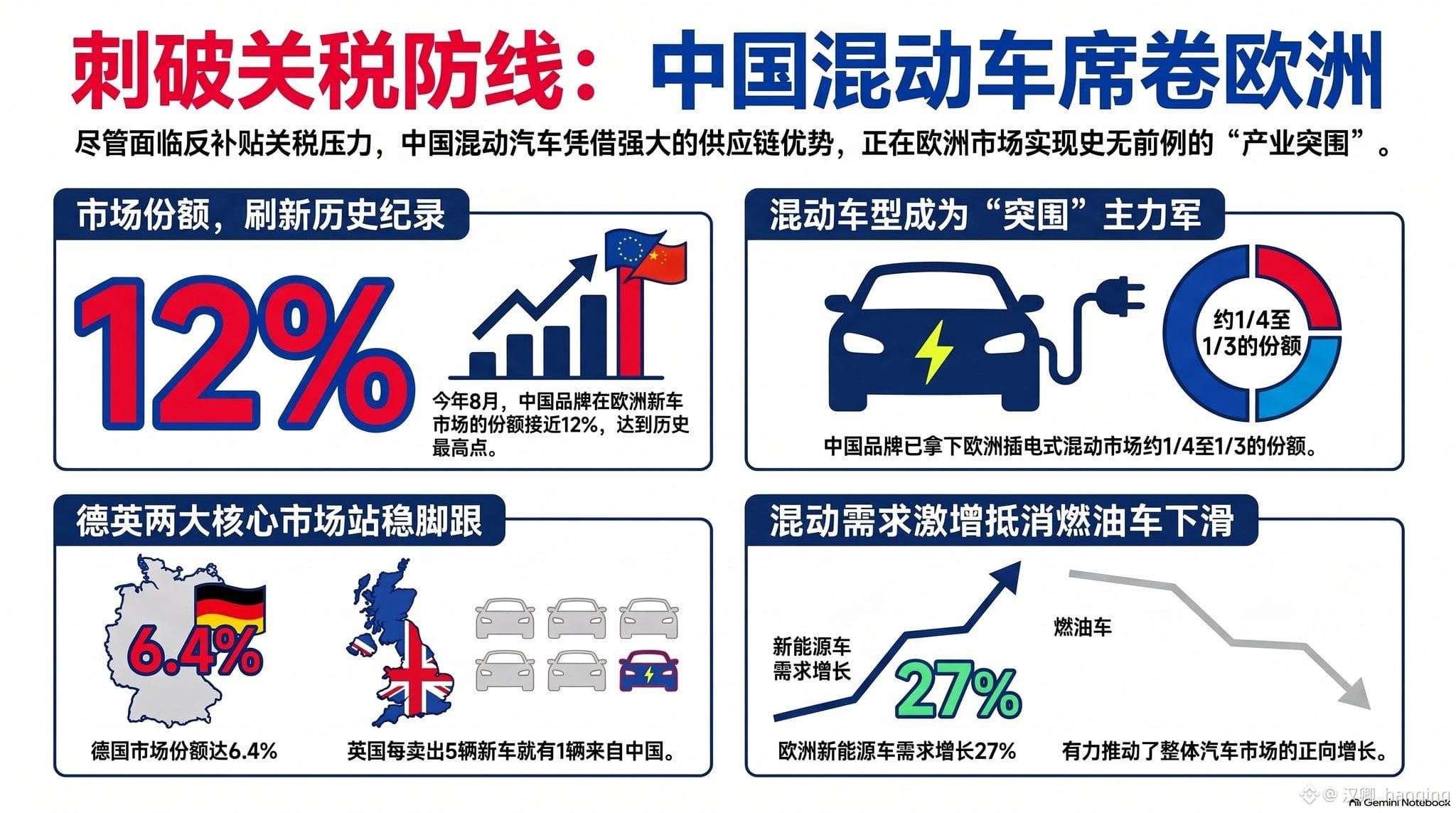
Tariffs Can’t Stop the Explosive Rise of Chinese Cars in Europe
This August, Chinese brands’ share in the European new-car market has nearly reached 12%, setting a new historical record. Brands represented by BYD have even captured about a quarter of Europe’s plug-in hybrid market, surpassing the one-third mark.
Meanwhile, demand for all-electric and hybrid vehicles in Europe surged by 27% in August, offsetting the pressure from the decline in traditional fuel vehicles, and driving overall new-car market growth of 4.6%. In Germany, Europe’s largest auto market, Chinese automakers’ share climbed to 6.4% in August. The UK’s penetration rate is even more astonishing—out of every five new cars sold, more than one comes from a Chinese automaker.
Previously, the industry worried that the EU would impose additional high tariffs on Chinese pure electric vehicles, but the latest industry data delivers a harsh answer: Chinese cars have not been cut in half in the European market; instead, they have achieved a historic surge. This phenomenon reveals a profound paradox: tariffs may be able to block certain products, but they cannot prevent fundamental generational changes in an industry.
#互关互粉# #有粉必回#
Tariffs Can’t Stop the Explosive Rise of Chinese Cars in Europe
This August, Chinese brands’ share in the European new-car market has nearly reached 12%, setting a new historical record. Brands represented by BYD have even captured about a quarter of Europe’s plug-in hybrid market, surpassing the one-third mark.
Meanwhile, demand for all-electric and hybrid vehicles in Europe surged by 27% in August, offsetting the pressure from the decline in traditional fuel vehicles, and driving overall new-car market growth of 4.6%. In Germany, Europe’s largest auto market, Chinese automakers’ share climbed to 6.4% in August. The UK’s penetration rate is even more astonishing—out of every five new cars sold, more than one comes from a Chinese automaker.
Previously, the industry worried that the EU would impose additional high tariffs on Chinese pure electric vehicles, but the latest industry data delivers a harsh answer: Chinese cars have not been cut in half in the European market; instead, they have achieved a historic surge. This phenomenon reveals a profound paradox: tariffs may be able to block certain products, but they cannot prevent fundamental generational changes in an industry.
#互关互粉# #有粉必回#
This August, Chinese brands’ share in the European new-car market has nearly reached 12%, setting a new historical record. Brands represented by BYD have even captured about a quarter of Europe’s plug-in hybrid market, surpassing the one-third mark.
Meanwhile, demand for all-electric and hybrid vehicles in Europe surged by 27% in August, offsetting the pressure from the decline in traditional fuel vehicles, and driving overall new-car market growth of 4.6%. In Germany, Europe’s largest auto market, Chinese automakers’ share climbed to 6.4% in August. The UK’s penetration rate is even more astonishing—out of every five new cars sold, more than one comes from a Chinese automaker.
Previously, the industry worried that the EU would impose additional high tariffs on Chinese pure electric vehicles, but the latest industry data delivers a harsh answer: Chinese cars have not been cut in half in the European market; instead, they have achieved a historic surge. This phenomenon reveals a profound paradox: tariffs may be able to block certain products, but they cannot prevent fundamental generational changes in an industry.
#互关互粉# #有粉必回#
106
·
--
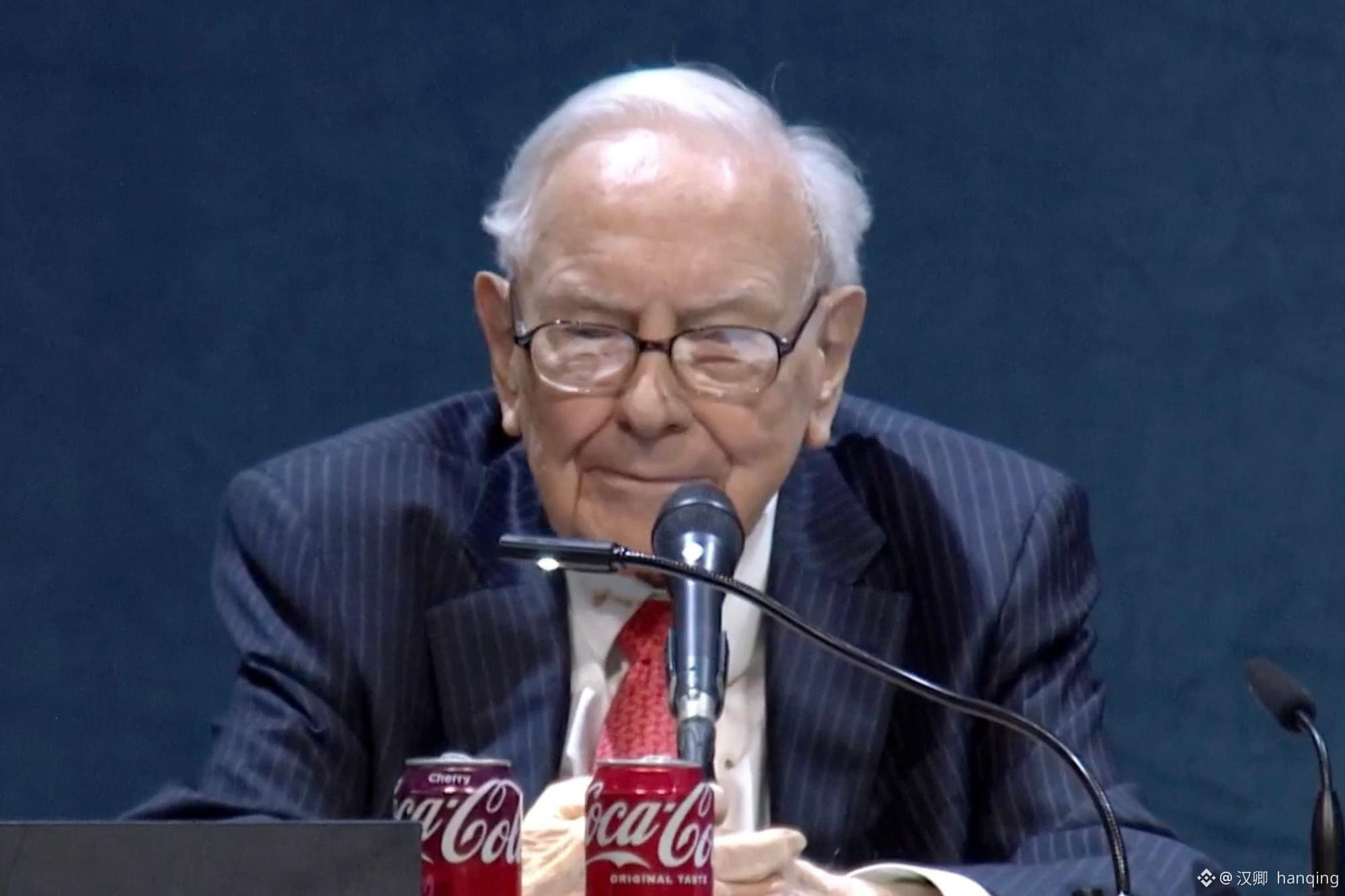
Berkshire Boosts Its Stake in Lennar by 10% as China’s A-Share Property Sector Rallies and Sentiment Rebounds
On September 23, Berkshire Hathaway Asset Management Company continued to add to its position in Lennar Corporation (a U.S. homebuilder) from September 17 to September 21, purchasing a total of 2.67 million shares of Class A and 75,000 shares of Class B, for a transaction value of about $212 million (approximately RMB 1.42 billion). After the purchases were completed, Berkshire’s stake rose to about 10%, driving Lennar’s stock to close up as much as 6%. U.S. homebuilders such as D.R. Horton and KB Home also moved higher in tandem.
Meanwhile, China’s A-share real estate sector sustained a surge. Huaruan Holdings, I Love My Home, and Hua Li Jia Zu all hit the daily limit for three consecutive trading days. Vanke (A shares) saw its stock jump with a sequence of three consecutive limit-ups over four days, while Vanke Enterprise (H shares) rose by more than 15%. Most institutions noted that as market optimism is gradually released, policy support increases, and inventory de-stocking shows improvement, sentiment in the real estate sector has been significantly restored.
It is worth noting that Berkshire’s move comes at a time when the U.S. housing market faces negative pressure. With the current 30-year fixed mortgage rate in the U.S. approaching 7%, affordability for homebuyers is under challenge. Lennar is therefore timely facing dual pressures: fewer orders and a decline in profit margins.
#Follow4Follow# #HaveFollowersBack#
Berkshire Boosts Its Stake in Lennar by 10% as China’s A-Share Property Sector Rallies and Sentiment Rebounds
On September 23, Berkshire Hathaway Asset Management Company continued to add to its position in Lennar Corporation (a U.S. homebuilder) from September 17 to September 21, purchasing a total of 2.67 million shares of Class A and 75,000 shares of Class B, for a transaction value of about $212 million (approximately RMB 1.42 billion). After the purchases were completed, Berkshire’s stake rose to about 10%, driving Lennar’s stock to close up as much as 6%. U.S. homebuilders such as D.R. Horton and KB Home also moved higher in tandem.
Meanwhile, China’s A-share real estate sector sustained a surge. Huaruan Holdings, I Love My Home, and Hua Li Jia Zu all hit the daily limit for three consecutive trading days. Vanke (A shares) saw its stock jump with a sequence of three consecutive limit-ups over four days, while Vanke Enterprise (H shares) rose by more than 15%. Most institutions noted that as market optimism is gradually released, policy support increases, and inventory de-stocking shows improvement, sentiment in the real estate sector has been significantly restored.
It is worth noting that Berkshire’s move comes at a time when the U.S. housing market faces negative pressure. With the current 30-year fixed mortgage rate in the U.S. approaching 7%, affordability for homebuyers is under challenge. Lennar is therefore timely facing dual pressures: fewer orders and a decline in profit margins.
#Follow4Follow# #HaveFollowersBack#
On September 23, Berkshire Hathaway Asset Management Company continued to add to its position in Lennar Corporation (a U.S. homebuilder) from September 17 to September 21, purchasing a total of 2.67 million shares of Class A and 75,000 shares of Class B, for a transaction value of about $212 million (approximately RMB 1.42 billion). After the purchases were completed, Berkshire’s stake rose to about 10%, driving Lennar’s stock to close up as much as 6%. U.S. homebuilders such as D.R. Horton and KB Home also moved higher in tandem.
Meanwhile, China’s A-share real estate sector sustained a surge. Huaruan Holdings, I Love My Home, and Hua Li Jia Zu all hit the daily limit for three consecutive trading days. Vanke (A shares) saw its stock jump with a sequence of three consecutive limit-ups over four days, while Vanke Enterprise (H shares) rose by more than 15%. Most institutions noted that as market optimism is gradually released, policy support increases, and inventory de-stocking shows improvement, sentiment in the real estate sector has been significantly restored.
It is worth noting that Berkshire’s move comes at a time when the U.S. housing market faces negative pressure. With the current 30-year fixed mortgage rate in the U.S. approaching 7%, affordability for homebuyers is under challenge. Lennar is therefore timely facing dual pressures: fewer orders and a decline in profit margins.
#Follow4Follow# #HaveFollowersBack#
46
·
--
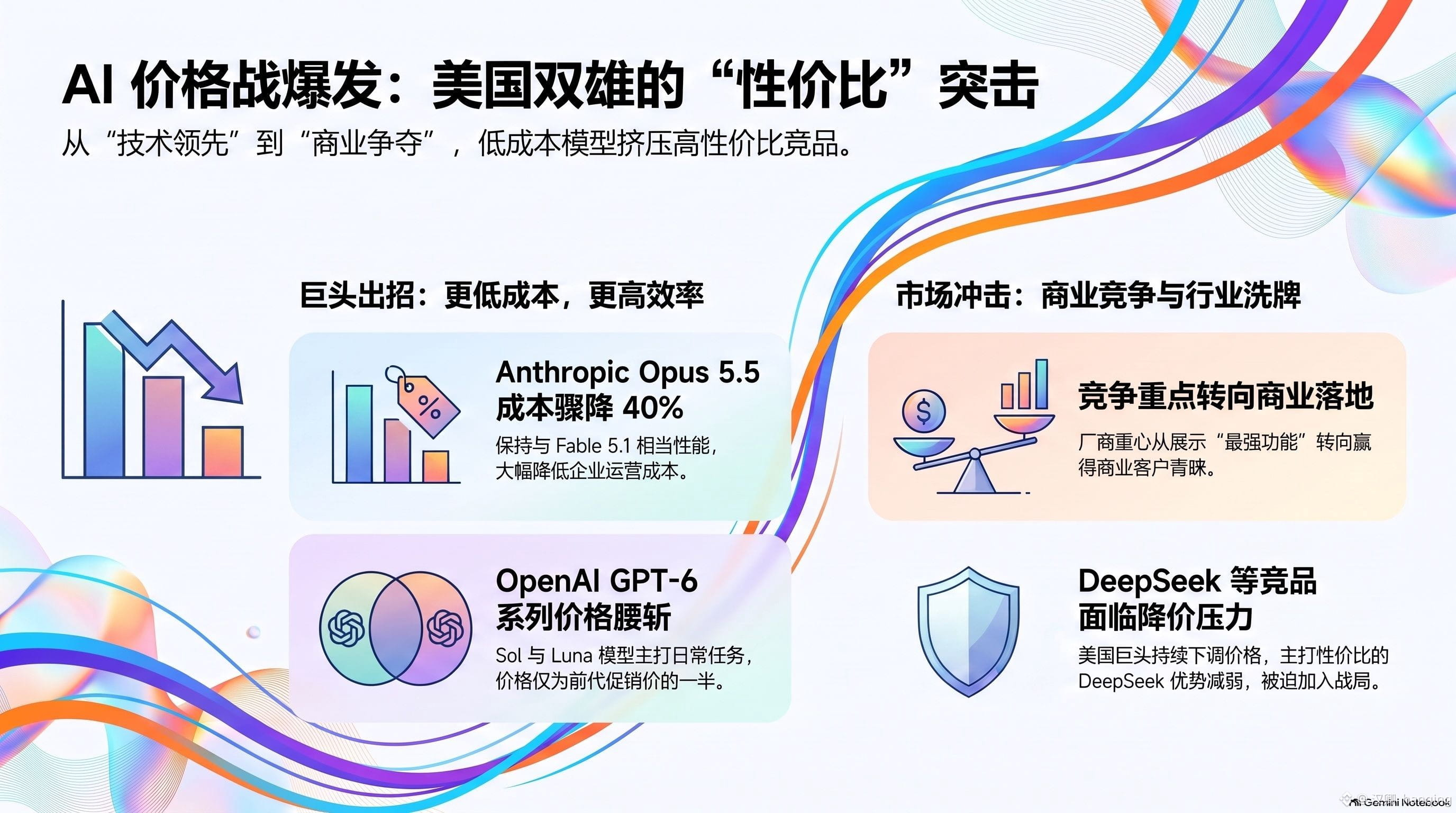
🤖 The hype calmed down for only 10 days, and the two US AI giants already started fighting! The one who may be most hurt could be deepseek, ah!
Half a month ago, the CEOs of OpenAI and Anthropic had just publicly called for “slowing down the pace of frontier progress,” and then, right on cue, they kicked off a new round of price war! The focus of competition has shifted from “whose features are strongest” to “who can win over business customers.”
🌟 Both sides released low-priced models on the same day:
• Anthropic launched Opus 5.5: costs dropped 40% compared with Opus 5, with performance comparable to Fable 5.1.
• OpenAI launched GPT-6 Sol and Luna: aimed at everyday tasks, with prices even half lower than the promotional price of GPT-5.6.
In the era of AI, the everyday battle for business is already fully underway! If the US AI giants keep cutting prices afterward, then deepseek—positioned on cost-effectiveness—may not look as attractive. And it will likely join the price war too; as a user, I’m looking forward to it.
#AI price war #OpenAI #Anthropic #Artificial Intelligence #科技趋势
🤖 The hype calmed down for only 10 days, and the two US AI giants already started fighting! The one who may be most hurt could be deepseek, ah!
Half a month ago, the CEOs of OpenAI and Anthropic had just publicly called for “slowing down the pace of frontier progress,” and then, right on cue, they kicked off a new round of price war! The focus of competition has shifted from “whose features are strongest” to “who can win over business customers.”
🌟 Both sides released low-priced models on the same day:
• Anthropic launched Opus 5.5: costs dropped 40% compared with Opus 5, with performance comparable to Fable 5.1.
• OpenAI launched GPT-6 Sol and Luna: aimed at everyday tasks, with prices even half lower than the promotional price of GPT-5.6.
In the era of AI, the everyday battle for business is already fully underway! If the US AI giants keep cutting prices afterward, then deepseek—positioned on cost-effectiveness—may not look as attractive. And it will likely join the price war too; as a user, I’m looking forward to it.
#AI price war #OpenAI #Anthropic #Artificial Intelligence #科技趋势
Half a month ago, the CEOs of OpenAI and Anthropic had just publicly called for “slowing down the pace of frontier progress,” and then, right on cue, they kicked off a new round of price war! The focus of competition has shifted from “whose features are strongest” to “who can win over business customers.”
🌟 Both sides released low-priced models on the same day:
• Anthropic launched Opus 5.5: costs dropped 40% compared with Opus 5, with performance comparable to Fable 5.1.
• OpenAI launched GPT-6 Sol and Luna: aimed at everyday tasks, with prices even half lower than the promotional price of GPT-5.6.
In the era of AI, the everyday battle for business is already fully underway! If the US AI giants keep cutting prices afterward, then deepseek—positioned on cost-effectiveness—may not look as attractive. And it will likely join the price war too; as a user, I’m looking forward to it.
#AI price war #OpenAI #Anthropic #Artificial Intelligence #科技趋势
47
·
--
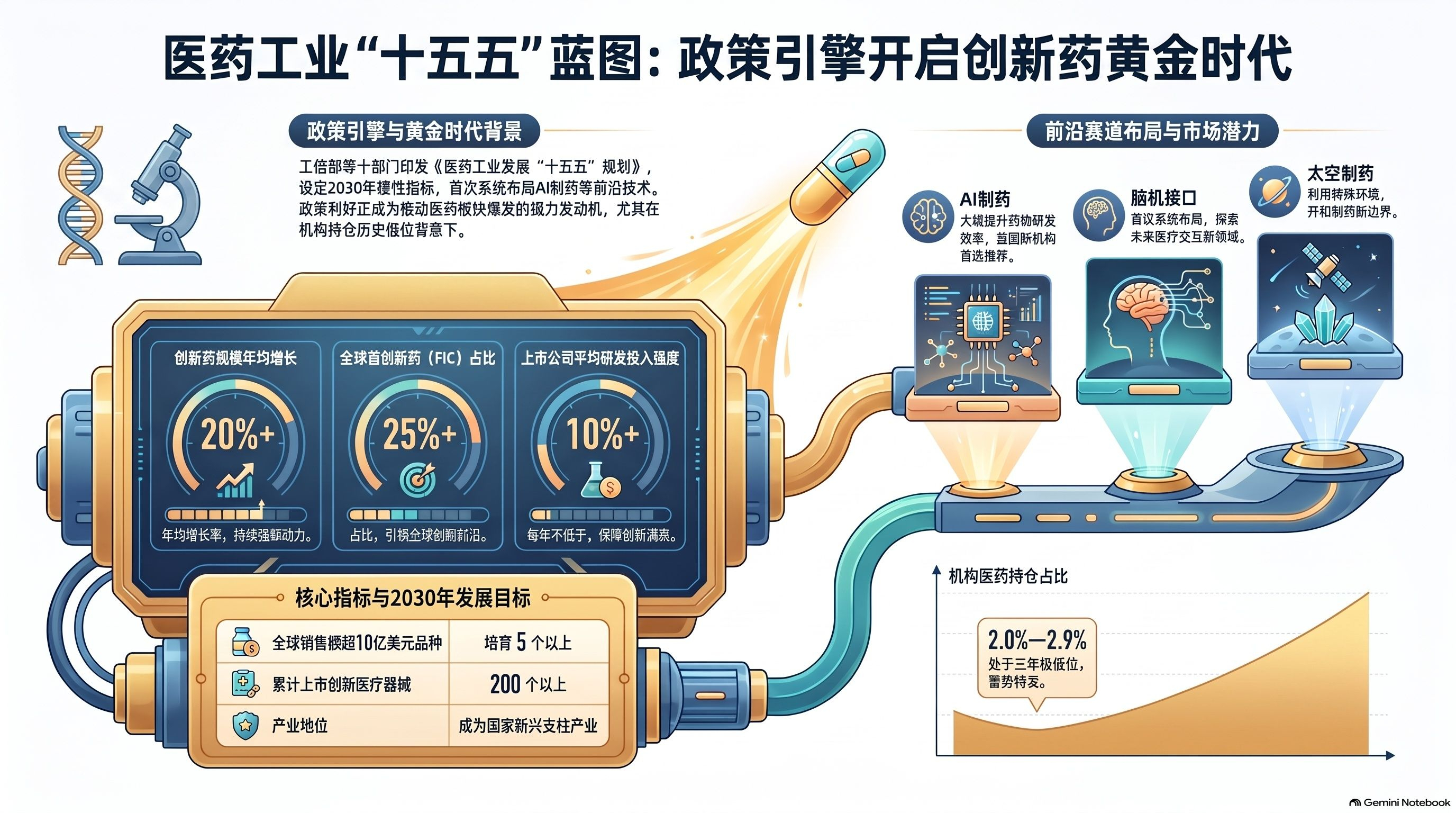
Big A Pharma shares surge across the board today 🔥
Oupumai is up more than 16%, Yinuosi up more than 14%, Yiqiao Shenzhou up more than 11%, BPSaike up more than 10%, and more than twenty other stocks—including Kangxinono and Zhaoyang Xinyao—are up over 5%… The A-share pharma sector is taking off collectively.
Behind it is a major policy: the Ministry of Industry and Information Technology and other departments jointly released the “14th Five-Year Plan” for Pharmaceutical Industry Development.
What’s the weight of this plan? A one-sentence insight from a Citi research note says: China’s pharmaceutical manufacturing should shift from “scale-driven” to “innovation-driven,” with the goal of ranking among the world’s leading players by 2030.
Note: this isn’t a single-point boost, but broad support across the entire value chain:
① Innovative drugs — shifting the policy focus from generics to original breakthroughs
② Innovative medical devices — high-end equipment and IVD in-vitro diagnostics are also on the list
③ AI drug discovery (AIDD) — AI-driven drug discovery, for the first time taking the policy spotlight
④ CRO/CDMO — pharmaceutical outsourcing service providers directly benefit
Citi’s preferred stock list has also been released: CSPC Group, Innovent Biologics, Innovent Bio, Kelun-Biotech, WuXi Biologics, Tigermed, and also AI drug-discovery newcomer Insilico Intelligent.
Judging by the market action, the biggest movers are actually the CXOs and upstream reagents/consumables — Oupumai, Yiqiao Shenzhou, and BPSaike are all the “water-sellers” in the innovative drug industry chain. The logic is straightforward: as the new era for innovative drugs begins, the first to profit from certainty is the upstream.
The previous round of the pharma rally relied on valuation repairs after centralized procurement cleared out supply. This round may be driven by a policy-driven industrial upgrade in positioning.
Do you think this pharma rally is just a short-term sentiment play, or the starting point of a long-cycle trend? Let’s discuss in the comments 👇
#Mutual Following and Mutual Follows# #Every Follower Will Be Replied#
Big A Pharma shares surge across the board today 🔥
Oupumai is up more than 16%, Yinuosi up more than 14%, Yiqiao Shenzhou up more than 11%, BPSaike up more than 10%, and more than twenty other stocks—including Kangxinono and Zhaoyang Xinyao—are up over 5%… The A-share pharma sector is taking off collectively.
Behind it is a major policy: the Ministry of Industry and Information Technology and other departments jointly released the “14th Five-Year Plan” for Pharmaceutical Industry Development.
What’s the weight of this plan? A one-sentence insight from a Citi research note says: China’s pharmaceutical manufacturing should shift from “scale-driven” to “innovation-driven,” with the goal of ranking among the world’s leading players by 2030.
Note: this isn’t a single-point boost, but broad support across the entire value chain:
① Innovative drugs — shifting the policy focus from generics to original breakthroughs
② Innovative medical devices — high-end equipment and IVD in-vitro diagnostics are also on the list
③ AI drug discovery (AIDD) — AI-driven drug discovery, for the first time taking the policy spotlight
④ CRO/CDMO — pharmaceutical outsourcing service providers directly benefit
Citi’s preferred stock list has also been released: CSPC Group, Innovent Biologics, Innovent Bio, Kelun-Biotech, WuXi Biologics, Tigermed, and also AI drug-discovery newcomer Insilico Intelligent.
Judging by the market action, the biggest movers are actually the CXOs and upstream reagents/consumables — Oupumai, Yiqiao Shenzhou, and BPSaike are all the “water-sellers” in the innovative drug industry chain. The logic is straightforward: as the new era for innovative drugs begins, the first to profit from certainty is the upstream.
The previous round of the pharma rally relied on valuation repairs after centralized procurement cleared out supply. This round may be driven by a policy-driven industrial upgrade in positioning.
Do you think this pharma rally is just a short-term sentiment play, or the starting point of a long-cycle trend? Let’s discuss in the comments 👇
#Mutual Following and Mutual Follows# #Every Follower Will Be Replied#
Oupumai is up more than 16%, Yinuosi up more than 14%, Yiqiao Shenzhou up more than 11%, BPSaike up more than 10%, and more than twenty other stocks—including Kangxinono and Zhaoyang Xinyao—are up over 5%… The A-share pharma sector is taking off collectively.
Behind it is a major policy: the Ministry of Industry and Information Technology and other departments jointly released the “14th Five-Year Plan” for Pharmaceutical Industry Development.
What’s the weight of this plan? A one-sentence insight from a Citi research note says: China’s pharmaceutical manufacturing should shift from “scale-driven” to “innovation-driven,” with the goal of ranking among the world’s leading players by 2030.
Note: this isn’t a single-point boost, but broad support across the entire value chain:
① Innovative drugs — shifting the policy focus from generics to original breakthroughs
② Innovative medical devices — high-end equipment and IVD in-vitro diagnostics are also on the list
③ AI drug discovery (AIDD) — AI-driven drug discovery, for the first time taking the policy spotlight
④ CRO/CDMO — pharmaceutical outsourcing service providers directly benefit
Citi’s preferred stock list has also been released: CSPC Group, Innovent Biologics, Innovent Bio, Kelun-Biotech, WuXi Biologics, Tigermed, and also AI drug-discovery newcomer Insilico Intelligent.
Judging by the market action, the biggest movers are actually the CXOs and upstream reagents/consumables — Oupumai, Yiqiao Shenzhou, and BPSaike are all the “water-sellers” in the innovative drug industry chain. The logic is straightforward: as the new era for innovative drugs begins, the first to profit from certainty is the upstream.
The previous round of the pharma rally relied on valuation repairs after centralized procurement cleared out supply. This round may be driven by a policy-driven industrial upgrade in positioning.
Do you think this pharma rally is just a short-term sentiment play, or the starting point of a long-cycle trend? Let’s discuss in the comments 👇
#Mutual Following and Mutual Follows# #Every Follower Will Be Replied#
54
·
--
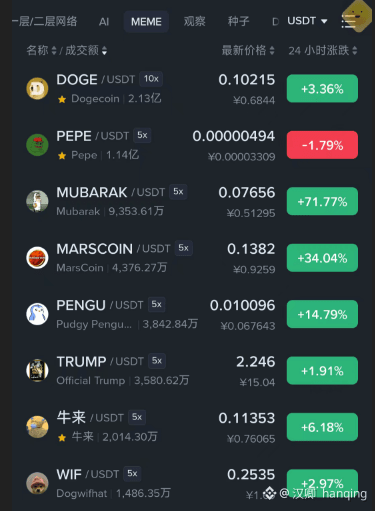
Brothers! Let’s talk about the Meme sector. In a bull market, it’s highly explosive and definitely worth paying attention to—some MEMEs have already started surging.
Personally, I’m optimistic about $PEPE , $WIF , $BONK, $NiuLai, and others. As for DOGE, yes, it does have strong consensus, but its market cap is too large; it needs a more relaxed cycle to really move.
PEPE: Has the world’s most well-known frog IP. It’s already listed on major top-tier exchanges, with extremely strong liquidity.
WIF: Considered the Meme leader of the Solana ecosystem. The “hat dog” image has extremely strong distribution power, and the community cohesion is very high.
BONK: An old-school retail-consensus coin in the Solana ecosystem—one of those “application-backed” memes.
$NiuLai: There’s a story to tell with the Chinese meme, and it also carries symbolic significance for a bull market.
Of course, other ones like TRUMP fall under the concept of elections and political figures (driven by strong time-sensitivity). There may be opportunities ahead of midterm elections, but I’m not really optimistic about the election prospects. Which other memes do you like? Let’s chat?
#FollowForFollow# #I’llReplyToEveryFan#
Brothers! Let’s talk about the Meme sector. In a bull market, it’s highly explosive and definitely worth paying attention to—some MEMEs have already started surging.
Personally, I’m optimistic about $PEPE , $WIF , $BONK , $NiuLai, and others. As for DOGE, yes, it does have strong consensus, but its market cap is too large; it needs a more relaxed cycle to really move.
PEPE: Has the world’s most well-known frog IP. It’s already listed on major top-tier exchanges, with extremely strong liquidity.
WIF: Considered the Meme leader of the Solana ecosystem. The “hat dog” image has extremely strong distribution power, and the community cohesion is very high.
BONK: An old-school retail-consensus coin in the Solana ecosystem—one of those “application-backed” memes.
$NiuLai: There’s a story to tell with the Chinese meme, and it also carries symbolic significance for a bull market.
Of course, other ones like TRUMP fall under the concept of elections and political figures (driven by strong time-sensitivity). There may be opportunities ahead of midterm elections, but I’m not really optimistic about the election prospects. Which other memes do you like? Let’s chat?
#FollowForFollow# #I’llReplyToEveryFan#
Personally, I’m optimistic about $PEPE , $WIF , $BONK , $NiuLai, and others. As for DOGE, yes, it does have strong consensus, but its market cap is too large; it needs a more relaxed cycle to really move.
PEPE: Has the world’s most well-known frog IP. It’s already listed on major top-tier exchanges, with extremely strong liquidity.
WIF: Considered the Meme leader of the Solana ecosystem. The “hat dog” image has extremely strong distribution power, and the community cohesion is very high.
BONK: An old-school retail-consensus coin in the Solana ecosystem—one of those “application-backed” memes.
$NiuLai: There’s a story to tell with the Chinese meme, and it also carries symbolic significance for a bull market.
Of course, other ones like TRUMP fall under the concept of elections and political figures (driven by strong time-sensitivity). There may be opportunities ahead of midterm elections, but I’m not really optimistic about the election prospects. Which other memes do you like? Let’s chat?
#FollowForFollow# #I’llReplyToEveryFan#
1.4k
·
--
International oil prices have just put on a high-altitude parachute jump. Ahead of the midterm elections, US stocks, cryptocurrencies, and A-shares are very likely all to benefit from a round of upside.
On the evening of September 22, WTI crude fell by more than 2%, dropping below $91. Brent also slid, losing the $96 level.
Behind this sudden plunge, the winds of geopolitics are quietly shifting. Iran’s presidential aircraft flew to New York to attend the United Nations General Assembly, and the Revolutionary Guard also sent a message: if national interests require it, we can negotiate while fighting.
The signals are clear: both the US and Iran are looking for a way to step down. On top of that, China’s leader visited the US to help drive improvements in China-US relations, and the international environment is entering a rare period of easing since Trump took office. At least before the midterm elections, US stocks, cryptocurrencies, and A-shares are very likely all to enjoy another wave of benefits.
This chess match seems to be moving in a direction that benefits everyone.
#Follow4Follow# #ReplyIfYouHaveFans#
International oil prices have just put on a high-altitude parachute jump. Ahead of the midterm elections, US stocks, cryptocurrencies, and A-shares are very likely all to benefit from a round of upside.
On the evening of September 22, WTI crude fell by more than 2%, dropping below $91. Brent also slid, losing the $96 level.
Behind this sudden plunge, the winds of geopolitics are quietly shifting. Iran’s presidential aircraft flew to New York to attend the United Nations General Assembly, and the Revolutionary Guard also sent a message: if national interests require it, we can negotiate while fighting.
The signals are clear: both the US and Iran are looking for a way to step down. On top of that, China’s leader visited the US to help drive improvements in China-US relations, and the international environment is entering a rare period of easing since Trump took office. At least before the midterm elections, US stocks, cryptocurrencies, and A-shares are very likely all to enjoy another wave of benefits.
This chess match seems to be moving in a direction that benefits everyone.
#Follow4Follow# #ReplyIfYouHaveFans#
On the evening of September 22, WTI crude fell by more than 2%, dropping below $91. Brent also slid, losing the $96 level.
Behind this sudden plunge, the winds of geopolitics are quietly shifting. Iran’s presidential aircraft flew to New York to attend the United Nations General Assembly, and the Revolutionary Guard also sent a message: if national interests require it, we can negotiate while fighting.
The signals are clear: both the US and Iran are looking for a way to step down. On top of that, China’s leader visited the US to help drive improvements in China-US relations, and the international environment is entering a rare period of easing since Trump took office. At least before the midterm elections, US stocks, cryptocurrencies, and A-shares are very likely all to enjoy another wave of benefits.
This chess match seems to be moving in a direction that benefits everyone.
#Follow4Follow# #ReplyIfYouHaveFans#
201
·
--
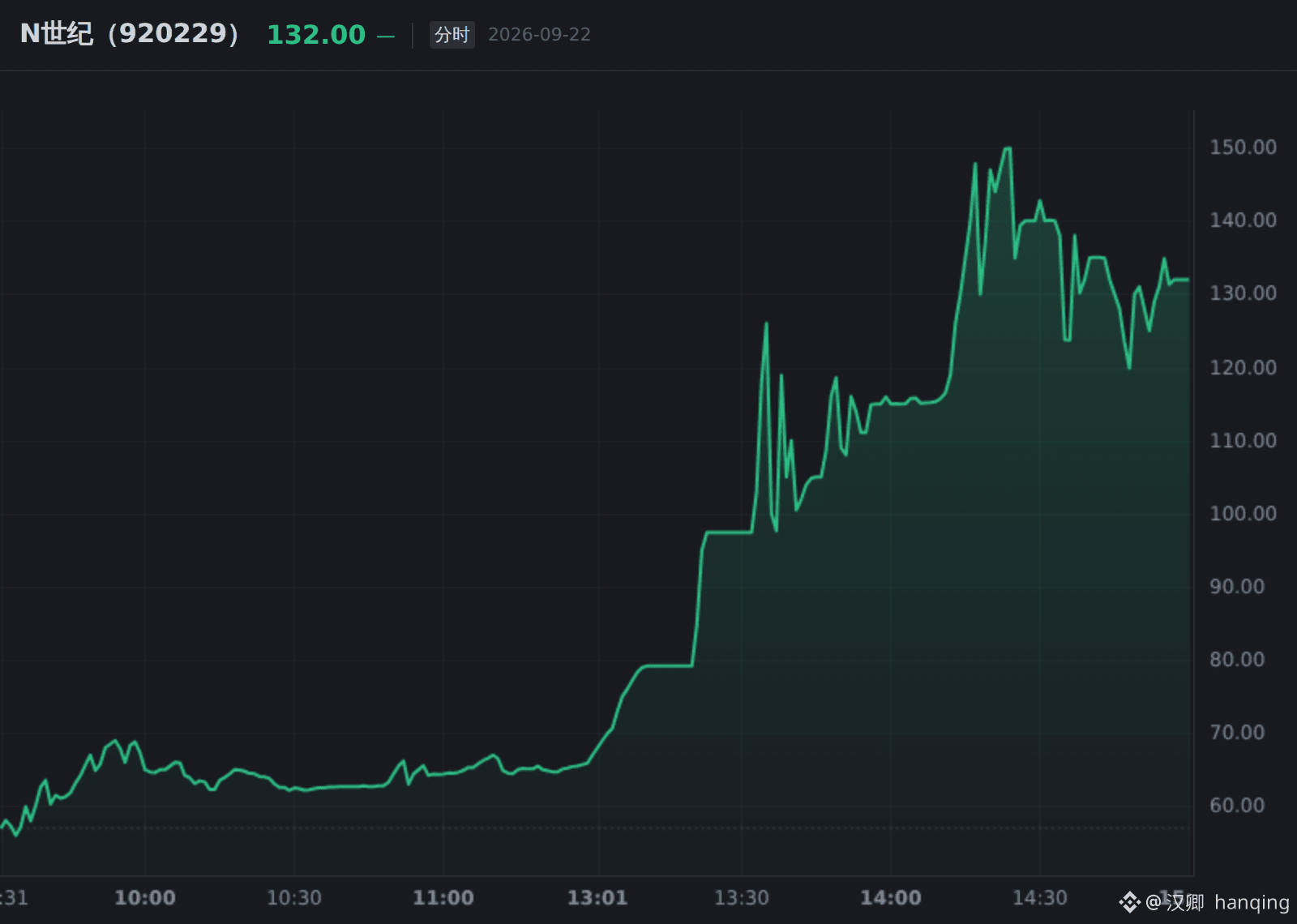
A-Share “New Stock Twin Stars” deliver violence-meets-aesthetics, comparable to crypto-currency MEME
On September 22, China’s A-Shares showcased the “New Stock Twin Stars” violence-meets-aesthetics.
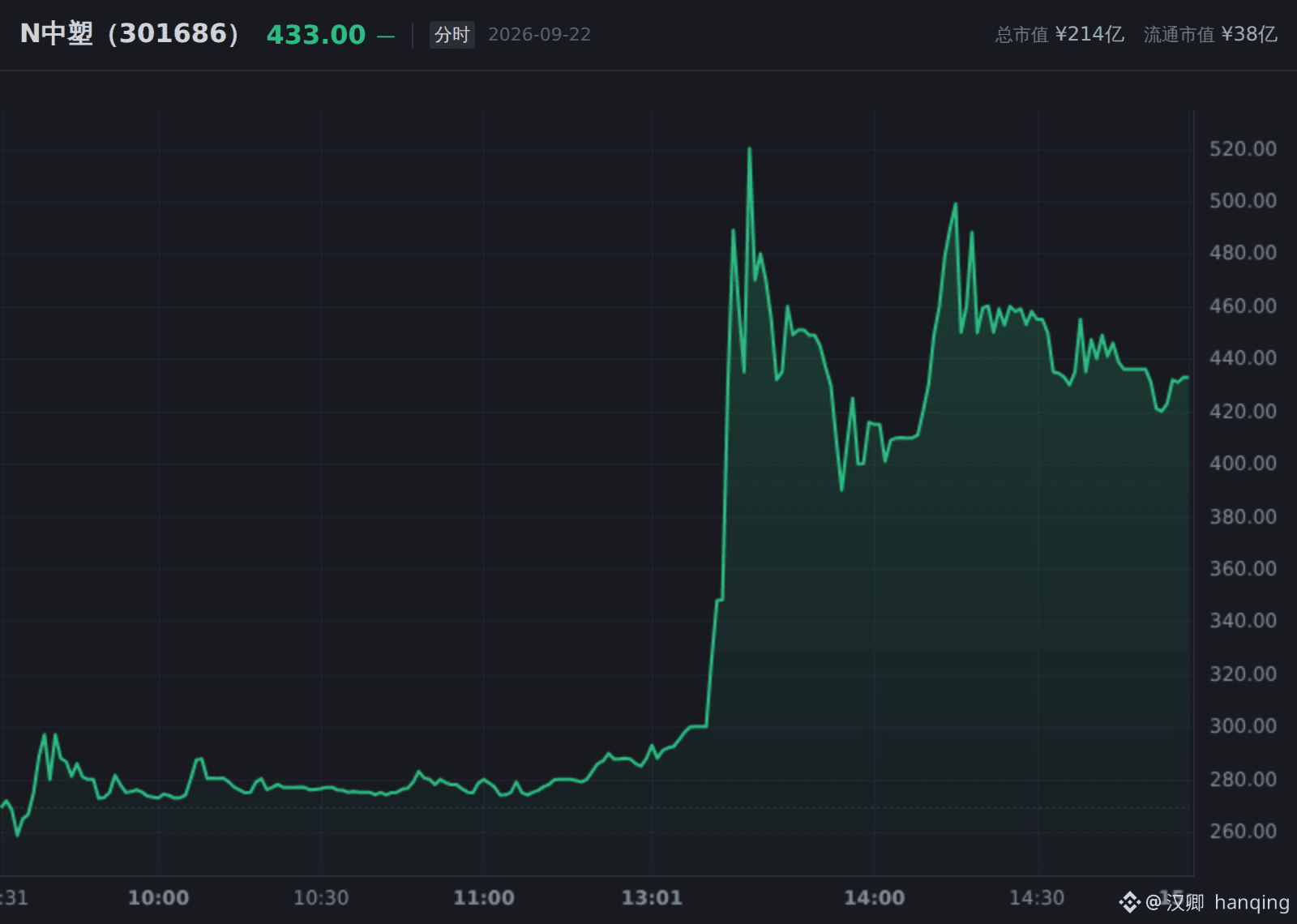
The Beijing Stock Exchange welcomed New Century Digital Technology (920229), priced at 15.67 yuan, which surged 288% at the open; on the Shenzhen Stock Exchange’s ChiNext, a new darling, Zhongsu New Materials (301686.SZ), priced at 55.28 yuan, opened the first day up more than 384%.
In the afternoon, the plot completely got out of control: the N-century stock’s intraday gain expanded to 570%, with the share price locked at 104.99 yuan;
N Zhongsu surged even more, up 712%, closing at 448.99 yuan.
Both stocks triggered a second interim trading halt, effectively replicating the “Beijing Stock Exchange new stock speculation model” in the ChiNext market.
#Follow-to-follow# #Follow and you’ll get a reply#
A-Share “New Stock Twin Stars” deliver violence-meets-aesthetics, comparable to crypto-currency MEME
On September 22, China’s A-Shares showcased the “New Stock Twin Stars” violence-meets-aesthetics.
The Beijing Stock Exchange welcomed New Century Digital Technology (920229), priced at 15.67 yuan, which surged 288% at the open; on the Shenzhen Stock Exchange’s ChiNext, a new darling, Zhongsu New Materials (301686.SZ), priced at 55.28 yuan, opened the first day up more than 384%.
In the afternoon, the plot completely got out of control: the N-century stock’s intraday gain expanded to 570%, with the share price locked at 104.99 yuan;
N Zhongsu surged even more, up 712%, closing at 448.99 yuan.
Both stocks triggered a second interim trading halt, effectively replicating the “Beijing Stock Exchange new stock speculation model” in the ChiNext market.
#Follow-to-follow# #Follow and you’ll get a reply#
On September 22, China’s A-Shares showcased the “New Stock Twin Stars” violence-meets-aesthetics.
The Beijing Stock Exchange welcomed New Century Digital Technology (920229), priced at 15.67 yuan, which surged 288% at the open; on the Shenzhen Stock Exchange’s ChiNext, a new darling, Zhongsu New Materials (301686.SZ), priced at 55.28 yuan, opened the first day up more than 384%.
In the afternoon, the plot completely got out of control: the N-century stock’s intraday gain expanded to 570%, with the share price locked at 104.99 yuan;
N Zhongsu surged even more, up 712%, closing at 448.99 yuan.
Both stocks triggered a second interim trading halt, effectively replicating the “Beijing Stock Exchange new stock speculation model” in the ChiNext market.
#Follow-to-follow# #Follow and you’ll get a reply#
33
·
--
$SUI has broken out of the bottom range. Volume and price are rising together, and it looks very well monitored. What other coins in the $SUI ecosystem are worth paying attention to? My top pick is $WAL, which belongs to the storage sector. It’s still in an accumulation zone at the bottom, and its market cap is still very low. Next are $DEEP (DeepBook is the native liquidity layer of the Sui ecosystem) and $CETUS (cetus is the DEX on the Sui chain).
$SUI has broken out of the bottom range. Volume and price are rising together, and it looks very well monitored. What other coins in the $SUI ecosystem are worth paying attention to? My top pick is $WAL, which belongs to the storage sector. It’s still in an accumulation zone at the bottom, and its market cap is still very low. Next are $DEEP (DeepBook is the native liquidity layer of the Sui ecosystem) and $CETUS (cetus is the DEX on the Sui chain).
1
1.9k
·
--
🚀Grok 4.7 just released by Musk, and opinions are split!
📉【Do netizens openly doubt it?】
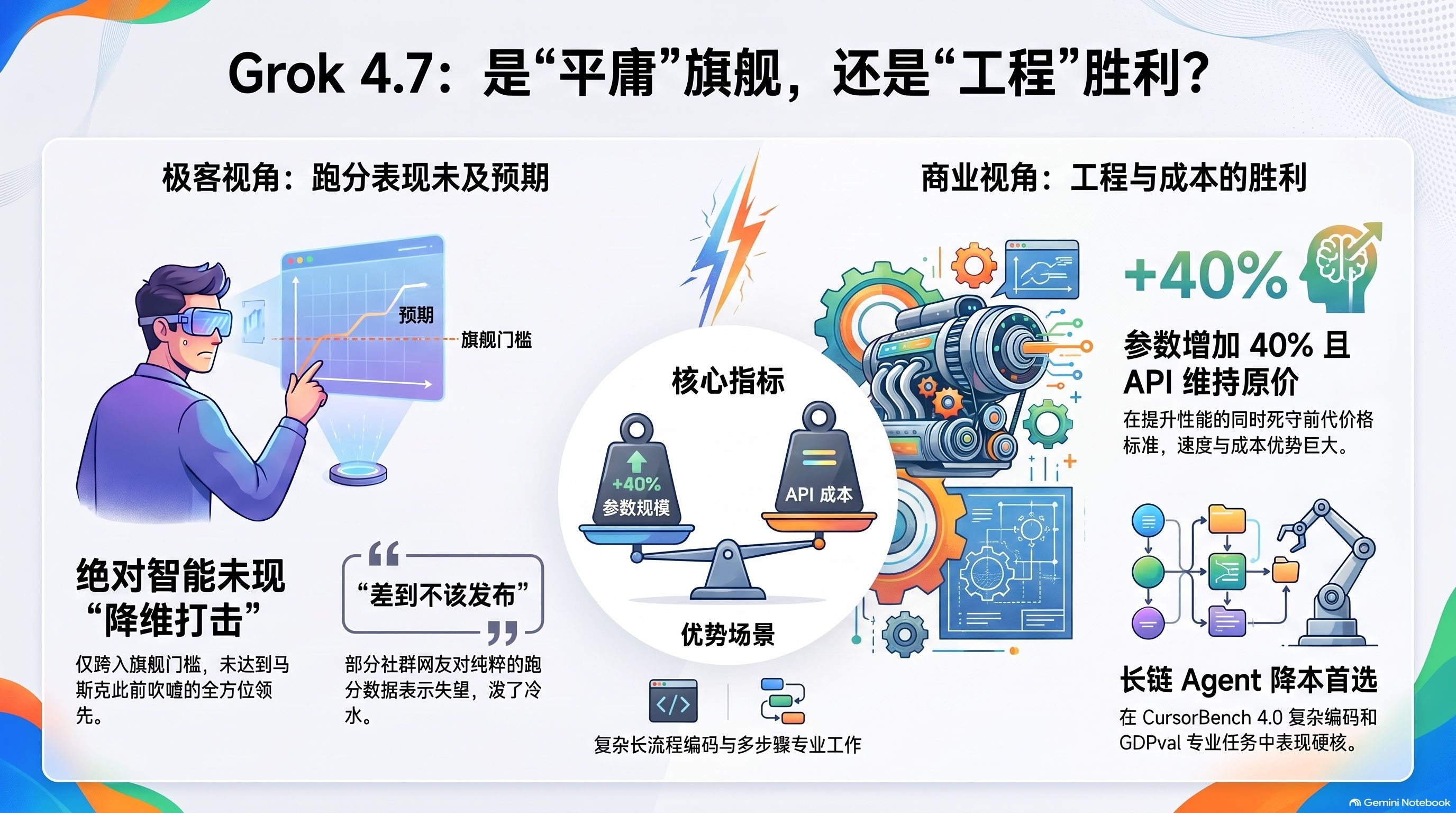
Many tech geeks and community users are pouring cold water on it, saying it’s “so bad it shouldn’t have been released.” In terms of pure absolute intelligence benchmark scores, Grok 4.7 hasn’t delivered Musk’s earlier claim of “comprehensive, all-around domination.” It only just steps into the flagship tier.
🏆【A “new king of value for money” in the eyes of enterprises and developers】
But for companies that do programming and real-world deployment, it’s basically a “can’t-go-wrong” machine!
Model size up by 40%, yet the API price is still clinging to the previous-gen standard—its speed and cost are going wild!
It performs extremely strongly in complex long-session coding (CursorBench 4.0) and multi-step professional tasks (GDPval), making it a genuine go-to choice for long-chain agents that cut costs.
Summary: This isn’t a leap of a scientific miracle—but it is a highly successful engineering and business win. A tool for cutting costs and improving efficiency—will you give it a try?👇
#Follow4Follow# #ReplyToEveryFollow#
🚀Grok 4.7 just released by Musk, and opinions are split!
📉【Do netizens openly doubt it?】
Many tech geeks and community users are pouring cold water on it, saying it’s “so bad it shouldn’t have been released.” In terms of pure absolute intelligence benchmark scores, Grok 4.7 hasn’t delivered Musk’s earlier claim of “comprehensive, all-around domination.” It only just steps into the flagship tier.
🏆【A “new king of value for money” in the eyes of enterprises and developers】
But for companies that do programming and real-world deployment, it’s basically a “can’t-go-wrong” machine!
Model size up by 40%, yet the API price is still clinging to the previous-gen standard—its speed and cost are going wild!
It performs extremely strongly in complex long-session coding (CursorBench 4.0) and multi-step professional tasks (GDPval), making it a genuine go-to choice for long-chain agents that cut costs.
Summary: This isn’t a leap of a scientific miracle—but it is a highly successful engineering and business win. A tool for cutting costs and improving efficiency—will you give it a try?👇
#Follow4Follow# #ReplyToEveryFollow#
📉【Do netizens openly doubt it?】
Many tech geeks and community users are pouring cold water on it, saying it’s “so bad it shouldn’t have been released.” In terms of pure absolute intelligence benchmark scores, Grok 4.7 hasn’t delivered Musk’s earlier claim of “comprehensive, all-around domination.” It only just steps into the flagship tier.
🏆【A “new king of value for money” in the eyes of enterprises and developers】
But for companies that do programming and real-world deployment, it’s basically a “can’t-go-wrong” machine!
Model size up by 40%, yet the API price is still clinging to the previous-gen standard—its speed and cost are going wild!
It performs extremely strongly in complex long-session coding (CursorBench 4.0) and multi-step professional tasks (GDPval), making it a genuine go-to choice for long-chain agents that cut costs.
Summary: This isn’t a leap of a scientific miracle—but it is a highly successful engineering and business win. A tool for cutting costs and improving efficiency—will you give it a try?👇
#Follow4Follow# #ReplyToEveryFollow#
59
·
--
DeepSeek’s big bet on Huawei Ascend: to run a “domestic full-power version” of large models through the gaps in the U.S. chip export ban.
Liang Wenfeng signed a “priority domestic” commandment, and Huawei promised to deliver training chips before the fourth quarter. At present, a 200-billion-parameter model is being “baked.” Next, the plan targets an 800-billion-parameter flagship.
In this game of chess, winning means a showcase of “independent compute power”; losing means a confirmed case of being “bottlenecked.”
#Follow4Follow# #ReplyToAllBack#
DeepSeek’s big bet on Huawei Ascend: to run a “domestic full-power version” of large models through the gaps in the U.S. chip export ban.
Liang Wenfeng signed a “priority domestic” commandment, and Huawei promised to deliver training chips before the fourth quarter. At present, a 200-billion-parameter model is being “baked.” Next, the plan targets an 800-billion-parameter flagship.
In this game of chess, winning means a showcase of “independent compute power”; losing means a confirmed case of being “bottlenecked.”
#Follow4Follow# #ReplyToAllBack#
Liang Wenfeng signed a “priority domestic” commandment, and Huawei promised to deliver training chips before the fourth quarter. At present, a 200-billion-parameter model is being “baked.” Next, the plan targets an 800-billion-parameter flagship.
In this game of chess, winning means a showcase of “independent compute power”; losing means a confirmed case of being “bottlenecked.”
#Follow4Follow# #ReplyToAllBack#
64
·
--
Pharmaceutical stocks surge across the board, with the CRO index up more than 5%
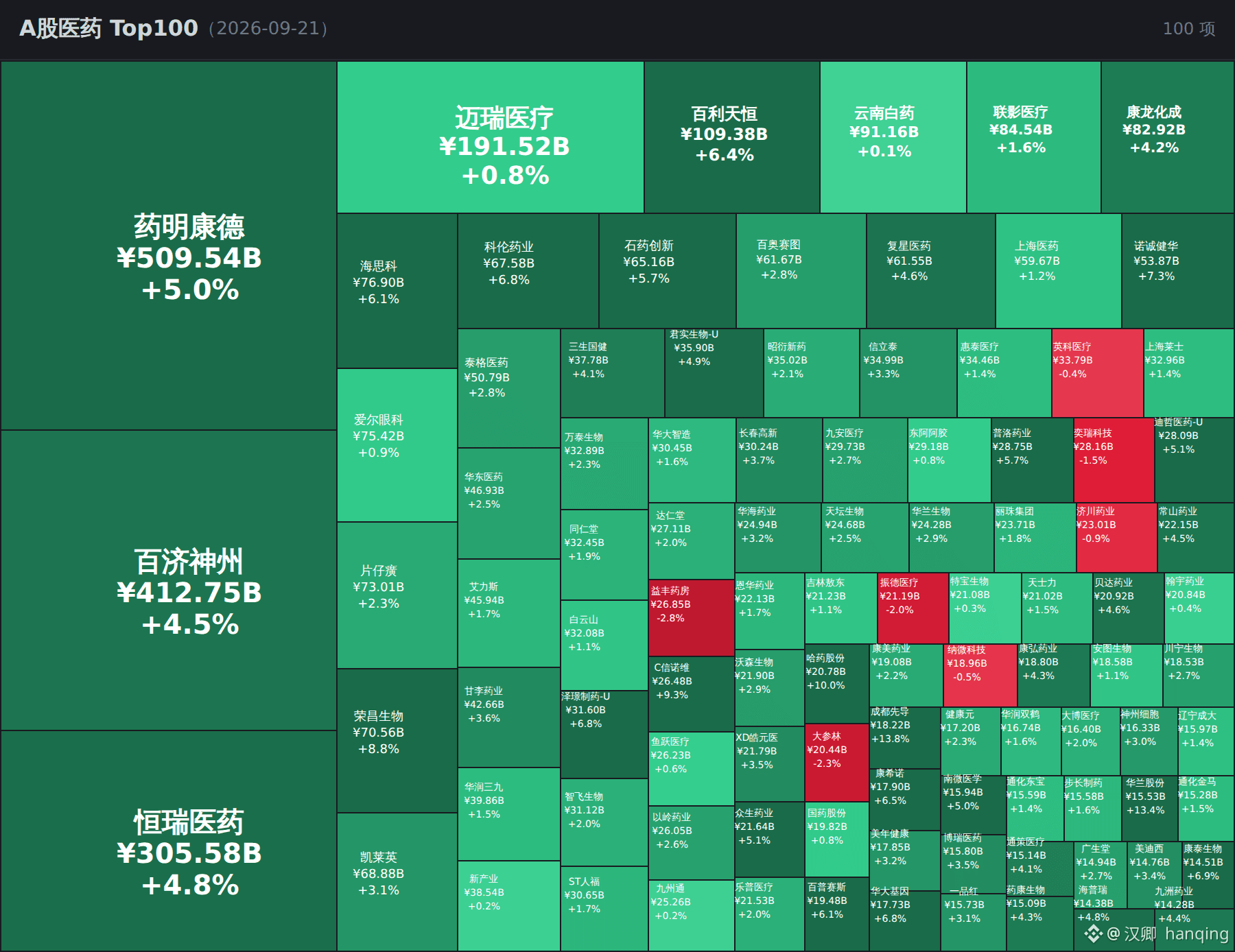
On September 21, all three major A-share indices rose. The pharmaceutical sector surged across the board, with the CRO index up more than 5%. The innovative drugs and healthcare services indices rose more than 4%, while sub-sector indices rose more than 3%. Nearly 20 stocks hit the daily trading limit or gained more than 10%, and Lingyi Pharmaceutical Industry hit the daily limit with a 30% gain.
Ten departments, including the Ministry of Industry and Information Technology, issued the “15th Five-Year Plan” for the development of the pharmaceutical industry. It calls for accelerating the enablement of drug R&D through technologies such as AI, quantum technologies, and supercomputing. Overall, the pharmaceutical sector’s momentum continues to heat up, and investor sentiment is high.
#Follow4Follow# #If You Follow, I’ll Follow Back#
Pharmaceutical stocks surge across the board, with the CRO index up more than 5%
On September 21, all three major A-share indices rose. The pharmaceutical sector surged across the board, with the CRO index up more than 5%. The innovative drugs and healthcare services indices rose more than 4%, while sub-sector indices rose more than 3%. Nearly 20 stocks hit the daily trading limit or gained more than 10%, and Lingyi Pharmaceutical Industry hit the daily limit with a 30% gain.
Ten departments, including the Ministry of Industry and Information Technology, issued the “15th Five-Year Plan” for the development of the pharmaceutical industry. It calls for accelerating the enablement of drug R&D through technologies such as AI, quantum technologies, and supercomputing. Overall, the pharmaceutical sector’s momentum continues to heat up, and investor sentiment is high.
#Follow4Follow# #If You Follow, I’ll Follow Back#
On September 21, all three major A-share indices rose. The pharmaceutical sector surged across the board, with the CRO index up more than 5%. The innovative drugs and healthcare services indices rose more than 4%, while sub-sector indices rose more than 3%. Nearly 20 stocks hit the daily trading limit or gained more than 10%, and Lingyi Pharmaceutical Industry hit the daily limit with a 30% gain.
Ten departments, including the Ministry of Industry and Information Technology, issued the “15th Five-Year Plan” for the development of the pharmaceutical industry. It calls for accelerating the enablement of drug R&D through technologies such as AI, quantum technologies, and supercomputing. Overall, the pharmaceutical sector’s momentum continues to heat up, and investor sentiment is high.
#Follow4Follow# #If You Follow, I’ll Follow Back#
43
·
--
Name astrology makes a splash in A-shares — “Xinhua” six stocks collectively lock limit-up and surge wildly; the A-share market is also playing the MEME concept.
Today, A-shares have fully fallen for “name astrology.” Shares with “Xinhua” in their names are being crazily snapped up by funds, with the entire sector seeing aggressive, collective limit-ups.
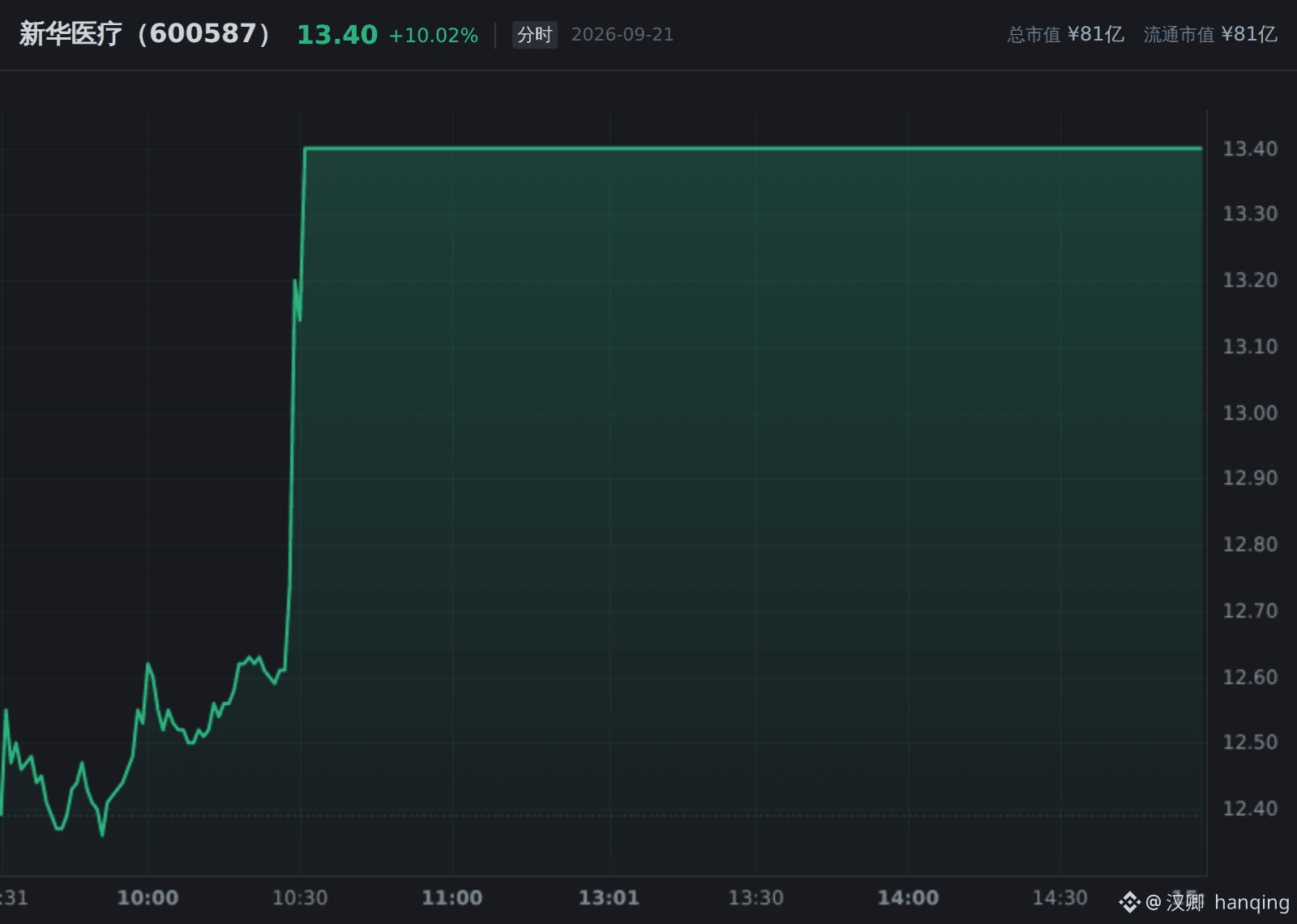
Xinhua Media locked a one-word limit-up, followed closely by Xinhua Wenxuan, Xinhua Pharmaceutical, Inner Mongolia Xinhua, Xinhua Biomed, and Xinhua Department Store—each sealed the limit-up with a +10% gain. Xinhua Net and Xinhua Insurance were slightly lagging: the former rose only 2.06%, while the latter dipped 0.33%.
Notably, on the evening of September 18, Xinhua Media (SH600825) released a restructuring announcement stating it plans to acquire 100% of the equity of Shanghai Jiemian-Lianhe Financial Technology Co., Ltd. via share issuance, which drew widespread market attention. The news directly propelled Xinhua Media to lock limit-up again at 13:14 on September 21. Its price hit 5.84 yuan, up 0.53 yuan, an increase of 9.98%. Trading volume was 12.53 million yuan, turnover rate 0.21%, and the P/E ratio (TTM) reached 142.99 times. Total market cap was 6.102 billion yuan (about $880 million).
Among the six “Xinhua” stocks, only Xinhua Insurance and Xinhua Net failed to lock limit-up: the former fell 0.33% and the latter rose 2.06%. The rest all sealed the limit-up with a 10% gain, creating a rare collective performance.
At this moment, the A-share market has vividly shown intense momentum and public sentiment competition—somewhat like the crypto world playing an abstract game.
#FollowBack# #IfYouHaveFansIDoBack#
Name astrology makes a splash in A-shares — “Xinhua” six stocks collectively lock limit-up and surge wildly; the A-share market is also playing the MEME concept.
Today, A-shares have fully fallen for “name astrology.” Shares with “Xinhua” in their names are being crazily snapped up by funds, with the entire sector seeing aggressive, collective limit-ups.
Xinhua Media locked a one-word limit-up, followed closely by Xinhua Wenxuan, Xinhua Pharmaceutical, Inner Mongolia Xinhua, Xinhua Biomed, and Xinhua Department Store—each sealed the limit-up with a +10% gain. Xinhua Net and Xinhua Insurance were slightly lagging: the former rose only 2.06%, while the latter dipped 0.33%.
Notably, on the evening of September 18, Xinhua Media (SH600825) released a restructuring announcement stating it plans to acquire 100% of the equity of Shanghai Jiemian-Lianhe Financial Technology Co., Ltd. via share issuance, which drew widespread market attention. The news directly propelled Xinhua Media to lock limit-up again at 13:14 on September 21. Its price hit 5.84 yuan, up 0.53 yuan, an increase of 9.98%. Trading volume was 12.53 million yuan, turnover rate 0.21%, and the P/E ratio (TTM) reached 142.99 times. Total market cap was 6.102 billion yuan (about $880 million).
Among the six “Xinhua” stocks, only Xinhua Insurance and Xinhua Net failed to lock limit-up: the former fell 0.33% and the latter rose 2.06%. The rest all sealed the limit-up with a 10% gain, creating a rare collective performance.
At this moment, the A-share market has vividly shown intense momentum and public sentiment competition—somewhat like the crypto world playing an abstract game.
#FollowBack# #IfYouHaveFansIDoBack#
Today, A-shares have fully fallen for “name astrology.” Shares with “Xinhua” in their names are being crazily snapped up by funds, with the entire sector seeing aggressive, collective limit-ups.
Xinhua Media locked a one-word limit-up, followed closely by Xinhua Wenxuan, Xinhua Pharmaceutical, Inner Mongolia Xinhua, Xinhua Biomed, and Xinhua Department Store—each sealed the limit-up with a +10% gain. Xinhua Net and Xinhua Insurance were slightly lagging: the former rose only 2.06%, while the latter dipped 0.33%.
Notably, on the evening of September 18, Xinhua Media (SH600825) released a restructuring announcement stating it plans to acquire 100% of the equity of Shanghai Jiemian-Lianhe Financial Technology Co., Ltd. via share issuance, which drew widespread market attention. The news directly propelled Xinhua Media to lock limit-up again at 13:14 on September 21. Its price hit 5.84 yuan, up 0.53 yuan, an increase of 9.98%. Trading volume was 12.53 million yuan, turnover rate 0.21%, and the P/E ratio (TTM) reached 142.99 times. Total market cap was 6.102 billion yuan (about $880 million).
Among the six “Xinhua” stocks, only Xinhua Insurance and Xinhua Net failed to lock limit-up: the former fell 0.33% and the latter rose 2.06%. The rest all sealed the limit-up with a 10% gain, creating a rare collective performance.
At this moment, the A-share market has vividly shown intense momentum and public sentiment competition—somewhat like the crypto world playing an abstract game.
#FollowBack# #IfYouHaveFansIDoBack#
59
·
--
Bessent says US-China trade and AI talks were “very successful”; both sides agreed to continue AI dialogue and establish a notification mechanism. Greer revealed that the US-China Trade Commission is now officially operational; China may involve consumer goods and low-tech products, while the US may include energy, agricultural products, and medical devices. This shows that cooperation between the two countries in trade and AI will continue to move forward.
#互关互粉# #有粉必回#
Bessent says US-China trade and AI talks were “very successful”; both sides agreed to continue AI dialogue and establish a notification mechanism. Greer revealed that the US-China Trade Commission is now officially operational; China may involve consumer goods and low-tech products, while the US may include energy, agricultural products, and medical devices. This shows that cooperation between the two countries in trade and AI will continue to move forward.
#互关互粉# #有粉必回#
#互关互粉# #有粉必回#
54
·
--
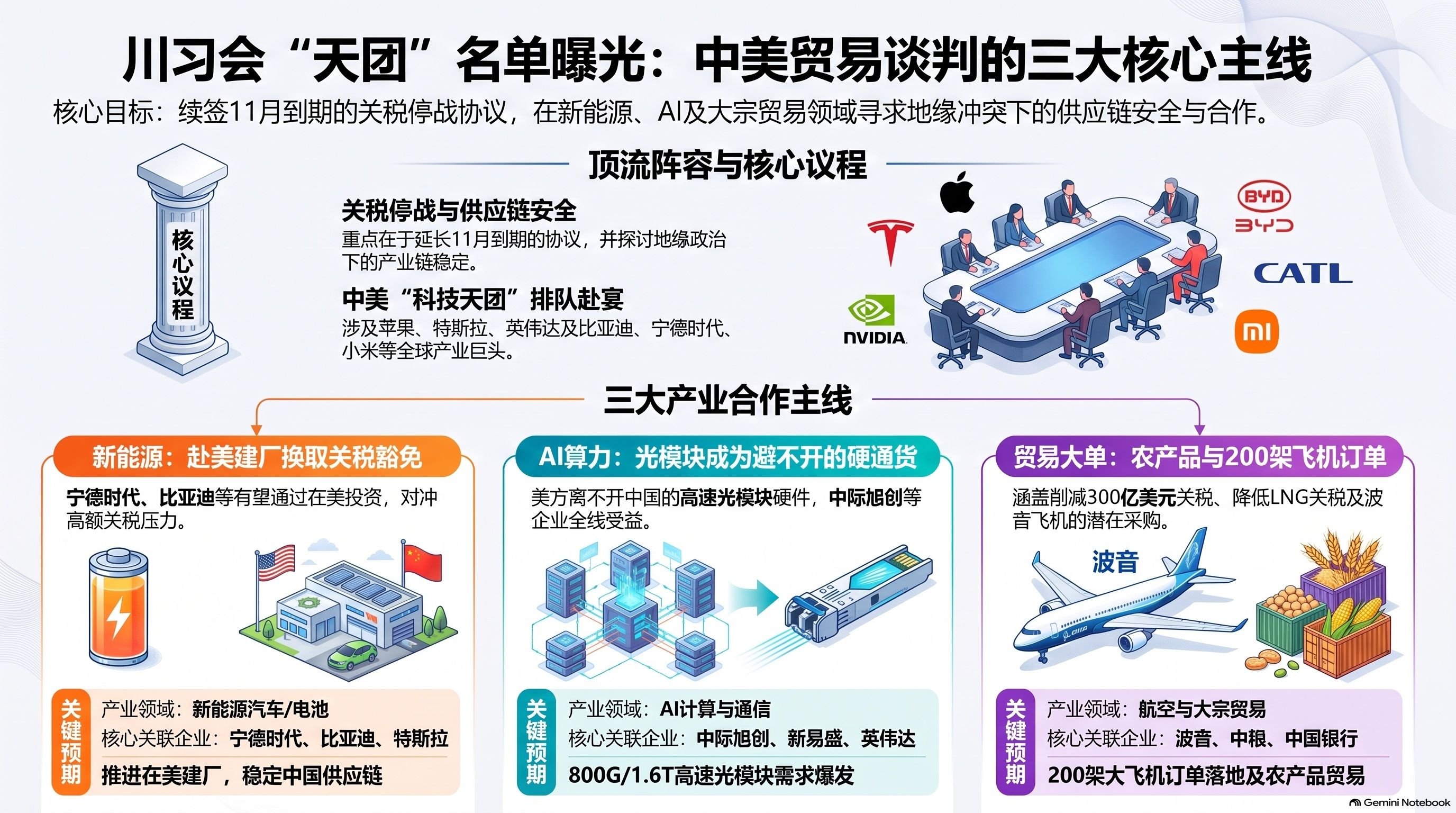
Exposed Trump-Xi summit “dream team” trump cards: tech giants line up for the state banquet, renewal of the tariff truce agreement
On September 24, Xi Jinping will visit the U.S. and meet with Donald Trump. The list of the two countries’ negotiation “dream team” has surfaced—
The U.S. side’s lineup for the state banquet is essentially a “top-tier of tech”: Apple’s Tim Cook, Tesla’s Elon Musk, NVIDIA’s Jensen Huang, and OpenAI’s Sam Altman will all attend. China’s side will be led by Cai Qi, bringing a roster of powerhouse companies and representatives, including BYD (Wang Chuanfu), CATL, Gotion High-Tech, Xiaomi (Lei Jun), InnoLight (Jiangsu?), Bank of China, Cofco, and others.
The core of this round of talks is one thing: extend the tariff truce agreement due to expire in November, and layer in supply-chain security amid geopolitical conflict. Three major industrial storylines are worth watching—
First, localized new energy manufacturing. Even though the U.S. has imposed an additional 100% tariff on Chinese electric vehicles, the Trump administration is inclined to use “building factories in the U.S.” as an exemption bargaining chip. CATL, Gotion High-Tech, and BYD’s investments in the U.S. directly benefit, and Tesla’s China supply chain is stabilized in parallel.
Second, AI computing power as the hard currency. The U.S. side is closely watching the “distillation” risk of AI models, but tech giants can’t do without Chinese hardware. InnoLight’s accompanying presence confirms the point: 800G/1.6T high-speed optical modules are core assets that can’t be avoided. InnoLight, Neway/NeoPhotonics, NVIDIA, and Foxconn Industrial Internet will all benefit across the board.
Third, tariff exemptions and super-sized orders. Negotiations are advancing to cut roughly $30 billion in each side’s commodity tariffs, and to reduce China’s 15% tariff on LNG imports from the U.S. Cofco and Boeing will attend as well; orders for agricultural products and large aircraft are building momentum, and Boeing’s order book of 200 planes is expected to land.
Reuters notes: Chinese company executives are expected not to attend a large-scale business roundtable; the symbolic significance may be greater than the substance of any signing. Despite many disagreements, China and the U.S. also share common interests, so they will certainly sign some agreements (He Lifeng will lead the delegation to the talks). These developments will have significant implications for the capital markets. Which industries and specific stocks do you think will benefit?
#MutualFollowMutualSupport# #FollowAndYou’llBeFollowed#
Exposed Trump-Xi summit “dream team” trump cards: tech giants line up for the state banquet, renewal of the tariff truce agreement
On September 24, Xi Jinping will visit the U.S. and meet with Donald Trump. The list of the two countries’ negotiation “dream team” has surfaced—
The U.S. side’s lineup for the state banquet is essentially a “top-tier of tech”: Apple’s Tim Cook, Tesla’s Elon Musk, NVIDIA’s Jensen Huang, and OpenAI’s Sam Altman will all attend. China’s side will be led by Cai Qi, bringing a roster of powerhouse companies and representatives, including BYD (Wang Chuanfu), CATL, Gotion High-Tech, Xiaomi (Lei Jun), InnoLight (Jiangsu?), Bank of China, Cofco, and others.
The core of this round of talks is one thing: extend the tariff truce agreement due to expire in November, and layer in supply-chain security amid geopolitical conflict. Three major industrial storylines are worth watching—
First, localized new energy manufacturing. Even though the U.S. has imposed an additional 100% tariff on Chinese electric vehicles, the Trump administration is inclined to use “building factories in the U.S.” as an exemption bargaining chip. CATL, Gotion High-Tech, and BYD’s investments in the U.S. directly benefit, and Tesla’s China supply chain is stabilized in parallel.
Second, AI computing power as the hard currency. The U.S. side is closely watching the “distillation” risk of AI models, but tech giants can’t do without Chinese hardware. InnoLight’s accompanying presence confirms the point: 800G/1.6T high-speed optical modules are core assets that can’t be avoided. InnoLight, Neway/NeoPhotonics, NVIDIA, and Foxconn Industrial Internet will all benefit across the board.
Third, tariff exemptions and super-sized orders. Negotiations are advancing to cut roughly $30 billion in each side’s commodity tariffs, and to reduce China’s 15% tariff on LNG imports from the U.S. Cofco and Boeing will attend as well; orders for agricultural products and large aircraft are building momentum, and Boeing’s order book of 200 planes is expected to land.
Reuters notes: Chinese company executives are expected not to attend a large-scale business roundtable; the symbolic significance may be greater than the substance of any signing. Despite many disagreements, China and the U.S. also share common interests, so they will certainly sign some agreements (He Lifeng will lead the delegation to the talks). These developments will have significant implications for the capital markets. Which industries and specific stocks do you think will benefit?
#MutualFollowMutualSupport# #FollowAndYou’llBeFollowed#
On September 24, Xi Jinping will visit the U.S. and meet with Donald Trump. The list of the two countries’ negotiation “dream team” has surfaced—
The U.S. side’s lineup for the state banquet is essentially a “top-tier of tech”: Apple’s Tim Cook, Tesla’s Elon Musk, NVIDIA’s Jensen Huang, and OpenAI’s Sam Altman will all attend. China’s side will be led by Cai Qi, bringing a roster of powerhouse companies and representatives, including BYD (Wang Chuanfu), CATL, Gotion High-Tech, Xiaomi (Lei Jun), InnoLight (Jiangsu?), Bank of China, Cofco, and others.
The core of this round of talks is one thing: extend the tariff truce agreement due to expire in November, and layer in supply-chain security amid geopolitical conflict. Three major industrial storylines are worth watching—
First, localized new energy manufacturing. Even though the U.S. has imposed an additional 100% tariff on Chinese electric vehicles, the Trump administration is inclined to use “building factories in the U.S.” as an exemption bargaining chip. CATL, Gotion High-Tech, and BYD’s investments in the U.S. directly benefit, and Tesla’s China supply chain is stabilized in parallel.
Second, AI computing power as the hard currency. The U.S. side is closely watching the “distillation” risk of AI models, but tech giants can’t do without Chinese hardware. InnoLight’s accompanying presence confirms the point: 800G/1.6T high-speed optical modules are core assets that can’t be avoided. InnoLight, Neway/NeoPhotonics, NVIDIA, and Foxconn Industrial Internet will all benefit across the board.
Third, tariff exemptions and super-sized orders. Negotiations are advancing to cut roughly $30 billion in each side’s commodity tariffs, and to reduce China’s 15% tariff on LNG imports from the U.S. Cofco and Boeing will attend as well; orders for agricultural products and large aircraft are building momentum, and Boeing’s order book of 200 planes is expected to land.
Reuters notes: Chinese company executives are expected not to attend a large-scale business roundtable; the symbolic significance may be greater than the substance of any signing. Despite many disagreements, China and the U.S. also share common interests, so they will certainly sign some agreements (He Lifeng will lead the delegation to the talks). These developments will have significant implications for the capital markets. Which industries and specific stocks do you think will benefit?
#MutualFollowMutualSupport# #FollowAndYou’llBeFollowed#
1
·
--
According to Bloomberg, Ukraine carried out one of the largest drone attacks in history, deploying more than 1,600 drones. The targets were aimed at the Moscow region and struck a major local oil refinery. Just six days earlier, President Trump had said that Ukraine and Russia agreed not to strike energy targets in order to lower diesel prices. The refinery supplies more than 33% of the fuel to the Moscow region and is still burning.
#FollowForFollow# #WeAlwaysReply#
According to Bloomberg, Ukraine carried out one of the largest drone attacks in history, deploying more than 1,600 drones. The targets were aimed at the Moscow region and struck a major local oil refinery. Just six days earlier, President Trump had said that Ukraine and Russia agreed not to strike energy targets in order to lower diesel prices. The refinery supplies more than 33% of the fuel to the Moscow region and is still burning.
#FollowForFollow# #WeAlwaysReply#
#FollowForFollow# #WeAlwaysReply#
2
1k
Log in to explore more content
Join global crypto users on Binance Square
⚡️ Get latest and useful information about crypto.
💬 Trusted by the world’s largest crypto exchange.
👍 Discover real insights from verified creators.
Email / Phone number
Trending Topics
PolymarketBankFailureBetsDrawFDICConcern
5,325 views
245 Discussing
#polymarketbankfailurebetsdrawfdicconcern
🚨 Market Alert: Bank Failure Bets on Polymarket Draw FDIC Concern
The Situation: The financial world is buzzing as a high-stakes prediction market on Polymarket—specifically betting on the probability of major bank failures—has drawn serious attention and concern from regulators, including the FDIC. This has created a volatile feedback loop where market sentiment directly influences regulatory scrutiny, driving massive volume and volatility across the sector.
What This Means for Traders: When prediction markets for financial distress gain this much traction, it signals extreme market stress and elevated systemic risk. Traders are closely monitoring contagion risk across the banking sector, making it a critical moment for risk management and sector rotation.
Highlighted Tradeable Coins to Watch:
$BTC (Bitcoin): The ultimate macro hedge. As concerns over fiat banking stability rise, traders frequently rotate capital into Bitcoin as a decentralized, non-sovereign store of value.
$ETH (Ethereum): Leading the decentralized finance (DeFi) ecosystem. If the traditional banking sector faces pressure, increased attention often turns to on-chain finance and lending protocols built on Ethereum.
$BNB (Binance Coin): As a proxy for exchange health and broader market sentiment, tracking how major exchange tokens react to sudden financial news provides insights into overall market liquidity and trader confidence.
Are you hedging against systemic risk or watching from the sidelines? Let's discuss your strategy in the comments below! 👇
#Polymarket #FDIC #BankingSector #PredictionMarkets
Axiom AlphA
·0 Likes
·2.6k views
BlackRockBuildsTokenizedPortfoliosForOndo
3,758 views
173 Discussing
BitwiseFilesToListNEARETFOnNYSEArca
5,191 views
191 Discussing