A summit that draws worldwide attention: Trump greeted the visiting leader at the airport—what diplomatic code is hidden in it? 🛬
Do you know? After World War II, it is rare indeed for a US president to personally go to the airport to welcome a foreign leader. Every time, it sends a heavy signal.
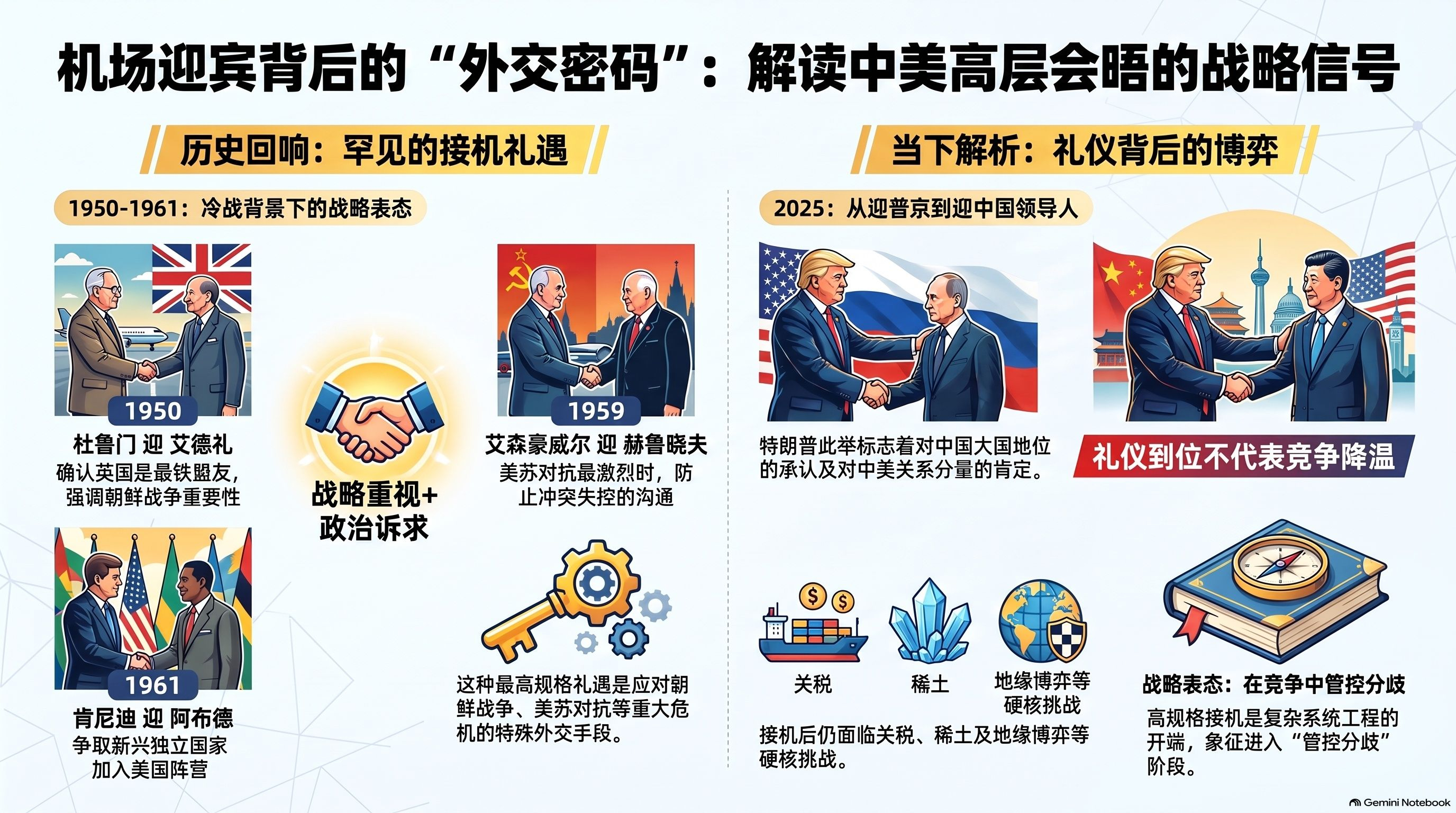
📌 In 1950, Truman welcomed British Prime Minister Clement Attlee—while the Korean War was in full swing, the US wanted the world to know: this war is crucial, and Britain is my staunchest ally.
📌 In 1957, Eisenhower welcomed South Vietnamese leader Ngô Đình Diệm—on the Cold War chessboard, openly giving a platform to the government in the South.
📌 In 1959, Eisenhower welcomed Khrushchev—when US-Soviet confrontation was at its fiercest, using face-to-face communication to prevent the situation from spiraling out of control.
📌 In 1961, Kennedy welcomed Sudanese President Abboud—sending a message to newly independent states: welcome to join the US camp.
The pattern is clear: airport greetings = strategic emphasis + political demands.
Now look at today:
🔹 In August 2025, Trump will welcome Putin in Alaska—his goal is to provide some resolution for the Russia-Ukraine conflict as soon as possible.
🔹 This time, he personally greeted China’s leadership—the weight is completely different. US-China relations have become the top priority in America’s global strategy. Economics, technology, security, and geopolitics are all intertwined across the board. This deep bow is an acknowledgment of China’s status as a major power, and also a statement on "managing differences in competition".
But don’t be too optimistic yet. Being at the airport doesn’t mean the temperature will cool. US-China relations are a three-dimensional and complex systems project—tariffs, rare earths, critical minerals, and geopolitical maneuvering. Each is a tough battle.
With the formalities done properly, the game is only just beginning. What can be negotiated next remains to be seen.🤝
#中美关系 #川习会 #International Observation
#FollowBack# #FollowAndReply#
Do you know? After World War II, it is rare indeed for a US president to personally go to the airport to welcome a foreign leader. Every time, it sends a heavy signal.
📌 In 1950, Truman welcomed British Prime Minister Clement Attlee—while the Korean War was in full swing, the US wanted the world to know: this war is crucial, and Britain is my staunchest ally.
📌 In 1957, Eisenhower welcomed South Vietnamese leader Ngô Đình Diệm—on the Cold War chessboard, openly giving a platform to the government in the South.
📌 In 1959, Eisenhower welcomed Khrushchev—when US-Soviet confrontation was at its fiercest, using face-to-face communication to prevent the situation from spiraling out of control.
📌 In 1961, Kennedy welcomed Sudanese President Abboud—sending a message to newly independent states: welcome to join the US camp.
The pattern is clear: airport greetings = strategic emphasis + political demands.
Now look at today:
🔹 In August 2025, Trump will welcome Putin in Alaska—his goal is to provide some resolution for the Russia-Ukraine conflict as soon as possible.
🔹 This time, he personally greeted China’s leadership—the weight is completely different. US-China relations have become the top priority in America’s global strategy. Economics, technology, security, and geopolitics are all intertwined across the board. This deep bow is an acknowledgment of China’s status as a major power, and also a statement on "managing differences in competition".
But don’t be too optimistic yet. Being at the airport doesn’t mean the temperature will cool. US-China relations are a three-dimensional and complex systems project—tariffs, rare earths, critical minerals, and geopolitical maneuvering. Each is a tough battle.
With the formalities done properly, the game is only just beginning. What can be negotiated next remains to be seen.🤝
#中美关系 #川习会 #International Observation
#FollowBack# #FollowAndReply#