
祈愿psycho
42 Posts

祈愿psycho
2024年1月份进场的新韭菜,欢迎老师们的指导与建议。
14 Following
63 Followers
73 Liked
Posts
Why did UNI suddenly surge recently?
In the Binance price increase leaderboard recently, $UNI once rose by more than 10%. If we count from around $3.30 on August 19, UNI has now reached about $4.88—an almost 48% gain in just over ten days.
This rally isn’t just another ordinary DeFi rotation. For a long time, UNI’s biggest problem was very clear: Uniswap has enormous trading volume, but no matter how thriving the protocol becomes, UNI has functioned more like a governance ballot—there’s a lack of direct linkage between business growth and token value.
Now, that logic is changing.
Since Uniswap launched protocol fee and UNI burn mechanisms toward the end of last year, some trading fees have begun entering the protocol treasury. To withdraw assets from the treasury, executors must pay and burn UNI. In other words, the more protocol fees Uniswap generates, the more UNI burn it can drive.
This is no longer just a governance roadmap. Official disclosures show that since the mechanism went live, protocol fees have driven the burn of about 7.5 million UNI, worth roughly $25.6 million. Monthly protocol fees increased from about $3.1 million in February to around $5.1 million in June, with the highest single-day burn reaching 186,000 UNI.
At the same time, Uniswap is becoming a major liquidity entry point for tokenized stocks on the Robinhood Chain. Stock tokens corresponding to assets like Apple, Nvidia, Tesla, and SPY are already tradable on-chain. Recently, related cumulative trading volume surpassed $1 billion, and daily trading volume at one point exceeded $130 million.
These two lines are now connecting: as tokenized stock trading increases, the protocol fees captured by Uniswap grow accordingly; as protocol fees flow into the burn system, UNI supply is ultimately reduced.
Uniswap has also introduced Permissioned Pools for regulated assets, allowing securities and fund issuers to execute wallet whitelists and compliance restrictions directly in v4 pools. What it’s competing for is no longer only the crypto exchange market, but the on-chain trading infrastructure for tokenized stocks, funds, and other real-world assets.
So, what UNI’s current surge truly reflects is that the market has started to change how it values UNI. In the past, it was a governance token that lacked value returning to holders; now, with protocol fees expanding, burns continuing, and tokenized stocks scaling up, UNI finally has a value chain that can be tracked: Uniswap processes more trades, the protocol earns more fees, and more UNI is permanently burned.
Burning doesn’t equal dividends to holders, and whether the trading heat on Robinhood Chain can continue also needs to be watched. But this time, UNI’s rise isn’t driven by sentiment alone—there are verifiable data points behind it.
$UNI #Uniswap #DeFi #RWA
In the Binance price increase leaderboard recently, $UNI once rose by more than 10%. If we count from around $3.30 on August 19, UNI has now reached about $4.88—an almost 48% gain in just over ten days.
This rally isn’t just another ordinary DeFi rotation. For a long time, UNI’s biggest problem was very clear: Uniswap has enormous trading volume, but no matter how thriving the protocol becomes, UNI has functioned more like a governance ballot—there’s a lack of direct linkage between business growth and token value.
Now, that logic is changing.
Since Uniswap launched protocol fee and UNI burn mechanisms toward the end of last year, some trading fees have begun entering the protocol treasury. To withdraw assets from the treasury, executors must pay and burn UNI. In other words, the more protocol fees Uniswap generates, the more UNI burn it can drive.
This is no longer just a governance roadmap. Official disclosures show that since the mechanism went live, protocol fees have driven the burn of about 7.5 million UNI, worth roughly $25.6 million. Monthly protocol fees increased from about $3.1 million in February to around $5.1 million in June, with the highest single-day burn reaching 186,000 UNI.
At the same time, Uniswap is becoming a major liquidity entry point for tokenized stocks on the Robinhood Chain. Stock tokens corresponding to assets like Apple, Nvidia, Tesla, and SPY are already tradable on-chain. Recently, related cumulative trading volume surpassed $1 billion, and daily trading volume at one point exceeded $130 million.
These two lines are now connecting: as tokenized stock trading increases, the protocol fees captured by Uniswap grow accordingly; as protocol fees flow into the burn system, UNI supply is ultimately reduced.
Uniswap has also introduced Permissioned Pools for regulated assets, allowing securities and fund issuers to execute wallet whitelists and compliance restrictions directly in v4 pools. What it’s competing for is no longer only the crypto exchange market, but the on-chain trading infrastructure for tokenized stocks, funds, and other real-world assets.
So, what UNI’s current surge truly reflects is that the market has started to change how it values UNI. In the past, it was a governance token that lacked value returning to holders; now, with protocol fees expanding, burns continuing, and tokenized stocks scaling up, UNI finally has a value chain that can be tracked: Uniswap processes more trades, the protocol earns more fees, and more UNI is permanently burned.
Burning doesn’t equal dividends to holders, and whether the trading heat on Robinhood Chain can continue also needs to be watched. But this time, UNI’s rise isn’t driven by sentiment alone—there are verifiable data points behind it.
$UNI #Uniswap #DeFi #RWA
Keep hold of the two targets; once the big cycle comes due, that’s all.
One is PONS, a platform token. Its burn-and-repurchase logic is still there, and it’s the kind of market where the float keeps getting lighter as it moves;
The other is $HOOD —it's a mother coin with a token dividend/share property, and it moves in sync with the U.S. stock market. The rhythm isn’t exactly the same, but the upside potential feels stronger.
You don’t need to watch these every day. Just hold them and let the cycle play out on its own.
One is PONS, a platform token. Its burn-and-repurchase logic is still there, and it’s the kind of market where the float keeps getting lighter as it moves;
The other is $HOOD —it's a mother coin with a token dividend/share property, and it moves in sync with the U.S. stock market. The rhythm isn’t exactly the same, but the upside potential feels stronger.
You don’t need to watch these every day. Just hold them and let the cycle play out on its own.
$DEXE recorded a +24.59% gain within the past 24 hours, reaching a high of 2.707 USDT and a low of 1.893 USDT. Binance spot trading volume reached 45.0803 million USDT, while futures trading volume was 174.66 million USDT.
Key observations for this market move:
1️⃣ No clear sudden catalyst: Within the 72-hour event window, no official major announcements or sudden events with clear timestamps were observed. The mainnet DAO governance plan is a long-term static attribute.
2️⃣ Increased volume: Perpetual futures trading volume was 174.66 million USDT (3.87x spot), with open interest of 4.7729 million USDT. The price action mainly reflects increased volume in both spot and derivatives.
3️⃣ Divergence from the broader market: In the same period, Bitcoin fell -2.53% over 24 hours, while $DEXE showed independent price fluctuations.
What to watch next:
• Continuation conditions: Spot trading volume remains active, and the price holds above the 24-hour low of 1.893 USDT and again tests the 24-hour high of 2.707 USDT.
• Pullback risk: If momentum fades after touching the high and trading volume contracts, the price may see profit-taking and pull back.
• Invalidation: If the daily close falls below the 24-hour low of 1.893 USDT, the bullish move from this episode is considered invalid.
Market observation only—for reference. DYOR.
Key observations for this market move:
1️⃣ No clear sudden catalyst: Within the 72-hour event window, no official major announcements or sudden events with clear timestamps were observed. The mainnet DAO governance plan is a long-term static attribute.
2️⃣ Increased volume: Perpetual futures trading volume was 174.66 million USDT (3.87x spot), with open interest of 4.7729 million USDT. The price action mainly reflects increased volume in both spot and derivatives.
3️⃣ Divergence from the broader market: In the same period, Bitcoin fell -2.53% over 24 hours, while $DEXE showed independent price fluctuations.
What to watch next:
• Continuation conditions: Spot trading volume remains active, and the price holds above the 24-hour low of 1.893 USDT and again tests the 24-hour high of 2.707 USDT.
• Pullback risk: If momentum fades after touching the high and trading volume contracts, the price may see profit-taking and pull back.
• Invalidation: If the daily close falls below the 24-hour low of 1.893 USDT, the bullish move from this episode is considered invalid.
Market observation only—for reference. DYOR.
In the early stage of a bull market, there’s really no need to obsess over timing swings every day.
Even if $BTC drops in the short term to 72–74k, what’s the worst that can happen? How much can it really fall?
If you try to swing trade, you might not get back in—and could miss an entire cycle.
For friends with a light position, though, you should instead think about when to switch/exit.
MSTR 500, HOOD 200, CRCL 200, HYPE 130, BNB 1500, SOL 250—three years from now looking back, these will all be considered low levels.
$BTC is at 79k right now. Saying this isn’t a call to action or a trading signal—it’s just a thought: don’t wait until it has gone up and then slap your thigh in regret.
Even if $BTC drops in the short term to 72–74k, what’s the worst that can happen? How much can it really fall?
If you try to swing trade, you might not get back in—and could miss an entire cycle.
For friends with a light position, though, you should instead think about when to switch/exit.
MSTR 500, HOOD 200, CRCL 200, HYPE 130, BNB 1500, SOL 250—three years from now looking back, these will all be considered low levels.
$BTC is at 79k right now. Saying this isn’t a call to action or a trading signal—it’s just a thought: don’t wait until it has gone up and then slap your thigh in regret.
79k BTC, people who already have chips in hand actually don't need to worry too much about short-term fluctuations. In the early stages of a bull market, even if the pullback hits the extreme of 72–74k, within the larger overall trend it’s just normal turnover and consolidation.
Timing trades for a swing seems smart, but the biggest drawback is that once you sell and miss the move, it’s very hard to get back in. The opportunity cost of being left on the sidelines over the big cycle is far higher than simply enduring a pullback in the short term. If your position is light, just be patient and wait for the pullback to find a comfortable entry point.
Timing trades for a swing seems smart, but the biggest drawback is that once you sell and miss the move, it’s very hard to get back in. The opportunity cost of being left on the sidelines over the big cycle is far higher than simply enduring a pullback in the short term. If your position is light, just be patient and wait for the pullback to find a comfortable entry point.
This market move isn’t a simple rebound—it’s the start of a trend.
Don’t be misled by the sharp rally over the past two days. If you break down the underlying rhythm, it becomes very clear:
1. **Time window**: This wave is based on a mid-term timeframe, with the time horizon stretching directly to **mid-September**. There will be volatility and intraday spikes, but as long as the structure hasn’t broken down, the overall trend remains upward;
2. **Price target (space)**: The upside target is clear: **$80,000 - $82,000**. This is the prior dense resistance zone and also the most reasonable place to realize gains in this phase of the move;
3. **Entry timing**: What you should avoid most right now is chasing highs during a rapid surge. There’s only one good right-side entry point for this trade—**a pullback to $74,000**. If you get a chance to buy at that level, it’s a “golden pit”—go in decisively. If you don’t, just wait and observe patiently; never chase highs passively at emotional peaks.
The market is only just getting started. Waiting for the certainty that comes later will be far more comfortable than paying the cost of chasing.
$BTC
Don’t be misled by the sharp rally over the past two days. If you break down the underlying rhythm, it becomes very clear:
1. **Time window**: This wave is based on a mid-term timeframe, with the time horizon stretching directly to **mid-September**. There will be volatility and intraday spikes, but as long as the structure hasn’t broken down, the overall trend remains upward;
2. **Price target (space)**: The upside target is clear: **$80,000 - $82,000**. This is the prior dense resistance zone and also the most reasonable place to realize gains in this phase of the move;
3. **Entry timing**: What you should avoid most right now is chasing highs during a rapid surge. There’s only one good right-side entry point for this trade—**a pullback to $74,000**. If you get a chance to buy at that level, it’s a “golden pit”—go in decisively. If you don’t, just wait and observe patiently; never chase highs passively at emotional peaks.
The market is only just getting started. Waiting for the certainty that comes later will be far more comfortable than paying the cost of chasing.
$BTC
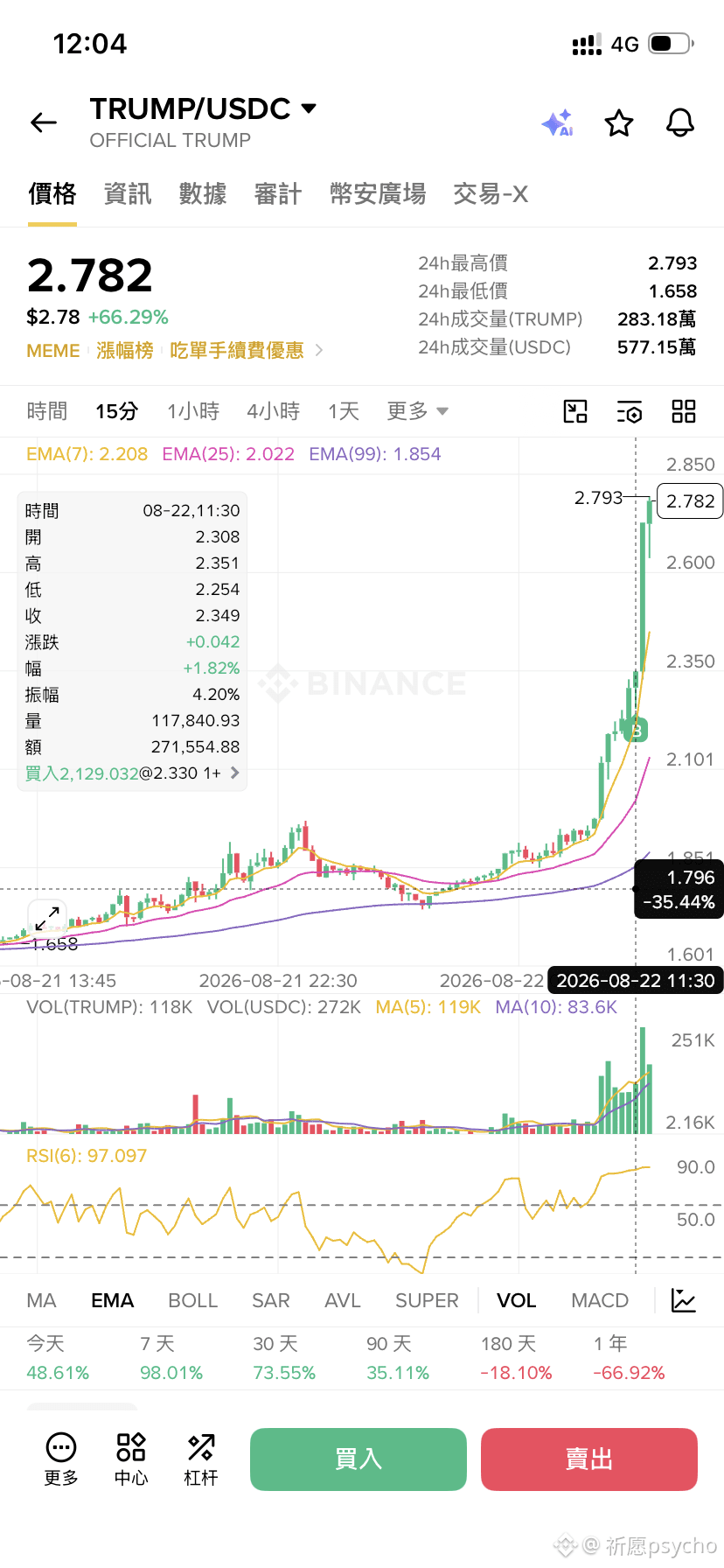
This one—$TRUMP , once you finish watching it, you’re ready to take off. Is this a bull market? Terrifyingly so.
Whenever the market drops to a phase low, sentiment is often most likely to fall into extreme self-reinforcement and panic spreading.
Looking back at the market battle in early June:
1. **Panic at its extreme**: When $BTC dipped to a $58,000 low, many people not only didn’t dare to look for a rebound, but instead generally turned bearish toward $20,000–30,000, with some even calling for an ultimate low of $28,888;
2. **Asymmetric risk**: The moment when sentiment is most fearful is also often the most dangerous point in the contest. Blindly shorting out of step with the crowd’s panic in an oversold support zone usually means taking on extremely lopsided squeeze risk and costs;
3. **The iron law of cycles**: The market has never evolved according to the most extreme panic script favored by the masses. When bearish sentiment reaches a peak of unanimity, it is often precisely the start of the shorts’ positions being fully shaken out.
Understanding the essence of the sentiment cycle is far more important than chasing shorts driven by emotion when others are at their most panicked.
#Crypto #行情观察 #Trading Mindset
Looking back at the market battle in early June:
1. **Panic at its extreme**: When $BTC dipped to a $58,000 low, many people not only didn’t dare to look for a rebound, but instead generally turned bearish toward $20,000–30,000, with some even calling for an ultimate low of $28,888;
2. **Asymmetric risk**: The moment when sentiment is most fearful is also often the most dangerous point in the contest. Blindly shorting out of step with the crowd’s panic in an oversold support zone usually means taking on extremely lopsided squeeze risk and costs;
3. **The iron law of cycles**: The market has never evolved according to the most extreme panic script favored by the masses. When bearish sentiment reaches a peak of unanimity, it is often precisely the start of the shorts’ positions being fully shaken out.
Understanding the essence of the sentiment cycle is far more important than chasing shorts driven by emotion when others are at their most panicked.
#Crypto #行情观察 #Trading Mindset
When the market drops, we’re more坚定 than anyone. Drop 30% and we don’t move; drop 50% and we grit our teeth. After months of a slow, grinding decline—being pinned to the ground and rubbed over and over—we still didn’t sell a single share. Back then, there was only one belief in our hearts: if it’s already fallen this much, where else can it drop?
As a result, when the market finally got going and only just started to rise—after three days of gains, and a bit of “blood” came back—we panicked. We couldn’t wait and threw all our chips out.
Those months of a grinding decline had already trained everyone into frightened birds. Every time the price goes up, we treat it like a signal to flee. This post-traumatic stress response is etched into our bones—our bodies react before our minds, instinctively ready to run.
When we were trapped, we were the most steadfast diamond hands in the entire market. Yet after just three days of rise, we became the fastest rabbits to run. Months of sideways grinding had worn away our confidence; with just a gentle pull from the main forces, we ended up handing over the shares of the main upswing ourselves.
$BTC
As a result, when the market finally got going and only just started to rise—after three days of gains, and a bit of “blood” came back—we panicked. We couldn’t wait and threw all our chips out.
Those months of a grinding decline had already trained everyone into frightened birds. Every time the price goes up, we treat it like a signal to flee. This post-traumatic stress response is etched into our bones—our bodies react before our minds, instinctively ready to run.
When we were trapped, we were the most steadfast diamond hands in the entire market. Yet after just three days of rise, we became the fastest rabbits to run. Months of sideways grinding had worn away our confidence; with just a gentle pull from the main forces, we ended up handing over the shares of the main upswing ourselves.
$BTC
Crowded commuters shoulder to shoulder on the morning rush. I squeeze myself by the door, holding my phone in one hand, watching the numbers in my account just jump a moment ago.
That single moment is worth an entire half month’s salary.
I sprint out of the subway and run all the way to clock in. The time clock beeps “ding” and shows 8:59—I'm not late. In that moment, I genuinely felt like an idiot.
Last night I stared at the charts until 3 a.m. The unrealized gains in my account were already enough for a decent car outright. Yet in the morning, I still have to sprint through the peak rush just for a 200 yuan attendance bonus.
The most disorienting part isn’t being poor. It’s that the fluctuations in my account have already surpassed my main job, but in reality I’m still on edge over a deduction of 50 yuan for being late. The moment I sat down at my desk and stared at my computer, for the first time I thought: this job—every extra minute is just wasting my life.
$BTC
That single moment is worth an entire half month’s salary.
I sprint out of the subway and run all the way to clock in. The time clock beeps “ding” and shows 8:59—I'm not late. In that moment, I genuinely felt like an idiot.
Last night I stared at the charts until 3 a.m. The unrealized gains in my account were already enough for a decent car outright. Yet in the morning, I still have to sprint through the peak rush just for a 200 yuan attendance bonus.
The most disorienting part isn’t being poor. It’s that the fluctuations in my account have already surpassed my main job, but in reality I’m still on edge over a deduction of 50 yuan for being late. The moment I sat down at my desk and stared at my computer, for the first time I thought: this job—every extra minute is just wasting my life.
$BTC
After this round of a one-day surge of 10% in $BTC , and the breakthrough above it, my deepest feeling is that the market has returned to the classic “half-believe, half-doubt” stage. Most people are still hesitating, watching from the sidelines, or treating it only as a short-term rebound. But often, this disagreement and hesitation make it difficult for the upward breakthrough momentum to die down easily in the near term.
In terms of my position-taking rhythm, my current strategy is to hold on to the core long position, with the timeline through mid-September:
1. **Resistance and upside**: Although the price faces resistance around the 74,000 USD level, once there is a confirmed breakout, the targets above could extend further into the 79,000–82,000 USD range. Mainstream and on-chain assets such as $SOL would likely catch up as well;
2. **Events and cycle**: In mid-September, several key milestones are set to land, such as a clear legislative vote and high-level visits. Even if, afterward, the market experiences a pullback according to the 4-year cycle pattern (with a relatively low probability of breaking back below 58,000 USD), it would still basically fit the script of the October–November period exploring the cycle bottom.
The hardest part of trading has never been anticipating exact price points. It’s rather that when the market generally doesn’t dare to get in, you must see through the logic of the game and stay patient—holding tight to the chips you already have.
#Crypto #交易心态 #行情观察
In terms of my position-taking rhythm, my current strategy is to hold on to the core long position, with the timeline through mid-September:
1. **Resistance and upside**: Although the price faces resistance around the 74,000 USD level, once there is a confirmed breakout, the targets above could extend further into the 79,000–82,000 USD range. Mainstream and on-chain assets such as $SOL would likely catch up as well;
2. **Events and cycle**: In mid-September, several key milestones are set to land, such as a clear legislative vote and high-level visits. Even if, afterward, the market experiences a pullback according to the 4-year cycle pattern (with a relatively low probability of breaking back below 58,000 USD), it would still basically fit the script of the October–November period exploring the cycle bottom.
The hardest part of trading has never been anticipating exact price points. It’s rather that when the market generally doesn’t dare to get in, you must see through the logic of the game and stay patient—holding tight to the chips you already have.
#Crypto #交易心态 #行情观察
The order book suddenly saw a surge and a single bullish candle pushed BTC straight into $69,500—this looks more like a short-squeeze move triggered directly by the liquidation of a massive number of short positions.
Let’s review the rhythm of this move: you added and set up your bids in the 65–66k range, and then rode the momentum from this round of short liquidations to break upward. The key focus now is to directly test the crucial resistance level at $74,000.
Many people only get swept up and chase after prices break out during the fast surge, but true breakout trading is never about buying while it’s spiking. Instead, you prepare your position in advance within the support zone, then patiently wait for the key resistance level to be tested and confirmed.
#BTC #Crypto #行情观察 #交易认知
Let’s review the rhythm of this move: you added and set up your bids in the 65–66k range, and then rode the momentum from this round of short liquidations to break upward. The key focus now is to directly test the crucial resistance level at $74,000.
Many people only get swept up and chase after prices break out during the fast surge, but true breakout trading is never about buying while it’s spiking. Instead, you prepare your position in advance within the support zone, then patiently wait for the key resistance level to be tested and confirmed.
#BTC #Crypto #行情观察 #交易认知
$SOL The market is already like this, does sol still need to look at the big pie’s face?
sol完全独立行情
61%
持续被btc绑架
39%
106 votes • Voting closed
$FLOKI I found that many people don't pay attention to the market trends. They just scold and even want to leave the market when they see floki falling. Today's wave of Bitcoin insertions has led to a collective downward adjustment of the copycats. Bitcoin has absolute hegemony in the field of cryptocurrency. No currency can achieve growth in the Bitcoin market correction. Now is the last man in the bull market. The cryptocurrency industry will only become more and more formalized. There will definitely be no get-rich-quick stories in future market fluctuations. So please hold on to the chips in your hand and let us welcome floki. Upcoming 0.001 target

$FLOKI Today’s price will be the last chance to get on the car. Floki is really doing something and doing marketing. The current top will be the future bottom. Those who have locked up their positions for 4 years don’t panic. What’s the point of entering the market with spot stocks?
I was cheated last night and couldn't get any money, so I thought of airdrops. I don’t know where I noticed something, so I followed it and forwarded it obsessively, and then clicked the link inexplicably. I hesitated for a moment when I needed to verify it at the last moment, but then I thought about interacting. I definitely needed to connect my wallet, and then the money was gone [tears][tears], which was not bad. Finally, someone from the other side gave me a reply that could not be opened. See The ntf of the picture is not available. Then I monitored his address and found that there are a lot of idiots [laughing and crying] [laughing and crying] and I felt a lot more mentally balanced. There was still someone at that address sending him money until just now. This money will definitely not be recovered, and now I have spent a small amount of money to buy a lesson. It would be really unthinkable to encounter this kind of thing again in the future when you suddenly become rich. Thinking about it this way, it will be more balanced. #gme
$JTO Did your chicken head become soft before it was hard? Is this what you can do? #$JTO
$JTO Is the chicken head coming back to life again? Can a chicken imitate the Phoenix and be reborn?
Log in to explore more content