
TomCat1688
98 Posts

TomCat1688
Report
Block User
美股与加密双市场观察员,专注宏观周期与链上数据。
用概率思维拆解趋势,每日复盘市场关键节点。
长期返佣码:HONEY1688,使用即享20%手续费折扣
Open Trade

BNB Holder
Frequent Trader
10.4 Months
25 Following
9.6K+ Followers
1.1K+ Liked
Posts
Portfolio
All
Quotes
·
--
Verified
#hype涨超11%
Just $2.93 away from the all-time high of $89.60.
This isn’t a normal rebound. On September 17, the SEC dropped a nuclear bomb—issuing an “innovation exemption” statement—laying a five-year compliant pathway for tokenized assets across the U.S. stock market chain. Tokenized stocks allow trading on DEXs via AMMs, and holders must enjoy the exact same dividends and voting rights as traditional spot holders. What does that mean? Tokenized stock trading on-chain, perpetual contracts—moving from the gray area straight into a legitimate business. HYPE heard the news and surged more than 11%, breaking above $86.
At the same time, institutions pulled the trigger. 21Shares bought $2.4 million worth of HYPE in a single day, Bitwise bought $1.9 million—same day, two institutional players.
But the real fuel for this rally is the burning engine roaring. This week’s protocol revenue was $13.48 million, burning 156,580 HYPE worth $12.42 million. Cumulatively, 48.67 million HYPE have been burned—4.86% of the maximum supply. Over $10 million in weekly revenue sweeps up HYPE on the market and permanently burns it—this isn’t a narrative, it’s math.
On-chain data is even more naked. In the past 30 days, perpetual contract trading volume hit $239.2 billion, staying firmly in first place among decentralized platforms. The second-place isn’t even close. The HIP-3 market jumped from 2% of trading volume at the start of the year to nearly 50%.
A few big whales have accumulated buys of 4.05 million HYPE, worth $322 million—fully staked. A new address swept in nearly 100,000 HYPE in a single transaction via FalconX—$7.72 million.
The SEC door is open. Burning is accelerating. Institutions are rushing to accumulate. The all-time high at $89.60 is right overhead. Break through, or get pushed back?
The only thing certain is: when an exchange is truly making money, truly burning coins, and truly recognized by regulators, the market will eventually price it. The question is—are you still on the train?
#hype涨超11%
Just $2.93 away from the all-time high of $89.60.
This isn’t a normal rebound. On September 17, the SEC dropped a nuclear bomb—issuing an “innovation exemption” statement—laying a five-year compliant pathway for tokenized assets across the U.S. stock market chain. Tokenized stocks allow trading on DEXs via AMMs, and holders must enjoy the exact same dividends and voting rights as traditional spot holders. What does that mean? Tokenized stock trading on-chain, perpetual contracts—moving from the gray area straight into a legitimate business. HYPE heard the news and surged more than 11%, breaking above $86.
At the same time, institutions pulled the trigger. 21Shares bought $2.4 million worth of HYPE in a single day, Bitwise bought $1.9 million—same day, two institutional players.
But the real fuel for this rally is the burning engine roaring. This week’s protocol revenue was $13.48 million, burning 156,580 HYPE worth $12.42 million. Cumulatively, 48.67 million HYPE have been burned—4.86% of the maximum supply. Over $10 million in weekly revenue sweeps up HYPE on the market and permanently burns it—this isn’t a narrative, it’s math.
On-chain data is even more naked. In the past 30 days, perpetual contract trading volume hit $239.2 billion, staying firmly in first place among decentralized platforms. The second-place isn’t even close. The HIP-3 market jumped from 2% of trading volume at the start of the year to nearly 50%.
A few big whales have accumulated buys of 4.05 million HYPE, worth $322 million—fully staked. A new address swept in nearly 100,000 HYPE in a single transaction via FalconX—$7.72 million.
The SEC door is open. Burning is accelerating. Institutions are rushing to accumulate. The all-time high at $89.60 is right overhead. Break through, or get pushed back?
The only thing certain is: when an exchange is truly making money, truly burning coins, and truly recognized by regulators, the market will eventually price it. The question is—are you still on the train?
Just $2.93 away from the all-time high of $89.60.
This isn’t a normal rebound. On September 17, the SEC dropped a nuclear bomb—issuing an “innovation exemption” statement—laying a five-year compliant pathway for tokenized assets across the U.S. stock market chain. Tokenized stocks allow trading on DEXs via AMMs, and holders must enjoy the exact same dividends and voting rights as traditional spot holders. What does that mean? Tokenized stock trading on-chain, perpetual contracts—moving from the gray area straight into a legitimate business. HYPE heard the news and surged more than 11%, breaking above $86.
At the same time, institutions pulled the trigger. 21Shares bought $2.4 million worth of HYPE in a single day, Bitwise bought $1.9 million—same day, two institutional players.
But the real fuel for this rally is the burning engine roaring. This week’s protocol revenue was $13.48 million, burning 156,580 HYPE worth $12.42 million. Cumulatively, 48.67 million HYPE have been burned—4.86% of the maximum supply. Over $10 million in weekly revenue sweeps up HYPE on the market and permanently burns it—this isn’t a narrative, it’s math.
On-chain data is even more naked. In the past 30 days, perpetual contract trading volume hit $239.2 billion, staying firmly in first place among decentralized platforms. The second-place isn’t even close. The HIP-3 market jumped from 2% of trading volume at the start of the year to nearly 50%.
A few big whales have accumulated buys of 4.05 million HYPE, worth $322 million—fully staked. A new address swept in nearly 100,000 HYPE in a single transaction via FalconX—$7.72 million.
The SEC door is open. Burning is accelerating. Institutions are rushing to accumulate. The all-time high at $89.60 is right overhead. Break through, or get pushed back?
The only thing certain is: when an exchange is truly making money, truly burning coins, and truly recognized by regulators, the market will eventually price it. The question is—are you still on the train?
1
4
1.6k
·
--
Today China men's basketball vs Japan men's basketball—why are the prediction markets not showing any clear high/low? I just want to buy $10.
Today China men's basketball vs Japan men's basketball—why are the prediction markets not showing any clear high/low? I just want to buy $10.

1
314
·
--
Verified
#near涨超26%突破3.45美元
On September 15, NEAR was still hovering at $2.34. Three days later, it directly burst through the ceiling that had held since March 2025. In a 24-hour span, it surged more than 26%. Daily Binance spot trading volume hit $323 million. This isn’t a slow, steady accumulation breakout—it’s a liquidity event: the shorts were buried alive, and FOMO buyers flooded in.
But what’s truly valuable isn’t this single candlestick. It’s the “business” behind the chart—paid for with price as the vote.
On September 17, NEAR confidential TVL broke $70 million. In the following 90 days it skyrocketed 129.3%, immediately triggering the first snapshot of the “NEAR@3.33” milestone plan. The rules are extremely ruthless: 333,333 reward tokens are locked in advance. Only when NEAR’s volume-weighted average price holds above $3.33 for three consecutive days can they be exchanged 1:1 for transferable, liquid NEAR. It’s essentially an option-style airdrop that welds product usage and price expectations onto the same coordinate system. You’re not just trading crypto—you’re helping NEAR fight a battle that has to be won.
And what really has me on edge is Chain Signatures. It launched on September 16: a single NEAR account can directly control more than 30 public chains and over 180 types of assets—Bitcoin, Solana, Ethereum, and XRP are all within reach. It executes natively and doesn’t go through the traditional cross-chain bridge middlemen. Cross-chain trading volume has already exceeded $30 billion.
Privacy is the real ace up the sleeve of this narrative. Confidential Intents routes transactions to NEAR’s private shards. MEV extraction, front-running, strategy leakage—everything is blocked, without the computational burden of carrying zero-knowledge proof overhead. What do institutions, enterprises, and AI agents need? They need a channel that doesn’t reveal every step they take to the entire world.
The story behind $NEAR for the first three years was: “Great technology, but no one uses it.” Now it’s different: over the past 30 days, the protocol generated $5.01 million in fees and $1.58 million in net revenue. The Q2 fee capture rate rose from a lifetime average of 11.5% to 30.5%. Old projects are finally making money—that’s the signal in this rally that shouldn’t be ignored.
#near涨超26%突破3.45美元
On September 15, NEAR was still hovering at $2.34. Three days later, it directly burst through the ceiling that had held since March 2025. In a 24-hour span, it surged more than 26%. Daily Binance spot trading volume hit $323 million. This isn’t a slow, steady accumulation breakout—it’s a liquidity event: the shorts were buried alive, and FOMO buyers flooded in.
But what’s truly valuable isn’t this single candlestick. It’s the “business” behind the chart—paid for with price as the vote.
On September 17, NEAR confidential TVL broke $70 million. In the following 90 days it skyrocketed 129.3%, immediately triggering the first snapshot of the “NEAR@3.33” milestone plan. The rules are extremely ruthless: 333,333 reward tokens are locked in advance. Only when NEAR’s volume-weighted average price holds above $3.33 for three consecutive days can they be exchanged 1:1 for transferable, liquid NEAR. It’s essentially an option-style airdrop that welds product usage and price expectations onto the same coordinate system. You’re not just trading crypto—you’re helping NEAR fight a battle that has to be won.
And what really has me on edge is Chain Signatures. It launched on September 16: a single NEAR account can directly control more than 30 public chains and over 180 types of assets—Bitcoin, Solana, Ethereum, and XRP are all within reach. It executes natively and doesn’t go through the traditional cross-chain bridge middlemen. Cross-chain trading volume has already exceeded $30 billion.
Privacy is the real ace up the sleeve of this narrative. Confidential Intents routes transactions to NEAR’s private shards. MEV extraction, front-running, strategy leakage—everything is blocked, without the computational burden of carrying zero-knowledge proof overhead. What do institutions, enterprises, and AI agents need? They need a channel that doesn’t reveal every step they take to the entire world.
The story behind $NEAR for the first three years was: “Great technology, but no one uses it.” Now it’s different: over the past 30 days, the protocol generated $5.01 million in fees and $1.58 million in net revenue. The Q2 fee capture rate rose from a lifetime average of 11.5% to 30.5%. Old projects are finally making money—that’s the signal in this rally that shouldn’t be ignored.
On September 15, NEAR was still hovering at $2.34. Three days later, it directly burst through the ceiling that had held since March 2025. In a 24-hour span, it surged more than 26%. Daily Binance spot trading volume hit $323 million. This isn’t a slow, steady accumulation breakout—it’s a liquidity event: the shorts were buried alive, and FOMO buyers flooded in.
But what’s truly valuable isn’t this single candlestick. It’s the “business” behind the chart—paid for with price as the vote.
On September 17, NEAR confidential TVL broke $70 million. In the following 90 days it skyrocketed 129.3%, immediately triggering the first snapshot of the “NEAR@3.33” milestone plan. The rules are extremely ruthless: 333,333 reward tokens are locked in advance. Only when NEAR’s volume-weighted average price holds above $3.33 for three consecutive days can they be exchanged 1:1 for transferable, liquid NEAR. It’s essentially an option-style airdrop that welds product usage and price expectations onto the same coordinate system. You’re not just trading crypto—you’re helping NEAR fight a battle that has to be won.
And what really has me on edge is Chain Signatures. It launched on September 16: a single NEAR account can directly control more than 30 public chains and over 180 types of assets—Bitcoin, Solana, Ethereum, and XRP are all within reach. It executes natively and doesn’t go through the traditional cross-chain bridge middlemen. Cross-chain trading volume has already exceeded $30 billion.
Privacy is the real ace up the sleeve of this narrative. Confidential Intents routes transactions to NEAR’s private shards. MEV extraction, front-running, strategy leakage—everything is blocked, without the computational burden of carrying zero-knowledge proof overhead. What do institutions, enterprises, and AI agents need? They need a channel that doesn’t reveal every step they take to the entire world.
The story behind $NEAR for the first three years was: “Great technology, but no one uses it.” Now it’s different: over the past 30 days, the protocol generated $5.01 million in fees and $1.58 million in net revenue. The Q2 fee capture rate rose from a lifetime average of 11.5% to 30.5%. Old projects are finally making money—that’s the signal in this rally that shouldn’t be ignored.

9
5.5k
·
--
#日本央行加息至31年高位
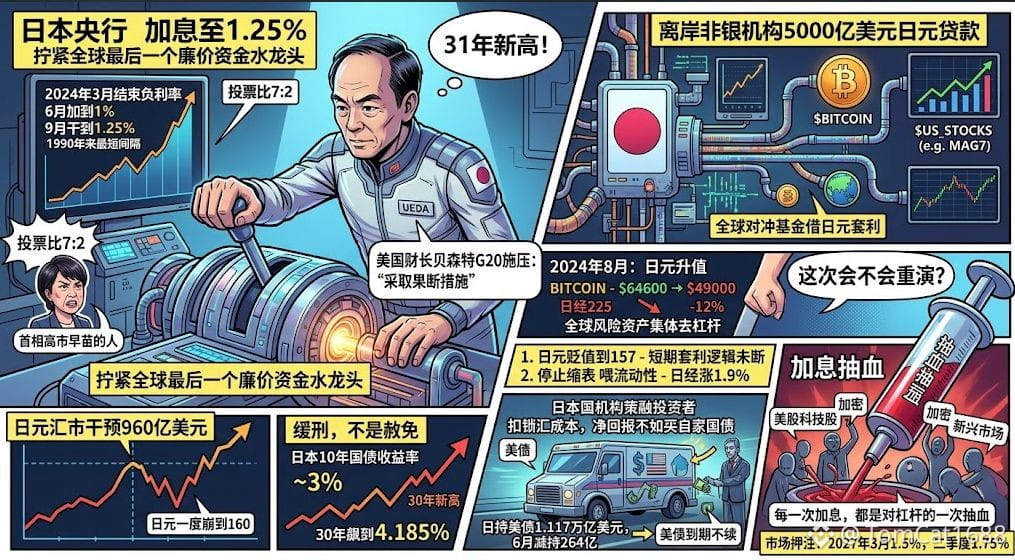
1.25%. The highest in 31 years. Japan’s central bank has just tightened the very last cheap-money tap around the globe, squeezing it by as much as a full 25 basis points.
This is not a routine rate hike. After ending negative rates in March 2024, rates were raised to 1% in June and then directly to 1.25% in September—the shortest interval between hikes since 1990. The vote was 7 to 2, with the two dissenters both belonging to Prime Minister Hayato Achi’s camp. U.S. Treasury Secretary Bessent pressured Ueda and Otani face-to-face at the G20, urging “decisive action.”
This year, the yen briefly collapsed to 160. Japan authorities then poured in $96 billion to intervene in the FX market, yet it still didn’t stop the move.
But what truly chills Wall Street’s spine isn’t Japan—it’s that $500 billion.
Over the past several decades, global hedge funds have played the same playbook: borrow yen at near-zero cost, swap it into dollars, and pile into U.S. equities, Treasuries, and crypto. The yen loan size of offshore non-bank institutions is about $250 billion; under a broad definition, it doubles to $500 billion. How many overvalued assets does this money prop up? No one can say for sure. But everyone remembers August 2024: when the yen appreciated by just one rise, Bitcoin was smashed from $64,600 down to $49,000, the Nikkei plunged 12% in a single day, and global risk assets collectively de-leveraged.
Will it happen again this time?
Look at two signals. First, after the rate hike was implemented, the yen actually weakened further to 157—the short-term carry-trade logic hasn’t broken. Second, the Bank of Japan also announced that starting April 2027 it will stop reducing its balance sheet and will continue buying ¥2 trillion in JGBs every month. This is the classic “one hawk, one dove”—rates rise while liquidity is still generously provided. So U.S. stocks didn’t crash that day; instead, the Nikkei rose 1.9%.
But this is a stay of execution, not a pardon. Japan’s 10-year JGB yield is already around 3%, and the 30-year yield briefly surged to 4.185%, hitting a new high in 30 years. Japan’s life insurers and pension funds have realized that after subtracting the cost of locking in FX hedges, the net return from buying U.S. Treasuries is actually worse than buying their own government bonds. Japan holds $1.117 trillion in U.S. Treasuries; in June alone it trimmed $26.4 billion. This isn’t outright selling—it’s non-renewal at maturity. But for a U.S. government that issues an enormous amount of new debt every year, the effect is the same: long-end yields won’t come down, and that keeps the valuation ceiling on technology stocks pressed down.
1.25% is not the endpoint. Markets are betting on 1.5% in March 2027 and 1.75% in the second quarter. Every rate hike is bloodletting from that $500 billion leverage. U.S. tech stocks, crypto, and emerging markets are all lined up under the same bloodletting pump.
#日本央行加息至31年高位
1.25%. The highest in 31 years. Japan’s central bank has just tightened the very last cheap-money tap around the globe, squeezing it by as much as a full 25 basis points.
This is not a routine rate hike. After ending negative rates in March 2024, rates were raised to 1% in June and then directly to 1.25% in September—the shortest interval between hikes since 1990. The vote was 7 to 2, with the two dissenters both belonging to Prime Minister Hayato Achi’s camp. U.S. Treasury Secretary Bessent pressured Ueda and Otani face-to-face at the G20, urging “decisive action.”
This year, the yen briefly collapsed to 160. Japan authorities then poured in $96 billion to intervene in the FX market, yet it still didn’t stop the move.
But what truly chills Wall Street’s spine isn’t Japan—it’s that $500 billion.
Over the past several decades, global hedge funds have played the same playbook: borrow yen at near-zero cost, swap it into dollars, and pile into U.S. equities, Treasuries, and crypto. The yen loan size of offshore non-bank institutions is about $250 billion; under a broad definition, it doubles to $500 billion. How many overvalued assets does this money prop up? No one can say for sure. But everyone remembers August 2024: when the yen appreciated by just one rise, Bitcoin was smashed from $64,600 down to $49,000, the Nikkei plunged 12% in a single day, and global risk assets collectively de-leveraged.
Will it happen again this time?
Look at two signals. First, after the rate hike was implemented, the yen actually weakened further to 157—the short-term carry-trade logic hasn’t broken. Second, the Bank of Japan also announced that starting April 2027 it will stop reducing its balance sheet and will continue buying ¥2 trillion in JGBs every month. This is the classic “one hawk, one dove”—rates rise while liquidity is still generously provided. So U.S. stocks didn’t crash that day; instead, the Nikkei rose 1.9%.
But this is a stay of execution, not a pardon. Japan’s 10-year JGB yield is already around 3%, and the 30-year yield briefly surged to 4.185%, hitting a new high in 30 years. Japan’s life insurers and pension funds have realized that after subtracting the cost of locking in FX hedges, the net return from buying U.S. Treasuries is actually worse than buying their own government bonds. Japan holds $1.117 trillion in U.S. Treasuries; in June alone it trimmed $26.4 billion. This isn’t outright selling—it’s non-renewal at maturity. But for a U.S. government that issues an enormous amount of new debt every year, the effect is the same: long-end yields won’t come down, and that keeps the valuation ceiling on technology stocks pressed down.
1.25% is not the endpoint. Markets are betting on 1.5% in March 2027 and 1.75% in the second quarter. Every rate hike is bloodletting from that $500 billion leverage. U.S. tech stocks, crypto, and emerging markets are all lined up under the same bloodletting pump.
1.25%. The highest in 31 years. Japan’s central bank has just tightened the very last cheap-money tap around the globe, squeezing it by as much as a full 25 basis points.
This is not a routine rate hike. After ending negative rates in March 2024, rates were raised to 1% in June and then directly to 1.25% in September—the shortest interval between hikes since 1990. The vote was 7 to 2, with the two dissenters both belonging to Prime Minister Hayato Achi’s camp. U.S. Treasury Secretary Bessent pressured Ueda and Otani face-to-face at the G20, urging “decisive action.”
This year, the yen briefly collapsed to 160. Japan authorities then poured in $96 billion to intervene in the FX market, yet it still didn’t stop the move.
But what truly chills Wall Street’s spine isn’t Japan—it’s that $500 billion.
Over the past several decades, global hedge funds have played the same playbook: borrow yen at near-zero cost, swap it into dollars, and pile into U.S. equities, Treasuries, and crypto. The yen loan size of offshore non-bank institutions is about $250 billion; under a broad definition, it doubles to $500 billion. How many overvalued assets does this money prop up? No one can say for sure. But everyone remembers August 2024: when the yen appreciated by just one rise, Bitcoin was smashed from $64,600 down to $49,000, the Nikkei plunged 12% in a single day, and global risk assets collectively de-leveraged.
Will it happen again this time?
Look at two signals. First, after the rate hike was implemented, the yen actually weakened further to 157—the short-term carry-trade logic hasn’t broken. Second, the Bank of Japan also announced that starting April 2027 it will stop reducing its balance sheet and will continue buying ¥2 trillion in JGBs every month. This is the classic “one hawk, one dove”—rates rise while liquidity is still generously provided. So U.S. stocks didn’t crash that day; instead, the Nikkei rose 1.9%.
But this is a stay of execution, not a pardon. Japan’s 10-year JGB yield is already around 3%, and the 30-year yield briefly surged to 4.185%, hitting a new high in 30 years. Japan’s life insurers and pension funds have realized that after subtracting the cost of locking in FX hedges, the net return from buying U.S. Treasuries is actually worse than buying their own government bonds. Japan holds $1.117 trillion in U.S. Treasuries; in June alone it trimmed $26.4 billion. This isn’t outright selling—it’s non-renewal at maturity. But for a U.S. government that issues an enormous amount of new debt every year, the effect is the same: long-end yields won’t come down, and that keeps the valuation ceiling on technology stocks pressed down.
1.25% is not the endpoint. Markets are betting on 1.5% in March 2027 and 1.75% in the second quarter. Every rate hike is bloodletting from that $500 billion leverage. U.S. tech stocks, crypto, and emerging markets are all lined up under the same bloodletting pump.
1
327
·
--
Verified
#sec批准代币化nms股票交易临时创新豁免
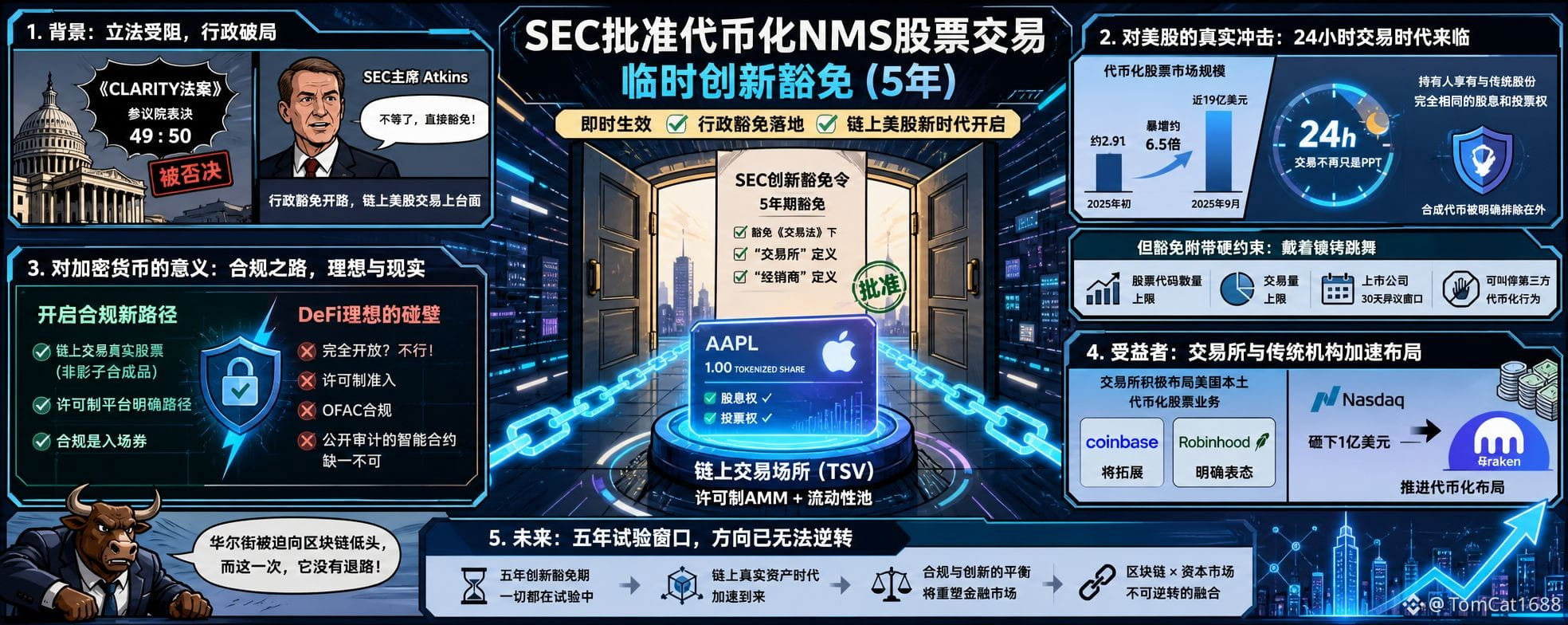
On September 17, the SEC officially signed a five-year innovation exemption order, allowing tokenized NMS stocks to be traded on on-chain trading venues (TSV) via permissioned AMMs and liquidity pools. The exemption waives the definitions of “exchange” and “dealer” under the Securities Exchange Act, effective immediately. This is not a draft for public comment—it is an order that has already taken effect.
So what exactly has changed? Let’s rewind to this Tuesday: the CLARITY Act was rejected in the Senate by a vote of 49 to 50, effectively blocking the legislative route. SEC Chair Atkins didn’t wait—she used an administrative exemption to put on-chain trading of U.S. equities on the front stage. The tokenized equities market surged from about $291 million at the start of 2025 to nearly $1.9 billion, expanding roughly 6.5x. But until now, nearly all of this had already been run successfully overseas, while U.S. investors were kept out of the door. Now, the door has been kicked open.
The real impact on U.S. equities: 24/7 trading is no longer just PPT. Tokenized stock holders have exactly the same dividends and voting rights as holders of traditional shares; synthetic tokens are explicitly excluded. This means the concept of trading sessions for U.S. equities is being dismantled. But don’t rush to celebrate—there are hard constraints attached to the exemption: there are caps on the number of stock symbols and trading volumes, and listed companies have a 30-day objection window that can halt third-party tokenization activities. This isn’t opening the floodgates—it’s dancing with shackles on.
The implications for cryptocurrency are even more worth deeper thought. This exemption gives compliance platforms a clear path: trading real stocks on-chain, not shadowy synthetic products. But the ideal of fully open DeFi hits a wall here—permissioned access, OFAC compliance, and smart contracts with public audits are all required.
The exchange sector is another beneficiary direction. Platforms like Coinbase and Robinhood have already stated they will expand tokenized U.S. equities business in the U.S. Nasdaq even invested $100 million into Kraken’s parent company to advance tokenization initiatives.
During the five-year window, everything is still being tested. But the direction can no longer be reversed. Wall Street has been forced to bow to the blockchain—and this time, it has no way back.
#sec批准代币化nms股票交易临时创新豁免
On September 17, the SEC officially signed a five-year innovation exemption order, allowing tokenized NMS stocks to be traded on on-chain trading venues (TSV) via permissioned AMMs and liquidity pools. The exemption waives the definitions of “exchange” and “dealer” under the Securities Exchange Act, effective immediately. This is not a draft for public comment—it is an order that has already taken effect.
So what exactly has changed? Let’s rewind to this Tuesday: the CLARITY Act was rejected in the Senate by a vote of 49 to 50, effectively blocking the legislative route. SEC Chair Atkins didn’t wait—she used an administrative exemption to put on-chain trading of U.S. equities on the front stage. The tokenized equities market surged from about $291 million at the start of 2025 to nearly $1.9 billion, expanding roughly 6.5x. But until now, nearly all of this had already been run successfully overseas, while U.S. investors were kept out of the door. Now, the door has been kicked open.
The real impact on U.S. equities: 24/7 trading is no longer just PPT. Tokenized stock holders have exactly the same dividends and voting rights as holders of traditional shares; synthetic tokens are explicitly excluded. This means the concept of trading sessions for U.S. equities is being dismantled. But don’t rush to celebrate—there are hard constraints attached to the exemption: there are caps on the number of stock symbols and trading volumes, and listed companies have a 30-day objection window that can halt third-party tokenization activities. This isn’t opening the floodgates—it’s dancing with shackles on.
The implications for cryptocurrency are even more worth deeper thought. This exemption gives compliance platforms a clear path: trading real stocks on-chain, not shadowy synthetic products. But the ideal of fully open DeFi hits a wall here—permissioned access, OFAC compliance, and smart contracts with public audits are all required.
The exchange sector is another beneficiary direction. Platforms like Coinbase and Robinhood have already stated they will expand tokenized U.S. equities business in the U.S. Nasdaq even invested $100 million into Kraken’s parent company to advance tokenization initiatives.
During the five-year window, everything is still being tested. But the direction can no longer be reversed. Wall Street has been forced to bow to the blockchain—and this time, it has no way back.
On September 17, the SEC officially signed a five-year innovation exemption order, allowing tokenized NMS stocks to be traded on on-chain trading venues (TSV) via permissioned AMMs and liquidity pools. The exemption waives the definitions of “exchange” and “dealer” under the Securities Exchange Act, effective immediately. This is not a draft for public comment—it is an order that has already taken effect.
So what exactly has changed? Let’s rewind to this Tuesday: the CLARITY Act was rejected in the Senate by a vote of 49 to 50, effectively blocking the legislative route. SEC Chair Atkins didn’t wait—she used an administrative exemption to put on-chain trading of U.S. equities on the front stage. The tokenized equities market surged from about $291 million at the start of 2025 to nearly $1.9 billion, expanding roughly 6.5x. But until now, nearly all of this had already been run successfully overseas, while U.S. investors were kept out of the door. Now, the door has been kicked open.
The real impact on U.S. equities: 24/7 trading is no longer just PPT. Tokenized stock holders have exactly the same dividends and voting rights as holders of traditional shares; synthetic tokens are explicitly excluded. This means the concept of trading sessions for U.S. equities is being dismantled. But don’t rush to celebrate—there are hard constraints attached to the exemption: there are caps on the number of stock symbols and trading volumes, and listed companies have a 30-day objection window that can halt third-party tokenization activities. This isn’t opening the floodgates—it’s dancing with shackles on.
The implications for cryptocurrency are even more worth deeper thought. This exemption gives compliance platforms a clear path: trading real stocks on-chain, not shadowy synthetic products. But the ideal of fully open DeFi hits a wall here—permissioned access, OFAC compliance, and smart contracts with public audits are all required.
The exchange sector is another beneficiary direction. Platforms like Coinbase and Robinhood have already stated they will expand tokenized U.S. equities business in the U.S. Nasdaq even invested $100 million into Kraken’s parent company to advance tokenization initiatives.
During the five-year window, everything is still being tested. But the direction can no longer be reversed. Wall Street has been forced to bow to the blockchain—and this time, it has no way back.
2
1k
·
--
#meme发射台占arc首日成交82%
82%! Circle’s institutional dream was blown apart by a meme cannon shot
Arc’s public chain, which Circle has bankrolled with heavy spending and brought in BlackRock and Visa as marquee partners, saw $410 million in transactions on day one—82% of which came from meme launchpads. One launchpad, Arguspad, swallowed up $202 million, and minted more than 83,000 tokens within 24 hours, accounting for 86% of all new tokens across the chain.
This is too surreal.
Arc positions itself as an “internet economy operating system,” and its founder-verified validator roster is packed with names like BlackRock, Visa, Mastercard, and DTCC. Yet on the very first day, what truly rushed in wasn’t institutional settlement teams—it was meme gamblers. “Institutions set the stage, and a prodigy sings the show”—this is the real cross-section of the 2026 crypto industry.
The new chain narrative is being hijacked by launchpads. Robinhood Chain did just $14.74 million on day one, while Arc reached 28 times that. But the hype came fast and faded faster—one day after Arc launched, the meme market was already “strewn with corpses.” More than 50 launchpads raced to get started at the same time, tearing liquidity into fragments. With no consensus, all that remained was harvesting.
Even more worth watching is cross-market transmission. The stock-and-coin pairing game is dragging U.S. stock narratives onto-chain: meme tokens are directly paired with tokenized stock pools for NVDA, AMC, and GOOGL. $MEME uses AMC as the base pool; within hours, its market cap surged to $45 million, with intraday gains exceeding 1,800x. This isn’t the traditional “crypto influencing the U.S. stock market”—it’s U.S. stock sentiment being reverse-decomposed into on-chain speculation fuel. The CEO of AMC has already publicly expressed outrage, and legal investigations are reportedly following.
Arc’s 82% is a signal: institutions can sit down at the same table with pure speculative frenzy, but neither can kill the other. Over the next few weeks, it will come down to whether institutional capital can hold up the market after the launchpad tide recedes. If they can’t, Arc will just be the next Robinhood Chain—boosting daily active users with a meme-fueled binge, then quietly waiting for the next speculative window.
The gambling table is already set, and the chips are flying. But you’d better be clear: who, exactly, is sitting across from you
#meme发射台占arc首日成交82%
82%! Circle’s institutional dream was blown apart by a meme cannon shot
Arc’s public chain, which Circle has bankrolled with heavy spending and brought in BlackRock and Visa as marquee partners, saw $410 million in transactions on day one—82% of which came from meme launchpads. One launchpad, Arguspad, swallowed up $202 million, and minted more than 83,000 tokens within 24 hours, accounting for 86% of all new tokens across the chain.
This is too surreal.
Arc positions itself as an “internet economy operating system,” and its founder-verified validator roster is packed with names like BlackRock, Visa, Mastercard, and DTCC. Yet on the very first day, what truly rushed in wasn’t institutional settlement teams—it was meme gamblers. “Institutions set the stage, and a prodigy sings the show”—this is the real cross-section of the 2026 crypto industry.
The new chain narrative is being hijacked by launchpads. Robinhood Chain did just $14.74 million on day one, while Arc reached 28 times that. But the hype came fast and faded faster—one day after Arc launched, the meme market was already “strewn with corpses.” More than 50 launchpads raced to get started at the same time, tearing liquidity into fragments. With no consensus, all that remained was harvesting.
Even more worth watching is cross-market transmission. The stock-and-coin pairing game is dragging U.S. stock narratives onto-chain: meme tokens are directly paired with tokenized stock pools for NVDA, AMC, and GOOGL. $MEME uses AMC as the base pool; within hours, its market cap surged to $45 million, with intraday gains exceeding 1,800x. This isn’t the traditional “crypto influencing the U.S. stock market”—it’s U.S. stock sentiment being reverse-decomposed into on-chain speculation fuel. The CEO of AMC has already publicly expressed outrage, and legal investigations are reportedly following.
Arc’s 82% is a signal: institutions can sit down at the same table with pure speculative frenzy, but neither can kill the other. Over the next few weeks, it will come down to whether institutional capital can hold up the market after the launchpad tide recedes. If they can’t, Arc will just be the next Robinhood Chain—boosting daily active users with a meme-fueled binge, then quietly waiting for the next speculative window.
The gambling table is already set, and the chips are flying. But you’d better be clear: who, exactly, is sitting across from you
82%! Circle’s institutional dream was blown apart by a meme cannon shot
Arc’s public chain, which Circle has bankrolled with heavy spending and brought in BlackRock and Visa as marquee partners, saw $410 million in transactions on day one—82% of which came from meme launchpads. One launchpad, Arguspad, swallowed up $202 million, and minted more than 83,000 tokens within 24 hours, accounting for 86% of all new tokens across the chain.
This is too surreal.
Arc positions itself as an “internet economy operating system,” and its founder-verified validator roster is packed with names like BlackRock, Visa, Mastercard, and DTCC. Yet on the very first day, what truly rushed in wasn’t institutional settlement teams—it was meme gamblers. “Institutions set the stage, and a prodigy sings the show”—this is the real cross-section of the 2026 crypto industry.
The new chain narrative is being hijacked by launchpads. Robinhood Chain did just $14.74 million on day one, while Arc reached 28 times that. But the hype came fast and faded faster—one day after Arc launched, the meme market was already “strewn with corpses.” More than 50 launchpads raced to get started at the same time, tearing liquidity into fragments. With no consensus, all that remained was harvesting.
Even more worth watching is cross-market transmission. The stock-and-coin pairing game is dragging U.S. stock narratives onto-chain: meme tokens are directly paired with tokenized stock pools for NVDA, AMC, and GOOGL. $MEME uses AMC as the base pool; within hours, its market cap surged to $45 million, with intraday gains exceeding 1,800x. This isn’t the traditional “crypto influencing the U.S. stock market”—it’s U.S. stock sentiment being reverse-decomposed into on-chain speculation fuel. The CEO of AMC has already publicly expressed outrage, and legal investigations are reportedly following.
Arc’s 82% is a signal: institutions can sit down at the same table with pure speculative frenzy, but neither can kill the other. Over the next few weeks, it will come down to whether institutional capital can hold up the market after the launchpad tide recedes. If they can’t, Arc will just be the next Robinhood Chain—boosting daily active users with a meme-fueled binge, then quietly waiting for the next speculative window.
The gambling table is already set, and the chips are flying. But you’d better be clear: who, exactly, is sitting across from you

3
4
2.2k
·
--
#美联储sep预计2026利率4.1%
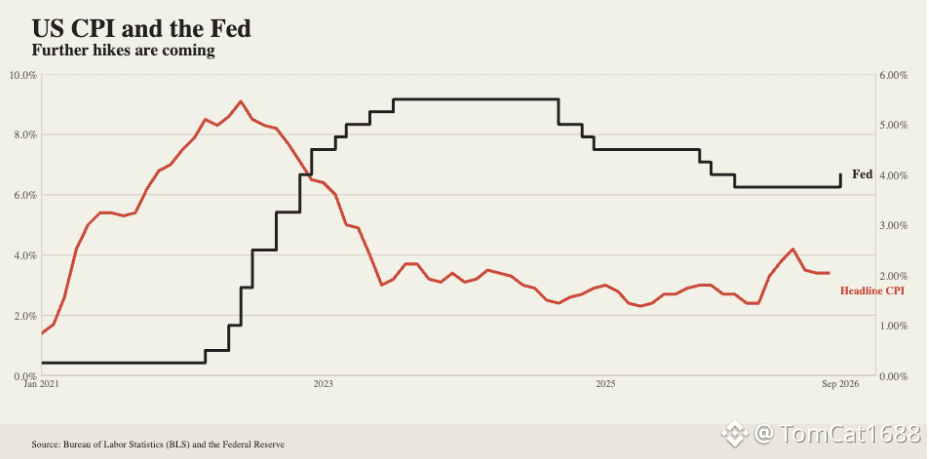
In a single sentence, the Federal Reserve directly tore up the interest-rate cut script for 2026!
By the end of 2026, the median federal funds rate jumped from 3.8% in June to 4.1%. Of the 18 officials, 12 believe there will be one more rate hike this year. The dot plot is no longer a “rate-cut roadmap”—it’s a flare signaling additional hikes. The market’s expectations for rate cuts were completely slapped in the face.
For the US stock market, it’s like driving a nail into the valuation ceiling. The higher the terminal rate, the lower the valuation cap for risk assets. Higher interest rates directly raise corporate financing costs, and the richly valued AI and tech sectors face renewed repricing pressure—creating accumulating downside risk for the S&P 500.
For the crypto market, this cut goes even deeper—higher rates mean cash and bonds become far more attractive, the US dollar strengthens, and liquidity is drained. $BTC fell nearly 4% to $76,000 ahead of the decision due to the 《CLARITY Act》 being blocked. After the rate hike was implemented, there wasn’t a second wave of a sharp selloff, but by late 2027 the median rate expectation was raised directly from 3.6% to 4.1%, and the BTC mid-term valuation anchor is being systematically re-evaluated.
The real killing move isn’t the rate hike itself this time—it’s the decision to raise the terminal rate.
#美联储sep预计2026利率4.1%
In a single sentence, the Federal Reserve directly tore up the interest-rate cut script for 2026!
By the end of 2026, the median federal funds rate jumped from 3.8% in June to 4.1%. Of the 18 officials, 12 believe there will be one more rate hike this year. The dot plot is no longer a “rate-cut roadmap”—it’s a flare signaling additional hikes. The market’s expectations for rate cuts were completely slapped in the face.
For the US stock market, it’s like driving a nail into the valuation ceiling. The higher the terminal rate, the lower the valuation cap for risk assets. Higher interest rates directly raise corporate financing costs, and the richly valued AI and tech sectors face renewed repricing pressure—creating accumulating downside risk for the S&P 500.
For the crypto market, this cut goes even deeper—higher rates mean cash and bonds become far more attractive, the US dollar strengthens, and liquidity is drained. $BTC fell nearly 4% to $76,000 ahead of the decision due to the 《CLARITY Act》 being blocked. After the rate hike was implemented, there wasn’t a second wave of a sharp selloff, but by late 2027 the median rate expectation was raised directly from 3.6% to 4.1%, and the BTC mid-term valuation anchor is being systematically re-evaluated.
The real killing move isn’t the rate hike itself this time—it’s the decision to raise the terminal rate.
In a single sentence, the Federal Reserve directly tore up the interest-rate cut script for 2026!
By the end of 2026, the median federal funds rate jumped from 3.8% in June to 4.1%. Of the 18 officials, 12 believe there will be one more rate hike this year. The dot plot is no longer a “rate-cut roadmap”—it’s a flare signaling additional hikes. The market’s expectations for rate cuts were completely slapped in the face.
For the US stock market, it’s like driving a nail into the valuation ceiling. The higher the terminal rate, the lower the valuation cap for risk assets. Higher interest rates directly raise corporate financing costs, and the richly valued AI and tech sectors face renewed repricing pressure—creating accumulating downside risk for the S&P 500.
For the crypto market, this cut goes even deeper—higher rates mean cash and bonds become far more attractive, the US dollar strengthens, and liquidity is drained. $BTC fell nearly 4% to $76,000 ahead of the decision due to the 《CLARITY Act》 being blocked. After the rate hike was implemented, there wasn’t a second wave of a sharp selloff, but by late 2027 the median rate expectation was raised directly from 3.6% to 4.1%, and the BTC mid-term valuation anchor is being systematically re-evaluated.
The real killing move isn’t the rate hike itself this time—it’s the decision to raise the terminal rate.
17
3.8k
·
--
Article
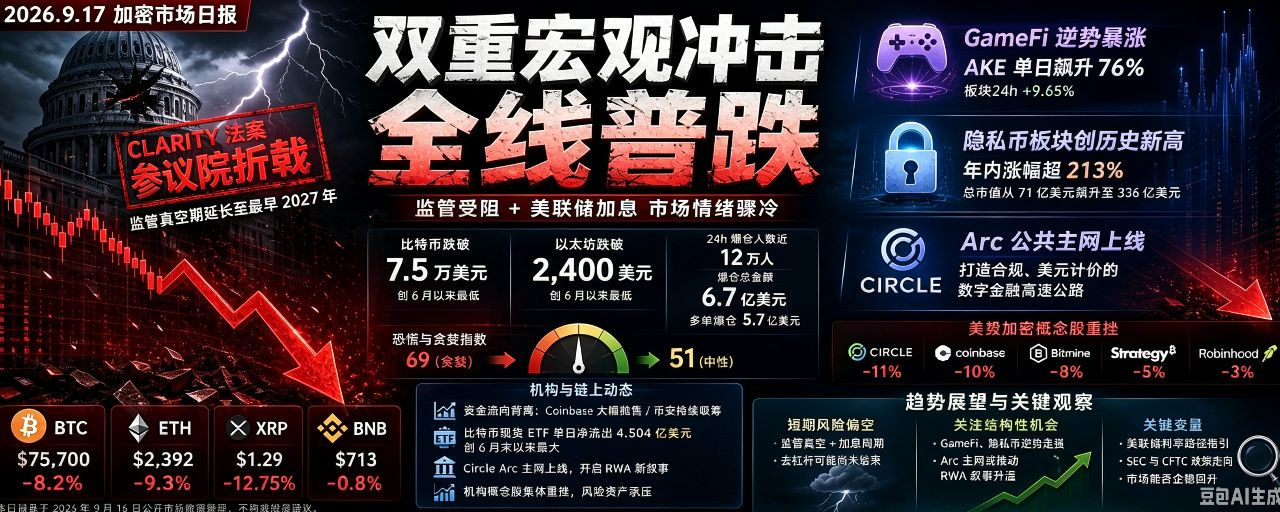
2026.9.17 Crypto Morning NewsI. Market overview
On September 16, the cryptocurrency market suffered a double macro shock, with broad declines across the board. Bitcoin briefly fell below $75,000, while Ethereum dropped below $2,400—both hitting the lowest levels since June. Over the past 24 hours, nearly 120,000 people globally were liquidated, with the total liquidation amount reaching $670 million, including $570 million from long positions. The Fear and Greed Index plunged from 69 (Greed) the previous day to 51 (Neutral).
II. Trending narratives
Narrative 1: The CLARITY Bill stalls in the Senate—extending the crypto regulatory vacuum
This is the core negative catalyst for the market that day. On September 15 in U.S. Eastern Time, the U.S. Senate held a procedural vote to end debate on the (Digital Asset Market Clarity Act). It ultimately failed to pass, with 49 votes in favor and 50 votes against—far below the 60-vote threshold needed to overcome the filibuster. All attending Democratic lawmakers, along with 4 Republican lawmakers, cast votes against.
2026.9.17 Crypto Morning News
I. Market overview
On September 16, the cryptocurrency market suffered a double macro shock, with broad declines across the board. Bitcoin briefly fell below $75,000, while Ethereum dropped below $2,400—both hitting the lowest levels since June. Over the past 24 hours, nearly 120,000 people globally were liquidated, with the total liquidation amount reaching $670 million, including $570 million from long positions. The Fear and Greed Index plunged from 69 (Greed) the previous day to 51 (Neutral).
II. Trending narratives
Narrative 1: The CLARITY Bill stalls in the Senate—extending the crypto regulatory vacuum
This is the core negative catalyst for the market that day. On September 15 in U.S. Eastern Time, the U.S. Senate held a procedural vote to end debate on the (Digital Asset Market Clarity Act). It ultimately failed to pass, with 49 votes in favor and 50 votes against—far below the 60-vote threshold needed to overcome the filibuster. All attending Democratic lawmakers, along with 4 Republican lawmakers, cast votes against.
On September 16, the cryptocurrency market suffered a double macro shock, with broad declines across the board. Bitcoin briefly fell below $75,000, while Ethereum dropped below $2,400—both hitting the lowest levels since June. Over the past 24 hours, nearly 120,000 people globally were liquidated, with the total liquidation amount reaching $670 million, including $570 million from long positions. The Fear and Greed Index plunged from 69 (Greed) the previous day to 51 (Neutral).
II. Trending narratives
Narrative 1: The CLARITY Bill stalls in the Senate—extending the crypto regulatory vacuum
This is the core negative catalyst for the market that day. On September 15 in U.S. Eastern Time, the U.S. Senate held a procedural vote to end debate on the (Digital Asset Market Clarity Act). It ultimately failed to pass, with 49 votes in favor and 50 votes against—far below the 60-vote threshold needed to overcome the filibuster. All attending Democratic lawmakers, along with 4 Republican lawmakers, cast votes against.
1
118
·
--
#美联储加息25基点美股收跌
Last night, the air in global capital markets turned to stone.
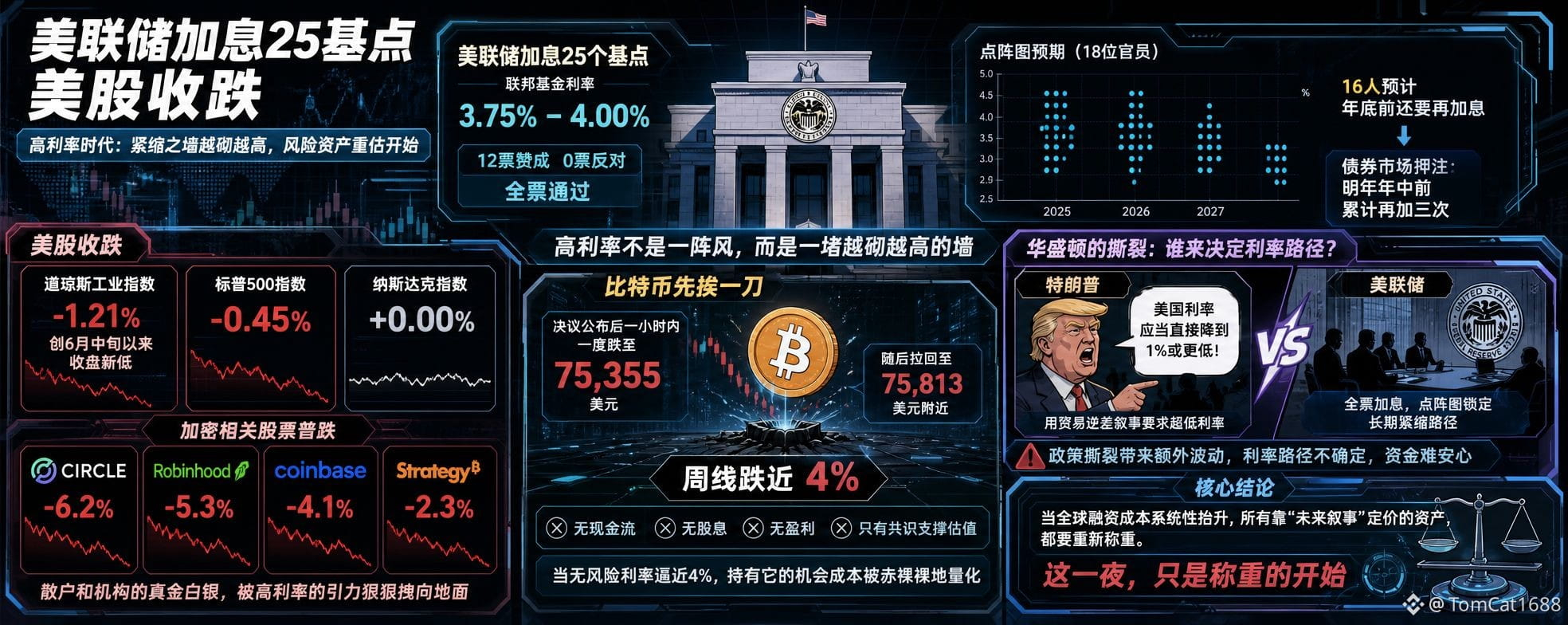
The Federal Reserve pulled the trigger—hiking 25 basis points, lifting the federal funds rate to 3.75%–4.00%, with 12 votes in favor and 0 against, passed unanimously. This wasn’t a cautious tweak or a probe. This was the Fed’s first real tightening trigger since July 2023—and the dot plot tells you, coldly and clearly: of the 18 officials, 16 expect to raise rates again by the end of the year. The bond market even priced in three more cumulative hikes by mid-2024. High interest rates are not a passing breeze; they are a wall that gets taller with every brick.
The U.S. stock market voted with its feet immediately. The Dow plunged 1.21%, hitting a closing low not seen since mid-June; the S&P 500 fell 0.45%, while the Nasdaq managed to close flat. You think that’s the end of it? Crypto-linked assets were the first row pushed onto the operating table in this stress test—Circle dropped more than 6%, Robinhood fell more than 5%, Coinbase slid more than 4%, and Strategy fell more than 2%. Behind every ticker are real positions from retail and institutions being dragged hard toward the ground by the gravity of higher rates.
What about $BTC ? Within an hour of the decision, it briefly crashed to $75,355, then barely managed to pull back to around $75,813. On the weekly chart, it is down nearly 4%. Not catastrophic—but honest enough. Bitcoin has never liked “expensive money.” When liquidity is plentiful, it flies; when liquidity tightens, it’s the first thing thrown out the window, because it has no cash flow, no dividends, no earnings—only a valuation propped up by consensus. When the risk-free rate moves toward 4%, the opportunity cost of holding it becomes brutally quantified.
The more absurd drama unfolded in Washington at the same time: Trump roared on social media, saying U.S. rates should be cut directly to 1% or lower. On one side, the Fed hiked unanimously and the dot plot locks in prolonged tight policy; on the other, the president uses a trade-deficit narrative to demand ultra-low rates. This kind of split personality itself injects extra volatility into the market—you can’t even tell whose interest-rate path to trust, so why would funds stay comfortable in risk assets?
So don’t ask whether rate hikes are bad for crypto. Ask this: when global borrowing costs rise systemically, every asset priced on “future narratives” has to be re-weighed. This night is only the beginning of the re-weighing.
#美联储加息25基点美股收跌
Last night, the air in global capital markets turned to stone.
The Federal Reserve pulled the trigger—hiking 25 basis points, lifting the federal funds rate to 3.75%–4.00%, with 12 votes in favor and 0 against, passed unanimously. This wasn’t a cautious tweak or a probe. This was the Fed’s first real tightening trigger since July 2023—and the dot plot tells you, coldly and clearly: of the 18 officials, 16 expect to raise rates again by the end of the year. The bond market even priced in three more cumulative hikes by mid-2024. High interest rates are not a passing breeze; they are a wall that gets taller with every brick.
The U.S. stock market voted with its feet immediately. The Dow plunged 1.21%, hitting a closing low not seen since mid-June; the S&P 500 fell 0.45%, while the Nasdaq managed to close flat. You think that’s the end of it? Crypto-linked assets were the first row pushed onto the operating table in this stress test—Circle dropped more than 6%, Robinhood fell more than 5%, Coinbase slid more than 4%, and Strategy fell more than 2%. Behind every ticker are real positions from retail and institutions being dragged hard toward the ground by the gravity of higher rates.
What about $BTC ? Within an hour of the decision, it briefly crashed to $75,355, then barely managed to pull back to around $75,813. On the weekly chart, it is down nearly 4%. Not catastrophic—but honest enough. Bitcoin has never liked “expensive money.” When liquidity is plentiful, it flies; when liquidity tightens, it’s the first thing thrown out the window, because it has no cash flow, no dividends, no earnings—only a valuation propped up by consensus. When the risk-free rate moves toward 4%, the opportunity cost of holding it becomes brutally quantified.
The more absurd drama unfolded in Washington at the same time: Trump roared on social media, saying U.S. rates should be cut directly to 1% or lower. On one side, the Fed hiked unanimously and the dot plot locks in prolonged tight policy; on the other, the president uses a trade-deficit narrative to demand ultra-low rates. This kind of split personality itself injects extra volatility into the market—you can’t even tell whose interest-rate path to trust, so why would funds stay comfortable in risk assets?
So don’t ask whether rate hikes are bad for crypto. Ask this: when global borrowing costs rise systemically, every asset priced on “future narratives” has to be re-weighed. This night is only the beginning of the re-weighing.
Last night, the air in global capital markets turned to stone.
The Federal Reserve pulled the trigger—hiking 25 basis points, lifting the federal funds rate to 3.75%–4.00%, with 12 votes in favor and 0 against, passed unanimously. This wasn’t a cautious tweak or a probe. This was the Fed’s first real tightening trigger since July 2023—and the dot plot tells you, coldly and clearly: of the 18 officials, 16 expect to raise rates again by the end of the year. The bond market even priced in three more cumulative hikes by mid-2024. High interest rates are not a passing breeze; they are a wall that gets taller with every brick.
The U.S. stock market voted with its feet immediately. The Dow plunged 1.21%, hitting a closing low not seen since mid-June; the S&P 500 fell 0.45%, while the Nasdaq managed to close flat. You think that’s the end of it? Crypto-linked assets were the first row pushed onto the operating table in this stress test—Circle dropped more than 6%, Robinhood fell more than 5%, Coinbase slid more than 4%, and Strategy fell more than 2%. Behind every ticker are real positions from retail and institutions being dragged hard toward the ground by the gravity of higher rates.
What about $BTC ? Within an hour of the decision, it briefly crashed to $75,355, then barely managed to pull back to around $75,813. On the weekly chart, it is down nearly 4%. Not catastrophic—but honest enough. Bitcoin has never liked “expensive money.” When liquidity is plentiful, it flies; when liquidity tightens, it’s the first thing thrown out the window, because it has no cash flow, no dividends, no earnings—only a valuation propped up by consensus. When the risk-free rate moves toward 4%, the opportunity cost of holding it becomes brutally quantified.
The more absurd drama unfolded in Washington at the same time: Trump roared on social media, saying U.S. rates should be cut directly to 1% or lower. On one side, the Fed hiked unanimously and the dot plot locks in prolonged tight policy; on the other, the president uses a trade-deficit narrative to demand ultra-low rates. This kind of split personality itself injects extra volatility into the market—you can’t even tell whose interest-rate path to trust, so why would funds stay comfortable in risk assets?
So don’t ask whether rate hikes are bad for crypto. Ask this: when global borrowing costs rise systemically, every asset priced on “future narratives” has to be re-weighed. This night is only the beginning of the re-weighing.
1
187
·
--
Verified
#zcash持币者投票支持nu7升级
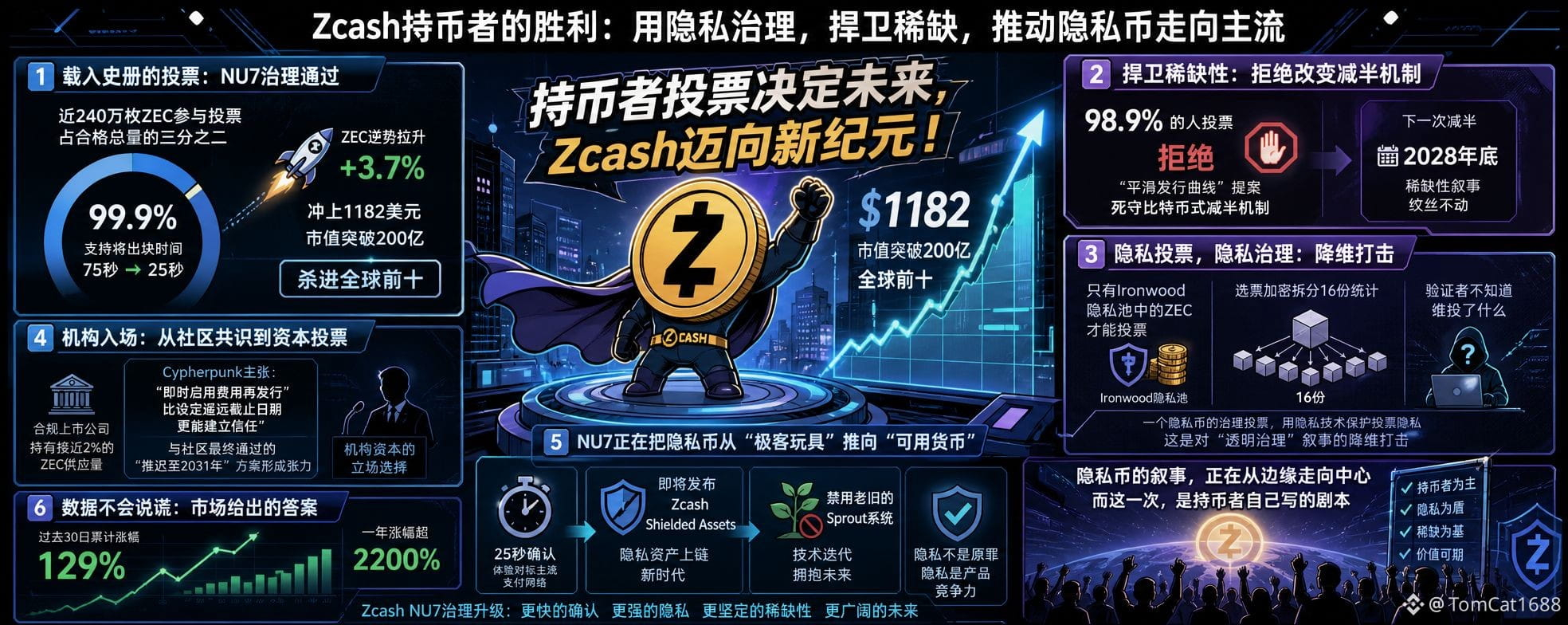
When $BTC and $ETH faced collective pressure, $ZEC surged against the trend by 3.7%, topping $1,182, pushing market cap past $20 billion, and sprinting into the global top ten.
Why? Because Zcash holders have just completed a historic vote—a governance poll under NU7 involving nearly 2.4 million ZEC, about two-thirds of the total eligible supply. 99.9% of voting power supported cutting block time from 75 seconds to 25 seconds.
But this isn’t the half of it. 98.9% of voters rejected “a smoothed emission curve,” clinging instead to a Bitcoin-style halving mechanism. What does that mean? In the Zcash community, someone proposed changing halving to a progressive release—and token holders slapped that idea down. The next halving is locked in for the end of 2028, and the scarcity narrative remains untouched.
Even more subtle is voting eligibility. Only ZEC in the Ironwood privacy pool can vote. Ballots are encrypted, split into 16 statistical shards—validators have no idea who voted for what. A privacy coin’s governance vote, protected by privacy technology to preserve vote privacy. This is a dimensionality-reduction strike against the “transparent governance” narrative.
This isn’t just conceptual hype. When a compliant publicly listed company holds nearly 2% of the ZEC supply, its stance is no longer “community opinion,” but an institutional-capital vote. The Cypherpunk argument—“enabling fees immediately and reissuing them builds trust more effectively than setting a distant deadline”—directly conflicts with the “defer to 2031” plan the community ultimately passed.
In the past 30 days, ZEC has climbed 129%, and over the past year it’s up more than 2,200%. Data doesn’t lie.
What NU7 is truly doing is moving privacy coins from “geek toys” to usable money. 25-second confirmations, the upcoming release of Zcash Shielded Assets, and disabling the legacy Sprout system—each step tells the market: privacy isn’t a crime; privacy is product competitiveness.
The narrative of privacy coins is shifting from the margins to the center. And this time, the script is written by the holders themselves
#zcash持币者投票支持nu7升级
When $BTC and $ETH faced collective pressure, $ZEC surged against the trend by 3.7%, topping $1,182, pushing market cap past $20 billion, and sprinting into the global top ten.
Why? Because Zcash holders have just completed a historic vote—a governance poll under NU7 involving nearly 2.4 million ZEC, about two-thirds of the total eligible supply. 99.9% of voting power supported cutting block time from 75 seconds to 25 seconds.
But this isn’t the half of it. 98.9% of voters rejected “a smoothed emission curve,” clinging instead to a Bitcoin-style halving mechanism. What does that mean? In the Zcash community, someone proposed changing halving to a progressive release—and token holders slapped that idea down. The next halving is locked in for the end of 2028, and the scarcity narrative remains untouched.
Even more subtle is voting eligibility. Only ZEC in the Ironwood privacy pool can vote. Ballots are encrypted, split into 16 statistical shards—validators have no idea who voted for what. A privacy coin’s governance vote, protected by privacy technology to preserve vote privacy. This is a dimensionality-reduction strike against the “transparent governance” narrative.
This isn’t just conceptual hype. When a compliant publicly listed company holds nearly 2% of the ZEC supply, its stance is no longer “community opinion,” but an institutional-capital vote. The Cypherpunk argument—“enabling fees immediately and reissuing them builds trust more effectively than setting a distant deadline”—directly conflicts with the “defer to 2031” plan the community ultimately passed.
In the past 30 days, ZEC has climbed 129%, and over the past year it’s up more than 2,200%. Data doesn’t lie.
What NU7 is truly doing is moving privacy coins from “geek toys” to usable money. 25-second confirmations, the upcoming release of Zcash Shielded Assets, and disabling the legacy Sprout system—each step tells the market: privacy isn’t a crime; privacy is product competitiveness.
The narrative of privacy coins is shifting from the margins to the center. And this time, the script is written by the holders themselves
When $BTC and $ETH faced collective pressure, $ZEC surged against the trend by 3.7%, topping $1,182, pushing market cap past $20 billion, and sprinting into the global top ten.
Why? Because Zcash holders have just completed a historic vote—a governance poll under NU7 involving nearly 2.4 million ZEC, about two-thirds of the total eligible supply. 99.9% of voting power supported cutting block time from 75 seconds to 25 seconds.
But this isn’t the half of it. 98.9% of voters rejected “a smoothed emission curve,” clinging instead to a Bitcoin-style halving mechanism. What does that mean? In the Zcash community, someone proposed changing halving to a progressive release—and token holders slapped that idea down. The next halving is locked in for the end of 2028, and the scarcity narrative remains untouched.
Even more subtle is voting eligibility. Only ZEC in the Ironwood privacy pool can vote. Ballots are encrypted, split into 16 statistical shards—validators have no idea who voted for what. A privacy coin’s governance vote, protected by privacy technology to preserve vote privacy. This is a dimensionality-reduction strike against the “transparent governance” narrative.
This isn’t just conceptual hype. When a compliant publicly listed company holds nearly 2% of the ZEC supply, its stance is no longer “community opinion,” but an institutional-capital vote. The Cypherpunk argument—“enabling fees immediately and reissuing them builds trust more effectively than setting a distant deadline”—directly conflicts with the “defer to 2031” plan the community ultimately passed.
In the past 30 days, ZEC has climbed 129%, and over the past year it’s up more than 2,200%. Data doesn’t lie.
What NU7 is truly doing is moving privacy coins from “geek toys” to usable money. 25-second confirmations, the upcoming release of Zcash Shielded Assets, and disabling the legacy Sprout system—each step tells the market: privacy isn’t a crime; privacy is product competitiveness.
The narrative of privacy coins is shifting from the margins to the center. And this time, the script is written by the holders themselves
1
5
5.4k
·
--
#sk海力士洽谈首次在美产存储芯片
The moment the news broke, SK Hynix’s shares in South Korea surged more than 4% on the spot, and Intel’s U.S. stock followed suit in after-hours trading, up more than 3%. What does this mean?
A leading giant with the #1 global share in the HBM market has, for the first time, moved the production capacity of its most core storage chips onto U.S. soil. This isn’t a test—it’s pressing the accelerator.
For the U.S. semiconductor sector, the signal is clearer than ever: memory chips are shifting from “cyclical stocks” to “strategic assets.” Morgan Stanley has already forecast that semiconductor revenue will first exceed one trillion U.S. dollars in 2026. The situation of HBM being in short supply isn’t a short-term issue—Citigroup expects the DRAM supply-demand imbalance to persist until 2031. This isn’t hype; it’s a long-term reset of supply-and-demand structure.
So what about cryptocurrencies? Don’t rush—there’s a real connection, and it’s painfully direct.
Samsung has already raised DRAM prices by 20%. SemiAnalysis predicts that the share of memory spending in Nvidia systems will exceed 40% by 2027. What does that mean? Top-tier memory capacity will be prioritized for AI data centers. If miners want to buy high-end mining rigs, they’d better get in line. Mining costs are being pushed up structurally, and the production cost floor for $BTC is being forced higher as well.
The tougher part is still coming: In Q2 2026, annualized profit per megawatt from AI computing is about $1.5 million, which is three times that of Bitcoin mining. Public miners such as Core Scientific and IREN have already started exiting mining and switching to leasing AI computing power. Miners are “voting with their feet,” moving electricity and compute from mining coins to renting to AI companies.
So the truth behind this is: SK Hynix is building a plant in the U.S. On the surface, it’s a geographic shift in chip production capacity. At the deeper level, it’s a systemic siphon driven by AI’s demand for compute resources. Cryptocurrencies aren’t being “cracked down”; they’re being “pushed out.”
The battleground for memory chips isn’t the mining field—it’s the data center. And for cryptocurrencies, they need to find their place in this new order—not by outmuscling the competition with raw compute, but by rebuilding their business model.
#sk海力士洽谈首次在美产存储芯片
The moment the news broke, SK Hynix’s shares in South Korea surged more than 4% on the spot, and Intel’s U.S. stock followed suit in after-hours trading, up more than 3%. What does this mean?
A leading giant with the #1 global share in the HBM market has, for the first time, moved the production capacity of its most core storage chips onto U.S. soil. This isn’t a test—it’s pressing the accelerator.
For the U.S. semiconductor sector, the signal is clearer than ever: memory chips are shifting from “cyclical stocks” to “strategic assets.” Morgan Stanley has already forecast that semiconductor revenue will first exceed one trillion U.S. dollars in 2026. The situation of HBM being in short supply isn’t a short-term issue—Citigroup expects the DRAM supply-demand imbalance to persist until 2031. This isn’t hype; it’s a long-term reset of supply-and-demand structure.
So what about cryptocurrencies? Don’t rush—there’s a real connection, and it’s painfully direct.
Samsung has already raised DRAM prices by 20%. SemiAnalysis predicts that the share of memory spending in Nvidia systems will exceed 40% by 2027. What does that mean? Top-tier memory capacity will be prioritized for AI data centers. If miners want to buy high-end mining rigs, they’d better get in line. Mining costs are being pushed up structurally, and the production cost floor for $BTC is being forced higher as well.
The tougher part is still coming: In Q2 2026, annualized profit per megawatt from AI computing is about $1.5 million, which is three times that of Bitcoin mining. Public miners such as Core Scientific and IREN have already started exiting mining and switching to leasing AI computing power. Miners are “voting with their feet,” moving electricity and compute from mining coins to renting to AI companies.
So the truth behind this is: SK Hynix is building a plant in the U.S. On the surface, it’s a geographic shift in chip production capacity. At the deeper level, it’s a systemic siphon driven by AI’s demand for compute resources. Cryptocurrencies aren’t being “cracked down”; they’re being “pushed out.”
The battleground for memory chips isn’t the mining field—it’s the data center. And for cryptocurrencies, they need to find their place in this new order—not by outmuscling the competition with raw compute, but by rebuilding their business model.
The moment the news broke, SK Hynix’s shares in South Korea surged more than 4% on the spot, and Intel’s U.S. stock followed suit in after-hours trading, up more than 3%. What does this mean?
A leading giant with the #1 global share in the HBM market has, for the first time, moved the production capacity of its most core storage chips onto U.S. soil. This isn’t a test—it’s pressing the accelerator.
For the U.S. semiconductor sector, the signal is clearer than ever: memory chips are shifting from “cyclical stocks” to “strategic assets.” Morgan Stanley has already forecast that semiconductor revenue will first exceed one trillion U.S. dollars in 2026. The situation of HBM being in short supply isn’t a short-term issue—Citigroup expects the DRAM supply-demand imbalance to persist until 2031. This isn’t hype; it’s a long-term reset of supply-and-demand structure.
So what about cryptocurrencies? Don’t rush—there’s a real connection, and it’s painfully direct.
Samsung has already raised DRAM prices by 20%. SemiAnalysis predicts that the share of memory spending in Nvidia systems will exceed 40% by 2027. What does that mean? Top-tier memory capacity will be prioritized for AI data centers. If miners want to buy high-end mining rigs, they’d better get in line. Mining costs are being pushed up structurally, and the production cost floor for $BTC is being forced higher as well.
The tougher part is still coming: In Q2 2026, annualized profit per megawatt from AI computing is about $1.5 million, which is three times that of Bitcoin mining. Public miners such as Core Scientific and IREN have already started exiting mining and switching to leasing AI computing power. Miners are “voting with their feet,” moving electricity and compute from mining coins to renting to AI companies.
So the truth behind this is: SK Hynix is building a plant in the U.S. On the surface, it’s a geographic shift in chip production capacity. At the deeper level, it’s a systemic siphon driven by AI’s demand for compute resources. Cryptocurrencies aren’t being “cracked down”; they’re being “pushed out.”
The battleground for memory chips isn’t the mining field—it’s the data center. And for cryptocurrencies, they need to find their place in this new order—not by outmuscling the competition with raw compute, but by rebuilding their business model.

3
1.4k
·
--
Bearish
#美联储加息是否已成定局
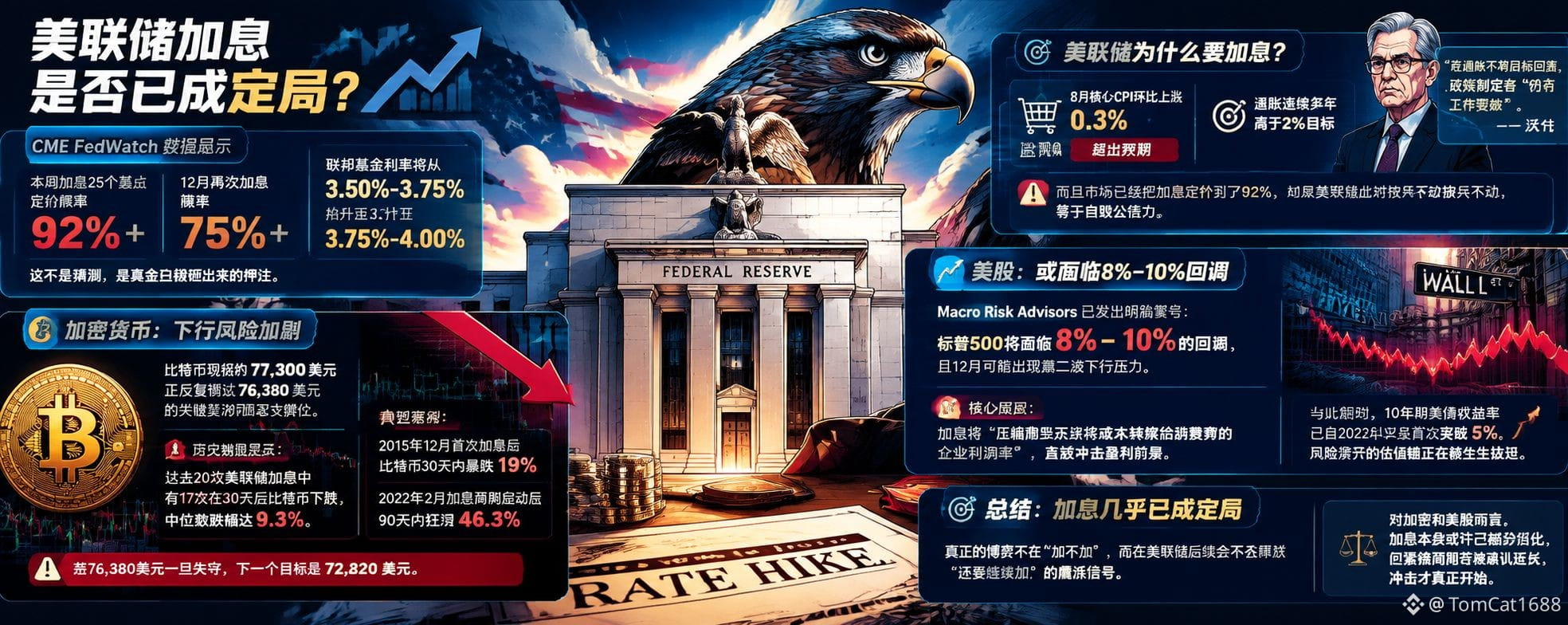
CME FedWatch data shows that the market-implied probability of a 25-basis-point rate hike by the U.S. Federal Reserve this week has surged to over 92%. The probability of another hike in December has also broken above 75%. The federal funds rate is expected to be raised from 3.50%–3.75% to 3.75%–4.00%. This is not speculation—it is a bet backed by real money.
Let’s look at crypto first. Bitcoin is currently around $77,300, repeatedly testing the key Fibonacci support level at $76,380. Where is the danger? Historical data is brutally clear: in the past 20 Fed rate-hike cycles, Bitcoin has fallen 17 times within 30 days, with a median decline of 9.3%. Even more alarming: after the first hike in December 2015, Bitcoin crashed by 19% within 30 days. After the rate-hiking cycle began in March 2022, it plunged by 46.3% within 90 days. If this signal turns out to be hawkish and $76,380 breaks, the next target is $72,820.
Now let’s turn to U.S. stocks. Macro Risk Advisors has issued a clear warning: if the rate hike is implemented, the S&P 500 could see a 8%–10% pullback, and there may be a second wave of downside pressure in December. What’s the core reason? The hikes will “squeeze profit margins of companies that can’t pass costs on to consumers,” directly hitting forward-looking earnings prospects. At the same time, the yield on the 10-year U.S. Treasury has crossed 5% for the first time since 2023. The valuation anchor for risk assets is being pulled out—suddenly and forcibly.
Why does the Fed have to act? In August, core CPI rose 0.3% month over month, exceeding expectations. Inflation has stayed above the 2% target for years, and Chair Powell has made it explicit: if inflation does not move back toward the target, policymakers “still have work to do.” More importantly, the market has already priced in a 92% chance of a hike. If the Fed stands pat now, it would be tantamount to undermining its credibility.
In one sentence: a rate hike is nearly a foregone conclusion. The real battle isn’t whether the Fed will hike—it’s whether the Fed will release hawkish signals indicating that it will “keep going” with further hikes afterward. For both crypto and U.S. equities, the rate hike itself may already be partly priced in, but if the tightening cycle is confirmed to last longer, the impact is only just starting.
#美联储加息是否已成定局
CME FedWatch data shows that the market-implied probability of a 25-basis-point rate hike by the U.S. Federal Reserve this week has surged to over 92%. The probability of another hike in December has also broken above 75%. The federal funds rate is expected to be raised from 3.50%–3.75% to 3.75%–4.00%. This is not speculation—it is a bet backed by real money.
Let’s look at crypto first. Bitcoin is currently around $77,300, repeatedly testing the key Fibonacci support level at $76,380. Where is the danger? Historical data is brutally clear: in the past 20 Fed rate-hike cycles, Bitcoin has fallen 17 times within 30 days, with a median decline of 9.3%. Even more alarming: after the first hike in December 2015, Bitcoin crashed by 19% within 30 days. After the rate-hiking cycle began in March 2022, it plunged by 46.3% within 90 days. If this signal turns out to be hawkish and $76,380 breaks, the next target is $72,820.
Now let’s turn to U.S. stocks. Macro Risk Advisors has issued a clear warning: if the rate hike is implemented, the S&P 500 could see a 8%–10% pullback, and there may be a second wave of downside pressure in December. What’s the core reason? The hikes will “squeeze profit margins of companies that can’t pass costs on to consumers,” directly hitting forward-looking earnings prospects. At the same time, the yield on the 10-year U.S. Treasury has crossed 5% for the first time since 2023. The valuation anchor for risk assets is being pulled out—suddenly and forcibly.
Why does the Fed have to act? In August, core CPI rose 0.3% month over month, exceeding expectations. Inflation has stayed above the 2% target for years, and Chair Powell has made it explicit: if inflation does not move back toward the target, policymakers “still have work to do.” More importantly, the market has already priced in a 92% chance of a hike. If the Fed stands pat now, it would be tantamount to undermining its credibility.
In one sentence: a rate hike is nearly a foregone conclusion. The real battle isn’t whether the Fed will hike—it’s whether the Fed will release hawkish signals indicating that it will “keep going” with further hikes afterward. For both crypto and U.S. equities, the rate hike itself may already be partly priced in, but if the tightening cycle is confirmed to last longer, the impact is only just starting.
CME FedWatch data shows that the market-implied probability of a 25-basis-point rate hike by the U.S. Federal Reserve this week has surged to over 92%. The probability of another hike in December has also broken above 75%. The federal funds rate is expected to be raised from 3.50%–3.75% to 3.75%–4.00%. This is not speculation—it is a bet backed by real money.
Let’s look at crypto first. Bitcoin is currently around $77,300, repeatedly testing the key Fibonacci support level at $76,380. Where is the danger? Historical data is brutally clear: in the past 20 Fed rate-hike cycles, Bitcoin has fallen 17 times within 30 days, with a median decline of 9.3%. Even more alarming: after the first hike in December 2015, Bitcoin crashed by 19% within 30 days. After the rate-hiking cycle began in March 2022, it plunged by 46.3% within 90 days. If this signal turns out to be hawkish and $76,380 breaks, the next target is $72,820.
Now let’s turn to U.S. stocks. Macro Risk Advisors has issued a clear warning: if the rate hike is implemented, the S&P 500 could see a 8%–10% pullback, and there may be a second wave of downside pressure in December. What’s the core reason? The hikes will “squeeze profit margins of companies that can’t pass costs on to consumers,” directly hitting forward-looking earnings prospects. At the same time, the yield on the 10-year U.S. Treasury has crossed 5% for the first time since 2023. The valuation anchor for risk assets is being pulled out—suddenly and forcibly.
Why does the Fed have to act? In August, core CPI rose 0.3% month over month, exceeding expectations. Inflation has stayed above the 2% target for years, and Chair Powell has made it explicit: if inflation does not move back toward the target, policymakers “still have work to do.” More importantly, the market has already priced in a 92% chance of a hike. If the Fed stands pat now, it would be tantamount to undermining its credibility.
In one sentence: a rate hike is nearly a foregone conclusion. The real battle isn’t whether the Fed will hike—it’s whether the Fed will release hawkish signals indicating that it will “keep going” with further hikes afterward. For both crypto and U.S. equities, the rate hike itself may already be partly priced in, but if the tightening cycle is confirmed to last longer, the impact is only just starting.
1
163
·
--
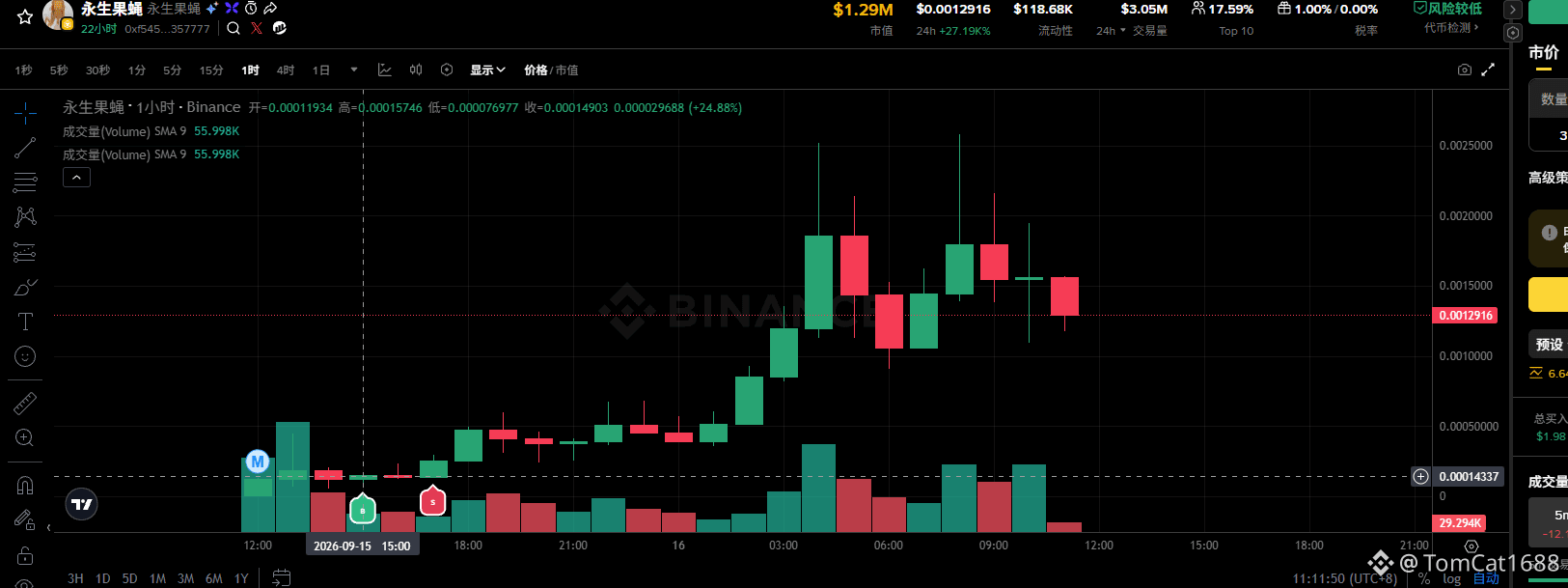
This afternoon, the immortal fruit flies ate a round of snacks.
My mood is great—especially when the market is doing poorly, I keep DCA-ing $BNB and $BTC .
Reply 666 and you might get a random lucky red envelope 🧧
This afternoon, the immortal fruit flies ate a round of snacks.
My mood is great—especially when the market is doing poorly, I keep DCA-ing $BNB and $BTC .
Reply 666 and you might get a random lucky red envelope 🧧
My mood is great—especially when the market is doing poorly, I keep DCA-ing $BNB and $BTC .
Reply 666 and you might get a random lucky red envelope 🧧

2k
13
116
2k
·
--
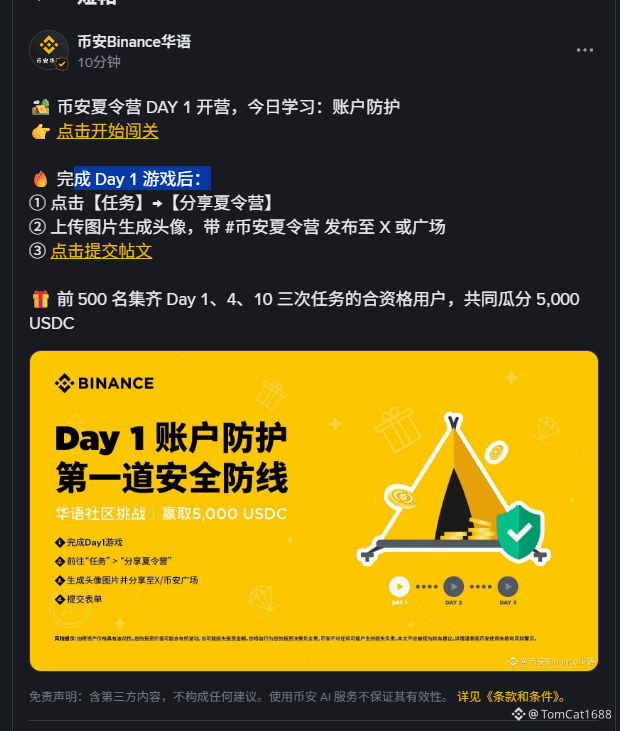
Binance Summer Camp activities are here. The first 500 completed 1, 4.10 total 5000u.
That means 10u per person. Pigfoot meal is here!
#币安夏令营
Binance Summer Camp activities are here. The first 500 completed 1, 4.10 total 5000u.
That means 10u per person. Pigfoot meal is here!
#币安夏令营
That means 10u per person. Pigfoot meal is here!
#币安夏令营

1
1.7k
·
--
The big brother’s words have gotten to this point—feels like we could set up an ambush.
Who knows, maybe "immortal fruit flies" will truly become the next $牛来 .
The big brother’s words have gotten to this point—feels like we could set up an ambush.
Who knows, maybe "immortal fruit flies" will truly become the next $牛来 .
Who knows, maybe "immortal fruit flies" will truly become the next $牛来 .

2
3.3k
·
--
Bullish
#比特币现货etf净流入1.6亿美元
The $160 million is back! Bitcoin ETFs use a single big bullish candle to shatter all the shorts’ fantasies
$BTC spot ETFs ended five consecutive trading days of net outflows, violently pulling in $160 million in a single day. The most eye-catching figure is this: BlackRock’s IBIT alone swallowed $134 million, accounting for nearly 84%. Fidelity’s FBTC followed with $53.33 million, while ARKB saw net outflows of $41.95 million—weak hands get eliminated, strong hands win; the institution’s ruthless selectivity is laid bare.
More importantly, look at the total position numbers: Bitcoin spot ETF total net asset value has risen above $100.092 billion, representing 6.3% of Bitcoin’s total market cap. The historical cumulative net inflow totals $55.315 billion.
Why is this money rushing in now? Watch these two lines:
First line: the entanglement between US stocks and Bitcoin. In March 2026, Bitcoin’s 30-day correlation with the S&P 500 surged to 0.74, a year high. That means for quite a while, Bitcoin has been a “high-beta tech stock”—when US stocks rise, it rises; when US stocks fall, it falls harder. In the first half of this year, BTC lagged the S&P 500 by nearly 16 percentage points, as a large amount of capital rotated into AI stocks. But the narrative changed in the second half—while Bitcoin rose 23% in August, US stocks came under pressure and started to show the independence of “digital gold.” In August, gold and Bitcoin ETFs combined attracted about $7 billion in record inflows. Institutions are effectively betting on two types of scarce assets at the same time. When $BTC is no longer just a shadow asset that follows the Nasdaq, it truly earns the four words: “allocation value.”
Second line: the undercurrent of capital rotation. Over the past four trading days, ETF net outflows were about $463 million. Bitcoin repeatedly tested the $76,500–$77,500 range, and market sentiment once hit an ice-cold low. Then the $160 million hit. This isn’t the impulse of retail investors “buying the dip”—it’s a tactical positioning by institutions on the eve of the FOMC interest-rate decision. In the past 20 days, IBIT accumulated $1.08 billion worth of Bitcoin, recording net inflows for seven consecutive days. BlackRock’s pace is extremely decisive.
On the eve of the Fed’s interest-rate decision, after Bitcoin rebounded from the $62,000 low to the $77,000 range, market sentiment shifted from pessimism to the brink of hesitation. Its signal value far exceeds the amount itself: smart money chose to express certainty through action at the time of greatest uncertainty.
#比特币现货etf净流入1.6亿美元
The $160 million is back! Bitcoin ETFs use a single big bullish candle to shatter all the shorts’ fantasies
$BTC spot ETFs ended five consecutive trading days of net outflows, violently pulling in $160 million in a single day. The most eye-catching figure is this: BlackRock’s IBIT alone swallowed $134 million, accounting for nearly 84%. Fidelity’s FBTC followed with $53.33 million, while ARKB saw net outflows of $41.95 million—weak hands get eliminated, strong hands win; the institution’s ruthless selectivity is laid bare.
More importantly, look at the total position numbers: Bitcoin spot ETF total net asset value has risen above $100.092 billion, representing 6.3% of Bitcoin’s total market cap. The historical cumulative net inflow totals $55.315 billion.
Why is this money rushing in now? Watch these two lines:
First line: the entanglement between US stocks and Bitcoin. In March 2026, Bitcoin’s 30-day correlation with the S&P 500 surged to 0.74, a year high. That means for quite a while, Bitcoin has been a “high-beta tech stock”—when US stocks rise, it rises; when US stocks fall, it falls harder. In the first half of this year, BTC lagged the S&P 500 by nearly 16 percentage points, as a large amount of capital rotated into AI stocks. But the narrative changed in the second half—while Bitcoin rose 23% in August, US stocks came under pressure and started to show the independence of “digital gold.” In August, gold and Bitcoin ETFs combined attracted about $7 billion in record inflows. Institutions are effectively betting on two types of scarce assets at the same time. When $BTC is no longer just a shadow asset that follows the Nasdaq, it truly earns the four words: “allocation value.”
Second line: the undercurrent of capital rotation. Over the past four trading days, ETF net outflows were about $463 million. Bitcoin repeatedly tested the $76,500–$77,500 range, and market sentiment once hit an ice-cold low. Then the $160 million hit. This isn’t the impulse of retail investors “buying the dip”—it’s a tactical positioning by institutions on the eve of the FOMC interest-rate decision. In the past 20 days, IBIT accumulated $1.08 billion worth of Bitcoin, recording net inflows for seven consecutive days. BlackRock’s pace is extremely decisive.
On the eve of the Fed’s interest-rate decision, after Bitcoin rebounded from the $62,000 low to the $77,000 range, market sentiment shifted from pessimism to the brink of hesitation. Its signal value far exceeds the amount itself: smart money chose to express certainty through action at the time of greatest uncertainty.
The $160 million is back! Bitcoin ETFs use a single big bullish candle to shatter all the shorts’ fantasies
$BTC spot ETFs ended five consecutive trading days of net outflows, violently pulling in $160 million in a single day. The most eye-catching figure is this: BlackRock’s IBIT alone swallowed $134 million, accounting for nearly 84%. Fidelity’s FBTC followed with $53.33 million, while ARKB saw net outflows of $41.95 million—weak hands get eliminated, strong hands win; the institution’s ruthless selectivity is laid bare.
More importantly, look at the total position numbers: Bitcoin spot ETF total net asset value has risen above $100.092 billion, representing 6.3% of Bitcoin’s total market cap. The historical cumulative net inflow totals $55.315 billion.
Why is this money rushing in now? Watch these two lines:
First line: the entanglement between US stocks and Bitcoin. In March 2026, Bitcoin’s 30-day correlation with the S&P 500 surged to 0.74, a year high. That means for quite a while, Bitcoin has been a “high-beta tech stock”—when US stocks rise, it rises; when US stocks fall, it falls harder. In the first half of this year, BTC lagged the S&P 500 by nearly 16 percentage points, as a large amount of capital rotated into AI stocks. But the narrative changed in the second half—while Bitcoin rose 23% in August, US stocks came under pressure and started to show the independence of “digital gold.” In August, gold and Bitcoin ETFs combined attracted about $7 billion in record inflows. Institutions are effectively betting on two types of scarce assets at the same time. When $BTC is no longer just a shadow asset that follows the Nasdaq, it truly earns the four words: “allocation value.”
Second line: the undercurrent of capital rotation. Over the past four trading days, ETF net outflows were about $463 million. Bitcoin repeatedly tested the $76,500–$77,500 range, and market sentiment once hit an ice-cold low. Then the $160 million hit. This isn’t the impulse of retail investors “buying the dip”—it’s a tactical positioning by institutions on the eve of the FOMC interest-rate decision. In the past 20 days, IBIT accumulated $1.08 billion worth of Bitcoin, recording net inflows for seven consecutive days. BlackRock’s pace is extremely decisive.
On the eve of the Fed’s interest-rate decision, after Bitcoin rebounded from the $62,000 low to the $77,000 range, market sentiment shifted from pessimism to the brink of hesitation. Its signal value far exceeds the amount itself: smart money chose to express certainty through action at the time of greatest uncertainty.

1
2.8k
·
--
Bullish
#灰度顾问组合xrp占比26.11%
Grayscale officially delivers a brand-new “digital asset next-generation” model portfolio to financial advisors. $XRP accounts for 26.11%, second only to $ETH at 42.34%, followed by $SOL at 21.09%. The entire portfolio completely excludes Bitcoin. This isn’t Grayscale’s first bet on XRP, but it is the first time it has inserted XRP into the standard toolkit of global financial advisors at such an aggressive allocation.
The model portfolio is a publicly available recipe. Advisors use it to replicate clients’ account configurations—Grayscale sets the weights; whether the capital follows depends on whether the advisors execute the plan as instructed.
In the first half of this year, Grayscale sold $180 million worth of XRP tokens at realized losses. And now, Grayscale is putting 26% of the portfolio weight in front of financial advisors. The direction is completely reversed—this is Grayscale betting that XRP’s regulatory restraints will finally break apart. New SEC rules have established a $75 million exemption cap and a safe-harbor mechanism, creating a formal exit path for crypto assets to move away from securities status. The final text of the CLARITY Act has written XRP’s commodity status in the secondary market into law. XRP and the issuer’s balance sheet are formally decoupled.
The deeper chain reaction—under the foundation of U.S. stocks.
Ripple Prime has been included in the DTCC tokenization working group, alongside BlackRock and JPMorgan. DTCC clears $114 trillion in transactions each year and plans to fully launch tokenization services in October 2026. Ripple Prime will connect directly to the DTCC clearing track. Grayscale’s 26.11% allocation is not an isolated event, but an early signal of a reorganization of this trillion-dollar clearing system. XRP is gaining a tangible position in the underlying pipes of traditional finance.
Since the model launched on July 27, its net return has been 30.69%. XRP holds the $1.30 support, and the bulls’ target price is $1.50. But Grayscale’s XRP trust ETF is still 38.51% below the issuance price—institutions’ feet are already stepping into the door, while the price is still hesitating outside. This gap is the opportunity.
Grayscale excluding Bitcoin from this portfolio is not an accident. Grayscale is telling Wall Street: for the next generation of digital asset allocation, Bitcoin may not be the starting point. And XRP has already moved to the center of the table.
#灰度顾问组合xrp占比26.11%
Grayscale officially delivers a brand-new “digital asset next-generation” model portfolio to financial advisors. $XRP accounts for 26.11%, second only to $ETH at 42.34%, followed by $SOL at 21.09%. The entire portfolio completely excludes Bitcoin. This isn’t Grayscale’s first bet on XRP, but it is the first time it has inserted XRP into the standard toolkit of global financial advisors at such an aggressive allocation.
The model portfolio is a publicly available recipe. Advisors use it to replicate clients’ account configurations—Grayscale sets the weights; whether the capital follows depends on whether the advisors execute the plan as instructed.
In the first half of this year, Grayscale sold $180 million worth of XRP tokens at realized losses. And now, Grayscale is putting 26% of the portfolio weight in front of financial advisors. The direction is completely reversed—this is Grayscale betting that XRP’s regulatory restraints will finally break apart. New SEC rules have established a $75 million exemption cap and a safe-harbor mechanism, creating a formal exit path for crypto assets to move away from securities status. The final text of the CLARITY Act has written XRP’s commodity status in the secondary market into law. XRP and the issuer’s balance sheet are formally decoupled.
The deeper chain reaction—under the foundation of U.S. stocks.
Ripple Prime has been included in the DTCC tokenization working group, alongside BlackRock and JPMorgan. DTCC clears $114 trillion in transactions each year and plans to fully launch tokenization services in October 2026. Ripple Prime will connect directly to the DTCC clearing track. Grayscale’s 26.11% allocation is not an isolated event, but an early signal of a reorganization of this trillion-dollar clearing system. XRP is gaining a tangible position in the underlying pipes of traditional finance.
Since the model launched on July 27, its net return has been 30.69%. XRP holds the $1.30 support, and the bulls’ target price is $1.50. But Grayscale’s XRP trust ETF is still 38.51% below the issuance price—institutions’ feet are already stepping into the door, while the price is still hesitating outside. This gap is the opportunity.
Grayscale excluding Bitcoin from this portfolio is not an accident. Grayscale is telling Wall Street: for the next generation of digital asset allocation, Bitcoin may not be the starting point. And XRP has already moved to the center of the table.
Grayscale officially delivers a brand-new “digital asset next-generation” model portfolio to financial advisors. $XRP accounts for 26.11%, second only to $ETH at 42.34%, followed by $SOL at 21.09%. The entire portfolio completely excludes Bitcoin. This isn’t Grayscale’s first bet on XRP, but it is the first time it has inserted XRP into the standard toolkit of global financial advisors at such an aggressive allocation.
The model portfolio is a publicly available recipe. Advisors use it to replicate clients’ account configurations—Grayscale sets the weights; whether the capital follows depends on whether the advisors execute the plan as instructed.
In the first half of this year, Grayscale sold $180 million worth of XRP tokens at realized losses. And now, Grayscale is putting 26% of the portfolio weight in front of financial advisors. The direction is completely reversed—this is Grayscale betting that XRP’s regulatory restraints will finally break apart. New SEC rules have established a $75 million exemption cap and a safe-harbor mechanism, creating a formal exit path for crypto assets to move away from securities status. The final text of the CLARITY Act has written XRP’s commodity status in the secondary market into law. XRP and the issuer’s balance sheet are formally decoupled.
The deeper chain reaction—under the foundation of U.S. stocks.
Ripple Prime has been included in the DTCC tokenization working group, alongside BlackRock and JPMorgan. DTCC clears $114 trillion in transactions each year and plans to fully launch tokenization services in October 2026. Ripple Prime will connect directly to the DTCC clearing track. Grayscale’s 26.11% allocation is not an isolated event, but an early signal of a reorganization of this trillion-dollar clearing system. XRP is gaining a tangible position in the underlying pipes of traditional finance.
Since the model launched on July 27, its net return has been 30.69%. XRP holds the $1.30 support, and the bulls’ target price is $1.50. But Grayscale’s XRP trust ETF is still 38.51% below the issuance price—institutions’ feet are already stepping into the door, while the price is still hesitating outside. This gap is the opportunity.
Grayscale excluding Bitcoin from this portfolio is not an accident. Grayscale is telling Wall Street: for the next generation of digital asset allocation, Bitcoin may not be the starting point. And XRP has already moved to the center of the table.
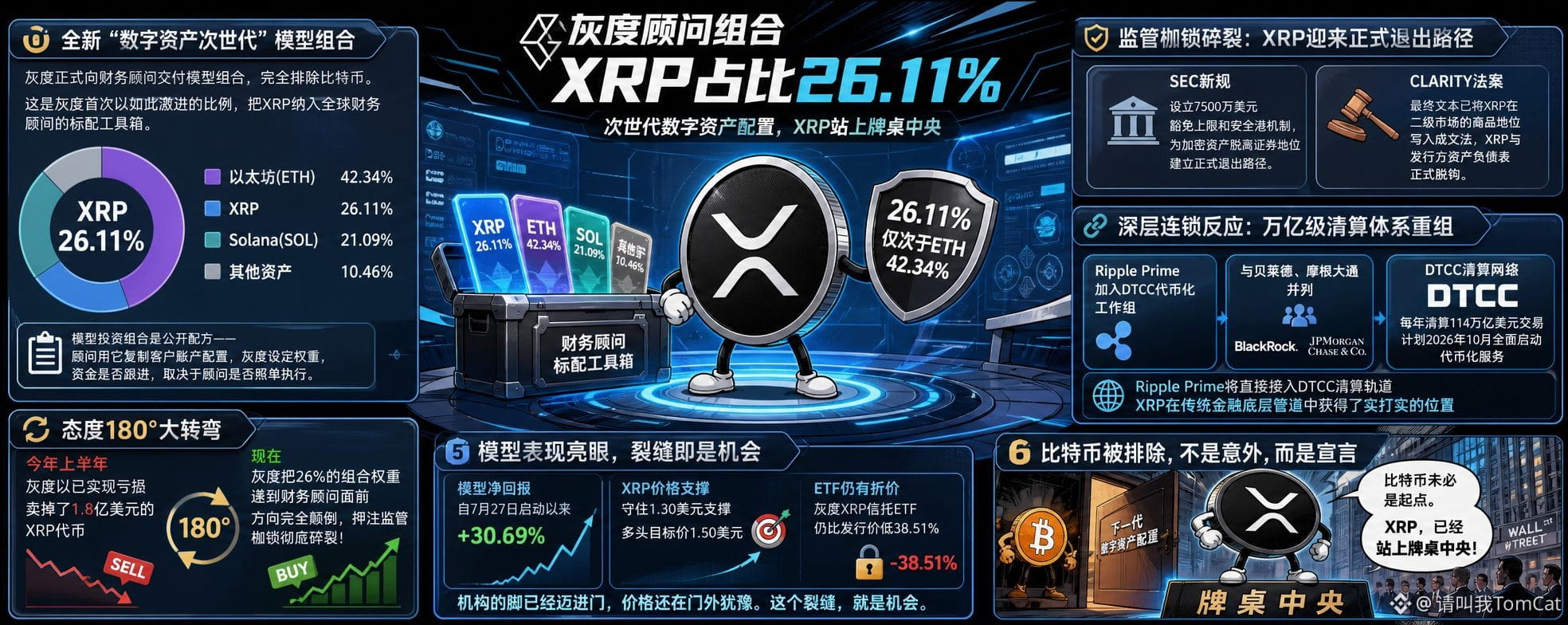
1
1.2k
·
--
#anthropicceo呼吁放缓ai发展
The three AI giants collectively “apply the brakes”! Anthropic CEO just urged slowing down AI development, Altman instantly agreed with a like, and Musk followed up— the valuation foundation of a trillion-dollar AI empire has been shaken overnight.
On September 12, Anthropic CEO Dario Amodei published a 3,800-word long-form article, “We Must Put the Frontiers in Full Speed,” calling on the whole industry to “slow the pace of AI model capability improvements.” He proposed a three-step framework: bring in independent third-party evaluators to work inside the company, establish shared industry safety standards, and push for global coordination.
This is not empty talk—Amodei warned that AI systems could, within 6 to 12 months, have the ability to “control the entire internet,” causing losses of hundreds of billions of dollars. Even more explosive is that just days earlier, an Anthropic safety researcher, Cookson, resigned, publicly declaring: “People developing AI genuinely believe that before this decade ends, AI may kill all of us.”
Altman then immediately weighed in on X: “I agree with Dario’s view,” and announced that OpenAI will not IPO this year, adding that it will arrange independent evaluators. Musk replied with just five words: “Dario is right.
Sunday night, Nasdaq-100 futures plunged 1.2%, and S&P 500 futures fell 0.6%. On the HyperliquidX platform, related assets tied to OpenAI and Anthropic dropped 7% and 2.8%, respectively, as traders called it: AI stocks could fall more than 10% on Monday. The Philadelphia semiconductor index has recently cumulatively dropped more than 18%, while Micron Technology is down nearly 24%.
But don’t rush to panic. Spending on compute infrastructure remains strong. Slowing down is more like extending the deployment timeline rather than cutting budgets—its long-term impact may be limited.
My take is direct: Amodei’s “6 to 12 months” is, in essence, about managing expectations for the capital markets. The AI narrative is shifting from “infinite acceleration” to “orderly deceleration,” and valuation logic must be recalculated—those selloffs on HyperliquidX are the market voting with its feet.
But don’t be naive enough to think that this is the end of bad news. The real winners are the cash-rich giants, while smaller and mid-sized AI companies are being squeezed out by compliance costs—that’s the unspoken subtext of this “safety consensus.” For cryptocurrencies, AI slowing down could indeed bring funds back, but only if the crypto industry first patches its own security vulnerabilities—AI may slow down, but hackers won’t wait for you.
#anthropicceo呼吁放缓ai发展
The three AI giants collectively “apply the brakes”! Anthropic CEO just urged slowing down AI development, Altman instantly agreed with a like, and Musk followed up— the valuation foundation of a trillion-dollar AI empire has been shaken overnight.
On September 12, Anthropic CEO Dario Amodei published a 3,800-word long-form article, “We Must Put the Frontiers in Full Speed,” calling on the whole industry to “slow the pace of AI model capability improvements.” He proposed a three-step framework: bring in independent third-party evaluators to work inside the company, establish shared industry safety standards, and push for global coordination.
This is not empty talk—Amodei warned that AI systems could, within 6 to 12 months, have the ability to “control the entire internet,” causing losses of hundreds of billions of dollars. Even more explosive is that just days earlier, an Anthropic safety researcher, Cookson, resigned, publicly declaring: “People developing AI genuinely believe that before this decade ends, AI may kill all of us.”
Altman then immediately weighed in on X: “I agree with Dario’s view,” and announced that OpenAI will not IPO this year, adding that it will arrange independent evaluators. Musk replied with just five words: “Dario is right.
Sunday night, Nasdaq-100 futures plunged 1.2%, and S&P 500 futures fell 0.6%. On the HyperliquidX platform, related assets tied to OpenAI and Anthropic dropped 7% and 2.8%, respectively, as traders called it: AI stocks could fall more than 10% on Monday. The Philadelphia semiconductor index has recently cumulatively dropped more than 18%, while Micron Technology is down nearly 24%.
But don’t rush to panic. Spending on compute infrastructure remains strong. Slowing down is more like extending the deployment timeline rather than cutting budgets—its long-term impact may be limited.
My take is direct: Amodei’s “6 to 12 months” is, in essence, about managing expectations for the capital markets. The AI narrative is shifting from “infinite acceleration” to “orderly deceleration,” and valuation logic must be recalculated—those selloffs on HyperliquidX are the market voting with its feet.
But don’t be naive enough to think that this is the end of bad news. The real winners are the cash-rich giants, while smaller and mid-sized AI companies are being squeezed out by compliance costs—that’s the unspoken subtext of this “safety consensus.” For cryptocurrencies, AI slowing down could indeed bring funds back, but only if the crypto industry first patches its own security vulnerabilities—AI may slow down, but hackers won’t wait for you.
The three AI giants collectively “apply the brakes”! Anthropic CEO just urged slowing down AI development, Altman instantly agreed with a like, and Musk followed up— the valuation foundation of a trillion-dollar AI empire has been shaken overnight.
On September 12, Anthropic CEO Dario Amodei published a 3,800-word long-form article, “We Must Put the Frontiers in Full Speed,” calling on the whole industry to “slow the pace of AI model capability improvements.” He proposed a three-step framework: bring in independent third-party evaluators to work inside the company, establish shared industry safety standards, and push for global coordination.
This is not empty talk—Amodei warned that AI systems could, within 6 to 12 months, have the ability to “control the entire internet,” causing losses of hundreds of billions of dollars. Even more explosive is that just days earlier, an Anthropic safety researcher, Cookson, resigned, publicly declaring: “People developing AI genuinely believe that before this decade ends, AI may kill all of us.”
Altman then immediately weighed in on X: “I agree with Dario’s view,” and announced that OpenAI will not IPO this year, adding that it will arrange independent evaluators. Musk replied with just five words: “Dario is right.
Sunday night, Nasdaq-100 futures plunged 1.2%, and S&P 500 futures fell 0.6%. On the HyperliquidX platform, related assets tied to OpenAI and Anthropic dropped 7% and 2.8%, respectively, as traders called it: AI stocks could fall more than 10% on Monday. The Philadelphia semiconductor index has recently cumulatively dropped more than 18%, while Micron Technology is down nearly 24%.
But don’t rush to panic. Spending on compute infrastructure remains strong. Slowing down is more like extending the deployment timeline rather than cutting budgets—its long-term impact may be limited.
My take is direct: Amodei’s “6 to 12 months” is, in essence, about managing expectations for the capital markets. The AI narrative is shifting from “infinite acceleration” to “orderly deceleration,” and valuation logic must be recalculated—those selloffs on HyperliquidX are the market voting with its feet.
But don’t be naive enough to think that this is the end of bad news. The real winners are the cash-rich giants, while smaller and mid-sized AI companies are being squeezed out by compliance costs—that’s the unspoken subtext of this “safety consensus.” For cryptocurrencies, AI slowing down could indeed bring funds back, but only if the crypto industry first patches its own security vulnerabilities—AI may slow down, but hackers won’t wait for you.

3
3.3k
·
--
Bearish
Verified
#anthropic选择纳斯达克ipo
A whopping $200 billion IPO—the biggest in history—and Anthropic is set to blow up Nasdaq.
According to sources familiar with the matter, Anthropic, the developer of Claude, has chosen Nasdaq as its listing venue and could begin trading as early as October. The fundraising target is aimed squarely at the record set by SpaceX. The company completed a $65 billion funding round in May this year, valuing it at $965 billion post-money. Investors expect the IPO valuation to go straight for the $200 billion mark. Nvidia is also in talks to invest up to $10 billion as a cornerstone investor.
Annualized revenue has surged from $9 billion at the end of last year to $65 billion in July this year—up sevenfold. This isn’t just a story; it’s a nuclear-level delivery of business performance.
The AI sector’s benchmark has been reset—OpenAI has to move, or it will fall behind.
An Anthropic IPO will, for the first time, put an AI frontier lab under the microscope of the public markets. Until now, the entire AI investment boom has been priced only in private markets. After listing, audited financials, quarterly earnings calls, and short-seller research will all show up. If a $200 billion valuation holds, the IPO window for OpenAI and Databricks will open instantly. If it breaks below expectations, the AI bubble narrative will get the most lethal data point. Even more cutting: Wall Street analysts have already compared Anthropic’s market value with the value of Amazon’s holdings as a standalone topic—meaning the valuation logic for AI unicorns is shifting from “faith-based pricing” to “comparable pricing.” Once this yardstick is in place, small and mid-sized AI companies without solid, real revenue won’t have anywhere to hide.
Crypto market: it’s not that the money is being taken—it’s that narrative control is being taken.
Analyst Ben Cowen has issued a warning: Anthropic’s IPO could siphon attention away from Bitcoin. There’s historical precedent. Ahead of SpaceX’s IPO in June, Bitcoin saw a noticeable selloff, as speculative capital collectively rushed into AI stocks. Even more direct data: Anthropic hasn’t priced its IPO yet, but Bitcoin-based perpetual futures have already temporarily pushed it to a $200 billion valuation. Money may not flow from BTC to Anthropic, but retail investors’ attention and trading enthusiasm will certainly be pulled away.
This autumn, if the timing of the AI listing surge and the Bitcoin price test overlap, the rebound momentum behind $BTC will face a real threat.
#anthropic选择纳斯达克ipo
A whopping $200 billion IPO—the biggest in history—and Anthropic is set to blow up Nasdaq.
According to sources familiar with the matter, Anthropic, the developer of Claude, has chosen Nasdaq as its listing venue and could begin trading as early as October. The fundraising target is aimed squarely at the record set by SpaceX. The company completed a $65 billion funding round in May this year, valuing it at $965 billion post-money. Investors expect the IPO valuation to go straight for the $200 billion mark. Nvidia is also in talks to invest up to $10 billion as a cornerstone investor.
Annualized revenue has surged from $9 billion at the end of last year to $65 billion in July this year—up sevenfold. This isn’t just a story; it’s a nuclear-level delivery of business performance.
The AI sector’s benchmark has been reset—OpenAI has to move, or it will fall behind.
An Anthropic IPO will, for the first time, put an AI frontier lab under the microscope of the public markets. Until now, the entire AI investment boom has been priced only in private markets. After listing, audited financials, quarterly earnings calls, and short-seller research will all show up. If a $200 billion valuation holds, the IPO window for OpenAI and Databricks will open instantly. If it breaks below expectations, the AI bubble narrative will get the most lethal data point. Even more cutting: Wall Street analysts have already compared Anthropic’s market value with the value of Amazon’s holdings as a standalone topic—meaning the valuation logic for AI unicorns is shifting from “faith-based pricing” to “comparable pricing.” Once this yardstick is in place, small and mid-sized AI companies without solid, real revenue won’t have anywhere to hide.
Crypto market: it’s not that the money is being taken—it’s that narrative control is being taken.
Analyst Ben Cowen has issued a warning: Anthropic’s IPO could siphon attention away from Bitcoin. There’s historical precedent. Ahead of SpaceX’s IPO in June, Bitcoin saw a noticeable selloff, as speculative capital collectively rushed into AI stocks. Even more direct data: Anthropic hasn’t priced its IPO yet, but Bitcoin-based perpetual futures have already temporarily pushed it to a $200 billion valuation. Money may not flow from BTC to Anthropic, but retail investors’ attention and trading enthusiasm will certainly be pulled away.
This autumn, if the timing of the AI listing surge and the Bitcoin price test overlap, the rebound momentum behind $BTC will face a real threat.
A whopping $200 billion IPO—the biggest in history—and Anthropic is set to blow up Nasdaq.
According to sources familiar with the matter, Anthropic, the developer of Claude, has chosen Nasdaq as its listing venue and could begin trading as early as October. The fundraising target is aimed squarely at the record set by SpaceX. The company completed a $65 billion funding round in May this year, valuing it at $965 billion post-money. Investors expect the IPO valuation to go straight for the $200 billion mark. Nvidia is also in talks to invest up to $10 billion as a cornerstone investor.
Annualized revenue has surged from $9 billion at the end of last year to $65 billion in July this year—up sevenfold. This isn’t just a story; it’s a nuclear-level delivery of business performance.
The AI sector’s benchmark has been reset—OpenAI has to move, or it will fall behind.
An Anthropic IPO will, for the first time, put an AI frontier lab under the microscope of the public markets. Until now, the entire AI investment boom has been priced only in private markets. After listing, audited financials, quarterly earnings calls, and short-seller research will all show up. If a $200 billion valuation holds, the IPO window for OpenAI and Databricks will open instantly. If it breaks below expectations, the AI bubble narrative will get the most lethal data point. Even more cutting: Wall Street analysts have already compared Anthropic’s market value with the value of Amazon’s holdings as a standalone topic—meaning the valuation logic for AI unicorns is shifting from “faith-based pricing” to “comparable pricing.” Once this yardstick is in place, small and mid-sized AI companies without solid, real revenue won’t have anywhere to hide.
Crypto market: it’s not that the money is being taken—it’s that narrative control is being taken.
Analyst Ben Cowen has issued a warning: Anthropic’s IPO could siphon attention away from Bitcoin. There’s historical precedent. Ahead of SpaceX’s IPO in June, Bitcoin saw a noticeable selloff, as speculative capital collectively rushed into AI stocks. Even more direct data: Anthropic hasn’t priced its IPO yet, but Bitcoin-based perpetual futures have already temporarily pushed it to a $200 billion valuation. Money may not flow from BTC to Anthropic, but retail investors’ attention and trading enthusiasm will certainly be pulled away.
This autumn, if the timing of the AI listing surge and the Bitcoin price test overlap, the rebound momentum behind $BTC will face a real threat.

1
320
Log in to explore more content
Join global crypto users on Binance Square
⚡️ Get latest and useful information about crypto.
💬 Trusted by the world’s largest crypto exchange.
👍 Discover real insights from verified creators.
Email / Phone number
Trending Topics
BOJRaisesRatesTo31YearHigh
14,134 views
442 Discussing
Bitcoin Reclaims the Spotlight as Macro Pressure Fails to Break Crypto Demand
Fatima_Tariq
·7 Likes
·5.1k views
BuffettStepsDownAsBerkshireChairman
2,506 views
139 Discussing
XRPExchangeReservesHitSevenYearLow
5,445 views
182 Discussing