

CryptoQuant Quicktake
9.1k Posts

CryptoQuant Quicktake
 Square Verified+
Report
Block User
CryptoQuant.com - Leading On-chain Data/Analytics Provider
0 Following
24.8K+ Followers
27.3K+ Liked
Posts
Article
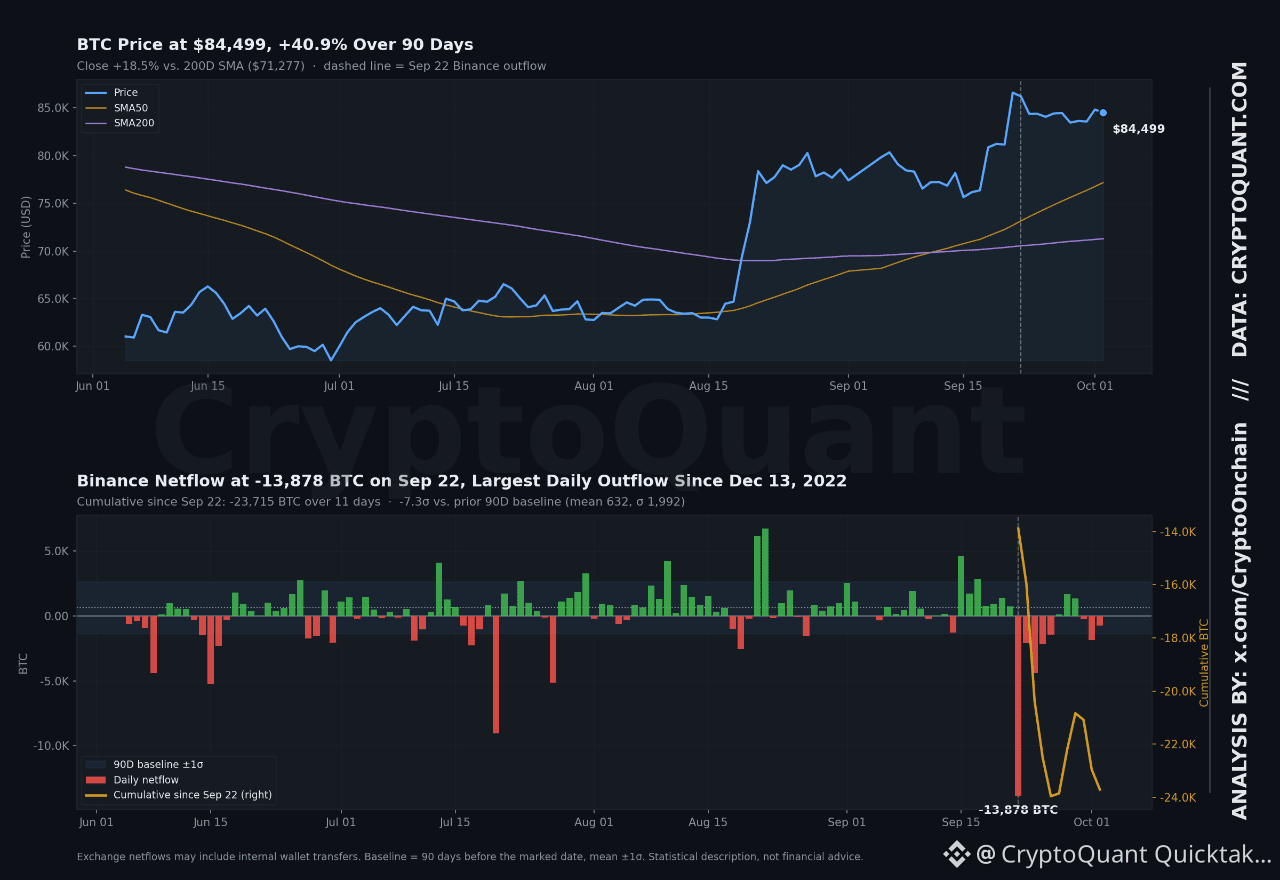
Binance Sees 23.7K BTC Outflow While Leverage Stays Cool: Is Spot Accumulation Driving the Rally?BTC trades at $84.5K. It is up 40.9% in 90 days and sits 18.5% above its 200-day SMA ($71.3K). The Mayer Multiple is 1.19, which is healthy rather than overheated. On-chain data suggests coins leaving exchanges are supporting the rebound, and Binance is at the center of it.
1. Binance Netflow: heavy outflows
On Sep 22, Binance recorded a net outflow of −13,878 BTC in a single day. Cumulative netflow since then is about −23.7K BTC over 11 days. When large amounts leave the biggest exchange, it usually means coins are moving into custody, which reduces the supply available to sell right away.
2. Exchange supply is shrinking
The all-exchange supply ratio (0.13) is at Z = −2.37 vs. the past 90 days, which is the 20th percentile of the year. Coinbase netflow is also negative (7D avg: −467 BTC).
3. Leverage is not the driver
Binance funding rates are near neutral (~0.00–0.01%), with Z90 = −1.03. Overleveraged longs are not fueling this rally, so the risk of a long squeeze is lower.
4. No euphoria
STH-SOPR is 1.02, so short-term holders are only slightly in profit and there are no signs of aggressive distribution.
⚠️ Risks
Coinbase Premium remains negative (−0.02 to −0.08), which points to weak US spot demand.
The estimated leverage ratio is rising (+1.39σ over 30D), diverging from the cool funding rates.
Price is still 32% below the $124.7K ATH.
Conclusion: Binance outflows combined with low funding point to spot accumulation. Watch for Binance netflow turning persistently positive. If that happens, BTC could stall near the $86.6K local high.
Written by CryptoOnchain
Binance Sees 23.7K BTC Outflow While Leverage Stays Cool: Is Spot Accumulation Driving the Rally?
BTC trades at $84.5K. It is up 40.9% in 90 days and sits 18.5% above its 200-day SMA ($71.3K). The Mayer Multiple is 1.19, which is healthy rather than overheated. On-chain data suggests coins leaving exchanges are supporting the rebound, and Binance is at the center of it.
1. Binance Netflow: heavy outflows
On Sep 22, Binance recorded a net outflow of −13,878 BTC in a single day. Cumulative netflow since then is about −23.7K BTC over 11 days. When large amounts leave the biggest exchange, it usually means coins are moving into custody, which reduces the supply available to sell right away.
2. Exchange supply is shrinking
The all-exchange supply ratio (0.13) is at Z = −2.37 vs. the past 90 days, which is the 20th percentile of the year. Coinbase netflow is also negative (7D avg: −467 BTC).
3. Leverage is not the driver
Binance funding rates are near neutral (~0.00–0.01%), with Z90 = −1.03. Overleveraged longs are not fueling this rally, so the risk of a long squeeze is lower.
4. No euphoria
STH-SOPR is 1.02, so short-term holders are only slightly in profit and there are no signs of aggressive distribution.
⚠️ Risks
Coinbase Premium remains negative (−0.02 to −0.08), which points to weak US spot demand.
The estimated leverage ratio is rising (+1.39σ over 30D), diverging from the cool funding rates.
Price is still 32% below the $124.7K ATH.
Conclusion: Binance outflows combined with low funding point to spot accumulation. Watch for Binance netflow turning persistently positive. If that happens, BTC could stall near the $86.6K local high.
Written by CryptoOnchain
1. Binance Netflow: heavy outflows
On Sep 22, Binance recorded a net outflow of −13,878 BTC in a single day. Cumulative netflow since then is about −23.7K BTC over 11 days. When large amounts leave the biggest exchange, it usually means coins are moving into custody, which reduces the supply available to sell right away.
2. Exchange supply is shrinking
The all-exchange supply ratio (0.13) is at Z = −2.37 vs. the past 90 days, which is the 20th percentile of the year. Coinbase netflow is also negative (7D avg: −467 BTC).
3. Leverage is not the driver
Binance funding rates are near neutral (~0.00–0.01%), with Z90 = −1.03. Overleveraged longs are not fueling this rally, so the risk of a long squeeze is lower.
4. No euphoria
STH-SOPR is 1.02, so short-term holders are only slightly in profit and there are no signs of aggressive distribution.
⚠️ Risks
Coinbase Premium remains negative (−0.02 to −0.08), which points to weak US spot demand.
The estimated leverage ratio is rising (+1.39σ over 30D), diverging from the cool funding rates.
Price is still 32% below the $124.7K ATH.
Conclusion: Binance outflows combined with low funding point to spot accumulation. Watch for Binance netflow turning persistently positive. If that happens, BTC could stall near the $86.6K local high.
Written by CryptoOnchain
108
Article
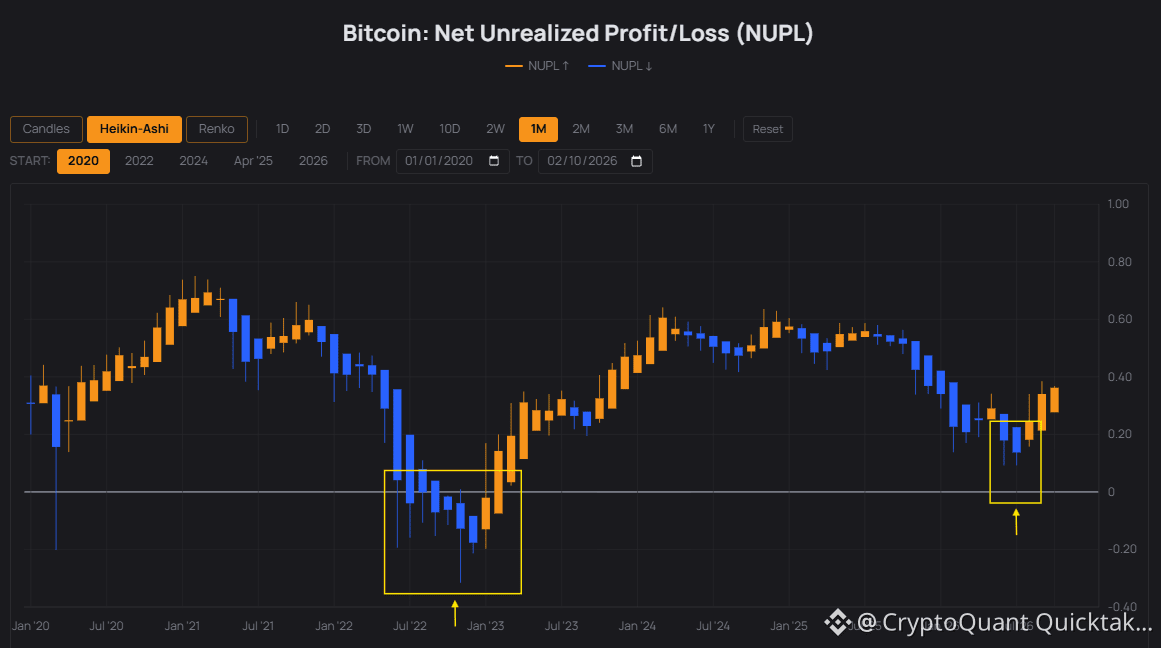
Bitcoin: the State of Holders - NUPL ↓• During the previous bear cycle, NUPL declined for approximately one year, eventually falling below 0 before beginning a sustained recovery. It reached -0.31.
• In the current cycle, the deterioration also lasted about one year, but the recovery began from a considerably less severe level of market stress. NUPL never fell below 0 and reached a low of only +0.09, meaning that the market remained in aggregate unrealized profit even at the deepest point of the decline.
• From its low, NUPL increased to +0.38, representing a rise of approximately 300%. This recovery occurred in just three months. The last time a recovery of similar magnitude occurred after a downtrend was in early 2023, which preceded a major bullish trend that extended through 2025.
Written by Facundo Fama
Bitcoin: the State of Holders - NUPL ↓
• During the previous bear cycle, NUPL declined for approximately one year, eventually falling below 0 before beginning a sustained recovery. It reached -0.31.
• In the current cycle, the deterioration also lasted about one year, but the recovery began from a considerably less severe level of market stress. NUPL never fell below 0 and reached a low of only +0.09, meaning that the market remained in aggregate unrealized profit even at the deepest point of the decline.
• From its low, NUPL increased to +0.38, representing a rise of approximately 300%. This recovery occurred in just three months. The last time a recovery of similar magnitude occurred after a downtrend was in early 2023, which preceded a major bullish trend that extended through 2025.
Written by Facundo Fama
• In the current cycle, the deterioration also lasted about one year, but the recovery began from a considerably less severe level of market stress. NUPL never fell below 0 and reached a low of only +0.09, meaning that the market remained in aggregate unrealized profit even at the deepest point of the decline.
• From its low, NUPL increased to +0.38, representing a rise of approximately 300%. This recovery occurred in just three months. The last time a recovery of similar magnitude occurred after a downtrend was in early 2023, which preceded a major bullish trend that extended through 2025.
Written by Facundo Fama
134
Article
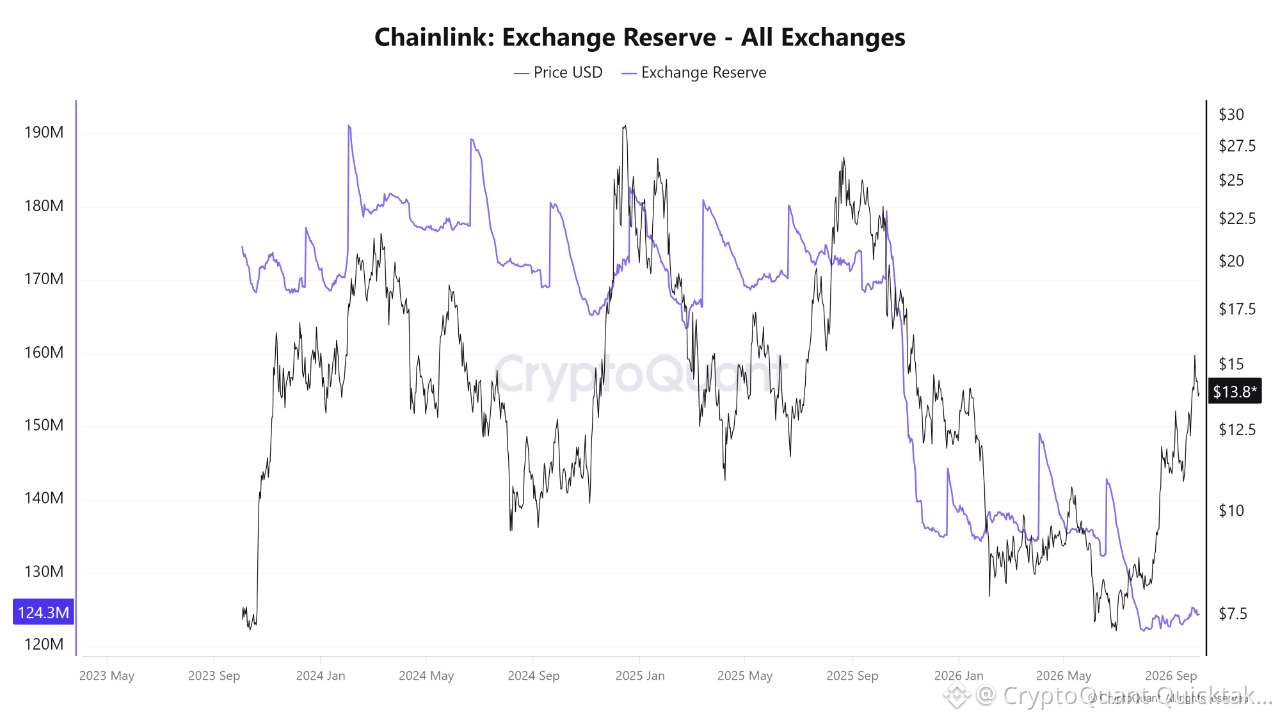
Chainlink Rallies From $9 to Above $15 While Exchange Reserves Sit Near a Multi-Year LowLINK broke out of a seven month $7 to $10 range starting in September, rallying to a peak above $15.50 before pulling back to its current $13.887. What makes this breakout different from several prior rallies on this same chart is what exchange reserves did, or rather, didn't do, while it happened.
Looking at the reserve chart since late 2023, a clear sawtooth pattern repeats, reserves build gradually, then jump sharply in a single move, a pattern that's shown up at least six or seven times, early 2024, mid 2024, late 2024, early and mid 2025, and once more in early 2026. Several of those spikes land close to local price tops or precede price weakness, consistent with sudden reserve increases reflecting coins moving toward exchanges ahead of potential selling.
This latest rally breaks that pattern. Reserves have stayed essentially flat near 124 to 130M through the entire September to October move, no sharp spike accompanying this breakout the way one accompanied several prior rallies. Reserves currently sit at 124.3M, near the lowest point of the entire multi-year window shown, well below the 190M peak from early 2024.
What stands out too is the broader structural decline, reserves have fallen from that 190M peak to current levels through a mix of gradual declines and periodic spikes, a multi-year downtrend in available exchange supply persisting across multiple price cycles.
My honest read: a rally happening without the characteristic reserve spike that's marked several prior tops is a genuinely different setup, suggesting less fresh supply arriving at exchanges than in past comparable moves. Not proof the rally continues, but the absence of that historical warning sign is worth noting.
What I'm watching: whether a reserve spike eventually shows up as this rally continues or if LINK pushes back toward its recent highs, since that's been the pattern's typical trigger point historically.
Written by R3N
Chainlink Rallies From $9 to Above $15 While Exchange Reserves Sit Near a Multi-Year Low
LINK broke out of a seven month $7 to $10 range starting in September, rallying to a peak above $15.50 before pulling back to its current $13.887. What makes this breakout different from several prior rallies on this same chart is what exchange reserves did, or rather, didn't do, while it happened.
Looking at the reserve chart since late 2023, a clear sawtooth pattern repeats, reserves build gradually, then jump sharply in a single move, a pattern that's shown up at least six or seven times, early 2024, mid 2024, late 2024, early and mid 2025, and once more in early 2026. Several of those spikes land close to local price tops or precede price weakness, consistent with sudden reserve increases reflecting coins moving toward exchanges ahead of potential selling.
This latest rally breaks that pattern. Reserves have stayed essentially flat near 124 to 130M through the entire September to October move, no sharp spike accompanying this breakout the way one accompanied several prior rallies. Reserves currently sit at 124.3M, near the lowest point of the entire multi-year window shown, well below the 190M peak from early 2024.
What stands out too is the broader structural decline, reserves have fallen from that 190M peak to current levels through a mix of gradual declines and periodic spikes, a multi-year downtrend in available exchange supply persisting across multiple price cycles.
My honest read: a rally happening without the characteristic reserve spike that's marked several prior tops is a genuinely different setup, suggesting less fresh supply arriving at exchanges than in past comparable moves. Not proof the rally continues, but the absence of that historical warning sign is worth noting.
What I'm watching: whether a reserve spike eventually shows up as this rally continues or if LINK pushes back toward its recent highs, since that's been the pattern's typical trigger point historically.
Written by R3N
Looking at the reserve chart since late 2023, a clear sawtooth pattern repeats, reserves build gradually, then jump sharply in a single move, a pattern that's shown up at least six or seven times, early 2024, mid 2024, late 2024, early and mid 2025, and once more in early 2026. Several of those spikes land close to local price tops or precede price weakness, consistent with sudden reserve increases reflecting coins moving toward exchanges ahead of potential selling.
This latest rally breaks that pattern. Reserves have stayed essentially flat near 124 to 130M through the entire September to October move, no sharp spike accompanying this breakout the way one accompanied several prior rallies. Reserves currently sit at 124.3M, near the lowest point of the entire multi-year window shown, well below the 190M peak from early 2024.
What stands out too is the broader structural decline, reserves have fallen from that 190M peak to current levels through a mix of gradual declines and periodic spikes, a multi-year downtrend in available exchange supply persisting across multiple price cycles.
My honest read: a rally happening without the characteristic reserve spike that's marked several prior tops is a genuinely different setup, suggesting less fresh supply arriving at exchanges than in past comparable moves. Not proof the rally continues, but the absence of that historical warning sign is worth noting.
What I'm watching: whether a reserve spike eventually shows up as this rally continues or if LINK pushes back toward its recent highs, since that's been the pattern's typical trigger point historically.
Written by R3N
81
Article
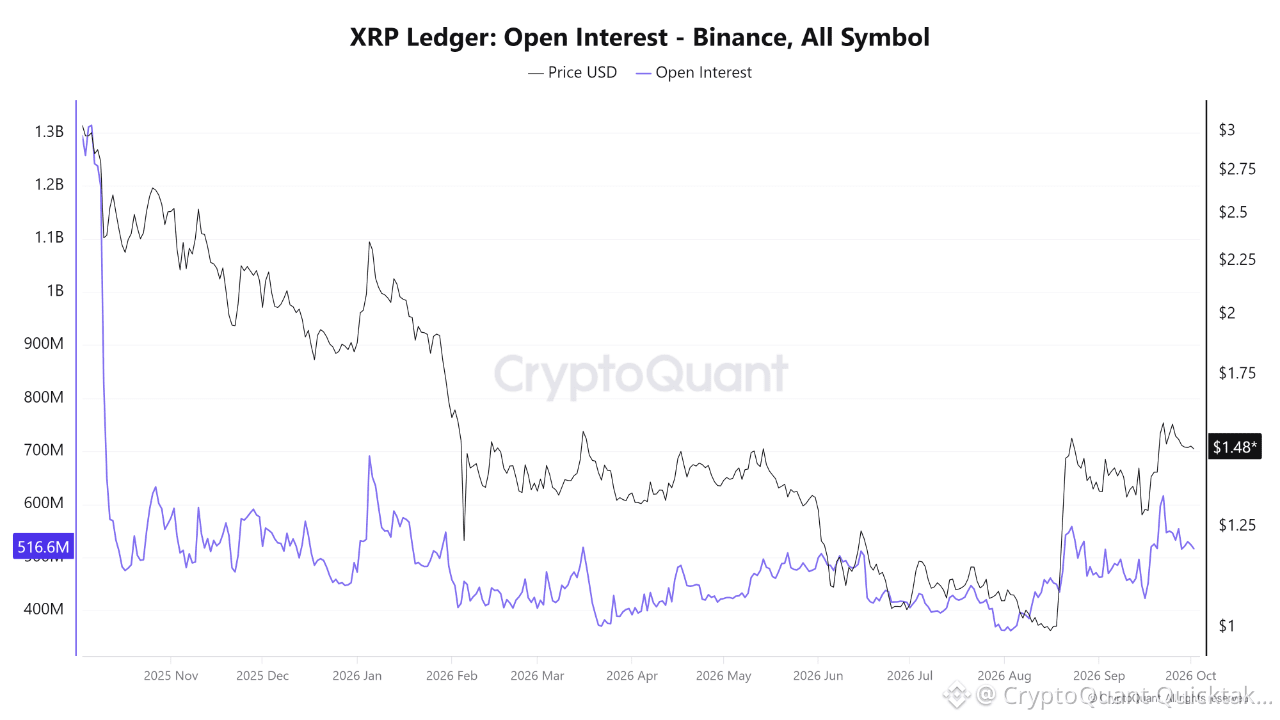
XRP Open Interest on Binance Recovers to 516.6M, Still Far Below Its October 2025 Starting PointXRP open interest on Binance sits at 516.6M, up from a 2026 low near 350 to 400M, but still a fraction of where it started this chart, above 1.3B last October. Price has recovered to $1.48 from a February low near $1, a genuine rebound open interest hasn't matched in scale.
The two series have largely moved together through this entire window. The sharpest open interest collapse happened almost immediately, cratering from 1.3B to the 500 to 600M range within the first weeks shown, right alongside price sliding from near $3 toward $2.20. Both continued declining through a volatile February, open interest dropping to its cycle low near 350 to 400M as price fell sharply toward $1.50. From March through July, both chopped sideways in a tight range, open interest mostly 400 to 700M, price $1 to $1.75, no clean directional trend in either.
The most recent move is where this gets interesting. Late August into September saw both lines spike together, open interest jumping from around 400M toward above 700M, price climbing from near $1 to the $1.25 to $1.30 area, before both pulled back. A genuine joint recovery in positioning and price, not price moving independently of leverage.
What stands out is the gap that remains. Price at $1.48 represents a real recovery off its own lows, but open interest at 516.6M is still well below both its October 2025 starting point and its own recent September peak above 700M. That asymmetry suggests leveraged positioning hasn't fully returned to the scale price action alone might suggest.
My honest read: open interest and price have been genuinely correlated throughout, making the current gap meaningful rather than noise. Price recovering faster than open interest rebuilds typically points to a less leveraged, more cautious market than a year ago.
What I'm watching: whether open interest continues climbing back toward its recent September peak, or whether this current pullback in both series extends further.
Written by R3N
XRP Open Interest on Binance Recovers to 516.6M, Still Far Below Its October 2025 Starting Point
XRP open interest on Binance sits at 516.6M, up from a 2026 low near 350 to 400M, but still a fraction of where it started this chart, above 1.3B last October. Price has recovered to $1.48 from a February low near $1, a genuine rebound open interest hasn't matched in scale.
The two series have largely moved together through this entire window. The sharpest open interest collapse happened almost immediately, cratering from 1.3B to the 500 to 600M range within the first weeks shown, right alongside price sliding from near $3 toward $2.20. Both continued declining through a volatile February, open interest dropping to its cycle low near 350 to 400M as price fell sharply toward $1.50. From March through July, both chopped sideways in a tight range, open interest mostly 400 to 700M, price $1 to $1.75, no clean directional trend in either.
The most recent move is where this gets interesting. Late August into September saw both lines spike together, open interest jumping from around 400M toward above 700M, price climbing from near $1 to the $1.25 to $1.30 area, before both pulled back. A genuine joint recovery in positioning and price, not price moving independently of leverage.
What stands out is the gap that remains. Price at $1.48 represents a real recovery off its own lows, but open interest at 516.6M is still well below both its October 2025 starting point and its own recent September peak above 700M. That asymmetry suggests leveraged positioning hasn't fully returned to the scale price action alone might suggest.
My honest read: open interest and price have been genuinely correlated throughout, making the current gap meaningful rather than noise. Price recovering faster than open interest rebuilds typically points to a less leveraged, more cautious market than a year ago.
What I'm watching: whether open interest continues climbing back toward its recent September peak, or whether this current pullback in both series extends further.
Written by R3N
The two series have largely moved together through this entire window. The sharpest open interest collapse happened almost immediately, cratering from 1.3B to the 500 to 600M range within the first weeks shown, right alongside price sliding from near $3 toward $2.20. Both continued declining through a volatile February, open interest dropping to its cycle low near 350 to 400M as price fell sharply toward $1.50. From March through July, both chopped sideways in a tight range, open interest mostly 400 to 700M, price $1 to $1.75, no clean directional trend in either.
The most recent move is where this gets interesting. Late August into September saw both lines spike together, open interest jumping from around 400M toward above 700M, price climbing from near $1 to the $1.25 to $1.30 area, before both pulled back. A genuine joint recovery in positioning and price, not price moving independently of leverage.
What stands out is the gap that remains. Price at $1.48 represents a real recovery off its own lows, but open interest at 516.6M is still well below both its October 2025 starting point and its own recent September peak above 700M. That asymmetry suggests leveraged positioning hasn't fully returned to the scale price action alone might suggest.
My honest read: open interest and price have been genuinely correlated throughout, making the current gap meaningful rather than noise. Price recovering faster than open interest rebuilds typically points to a less leveraged, more cautious market than a year ago.
What I'm watching: whether open interest continues climbing back toward its recent September peak, or whether this current pullback in both series extends further.
Written by R3N
1
154
Article
Bitcoin Supply Is Tightening, but U.S. Spot Buyers Haven't Shown Up YetBitcoin is trading near $85K, and the on-chain picture is split: supply-side metrics are clearly constructive, while U.S. spot demand still lags.
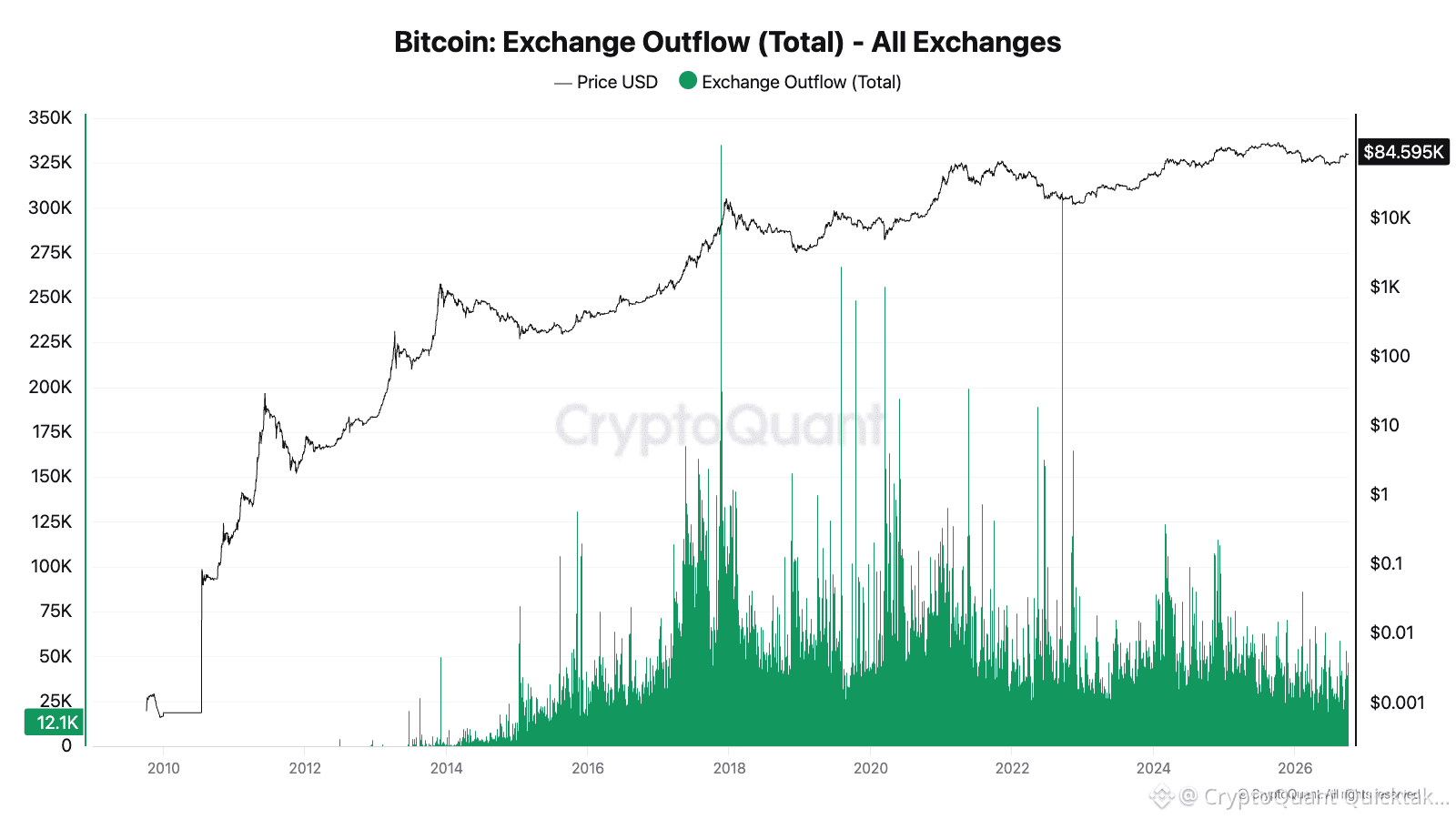
Supply is tightening. All-exchange reserves have fallen to about 2.68M BTC, the lowest since at least September 2023, and have declined through every price cycle since the early-2024 peak near 3.2M BTC. Exchanges recorded net outflows on six of seven days from September 24 to 30, roughly 18.2K BTC in total.
Institutional flows have turned. U.S. spot ETFs are now +2,312 BTC year-to-date after absorbing 85.4K BTC since the July low. Short-term holders are back in profit, with STH Market Cap about 15% above STH Realized Cap.
The missing piece is U.S. spot demand. The Coinbase Premium has been negative for 26 consecutive days, and Apparent Demand (30D) is improving but still negative near -101K BTC.
Derivatives are calm. DVOL sits near 36, lower than on 95% of days since 2021, and funding is neutral. Low leverage makes the move cleaner, but compressed volatility has often come before sharp expansions.
My read: structurally constructive, tactically unconfirmed. Outflows and ETF absorption are tightening liquid supply, but without U.S. spot bids, rallies risk stalling, as the quick rejection from $87K after the jobs report showed.
What I'm watching: a Coinbase Premium flip to positive, Apparent Demand crossing above zero, and whether outflows continue as price approaches $95K. Coins flowing back onto exchanges into strength would invalidate the setup.
Written by Zakariya Sharif
Bitcoin Supply Is Tightening, but U.S. Spot Buyers Haven't Shown Up Yet
Bitcoin is trading near $85K, and the on-chain picture is split: supply-side metrics are clearly constructive, while U.S. spot demand still lags.
Supply is tightening. All-exchange reserves have fallen to about 2.68M BTC, the lowest since at least September 2023, and have declined through every price cycle since the early-2024 peak near 3.2M BTC. Exchanges recorded net outflows on six of seven days from September 24 to 30, roughly 18.2K BTC in total.
Institutional flows have turned. U.S. spot ETFs are now +2,312 BTC year-to-date after absorbing 85.4K BTC since the July low. Short-term holders are back in profit, with STH Market Cap about 15% above STH Realized Cap.
The missing piece is U.S. spot demand. The Coinbase Premium has been negative for 26 consecutive days, and Apparent Demand (30D) is improving but still negative near -101K BTC.
Derivatives are calm. DVOL sits near 36, lower than on 95% of days since 2021, and funding is neutral. Low leverage makes the move cleaner, but compressed volatility has often come before sharp expansions.
My read: structurally constructive, tactically unconfirmed. Outflows and ETF absorption are tightening liquid supply, but without U.S. spot bids, rallies risk stalling, as the quick rejection from $87K after the jobs report showed.
What I'm watching: a Coinbase Premium flip to positive, Apparent Demand crossing above zero, and whether outflows continue as price approaches $95K. Coins flowing back onto exchanges into strength would invalidate the setup.
Written by Zakariya Sharif
Supply is tightening. All-exchange reserves have fallen to about 2.68M BTC, the lowest since at least September 2023, and have declined through every price cycle since the early-2024 peak near 3.2M BTC. Exchanges recorded net outflows on six of seven days from September 24 to 30, roughly 18.2K BTC in total.
Institutional flows have turned. U.S. spot ETFs are now +2,312 BTC year-to-date after absorbing 85.4K BTC since the July low. Short-term holders are back in profit, with STH Market Cap about 15% above STH Realized Cap.
The missing piece is U.S. spot demand. The Coinbase Premium has been negative for 26 consecutive days, and Apparent Demand (30D) is improving but still negative near -101K BTC.
Derivatives are calm. DVOL sits near 36, lower than on 95% of days since 2021, and funding is neutral. Low leverage makes the move cleaner, but compressed volatility has often come before sharp expansions.
My read: structurally constructive, tactically unconfirmed. Outflows and ETF absorption are tightening liquid supply, but without U.S. spot bids, rallies risk stalling, as the quick rejection from $87K after the jobs report showed.
What I'm watching: a Coinbase Premium flip to positive, Apparent Demand crossing above zero, and whether outflows continue as price approaches $95K. Coins flowing back onto exchanges into strength would invalidate the setup.
Written by Zakariya Sharif
2
219
Article
Bitcoin Between Two Walls: High Yields and Profit-Taking Meet ETF DemandBitcoin is caught between forces capping gains and demand cushioning declines.
High U.S. Treasury yields, uncertainty ahead of the midterm elections, and profit-taking weigh on prices. AI investment may also compete for capital, although direct flows from Bitcoin into AI stocks have not been established.
Spot Bitcoin ETFs remain a key support, but inflows have slowed. Farside data show net inflows of about $2.39 billion on September 21–25, versus just $51.2 million across September 28–October 1.
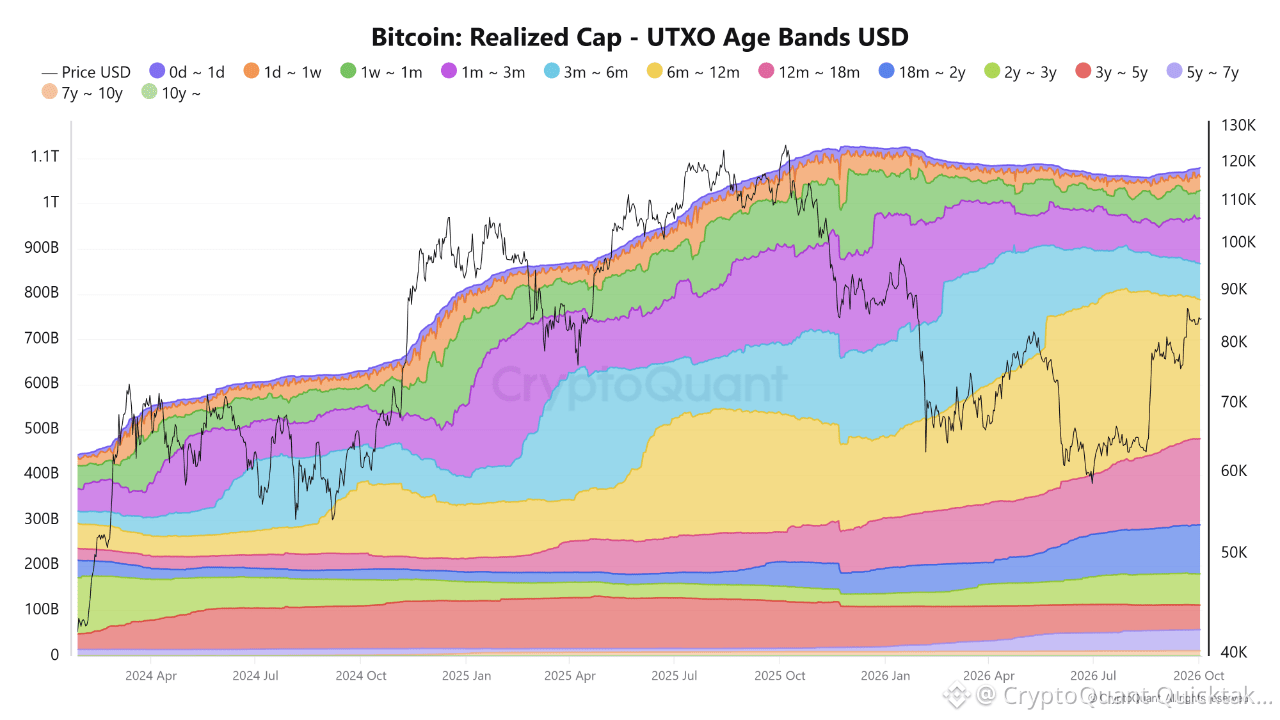
CryptoQuant's Realized Cap chart shows a modest recovery after declining earlier in 2026, suggesting improvement in the capital represented by coins' last-moved prices. However, this is not a direct measure of cash inflows, and changes across age bands also reflect coins aging.
Funding rates have generally remained slightly positive, easing toward zero at the chart's endpoint. They show less overheating than earlier rally peaks, but cannot guarantee limited liquidation risk.
The key is whether spot buying broadens beyond ETFs and absorbs profit-taking. Neither wall is permanent. Watch demand and long-term yields, and remain prepared for a move in either direction.
Written by XWIN Japan
Bitcoin Between Two Walls: High Yields and Profit-Taking Meet ETF Demand
Bitcoin is caught between forces capping gains and demand cushioning declines.
High U.S. Treasury yields, uncertainty ahead of the midterm elections, and profit-taking weigh on prices. AI investment may also compete for capital, although direct flows from Bitcoin into AI stocks have not been established.
Spot Bitcoin ETFs remain a key support, but inflows have slowed. Farside data show net inflows of about $2.39 billion on September 21–25, versus just $51.2 million across September 28–October 1.
CryptoQuant's Realized Cap chart shows a modest recovery after declining earlier in 2026, suggesting improvement in the capital represented by coins' last-moved prices. However, this is not a direct measure of cash inflows, and changes across age bands also reflect coins aging.
Funding rates have generally remained slightly positive, easing toward zero at the chart's endpoint. They show less overheating than earlier rally peaks, but cannot guarantee limited liquidation risk.
The key is whether spot buying broadens beyond ETFs and absorbs profit-taking. Neither wall is permanent. Watch demand and long-term yields, and remain prepared for a move in either direction.
Written by XWIN Japan
High U.S. Treasury yields, uncertainty ahead of the midterm elections, and profit-taking weigh on prices. AI investment may also compete for capital, although direct flows from Bitcoin into AI stocks have not been established.
Spot Bitcoin ETFs remain a key support, but inflows have slowed. Farside data show net inflows of about $2.39 billion on September 21–25, versus just $51.2 million across September 28–October 1.
CryptoQuant's Realized Cap chart shows a modest recovery after declining earlier in 2026, suggesting improvement in the capital represented by coins' last-moved prices. However, this is not a direct measure of cash inflows, and changes across age bands also reflect coins aging.
Funding rates have generally remained slightly positive, easing toward zero at the chart's endpoint. They show less overheating than earlier rally peaks, but cannot guarantee limited liquidation risk.
The key is whether spot buying broadens beyond ETFs and absorbs profit-taking. Neither wall is permanent. Watch demand and long-term yields, and remain prepared for a move in either direction.
Written by XWIN Japan
BTC+0.30%
IEFETF-0.27%
1
145
Article
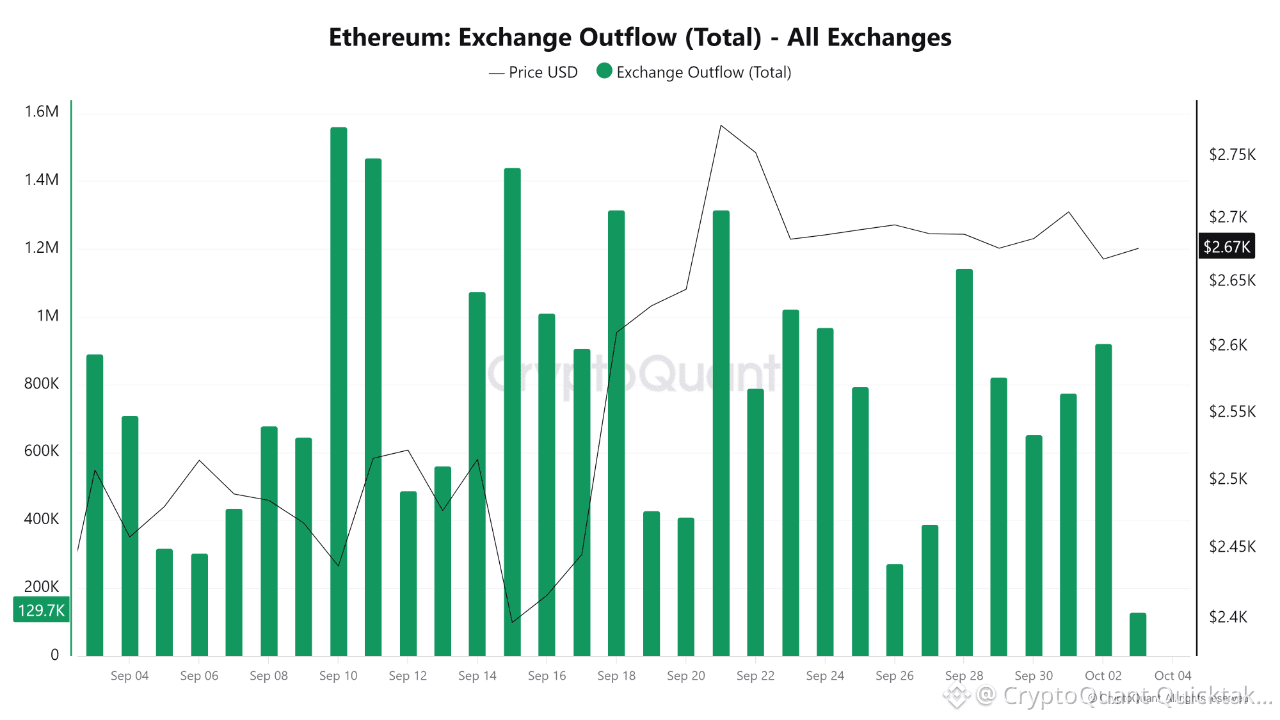
Ethereum Exchange Inflow Vs Outflow: a Month of Near Perfect Twin Spikes, Until the Final ReadingEthereum's exchange inflow and outflow have moved in near lockstep for most of the past month, both spiking on the same days, both easing on the same days. The exception is the most recent reading, where outflow finally pulled ahead of inflow, 129.7K versus 116.7K.
Looking at both charts side by side, the pattern through September is strikingly synchronized. The largest spikes, September 10 near 1.58M in and 1.55M out, September 18 around 1.45M in and 1.3M out, September 22 near 1.3M on both sides, September 28 around 1.15M on both sides, all land on identical days with nearly matching magnitude. That kind of twin movement usually points to high churn, large volumes cycling through exchanges, rather than one directional trend building across the month.
What changes at the very end is worth flagging. The latest print shows outflow at 129.7K against inflow at 116.7K, a net negative flow day, coins leaving exchanges rather than the roughly balanced churn that dominated the prior four weeks. One data point doesn't establish a new trend, but it's the first clear divergence in an otherwise matched month.
Price moved from around $2.40K in mid September up to $2.67K by early October, with the sharpest jump, roughly $2.45K to $2.70K between September 19 and 21, landing right after the September 18 inflow and outflow spike. Large two sided flow preceding a price breakout is worth noting, though it doesn't establish causation.
My honest read: a month of matched inflow and outflow mostly describes active trading and repositioning, not sustained accumulation or distribution. The final day's shift toward net outflow is the one genuinely new signal, worth watching for confirmation rather than treating as settled.
What I'm watching: whether outflow continues leading inflow over the next several sessions, which would mark an actual shift from this month's balanced pattern, or whether this reverts back to matched twin spikes.
Written by R3N
Ethereum Exchange Inflow Vs Outflow: a Month of Near Perfect Twin Spikes, Until the Final Reading
Ethereum's exchange inflow and outflow have moved in near lockstep for most of the past month, both spiking on the same days, both easing on the same days. The exception is the most recent reading, where outflow finally pulled ahead of inflow, 129.7K versus 116.7K.
Looking at both charts side by side, the pattern through September is strikingly synchronized. The largest spikes, September 10 near 1.58M in and 1.55M out, September 18 around 1.45M in and 1.3M out, September 22 near 1.3M on both sides, September 28 around 1.15M on both sides, all land on identical days with nearly matching magnitude. That kind of twin movement usually points to high churn, large volumes cycling through exchanges, rather than one directional trend building across the month.
What changes at the very end is worth flagging. The latest print shows outflow at 129.7K against inflow at 116.7K, a net negative flow day, coins leaving exchanges rather than the roughly balanced churn that dominated the prior four weeks. One data point doesn't establish a new trend, but it's the first clear divergence in an otherwise matched month.
Price moved from around $2.40K in mid September up to $2.67K by early October, with the sharpest jump, roughly $2.45K to $2.70K between September 19 and 21, landing right after the September 18 inflow and outflow spike. Large two sided flow preceding a price breakout is worth noting, though it doesn't establish causation.
My honest read: a month of matched inflow and outflow mostly describes active trading and repositioning, not sustained accumulation or distribution. The final day's shift toward net outflow is the one genuinely new signal, worth watching for confirmation rather than treating as settled.
What I'm watching: whether outflow continues leading inflow over the next several sessions, which would mark an actual shift from this month's balanced pattern, or whether this reverts back to matched twin spikes.
Written by R3N
Looking at both charts side by side, the pattern through September is strikingly synchronized. The largest spikes, September 10 near 1.58M in and 1.55M out, September 18 around 1.45M in and 1.3M out, September 22 near 1.3M on both sides, September 28 around 1.15M on both sides, all land on identical days with nearly matching magnitude. That kind of twin movement usually points to high churn, large volumes cycling through exchanges, rather than one directional trend building across the month.
What changes at the very end is worth flagging. The latest print shows outflow at 129.7K against inflow at 116.7K, a net negative flow day, coins leaving exchanges rather than the roughly balanced churn that dominated the prior four weeks. One data point doesn't establish a new trend, but it's the first clear divergence in an otherwise matched month.
Price moved from around $2.40K in mid September up to $2.67K by early October, with the sharpest jump, roughly $2.45K to $2.70K between September 19 and 21, landing right after the September 18 inflow and outflow spike. Large two sided flow preceding a price breakout is worth noting, though it doesn't establish causation.
My honest read: a month of matched inflow and outflow mostly describes active trading and repositioning, not sustained accumulation or distribution. The final day's shift toward net outflow is the one genuinely new signal, worth watching for confirmation rather than treating as settled.
What I'm watching: whether outflow continues leading inflow over the next several sessions, which would mark an actual shift from this month's balanced pattern, or whether this reverts back to matched twin spikes.
Written by R3N
179
Article
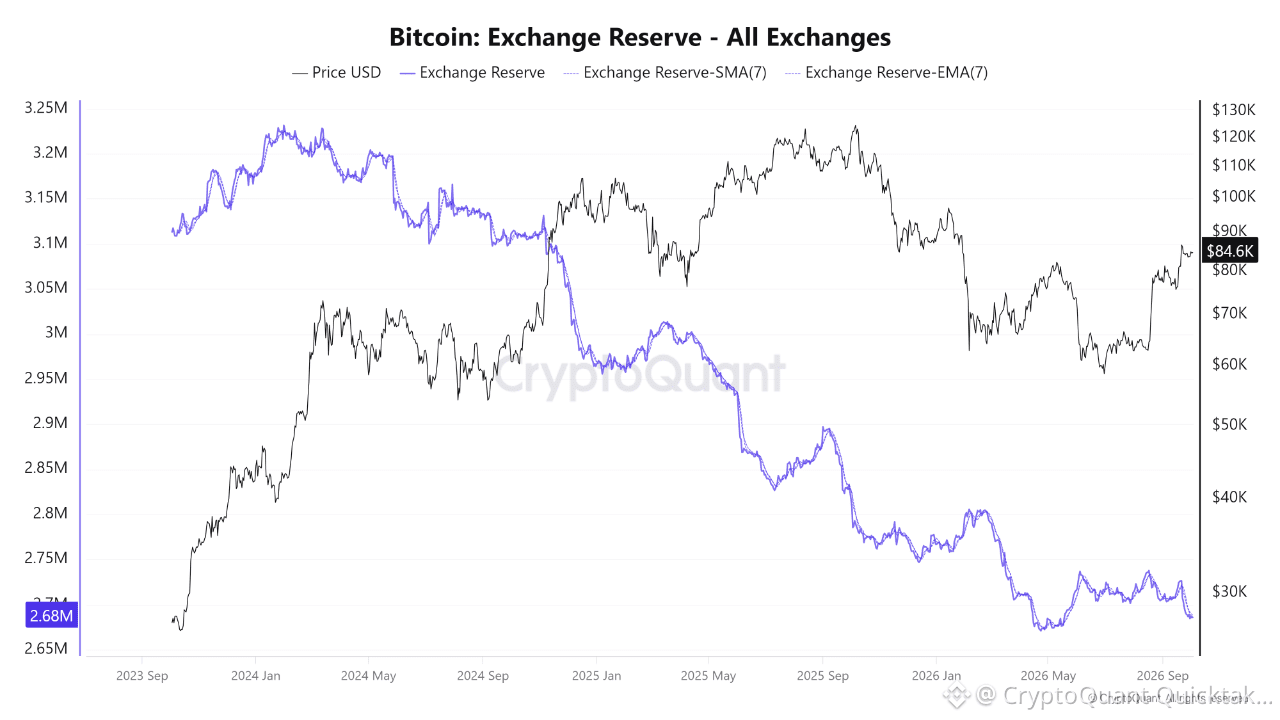
Bitcoin Exchange Reserves Hit a Fresh Multi-Year Low As Price Climbs Back Toward $85KAll exchange Bitcoin reserves sit at 2.68 million BTC, the lowest level on this chart since at least September 2023, while price has climbed back to $84,600. That combination, falling reserves alongside a recovering price, is the actual structural story, not just where price sits today.
Zooming out, the trend is strikingly consistent despite multiple price cycles in either direction. Reserves peaked near 3.2 million BTC in early 2024, when price was still well below $70K. From there, reserves declined in a persistent downtrend through every subsequent price cycle, the 2024 highs near $73K, the 2025 run toward $126K, and the pullback into 2026, reserves kept falling through all of it rather than tracking price moves.
What stands out is the period from late 2024 into 2025, where reserves dropped sharply, from around 3.1 million toward 2.9 million, even as price worked through a wide consolidation range. Coins leaving exchanges independent of any single price catalyst, a steady outflow pattern rather than event driven spikes.
The SMA and EMA overlays track the raw reserve line closely throughout, no major divergence between short term smoothing and the actual balance, suggesting this isn't noisy day to day volatility distorting the picture, it's a genuine sustained trend.
My honest read: persistent exchange reserve decline across multiple price regimes is typically read as a sign of accumulation or long term holding intent, since coins aren't sitting available for immediate sale. Reasonable here given how consistent the decline has been, though reserves leaving exchanges doesn't by itself confirm where those coins are going, cold storage, OTC desks, or other custody would all show the same pattern.
What I'm watching: whether this reserve decline continues as price pushes higher, or whether a rally toward new highs starts pulling supply back onto exchanges the way past cycles eventually did.
Written by R3N
Bitcoin Exchange Reserves Hit a Fresh Multi-Year Low As Price Climbs Back Toward $85K
All exchange Bitcoin reserves sit at 2.68 million BTC, the lowest level on this chart since at least September 2023, while price has climbed back to $84,600. That combination, falling reserves alongside a recovering price, is the actual structural story, not just where price sits today.
Zooming out, the trend is strikingly consistent despite multiple price cycles in either direction. Reserves peaked near 3.2 million BTC in early 2024, when price was still well below $70K. From there, reserves declined in a persistent downtrend through every subsequent price cycle, the 2024 highs near $73K, the 2025 run toward $126K, and the pullback into 2026, reserves kept falling through all of it rather than tracking price moves.
What stands out is the period from late 2024 into 2025, where reserves dropped sharply, from around 3.1 million toward 2.9 million, even as price worked through a wide consolidation range. Coins leaving exchanges independent of any single price catalyst, a steady outflow pattern rather than event driven spikes.
The SMA and EMA overlays track the raw reserve line closely throughout, no major divergence between short term smoothing and the actual balance, suggesting this isn't noisy day to day volatility distorting the picture, it's a genuine sustained trend.
My honest read: persistent exchange reserve decline across multiple price regimes is typically read as a sign of accumulation or long term holding intent, since coins aren't sitting available for immediate sale. Reasonable here given how consistent the decline has been, though reserves leaving exchanges doesn't by itself confirm where those coins are going, cold storage, OTC desks, or other custody would all show the same pattern.
What I'm watching: whether this reserve decline continues as price pushes higher, or whether a rally toward new highs starts pulling supply back onto exchanges the way past cycles eventually did.
Written by R3N
Zooming out, the trend is strikingly consistent despite multiple price cycles in either direction. Reserves peaked near 3.2 million BTC in early 2024, when price was still well below $70K. From there, reserves declined in a persistent downtrend through every subsequent price cycle, the 2024 highs near $73K, the 2025 run toward $126K, and the pullback into 2026, reserves kept falling through all of it rather than tracking price moves.
What stands out is the period from late 2024 into 2025, where reserves dropped sharply, from around 3.1 million toward 2.9 million, even as price worked through a wide consolidation range. Coins leaving exchanges independent of any single price catalyst, a steady outflow pattern rather than event driven spikes.
The SMA and EMA overlays track the raw reserve line closely throughout, no major divergence between short term smoothing and the actual balance, suggesting this isn't noisy day to day volatility distorting the picture, it's a genuine sustained trend.
My honest read: persistent exchange reserve decline across multiple price regimes is typically read as a sign of accumulation or long term holding intent, since coins aren't sitting available for immediate sale. Reasonable here given how consistent the decline has been, though reserves leaving exchanges doesn't by itself confirm where those coins are going, cold storage, OTC desks, or other custody would all show the same pattern.
What I'm watching: whether this reserve decline continues as price pushes higher, or whether a rally toward new highs starts pulling supply back onto exchanges the way past cycles eventually did.
Written by R3N
224
Verified
Article
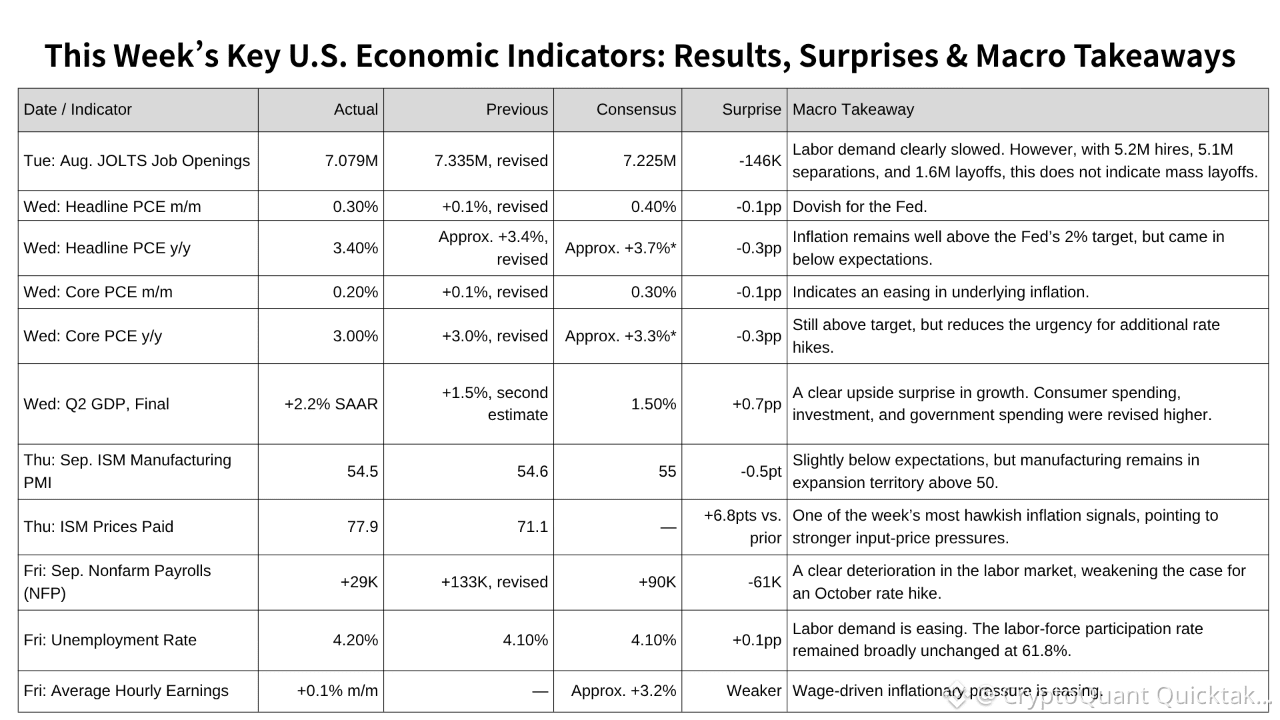
Bitcoin Surges Above $87K, Then Pulls Back — What Happened After the U.S. Jobs Report?Bitcoin experienced a volatile week as U.S. inflation, growth, and labor data reshaped expectations for Federal Reserve policy.
BTC fell to around $82,600 (¥13.05 million) early in the week before rebounding sharply. U.S. PCE inflation came in below expectations, while JOLTS data showed weakening labor demand.
The biggest move followed the September jobs report. Nonfarm payrolls increased by only 29,000, far below the 90,000 consensus, while unemployment rose to 4.2%. Wage growth also slowed, reducing pressure on the Fed to raise rates again.
Bitcoin responded by surging to around $87,100 (¥13.76 million), but the rally quickly faded. BTC later fell back to around $84,700 (¥13.34 million).
The key issue now is that weaker Fed rate-hike expectations alone may not be enough to sustain a Bitcoin rally. Treasury yields, the U.S. dollar, oil prices, and inflation risks remain major factors.
The next BTC move may depend on this chain:
Inflation → Fed → Treasury yields → U.S. dollar → Bitcoin.
Written by XWIN Japan
Bitcoin Surges Above $87K, Then Pulls Back — What Happened After the U.S. Jobs Report?
Bitcoin experienced a volatile week as U.S. inflation, growth, and labor data reshaped expectations for Federal Reserve policy.
BTC fell to around $82,600 (¥13.05 million) early in the week before rebounding sharply. U.S. PCE inflation came in below expectations, while JOLTS data showed weakening labor demand.
The biggest move followed the September jobs report. Nonfarm payrolls increased by only 29,000, far below the 90,000 consensus, while unemployment rose to 4.2%. Wage growth also slowed, reducing pressure on the Fed to raise rates again.
Bitcoin responded by surging to around $87,100 (¥13.76 million), but the rally quickly faded. BTC later fell back to around $84,700 (¥13.34 million).
The key issue now is that weaker Fed rate-hike expectations alone may not be enough to sustain a Bitcoin rally. Treasury yields, the U.S. dollar, oil prices, and inflation risks remain major factors.
The next BTC move may depend on this chain:
Inflation → Fed → Treasury yields → U.S. dollar → Bitcoin.
Written by XWIN Japan
BTC fell to around $82,600 (¥13.05 million) early in the week before rebounding sharply. U.S. PCE inflation came in below expectations, while JOLTS data showed weakening labor demand.
The biggest move followed the September jobs report. Nonfarm payrolls increased by only 29,000, far below the 90,000 consensus, while unemployment rose to 4.2%. Wage growth also slowed, reducing pressure on the Fed to raise rates again.
Bitcoin responded by surging to around $87,100 (¥13.76 million), but the rally quickly faded. BTC later fell back to around $84,700 (¥13.34 million).
The key issue now is that weaker Fed rate-hike expectations alone may not be enough to sustain a Bitcoin rally. Treasury yields, the U.S. dollar, oil prices, and inflation risks remain major factors.
The next BTC move may depend on this chain:
Inflation → Fed → Treasury yields → U.S. dollar → Bitcoin.
Written by XWIN Japan
1
201
Article
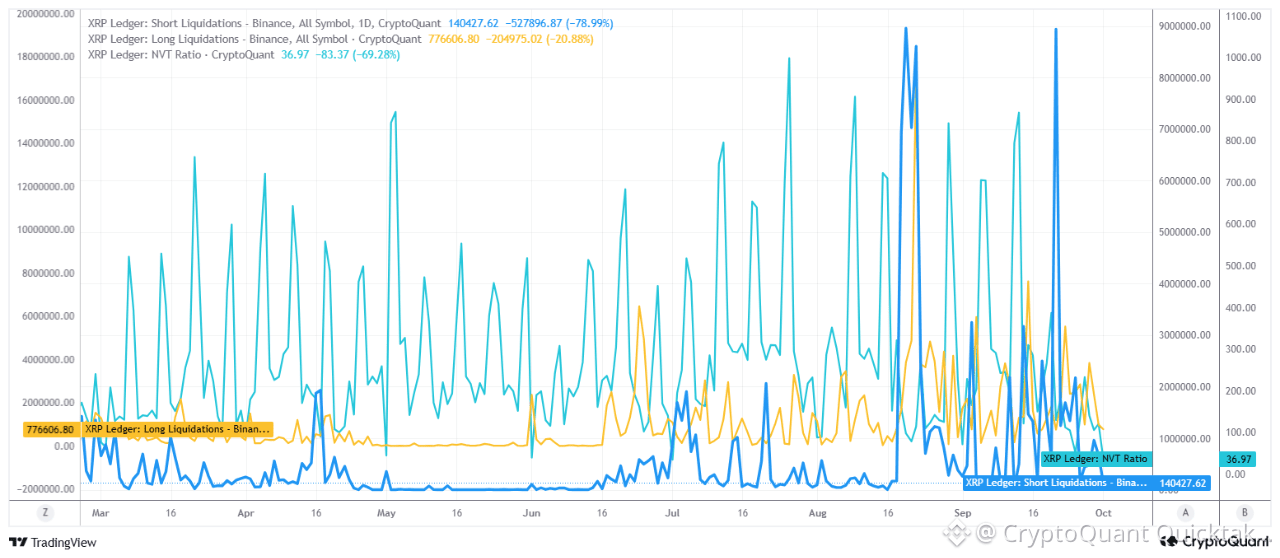
XRP’s Leverage Trading CalmThe chart shows particularly sharp and frequent spikes in liquidations from the end of July through September. This indicates that leveraged positions in the XRP derivatives market were liquidated heavily during certain periods.
In the current data, long liquidations appear to be higher than short liquidations, suggesting that long positions have been more heavily affected by recent downward price movements. This situation may create a liquidation risk for long positions. However, there has been a decline in liquidations, which may indicate that liquidation pressure is decreasing.
The fact that NVT has fallen by 69.28% to 36.97 indicates a significant change compared with the previous period. However, this decline needs to be interpreted correctly. If XRP’s transfer volume has increased while NVT is falling, network activity may have strengthened relative to the market capitalization. This is positive in terms of the price potentially receiving greater support from underlying network activity.
The recent decline in liquidations and the drop in NVT may indicate an environment where price movements can continue under lower leverage pressure. If spot market demand also accompanies these developments, it could provide a stronger signal. The decline in liquidations may offer some relief; however, for a sustained rise, spot buying, trading volume, and price structure would need to support the move.
Written by PelinayPA
XRP’s Leverage Trading Calm
The chart shows particularly sharp and frequent spikes in liquidations from the end of July through September. This indicates that leveraged positions in the XRP derivatives market were liquidated heavily during certain periods.
In the current data, long liquidations appear to be higher than short liquidations, suggesting that long positions have been more heavily affected by recent downward price movements. This situation may create a liquidation risk for long positions. However, there has been a decline in liquidations, which may indicate that liquidation pressure is decreasing.
The fact that NVT has fallen by 69.28% to 36.97 indicates a significant change compared with the previous period. However, this decline needs to be interpreted correctly. If XRP’s transfer volume has increased while NVT is falling, network activity may have strengthened relative to the market capitalization. This is positive in terms of the price potentially receiving greater support from underlying network activity.
The recent decline in liquidations and the drop in NVT may indicate an environment where price movements can continue under lower leverage pressure. If spot market demand also accompanies these developments, it could provide a stronger signal. The decline in liquidations may offer some relief; however, for a sustained rise, spot buying, trading volume, and price structure would need to support the move.
Written by PelinayPA
In the current data, long liquidations appear to be higher than short liquidations, suggesting that long positions have been more heavily affected by recent downward price movements. This situation may create a liquidation risk for long positions. However, there has been a decline in liquidations, which may indicate that liquidation pressure is decreasing.
The fact that NVT has fallen by 69.28% to 36.97 indicates a significant change compared with the previous period. However, this decline needs to be interpreted correctly. If XRP’s transfer volume has increased while NVT is falling, network activity may have strengthened relative to the market capitalization. This is positive in terms of the price potentially receiving greater support from underlying network activity.
The recent decline in liquidations and the drop in NVT may indicate an environment where price movements can continue under lower leverage pressure. If spot market demand also accompanies these developments, it could provide a stronger signal. The decline in liquidations may offer some relief; however, for a sustained rise, spot buying, trading volume, and price structure would need to support the move.
Written by PelinayPA
170
Article
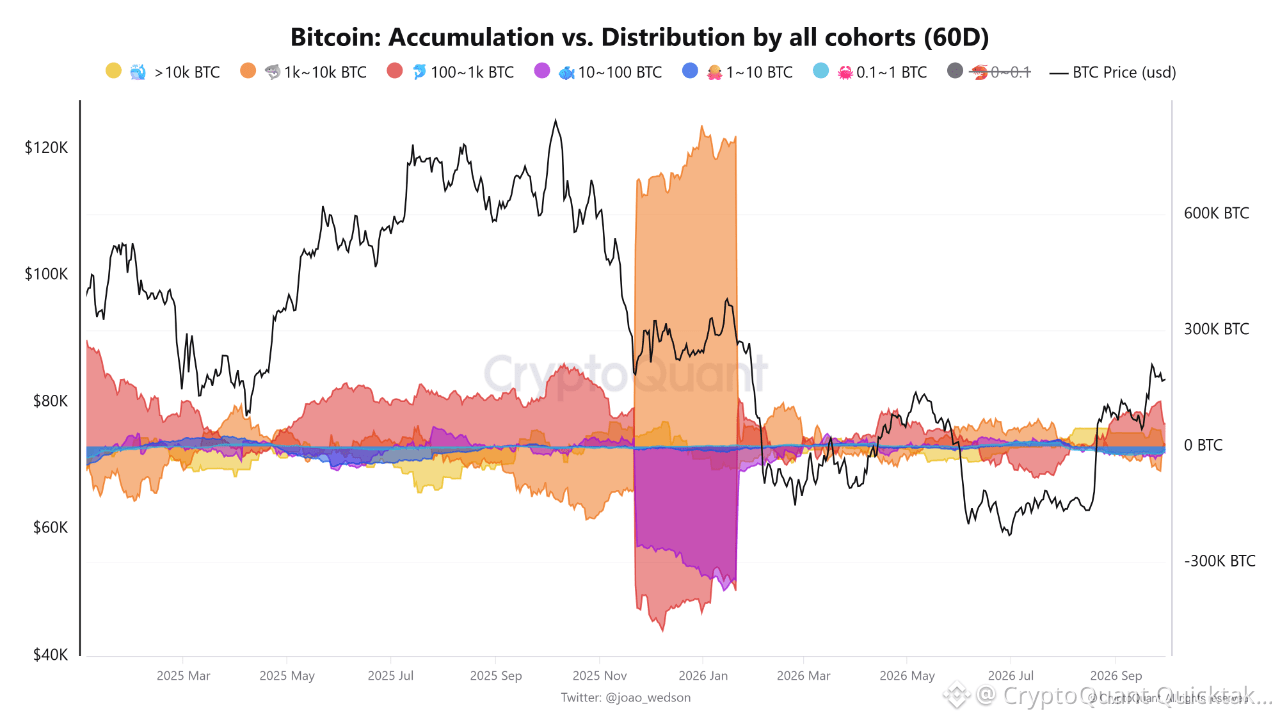
Uptober May Be Sealed As This Indicator Flashes Rare Green SignalThe indicator in question is the Bitcoin Accumulation Trend. Traditionally, it is used to understand the behavior of different Bitcoin holder cohorts. It reveals who is buying and how many units are being accumulated or sold at a given time.
While tracking the figures, a new pattern emerges that has coincided with significant uptrends. A closer look at the chart shows several areas where the bands contracted.
Paying attention to these contractions reveals a recurring pattern: periods of significant thinning have preceded strong upward momentum. For example, the metric underwent notable contraction between April 17 and 20, 2025. During this period, Bitcoin began climbing from around $84,000 and eventually reached $109,000.
Another contraction occurred between March 5 and 8, followed shortly afterward by a notable uptrend.
The bands are contracting again on the BTC Accumulation Trend chart at the time of writing. If history is anything to go by, the apex coin may be gearing up for another significant uptrend this month.
Written by APTRekt
Uptober May Be Sealed As This Indicator Flashes Rare Green Signal
The indicator in question is the Bitcoin Accumulation Trend. Traditionally, it is used to understand the behavior of different Bitcoin holder cohorts. It reveals who is buying and how many units are being accumulated or sold at a given time.
While tracking the figures, a new pattern emerges that has coincided with significant uptrends. A closer look at the chart shows several areas where the bands contracted.
Paying attention to these contractions reveals a recurring pattern: periods of significant thinning have preceded strong upward momentum. For example, the metric underwent notable contraction between April 17 and 20, 2025. During this period, Bitcoin began climbing from around $84,000 and eventually reached $109,000.
Another contraction occurred between March 5 and 8, followed shortly afterward by a notable uptrend.
The bands are contracting again on the BTC Accumulation Trend chart at the time of writing. If history is anything to go by, the apex coin may be gearing up for another significant uptrend this month.
Written by APTRekt
While tracking the figures, a new pattern emerges that has coincided with significant uptrends. A closer look at the chart shows several areas where the bands contracted.
Paying attention to these contractions reveals a recurring pattern: periods of significant thinning have preceded strong upward momentum. For example, the metric underwent notable contraction between April 17 and 20, 2025. During this period, Bitcoin began climbing from around $84,000 and eventually reached $109,000.
Another contraction occurred between March 5 and 8, followed shortly afterward by a notable uptrend.
The bands are contracting again on the BTC Accumulation Trend chart at the time of writing. If history is anything to go by, the apex coin may be gearing up for another significant uptrend this month.
Written by APTRekt
1
2
111
Article
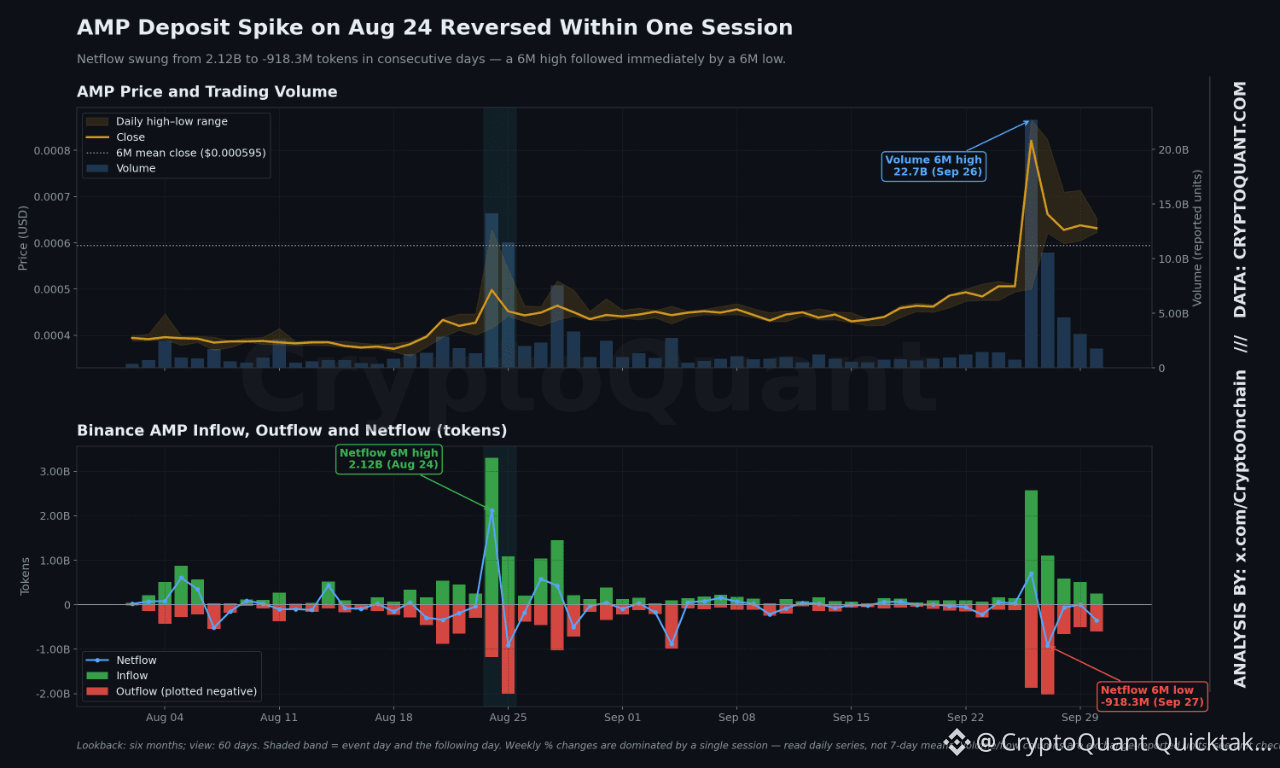
AMP: the Sep 26 Activity Shock Was Absorbed — Binance Reserve Ends Lower Than BeforeAMP’s 7-day averages look explosive (volume +572% w/w, transactions +413%, active addresses +120%), but the daily data shows this is a single-day event, not a trend. On Sep 26, volume hit $22.7B and transaction count reached 11,216 — both 6-month highs, roughly 15–30x the prior baseline. Active addresses rose to 790, below the 6-month peak of 940.
The exchange flow pattern is the real story. On Sep 26, 2.58B AMP flowed into Binance (netflow +706M) and reserve jumped from 6.59B to 7.29B. The very next day, 2.02B flowed out — the largest daily outflow in six months — pushing netflow to -918M, a 6-month low. Reserve dropped to 6.37B and has drifted to ~6.31B since, about 4% below the pre-event level and close to the 6-month mean of 6.27B. In short: the supply that came in to be sold was fully absorbed, and more left than arrived.
Deposit composition points to retail participation. Average inflow per transaction (4.08M) is roughly half the 6-month mean (8.1M), and top-10 inflow (5.56M) is 40% below its 6-month average — many small deposits rather than whale distribution. Reserve in USD rose 29% while reserve in tokens fell 3.7%, confirming the move is price-driven, not accumulation on exchange.
Price closed +34% w/w and +46% vs. three months ago, with velocity at 36.7, near its 6-month high (36.9) and above the mean (34.3) — the token is turning over faster than usual.
The caveat: momentum is fading quickly. Daily transactions fell 11,216 → 6,460 → 3,013 → 1,664, converging back toward the 6-month mean of ~1,050. Key signals to watch: whether transaction count holds above the 6-month average, and whether Binance reserve continues to decline. A reserve break below 6.2B with steady outflows would suggest holders are withdrawing after the event; a return to the pre-spike reserve would indicate the rally is being sold into.
Written by CryptoOnchain
AMP: the Sep 26 Activity Shock Was Absorbed — Binance Reserve Ends Lower Than Before
AMP’s 7-day averages look explosive (volume +572% w/w, transactions +413%, active addresses +120%), but the daily data shows this is a single-day event, not a trend. On Sep 26, volume hit $22.7B and transaction count reached 11,216 — both 6-month highs, roughly 15–30x the prior baseline. Active addresses rose to 790, below the 6-month peak of 940.
The exchange flow pattern is the real story. On Sep 26, 2.58B AMP flowed into Binance (netflow +706M) and reserve jumped from 6.59B to 7.29B. The very next day, 2.02B flowed out — the largest daily outflow in six months — pushing netflow to -918M, a 6-month low. Reserve dropped to 6.37B and has drifted to ~6.31B since, about 4% below the pre-event level and close to the 6-month mean of 6.27B. In short: the supply that came in to be sold was fully absorbed, and more left than arrived.
Deposit composition points to retail participation. Average inflow per transaction (4.08M) is roughly half the 6-month mean (8.1M), and top-10 inflow (5.56M) is 40% below its 6-month average — many small deposits rather than whale distribution. Reserve in USD rose 29% while reserve in tokens fell 3.7%, confirming the move is price-driven, not accumulation on exchange.
Price closed +34% w/w and +46% vs. three months ago, with velocity at 36.7, near its 6-month high (36.9) and above the mean (34.3) — the token is turning over faster than usual.
The caveat: momentum is fading quickly. Daily transactions fell 11,216 → 6,460 → 3,013 → 1,664, converging back toward the 6-month mean of ~1,050. Key signals to watch: whether transaction count holds above the 6-month average, and whether Binance reserve continues to decline. A reserve break below 6.2B with steady outflows would suggest holders are withdrawing after the event; a return to the pre-spike reserve would indicate the rally is being sold into.
Written by CryptoOnchain
The exchange flow pattern is the real story. On Sep 26, 2.58B AMP flowed into Binance (netflow +706M) and reserve jumped from 6.59B to 7.29B. The very next day, 2.02B flowed out — the largest daily outflow in six months — pushing netflow to -918M, a 6-month low. Reserve dropped to 6.37B and has drifted to ~6.31B since, about 4% below the pre-event level and close to the 6-month mean of 6.27B. In short: the supply that came in to be sold was fully absorbed, and more left than arrived.
Deposit composition points to retail participation. Average inflow per transaction (4.08M) is roughly half the 6-month mean (8.1M), and top-10 inflow (5.56M) is 40% below its 6-month average — many small deposits rather than whale distribution. Reserve in USD rose 29% while reserve in tokens fell 3.7%, confirming the move is price-driven, not accumulation on exchange.
Price closed +34% w/w and +46% vs. three months ago, with velocity at 36.7, near its 6-month high (36.9) and above the mean (34.3) — the token is turning over faster than usual.
The caveat: momentum is fading quickly. Daily transactions fell 11,216 → 6,460 → 3,013 → 1,664, converging back toward the 6-month mean of ~1,050. Key signals to watch: whether transaction count holds above the 6-month average, and whether Binance reserve continues to decline. A reserve break below 6.2B with steady outflows would suggest holders are withdrawing after the event; a return to the pre-spike reserve would indicate the rally is being sold into.
Written by CryptoOnchain
102
Article
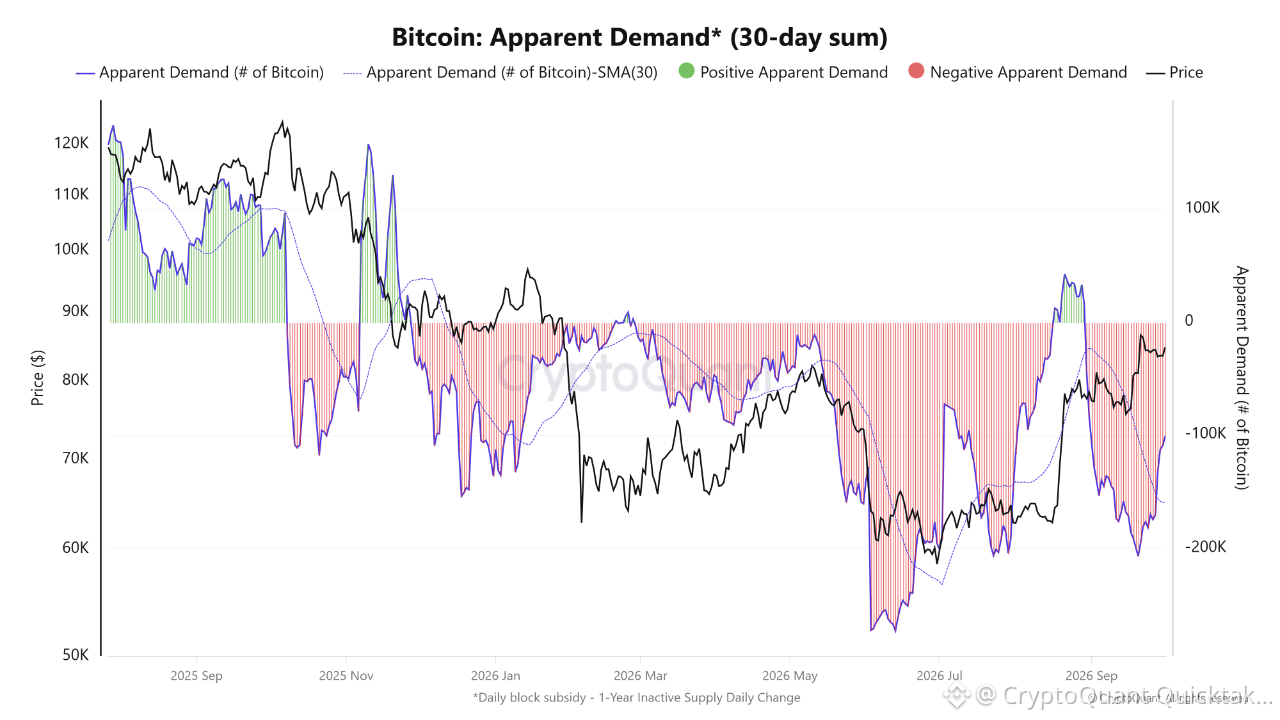
BTC Spot Demand Recovery and Divergence in U.S. DemandBitcoin has risen toward the $85K level, while on-chain data is showing signs of a recovery in demand. However, further confirmation is still needed before concluding that the current rally is being supported by strong spot demand.
First, looking at Apparent Demand Growth 30D, the metric improved from approximately -182K BTC on September 24 to -101K BTC on October 1, an improvement of roughly 81K BTC in just one week. Although it remains in negative territory, the rapid narrowing of the contraction suggests that spot demand is recovering.
In contrast, the Coinbase Premium Index remains negative. This indicates that despite the recovery in Bitcoin’s price and overall demand, spot buying pressure from U.S. investors has yet to show a clear recovery.
Therefore, a key factor to watch during the current rally is the divergence between Bitcoin’s price and U.S. spot demand. Even if Bitcoin continues higher and breaks its previous high, the rally may become difficult to sustain if the Coinbase Premium and on-chain spot demand fail to rise alongside the price.
In conclusion, Bitcoin demand is currently in a recovery phase, but confirmation from U.S. spot demand remains lacking. A shift in Apparent Demand into positive territory, accompanied by a recovery in the Coinbase Premium, will be a key signal in assessing whether the current rally can be sustained.
Written by MAC_D
BTC Spot Demand Recovery and Divergence in U.S. Demand
Bitcoin has risen toward the $85K level, while on-chain data is showing signs of a recovery in demand. However, further confirmation is still needed before concluding that the current rally is being supported by strong spot demand.
First, looking at Apparent Demand Growth 30D, the metric improved from approximately -182K BTC on September 24 to -101K BTC on October 1, an improvement of roughly 81K BTC in just one week. Although it remains in negative territory, the rapid narrowing of the contraction suggests that spot demand is recovering.
In contrast, the Coinbase Premium Index remains negative. This indicates that despite the recovery in Bitcoin’s price and overall demand, spot buying pressure from U.S. investors has yet to show a clear recovery.
Therefore, a key factor to watch during the current rally is the divergence between Bitcoin’s price and U.S. spot demand. Even if Bitcoin continues higher and breaks its previous high, the rally may become difficult to sustain if the Coinbase Premium and on-chain spot demand fail to rise alongside the price.
In conclusion, Bitcoin demand is currently in a recovery phase, but confirmation from U.S. spot demand remains lacking. A shift in Apparent Demand into positive territory, accompanied by a recovery in the Coinbase Premium, will be a key signal in assessing whether the current rally can be sustained.
Written by MAC_D
First, looking at Apparent Demand Growth 30D, the metric improved from approximately -182K BTC on September 24 to -101K BTC on October 1, an improvement of roughly 81K BTC in just one week. Although it remains in negative territory, the rapid narrowing of the contraction suggests that spot demand is recovering.
In contrast, the Coinbase Premium Index remains negative. This indicates that despite the recovery in Bitcoin’s price and overall demand, spot buying pressure from U.S. investors has yet to show a clear recovery.
Therefore, a key factor to watch during the current rally is the divergence between Bitcoin’s price and U.S. spot demand. Even if Bitcoin continues higher and breaks its previous high, the rally may become difficult to sustain if the Coinbase Premium and on-chain spot demand fail to rise alongside the price.
In conclusion, Bitcoin demand is currently in a recovery phase, but confirmation from U.S. spot demand remains lacking. A shift in Apparent Demand into positive territory, accompanied by a recovery in the Coinbase Premium, will be a key signal in assessing whether the current rally can be sustained.
Written by MAC_D
129
Article
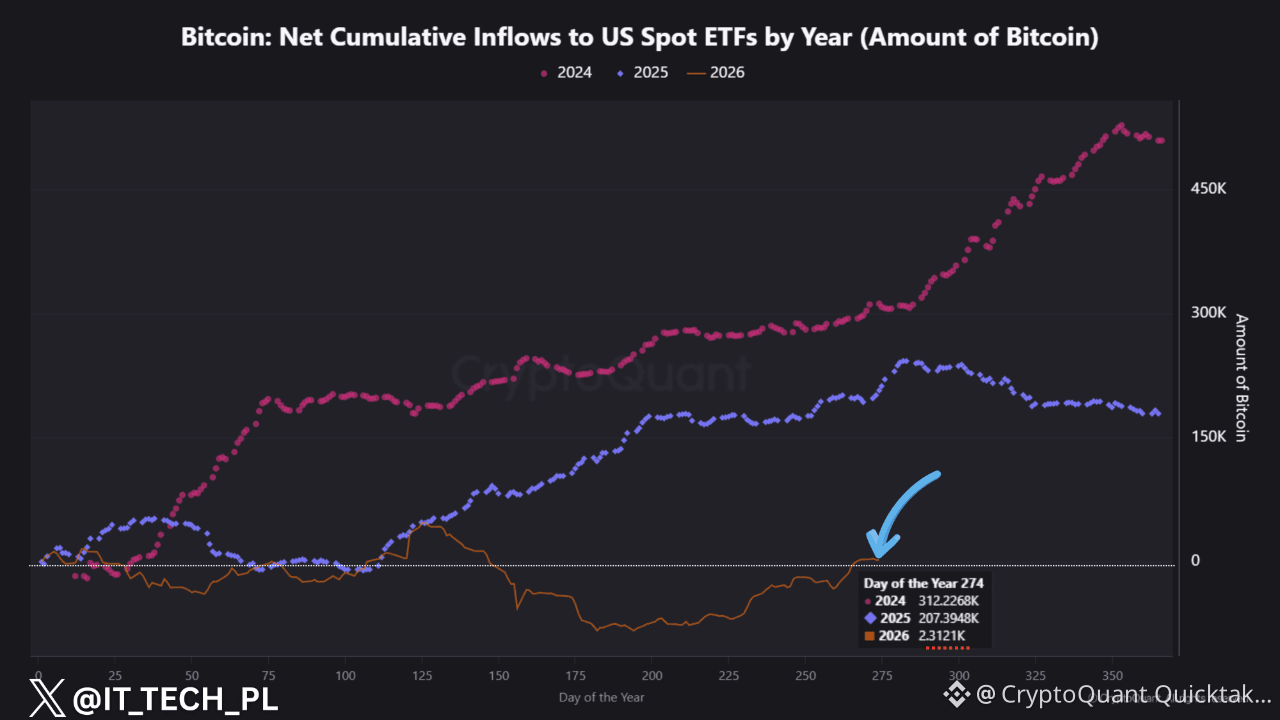
Bitcoin Spot ETF Demand Turned Positive for 2026US spot ETFs are at +2,312 BTC YTD, after absorbing 85,439 BTC since the July 13 low of -83,127 BTC.
Q4 has split hard before. In 2024, ETFs added another 197,194 BTC from this point. In 2025, flows peaked on October 9 and ended the year 28,067 BTC lower.
🤔 Which Q4 do we get?
Written by IT Tech
Bitcoin Spot ETF Demand Turned Positive for 2026
US spot ETFs are at +2,312 BTC YTD, after absorbing 85,439 BTC since the July 13 low of -83,127 BTC.
Q4 has split hard before. In 2024, ETFs added another 197,194 BTC from this point. In 2025, flows peaked on October 9 and ended the year 28,067 BTC lower.
🤔 Which Q4 do we get?
Written by IT Tech
Q4 has split hard before. In 2024, ETFs added another 197,194 BTC from this point. In 2025, flows peaked on October 9 and ended the year 28,067 BTC lower.
🤔 Which Q4 do we get?
Written by IT Tech
101
Article
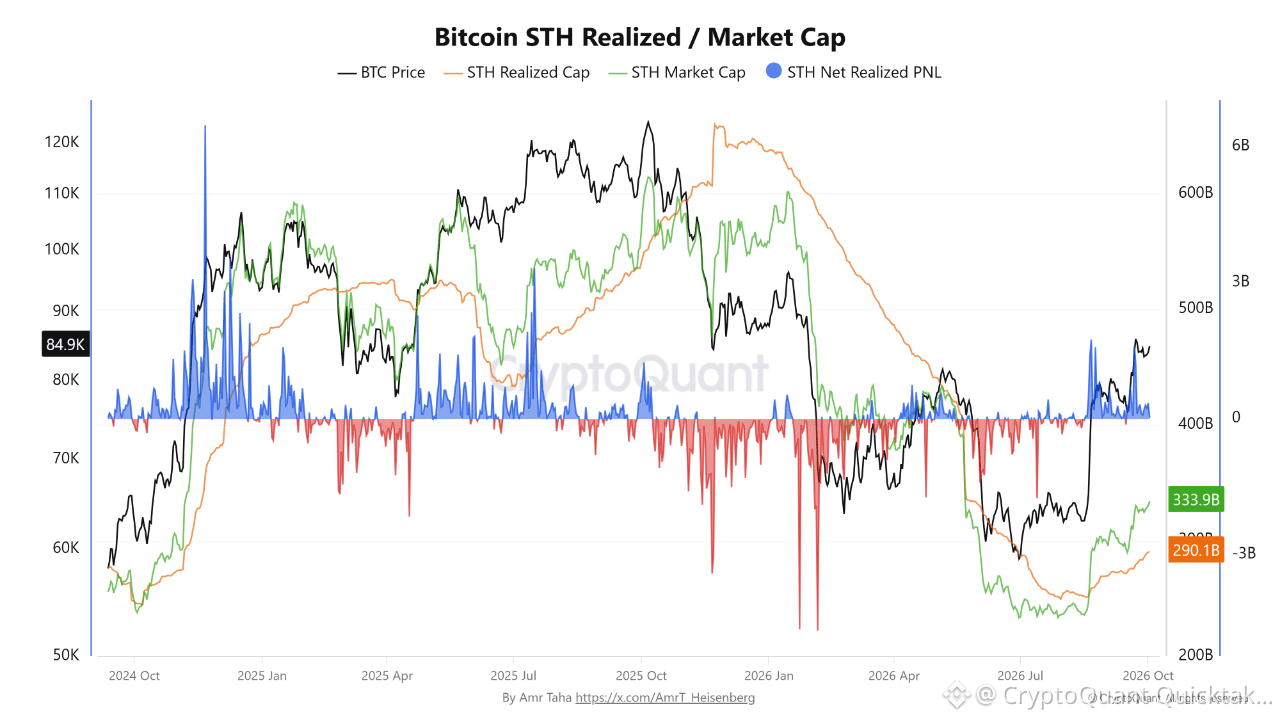
Bitcoin Short-Term Holders Build $43.8B Unrealized Profit Cushion As BTC Reaches $84.9KBitcoin short-term holders have moved back into a sizable unrealized profit position as BTC trades near $84,900.
STH Market Cap, which values short-term holder coins at current prices, stands at $333.9 billion. STH Realized Cap, which values those coins based on the price at which they last moved, is lower at $290.1 billion.
That leaves a $43.8 billion gap between current market value and realized value, equivalent to a premium of roughly 15%.
The shift marks a clear improvement from the summer, when STH Market Cap fell below Realized Cap as Bitcoin traded closer to the $60,000 area, leaving the cohort in aggregate unrealized losses.
Now, with market value back above realized value, short-term holders have rebuilt a meaningful profit cushion.
The combination points to a broad recovery in short-term holder profitability alongside Bitcoin’s rebound toward $85,000.
Written by Amr Taha
Bitcoin Short-Term Holders Build $43.8B Unrealized Profit Cushion As BTC Reaches $84.9K
Bitcoin short-term holders have moved back into a sizable unrealized profit position as BTC trades near $84,900.
STH Market Cap, which values short-term holder coins at current prices, stands at $333.9 billion. STH Realized Cap, which values those coins based on the price at which they last moved, is lower at $290.1 billion.
That leaves a $43.8 billion gap between current market value and realized value, equivalent to a premium of roughly 15%.
The shift marks a clear improvement from the summer, when STH Market Cap fell below Realized Cap as Bitcoin traded closer to the $60,000 area, leaving the cohort in aggregate unrealized losses.
Now, with market value back above realized value, short-term holders have rebuilt a meaningful profit cushion.
The combination points to a broad recovery in short-term holder profitability alongside Bitcoin’s rebound toward $85,000.
Written by Amr Taha
STH Market Cap, which values short-term holder coins at current prices, stands at $333.9 billion. STH Realized Cap, which values those coins based on the price at which they last moved, is lower at $290.1 billion.
That leaves a $43.8 billion gap between current market value and realized value, equivalent to a premium of roughly 15%.
The shift marks a clear improvement from the summer, when STH Market Cap fell below Realized Cap as Bitcoin traded closer to the $60,000 area, leaving the cohort in aggregate unrealized losses.
Now, with market value back above realized value, short-term holders have rebuilt a meaningful profit cushion.
The combination points to a broad recovery in short-term holder profitability alongside Bitcoin’s rebound toward $85,000.
Written by Amr Taha
2
175
Article
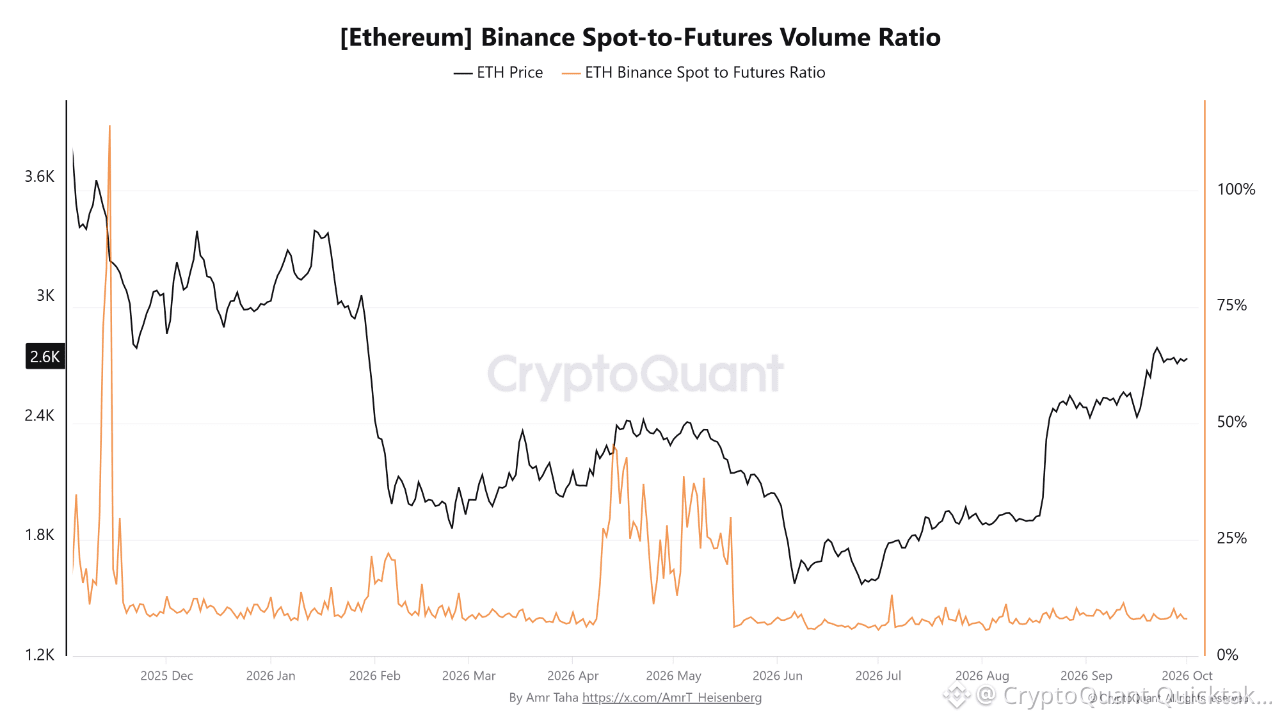
Ethereum Jumps 73% As Binance Futures Volume Still Outpaces Spot By 12.5xEthereum rose about 73% from late June to October even as Binance’s spot-to-futures volume ratio remained near low levels.
The ratio compares Ethereum spot trading volume with futures trading volume on Binance.
A reading of 8% means spot volume equals just 8% of futures volume.
On June 27, ETH traded near $1,560 while the ratio stood at 6.5%. By October 1, Ethereum had climbed to about $2,700, but the ratio had increased only slightly to 8%.
In other words, Ethereum gained more than $1,100 while spot volume remained below one-tenth of futures volume on Binance.
The divergence shows that ETH’s strong price recovery was not accompanied by a comparable increase in spot’s share of trading activity.
The current reading also contrasts sharply with previous peaks in the ratio.
It reached about 45% on April 13, 2026, before ETH subsequently fell roughly 36%, while a much higher reading of 114% on November 14, 2025 was followed by a decline of about 45%.
Those episodes do not establish that a high ratio causes price declines, but they show that stronger spot volume relative to futures has not necessarily coincided with stronger subsequent price performance.
Written by Amr Taha
Ethereum Jumps 73% As Binance Futures Volume Still Outpaces Spot By 12.5x
Ethereum rose about 73% from late June to October even as Binance’s spot-to-futures volume ratio remained near low levels.
The ratio compares Ethereum spot trading volume with futures trading volume on Binance.
A reading of 8% means spot volume equals just 8% of futures volume.
On June 27, ETH traded near $1,560 while the ratio stood at 6.5%. By October 1, Ethereum had climbed to about $2,700, but the ratio had increased only slightly to 8%.
In other words, Ethereum gained more than $1,100 while spot volume remained below one-tenth of futures volume on Binance.
The divergence shows that ETH’s strong price recovery was not accompanied by a comparable increase in spot’s share of trading activity.
The current reading also contrasts sharply with previous peaks in the ratio.
It reached about 45% on April 13, 2026, before ETH subsequently fell roughly 36%, while a much higher reading of 114% on November 14, 2025 was followed by a decline of about 45%.
Those episodes do not establish that a high ratio causes price declines, but they show that stronger spot volume relative to futures has not necessarily coincided with stronger subsequent price performance.
Written by Amr Taha
The ratio compares Ethereum spot trading volume with futures trading volume on Binance.
A reading of 8% means spot volume equals just 8% of futures volume.
On June 27, ETH traded near $1,560 while the ratio stood at 6.5%. By October 1, Ethereum had climbed to about $2,700, but the ratio had increased only slightly to 8%.
In other words, Ethereum gained more than $1,100 while spot volume remained below one-tenth of futures volume on Binance.
The divergence shows that ETH’s strong price recovery was not accompanied by a comparable increase in spot’s share of trading activity.
The current reading also contrasts sharply with previous peaks in the ratio.
It reached about 45% on April 13, 2026, before ETH subsequently fell roughly 36%, while a much higher reading of 114% on November 14, 2025 was followed by a decline of about 45%.
Those episodes do not establish that a high ratio causes price declines, but they show that stronger spot volume relative to futures has not necessarily coincided with stronger subsequent price performance.
Written by Amr Taha
2
231
Article
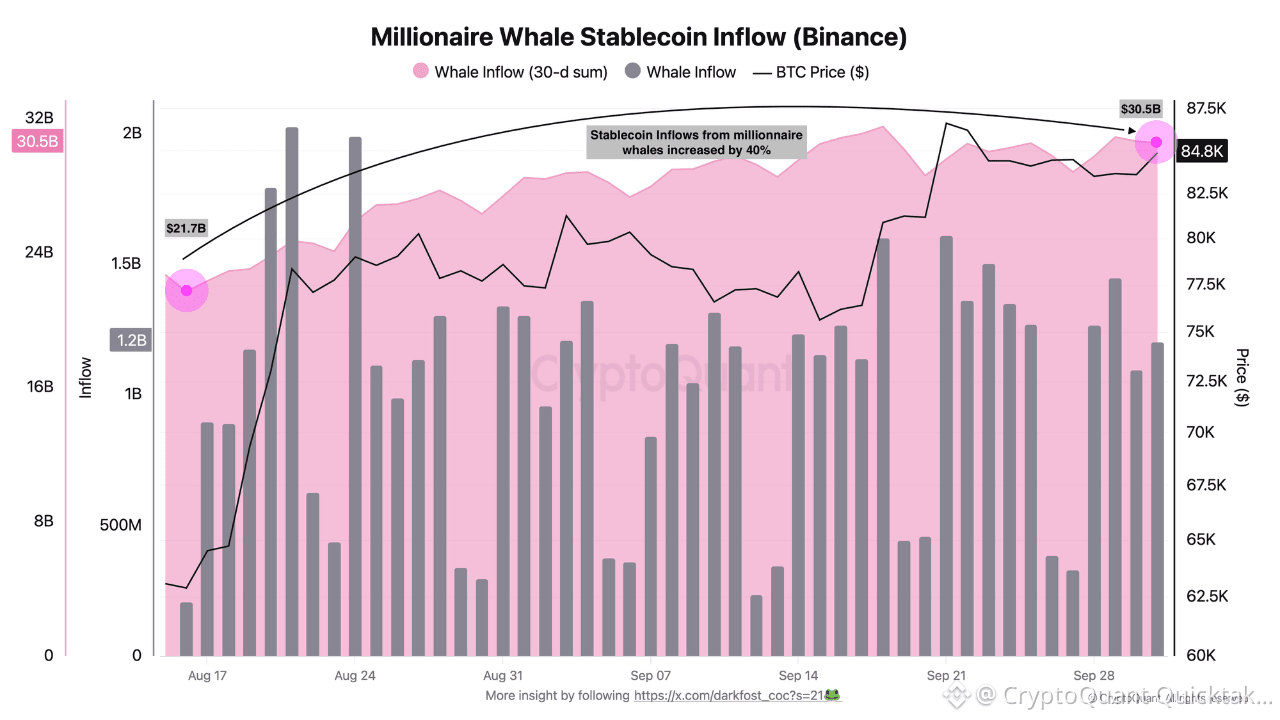
Millionaire Whales Ramp Up Stablecoin Inflows By 40%Whales are gradually deploying more capital on Bitcoin.
This chart focuses on whales sending more than $1 million in stablecoins to Binance.
On a 30d sum basis, their stablecoin inflows to Binance have risen from $21.7B to $30.5B in a little over a month. These millionaire whales have thus increased their capital flows to Binance by more than 40% over the period.
When stablecoins are sent to an exchange, it is very often to prepare market exposure, so an increase in these inflows can be associated with buying pressure.
This change in behavior comes after a long lull, during which their inflows receded from the October peak, when they exceeded $61B. Some rebounds still prompted a reaction from them, ranging from a desire to play a technical bounce to buying the dips.
Their behavior is quite different today: while Bitcoin is confirming a structural trend reversal, these millionaire whales are deploying their liquidity with greater caution. This behavior is probably torn between Bitcoin's seasonality, with a highly anticipated October, and an environment marked by conflict, inflation, and the relentless rise in bond yields.
Written by Darkfost
Millionaire Whales Ramp Up Stablecoin Inflows By 40%
Whales are gradually deploying more capital on Bitcoin.
This chart focuses on whales sending more than $1 million in stablecoins to Binance.
On a 30d sum basis, their stablecoin inflows to Binance have risen from $21.7B to $30.5B in a little over a month. These millionaire whales have thus increased their capital flows to Binance by more than 40% over the period.
When stablecoins are sent to an exchange, it is very often to prepare market exposure, so an increase in these inflows can be associated with buying pressure.
This change in behavior comes after a long lull, during which their inflows receded from the October peak, when they exceeded $61B. Some rebounds still prompted a reaction from them, ranging from a desire to play a technical bounce to buying the dips.
Their behavior is quite different today: while Bitcoin is confirming a structural trend reversal, these millionaire whales are deploying their liquidity with greater caution. This behavior is probably torn between Bitcoin's seasonality, with a highly anticipated October, and an environment marked by conflict, inflation, and the relentless rise in bond yields.
Written by Darkfost
This chart focuses on whales sending more than $1 million in stablecoins to Binance.
On a 30d sum basis, their stablecoin inflows to Binance have risen from $21.7B to $30.5B in a little over a month. These millionaire whales have thus increased their capital flows to Binance by more than 40% over the period.
When stablecoins are sent to an exchange, it is very often to prepare market exposure, so an increase in these inflows can be associated with buying pressure.
This change in behavior comes after a long lull, during which their inflows receded from the October peak, when they exceeded $61B. Some rebounds still prompted a reaction from them, ranging from a desire to play a technical bounce to buying the dips.
Their behavior is quite different today: while Bitcoin is confirming a structural trend reversal, these millionaire whales are deploying their liquidity with greater caution. This behavior is probably torn between Bitcoin's seasonality, with a highly anticipated October, and an environment marked by conflict, inflation, and the relentless rise in bond yields.
Written by Darkfost
160
Article
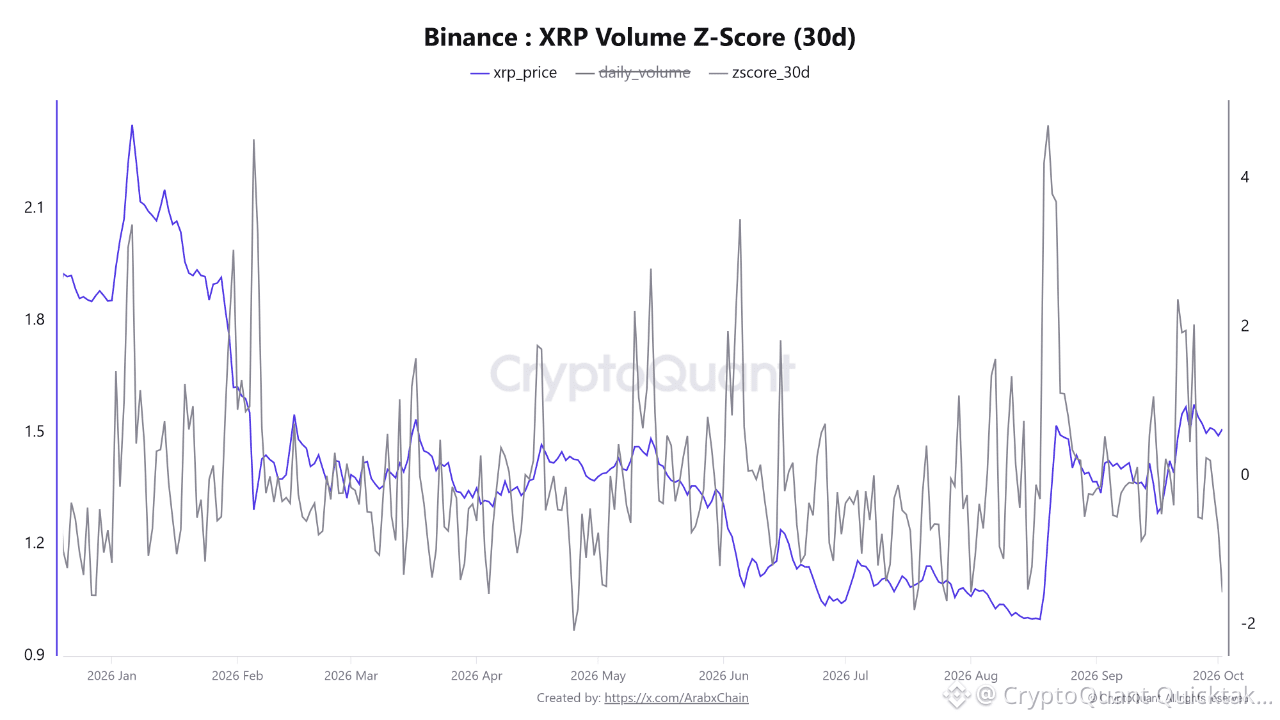
XRP Volume Z-Score on Binance Turns NegativeData shows that the XRP Volume Z-Score (30d) on Binance has declined to approximately -0.73, indicating that trading volume has fallen below its historical average over the reference period. This reading follows notable fluctuations in the indicator over recent months, including sharp spikes exceeding 1.5, before it recently retreated into negative territory.
A Z-score below zero indicates that current XRP trading volume is below its historical average, suggesting a relative slowdown in trading activity on Binance compared to previous levels.
Notably, the indicator experienced temporary spikes in August and September, approaching elevated levels. However, these movements were short-lived, and the indicator began declining again in early October. Meanwhile, XRP is trading near $1.49, following a period of price volatility over the past few months.
This decline may signal reduced trader interest in executing transactions on Binance, although it does not necessarily indicate a clear selling or buying trend, as lower trading volume can result from reduced activity in either direction.
Consequently, the indicator's continued presence in negative territory may reflect weakening trading momentum, making it important to monitor trading volume and price movements to better understand the nature of future activity in the XRP market.
Written by Arab Chain
XRP Volume Z-Score on Binance Turns Negative
Data shows that the XRP Volume Z-Score (30d) on Binance has declined to approximately -0.73, indicating that trading volume has fallen below its historical average over the reference period. This reading follows notable fluctuations in the indicator over recent months, including sharp spikes exceeding 1.5, before it recently retreated into negative territory.
A Z-score below zero indicates that current XRP trading volume is below its historical average, suggesting a relative slowdown in trading activity on Binance compared to previous levels.
Notably, the indicator experienced temporary spikes in August and September, approaching elevated levels. However, these movements were short-lived, and the indicator began declining again in early October. Meanwhile, XRP is trading near $1.49, following a period of price volatility over the past few months.
This decline may signal reduced trader interest in executing transactions on Binance, although it does not necessarily indicate a clear selling or buying trend, as lower trading volume can result from reduced activity in either direction.
Consequently, the indicator's continued presence in negative territory may reflect weakening trading momentum, making it important to monitor trading volume and price movements to better understand the nature of future activity in the XRP market.
Written by Arab Chain
A Z-score below zero indicates that current XRP trading volume is below its historical average, suggesting a relative slowdown in trading activity on Binance compared to previous levels.
Notably, the indicator experienced temporary spikes in August and September, approaching elevated levels. However, these movements were short-lived, and the indicator began declining again in early October. Meanwhile, XRP is trading near $1.49, following a period of price volatility over the past few months.
This decline may signal reduced trader interest in executing transactions on Binance, although it does not necessarily indicate a clear selling or buying trend, as lower trading volume can result from reduced activity in either direction.
Consequently, the indicator's continued presence in negative territory may reflect weakening trading momentum, making it important to monitor trading volume and price movements to better understand the nature of future activity in the XRP market.
Written by Arab Chain
56
Article
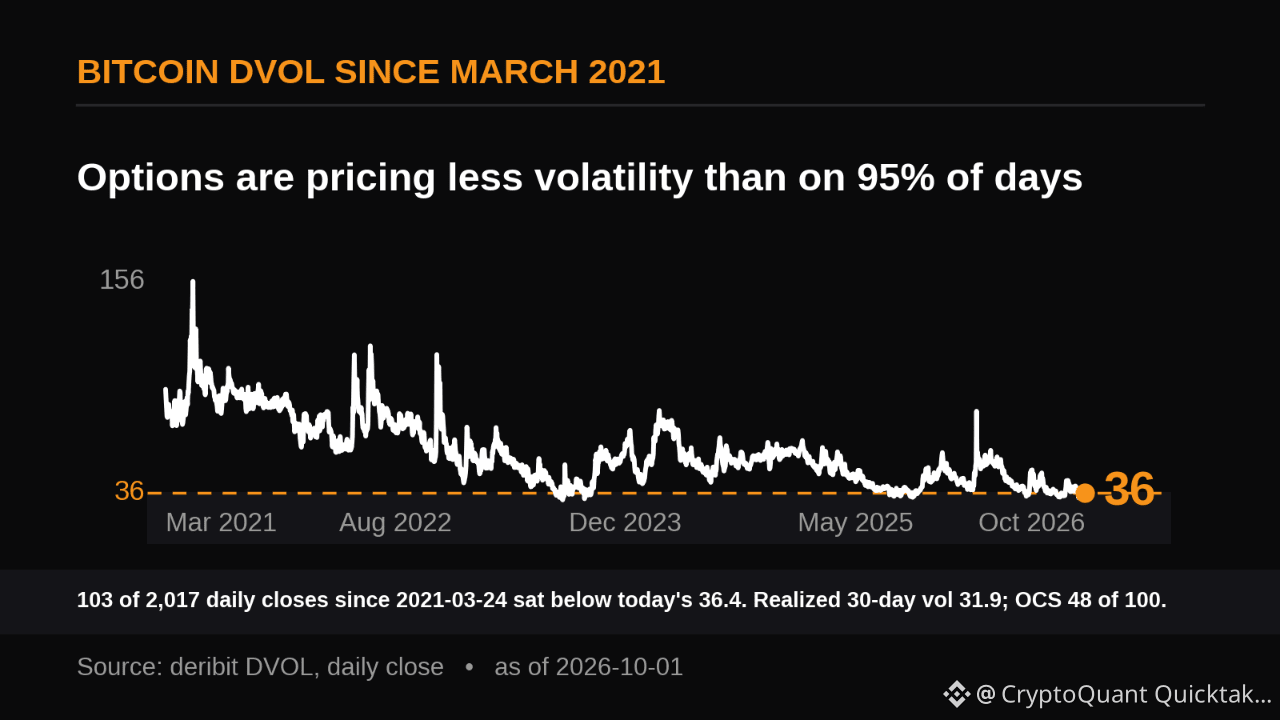
Bitcoin Options Price Less Volatility Than on 95% of Days Since 2021Deribit's DVOL index, the 30-day implied volatility for bitcoin options, sits at 36.42. That is lower than on 95% of days since March 2021. Options are pricing a calm month.
For that print to hold, option sellers have to be comfortable with the risk they carry. The tape gives them cover. Realized 30-day volatility is 31.9, so implied still sits 4.52 points above what the market has delivered. Traders are paying a little extra for downside protection: the 25-delta risk reversal on the 30 October expiry is -2.45.
CryptoQuant's all-exchange Funding Rates tell the same story from the futures side. Funding was 0.0062% on 30 September, inside its 30-day range of 0.0004% to 0.0085%. Perp traders are neither crowded long nor running for the exit.
The caveat matters here. A low implied volatility reading does not make options cheap. Across 1,588 days, DVOL priced more volatility than the next 30 days delivered on 73.4% of them, by a median 10.8 points. A low print shows what the market expects, not what it is missing.
The October expiry has its own tell. The $95,000 call holds $2.0 billion of open interest, the largest strike on the board. Max pain, the price where option holders collectively lose the most and not a target, sits at $77,000 with spot at $84,501.
Bitcoin's options market is priced for a quiet October, and the futures market agrees with it.
What reverses the read: DVOL back above 45 before the 30 October expiry says the calm broke. Realized volatility climbing above 36.42 while DVOL stays flat says sellers underpriced the month.
Written by The Daily Digits
Bitcoin Options Price Less Volatility Than on 95% of Days Since 2021
Deribit's DVOL index, the 30-day implied volatility for bitcoin options, sits at 36.42. That is lower than on 95% of days since March 2021. Options are pricing a calm month.
For that print to hold, option sellers have to be comfortable with the risk they carry. The tape gives them cover. Realized 30-day volatility is 31.9, so implied still sits 4.52 points above what the market has delivered. Traders are paying a little extra for downside protection: the 25-delta risk reversal on the 30 October expiry is -2.45.
CryptoQuant's all-exchange Funding Rates tell the same story from the futures side. Funding was 0.0062% on 30 September, inside its 30-day range of 0.0004% to 0.0085%. Perp traders are neither crowded long nor running for the exit.
The caveat matters here. A low implied volatility reading does not make options cheap. Across 1,588 days, DVOL priced more volatility than the next 30 days delivered on 73.4% of them, by a median 10.8 points. A low print shows what the market expects, not what it is missing.
The October expiry has its own tell. The $95,000 call holds $2.0 billion of open interest, the largest strike on the board. Max pain, the price where option holders collectively lose the most and not a target, sits at $77,000 with spot at $84,501.
Bitcoin's options market is priced for a quiet October, and the futures market agrees with it.
What reverses the read: DVOL back above 45 before the 30 October expiry says the calm broke. Realized volatility climbing above 36.42 while DVOL stays flat says sellers underpriced the month.
Written by The Daily Digits
For that print to hold, option sellers have to be comfortable with the risk they carry. The tape gives them cover. Realized 30-day volatility is 31.9, so implied still sits 4.52 points above what the market has delivered. Traders are paying a little extra for downside protection: the 25-delta risk reversal on the 30 October expiry is -2.45.
CryptoQuant's all-exchange Funding Rates tell the same story from the futures side. Funding was 0.0062% on 30 September, inside its 30-day range of 0.0004% to 0.0085%. Perp traders are neither crowded long nor running for the exit.
The caveat matters here. A low implied volatility reading does not make options cheap. Across 1,588 days, DVOL priced more volatility than the next 30 days delivered on 73.4% of them, by a median 10.8 points. A low print shows what the market expects, not what it is missing.
The October expiry has its own tell. The $95,000 call holds $2.0 billion of open interest, the largest strike on the board. Max pain, the price where option holders collectively lose the most and not a target, sits at $77,000 with spot at $84,501.
Bitcoin's options market is priced for a quiet October, and the futures market agrees with it.
What reverses the read: DVOL back above 45 before the 30 October expiry says the calm broke. Realized volatility climbing above 36.42 while DVOL stays flat says sellers underpriced the month.
Written by The Daily Digits
1
138
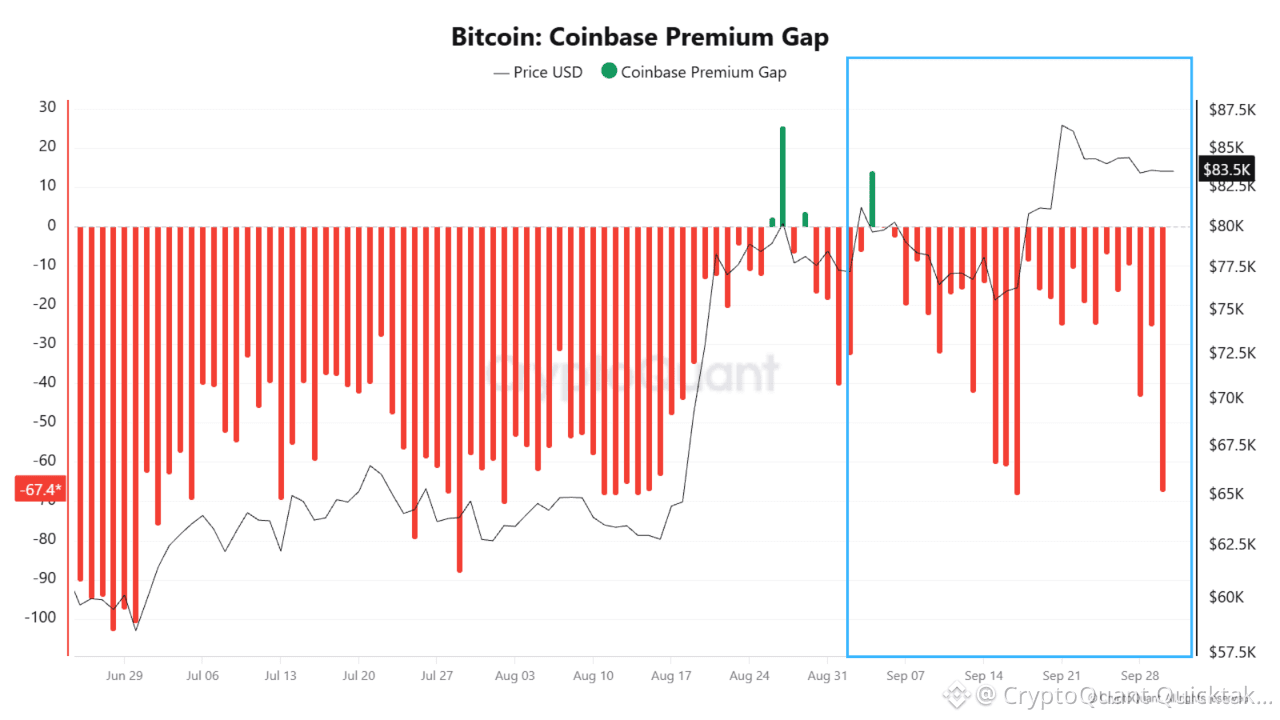
Article
Bitcoin Gained About 7% in September: Is a Bottom Near, and Who Will Buy in October?Bitcoin rose about 7% in September, from around $79,000 to $85,000, defying its historically weak seasonality. Yet the recovery was far from smooth.
Oil prices, rising Treasury yields and Fed tightening concerns weighed on markets mid-month. The XWIN CAPITAL INDEX fell to 35 on September 17 before recovering to 78 on September 26 as ETF inflows, whale accumulation and exchange outflows improved market conditions.
This suggests the rebound involved more than a short squeeze. ETFs, companies and large investors provided support.
Still, a bottom is not confirmed. The index eased to 62 by September 30. Profit-taking increased, ETF inflows slowed, and broader spot demand remained weak. Coinbase Premium Gap fell to around −$67, suggesting buying pressure on Coinbase still lagged Binance.
October's key question is who buys the next dip. Continued ETF inflows, whale accumulation and stronger spot demand would support a bottom retest. ETF outflows and rising whale deposits to exchanges would challenge that view.
High US yields remain a risk, despite softer PCE easing rate-hike concerns. Watch whether strong buyers return during pullbacks.
Written by XWIN Japan
Bitcoin Gained About 7% in September: Is a Bottom Near, and Who Will Buy in October?
Bitcoin rose about 7% in September, from around $79,000 to $85,000, defying its historically weak seasonality. Yet the recovery was far from smooth.
Oil prices, rising Treasury yields and Fed tightening concerns weighed on markets mid-month. The XWIN CAPITAL INDEX fell to 35 on September 17 before recovering to 78 on September 26 as ETF inflows, whale accumulation and exchange outflows improved market conditions.
This suggests the rebound involved more than a short squeeze. ETFs, companies and large investors provided support.
Still, a bottom is not confirmed. The index eased to 62 by September 30. Profit-taking increased, ETF inflows slowed, and broader spot demand remained weak. Coinbase Premium Gap fell to around −$67, suggesting buying pressure on Coinbase still lagged Binance.
October's key question is who buys the next dip. Continued ETF inflows, whale accumulation and stronger spot demand would support a bottom retest. ETF outflows and rising whale deposits to exchanges would challenge that view.
High US yields remain a risk, despite softer PCE easing rate-hike concerns. Watch whether strong buyers return during pullbacks.
Written by XWIN Japan
Oil prices, rising Treasury yields and Fed tightening concerns weighed on markets mid-month. The XWIN CAPITAL INDEX fell to 35 on September 17 before recovering to 78 on September 26 as ETF inflows, whale accumulation and exchange outflows improved market conditions.
This suggests the rebound involved more than a short squeeze. ETFs, companies and large investors provided support.
Still, a bottom is not confirmed. The index eased to 62 by September 30. Profit-taking increased, ETF inflows slowed, and broader spot demand remained weak. Coinbase Premium Gap fell to around −$67, suggesting buying pressure on Coinbase still lagged Binance.
October's key question is who buys the next dip. Continued ETF inflows, whale accumulation and stronger spot demand would support a bottom retest. ETF outflows and rising whale deposits to exchanges would challenge that view.
High US yields remain a risk, despite softer PCE easing rate-hike concerns. Watch whether strong buyers return during pullbacks.
Written by XWIN Japan
1
166
Log in to explore more content
Join global crypto users on Binance Square
⚡️ Get latest and useful information about crypto.
💬 Trusted by the world’s largest crypto exchange.
👍 Discover real insights from verified creators.
Email / Phone number
Trending Topics
ZcashETFPostsFirstWeeklyOutflow$93.6M
40,370 views
131 Discussing
#ZcashETFPostsFirstWeeklyOutflow$93.6M
🚨🚨🚨🚨🚨🚨🚨🚨🚨🚨🚨🚨🚨🚨✅ 🚨 ZCASH ETF FLOWS TURN NEGATIVE FOR THE FIRST TIME! 📉
$ZEC is facing a notable shift in institutional fund flows, with Zcash investment products recording their first weekly net outflow since launching in August.
According to fund-flow data, around $93.6M was withdrawn from Zcash products during the latest week, while ZEC price action also cooled significantly.
📊 WHAT HAPPENED?
• Weekly Zcash ETF outflow: $93.6M
• September 30 daily outflow: $30.25M
• ZCSH previously attracted around $98.2M in one week
• ZEC is trading near $1,300
• Recent high: around $1,690
• Weekly decline: roughly 17%+
🔍 LEVELS TO WATCH
🟢 Support: $1,280–$1,300
🔴 Resistance: $1,450–$1,500
The key question now is whether the $1,300 area can hold and attract fresh buyers.
Institutional flows will also be important. A return of consistent positive inflows could signal renewed confidence, while continued outflows may keep pressure on $ZEC .
👀 Is this simply profit-taking after ZEC’s huge rally, or could we see another deeper pullback before buyers return?
Share your view below. 👇
#Zcash #ZEC #ZcashETF #Crypto
#analysis
owhggwiohsjowve
·0 Likes
·184 views
GreekPoliceBustCryptoScamRingArrest17
97,270 views
782 Discussing
BitcoinRejectedAt$87K
132,301 views
190 Discussing