
财经大圣
1.3k Posts

财经大圣
Report
Block User
Frequent Trader
8.9 Years
106 Following
1.0K+ Followers
2.0K+ Liked
Posts
All
Quotes
Videos
PINNED
·
--
Article
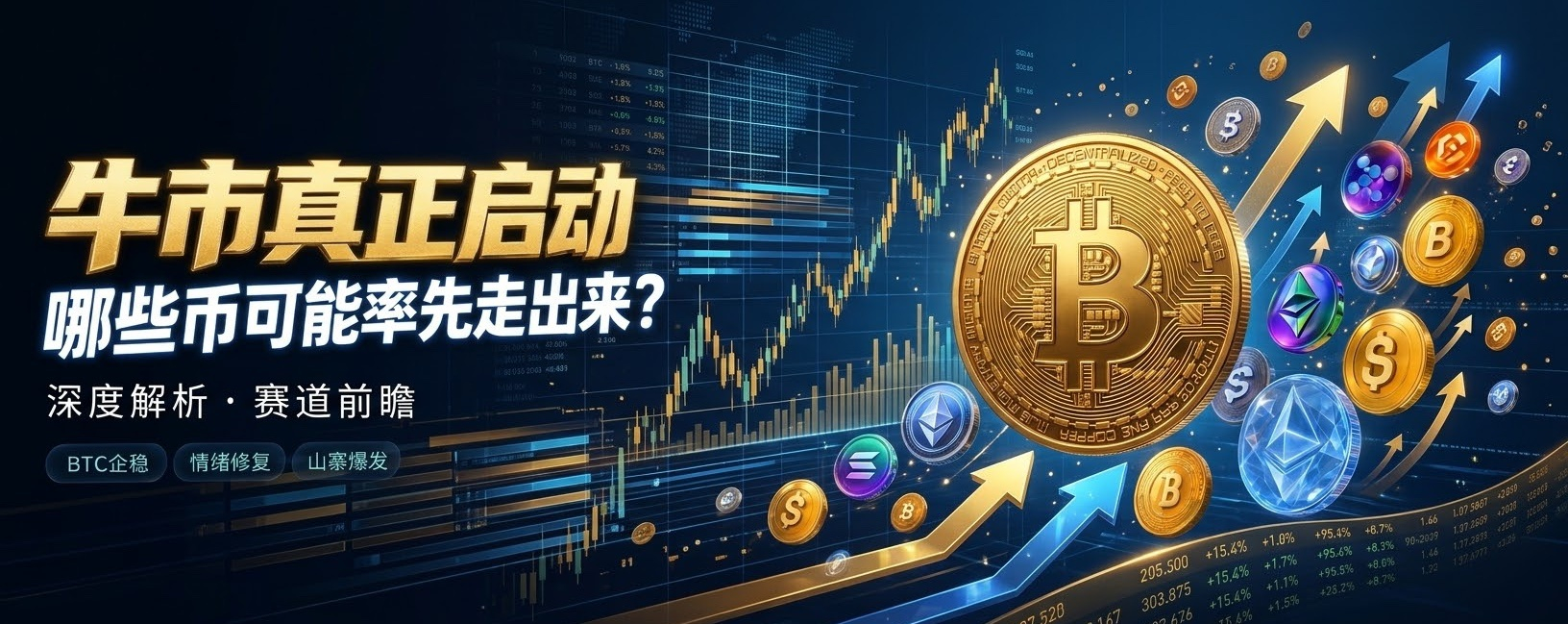
As the Bull Market Truly Takes Off, Which Coins Might Lead the Way?With the U.S. midterm elections behind us, Bitcoin has gradually stabilized, and market sentiment is beginning to show signs of recovery.
If this correction is nearing its end, the question most worth considering next is: which coins might be the first to take off in the next altcoin rally?
I've always paid close attention to one phenomenon: in every market cycle, the coins that truly lead the way are often not simply those that have fallen the most, but strong coins that have already demonstrated their ability to attract capital in the previous cycle, enjoy high market visibility, and can quickly move in tandem with the broader market.
As the Bull Market Truly Takes Off, Which Coins Might Lead the Way?
With the U.S. midterm elections behind us, Bitcoin has gradually stabilized, and market sentiment is beginning to show signs of recovery.
If this correction is nearing its end, the question most worth considering next is: which coins might be the first to take off in the next altcoin rally?
I've always paid close attention to one phenomenon: in every market cycle, the coins that truly lead the way are often not simply those that have fallen the most, but strong coins that have already demonstrated their ability to attract capital in the previous cycle, enjoy high market visibility, and can quickly move in tandem with the broader market.
3
1.9k
PINNED
·
--
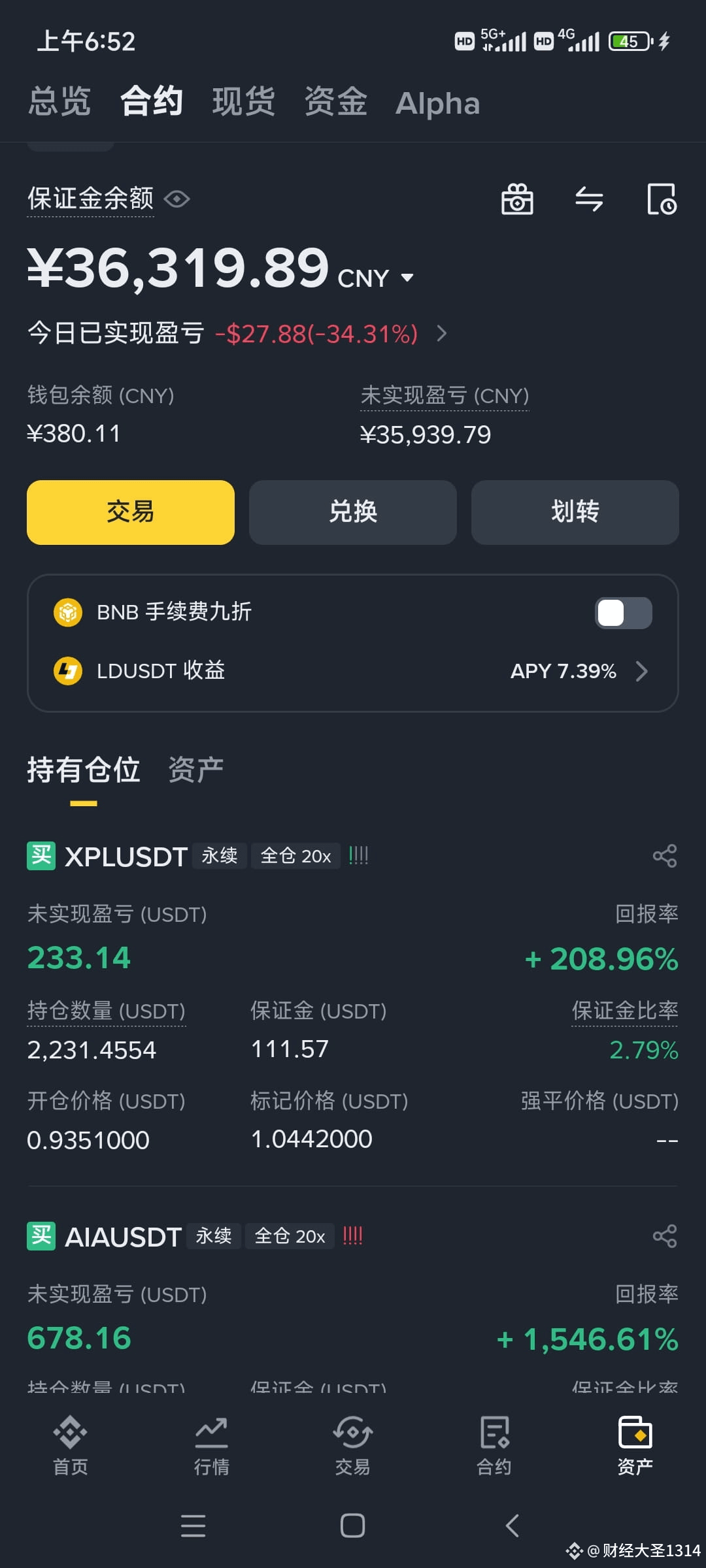
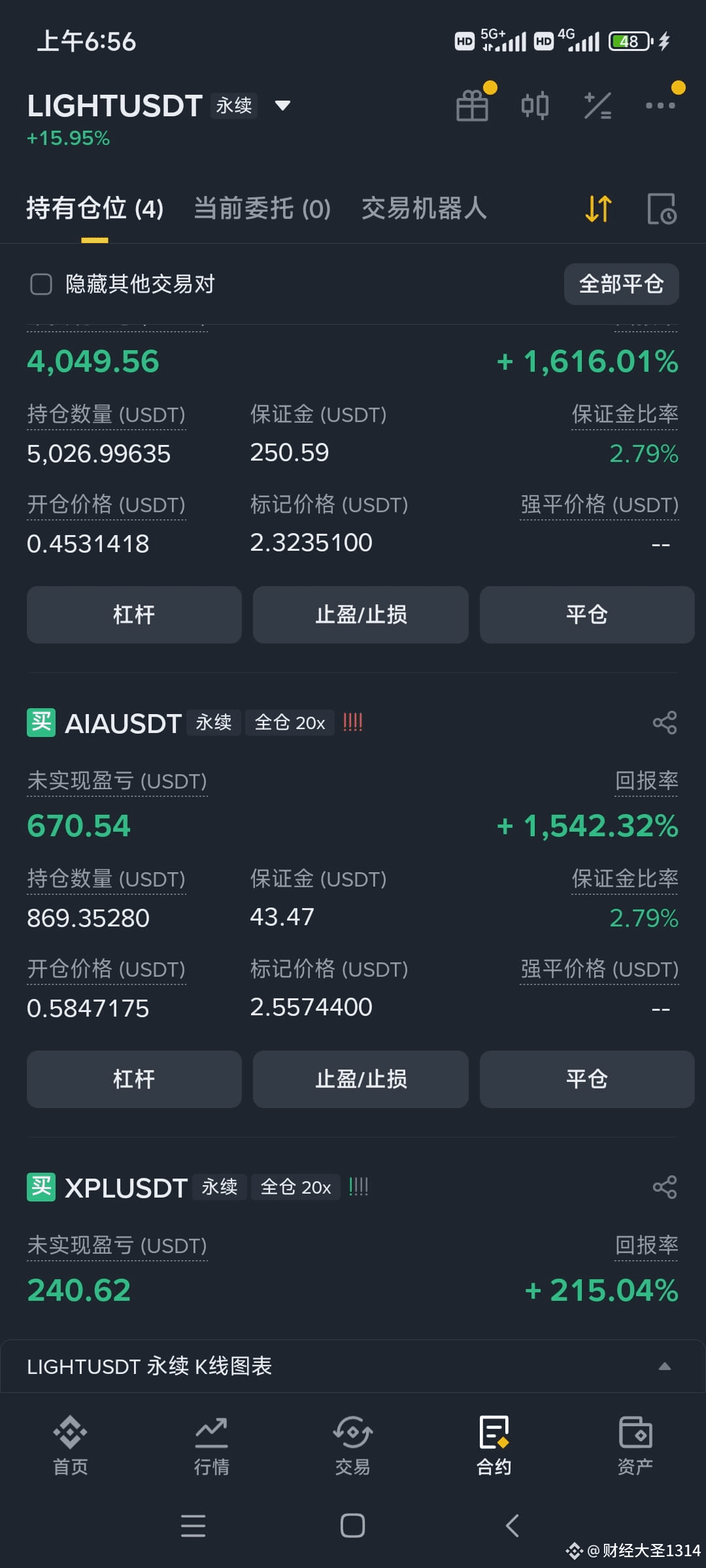
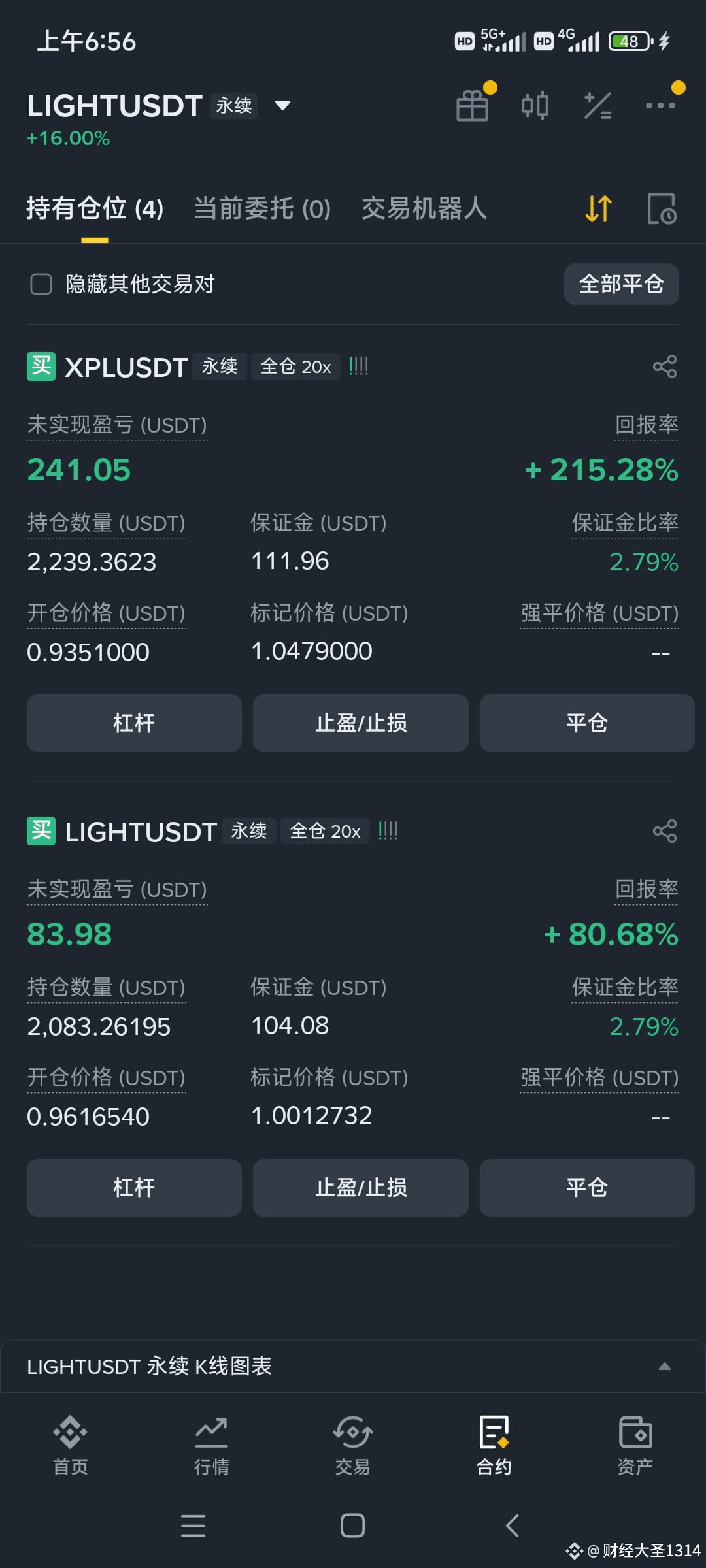
Starting from October 2nd when I bought AIA, today is the 7th day, with a principal of 900 currently floating a profit of 35000➕, I have newly entered 2 new coins XPL, and I am trading LIGHT short, keep it up #BTC再创新高
Starting from October 2nd when I bought AIA, today is the 7th day, with a principal of 900 currently floating a profit of 35000➕, I have newly entered 2 new coins XPL, and I am trading LIGHT short, keep it up #BTC再创新高
23
6
61
65k
·
--
Bullish
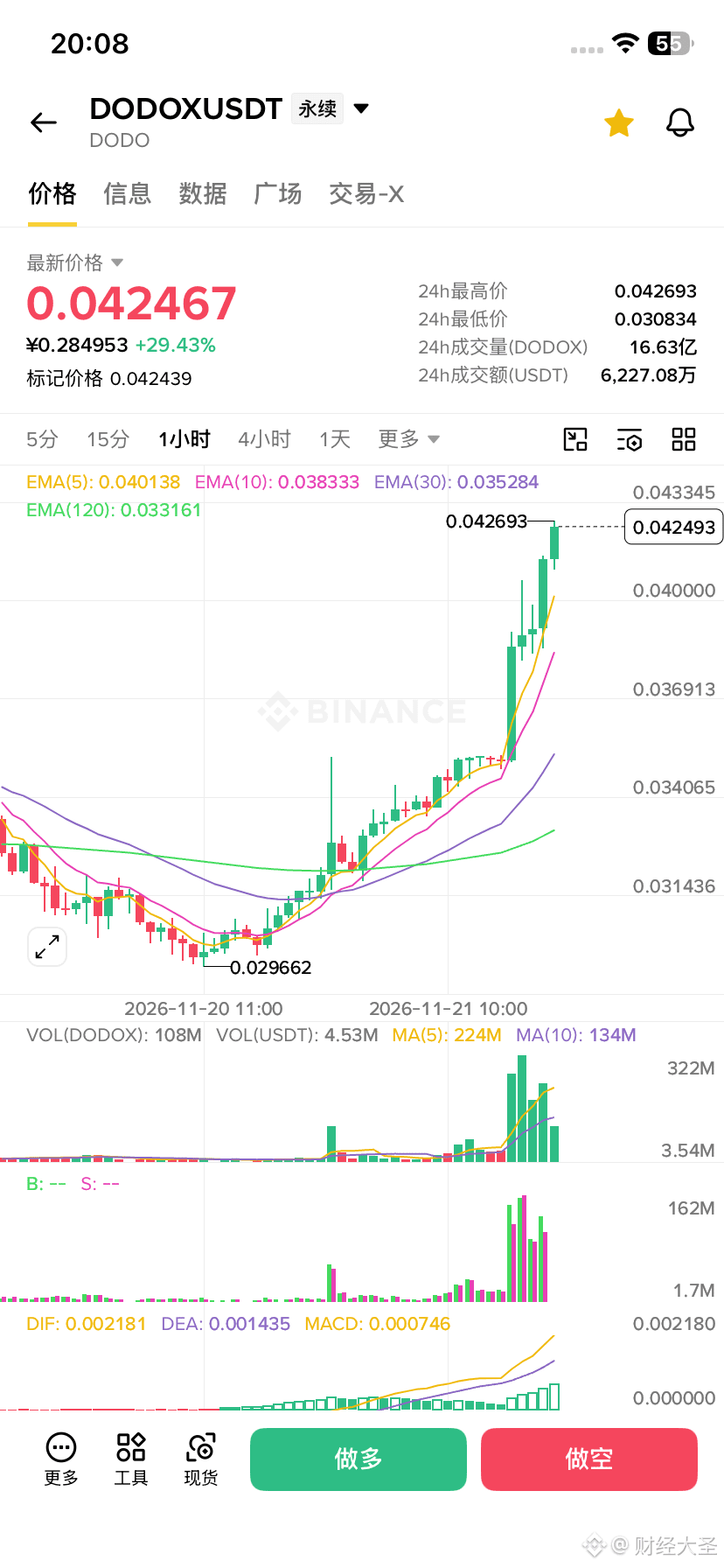
🚨 $DODOX , pay attention!
This move could really take off! 🚀
A breakout on surging volume, with prices climbing strongly and trading volume clearly increasing—there are unmistakable signs of money flowing in!
My take is simple: this may be more than just an ordinary rebound. DODO could be gearing up for a stronger major uptrend!
Strategy: Consider entering with a small position if the price pulls back to the breakout level and holds steady. Cut your losses decisively if it falls below key support.
🔥 This time, I’m backing DODO! Let the market prove me right!
328
·
--
Partly True
Positioning in a bear market: prioritize researching projects with real businesses and revenue!
Today, let’s talk about a key project in the DeFi trading sector: $UNI (Uniswap).
Why pay attention to it? Let’s look at a few key metrics:
I. Fundamentals
* Sector standing: A leading global decentralized trading protocol, spanning 51 blockchains.
* Funds: Approximately $2.8 billion in TVL.
* Real trading activity: Trading volume of approximately 64.1 billion Jo over the past 30 days.
* Protocol revenue: Approximately $69.6 million in fees and $8.19 million in protocol revenue over the past 30 days.
* Token value: Advancing the distribution of protocol fees and a UNI burn mechanism, creating a more direct link between the token’s value and the protocol’s growth.
* Ecosystem expansion: V4 introduces Hooks, while Unichain further expands on-chain infrastructure.
UNI is more than just an exchange platform token. It is backed by real trading demand, fee revenue, and a steadily expanding ecosystem.
II. Technical Analysis and Positioning Strategy
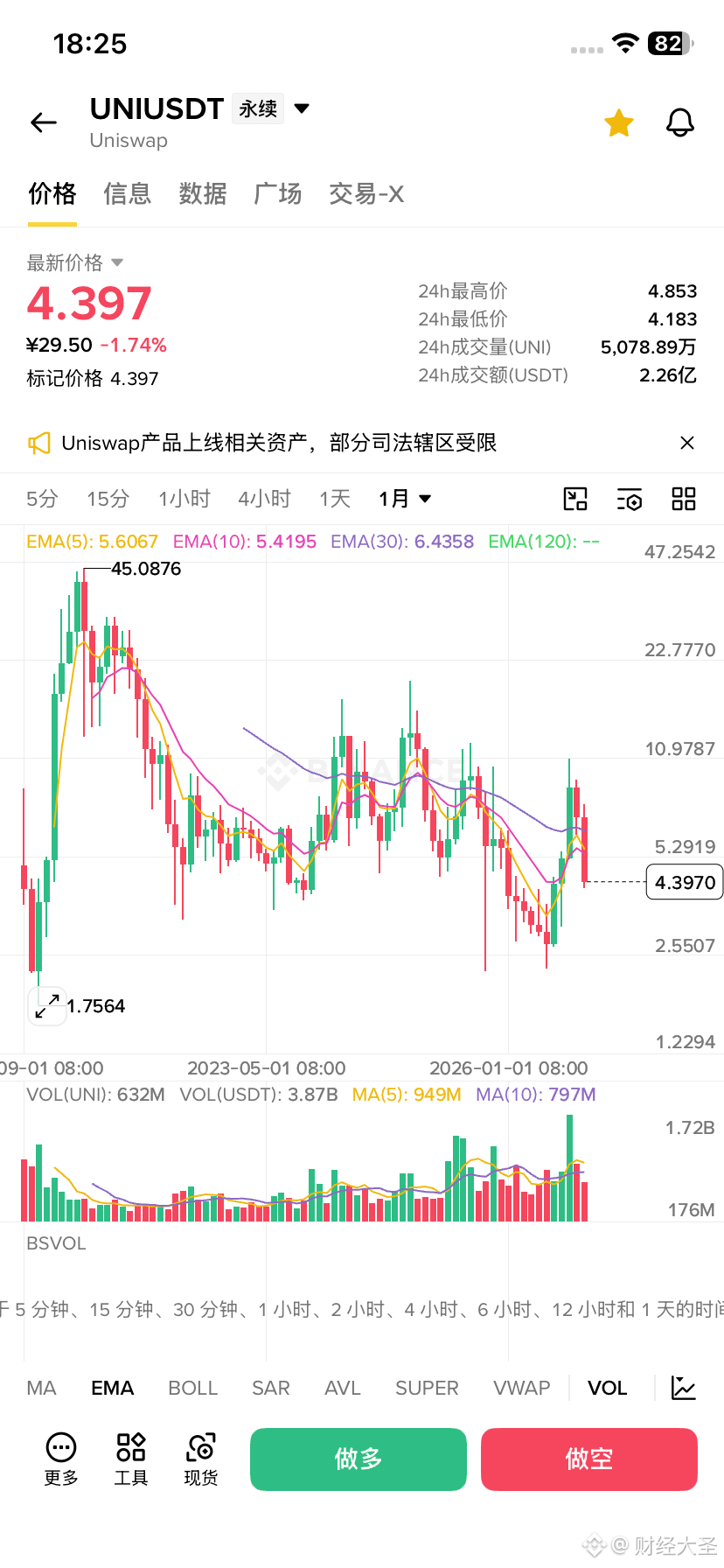
The current price is around $4.4. The daily RSI has entered oversold territory, but the overall trend remains weak.
Watch for three stages:
1. Stage one: $4.20–$4.35. Watch for the price to stop falling and stabilize; if a signal appears, consider testing the waters with a small position.
2. Stage two: $3.90–$4.00. If the pullback continues, focus on whether new support emerges.
3. Stage three: $4.69–$5.17. If the price recovers this range on increased volume, consider following the trend if it turns stronger.
If the price breaks below $3.90 decisively, reassess rather than blindly adding to the position.
My view:
AAVE is DeFi lending infrastructure, while UNI is DeFi trading infrastructure.
In a downturn, I’d rather spend time researching projects with real businesses, ecosystems, and revenue than simply looking for the coins that have fallen the most.
Fundamentals determine what to watch; technicals determine when to position.
{future}(UNIUSDT)
Positioning in a bear market: prioritize researching projects with real businesses and revenue!
Today, let’s talk about a key project in the DeFi trading sector: $UNI (Uniswap).
Why pay attention to it? Let’s look at a few key metrics:
I. Fundamentals
* Sector standing: A leading global decentralized trading protocol, spanning 51 blockchains.
* Funds: Approximately $2.8 billion in TVL.
* Real trading activity: Trading volume of approximately 64.1 billion Jo over the past 30 days.
* Protocol revenue: Approximately $69.6 million in fees and $8.19 million in protocol revenue over the past 30 days.
* Token value: Advancing the distribution of protocol fees and a UNI burn mechanism, creating a more direct link between the token’s value and the protocol’s growth.
* Ecosystem expansion: V4 introduces Hooks, while Unichain further expands on-chain infrastructure.
UNI is more than just an exchange platform token. It is backed by real trading demand, fee revenue, and a steadily expanding ecosystem.
II. Technical Analysis and Positioning Strategy
The current price is around $4.4. The daily RSI has entered oversold territory, but the overall trend remains weak.
Watch for three stages:
1. Stage one: $4.20–$4.35. Watch for the price to stop falling and stabilize; if a signal appears, consider testing the waters with a small position.
2. Stage two: $3.90–$4.00. If the pullback continues, focus on whether new support emerges.
3. Stage three: $4.69–$5.17. If the price recovers this range on increased volume, consider following the trend if it turns stronger.
If the price breaks below $3.90 decisively, reassess rather than blindly adding to the position.
My view:
AAVE is DeFi lending infrastructure, while UNI is DeFi trading infrastructure.
In a downturn, I’d rather spend time researching projects with real businesses, ecosystems, and revenue than simply looking for the coins that have fallen the most.
Fundamentals determine what to watch; technicals determine when to position.
4
3
2.8k
·
--
$DODOX
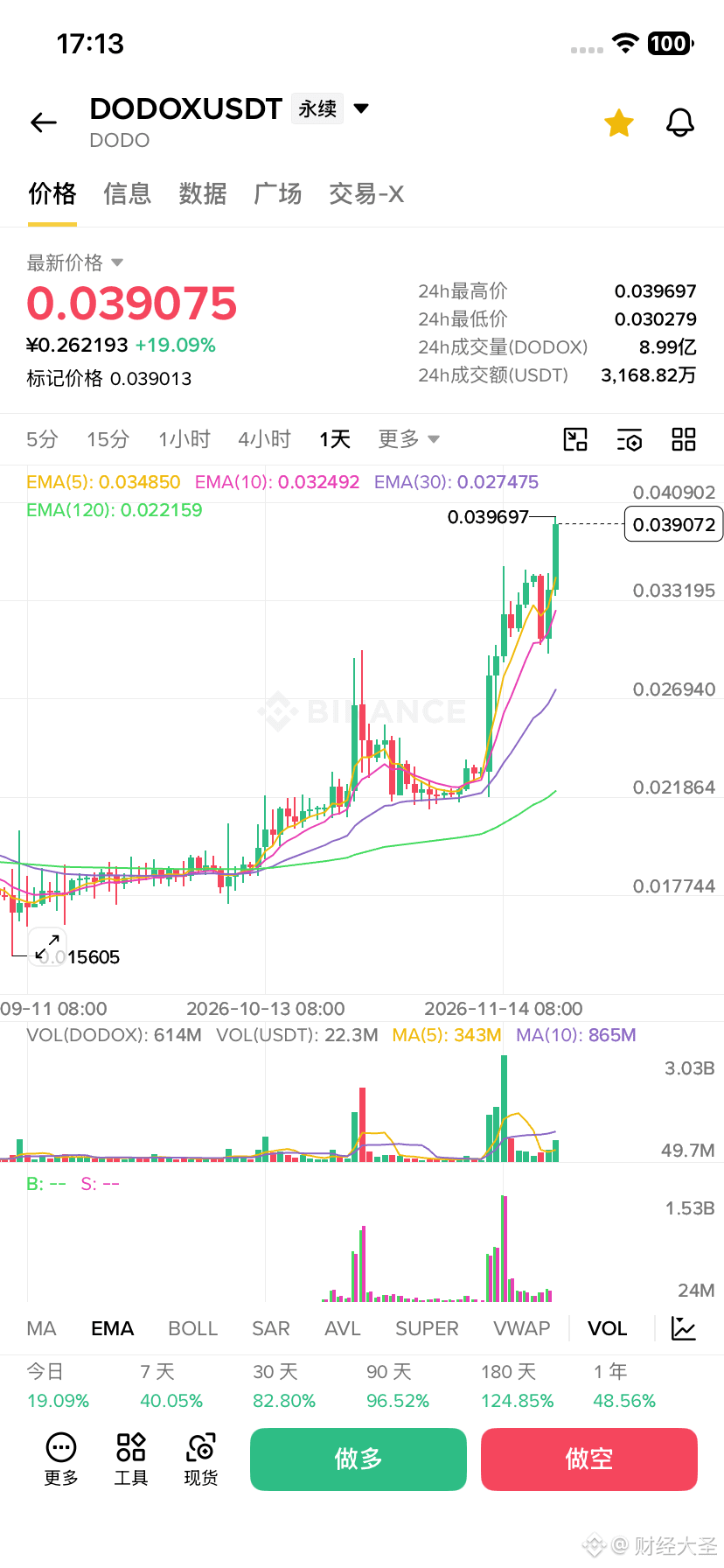
Once again, this proves it: the strong only get stronger! 🔥
I previously shared DODO after it broke out on high volume from a large weekly range. At the time, I said this was a setup worth paying close attention to.
After the breakout, it pulled back and shook out some holders. Many people may have sold, but the trend remained intact.
Now it’s climbing again on strong volume, and the price is hovering around 0.039!
From the earlier level of around 0.0301, that’s a gain of nearly 30%.
That’s the value of spotting an opportunity early.
Getting the direction right is one thing; having the conviction to hold is another.
Congratulations to everyone who got in and made a profit! 🚀
{future}(DODOXUSDT)
$DODOX
Once again, this proves it: the strong only get stronger! 🔥
I previously shared DODO after it broke out on high volume from a large weekly range. At the time, I said this was a setup worth paying close attention to.
After the breakout, it pulled back and shook out some holders. Many people may have sold, but the trend remained intact.
Now it’s climbing again on strong volume, and the price is hovering around 0.039!
From the earlier level of around 0.0301, that’s a gain of nearly 30%.
That’s the value of spotting an opportunity early.
Getting the direction right is one thing; having the conviction to hold is another.
Congratulations to everyone who got in and made a profit! 🚀
财经大圣
·
--
$DODOX
It pulled back, but I actually think an opportunity is brewing.
As I mentioned before, breaking out of a long-term trading range has significantly improved the overall trend.
The price is currently around 0.0301. Here are a few key levels to watch next:
- 0.0290: First level to watch
- 0.0275: Second level to watch
- 0.0255: Level to watch for a deeper pullback
- 0.0355: Target resistance level above
My approach is simple:
Don’t chase the rally; look for opportunities on pullbacks.
As long as the trend structure remains intact, a pullback could actually offer a better opportunity to build a position.
DODO, keep watching! 👀
1
211
·
--
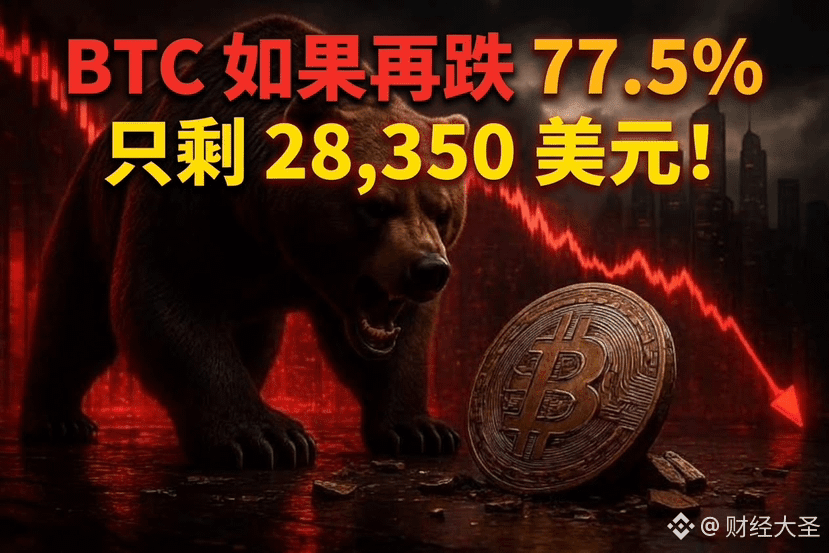
Could you stomach it if Bitcoin plunged 77.5% from a peak of $126,000?
Don’t assume it’s impossible.
In the last bear market, BTC fell all the way from $69,000 to $15,500—a drop of as much as 77.5%.
If history repeats itself this cycle, using $126,000 as the peak:
BTC’s target price would be just $28,350!
Based on the 84%–87% declines in earlier bear markets, BTC could even fall to $16,000–$20,000.
What would that mean?
A fall from $126,000 to $28,000 wouldn’t be a simple correction—it would wipe out more than $90,000 in wealth.
Of course, history doesn’t simply repeat itself. This is only an extreme scenario analysis and doesn’t mean things will necessarily unfold this way.
But there’s one question every investor should seriously consider:
If the next bear market really comes, will your position hold up until the end?
3
1.3k
·
--
Verified
Worse than 2008? Gao Zhikai warns: A global financial crisis may be looming!
Gao Zhikai previously predicted that a global financial crisis could erupt between late 2026 and the first half of 2027, with an impact potentially even greater than that of 2008.
His main concerns are three issues:
1. U.S. debt continues to balloon.
2. AI investment is overheating, and the bubble could burst.
3. Risks in the global financial system are continuing to build.
Now look at the markets: U.S. stocks are under pressure, while gold and Bitcoin are also continuing to fall.
With stocks, gold, and cryptocurrencies all under pressure, what risks are markets actually pricing in?
Of course, a downturn doesn’t mean a financial crisis is inevitable.
But there’s a question worth considering:
If another global financial crisis does happen, what do you think will trigger it: the AI bubble or U.S. debt?

1
1.3k
·
--
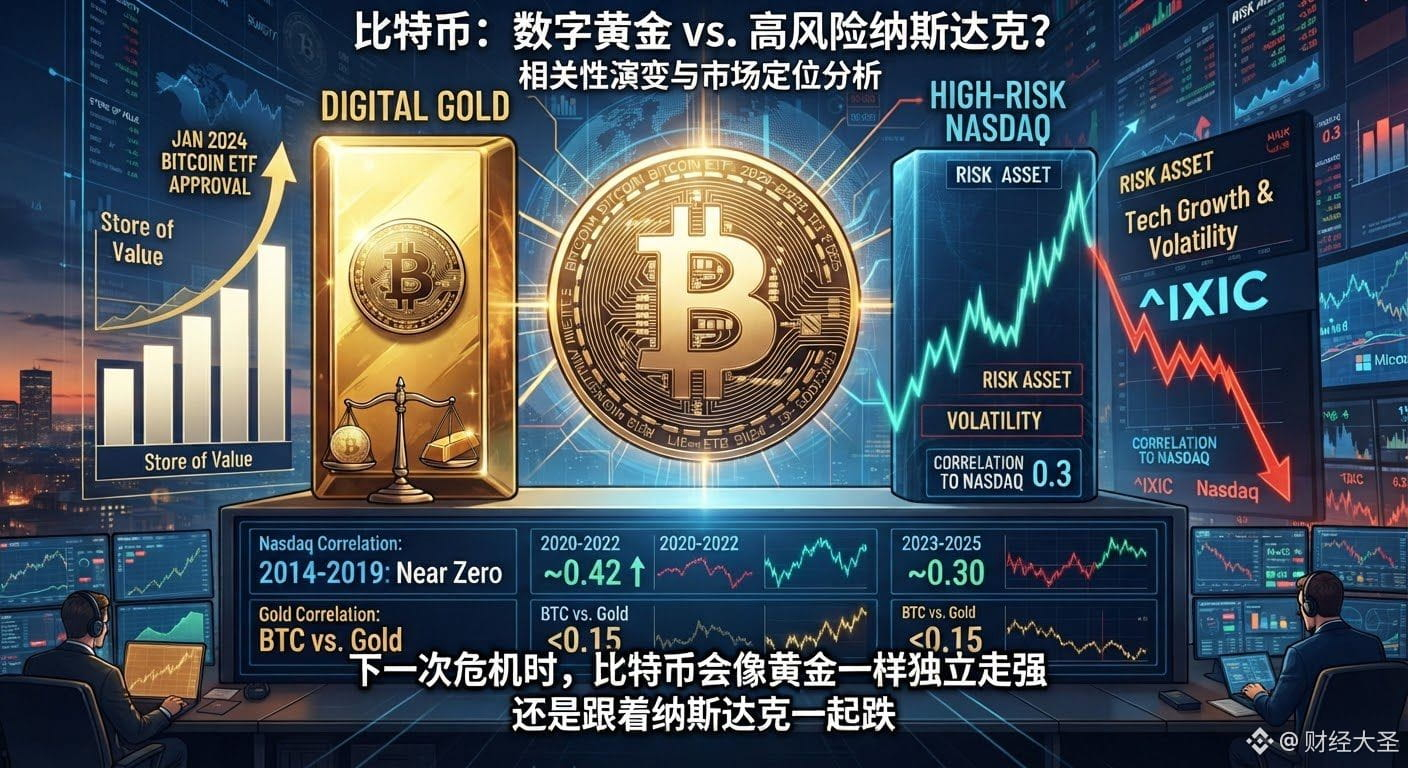
Is Bitcoin really digital gold, or a high-risk version of the Nasdaq?
In January 2024, U.S. spot Bitcoin ETFs were approved, and institutional money began flowing into the Bitcoin market on a large scale.
Many people believe this brought Bitcoin one step closer to becoming digital gold.
But market correlations suggest the picture may not be so simple.
First, let’s look at the Nasdaq:
From 2014 to 2019, Bitcoin’s correlation with the Nasdaq was close to zero.
From 2020 to 2022, it rose to around 0.42.
From 2023 to 2025, it remained at around 0.30.
This suggests that Bitcoin has become increasingly susceptible to U.S. stock market movements, dollar liquidity, and market risk appetite.
Now let’s look at gold:
In recent years, Bitcoin’s correlation with the Nasdaq 100 has been around 0.3, while its correlation with gold has been below 0.15.
In other words, during many periods, Bitcoin has behaved more like a risk asset than a traditional safe haven.
My view:
Bitcoin does have gold-like scarcity, but it hasn’t yet fully acquired gold’s safe-haven qualities.
It carries both the narrative of digital gold and the volatility of a technology growth asset.
What’s really worth watching is this:
The next time a crisis hits global financial markets, will Bitcoin fall alongside the Nasdaq, or will it rise independently like gold?
Ultimately, Bitcoin will have to prove its “digital gold” status through its market performance.
345
·
--
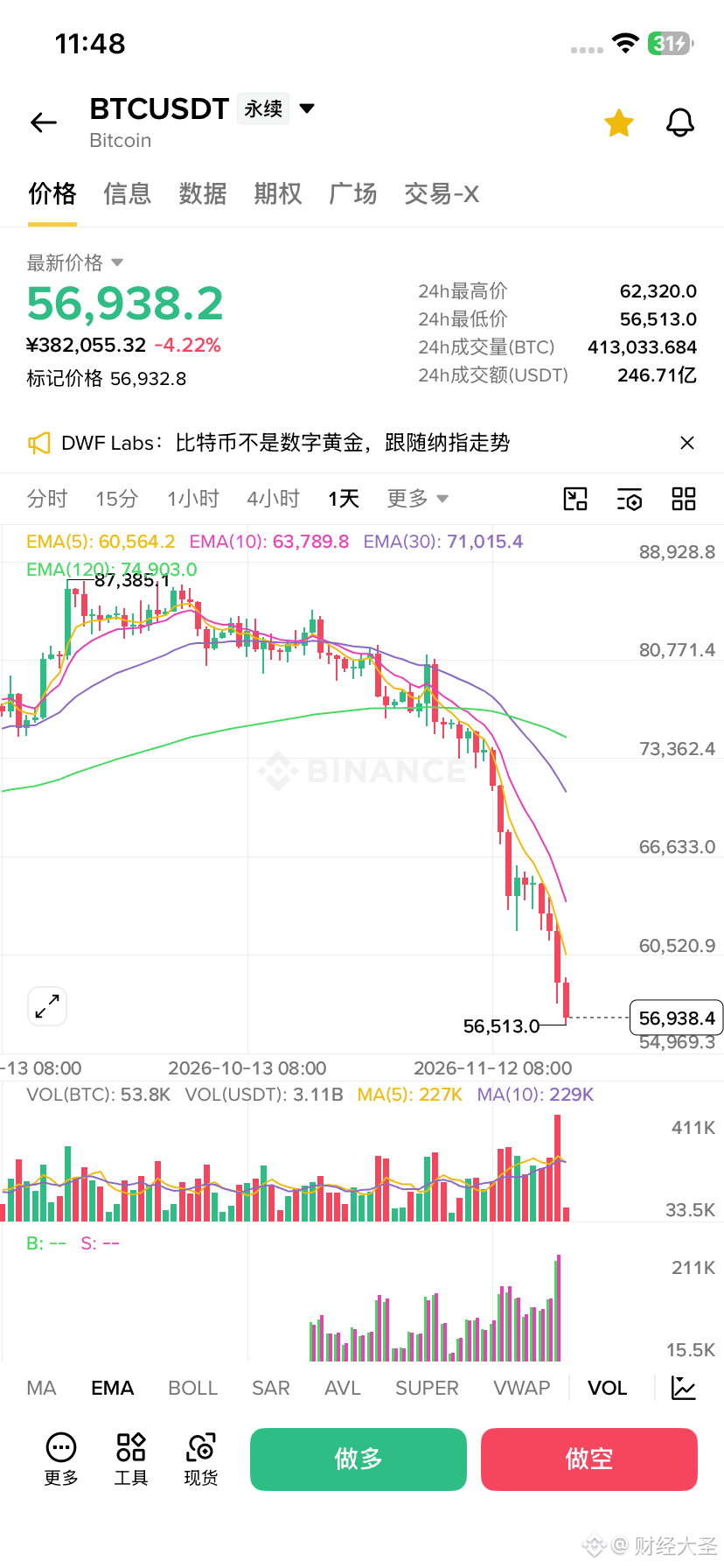
Bitcoin’s been sliding so smoothly these past few days.
No grand conspiracy, no complicated technical analysis, not even enough time to react.
Yesterday I thought I could tough it out. Today I think I’ll wait a little longer. Tomorrow I might start figuring out how to turn my life around.
I used to trade crypto and spend every day wondering when I’d be financially free.
Now I trade crypto and spend every day wondering how I can be free.
“Be fearful when others are greedy, and greedy when others are fearful”?
Sorry, I’m about to lose even the right to be greedy.
The one thing I can be grateful for:
At least I’m still alive, and my account hasn’t been closed yet. 😂
$BTC
{future}(BTCUSDT)
Bitcoin’s been sliding so smoothly these past few days.
No grand conspiracy, no complicated technical analysis, not even enough time to react.
Yesterday I thought I could tough it out. Today I think I’ll wait a little longer. Tomorrow I might start figuring out how to turn my life around.
I used to trade crypto and spend every day wondering when I’d be financially free.
Now I trade crypto and spend every day wondering how I can be free.
“Be fearful when others are greedy, and greedy when others are fearful”?
Sorry, I’m about to lose even the right to be greedy.
The one thing I can be grateful for:
At least I’m still alive, and my account hasn’t been closed yet. 😂
$BTC
630
·
--
Bullish
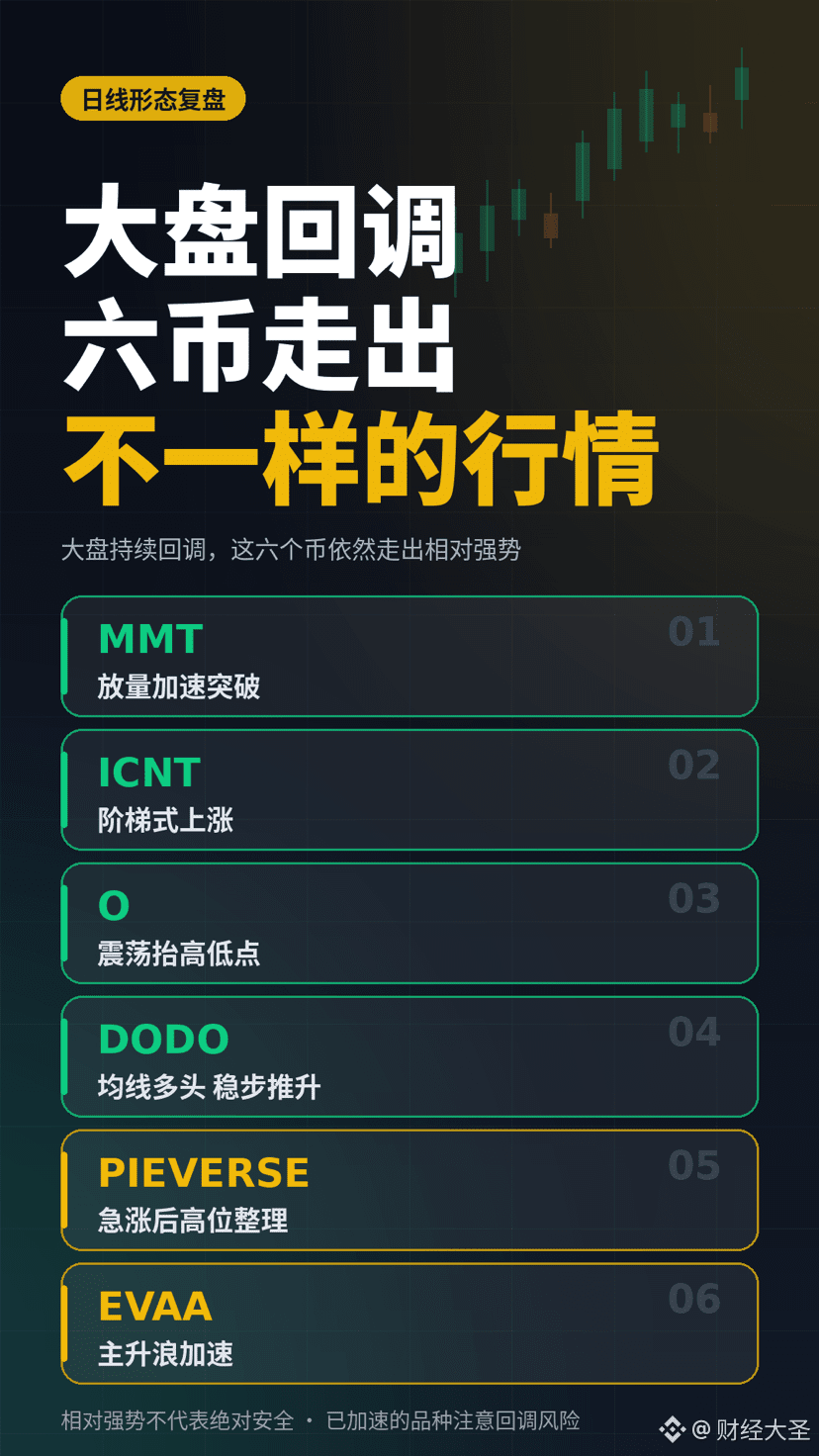
The broader market has been in a sustained pullback, but these 6 coins have bucked the trend.
I took another look at their daily charts and found each one’s price action pretty interesting:
🔹 MMT: Bounced off the bottom, then broke out with rising volume.
🔹 ICNT: Climbed in steps, making higher highs after each pullback.
🔹 O: Consolidated in a range, with lows gradually moving higher.
🔹 DODO: Bullish moving-average alignment, with the trend steadily pushing higher.
🔹 PIEVERSE: Rallied sharply, then entered a consolidation phase near the highs.
🔹 EVAA: Its main uptrend has accelerated, and its short-term gains are already substantial.
These six coins have different price patterns, but they share one thing: even as the broader market pulled back, they showed solid relative strength.
I don’t think trading should be just about watching the coins that have fallen the most. Sometimes the assets worth studying are the ones people are still willing to buy when the market is weak.
Of course, a big rally doesn’t mean a coin will keep going up. For those that have already accelerated, it’s especially important to watch out for pullback risk.
Which of these six has the best daily chart pattern, in your view? Which one has the best chance in the next market cycle?
#BTC #Altcoins
922
·
--

Article
This is the kind of person you should become after 2027.First: Learn English well enough to use it directly.
Not just to pass the CET-4 or CET-6 exams, but to understand information in English, communicate naturally with people from other countries, and freely use the English-language internet.
The freedom to access information largely determines the limits of what we can know.
If you spend all your time on the Chinese internet, the information you encounter is inevitably limited by language, platforms, and algorithms. Much of it has been translated, paraphrased, or reworked, and inevitably reflects the perspectives and biases of those sharing it.
English is a global lingua franca and one of the most important languages on the internet.
This is the kind of person you should become after 2027.
First: Learn English well enough to use it directly.
Not just to pass the CET-4 or CET-6 exams, but to understand information in English, communicate naturally with people from other countries, and freely use the English-language internet.
The freedom to access information largely determines the limits of what we can know.
If you spend all your time on the Chinese internet, the information you encounter is inevitably limited by language, platforms, and algorithms. Much of it has been translated, paraphrased, or reworked, and inevitably reflects the perspectives and biases of those sharing it.
English is a global lingua franca and one of the most important languages on the internet.
1
107
·
--
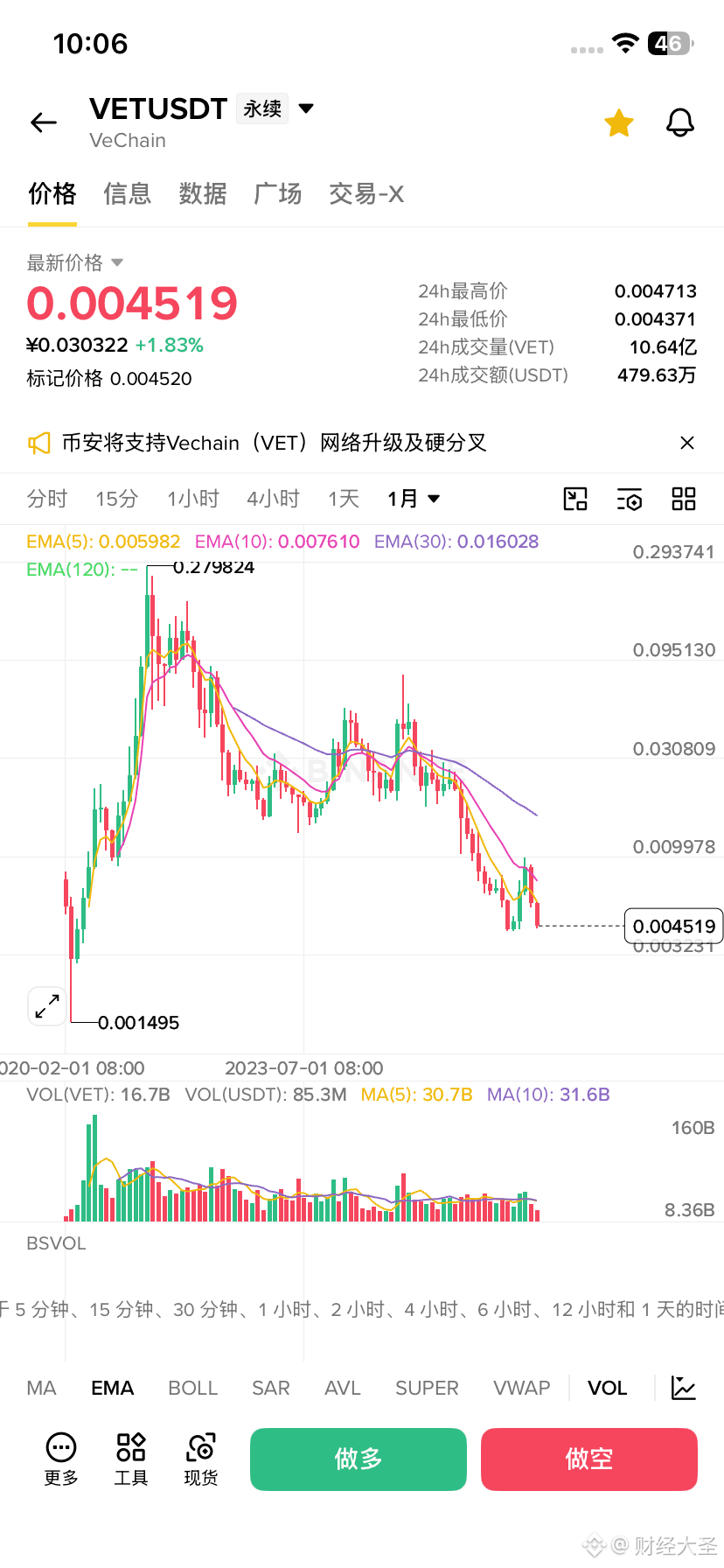
What happened to the enterprise blockchain project that was once full of promise? $VET
During the 2021 bull market, VET was also a very popular star project.
It focused on supply chain management, product traceability, and enterprise blockchain applications.
Simply put, it aimed to use blockchain to record every step of a product’s journey, from production and shipping to sales, making information more transparent.
The market was very optimistic about this sector back then, and VET climbed to a high of around $0.28.
But what happened next?
Enterprise adoption was slower than the market expected, and the commercial value of blockchain technology did not quickly translate into demand for the token.
On top of that, competition from new public blockchains and other technological approaches gradually caused VET to lose the market buzz it once had.
The project is still developing, but the token’s performance has fallen far short of the market’s expectations back then.
The fact that a technology can solve problems doesn’t necessarily mean its token will share in the resulting commercial value.
Do you think VET still has a chance to make a comeback?
{future}(VETUSDT)
What happened to the enterprise blockchain project that was once full of promise? $VET
During the 2021 bull market, VET was also a very popular star project.
It focused on supply chain management, product traceability, and enterprise blockchain applications.
Simply put, it aimed to use blockchain to record every step of a product’s journey, from production and shipping to sales, making information more transparent.
The market was very optimistic about this sector back then, and VET climbed to a high of around $0.28.
But what happened next?
Enterprise adoption was slower than the market expected, and the commercial value of blockchain technology did not quickly translate into demand for the token.
On top of that, competition from new public blockchains and other technological approaches gradually caused VET to lose the market buzz it once had.
The project is still developing, but the token’s performance has fallen far short of the market’s expectations back then.
The fact that a technology can solve problems doesn’t necessarily mean its token will share in the resulting commercial value.
Do you think VET still has a chance to make a comeback?

231
·
--
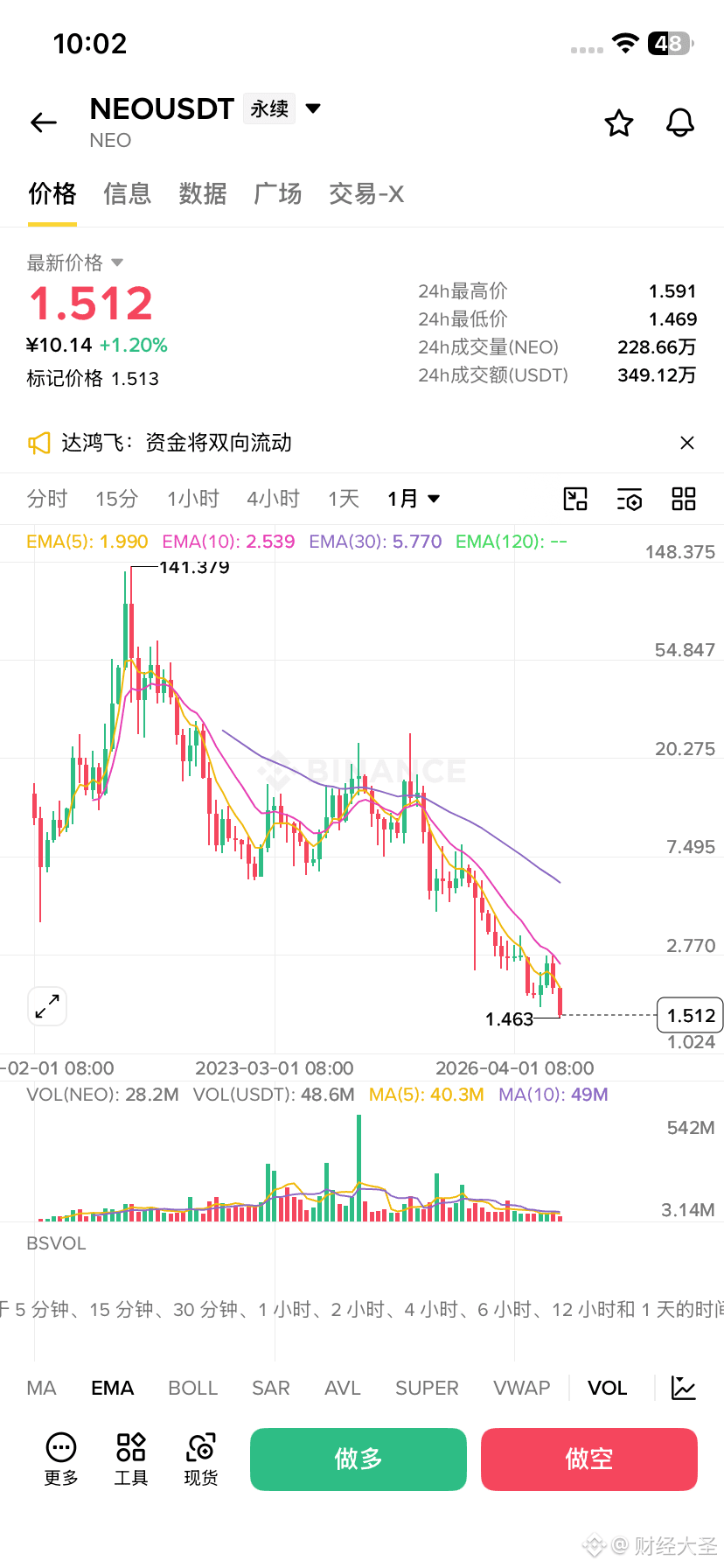
How many people still remember NEO, once known as China’s Ethereum? $NEO
In 2017, NEO was one of the most highly sought-after public blockchain projects in China’s crypto market.
At the time, it was called the Chinese version of Ethereum, focusing on smart contracts, digital assets, and digital identity.
During the heyday of homegrown public blockchains, NEO was once a star project in the eyes of countless investors.
In 2018, NEO reached a high of around $198.
But what happened next?
Its ecosystem failed to live up to market expectations. Interest from developers and users gradually declined, while competition continued to grow.
Once a leading homegrown public blockchain, it slowly faded from the mainstream market.
NEO hasn’t disappeared completely, but its glory days are long gone.
From being called China’s Ethereum to gradually slipping into obscurity, NEO’s journey reflects the rise and fall of China’s entire homegrown public blockchain sector.
Did you ever buy Antshares back then?
{future}(NEOUSDT)
How many people still remember NEO, once known as China’s Ethereum? $NEO
In 2017, NEO was one of the most highly sought-after public blockchain projects in China’s crypto market.
At the time, it was called the Chinese version of Ethereum, focusing on smart contracts, digital assets, and digital identity.
During the heyday of homegrown public blockchains, NEO was once a star project in the eyes of countless investors.
In 2018, NEO reached a high of around $198.
But what happened next?
Its ecosystem failed to live up to market expectations. Interest from developers and users gradually declined, while competition continued to grow.
Once a leading homegrown public blockchain, it slowly faded from the mainstream market.
NEO hasn’t disappeared completely, but its glory days are long gone.
From being called China’s Ethereum to gradually slipping into obscurity, NEO’s journey reflects the rise and fall of China’s entire homegrown public blockchain sector.
Did you ever buy Antshares back then?
1
2
354
·
--
Verified
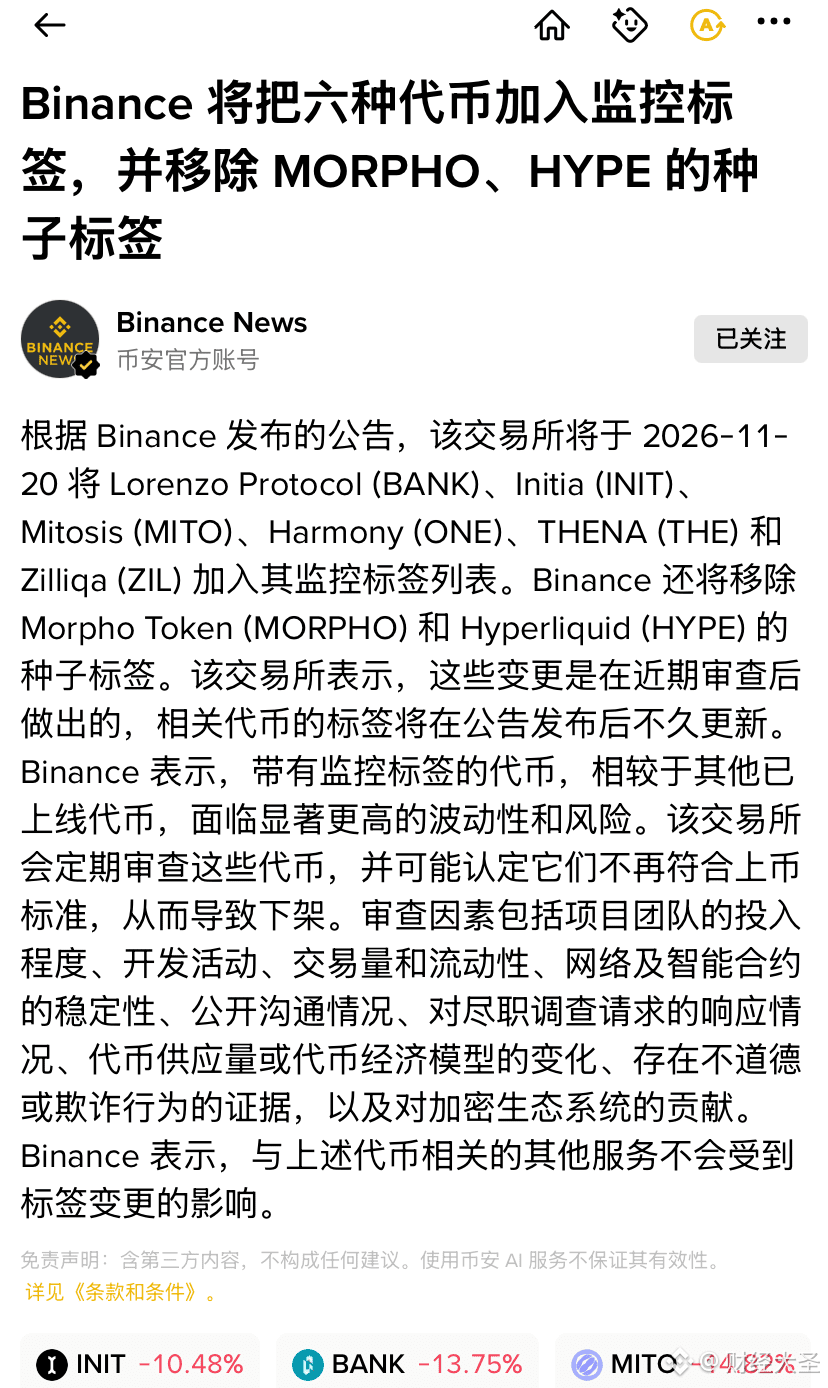
Binance raises a risk alert for 6 tokens!
Binance officially announced that it is adding the following tokens to its Monitoring Tag list:
$ONE (Harmony)
$ZIL (Zilliqa)
$BANK, $INIT, $MITO, $THE
Note: Being added to the monitoring list does not mean immediate delisting, but it does mean the project will face stricter scrutiny and could be at risk of delisting in the future.
This is a warning sign for investors in older altcoins.
Being popular in the past doesn’t mean a project is still competitive today.
If a project lacks ongoing development, real users, ecosystem growth, and market liquidity, it may gradually be left behind—even if it once thrived.
There are no permanent leaders in crypto, only ever-changing competition.
Do you think these established altcoins still have a chance to bounce back?
1
1.4k
·
--
Article
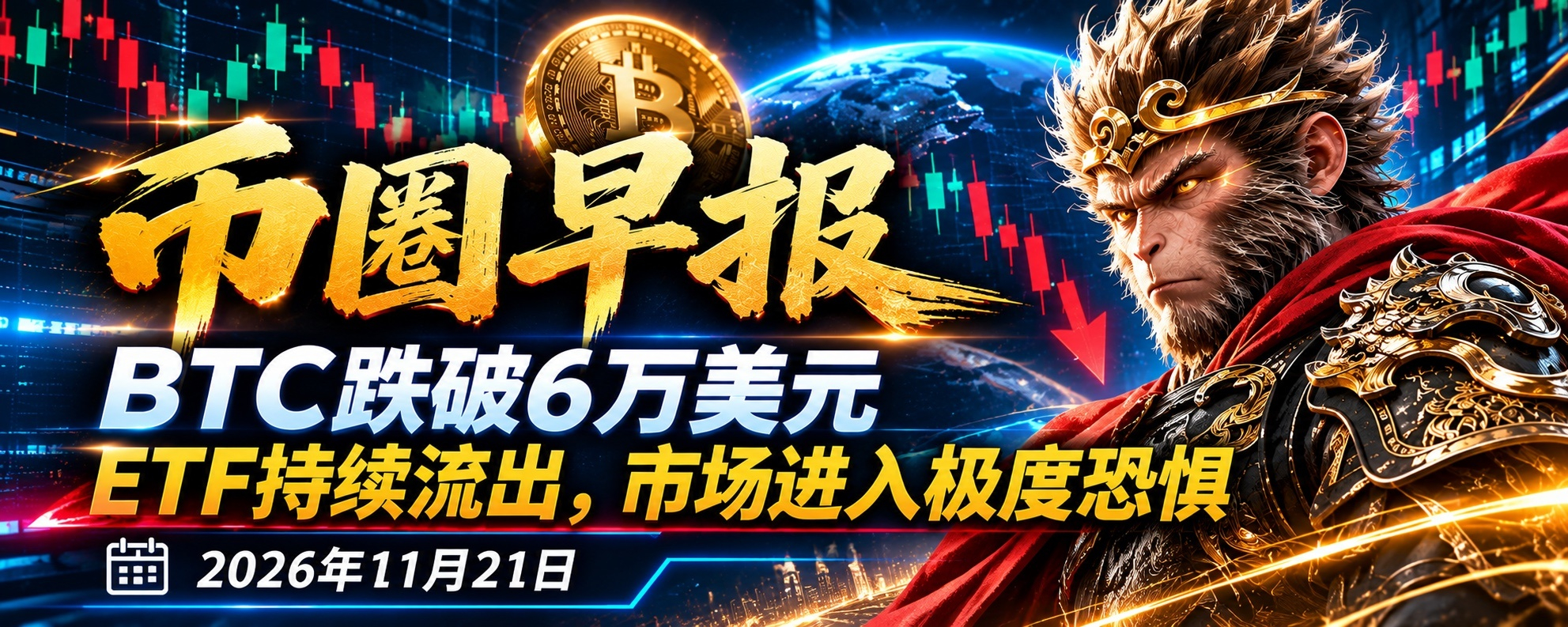
Crypto Morning Brief | November 21, 2026: BTC Falls Below $60,000, ETF Outflows Continue, Market Enters Extreme FearCrypto Morning Brief | November 21, 2026: BTC Falls Below $60,000, ETF Outflows Continue, Market Enters Extreme Fear
Over the past 24 hours, the crypto market has undergone a notable correction.
Bitcoin fell below $60,000, briefly dropping to around $58,000 during the day; Ether fell even further, with major assets broadly under pressure.
Meanwhile, U.S. spot Bitcoin ETFs saw consecutive net outflows, and the Crypto Fear & Greed Index fell to 12, in the extreme fear zone.
This downturn is not just a correction within the crypto market. Concerns about tech stock valuations, expectations for macro liquidity, and broad pressure on risk assets are all weighing on market sentiment.
Crypto Morning Brief | November 21, 2026: BTC Falls Below $60,000, ETF Outflows Continue, Market Enters Extreme Fear
Crypto Morning Brief | November 21, 2026: BTC Falls Below $60,000, ETF Outflows Continue, Market Enters Extreme Fear
Over the past 24 hours, the crypto market has undergone a notable correction.
Bitcoin fell below $60,000, briefly dropping to around $58,000 during the day; Ether fell even further, with major assets broadly under pressure.
Meanwhile, U.S. spot Bitcoin ETFs saw consecutive net outflows, and the Crypto Fear & Greed Index fell to 12, in the extreme fear zone.
This downturn is not just a correction within the crypto market. Concerns about tech stock valuations, expectations for macro liquidity, and broad pressure on risk assets are all weighing on market sentiment.
196
·
--
Whether you make money through unconventional means or invest.
If you succeed, your whole family is happy;
if you fail, you bear the burden alone.
Are people really born gamblers?
They’re just kids from poor families, trying to seize a chance to turn their lives around.
Moving up the social ladder has never been easy.
You have to dare to take risks—but always set a stop-loss before you do.
If you’re afraid to lose, you may never rise above your station; if you play it safe all your life, you may never get ahead.
But there’s one thing you must understand:
The opportunity that truly changes your fate is often not something you calculated to perfection, but a lucky break you happen to stumble upon.
More often than not, the perfect plans you stay up all night refining may end up meaning very little.
So don’t doubt yourself just because you missed one opportunity, and don’t dismiss all your past efforts because of one loss.
There’s a saying I’ve always believed in:
Leave your downside to discipline, and your upside to luck.
When it’s time to cut your losses, don’t hesitate. When it’s time to wait, learn to endure the solitude.
When that wind of change finally begins to blow, you may not need especially powerful wings.
You just need to still be at the table.
Because opportunity never gives you advance notice.
But there’s one condition:
When the wind comes, you must not have already eliminated yourself.

4
1.1k
·
--
Article
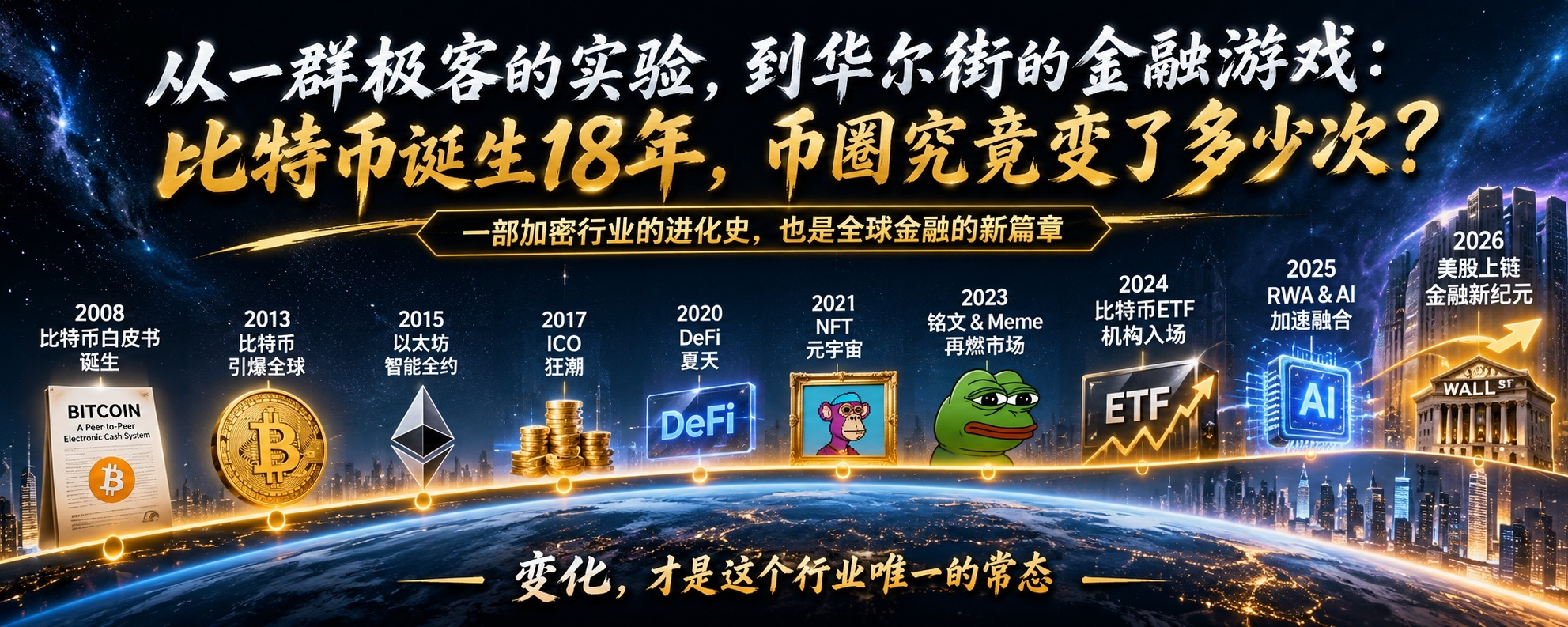
From an experiment by a group of geeks to a Wall Street financial game: Eighteen years after Bitcoin’s birth, how much has the crypto world changed?If you’ve been following Bitcoin since 2008 and stayed with it until today, you’ll discover something truly incredible:
This industry may be changing faster than almost any other in the world.
In 2008, almost no one knew what Bitcoin was.
There was no Binance, no OKX, no futures, no ETFs—let alone the wide variety of DeFi, NFTs, memecoins, and RWAs we have today.
At first, it was just a group of cryptography enthusiasts and programmers discussing a brand-new digital currency on internet forums.
Eighteen years later, Bitcoin has become part of Wall Street’s asset allocation strategies. Traditional financial institutions are beginning to study blockchain, and even U.S. stocks, Treasury bonds, and real-world assets are exploring on-chain integration.
From an experiment by a group of geeks to a Wall Street financial game: Eighteen years after Bitcoin’s birth, how much has the crypto world changed?
If you’ve been following Bitcoin since 2008 and stayed with it until today, you’ll discover something truly incredible:
This industry may be changing faster than almost any other in the world.
In 2008, almost no one knew what Bitcoin was.
There was no Binance, no OKX, no futures, no ETFs—let alone the wide variety of DeFi, NFTs, memecoins, and RWAs we have today.
At first, it was just a group of cryptography enthusiasts and programmers discussing a brand-new digital currency on internet forums.
Eighteen years later, Bitcoin has become part of Wall Street’s asset allocation strategies. Traditional financial institutions are beginning to study blockchain, and even U.S. stocks, Treasury bonds, and real-world assets are exploring on-chain integration.
1
293
·
--
I recently took a closer look at Space and Time ($SXT ), and this project has some interesting things going for it.
Everyone’s talking about AI these days, but I think there’s an issue that’s easy to overlook: no matter how smart AI gets, if the data it uses isn’t accurate or its calculations can’t be verified, how much confidence can we really have in its conclusions?
Space and Time aims to solve the problem of data trustworthiness.
Its core technology is called Proof of SQL. Put simply, it uses zero-knowledge proofs to let others not only see the results of database queries and calculations, but also verify whether those results were calculated according to the correct rules and haven’t been tampered with.
I think there are three main areas worth paying attention to:
1️⃣ AI applications: AI agents will rely on more and more external data in the future. Space and Time aims to make the results of these data queries verifiable, giving AI applications a more reliable data foundation.
2️⃣ DeFi: Use cases like lending, liquidations, and on-chain asset management often involve processing large amounts of historical data. If the data and calculation results can be verified, this can reduce reliance on trusting a single data provider.
3️⃣ On-chain and off-chain data: A lot of real-world business data isn’t on the blockchain. Space and Time aims to connect on-chain and off-chain data, allowing smart contracts to use verified data too.
Now, a bit about $SXT.
It’s more than just a token associated with the project name. It also serves functions related to network staking, network services, and ecosystem incentives. The network’s actual usage and the token’s utility still need to be monitored over time.
Personally, I think that now AI and blockchain have come this far, we shouldn’t focus only on how smart models are or how many applications there are. Whether data is authentic and calculations can be verified are equally important questions that can’t be ignored.
Of course, a promising technical direction doesn’t guarantee commercial success. Ultimately, it comes down to real users, network usage, and ecosystem growth.
What do you guys think? As AI and Web3 become more widespread, could verifiable data become a key piece of infrastructure in the next phase?
#sxt $SXT @SpaceandTimeDB
I recently took a closer look at Space and Time ($SXT ), and this project has some interesting things going for it.
Everyone’s talking about AI these days, but I think there’s an issue that’s easy to overlook: no matter how smart AI gets, if the data it uses isn’t accurate or its calculations can’t be verified, how much confidence can we really have in its conclusions?
Space and Time aims to solve the problem of data trustworthiness.
Its core technology is called Proof of SQL. Put simply, it uses zero-knowledge proofs to let others not only see the results of database queries and calculations, but also verify whether those results were calculated according to the correct rules and haven’t been tampered with.
I think there are three main areas worth paying attention to:
1️⃣ AI applications: AI agents will rely on more and more external data in the future. Space and Time aims to make the results of these data queries verifiable, giving AI applications a more reliable data foundation.
2️⃣ DeFi: Use cases like lending, liquidations, and on-chain asset management often involve processing large amounts of historical data. If the data and calculation results can be verified, this can reduce reliance on trusting a single data provider.
3️⃣ On-chain and off-chain data: A lot of real-world business data isn’t on the blockchain. Space and Time aims to connect on-chain and off-chain data, allowing smart contracts to use verified data too.
Now, a bit about $SXT .
It’s more than just a token associated with the project name. It also serves functions related to network staking, network services, and ecosystem incentives. The network’s actual usage and the token’s utility still need to be monitored over time.
Personally, I think that now AI and blockchain have come this far, we shouldn’t focus only on how smart models are or how many applications there are. Whether data is authentic and calculations can be verified are equally important questions that can’t be ignored.
Of course, a promising technical direction doesn’t guarantee commercial success. Ultimately, it comes down to real users, network usage, and ecosystem growth.
What do you guys think? As AI and Web3 become more widespread, could verifiable data become a key piece of infrastructure in the next phase?
#sxt $SXT @SpaceandTime

2
182
·
--
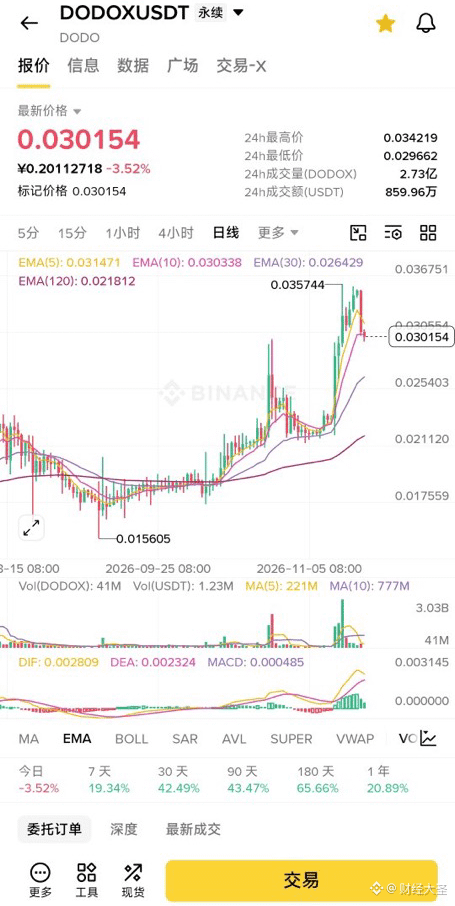
$DODOX
It pulled back, but I actually think an opportunity is brewing.
As I mentioned before, breaking out of a long-term trading range has significantly improved the overall trend.
The price is currently around 0.0301. Here are a few key levels to watch next:
- 0.0290: First level to watch
- 0.0275: Second level to watch
- 0.0255: Level to watch for a deeper pullback
- 0.0355: Target resistance level above
My approach is simple:
Don’t chase the rally; look for opportunities on pullbacks.
As long as the trend structure remains intact, a pullback could actually offer a better opportunity to build a position.
DODO, keep watching! 👀
{future}(DODOXUSDT)
$DODOX
It pulled back, but I actually think an opportunity is brewing.
As I mentioned before, breaking out of a long-term trading range has significantly improved the overall trend.
The price is currently around 0.0301. Here are a few key levels to watch next:
- 0.0290: First level to watch
- 0.0275: Second level to watch
- 0.0255: Level to watch for a deeper pullback
- 0.0355: Target resistance level above
My approach is simple:
Don’t chase the rally; look for opportunities on pullbacks.
As long as the trend structure remains intact, a pullback could actually offer a better opportunity to build a position.
DODO, keep watching! 👀
财经大圣
·
--
BullishThe trend in $DODOX , which we were watching earlier, is still continuing.
Looking back now, our earlier assessment was correct.
DODOX has gained over 40% in the past 7 days and nearly 60% in the past 30 days.
A market rally doesn’t automatically end just because prices have risen for a while. The key is whether the trend has been broken.
For now, the upward structure remains intact, and the trend hasn’t changed.
Still bullish!
Next, keep an eye on trading volume and key support levels. As long as the trend holds, we’ll continue to monitor it.📈
1
1
1
584
·
--
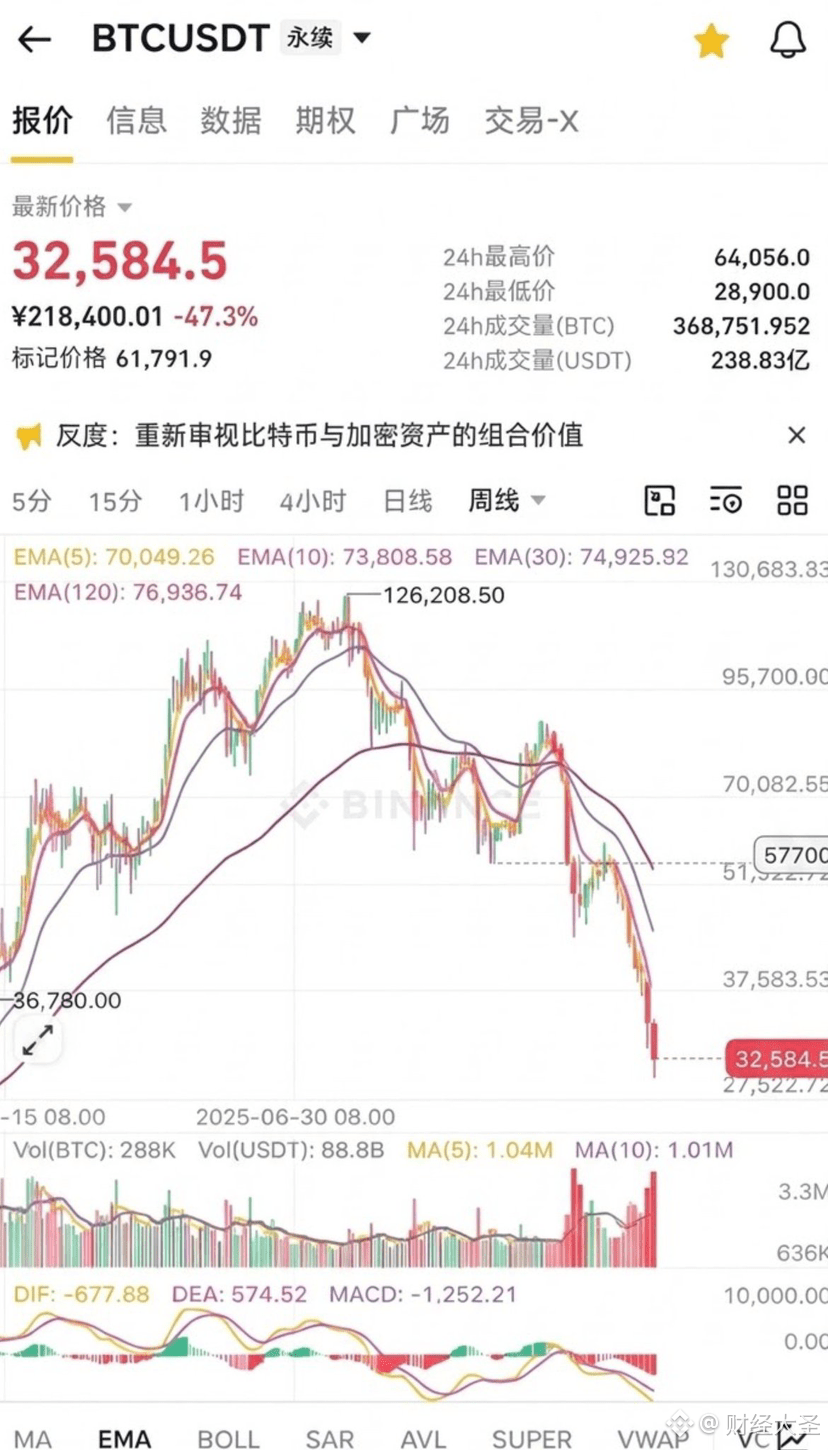
If Bitcoin continues to fall and breaks below $57,700 for real, where do you think it will go next?
$50,000?
$40,000?
Or straight down to $30,000?
Market sentiment is already very fragile.
What I’m more curious about is: if we really enter a deep bear market, how low do you think BTC could go?
Share your thoughts in the comments.
$50,000?
$40,000?
Or straight down to $30,000?
Market sentiment is already very fragile.
What I’m more curious about is: if we really enter a deep bear market, how low do you think BTC could go?
Share your thoughts in the comments.
1
1
129
Log in to explore more content
Join global crypto users on Binance Square
⚡️ Get latest and useful information about crypto.
💬 Trusted by the world’s largest crypto exchange.
👍 Discover real insights from verified creators.
Email / Phone number
Trending Topics
NvidiaLoses$2.7TrillionInMonthAndAHalf
20,678 views
132 Discussing
Nvidia’s $2.7 Trillion Wipeout: When Narrative Overrides Numbers 📉
Crypto With Faisal
·7 Likes
·5.5k views
CanBTCReboundAfterFallingBelow60K?
779,053 views
3,008 Discussing
GlobalStocksFaceLongestLosingStreakSince2023
284,337 views
2,005 Discussing