
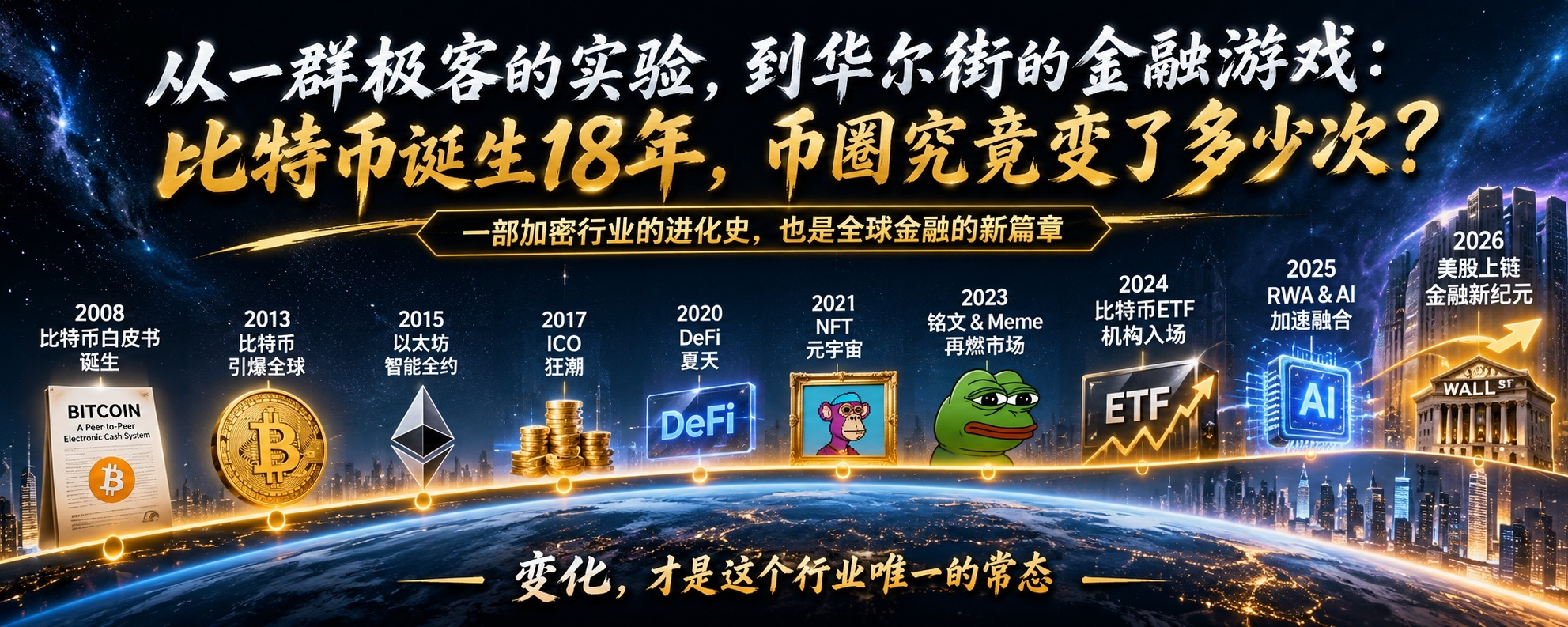

If you’ve been following Bitcoin since 2008 and stayed with it until today, you’ll discover something truly incredible:
This industry may be changing faster than almost any other in the world.
In 2008, almost no one knew what Bitcoin was.
There was no Binance, no OKX, no futures, no ETFs—let alone the wide variety of DeFi, NFTs, memecoins, and RWAs we have today.
At first, it was just a group of cryptography enthusiasts and programmers discussing a brand-new digital currency on internet forums.
Eighteen years later, Bitcoin has become part of Wall Street’s asset allocation strategies. Traditional financial institutions are beginning to study blockchain, and even U.S. stocks, Treasury bonds, and real-world assets are exploring on-chain integration.
Looking back, this industry has undergone a major transformation almost every few years.
Today, let’s retrace the story from the beginning.

I. 2008–2010: Bitcoin is born as an experiment among a circle of tech enthusiasts
On October 31, 2008, someone using the pseudonym Satoshi Nakamoto published the Bitcoin white paper.
The core idea was simple:
It enabled people to transact digital currencies directly with one another, without relying on banks or other third-party financial institutions.
On January 3, 2009, the Bitcoin genesis block was created.
Back then, Bitcoin had nothing like the mature trading market we have today.
There were no professional exchanges, professional traders, or so-called crypto KOLs.
The earliest participants were mostly cryptography enthusiasts, programmers, and geeks interested in the idea of decentralization.
People discussed technology on forums, mined with ordinary computer CPUs, and sent bitcoins to one another.
On May 22, 2010, a programmer used 10,000 BTC to buy two pizzas.
This later became known as Bitcoin Pizza Day.
It was also during this period that public Bitcoin trading markets began to emerge, gradually establishing a price.
Back then, Bitcoin was first and foremost a technological experiment, not an investment market in the sense we know today.
II. 2011–2013: Exchanges emerge and the altcoin era begins
As more people gradually became familiar with Bitcoin, the market underwent its first transformation.
The early trading platform Mt. Gox gradually became one of the world’s major Bitcoin exchanges.
People could now buy and sell Bitcoin more easily.
Mining also evolved from ordinary computer CPUs to GPUs, and then to specialized ASIC mining machines.
At the same time, new cryptocurrencies began to appear.
Projects such as Litecoin and Dogecoin entered the market one after another.
For the first time, crypto assets other than Bitcoin appeared in the market.
In 2013, Bitcoin went through a major bull run, with its price surging as media around the world began reporting on it.
A number of early miners, investors, and trading platforms also emerged in China.
But the industry was still very rudimentary at this stage. Wallets, exchanges, and security systems were all immature.
In 2014, the once highly influential Mt. Gox exchange suffered a major security breach and eventually went bankrupt.
The crypto community learned firsthand about exchange risk.
III. 2014–2017: Ethereum emerges, and ICOs transform the industry
If Bitcoin created a digital currency, Ethereum created an entirely new platform for blockchain applications.
Ethereum’s white paper was published in 2013.
Ethereum held an early token sale in 2014.
The Ethereum mainnet went live in 2015.
Its most important innovation was the smart contract.
This meant that blockchain could do more than record transfers; it could also run programs.
Anyone could build their own tokens, applications, and financial protocols on Ethereum.
ICOs took off on a massive scale in 2017.
Projects raised funds by issuing tokens.
A white paper, a team, and a business idea could be enough to attract huge amounts of capital.
That year, the market saw a flood of new public blockchains, projects, and tokens.
Of course, the bubble was enormous too.
Many projects had no real product; some raised funds on nothing more than an idea.
The market then entered a deep bear market in 2018, and many projects became worthless.
But Ethereum fundamentally changed the crypto industry’s business model.
From then on, anyone could create their own assets and applications on the blockchain.

IV. 2018–2019: The bear market shakes out the industry as infrastructure quietly matures
Many people remember only the 2018 bear market and overlook the development that took place during this period.
Exchanges began improving, stablecoins gradually gained adoption, and wallet experiences continued to get better.
USDT became an important medium of exchange in the crypto market.
Decentralized exchanges began exploring new ways to trade.
Projects such as Uniswap, MakerDAO, Compound, and Aave continued to develop.
Meanwhile, competition among public blockchains intensified, and projects such as EOS and TRON became major market talking points.
The market began expanding beyond simply trading coins into infrastructure, trading services, and financial applications.
Many innovations that took off later had actually begun taking shape during this period.
V. 2020: DeFi Summer gives blockchain its own financial system
2020 was a major turning point for the crypto industry.
DeFi Summer officially set the market ablaze.
Lending, liquidity mining, yield farming, decentralized exchanges, synthetic assets, and other concepts rapidly gained traction.
Users could deposit assets into protocols to earn interest and token rewards, or borrow stablecoins by putting up collateral.
Projects such as Uniswap, Compound, Aave, and Yearn Finance became market focal points.
In the past, financial services were mainly provided by banks and centralized institutions.
DeFi began experimenting with moving some financial services onto the blockchain through smart contracts.
The crypto industry was no longer just creating new coins; it was beginning to create new financial products.
VI. 2021: NFTs, GameFi, and the metaverse push crypto beyond finance
In 2021, the crypto industry experienced another major boom.
NFTs entered the mainstream spotlight.
Digital art, profile pictures, and collectibles could all be authenticated and traded through blockchain.
Projects such as CryptoPunks and Bored Ape Yacht Club became market sensations.
Then Axie Infinity sparked a GameFi boom.
Play-to-earn became a popular business model.
The metaverse concept also began attracting significant capital.
Meanwhile, new public blockchains such as Solana rose rapidly, challenging Ethereum’s ecosystem dominance.
The people involved in crypto also changed.
Alongside traders and technology developers, more and more artists, gamers, brands, and everyday users entered the industry.
The crypto industry began expanding beyond financial experiments into culture, entertainment, gaming, and social networking.
VII. 2022: A series of collapses triggers the industry’s most severe crisis of confidence
Behind the boom, risks were building up too.
In 2022, Terra/LUNA collapsed, and firms such as Three Arrows Capital and Celsius ran into trouble one after another.
Then the globally renowned exchange FTX went bankrupt.
Institutions once considered enormous and financially powerful lost their credibility overnight.
The market was reminded that:
An exchange is not a bank, a platform’s size does not guarantee safety, and so-called high returns don’t mean there’s no risk.
Meanwhile, Ethereum completed The Merge, transitioning from proof of work to proof of stake and bringing the era of traditional mining on the Ethereum mainnet to an end.
That year, the market experienced falling prices, shrinking liquidity, and a crisis of confidence.
But infrastructure continued to develop.
Technologies such as Layer 2 and zero-knowledge proofs began attracting more attention.
VIII. 2023: The Bitcoin ecosystem revives, with inscriptions, memes, and new public-chain narratives
In 2023, the market gradually recovered from the previous cycle’s crisis.
One notable change that year was the emergence of new ways to use the Bitcoin ecosystem.
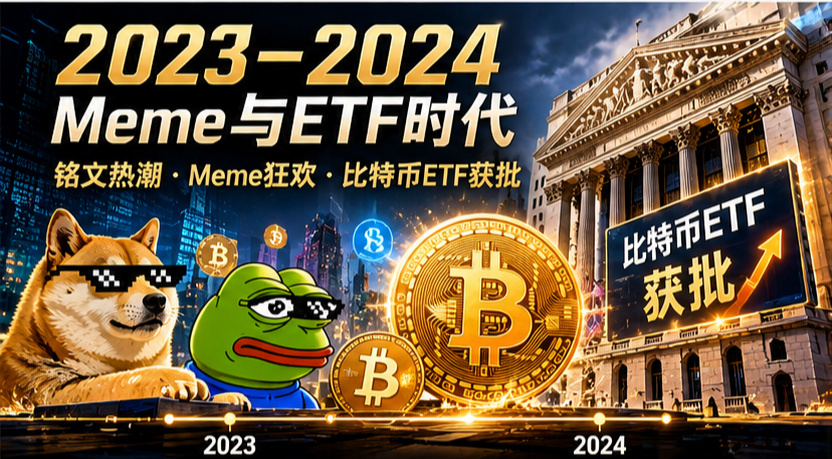
The Ordinals protocol made it possible to embed digital content on Bitcoin through inscriptions.
Then token standards such as BRC-20 sparked a frenzy.
In the past, Bitcoin was primarily seen as a store of value and a payment asset.
Now, the market is exploring its potential as a platform for issuing and trading digital assets.
Meanwhile, Layer 2 ecosystems such as Arbitrum and Optimism continued to grow.
Solana also gradually regained its momentum.
Meme coins became a new market sensation.
The market’s focus shifted further away from project fundraising and technological concepts toward communities, distribution, liquidity, and sentiment.
IX. 2024: Bitcoin ETFs are approved, bringing institutional capital onto center stage
In January 2024, the U.S. SEC approved spot Bitcoin ETFs for trading.
This was an important milestone in the history of the crypto industry.
Previously, traditional finance investors who wanted exposure to Bitcoin often had to use crypto exchanges and digital wallets.
ETFs offered another, more familiar way to invest.
Traditional financial institutions such as BlackRock and Fidelity began to play an important role in the market.
That same year, Bitcoin underwent its fourth halving.
The meme ecosystem also boomed again. Solana became a major hub for meme trading, and platforms such as Pump.fun lowered the barrier to issuing tokens.
The most noteworthy thing that year was:
Wall Street began embracing Bitcoin, while the native crypto market continued to come up with new ways to play.

X. 2025: Stablecoins, RWA, and AI accelerate their convergence with traditional finance
In 2025, the industry’s focus shifted further.
Stablecoins began expanding beyond their role as basic tools for crypto trading into cross-border payments, commercial settlements, and global fund transfers.
The U.S. GENIUS Act was signed into law, ushering stablecoin regulation into a new phase.
RWA (real-world asset tokenization) attracted growing interest from traditional financial institutions.
Treasury bonds, funds, gold, and other real-world assets began exploring issuance and trading through blockchain.
The convergence of AI and crypto also emerged as a new direction.
Concepts such as AI agents, automated payments, and on-chain intelligent execution continued to develop.
Meanwhile, perpetual futures, prediction markets, on-chain trading platforms, and various new financial products continued to expand.
The market began shifting away from simply speculating on tokens and toward studying real business activity, capital flows, and financial infrastructure.
XI. 2026: The boundary between the crypto industry and global financial markets grows increasingly blurred
In 2026, the industry entered another new phase of development.
In the past, we studied Bitcoin, Ethereum, and various altcoins.
Now, more and more people are starting to study:
Tokenized U.S. stocks, on-chain funds, tokenized Treasury bonds and gold, stablecoin payments, and how traditional financial assets can enter the blockchain.
Some platforms have already begun offering tokenized stock products, while traditional financial institutions are also advancing related infrastructure.
This means the crypto market of the future may no longer be just a standalone digital currency market.
It could become part of the global system for trading, settling, and circulating assets.
Meanwhile, AI agents, on-chain payments, prediction markets, derivatives, and automated trading are also continuing to develop.
Of course, these areas are at different stages of development. This does not mean that traditional stock markets have already moved entirely onto the blockchain.
But the trend is already very clear:
Blockchain is moving beyond the creation of digital assets toward supporting more real-world financial assets and services.
XII. Looking back at these 18 years, what exactly has happened?
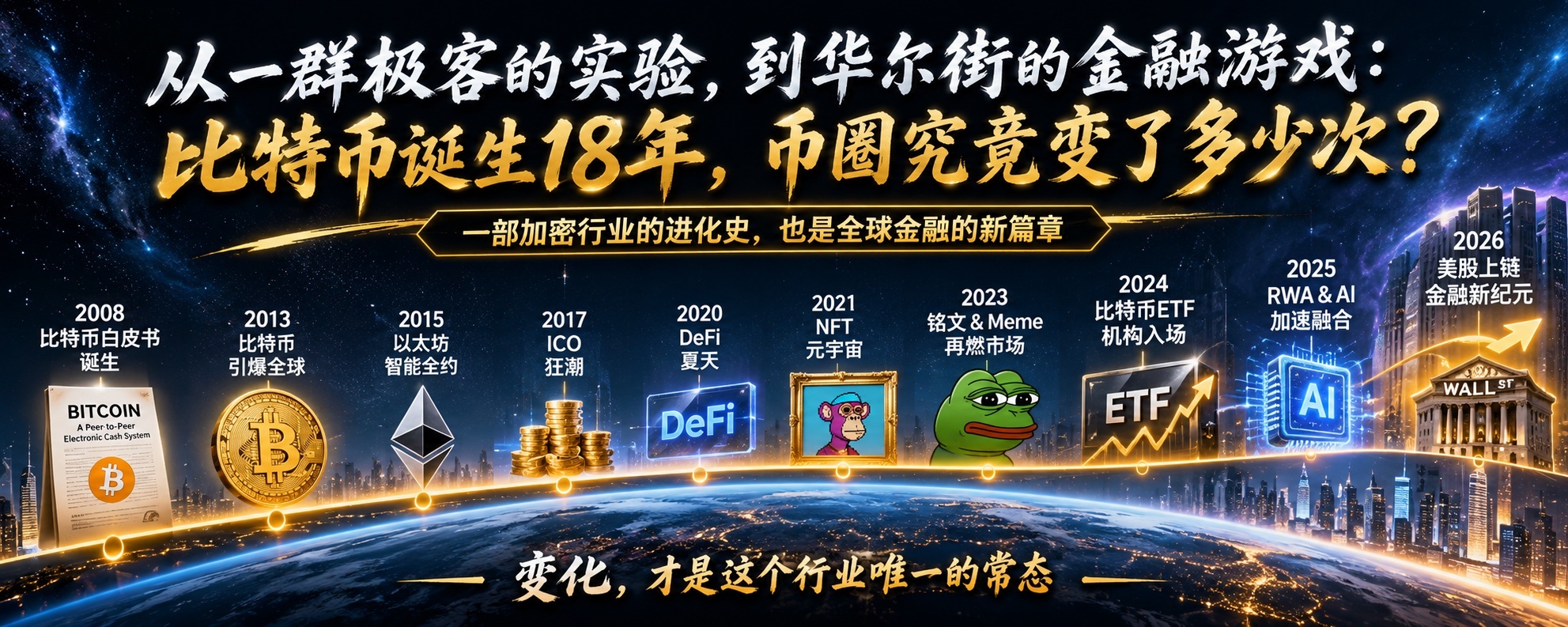
If we condense the development of the entire crypto industry, it comes down to a few major evolutions.
2008–2010: Bitcoin was created, solving the problem of decentralizing digital currency.
2011–2013: Trading markets emerged, and altcoins began to develop.
2014–2017: Ethereum and smart contracts emerged, and ICOs made token issuance a new way to raise funds.
2018–2019: The industry was reshaped, while exchanges, stablecoins, and infrastructure gradually matured.
2020: DeFi gave blockchain its own financial system.
2021: NFTs, GameFi, DAOs, and the metaverse expanded the industry’s boundaries.
2022: The bubble burst, and the industry began to take security, risk, and regulation seriously again.
2023: The Bitcoin ecosystem, inscriptions, memes, and Layer 2 brought new ways to engage with the market.
2024: Spot ETFs opened the door to capital from traditional institutions.
2025: Stablecoins, RWA, and AI accelerated their development.
2026: Traditional financial assets and blockchain moved closer together.
From a single digital currency at the beginning to today’s fintech ecosystem, the crypto industry has changed enormously.
But there is one question here that everyone involved should consider:
If someone keeps using a 2017 mindset to understand the 2026 market, can they still recognize today’s opportunities?
XIII. How can we keep up with an industry that is constantly changing?
I believe there are at least five things we should do.
First, don’t let past successes hold you back.
Bitcoin used to be the undisputed core. Then Ethereum brought smart contracts, DeFi changed how finance works, and memes reshaped market attention and the way capital is allocated.
Every era has its own defining trend.
Don’t assume future opportunities will stay in a sector just because you’re familiar with it.
Second, don’t focus only on coin prices; study the underlying changes in the industry.
When a new project appears, don’t just look at how much its price has risen.
Study what problem it solves, why it emerged, who is using it, where its funding comes from, and whether it has room to grow over the long term.
Price is the result; understanding the logic behind it is what matters.
Third, build a cross-disciplinary framework of understanding.
Today, you can’t study crypto by looking only at candlestick charts and technical indicators.
You also need to understand the macroeconomy, U.S. stocks, dollar liquidity, artificial intelligence, traditional finance, regulatory policy, and global capital flows.
Because the crypto market is no longer a completely independent market.
Fourth, learn to distinguish genuine trends from short-term hype.
Not every new narrative is worth getting involved in.
Some concepts may only be popular for a few months, while some infrastructure could reshape the industry over the next decade.
You need to distinguish technological innovation and commercial applications from short-term speculation driven by capital.
Fifth, keep learning.
Today you may be studying DeFi; tomorrow, you may need to study RWA.
Today you may be following the Bitcoin ecosystem; tomorrow, you may need to understand AI agents and on-chain payments.
What really matters is not how much you know right now, but whether you can keep updating your understanding.
Finally,
I’ve always felt that what makes the crypto world so fascinating isn’t just price volatility and the potential to build wealth.
It’s that the industry is always changing.
In 2008, a group of geeks set out to create a digital currency that didn’t rely on banks.
Later, people used blockchain to create smart contracts, built decentralized finance, and created NFTs and GameFi.
Later still, Wall Street began allocating funds to Bitcoin, and traditional financial institutions began researching stablecoins and RWA.
Now, we’re even starting to discuss bringing U.S. stocks on-chain.
In 18 years, the industry has undergone several sweeping changes.
With every change, some people seized opportunities by updating their understanding, while others missed a new era by clinging to the past.
So I believe the most important skill for anyone taking part in this industry isn’t predicting when the next bull market will arrive. It’s staying alert to new things, revising outdated assumptions, and thinking independently.
Don’t be just another person chasing the latest hype.
Strive to become someone who can understand how the industry is changing.
Because in this industry, the only constant may be change itself.