
CEOCryptoMoney
136 Posts

CEOCryptoMoney
Pro Crypto Trader|| Certified Technical Analyst|| Web3 Content Creator
30 Following
46 Followers
94 Liked
Posts
$150K in one day may look small in crypto. But for Omniston, it tells a bigger story.
On August 25, Omniston processed roughly $150,000 in cross chain swap volume in a single day.
What interests me isn’t the size of the number.
It’s the fact that real users were moving real value through cross-chain infrastructure that is still relatively young.
Omniston is evolving from a $TON liquidity aggregation layer into a broader execution layer coordinating quotes, routing, and settlement across different ecosystems.
And every transaction adds another piece to that story.
• Users are testing cross-chain routes
• Resolvers are providing liquidity
• Native assets can move between ecosystems
• Liquidity becomes less fragmented
• Different networks start feeling more connected
The resolver based model combines competitive RFQ pricing with HTLC based settlement, aiming to let users receive native assets on the destination chain without relying on a conventional shared bridge.
That’s the bigger idea.
Cross-chain shouldn’t feel like a complicated process.
Users shouldn’t have to think about bridges, wrapped assets, multiple interfaces, or a long chain of transactions just to move value between ecosystems.
The infrastructure should handle that complexity in the background.
And that’s why small milestones like this are worth watching.
Infrastructure doesn’t become important overnight.
First comes testing.
Then usage.
Then trust.
Then scale.
$150K today isn’t the destination. It’s another checkpoint.
The real question is what happens when cross-chain execution becomes a normal part of everyday DeFi activity.
Real users.
Real routes.
Real value moving.
One transaction at a time.
Explore STON.fi:
https://app.ston.fi/swap
On August 25, Omniston processed roughly $150,000 in cross chain swap volume in a single day.
What interests me isn’t the size of the number.
It’s the fact that real users were moving real value through cross-chain infrastructure that is still relatively young.
Omniston is evolving from a $TON liquidity aggregation layer into a broader execution layer coordinating quotes, routing, and settlement across different ecosystems.
And every transaction adds another piece to that story.
• Users are testing cross-chain routes
• Resolvers are providing liquidity
• Native assets can move between ecosystems
• Liquidity becomes less fragmented
• Different networks start feeling more connected
The resolver based model combines competitive RFQ pricing with HTLC based settlement, aiming to let users receive native assets on the destination chain without relying on a conventional shared bridge.
That’s the bigger idea.
Cross-chain shouldn’t feel like a complicated process.
Users shouldn’t have to think about bridges, wrapped assets, multiple interfaces, or a long chain of transactions just to move value between ecosystems.
The infrastructure should handle that complexity in the background.
And that’s why small milestones like this are worth watching.
Infrastructure doesn’t become important overnight.
First comes testing.
Then usage.
Then trust.
Then scale.
$150K today isn’t the destination. It’s another checkpoint.
The real question is what happens when cross-chain execution becomes a normal part of everyday DeFi activity.
Real users.
Real routes.
Real value moving.
One transaction at a time.
Explore STON.fi:
https://app.ston.fi/swap

What happens when a DEX becomes infrastructure?
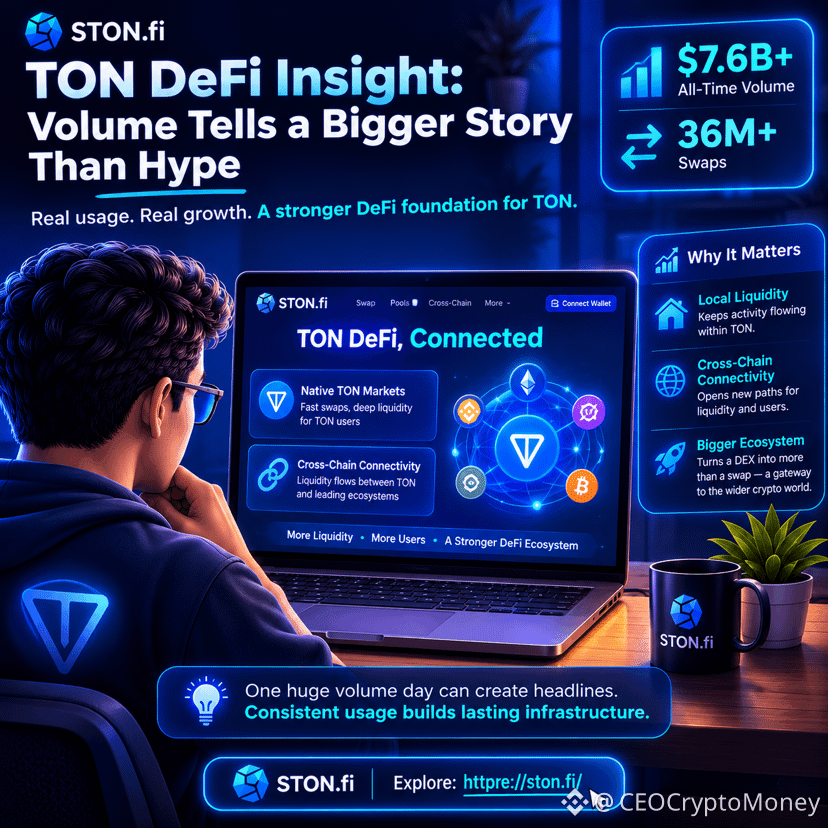
$7.6B+ in all time volume and 36M+ swaps tell a story that goes beyond short-term market hype.
The interesting part isn't just the size of these numbers, it's the repeated activity behind them.
STON.fi has evolved from a $TON native DEX into infrastructure supporting broader liquidity flows. Native markets serve users within $TON, while cross-chain connectivity creates additional pathways between $TON and other ecosystems.
That creates two important layers:
Local liquidity → keeps activity flowing within $TON.
Cross-chain connectivity → opens new paths for liquidity and users.
When these work together, a DEX becomes more than a place to swap tokens. It becomes part of the infrastructure connecting an ecosystem to the wider crypto landscape.
One huge volume day can create headlines.
But users consistently returning and using the infrastructure is what creates lasting value.
Hype attracts attention.
Consistent usage builds infrastructure.
Explore STON.fi:
https://ston.fi/
$7.6B+ in all time volume and 36M+ swaps tell a story that goes beyond short-term market hype.
The interesting part isn't just the size of these numbers, it's the repeated activity behind them.
STON.fi has evolved from a $TON native DEX into infrastructure supporting broader liquidity flows. Native markets serve users within $TON, while cross-chain connectivity creates additional pathways between $TON and other ecosystems.
That creates two important layers:
Local liquidity → keeps activity flowing within $TON.
Cross-chain connectivity → opens new paths for liquidity and users.
When these work together, a DEX becomes more than a place to swap tokens. It becomes part of the infrastructure connecting an ecosystem to the wider crypto landscape.
One huge volume day can create headlines.
But users consistently returning and using the infrastructure is what creates lasting value.
Hype attracts attention.
Consistent usage builds infrastructure.
Explore STON.fi:
https://ston.fi/
Cross Chain Should Feel Simple, Not Complicated
The interesting thing about STON.fi right now isn’t simply the number of networks being added.
It’s the direction behind them.
The goal appears to be making cross-chain liquidity movement feel less complicated for users.
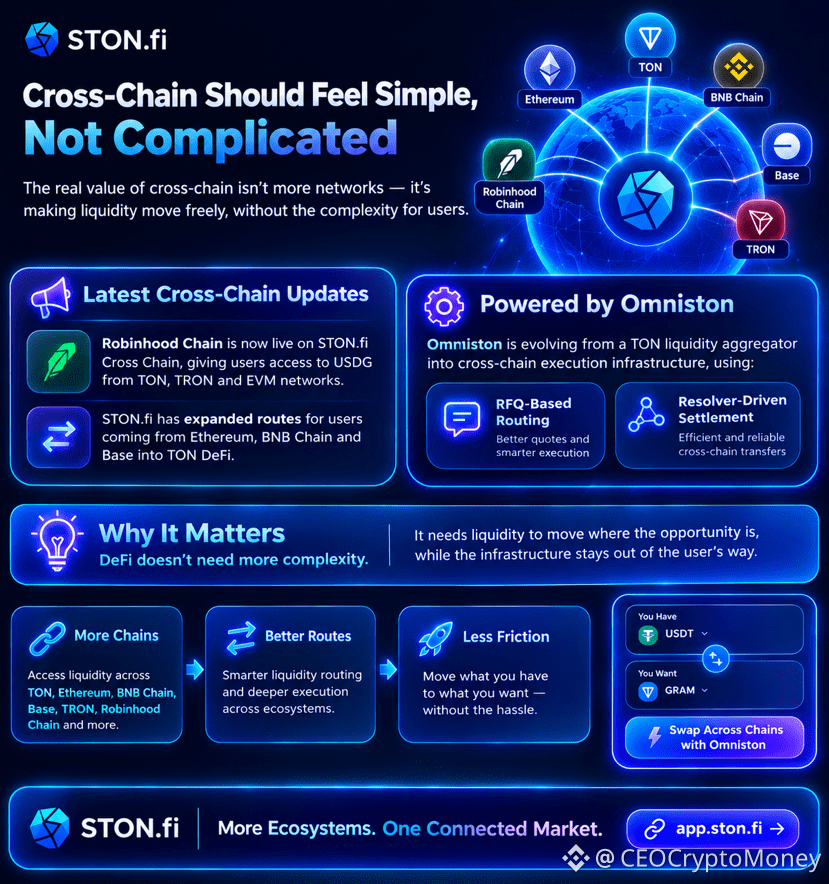
Robinhood Chain is now part of STON.fi’s cross chain flow, giving users access to USDG alongside expanding routes between TON, TRON, Ethereum, BNB Chain, Base, and other supported ecosystems.
Behind this experience is Omniston, evolving beyond TON liquidity aggregation toward cross-chain execution through RFQ based routing and resolver driven settlement.
And that matters because DeFi already has enough complexity.
Users shouldn’t have to think about:
Which bridge?
Which route?
Which liquidity source?
Which network?
Ideally, they should simply choose what they have and what they want.
The infrastructure handles the complexity underneath.
More chains.
Better routes.
Less friction.
That’s the STON.fi direction I’m watching closely. 🔵
➥ https://app.ston.fi
The interesting thing about STON.fi right now isn’t simply the number of networks being added.
It’s the direction behind them.
The goal appears to be making cross-chain liquidity movement feel less complicated for users.
Robinhood Chain is now part of STON.fi’s cross chain flow, giving users access to USDG alongside expanding routes between TON, TRON, Ethereum, BNB Chain, Base, and other supported ecosystems.
Behind this experience is Omniston, evolving beyond TON liquidity aggregation toward cross-chain execution through RFQ based routing and resolver driven settlement.
And that matters because DeFi already has enough complexity.
Users shouldn’t have to think about:
Which bridge?
Which route?
Which liquidity source?
Which network?
Ideally, they should simply choose what they have and what they want.
The infrastructure handles the complexity underneath.
More chains.
Better routes.
Less friction.
That’s the STON.fi direction I’m watching closely. 🔵
➥ https://app.ston.fi
DeFi Doesn’t Lack Liquidity. It Lacks Connectivity.
One of DeFi’s biggest challenges isn’t the amount of liquidity available.
It’s where that liquidity is located.
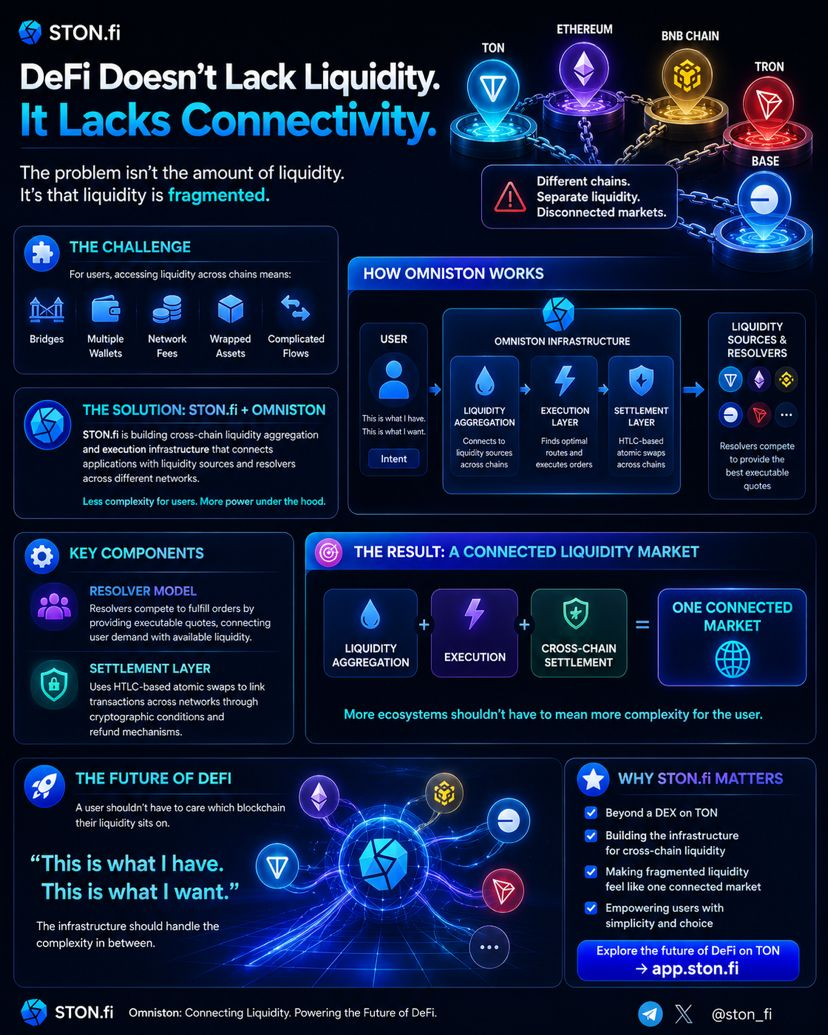
TON, Ethereum, BNB Chain, Base, TRON, and other networks each have their own markets. For users, accessing them can mean bridges, multiple wallets, network fees, wrapped assets, and complicated transaction flows.
STON.fi is working to make that complexity less visible.
Through Omniston, the infrastructure connects users and applications with liquidity sources and resolvers across different networks.
Instead of figuring out where the best liquidity is and how to execute across chains, much of that complexity can happen behind the scenes.
A key part is the resolver model, where resolvers can compete to provide executable quotes for orders.
Then there’s the settlement layer, which uses HTLC based atomic swaps to coordinate cross chain execution with cryptographic conditions and refund mechanisms.
The bigger picture is:
Liquidity aggregation → Execution → Cross-chain settlement
And that leads to a simple vision for DeFi:
“This is what I have. This is what I want.”
The infrastructure should handle everything in between.
That’s why STON.fi is interesting beyond being a DEX on TON. The bigger opportunity is making fragmented liquidity across different ecosystems feel more like one connected market.
More chains shouldn’t have to mean more complexity.
➥ https://app.ston.fi
$TON #TON #STONfi
One of DeFi’s biggest challenges isn’t the amount of liquidity available.
It’s where that liquidity is located.
TON, Ethereum, BNB Chain, Base, TRON, and other networks each have their own markets. For users, accessing them can mean bridges, multiple wallets, network fees, wrapped assets, and complicated transaction flows.
STON.fi is working to make that complexity less visible.
Through Omniston, the infrastructure connects users and applications with liquidity sources and resolvers across different networks.
Instead of figuring out where the best liquidity is and how to execute across chains, much of that complexity can happen behind the scenes.
A key part is the resolver model, where resolvers can compete to provide executable quotes for orders.
Then there’s the settlement layer, which uses HTLC based atomic swaps to coordinate cross chain execution with cryptographic conditions and refund mechanisms.
The bigger picture is:
Liquidity aggregation → Execution → Cross-chain settlement
And that leads to a simple vision for DeFi:
“This is what I have. This is what I want.”
The infrastructure should handle everything in between.
That’s why STON.fi is interesting beyond being a DEX on TON. The bigger opportunity is making fragmented liquidity across different ecosystems feel more like one connected market.
More chains shouldn’t have to mean more complexity.
➥ https://app.ston.fi
$TON #TON #STONfi
Don’t Just Create Web3 Content. Understand the Infrastructure.
For Web3 creators, knowing STON.fi as “just a DEX” misses the bigger picture.
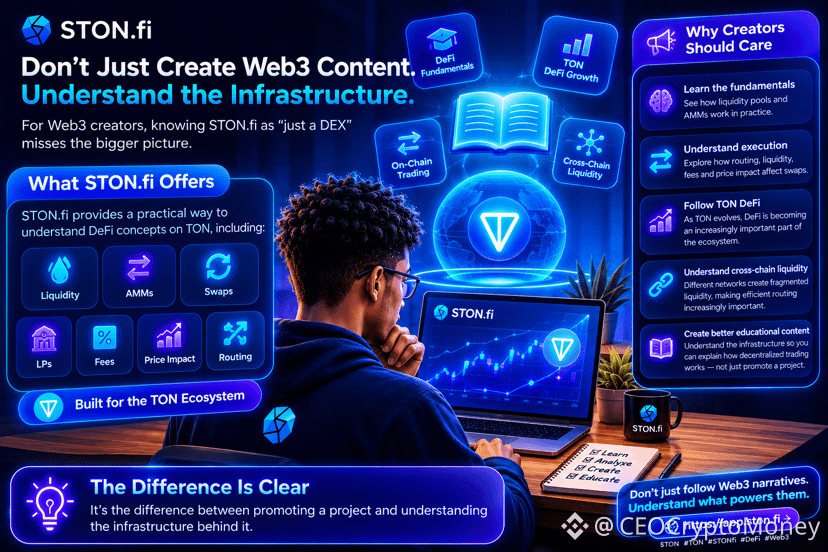
STON.fi offers a practical way to understand DeFi concepts on $TON, including liquidity, AMMs, swaps, LPs, fees, price impact, and routing.
Why should creators care?
Learn DeFi fundamentals
See how liquidity pools and AMMs work in practice.
Understand execution
Explore how routing, liquidity, fees, and price impact affect swaps.
Follow TON DeFi
As TON evolves, DeFi is becoming an increasingly important part of the ecosystem.
Understand cross chain liquidity
Different networks create fragmented liquidity, making efficient routing increasingly important.
Create better educational content
Understanding the infrastructure allows you to explain how decentralized trading works—not just promote a project.
Don’t just follow Web3 narratives.
Understand what powers them.
➥ https://app.ston.fi
#TON #STONfi
For Web3 creators, knowing STON.fi as “just a DEX” misses the bigger picture.
STON.fi offers a practical way to understand DeFi concepts on $TON, including liquidity, AMMs, swaps, LPs, fees, price impact, and routing.
Why should creators care?
Learn DeFi fundamentals
See how liquidity pools and AMMs work in practice.
Understand execution
Explore how routing, liquidity, fees, and price impact affect swaps.
Follow TON DeFi
As TON evolves, DeFi is becoming an increasingly important part of the ecosystem.
Understand cross chain liquidity
Different networks create fragmented liquidity, making efficient routing increasingly important.
Create better educational content
Understanding the infrastructure allows you to explain how decentralized trading works—not just promote a project.
Don’t just follow Web3 narratives.
Understand what powers them.
➥ https://app.ston.fi
#TON #STONfi
The future of cross chain DeFi isn't about moving assets.
It's about moving them with confidence.
For years, cross chain activity has relied heavily on traditional bridge models. While they've connected blockchain ecosystems, they've also introduced additional complexity and security considerations that every user should understand.
That's why I find the approach behind STON.fi's Omniston particularly interesting.
Instead of focusing solely on connecting networks, Omniston is designed to optimise how cross chain swaps are executed.
What stands out to me is its emphasis on execution certainty.
✔️ You see the quoted amount before confirming.
✔️ The protocol aims to deliver exactly that amount.
✔️ If the required execution conditions can't be met, the swap doesn't proceed under those conditions rather than leaving users with an uncertain outcome.
Combined with its HTLC and resolver based execution model, the goal is to make cross chain transactions feel more predictable while reducing unnecessary friction for users.
To me, that's where the next stage of DeFi is heading.
The best infrastructure isn't the one users notice the most it's the one that quietly makes every interaction smoother, more reliable, and easier to trust.
As liquidity continues to spread across multiple ecosystems, execution quality may become just as important as the networks themselves.
➥ https://app.ston.fi
It's about moving them with confidence.
For years, cross chain activity has relied heavily on traditional bridge models. While they've connected blockchain ecosystems, they've also introduced additional complexity and security considerations that every user should understand.
That's why I find the approach behind STON.fi's Omniston particularly interesting.
Instead of focusing solely on connecting networks, Omniston is designed to optimise how cross chain swaps are executed.
What stands out to me is its emphasis on execution certainty.
✔️ You see the quoted amount before confirming.
✔️ The protocol aims to deliver exactly that amount.
✔️ If the required execution conditions can't be met, the swap doesn't proceed under those conditions rather than leaving users with an uncertain outcome.
Combined with its HTLC and resolver based execution model, the goal is to make cross chain transactions feel more predictable while reducing unnecessary friction for users.
To me, that's where the next stage of DeFi is heading.
The best infrastructure isn't the one users notice the most it's the one that quietly makes every interaction smoother, more reliable, and easier to trust.
As liquidity continues to spread across multiple ecosystems, execution quality may become just as important as the networks themselves.
➥ https://app.ston.fi
Creating valuable content can be just as important as building valuable products.
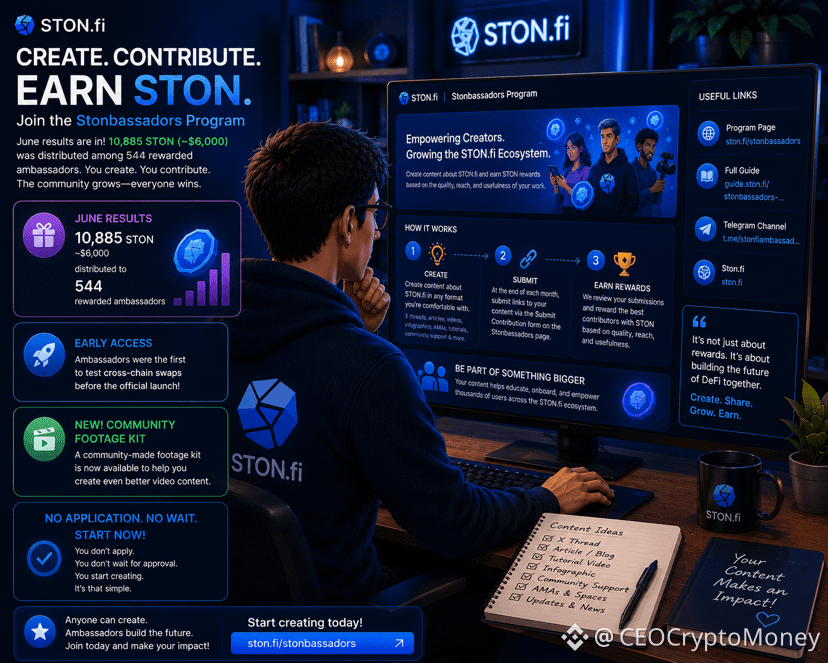
That's one of the reasons I find the Stonbassadors program interesting.
The latest community update shows that 10,885 STON was distributed among 544 ambassadors in June, rewarding creators who helped educate and grow the STON.fi ecosystem.
What surprised me most is how simple it is to get started.
You don't need to apply or wait for an invitation.
Instead, you:
Create original content about STON.fi in your preferred format
Submit your work at the end of the month
Earn rewards based on the quality, reach, and usefulness of your contributions
Another highlight from June is that ambassadors received early access to test cross-chain swaps before their public release, along with new resources to help improve video content creation.
To me, that's what makes a strong community program.
It doesn't just reward participation, it encourages people to learn, create, and contribute to the growth of the ecosystem.
➥ https://app.ston.fi
#STONfi
That's one of the reasons I find the Stonbassadors program interesting.
The latest community update shows that 10,885 STON was distributed among 544 ambassadors in June, rewarding creators who helped educate and grow the STON.fi ecosystem.
What surprised me most is how simple it is to get started.
You don't need to apply or wait for an invitation.
Instead, you:
Create original content about STON.fi in your preferred format
Submit your work at the end of the month
Earn rewards based on the quality, reach, and usefulness of your contributions
Another highlight from June is that ambassadors received early access to test cross-chain swaps before their public release, along with new resources to help improve video content creation.
To me, that's what makes a strong community program.
It doesn't just reward participation, it encourages people to learn, create, and contribute to the growth of the ecosystem.
➥ https://app.ston.fi
#STONfi
The future of DeFi isn't about adding more blockchains.
It's about making those blockchains feel invisible.
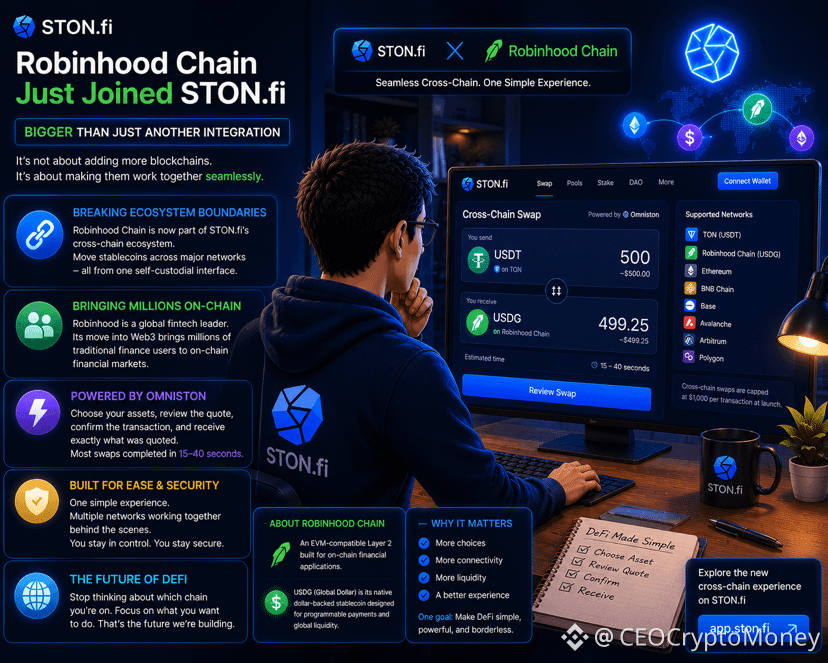
That's why STON.fi's integration of Robinhood Chain stands out to me.
Instead of asking users to navigate bridges, wallets, and multiple interfaces, the goal is much simpler: move assets across ecosystems through one seamless experience.
Powered by Omniston, STON.fi coordinates the entire cross-chain process behind the scenes. You select the asset, review the quote, confirm the transaction, and the infrastructure handles the complexity.
Today, users can access cross-chain swaps across:
🔹 $TON
🔹 Robinhood Chain (USDG)
🔹 Ethereum
🔹 Base
🔹 BNB Chain
🔹 Avalanche
🔹 Arbitrum
🔹 Polygon
What I find most exciting isn't the addition of another network, it's what it represents.
Each new integration moves DeFi closer to a future where users no longer think about which blockchain they're using. They simply focus on what they want to achieve, while the technology works quietly in the background.
To me, that's what great infrastructure looks like: powerful enough to connect ecosystems, yet simple enough that the user barely notices it.
➥ https://app.ston.fi
$TON #TON #STONfi
It's about making those blockchains feel invisible.
That's why STON.fi's integration of Robinhood Chain stands out to me.
Instead of asking users to navigate bridges, wallets, and multiple interfaces, the goal is much simpler: move assets across ecosystems through one seamless experience.
Powered by Omniston, STON.fi coordinates the entire cross-chain process behind the scenes. You select the asset, review the quote, confirm the transaction, and the infrastructure handles the complexity.
Today, users can access cross-chain swaps across:
🔹 $TON
🔹 Robinhood Chain (USDG)
🔹 Ethereum
🔹 Base
🔹 BNB Chain
🔹 Avalanche
🔹 Arbitrum
🔹 Polygon
What I find most exciting isn't the addition of another network, it's what it represents.
Each new integration moves DeFi closer to a future where users no longer think about which blockchain they're using. They simply focus on what they want to achieve, while the technology works quietly in the background.
To me, that's what great infrastructure looks like: powerful enough to connect ecosystems, yet simple enough that the user barely notices it.
➥ https://app.ston.fi
$TON #TON #STONfi
One of the biggest challenges in crypto has always been accessing Bitcoin without constantly moving between different blockchains.
For users in the $TON ecosystem, that experience is becoming much simpler.
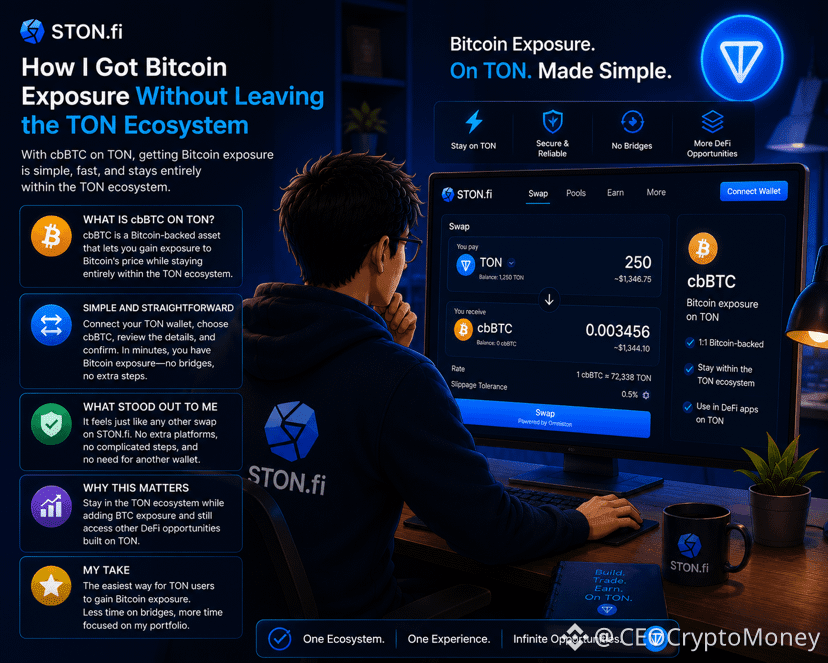
With cbBTC available on STON.fi, Bitcoin exposure is now accessible directly from within the TON ecosystem no separate Bitcoin wallet, no complex bridging process, and no switching between multiple platforms.
What stands out to me is how seamless the experience feels.
You interact with cbBTC just like any other supported asset on STON.fi. From the user’s perspective, it’s simply another swap. Behind the scenes, the infrastructure handles the complexity, allowing you to stay focused on managing your portfolio.
Why does this matter?
🔸 Gain Bitcoin exposure while remaining on $TON
🔸 Avoid unnecessary cross-chain complexity
🔸 Manage assets from a single, familiar interface
🔸 Continue exploring DeFi opportunities without leaving the ecosystem
As DeFi evolves, I think the best innovations are the ones users barely notice.
When accessing assets becomes this straightforward, the technology fades into the background and that’s exactly how a great user experience should feel.
➥ https://app.ston.fi
$TON #STONfi @STONfi DEX
For users in the $TON ecosystem, that experience is becoming much simpler.
With cbBTC available on STON.fi, Bitcoin exposure is now accessible directly from within the TON ecosystem no separate Bitcoin wallet, no complex bridging process, and no switching between multiple platforms.
What stands out to me is how seamless the experience feels.
You interact with cbBTC just like any other supported asset on STON.fi. From the user’s perspective, it’s simply another swap. Behind the scenes, the infrastructure handles the complexity, allowing you to stay focused on managing your portfolio.
Why does this matter?
🔸 Gain Bitcoin exposure while remaining on $TON
🔸 Avoid unnecessary cross-chain complexity
🔸 Manage assets from a single, familiar interface
🔸 Continue exploring DeFi opportunities without leaving the ecosystem
As DeFi evolves, I think the best innovations are the ones users barely notice.
When accessing assets becomes this straightforward, the technology fades into the background and that’s exactly how a great user experience should feel.
➥ https://app.ston.fi
$TON #STONfi @STONfi DEX
Most people think a swap is just one transaction.
But after learning more about intent-based execution, I realized there's a completely different way to approach it.
Think about planning a road trip.
One option is to follow the exact route you planned from the beginning, no matter what happens along the way.
The other option is using live navigation that continuously looks for the fastest and most efficient route based on current conditions.
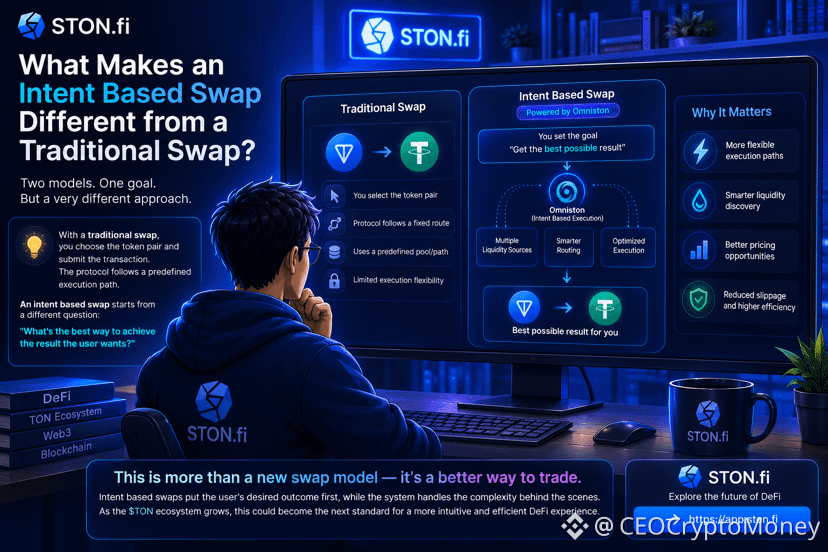
That's how I see the difference between traditional swaps and intent-based swaps.
With a traditional swap, the execution follows a predetermined path.
With an intent-based swap, the goal comes first.
Instead of asking, "Which route should we take?", the system asks, "What's the best way to deliver the result the user expects?"
That shift opens the door to:
More flexible execution paths
Smarter liquidity discovery
Better opportunities to reduce slippage
More efficient pricing when multiple liquidity sources are available
This is one reason Omniston caught my attention.
Rather than thinking in terms of a single trading route, it focuses on helping users achieve the intended outcome through intelligent execution across available liquidity.
To me, that's where DeFi is heading.
The best technology won't ask users to understand routing algorithms or liquidity mechanics.
It will simply deliver the best possible result while the complexity stays hidden in the background.
As the $TON ecosystem continues to evolve, intent based execution could become one of the technologies that makes DeFi feel more intuitive for everyone, not just experienced users.
I'm interested to see how this approach develops as more builders adopt it.
➥ https://app.ston.fi
$TON #TON #STONfi
But after learning more about intent-based execution, I realized there's a completely different way to approach it.
Think about planning a road trip.
One option is to follow the exact route you planned from the beginning, no matter what happens along the way.
The other option is using live navigation that continuously looks for the fastest and most efficient route based on current conditions.
That's how I see the difference between traditional swaps and intent-based swaps.
With a traditional swap, the execution follows a predetermined path.
With an intent-based swap, the goal comes first.
Instead of asking, "Which route should we take?", the system asks, "What's the best way to deliver the result the user expects?"
That shift opens the door to:
More flexible execution paths
Smarter liquidity discovery
Better opportunities to reduce slippage
More efficient pricing when multiple liquidity sources are available
This is one reason Omniston caught my attention.
Rather than thinking in terms of a single trading route, it focuses on helping users achieve the intended outcome through intelligent execution across available liquidity.
To me, that's where DeFi is heading.
The best technology won't ask users to understand routing algorithms or liquidity mechanics.
It will simply deliver the best possible result while the complexity stays hidden in the background.
As the $TON ecosystem continues to evolve, intent based execution could become one of the technologies that makes DeFi feel more intuitive for everyone, not just experienced users.
I'm interested to see how this approach develops as more builders adopt it.
➥ https://app.ston.fi
$TON #TON #STONfi
One feature that often goes unnoticed in DeFi is transparency.
It's easy to focus on prices, liquidity, and new opportunities, but understanding the token you're interacting with is just as important.
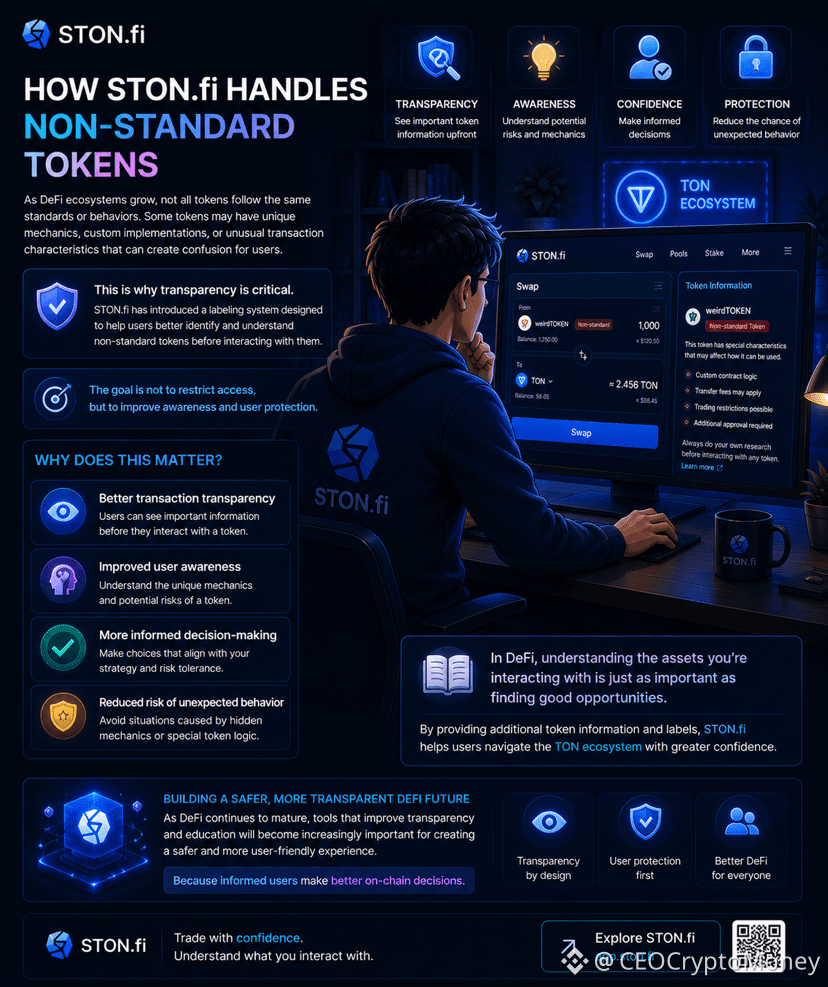
As the $TON ecosystem grows, not every token follows the same standards. Some have custom mechanics or unique transaction behavior that may affect how they work onchain.
That's why I think STON.fi's approach to non standard tokens is a valuable step forward.
Instead of leaving users to figure everything out on their own, STON.fi now provides labels that help identify tokens with non standard characteristics before you interact with them.
What I like most is the purpose behind the feature.
It's not about limiting what users can do.
It's about giving them more context so they can make smarter decisions.
Here are some of the benefits this brings:
🔹 Greater transparency before interacting with a token
🔹 Better understanding of unique token behaviors
🔹 More informed on chain decisions
🔹 Reduced risk of unexpected transaction outcomes
In my opinion, features like this represent the next stage of DeFi.
The best platforms don't just provide access to liquidity, they also help users navigate the ecosystem with greater confidence.
As more projects launch across the $TON network, educational tools and transparency features will become just as important as speed and efficiency.
Because in Web3, the more you understand your assets, the better your decisions become.
⛓️💥 https://app.ston.fi
$TON #TON #STONfi @STONfi DEX
It's easy to focus on prices, liquidity, and new opportunities, but understanding the token you're interacting with is just as important.
As the $TON ecosystem grows, not every token follows the same standards. Some have custom mechanics or unique transaction behavior that may affect how they work onchain.
That's why I think STON.fi's approach to non standard tokens is a valuable step forward.
Instead of leaving users to figure everything out on their own, STON.fi now provides labels that help identify tokens with non standard characteristics before you interact with them.
What I like most is the purpose behind the feature.
It's not about limiting what users can do.
It's about giving them more context so they can make smarter decisions.
Here are some of the benefits this brings:
🔹 Greater transparency before interacting with a token
🔹 Better understanding of unique token behaviors
🔹 More informed on chain decisions
🔹 Reduced risk of unexpected transaction outcomes
In my opinion, features like this represent the next stage of DeFi.
The best platforms don't just provide access to liquidity, they also help users navigate the ecosystem with greater confidence.
As more projects launch across the $TON network, educational tools and transparency features will become just as important as speed and efficiency.
Because in Web3, the more you understand your assets, the better your decisions become.
⛓️💥 https://app.ston.fi
$TON #TON #STONfi @STONfi DEX
When people talk about successful trades, they usually focus on one thing:
Price.
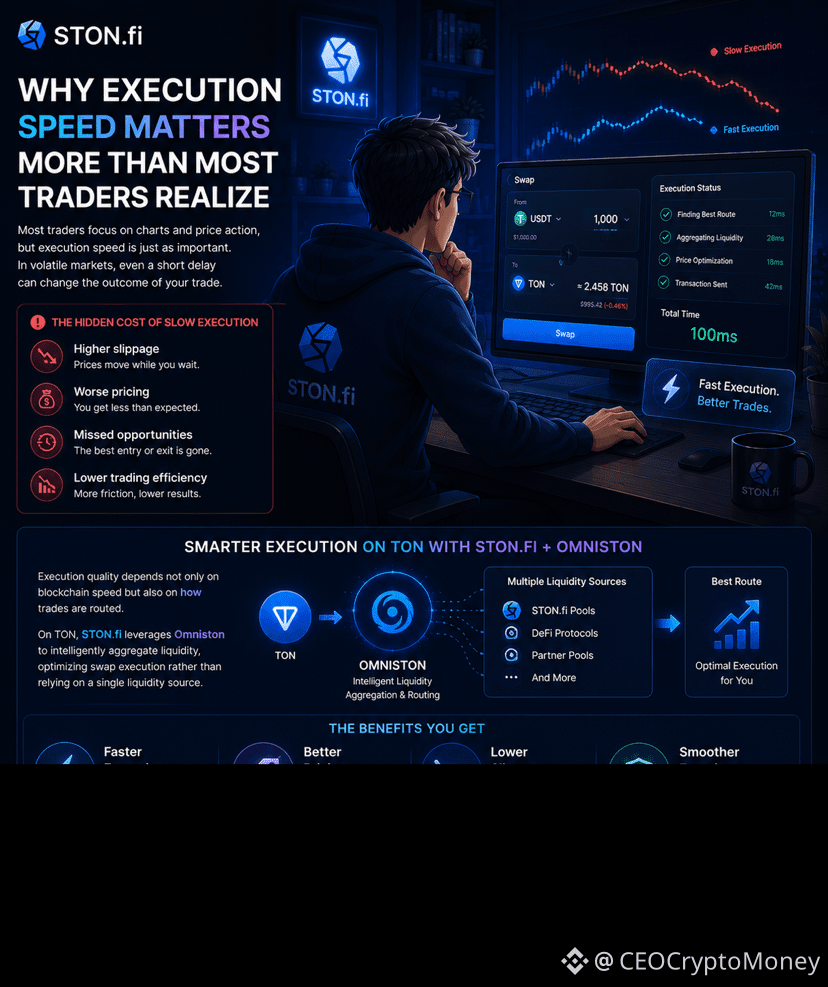
But there's another factor that often determines the final outcome, execution speed.
In fast moving markets, even a small delay can make a noticeable difference. By the time a transaction reaches the blockchain, the market may have already shifted, affecting the final execution.
That's why execution quality matters just as much as market analysis.
A high quality swap isn't only about finding liquidity, it's also about finding it quickly and efficiently.
This is where infrastructure plays a crucial role.
On the $TON ecosystem, STON.fi uses Omniston to intelligently aggregate liquidity across multiple sources instead of relying on a single pool. The system continuously searches for an efficient execution path to help improve overall swap performance.
The result is a trading experience designed around:
.Faster execution when timing matters
.Smarter liquidity aggregation
.Lower slippage during volatile conditions
. More competitive pricing through optimized routing
One thing I've come to appreciate is that the best trading experience isn't always the one with the flashiest interface.
It's the one where the infrastructure quietly works behind the scenes to help every swap execute as efficiently as possible.
As DeFi continues to evolve, execution quality will likely become one of the biggest competitive advantages for both platforms and users.
Fast execution isn't just about saving time.
It's about helping every trade reach its full potential.
⛓️💥 https://app.ston.fi
$TON #TON #STONfi
Price.
But there's another factor that often determines the final outcome, execution speed.
In fast moving markets, even a small delay can make a noticeable difference. By the time a transaction reaches the blockchain, the market may have already shifted, affecting the final execution.
That's why execution quality matters just as much as market analysis.
A high quality swap isn't only about finding liquidity, it's also about finding it quickly and efficiently.
This is where infrastructure plays a crucial role.
On the $TON ecosystem, STON.fi uses Omniston to intelligently aggregate liquidity across multiple sources instead of relying on a single pool. The system continuously searches for an efficient execution path to help improve overall swap performance.
The result is a trading experience designed around:
.Faster execution when timing matters
.Smarter liquidity aggregation
.Lower slippage during volatile conditions
. More competitive pricing through optimized routing
One thing I've come to appreciate is that the best trading experience isn't always the one with the flashiest interface.
It's the one where the infrastructure quietly works behind the scenes to help every swap execute as efficiently as possible.
As DeFi continues to evolve, execution quality will likely become one of the biggest competitive advantages for both platforms and users.
Fast execution isn't just about saving time.
It's about helping every trade reach its full potential.
⛓️💥 https://app.ston.fi
$TON #TON #STONfi
Imagine using DeFi without ever thinking about which blockchain you’re on.
I believe that’s where the industry is heading.
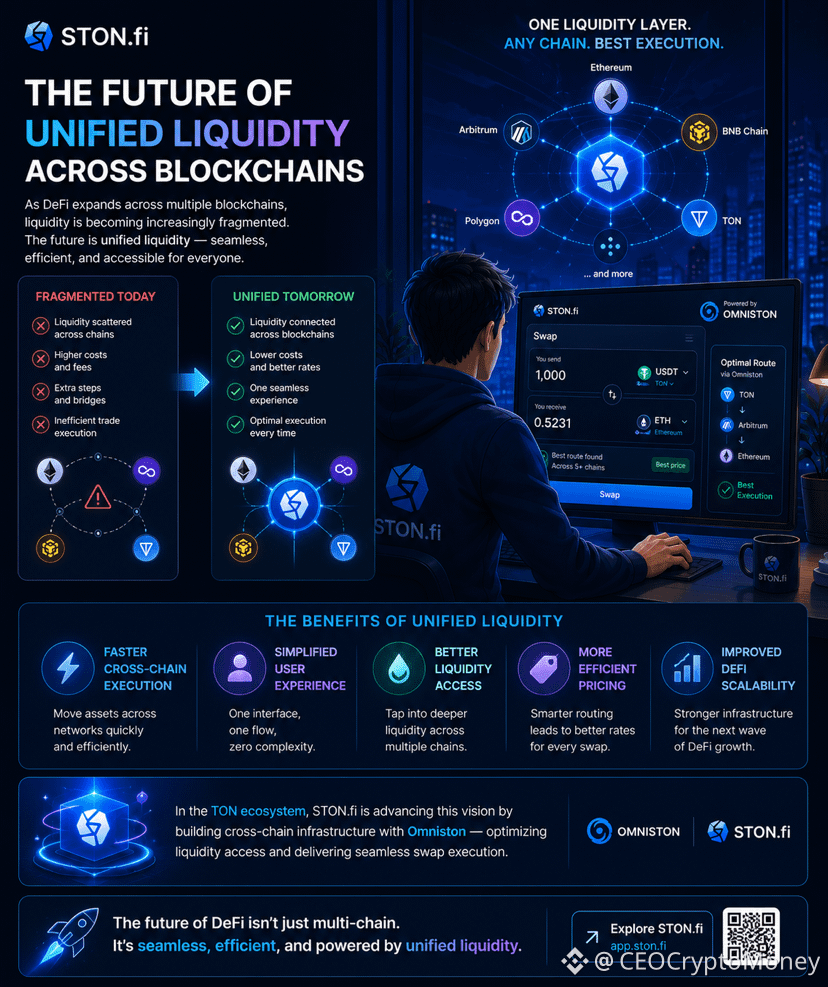
Today, liquidity is scattered across multiple networks, which often means extra bridges, additional wallets, higher costs, and unnecessary complexity just to complete a single transaction.
But what if all of that happened quietly in the background?
That’s the idea behind unified liquidity.
Instead of asking users to move between blockchains manually, the infrastructure works behind the scenes, finding liquidity, optimizing execution, and delivering a smoother experience from start to finish.
This shift could bring major improvements to DeFi:
🔹 Faster cross chain execution
🔹 Better access to liquidity across ecosystems
🔹 More competitive pricing through smarter routing
🔹 A simpler experience for everyday users
🔹 Stronger scalability as the multi chain ecosystem grows
One reason I find STON.fi interesting is its focus on this direction through Omniston.
Rather than treating each blockchain as a separate destination, the goal is to make liquidity feel connected, allowing users to interact with DeFi without worrying about the complexity underneath.
To me, that’s what the next phase of Web3 should look like.
Not just more chains.
But one seamless experience where the technology becomes almost invisible, and users simply get the best execution possible.
The future of DeFi won’t be defined by how many blockchains exist.
It will be defined by how effortlessly they work together.
🔗 Explore STON.fi and discover how cross chain liquidity is evolving.
$TON #TON #STONfi
I believe that’s where the industry is heading.
Today, liquidity is scattered across multiple networks, which often means extra bridges, additional wallets, higher costs, and unnecessary complexity just to complete a single transaction.
But what if all of that happened quietly in the background?
That’s the idea behind unified liquidity.
Instead of asking users to move between blockchains manually, the infrastructure works behind the scenes, finding liquidity, optimizing execution, and delivering a smoother experience from start to finish.
This shift could bring major improvements to DeFi:
🔹 Faster cross chain execution
🔹 Better access to liquidity across ecosystems
🔹 More competitive pricing through smarter routing
🔹 A simpler experience for everyday users
🔹 Stronger scalability as the multi chain ecosystem grows
One reason I find STON.fi interesting is its focus on this direction through Omniston.
Rather than treating each blockchain as a separate destination, the goal is to make liquidity feel connected, allowing users to interact with DeFi without worrying about the complexity underneath.
To me, that’s what the next phase of Web3 should look like.
Not just more chains.
But one seamless experience where the technology becomes almost invisible, and users simply get the best execution possible.
The future of DeFi won’t be defined by how many blockchains exist.
It will be defined by how effortlessly they work together.
🔗 Explore STON.fi and discover how cross chain liquidity is evolving.
$TON #TON #STONfi
Most users only see the front end of a DeFi app.
What they don't see is the infrastructure making every transaction possible behind the scenes.
That's why the latest TractionEye integration caught my attention
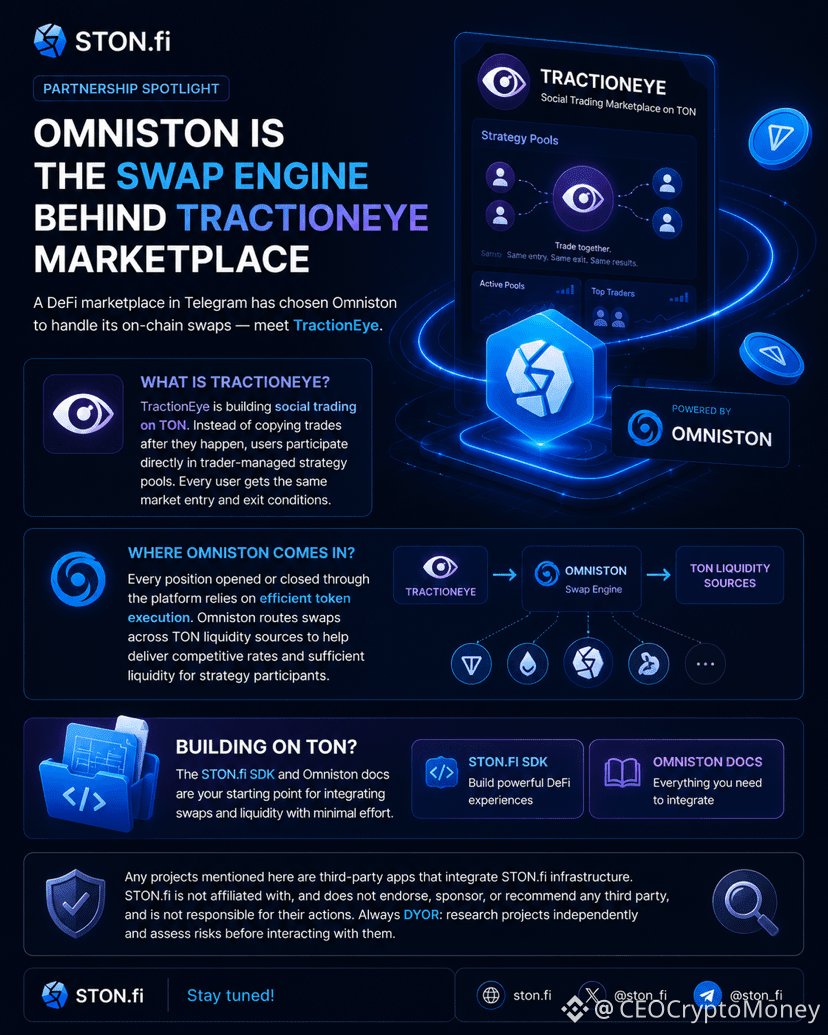
TractionEye is building a social trading marketplace on $TON where users can participate in trader managed strategy pools instead of reacting to trades after they've already happened.
The interesting part?
Every position opened or closed on the platform relies on swap execution powered by Omniston.
That means when users enter or exit strategies, Omniston helps route orders across available liquidity sources on $TON to support efficient execution and liquidity access.
To me, this highlights a bigger trend:
STON.fi isn't only growing as a destination for swaps.
Its infrastructure is increasingly becoming part of products users may never realize are connected to it.
We're starting to see:
🔹 Trading platforms
🔹 Telegram native apps
🔹 Wallet integrations
🔹 DeFi dashboards
🔹 Strategy marketplaces
all building on top of the same liquidity layer.
And that's usually a sign of ecosystem maturity.
The strongest infrastructure often works quietly in the background while other products create unique user experiences on top of it.
TractionEye is another example of how builders are leveraging STON.fi infrastructure to create new ways for users to interact with DeFi on $TON.
I'm curious to see what type of applications integrate Omniston next.
🔗 STON.fi
🔗 Explore Omniston and the STON.fi SDK
🔗 Follow STON.fi for ecosystem and builder updates
$TON #GRAM #STONfi
What they don't see is the infrastructure making every transaction possible behind the scenes.
That's why the latest TractionEye integration caught my attention
TractionEye is building a social trading marketplace on $TON where users can participate in trader managed strategy pools instead of reacting to trades after they've already happened.
The interesting part?
Every position opened or closed on the platform relies on swap execution powered by Omniston.
That means when users enter or exit strategies, Omniston helps route orders across available liquidity sources on $TON to support efficient execution and liquidity access.
To me, this highlights a bigger trend:
STON.fi isn't only growing as a destination for swaps.
Its infrastructure is increasingly becoming part of products users may never realize are connected to it.
We're starting to see:
🔹 Trading platforms
🔹 Telegram native apps
🔹 Wallet integrations
🔹 DeFi dashboards
🔹 Strategy marketplaces
all building on top of the same liquidity layer.
And that's usually a sign of ecosystem maturity.
The strongest infrastructure often works quietly in the background while other products create unique user experiences on top of it.
TractionEye is another example of how builders are leveraging STON.fi infrastructure to create new ways for users to interact with DeFi on $TON.
I'm curious to see what type of applications integrate Omniston next.
🔗 STON.fi
🔗 Explore Omniston and the STON.fi SDK
🔗 Follow STON.fi for ecosystem and builder updates
$TON #GRAM #STONfi
What does a thriving ecosystem actually look like?
Sometimes the answer isn't found in charts or transaction volume.
It's found in the people building, teaching, and creating around it.
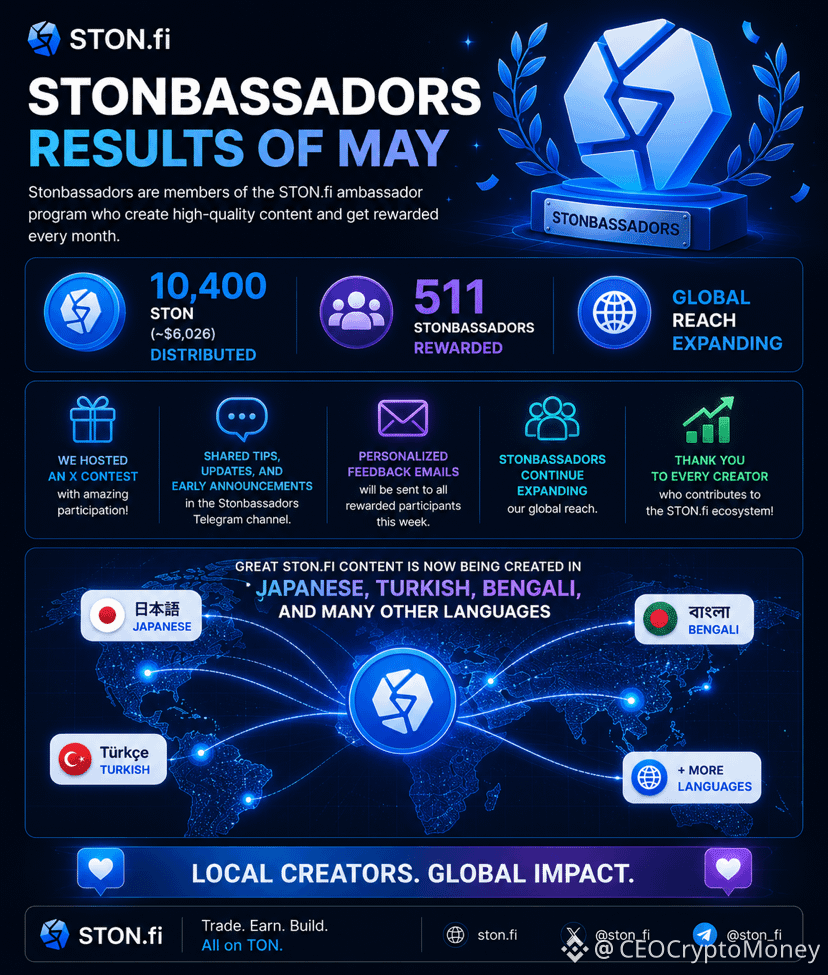
Looking at the latest Stonbassadors results, one thing stood out to me:
The STON.fi community isn't just growing, it's becoming increasingly global.
In May alone:
🌍 511 creators were rewarded
🎁 10,400 STON distributed
📢 Community contests and exclusive ambassador activities continued throughout the month
📧 Personalized feedback was prepared for participants
🗣️ Content about STON.fi expanded across Japanese, Turkish, Bengali, and many other language communities
I think this is one of the most underrated growth indicators in any ecosystem.
When creators from different regions start producing educational content in their native languages, information spreads much further than any single marketing campaign ever could.
That's how communities become global.
Not through advertisements alone,
but through local voices helping new users understand the ecosystem.
It's also encouraging to see contributors receiving feedback and recognition rather than simply participating and disappearing.
The more educational content created around swaps, liquidity, farming, Omniston, and the broader $TON ecosystem, the stronger the network becomes.
May was a strong month for the Stonbassadors program, and it will be interesting to see how much further the community expands in the months ahead.
🔗 STON.fi
🔗 Explore the Stonbassadors program
🔗 Follow STON.fi for community updates
$TON #GRAM #STONfi
Sometimes the answer isn't found in charts or transaction volume.
It's found in the people building, teaching, and creating around it.
Looking at the latest Stonbassadors results, one thing stood out to me:
The STON.fi community isn't just growing, it's becoming increasingly global.
In May alone:
🌍 511 creators were rewarded
🎁 10,400 STON distributed
📢 Community contests and exclusive ambassador activities continued throughout the month
📧 Personalized feedback was prepared for participants
🗣️ Content about STON.fi expanded across Japanese, Turkish, Bengali, and many other language communities
I think this is one of the most underrated growth indicators in any ecosystem.
When creators from different regions start producing educational content in their native languages, information spreads much further than any single marketing campaign ever could.
That's how communities become global.
Not through advertisements alone,
but through local voices helping new users understand the ecosystem.
It's also encouraging to see contributors receiving feedback and recognition rather than simply participating and disappearing.
The more educational content created around swaps, liquidity, farming, Omniston, and the broader $TON ecosystem, the stronger the network becomes.
May was a strong month for the Stonbassadors program, and it will be interesting to see how much further the community expands in the months ahead.
🔗 STON.fi
🔗 Explore the Stonbassadors program
🔗 Follow STON.fi for community updates
$TON #GRAM #STONfi
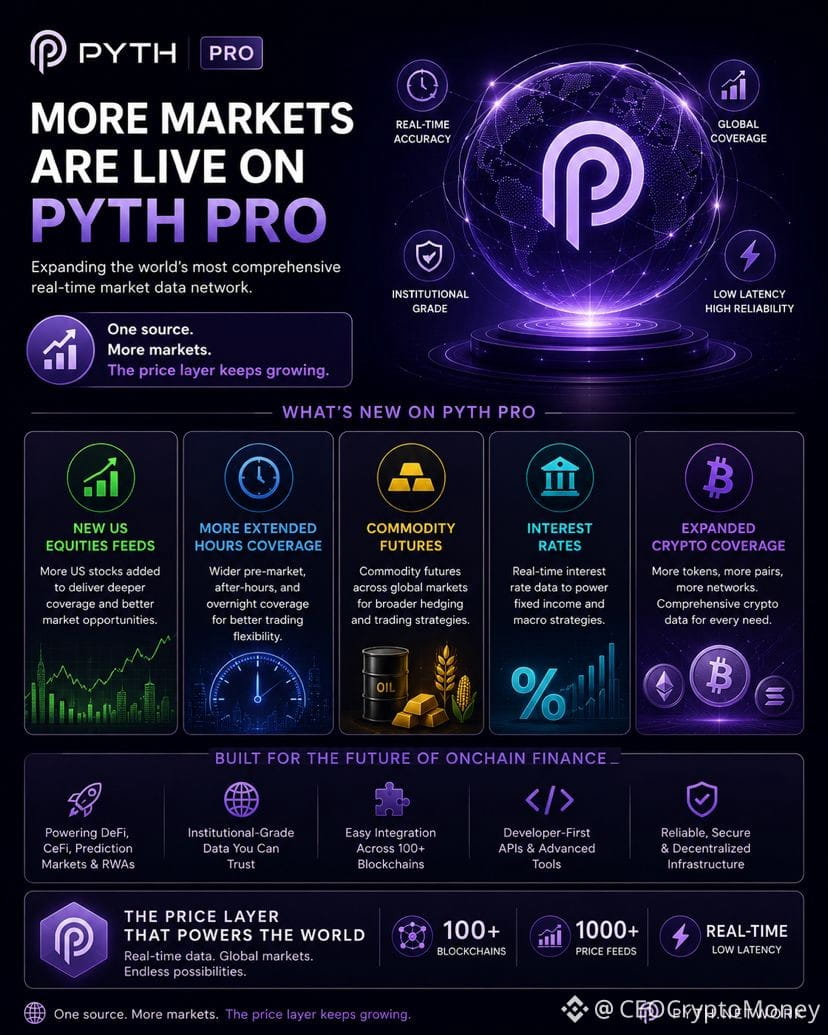
Pyth Pro just got even bigger.
The network has expanded its market coverage with:
.New US equities feeds
.More extended hours pricing
.Commodity futures across global markets
Interest rate data
.Expanded crypto coverage
This isn't just about adding more assets.
It's about building a single source of truth for financial markets across every major asset class.
As onchain finance evolves, developers and institutions need reliable, real-time data that goes beyond crypto. From stocks and commodities to rates and digital assets, the demand for comprehensive market coverage continues to grow.
$PYTH is meeting that demand by expanding the price layer that powers the next generation of trading platforms, prediction markets, tokenized assets, and financial applications.
One source. More markets. More opportunities.
The future of finance runs on data, and Pyth keeps expanding the foundation.
@PythNetwork #PYTH
The network has expanded its market coverage with:
.New US equities feeds
.More extended hours pricing
.Commodity futures across global markets
Interest rate data
.Expanded crypto coverage
This isn't just about adding more assets.
It's about building a single source of truth for financial markets across every major asset class.
As onchain finance evolves, developers and institutions need reliable, real-time data that goes beyond crypto. From stocks and commodities to rates and digital assets, the demand for comprehensive market coverage continues to grow.
$PYTH is meeting that demand by expanding the price layer that powers the next generation of trading platforms, prediction markets, tokenized assets, and financial applications.
One source. More markets. More opportunities.
The future of finance runs on data, and Pyth keeps expanding the foundation.
@PythNetwork #PYTH
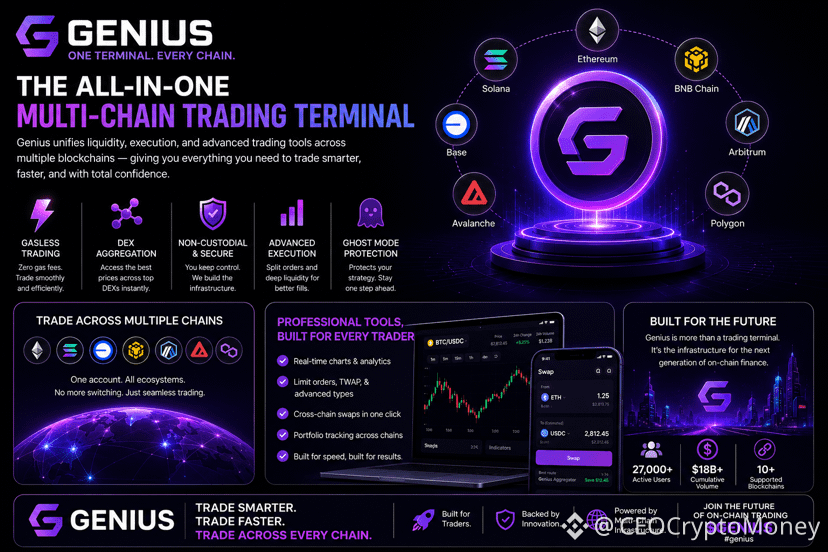
One thing becoming increasingly obvious in DeFi is that traders want speed, simplicity, and access to liquidity across multiple ecosystems without constantly switching platforms.
That’s why @GeniusOfficial has been interesting to follow recently.
The project is building a multi chain trading environment designed to connect users with liquidity and execution across ecosystems like Ethereum, Solana, Base, Arbitrum, and BNB Chain. As DeFi expands across more networks, infrastructure that reduces fragmentation could become extremely valuable for both casual users and advanced onchain traders.
What also stands out to me is the focus on trading efficiency. Features like DEX aggregation, gasless transactions, and advanced execution tools show how the next generation of DeFi platforms may prioritize user experience just as much as raw functionality.
I think the future winners in Web3 trading will likely be platforms capable of simplifying complexity while still giving users deep liquidity access and strong execution quality.
#genius $GENIUS
That’s why @GeniusOfficial has been interesting to follow recently.
The project is building a multi chain trading environment designed to connect users with liquidity and execution across ecosystems like Ethereum, Solana, Base, Arbitrum, and BNB Chain. As DeFi expands across more networks, infrastructure that reduces fragmentation could become extremely valuable for both casual users and advanced onchain traders.
What also stands out to me is the focus on trading efficiency. Features like DEX aggregation, gasless transactions, and advanced execution tools show how the next generation of DeFi platforms may prioritize user experience just as much as raw functionality.
I think the future winners in Web3 trading will likely be platforms capable of simplifying complexity while still giving users deep liquidity access and strong execution quality.
#genius $GENIUS
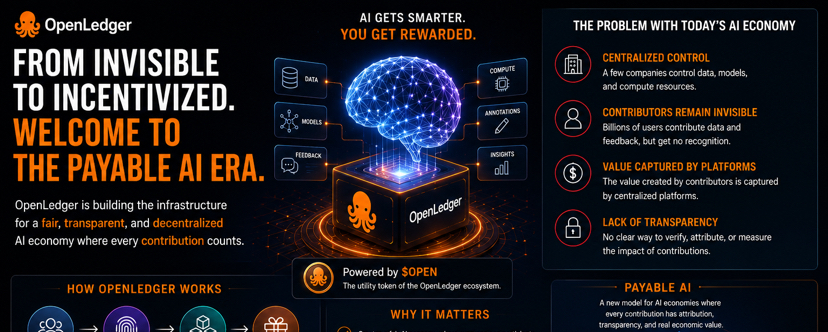
The AI sector is growing at an incredible pace, but one issue becoming more important every day is transparency around data, ownership, and contribution.
Most AI systems today rely on massive datasets generated by users, communities, and online activity, yet the majority of contributors never participate in the value created from those systems. That imbalance could become one of the biggest discussions in the future AI economy.
This is one reason @OpenLedger has been standing out to me recently.
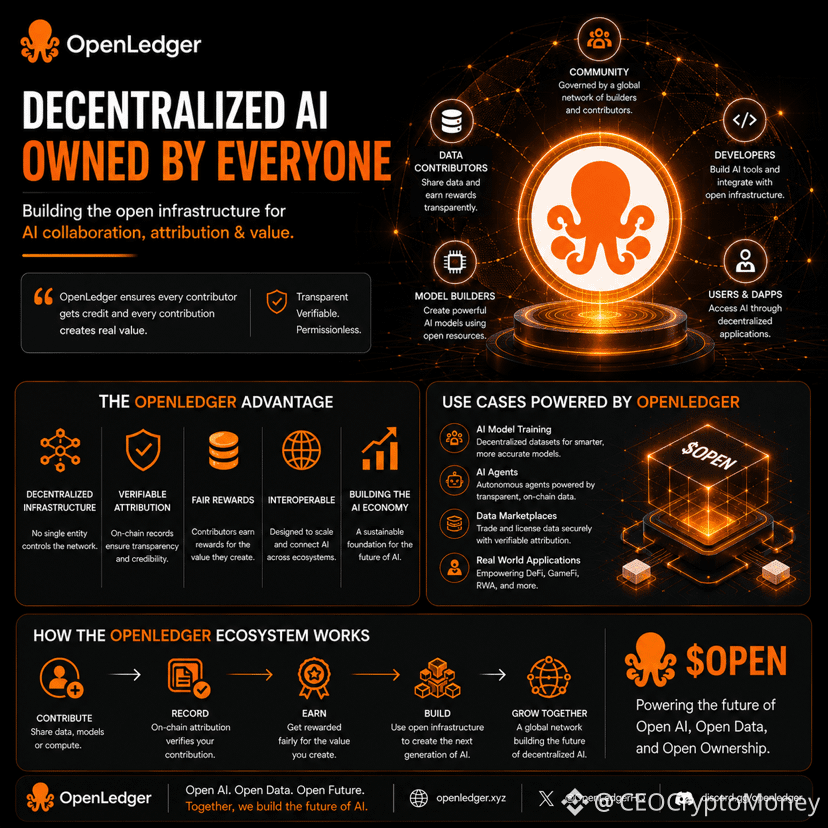
Instead of focusing only on AI hype narratives, OpenLedger is building decentralized infrastructure designed around attribution, open participation, and community driven coordination. I think this approach becomes increasingly relevant as AI adoption expands across finance, gaming, automation, and digital applications.
What I find especially interesting is the idea that contributors should eventually have transparent visibility into how value is created within AI ecosystems. Combining blockchain coordination with AI infrastructure could create entirely new economic models around ownership, incentives, and collaboration.
The intersection of AI and Web3 still feels very early, but projects focused on infrastructure rather than short term speculation may end up becoming foundational layers over time.
#openledger $OPEN
Most AI systems today rely on massive datasets generated by users, communities, and online activity, yet the majority of contributors never participate in the value created from those systems. That imbalance could become one of the biggest discussions in the future AI economy.
This is one reason @OpenLedger has been standing out to me recently.
Instead of focusing only on AI hype narratives, OpenLedger is building decentralized infrastructure designed around attribution, open participation, and community driven coordination. I think this approach becomes increasingly relevant as AI adoption expands across finance, gaming, automation, and digital applications.
What I find especially interesting is the idea that contributors should eventually have transparent visibility into how value is created within AI ecosystems. Combining blockchain coordination with AI infrastructure could create entirely new economic models around ownership, incentives, and collaboration.
The intersection of AI and Web3 still feels very early, but projects focused on infrastructure rather than short term speculation may end up becoming foundational layers over time.
#openledger $OPEN
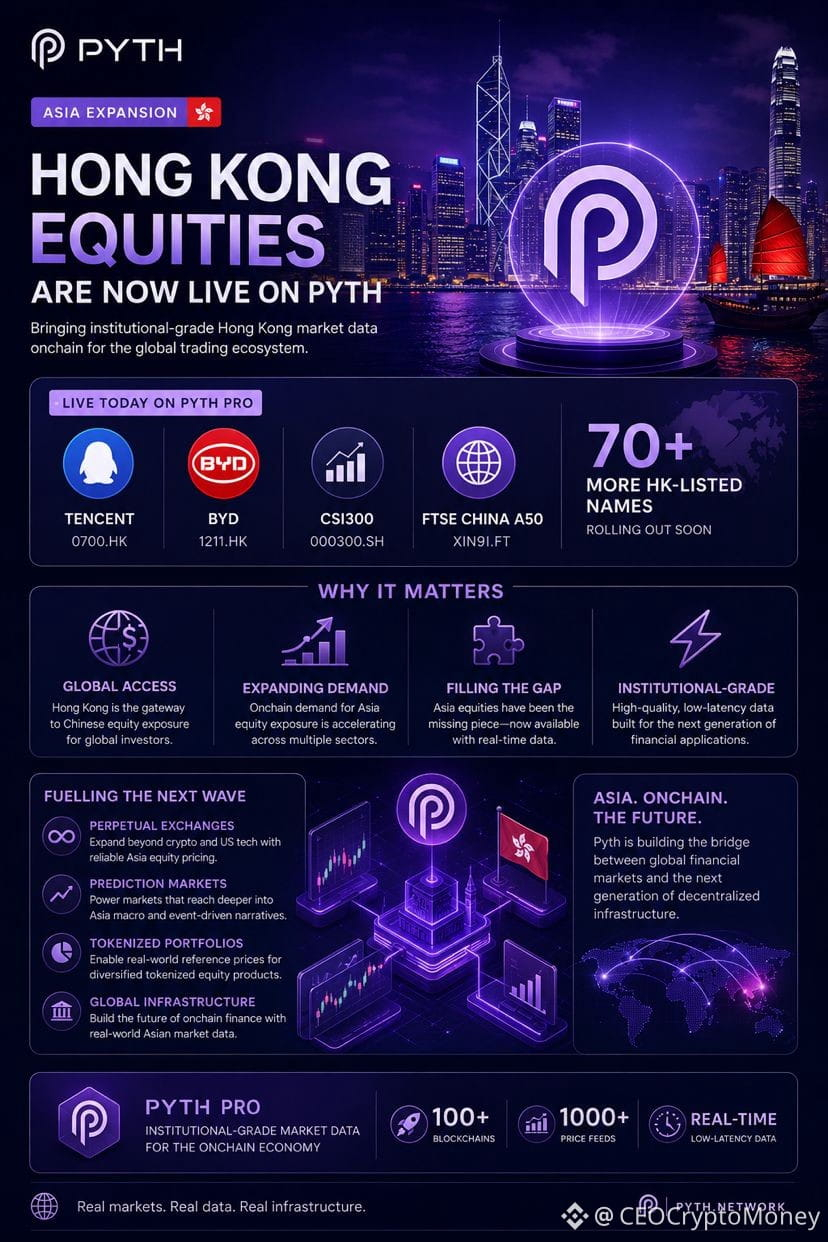
@PythNetwork is officially bringing Hong Kong equities onchain.
Tencent, BYD, CSI300, FTSE China A50, now live on Pyth Pro, with 70+ more HK listed assets rolling out soon.
This is bigger than just adding new price feeds.
Hong Kong has always been one of the most important gateways to Chinese equity exposure for global markets, but access to reliable institutional grade market data has traditionally been expensive, fragmented, and difficult to integrate globally.
@PythNetwork is changing that infrastructure layer.
As onchain finance rapidly expands beyond crypto, demand for Asian market exposure is exploding across:
• Perpetual exchanges
• Prediction markets
• Tokenized portfolios
• Global macro trading products
Until now, Asia equities remained one of the largest missing pieces.
With real time Hong Kong equity data now entering the onchain ecosystem through Pyth Pro, developers and trading platforms can begin building a completely new category of financial products around Asian markets.
This is how traditional capital markets slowly merge with onchain finance.
$PYTH isn’t only competing in crypto anymore.
It’s becoming the bridge between global financial markets and the next generation of decentralized infrastructure.
Tencent, BYD, CSI300, FTSE China A50, now live on Pyth Pro, with 70+ more HK listed assets rolling out soon.
This is bigger than just adding new price feeds.
Hong Kong has always been one of the most important gateways to Chinese equity exposure for global markets, but access to reliable institutional grade market data has traditionally been expensive, fragmented, and difficult to integrate globally.
@PythNetwork is changing that infrastructure layer.
As onchain finance rapidly expands beyond crypto, demand for Asian market exposure is exploding across:
• Perpetual exchanges
• Prediction markets
• Tokenized portfolios
• Global macro trading products
Until now, Asia equities remained one of the largest missing pieces.
With real time Hong Kong equity data now entering the onchain ecosystem through Pyth Pro, developers and trading platforms can begin building a completely new category of financial products around Asian markets.
This is how traditional capital markets slowly merge with onchain finance.
$PYTH isn’t only competing in crypto anymore.
It’s becoming the bridge between global financial markets and the next generation of decentralized infrastructure.
Log in to explore more content