
北岛_98
227 Posts

北岛_98
人生不过是各种体验的叠加 X:@beidao_98 $BNB $ETH $ASTER $SOL BTC坚定持有者
106 Following
8.9K+ Followers
1.6K+ Liked
Posts
All
Quotes
Verified
I’m getting more and more excited about the TGE for @TermMax . Fixed-rate DeFi in itself is a direction worth long-term attention. Compared with simply chasing high APY, TermMax wants to address the volatility of on-chain lending rates and capital efficiency issues.
For the upcoming TGE, personally I’ll focus on the initial circulating market cap and the opening valuation.
Airdrops can also be checked now. For those with larger amounts, some will be locked up, so people won’t be able to get everything immediately. As a result, I estimate the opening sell-pressure won’t be that big.
If market sentiment is good, I think having FDV land in the $200–400 million range would already be a pretty comfortable starting point. But if the opening valuation is given too high right away, it would actually compress the room for growth afterward.
Of course, these are just my personal expectations, not a price prediction.
What really matters is whether after the TGE, $TMX can form a positive feedback loop with protocol revenue, user growth, and the expansion of the fixed-rate market. Looking forward to the day when it’s officially revealed.
#termmax
For the upcoming TGE, personally I’ll focus on the initial circulating market cap and the opening valuation.
Airdrops can also be checked now. For those with larger amounts, some will be locked up, so people won’t be able to get everything immediately. As a result, I estimate the opening sell-pressure won’t be that big.
If market sentiment is good, I think having FDV land in the $200–400 million range would already be a pretty comfortable starting point. But if the opening valuation is given too high right away, it would actually compress the room for growth afterward.
Of course, these are just my personal expectations, not a price prediction.
What really matters is whether after the TGE, $TMX can form a positive feedback loop with protocol revenue, user growth, and the expansion of the fixed-rate market. Looking forward to the day when it’s officially revealed.
#termmax
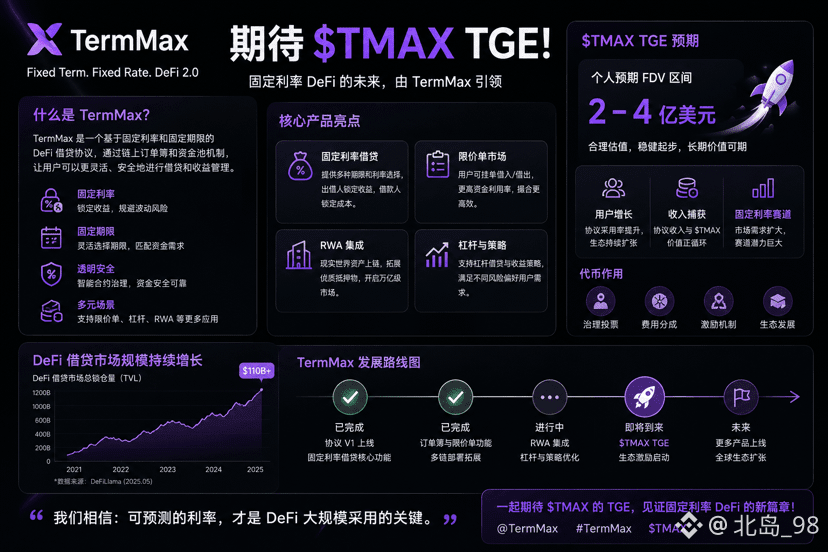
Study @TermMax Day 3: What I think is most worth paying attention to isn’t just the fixed interest rate—it’s that it tries to turn “interest rates” themselves into an asset that can be traded.
In traditional DeFi lending, returns are usually hidden inside a single APY number.
Today it’s 10%, tomorrow it might be 5%, and users can only passively accept market changes.
TermMax’s approach is closer to traditional finance:
It separates future yield and time to maturity, allowing users to price future cash flows in advance.
FT represents the fixed-income portion, making the yield structure clearer;
GT takes on collateral and risk-management responsibilities.
This made me think of a question:
As on-chain finance becomes more mature, could the competition be not just for asset prices, but for how well different financial instruments can be expressed?
Stocks have options,
Bonds have interest rates,
So will on-chain assets in the future also need richer yield instruments?
Of course, this design also needs time to be validated.
I’ll focus on:
Whether there’s real trading demand in the fixed-income market;
Whether products of different maturities can form liquidity;
And whether users are willing to manage capital in this way.
In the early days, DeFi solved the question of “whether there’s yield.”
The next stage of competition might be:
Who can make yield more predictable and more composable.
Do you think on-chain finance will increasingly resemble traditional finance, or will it evolve into an entirely different model?
#termmax
In traditional DeFi lending, returns are usually hidden inside a single APY number.
Today it’s 10%, tomorrow it might be 5%, and users can only passively accept market changes.
TermMax’s approach is closer to traditional finance:
It separates future yield and time to maturity, allowing users to price future cash flows in advance.
FT represents the fixed-income portion, making the yield structure clearer;
GT takes on collateral and risk-management responsibilities.
This made me think of a question:
As on-chain finance becomes more mature, could the competition be not just for asset prices, but for how well different financial instruments can be expressed?
Stocks have options,
Bonds have interest rates,
So will on-chain assets in the future also need richer yield instruments?
Of course, this design also needs time to be validated.
I’ll focus on:
Whether there’s real trading demand in the fixed-income market;
Whether products of different maturities can form liquidity;
And whether users are willing to manage capital in this way.
In the early days, DeFi solved the question of “whether there’s yield.”
The next stage of competition might be:
Who can make yield more predictable and more composable.
Do you think on-chain finance will increasingly resemble traditional finance, or will it evolve into an entirely different model?
#termmax

After studying @TermMax until the next day, I realized that what makes fixed-rate products truly difficult may not be “locking in the rate,” but rather how to safely convert the receivable back into an asset after maturity.
TermMax’s borrowing position is supported by collateral; if the collateral ratio deteriorates, liquidation is triggered. Even more interestingly, if it isn’t repaid normally at maturity, it doesn’t simply turn the FT into a “bad debt document”—the protocol also includes subsequent liquidation and collateral delivery mechanisms.
This design solves a very real problem:
Fixed income can be determined in advance, but final settlement can’t rely on just one line—“redeem at maturity.”
That said, I also keep a close eye on risk.
In extreme market conditions, what really matters isn’t how smoothly things liquidate day-to-day, but:
whether collateral can be handled promptly when it collapses;
what creditors ultimately recover when liquidity is insufficient;
and whether maturity settlement remains stable over the long run.
So when I look at @TermMax now, I don’t just look at APY.
I’m more interested in its ability to “wrap things up” in the worst-case scenario.
Fixed-income products look great when they’re making money; the real gap shows up when something goes wrong—who can actually get the books settled.
In your view, is the most important aspect of DeFi fixed-rate lending the yield, or the ability to ensure stable settlement at maturity?
#termmax
TermMax’s borrowing position is supported by collateral; if the collateral ratio deteriorates, liquidation is triggered. Even more interestingly, if it isn’t repaid normally at maturity, it doesn’t simply turn the FT into a “bad debt document”—the protocol also includes subsequent liquidation and collateral delivery mechanisms.
This design solves a very real problem:
Fixed income can be determined in advance, but final settlement can’t rely on just one line—“redeem at maturity.”
That said, I also keep a close eye on risk.
In extreme market conditions, what really matters isn’t how smoothly things liquidate day-to-day, but:
whether collateral can be handled promptly when it collapses;
what creditors ultimately recover when liquidity is insufficient;
and whether maturity settlement remains stable over the long run.
So when I look at @TermMax now, I don’t just look at APY.
I’m more interested in its ability to “wrap things up” in the worst-case scenario.
Fixed-income products look great when they’re making money; the real gap shows up when something goes wrong—who can actually get the books settled.
In your view, is the most important aspect of DeFi fixed-rate lending the yield, or the ability to ensure stable settlement at maturity?
#termmax

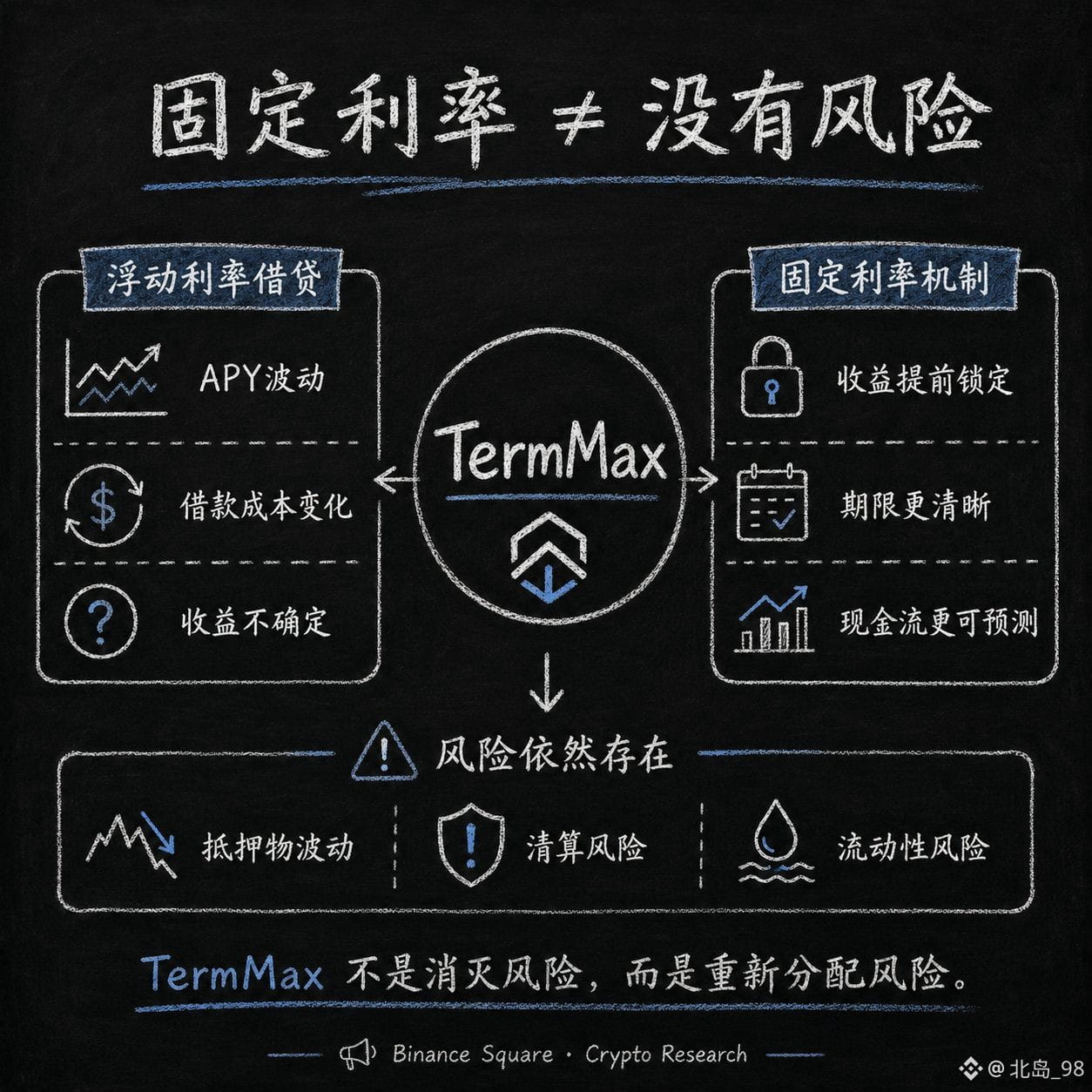
After researching @TermMax , I’ve increasingly come to believe that what it truly sells isn’t “high yield,” but rather certainty.
Most of the issues with DeFi lending are that the interest rate you see today doesn’t mean it will be the same next week. APY changes, and so does the borrowing cost.
TermMax’s fixed-rate mechanism is essentially about locking in the returns in advance. An FT is more like an on-chain zero-coupon bond: you buy it at a discount, redeem it at maturity according to the face value, and the price spread in between is your guaranteed return.
But I want to emphasize one thing:
Fixed interest rates don’t mean there is no risk.
Even when the rate is locked, risks remain—collateral volatility, liquidation risk, and liquidity risk. In other words, @TermMax doesn’t eliminate risk; it just redistributes the risk.
So what I’ll look at next isn’t the superficial yield, but:
1. Trading depth across different maturities
2. The price spread between the fixed rate and the market rate
3. Liquidation and redemption performance during extreme market conditions
High yields can attract people; only certainty may keep large capital.
Would you choose a high APY with greater volatility, or a clearer fixed-income return?
#termmax
Most of the issues with DeFi lending are that the interest rate you see today doesn’t mean it will be the same next week. APY changes, and so does the borrowing cost.
TermMax’s fixed-rate mechanism is essentially about locking in the returns in advance. An FT is more like an on-chain zero-coupon bond: you buy it at a discount, redeem it at maturity according to the face value, and the price spread in between is your guaranteed return.
But I want to emphasize one thing:
Fixed interest rates don’t mean there is no risk.
Even when the rate is locked, risks remain—collateral volatility, liquidation risk, and liquidity risk. In other words, @TermMax doesn’t eliminate risk; it just redistributes the risk.
So what I’ll look at next isn’t the superficial yield, but:
1. Trading depth across different maturities
2. The price spread between the fixed rate and the market rate
3. Liquidation and redemption performance during extreme market conditions
High yields can attract people; only certainty may keep large capital.
Would you choose a high APY with greater volatility, or a clearer fixed-income return?
#termmax
Awesome! @TermMax is on Boost
This project has really been around for quite a while.
But it's always tightly linked with the Binance Wallet, and the collaboration is still close.
I feel it should be able to list on contracts.
And there should be many people who have been following it for a long time.
Whether they’re “farm-earning” from traditional methods or chatting and farming on X, I believe everyone is really looking forward to $TMX’s performance.
A brief introduction to this project: The native token $TMX is currently trading in aspecta OTC at around 0.17u.
TermMax is a new-generation fixed-rate (Fixed-Rate) DeFi lending protocol, developed by the Term Structure team. It goes live on the mainnet in April 2025.
Its core goal is to solve the problems in traditional DeFi lending (such as Aave and Compound): high interest-rate volatility, high liquidation risk, and complex management. It allows users to borrow and leverage with locked-in rates and terms, achieving more predictable returns and costs.
The protocol is built on a loan AMM mechanism similar to Uniswap V3, and supports:
Fixed-rate + fixed-term lending markets with one-click looping / leverage (liquidation-free, no ongoing margin liquidation pressure)
Curator-managed Vaults (ERC-4626 standard, passive yield)
Range Orders, custom pricing curves, Smart Unwind (exit anytime and convert into tradable liquidity), etc.
Users can purchase/trade tokens such as FT (Fixed-rate Token, similar to zero-coupon bonds) and GT (Gearing Token) to simplify complex operations.
Total funding of about $6.8 million (Angel + Seed round)
Do you think TMX will perform well in its opening run?
#termmax
This project has really been around for quite a while.
But it's always tightly linked with the Binance Wallet, and the collaboration is still close.
I feel it should be able to list on contracts.
And there should be many people who have been following it for a long time.
Whether they’re “farm-earning” from traditional methods or chatting and farming on X, I believe everyone is really looking forward to $TMX’s performance.
A brief introduction to this project: The native token $TMX is currently trading in aspecta OTC at around 0.17u.
TermMax is a new-generation fixed-rate (Fixed-Rate) DeFi lending protocol, developed by the Term Structure team. It goes live on the mainnet in April 2025.
Its core goal is to solve the problems in traditional DeFi lending (such as Aave and Compound): high interest-rate volatility, high liquidation risk, and complex management. It allows users to borrow and leverage with locked-in rates and terms, achieving more predictable returns and costs.
The protocol is built on a loan AMM mechanism similar to Uniswap V3, and supports:
Fixed-rate + fixed-term lending markets with one-click looping / leverage (liquidation-free, no ongoing margin liquidation pressure)
Curator-managed Vaults (ERC-4626 standard, passive yield)
Range Orders, custom pricing curves, Smart Unwind (exit anytime and convert into tradable liquidity), etc.
Users can purchase/trade tokens such as FT (Fixed-rate Token, similar to zero-coupon bonds) and GT (Gearing Token) to simplify complex operations.
Total funding of about $6.8 million (Angel + Seed round)
Do you think TMX will perform well in its opening run?
#termmax
The most important thing to watch today isn’t price up or down, but the safety boundary: US spot Bitcoin ETF weekly inflows hit $1 billion, the highest in 4 months.
Cross-source information indicates that the US spot Bitcoin ETF recorded approximately $1 billion in net inflows this week—the strongest since April. It occurred at the same time as the Coldcard hacker stealing $116 million worth of Bitcoin; analysts note that self-regulation may be shifting. The same incident has been independently reported by CRYPTOSLATE, TechFlow, and CRYPTOPOTATO. $BTC is currently around $64,875, with a 24-hour change of -0.05%.
My view: what truly affects price isn’t the headline, but whether the losses continue to expand and whether funds can be frozen. If the project team quickly discloses and manages risks, the impact may stabilize; if information remains missing, the opposite may happen.
Next, watch: whether Bitcoin-related price and trading volume confirm each other, and whether the news sources update details. Are you more focused on the size of the losses, or on how quickly the project team responds and disposes of the situation?
Data sources: CRYPTOSLATE, TechFlow, CRYPTOPOTATO, Surf, Binance; data as of 08-09 09:30. For observation only; not investment advice.
Cross-source information indicates that the US spot Bitcoin ETF recorded approximately $1 billion in net inflows this week—the strongest since April. It occurred at the same time as the Coldcard hacker stealing $116 million worth of Bitcoin; analysts note that self-regulation may be shifting. The same incident has been independently reported by CRYPTOSLATE, TechFlow, and CRYPTOPOTATO. $BTC is currently around $64,875, with a 24-hour change of -0.05%.
My view: what truly affects price isn’t the headline, but whether the losses continue to expand and whether funds can be frozen. If the project team quickly discloses and manages risks, the impact may stabilize; if information remains missing, the opposite may happen.
Next, watch: whether Bitcoin-related price and trading volume confirm each other, and whether the news sources update details. Are you more focused on the size of the losses, or on how quickly the project team responds and disposes of the situation?
Data sources: CRYPTOSLATE, TechFlow, CRYPTOPOTATO, Surf, Binance; data as of 08-09 09:30. For observation only; not investment advice.
New signals have emerged in the flow of capital: WLFI Financial’s AI Financial has sold its Canadian subsidiary to Prime Delta.
Multi-source cross-referenced information indicates that after negotiations failed on Perpetuals.com, WLFI Financial sold ALT5 Sigma Canada to Prime Delta at a price of a $12.00 million note and 11.60 million shares. The same event has been independently reported by ChainCatcher and PANews. $BTC is currently around $65,018, with a 24-hour change of -0.20%.
My take: A single day’s capital inflow/outflow cannot define the trend; continuity matters more than the absolute value. If the direction reverses over the next two days, this change is more likely just a reallocation.
Next, watch: whether the prices and trading volume for World Liberty Financial-related assets confirm in sync, and whether the sources update the details. Do you think this is trend-driven capital, or a one-off reallocation?
Data sources: ChainCatcher, PANews, Surf, Binance; data cutoff 08-08 21:30. For observation only and does not constitute investment advice.
Multi-source cross-referenced information indicates that after negotiations failed on Perpetuals.com, WLFI Financial sold ALT5 Sigma Canada to Prime Delta at a price of a $12.00 million note and 11.60 million shares. The same event has been independently reported by ChainCatcher and PANews. $BTC is currently around $65,018, with a 24-hour change of -0.20%.
My take: A single day’s capital inflow/outflow cannot define the trend; continuity matters more than the absolute value. If the direction reverses over the next two days, this change is more likely just a reallocation.
Next, watch: whether the prices and trading volume for World Liberty Financial-related assets confirm in sync, and whether the sources update the details. Do you think this is trend-driven capital, or a one-off reallocation?
Data sources: ChainCatcher, PANews, Surf, Binance; data cutoff 08-08 21:30. For observation only and does not constitute investment advice.
New signals have emerged in capital flows: Ethereum spot ETFs saw a net inflow of $49.601 million yesterday, marking 4 consecutive days of net inflows.
Cross-source information indicates that Ethereum spot ETFs recorded a net inflow of $49.601 million on August 7, led by BlackRock's ETHA ($38.15 million) and Fidelity's FETH ($11.45 million). Total assets under management stand at $10.744B. The same event has been independently reported by COINNESS, BLOOMINGBIT, and ChainCatcher. $BTC is currently around $64,975, up 0.90% over the past 24 hours.
My take: single-day capital flows cannot define a trend; continuity matters more than the absolute value. If the direction reverses over the next two days, this change is more likely just rebalancing.
Next to watch: whether Ethereum-related price and trading volume confirm each other in sync, and whether the news sources update the details. Do you think this is trend-driven capital, or a one-off rebalancing?
Data sources: COINNESS, BLOOMINGBIT, ChainCatcher, Surf, Binance; data as of 08-08 14:30. For observation only and does not constitute investment advice.
Cross-source information indicates that Ethereum spot ETFs recorded a net inflow of $49.601 million on August 7, led by BlackRock's ETHA ($38.15 million) and Fidelity's FETH ($11.45 million). Total assets under management stand at $10.744B. The same event has been independently reported by COINNESS, BLOOMINGBIT, and ChainCatcher. $BTC is currently around $64,975, up 0.90% over the past 24 hours.
My take: single-day capital flows cannot define a trend; continuity matters more than the absolute value. If the direction reverses over the next two days, this change is more likely just rebalancing.
Next to watch: whether Ethereum-related price and trading volume confirm each other in sync, and whether the news sources update the details. Do you think this is trend-driven capital, or a one-off rebalancing?
Data sources: COINNESS, BLOOMINGBIT, ChainCatcher, Surf, Binance; data as of 08-08 14:30. For observation only and does not constitute investment advice.
Rule changes often precede price reactions: breaking news: Donald Trump’s company decides to keep its distance from cryptocurrency—leading to a sharp drop in the price of a meme coin.
Cross-source, corroborated information shows: TMTG, citing oversaturation, terminated two transactions with Crypto.com—one in the CRO treasury and one in the prediction market; it is now refocusing on media operations and merging TAE, and the CRO price has fallen. The same event has been independently reported by ChainCatcher, PANews, and Decrypt. $BTC is currently around $64,909, up 0.72% over the past 24 hours.
My view: policy headlines are only the first step; the scope of implementation and the timing of execution determine the real impact. If the details are weaker than expected, the market may correct in the opposite direction.
Next, watch: whether Cronos-related price and trading volume confirm simultaneously, and whether the news sources update further details. Do you think the market will trade the headline first, or wait for the details?
Data sources: ChainCatcher, PANews, Decrypt, Surf, Binance; data as of 08-08 09:30. For observation only and not investment advice.
Cross-source, corroborated information shows: TMTG, citing oversaturation, terminated two transactions with Crypto.com—one in the CRO treasury and one in the prediction market; it is now refocusing on media operations and merging TAE, and the CRO price has fallen. The same event has been independently reported by ChainCatcher, PANews, and Decrypt. $BTC is currently around $64,909, up 0.72% over the past 24 hours.
My view: policy headlines are only the first step; the scope of implementation and the timing of execution determine the real impact. If the details are weaker than expected, the market may correct in the opposite direction.
Next, watch: whether Cronos-related price and trading volume confirm simultaneously, and whether the news sources update further details. Do you think the market will trade the headline first, or wait for the details?
Data sources: ChainCatcher, PANews, Decrypt, Surf, Binance; data as of 08-08 09:30. For observation only and not investment advice.
Capital is again chasing a main thread: Wall Street Morning News—S&P and Dow hit fresh highs, the Nasdaq and chip stocks have risen four straight sessions. SanDisk and Intel surged more than 10%, while Micron’s market value has returned to the trillion-dollar mark.
CNBC, PANews, and Cailianpress all cross-confirm the same event. <0-9]{11} $BTC is currently around $65,137, up +1.40% over 24 hours. What really matters here is whether the impact on traditional risk assets continues to transmit onto the chain.
My view: a single day of gains only shows that capital has flowed back in; it cannot prove that the trend has restarted. If trading volume and subsequent catalysts don’t keep up, even strength can quickly fade.
Next, watch: whether the related stocks can stop falling in the next trading session, and whether the trading volume for BTC, ETH, and the high-beta narrative changes in sync. Do you think this is a return of the trend, or an event-driven impulse?
Data sources: CNBC, PANews, Cailianpress, Binance; data cutoff 08-07 21:30. For observation only; not investment advice.
CNBC, PANews, and Cailianpress all cross-confirm the same event. <0-9]{11} $BTC is currently around $65,137, up +1.40% over 24 hours. What really matters here is whether the impact on traditional risk assets continues to transmit onto the chain.
My view: a single day of gains only shows that capital has flowed back in; it cannot prove that the trend has restarted. If trading volume and subsequent catalysts don’t keep up, even strength can quickly fade.
Next, watch: whether the related stocks can stop falling in the next trading session, and whether the trading volume for BTC, ETH, and the high-beta narrative changes in sync. Do you think this is a return of the trend, or an event-driven impulse?
Data sources: CNBC, PANews, Cailianpress, Binance; data cutoff 08-07 21:30. For observation only; not investment advice.
The one thing you should focus on today isn’t price up or down, but the safety boundary: Coldcard hackers moved $1.9 million worth of BTC to a new wallet.
Cross-source information indicates that, according to Lookonchain, the hacker in the Coldcard incident stole 2,055 BTC (about $130 million) and transferred 30.185 BTC (about $1.94 million) to a new wallet. The same event has been independently reported by COINNESS, ChainCatcher, and PANews. $BTC is currently around $64,389, with the past 24 hours down -0.66%.
My take: what truly affects the price isn’t the headline, but whether losses continue to expand and whether the funds can be frozen. If the project team quickly discloses and contains the risk, the impact may stabilize; if key information remains missing, the opposite is likely.
Next, watch for: whether Bitcoin-related price and trading volume confirm in sync, and whether the sources update further details. Which do you care about more—the size of the losses, or the project team’s speed of response?
Data sources: COINNESS, ChainCatcher, PANews, Surf, Binance; data as of 08-07 14:30. For observation only and not investment advice.
Cross-source information indicates that, according to Lookonchain, the hacker in the Coldcard incident stole 2,055 BTC (about $130 million) and transferred 30.185 BTC (about $1.94 million) to a new wallet. The same event has been independently reported by COINNESS, ChainCatcher, and PANews. $BTC is currently around $64,389, with the past 24 hours down -0.66%.
My take: what truly affects the price isn’t the headline, but whether losses continue to expand and whether the funds can be frozen. If the project team quickly discloses and contains the risk, the impact may stabilize; if key information remains missing, the opposite is likely.
Next, watch for: whether Bitcoin-related price and trading volume confirm in sync, and whether the sources update further details. Which do you care about more—the size of the losses, or the project team’s speed of response?
Data sources: COINNESS, ChainCatcher, PANews, Surf, Binance; data as of 08-07 14:30. For observation only and not investment advice.
New pressure emerges in global risk appetite: US stock market opens—storage sector collectively crashes; Micron Technology falls 5%, SK hynix drops 8%, SanDisk plunges 12%, Western Digital slides 19%, and Seagate Technology falls 7%.
21st Century Finance and CNBC provide cross-confirmation of the same event.$BTC is currently around $64,437, down 0.10% in 24 hours; what really matters is whether the shock to traditional risk assets continues to transmit to the chain.
My view: it’s not just about how much the stocks fall—it's whether the pressure will spread to crypto high-beta assets. If tech stocks stabilize while BTC keeps weakening, it suggests there is still sell pressure specific to the crypto market.
Next to watch: whether the related stocks can stop falling in the next trading session, and whether the trading volume for BTC, ETH, and the high-beta narrative moves in sync. Do you think the pressure will spread into the coin market, or will a cross-market decoupling appear?
Data sources: 21st Century Finance, CNBC, Binance; data as of 08-07 09:30. For observation only and does not constitute investment advice.
21st Century Finance and CNBC provide cross-confirmation of the same event.$BTC is currently around $64,437, down 0.10% in 24 hours; what really matters is whether the shock to traditional risk assets continues to transmit to the chain.
My view: it’s not just about how much the stocks fall—it's whether the pressure will spread to crypto high-beta assets. If tech stocks stabilize while BTC keeps weakening, it suggests there is still sell pressure specific to the crypto market.
Next to watch: whether the related stocks can stop falling in the next trading session, and whether the trading volume for BTC, ETH, and the high-beta narrative moves in sync. Do you think the pressure will spread into the coin market, or will a cross-market decoupling appear?
Data sources: 21st Century Finance, CNBC, Binance; data as of 08-07 09:30. For observation only and does not constitute investment advice.
What you should be paying attention to today isn’t price fluctuations, but the safety boundaries: after the Zeus Wallet suffered a network attack, it was urgently taken offline, indicating customer funds are safe.
Cross-source information shows that after the network attack on Wednesday, the Zeus Wallet shut down its infrastructure for an audit; no funds were lost—only limited to its own system—along with a commitment to replace the affected channel. The same incident has been independently reported by ChainCatcher and TechFlow. $BTC is currently around $64,220, up 0.16% in the past 24 hours.
My take: what truly affects the price isn’t the headline, but whether the losses continue to expand and whether funds can be frozen. If the project team quickly discloses and manages risk, the impact may stabilize; if information remains absent, it will likely do the opposite.
Next, watch: whether ZEUS-related price and trading volume confirm each other in tandem, and whether the message sources update the details. Are you more focused on the scale of the losses, or on how quickly the project team responds?
Data sources: ChainCatcher, TechFlow, Surf, Binance; data as of 08-06 21:31. For observation only and not investment advice.
Cross-source information shows that after the network attack on Wednesday, the Zeus Wallet shut down its infrastructure for an audit; no funds were lost—only limited to its own system—along with a commitment to replace the affected channel. The same incident has been independently reported by ChainCatcher and TechFlow. $BTC is currently around $64,220, up 0.16% in the past 24 hours.
My take: what truly affects the price isn’t the headline, but whether the losses continue to expand and whether funds can be frozen. If the project team quickly discloses and manages risk, the impact may stabilize; if information remains absent, it will likely do the opposite.
Next, watch: whether ZEUS-related price and trading volume confirm each other in tandem, and whether the message sources update the details. Are you more focused on the scale of the losses, or on how quickly the project team responds?
Data sources: ChainCatcher, TechFlow, Surf, Binance; data as of 08-06 21:31. For observation only and not investment advice.
The market is stress-testing: a whale shorts Bitcoin with 40x leverage. After reducing its position by 200 BTC, it partially stops out.
Cross-source corroboration indicates that as the price bounced back to $65,000, the whale shorted 1,600 BTC with 40x leverage, partially liquidating 200 BTC, incurring a loss of $146,000, but still holding a 1,400 BTC short position. The same event has been independently reported by COINNESS, TechFlow, and ChainCatcher. $BTC is currently around $64,500, up +0.57% over the past 24 hours.
My view: forced deleveraging may amplify short-term volatility, but it doesn’t necessarily mean the trend has reversed. Only if, after volume fades, the price still can’t recover would it indicate that risk appetite is truly pulling back.
Next, watch: whether Bitcoin-related price and volume are confirmed in sync, and whether the news sources have updated details. Do you see this as short-term deleveraging, or a trend reversal?
Data sources: COINNESS, TechFlow, ChainCatcher, Surf, Binance; data cutoff 08-06 09:30. For observation only and does not constitute investment advice.
Cross-source corroboration indicates that as the price bounced back to $65,000, the whale shorted 1,600 BTC with 40x leverage, partially liquidating 200 BTC, incurring a loss of $146,000, but still holding a 1,400 BTC short position. The same event has been independently reported by COINNESS, TechFlow, and ChainCatcher. $BTC is currently around $64,500, up +0.57% over the past 24 hours.
My view: forced deleveraging may amplify short-term volatility, but it doesn’t necessarily mean the trend has reversed. Only if, after volume fades, the price still can’t recover would it indicate that risk appetite is truly pulling back.
Next, watch: whether Bitcoin-related price and volume are confirmed in sync, and whether the news sources have updated details. Do you see this as short-term deleveraging, or a trend reversal?
Data sources: COINNESS, TechFlow, ChainCatcher, Surf, Binance; data cutoff 08-06 09:30. For observation only and does not constitute investment advice.
What you should look at today isn’t the rise or fall, but the safety boundary: Ethereum Foundation provides FPF funding for WEBCAT browser code verification.
Multi-source cross-checked information shows: the Ethereum Foundation’s 1TS grant to FPF involved undisclosed funds for developing WEBCAT used to verify and integrate with Ethereum wallet frontends. The same incident has also been independently reported by TRADINGVIEW and ChainCatcher. $BTC is currently about $64,126, up 0.28% in the past 24 hours.
My take: what truly affects the price isn’t the headline, but whether losses continue to expand and whether funds can be frozen. If the project team quickly discloses information and controls risk, the impact may stabilize; if information remains absent, the opposite is true.
Next, watch: whether Ethereum-related price and trading volume confirm together, and whether the message sources update the details. Do you care more about the size of the losses, or the project team’s speed of response?
Data sources: TRADINGVIEW, ChainCatcher, Surf, Binance; data cutoff 08-05 21:30. For observation only, not investment advice.
Multi-source cross-checked information shows: the Ethereum Foundation’s 1TS grant to FPF involved undisclosed funds for developing WEBCAT used to verify and integrate with Ethereum wallet frontends. The same incident has also been independently reported by TRADINGVIEW and ChainCatcher. $BTC is currently about $64,126, up 0.28% in the past 24 hours.
My take: what truly affects the price isn’t the headline, but whether losses continue to expand and whether funds can be frozen. If the project team quickly discloses information and controls risk, the impact may stabilize; if information remains absent, the opposite is true.
Next, watch: whether Ethereum-related price and trading volume confirm together, and whether the message sources update the details. Do you care more about the size of the losses, or the project team’s speed of response?
Data sources: TRADINGVIEW, ChainCatcher, Surf, Binance; data cutoff 08-05 21:30. For observation only, not investment advice.
Capital is again chasing a main storyline: Nvidia officially announces CPO mass production! Tianfu Communications surges 9.87%! Are AI applications shifting from “burning money” to “making money”?。
21 Finance and Caixin confirm the same event with cross-validation. $BTC is currently around $64,310, up 0.87% in the past 24 hours; what really matters is whether the impact on traditional risk assets continues to transmit upward along the chain.
My view: a one-day rise only proves that funds have returned, but it does not prove that the trend has restarted. If trading volume and subsequent catalysts don’t keep up, even strength may quickly fade.
Next, watch: whether the related stocks can stop falling in the next trading session, and whether the trading volume of BTC, ETH, and the high-beta narrative moves in sync. Do you think this is a return of the trend, or an event-driven pulse?
Data sources: 21 Finance, Caixin, Binance; data cutoff at 08-05 14:30. For observation only and does not constitute investment advice.
21 Finance and Caixin confirm the same event with cross-validation. $BTC is currently around $64,310, up 0.87% in the past 24 hours; what really matters is whether the impact on traditional risk assets continues to transmit upward along the chain.
My view: a one-day rise only proves that funds have returned, but it does not prove that the trend has restarted. If trading volume and subsequent catalysts don’t keep up, even strength may quickly fade.
Next, watch: whether the related stocks can stop falling in the next trading session, and whether the trading volume of BTC, ETH, and the high-beta narrative moves in sync. Do you think this is a return of the trend, or an event-driven pulse?
Data sources: 21 Finance, Caixin, Binance; data cutoff at 08-05 14:30. For observation only and does not constitute investment advice.
A new signal has emerged in capital flows: Ethereum staking total has reached a historic high, at 41.4 million ETH, accounting for 34% of total supply.
Cross-referenced information from multiple sources shows: ETH staking reached a record 41.4 million (34% of supply), up by 1.4 million from last week; BitMine added another 150,000; the stablecoin cap fell by 1.6% (worst quarter so far), with a $6B outflow and trading volume down 70%. The same event was independently reported by COINNESS, ChainCatcher, and TechFlow. $BTC is currently around $64,130, up +0.85% over the past 24 hours.
My take: single-day capital flows can’t define a trend; continuity matters more than the absolute figure. If the direction reverses over the next two days, this change is more likely just rebalancing.
Next, watch: whether Ethereum-related price and trading volume confirm in sync, and whether the news sources update the details. Do you think this is trend-driven capital, or a one-off rebalance?
Data sources: COINNESS, ChainCatcher, TechFlow, Surf, Binance; data as of 08-05 09:30. For observation only; not investment advice.
Cross-referenced information from multiple sources shows: ETH staking reached a record 41.4 million (34% of supply), up by 1.4 million from last week; BitMine added another 150,000; the stablecoin cap fell by 1.6% (worst quarter so far), with a $6B outflow and trading volume down 70%. The same event was independently reported by COINNESS, ChainCatcher, and TechFlow. $BTC is currently around $64,130, up +0.85% over the past 24 hours.
My take: single-day capital flows can’t define a trend; continuity matters more than the absolute figure. If the direction reverses over the next two days, this change is more likely just rebalancing.
Next, watch: whether Ethereum-related price and trading volume confirm in sync, and whether the news sources update the details. Do you think this is trend-driven capital, or a one-off rebalance?
Data sources: COINNESS, ChainCatcher, TechFlow, Surf, Binance; data as of 08-05 09:30. For observation only; not investment advice.
Policy changes often come before price reactions: Bernstein: The Texas grid pause will not have a material impact on Bitcoin miners.
Multiple-source cross-referenced information indicates that Texas Bitcoin miners are unlikely to be affected by the suspension of the data center by J&J (Abbott), because most miners have approved ERCOT contracts; approved MW (megawatts) become more valuable. The same event has been independently reported by PANews, Cointelegraph, and TradingView. $BTC is currently about $63,946, up 1.91% over the past 24 hours.
My take: the policy headline is only the first step; the scope of implementation and timing determine the actual impact. If the details are weaker than expected, the market may correct in the opposite direction.
Next, watch: whether Bitcoin-related price and volume confirm in sync, and whether the sources update the details. Do you think the market will trade the headline first, or wait for the fine print?
Data sources: PANews, Cointelegraph, TradingView, Surf, Binance; data as of 08-04 21:30. For observation only and does not constitute investment advice.
Multiple-source cross-referenced information indicates that Texas Bitcoin miners are unlikely to be affected by the suspension of the data center by J&J (Abbott), because most miners have approved ERCOT contracts; approved MW (megawatts) become more valuable. The same event has been independently reported by PANews, Cointelegraph, and TradingView. $BTC is currently about $63,946, up 1.91% over the past 24 hours.
My take: the policy headline is only the first step; the scope of implementation and timing determine the actual impact. If the details are weaker than expected, the market may correct in the opposite direction.
Next, watch: whether Bitcoin-related price and volume confirm in sync, and whether the sources update the details. Do you think the market will trade the headline first, or wait for the fine print?
Data sources: PANews, Cointelegraph, TradingView, Surf, Binance; data as of 08-04 21:30. For observation only and does not constitute investment advice.
A new signal has emerged regarding the flow of funds: Brazilian listed company OranjeBTC has expanded its Bitcoin holdings to 3,948 BTC.
Cross-source corroboration indicates that, according to data from BitcoinTreasuries.net, the Bitcoin holdings of Brazilian listed company OranjeBTC increased by 30 BTC to reach 3,948 BTC. The same event has been independently reported by TechFlow, BITCOINWORLD, and COINNESS.$BTC is currently about $63,542, up 0.59% in the past 24 hours.
My take: A single day’s fund inflow/outflow cannot define a trend; continuity matters more than absolute value. If the direction reverses over the next two days, this change is more likely just a portfolio reallocation.
Next, watch: whether Bitcoin-related price and trading volume confirm in tandem, and whether the news sources update further details. Do you think this is trend-driven capital, or a one-time reallocation?
Data sources: TechFlow, BITCOINWORLD, COINNESS, Surf, Binance; data cutoff 08-04 09:30. For observation only; not investment advice.
Cross-source corroboration indicates that, according to data from BitcoinTreasuries.net, the Bitcoin holdings of Brazilian listed company OranjeBTC increased by 30 BTC to reach 3,948 BTC. The same event has been independently reported by TechFlow, BITCOINWORLD, and COINNESS.$BTC is currently about $63,542, up 0.59% in the past 24 hours.
My take: A single day’s fund inflow/outflow cannot define a trend; continuity matters more than absolute value. If the direction reverses over the next two days, this change is more likely just a portfolio reallocation.
Next, watch: whether Bitcoin-related price and trading volume confirm in tandem, and whether the news sources update further details. Do you think this is trend-driven capital, or a one-time reallocation?
Data sources: TechFlow, BITCOINWORLD, COINNESS, Surf, Binance; data cutoff 08-04 09:30. For observation only; not investment advice.
A new signal has emerged in capital flows: the Strategy Bitcoin holdings have an unrealized loss of $10.829 billion, and the Bitcoin holdings of Strategy have an unrealized loss of $8.871 billion for Ethereum holdings.
Multi-source cross-referenced information shows: Strategy (MSTR) sold 1,638 BTC last week at a price of about $63,957, and currently holds 842,138 BTC, with an unrealized loss of $10.829B. The same event has been independently reported by COINPAPER, PANews, and TRADINGVIEW. $BTC is currently around $62,696, with a 24-hour change of -0.64%.
My view: single-day capital flows can’t define a trend; continuity matters more than absolute values. If the direction reverses over the next two days, this change is more likely just a portfolio reallocation.
Next to watch: whether Bitcoin-related price and trading volume confirm each other, and whether the news sources update the details. Do you think this is trend-following capital, or a one-time reallocation?
Data sources: COINPAPER, PANews, TRADINGVIEW, Surf, Binance; data as of 08-03 21:30. For observation only and does not constitute investment advice.
Multi-source cross-referenced information shows: Strategy (MSTR) sold 1,638 BTC last week at a price of about $63,957, and currently holds 842,138 BTC, with an unrealized loss of $10.829B. The same event has been independently reported by COINPAPER, PANews, and TRADINGVIEW. $BTC is currently around $62,696, with a 24-hour change of -0.64%.
My view: single-day capital flows can’t define a trend; continuity matters more than absolute values. If the direction reverses over the next two days, this change is more likely just a portfolio reallocation.
Next to watch: whether Bitcoin-related price and trading volume confirm each other, and whether the news sources update the details. Do you think this is trend-following capital, or a one-time reallocation?
Data sources: COINPAPER, PANews, TRADINGVIEW, Surf, Binance; data as of 08-03 21:30. For observation only and does not constitute investment advice.
Log in to explore more content