

Alpha哥AI投资日记
252 Posts

Alpha哥AI投资日记
Report
Block User
2025投资收益率打败99%币安用户
High-Frequency Trader
9.2 Years
16 Following
93 Followers
62 Liked
Posts
All
Quotes
·
--
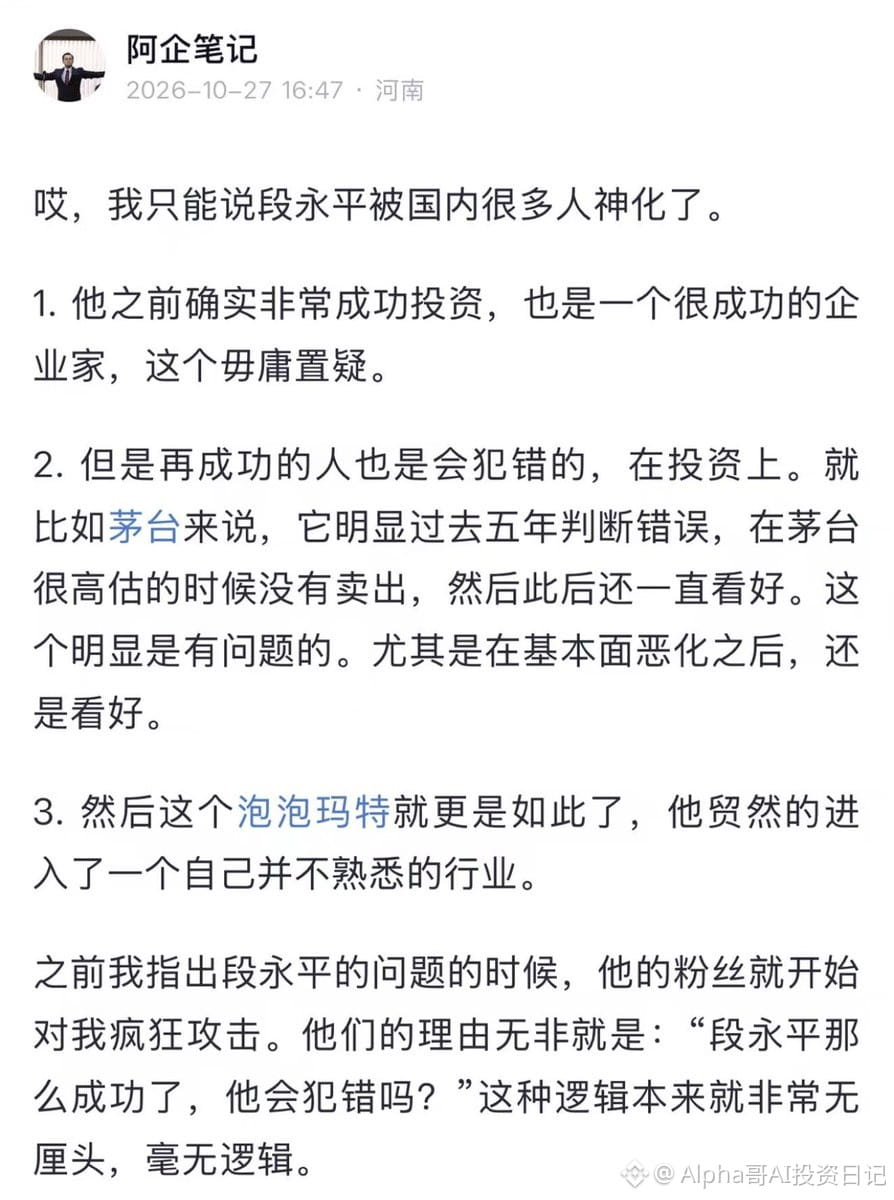
I’ve always believed that one of the biggest mistakes in investing is placing too much faith in so-called “stock gods” and “gurus.”
Warren Buffett is one of the most successful investors in history, but his judgment on emerging technologies hasn’t always been right.
He made a major investment in IBM in 2011, which ultimately proved unsuccessful. In 2018, Buffett called BTC “rat poison squared,” when BTC was still worth less than $10,000. Earlier, in 2013, when Charlie Munger first compared BTC to “rat poison,” BTC was worth just over $100.
None of this diminishes the fact that Buffett and Munger are still great investors. Buffett later bought Apple, which went on to become one of his most successful investments.
Even the most successful people have limits to their expertise and blind spots. An excellent long-term track record doesn’t mean every judgment is right; getting things right many times in the past doesn’t mean you won’t make mistakes in the future.
What’s truly worth learning from great investors is how they think—not treating every word they say as gospel. Independent thinking has always been essential to investing, as is being wary of idolizing authority.
I’ve always believed that one of the biggest mistakes in investing is placing too much faith in so-called “stock gods” and “gurus.”
Warren Buffett is one of the most successful investors in history, but his judgment on emerging technologies hasn’t always been right.
He made a major investment in IBM in 2011, which ultimately proved unsuccessful. In 2018, Buffett called BTC “rat poison squared,” when BTC was still worth less than $10,000. Earlier, in 2013, when Charlie Munger first compared BTC to “rat poison,” BTC was worth just over $100.
None of this diminishes the fact that Buffett and Munger are still great investors. Buffett later bought Apple, which went on to become one of his most successful investments.
Even the most successful people have limits to their expertise and blind spots. An excellent long-term track record doesn’t mean every judgment is right; getting things right many times in the past doesn’t mean you won’t make mistakes in the future.
What’s truly worth learning from great investors is how they think—not treating every word they say as gospel. Independent thinking has always been essential to investing, as is being wary of idolizing authority.
Warren Buffett is one of the most successful investors in history, but his judgment on emerging technologies hasn’t always been right.
He made a major investment in IBM in 2011, which ultimately proved unsuccessful. In 2018, Buffett called BTC “rat poison squared,” when BTC was still worth less than $10,000. Earlier, in 2013, when Charlie Munger first compared BTC to “rat poison,” BTC was worth just over $100.
None of this diminishes the fact that Buffett and Munger are still great investors. Buffett later bought Apple, which went on to become one of his most successful investments.
Even the most successful people have limits to their expertise and blind spots. An excellent long-term track record doesn’t mean every judgment is right; getting things right many times in the past doesn’t mean you won’t make mistakes in the future.
What’s truly worth learning from great investors is how they think—not treating every word they say as gospel. Independent thinking has always been essential to investing, as is being wary of idolizing authority.
100
·
--
Recently, I've been thinking about something: Many people here think gold ethereum:0x68749665ff8d2d112fa859aa293f07a622782f38 is at a bottom, and are buying the dip, while most people think high oil prices are only temporary. Could this fairly popular idea be wrong? What if oil prices prove more resilient than everyone thinks?
Given the moves in various oil stocks last week (for example, $CVX and $XOM breaking out), oil stocks and oil prices may remain strong for some time, exceeding expectations.
Keep a close eye on the gold-to-oil ratio.
Source: https://x.com/i/web/status/2114897573790339149
Recently, I've been thinking about something: Many people here think gold ethereum:0x68749665ff8d2d112fa859aa293f07a622782f38 is at a bottom, and are buying the dip, while most people think high oil prices are only temporary. Could this fairly popular idea be wrong? What if oil prices prove more resilient than everyone thinks?
Given the moves in various oil stocks last week (for example, $CVX and $XOM breaking out), oil stocks and oil prices may remain strong for some time, exceeding expectations.
Keep a close eye on the gold-to-oil ratio.
Source: https://x.com/i/web/status/2114897573790339149
Given the moves in various oil stocks last week (for example, $CVX and $XOM breaking out), oil stocks and oil prices may remain strong for some time, exceeding expectations.
Keep a close eye on the gold-to-oil ratio.
Source: https://x.com/i/web/status/2114897573790339149
675
·
--
Outside industry players bring industry-leading strategies and fresh operational thinking to empower leading local companies, pushing local products to iterate and upgrade and driving the overall transformation of traditional local industries.
Gypsy: I get to have a day like this too???
Outside industry players bring industry-leading strategies and fresh operational thinking to empower leading local companies, pushing local products to iterate and upgrade and driving the overall transformation of traditional local industries.
Gypsy: I get to have a day like this too???
Gypsy: I get to have a day like this too???

72
·
--
South Korean stock SK Hynix got a boost over the past few days from the excitement around Anthropic’s IPO, as well as positive news that it may increase shareholder dividends. The stock staged a brief rebound, rather than completing its deleveraging process as quickly as previously expected.
But it seems that deleveraging has not yet been completed in the medium term. According to data from the Korea Financial Investment Association, margin debt peaked at 38.63 trillion won on June 24 and then declined, but it still stood at 30.15 trillion won as of the 23rd of this month—above the 27.42 trillion won recorded at the start of the year.
From a medium-term perspective, the deleveraging process has been drawn out.
Quote: https://x.com/i/web/status/2112350954263916994
South Korean stock SK Hynix got a boost over the past few days from the excitement around Anthropic’s IPO, as well as positive news that it may increase shareholder dividends. The stock staged a brief rebound, rather than completing its deleveraging process as quickly as previously expected.
But it seems that deleveraging has not yet been completed in the medium term. According to data from the Korea Financial Investment Association, margin debt peaked at 38.63 trillion won on June 24 and then declined, but it still stood at 30.15 trillion won as of the 23rd of this month—above the 27.42 trillion won recorded at the start of the year.
From a medium-term perspective, the deleveraging process has been drawn out.
Quote: https://x.com/i/web/status/2112350954263916994
But it seems that deleveraging has not yet been completed in the medium term. According to data from the Korea Financial Investment Association, margin debt peaked at 38.63 trillion won on June 24 and then declined, but it still stood at 30.15 trillion won as of the 23rd of this month—above the 27.42 trillion won recorded at the start of the year.
From a medium-term perspective, the deleveraging process has been drawn out.
Quote: https://x.com/i/web/status/2112350954263916994
283
·
--
I had AI take a look at Anthropic’s S-1. The conclusion: in the long run, it really is an exceptionally strong company, but in the short term, the capital markets may be overly optimistic.
The financials are truly astonishing:
Revenue was $4.6B in 2025, and reached $16.3B in just the first half of 2026. Q2 revenue alone was $11.6B, and the company had even achieved nearly $1B in GAAP operating profit.
The number of large enterprise customers has exploded, and 80% of revenue comes from customers paying based on token usage. But what matters to investors isn’t just how fast growth is—it’s how long that growth can last. Q3 revenue was $16.8B, up 45% quarter over quarter, which still looks very impressive on the surface.
Risks explicitly disclosed by management:
1. They clearly expect the growth rate to decline, “potentially more significantly and more quickly than we expect,” and acknowledge that “we have historically had difficulty accurately forecasting revenue.”
2. 80% of revenue is usage-based. Most large customers have no long-term contracts or can scale back at any time, and some large-customer contracts include flexible termination provisions.
3. 5–7% of revenue came from customers violating the usage policy (over a nine-month period). Enforcement was stepped up in August and September, which will weigh on future growth.
4. Seasonality has been masked by high growth: during the two holiday weeks at the end of 2025, spending fell by about 20%. This will become more apparent as growth slows.
Also, monthly trends show that growth momentum has already slowed markedly. The Revenue Run Rate at the end of July had already exceeded $65B, while Q3 revenue annualized was only $67.2B. Monthly revenue may already have leveled off, or even started to decline.
At the same time, Anthropic disclosed in its S-1 hundreds of billions of dollars in long-term commitments for computing capacity purchases and leases. These costs are highly fixed, and if revenue growth falls short of expectations, operating leverage could also work against the company.
That’s why I think the Q4 figures will be crucial. If Q4 continues to show strong growth, it would indicate that demand for AI agents is still ramping up rapidly. But if revenue growth steps down significantly, the market will have to reassess its growth expectations for the coming years.
I’m very bullish on AI over the long term, and I believe AI agents will create enormous economic value. But being bullish on AI long term and going all-in on a company at a high valuation are two different things.
At a $2T valuation expectation, I think the market may already be pricing in several years of rapid growth ahead of time.
Original S-1:
https://www.sec.gov/Archives/edgar/data/2130357/000162828026067168/anthropicpbc-s…
I had AI take a look at Anthropic’s S-1. The conclusion: in the long run, it really is an exceptionally strong company, but in the short term, the capital markets may be overly optimistic.
The financials are truly astonishing:
Revenue was $4.6B in 2025, and reached $16.3B in just the first half of 2026. Q2 revenue alone was $11.6B, and the company had even achieved nearly $1B in GAAP operating profit.
The number of large enterprise customers has exploded, and 80% of revenue comes from customers paying based on token usage. But what matters to investors isn’t just how fast growth is—it’s how long that growth can last. Q3 revenue was $16.8B, up 45% quarter over quarter, which still looks very impressive on the surface.
Risks explicitly disclosed by management:
1. They clearly expect the growth rate to decline, “potentially more significantly and more quickly than we expect,” and acknowledge that “we have historically had difficulty accurately forecasting revenue.”
2. 80% of revenue is usage-based. Most large customers have no long-term contracts or can scale back at any time, and some large-customer contracts include flexible termination provisions.
3. 5–7% of revenue came from customers violating the usage policy (over a nine-month period). Enforcement was stepped up in August and September, which will weigh on future growth.
4. Seasonality has been masked by high growth: during the two holiday weeks at the end of 2025, spending fell by about 20%. This will become more apparent as growth slows.
Also, monthly trends show that growth momentum has already slowed markedly. The Revenue Run Rate at the end of July had already exceeded $65B, while Q3 revenue annualized was only $67.2B. Monthly revenue may already have leveled off, or even started to decline.
At the same time, Anthropic disclosed in its S-1 hundreds of billions of dollars in long-term commitments for computing capacity purchases and leases. These costs are highly fixed, and if revenue growth falls short of expectations, operating leverage could also work against the company.
That’s why I think the Q4 figures will be crucial. If Q4 continues to show strong growth, it would indicate that demand for AI agents is still ramping up rapidly. But if revenue growth steps down significantly, the market will have to reassess its growth expectations for the coming years.
I’m very bullish on AI over the long term, and I believe AI agents will create enormous economic value. But being bullish on AI long term and going all-in on a company at a high valuation are two different things.
At a $2T valuation expectation, I think the market may already be pricing in several years of rapid growth ahead of time.
Original S-1:
https://www.sec.gov/Archives/edgar/data/2130357/000162828026067168/anthropicpbc-s…
The financials are truly astonishing:
Revenue was $4.6B in 2025, and reached $16.3B in just the first half of 2026. Q2 revenue alone was $11.6B, and the company had even achieved nearly $1B in GAAP operating profit.
The number of large enterprise customers has exploded, and 80% of revenue comes from customers paying based on token usage. But what matters to investors isn’t just how fast growth is—it’s how long that growth can last. Q3 revenue was $16.8B, up 45% quarter over quarter, which still looks very impressive on the surface.
Risks explicitly disclosed by management:
1. They clearly expect the growth rate to decline, “potentially more significantly and more quickly than we expect,” and acknowledge that “we have historically had difficulty accurately forecasting revenue.”
2. 80% of revenue is usage-based. Most large customers have no long-term contracts or can scale back at any time, and some large-customer contracts include flexible termination provisions.
3. 5–7% of revenue came from customers violating the usage policy (over a nine-month period). Enforcement was stepped up in August and September, which will weigh on future growth.
4. Seasonality has been masked by high growth: during the two holiday weeks at the end of 2025, spending fell by about 20%. This will become more apparent as growth slows.
Also, monthly trends show that growth momentum has already slowed markedly. The Revenue Run Rate at the end of July had already exceeded $65B, while Q3 revenue annualized was only $67.2B. Monthly revenue may already have leveled off, or even started to decline.
At the same time, Anthropic disclosed in its S-1 hundreds of billions of dollars in long-term commitments for computing capacity purchases and leases. These costs are highly fixed, and if revenue growth falls short of expectations, operating leverage could also work against the company.
That’s why I think the Q4 figures will be crucial. If Q4 continues to show strong growth, it would indicate that demand for AI agents is still ramping up rapidly. But if revenue growth steps down significantly, the market will have to reassess its growth expectations for the coming years.
I’m very bullish on AI over the long term, and I believe AI agents will create enormous economic value. But being bullish on AI long term and going all-in on a company at a high valuation are two different things.
At a $2T valuation expectation, I think the market may already be pricing in several years of rapid growth ahead of time.
Original S-1:
https://www.sec.gov/Archives/edgar/data/2130357/000162828026067168/anthropicpbc-s…
·
--
Anthropic S-1 原文:
https://www.sec.gov/Archives/edgar/data/2130357/000162828026067168/anthropicpbc-sx1.htm
有兴趣的朋友可以让AI去解读一下
Anthropic S-1 原文:
https://www.sec.gov/Archives/edgar/data/2130357/000162828026067168/anthropicpbc-sx1.htm
有兴趣的朋友可以让AI去解读一下
https://www.sec.gov/Archives/edgar/data/2130357/000162828026067168/anthropicpbc-sx1.htm
有兴趣的朋友可以让AI去解读一下
249
·
--
Verified
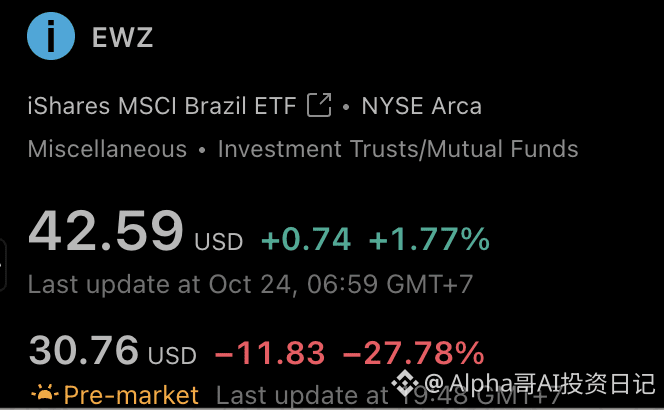
Brazil ETF ( $EWZ ) plunged 27.78% in pre-market trading today, nearing -30%!
Brazil’s election delivered a major upset: left-wing President Lula was unexpectedly reelected. After trailing right-wing candidate Bolsonaro in the first round, he staged a successful comeback in the second. This is the first time since Brazil restored direct presidential elections in 1989 that a candidate who trailed in the first round has gone on to win.
The market had been betting on the right wing coming to power, but those expectations were completely dashed.
Brazil ETF ( $EWZ ) plunged 27.78% in pre-market trading today, nearing -30%!
Brazil’s election delivered a major upset: left-wing President Lula was unexpectedly reelected. After trailing right-wing candidate Bolsonaro in the first round, he staged a successful comeback in the second. This is the first time since Brazil restored direct presidential elections in 1989 that a candidate who trailed in the first round has gone on to win.
The market had been betting on the right wing coming to power, but those expectations were completely dashed.
Brazil’s election delivered a major upset: left-wing President Lula was unexpectedly reelected. After trailing right-wing candidate Bolsonaro in the first round, he staged a successful comeback in the second. This is the first time since Brazil restored direct presidential elections in 1989 that a candidate who trailed in the first round has gone on to win.
The market had been betting on the right wing coming to power, but those expectations were completely dashed.
764
·
--
According to Fox Business: Anthropic will file its S-1 at 9 a.m. Eastern Time (9 p.m. Beijing Time tonight)
AI investors, get ready to place your orders! https://twitter.com/DeItaone/status/2114680761848897631
According to Fox Business: Anthropic will file its S-1 at 9 a.m. Eastern Time (9 p.m. Beijing Time tonight)
AI investors, get ready to place your orders! https://twitter.com/DeItaone/status/2114680761848897631
AI investors, get ready to place your orders! https://twitter.com/DeItaone/status/2114680761848897631
491
·
--
Verified
Feels like buying MEME and then watching it instantly go to zero 😂
Brazil 🇧🇷 ETF $EWZ plunged 18% in overnight trading https://twitter.com/antonlavay/status/2114544640804392966
Feels like buying MEME and then watching it instantly go to zero 😂
Brazil 🇧🇷 ETF $EWZ plunged 18% in overnight trading https://twitter.com/antonlavay/status/2114544640804392966
Brazil 🇧🇷 ETF $EWZ plunged 18% in overnight trading https://twitter.com/antonlavay/status/2114544640804392966
927
·
--
In 2007, Andy Xie pointed out that Chinese developers’ competitiveness depended largely on their ability to acquire land and bank loans. Because holding land brought capital gains, developers tended to delay development, and their entire business model relied heavily on financing. He further warned that when housing prices stopped rising or even fell, this business model could lead to the bankruptcy of a large number of property companies. This was essentially the core mechanism behind the later crisis in China’s highly leveraged real estate development model.
But his prediction came 13 years too early. He underestimated how long a market already in a bubble could keep rising with institutional support.
Andy Xie predicted in 2011 that average home prices nationwide would fall by 50% within two or three years. In 2013, he again predicted that home prices would be cut in half over the next five years. Completely wrong—if you’d listened to him, you’d have been done for 😂
So when researching a short, you can’t just study Why it must fall. You also have to study What keeps it going, and What finally breaks it.
Citation: https://x.com/i/web/status/2114520240239579386
In 2007, Andy Xie pointed out that Chinese developers’ competitiveness depended largely on their ability to acquire land and bank loans. Because holding land brought capital gains, developers tended to delay development, and their entire business model relied heavily on financing. He further warned that when housing prices stopped rising or even fell, this business model could lead to the bankruptcy of a large number of property companies. This was essentially the core mechanism behind the later crisis in China’s highly leveraged real estate development model.
But his prediction came 13 years too early. He underestimated how long a market already in a bubble could keep rising with institutional support.
Andy Xie predicted in 2011 that average home prices nationwide would fall by 50% within two or three years. In 2013, he again predicted that home prices would be cut in half over the next five years. Completely wrong—if you’d listened to him, you’d have been done for 😂
So when researching a short, you can’t just study Why it must fall. You also have to study What keeps it going, and What finally breaks it.
Citation: https://x.com/i/web/status/2114520240239579386
But his prediction came 13 years too early. He underestimated how long a market already in a bubble could keep rising with institutional support.
Andy Xie predicted in 2011 that average home prices nationwide would fall by 50% within two or three years. In 2013, he again predicted that home prices would be cut in half over the next five years. Completely wrong—if you’d listened to him, you’d have been done for 😂
So when researching a short, you can’t just study Why it must fall. You also have to study What keeps it going, and What finally breaks it.
Citation: https://x.com/i/web/status/2114520240239579386
881
·
--
Verified
Semiconductors are still falling, but retail investors keep buying the dip, piling into a 3x leveraged long ETF
The 3x leveraged long semiconductor ETF $SOXL is down 51% from its October 6 peak and 72% from its June peak. But over the past two weeks, it has actually seen net inflows of $9.27 billion—the largest two-week inflow on record https://twitter.com/globalmktobserv/status/2114331642873418062
Semiconductors are still falling, but retail investors keep buying the dip, piling into a 3x leveraged long ETF
The 3x leveraged long semiconductor ETF $SOXL is down 51% from its October 6 peak and 72% from its June peak. But over the past two weeks, it has actually seen net inflows of $9.27 billion—the largest two-week inflow on record https://twitter.com/globalmktobserv/status/2114331642873418062
The 3x leveraged long semiconductor ETF $SOXL is down 51% from its October 6 peak and 72% from its June peak. But over the past two weeks, it has actually seen net inflows of $9.27 billion—the largest two-week inflow on record https://twitter.com/globalmktobserv/status/2114331642873418062
1.2k
·
--
Recently, the stocks in the AI “chokepoint” theme haven’t been doing too well. Lately I’ve discovered another kind of chokepoint asset:
「Physical AI, a specialized liquid Token for advancing the physical world」
After injecting it into a car, it can keep running for hundreds of kilometers. Pay by usage, consumed at high frequency, a daily necessity for users, with extremely strong repeat purchases. Once the Token runs out, inference stops immediately, and the car will stop by the roadside and won’t be able to move.
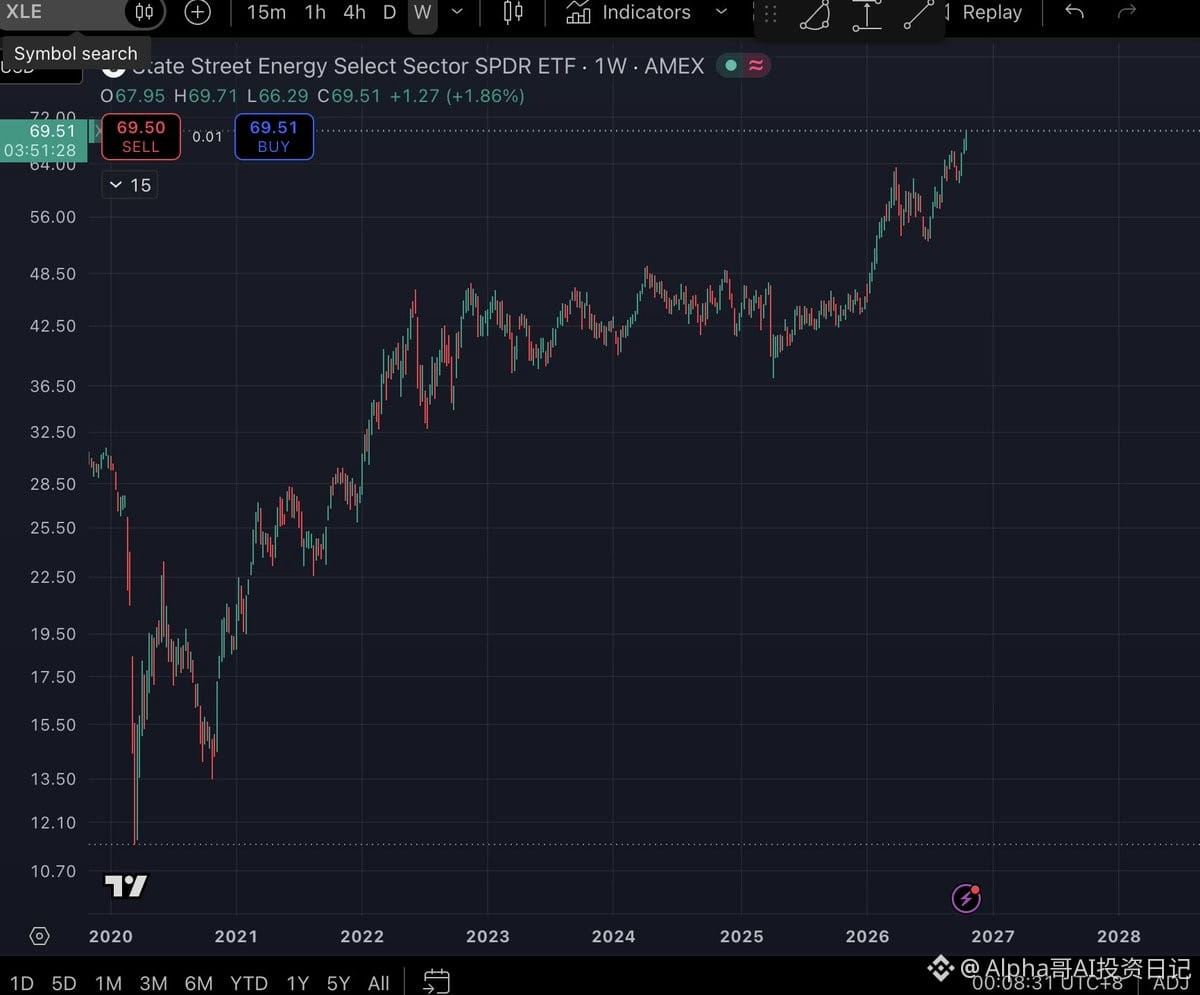
Recently, companies working on this industrial chain have seen their stock prices rise quite well. The ETF is $XLE breaking strongly upward.
By the way, 「Physical AI, a specialized liquid Token for advancing the physical world」 also has another name: oil
Recently, the stocks in the AI “chokepoint” theme haven’t been doing too well. Lately I’ve discovered another kind of chokepoint asset:
「Physical AI, a specialized liquid Token for advancing the physical world」
After injecting it into a car, it can keep running for hundreds of kilometers. Pay by usage, consumed at high frequency, a daily necessity for users, with extremely strong repeat purchases. Once the Token runs out, inference stops immediately, and the car will stop by the roadside and won’t be able to move.
Recently, companies working on this industrial chain have seen their stock prices rise quite well. The ETF is $XLE breaking strongly upward.
By the way, 「Physical AI, a specialized liquid Token for advancing the physical world」 also has another name: oil
「Physical AI, a specialized liquid Token for advancing the physical world」
After injecting it into a car, it can keep running for hundreds of kilometers. Pay by usage, consumed at high frequency, a daily necessity for users, with extremely strong repeat purchases. Once the Token runs out, inference stops immediately, and the car will stop by the roadside and won’t be able to move.
Recently, companies working on this industrial chain have seen their stock prices rise quite well. The ETF is $XLE breaking strongly upward.
By the way, 「Physical AI, a specialized liquid Token for advancing the physical world」 also has another name: oil
859
·
--
China’s A-share “quarter-conductor stocks” rebounded today
Wonder if U.S. stocks can keep the momentum going tonight.
China’s A-share “quarter-conductor stocks” rebounded today
Wonder if U.S. stocks can keep the momentum going tonight.
Wonder if U.S. stocks can keep the momentum going tonight.

70
·
--
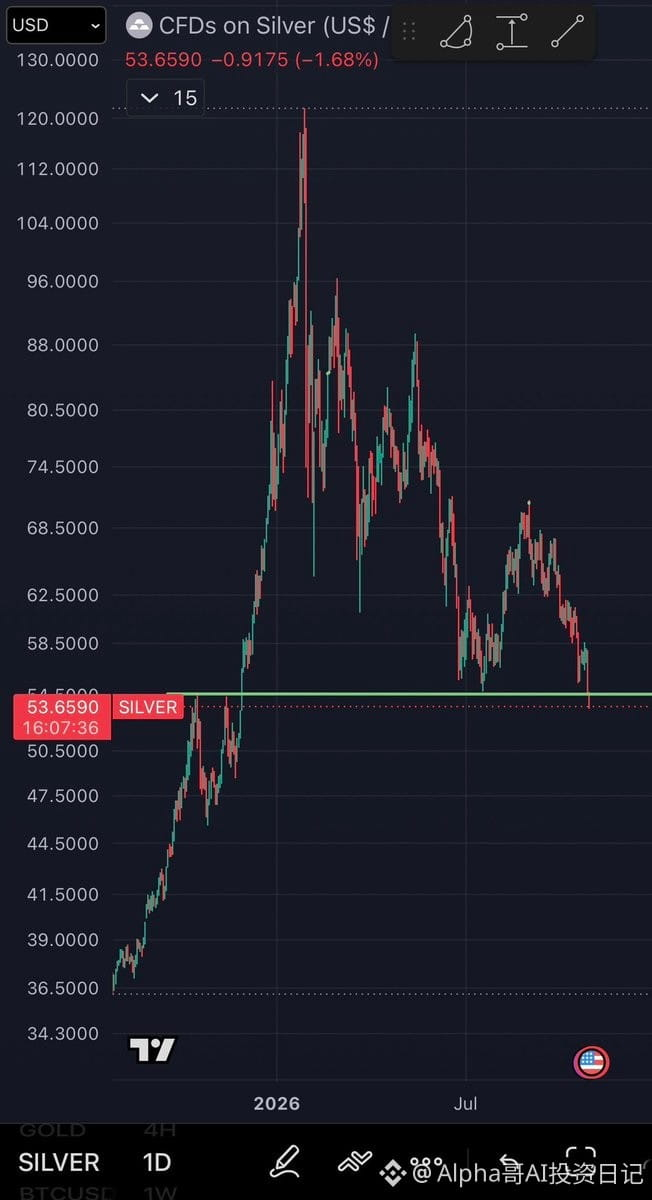
As I said last week, silver $XAG was showing considerable weakness, and it might still dip below $50 to trigger another wave of stop-losses on long positions.
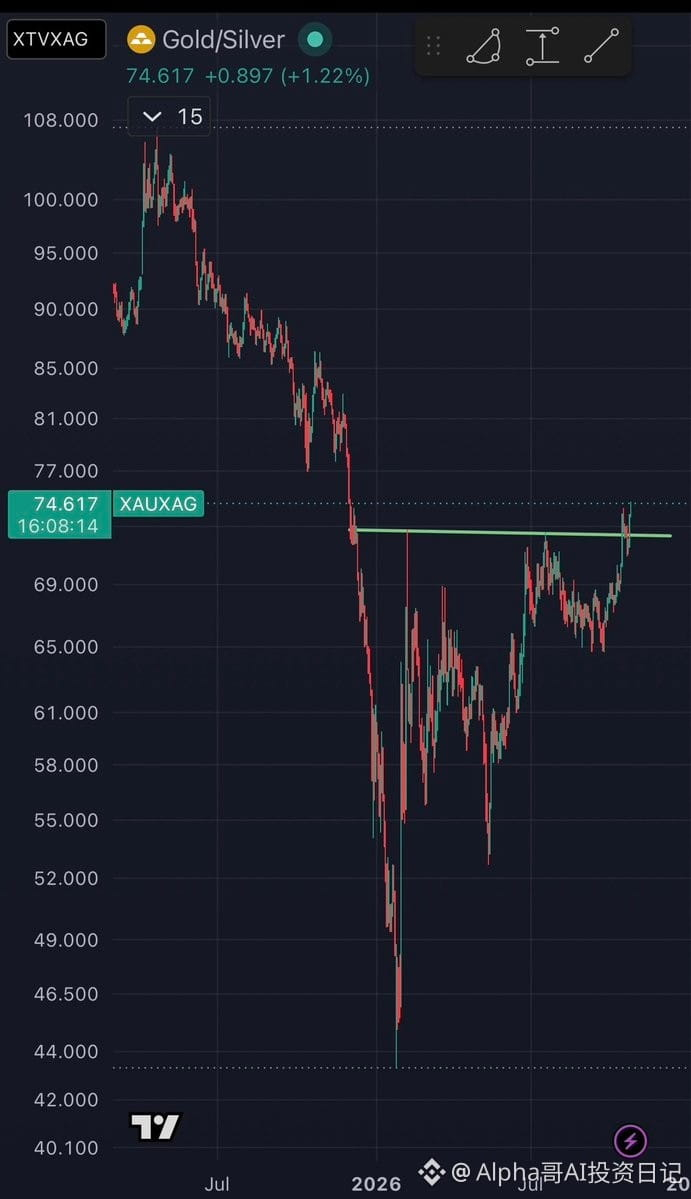
Looking at the situation now, the Gold/Silver Ratio has broken above key resistance around 72–73, indicating that silver is weakening further relative to gold.
More concerningly, silver has fallen below the support zone ($54–55) formed by the two highs in October and November last year.
On the daily chart, rebound highs keep moving lower and support levels keep giving way. The overall technical picture looks quite bad.
It feels like this correction isn’t over yet. Most likely, we’ll see another downward move in the near term.
Source: https://x.com/i/web/status/2110391173579993173
As I said last week, silver $XAG was showing considerable weakness, and it might still dip below $50 to trigger another wave of stop-losses on long positions.
Looking at the situation now, the Gold/Silver Ratio has broken above key resistance around 72–73, indicating that silver is weakening further relative to gold.
More concerningly, silver has fallen below the support zone ($54–55) formed by the two highs in October and November last year.
On the daily chart, rebound highs keep moving lower and support levels keep giving way. The overall technical picture looks quite bad.
It feels like this correction isn’t over yet. Most likely, we’ll see another downward move in the near term.
Source: https://x.com/i/web/status/2110391173579993173
Looking at the situation now, the Gold/Silver Ratio has broken above key resistance around 72–73, indicating that silver is weakening further relative to gold.
More concerningly, silver has fallen below the support zone ($54–55) formed by the two highs in October and November last year.
On the daily chart, rebound highs keep moving lower and support levels keep giving way. The overall technical picture looks quite bad.
It feels like this correction isn’t over yet. Most likely, we’ll see another downward move in the near term.
Source: https://x.com/i/web/status/2110391173579993173
354
·
--
The market action over the past few days has been a perfect illustration of what “Yields falling for the wrong reasons” means.
US10Y had previously broken decisively above the long-term neckline resistance at 4.80%, climbing all the way to a high near 5.40%. Only in the past two days did it finally pull back to 4.978%, after a sharp one-day drop of 14.1 bps. If yields were falling because inflation was cooling moderately and the Fed was sending dovish signals, US stocks would have taken off by now.
But the key tension now is that the sharp sell-off in US stocks and geopolitical black swan events have scared investors into seeking safety in Treasuries. Everyone rushed to buy Treasuries as a safe haven, and that’s what forced yields down 😂
The market action over the past few days has been a perfect illustration of what “Yields falling for the wrong reasons” means.
US10Y had previously broken decisively above the long-term neckline resistance at 4.80%, climbing all the way to a high near 5.40%. Only in the past two days did it finally pull back to 4.978%, after a sharp one-day drop of 14.1 bps. If yields were falling because inflation was cooling moderately and the Fed was sending dovish signals, US stocks would have taken off by now.
But the key tension now is that the sharp sell-off in US stocks and geopolitical black swan events have scared investors into seeking safety in Treasuries. Everyone rushed to buy Treasuries as a safe haven, and that’s what forced yields down 😂
US10Y had previously broken decisively above the long-term neckline resistance at 4.80%, climbing all the way to a high near 5.40%. Only in the past two days did it finally pull back to 4.978%, after a sharp one-day drop of 14.1 bps. If yields were falling because inflation was cooling moderately and the Fed was sending dovish signals, US stocks would have taken off by now.
But the key tension now is that the sharp sell-off in US stocks and geopolitical black swan events have scared investors into seeking safety in Treasuries. Everyone rushed to buy Treasuries as a safe haven, and that’s what forced yields down 😂
IEFETF-0.03%
8
·
--
Recently, $SAP, $NOW , has been trending nicely. Along with Thomson Reuters $TRI, mentioned earlier, it’s managed a modest bull run even as the broader U.S. stock market plunged.
Some investors may already be starting to rethink where the profits from the AI revolution will ultimately end up.
On X, many people’s understanding of “AI beneficiaries” has become a bit dogmatic.
Mention AI, and they think storage, CPUs, GPUs, and optical modules. It’s as if only hardware facing supply shortages and capable of becoming a “chokepoint” qualifies as an AI beneficiary.
I think some enterprise software companies that were unfairly sold off earlier may actually be among the most attractively priced AI beneficiaries.
The logic is pretty straightforward.
First, foundation models are increasingly becoming a utility.
Model providers continue to compete, and enterprises can use different models. If the cost of accessing models with comparable capabilities keeps falling, software companies with established customer relationships, data, and business entry points have an opportunity to offer more valuable products at lower cost.
Second, being able to write code is still a long way from replacing core enterprise systems.
SAP manages finance, procurement, and supply chains; ServiceNow is deeply embedded in enterprise IT services and approval workflows. These systems also sit on top of years of accumulated data, permissions, audit requirements, and extensive system integrations. Building an interface with similar features is one thing; getting a multinational corporation to migrate its entire business system is another. What big-company CTO would dare to sign off on the company not using SAP or ServiceNow? These systems are hard to replace, and AI can help them automate more and expand the value of their functionality.
Third, high-margin subscription businesses have the opportunity to add new sources of growth.
AI can help software companies sell higher-priced plans, add paid modules, expand use cases, and potentially reduce R&D and service costs.
Some data is already worth watching: ServiceNow’s second-quarter subscription revenue grew 24.5% year over year, and the annual contract value of its AI business topped $1 billion. SAP’s latest quarterly current cloud backlog grew 26% at constant currencies. At the very least, this shows that demand for some enterprise software and the commercialization of AI are still moving forward.
Fourth, the gap between expectations and reality may matter more than “who’s facing the biggest shortage.”
The narrative that “Claude will kill SaaS” had already caused many software stocks to go through a round of valuation compression. If it turns out that some of these companies retain their customers while increasing revenue through AI, the market will have to reassess both their earnings potential and their valuations.
They were priced as “AI victims,” but are gradually delivering results as “AI beneficiaries.”
The more intense the competition among foundation models gets, the more likely it is that, ultimately…
Recently, $SAP, $NOW , has been trending nicely. Along with Thomson Reuters $TRI, mentioned earlier, it’s managed a modest bull run even as the broader U.S. stock market plunged.
Some investors may already be starting to rethink where the profits from the AI revolution will ultimately end up.
On X, many people’s understanding of “AI beneficiaries” has become a bit dogmatic.
Mention AI, and they think storage, CPUs, GPUs, and optical modules. It’s as if only hardware facing supply shortages and capable of becoming a “chokepoint” qualifies as an AI beneficiary.
I think some enterprise software companies that were unfairly sold off earlier may actually be among the most attractively priced AI beneficiaries.
The logic is pretty straightforward.
First, foundation models are increasingly becoming a utility.
Model providers continue to compete, and enterprises can use different models. If the cost of accessing models with comparable capabilities keeps falling, software companies with established customer relationships, data, and business entry points have an opportunity to offer more valuable products at lower cost.
Second, being able to write code is still a long way from replacing core enterprise systems.
SAP manages finance, procurement, and supply chains; ServiceNow is deeply embedded in enterprise IT services and approval workflows. These systems also sit on top of years of accumulated data, permissions, audit requirements, and extensive system integrations. Building an interface with similar features is one thing; getting a multinational corporation to migrate its entire business system is another. What big-company CTO would dare to sign off on the company not using SAP or ServiceNow? These systems are hard to replace, and AI can help them automate more and expand the value of their functionality.
Third, high-margin subscription businesses have the opportunity to add new sources of growth.
AI can help software companies sell higher-priced plans, add paid modules, expand use cases, and potentially reduce R&D and service costs.
Some data is already worth watching: ServiceNow’s second-quarter subscription revenue grew 24.5% year over year, and the annual contract value of its AI business topped $1 billion. SAP’s latest quarterly current cloud backlog grew 26% at constant currencies. At the very least, this shows that demand for some enterprise software and the commercialization of AI are still moving forward.
Fourth, the gap between expectations and reality may matter more than “who’s facing the biggest shortage.”
The narrative that “Claude will kill SaaS” had already caused many software stocks to go through a round of valuation compression. If it turns out that some of these companies retain their customers while increasing revenue through AI, the market will have to reassess both their earnings potential and their valuations.
They were priced as “AI victims,” but are gradually delivering results as “AI beneficiaries.”
The more intense the competition among foundation models gets, the more likely it is that, ultimately…
Some investors may already be starting to rethink where the profits from the AI revolution will ultimately end up.
On X, many people’s understanding of “AI beneficiaries” has become a bit dogmatic.
Mention AI, and they think storage, CPUs, GPUs, and optical modules. It’s as if only hardware facing supply shortages and capable of becoming a “chokepoint” qualifies as an AI beneficiary.
I think some enterprise software companies that were unfairly sold off earlier may actually be among the most attractively priced AI beneficiaries.
The logic is pretty straightforward.
First, foundation models are increasingly becoming a utility.
Model providers continue to compete, and enterprises can use different models. If the cost of accessing models with comparable capabilities keeps falling, software companies with established customer relationships, data, and business entry points have an opportunity to offer more valuable products at lower cost.
Second, being able to write code is still a long way from replacing core enterprise systems.
SAP manages finance, procurement, and supply chains; ServiceNow is deeply embedded in enterprise IT services and approval workflows. These systems also sit on top of years of accumulated data, permissions, audit requirements, and extensive system integrations. Building an interface with similar features is one thing; getting a multinational corporation to migrate its entire business system is another. What big-company CTO would dare to sign off on the company not using SAP or ServiceNow? These systems are hard to replace, and AI can help them automate more and expand the value of their functionality.
Third, high-margin subscription businesses have the opportunity to add new sources of growth.
AI can help software companies sell higher-priced plans, add paid modules, expand use cases, and potentially reduce R&D and service costs.
Some data is already worth watching: ServiceNow’s second-quarter subscription revenue grew 24.5% year over year, and the annual contract value of its AI business topped $1 billion. SAP’s latest quarterly current cloud backlog grew 26% at constant currencies. At the very least, this shows that demand for some enterprise software and the commercialization of AI are still moving forward.
Fourth, the gap between expectations and reality may matter more than “who’s facing the biggest shortage.”
The narrative that “Claude will kill SaaS” had already caused many software stocks to go through a round of valuation compression. If it turns out that some of these companies retain their customers while increasing revenue through AI, the market will have to reassess both their earnings potential and their valuations.
They were priced as “AI victims,” but are gradually delivering results as “AI beneficiaries.”
The more intense the competition among foundation models gets, the more likely it is that, ultimately…
40
·
--
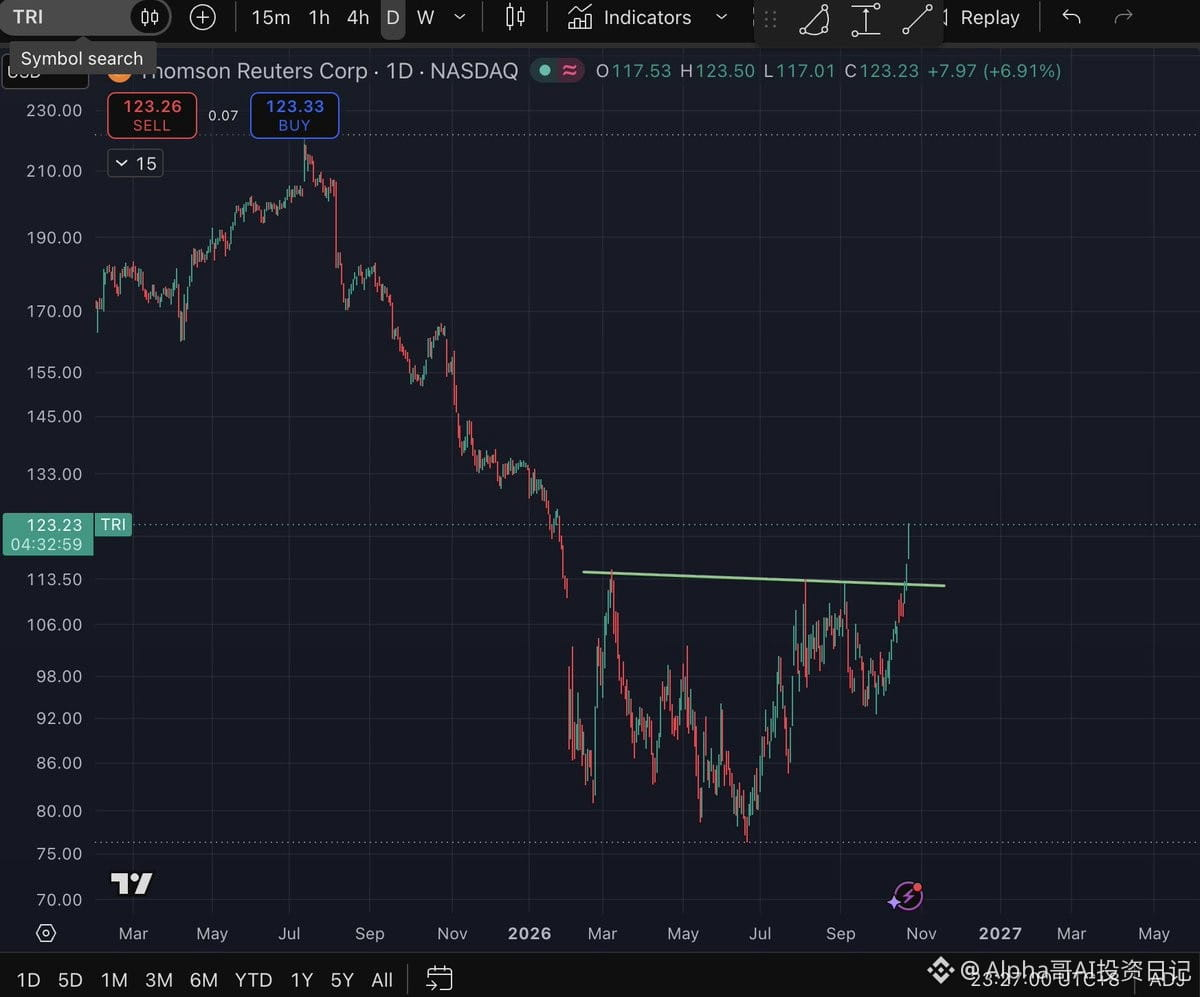
U.S. stocks have plunged over the past few days, putting pressure on the AI supply chain—but one stock has broken out against the trend: Thomson Reuters $TRI
It rose 6.91% today. From its October 19 closing price of $108.23, it has gained about 13.9% over three trading days.
Previous rallies were turned back near $112–$115, but the stock has now broken above that resistance zone. This kind of relative strength while the broader market is under pressure is worth watching.
When people hear Reuters, they often think only of news. In fact, Thomson Reuters also offers professional databases and software for legal, tax, accounting, and corporate compliance work. The market had worried that AI might replace these offerings, but total revenue still grew 9% in the second quarter, while organic revenue across its three core businesses rose 10%. At the very least, these figures show that paid demand from professional customers remains resilient. The market is starting to reassess Reuters as an “AI victim.”
The company recently launched a new version of its CoCounsel Tax, Audit & Accounting AI solution. It can plan tasks, write and run code to perform tax calculations, and then hand the work over to accountants and tax professionals for review. As large AI models become increasingly capable, companies with “specialized content + customer relationships + workflows” may be better positioned to turn AI into products customers are willing to pay for.
My take is that this rally reflects a recovery from overly pessimistic expectations, along with the potential to commercialize professional AI. As the market starts questioning the returns on compute investment, application companies with specialized data and paying customers may regain attention.
Next up is the November 3 earnings report: can growth and profits continue to beat expectations?
U.S. stocks have plunged over the past few days, putting pressure on the AI supply chain—but one stock has broken out against the trend: Thomson Reuters $TRI
It rose 6.91% today. From its October 19 closing price of $108.23, it has gained about 13.9% over three trading days.
Previous rallies were turned back near $112–$115, but the stock has now broken above that resistance zone. This kind of relative strength while the broader market is under pressure is worth watching.
When people hear Reuters, they often think only of news. In fact, Thomson Reuters also offers professional databases and software for legal, tax, accounting, and corporate compliance work. The market had worried that AI might replace these offerings, but total revenue still grew 9% in the second quarter, while organic revenue across its three core businesses rose 10%. At the very least, these figures show that paid demand from professional customers remains resilient. The market is starting to reassess Reuters as an “AI victim.”
The company recently launched a new version of its CoCounsel Tax, Audit & Accounting AI solution. It can plan tasks, write and run code to perform tax calculations, and then hand the work over to accountants and tax professionals for review. As large AI models become increasingly capable, companies with “specialized content + customer relationships + workflows” may be better positioned to turn AI into products customers are willing to pay for.
My take is that this rally reflects a recovery from overly pessimistic expectations, along with the potential to commercialize professional AI. As the market starts questioning the returns on compute investment, application companies with specialized data and paying customers may regain attention.
Next up is the November 3 earnings report: can growth and profits continue to beat expectations?
It rose 6.91% today. From its October 19 closing price of $108.23, it has gained about 13.9% over three trading days.
Previous rallies were turned back near $112–$115, but the stock has now broken above that resistance zone. This kind of relative strength while the broader market is under pressure is worth watching.
When people hear Reuters, they often think only of news. In fact, Thomson Reuters also offers professional databases and software for legal, tax, accounting, and corporate compliance work. The market had worried that AI might replace these offerings, but total revenue still grew 9% in the second quarter, while organic revenue across its three core businesses rose 10%. At the very least, these figures show that paid demand from professional customers remains resilient. The market is starting to reassess Reuters as an “AI victim.”
The company recently launched a new version of its CoCounsel Tax, Audit & Accounting AI solution. It can plan tasks, write and run code to perform tax calculations, and then hand the work over to accountants and tax professionals for review. As large AI models become increasingly capable, companies with “specialized content + customer relationships + workflows” may be better positioned to turn AI into products customers are willing to pay for.
My take is that this rally reflects a recovery from overly pessimistic expectations, along with the potential to commercialize professional AI. As the market starts questioning the returns on compute investment, application companies with specialized data and paying customers may regain attention.
Next up is the November 3 earnings report: can growth and profits continue to beat expectations?
28
·
--
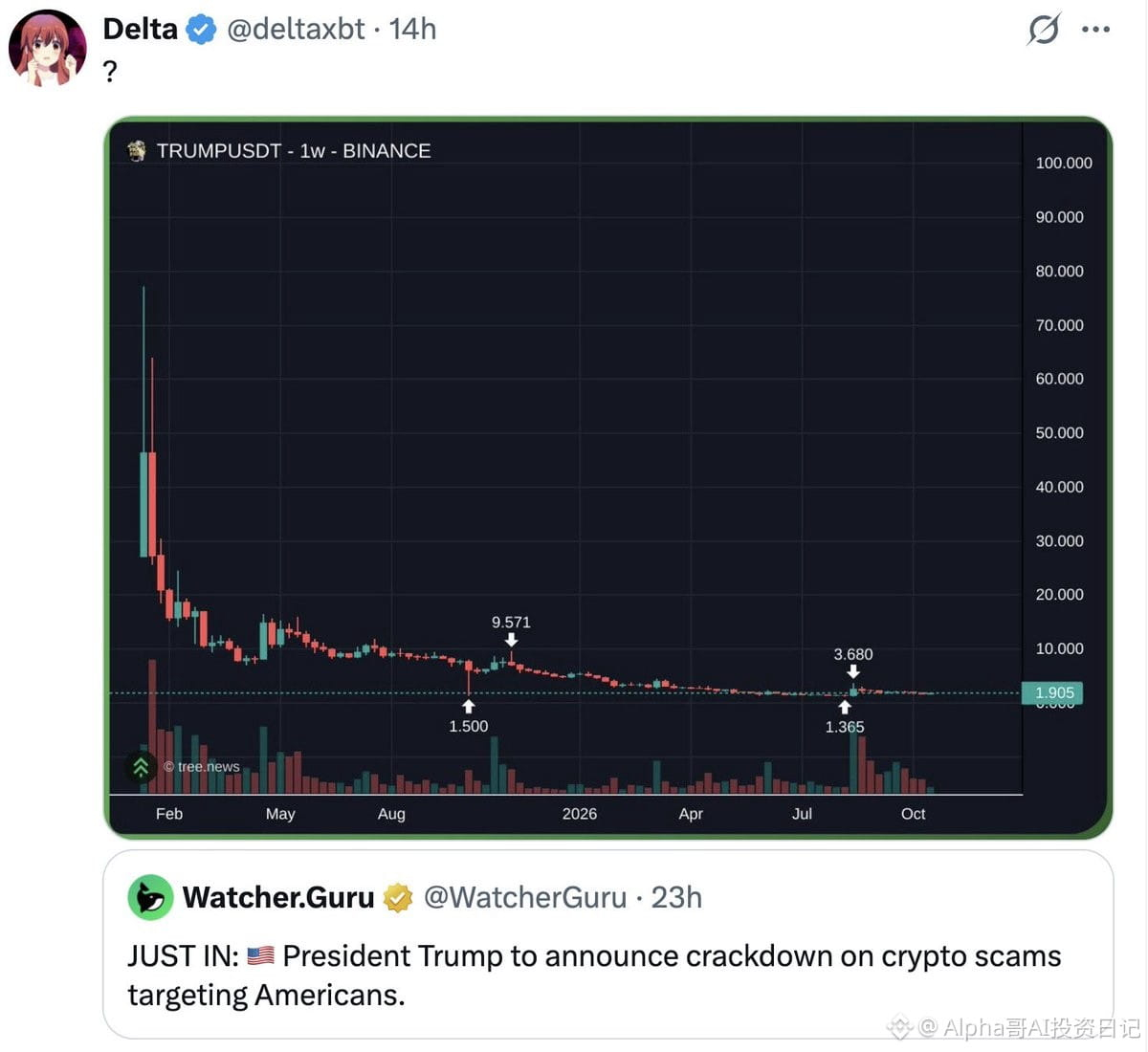
????
The president can set fires, but ordinary people aren't allowed to light lamps
$Trump
????
The president can set fires, but ordinary people aren't allowed to light lamps
$Trump
The president can set fires, but ordinary people aren't allowed to light lamps
$Trump
238
·
--
UBI exploration has begun around the world https://twitter.com/supermao/status/2113252756060520488
UBI exploration has begun around the world https://twitter.com/supermao/status/2113252756060520488
39
·
--
Although my position has been relatively light lately and I've been taking a relatively defensive stance, the odds that this entire AI rally is completely over from a five-year-cycle perspective—and that history will repeat itself exactly as it did in 2000—are very, very low.
Of course, AI stocks are divided into different sectors. It’s normal for some sectors that previously had high expectations and leverage to undergo a deeper correction.
The bulls may have a relatively tough time over the next two or three months as some leverage gets flushed out. That could set the stage for a stronger rally later. We might see a wave that makes everyone think 2000 is repeating itself and the AI bubble has burst—followed by a huge V-shaped rebound to the moon.
For ordinary retail investors, those using leverage should reduce it. Those who aren’t should focus on earning more outside the market.
Eat well, sleep well, and wait for opportunities—and for bloodied chips to hit the floor.
Quote: https://x.com/i/web/status/2113173310095913130
Although my position has been relatively light lately and I've been taking a relatively defensive stance, the odds that this entire AI rally is completely over from a five-year-cycle perspective—and that history will repeat itself exactly as it did in 2000—are very, very low.
Of course, AI stocks are divided into different sectors. It’s normal for some sectors that previously had high expectations and leverage to undergo a deeper correction.
The bulls may have a relatively tough time over the next two or three months as some leverage gets flushed out. That could set the stage for a stronger rally later. We might see a wave that makes everyone think 2000 is repeating itself and the AI bubble has burst—followed by a huge V-shaped rebound to the moon.
For ordinary retail investors, those using leverage should reduce it. Those who aren’t should focus on earning more outside the market.
Eat well, sleep well, and wait for opportunities—and for bloodied chips to hit the floor.
Quote: https://x.com/i/web/status/2113173310095913130
Of course, AI stocks are divided into different sectors. It’s normal for some sectors that previously had high expectations and leverage to undergo a deeper correction.
The bulls may have a relatively tough time over the next two or three months as some leverage gets flushed out. That could set the stage for a stronger rally later. We might see a wave that makes everyone think 2000 is repeating itself and the AI bubble has burst—followed by a huge V-shaped rebound to the moon.
For ordinary retail investors, those using leverage should reduce it. Those who aren’t should focus on earning more outside the market.
Eat well, sleep well, and wait for opportunities—and for bloodied chips to hit the floor.
Quote: https://x.com/i/web/status/2113173310095913130
61
Log in to explore more content
Join global crypto users on Binance Square
⚡️ Get latest and useful information about crypto.
💬 Trusted by the world’s largest crypto exchange.
👍 Discover real insights from verified creators.
Email / Phone number