
A-59
115 Posts

A-59
Report
Block User
NEWS.
0 Following
28 Followers
58 Liked
Posts
All
Quotes
Videos
·
--
Article
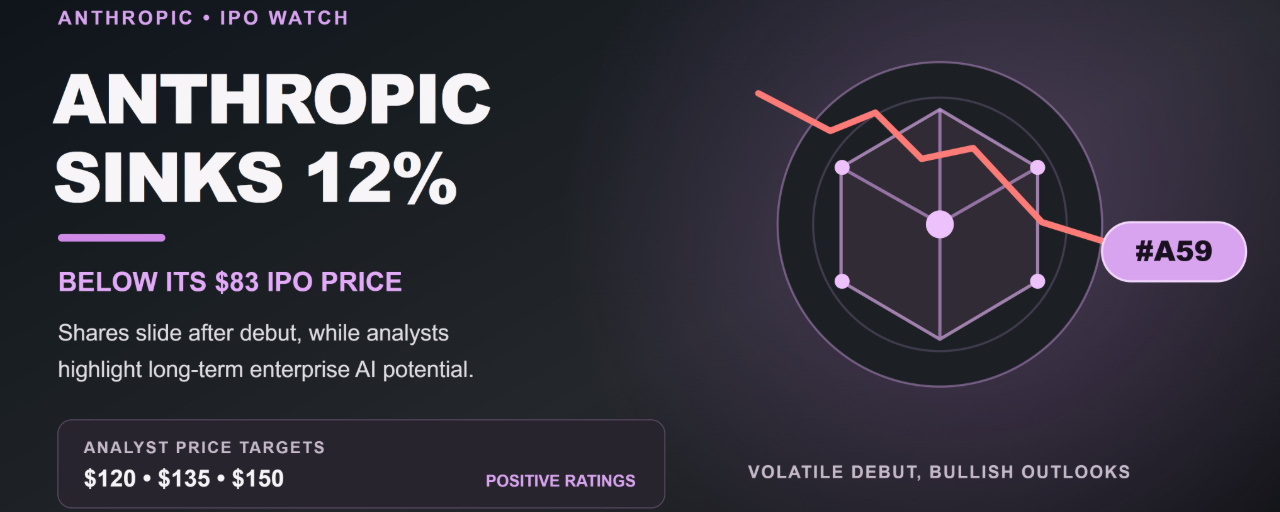
Anthropic sinks 12%, falling below $83 IPO price, but analysts are still largely positivesourch : CNBC Ashley Capoot Published Tue, Nov 24 20269:33 AM EST
Shares of Anthropic $ANTB
{spot}(ANTBUSDT)
fell 12% on Tuesday, sending the stock below the artificial intelligence company’s $83 IPO price.
The AI lab’s stock has been sinking steadily since opening at $111.50 on the Nasdaq on Thursday, after Anthropic raised $81.3 billion in the largest offering of all time. Investors eagerly awaited Anthropic’s debut in hopes that the company would revitalize the broader AI trade, which has been volatile in recent weeks over concerns about the feasibility of a multitrillion-dollar infrastructure buildout.
Anthropic’s initial public offering was oversubscribed, and roughly half of the institutional investors that placed orders for the stock were left empty-handed, as CNBC previously reported. But at least for now, as the market wavers, those firms don’t appear to be racing to scoop up shares.
Chip stocks Nvidia $NVDAB
{spot}(NVDABUSDT)
, Advanced Micro Devices $AMDB and Intel , as well as neoclouds CoreWeave, IREN and Nebius, all fell during intraday trading on Tuesday. The market is still reeling after Nvidia reinstated Jensen Huang as CEO, a dramatic reversal from his ouster earlier this month. Nvidia shares surged more than 30% on Monday, but pared those gains Tuesday.
Analysts at Canaccord Genuity said Tuesday that they’re focused on Anthropic’s long-term potential. They said they believe that the company is building “one of the most important enterprise technology franchises of the AI era” and that the “opportunity is considerably larger than traditional software spending.”
Canaccord Genuity initiated coverage of Anthropic with a buy rating and a $135 price target.
“The risks are unusually large, particularly around infrastructure commitments and the durability of competitive differentiation, but we believe the combination of exceptional growth, emerging earnings capacity, and an attractive entry valuation support a compelling investment opportunity,” the analysts wrote in a Tuesday note.
Wedbush analysts initiated coverage of Anthropic with an outperform rating and a $120 price target on Monday. They said Anthropic went public in a “tumultuous market” as debate around the AI buildout continues, but that they expect the company to navigate the competitive environment and “capture a uniquely large addressable market.”
“While there’s going to continue to be many ups and downs, and winners and losers as this ecosystem gets built, in our view there is no real question that it does get built over time,” the analysts wrote in a Monday note. “The genie is out of the bottle. And ANT is a strong play on that theme.”
Analysts at Oppenheimer initiated coverage of Anthropic with an outperform rating on Tuesday, and they set a $150 price target for the stock.
They said their “bullish stance” on the company stems from their belief that Anthropic will capture growing enterprise AI spending, that its improving compute efficiency lowers cost per task and that its multi-chip strategy optimizes price performance. The analysts added that Anthropic’s focus on the enterprise also relies less on consumer subsidies, and that rising customer adoption creates “a substantial runway” for the company.
“While competition and compute commitments remain risks, we believe Anthropic can translate its leadership into durable growth and operating leverage,” the analysts wrote in a Tuesday note.
#A59 #AnthropicBreaksBelowIPOPriceAmidAISlump #news
Anthropic sinks 12%, falling below $83 IPO price, but analysts are still largely positive
sourch : CNBC Ashley Capoot Published Tue, Nov 24 20269:33 AM EST
Shares of Anthropic $ANTB
fell 12% on Tuesday, sending the stock below the artificial intelligence company’s $83 IPO price.
The AI lab’s stock has been sinking steadily since opening at $111.50 on the Nasdaq on Thursday, after Anthropic raised $81.3 billion in the largest offering of all time. Investors eagerly awaited Anthropic’s debut in hopes that the company would revitalize the broader AI trade, which has been volatile in recent weeks over concerns about the feasibility of a multitrillion-dollar infrastructure buildout.
Anthropic’s initial public offering was oversubscribed, and roughly half of the institutional investors that placed orders for the stock were left empty-handed, as CNBC previously reported. But at least for now, as the market wavers, those firms don’t appear to be racing to scoop up shares.
Chip stocks Nvidia $NVDAB
, Advanced Micro Devices $AMDB and Intel , as well as neoclouds CoreWeave, IREN and Nebius, all fell during intraday trading on Tuesday. The market is still reeling after Nvidia reinstated Jensen Huang as CEO, a dramatic reversal from his ouster earlier this month. Nvidia shares surged more than 30% on Monday, but pared those gains Tuesday.
Analysts at Canaccord Genuity said Tuesday that they’re focused on Anthropic’s long-term potential. They said they believe that the company is building “one of the most important enterprise technology franchises of the AI era” and that the “opportunity is considerably larger than traditional software spending.”
Canaccord Genuity initiated coverage of Anthropic with a buy rating and a $135 price target.
“The risks are unusually large, particularly around infrastructure commitments and the durability of competitive differentiation, but we believe the combination of exceptional growth, emerging earnings capacity, and an attractive entry valuation support a compelling investment opportunity,” the analysts wrote in a Tuesday note.
Wedbush analysts initiated coverage of Anthropic with an outperform rating and a $120 price target on Monday. They said Anthropic went public in a “tumultuous market” as debate around the AI buildout continues, but that they expect the company to navigate the competitive environment and “capture a uniquely large addressable market.”
“While there’s going to continue to be many ups and downs, and winners and losers as this ecosystem gets built, in our view there is no real question that it does get built over time,” the analysts wrote in a Monday note. “The genie is out of the bottle. And ANT is a strong play on that theme.”
Analysts at Oppenheimer initiated coverage of Anthropic with an outperform rating on Tuesday, and they set a $150 price target for the stock.
They said their “bullish stance” on the company stems from their belief that Anthropic will capture growing enterprise AI spending, that its improving compute efficiency lowers cost per task and that its multi-chip strategy optimizes price performance. The analysts added that Anthropic’s focus on the enterprise also relies less on consumer subsidies, and that rising customer adoption creates “a substantial runway” for the company.
“While competition and compute commitments remain risks, we believe Anthropic can translate its leadership into durable growth and operating leverage,” the analysts wrote in a Tuesday note.
#A59 #AnthropicBreaksBelowIPOPriceAmidAISlump #news
17
·
--
Article
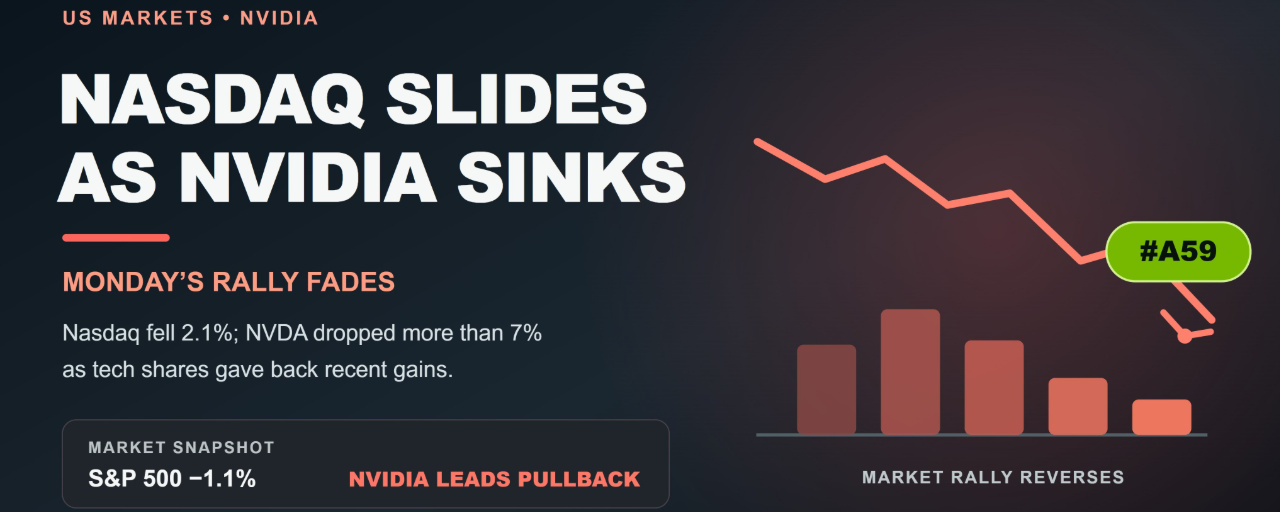
Nasdaq declines as Nvidia slides, giving back part of Monday’s rally: Live updatessourch ; CNBC Updated Tue, Nov 24 202610:29 AM EST
The Nasdaq $NDAQ.US
{stock_us}(NDAQ.US)
Composite fell on Tuesday, giving back some of the sharp gains from the previous session that were sparked by Jensen Huang’s return as Nvidia CEO.
The tech-heavy was 2.1% lower, while the S&P 500 fell 1.1%. The Dow Jones Industrial Average traded around the flatline, bolstered by gains in stocks such as Amgen, Nike and Salesforce.
Nvidia $NVDAB
{spot}(NVDABUSDT)
shares reversed course following their 31% surge on Monday, a move that led a rally in chip stocks. The stock was down more than 7%.
Tom Hulick, CEO of Strategy Asset Managers, told CNBC’s “Squawk Box Europe” on Tuesday that Huang was probably the right person to lead Nvidia “for now.” However, he added that the company still has “a lot of things to worry about” regarding corporate governance.
Meanwhile, Anthropic $ANTB
{spot}(ANTBUSDT)
shares fell 9%, breaking below its IPO price and adding pressure to the broader market.
Other stocks linked to AI fell alongside Nvidia and Anthropic. Chipmaker Micron Technology dropped more than 10%, as did Advanced Micro Devices, while Broadcom declined 3%. Additionally, Alphabet shed more than 1%, while Oracle lost more than 3%.
Contributing to the downbeat investor sentiment, the U.S. is preparing to increase tariffs on dozens of countries, including China. That’s according to The Wall Street Journal, which cited people familiar with the plans.
The market saw a massive rally on Monday, with the Nasdaq and S&P 500 seeing their best session since April 9, 2025, when President Donald Trump announced a reprieve on tariffs.
Monday’s market action was a sharp reversal from Friday’s steep sell-off, which saw the S&P 500 and Dow close in correction as the AI trade suffered and Nvidia tanked.
Mark Haefele, Chief Investment Officer at UBS Global Wealth Management, said in a note Tuesday morning that his team does not believe the volatility in global tech names is “a signal that the structural AI investment story has broken.”
“Cloud growth, rising usage, and continued demand for computing capacity remain supportive,” he said. “But we do expect greater differentiation between established platforms with visible monetization and strong balance sheets, and companies dependent on debt, scarce capacity, or continued speculative growth.”
#A59 #news #NASDAQ #NVDA
Nasdaq declines as Nvidia slides, giving back part of Monday’s rally: Live updates
sourch ; CNBC Updated Tue, Nov 24 202610:29 AM EST
The Nasdaq $NDAQ.US
Composite fell on Tuesday, giving back some of the sharp gains from the previous session that were sparked by Jensen Huang’s return as Nvidia CEO.
The tech-heavy was 2.1% lower, while the S&P 500 fell 1.1%. The Dow Jones Industrial Average traded around the flatline, bolstered by gains in stocks such as Amgen, Nike and Salesforce.
Nvidia $NVDAB
shares reversed course following their 31% surge on Monday, a move that led a rally in chip stocks. The stock was down more than 7%.
Tom Hulick, CEO of Strategy Asset Managers, told CNBC’s “Squawk Box Europe” on Tuesday that Huang was probably the right person to lead Nvidia “for now.” However, he added that the company still has “a lot of things to worry about” regarding corporate governance.
Meanwhile, Anthropic $ANTB
shares fell 9%, breaking below its IPO price and adding pressure to the broader market.
Other stocks linked to AI fell alongside Nvidia and Anthropic. Chipmaker Micron Technology dropped more than 10%, as did Advanced Micro Devices, while Broadcom declined 3%. Additionally, Alphabet shed more than 1%, while Oracle lost more than 3%.
Contributing to the downbeat investor sentiment, the U.S. is preparing to increase tariffs on dozens of countries, including China. That’s according to The Wall Street Journal, which cited people familiar with the plans.
The market saw a massive rally on Monday, with the Nasdaq and S&P 500 seeing their best session since April 9, 2025, when President Donald Trump announced a reprieve on tariffs.
Monday’s market action was a sharp reversal from Friday’s steep sell-off, which saw the S&P 500 and Dow close in correction as the AI trade suffered and Nvidia tanked.
Mark Haefele, Chief Investment Officer at UBS Global Wealth Management, said in a note Tuesday morning that his team does not believe the volatility in global tech names is “a signal that the structural AI investment story has broken.”
“Cloud growth, rising usage, and continued demand for computing capacity remain supportive,” he said. “But we do expect greater differentiation between established platforms with visible monetization and strong balance sheets, and companies dependent on debt, scarce capacity, or continued speculative growth.”
#A59 #news #NASDAQ #NVDA
115
·
--
Article
Marvell Stock Fell Almost 12% in a Single Day. I'd Consider Buying Shares Now.By Daniel Sparks – Nov 24, 2026 at 5:37AM EST
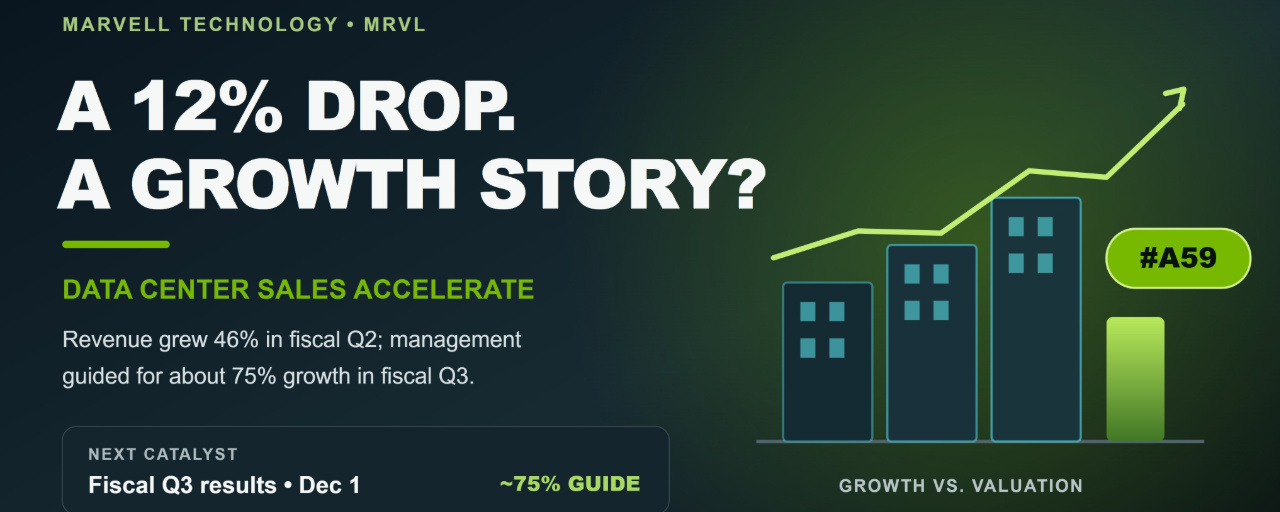
Marvell Technology ( $MRVLB -5.16%) stock fell almost 12% on Nov. 20 to close at $122.28. The chipmaker's shares hadn't closed this low since April. And they stood at around 39% of the record close they hit on June 4 -- $316.43.
Most of that slide happened over the past month. Marvell closed around $252 on Oct. 28, the last trading day before news broke that it was in talks to buy optical parts maker Lumentum Holdings ($LITE.US -6.32%). The stock had lost over half its value by Nov. 20.
Shares rebounded sharply on Nov. 23, but I think the sell-off has still gone further than the business justifies. At this price, the stock is valued as if Marvell's growth was about to fade into something ordinary. Its data center business is doing the opposite, so I'd buy the shares now.
Data center growth keeps speeding up
Data centers account for most of Marvell's sales. They made up 79% of its revenue in the fiscal second quarter of 2027 (the period ended Aug. 1, 2026).
Showing how quickly demand has picked up, Marvell's data center revenue reached around $2.17 billion in fiscal Q2, up 46% year over year. That was faster than the 27% growth in fiscal Q1 and the 21% growth in the fourth quarter of fiscal 2026. Plus, management guided for data center revenue to grow around 75% from a year earlier in the fiscal third quarter, which ended Oct. 31. And profits are keeping up with sales. Marvell's non-GAAP (adjusted) earnings per share climbed 40% year over year in fiscal Q2.
The fourth-quarter report, released in March, was still Marvell's latest earnings update the last time the stock closed this low, on April 9. Since then, the data center business has moved from 21% growth to a guided 75%, but the share price has landed right back near where it was.
Marvell's data center business brought in around $2.2 billion for all of fiscal 2024. In fiscal Q2 alone, it brought in almost as much.
Marvell reports fiscal third-quarter results on Dec. 1, which will show if data center sales met that guide. But on Nov. 2, the company said preliminary total revenue for the quarter was consistent with its guidance.
Priced close to an average stock
At around $146, Marvell's price-to-earnings ratio is about 20 using the adjusted per-share earnings analysts expect for fiscal 2028 (it ends in January 2028). For comparison, FactSet puts the forward price-to-earnings ratio of the S&P 500 at about 17, based on expected earnings for the next 12 months. Marvell's fiscal 2028 goes a few months further out than that period, but the two multiples are not far apart.
So investors are now paying only a little more than a market-average price for Marvell's expected earnings.
Marvell's own plan for fiscal 2028 is far from average. Management's outlook, given at an Oct. 6 investor day, calls for around $20 billion in revenue that year. That would be about 67% above the roughly $12 billion it expects this fiscal year. I'd expect a market-average price for a company whose growth was slowing, not accelerating.
Sure, chip demand often runs in cycles, so a chipmaker arguably deserves a lower valuation multiple than a business with steadier demand. But at about 20 times expected earnings, I think a lot of that risk is already in the price.
Is the Lumentum deal a reason to wait?
Much of the fall followed the Lumentum news, and it's clear why. Under the deal announced on Nov. 2, Lumentum shareholders will get 4.5 Marvell shares for every share they hold, and current Marvell shareholders will have around 67% of the merged company. Each existing share will be a smaller part of a bigger business.
But management expects the deal to lift adjusted earnings per share in the first year after closing, and it sees a path to over $1 billion in yearly cost savings. And Marvell expects to close the deal sometime in the first half of calendar 2028, so those new shares are probably more than a year off.
Sure, a deal this big can go wrong, and AI spending by Marvell's largest customers could slow before it closes.
But the data center business keeps accelerating, and the stock trades close to a market-average price for its expected earnings. I think around 20 times earnings is a good price for a company growing so fast.
I'd buy Marvell stock here. With the stock swinging this hard from one day to the next, though, I'd space my buying out over the next several months.
Should you buy stock in Marvell Technology right now
Before you buy stock in Marvell Technology, consider this:
Consider when Netflix made this list on December 17, 2004... if you invested $1,000 at the time of our recommendation, you’d have $313,329!* Or when Nvidia ($NVDAB ) made this list on April 15, 2005... if you invested $1,000 at the time of our recommendation, you’d have $1,014,158!*
Now, it’s worth noting Stock Advisor’s total average return is 796% — a market-crushing outperformance compared to 200% for the S&P 500. Don't miss the latest top 10 list, available with Stock Advisor, and join an investing community built by individual investors for individual investors.
#marvel
#A59 #news
Marvell Stock Fell Almost 12% in a Single Day. I'd Consider Buying Shares Now.
By Daniel Sparks – Nov 24, 2026 at 5:37AM EST
Marvell Technology ( $MRVLB -5.16%) stock fell almost 12% on Nov. 20 to close at $122.28. The chipmaker's shares hadn't closed this low since April. And they stood at around 39% of the record close they hit on June 4 -- $316.43.
Most of that slide happened over the past month. Marvell closed around $252 on Oct. 28, the last trading day before news broke that it was in talks to buy optical parts maker Lumentum Holdings ($LITE.US -6.32%). The stock had lost over half its value by Nov. 20.
Shares rebounded sharply on Nov. 23, but I think the sell-off has still gone further than the business justifies. At this price, the stock is valued as if Marvell's growth was about to fade into something ordinary. Its data center business is doing the opposite, so I'd buy the shares now.
Data center growth keeps speeding up
Data centers account for most of Marvell's sales. They made up 79% of its revenue in the fiscal second quarter of 2027 (the period ended Aug. 1, 2026).
Showing how quickly demand has picked up, Marvell's data center revenue reached around $2.17 billion in fiscal Q2, up 46% year over year. That was faster than the 27% growth in fiscal Q1 and the 21% growth in the fourth quarter of fiscal 2026. Plus, management guided for data center revenue to grow around 75% from a year earlier in the fiscal third quarter, which ended Oct. 31. And profits are keeping up with sales. Marvell's non-GAAP (adjusted) earnings per share climbed 40% year over year in fiscal Q2.
The fourth-quarter report, released in March, was still Marvell's latest earnings update the last time the stock closed this low, on April 9. Since then, the data center business has moved from 21% growth to a guided 75%, but the share price has landed right back near where it was.
Marvell's data center business brought in around $2.2 billion for all of fiscal 2024. In fiscal Q2 alone, it brought in almost as much.
Marvell reports fiscal third-quarter results on Dec. 1, which will show if data center sales met that guide. But on Nov. 2, the company said preliminary total revenue for the quarter was consistent with its guidance.
Priced close to an average stock
At around $146, Marvell's price-to-earnings ratio is about 20 using the adjusted per-share earnings analysts expect for fiscal 2028 (it ends in January 2028). For comparison, FactSet puts the forward price-to-earnings ratio of the S&P 500 at about 17, based on expected earnings for the next 12 months. Marvell's fiscal 2028 goes a few months further out than that period, but the two multiples are not far apart.
So investors are now paying only a little more than a market-average price for Marvell's expected earnings.
Marvell's own plan for fiscal 2028 is far from average. Management's outlook, given at an Oct. 6 investor day, calls for around $20 billion in revenue that year. That would be about 67% above the roughly $12 billion it expects this fiscal year. I'd expect a market-average price for a company whose growth was slowing, not accelerating.
Sure, chip demand often runs in cycles, so a chipmaker arguably deserves a lower valuation multiple than a business with steadier demand. But at about 20 times expected earnings, I think a lot of that risk is already in the price.
Is the Lumentum deal a reason to wait?
Much of the fall followed the Lumentum news, and it's clear why. Under the deal announced on Nov. 2, Lumentum shareholders will get 4.5 Marvell shares for every share they hold, and current Marvell shareholders will have around 67% of the merged company. Each existing share will be a smaller part of a bigger business.
But management expects the deal to lift adjusted earnings per share in the first year after closing, and it sees a path to over $1 billion in yearly cost savings. And Marvell expects to close the deal sometime in the first half of calendar 2028, so those new shares are probably more than a year off.
Sure, a deal this big can go wrong, and AI spending by Marvell's largest customers could slow before it closes.
But the data center business keeps accelerating, and the stock trades close to a market-average price for its expected earnings. I think around 20 times earnings is a good price for a company growing so fast.
I'd buy Marvell stock here. With the stock swinging this hard from one day to the next, though, I'd space my buying out over the next several months.
Should you buy stock in Marvell Technology right now
Before you buy stock in Marvell Technology, consider this:
Consider when Netflix made this list on December 17, 2004... if you invested $1,000 at the time of our recommendation, you’d have $313,329!* Or when Nvidia ($NVDAB ) made this list on April 15, 2005... if you invested $1,000 at the time of our recommendation, you’d have $1,014,158!*
Now, it’s worth noting Stock Advisor’s total average return is 796% — a market-crushing outperformance compared to 200% for the S&P 500. Don't miss the latest top 10 list, available with Stock Advisor, and join an investing community built by individual investors for individual investors.
#marvel
#A59 #news
153
·
--
Article
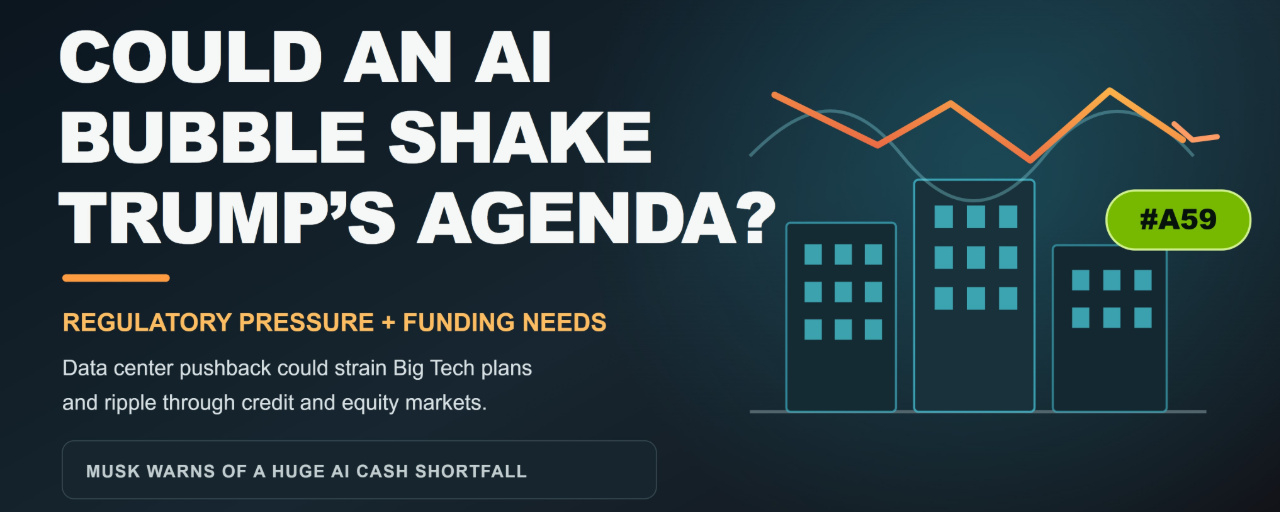
“Could an AI Bubble Collapse Undermine Trump?” Democratic Regulatory Pressure Heightens Uncertai....“Could an AI Bubble Collapse Undermine Trump?” Democratic Regulatory Pressure Heightens Uncertainty Over Big Tech’s AI Investment, Raising Fears of Cascading Financial and Political Crises
sourch ; The Economy by Oliver Griffin
Authored On
Nov 24, 2026 02:44
Modified
Nov 24, 2026 03:25
Elon Musk, CEO of SpaceX $SPCXB and Tesla $TSLAB , has warned that the artificial intelligence (AI) industry could face a massive liquidity shortfall. With the Democrats gaining the upper hand in the U.S. midterm elections and increasing the likelihood of tighter data center regulations, AI companies that have committed to enormous capital expenditures are expected to face even greater funding pressures. Against this backdrop, market observers suggest that an AI bubble collapse could send shock waves across financial markets, including bonds, private credit and equities, and raise questions about the policy responsibility of Donald Trump’s administration, which has pursued a pro-AI agenda.
Musk Warns of Cash Shortages at AI Companies
According to Business Insider on the 22nd (local time), Musk said on X (formerly Twitter) that day, “The cash shortfall (at AI companies) next year will be enormous,” adding, “If delays of several months accumulate between paying for compute and getting it running reliably enough to generate revenue, hundreds of billions of USD in additional funding will be needed.” Major technology companies have recently been rapidly expanding capital expenditures, committing vast sums to AI data centers and advanced semiconductors. Combined capital spending this year by four companies—Amazon, Alphabet, Meta and Microsoft ($MSFTB )—is estimated to exceed USD 700 billion, while SpaceX has also announced plans to invest USD 24 billion in building a data center in Texas.
The problem is that public sentiment toward data center projects in the United States is deteriorating rapidly. Opposition from local residents, in particular, has been growing noticeably stronger. Concerns have intensified that data centers’ enormous electricity demand could drive up household electricity bills and strain local power grids. Water depletion caused by cooling facilities, along with noise and air pollution from cooling equipment and emergency generators, has also emerged as a major source of conflict. Some residents argue that data centers impose excessive environmental and economic burdens relative to the jobs and economic benefits they provide to communities, and have launched campaigns opposing construction and lawsuits seeking to revoke permits. A growing number of local governments have also temporarily halted new data center construction or tightened site-selection and environmental review requirements.
Republicans Blame Pro-AI Policies for Election Defeat
Conflicts over data centers have also emerged as a major issue in U.S. politics. With Democrats gaining the upper hand by taking control of both the Senate and the House in the U.S. midterm elections held on the 3rd, voices within President Trump’s core MAGA (Make America Great Again) support base are criticizing the administration’s overly favorable policies toward the AI industry and Big Tech. Kevin Roberts, president of the conservative Heritage Foundation think tank, identified voters’ distrust of the AI industry as a primary reason for the Republicans’ midterm defeat. He said it had been a political mistake not to listen sufficiently to residents concerned about the industry’s growing influence. In his assessment, Democrats won voters’ support by taking the advantageous position on the data center issue first.
Republican U.S. Representative Chip Roy of Texas also cited the party leadership’s stance toward the AI industry as a reason for the defeat at a Heritage Foundation event. “Voters’ grievances are not limited to data centers’ electricity and water use,” Roy said. “The prospect of AI replacing jobs and technology executives’ unilateral approach to development have fueled residents’ resentment.” Texas, where Roy’s district is located, was among the states where the rapid expansion of AI data centers emerged as a major election issue. Democratic candidate Gina Hinojosa was elected governor.
Democrats Signal Tighter Data Center Regulations
Having secured majorities in both the Senate and the House, Democrats are moving in earnest to tighten regulations on AI data centers. According to a Reuters report on the 6th, Democratic lawmakers plan to introduce a series of bills expanding data center operators’ responsibilities after the new Congress convenes next January. The central aim is to prevent the cost of expanding power grids for large-scale data center construction from being passed on to households and small and medium-sized businesses through their electricity bills. To that end, they intend to require large data center operators to directly cover the costs of new power generation and transmission facilities and grid upgrades, while also expanding disclosure of electricity consumption and related costs.
This push for tighter regulation was also clearly reflected in Democratic candidates’ campaign pledges. For example, Wisconsin Governor-elect David Crowley supported a temporary halt to new data center permits and the elimination of sales tax exemptions for operators. Texas Governor-elect Hinojosa also said she would deny permits for data centers that had not secured sufficient resident consent and community benefits. Ohio Governor-elect Amy Acton likewise pledged to block data center projects that fail to meet certain environmental and business standards, while Georgia Governor-elect Keisha Lance Bottoms proposed a statewide pause on new data center construction.
Table 1. Democratic Governors-Elect’s Data Center Regulation Pledges
WISCONSIN — David Crowley
Temporarily halt new permits and eliminate sales tax exemptions.
TEXAS — Gina Hinojosa
Suspend all permits until protective legislation is in place.
OHIO — Amy Acton
Restrict projects that fail to meet cost, environmental, and community benefit standards.
GEORGIA — Keisha Lance Bottoms
Halt new construction while economic and community impacts are assessed.
Source: Compiled from foreign media reports
Red Flags for AI Companies’ Financial Health
Market participants are concerned that the trend toward tighter data center regulation could place considerable pressure on AI companies’ financial health. If data center construction is delayed or halted, companies may struggle to recover money already spent on land purchases, design and equipment, while revenue from operating the facilities would also be pushed back. Companies that have financed their projects through substantial borrowing, in particular, must continue to pay interest and financing fees during construction delays. Prolonged setbacks could also make it difficult to refinance existing loans or secure additional funding.
The AI infrastructure industry’s heavy reliance on external financing further compounds these risks. Major technology companies and data center developers have recently been increasing their funding through corporate bond issuance, private credit loans and project financing through special-purpose vehicles (SPVs). According to the Financial Stability Report released by the U.S. Federal Reserve (Fed) on the 13th, debt issuance related to advanced computing infrastructure, including bonds and loans, exceeded USD 680 billion from January through October this year. That is roughly 5 times the USD 130 billion issued during all of 2023. As of last month, outstanding related public-market debt also exceeded USD 1.1 trillion.
Financial and Political Risks From the AI Bubble
If the AI bubble collapses, the shock is expected to spread across global financial markets. In its Financial Stability Review released this month, the European Central Bank (ECB) warned that the rapid expansion of debt financing in the AI industry was reminiscent of the dot-com bubble and the subprime mortgage crisis. It explained that a sharp decline in the value of AI-related assets could trigger a chain reaction of investment fund redemptions and forced asset sales, with losses spreading to banks, private credit and bond markets and potentially damaging the real economy. Moreover, with AI investment now a major growth driver for U.S. equities and businesses, a sharp contraction in the industry could directly undermine confidence in the broader U.S. economy.
Political observers also suggest that a crisis in the AI industry could weaken the Trump administration’s position. If an AI industry downturn leads to large financial losses and an economic slowdown, distrust of the economic management capabilities of the administration, which has pursued pro-business and pro-AI policies, would likely grow, intensifying criticism within the Republican Party and deepening Trump’s lame-duck status (the erosion of power toward the end of a term). The responses of major technology executives such as Elon Musk, whose political and economic interests are intertwined with President Trump’s, are also expected to emerge as a variable in this process. If they characterize the AI industry’s contraction as the result of tighter political regulation rather than individual companies’ strategic failures and demand a policy response, the debate surrounding the industry could turn into a blame game between businesses and politicians.
#A59 #news #AI
“Could an AI Bubble Collapse Undermine Trump?” Democratic Regulatory Pressure Heightens Uncertai....
“Could an AI Bubble Collapse Undermine Trump?” Democratic Regulatory Pressure Heightens Uncertainty Over Big Tech’s AI Investment, Raising Fears of Cascading Financial and Political Crises
sourch ; The Economy by Oliver Griffin
Authored On
Nov 24, 2026 02:44
Modified
Nov 24, 2026 03:25
Elon Musk, CEO of SpaceX $SPCXB and Tesla $TSLAB , has warned that the artificial intelligence (AI) industry could face a massive liquidity shortfall. With the Democrats gaining the upper hand in the U.S. midterm elections and increasing the likelihood of tighter data center regulations, AI companies that have committed to enormous capital expenditures are expected to face even greater funding pressures. Against this backdrop, market observers suggest that an AI bubble collapse could send shock waves across financial markets, including bonds, private credit and equities, and raise questions about the policy responsibility of Donald Trump’s administration, which has pursued a pro-AI agenda.
Musk Warns of Cash Shortages at AI Companies
According to Business Insider on the 22nd (local time), Musk said on X (formerly Twitter) that day, “The cash shortfall (at AI companies) next year will be enormous,” adding, “If delays of several months accumulate between paying for compute and getting it running reliably enough to generate revenue, hundreds of billions of USD in additional funding will be needed.” Major technology companies have recently been rapidly expanding capital expenditures, committing vast sums to AI data centers and advanced semiconductors. Combined capital spending this year by four companies—Amazon, Alphabet, Meta and Microsoft ($MSFTB )—is estimated to exceed USD 700 billion, while SpaceX has also announced plans to invest USD 24 billion in building a data center in Texas.
The problem is that public sentiment toward data center projects in the United States is deteriorating rapidly. Opposition from local residents, in particular, has been growing noticeably stronger. Concerns have intensified that data centers’ enormous electricity demand could drive up household electricity bills and strain local power grids. Water depletion caused by cooling facilities, along with noise and air pollution from cooling equipment and emergency generators, has also emerged as a major source of conflict. Some residents argue that data centers impose excessive environmental and economic burdens relative to the jobs and economic benefits they provide to communities, and have launched campaigns opposing construction and lawsuits seeking to revoke permits. A growing number of local governments have also temporarily halted new data center construction or tightened site-selection and environmental review requirements.
Republicans Blame Pro-AI Policies for Election Defeat
Conflicts over data centers have also emerged as a major issue in U.S. politics. With Democrats gaining the upper hand by taking control of both the Senate and the House in the U.S. midterm elections held on the 3rd, voices within President Trump’s core MAGA (Make America Great Again) support base are criticizing the administration’s overly favorable policies toward the AI industry and Big Tech. Kevin Roberts, president of the conservative Heritage Foundation think tank, identified voters’ distrust of the AI industry as a primary reason for the Republicans’ midterm defeat. He said it had been a political mistake not to listen sufficiently to residents concerned about the industry’s growing influence. In his assessment, Democrats won voters’ support by taking the advantageous position on the data center issue first.
Republican U.S. Representative Chip Roy of Texas also cited the party leadership’s stance toward the AI industry as a reason for the defeat at a Heritage Foundation event. “Voters’ grievances are not limited to data centers’ electricity and water use,” Roy said. “The prospect of AI replacing jobs and technology executives’ unilateral approach to development have fueled residents’ resentment.” Texas, where Roy’s district is located, was among the states where the rapid expansion of AI data centers emerged as a major election issue. Democratic candidate Gina Hinojosa was elected governor.
Democrats Signal Tighter Data Center Regulations
Having secured majorities in both the Senate and the House, Democrats are moving in earnest to tighten regulations on AI data centers. According to a Reuters report on the 6th, Democratic lawmakers plan to introduce a series of bills expanding data center operators’ responsibilities after the new Congress convenes next January. The central aim is to prevent the cost of expanding power grids for large-scale data center construction from being passed on to households and small and medium-sized businesses through their electricity bills. To that end, they intend to require large data center operators to directly cover the costs of new power generation and transmission facilities and grid upgrades, while also expanding disclosure of electricity consumption and related costs.
This push for tighter regulation was also clearly reflected in Democratic candidates’ campaign pledges. For example, Wisconsin Governor-elect David Crowley supported a temporary halt to new data center permits and the elimination of sales tax exemptions for operators. Texas Governor-elect Hinojosa also said she would deny permits for data centers that had not secured sufficient resident consent and community benefits. Ohio Governor-elect Amy Acton likewise pledged to block data center projects that fail to meet certain environmental and business standards, while Georgia Governor-elect Keisha Lance Bottoms proposed a statewide pause on new data center construction.
Table 1. Democratic Governors-Elect’s Data Center Regulation Pledges
WISCONSIN — David Crowley
Temporarily halt new permits and eliminate sales tax exemptions.
TEXAS — Gina Hinojosa
Suspend all permits until protective legislation is in place.
OHIO — Amy Acton
Restrict projects that fail to meet cost, environmental, and community benefit standards.
GEORGIA — Keisha Lance Bottoms
Halt new construction while economic and community impacts are assessed.
Source: Compiled from foreign media reports
Red Flags for AI Companies’ Financial Health
Market participants are concerned that the trend toward tighter data center regulation could place considerable pressure on AI companies’ financial health. If data center construction is delayed or halted, companies may struggle to recover money already spent on land purchases, design and equipment, while revenue from operating the facilities would also be pushed back. Companies that have financed their projects through substantial borrowing, in particular, must continue to pay interest and financing fees during construction delays. Prolonged setbacks could also make it difficult to refinance existing loans or secure additional funding.
The AI infrastructure industry’s heavy reliance on external financing further compounds these risks. Major technology companies and data center developers have recently been increasing their funding through corporate bond issuance, private credit loans and project financing through special-purpose vehicles (SPVs). According to the Financial Stability Report released by the U.S. Federal Reserve (Fed) on the 13th, debt issuance related to advanced computing infrastructure, including bonds and loans, exceeded USD 680 billion from January through October this year. That is roughly 5 times the USD 130 billion issued during all of 2023. As of last month, outstanding related public-market debt also exceeded USD 1.1 trillion.
Financial and Political Risks From the AI Bubble
If the AI bubble collapses, the shock is expected to spread across global financial markets. In its Financial Stability Review released this month, the European Central Bank (ECB) warned that the rapid expansion of debt financing in the AI industry was reminiscent of the dot-com bubble and the subprime mortgage crisis. It explained that a sharp decline in the value of AI-related assets could trigger a chain reaction of investment fund redemptions and forced asset sales, with losses spreading to banks, private credit and bond markets and potentially damaging the real economy. Moreover, with AI investment now a major growth driver for U.S. equities and businesses, a sharp contraction in the industry could directly undermine confidence in the broader U.S. economy.
Political observers also suggest that a crisis in the AI industry could weaken the Trump administration’s position. If an AI industry downturn leads to large financial losses and an economic slowdown, distrust of the economic management capabilities of the administration, which has pursued pro-business and pro-AI policies, would likely grow, intensifying criticism within the Republican Party and deepening Trump’s lame-duck status (the erosion of power toward the end of a term). The responses of major technology executives such as Elon Musk, whose political and economic interests are intertwined with President Trump’s, are also expected to emerge as a variable in this process. If they characterize the AI industry’s contraction as the result of tighter political regulation rather than individual companies’ strategic failures and demand a policy response, the debate surrounding the industry could turn into a blame game between businesses and politicians.
#A59 #news #AI
252
·
--
Article
Inside the extraordinary push to get Nvidia CEO back in power with Trump’s supportsourch : james C. Reynolds
Tuesday 24 November 2026 12:50 GMT
Jensen Huang made a triumphant return to Nvidia's California headquarters on Monday, less than two weeks after he resigned as CEO following revelations of extramarital affairs,
including one with an alleged spy for China.
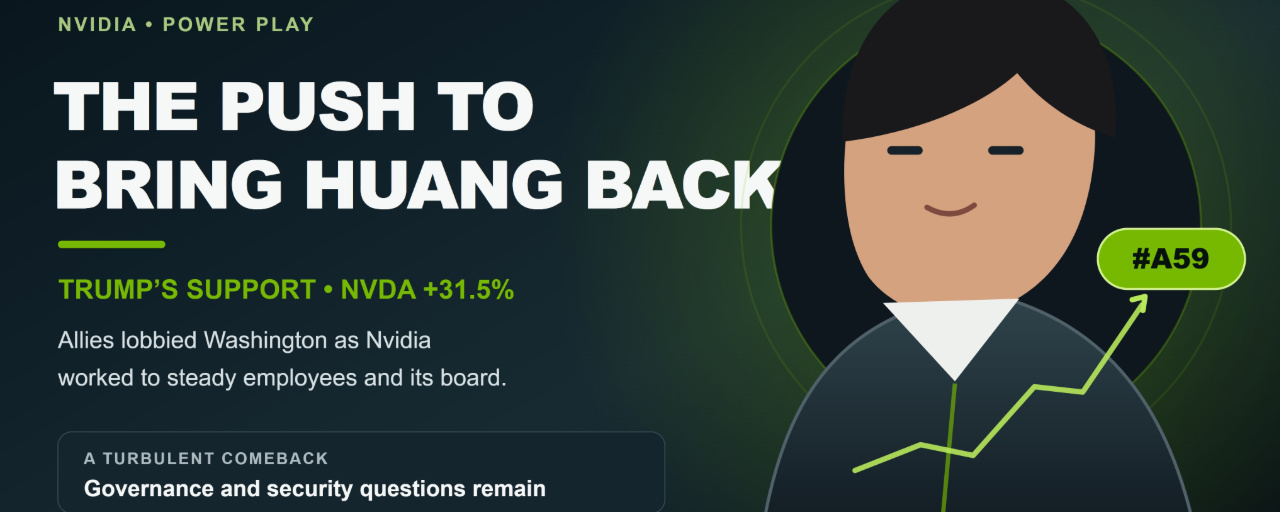
Insiders have revealed that the return was the result of two weeks of desperate lobbying by a small group of loyal allies, who worked to convince the Trump administration that Huang was a vital to the $4 trillion company’s long-term prosperity.
The firm, which had been thrown into chaos by Huang’s departure, meanwhile fought to keep employees on side, bringing forward pay rises and blaring Tom Petty’s “I Won’t Back Down” to anxious staff bracing through the turbulence.
It was US president Donald trump that finally broke the tension this week, announcing the return of the “Great Patriot and National Treasure” Huang after piling pressure onto the board of executives to “exonerate” him.
The 63-year-old Huang, clad in his trademark black leather jacket, was welcomed back to the fore by doting employees in California as he apologised: “I’ve made some very terrible mistakes, and I’m going to work on coming back.”
Nvidia shares surged 31.5% as the market opened on Monday, adding around $950bn to the company’s value and reportedly making Trump up to $15m (£11.5m) on his holdings.
Huang’s ‘war room’ in Silicon Valley
Huang’s surprise return to the role capped a turbulent fortnight for the world’s second largest company.
People familiar with the backroom conversations told the Financial Times that Trump and his vice president JD Vance were both personally involved in the rescue mission, urged on by a ‘war room’ of Huang’s allies in Silicon Valley.
Supporters were said to include Uber founder Travis Kalanick, Goldman Sachs executive John Underwood, and venture capitalists Gavin Baker, Brad Gerstner and Marc Andreessen.
They argued that Huang, who founded Nvidia in 1993, was vital to the success of the company, which in turn is essential to the health of America’s wider AI industry that has powered the US stock market.
Huang announced he would step down on Thursday, 12 November following the bombshell revelations that he had had an affair with Alice Huang, a businesswoman accused of being a Chinese spy.
US intelligence officials believe Alice Huang, the former boss of Singaporean cloud computing firm Megaspeed, was funnelling information to China as she courted Nvidia’s CEO.
Authorities had been investigating Megaspeed since late 2025 over suspicions that it was helping to divert advanced AI chips to Beijing.
And earlier this month, Nvidia’s own board launched a probe into whether Jensen had been targeted by a foreign intelligence operation. It expressed confidence in him at the time, but reports of the alleged affair with Alice piled on pressure.
Huang finally gave in to the pressure but allies were quick to rally around him, making the case in public and in private for him to be reinstated, insiders told the FT.
Nvidia executives ‘tried to boost morale’
The top executive team met last Wednesday, 18 November for an ‘all hands’ meeting to boost morale and address concerns as Nvidia’s market value lost around $500bn.
The firm unveiled plans to bring forward pay increases to December, instead of the spring, and raised spirits by playing Tom Petty’s “I Won’t Back Down” as employees waved torches on their phones, the newspaper reported.
Those close to Huang meanwhile began lobbying their contacts in Washington, insisting on his importance to the firm, reports said.
Huang is known for his hands-on management style and overseeing some 60 direct reports, nearly all in engineering roles, including experts in memory chips, networking and graphics and central processors.
But critics have suggested such an approach left Nvidia with a dysfunctional management structure, that made it more difficult for the firm to function without Huang at its core.
He has dug deep into the startups Nvidia has invested in, helping them secure customers and has even joined fundraising calls to attract investors, according to startup founders, venture capitalists and a former Nvidia employee.
Behind the scenes, an ally had managed to secure a call between Huang and Vance, during which the ousted Nvidia boss explained his dealings with Megaspeed and talked out his positions on semiconductor export controls.
Vance and Trump ‘decided Huang was not national security risk’
It was then up to Vance and Trump to convince the Nvidia board that Huang’s affair with Alice Huang did not make him a national security risk to the United States.
Treasury Secretary Scott Bessent walked back criticism on Sunday and said he would not oppose Jensen’s return to Nvidia, a week after calling on the board to implement a “dramatic shake-up” and look elsewhere for a new leader.
The intervention seemingly worked, as Huang was returned to his post on Monday. Trump said he had played a key role in the decision and insisted: “He did nothing wrong.”
In a lengthy post on Truth Social, Trump said the board had made the “correct and proper decision to return Jensen Huang to the position of CEO”.
“The Country needs Jensen’s leadership at NVIDIA in order to ensure the Success and Prosperity of not only the Company, but the American Economy,” he said, adding: “The United States Government has no reason to believe that Jensen’s return to NVIDIA poses any risk to National Security.”
Nvidia’s board, which only last week said it did not plan to reinstate him, finally conceded that “Jensen is the right person to lead” the firm, after receiving “input from senior levels of the US government”.
Trump went on to share the famous picture of himself with a fist raised after the July 2024 assassination attempt in Butler, edited to show a bloodied Huang raising a bra in front of a Nvidia flag.
Despite the certainty with which the US government was willing to pardon Huang, the US Commerce Department added Megaspeed to its trade blacklist on Monday.
And both Democratic and Republican lawmakers were furious that Huang had been “exonerated”, even after the US attorney general’s office concluded a “thorough” investigation into his conduct, according to Trump.
Huang made his triumphant return to the Santa Clara office on Monday.
“This is my first day of work. I don’t have a computer, so the IT department is going to give me a new PC,” he joked, before adopting a more serious tone and apologising to staff for putting “all of you through all of this”.
$NVDAB
{spot}(NVDABUSDT)
#A59 #news #NVDIA #NVDASoarsOnJensenReturn
Inside the extraordinary push to get Nvidia CEO back in power with Trump’s support
sourch : james C. Reynolds
Tuesday 24 November 2026 12:50 GMT
Jensen Huang made a triumphant return to Nvidia's California headquarters on Monday, less than two weeks after he resigned as CEO following revelations of extramarital affairs,
including one with an alleged spy for China.
Insiders have revealed that the return was the result of two weeks of desperate lobbying by a small group of loyal allies, who worked to convince the Trump administration that Huang was a vital to the $4 trillion company’s long-term prosperity.
The firm, which had been thrown into chaos by Huang’s departure, meanwhile fought to keep employees on side, bringing forward pay rises and blaring Tom Petty’s “I Won’t Back Down” to anxious staff bracing through the turbulence.
It was US president Donald trump that finally broke the tension this week, announcing the return of the “Great Patriot and National Treasure” Huang after piling pressure onto the board of executives to “exonerate” him.
The 63-year-old Huang, clad in his trademark black leather jacket, was welcomed back to the fore by doting employees in California as he apologised: “I’ve made some very terrible mistakes, and I’m going to work on coming back.”
Nvidia shares surged 31.5% as the market opened on Monday, adding around $950bn to the company’s value and reportedly making Trump up to $15m (£11.5m) on his holdings.
Huang’s ‘war room’ in Silicon Valley
Huang’s surprise return to the role capped a turbulent fortnight for the world’s second largest company.
People familiar with the backroom conversations told the Financial Times that Trump and his vice president JD Vance were both personally involved in the rescue mission, urged on by a ‘war room’ of Huang’s allies in Silicon Valley.
Supporters were said to include Uber founder Travis Kalanick, Goldman Sachs executive John Underwood, and venture capitalists Gavin Baker, Brad Gerstner and Marc Andreessen.
They argued that Huang, who founded Nvidia in 1993, was vital to the success of the company, which in turn is essential to the health of America’s wider AI industry that has powered the US stock market.
Huang announced he would step down on Thursday, 12 November following the bombshell revelations that he had had an affair with Alice Huang, a businesswoman accused of being a Chinese spy.
US intelligence officials believe Alice Huang, the former boss of Singaporean cloud computing firm Megaspeed, was funnelling information to China as she courted Nvidia’s CEO.
Authorities had been investigating Megaspeed since late 2025 over suspicions that it was helping to divert advanced AI chips to Beijing.
And earlier this month, Nvidia’s own board launched a probe into whether Jensen had been targeted by a foreign intelligence operation. It expressed confidence in him at the time, but reports of the alleged affair with Alice piled on pressure.
Huang finally gave in to the pressure but allies were quick to rally around him, making the case in public and in private for him to be reinstated, insiders told the FT.
Nvidia executives ‘tried to boost morale’
The top executive team met last Wednesday, 18 November for an ‘all hands’ meeting to boost morale and address concerns as Nvidia’s market value lost around $500bn.
The firm unveiled plans to bring forward pay increases to December, instead of the spring, and raised spirits by playing Tom Petty’s “I Won’t Back Down” as employees waved torches on their phones, the newspaper reported.
Those close to Huang meanwhile began lobbying their contacts in Washington, insisting on his importance to the firm, reports said.
Huang is known for his hands-on management style and overseeing some 60 direct reports, nearly all in engineering roles, including experts in memory chips, networking and graphics and central processors.
But critics have suggested such an approach left Nvidia with a dysfunctional management structure, that made it more difficult for the firm to function without Huang at its core.
He has dug deep into the startups Nvidia has invested in, helping them secure customers and has even joined fundraising calls to attract investors, according to startup founders, venture capitalists and a former Nvidia employee.
Behind the scenes, an ally had managed to secure a call between Huang and Vance, during which the ousted Nvidia boss explained his dealings with Megaspeed and talked out his positions on semiconductor export controls.
Vance and Trump ‘decided Huang was not national security risk’
It was then up to Vance and Trump to convince the Nvidia board that Huang’s affair with Alice Huang did not make him a national security risk to the United States.
Treasury Secretary Scott Bessent walked back criticism on Sunday and said he would not oppose Jensen’s return to Nvidia, a week after calling on the board to implement a “dramatic shake-up” and look elsewhere for a new leader.
The intervention seemingly worked, as Huang was returned to his post on Monday. Trump said he had played a key role in the decision and insisted: “He did nothing wrong.”
In a lengthy post on Truth Social, Trump said the board had made the “correct and proper decision to return Jensen Huang to the position of CEO”.
“The Country needs Jensen’s leadership at NVIDIA in order to ensure the Success and Prosperity of not only the Company, but the American Economy,” he said, adding: “The United States Government has no reason to believe that Jensen’s return to NVIDIA poses any risk to National Security.”
Nvidia’s board, which only last week said it did not plan to reinstate him, finally conceded that “Jensen is the right person to lead” the firm, after receiving “input from senior levels of the US government”.
Trump went on to share the famous picture of himself with a fist raised after the July 2024 assassination attempt in Butler, edited to show a bloodied Huang raising a bra in front of a Nvidia flag.
Despite the certainty with which the US government was willing to pardon Huang, the US Commerce Department added Megaspeed to its trade blacklist on Monday.
And both Democratic and Republican lawmakers were furious that Huang had been “exonerated”, even after the US attorney general’s office concluded a “thorough” investigation into his conduct, according to Trump.
Huang made his triumphant return to the Santa Clara office on Monday.
“This is my first day of work. I don’t have a computer, so the IT department is going to give me a new PC,” he joked, before adopting a more serious tone and apologising to staff for putting “all of you through all of this”.
$NVDAB
#A59 #news #NVDIA #NVDASoarsOnJensenReturn
115
·
--
Article
Bitcoin falls below $60,000 as rally on Jensen Huang’s Nvidia return fadesCoindesk , Nov 24, 2026, 5:08 a.m. EST
$BTC
{spot}(BTCUSDT)
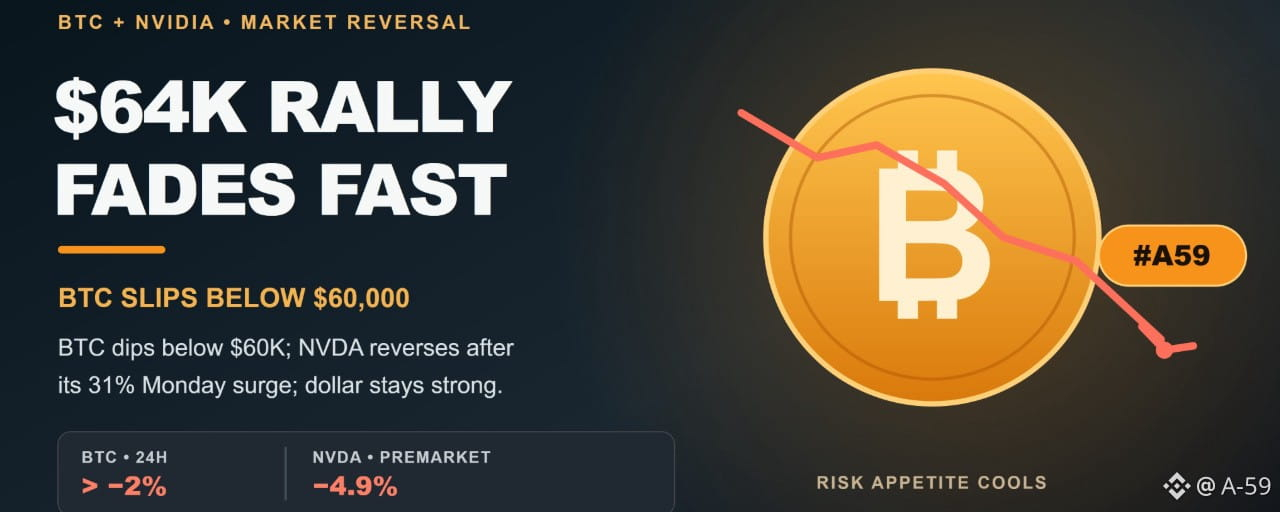
$60.072.46 fell below $60,000 on Tuesday, giving back most of a rally that took it close to $64,000 after
Jensen Huang returned as CEO of Nvidia $NVDAB
{spot}(NVDABUSDT)
$164.072 market closed.
The largest cryptocurrency by market capitalization fell more than 2% over 24 hours as the surge in AI stocks that lifted broader markets on Monday began to unwind.
Nvidia rose as much as 31% on Monday after the company reinstated Huang, and the Nasdaq 100 index rose 7%. By Tuesday, Nasdaq 100 futures were down about 1% and Nvidia was 4.9% lower before U.S. markets opened.
AI infrastructure stocks Cipher Digital $CIFR.US
{stock_us}(CIFR.US)
$6.2000 market closed, CoreWeave (CRWV) and TeraWulf $WULF $10.91 market closed all posted double-digit gains on Monday and were down roughly 3% to 4% in premarket trading.
Anthropic ANT $87.66 market closed fell 4%, extending Monday’s 2% decline even as most AI stocks rallied. They were recently priced around $84, just above their $83 initial public offering value.
Gold also gave back part of Monday’s gains, retreating to $3,622 an ounce after reaching $3,690. The U.S. Dollar Index (DXY) held firmly above 104, its highest level since March 2025. The stronger dollar added pressure on risk assets as the previous session’s gains faded.
Oil prices dropped, with West Texas Intermediate crude trading near $80 a barrel and Brent crude slipping below $87 a barrel.
#A59 #Bitcoin'sReboundFadesBelow$60K #AnthropicFallsBelow$83IPOPricePremarket #NVDASoarsOnJensenReturn #WillMarketsStageAThanksgivingReliefRally?
Bitcoin falls below $60,000 as rally on Jensen Huang’s Nvidia return fades
Coindesk , Nov 24, 2026, 5:08 a.m. EST
$BTC
$60.072.46 fell below $60,000 on Tuesday, giving back most of a rally that took it close to $64,000 after
Jensen Huang returned as CEO of Nvidia $NVDAB
$164.072 market closed.
The largest cryptocurrency by market capitalization fell more than 2% over 24 hours as the surge in AI stocks that lifted broader markets on Monday began to unwind.
Nvidia rose as much as 31% on Monday after the company reinstated Huang, and the Nasdaq 100 index rose 7%. By Tuesday, Nasdaq 100 futures were down about 1% and Nvidia was 4.9% lower before U.S. markets opened.
AI infrastructure stocks Cipher Digital $CIFR.US
$6.2000 market closed, CoreWeave (CRWV) and TeraWulf $WULF $10.91 market closed all posted double-digit gains on Monday and were down roughly 3% to 4% in premarket trading.
Anthropic ANT $87.66 market closed fell 4%, extending Monday’s 2% decline even as most AI stocks rallied. They were recently priced around $84, just above their $83 initial public offering value.
Gold also gave back part of Monday’s gains, retreating to $3,622 an ounce after reaching $3,690. The U.S. Dollar Index (DXY) held firmly above 104, its highest level since March 2025. The stronger dollar added pressure on risk assets as the previous session’s gains faded.
Oil prices dropped, with West Texas Intermediate crude trading near $80 a barrel and Brent crude slipping below $87 a barrel.
#A59 #Bitcoin'sReboundFadesBelow$60K #AnthropicFallsBelow$83IPOPricePremarket #NVDASoarsOnJensenReturn #WillMarketsStageAThanksgivingReliefRally?
89
·
--
Article
Nvidia Could Generate $741 Billion in Revenue Next Year. Here’s What That Means for the Stock.By Adam Levy – Nov 24, 2026 at 4:55AM EST
Nvidia's ($NVDAB
{spot}(NVDABUSDT)
+31.48%) earnings report last week, without Jensen Huang leading the company, went better than expected. Revenue climbed 103% year over year to $115.8 billion, and earnings per share climbed to $2.70, up 108%. Both came in above analysts' expectations.
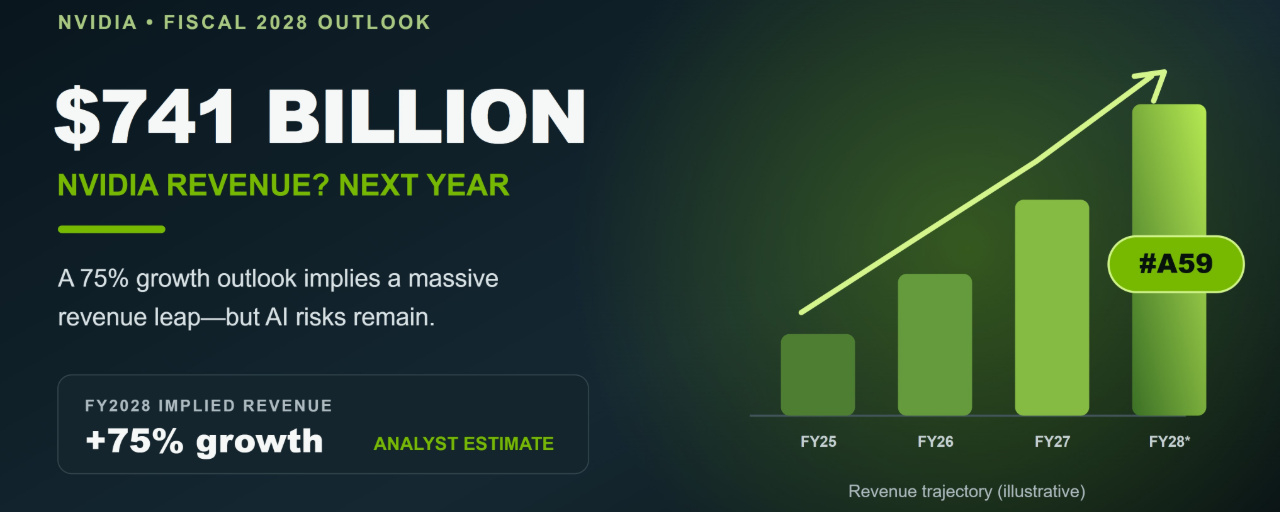
Perhaps more important was CFO and interim CEO Colette Kress's fiscal 2028 guidance. Last quarter she said she expects 70% revenue growth. This quarter, she increased it to 75%. That's despite higher-than-expected revenue growth last quarter and strong fourth-quarter guidance.
Her fourth-quarter guidance calls for $130 billion in revenue, bringing fiscal 2027 total revenue to $423.7 billion. A 75% growth rate implies $741 billion in revenue next year. Here's what that means for the stock.
Nvidia stock is incredibly cheap right now
With the recent sell-off in shares, the company has a market cap of about $4 trillion as of this writing. That means the stock is priced just over 5 times next year's sales. Its stock price has dropped to 10 times analysts' expectations for next year's earnings.
There are a few reasons why a stock would be so cheap.
The market may be indicating that the analysts are overconfident in the business and their estimates are too high. Kress's increased 2028 outlook decreases that likelihood, although it's possible Kress is overconfident as well.
The market may be indicating that the earnings aren't sustainable and an earnings downcycle will hit extremely hard in the not-too-distant future. But Nvidia is an asset-light, fabless semiconductor stock, so while earnings might drop and its margin might contract, it doesn't face the same cyclical pressure as semiconductor stocks with huge capital investment requirements.
The market believes the risks to the company are extremely high, requiring a larger margin of safety to buy the stock. With growing uncertainty about the future of artificial intelligence stocks, this is the clear reason for Nvidia's current stock price.
Kress looked to put investors at ease during the earnings call. She said her 75% revenue growth outlook is based on "data center readiness, the strength and durability of end customer demand, and our customers' access to capital." She noted the $32 billion in financial commitments to neocloud companies require those partners to secure their own capital for data centers first. She stressed that Nvidia has a multi-year roadmap in place and it's "business as usual."
Is it time to buy shares of Nvidia?
While Nvidia shares look incredibly cheap right now, there's a lot of uncertainty about the business. While Huang has been reinstated as CEO, investors need to know whether he knowingly or unknowingly sold chips that ultimately landed in China, and what percentage of Nvidia's sales they accounted for. There could be legal repercussions as well, in the form of fines and further sales restrictions, which would impact Nvidia's bottom line.
Nvidia is also increasingly reliant on neocloud companies continuing to build quickly, a trend that faces both regulatory and credit risks. While Nvidia's GPUs remain best-in-class and can remain so even without Huang, the risk is that hyperscalers and leading AI labs will run more of their software on custom silicon instead of GPUs.
To be sure, the market appears to be pricing in the risks to Nvidia at the current price. But there are other AI stocks that have been caught up in the broader AI sell-off and look like great opportunities with less uncertainty. For now, a wait-and-see approach may be most prudent for Nvidia stock.
Should you buy stock in Nvidia right now
Before you buy stock in Nvidia, consider this:
The Motley Fool Stock Advisor analyst team just identified what they believe are the 10 best stocks for investors to buy now… and Nvidia wasn’t one of them. The 10 stocks that made the cut could produce monster returns in the coming years.
Consider when Netflix made this list on December 17, 2004... if you invested $1,000 at the time of our recommendation, you’d have $305,941!* Or when Nvidia made this list on April 15, 2005... if you invested $1,000 at the time of our recommendation, you’d have $771,325!*
Now, it’s worth noting Stock Advisor’s total average return is 719% — a market-crushing outperformance compared to 192% for the S&P 500. Don't miss the latest top 10 list, available with Stock Advisor, and join an investing community built by individual investors for individual investors.
#A59 #news #NVDASoarsOnJensenReturn #NVIDIAReinstatesJensenHuangasCEO #stockmarketnews
Nvidia Could Generate $741 Billion in Revenue Next Year. Here’s What That Means for the Stock.
By Adam Levy – Nov 24, 2026 at 4:55AM EST
Nvidia's ($NVDAB
+31.48%) earnings report last week, without Jensen Huang leading the company, went better than expected. Revenue climbed 103% year over year to $115.8 billion, and earnings per share climbed to $2.70, up 108%. Both came in above analysts' expectations.
Perhaps more important was CFO and interim CEO Colette Kress's fiscal 2028 guidance. Last quarter she said she expects 70% revenue growth. This quarter, she increased it to 75%. That's despite higher-than-expected revenue growth last quarter and strong fourth-quarter guidance.
Her fourth-quarter guidance calls for $130 billion in revenue, bringing fiscal 2027 total revenue to $423.7 billion. A 75% growth rate implies $741 billion in revenue next year. Here's what that means for the stock.
Nvidia stock is incredibly cheap right now
With the recent sell-off in shares, the company has a market cap of about $4 trillion as of this writing. That means the stock is priced just over 5 times next year's sales. Its stock price has dropped to 10 times analysts' expectations for next year's earnings.
There are a few reasons why a stock would be so cheap.
The market may be indicating that the analysts are overconfident in the business and their estimates are too high. Kress's increased 2028 outlook decreases that likelihood, although it's possible Kress is overconfident as well.
The market may be indicating that the earnings aren't sustainable and an earnings downcycle will hit extremely hard in the not-too-distant future. But Nvidia is an asset-light, fabless semiconductor stock, so while earnings might drop and its margin might contract, it doesn't face the same cyclical pressure as semiconductor stocks with huge capital investment requirements.
The market believes the risks to the company are extremely high, requiring a larger margin of safety to buy the stock. With growing uncertainty about the future of artificial intelligence stocks, this is the clear reason for Nvidia's current stock price.
Kress looked to put investors at ease during the earnings call. She said her 75% revenue growth outlook is based on "data center readiness, the strength and durability of end customer demand, and our customers' access to capital." She noted the $32 billion in financial commitments to neocloud companies require those partners to secure their own capital for data centers first. She stressed that Nvidia has a multi-year roadmap in place and it's "business as usual."
Is it time to buy shares of Nvidia?
While Nvidia shares look incredibly cheap right now, there's a lot of uncertainty about the business. While Huang has been reinstated as CEO, investors need to know whether he knowingly or unknowingly sold chips that ultimately landed in China, and what percentage of Nvidia's sales they accounted for. There could be legal repercussions as well, in the form of fines and further sales restrictions, which would impact Nvidia's bottom line.
Nvidia is also increasingly reliant on neocloud companies continuing to build quickly, a trend that faces both regulatory and credit risks. While Nvidia's GPUs remain best-in-class and can remain so even without Huang, the risk is that hyperscalers and leading AI labs will run more of their software on custom silicon instead of GPUs.
To be sure, the market appears to be pricing in the risks to Nvidia at the current price. But there are other AI stocks that have been caught up in the broader AI sell-off and look like great opportunities with less uncertainty. For now, a wait-and-see approach may be most prudent for Nvidia stock.
Should you buy stock in Nvidia right now
Before you buy stock in Nvidia, consider this:
The Motley Fool Stock Advisor analyst team just identified what they believe are the 10 best stocks for investors to buy now… and Nvidia wasn’t one of them. The 10 stocks that made the cut could produce monster returns in the coming years.
Consider when Netflix made this list on December 17, 2004... if you invested $1,000 at the time of our recommendation, you’d have $305,941!* Or when Nvidia made this list on April 15, 2005... if you invested $1,000 at the time of our recommendation, you’d have $771,325!*
Now, it’s worth noting Stock Advisor’s total average return is 719% — a market-crushing outperformance compared to 192% for the S&P 500. Don't miss the latest top 10 list, available with Stock Advisor, and join an investing community built by individual investors for individual investors.
#A59 #news #NVDASoarsOnJensenReturn #NVIDIAReinstatesJensenHuangasCEO #stockmarketnews
90
·
--
Article
Why 1 Billionaire Investor Just Poured $3 Billion Into Amazon, Meta, and AlphabetBy Geoffrey Seiler – Nov 24, 2026 at 5:15AM EST
Billionaire Stephen Mandel's Lone Pine Capital fund was busy loading up on shares of Amazon ($AMZNB
{spot}(AMZNBUSDT)
+3.47%), Meta Platforms ($METAB
{spot}(METABUSDT)
+6.55%), and Alphabet ($GOOGLB
{spot}(GOOGLBUSDT)
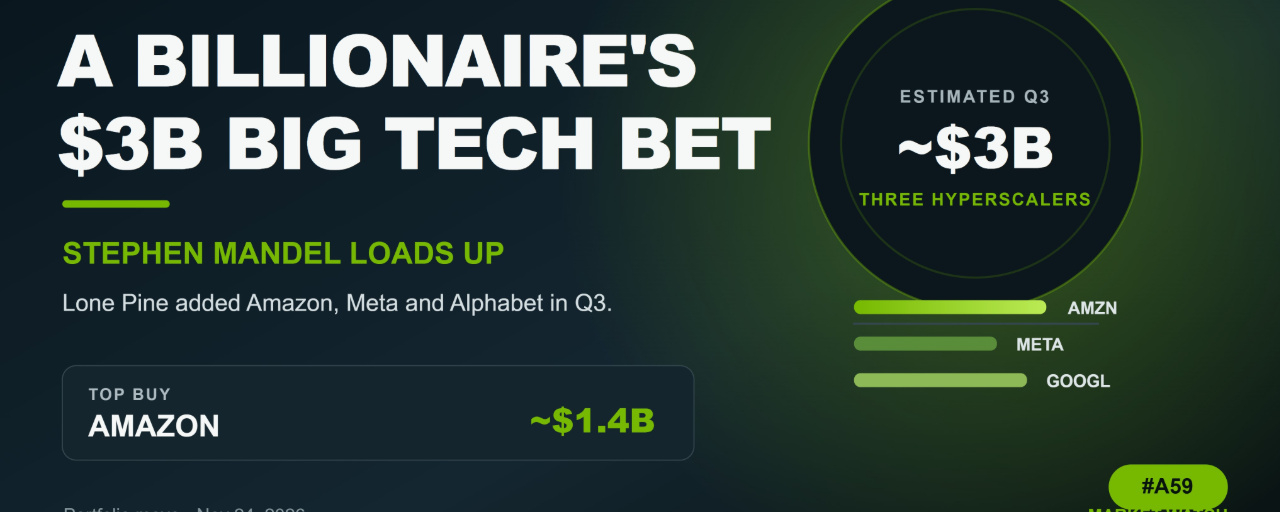
+6.34%) ($GOOG +5.88%) in the third quarter, investing an estimated nearly $3 billion in the trio of hyperscalers. All three are now top-10 positions.
Amazon $AMZN
Amazon was Lone Pine's biggest purchase in Q3, with the fund pouring an estimated $1.4 billion into the e-commerce and cloud computing leader to establish a new position and make it its largest holding at over 9% of its portfolio. It's easy to see what Lone Pine may like about Amazon, with both its core businesses firing on all cylinders.
Amazon's cloud computing unit, AWS (Amazon Web Services), is its main driver, with revenue accelerating as the company aggressively builds out its AI infrastructure. The company is getting strong returns on its investments, locking in five-year or longer contracts and recouping its investment within two to three years. As it grows its AI accelerator business, I think its payback period could shrink, and demand for its chips is so high that it plans to begin selling them externally late next year. Overall, Amazon sees the potential for AWS to grow into a $1 trillion revenue business.
Meanwhile, often overlooked is how strongly Amazon's e-commerce business has been performing. The company is the world’s leading manufacturer and operator of mobile robotics. Combined with its investments in AI, this is driving incredible operating efficiency and surging profitability in this business.
Meta Platforms $META
Lone Pine was also aggressively buying Meta shares in the quarter, with the new position becoming the fund's third-largest holding.
Meta has demonstrated that it has one of the best AI flywheel businesses, with investments in algorithm improvements that lead to users being fed more relevant content and ads. This, in turn, has been boosting ad loads and increasing conversions and ad prices, driving strong revenue growth.
Meanwhile, Meta is not sitting still. The introduction of its AI Muse agents puts it in a strong position to take a leadership role in the emerging consumer AI agent market. While Meta's AI Muse agents can perform many tasks for users, Meta benefits the most when they facilitate transactions on users' behalf, as it will receive either affiliate or transaction fees. This will give Meta a whole new non-advertising revenue stream and position the company as a major player in e-commerce. Just the ability to monetize its Facebook Marketplace with these agents should be a nice growth driver.
Alphabet
Lone Pine significantly increased its Alphabet position in Q3, making Alphabet its seventh-largest holding. As the company with the most complete AI stack, Alphabet is a popular holding among many large hedge funds.
Alphabet's biggest edge is the ecosystem it builds around its Tensor Processing Units (TPUs), making its computing platform a strong alternative to Nvidia ( $NVDA +31.48%). This has given it a large cost advantage in developing and running inference on its own AI models, as well as in cloud computing, where it can get a payback within a year when using its own chips. Semianalysis recently reported that TPUs have shown a price-to-performance edge over Nvidia's GPUs. This comes at a great time as Alphabet also begins selling these chips externally to customers.
Alphabet's core search business, meanwhile, continues to see growth driven by increased usage of its AI-powered tools, including AI Overviews and AI Mode. While search is still in a bit of a transition with AI, it should benefit as Alphabet creates new ad formats. Meanwhile, its ownership of Chrome and Android, and a revenue-sharing deal with Apple ( $AAPL +1.90%) , still give it a huge distribution advantage.
Should you buy stock in Amazon right now
Before you buy stock in Amazon, consider this:
The Motley Fool Stock Advisor analyst team just identified what they believe are the 10 best stocks for investors to buy now… and Amazon wasn’t one of them. The 10 stocks that made the cut could produce monster returns in the coming years.
Consider when Netflix made this list on December 17, 2004... if you invested $1,000 at the time of our recommendation, you’d have $305,941!* Or when Nvidia made this list on April 15, 2005... if you invested $1,000 at the time of our recommendation, you’d have $771,325!*
Now, it’s worth noting Stock Advisor’s total average return is 719% — a market-crushing outperformance compared to 192% for the S&P 500. Don't miss the latest top 10 list, available with Stock Advisor, and join an investing community built by individual investors for individual investors.
#A59 #news #stockmarketnews
Why 1 Billionaire Investor Just Poured $3 Billion Into Amazon, Meta, and Alphabet
By Geoffrey Seiler – Nov 24, 2026 at 5:15AM EST
Billionaire Stephen Mandel's Lone Pine Capital fund was busy loading up on shares of Amazon ($AMZNB
+3.47%), Meta Platforms ($METAB
+6.55%), and Alphabet ($GOOGLB
+6.34%) ($GOOG +5.88%) in the third quarter, investing an estimated nearly $3 billion in the trio of hyperscalers. All three are now top-10 positions.
Amazon $AMZN
Amazon was Lone Pine's biggest purchase in Q3, with the fund pouring an estimated $1.4 billion into the e-commerce and cloud computing leader to establish a new position and make it its largest holding at over 9% of its portfolio. It's easy to see what Lone Pine may like about Amazon, with both its core businesses firing on all cylinders.
Amazon's cloud computing unit, AWS (Amazon Web Services), is its main driver, with revenue accelerating as the company aggressively builds out its AI infrastructure. The company is getting strong returns on its investments, locking in five-year or longer contracts and recouping its investment within two to three years. As it grows its AI accelerator business, I think its payback period could shrink, and demand for its chips is so high that it plans to begin selling them externally late next year. Overall, Amazon sees the potential for AWS to grow into a $1 trillion revenue business.
Meanwhile, often overlooked is how strongly Amazon's e-commerce business has been performing. The company is the world’s leading manufacturer and operator of mobile robotics. Combined with its investments in AI, this is driving incredible operating efficiency and surging profitability in this business.
Meta Platforms $META
Lone Pine was also aggressively buying Meta shares in the quarter, with the new position becoming the fund's third-largest holding.
Meta has demonstrated that it has one of the best AI flywheel businesses, with investments in algorithm improvements that lead to users being fed more relevant content and ads. This, in turn, has been boosting ad loads and increasing conversions and ad prices, driving strong revenue growth.
Meanwhile, Meta is not sitting still. The introduction of its AI Muse agents puts it in a strong position to take a leadership role in the emerging consumer AI agent market. While Meta's AI Muse agents can perform many tasks for users, Meta benefits the most when they facilitate transactions on users' behalf, as it will receive either affiliate or transaction fees. This will give Meta a whole new non-advertising revenue stream and position the company as a major player in e-commerce. Just the ability to monetize its Facebook Marketplace with these agents should be a nice growth driver.
Alphabet
Lone Pine significantly increased its Alphabet position in Q3, making Alphabet its seventh-largest holding. As the company with the most complete AI stack, Alphabet is a popular holding among many large hedge funds.
Alphabet's biggest edge is the ecosystem it builds around its Tensor Processing Units (TPUs), making its computing platform a strong alternative to Nvidia ( $NVDA +31.48%). This has given it a large cost advantage in developing and running inference on its own AI models, as well as in cloud computing, where it can get a payback within a year when using its own chips. Semianalysis recently reported that TPUs have shown a price-to-performance edge over Nvidia's GPUs. This comes at a great time as Alphabet also begins selling these chips externally to customers.
Alphabet's core search business, meanwhile, continues to see growth driven by increased usage of its AI-powered tools, including AI Overviews and AI Mode. While search is still in a bit of a transition with AI, it should benefit as Alphabet creates new ad formats. Meanwhile, its ownership of Chrome and Android, and a revenue-sharing deal with Apple ( $AAPL +1.90%) , still give it a huge distribution advantage.
Should you buy stock in Amazon right now
Before you buy stock in Amazon, consider this:
The Motley Fool Stock Advisor analyst team just identified what they believe are the 10 best stocks for investors to buy now… and Amazon wasn’t one of them. The 10 stocks that made the cut could produce monster returns in the coming years.
Consider when Netflix made this list on December 17, 2004... if you invested $1,000 at the time of our recommendation, you’d have $305,941!* Or when Nvidia made this list on April 15, 2005... if you invested $1,000 at the time of our recommendation, you’d have $771,325!*
Now, it’s worth noting Stock Advisor’s total average return is 719% — a market-crushing outperformance compared to 192% for the S&P 500. Don't miss the latest top 10 list, available with Stock Advisor, and join an investing community built by individual investors for individual investors.
#A59 #news #stockmarketnews
71
·
--

Article
TRENDING : 'I Made the Deal': Trump Takes Credit for Jensen Huang's NVIDIA Return....'I Made the Deal': Trump Takes Credit for Jensen Huang's NVIDIA $NVDAB
{spot}(NVDABUSDT)
Return as National Security Probe Continues
Donald Trump claims he secured Jensen Huang's return as NVIDIA CEO despite an ongoing foreign intelligence investigation and divided employee reactions
By Maybelyn B. Paden
Published 24 November 2026, 9:43 AM GMT
Donald Trump says he personally helped secure Jensen Huang's return as NVIDIA chief executive, while the chipmaker continues investigating reports that the billionaire was targeted by a foreign intelligence operation. The president made the claim on Monday, 23 November, following the board's decision to reinstate Huang.
Huang's departure was announced on 12 November, following reports of extramarital relationships involving a Chinese businesswoman and NVIDIA employees. His return reverses the board's position less than a week after its chair indicated that Huang would not be reinstated.
Speaking during a telephone interview with CNBC's Eamon Javers, Trump said he had helped persuade NVIDIA's directors to change their position.
'I made the deal,' Trump said.
The president acknowledged that directors had sought assurances about national security concerns before agreeing to Huang's return. The board's decision came as the company continued its inquiry into reports concerning the chief executive.
Jensen Huang's Return Follows Trump's Intervention
NVIDIA announced on Monday that its board had unanimously approved Huang's reinstatement as president, chief executive and board member, following discussions with the company's co-founder.
The board said it had received 'input from senior levels of the United States government' before reaching its decision. It said it was confident Huang's reinstatement presented no national security risk.
Board chair Harvey C. Jones said the decision served the interests of shareholders, employees and business partners. Jones will remain chair, while former interim chief executive Colette Kress will continue as chief financial officer.
During NVIDIA's quarterly earnings call on 17 November, Jones had indicated that the board did not intend to reinstate Huang. The board's announcement on Monday therefore marked a change from the position he had outlined publicly.
The decision does not resolve the questions surrounding the reported foreign intelligence operation. NVIDIA confirmed that an independent committee, assisted by external legal counsel, would continue examining reports that Huang had been targeted.
The New York Times and Financial Times previously reported that US intelligence officials suspected the Chinese businesswoman allegedly involved with Huang had connections to Chinese intelligence. The reliability of those assessments has since been questioned, while Beijing has rejected allegations that the woman was a Chinese spy.
The allegations do not establish that Huang knowingly assisted a foreign intelligence service or compromised US national security. NVIDIA has not publicly disclosed the committee's findings, and its inquiry remains under way.
#NVDASoarsOnJensenReturn #NVIDIAReinstatesJensenHuangasCEO
#A59 #news
TRENDING : 'I Made the Deal': Trump Takes Credit for Jensen Huang's NVIDIA Return....
'I Made the Deal': Trump Takes Credit for Jensen Huang's NVIDIA $NVDAB
Return as National Security Probe Continues
Donald Trump claims he secured Jensen Huang's return as NVIDIA CEO despite an ongoing foreign intelligence investigation and divided employee reactions
By Maybelyn B. Paden
Published 24 November 2026, 9:43 AM GMT
Donald Trump says he personally helped secure Jensen Huang's return as NVIDIA chief executive, while the chipmaker continues investigating reports that the billionaire was targeted by a foreign intelligence operation. The president made the claim on Monday, 23 November, following the board's decision to reinstate Huang.
Huang's departure was announced on 12 November, following reports of extramarital relationships involving a Chinese businesswoman and NVIDIA employees. His return reverses the board's position less than a week after its chair indicated that Huang would not be reinstated.
Speaking during a telephone interview with CNBC's Eamon Javers, Trump said he had helped persuade NVIDIA's directors to change their position.
'I made the deal,' Trump said.
The president acknowledged that directors had sought assurances about national security concerns before agreeing to Huang's return. The board's decision came as the company continued its inquiry into reports concerning the chief executive.
Jensen Huang's Return Follows Trump's Intervention
NVIDIA announced on Monday that its board had unanimously approved Huang's reinstatement as president, chief executive and board member, following discussions with the company's co-founder.
The board said it had received 'input from senior levels of the United States government' before reaching its decision. It said it was confident Huang's reinstatement presented no national security risk.
Board chair Harvey C. Jones said the decision served the interests of shareholders, employees and business partners. Jones will remain chair, while former interim chief executive Colette Kress will continue as chief financial officer.
During NVIDIA's quarterly earnings call on 17 November, Jones had indicated that the board did not intend to reinstate Huang. The board's announcement on Monday therefore marked a change from the position he had outlined publicly.
The decision does not resolve the questions surrounding the reported foreign intelligence operation. NVIDIA confirmed that an independent committee, assisted by external legal counsel, would continue examining reports that Huang had been targeted.
The New York Times and Financial Times previously reported that US intelligence officials suspected the Chinese businesswoman allegedly involved with Huang had connections to Chinese intelligence. The reliability of those assessments has since been questioned, while Beijing has rejected allegations that the woman was a Chinese spy.
The allegations do not establish that Huang knowingly assisted a foreign intelligence service or compromised US national security. NVIDIA has not publicly disclosed the committee's findings, and its inquiry remains under way.
#NVDASoarsOnJensenReturn #NVIDIAReinstatesJensenHuangasCEO
#A59 #news
157
·
--
Verified

Article
Jensen Huang is ‘too big to fire,’ putting Nvidia’s governance in focus: analystsPublished Tue, Nov 24 202612:09 AM EST
Jensen Huang’s return as Nvidia $NVDAB
CEO may have eased concerns over the chipmaker’s leadership, but it has also brought renewed scrutiny to the company’s corporate governance and its reliance on its founder.
Huang’s abrupt departure and unexpected reinstatement exposed a deeper vulnerability at the heart of Nvidia, industry experts told CNBC, raising questions about board oversight and succession planning.
“What does it mean if you have a company too big to fail or a CEO too big to fire?” Angela Mancini, head of advisory for global risk insights at Dow Jones, told CNBC’s “Squawk Box Asia” on Tuesday.
Mancini pointed to Huang’s unusually large number of direct reports as another sign of how heavily Nvidia depends on its founder.
“What does it mean when someone has 60 direct reports, and you literally are in a situation where you feel like you can’t fire them?” she added.
Nvidia’s market cap ballooned from $3 trillion on Friday to almost $4 trillion on Tuesday after Huang was reinstated. “That is what you’d call a founder premium,” Yang Wang, a principal analyst at Counterpoint Research, told CNBC’s “Squawk Box Europe.”
“The reaction has been staggering,” Wang said. “But is this level of dependence healthy?”
For Nvidia, Huang’s return offers an opportunity to address some of the governance issues brought to light by his departure.
An opportunity for change
Jeff Herbst, managing partner at GFT Ventures and a former Nvidia executive who spent nearly two decades at the company, said he had written to the board late last week calling for Huang’s return.
While initially disappointed by the allegations surrounding Huang, Herbst said he came to view the episode as an opportunity for Nvidia to strengthen its governance, succession planning and overall management.
“While a lot of people saw a crisis here, I saw a potential opportunity,” he said.
Herbst said Nvidia’s management and oversight functions needed to evolve alongside its transformation from a relatively small technology company into one of the world’s largest corporations.
“I think the corporate governance, the succession planning, the legal function, the regulatory function, the political function, all has to scale at the same time,” he said.
He suggested Nvidia add more experience to its board by bringing in individuals who have run large companies and take a more formal approach to developing potential successors to Huang.
Tom Hulick, CEO of Strategy Asset Managers, agreed, saying the chip giant’s “corporate governance definitely needs to be retooled.”
It’s “unheard of” and “unprecedented” for a president to enforce the reinstatement of a company’s CEO, Hulick said on “Squawk Box Europe” on Tuesday.
“He’s a born leader. He’s enduring a lot of pain right now. Does he deserve to be back as CEO? It’s not for me to speculate. Is he the right person? Probably for now.”
However, Hulick added that the company still has “a lot of things to worry about” regarding corporate governance.
The succession question
Huang’s departure also exposed how closely Nvidia’s leadership and long-term strategy are tied to its founder, raising questions about how the company would navigate a future transition.
Stacy Rasgon, managing director and senior U.S. semiconductor analyst at Bernstein Research, said the episode had revived attention to a risk investors had long overlooked.
“We all knew that there was key man risk here. We all chose, and I’m including myself in that. We all kind of chose to just ignore it,” Rasgon told CNBC.
Succession planning, he said, is an issue both Huang and the board will need to address and communicate clearly to investors.
“I think both Jensen and the board will have to figure out, and I think communicate to investors,” he added.
Herbst also pointed to Huang’s personal role in driving Nvidia’s technological innovations, including his willingness to invest in artificial intelligence and high-performance computing long before those businesses became profitable.
New markets such as autonomous systems and robotics would require major investment and a leader with Huang’s passion and vision, Herbst added.
Correction: This story has been updated to reflect that Angela Mancini said Nvidia is in a situation where it feels like you can not fire the CEO.
#A59 #news #NVDASoarsOnJensenReturn #NVIDIAReinstatesJensenHuangasCEO
Jensen Huang is ‘too big to fire,’ putting Nvidia’s governance in focus: analysts
Published Tue, Nov 24 202612:09 AM EST
Jensen Huang’s return as Nvidia $NVDAB
CEO may have eased concerns over the chipmaker’s leadership, but it has also brought renewed scrutiny to the company’s corporate governance and its reliance on its founder.
Huang’s abrupt departure and unexpected reinstatement exposed a deeper vulnerability at the heart of Nvidia, industry experts told CNBC, raising questions about board oversight and succession planning.
“What does it mean if you have a company too big to fail or a CEO too big to fire?” Angela Mancini, head of advisory for global risk insights at Dow Jones, told CNBC’s “Squawk Box Asia” on Tuesday.
Mancini pointed to Huang’s unusually large number of direct reports as another sign of how heavily Nvidia depends on its founder.
“What does it mean when someone has 60 direct reports, and you literally are in a situation where you feel like you can’t fire them?” she added.
Nvidia’s market cap ballooned from $3 trillion on Friday to almost $4 trillion on Tuesday after Huang was reinstated. “That is what you’d call a founder premium,” Yang Wang, a principal analyst at Counterpoint Research, told CNBC’s “Squawk Box Europe.”
“The reaction has been staggering,” Wang said. “But is this level of dependence healthy?”
For Nvidia, Huang’s return offers an opportunity to address some of the governance issues brought to light by his departure.
An opportunity for change
Jeff Herbst, managing partner at GFT Ventures and a former Nvidia executive who spent nearly two decades at the company, said he had written to the board late last week calling for Huang’s return.
While initially disappointed by the allegations surrounding Huang, Herbst said he came to view the episode as an opportunity for Nvidia to strengthen its governance, succession planning and overall management.
“While a lot of people saw a crisis here, I saw a potential opportunity,” he said.
Herbst said Nvidia’s management and oversight functions needed to evolve alongside its transformation from a relatively small technology company into one of the world’s largest corporations.
“I think the corporate governance, the succession planning, the legal function, the regulatory function, the political function, all has to scale at the same time,” he said.
He suggested Nvidia add more experience to its board by bringing in individuals who have run large companies and take a more formal approach to developing potential successors to Huang.
Tom Hulick, CEO of Strategy Asset Managers, agreed, saying the chip giant’s “corporate governance definitely needs to be retooled.”
It’s “unheard of” and “unprecedented” for a president to enforce the reinstatement of a company’s CEO, Hulick said on “Squawk Box Europe” on Tuesday.
“He’s a born leader. He’s enduring a lot of pain right now. Does he deserve to be back as CEO? It’s not for me to speculate. Is he the right person? Probably for now.”
However, Hulick added that the company still has “a lot of things to worry about” regarding corporate governance.
The succession question
Huang’s departure also exposed how closely Nvidia’s leadership and long-term strategy are tied to its founder, raising questions about how the company would navigate a future transition.
Stacy Rasgon, managing director and senior U.S. semiconductor analyst at Bernstein Research, said the episode had revived attention to a risk investors had long overlooked.
“We all knew that there was key man risk here. We all chose, and I’m including myself in that. We all kind of chose to just ignore it,” Rasgon told CNBC.
Succession planning, he said, is an issue both Huang and the board will need to address and communicate clearly to investors.
“I think both Jensen and the board will have to figure out, and I think communicate to investors,” he added.
Herbst also pointed to Huang’s personal role in driving Nvidia’s technological innovations, including his willingness to invest in artificial intelligence and high-performance computing long before those businesses became profitable.
New markets such as autonomous systems and robotics would require major investment and a leader with Huang’s passion and vision, Herbst added.
Correction: This story has been updated to reflect that Angela Mancini said Nvidia is in a situation where it feels like you can not fire the CEO.
#A59 #news #NVDASoarsOnJensenReturn #NVIDIAReinstatesJensenHuangasCEO
1
971
·
--
What is the similarity of that sentence?
If I.
To all ladies and gentlemen, for the future.. I hope you all will spend more time for your family.
$XAG $XAU
#WhenWillBTCRebound #A59 #MarketCorrection #USGovShutdown #CZAMAonBinanceSquare
What is the similarity of that sentence?
If I.
To all ladies and gentlemen, for the future.. I hope you all will spend more time for your family.
$XAG $XAU
#WhenWillBTCRebound #A59 #MarketCorrection #USGovShutdown #CZAMAonBinanceSquare
If I.
To all ladies and gentlemen, for the future.. I hope you all will spend more time for your family.
$XAG $XAU
#WhenWillBTCRebound #A59 #MarketCorrection #USGovShutdown #CZAMAonBinanceSquare
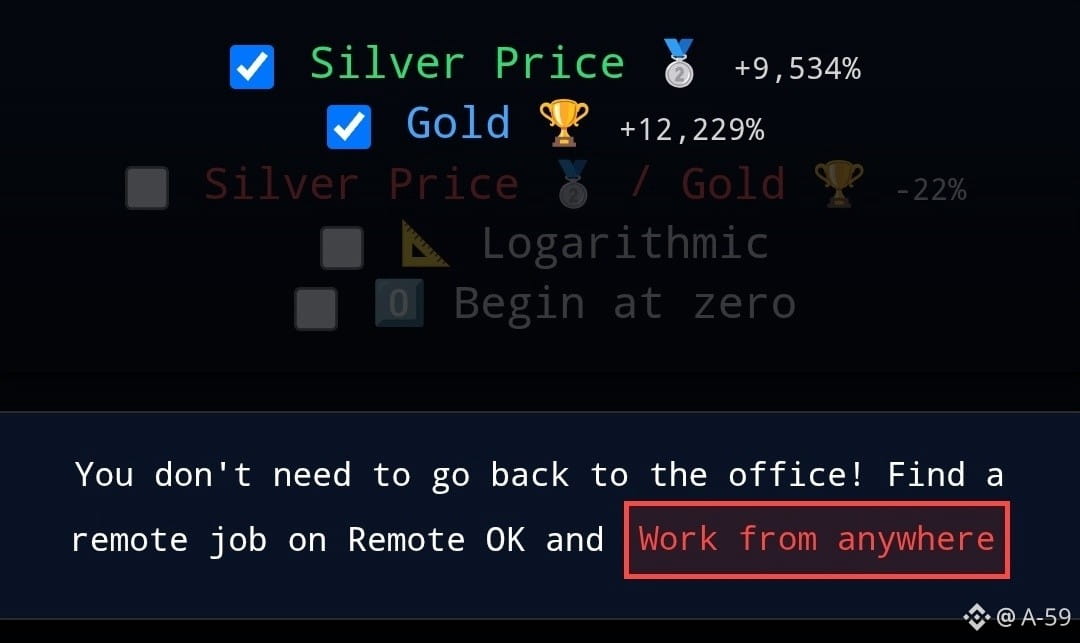
265
·
--
S&P 500 Measured in Gold (All Time)
When the S&P 500 is measured in gold, the story changes entirely.
While equities appear to reach new highs in nominal terms, their performance looks far more restrained when priced in real money.
This chart highlights a critical truth:
📉 Financial asset expansion is often diluted by currency debasement, while gold continues to preserve purchasing power across generations.
Gold isn’t about chasing fast returns — it’s about protecting value through cycles.
Over long time horizons, it acts as a stabilizing anchor amid leverage, liquidity expansion, and monetary excess.
Nominal gains are not real gains.
Measure in gold — and reality becomes clear.
S&P 500 Measured in Silver (All Time)
If gold represents value preservation, silver reflects cycle amplification.
When the S&P 500 is priced in silver, volatility increases — revealing silver’s sensitivity to inflation, liquidity shifts, and late-cycle dynamics.
Silver tends to lag early, then outperform aggressively in the latter stages of monetary cycles, as confidence in fiat weakens and real asset demand accelerates.
This chart illustrates the rotation between productive assets and monetary-industrial metals, each leading at different phases of the cycle.
Silver is not just a metal — it is a stress signal of the system.
When silver begins to outperform, regime change is often underway.
Watch the ratios. Cycles always speak.
$XAU $XAG
#A59 #CZAMAonBinanceSquare #USPPIJump #BitcoinETFWatch #USGovShutdown
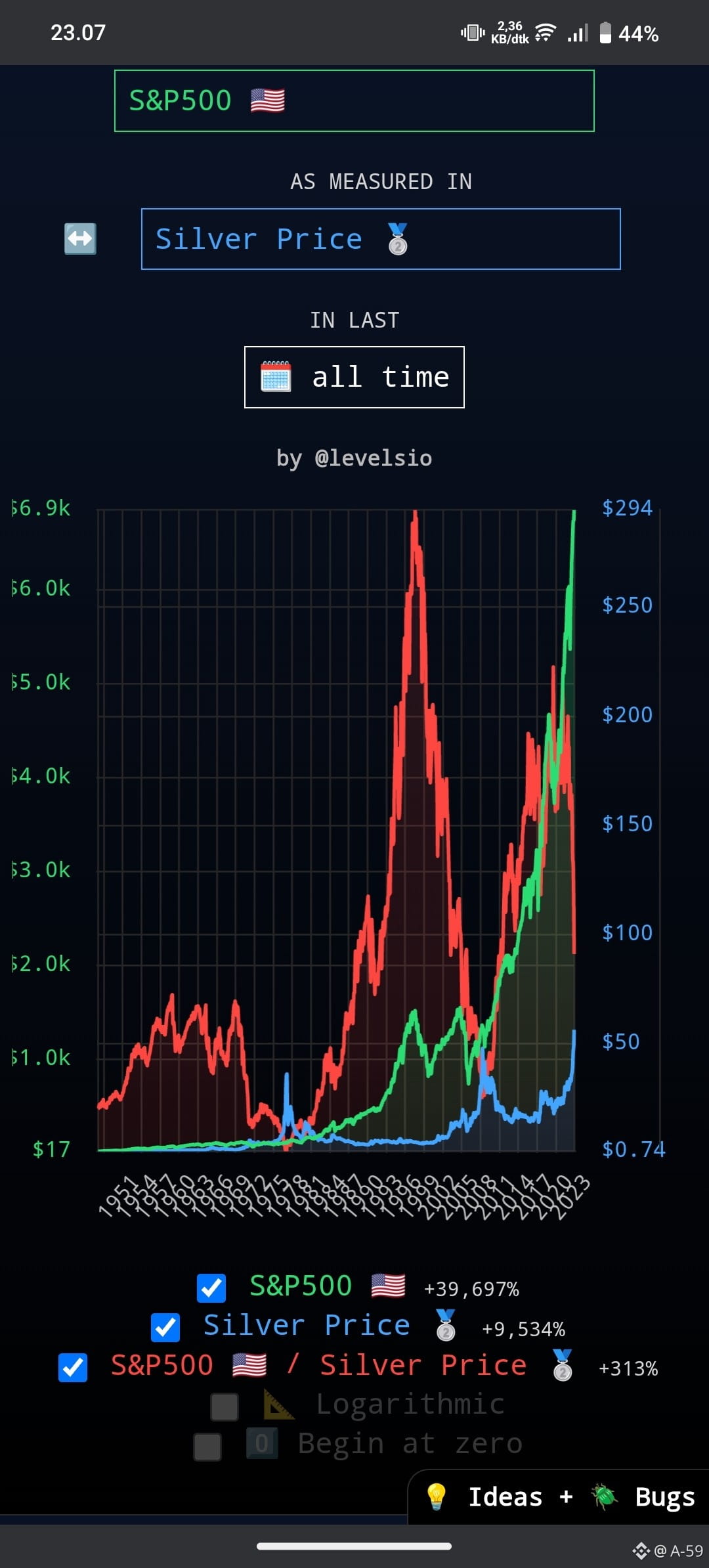
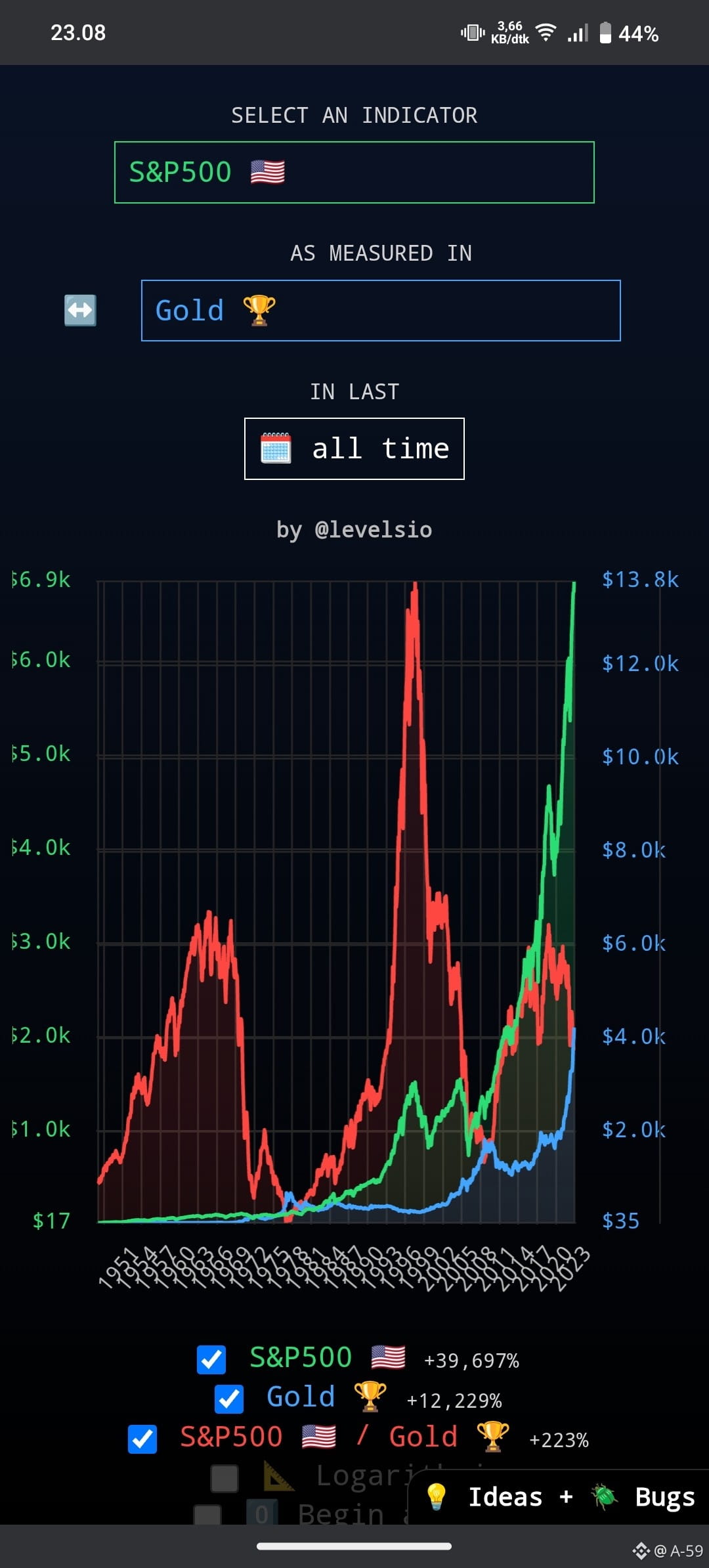
5
·
--
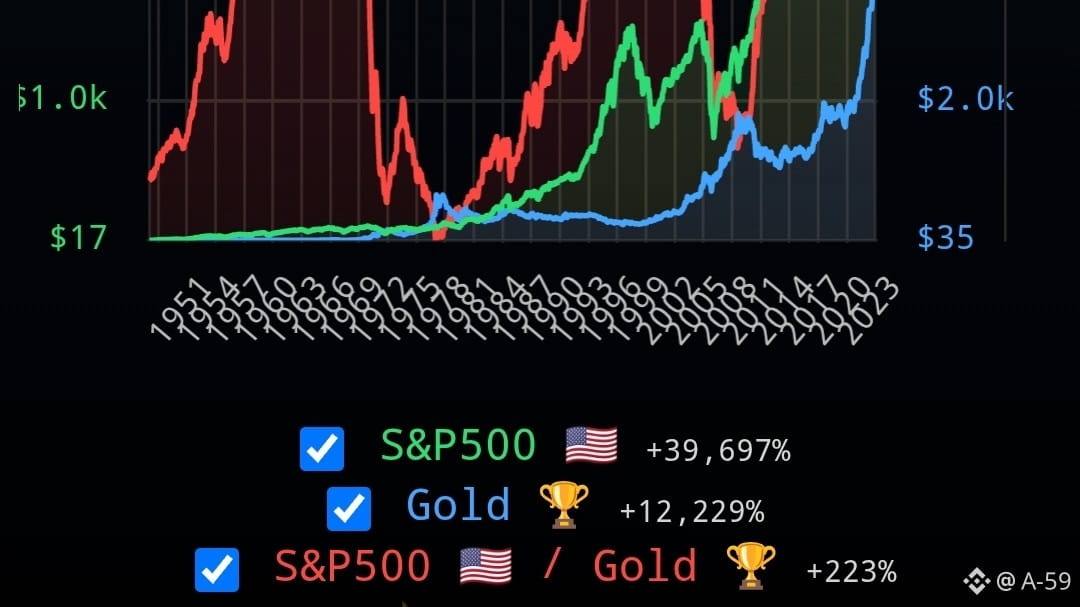
Article
xaS&P 500 Measured in Gold (All Time)
When the S&P 500 is measured in gold, the story changes entirely.
While equities appear to reach new highs in nominal terms, their performance looks far more restrained when priced in real money.
This chart highlights a critical truth:
📉 Financial asset expansion is often diluted by currency debasement, while gold continues to preserve purchasing power across generations.
Gold isn’t about chasing fast returns — it’s about protecting value through cycles.
Over long time horizons, it acts as a stabilizing anchor amid leverage, liquidity expansion, and monetary excess.
Nominal gains are not real gains.
Measure in gold — and reality becomes clear.
— S&P 500 Measured in Silver (All Time)
If gold represents value preservation, silver reflects cycle amplification.
When the S&P 500 is priced in silver, volatility increases — revealing silver’s sensitivity to inflation, liquidity shifts, and late-cycle dynamics.
Silver tends to lag early, then outperform aggressively in the latter stages of monetary cycles, as confidence in fiat weakens and real asset demand accelerates.
This chart illustrates the rotation between productive assets and monetary-industrial metals, each leading at different phases of the cycle.
Silver is not just a metal — it is a stress signal of the system.
When silver begins to outperform, regime change is often underway.
Watch the ratios. Cycles always speak.
$XAU
$XAG
##GOLD #Silver #A59 #FedHoldsRates #news
xa
S&P 500 Measured in Gold (All Time)
When the S&P 500 is measured in gold, the story changes entirely.
While equities appear to reach new highs in nominal terms, their performance looks far more restrained when priced in real money.
This chart highlights a critical truth:
📉 Financial asset expansion is often diluted by currency debasement, while gold continues to preserve purchasing power across generations.
Gold isn’t about chasing fast returns — it’s about protecting value through cycles.
Over long time horizons, it acts as a stabilizing anchor amid leverage, liquidity expansion, and monetary excess.
Nominal gains are not real gains.
Measure in gold — and reality becomes clear.
— S&P 500 Measured in Silver (All Time)
If gold represents value preservation, silver reflects cycle amplification.
When the S&P 500 is priced in silver, volatility increases — revealing silver’s sensitivity to inflation, liquidity shifts, and late-cycle dynamics.
Silver tends to lag early, then outperform aggressively in the latter stages of monetary cycles, as confidence in fiat weakens and real asset demand accelerates.
This chart illustrates the rotation between productive assets and monetary-industrial metals, each leading at different phases of the cycle.
Silver is not just a metal — it is a stress signal of the system.
When silver begins to outperform, regime change is often underway.
Watch the ratios. Cycles always speak.
$XAU
$XAG
##GOLD #Silver #A59 #FedHoldsRates #news
1
536
·
--
Significant XAUT Volume & Activity
• On-chain data shows a major whale recently purchased 1,108.79 XAUT ($6M) using USDC and supplied it as collateral on Aave V3 — signaling a long-term accumulation strategy, not short-term trading.
• Several dominant whales have also been reported withdrawing large amounts of XAUT (thousands of tokens) from exchanges to private wallets, often as a store of value during market volatility.
• XAUT (alongside PAXG) trading volume surged 100–200% in a single day. Analysts note this move is not mere “gold hype,” but rather a risk rotation by institutions and professional traders.
📈 Market Sentiment & Fundamentals
• Tether is reported to have significantly increased its physical gold reserves, further strengthening XAUT’s backing by real gold.
• The total market value of gold-backed tokens (including XAUT) has reached record highs, supported by elevated global gold prices and growing demand for RWA (Real-World Asset) tokens.
🧠 What Does This Mean for XAUT & Binance Square?
1. Strong Interest from Whales & Institutional Traders
The surge in volume and whale accumulation confirms that XAUT is attracting more than just retail traders — it reflects a meaningful capital shift into tokenized gold.
2. XAUT as a Hedge Asset
With physical gold prices rising, market participants are increasingly using XAUT as a hedge during heightened crypto market volatility.
3. Binance Square as a Market Insight Hub
Discussions and posts on Binance Square show that XAUT and PAXG news are often used as indicators of broader market sentiment and upcoming capital rotation.
⚠️ Not Financial Advice
$XAU
{future}(XAUUSDT)
#A59 #WhoIsNextFedChair #USGovShutdown #MarketCorrection #USPPIJump
Significant XAUT Volume & Activity
• On-chain data shows a major whale recently purchased 1,108.79 XAUT ($6M) using USDC and supplied it as collateral on Aave V3 — signaling a long-term accumulation strategy, not short-term trading.
• Several dominant whales have also been reported withdrawing large amounts of XAUT (thousands of tokens) from exchanges to private wallets, often as a store of value during market volatility.
• XAUT (alongside PAXG) trading volume surged 100–200% in a single day. Analysts note this move is not mere “gold hype,” but rather a risk rotation by institutions and professional traders.
📈 Market Sentiment & Fundamentals
• Tether is reported to have significantly increased its physical gold reserves, further strengthening XAUT’s backing by real gold.
• The total market value of gold-backed tokens (including XAUT) has reached record highs, supported by elevated global gold prices and growing demand for RWA (Real-World Asset) tokens.
🧠 What Does This Mean for XAUT & Binance Square?
1. Strong Interest from Whales & Institutional Traders
The surge in volume and whale accumulation confirms that XAUT is attracting more than just retail traders — it reflects a meaningful capital shift into tokenized gold.
2. XAUT as a Hedge Asset
With physical gold prices rising, market participants are increasingly using XAUT as a hedge during heightened crypto market volatility.
3. Binance Square as a Market Insight Hub
Discussions and posts on Binance Square show that XAUT and PAXG news are often used as indicators of broader market sentiment and upcoming capital rotation.
⚠️ Not Financial Advice
$XAU
#A59 #WhoIsNextFedChair #USGovShutdown #MarketCorrection #USPPIJump
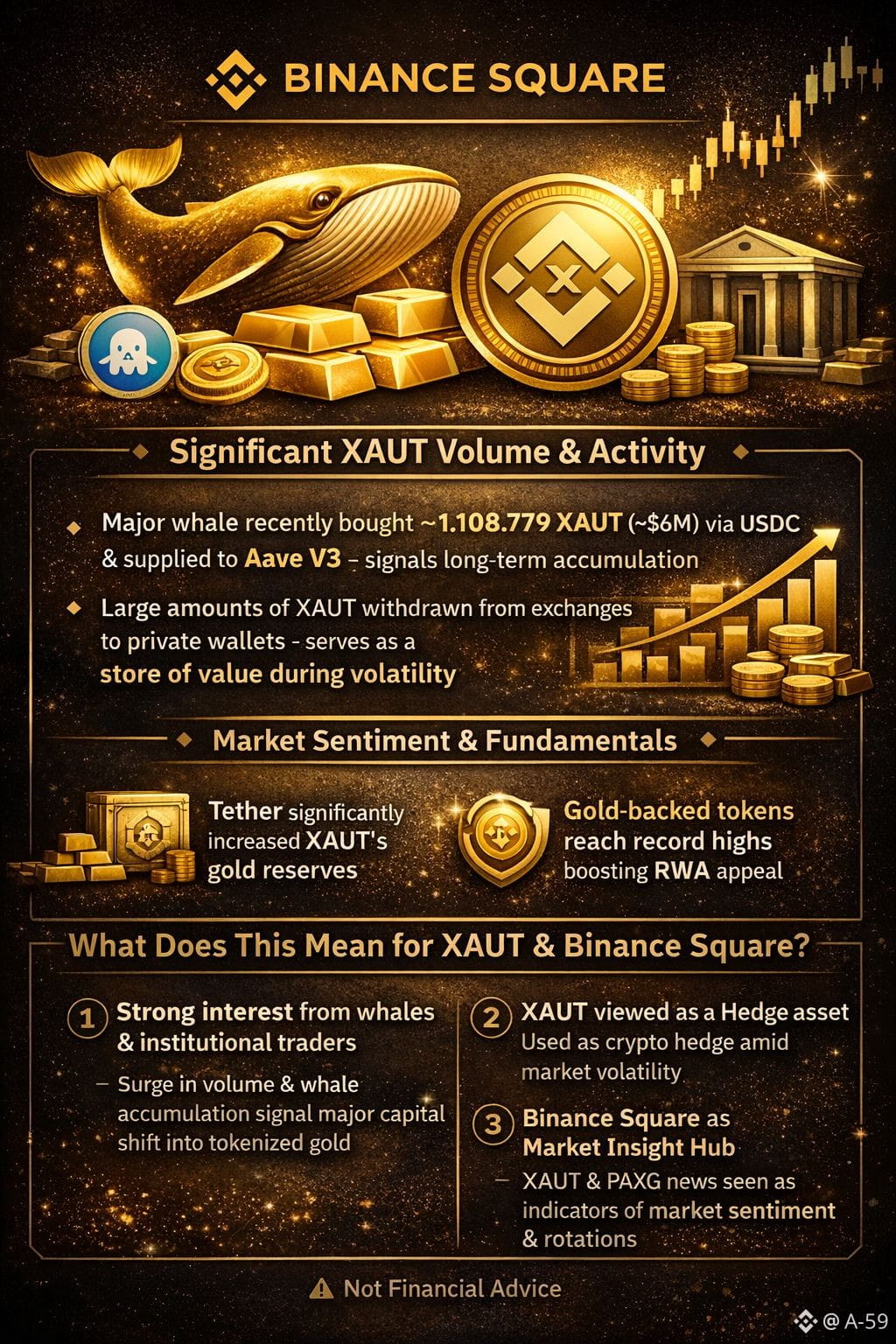
1
126
·
--
Latest Zcash $ZEC
{future}(ZECUSDT)
News & Market Highlights
Institutional Accumulation and Confidence
Nasdaq listed Cypherpunk Technologies expanded its ZEC holdings with a 29 million dollar purchase around 56418 ZEC increasing its total position to about 176 percent of circulating supply The company targets accumulation up to 5 percent of ZEC signaling growing institutional confidence in privacy focused crypto assets
ZEC Ranked Top 20 by Market Cap
Zcash entered the top 20 largest cryptocurrencies by market capitalization in late 2025 marking a major milestone for a privacy focused digital asset amid a market dominated by transparent ledger coins
Halving and Supply Dynamics
The Zcash halving in November 2025 reduced block rewards tightening issuance and strengthening the scarcity narrative Increased adoption of shielded transactions indicates a larger portion of supply moving into privacy enhanced pools
Privacy Adoption and On Chain Activity
On chain data shows rising transaction activity and increased use of shielded addresses Network upgrades and mobile wallet improvements enhance accessibility and privacy supporting long term ecosystem growth beyond short term speculation
Quick Takeaways
Institutional demand is rising driven by large scale accumulation
Top 20 market cap status confirms renewed interest in privacy coins
Supply tightening supports long term scarcity narrative
Privacy adoption and network upgrades strengthen fundamentals
#A59 #zec #BTC90kChristmas #StrategyBTCPurchase #WriteToEarnUpgrade
Latest Zcash $ZEC
News & Market Highlights
Institutional Accumulation and Confidence
Nasdaq listed Cypherpunk Technologies expanded its ZEC holdings with a 29 million dollar purchase around 56418 ZEC increasing its total position to about 176 percent of circulating supply The company targets accumulation up to 5 percent of ZEC signaling growing institutional confidence in privacy focused crypto assets
ZEC Ranked Top 20 by Market Cap
Zcash entered the top 20 largest cryptocurrencies by market capitalization in late 2025 marking a major milestone for a privacy focused digital asset amid a market dominated by transparent ledger coins
Halving and Supply Dynamics
The Zcash halving in November 2025 reduced block rewards tightening issuance and strengthening the scarcity narrative Increased adoption of shielded transactions indicates a larger portion of supply moving into privacy enhanced pools
Privacy Adoption and On Chain Activity
On chain data shows rising transaction activity and increased use of shielded addresses Network upgrades and mobile wallet improvements enhance accessibility and privacy supporting long term ecosystem growth beyond short term speculation
Quick Takeaways
Institutional demand is rising driven by large scale accumulation
Top 20 market cap status confirms renewed interest in privacy coins
Supply tightening supports long term scarcity narrative
Privacy adoption and network upgrades strengthen fundamentals
#A59 #zec #BTC90kChristmas #StrategyBTCPurchase #WriteToEarnUpgrade
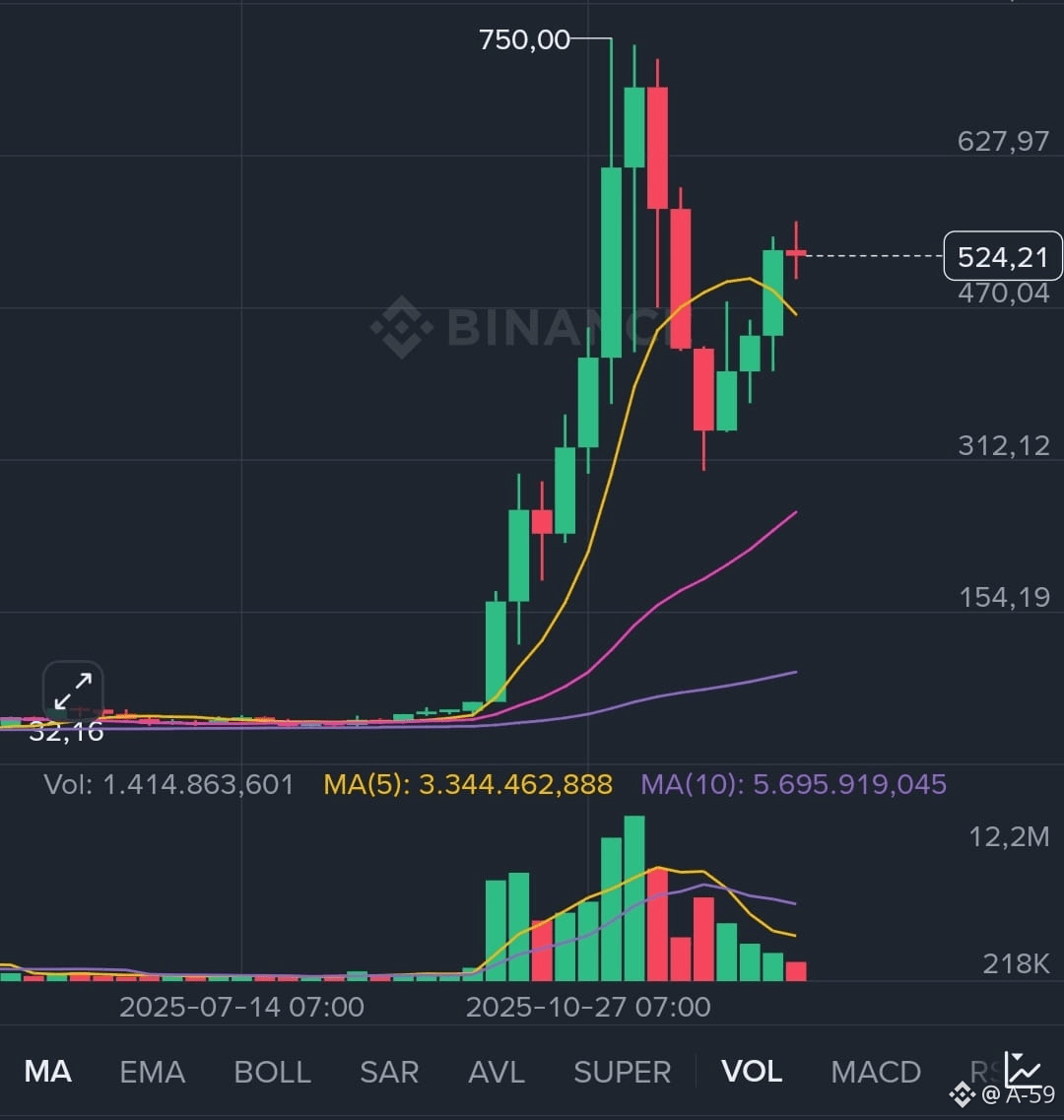
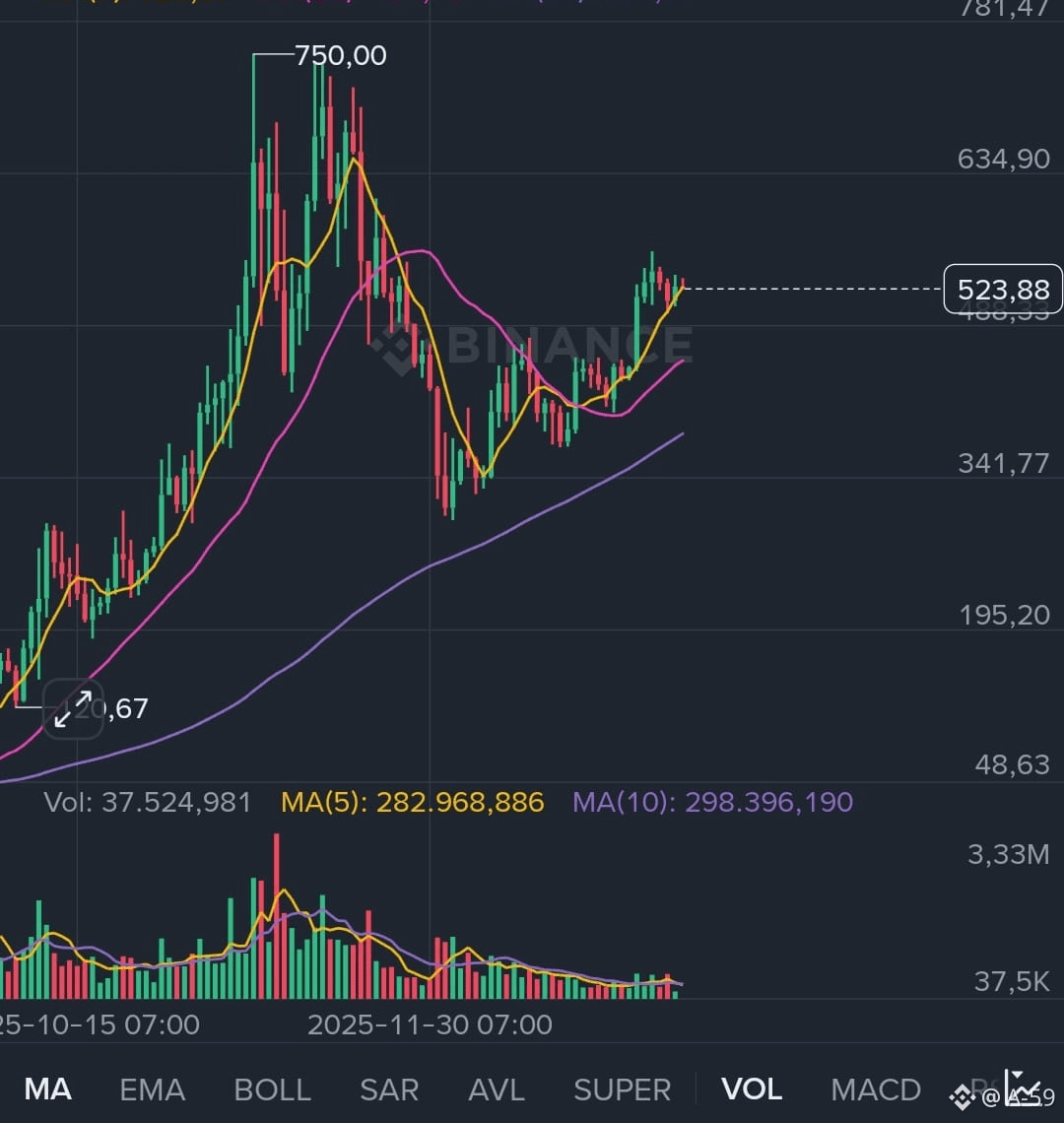
16
·
--
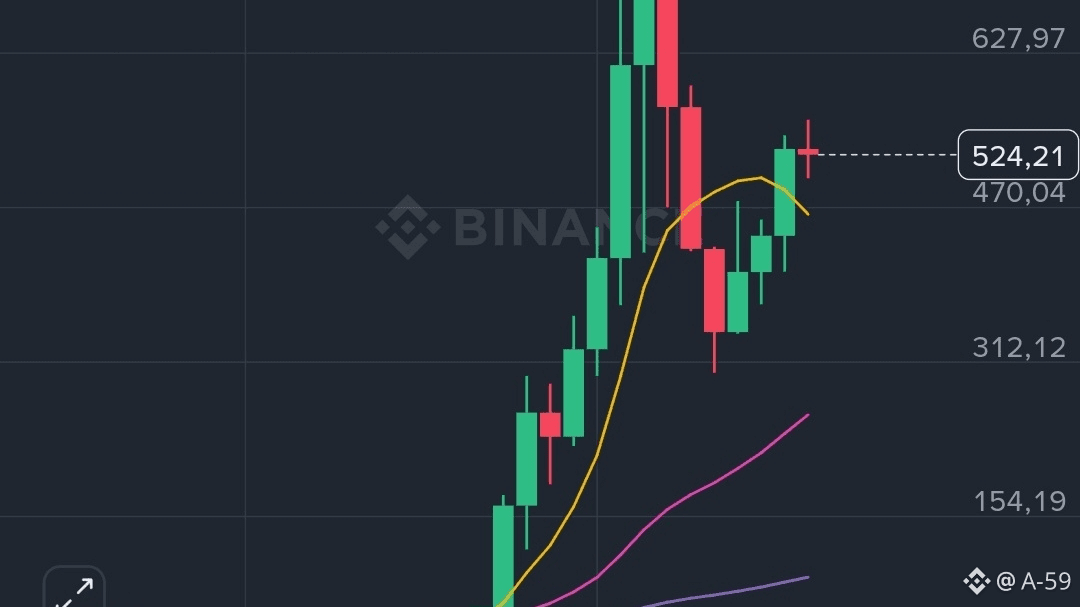
Article
ZEC TIMELatest Zcash ($ZEC ) News & Market Highlights
1) Institutional Accumulation & Confidence
Nasdaq-listed Cypherpunk Technologies expanded its ZEC holdings with a $29 million purchase (~56,418 ZEC), increasing its total position to about 1.76% of circulating supply. The firm aims to accumulate up to 5% of ZEC, signaling growing institutional trust in privacy-centric crypto assets. �
FX Leaders + 1
2) ZEC Ranked Top 20 by Market Cap
Zcash climbed into the top 20 largest cryptocurrencies by market capitalization as of late 2025, marking a significant milestone for a privacy-focused asset in a market dominated by clear-ledger coins. �
MEXC
3) Halving & Supply Dynamics
The Zcash halving in November 2025 cut block rewards in half, tightening issuance and reinforcing ZEC’s scarcity narrative. The change also coincided with increased adoption of shielded transactions, where a large portion of supply resides in privacy-enhanced pools. �
AInvest + 1
4) Privacy Adoption & On-Chain Activity
ZEC’s on-chain activity shows a significant rise in transactions and shielded usage, highlighting broader utility growth. Network upgrades and features like mobile wallet improvements have enhanced accessibility and privacy capability, contributing to long-term interest beyond short-term speculation. �
AInvest
Quick Takeaways for Your Feed
Institutional demand rising: Big accumulation by Cypherpunk points to confidence in ZEC’s privacy value proposition. �
FX Leaders
Top 20 crypto status: Zcash’s market cap ranking highlights renewed demand in the privacy coin category. �
MEXC
Supply tightening: Halving event reduces new ZEC issuance, which may support scarcity-driven narratives. �
AInvest
Privacy adoption trend: Increased shielded transactions and tech upgrades show progressing ecosystem fundamentals. �
#A59 #ZECUSDT #BTC90kChristmas #StrategyBTCPurchase #NewsAboutCrypto
ZEC TIME
Latest Zcash ($ZEC ) News & Market Highlights
1) Institutional Accumulation & Confidence
Nasdaq-listed Cypherpunk Technologies expanded its ZEC holdings with a $29 million purchase (~56,418 ZEC), increasing its total position to about 1.76% of circulating supply. The firm aims to accumulate up to 5% of ZEC, signaling growing institutional trust in privacy-centric crypto assets. �
FX Leaders + 1
2) ZEC Ranked Top 20 by Market Cap
Zcash climbed into the top 20 largest cryptocurrencies by market capitalization as of late 2025, marking a significant milestone for a privacy-focused asset in a market dominated by clear-ledger coins. �
MEXC
3) Halving & Supply Dynamics
The Zcash halving in November 2025 cut block rewards in half, tightening issuance and reinforcing ZEC’s scarcity narrative. The change also coincided with increased adoption of shielded transactions, where a large portion of supply resides in privacy-enhanced pools. �
AInvest + 1
4) Privacy Adoption & On-Chain Activity
ZEC’s on-chain activity shows a significant rise in transactions and shielded usage, highlighting broader utility growth. Network upgrades and features like mobile wallet improvements have enhanced accessibility and privacy capability, contributing to long-term interest beyond short-term speculation. �
AInvest
Quick Takeaways for Your Feed
Institutional demand rising: Big accumulation by Cypherpunk points to confidence in ZEC’s privacy value proposition. �
FX Leaders
Top 20 crypto status: Zcash’s market cap ranking highlights renewed demand in the privacy coin category. �
MEXC
Supply tightening: Halving event reduces new ZEC issuance, which may support scarcity-driven narratives. �
AInvest
Privacy adoption trend: Increased shielded transactions and tech upgrades show progressing ecosystem fundamentals. �
#A59 #ZECUSDT #BTC90kChristmas #StrategyBTCPurchase #NewsAboutCrypto
98
·
--
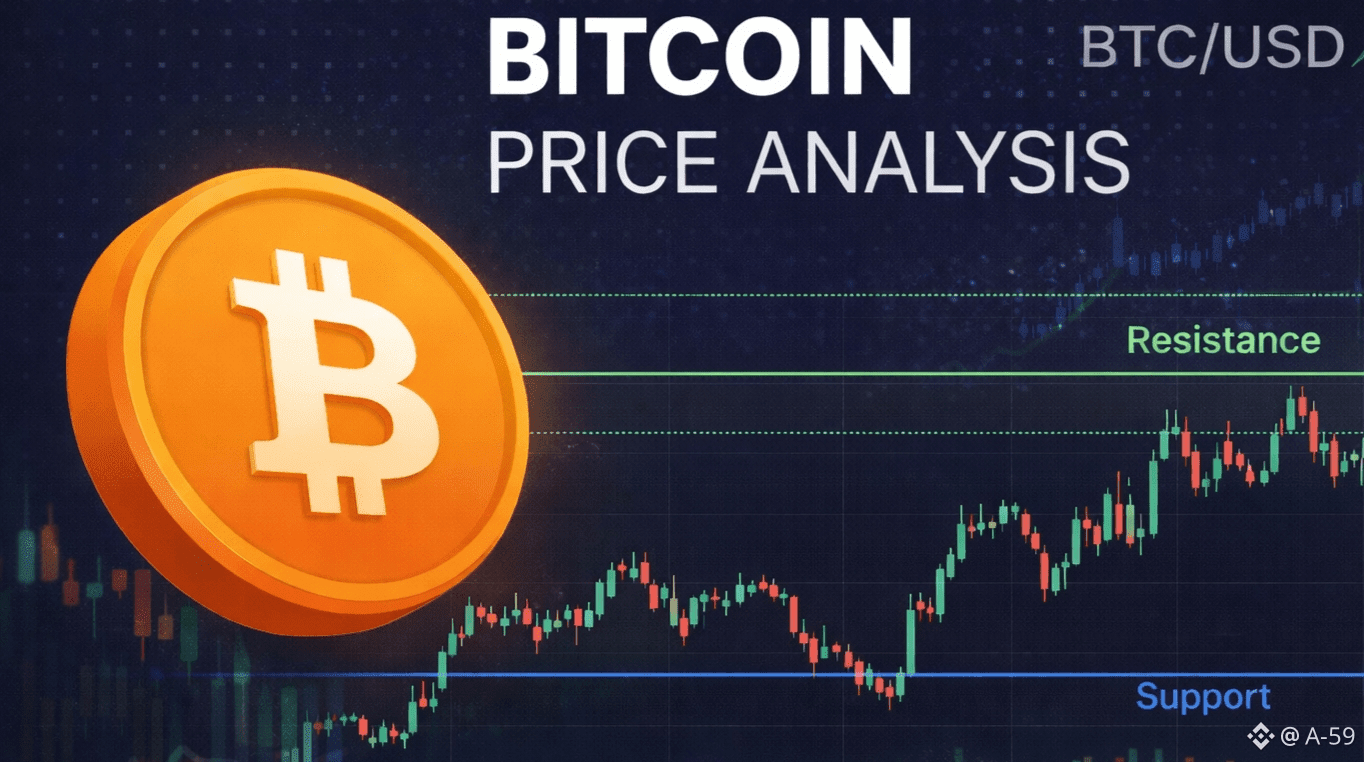
Article
BTC LATEST UPDATE$BTC Latest News & Market Highlights
1) Major Market Narrative Shift in 2025
Bitcoin reached an all-time high above $126,000 during 2025, but later retraced and finished the year below $88,000, contributing to over $1 trillion wiped off the crypto market cap. ETF flows turned net negative and investor sentiment weakened sharply, prompting analysts to adopt a more cautious outlook despite ongoing adoption trends. �
The Wall Street Journal
2) Institutional Buying Continues
Strategy (Michael Saylor’s company) resumed major BTC purchases at the end of December, acquiring 1,129 BTC (~$108.8M) after a brief pause, bringing total holdings to over 672,000 BTC. This indicates continued institutional accumulation at key price levels. �
Barron's
3) Price Momentum & Market Strength
Bitcoin recently showed upside momentum, climbing above $90,000 alongside Ethereum reclaiming key levels. This reflects short-term risk appetite and renewed trading interest in the broader crypto market. �
The Economic Times
4) High-Profile BTC Strategy Reversal
David Beckham–backed health company Prenetics Global reversed its prior Bitcoin acquisition strategy just six months after announcing a sizable BTC purchase, signaling mixed sentiment among corporate holders and rotation back to core business focus. �
MarketWatch
5) Crypto Security & BTC Usage in Crime
Two former cybersecurity employees pleaded guilty to utilizing Bitcoin in extortion through ransomware attacks, underlining continued BTC involvement in cybercrime and regulatory focus on illicit digital asset use. �
theverge.com
Market Takeaways for Binance Feed
Bearish shift from 2025 rally: BTC pulled back significantly amid profit-taking and ETF sell-offs. �
The Wall Street Journal
Institutional accumulation persists with heavy corporate BTC purchases. �
Barron's
Price support near $90K suggests resilience despite macro uncertainty. �
The Economic Times
Corporate strategy reversals reflect selective capital allocation away from BTC. �
MarketWatch
Security/legal headlines continue to impact risk perception. �
#A59 #BTC90kChristmas #StrategyBTCPurchase #BTCVSGOLD #WriteToEarnUpgrade $BTC
BTC LATEST UPDATE
$BTC Latest News & Market Highlights
1) Major Market Narrative Shift in 2025
Bitcoin reached an all-time high above $126,000 during 2025, but later retraced and finished the year below $88,000, contributing to over $1 trillion wiped off the crypto market cap. ETF flows turned net negative and investor sentiment weakened sharply, prompting analysts to adopt a more cautious outlook despite ongoing adoption trends. �
The Wall Street Journal
2) Institutional Buying Continues
Strategy (Michael Saylor’s company) resumed major BTC purchases at the end of December, acquiring 1,129 BTC (~$108.8M) after a brief pause, bringing total holdings to over 672,000 BTC. This indicates continued institutional accumulation at key price levels. �
Barron's
3) Price Momentum & Market Strength
Bitcoin recently showed upside momentum, climbing above $90,000 alongside Ethereum reclaiming key levels. This reflects short-term risk appetite and renewed trading interest in the broader crypto market. �
The Economic Times
4) High-Profile BTC Strategy Reversal
David Beckham–backed health company Prenetics Global reversed its prior Bitcoin acquisition strategy just six months after announcing a sizable BTC purchase, signaling mixed sentiment among corporate holders and rotation back to core business focus. �
MarketWatch
5) Crypto Security & BTC Usage in Crime
Two former cybersecurity employees pleaded guilty to utilizing Bitcoin in extortion through ransomware attacks, underlining continued BTC involvement in cybercrime and regulatory focus on illicit digital asset use. �
theverge.com
Market Takeaways for Binance Feed
Bearish shift from 2025 rally: BTC pulled back significantly amid profit-taking and ETF sell-offs. �
The Wall Street Journal
Institutional accumulation persists with heavy corporate BTC purchases. �
Barron's
Price support near $90K suggests resilience despite macro uncertainty. �
The Economic Times
Corporate strategy reversals reflect selective capital allocation away from BTC. �
MarketWatch
Security/legal headlines continue to impact risk perception. �
theverge.com
Market Takeaways for Binance Feed
Bearish shift from 2025 rally: BTC pulled back significantly amid profit-taking and ETF sell-offs. �
The Wall Street Journal
Institutional accumulation persists with heavy corporate BTC purchases. �
Barron's
Price support near $90K suggests resilience despite macro uncertainty. �
The Economic Times
Corporate strategy reversals reflect selective capital allocation away from BTC. �
MarketWatch
Security/legal headlines continue to impact risk perception. �
#A59 #BTC90kChristmas #StrategyBTCPurchase #BTCVSGOLD #WriteToEarnUpgrade $BTC
64
·
--
Bullish
$BTC
{spot}(BTCUSDT)
$BTC Latest News & Market Highlights
1) Major Market Narrative Shift in 2025
Bitcoin reached an all-time high above $126,000 during 2025, but later retraced and finished the year below $88,000, contributing to over $1 trillion wiped off the crypto market cap. ETF flows turned net negative and investor sentiment weakened sharply, prompting analysts to adopt a more cautious outlook despite ongoing adoption trends. �
2) Institutional Buying Continues
Strategy (Michael Saylor’s company) resumed major BTC purchases at the end of December, acquiring 1,129 BTC (~$108.8M) after a brief pause, bringing total holdings to over 672,000 BTC. This indicates continued institutional accumulation at key price levels. �
Barron's
3) Price Momentum & Market Strength
Bitcoin recently showed upside momentum, climbing above $90,000 alongside Ethereum reclaiming key levels. This reflects short-term risk appetite and renewed trading interest in the broader crypto market. �
4) High-Profile BTC Strategy Reversal
David Beckham–backed health company Prenetics Global reversed its prior Bitcoin acquisition strategy just six months after announcing a sizable BTC purchase, signaling mixed sentiment among corporate holders and rotation back to core business focus. �
5) Crypto Security & BTC Usage in Crime
Two former cybersecurity employees pleaded guilty to utilizing Bitcoin in extortion through ransomware attacks, underlining continued BTC involvement in cybercrime and regulatory focus on illicit digital asset use. �
Market Takeaways for Binance Feed
Bearish shift from 2025 rally: BTC pulled back significantly amid profit-taking and ETF sell-offs. �
The Wall Street Journal
Institutional accumulation persists with heavy corporate BTC purchases. �
Barron's
Price support near $90K suggests resilience despite macro uncertainty. �
The Economic Times
Corporate strategy reversals reflect selective capital allocation away from BTC. �
MarketWatch
Security/legal headlines continue to impact risk perception. �
#A59 #BTC90kChristmas #StrategyBTCPurchase
$BTC
$BTC Latest News & Market Highlights
1) Major Market Narrative Shift in 2025
Bitcoin reached an all-time high above $126,000 during 2025, but later retraced and finished the year below $88,000, contributing to over $1 trillion wiped off the crypto market cap. ETF flows turned net negative and investor sentiment weakened sharply, prompting analysts to adopt a more cautious outlook despite ongoing adoption trends. �
2) Institutional Buying Continues
Strategy (Michael Saylor’s company) resumed major BTC purchases at the end of December, acquiring 1,129 BTC (~$108.8M) after a brief pause, bringing total holdings to over 672,000 BTC. This indicates continued institutional accumulation at key price levels. �
Barron's
3) Price Momentum & Market Strength
Bitcoin recently showed upside momentum, climbing above $90,000 alongside Ethereum reclaiming key levels. This reflects short-term risk appetite and renewed trading interest in the broader crypto market. �
4) High-Profile BTC Strategy Reversal
David Beckham–backed health company Prenetics Global reversed its prior Bitcoin acquisition strategy just six months after announcing a sizable BTC purchase, signaling mixed sentiment among corporate holders and rotation back to core business focus. �
5) Crypto Security & BTC Usage in Crime
Two former cybersecurity employees pleaded guilty to utilizing Bitcoin in extortion through ransomware attacks, underlining continued BTC involvement in cybercrime and regulatory focus on illicit digital asset use. �
Market Takeaways for Binance Feed
Bearish shift from 2025 rally: BTC pulled back significantly amid profit-taking and ETF sell-offs. �
The Wall Street Journal
Institutional accumulation persists with heavy corporate BTC purchases. �
Barron's
Price support near $90K suggests resilience despite macro uncertainty. �
The Economic Times
Corporate strategy reversals reflect selective capital allocation away from BTC. �
MarketWatch
Security/legal headlines continue to impact risk perception. �
#A59 #BTC90kChristmas #StrategyBTCPurchase
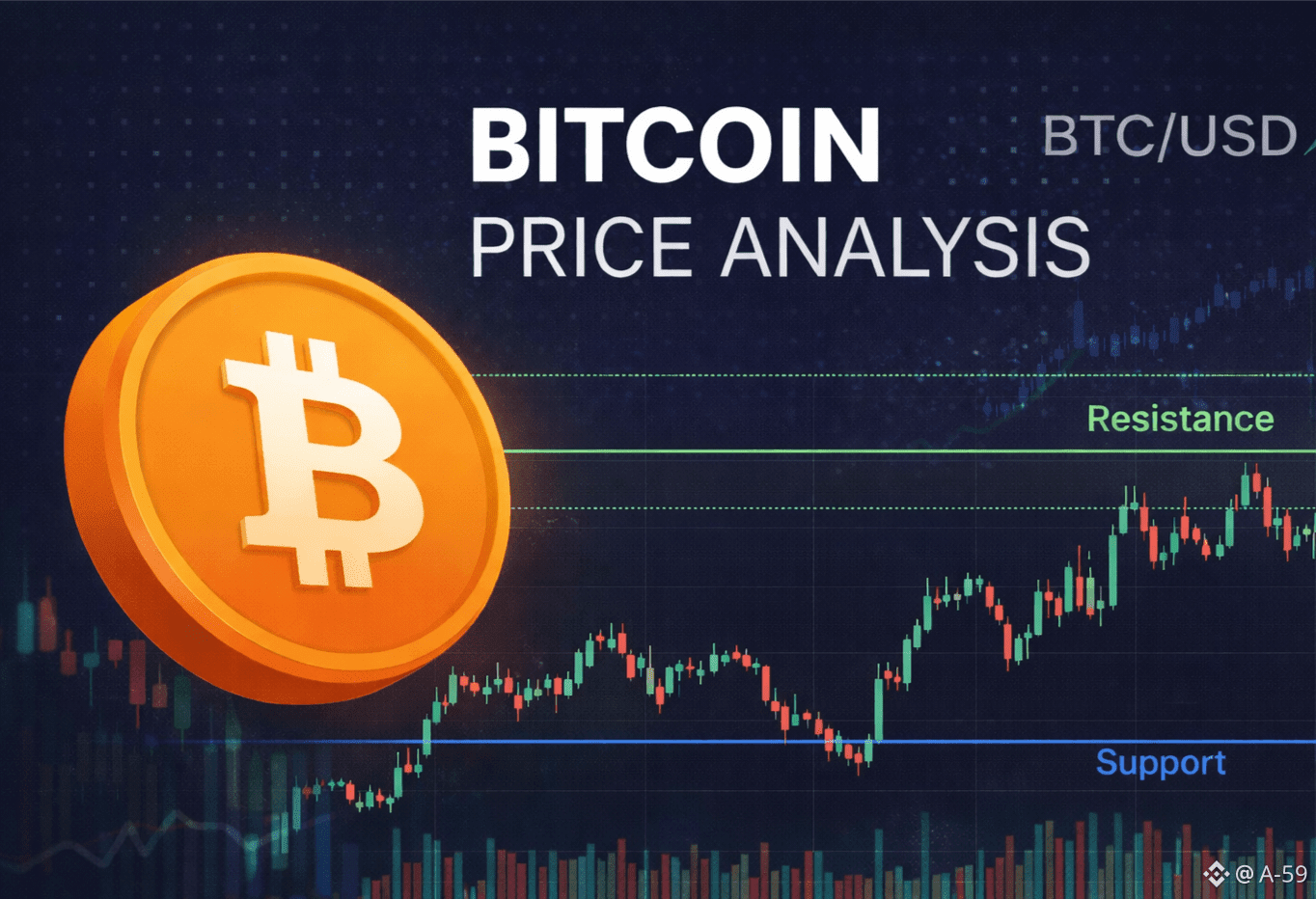
79
·
--
🎯 My Opinion (As an Investor/Consultant): Careful & Selective
BTC now looks like a “market catching its breath” — from a rally to the peak, then a fall, and now a rebound. For investors who understand risks and are meticulous about macro conditions + regulations, this could be an interesting opportunity. But for those who are uncomfortable with sharp volatility — it’s best to be cautious and not too aggressive.
Personally, I see DCA + HODL as the most sensible strategy right now — while keeping the portfolio allocation so that crypto does not dominate the entire investment allocation.
$BTC
{future}(BTCUSDT)
$BTC
#BTCRebound90kNext? #A59 #BTC #NewsAboutCrypto #CryptoRally
🎯 My Opinion (As an Investor/Consultant): Careful & Selective
BTC now looks like a “market catching its breath” — from a rally to the peak, then a fall, and now a rebound. For investors who understand risks and are meticulous about macro conditions + regulations, this could be an interesting opportunity. But for those who are uncomfortable with sharp volatility — it’s best to be cautious and not too aggressive.
Personally, I see DCA + HODL as the most sensible strategy right now — while keeping the portfolio allocation so that crypto does not dominate the entire investment allocation.
$BTC
$BTC
#BTCRebound90kNext? #A59 #BTC #NewsAboutCrypto #CryptoRally
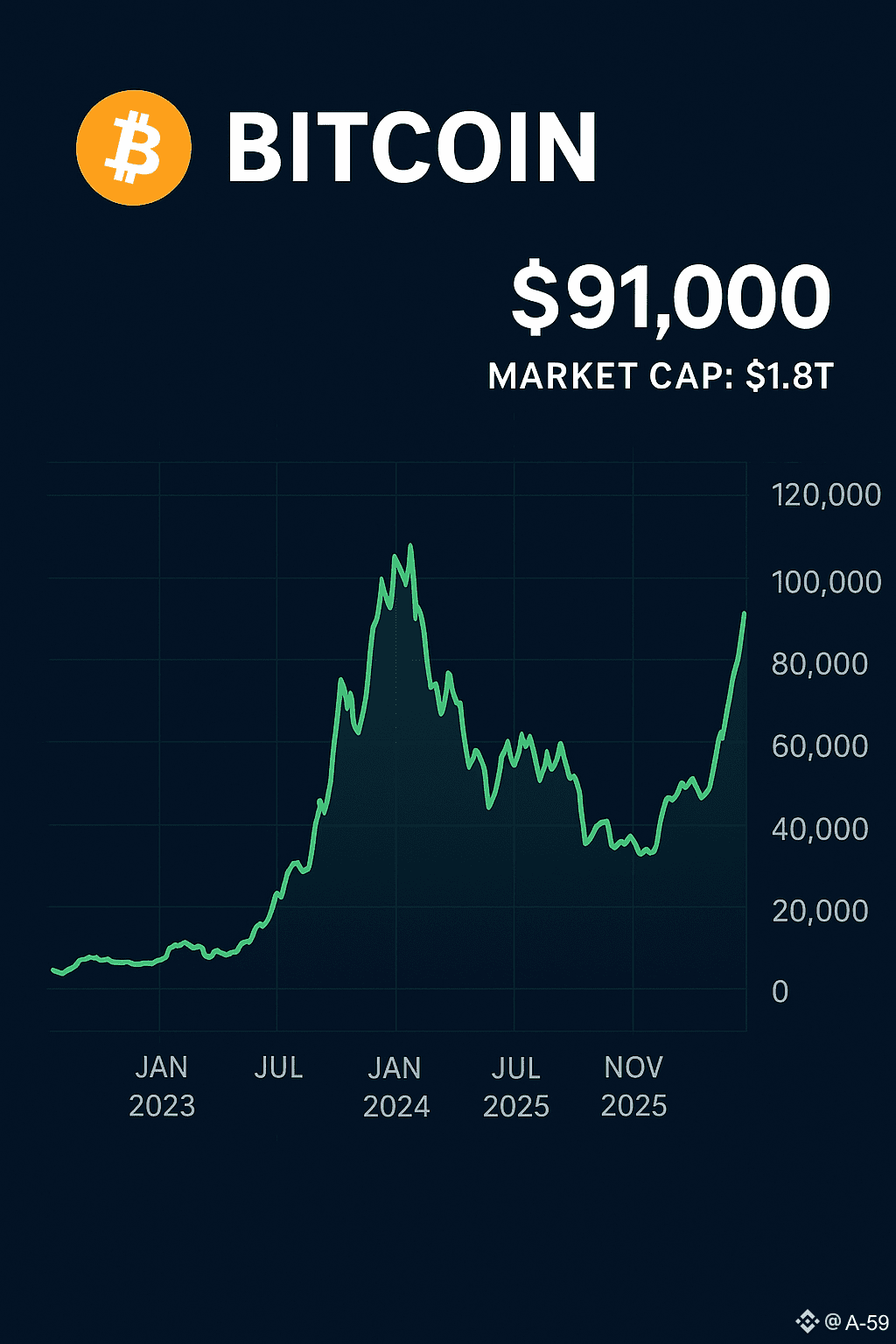
1
173
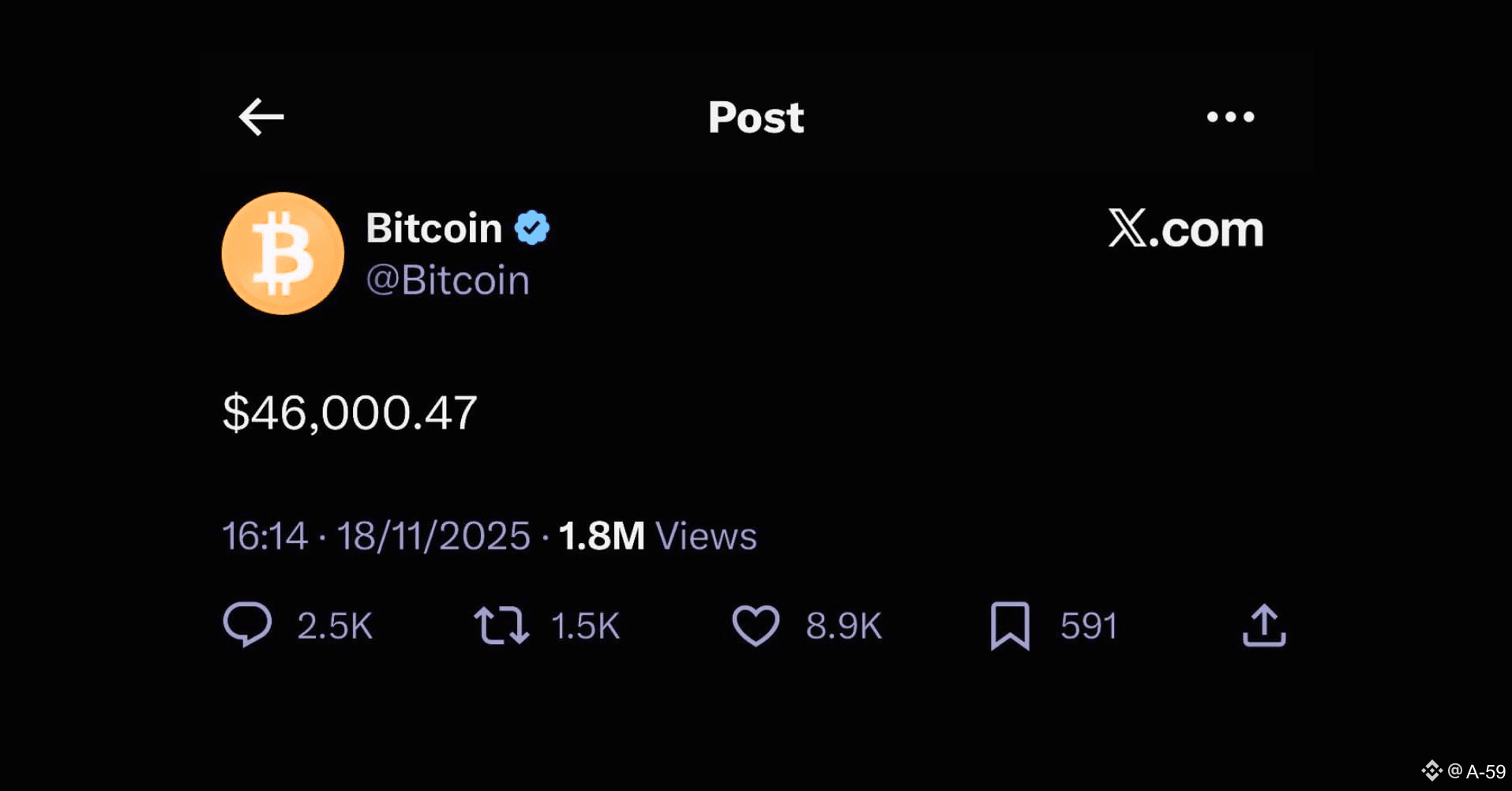
Log in to explore more content
Join global crypto users on Binance Square
⚡️ Get latest and useful information about crypto.
💬 Trusted by the world’s largest crypto exchange.
👍 Discover real insights from verified creators.
Email / Phone number
Trending Topics
AnthropicBreaksBelowIPOPriceAmidAISlump
18,812 views
295 Discussing
TradFi News | Micron, Nvidia Lead AI Stock Slide as VIX Jumps Above 32 and Anthropic Falls Below IPO Price
Binance News
·13 Likes
·6.4k views
Bitcoin'sReboundFadesBelow$60K
67,114 views
319 Discussing
WillMarketsStageAThanksgivingReliefRally?
500,213 views
3,260 Discussing