
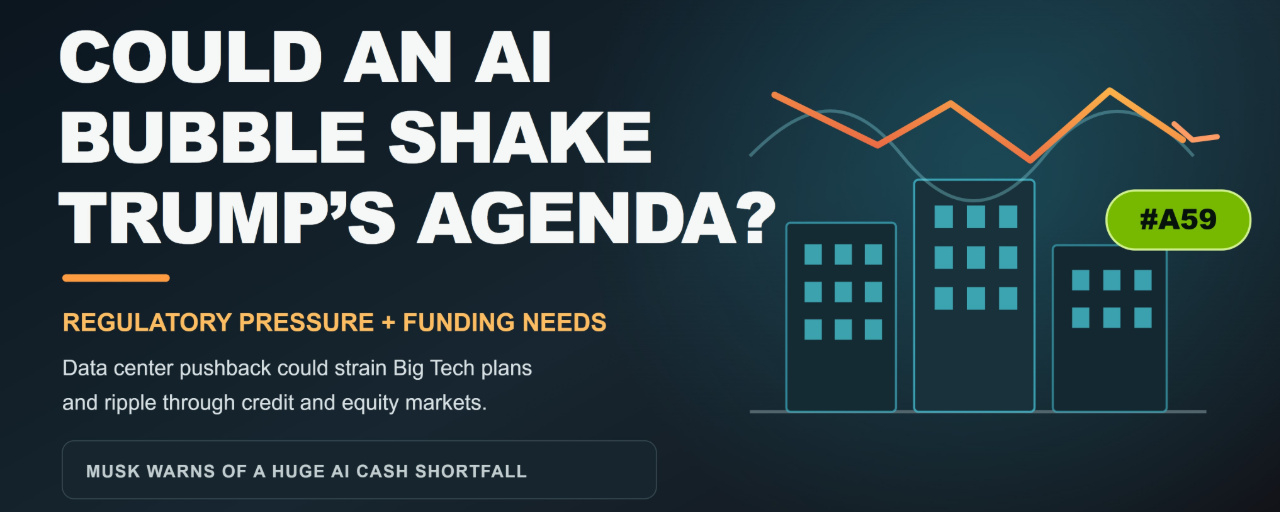
“Could an AI Bubble Collapse Undermine Trump?” Democratic Regulatory Pressure Heightens Uncertainty Over Big Tech’s AI Investment, Raising Fears of Cascading Financial and Political Crises
sourch ; The Economy by Oliver Griffin
Authored On
Nov 24, 2026 02:44
Modified
Nov 24, 2026 03:25
Elon Musk, CEO of SpaceX $SPCXB and Tesla $TSLAB , has warned that the artificial intelligence (AI) industry could face a massive liquidity shortfall. With the Democrats gaining the upper hand in the U.S. midterm elections and increasing the likelihood of tighter data center regulations, AI companies that have committed to enormous capital expenditures are expected to face even greater funding pressures. Against this backdrop, market observers suggest that an AI bubble collapse could send shock waves across financial markets, including bonds, private credit and equities, and raise questions about the policy responsibility of Donald Trump’s administration, which has pursued a pro-AI agenda.
Musk Warns of Cash Shortages at AI Companies
According to Business Insider on the 22nd (local time), Musk said on X (formerly Twitter) that day, “The cash shortfall (at AI companies) next year will be enormous,” adding, “If delays of several months accumulate between paying for compute and getting it running reliably enough to generate revenue, hundreds of billions of USD in additional funding will be needed.” Major technology companies have recently been rapidly expanding capital expenditures, committing vast sums to AI data centers and advanced semiconductors. Combined capital spending this year by four companies—Amazon, Alphabet, Meta and Microsoft ($MSFTB )—is estimated to exceed USD 700 billion, while SpaceX has also announced plans to invest USD 24 billion in building a data center in Texas.
The problem is that public sentiment toward data center projects in the United States is deteriorating rapidly. Opposition from local residents, in particular, has been growing noticeably stronger. Concerns have intensified that data centers’ enormous electricity demand could drive up household electricity bills and strain local power grids. Water depletion caused by cooling facilities, along with noise and air pollution from cooling equipment and emergency generators, has also emerged as a major source of conflict. Some residents argue that data centers impose excessive environmental and economic burdens relative to the jobs and economic benefits they provide to communities, and have launched campaigns opposing construction and lawsuits seeking to revoke permits. A growing number of local governments have also temporarily halted new data center construction or tightened site-selection and environmental review requirements.
Republicans Blame Pro-AI Policies for Election Defeat
Conflicts over data centers have also emerged as a major issue in U.S. politics. With Democrats gaining the upper hand by taking control of both the Senate and the House in the U.S. midterm elections held on the 3rd, voices within President Trump’s core MAGA (Make America Great Again) support base are criticizing the administration’s overly favorable policies toward the AI industry and Big Tech. Kevin Roberts, president of the conservative Heritage Foundation think tank, identified voters’ distrust of the AI industry as a primary reason for the Republicans’ midterm defeat. He said it had been a political mistake not to listen sufficiently to residents concerned about the industry’s growing influence. In his assessment, Democrats won voters’ support by taking the advantageous position on the data center issue first.
Republican U.S. Representative Chip Roy of Texas also cited the party leadership’s stance toward the AI industry as a reason for the defeat at a Heritage Foundation event. “Voters’ grievances are not limited to data centers’ electricity and water use,” Roy said. “The prospect of AI replacing jobs and technology executives’ unilateral approach to development have fueled residents’ resentment.” Texas, where Roy’s district is located, was among the states where the rapid expansion of AI data centers emerged as a major election issue. Democratic candidate Gina Hinojosa was elected governor.
Democrats Signal Tighter Data Center Regulations
Having secured majorities in both the Senate and the House, Democrats are moving in earnest to tighten regulations on AI data centers. According to a Reuters report on the 6th, Democratic lawmakers plan to introduce a series of bills expanding data center operators’ responsibilities after the new Congress convenes next January. The central aim is to prevent the cost of expanding power grids for large-scale data center construction from being passed on to households and small and medium-sized businesses through their electricity bills. To that end, they intend to require large data center operators to directly cover the costs of new power generation and transmission facilities and grid upgrades, while also expanding disclosure of electricity consumption and related costs.
This push for tighter regulation was also clearly reflected in Democratic candidates’ campaign pledges. For example, Wisconsin Governor-elect David Crowley supported a temporary halt to new data center permits and the elimination of sales tax exemptions for operators. Texas Governor-elect Hinojosa also said she would deny permits for data centers that had not secured sufficient resident consent and community benefits. Ohio Governor-elect Amy Acton likewise pledged to block data center projects that fail to meet certain environmental and business standards, while Georgia Governor-elect Keisha Lance Bottoms proposed a statewide pause on new data center construction.
Table 1. Democratic Governors-Elect’s Data Center Regulation Pledges
WISCONSIN — David Crowley
Temporarily halt new permits and eliminate sales tax exemptions.
TEXAS — Gina Hinojosa
Suspend all permits until protective legislation is in place.
OHIO — Amy Acton
Restrict projects that fail to meet cost, environmental, and community benefit standards.
GEORGIA — Keisha Lance Bottoms
Halt new construction while economic and community impacts are assessed.
Source: Compiled from foreign media reports
Red Flags for AI Companies’ Financial Health
Market participants are concerned that the trend toward tighter data center regulation could place considerable pressure on AI companies’ financial health. If data center construction is delayed or halted, companies may struggle to recover money already spent on land purchases, design and equipment, while revenue from operating the facilities would also be pushed back. Companies that have financed their projects through substantial borrowing, in particular, must continue to pay interest and financing fees during construction delays. Prolonged setbacks could also make it difficult to refinance existing loans or secure additional funding.
The AI infrastructure industry’s heavy reliance on external financing further compounds these risks. Major technology companies and data center developers have recently been increasing their funding through corporate bond issuance, private credit loans and project financing through special-purpose vehicles (SPVs). According to the Financial Stability Report released by the U.S. Federal Reserve (Fed) on the 13th, debt issuance related to advanced computing infrastructure, including bonds and loans, exceeded USD 680 billion from January through October this year. That is roughly 5 times the USD 130 billion issued during all of 2023. As of last month, outstanding related public-market debt also exceeded USD 1.1 trillion.
Financial and Political Risks From the AI Bubble
If the AI bubble collapses, the shock is expected to spread across global financial markets. In its Financial Stability Review released this month, the European Central Bank (ECB) warned that the rapid expansion of debt financing in the AI industry was reminiscent of the dot-com bubble and the subprime mortgage crisis. It explained that a sharp decline in the value of AI-related assets could trigger a chain reaction of investment fund redemptions and forced asset sales, with losses spreading to banks, private credit and bond markets and potentially damaging the real economy. Moreover, with AI investment now a major growth driver for U.S. equities and businesses, a sharp contraction in the industry could directly undermine confidence in the broader U.S. economy.
Political observers also suggest that a crisis in the AI industry could weaken the Trump administration’s position. If an AI industry downturn leads to large financial losses and an economic slowdown, distrust of the economic management capabilities of the administration, which has pursued pro-business and pro-AI policies, would likely grow, intensifying criticism within the Republican Party and deepening Trump’s lame-duck status (the erosion of power toward the end of a term). The responses of major technology executives such as Elon Musk, whose political and economic interests are intertwined with President Trump’s, are also expected to emerge as a variable in this process. If they characterize the AI industry’s contraction as the result of tighter political regulation rather than individual companies’ strategic failures and demand a policy response, the debate surrounding the industry could turn into a blame game between businesses and politicians.