
玖玖说Web3-小助理
100 Posts
 LIVE
LIVE玖玖说Web3-小助理
6年在圈子的经验,公众号:比特雷达。取每日CF资讯
3 Following
1.7K+ Followers
24 Liked
Posts
All
Quotes
Live
See translation
🚨HashKey半年营收增长20%!
机构资金正在加速进场,但盈利仍是最大难题?
群组:点击进入玖玖的粉丝群
HashKey公布2026年上半年成绩单,整体来看可以用一句话概括:业务在增长,但距离真正盈利还有一段路。数据显示,公司上半年营收达到3.425亿港元,同比增长20.6%。调整后的亏损则收窄21%,降至3.148亿港元。
其中最值得关注的,是机构业务正在成为HashKey的重要增长动力。📈上半年平台总交易量增长31.8%,达到2822亿港元。而机构客户交易量增长更快,同比增加58.8%,达到2315亿港元,占整体交易量超过82%
换句话说,HashKey现在的增长逻辑已经越来越清晰:未来真正撑起交易量的,可能不再只是普通用户,而是机构资金。交易撮合业务依然是公司最大的收入来源,相关收入同比增长38.6%,达到2.679亿港元,占整体营收的大部分。
与此同时,另一个增长速度更快的板块,是代币化资产。🔥
HashKey披露,链上实物资产相关规模达到26.8亿港元,同比增长高达167.8%。从房地产代币化,到受监管的白银代币,再到链上货币市场基金,HashKey正在不断扩大传统资产上链的布局。这也反映出一个趋势:未来加密行业的竞争,可能不仅仅是谁的交易量更高,而是谁能率先连接传统金融机构、现实世界资产以及链上金融市场。
不过,问题同样不能忽视。虽然营收增长、亏损收窄,但3.148亿港元的调整后亏损,依然接近公司3.425亿港元的上半年营收规模。
这意味着HashKey目前仍处于“高速扩张阶段”。机构交易、资产管理、代币化业务都在增长,但运营成本和区域扩张同样需要大量资金支持。
点击头像看直播 + 加入玖玖聊天群获取每日策略🚀
#HashKey #加密货币 #RWA
机构资金正在加速进场,但盈利仍是最大难题?
群组:点击进入玖玖的粉丝群
HashKey公布2026年上半年成绩单,整体来看可以用一句话概括:业务在增长,但距离真正盈利还有一段路。数据显示,公司上半年营收达到3.425亿港元,同比增长20.6%。调整后的亏损则收窄21%,降至3.148亿港元。
其中最值得关注的,是机构业务正在成为HashKey的重要增长动力。📈上半年平台总交易量增长31.8%,达到2822亿港元。而机构客户交易量增长更快,同比增加58.8%,达到2315亿港元,占整体交易量超过82%
换句话说,HashKey现在的增长逻辑已经越来越清晰:未来真正撑起交易量的,可能不再只是普通用户,而是机构资金。交易撮合业务依然是公司最大的收入来源,相关收入同比增长38.6%,达到2.679亿港元,占整体营收的大部分。
与此同时,另一个增长速度更快的板块,是代币化资产。🔥
HashKey披露,链上实物资产相关规模达到26.8亿港元,同比增长高达167.8%。从房地产代币化,到受监管的白银代币,再到链上货币市场基金,HashKey正在不断扩大传统资产上链的布局。这也反映出一个趋势:未来加密行业的竞争,可能不仅仅是谁的交易量更高,而是谁能率先连接传统金融机构、现实世界资产以及链上金融市场。
不过,问题同样不能忽视。虽然营收增长、亏损收窄,但3.148亿港元的调整后亏损,依然接近公司3.425亿港元的上半年营收规模。
这意味着HashKey目前仍处于“高速扩张阶段”。机构交易、资产管理、代币化业务都在增长,但运营成本和区域扩张同样需要大量资金支持。
点击头像看直播 + 加入玖玖聊天群获取每日策略🚀
#HashKey #加密货币 #RWA

🚨XRP, BNB, HYPE all at key levels! Can this wave keep pushing higher?
Group: 点击加入玖玖的粉丝群
Recently, the market has shown clear divergence. Although XRP, BNB, and HYPE all remain strong, short-term conditions have started to show overbought signals. Next, the focus is whether a few important levels can be held.👀
For XRP, the most critical level is around 1.35. As long as this area holds, the overall upward structure has not yet been broken. Above that, look at the 1.50–1.55 zone—whether it can break through may determine the direction of the next wave.
BNB is also approaching a key resistance area. The 720–730 region is an important short-term checkpoint. If it breaks through smoothly, the market may continue pushing to higher levels; if the rally meets resistance, be mindful of downside support.
As for HYPE, its recent price action remains bullish and has entered a new phase of price discovery, but the RSI is also at relatively high levels. The uptrend is still intact, but the higher it goes, the greater the risk of short-term volatility becomes.🔥
In short, the market isn’t turning weak across the board—it’s moved into a phase where strong assets are testing key resistance levels. The most important thing now isn’t blindly chasing—it's to watch: can XRP hold support, can BNB break resistance, and can HYPE maintain its upward momentum?
These levels are very likely to decide the rhythm of the next market move.🚀
Click the profile photo to watch the live stream + join the Jiujiu chat group to get the daily strategy🚀
#xrp #bnb #hype
Group: 点击加入玖玖的粉丝群
Recently, the market has shown clear divergence. Although XRP, BNB, and HYPE all remain strong, short-term conditions have started to show overbought signals. Next, the focus is whether a few important levels can be held.👀
For XRP, the most critical level is around 1.35. As long as this area holds, the overall upward structure has not yet been broken. Above that, look at the 1.50–1.55 zone—whether it can break through may determine the direction of the next wave.
BNB is also approaching a key resistance area. The 720–730 region is an important short-term checkpoint. If it breaks through smoothly, the market may continue pushing to higher levels; if the rally meets resistance, be mindful of downside support.
As for HYPE, its recent price action remains bullish and has entered a new phase of price discovery, but the RSI is also at relatively high levels. The uptrend is still intact, but the higher it goes, the greater the risk of short-term volatility becomes.🔥
In short, the market isn’t turning weak across the board—it’s moved into a phase where strong assets are testing key resistance levels. The most important thing now isn’t blindly chasing—it's to watch: can XRP hold support, can BNB break resistance, and can HYPE maintain its upward momentum?
These levels are very likely to decide the rhythm of the next market move.🚀
Click the profile photo to watch the live stream + join the Jiujiu chat group to get the daily strategy🚀
#xrp #bnb #hype
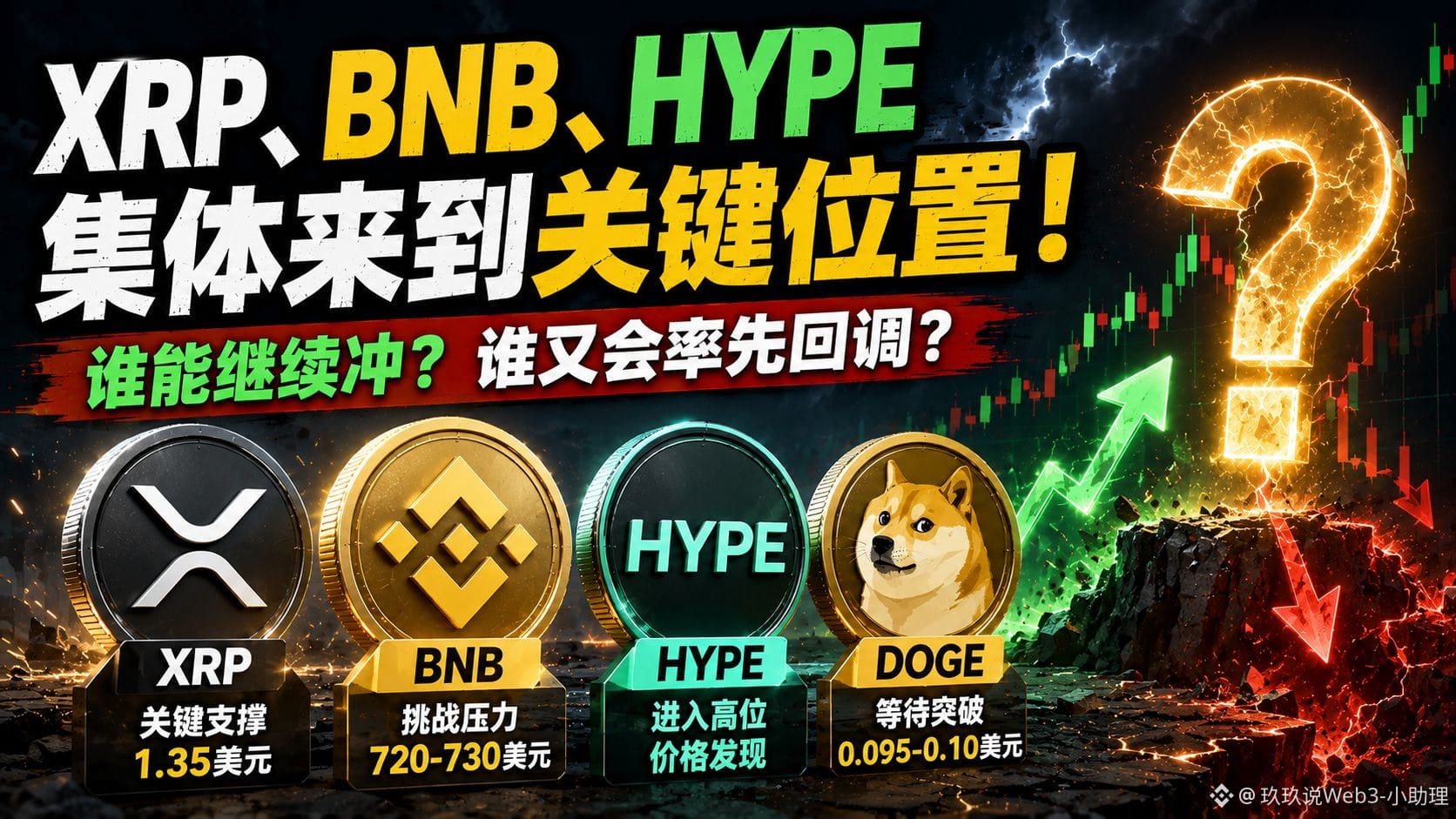
🚨 XRP Ledger breaks through 5 billion transactions! Are the real moves just beginning?
Group: 点击加入玖玖的粉丝群
The XRP Ledger (XRPL) has reached an important milestone: its cumulative transaction volume has officially surpassed 5 billion. Since going live in 2012, XRPL has been running steadily for 14 years. It initially focused on fast, low-cost payment settlement; today, its evolution is no longer just about “transfers.”
📈 Data shows that AI agent payments on XRPL have already exceeded 2.3 million transactions. The on-chain tokenized real-world assets total is around $4.05 billion, and the number of network accounts has also surpassed 8 million.
On the other side, institutional capital is starting to flow into this ecosystem as well. The U.S. spot XRP ETF currently holds assets worth about $1.4 billion, and Mastercard has also officially sponsored the XRPL hackathon.
This means that XRPL is gradually expanding from a pure payment network into multiple areas such as AI payments, asset tokenization, and institutional finance. 5 billion transactions is just a number—but what truly matters is what comes next: can these new application scenarios continue to generate real network demand?
The story of XRP may be entering a new phase. 👀
Click the avatar to watch the livestream + join the Jiujiu chat group to get daily strategies 🚀
#xrp #XRPL #etf #RWA
Group: 点击加入玖玖的粉丝群
The XRP Ledger (XRPL) has reached an important milestone: its cumulative transaction volume has officially surpassed 5 billion. Since going live in 2012, XRPL has been running steadily for 14 years. It initially focused on fast, low-cost payment settlement; today, its evolution is no longer just about “transfers.”
📈 Data shows that AI agent payments on XRPL have already exceeded 2.3 million transactions. The on-chain tokenized real-world assets total is around $4.05 billion, and the number of network accounts has also surpassed 8 million.
On the other side, institutional capital is starting to flow into this ecosystem as well. The U.S. spot XRP ETF currently holds assets worth about $1.4 billion, and Mastercard has also officially sponsored the XRPL hackathon.
This means that XRPL is gradually expanding from a pure payment network into multiple areas such as AI payments, asset tokenization, and institutional finance. 5 billion transactions is just a number—but what truly matters is what comes next: can these new application scenarios continue to generate real network demand?
The story of XRP may be entering a new phase. 👀
Click the avatar to watch the livestream + join the Jiujiu chat group to get daily strategies 🚀
#xrp #XRPL #etf #RWA
🚨XRP sees new developments! Evernorth is getting closer to Nasdaq
Group: 点击进入玖玖的粉丝群
Evernorth has just announced that its S-4 registration statement has become effective, meaning the company has taken another key step toward its plan to list on the public market. 👀
In simple terms, in the future, investors may be able to gain indirect exposure to XRP through a publicly listed company—without needing to directly hold XRP. Evernorth’s plan is to use XRP as its core asset, while investing in related infrastructure, and continually increasing the XRP value represented per share through capital management.
However, the fact that the S-4 has become effective this time does not mean the entire transaction is already completed, nor does it mean regulators have “endorsed” XRP. Next, shareholder voting and other closing conditions are still required. What the market is truly focused on is this: if Evernorth ultimately completes the merger and enters the public market, will it open a new channel for institutional capital into XRP? 🔥
On the other hand, the model of a single-asset treasury company is also being tested by the market. Over the past period, many similar companies have faced issues such as asset shrinkage and declining valuations.
So while this is an important development for XRP, the real test may only be just beginning.
Next, the key focus is the shareholder vote on September 30, and whether the final transaction can be completed smoothly. 🚀
Click to join the Jiujiu chat group for daily strategy 🚀
#xrp #rippl #SEC
Group: 点击进入玖玖的粉丝群
Evernorth has just announced that its S-4 registration statement has become effective, meaning the company has taken another key step toward its plan to list on the public market. 👀
In simple terms, in the future, investors may be able to gain indirect exposure to XRP through a publicly listed company—without needing to directly hold XRP. Evernorth’s plan is to use XRP as its core asset, while investing in related infrastructure, and continually increasing the XRP value represented per share through capital management.
However, the fact that the S-4 has become effective this time does not mean the entire transaction is already completed, nor does it mean regulators have “endorsed” XRP. Next, shareholder voting and other closing conditions are still required. What the market is truly focused on is this: if Evernorth ultimately completes the merger and enters the public market, will it open a new channel for institutional capital into XRP? 🔥
On the other hand, the model of a single-asset treasury company is also being tested by the market. Over the past period, many similar companies have faced issues such as asset shrinkage and declining valuations.
So while this is an important development for XRP, the real test may only be just beginning.
Next, the key focus is the shareholder vote on September 30, and whether the final transaction can be completed smoothly. 🚀
Click to join the Jiujiu chat group for daily strategy 🚀
#xrp #rippl #SEC
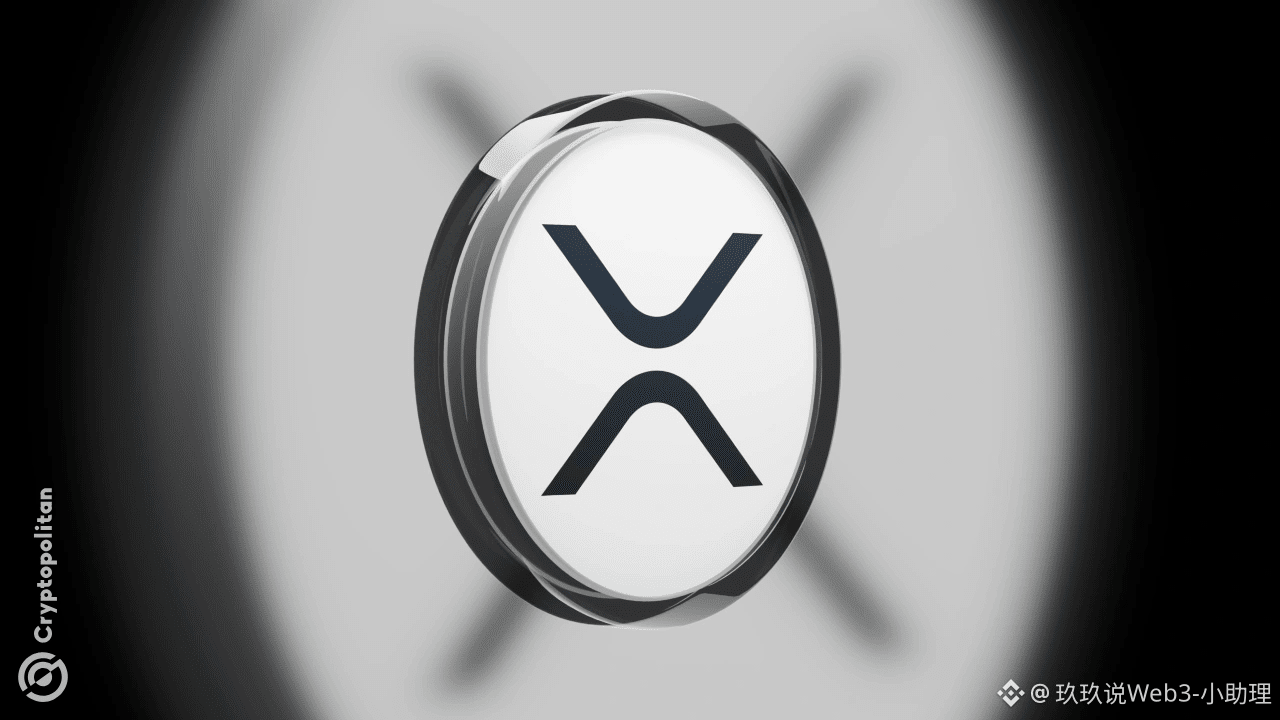
🚨 Ripple CEO’s one-liner sparks controversy:
Will 99% of cryptocurrencies ultimately disappear?
Group: 点击加入玖玖的粉丝群
Recently, the XRP community once again dug up a past remark by Ripple CEO Brad Garlinghouse. His judgment was very direct: in the future, most cryptocurrencies may fail.
He even once gave an extremely exaggerated figure—99% of cryptocurrencies could eventually go to zero.
But the key point isn’t “the entire crypto market will vanish,” but that many projects themselves may not have any real long-term reason to exist.
In Garlinghouse’s view, the core condition for a project to truly remain is practical value.
That is, what determines whether a project can survive in the future may not be just hype, narratives, or short-term capital driving it, but whether it has real users, real demand, and whether it can solve real-world problems. This also explains why John Squire continues to be bullish on XRP.
His logic is simple 👇
If the market really goes through a major round of mass elimination, then projects with only stories and no practical applications may find it increasingly hard to survive.
Whereas projects that genuinely have use cases—such as payments, cross-border transfers, and financial infrastructure—may, in theory, have a longer lifecycle.
Of course, this doesn’t mean XRP is definitely going to rise.
Garlinghouse’s remarks didn’t provide any specific price prediction by themselves.
But this viewpoint does raise a question worth thinking about for the market:
If 99% of projects really get eliminated in the future, then who will be left? 👀
In the next round of competition, it may not be just “whose story is told better.”
It may be—who truly has people using it, and who can live longer.
Click the avatar to watch the live stream + join the chat group to get daily strategies 🚀
#xrp #Ripple
Will 99% of cryptocurrencies ultimately disappear?
Group: 点击加入玖玖的粉丝群
Recently, the XRP community once again dug up a past remark by Ripple CEO Brad Garlinghouse. His judgment was very direct: in the future, most cryptocurrencies may fail.
He even once gave an extremely exaggerated figure—99% of cryptocurrencies could eventually go to zero.
But the key point isn’t “the entire crypto market will vanish,” but that many projects themselves may not have any real long-term reason to exist.
In Garlinghouse’s view, the core condition for a project to truly remain is practical value.
That is, what determines whether a project can survive in the future may not be just hype, narratives, or short-term capital driving it, but whether it has real users, real demand, and whether it can solve real-world problems. This also explains why John Squire continues to be bullish on XRP.
His logic is simple 👇
If the market really goes through a major round of mass elimination, then projects with only stories and no practical applications may find it increasingly hard to survive.
Whereas projects that genuinely have use cases—such as payments, cross-border transfers, and financial infrastructure—may, in theory, have a longer lifecycle.
Of course, this doesn’t mean XRP is definitely going to rise.
Garlinghouse’s remarks didn’t provide any specific price prediction by themselves.
But this viewpoint does raise a question worth thinking about for the market:
If 99% of projects really get eliminated in the future, then who will be left? 👀
In the next round of competition, it may not be just “whose story is told better.”
It may be—who truly has people using it, and who can live longer.
Click the avatar to watch the live stream + join the chat group to get daily strategies 🚀
#xrp #Ripple
🚨 Sam Altman makes a bold claim:
By the end of 2026, could OpenAI’s internal team give birth to AGI?
Group: 点击加入玖玖的粉丝群
Recently, Sam Altman has once again floated a prediction significant enough to shake people up.
He said that by the end of 2026, OpenAI may have internally developed a system he would call “general artificial intelligence (AGI).”
But the key point is this—OpenAI itself also admits that it hasn’t truly crossed that line yet.
Even Mark Chen, OpenAI’s head of research, made an extremely audacious assessment: they may have already achieved 80% of the goal of implementing AGI. And the core of what the market is paying close attention to this time is a new model series called Astra.
According to reports, Astra is no longer just about answering questions—it can carry out complex tasks for extended periods of time. Multiple AI agents can divide work, coordinate with each other, solve research-level mathematics problems; it can also use computer software, write code, run experiments, and complete some tasks that would normally take junior researchers several days to finish.
But the next stage of AI may begin to turn into real “virtual coworkers” that can work independently.
It can take on tasks, break them down, execute them, and even continue pushing forward to the next step based on the results.
If these capabilities keep improving, the scariest part of AI might not be replacing a single job, but starting to participate in “R&D for the next generation of AI.”
This is also the imagination space the market is most focused on: will AI enter the so-called “recursive improvement” phase?
In simple terms, AI helps humans develop stronger AI, and stronger AI further accelerates the next round of R&D. Once this loop truly takes shape, the pace of technological progress could become faster than we currently imagine.📈
Of course, there are still many questions OpenAI needs to answer before it can truly announce AGI.
Astra’s capabilities currently rely mainly on internal descriptions; there’s no complete publicly available testing, and no independent institution has conducted comprehensive verification. More importantly, how AGI should be defined—up to now, the world still hasn’t reached a unified answer. So Sam Altman’s remarks are more like a very bold preview of a timeline, rather than proof that “AGI has officially arrived.”
Click the avatar to watch the livestream + join the Jiujiu chat group for daily strategies 🚀
#人工智能 #OpenAI #AGI
By the end of 2026, could OpenAI’s internal team give birth to AGI?
Group: 点击加入玖玖的粉丝群
Recently, Sam Altman has once again floated a prediction significant enough to shake people up.
He said that by the end of 2026, OpenAI may have internally developed a system he would call “general artificial intelligence (AGI).”
But the key point is this—OpenAI itself also admits that it hasn’t truly crossed that line yet.
Even Mark Chen, OpenAI’s head of research, made an extremely audacious assessment: they may have already achieved 80% of the goal of implementing AGI. And the core of what the market is paying close attention to this time is a new model series called Astra.
According to reports, Astra is no longer just about answering questions—it can carry out complex tasks for extended periods of time. Multiple AI agents can divide work, coordinate with each other, solve research-level mathematics problems; it can also use computer software, write code, run experiments, and complete some tasks that would normally take junior researchers several days to finish.
But the next stage of AI may begin to turn into real “virtual coworkers” that can work independently.
It can take on tasks, break them down, execute them, and even continue pushing forward to the next step based on the results.
If these capabilities keep improving, the scariest part of AI might not be replacing a single job, but starting to participate in “R&D for the next generation of AI.”
This is also the imagination space the market is most focused on: will AI enter the so-called “recursive improvement” phase?
In simple terms, AI helps humans develop stronger AI, and stronger AI further accelerates the next round of R&D. Once this loop truly takes shape, the pace of technological progress could become faster than we currently imagine.📈
Of course, there are still many questions OpenAI needs to answer before it can truly announce AGI.
Astra’s capabilities currently rely mainly on internal descriptions; there’s no complete publicly available testing, and no independent institution has conducted comprehensive verification. More importantly, how AGI should be defined—up to now, the world still hasn’t reached a unified answer. So Sam Altman’s remarks are more like a very bold preview of a timeline, rather than proof that “AGI has officially arrived.”
Click the avatar to watch the livestream + join the Jiujiu chat group for daily strategies 🚀
#人工智能 #OpenAI #AGI

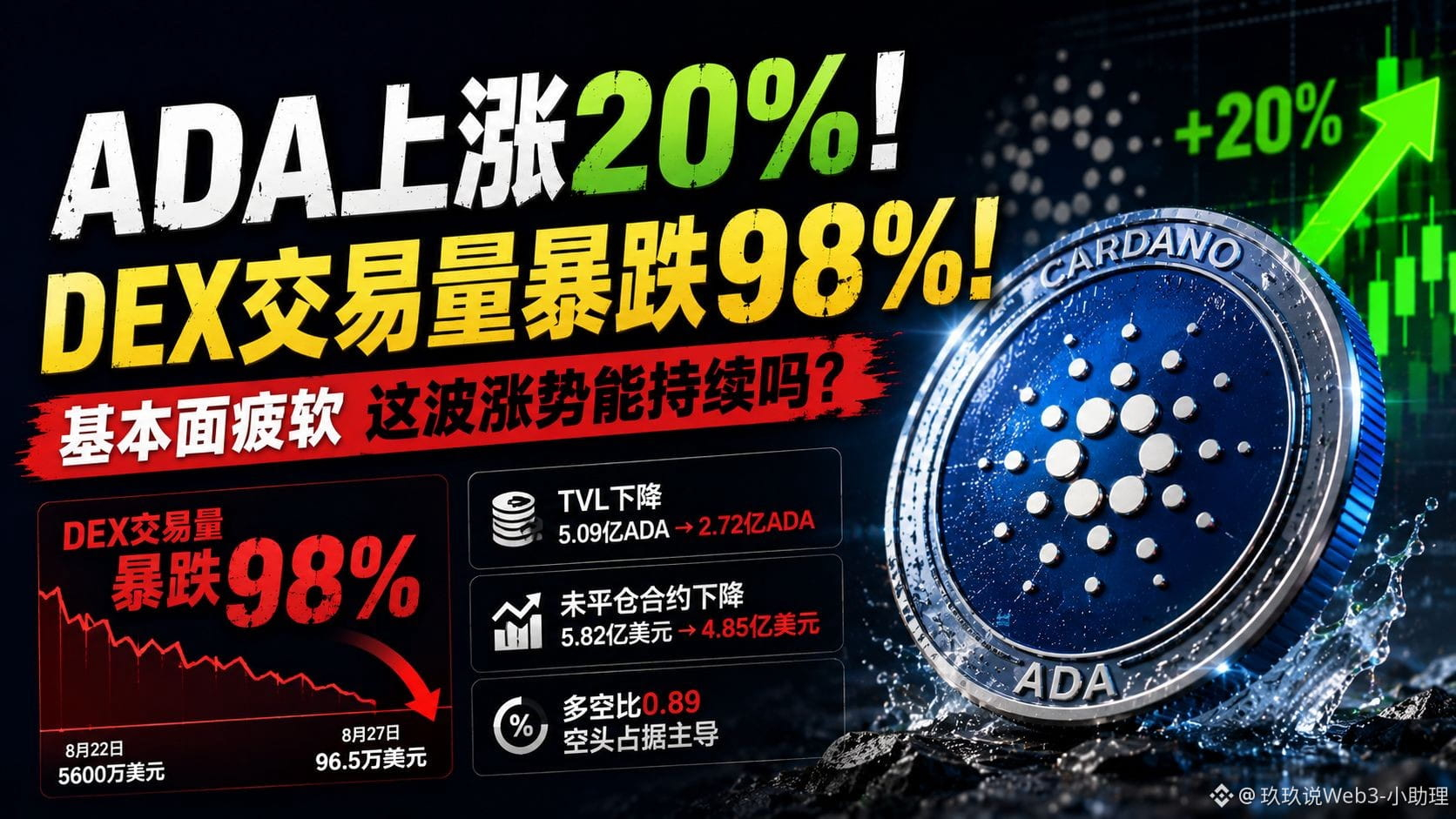
🚨 ADA rose 20%, but one data point crashed by 98%!
Group: 点击加入玖玖的粉丝群
ADA has surged more than 20% recently over the past 7 days, and the trend looks quite strong—yet on-chain data shows a very clear contrast. Cardano’s DEX trading volume dropped from $56 million on August 22 to about $965,000 in just 5 days, a decrease of as much as 98%! 😳
Not only that, Cardano’s TVL has continued to decline as well. Derivatives open interest fell from $582 million to $485 million, suggesting that market participation may be weakening. This raises an important question: when prices rise, is it truly because funds are flowing back—or is it just a rebound driven by overall market sentiment? 🤔
Some analysts even believe that, without any obvious improvement in fundamentals, this kind of rally may be prone to a pullback. Currently, ADA is still within an upward channel. In the short term, the market is focused on resistance around $0.24, while $0.19 is becoming an important support zone.
Next, the most critical factor for ADA isn’t just whether it can keep rising—it’s whether network activity can return. After all, if prices rise but on-chain data keeps weakening, this divergence is something the market should take seriously. 👀
Click the profile picture to watch the live stream + join the chat group to get daily strategies 🚀
#ADA #Cardano
Group: 点击加入玖玖的粉丝群
ADA has surged more than 20% recently over the past 7 days, and the trend looks quite strong—yet on-chain data shows a very clear contrast. Cardano’s DEX trading volume dropped from $56 million on August 22 to about $965,000 in just 5 days, a decrease of as much as 98%! 😳
Not only that, Cardano’s TVL has continued to decline as well. Derivatives open interest fell from $582 million to $485 million, suggesting that market participation may be weakening. This raises an important question: when prices rise, is it truly because funds are flowing back—or is it just a rebound driven by overall market sentiment? 🤔
Some analysts even believe that, without any obvious improvement in fundamentals, this kind of rally may be prone to a pullback. Currently, ADA is still within an upward channel. In the short term, the market is focused on resistance around $0.24, while $0.19 is becoming an important support zone.
Next, the most critical factor for ADA isn’t just whether it can keep rising—it’s whether network activity can return. After all, if prices rise but on-chain data keeps weakening, this divergence is something the market should take seriously. 👀
Click the profile picture to watch the live stream + join the chat group to get daily strategies 🚀
#ADA #Cardano
🚨 Nvidia’s earnings blew the roof off! Did Bitcoin get carried too?
Group: 点击加入玖玖的粉丝群
This time, Nvidia’s earnings once again beat market expectations. Quarterly revenue reached $96.2 billion, higher than the market’s forecast of about $92.3 billion. Guidance for the next quarter is even higher at $108.0 billion.
After the news broke, Nvidia jumped about 8% in pre-market trading, and tech stocks surged across the board. Companies related to AI infrastructure also rose along with the broader move. What’s even more worth paying attention to in the crypto space is that Bitcoin (the big one) also rebounded in sync, again challenging the $80,000 level.
What this really shows is that the market logic is becoming clearer: the linkage between AI, tech stocks, computing power, and risk assets is strengthening.
Nvidia’s management expects that FY2028 revenue could still grow by around 70%. They also said that future demand for computing power will remain enormous, and supply could continue to be a limiting factor.
So what the market is focused on this time is not just “one earnings report beating expectations.”
The real question is: has the AI boom really ended?
From the current picture, the answer may not be that simple yet. If tech stocks strengthen again and market risk appetite picks up, Bitcoin and the entire crypto market could continue to be driven by sentiment.
Next, key points to watch: whether Nvidia’s rally can sustain, and whether Bitcoin can truly hold above $80,000.
Click the avatar to watch the live stream + join the Jiujiu chat group to get daily strategies 🚀
#英伟达 #Aİ #BTC
Group: 点击加入玖玖的粉丝群
This time, Nvidia’s earnings once again beat market expectations. Quarterly revenue reached $96.2 billion, higher than the market’s forecast of about $92.3 billion. Guidance for the next quarter is even higher at $108.0 billion.
After the news broke, Nvidia jumped about 8% in pre-market trading, and tech stocks surged across the board. Companies related to AI infrastructure also rose along with the broader move. What’s even more worth paying attention to in the crypto space is that Bitcoin (the big one) also rebounded in sync, again challenging the $80,000 level.
What this really shows is that the market logic is becoming clearer: the linkage between AI, tech stocks, computing power, and risk assets is strengthening.
Nvidia’s management expects that FY2028 revenue could still grow by around 70%. They also said that future demand for computing power will remain enormous, and supply could continue to be a limiting factor.
So what the market is focused on this time is not just “one earnings report beating expectations.”
The real question is: has the AI boom really ended?
From the current picture, the answer may not be that simple yet. If tech stocks strengthen again and market risk appetite picks up, Bitcoin and the entire crypto market could continue to be driven by sentiment.
Next, key points to watch: whether Nvidia’s rally can sustain, and whether Bitcoin can truly hold above $80,000.
Click the avatar to watch the live stream + join the Jiujiu chat group to get daily strategies 🚀
#英伟达 #Aİ #BTC

Verified
🚨Mastercard suddenly steps in! What XRP is watching this time may not be just the price!
Group: 点击加入玖玖的粉丝群
Recently, XRP’s ecosystem has seen two new developments worth paying attention to.
On one side, the traditional payments giant Mastercard has announced it will sponsor an upcoming XRP Ledger hackathon. On the other, 21Shares has also updated the pricing benchmark and fee structure of its XRP ETF.
It looks like two separate pieces of news, but behind the scenes they point to the same direction: XRP is continuously trying to enter bigger payments and financial systems. 👀 Let’s look at Mastercard first. The XRP Ledger Foundation announced that Mastercard will become the official sponsor of the XRP Ledger hackathon. The event will be held in late October, followed immediately by Ripple Swell 2026.
This event is mainly aimed at developers, encouraging them to build more payment-focused applications based on the XRP Ledger.
The key point isn’t as simple as “sponsoring an event.” Mastercard itself is a major participant in the global payments ecosystem, and the direction that XRP Ledger has long emphasized is also cross-border payments and settlement.
Now, a mainstream payments giant is directly engaging with the XRP Ledger ecosystem—at the very least, it suggests that this ecosystem is drawing attention from more traditional financial institutions.
Meanwhile, on the other side, new changes are also appearing in the XRP ETF market.
21Shares has updated the pricing benchmark for its XRP ETF and adjusted how fund fees are paid. One especially notable change is that, going forward, the related fees will be settled directly using XRP.
This means the ETF is not only “tracking” XRP—part of the fund’s own operations will also begin to use XRP directly.
At the same time, overall capital inflows into the XRP ETF market are increasing.
In the past few days, related ETFs have continued to see inflows, and market attention to regulated XRP products has clearly risen. 📈 But there’s also an important split here.
21Shares’ TOXR’s cumulative inflow performance is still relatively weak, while some leading XRP ETFs have attracted more capital.
This shows that the market isn’t “all XRP ETFs are pulling in money.”
Capital is concentrating.
Click the avatar to watch the live stream + join the chat group for daily strategies 🚀
#xrp #ETF #Ripple
Group: 点击加入玖玖的粉丝群
Recently, XRP’s ecosystem has seen two new developments worth paying attention to.
On one side, the traditional payments giant Mastercard has announced it will sponsor an upcoming XRP Ledger hackathon. On the other, 21Shares has also updated the pricing benchmark and fee structure of its XRP ETF.
It looks like two separate pieces of news, but behind the scenes they point to the same direction: XRP is continuously trying to enter bigger payments and financial systems. 👀 Let’s look at Mastercard first. The XRP Ledger Foundation announced that Mastercard will become the official sponsor of the XRP Ledger hackathon. The event will be held in late October, followed immediately by Ripple Swell 2026.
This event is mainly aimed at developers, encouraging them to build more payment-focused applications based on the XRP Ledger.
The key point isn’t as simple as “sponsoring an event.” Mastercard itself is a major participant in the global payments ecosystem, and the direction that XRP Ledger has long emphasized is also cross-border payments and settlement.
Now, a mainstream payments giant is directly engaging with the XRP Ledger ecosystem—at the very least, it suggests that this ecosystem is drawing attention from more traditional financial institutions.
Meanwhile, on the other side, new changes are also appearing in the XRP ETF market.
21Shares has updated the pricing benchmark for its XRP ETF and adjusted how fund fees are paid. One especially notable change is that, going forward, the related fees will be settled directly using XRP.
This means the ETF is not only “tracking” XRP—part of the fund’s own operations will also begin to use XRP directly.
At the same time, overall capital inflows into the XRP ETF market are increasing.
In the past few days, related ETFs have continued to see inflows, and market attention to regulated XRP products has clearly risen. 📈 But there’s also an important split here.
21Shares’ TOXR’s cumulative inflow performance is still relatively weak, while some leading XRP ETFs have attracted more capital.
This shows that the market isn’t “all XRP ETFs are pulling in money.”
Capital is concentrating.
Click the avatar to watch the live stream + join the chat group for daily strategies 🚀
#xrp #ETF #Ripple

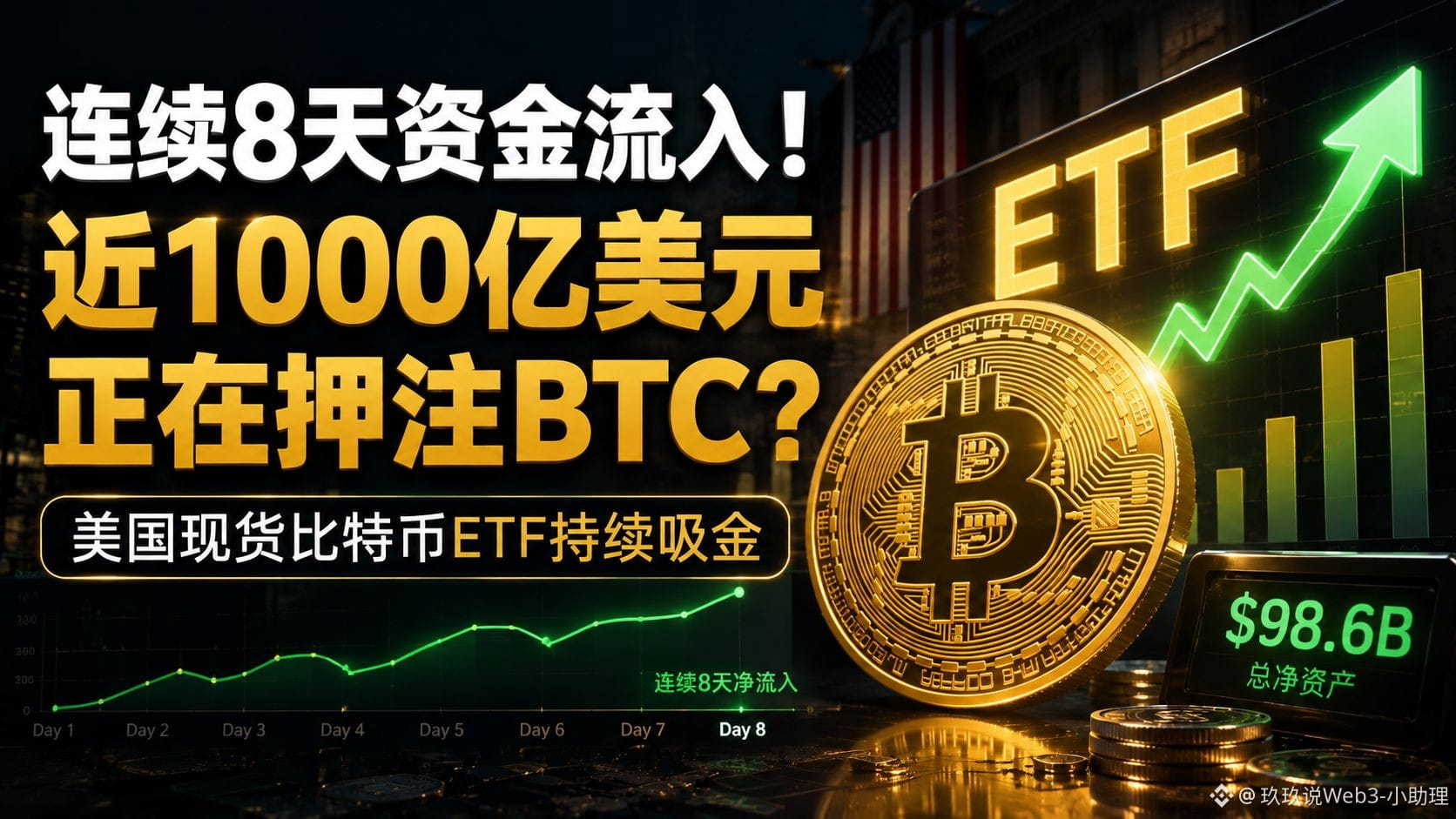
🚨8 Consecutive Days of Inflows! Nearly $100 Billion Is Betting on BTC?
Group: 点击加入玖玖的粉丝群
BTC’s recent price hasn’t surged wildly, but the capital side has released a noteworthy signal. U.S. spot BTC ETFs have recorded net inflows for 8 straight trading days. The latest data shows the latest single-day net inflow reached $232.1 million. Although it slowed compared with the previous day’s $314.4 million, the streak of inflows remains unbroken.
More importantly, over these 8 days, the cumulative inflow has totaled about $2.8 billion. As of now, the total net assets of U.S. spot BTC ETFs are already $98.6 billion—just one step away from $100 billion. 👀 Many people may only focus on whether BTC is up or down today, but for the current market, ETF capital flows may be more worth paying attention to than short-term price fluctuations.
Because prices can be driven by sentiment over a short time, but sustained inflows often indicate that there is still steady demand behind the scenes. Although BTC has at one point broken above $80,000, it has since slipped back into consolidation and is currently hovering around $78,000. Here’s where things get interesting.
The price begins to cool off, but ETF capital doesn’t immediately switch to outflows.
This suggests some funds may not have exited due to short-term volatility; instead, they may still be continuously entering the market. Of course, ETF inflows alone can’t determine BTC’s next move.
But if capital continues to maintain net inflows, and the market can gradually absorb near-term selling pressure, then this could become an important foundation for the market to look for its next direction. 📈
And it seems the capital’s focus is not just on BTC anymore. Spot ETH ETFs have also recorded net inflows for 8 consecutive days, with daily inflows approaching $200 million. XRP ETFs have also seen comparatively more noticeable inflows recently. This indicates a trend: market capital may be shifting from focusing solely on BTC to gradually seeking more opportunities.
Click the avatar to watch the live stream + join the chat group for daily strategies 🚀
#BTC #etf
Group: 点击加入玖玖的粉丝群
BTC’s recent price hasn’t surged wildly, but the capital side has released a noteworthy signal. U.S. spot BTC ETFs have recorded net inflows for 8 straight trading days. The latest data shows the latest single-day net inflow reached $232.1 million. Although it slowed compared with the previous day’s $314.4 million, the streak of inflows remains unbroken.
More importantly, over these 8 days, the cumulative inflow has totaled about $2.8 billion. As of now, the total net assets of U.S. spot BTC ETFs are already $98.6 billion—just one step away from $100 billion. 👀 Many people may only focus on whether BTC is up or down today, but for the current market, ETF capital flows may be more worth paying attention to than short-term price fluctuations.
Because prices can be driven by sentiment over a short time, but sustained inflows often indicate that there is still steady demand behind the scenes. Although BTC has at one point broken above $80,000, it has since slipped back into consolidation and is currently hovering around $78,000. Here’s where things get interesting.
The price begins to cool off, but ETF capital doesn’t immediately switch to outflows.
This suggests some funds may not have exited due to short-term volatility; instead, they may still be continuously entering the market. Of course, ETF inflows alone can’t determine BTC’s next move.
But if capital continues to maintain net inflows, and the market can gradually absorb near-term selling pressure, then this could become an important foundation for the market to look for its next direction. 📈
And it seems the capital’s focus is not just on BTC anymore. Spot ETH ETFs have also recorded net inflows for 8 consecutive days, with daily inflows approaching $200 million. XRP ETFs have also seen comparatively more noticeable inflows recently. This indicates a trend: market capital may be shifting from focusing solely on BTC to gradually seeking more opportunities.
Click the avatar to watch the live stream + join the chat group for daily strategies 🚀
#BTC #etf
Verified
🚨 Privacy coins are suddenly back! 🚨
ZEC, once “looked down on” by exchanges for years, somehow just got the US’s first spot ETF? 👀
Group: 点击加入玖玖的粉丝群
📈 A very noteworthy shift has recently appeared in the market.
Cash Trust has converted into the United States’ first Zcash spot ETF, code ZCSH, and it has listed on the NYSE Arca. After the news broke, ZEC surged sharply in a short period of time—its highest weekly gain exceeded 66%. The price even temporarily climbed above $850, hitting a multi-year high. 🔥
What’s truly worth paying attention to isn’t only the price jump.
It’s that a “privacy coin” which was once at the center of long-running regulatory controversy has now entered traditional financial markets through the ETF route. In recent years, privacy coins have been one of the most sensitive areas for exchanges and regulators. That’s because the defining feature of these assets is that they can hide transaction information, so they have long faced compliance pressure.
But Zcash and other privacy coins have one important difference.
It uses a “selective privacy” mechanism. Users can choose regular transparent transactions, or they can opt to use privacy technology to conceal transaction information. And the ZCSH ETF itself, in particular, holds ZEC via transparent address custody, allowing the traditional financial system to regulate the fund’s asset flows.
In other words, a very interesting structure is emerging in the market now:
Institutions can hold ZEC through an ETF, while ordinary users can still use Zcash network privacy features. This may also be a key reason why ZEC was the first to open the ETF door. ⚡Even more notable is that changes are also happening within the Zcash network itself.
Data shows that more and more users are starting to use transaction shielding, and the share of private transactions has increased significantly. This suggests that the market is paying renewed attention to ZEC—not just because the ETF brings in short-term capital. It’s also because the “financial privacy” track is returning to the center of discussion.
Click the avatar to watch the livestream + join the Jiujiu chat group to get daily strategies 🚀
#zec #zcash
ZEC, once “looked down on” by exchanges for years, somehow just got the US’s first spot ETF? 👀
Group: 点击加入玖玖的粉丝群
📈 A very noteworthy shift has recently appeared in the market.
Cash Trust has converted into the United States’ first Zcash spot ETF, code ZCSH, and it has listed on the NYSE Arca. After the news broke, ZEC surged sharply in a short period of time—its highest weekly gain exceeded 66%. The price even temporarily climbed above $850, hitting a multi-year high. 🔥
What’s truly worth paying attention to isn’t only the price jump.
It’s that a “privacy coin” which was once at the center of long-running regulatory controversy has now entered traditional financial markets through the ETF route. In recent years, privacy coins have been one of the most sensitive areas for exchanges and regulators. That’s because the defining feature of these assets is that they can hide transaction information, so they have long faced compliance pressure.
But Zcash and other privacy coins have one important difference.
It uses a “selective privacy” mechanism. Users can choose regular transparent transactions, or they can opt to use privacy technology to conceal transaction information. And the ZCSH ETF itself, in particular, holds ZEC via transparent address custody, allowing the traditional financial system to regulate the fund’s asset flows.
In other words, a very interesting structure is emerging in the market now:
Institutions can hold ZEC through an ETF, while ordinary users can still use Zcash network privacy features. This may also be a key reason why ZEC was the first to open the ETF door. ⚡Even more notable is that changes are also happening within the Zcash network itself.
Data shows that more and more users are starting to use transaction shielding, and the share of private transactions has increased significantly. This suggests that the market is paying renewed attention to ZEC—not just because the ETF brings in short-term capital. It’s also because the “financial privacy” track is returning to the center of discussion.
Click the avatar to watch the livestream + join the Jiujiu chat group to get daily strategies 🚀
#zec #zcash
🚨 Is SHIB about to move? The real key might not be the price, but “liquidity”!
Group: 点击加入玖玖的粉丝群
🐕 Recently, SHIB is back in the spotlight of market discussions.
The reason is not complicated: when the entire meme coin sector starts to regain momentum, once funds flow back in, established projects like SHIB—already backed by a massive community and market foundation—often find it easier to attract renewed attention.
In July, the overall size of the meme coin sector reached about $34.7 billion at one point.🔥
What does that mean? Many people think the meme coin market is gone, but in reality, a large amount of capital hasn’t really left the track—it’s just waiting for new sentiment and liquidity. And the biggest feature of meme coins is: when things go quiet, nobody talks about them; once the heat returns, capital can enter very quickly.👀
Judging by the recent market performance, Dogecoin, SHIB, and some small tokens based on dog/cat themes have all started to show activity to varying degrees. Behind this is a change in the market’s risk appetite. When the broader market stabilizes, some funds often start looking for sectors with higher volatility and stronger storytelling. Meme coins are typically one of the places where market sentiment is released fastest.
For SHIB, its biggest advantage isn’t that it’s “new.” Rather, it already has mature brand recognition, a huge community, and relatively high market identifiability.
Once the meme coin sector truly sees a new round of liquidity, where will the funds go first?
More often than not, the market won’t immediately find the smallest project. Instead, it will first return to those old, popular favorites that everyone already knows.
SHIB might be one of them.🐕
However, what truly needs to be kept in mind is that social media hype doesn’t equal a sustained uptrend. For meme coins to form a real trading setup, you must see trading volume, market participation, and continuous inflows of capital all appearing at the same time. If it’s only a brief surge driven by sentiment, and there’s no follow-through from incoming capital, the price can drop just as quickly.
But before capital has truly confirmed that it’s flowing back in, all that heat is still just expectation.
Click the avatar to watch the live stream + join the chat group to get daily strategies 🚀
#SHİB #柴犬币
Group: 点击加入玖玖的粉丝群
🐕 Recently, SHIB is back in the spotlight of market discussions.
The reason is not complicated: when the entire meme coin sector starts to regain momentum, once funds flow back in, established projects like SHIB—already backed by a massive community and market foundation—often find it easier to attract renewed attention.
In July, the overall size of the meme coin sector reached about $34.7 billion at one point.🔥
What does that mean? Many people think the meme coin market is gone, but in reality, a large amount of capital hasn’t really left the track—it’s just waiting for new sentiment and liquidity. And the biggest feature of meme coins is: when things go quiet, nobody talks about them; once the heat returns, capital can enter very quickly.👀
Judging by the recent market performance, Dogecoin, SHIB, and some small tokens based on dog/cat themes have all started to show activity to varying degrees. Behind this is a change in the market’s risk appetite. When the broader market stabilizes, some funds often start looking for sectors with higher volatility and stronger storytelling. Meme coins are typically one of the places where market sentiment is released fastest.
For SHIB, its biggest advantage isn’t that it’s “new.” Rather, it already has mature brand recognition, a huge community, and relatively high market identifiability.
Once the meme coin sector truly sees a new round of liquidity, where will the funds go first?
More often than not, the market won’t immediately find the smallest project. Instead, it will first return to those old, popular favorites that everyone already knows.
SHIB might be one of them.🐕
However, what truly needs to be kept in mind is that social media hype doesn’t equal a sustained uptrend. For meme coins to form a real trading setup, you must see trading volume, market participation, and continuous inflows of capital all appearing at the same time. If it’s only a brief surge driven by sentiment, and there’s no follow-through from incoming capital, the price can drop just as quickly.
But before capital has truly confirmed that it’s flowing back in, all that heat is still just expectation.
Click the avatar to watch the live stream + join the chat group to get daily strategies 🚀
#SHİB #柴犬币
🚨 XRP is trading near $1.45, but the real key is at $1.65!
Group: 点击加入玖玖的粉丝群
📉 The latest XRP is entering a very critical position.
The current price is holding around $1.45, and the market seems relatively calm at first glance, but whale holdings, smart money, and futures data show a clear divergence. The key level that will determine the next direction is $1.65.👀
Based on data from some exchanges, whale long positions are increasing.
Especially on OKX, the whale long ratio is noticeably higher, suggesting that some large funds are positioning themselves early with expectations of an upside move. But on the other side, the market hasn’t fully turned optimistic. Some “smart money” sentiment remains cautious, meaning even though funds are starting to pay attention to XRP, they haven’t formed a unified offensive yet.
This is exactly what’s most worth noting right now.⚡
The market isn’t simply “bullish” or “bearish”—it’s waiting for a true confirmation of direction.🚨 For XRP, $1.65 is the most important watershed level right now.
If the price can break through and hold above this level, the weekly structure may improve further, and expectations for a trend reversal could heat up significantly.
But if repeated attempts fail to break through, the price may fall again to seek support below.
It’s also worth noting that the XRP market has recently seen a clear long liquidation.
On August 22, a large number of long positions were wiped out, which also indicates that leverage in the current market is still high, so short-term volatility may continue to amplify.
So don’t just watch price up or down from here.
What’s even more important to monitor: are open contracts increasing? Are whales continuing to hold longs? Will smart money sentiment shift? If these signals start improving in sync, then a breakout above $1.65 may become truly meaningful.🔥 But if the price still can’t break through for a long time, XRP may test even lower levels again, and then seek a new balance.
Click the avatar to watch the live stream + join the Jiujiu chat group for daily strategies🚀
#xrp #瑞波币
Group: 点击加入玖玖的粉丝群
📉 The latest XRP is entering a very critical position.
The current price is holding around $1.45, and the market seems relatively calm at first glance, but whale holdings, smart money, and futures data show a clear divergence. The key level that will determine the next direction is $1.65.👀
Based on data from some exchanges, whale long positions are increasing.
Especially on OKX, the whale long ratio is noticeably higher, suggesting that some large funds are positioning themselves early with expectations of an upside move. But on the other side, the market hasn’t fully turned optimistic. Some “smart money” sentiment remains cautious, meaning even though funds are starting to pay attention to XRP, they haven’t formed a unified offensive yet.
This is exactly what’s most worth noting right now.⚡
The market isn’t simply “bullish” or “bearish”—it’s waiting for a true confirmation of direction.🚨 For XRP, $1.65 is the most important watershed level right now.
If the price can break through and hold above this level, the weekly structure may improve further, and expectations for a trend reversal could heat up significantly.
But if repeated attempts fail to break through, the price may fall again to seek support below.
It’s also worth noting that the XRP market has recently seen a clear long liquidation.
On August 22, a large number of long positions were wiped out, which also indicates that leverage in the current market is still high, so short-term volatility may continue to amplify.
So don’t just watch price up or down from here.
What’s even more important to monitor: are open contracts increasing? Are whales continuing to hold longs? Will smart money sentiment shift? If these signals start improving in sync, then a breakout above $1.65 may become truly meaningful.🔥 But if the price still can’t break through for a long time, XRP may test even lower levels again, and then seek a new balance.
Click the avatar to watch the live stream + join the Jiujiu chat group for daily strategies🚀
#xrp #瑞波币
🚨 This week in the crypto market, a real “Song of Ice and Fire” is unfolding!
Group: 点击加入玖玖的粉丝群
On one side, institutional funds are surging in wildly.
As of the week of August 21, U.S. spot Bitcoin and Ethereum ETF combined recorded net inflows of about $2.6 billion, the strongest single-week performance since 2026. Among them, Bitcoin ETFs pulled in about $1.9 billion, while Ethereum ETFs also logged nearly $700 million in net inflows.
What does that mean?📈
Market capital is moving back into mainstream assets. And this time, it’s not just price volatility—ETF fund flows and trading activity are heating up in tandem. But on the other side, the on-chain world is sounding the alarm again.⚠️
On August 23, Term Finance disclosed a governance vulnerability incident.
Security firms estimate the losses could be as high as $8.5 million. At one point, the affected vaults reportedly lost more than two-thirds of their funds. Same crypto market, yet completely different pictures are playing out.
On one side, institutions are continuously allocating BTC and ETH through ETFs; on the other, DeFi protocols are suffering major losses due to governance vulnerabilities.
This also reflects an increasingly obvious trend:
Capital hasn’t left the market—it’s simply been reselecting where the “risk” is located.
For traditional institutions, ETFs offer a relatively mature custody and regulatory framework.
While DeFi offers greater openness and room for innovation, the risks in smart contracts, governance mechanisms, and fund security are still unavoidable.
At the same time, U.S. regulators are also beginning to focus on on-chain vaults and lending strategies.
In the future, the market may not be as simple as “Will BTC go up or will ETH go up?”
The real competition may gradually become:
Who can provide safer asset custody? Who can reduce on-chain risk? And who can strike a balance between regulation and innovation?👀
Putting these two developments together this week is especially interesting. Institutional capital is accelerating into the market, and the industry itself is also undergoing a reshuffle of security and regulation. Opportunity and risk may have never appeared at the same time like they are now.
Click the avatar to watch the live stream + join the Jiuji chat group to get daily strategies🚀
#BTC #ETH #etf
Group: 点击加入玖玖的粉丝群
On one side, institutional funds are surging in wildly.
As of the week of August 21, U.S. spot Bitcoin and Ethereum ETF combined recorded net inflows of about $2.6 billion, the strongest single-week performance since 2026. Among them, Bitcoin ETFs pulled in about $1.9 billion, while Ethereum ETFs also logged nearly $700 million in net inflows.
What does that mean?📈
Market capital is moving back into mainstream assets. And this time, it’s not just price volatility—ETF fund flows and trading activity are heating up in tandem. But on the other side, the on-chain world is sounding the alarm again.⚠️
On August 23, Term Finance disclosed a governance vulnerability incident.
Security firms estimate the losses could be as high as $8.5 million. At one point, the affected vaults reportedly lost more than two-thirds of their funds. Same crypto market, yet completely different pictures are playing out.
On one side, institutions are continuously allocating BTC and ETH through ETFs; on the other, DeFi protocols are suffering major losses due to governance vulnerabilities.
This also reflects an increasingly obvious trend:
Capital hasn’t left the market—it’s simply been reselecting where the “risk” is located.
For traditional institutions, ETFs offer a relatively mature custody and regulatory framework.
While DeFi offers greater openness and room for innovation, the risks in smart contracts, governance mechanisms, and fund security are still unavoidable.
At the same time, U.S. regulators are also beginning to focus on on-chain vaults and lending strategies.
In the future, the market may not be as simple as “Will BTC go up or will ETH go up?”
The real competition may gradually become:
Who can provide safer asset custody? Who can reduce on-chain risk? And who can strike a balance between regulation and innovation?👀
Putting these two developments together this week is especially interesting. Institutional capital is accelerating into the market, and the industry itself is also undergoing a reshuffle of security and regulation. Opportunity and risk may have never appeared at the same time like they are now.
Click the avatar to watch the live stream + join the Jiuji chat group to get daily strategies🚀
#BTC #ETH #etf

🚨 Bitcoin Breaks Below $79,000!
XRP Leads the Decline—Has the Market Suddenly Started Pricing in a Fed Rate Hike?
Group: 点击加入玖玖的粉丝群
📉 The market is getting tense again.
Bitcoin briefly fell below $79,000. And what the market is most concerned about isn’t just a short-term dip in “big BTC.” The real pressure comes from the macro environment. The latest data shows that the U.S. July PCE inflation rate hit 3.7%, clearly above the Federal Reserve’s long-term 2% target.
The easing expectations the market originally hoped for may be starting to change.
More and more traders are re-evaluating a question: If inflation refuses to come down, will the Fed tighten policy again? 👀
⚠️ Once the market starts repricing rate-hike expectations, risk assets usually take the first hit.
That’s also why this selloff isn’t only about volatility in BTC.
Among major cryptocurrencies, XRP became one of the weaker performers: its drop was noticeably larger than BTC’s, while other mainstream assets showed a split in performance.
This suggests the market isn’t in a full-scale breakdown right now—it’s more like capital is readjusting its exposure to risk.
📊 Another thing to note is that although the price has pulled back, market sentiment hasn’t fully flipped into panic. The Fear & Greed Index is still in the “greed” zone.
This may mean the market is in a relatively delicate phase:
On one side, prices are starting to retrace;
on the other, some capital hasn’t completely withdrawn.
So what’s truly worth watching next isn’t only whether BTC can reclaim $79,000.
It’s whether macro data will continue to shift market expectations for Fed policy. 🔥
If inflation stays elevated and rate-hike expectations heat up even more, then risk markets—including crypto—may continue to face repricing. But if subsequent data eases, this current drop could also turn out to be just a market shakeout.
Click the avatar to watch the live stream + join the Jiujiu chat group for daily strategies 🚀
#BTC #xrp
XRP Leads the Decline—Has the Market Suddenly Started Pricing in a Fed Rate Hike?
Group: 点击加入玖玖的粉丝群
📉 The market is getting tense again.
Bitcoin briefly fell below $79,000. And what the market is most concerned about isn’t just a short-term dip in “big BTC.” The real pressure comes from the macro environment. The latest data shows that the U.S. July PCE inflation rate hit 3.7%, clearly above the Federal Reserve’s long-term 2% target.
The easing expectations the market originally hoped for may be starting to change.
More and more traders are re-evaluating a question: If inflation refuses to come down, will the Fed tighten policy again? 👀
⚠️ Once the market starts repricing rate-hike expectations, risk assets usually take the first hit.
That’s also why this selloff isn’t only about volatility in BTC.
Among major cryptocurrencies, XRP became one of the weaker performers: its drop was noticeably larger than BTC’s, while other mainstream assets showed a split in performance.
This suggests the market isn’t in a full-scale breakdown right now—it’s more like capital is readjusting its exposure to risk.
📊 Another thing to note is that although the price has pulled back, market sentiment hasn’t fully flipped into panic. The Fear & Greed Index is still in the “greed” zone.
This may mean the market is in a relatively delicate phase:
On one side, prices are starting to retrace;
on the other, some capital hasn’t completely withdrawn.
So what’s truly worth watching next isn’t only whether BTC can reclaim $79,000.
It’s whether macro data will continue to shift market expectations for Fed policy. 🔥
If inflation stays elevated and rate-hike expectations heat up even more, then risk markets—including crypto—may continue to face repricing. But if subsequent data eases, this current drop could also turn out to be just a market shakeout.
Click the avatar to watch the live stream + join the Jiujiu chat group for daily strategies 🚀
#BTC #xrp
🚨 Solana may be heading toward large-scale deflation!
In the next 6 years, 18.9 million fewer SOL will be issued—will $1.5 billion in supply disappear?
Group: 点击加入玖玖的粉丝群
Solana recently has two major proposals under governance voting, and this time the impact isn’t just on network parameters—it’s on the future SOL supply structure. 👀 If the proposals are ultimately approved, the rate of new SOL issuance in the coming years could slow down significantly, while the amount of network transaction fees burned could increase sharply.
The first key proposal is SIMD-0550.
Currently, Solana’s inflation rate gradually declines, and the new plan aims to accelerate that decline by doubling it—raising the deflation speed from the original 15% to 30%. This doesn’t mean that SOL will stop being issued immediately; instead, it would help Solana reach the final long-term inflation level of 1.5% faster.
According to related models, if the proposal is implemented, over the next 6 years Solana could release about 18.9 million fewer SOL than the original issuance schedule. Based on today’s prices, the scale would be close to $1.4–$1.5 billion. 📉 If network demand keeps growing but new supply starts shrinking, the supply-demand structure of SOL could change. However, there’s also an important trade-off here.
Reducing issuance also means staking rewards may decline. According to 21Shares’ model, in the coming years the nominal staking yield for SOL could fall from roughly 5% currently, gradually down to 4%, 3%, and even near 2%. ⚠️ For long-term holders, less new coin supply could be beneficial in reducing sell pressure.
But for validators and institutions that rely on staking yield, the drop in rewards could directly affect revenue. The second proposal, which is even more worth watching, is SIMD-0553.
This plan targets Solana’s transaction fees. In the future, some resource costs may no longer be paid to validators and would instead be directly burned. Based on current network activity levels, the number of SOL burned per day could rise from about 648 to 7,500–9,000. In theory, that’s more than a 10x increase. 🔥
Of course, none of this has truly happened yet.
Even if the governance vote passes, it doesn’t mean the new mechanism will be live immediately.
There will still be code development, testing, validator coordination, and phased deployment ahead.
Click the avatar to watch the livestream + join the Jiuji chat group to get daily strategies 🚀
#sol #solana
In the next 6 years, 18.9 million fewer SOL will be issued—will $1.5 billion in supply disappear?
Group: 点击加入玖玖的粉丝群
Solana recently has two major proposals under governance voting, and this time the impact isn’t just on network parameters—it’s on the future SOL supply structure. 👀 If the proposals are ultimately approved, the rate of new SOL issuance in the coming years could slow down significantly, while the amount of network transaction fees burned could increase sharply.
The first key proposal is SIMD-0550.
Currently, Solana’s inflation rate gradually declines, and the new plan aims to accelerate that decline by doubling it—raising the deflation speed from the original 15% to 30%. This doesn’t mean that SOL will stop being issued immediately; instead, it would help Solana reach the final long-term inflation level of 1.5% faster.
According to related models, if the proposal is implemented, over the next 6 years Solana could release about 18.9 million fewer SOL than the original issuance schedule. Based on today’s prices, the scale would be close to $1.4–$1.5 billion. 📉 If network demand keeps growing but new supply starts shrinking, the supply-demand structure of SOL could change. However, there’s also an important trade-off here.
Reducing issuance also means staking rewards may decline. According to 21Shares’ model, in the coming years the nominal staking yield for SOL could fall from roughly 5% currently, gradually down to 4%, 3%, and even near 2%. ⚠️ For long-term holders, less new coin supply could be beneficial in reducing sell pressure.
But for validators and institutions that rely on staking yield, the drop in rewards could directly affect revenue. The second proposal, which is even more worth watching, is SIMD-0553.
This plan targets Solana’s transaction fees. In the future, some resource costs may no longer be paid to validators and would instead be directly burned. Based on current network activity levels, the number of SOL burned per day could rise from about 648 to 7,500–9,000. In theory, that’s more than a 10x increase. 🔥
Of course, none of this has truly happened yet.
Even if the governance vote passes, it doesn’t mean the new mechanism will be live immediately.
There will still be code development, testing, validator coordination, and phased deployment ahead.
Click the avatar to watch the livestream + join the Jiuji chat group to get daily strategies 🚀
#sol #solana
🚨 Bitcoin has just accomplished something big!
The first “quantum-resistant” transaction has been added to the mainnet—has BTC really started upgrading?
Group: 点击加入玖玖的粉丝群
⚡ Bitcoin has recently seen a new development worth paying attention to.
StarkWare says they have successfully completed, on Bitcoin’s mainnet, a transaction with “quantum-safe” features. The key point is: this isn’t a testnet, and it’s not a simulated exercise in a lab—it’s a real transaction that happened on the actual Bitcoin mainnet.🔥
Why has this sparked such a huge discussion?
Because today’s Bitcoin transactions rely mainly on elliptic curve cryptography to secure assets.
In theory, if quantum computers become strong enough in the future, they could pose challenges to the existing encryption methods.
So developers have been researching a question for years:
🚨 If quantum computing really keeps getting more powerful, how will Bitcoin protect itself?
And what StarkWare demonstrated this time is one possible solution path.
They successfully proved that, without changing Bitcoin’s current consensus rules, it’s possible to construct and complete a transaction with quantum-attack resistance features.👀
However, there’s one crucial thing to note ⚠️ This does not mean Bitcoin has already completed a “quantum-safe upgrade.”
Right now, it’s only a successful mainnet test.
It’s more like a concept validation in a real environment—showing that this technical approach can, in theory, run on the Bitcoin network.
There may still be many issues to resolve before true large-scale adoption, such as:
transaction costs, computational efficiency, wallet compatibility, and whether it can eventually become part of the Bitcoin protocol.
So the truly important part of this isn’t that “Bitcoin will be safe from quantum computing starting tomorrow.”
Instead, it shows the market something:
🔥 Bitcoin is not something that stays unchanged.
In the face of potential new technological risks in the future, developers have already started testing different solutions ahead of time.
Click the avatar to watch the live stream + join the Jiujiu chat group to get daily strategies🚀
#BTC #StarkWare #量子计算
The first “quantum-resistant” transaction has been added to the mainnet—has BTC really started upgrading?
Group: 点击加入玖玖的粉丝群
⚡ Bitcoin has recently seen a new development worth paying attention to.
StarkWare says they have successfully completed, on Bitcoin’s mainnet, a transaction with “quantum-safe” features. The key point is: this isn’t a testnet, and it’s not a simulated exercise in a lab—it’s a real transaction that happened on the actual Bitcoin mainnet.🔥
Why has this sparked such a huge discussion?
Because today’s Bitcoin transactions rely mainly on elliptic curve cryptography to secure assets.
In theory, if quantum computers become strong enough in the future, they could pose challenges to the existing encryption methods.
So developers have been researching a question for years:
🚨 If quantum computing really keeps getting more powerful, how will Bitcoin protect itself?
And what StarkWare demonstrated this time is one possible solution path.
They successfully proved that, without changing Bitcoin’s current consensus rules, it’s possible to construct and complete a transaction with quantum-attack resistance features.👀
However, there’s one crucial thing to note ⚠️ This does not mean Bitcoin has already completed a “quantum-safe upgrade.”
Right now, it’s only a successful mainnet test.
It’s more like a concept validation in a real environment—showing that this technical approach can, in theory, run on the Bitcoin network.
There may still be many issues to resolve before true large-scale adoption, such as:
transaction costs, computational efficiency, wallet compatibility, and whether it can eventually become part of the Bitcoin protocol.
So the truly important part of this isn’t that “Bitcoin will be safe from quantum computing starting tomorrow.”
Instead, it shows the market something:
🔥 Bitcoin is not something that stays unchanged.
In the face of potential new technological risks in the future, developers have already started testing different solutions ahead of time.
Click the avatar to watch the live stream + join the Jiujiu chat group to get daily strategies🚀
#BTC #StarkWare #量子计算

🚨 Have meme coin cycles really returned?
SHIB burns up 441%, while FLOKI and PENGU see collective movement!
Group: 点击加入玖玖的粉丝群
Lately, the meme-coin sector seems to be getting lively again. 🔥
SHIB previously surged by 22%. At the same time, in a 24-hour period, more than 41.8 million SHIB were transferred into wallets that can’t be retrieved, causing a 441% spike in burn activity. With prices rising, network activity picking up, and supply continuing to shrink, many market participants are starting to pay attention to SHIB again.
Meanwhile, FLOKI’s trading activity has also clearly warmed up recently, and PENGU saw a similarly large increase over the previous week. When these well-known names all show up moving at once, the market starts asking a question: could the long-dormant meme-coin sector be entering a new round of capital rotation? 👀
But keep in mind: the biggest feature of meme-coin rallies is—
They rise fast, and volatility is fast too.
An increase in SHIB’s burn amount doesn’t necessarily mean the price will keep going up; the short-term performance of FLOKI and PENGU also still needs to be watched to see whether capital continues to flow in. As for some newly hyped projects and presales that have been getting attention lately, the higher the hype, the easier the risks are often to overlook. Especially information like “white-list countdown,” “presale price,” and “future listing price” can’t simply be equated with future performance.
What’s truly worth watching isn’t how much one meme coin suddenly pumps, but whether the whole sector starts showing consistent inflows.
If multiple projects like SHIB, FLOKI, and PENGU keep staying active, and trading volume plus market discussion continue to heat up, then the rotation signal for the meme-coin sector may become even more obvious. 🐶🐧🚀
Next, who do you think will be the first meme coin to break out in this round?
Tap the avatar to watch the live stream + join the Jiujiu chat group to get daily market hot spots 🚀
#SHİB #floki #pengu
SHIB burns up 441%, while FLOKI and PENGU see collective movement!
Group: 点击加入玖玖的粉丝群
Lately, the meme-coin sector seems to be getting lively again. 🔥
SHIB previously surged by 22%. At the same time, in a 24-hour period, more than 41.8 million SHIB were transferred into wallets that can’t be retrieved, causing a 441% spike in burn activity. With prices rising, network activity picking up, and supply continuing to shrink, many market participants are starting to pay attention to SHIB again.
Meanwhile, FLOKI’s trading activity has also clearly warmed up recently, and PENGU saw a similarly large increase over the previous week. When these well-known names all show up moving at once, the market starts asking a question: could the long-dormant meme-coin sector be entering a new round of capital rotation? 👀
But keep in mind: the biggest feature of meme-coin rallies is—
They rise fast, and volatility is fast too.
An increase in SHIB’s burn amount doesn’t necessarily mean the price will keep going up; the short-term performance of FLOKI and PENGU also still needs to be watched to see whether capital continues to flow in. As for some newly hyped projects and presales that have been getting attention lately, the higher the hype, the easier the risks are often to overlook. Especially information like “white-list countdown,” “presale price,” and “future listing price” can’t simply be equated with future performance.
What’s truly worth watching isn’t how much one meme coin suddenly pumps, but whether the whole sector starts showing consistent inflows.
If multiple projects like SHIB, FLOKI, and PENGU keep staying active, and trading volume plus market discussion continue to heat up, then the rotation signal for the meme-coin sector may become even more obvious. 🐶🐧🚀
Next, who do you think will be the first meme coin to break out in this round?
Tap the avatar to watch the live stream + join the Jiujiu chat group to get daily market hot spots 🚀
#SHİB #floki #pengu
Verified
🚨 HYPE suddenly surges to $83!
HyperEVM revenue breaks $500,000—is the next wave coming?
Group: 点击加入玖玖的粉丝群
📈 HYPE’s recent performance has once again pulled market attention toward the Hyperliquid ecosystem.
Although the price spiked to $83 and then quickly pulled back, it has now returned to around $78. However, this short-term correction hasn’t fully cooled the overall momentum.
What’s more worth watching is that on August 23, HyperEVM’s daily revenue first exceeded $500,000, while the number of trading addresses reached about 25,500—its highest level in nearly a year.🔥
So what does this mean?
HyperEVM’s recent activity is clearly increasing—trading addresses, trading volume, and on-chain transactions are all showing growth.
Data shows that Hyperliquid’s weekly revenue has already surpassed $21 million, the vast majority coming from trading fees. Meanwhile, HyperEVM’s gas fees are also starting to become a new source of income.
Even more importantly, Hyperliquid currently performs public-market buybacks and burns HYPE. In other words, as ecosystem activity rises, income generated from trading increases, which could further influence HYPE’s supply-demand dynamics in the long run.👀
⚡ Another piece of news to watch comes from Elysium.
Kinetiq plans to launch this new Layer 2 network, and HYPE will be used to pay gas fees. If Elysium’s ecosystem can attract more transactions, projects, and users in the future, HYPE’s use cases could expand even further.
Of course, the market also shows a clear signal right now ⚠️
Although HYPE’s rise has been strong in the short term, noticeable sell pressure has already appeared around $83. From a short-term perspective, $78 is an important watch zone. Meanwhile, $80 to $83 remains the overhead pressure area that still needs to break through. So what’s truly worth watching next isn’t just whether the price can spike higher again.
🚨 Can HyperEVM’s trading activity sustain?
Can Elysium bring new ecosystem demand?
Will ecosystem revenue growth genuinely translate into long-term HYPE demand?
If these metrics continue to grow, the story of HYPE may not be over yet.🔥
Click the avatar to watch the live stream + join the Jiujiu chat group for daily strategies 🚀
#hype #Hyperliquid #HyperEVM
HyperEVM revenue breaks $500,000—is the next wave coming?
Group: 点击加入玖玖的粉丝群
📈 HYPE’s recent performance has once again pulled market attention toward the Hyperliquid ecosystem.
Although the price spiked to $83 and then quickly pulled back, it has now returned to around $78. However, this short-term correction hasn’t fully cooled the overall momentum.
What’s more worth watching is that on August 23, HyperEVM’s daily revenue first exceeded $500,000, while the number of trading addresses reached about 25,500—its highest level in nearly a year.🔥
So what does this mean?
HyperEVM’s recent activity is clearly increasing—trading addresses, trading volume, and on-chain transactions are all showing growth.
Data shows that Hyperliquid’s weekly revenue has already surpassed $21 million, the vast majority coming from trading fees. Meanwhile, HyperEVM’s gas fees are also starting to become a new source of income.
Even more importantly, Hyperliquid currently performs public-market buybacks and burns HYPE. In other words, as ecosystem activity rises, income generated from trading increases, which could further influence HYPE’s supply-demand dynamics in the long run.👀
⚡ Another piece of news to watch comes from Elysium.
Kinetiq plans to launch this new Layer 2 network, and HYPE will be used to pay gas fees. If Elysium’s ecosystem can attract more transactions, projects, and users in the future, HYPE’s use cases could expand even further.
Of course, the market also shows a clear signal right now ⚠️
Although HYPE’s rise has been strong in the short term, noticeable sell pressure has already appeared around $83. From a short-term perspective, $78 is an important watch zone. Meanwhile, $80 to $83 remains the overhead pressure area that still needs to break through. So what’s truly worth watching next isn’t just whether the price can spike higher again.
🚨 Can HyperEVM’s trading activity sustain?
Can Elysium bring new ecosystem demand?
Will ecosystem revenue growth genuinely translate into long-term HYPE demand?
If these metrics continue to grow, the story of HYPE may not be over yet.🔥
Click the avatar to watch the live stream + join the Jiujiu chat group for daily strategies 🚀
#hype #Hyperliquid #HyperEVM
Log in to explore more content