
子轩 — Zǐ Xuān
22.4k Posts

子轩 — Zǐ Xuān
2.4K+ Following
27.1K+ Followers
22.5K+ Liked
Posts
All
Quotes
Live
The market is giving mixed signals here. $LAB is under pressure, while $CRCLONBSC and $BTW are holding positive momentum. I would avoid chasing and wait for cleaner entries.
LAB — $0.074665 | -9.47%
Buy Zone: $0.0715–$0.0735
Targets: $0.078 / $0.082 / $0.087
Stop Loss: $0.068
CRCLon — $93.41 | +3.84%
Buy Zone: $90.00–$92.00
Targets: $97 / $102 / $108
Stop Loss: $86
BTW — $0.40989 | +2.32%
Buy Zone: $0.400–$0.407
Targets: $0.420 / $0.435 / $0.455
Stop Loss: $0.385
LAB needs a bounce confirmation after the drop, while CRCLon and BTW are showing better stability. No blind entries—wait for support, watch volume, and keep risk controlled.#RussiaStartsLargeScaleDigitalRubleRolloutSep1 #BitcoinUp23%InAugustOutperformingGoldAndStocks #IranStrikesUSBasesInJordan #SaylorHintsStrategyBitcoinBuy
LAB — $0.074665 | -9.47%
Buy Zone: $0.0715–$0.0735
Targets: $0.078 / $0.082 / $0.087
Stop Loss: $0.068
CRCLon — $93.41 | +3.84%
Buy Zone: $90.00–$92.00
Targets: $97 / $102 / $108
Stop Loss: $86
BTW — $0.40989 | +2.32%
Buy Zone: $0.400–$0.407
Targets: $0.420 / $0.435 / $0.455
Stop Loss: $0.385
LAB needs a bounce confirmation after the drop, while CRCLon and BTW are showing better stability. No blind entries—wait for support, watch volume, and keep risk controlled.#RussiaStartsLargeScaleDigitalRubleRolloutSep1 #BitcoinUp23%InAugustOutperformingGoldAndStocks #IranStrikesUSBasesInJordan #SaylorHintsStrategyBitcoinBuy
LAB👀🙈
CRCLon,👍❤️
BTW,👍💐
18 hr(s) left
These three are moving differently, so I would not treat them the same. My focus is on buying controlled pullbacks instead of chasing green candles.
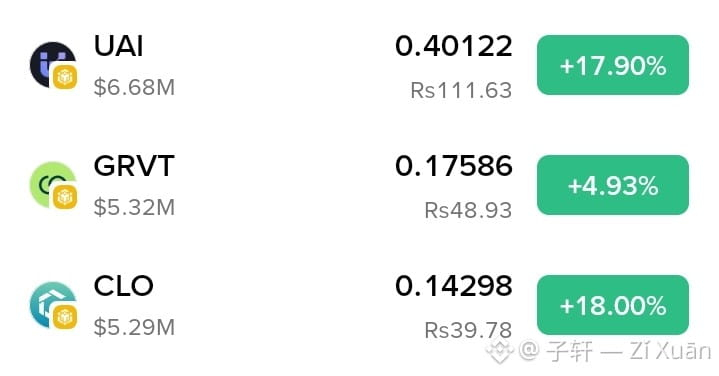
$UAI — $0.40122 | +17.90%
Buy Zone: $0.385–$0.395
Targets: $0.420 / $0.445 / $0.480
Stop Loss: $0.365
$GRVT — $0.17586 | +4.93%
Buy Zone: $0.169–$0.173
Targets: $0.182 / $0.190 / $0.200
Stop Loss: $0.162
$CLO — $0.14298 | +18.00%
Buy Zone: $0.136–$0.141
Targets: $0.150 / $0.160 / $0.175
Stop Loss: $0.128
UAI and CLO have stronger short-term momentum, while GRVT needs a cleaner breakout. Wait for the buy zone, confirm support, and protect capital if the stop breaks.#USStrikesIranianRocketLaunchers #UKReleasesFirstCryptoGainsTaxStats #KospiDrops3.6%AsSamsungSKHynixWeaken #SKHynixStudiesJapanMemoryChipVenture
$UAI — $0.40122 | +17.90%
Buy Zone: $0.385–$0.395
Targets: $0.420 / $0.445 / $0.480
Stop Loss: $0.365
$GRVT — $0.17586 | +4.93%
Buy Zone: $0.169–$0.173
Targets: $0.182 / $0.190 / $0.200
Stop Loss: $0.162
$CLO — $0.14298 | +18.00%
Buy Zone: $0.136–$0.141
Targets: $0.150 / $0.160 / $0.175
Stop Loss: $0.128
UAI and CLO have stronger short-term momentum, while GRVT needs a cleaner breakout. Wait for the buy zone, confirm support, and protect capital if the stop breaks.#USStrikesIranianRocketLaunchers #UKReleasesFirstCryptoGainsTaxStats #KospiDrops3.6%AsSamsungSKHynixWeaken #SKHynixStudiesJapanMemoryChipVenture
The market is moving fast, and these three are still showing strength. But after big moves, I would rather wait for a clean pullback than chase the candle.
$牛来 — $0.11492 | +34.14%
Buy Zone: $0.108–$0.113
Targets: $0.122 / $0.132 / $0.145
Stop Loss: $0.102
$CYS (Cysic) — $0.9682 | +21.36%
Buy Zone: $0.925–$0.950
Targets: $1.02 / $1.10 / $1.20
Stop Loss: $0.885
$UAI (UnifAI Network) — $0.40393 | +18.59%
Buy Zone: $0.385–$0.398
Targets: $0.425 / $0.455 / $0.490
Stop Loss: $0.365
My plan is simple: wait for the buy zone, confirm support and volume, then enter. If stop loss breaks, protect capital and step aside. Momentum is attractive, but risk management comes first.#USStrikesIranianRocketLaunchers #YenBreaks160AgainstDollar #KospiDrops3.6%AsSamsungSKHynixWeaken #SKHynixStudiesJapanMemoryChipVenture
$牛来 — $0.11492 | +34.14%
Buy Zone: $0.108–$0.113
Targets: $0.122 / $0.132 / $0.145
Stop Loss: $0.102
$CYS (Cysic) — $0.9682 | +21.36%
Buy Zone: $0.925–$0.950
Targets: $1.02 / $1.10 / $1.20
Stop Loss: $0.885
$UAI (UnifAI Network) — $0.40393 | +18.59%
Buy Zone: $0.385–$0.398
Targets: $0.425 / $0.455 / $0.490
Stop Loss: $0.365
My plan is simple: wait for the buy zone, confirm support and volume, then enter. If stop loss breaks, protect capital and step aside. Momentum is attractive, but risk management comes first.#USStrikesIranianRocketLaunchers #YenBreaks160AgainstDollar #KospiDrops3.6%AsSamsungSKHynixWeaken #SKHynixStudiesJapanMemoryChipVenture
牛来💪💝💃
CYS🌹💐
UAI❤️💝
9 hr(s) left
#dusk @Dusk
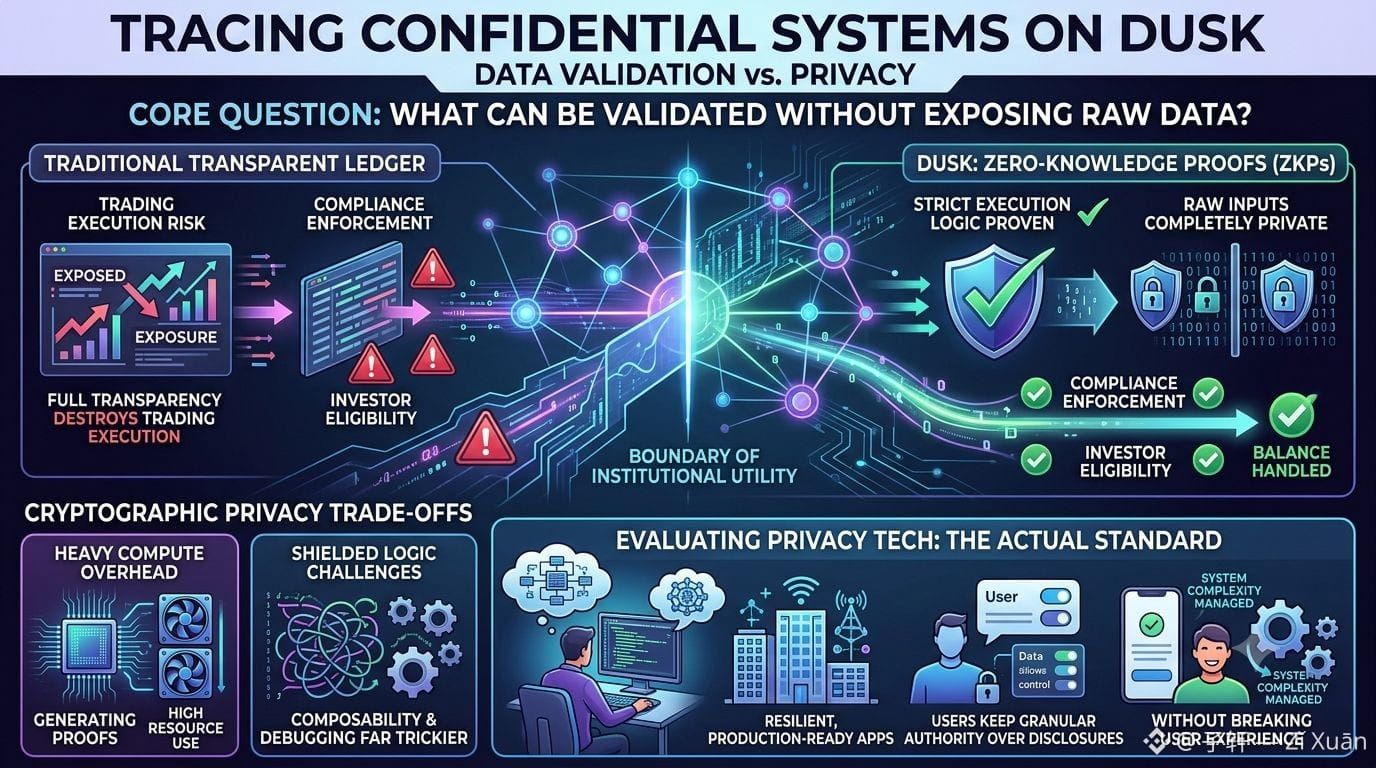
Tracing confidential systems on Dusk shifts the core question from what gets hidden to what can actually be validated without exposing the underlying data
That boundary is where institutional utility lives. A tokenized securities network has to enforce compliance rules, investor eligibility and settlement conditions, but doing that on a fully transparent ledger destroys trading execution through exposure.
Zero knowledge proofs handle this balance well by proving strict execution logic while keeping raw inputs completely private.
However, cryptographic privacy comes with clear trade offs. Generating these proofs adds heavy compute overhead, while shielded logic makes composability and contract debugging far trickier than standard public chains
Evaluating privacy tech goes beyond checking math or cryptographic soundness. The actual standard is whether developers can build resilient, production-ready apps where users keep granular authority over their disclosures without system complexity breaking the user experience.
#dusk @Dusk $DUSK
Tracing confidential systems on Dusk shifts the core question from what gets hidden to what can actually be validated without exposing the underlying data
That boundary is where institutional utility lives. A tokenized securities network has to enforce compliance rules, investor eligibility and settlement conditions, but doing that on a fully transparent ledger destroys trading execution through exposure.
Zero knowledge proofs handle this balance well by proving strict execution logic while keeping raw inputs completely private.
However, cryptographic privacy comes with clear trade offs. Generating these proofs adds heavy compute overhead, while shielded logic makes composability and contract debugging far trickier than standard public chains
Evaluating privacy tech goes beyond checking math or cryptographic soundness. The actual standard is whether developers can build resilient, production-ready apps where users keep granular authority over their disclosures without system complexity breaking the user experience.
#dusk @Dusk $DUSK
$DOS is the strongest mover at $0.3224, up nearly 18%.
Buy Zone: $0.310–$0.318
Targets: $0.335 / $0.350 / $0.370
Stop Loss: $0.298
$AIA is trading near $0.07915 with slower momentum.
Buy Zone: $0.077–$0.0785
Targets: $0.081 / $0.084 / $0.088
Stop Loss: $0.0745
$quq is around $0.001717, showing little movement.
Buy Zone: $0.00168–$0.00171
Targets: $0.00176 / $0.00182 / $0.00190
Stop Loss: $0.00162
My approach: don’t chase green candles. Wait for price to enter the buy zone, confirm support with volume, and keep risk controlled. If the stop breaks, the setup is invalid.#AfghanistanTalibanReportedlyBansCryptoNationwide #VenezuelaUSSign25YearOilDeal #VietnamPilotsCryptoAssetMarket #KoreaSingleStockLeveragedETFTradingFalls
Buy Zone: $0.310–$0.318
Targets: $0.335 / $0.350 / $0.370
Stop Loss: $0.298
$AIA is trading near $0.07915 with slower momentum.
Buy Zone: $0.077–$0.0785
Targets: $0.081 / $0.084 / $0.088
Stop Loss: $0.0745
$quq is around $0.001717, showing little movement.
Buy Zone: $0.00168–$0.00171
Targets: $0.00176 / $0.00182 / $0.00190
Stop Loss: $0.00162
My approach: don’t chase green candles. Wait for price to enter the buy zone, confirm support with volume, and keep risk controlled. If the stop breaks, the setup is invalid.#AfghanistanTalibanReportedlyBansCryptoNationwide #VenezuelaUSSign25YearOilDeal #VietnamPilotsCryptoAssetMarket #KoreaSingleStockLeveragedETFTradingFalls
AIA❤️💃
38%
DOS,💪💖💐
53%
QUQ💝🌹
9%
32 votes • Voting closed
$LAB USDT: Price is strong at 0.08536 (+12.72%). I would avoid chasing the pump.
Buy Zone: 0.0820–0.0845
Targets: 0.0890 / 0.0940 / 0.1000
Stop Loss: 0.0780
$SKHYNIX USDT: Steady momentum at 1,234.70 (+1.75%).
Buy Zone: 1,215–1,230
Targets: 1,255 / 1,280 / 1,310
Stop Loss: 1,185
$DEXE USDT: Weak at 2.341 (-2.54%), so confirmation is important.
Buy Zone: 2.28–2.33
Targets: 2.42 / 2.52 / 2.65
Stop Loss: 2.20
My view: LAB has the strongest momentum, SKHYNIX looks more stable, while DEXE needs reversal confirmation. Don’t chase candles; wait for your zone and manage risk.#KoreaSingleStockLeveragedETFTradingFalls #VenezuelaUSSign25YearOilDeal #VietnamPilotsCryptoAssetMarket #AfghanistanTalibanReportedlyBansCryptoNationwide
Buy Zone: 0.0820–0.0845
Targets: 0.0890 / 0.0940 / 0.1000
Stop Loss: 0.0780
$SKHYNIX USDT: Steady momentum at 1,234.70 (+1.75%).
Buy Zone: 1,215–1,230
Targets: 1,255 / 1,280 / 1,310
Stop Loss: 1,185
$DEXE USDT: Weak at 2.341 (-2.54%), so confirmation is important.
Buy Zone: 2.28–2.33
Targets: 2.42 / 2.52 / 2.65
Stop Loss: 2.20
My view: LAB has the strongest momentum, SKHYNIX looks more stable, while DEXE needs reversal confirmation. Don’t chase candles; wait for your zone and manage risk.#KoreaSingleStockLeveragedETFTradingFalls #VenezuelaUSSign25YearOilDeal #VietnamPilotsCryptoAssetMarket #AfghanistanTalibanReportedlyBansCryptoNationwide
SKHYNIXUSDT, 💝🌹
16%
LABUSDT🌹💪
52%
DEXEUSDT 🙈🚨
32%
84 votes • Voting closed
Today’s three interesting setups have different momentum levels. SK HYNIX has the strongest volume and move, while LAB and DEXE are showing more controlled price action.
$LAB USDT — Buy: 0.0685–0.0702 | Targets: 0.0725 / 0.0750 / 0.0780 | SL: 0.0660
$SKHYNIX USDT — Buy: 1,235–1,255 | Targets: 1,280 / 1,310 / 1,345 | SL: 1,205
$DEXE USDT — Buy: 1.875–1.905 | Targets: 1.950 / 2.020 / 2.100 | SL: 1.825
My preference is to avoid chasing fast candles. Let price come toward the buy zones and look for confirmation. If stop-loss levels break with strong volume, the setup is invalid and risk should be controlled.#IranSaysHormuzOmanDealNotFinalized #NvidiaRises4%OnRevenueBeat #XRPLeadsCryptoPullbackDropsNearly7% #BankOfKoreaHikesRatesTo3%
$LAB USDT — Buy: 0.0685–0.0702 | Targets: 0.0725 / 0.0750 / 0.0780 | SL: 0.0660
$SKHYNIX USDT — Buy: 1,235–1,255 | Targets: 1,280 / 1,310 / 1,345 | SL: 1,205
$DEXE USDT — Buy: 1.875–1.905 | Targets: 1.950 / 2.020 / 2.100 | SL: 1.825
My preference is to avoid chasing fast candles. Let price come toward the buy zones and look for confirmation. If stop-loss levels break with strong volume, the setup is invalid and risk should be controlled.#IranSaysHormuzOmanDealNotFinalized #NvidiaRises4%OnRevenueBeat #XRPLeadsCryptoPullbackDropsNearly7% #BankOfKoreaHikesRatesTo3%
DEXEUSDT,,,🕺🪻
54%
SKHYNIXUSDT, 💝
7%
LABUSDT 💐
39%
82 votes • Voting closed
Verified
#dusk @Dusk
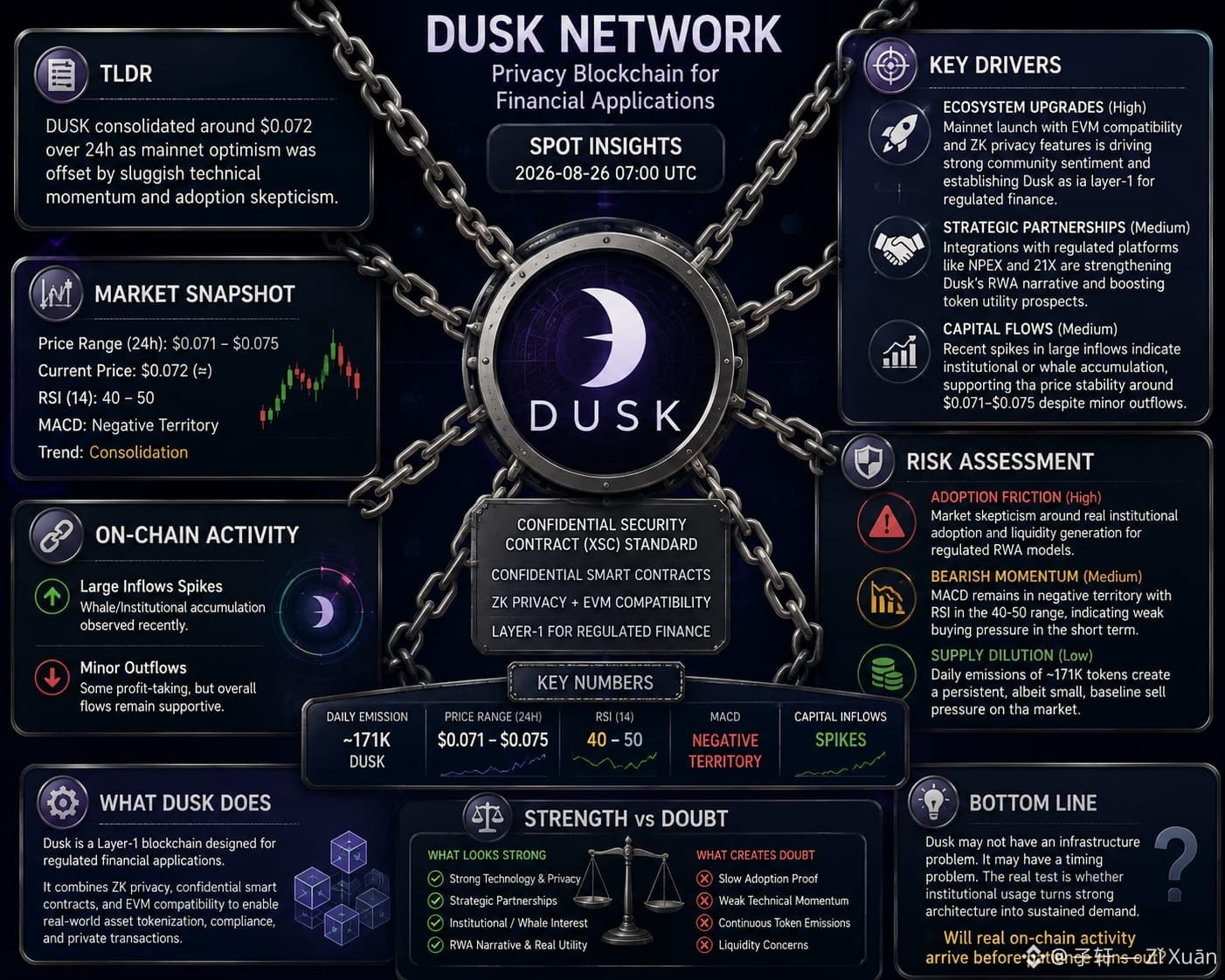
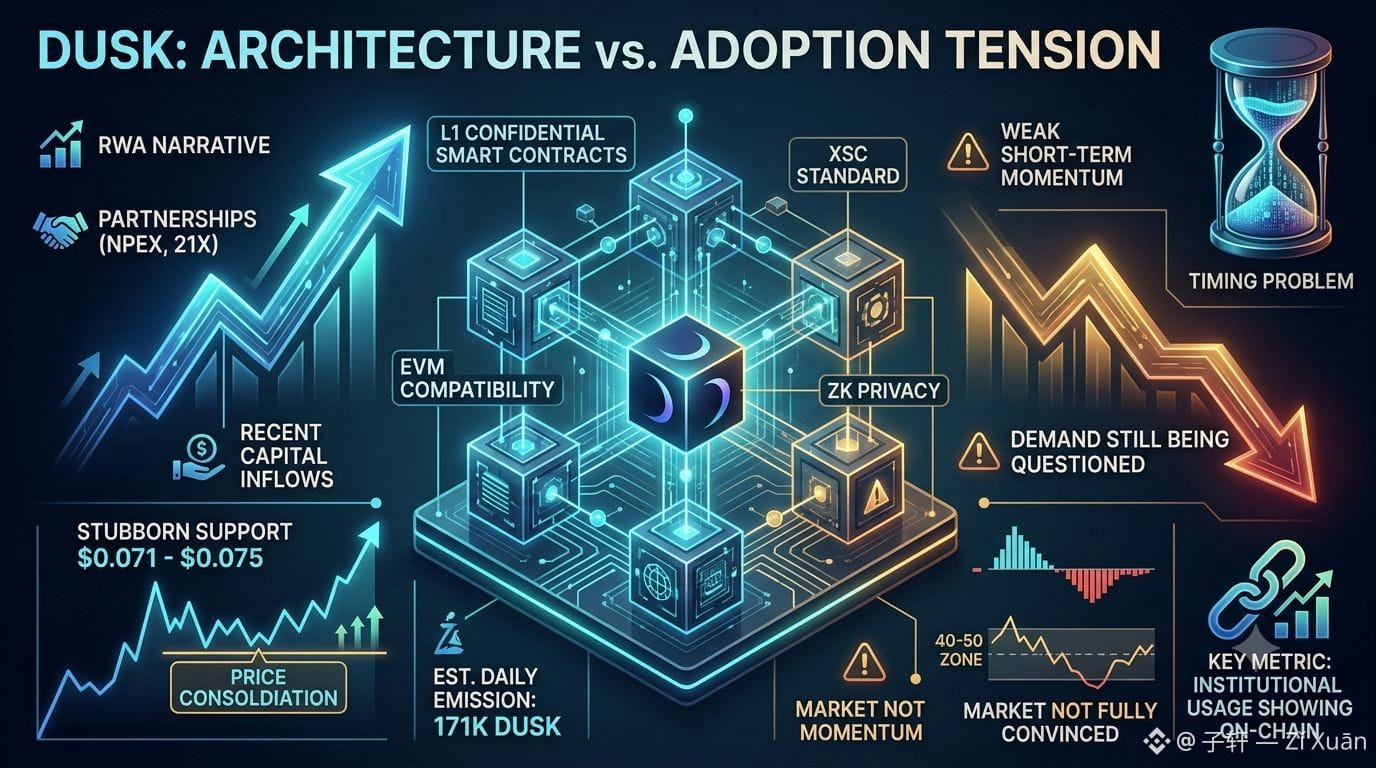
I was looking through the DUSK chart this morning and the price itself wasn’t what caught my attention. It was how stubbornly it has held around the $0.071 $0.075 area despite weak short-term momentum.
Then I noticed the estimated daily emission: roughly 171K DUSK. That is not huge, but it matters when demand is still being questioned
What keeps me interested is the architecture. Dusk is building a Layer-1 around regulated financial applications, with confidential smart contracts and the XSC standard. The newer EVM compatibility and ZK privacy direction make the thesis easier to understand: financial assets may need blockchain settlement without exposing every sensitive detail publicly.
The interesting tension is that the technology story looks stronger than the adoption evidence.
Partnerships and integrations with regulated platforms such as NPEX and 21X help the RWA narrative, while larger capital inflows have supported the recent price range. But MACD remains negative and RSI is still sitting around the 40 50 zone, suggesting the market is not fully convinced yet.
I kept coming back to that contrast.
Dusk may not have an infrastructure problem. It may have a timing problem: how quickly real financial activity turns strong architecture into sustained demand.
For me, that is the metric worth watching next.
Will actual institutional usage start showing up on chain before the market loses patience with the thesis?
#dusk @Dusk $DUSK
I was looking through the DUSK chart this morning and the price itself wasn’t what caught my attention. It was how stubbornly it has held around the $0.071 $0.075 area despite weak short-term momentum.
Then I noticed the estimated daily emission: roughly 171K DUSK. That is not huge, but it matters when demand is still being questioned
What keeps me interested is the architecture. Dusk is building a Layer-1 around regulated financial applications, with confidential smart contracts and the XSC standard. The newer EVM compatibility and ZK privacy direction make the thesis easier to understand: financial assets may need blockchain settlement without exposing every sensitive detail publicly.
The interesting tension is that the technology story looks stronger than the adoption evidence.
Partnerships and integrations with regulated platforms such as NPEX and 21X help the RWA narrative, while larger capital inflows have supported the recent price range. But MACD remains negative and RSI is still sitting around the 40 50 zone, suggesting the market is not fully convinced yet.
I kept coming back to that contrast.
Dusk may not have an infrastructure problem. It may have a timing problem: how quickly real financial activity turns strong architecture into sustained demand.
For me, that is the metric worth watching next.
Will actual institutional usage start showing up on chain before the market loses patience with the thesis?
#dusk @Dusk $DUSK
#dusk @Dusk
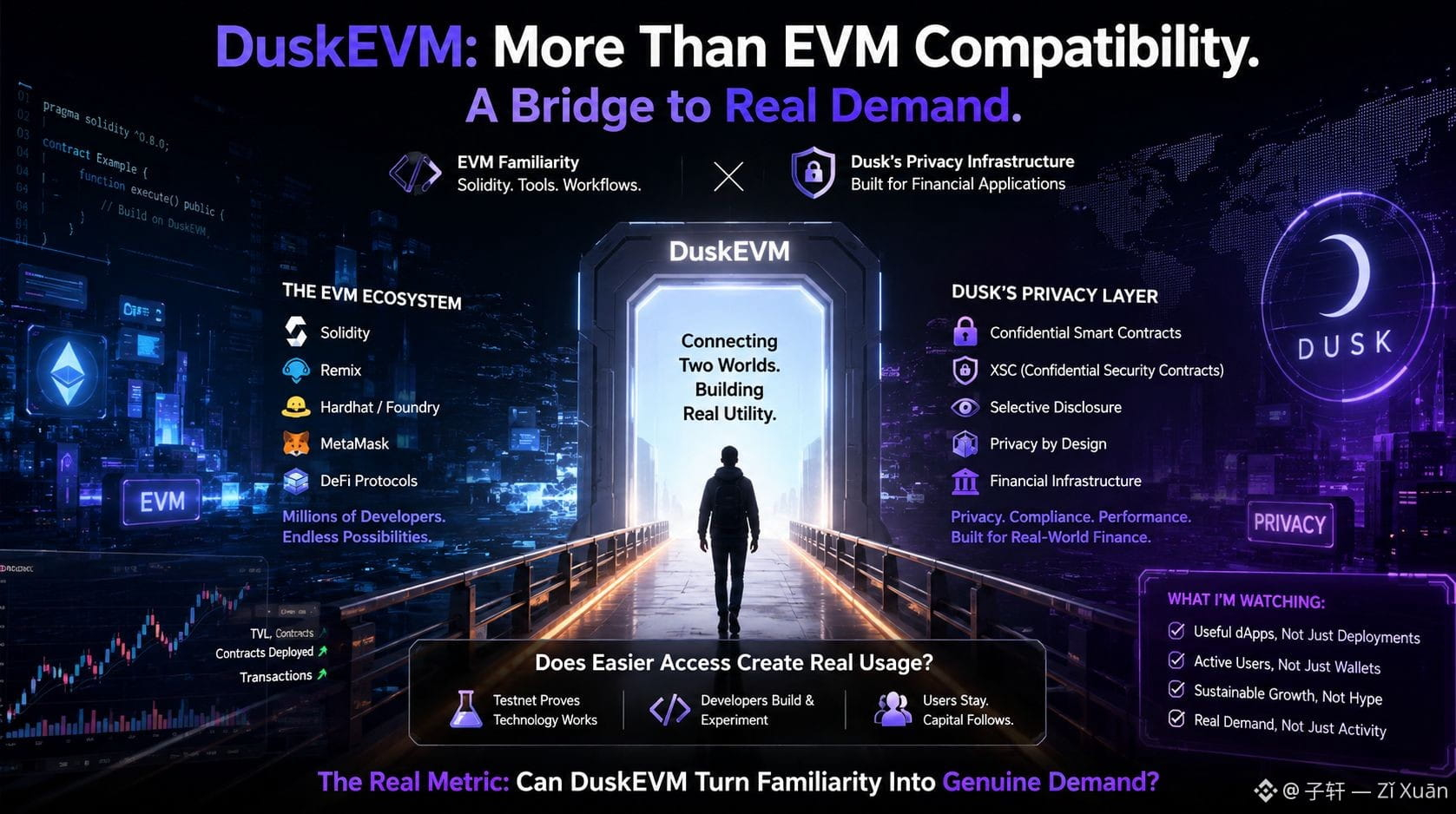
Last night I was jumping between Dusk’s docs the testnet details, and a few charts and I caught myself thinking about something I hadn’t really considered before
Maybe DuskEVM isn’t the main story
The interesting part is what it could bring with it
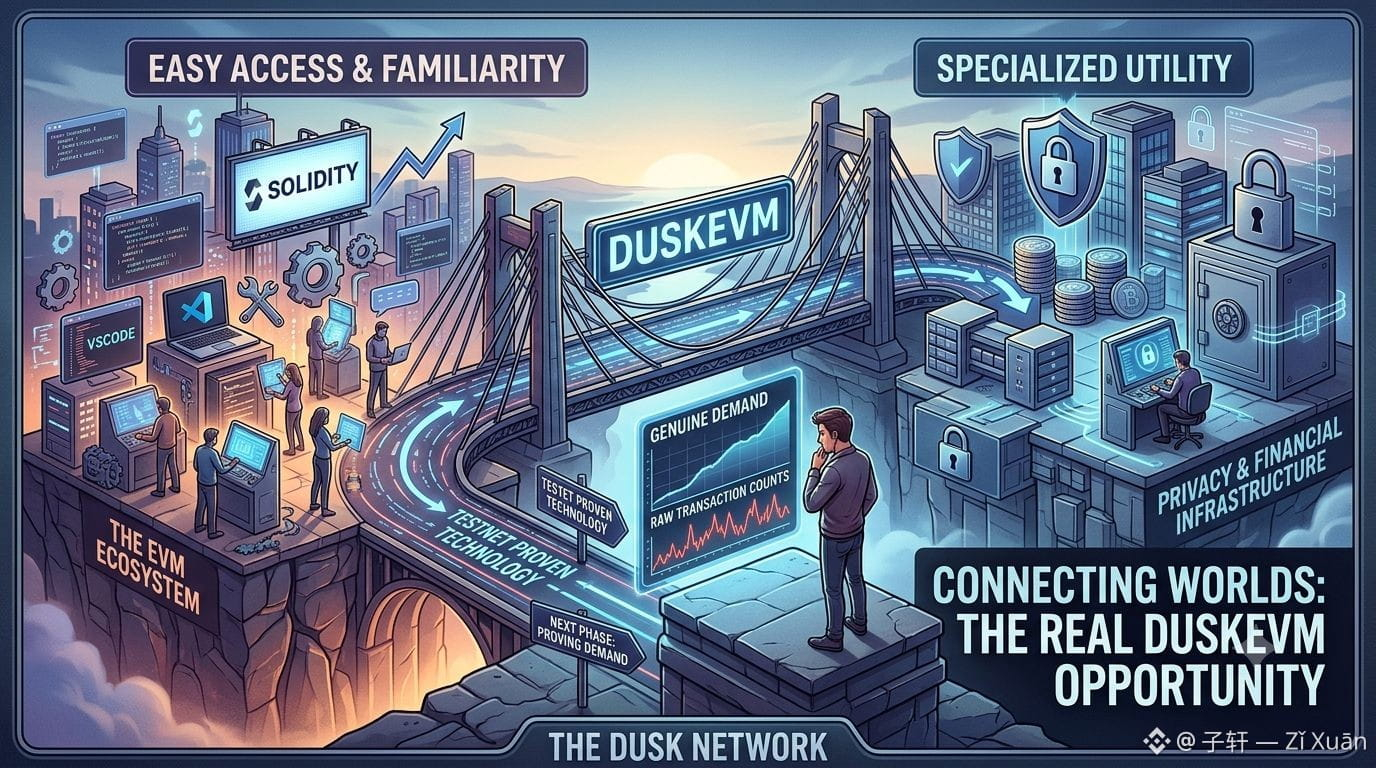
Dusk already has its own infrastructure for privacy focused financial applications. Now, by opening an EVM compatible path, it can meet developers somewhere they already feel comfortable: Solidity, familiar tooling, familiar workflows
That sounds simple, but I think it matters.
I kept coming back to the same question: does easier access actually translate into real usage?
Because a testnet can look impressive on paper. Contracts deploy. Transactions go through. Developers experiment. But none of that automatically means users will stay or capital will follow
That’s the part I’m watching closely.
I’d rather see a smaller number of developers building something useful than thousands of wallets appearing once and disappearing
For Dusk, the real opportunity may be connecting two worlds: the huge EVM developer ecosystem and Dusk’s more specialized focus on privacy and financial infrastructure
I like the direction but I’m still cautious.
The testnet can prove the technology works The next phase has to prove people actually want to use it
And honestly, that’s the metric I’ll be watching more than raw transaction counts.
Can DuskEVM turn EVM familiarity into genuine demand for everything Dusk has been building underneath?
#dusk @Dusk $DUSK
Last night I was jumping between Dusk’s docs the testnet details, and a few charts and I caught myself thinking about something I hadn’t really considered before
Maybe DuskEVM isn’t the main story
The interesting part is what it could bring with it
Dusk already has its own infrastructure for privacy focused financial applications. Now, by opening an EVM compatible path, it can meet developers somewhere they already feel comfortable: Solidity, familiar tooling, familiar workflows
That sounds simple, but I think it matters.
I kept coming back to the same question: does easier access actually translate into real usage?
Because a testnet can look impressive on paper. Contracts deploy. Transactions go through. Developers experiment. But none of that automatically means users will stay or capital will follow
That’s the part I’m watching closely.
I’d rather see a smaller number of developers building something useful than thousands of wallets appearing once and disappearing
For Dusk, the real opportunity may be connecting two worlds: the huge EVM developer ecosystem and Dusk’s more specialized focus on privacy and financial infrastructure
I like the direction but I’m still cautious.
The testnet can prove the technology works The next phase has to prove people actually want to use it
And honestly, that’s the metric I’ll be watching more than raw transaction counts.
Can DuskEVM turn EVM familiarity into genuine demand for everything Dusk has been building underneath?
#dusk @Dusk $DUSK
$LAB USDT is the one I’m watching closely here.
Price is around 0.07253 after a small +0.43% move, so I would rather wait for a controlled pullback than chase the candle.
Buy zone: 0.0715–0.0725
Targets: 0.0750 / 0.0780 / 0.0810
Stop Loss: 0.0695
$SKHYNIX USDT has stronger momentum, but the volatility is much higher. $DEXE looks slower by comparison.
For me, LAB is the cleaner setup because the entry gives room for a defined invalidation. If 0.0695 breaks, I would step aside instead of averaging down blindly.
No trade is guaranteed. Risk small and let price confirm the setup.#USCanadaTradeTalksCollapseCanadaVowsRetaliation #NvidiaAIServerPricesRiseOver15% #AnthropicIPOCouldTopSpaceXRecordReportsSay #BitcoinStrongestWeekSinceMarch2023
Price is around 0.07253 after a small +0.43% move, so I would rather wait for a controlled pullback than chase the candle.
Buy zone: 0.0715–0.0725
Targets: 0.0750 / 0.0780 / 0.0810
Stop Loss: 0.0695
$SKHYNIX USDT has stronger momentum, but the volatility is much higher. $DEXE looks slower by comparison.
For me, LAB is the cleaner setup because the entry gives room for a defined invalidation. If 0.0695 breaks, I would step aside instead of averaging down blindly.
No trade is guaranteed. Risk small and let price confirm the setup.#USCanadaTradeTalksCollapseCanadaVowsRetaliation #NvidiaAIServerPricesRiseOver15% #AnthropicIPOCouldTopSpaceXRecordReportsSay #BitcoinStrongestWeekSinceMarch2023
SKHYNIXUSDT, 💝🌹
20%
LABUSDT, 💪💝
68%
DEXE🙈👀
12%
56 votes • Voting closed
#dusk @Dusk
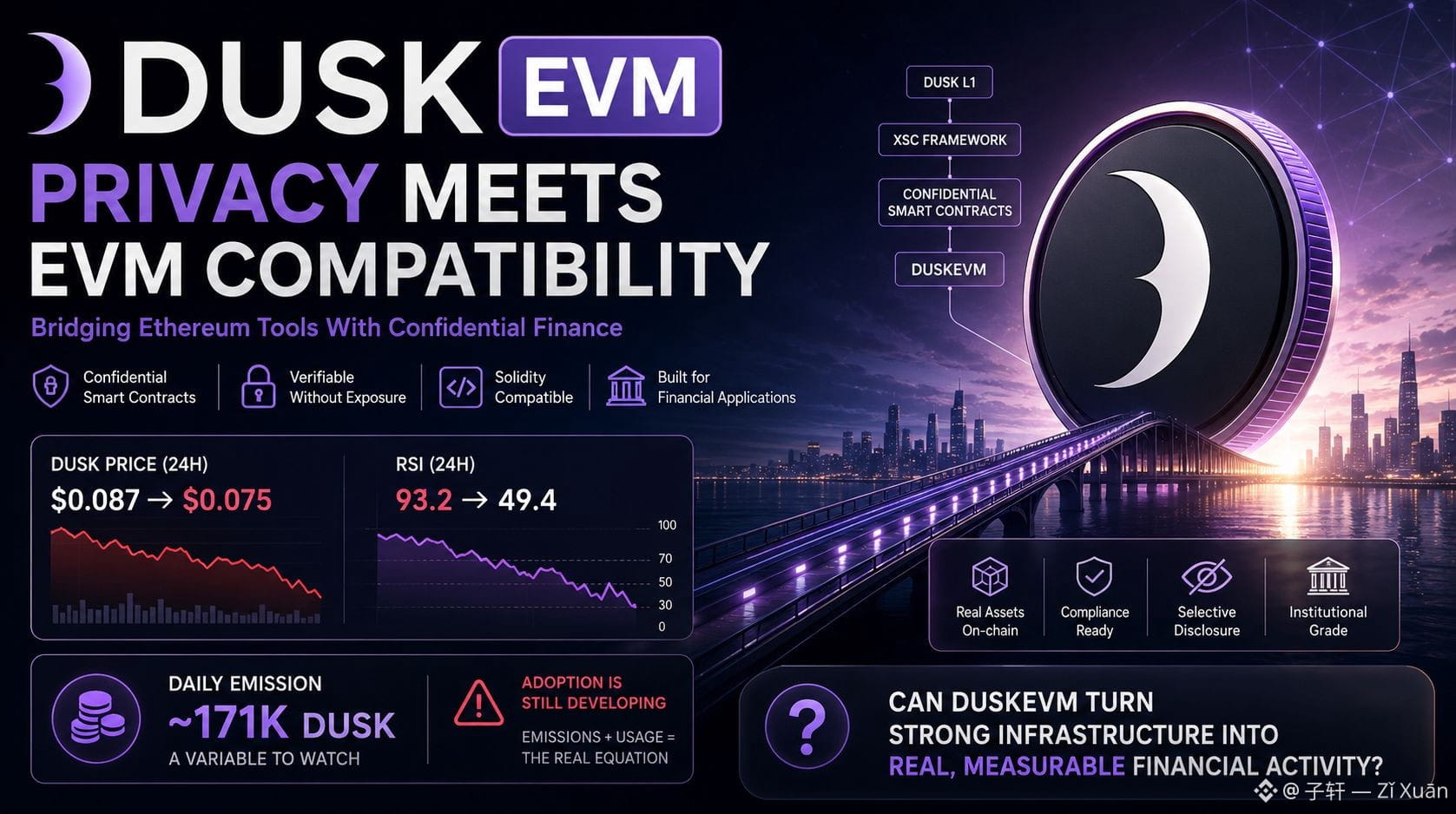
I opened Dusk’s chart this morning expecting to focus on the pullback, but I ended up spending more time reading about DuskEVM
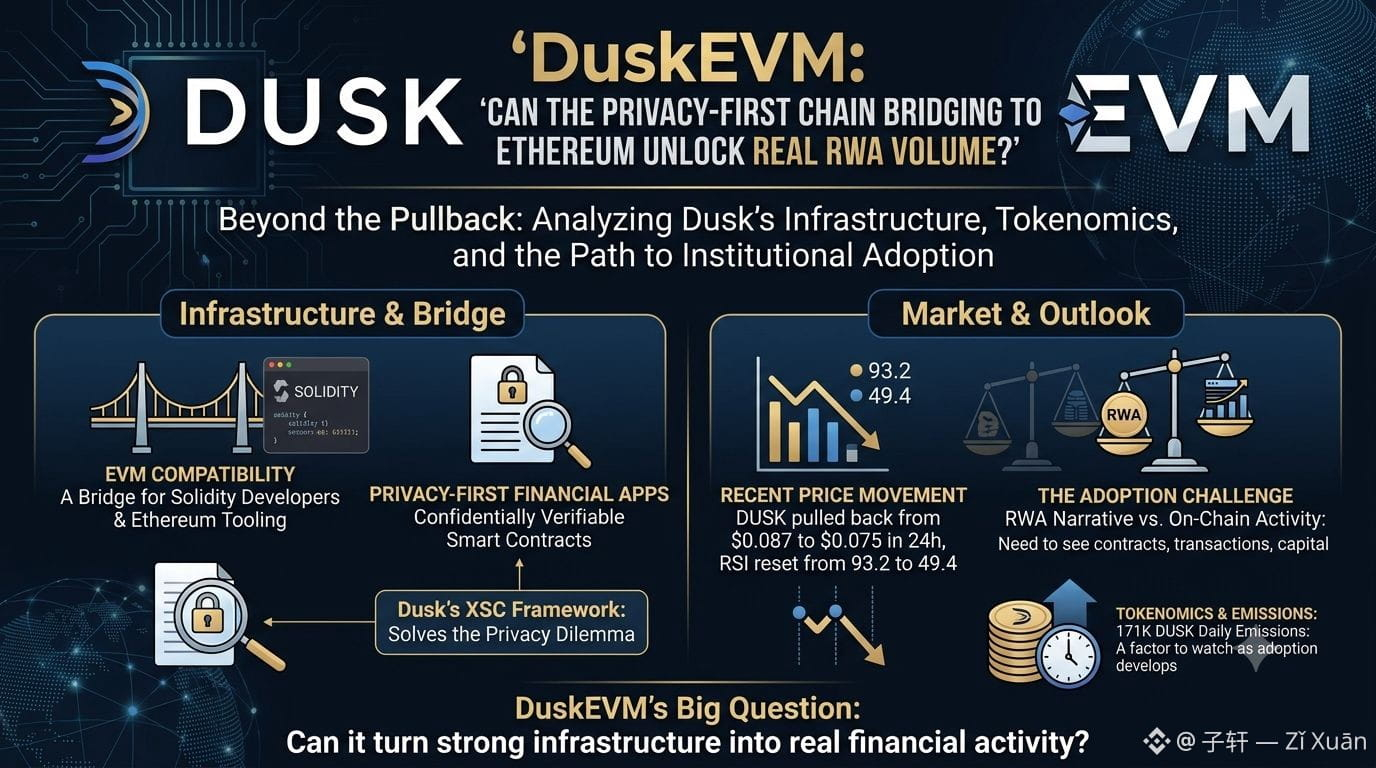
DUSK moved from roughly $0.087 to $0.075 in 24 hours, while RSI cooled from 93.2 to around 49.4. That’s a sharp reset, but it wasn’t the part I found most interesting
I keep coming back to DuskEVM because EVM compatibility could mean more than simply attracting Solidity developers. I see it as a possible bridge between familiar Ethereum tooling and Dusk’s privacy-first approach to financial applications
Dusk’s XSC framework and confidential smart contracts are designed around a problem I think financial blockchains often underestimate: some information needs to be verifiable without being completely exposed
That makes the architecture interesting to me
But I’m still cautious. RWA infrastructure can sound impressive long before meaningful usage appears on-chain. I want to see actual contracts, transactions, users and capital moving through Dusk before I treat the narrative as validated.
One number I won’t ignore is the reported daily emission of roughly 171K DUSK. It isn’t necessarily a deal-breaker, but it adds another variable when adoption is still developing
I keep asking myself one question: can DuskEVM turn strong infrastructure into real, measurable financial activity?
#dusk @Dusk $DUSK
I opened Dusk’s chart this morning expecting to focus on the pullback, but I ended up spending more time reading about DuskEVM
DUSK moved from roughly $0.087 to $0.075 in 24 hours, while RSI cooled from 93.2 to around 49.4. That’s a sharp reset, but it wasn’t the part I found most interesting
I keep coming back to DuskEVM because EVM compatibility could mean more than simply attracting Solidity developers. I see it as a possible bridge between familiar Ethereum tooling and Dusk’s privacy-first approach to financial applications
Dusk’s XSC framework and confidential smart contracts are designed around a problem I think financial blockchains often underestimate: some information needs to be verifiable without being completely exposed
That makes the architecture interesting to me
But I’m still cautious. RWA infrastructure can sound impressive long before meaningful usage appears on-chain. I want to see actual contracts, transactions, users and capital moving through Dusk before I treat the narrative as validated.
One number I won’t ignore is the reported daily emission of roughly 171K DUSK. It isn’t necessarily a deal-breaker, but it adds another variable when adoption is still developing
I keep asking myself one question: can DuskEVM turn strong infrastructure into real, measurable financial activity?
#dusk @Dusk $DUSK
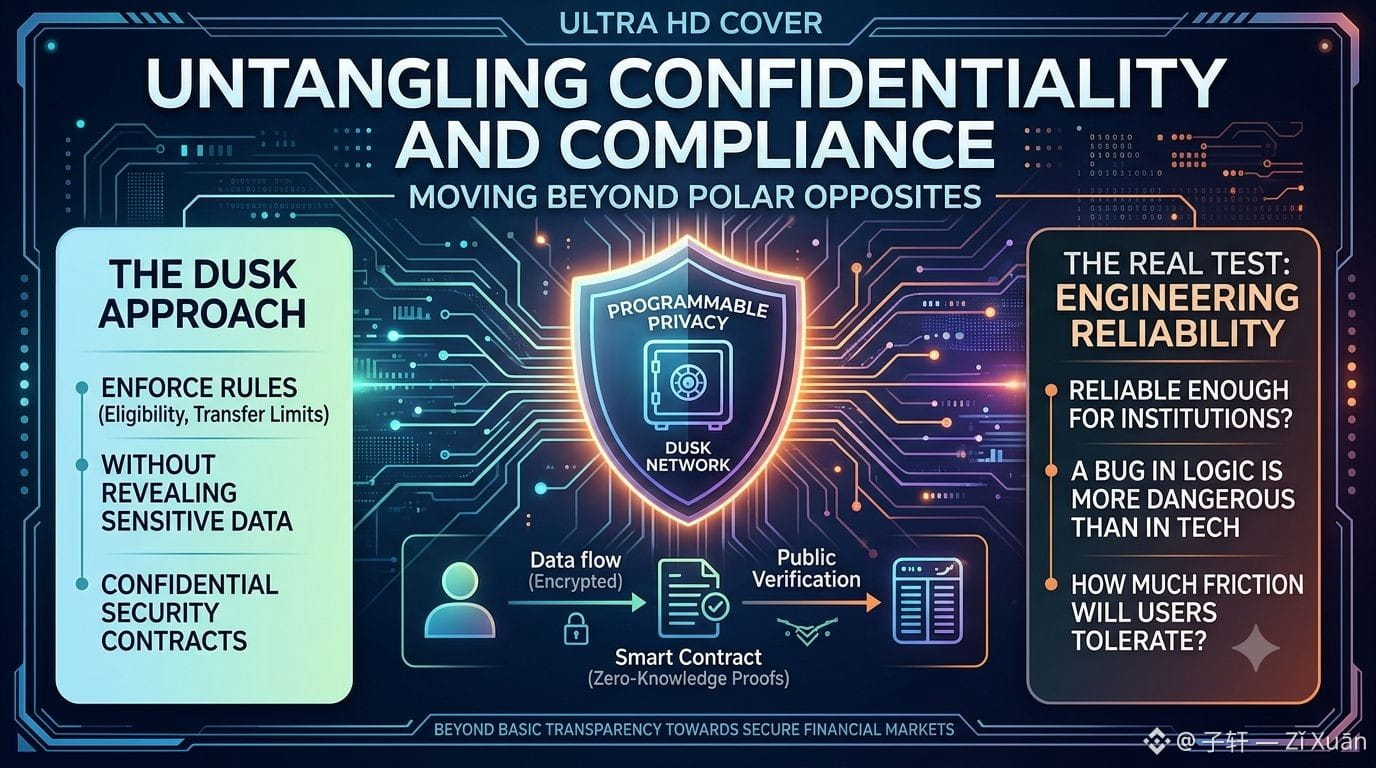
#dusk @Dusk Spent some time digging into Dusk’s approach to privacy and what stands out to me is how it tries to untangle confidentiality from compliance instead of treating them as polar opposites.
With its Confidential Security Contract model an app can enforce rules like eligibility and transfer limits without having to blast sensitive transaction data out for the whole world to see.
That’s an important distinction. Public blockchains usually make verification easy by making everything public. But real-world financial markets just can’t operate with that level of transparency visible positions and order flows leak strategy, plain and simple.
That said, privacy doesn't magically solve the hard stuff. You still need people to define the rules properly, prove the right data, and build tools that traditional institutions can actually use. Honestly, a bug in the smart contract logic would probably cause way more damage than a flaw in the underlying privacy tech.
To me, Dusk’s real test is an engineering one: can programmable privacy get reliable enough that regulated institutions treat it as basic, boring infrastructure rather than some exotic tech?
And really, how much extra friction are financial users actually willing to tolerate just to get better privacy?
#dusk @Dusk $DUSK
With its Confidential Security Contract model an app can enforce rules like eligibility and transfer limits without having to blast sensitive transaction data out for the whole world to see.
That’s an important distinction. Public blockchains usually make verification easy by making everything public. But real-world financial markets just can’t operate with that level of transparency visible positions and order flows leak strategy, plain and simple.
That said, privacy doesn't magically solve the hard stuff. You still need people to define the rules properly, prove the right data, and build tools that traditional institutions can actually use. Honestly, a bug in the smart contract logic would probably cause way more damage than a flaw in the underlying privacy tech.
To me, Dusk’s real test is an engineering one: can programmable privacy get reliable enough that regulated institutions treat it as basic, boring infrastructure rather than some exotic tech?
And really, how much extra friction are financial users actually willing to tolerate just to get better privacy?
#dusk @Dusk $DUSK

#TermMax @TermMax
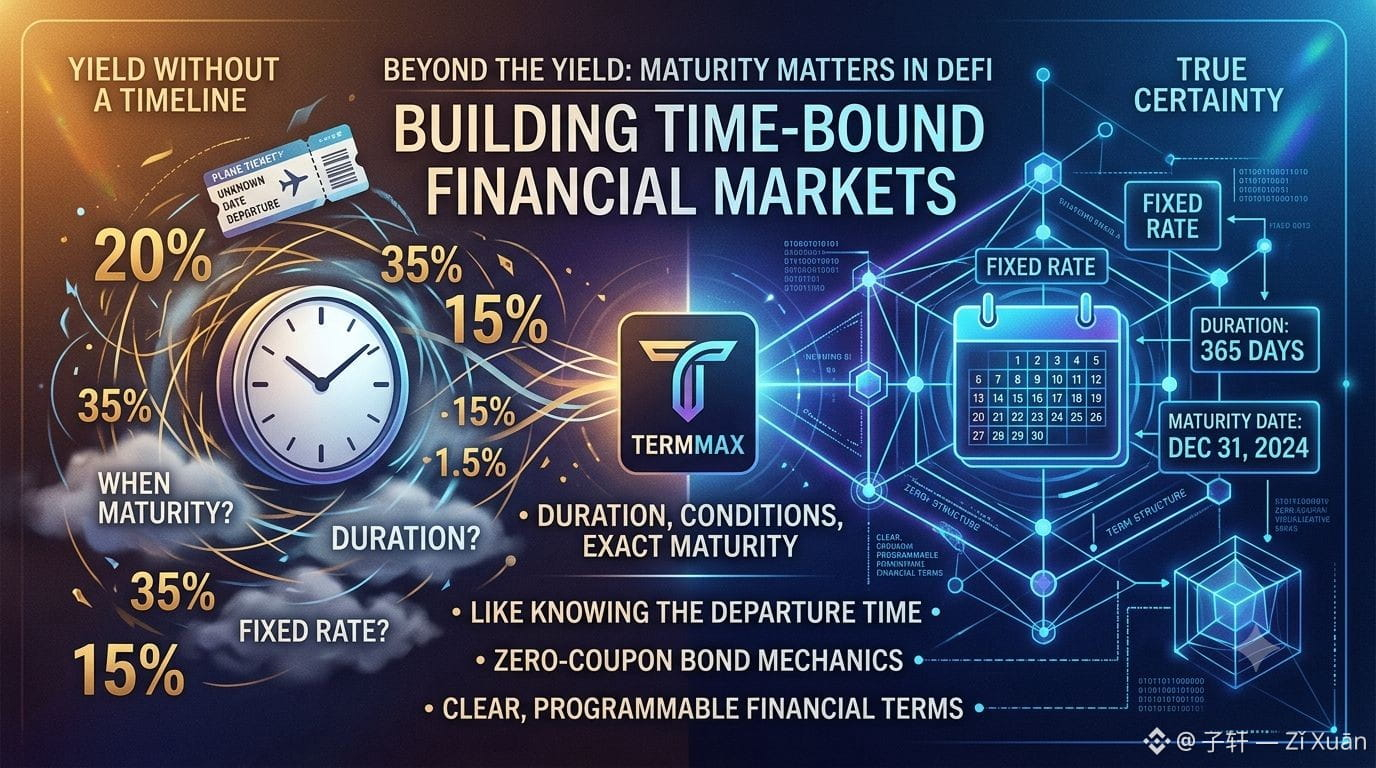
A fixed yield without a fixed timeline isn't true certainty it's just half the equation
High APY is easy to market but real financial planning requires knowing three things duration conditions and exact maturity
Think of it like buying a plane ticket A fixed price is great, but it’s completely useless if you don't know the departure time. Time is what gives value to the commitment.
This is why maturity based structures in DeFi matter By using zero coupon bond mechanics, protocols like TermMax give both borrowers and lenders complete visibility into their obligations upfront. No guessing floating rates, no hidden liquidity traps just clear, programmable financial terms
DeFi spent years optimizing yield discovery The next real shift is building reliable time bound financial markets
While most people are still chasing APY numbers the actual innovation is turning future commitments into predictable on chain tools.
#TermMax @TermMax
$LAB $BANK
A fixed yield without a fixed timeline isn't true certainty it's just half the equation
High APY is easy to market but real financial planning requires knowing three things duration conditions and exact maturity
Think of it like buying a plane ticket A fixed price is great, but it’s completely useless if you don't know the departure time. Time is what gives value to the commitment.
This is why maturity based structures in DeFi matter By using zero coupon bond mechanics, protocols like TermMax give both borrowers and lenders complete visibility into their obligations upfront. No guessing floating rates, no hidden liquidity traps just clear, programmable financial terms
DeFi spent years optimizing yield discovery The next real shift is building reliable time bound financial markets
While most people are still chasing APY numbers the actual innovation is turning future commitments into predictable on chain tools.
#TermMax @TermMax
$LAB $BANK

#dusk @Dusk
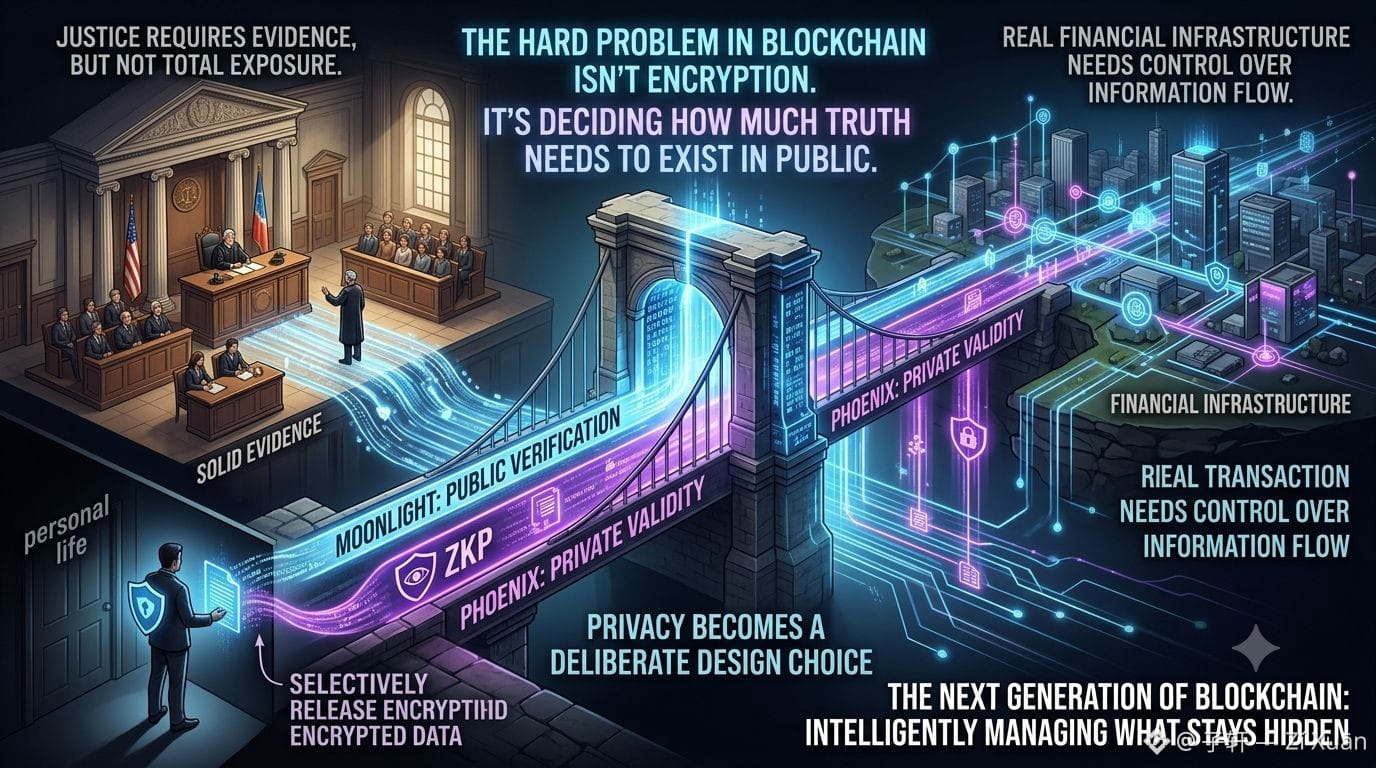
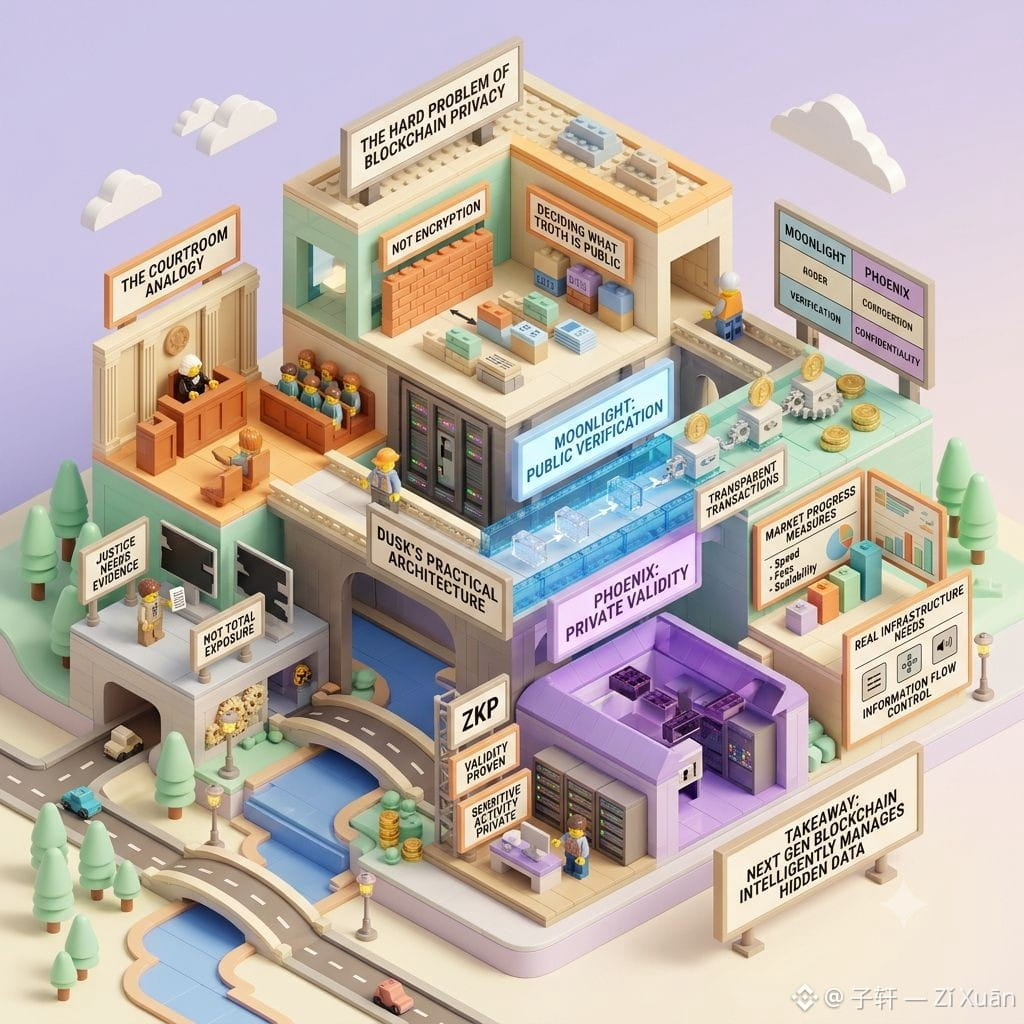
One realization keeps coming back to me while researching privacy: the hardest problem in blockchain isn’t encryption. It’s deciding how much of the truth needs to exist in public.
Think about a courtroom. Justice requires solid evidence, but you don't need to expose every personal detail of someone’s life just to prove a point. Trust doesn't require total exposure.
This is what makes Dusk’s architecture so practical. Moonlight handles transparent transactions where public verification is essential. Phoenix uses zero knowledge proofs to let users prove validity while keeping sensitive activity private.
Instead of forcing a trade off, privacy becomes a deliberate design choice. Transparency and confidentiality aren't opposing forces they’re just different tools for different situations.
The market usually measures progress by speed, fees, and scalability. But real financial infrastructure needs control over information flow.
The next generation of blockchain won't be defined by how much it reveals, but by how intelligently it manages what stays hidden.
#dusk @Dusk $DUSK
One realization keeps coming back to me while researching privacy: the hardest problem in blockchain isn’t encryption. It’s deciding how much of the truth needs to exist in public.
Think about a courtroom. Justice requires solid evidence, but you don't need to expose every personal detail of someone’s life just to prove a point. Trust doesn't require total exposure.
This is what makes Dusk’s architecture so practical. Moonlight handles transparent transactions where public verification is essential. Phoenix uses zero knowledge proofs to let users prove validity while keeping sensitive activity private.
Instead of forcing a trade off, privacy becomes a deliberate design choice. Transparency and confidentiality aren't opposing forces they’re just different tools for different situations.
The market usually measures progress by speed, fees, and scalability. But real financial infrastructure needs control over information flow.
The next generation of blockchain won't be defined by how much it reveals, but by how intelligently it manages what stays hidden.
#dusk @Dusk $DUSK
#TermMax❤️❤️ @TermMax
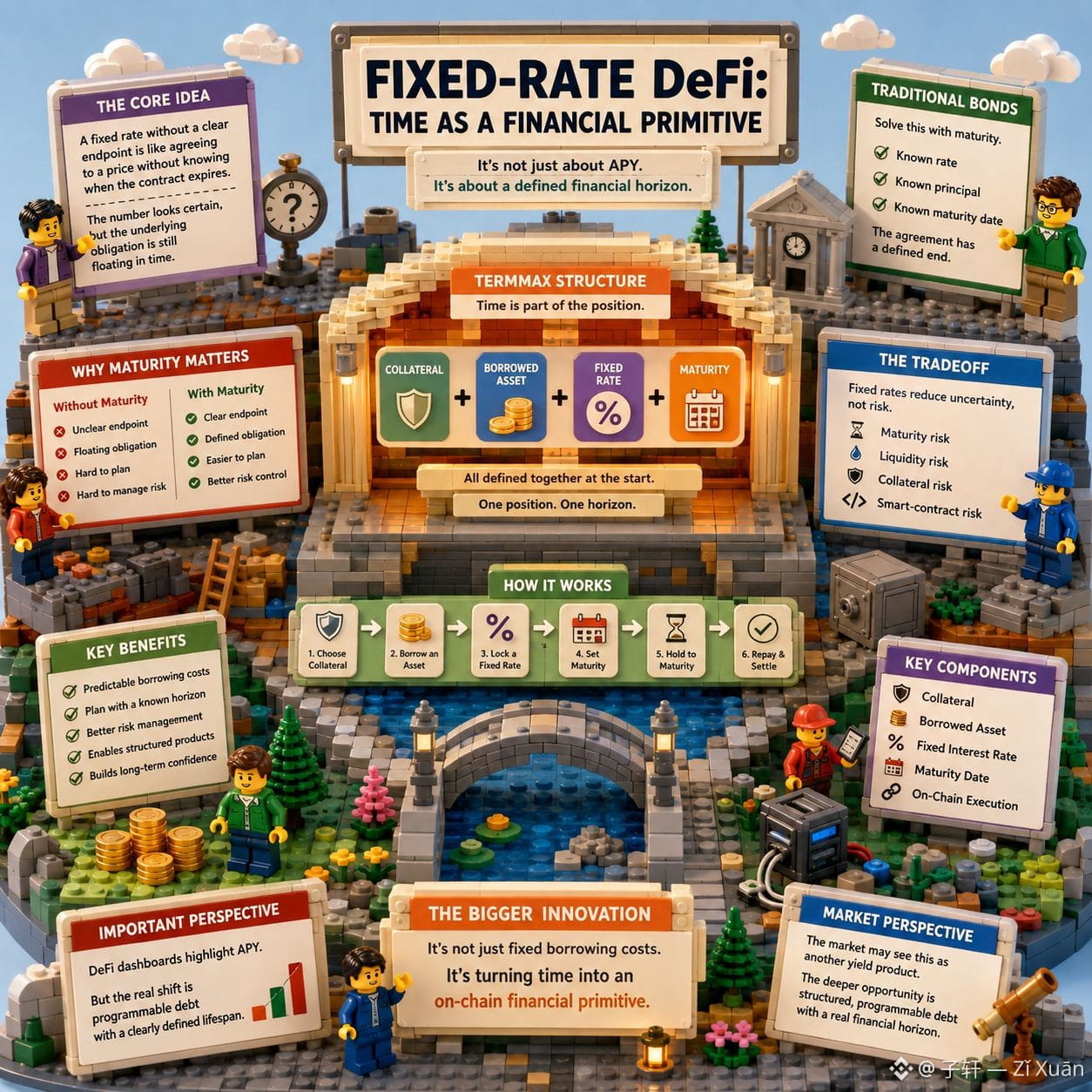
The more I study fixed rate DeFi the more I think the APY is actually the least interesting part.
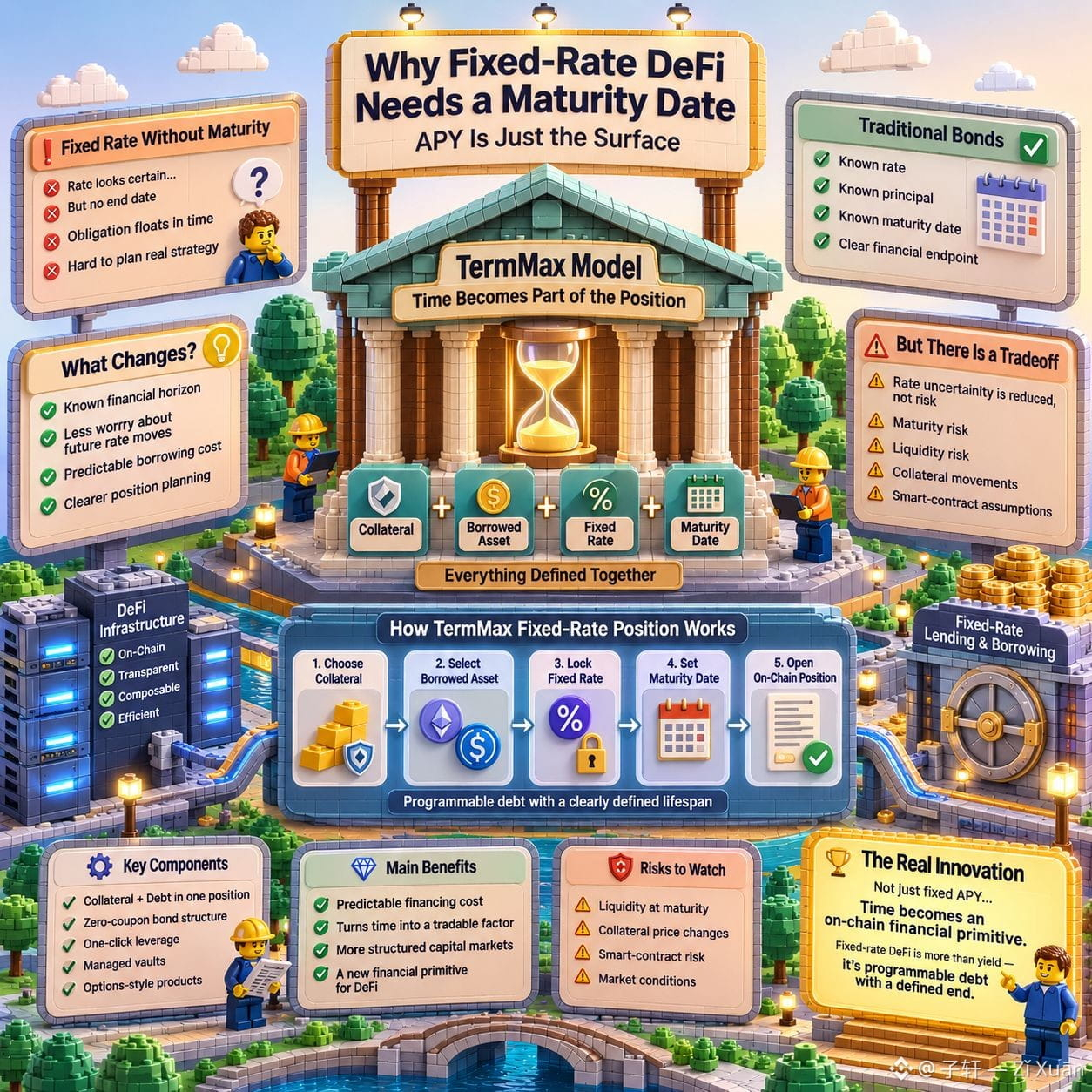
A fixed rate without a clear endpoint is like agreeing to a price without knowing when the contract expires. The number looks certain, but the underlying obligation is still floating in time.
Traditional bonds solve this with maturity. You know the rate, the principal, and the date when the agreement reaches its defined end.
That is where TermMax gets interesting.
Its structure makes time part of the position itself: collateral, borrowed asset, fixed rate, and maturity are defined together. Instead of continuously asking where rates might move next, the user can reason around a known financial horizon.
But there is a tradeoff. Rate uncertainty is reduced not risk. Maturity liquidity collateral movements, and smart contract assumptions become more important.
That distinction is easy to miss when DeFi focuses on APY dashboards
To me the bigger innovation is not simply fixed borrowing costs.
It is turning time into an on chain financial primitive
The market may be pricing fixed rate DeFi as another yield product. The deeper opportunity is programmable debt with a clearly defined lifespan
#termmax @TermMax
The more I study fixed rate DeFi the more I think the APY is actually the least interesting part.
A fixed rate without a clear endpoint is like agreeing to a price without knowing when the contract expires. The number looks certain, but the underlying obligation is still floating in time.
Traditional bonds solve this with maturity. You know the rate, the principal, and the date when the agreement reaches its defined end.
That is where TermMax gets interesting.
Its structure makes time part of the position itself: collateral, borrowed asset, fixed rate, and maturity are defined together. Instead of continuously asking where rates might move next, the user can reason around a known financial horizon.
But there is a tradeoff. Rate uncertainty is reduced not risk. Maturity liquidity collateral movements, and smart contract assumptions become more important.
That distinction is easy to miss when DeFi focuses on APY dashboards
To me the bigger innovation is not simply fixed borrowing costs.
It is turning time into an on chain financial primitive
The market may be pricing fixed rate DeFi as another yield product. The deeper opportunity is programmable debt with a clearly defined lifespan
#termmax @TermMax
Verified
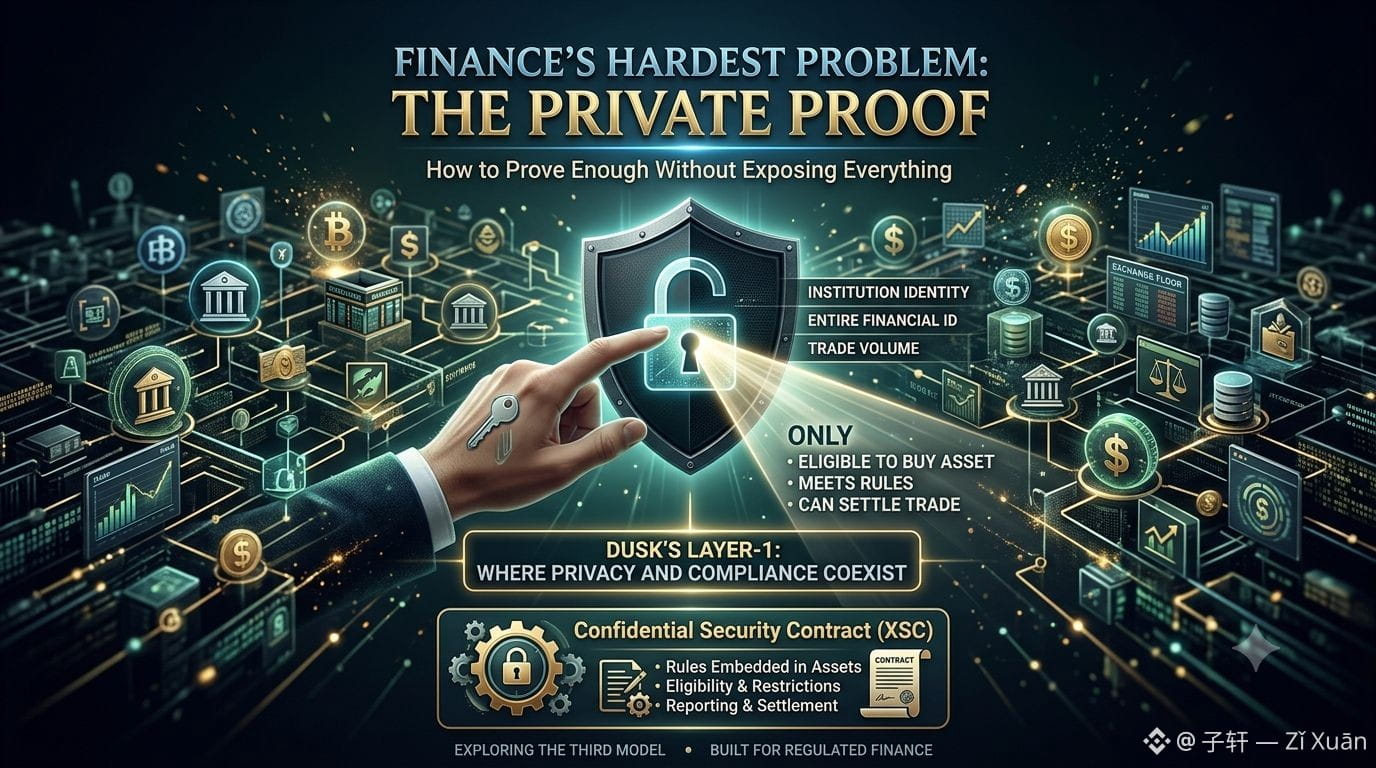
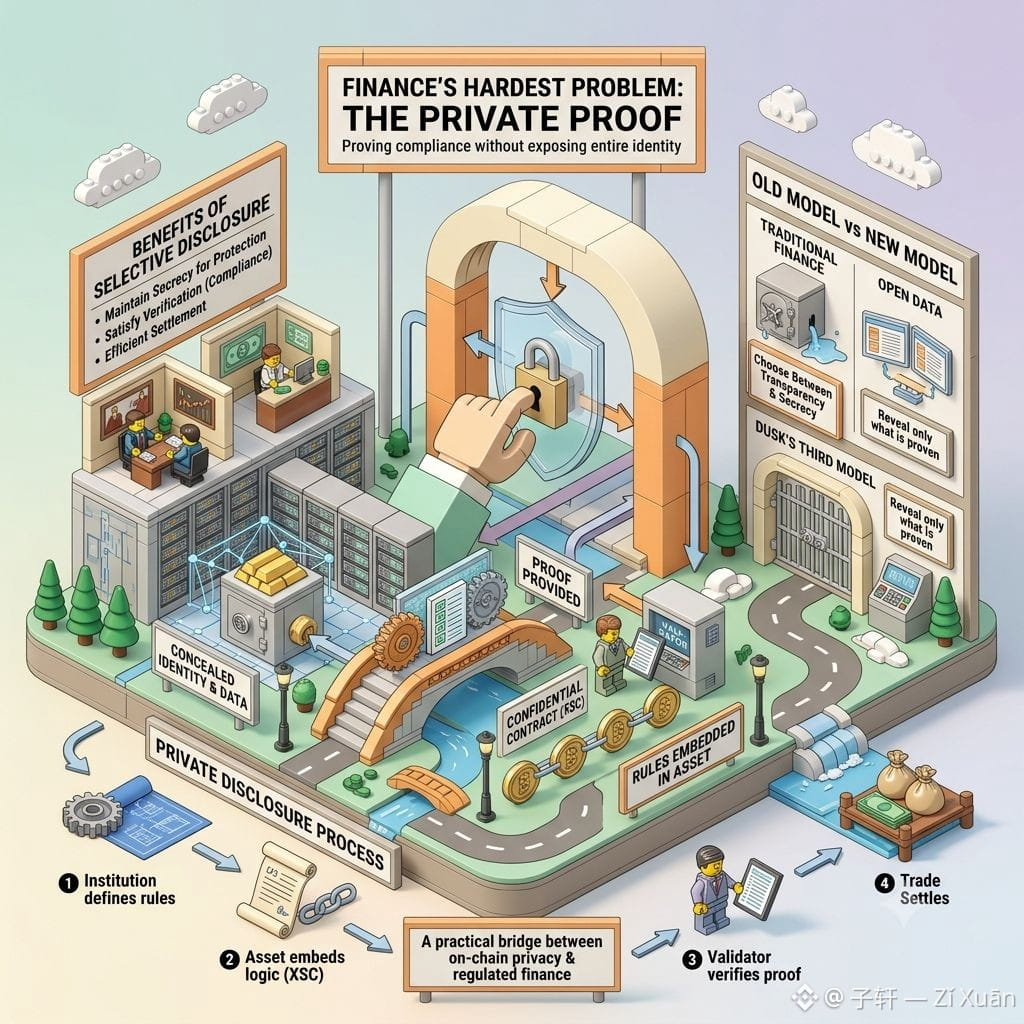
#dusk @Dusk The more I study Dusk the more I realize that the hardest problem in financial markets isn’t speed it’s proving what you need to prove without giving away everything else
Think of it like this an institution enters a private room, proves it’s cleared to trade satisfies all the compliance rules, and settles the transaction all without laying its entire portfolio or identity on the table.
That’s what makes Dusk’s Layer 1 approach to confidential finance so compelling.
By embedding rules directly into assets via their Confidential Security Contract (XSC) standard, things like eligibility, transfer limits, and reporting become part of the asset itself rather than depending on middleman trust.
The big shift here isn't just making transactions private It’s showing that compliance and privacy don't have to be enemies
TradFi has always forced a bad tradeoff total transparency or total secrecy Dusk is showing a third path reveal only what’s required keep the rest hidden
Most people treat privacy like a luxury feature To me it looks like necessary infrastructure for markets that simply can't function in the open.
#dusk @Dusk $DUSK
Think of it like this an institution enters a private room, proves it’s cleared to trade satisfies all the compliance rules, and settles the transaction all without laying its entire portfolio or identity on the table.
That’s what makes Dusk’s Layer 1 approach to confidential finance so compelling.
By embedding rules directly into assets via their Confidential Security Contract (XSC) standard, things like eligibility, transfer limits, and reporting become part of the asset itself rather than depending on middleman trust.
The big shift here isn't just making transactions private It’s showing that compliance and privacy don't have to be enemies
TradFi has always forced a bad tradeoff total transparency or total secrecy Dusk is showing a third path reveal only what’s required keep the rest hidden
Most people treat privacy like a luxury feature To me it looks like necessary infrastructure for markets that simply can't function in the open.
#dusk @Dusk $DUSK
$MRNA.US , $SKYAI & $STAR What Next?
These three moves caught my attention, but I would not chase green candles after such strong rallies.
MRNA: around Rs45,934 position value and +163%. After the huge breakout, I would wait for a pullback. Buy zone: $145–155. Targets: $175, $190. Stop-loss: $135.
SKYAI: +41.88% with price around Rs21.18. Momentum is strong but volatility is extreme. Buy zone: $0.070–0.073. Targets: $0.085, $0.095. Stop-loss: $0.064.
STAR: +30.74% around Rs38.50. I prefer confirmation before entering. Buy zone: $0.130–0.135. Targets: $0.150, $0.165. Stop-loss: $0.120.
MRNA’s surge followed positive Phase 3 cancer-vaccine results, while SKYAI has recently shown sharp volatility.
My rule: do not chase pumps. Let price come to the buy zone, confirm volume, then enter with controlled risk.
.#ColdcardTheftInvestigationAdvances #TrumpUrgesCongressToPassClarityAct #FOMCWatch #CryptoRally
These three moves caught my attention, but I would not chase green candles after such strong rallies.
MRNA: around Rs45,934 position value and +163%. After the huge breakout, I would wait for a pullback. Buy zone: $145–155. Targets: $175, $190. Stop-loss: $135.
SKYAI: +41.88% with price around Rs21.18. Momentum is strong but volatility is extreme. Buy zone: $0.070–0.073. Targets: $0.085, $0.095. Stop-loss: $0.064.
STAR: +30.74% around Rs38.50. I prefer confirmation before entering. Buy zone: $0.130–0.135. Targets: $0.150, $0.165. Stop-loss: $0.120.
MRNA’s surge followed positive Phase 3 cancer-vaccine results, while SKYAI has recently shown sharp volatility.
My rule: do not chase pumps. Let price come to the buy zone, confirm volume, then enter with controlled risk.
.#ColdcardTheftInvestigationAdvances #TrumpUrgesCongressToPassClarityAct #FOMCWatch #CryptoRally
MRNA🥰🕺
18%
SKYAI💝💐
27%
STAR💪💝
55%
11 votes • Voting closed
These three coins are moving fast, but after a strong pump, chasing can be risky.
$牛来 Buy Zone $0.0385–$0.0400 | Target $0.0445–$0.0480 | Stop Loss $0.0360
$RICE : Buy Zone $0.0071–$0.0074 | Target $0.0084–$0.0092 | Stop Loss $0.0067
$STAR : Buy Zone $0.131–$0.136 | Target $0.153–$0.165 | Stop Loss $0.123
RICE has already gained over 134%, so I would be the most careful here. I prefer waiting for a controlled pullback and confirmation instead of entering after a vertical move. Keep position size small and respect the stop loss. The key question now is simple: can buyers defend the next pullback?#ToyotaFinanceLaunchesTokenizedBondForRetail #MetaplanetToInvest2100BTCInSuperLeague #WyomingMovesFRNTToChainlinkCCIP #FOMCWatch
$牛来 Buy Zone $0.0385–$0.0400 | Target $0.0445–$0.0480 | Stop Loss $0.0360
$RICE : Buy Zone $0.0071–$0.0074 | Target $0.0084–$0.0092 | Stop Loss $0.0067
$STAR : Buy Zone $0.131–$0.136 | Target $0.153–$0.165 | Stop Loss $0.123
RICE has already gained over 134%, so I would be the most careful here. I prefer waiting for a controlled pullback and confirmation instead of entering after a vertical move. Keep position size small and respect the stop loss. The key question now is simple: can buyers defend the next pullback?#ToyotaFinanceLaunchesTokenizedBondForRetail #MetaplanetToInvest2100BTCInSuperLeague #WyomingMovesFRNTToChainlinkCCIP #FOMCWatch
牛来❤️💃
75%
RICE💝💪
16%
STAR,💐🌹
9%
55 votes • Voting closed
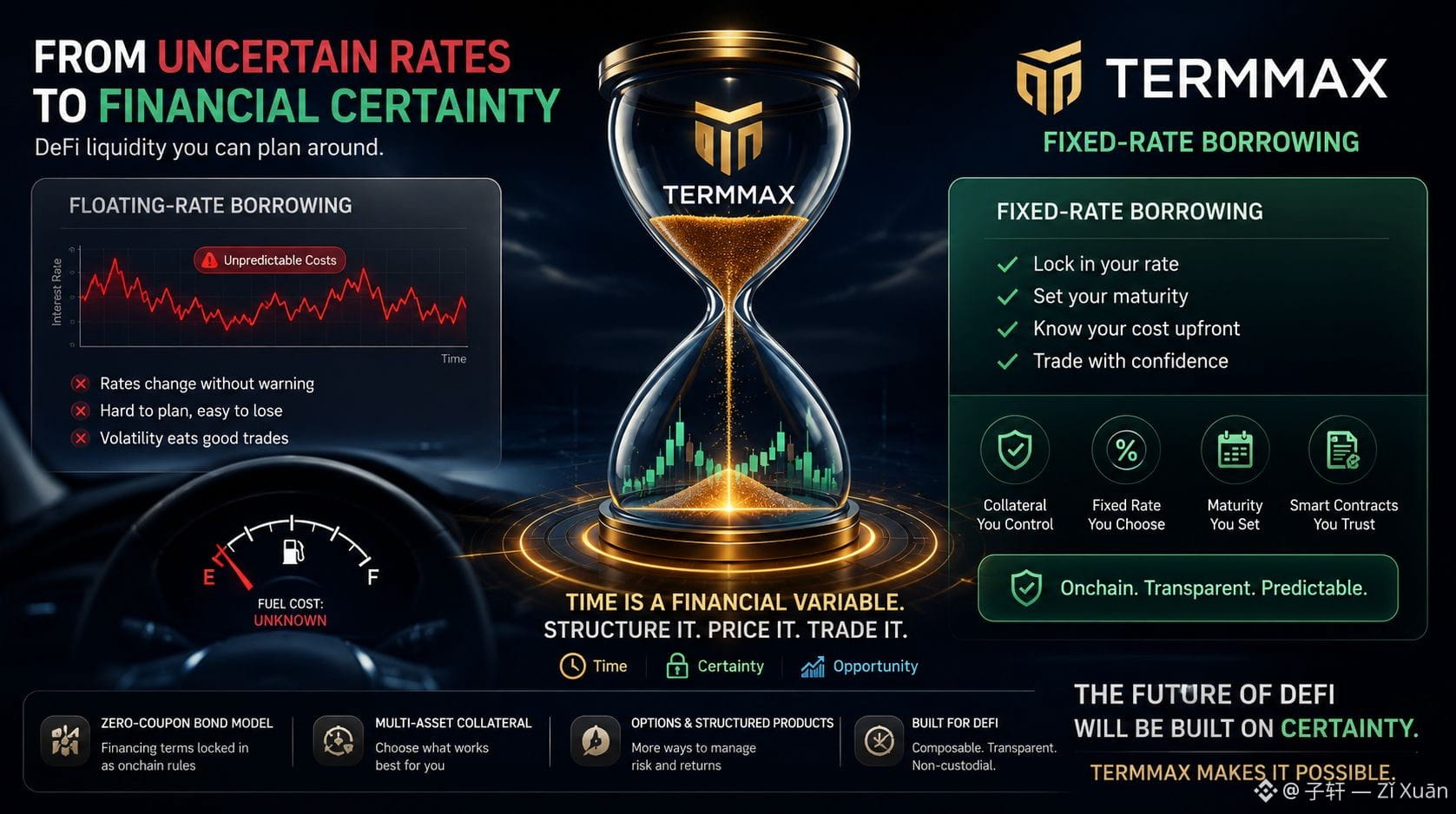
#termmax @TermMax One idea keeps coming back while studying TermMax DeFi made capital easy to get but almost impossible to plan around
Floating rate borrowing feels like driving with a fuel gauge that won’t stay still You know what it costs right now but you have no idea what the same position will cost you tomorrow In a volatile market, that moving target quietly kills good trades.
TermMax shifts this dynamic by making time an explicit part of the contract. You pick your collateral lock in a fixed rate set a maturity date and borrow Using a zero coupon bond structure it turns financing terms into fixed onchain rules rather than a moving target
It doesn’t eliminate risk it just shifts your focus to what actually matters maturity dates available liquidity collateral quality and contract execution But the crucial difference is that you know these parameters before you commit your capital
That is what makes it compelling
DeFi won't just compete on yields and leverage forever The real competition will be on certainty
TermMax treats time for what it truly is a financial variable that can be structured priced and traded
#TermMax @TermMax
Floating rate borrowing feels like driving with a fuel gauge that won’t stay still You know what it costs right now but you have no idea what the same position will cost you tomorrow In a volatile market, that moving target quietly kills good trades.
TermMax shifts this dynamic by making time an explicit part of the contract. You pick your collateral lock in a fixed rate set a maturity date and borrow Using a zero coupon bond structure it turns financing terms into fixed onchain rules rather than a moving target
It doesn’t eliminate risk it just shifts your focus to what actually matters maturity dates available liquidity collateral quality and contract execution But the crucial difference is that you know these parameters before you commit your capital
That is what makes it compelling
DeFi won't just compete on yields and leverage forever The real competition will be on certainty
TermMax treats time for what it truly is a financial variable that can be structured priced and traded
#TermMax @TermMax

Verified
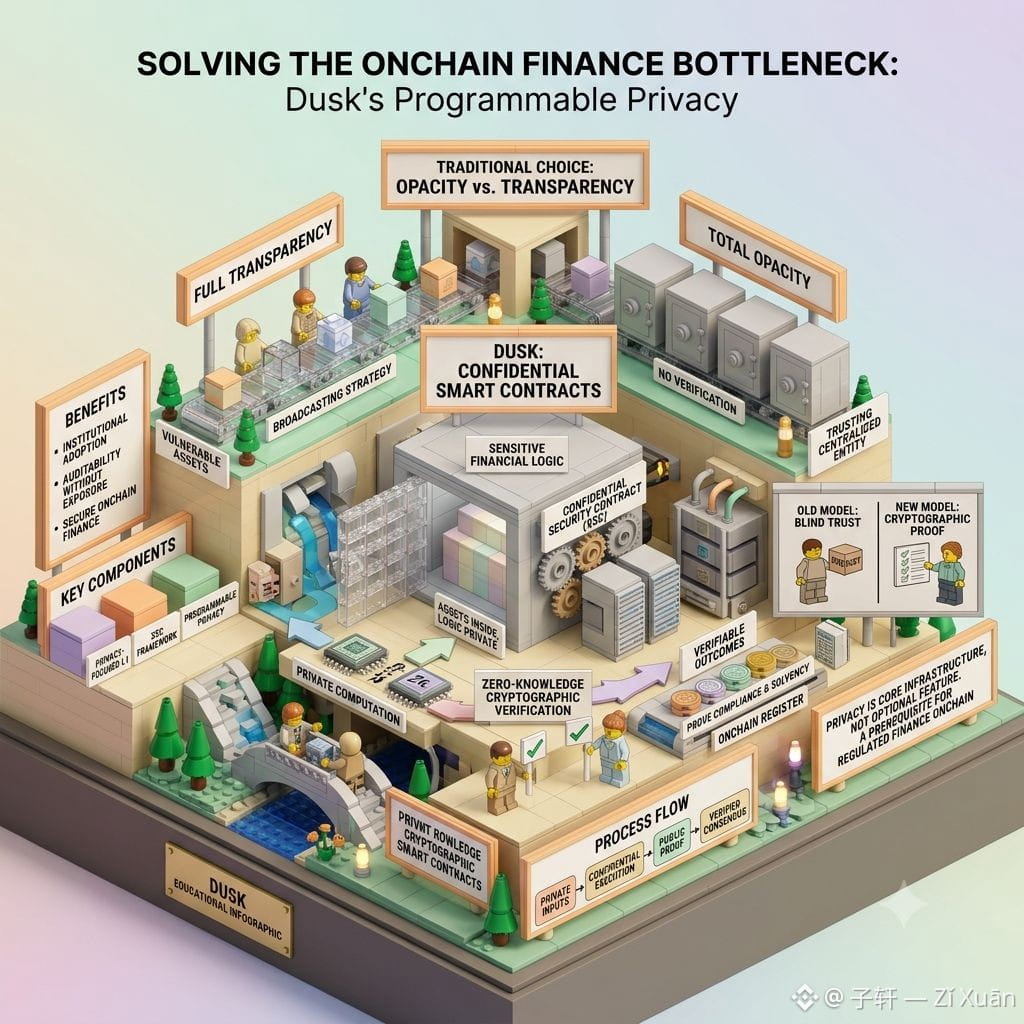
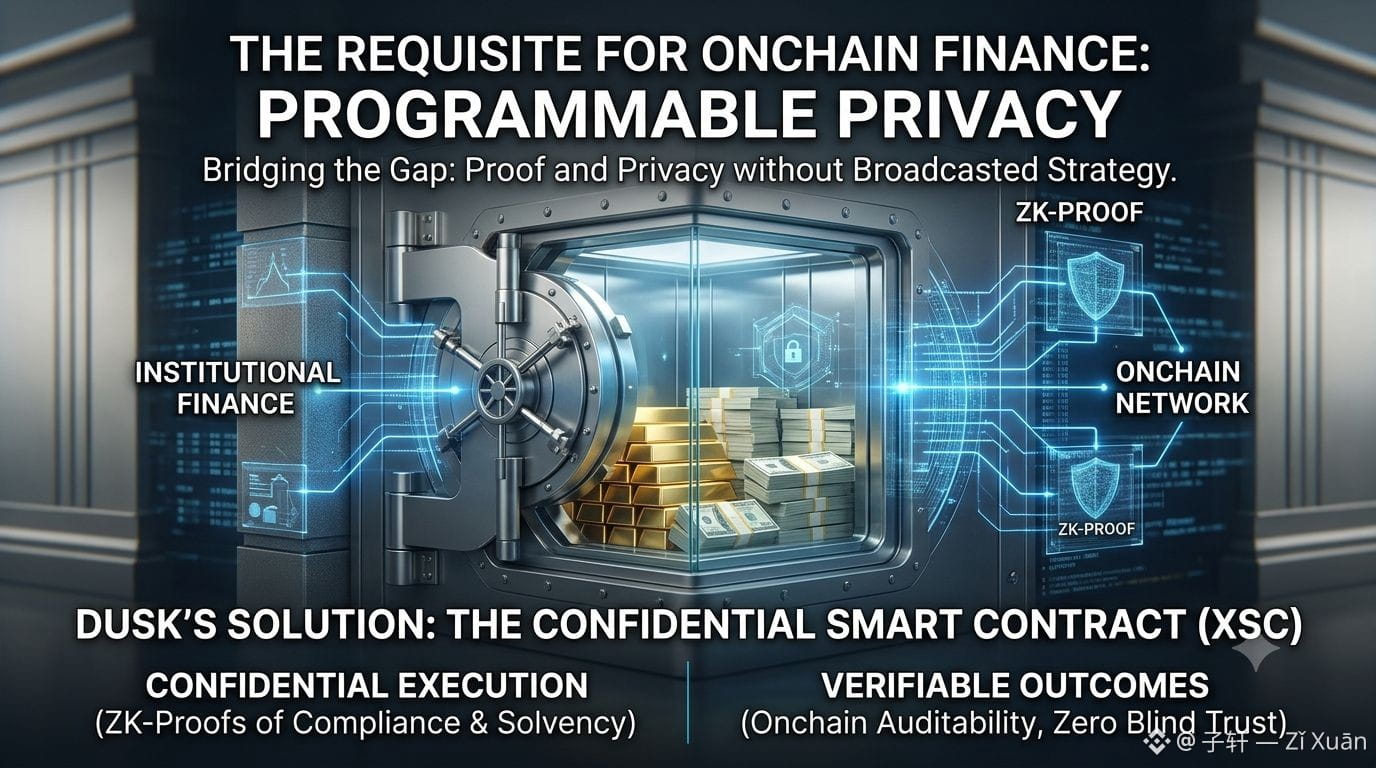
#dusk @Dusk The real bottleneck for onchain finance isn’t execution speed it’s exposure
Traditional markets force an unnecessary choice: full transparency or total opacity But serious institutions need both. Imagine a bank vault with a glass door; you need to prove the assets are inside without letting everyone read every document on the shelf
This is where Dusk changes the equation Through its privacy-focused Layer 1 and Confidential Security Contract XSC framework, it enables confidential smart contracts. Sensitive financial logic stays private, but the final outcomes remain fully verifiable onchain
The fundamental shift here is subtle: privacy no longer requires trusting a centralized entity’s word. Zero knowledge cryptographic verification replaces blind trust, letting participants prove compliance and solvency without broadcasting their entire strategy to the world.
While the broader market still views privacy as an optional feature, programmable privacy is actually core infrastructure. If regulated finance is truly moving onchain, this balance of privacy and auditability isn't just an upgrade it’s a prerequisite.
#dusk @Dusk $DUSK
Traditional markets force an unnecessary choice: full transparency or total opacity But serious institutions need both. Imagine a bank vault with a glass door; you need to prove the assets are inside without letting everyone read every document on the shelf
This is where Dusk changes the equation Through its privacy-focused Layer 1 and Confidential Security Contract XSC framework, it enables confidential smart contracts. Sensitive financial logic stays private, but the final outcomes remain fully verifiable onchain
The fundamental shift here is subtle: privacy no longer requires trusting a centralized entity’s word. Zero knowledge cryptographic verification replaces blind trust, letting participants prove compliance and solvency without broadcasting their entire strategy to the world.
While the broader market still views privacy as an optional feature, programmable privacy is actually core infrastructure. If regulated finance is truly moving onchain, this balance of privacy and auditability isn't just an upgrade it’s a prerequisite.
#dusk @Dusk $DUSK
Log in to explore more content