

1. What is Bitcoin Halving?
A total Bitcoin maximum supply of 21 million BTC will be released, and for every 210,000 blocks created, the reward for each new block will be halved. Now after ten minutes 6.25 bitcoins will be released. Every 4 years, the block reward will be halved hence this is called “Bitcoin Halving”. According to calculations, by 2140, all 21 million Bitcoins will be mined.
“The total circulation of bitcoin is 21 million BTC. Every 4 years, the block reward will be halved. First four years: 10,500,000 BTC. Next four years: 5,250,000 BTC. Next four years: 2,625,000 BTC. Next four years: 1,312,500 BTC..."
**Satoshi Nakamoto, *The Cryptography Mailing List*, January 8, 2009**
2. Upcoming Bitcoin halving event
The next halving is expected to take place on April 20, 2024. Mining rewards will decrease from 6.25 BTC per block to 3.125 BTC per block.
According to Efficient Markets Theory says that if we all know it will happen, then it must be priced in. Warren Buffet said that “The market is almost always potential but the difference between almost and always is $80 billion to me.” So even if we think everyone knows something, that doesn't mean there won't be a lot of money to be made.
“Investing in a market where people believe in efficiency is like playing cards with someone who has been told not to look at the cards” — Warren Buffet, 1984, as cited by Davis, 1990.
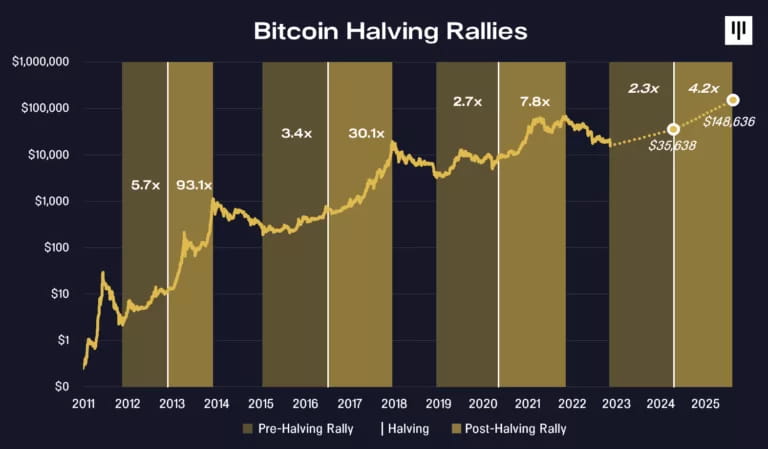
Demand for Bitcoin also increased ahead of the block reward halving event in anticipation of a price increase. For years, we have emphasized that the halving is a big event – but it takes years to happen. The typical bottom is 1.3 years before the halving and on average, the market peaks 1.3 years after. The entire process took 2.6 years to see the full impact.
Historically, Bitcoin bottomed 477 days before the halving, climbed to the top and then exploded to gains afterward. Post-halving rallies have lasted an average of 480 days – from the halving to the peak of the subsequent bull cycle.
If history repeats itself, bitcoin price will bottom on December 30, 2022. We will then see a recovery in early 2024 and then a strong recovery after the actual halving. The following chart shows what could happen if Bitcoin repeats its performance around the previous halving.
3. Bitcoin Halving: Price estimated according to the STOCK-TO-FLOW model
The framework we used to analyze the impact of the halving event was to study the change in the stock-to-flow ratio per halving. The first halving reduced the supply of new Bitcoins by 17% of the total number of Bitcoins in circulation. That's a huge impact on new supply and it has a huge impact on prices.
The impact of each subsequent halving on price is likely to gradually decrease in importance due to the rate of reduction in new Bitcoin supply from previous halvings to the next. Below is a chart depicting past halving supply reductions as a percentage of Bitcoin in circulation at the time of the halving.
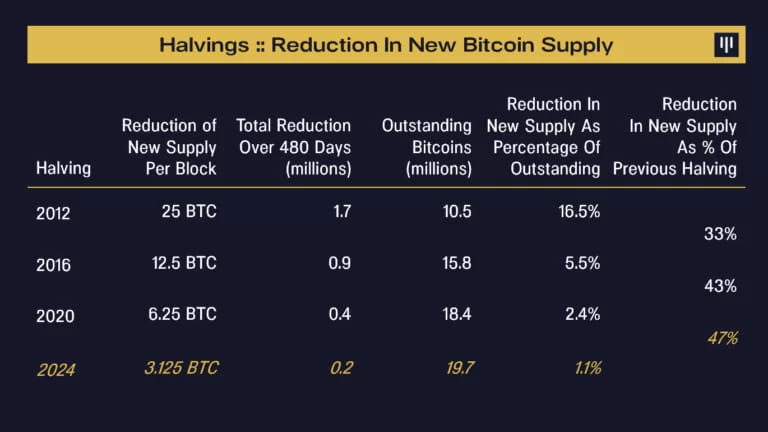
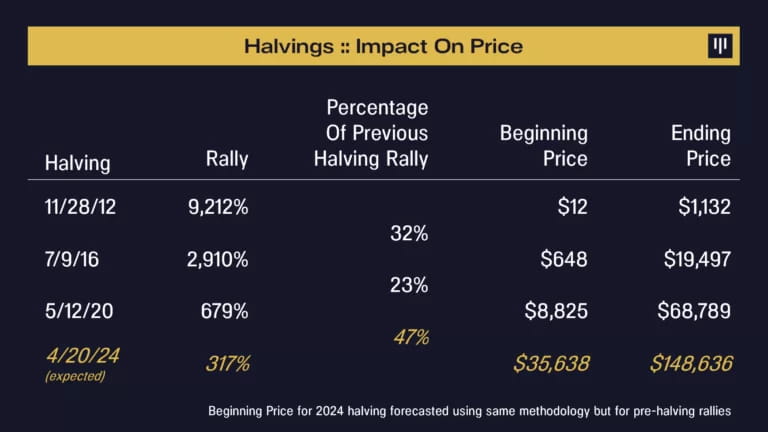
The 2016 halving reduced the supply of new Bitcoin by just one-third compared to the first time. Interestingly, it has exactly one-third the price impact. The 2020 halving reduced new bitcoin supply by 43% compared to the previous halving. It has a huge impact of 23% on prices. The next halving is expected to take place on April 20, 2024. Since most Bitcoin is currently in circulation, each halving will reduce new supply by nearly half. If history repeats itself, the next halving will see Bitcoin rise to $36k before the halving and $149k after.
Read more: https://theblock101.com/bitcoin-halving-la-gi-tai-sao-bitcoin-halving-lai-quan-trong