
张瑞阳-kevin
6k Posts

张瑞阳-kevin
 Square Verified+
Report
Block User
交易路上不迷茫,只讲干货张瑞阳!|红薯🍠和X:@cryptokevin1688|找到学习和可落地的路径,比拼执行力,千万别欺负正在努力和弱小时的你
Open Trade
High-Frequency Trader
1 Years
174 Following
46.7K+ Followers
26.6K+ Liked
Posts
Portfolio
All
Quotes
Videos
Live
PINNED
·
--
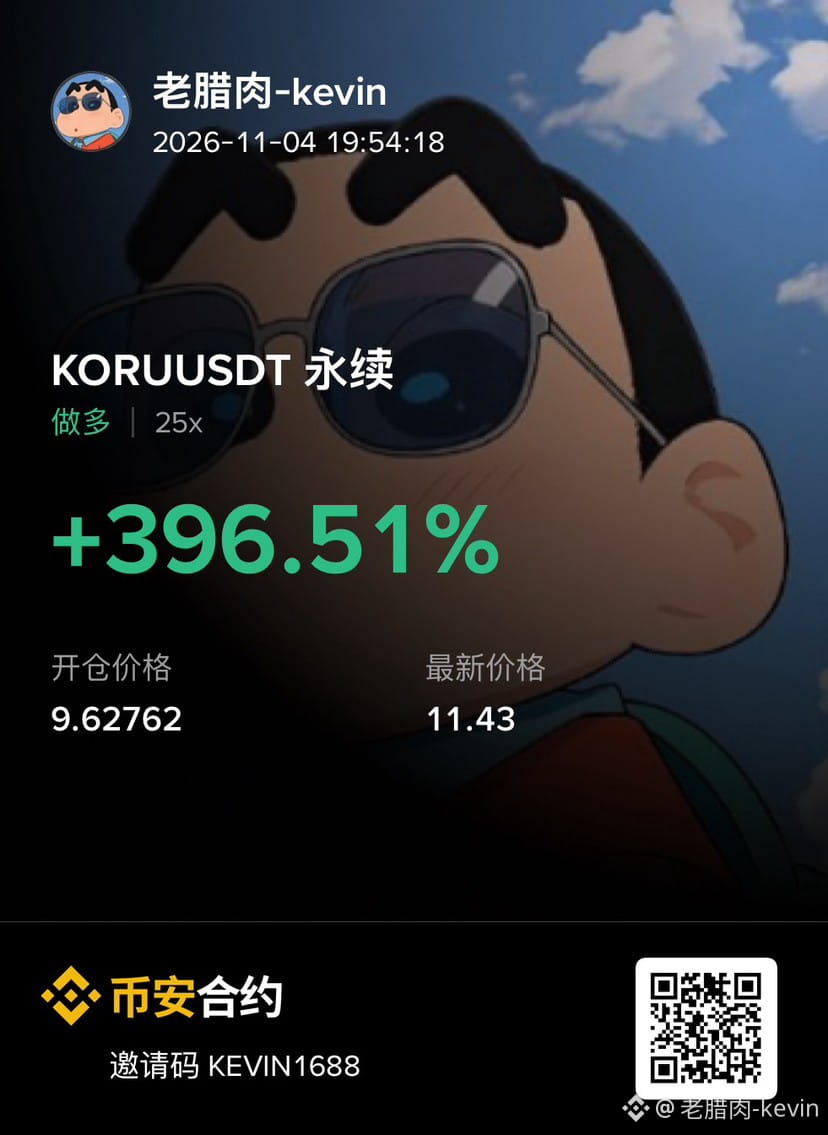
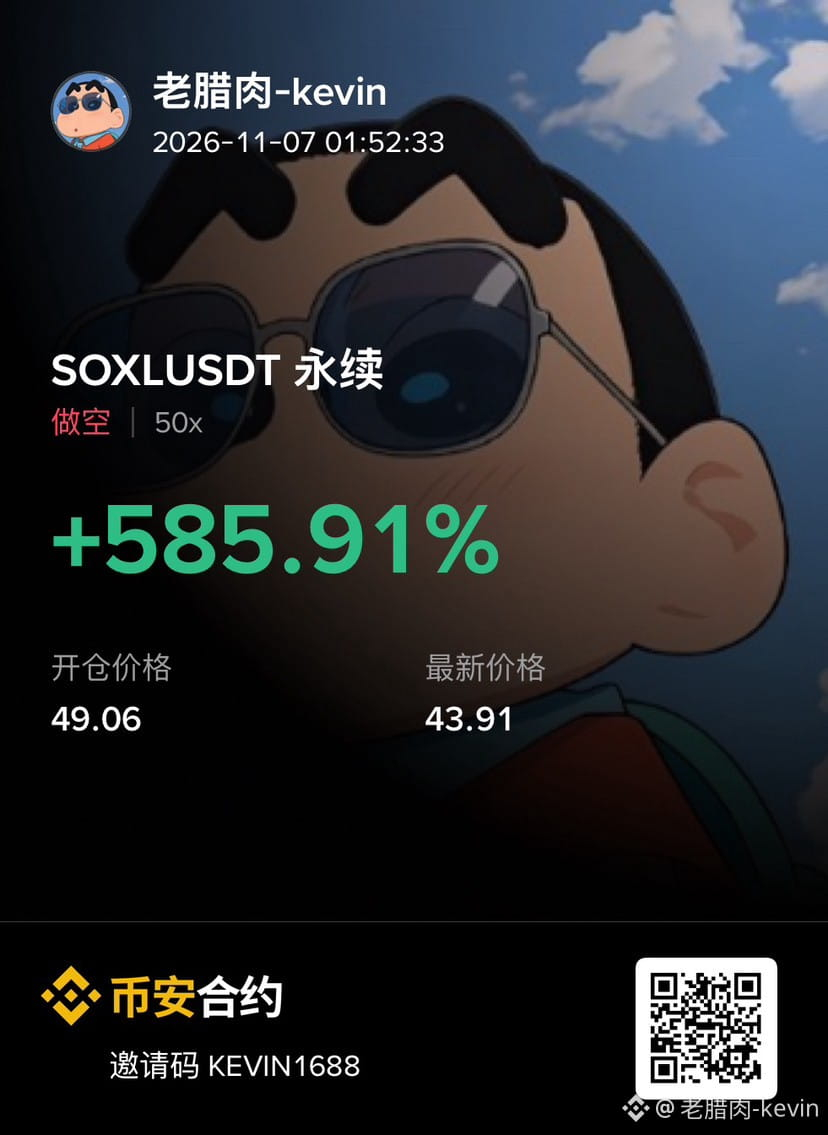
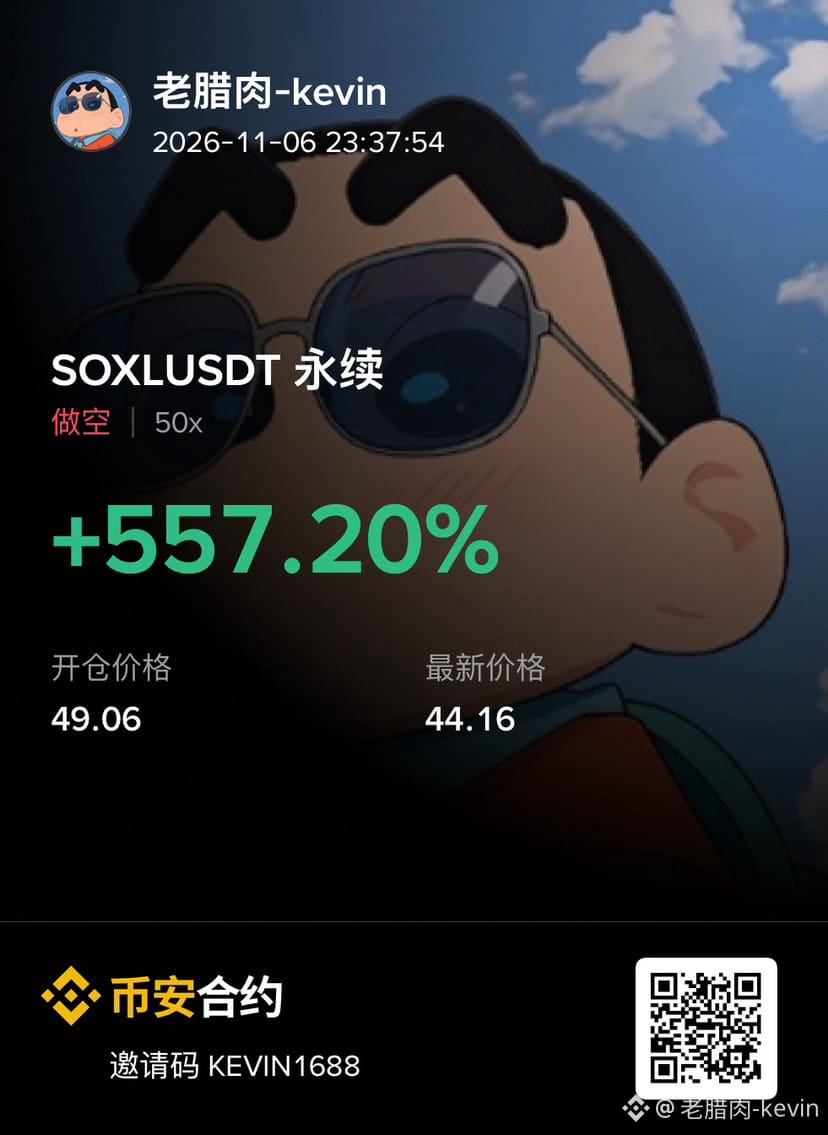
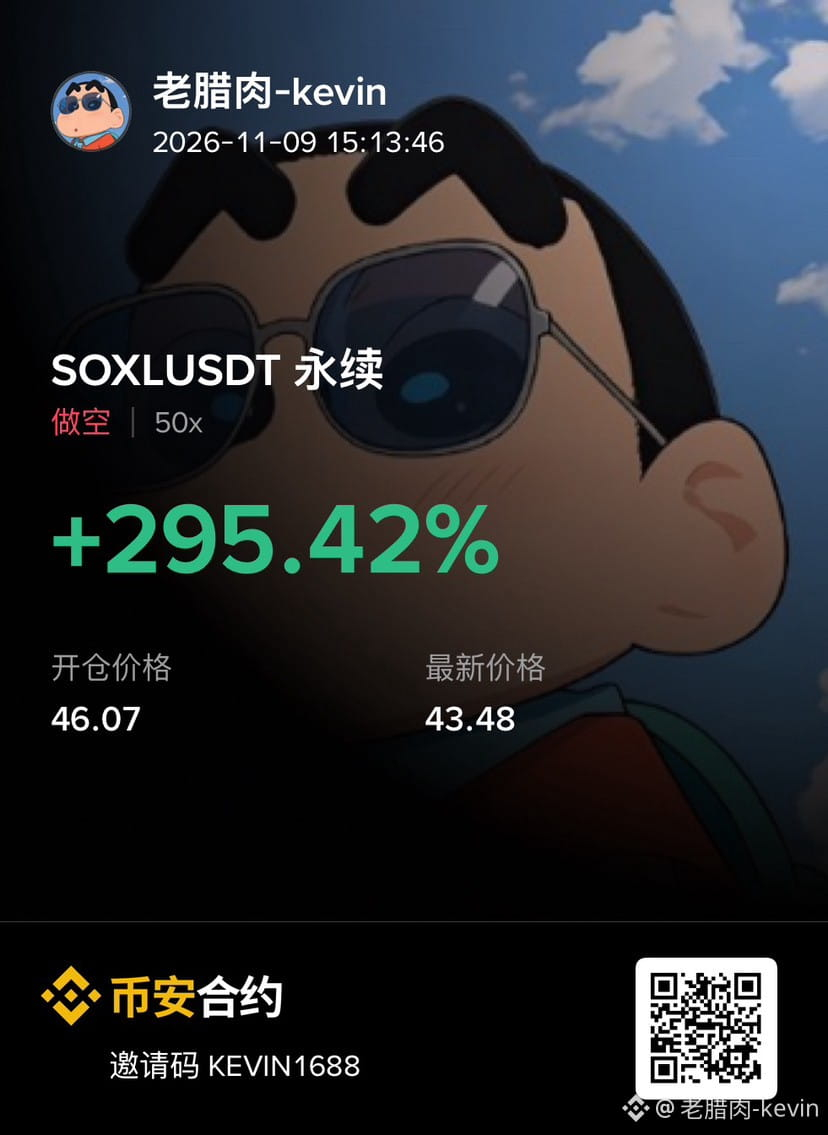
Recently, U.S. stocks have been highly volatile
unlike Bitcoin, which has recently been in a one-way downward trend
Stocks like Nvidia, SOXL, and KORU have all been fluctuating sharply
Some are high-confidence opportunities
while others are traps or attempts to lure traders into short positions
Remember to follow me, and let's trade high-confidence opportunities in U.S. stocks together #英伟达正物色新CEO,谁会接替黄仁勋?
1
1
1.2k
PINNED
·
--
Binance Wb3 Wallet Benefits
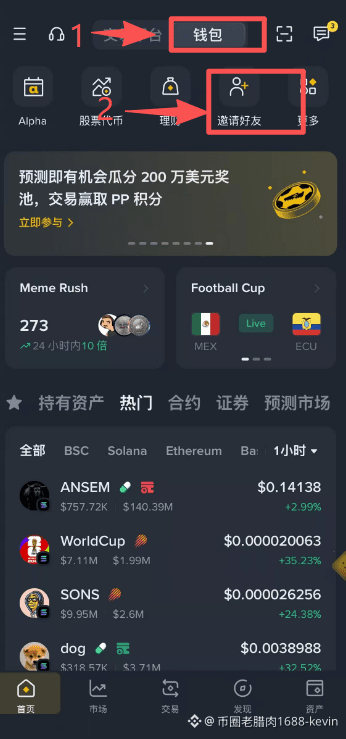
Brothers, let me tell you a great way to save 30% on trading fees (operate as shown in the picture)
In the Binance app, go to the home page. At the top, you’ll see two options: Trading Platform and Wallet.
Step 1: Select Wallet to switch to the wallet;
Step 2: Select Invite Friends;
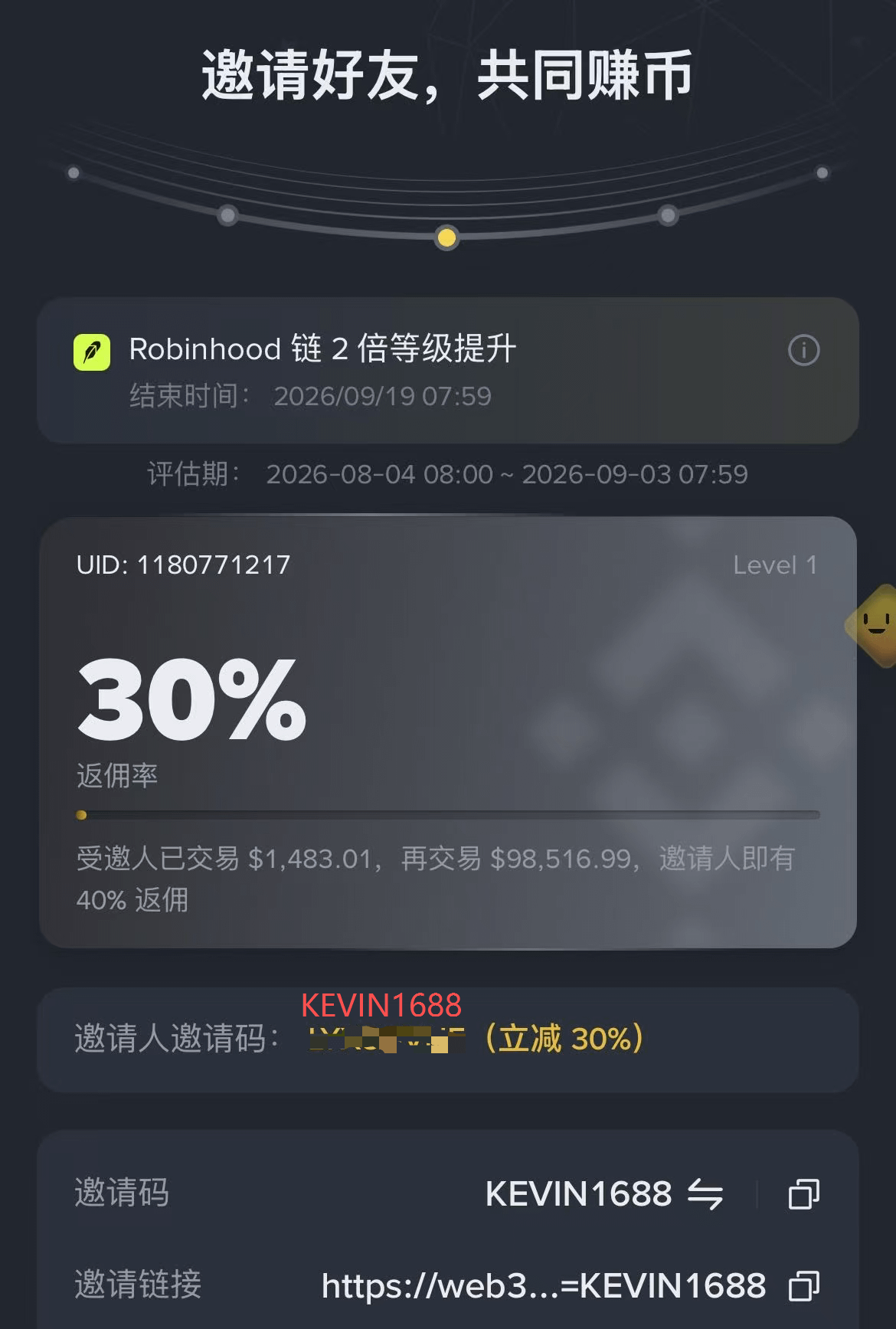
Step 3: Enter the invitation code: KEVIN1688 (copy it to the position shown in the picture);
Step 4: Claim the reward below.
Especially for brothers who like to farm on-chain low-cap “scam/dog” coins and do high-frequency trading—remember to bind the invitation code: KEVIN1688 to get a 30% reward. If you trade less, you can receive 5U or 10U; if you trade more, you can receive dozens of U, or even 100U.
[点击钱包,赶紧去绑定邀请码:KEVIN1688 ,领取奖励吧!](https://web3.binance.com/referral?ref=EHJSNS5W)
Binance Wb3 Wallet Benefits
Brothers, let me tell you a great way to save 30% on trading fees (operate as shown in the picture)
In the Binance app, go to the home page. At the top, you’ll see two options: Trading Platform and Wallet.
Step 1: Select Wallet to switch to the wallet;
Step 2: Select Invite Friends;
Step 3: Enter the invitation code: KEVIN1688 (copy it to the position shown in the picture);
Step 4: Claim the reward below.
Especially for brothers who like to farm on-chain low-cap “scam/dog” coins and do high-frequency trading—remember to bind the invitation code: KEVIN1688 to get a 30% reward. If you trade less, you can receive 5U or 10U; if you trade more, you can receive dozens of U, or even 100U.
点击钱包,赶紧去绑定邀请码:KEVIN1688 ,领取奖励吧!
6
4
27
935
·
--
Shortly after the market opened, a report carried by Bloomberg and other media quickly spread across Wall Street trading desks: “Anthropic’s IPO reportedly allocated almost nothing to most institutional buyers.”
The news immediately put the market on alert. ZeroHedge’s analysis pointed to two possible interpretations:
Either the underwriters were extremely confident in demand and deliberately limited institutional allocations to ensure a post-listing surge in the share price;
or institutions simply weren’t willing to buy in at $83, leaving the shares to be placed with retail investors, who are less price-sensitive.
The market seems to favor the latter explanation.
张瑞阳-kevin
·
--
Black Friday: Global stock markets plunge! What happened?
U.S. stocks opened higher last night, then fell. The Nasdaq went from a 2% gain to closing down 2.25%, while the Dow plunged 1,101 points, falling below the 50,000 mark.
There was just one trigger: Anthropic went public in the biggest IPO in history. Shares surged 34% at the open, but closed up just 17%—the biggest AI tailwind turned into the biggest sell signal, and investors immediately dumped AI stocks. AMD was hit by another short-seller report and fell 7.7%, dragging chip stocks across the board lower.
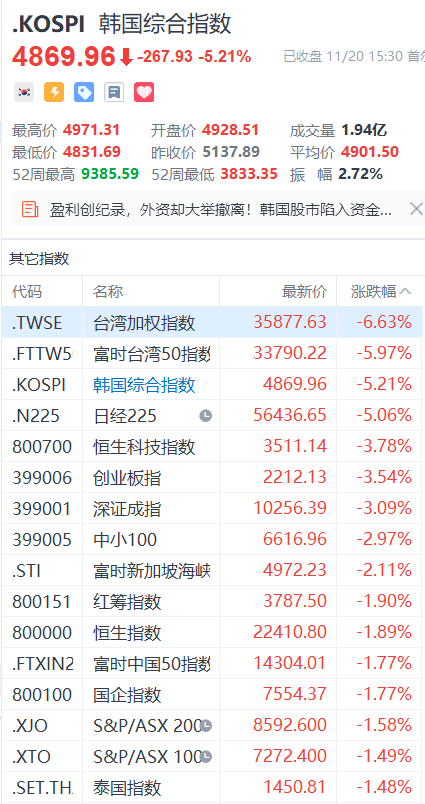
Today, Asia-Pacific markets saw a full-blown sell-off. South Korea’s KOSPI fell 4.7%, and SK Hynix plunged 7%; Japan’s Nikkei dropped 4.6%, while SoftBank tumbled 15%; Taiwan’s market fared even worse, plunging more than 5% during the session.
Investors are scrambling to get out of AI and tech stocks, and gold is being caught in the sell-off too. Spot gold fell below 3,600, while silver futures dropped nearly 5%. It’s not that gold has lost its appeal—when liquidity gets tight, people sell whatever they can.
The AI narrative has weakened, the IPO has drained cash from the market, and the Fed is still taking a hawkish stance. Those three factors collided, and that’s how Black Friday happened.$SOXL $BTC $XAU
277
·
--
Black Friday: Global stock markets plunge! What happened?
U.S. stocks opened higher last night, then fell. The Nasdaq went from a 2% gain to closing down 2.25%, while the Dow plunged 1,101 points, falling below the 50,000 mark.
There was just one trigger: Anthropic went public in the biggest IPO in history. Shares surged 34% at the open, but closed up just 17%—the biggest AI tailwind turned into the biggest sell signal, and investors immediately dumped AI stocks. AMD was hit by another short-seller report and fell 7.7%, dragging chip stocks across the board lower.
Today, Asia-Pacific markets saw a full-blown sell-off. South Korea’s KOSPI fell 4.7%, and SK Hynix plunged 7%; Japan’s Nikkei dropped 4.6%, while SoftBank tumbled 15%; Taiwan’s market fared even worse, plunging more than 5% during the session.
Investors are scrambling to get out of AI and tech stocks, and gold is being caught in the sell-off too. Spot gold fell below 3,600, while silver futures dropped nearly 5%. It’s not that gold has lost its appeal—when liquidity gets tight, people sell whatever they can.
The AI narrative has weakened, the IPO has drained cash from the market, and the Fed is still taking a hawkish stance. Those three factors collided, and that’s how Black Friday happened.$SOXL $BTC $XAU
{future}(XAUUSDT)
{future}(BTCUSDT)
{future}(SOXLUSDT)
Black Friday: Global stock markets plunge! What happened?
U.S. stocks opened higher last night, then fell. The Nasdaq went from a 2% gain to closing down 2.25%, while the Dow plunged 1,101 points, falling below the 50,000 mark.
There was just one trigger: Anthropic went public in the biggest IPO in history. Shares surged 34% at the open, but closed up just 17%—the biggest AI tailwind turned into the biggest sell signal, and investors immediately dumped AI stocks. AMD was hit by another short-seller report and fell 7.7%, dragging chip stocks across the board lower.
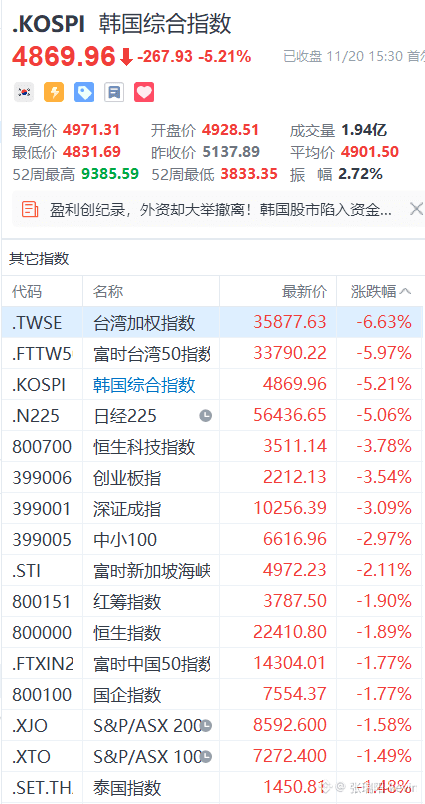
Today, Asia-Pacific markets saw a full-blown sell-off. South Korea’s KOSPI fell 4.7%, and SK Hynix plunged 7%; Japan’s Nikkei dropped 4.6%, while SoftBank tumbled 15%; Taiwan’s market fared even worse, plunging more than 5% during the session.
Investors are scrambling to get out of AI and tech stocks, and gold is being caught in the sell-off too. Spot gold fell below 3,600, while silver futures dropped nearly 5%. It’s not that gold has lost its appeal—when liquidity gets tight, people sell whatever they can.
The AI narrative has weakened, the IPO has drained cash from the market, and the Fed is still taking a hawkish stance. Those three factors collided, and that’s how Black Friday happened.$SOXL $BTC $XAU
2
1
1
354
·
--
🎙️ Will ANT continue to plunge tomorrow? Will BTC fall below 60,000 or surge toward 65,000?
Preview
14:40 Nov 20
0
0
0
·
--
Verified
From +2% to −2%! Nasdaq falls below 24,000, S&P 500 logs six straight losses; Anthropic surges then retreats, up 17%; Nvidia falls another 3%; Pinduoduo jumps 11% after earnings; gold falls toward 3,600
From +2% to −2%! Nasdaq falls below 24,000, S&P 500 logs six straight losses; Anthropic surges then retreats, up 17%; Nvidia falls another 3%; Pinduoduo jumps 11% after earnings; gold falls toward 3,600
张瑞阳-kevin
·
--
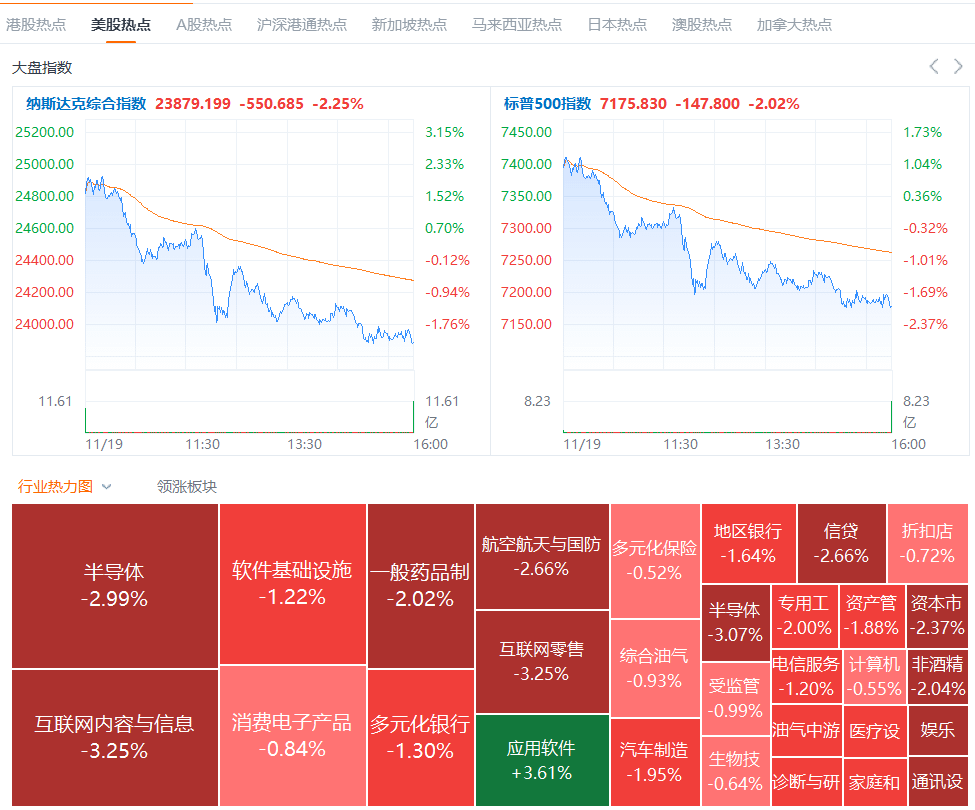
U.S. Stock Market Analysis: Hawkish Rate Hikes + Fading AI Conviction—Where Is All the Money Going?
U.S. stocks took investors on a roller-coaster ride last night. The Dow fell 2.19%, dropping below 50,000; the Nasdaq fell 2.25%, slipping below 24,000; and the S&P 500 posted its sixth straight loss. Stocks were still in the green at the open, but when Anthropic went public, the selling came pouring in. The biggest IPO in history turned out to be the starting gun for the whole market—once it went off, everyone headed for the exits.
In stocks, the Philadelphia Semiconductor Index was up 4.7% early in the session, but ended down 2.41%, with all 27 of its components turning negative. Nvidia fell 3.3% to a new 52-week low, while AMD was hammered down 7.72% by a short-seller report.
But some Chinese stocks stole the spotlight, bucking the trend: Pinduoduo surged 11% after earnings, while Futu and Tiger also rebounded. The money isn't “leaving”—it's scrambling out of high-flying AI stocks and into other areas.
The bond market, by contrast, became a haven. The 10-year Treasury yield briefly surged to 5.1% intraday, then closed back around 5.05%, down about 1.5 basis points. Falling yields suggest investors are buying bonds for shelter.
The currency market was the most honest. The U.S. Dollar Index rose 0.2% to an 18-month high, moving above 104 intraday. Fed officials openly said they “wouldn't rule out a larger-than-usual rate hike at a single meeting.” Money is rushing into the dollar faster than anywhere else.
Commodities were drained of liquidity. Gold fell more than 2.7%, plunging to around 3,600 and hitting its lowest level since last September; silver dropped nearly 5%. It's not that gold has lost its rationale—when liquidity is squeezed, investors sell whatever they can sell first.
Hawkish rate hikes are pushing valuations down, fading faith in AI is forcing investors to dump their holdings, and the IPO is soaking up available cash. $ANT $BTC $XAU
1k
·
--
U.S. Stock Market Analysis: Hawkish Rate Hikes + Fading AI Conviction—Where Is All the Money Going?
U.S. stocks took investors on a roller-coaster ride last night. The Dow fell 2.19%, dropping below 50,000; the Nasdaq fell 2.25%, slipping below 24,000; and the S&P 500 posted its sixth straight loss. Stocks were still in the green at the open, but when Anthropic went public, the selling came pouring in. The biggest IPO in history turned out to be the starting gun for the whole market—once it went off, everyone headed for the exits.
In stocks, the Philadelphia Semiconductor Index was up 4.7% early in the session, but ended down 2.41%, with all 27 of its components turning negative. Nvidia fell 3.3% to a new 52-week low, while AMD was hammered down 7.72% by a short-seller report.
But some Chinese stocks stole the spotlight, bucking the trend: Pinduoduo surged 11% after earnings, while Futu and Tiger also rebounded. The money isn't “leaving”—it's scrambling out of high-flying AI stocks and into other areas.
The bond market, by contrast, became a haven. The 10-year Treasury yield briefly surged to 5.1% intraday, then closed back around 5.05%, down about 1.5 basis points. Falling yields suggest investors are buying bonds for shelter.
The currency market was the most honest. The U.S. Dollar Index rose 0.2% to an 18-month high, moving above 104 intraday. Fed officials openly said they “wouldn't rule out a larger-than-usual rate hike at a single meeting.” Money is rushing into the dollar faster than anywhere else.
Commodities were drained of liquidity. Gold fell more than 2.7%, plunging to around 3,600 and hitting its lowest level since last September; silver dropped nearly 5%. It's not that gold has lost its rationale—when liquidity is squeezed, investors sell whatever they can sell first.
Hawkish rate hikes are pushing valuations down, fading faith in AI is forcing investors to dump their holdings, and the IPO is soaking up available cash. $ANT $BTC $XAU
{future}(XAUUSDT)
{future}(BTCUSDT)
{future}(ANTUSDT)
U.S. Stock Market Analysis: Hawkish Rate Hikes + Fading AI Conviction—Where Is All the Money Going?
U.S. stocks took investors on a roller-coaster ride last night. The Dow fell 2.19%, dropping below 50,000; the Nasdaq fell 2.25%, slipping below 24,000; and the S&P 500 posted its sixth straight loss. Stocks were still in the green at the open, but when Anthropic went public, the selling came pouring in. The biggest IPO in history turned out to be the starting gun for the whole market—once it went off, everyone headed for the exits.
In stocks, the Philadelphia Semiconductor Index was up 4.7% early in the session, but ended down 2.41%, with all 27 of its components turning negative. Nvidia fell 3.3% to a new 52-week low, while AMD was hammered down 7.72% by a short-seller report.
But some Chinese stocks stole the spotlight, bucking the trend: Pinduoduo surged 11% after earnings, while Futu and Tiger also rebounded. The money isn't “leaving”—it's scrambling out of high-flying AI stocks and into other areas.
The bond market, by contrast, became a haven. The 10-year Treasury yield briefly surged to 5.1% intraday, then closed back around 5.05%, down about 1.5 basis points. Falling yields suggest investors are buying bonds for shelter.
The currency market was the most honest. The U.S. Dollar Index rose 0.2% to an 18-month high, moving above 104 intraday. Fed officials openly said they “wouldn't rule out a larger-than-usual rate hike at a single meeting.” Money is rushing into the dollar faster than anywhere else.
Commodities were drained of liquidity. Gold fell more than 2.7%, plunging to around 3,600 and hitting its lowest level since last September; silver dropped nearly 5%. It's not that gold has lost its rationale—when liquidity is squeezed, investors sell whatever they can sell first.
Hawkish rate hikes are pushing valuations down, fading faith in AI is forcing investors to dump their holdings, and the IPO is soaking up available cash. $ANT $BTC $XAU
1
1
1
1.3k
·
--
It’s a good time to go long on dips, with a stop-loss around 61,200. For shorts, wait until the price moves back above 63,000 and sweeps liquidity before considering an entry. U.S. stock index futures continue to fall, while gold seems to have stopped declining for the day. Let’s see whether liquidity flows into crypto before the market opens.
It’s a good time to go long on dips, with a stop-loss around 61,200. For shorts, wait until the price moves back above 63,000 and sweeps liquidity before considering an entry. U.S. stock index futures continue to fall, while gold seems to have stopped declining for the day. Let’s see whether liquidity flows into crypto before the market opens.
张瑞阳-kevin
·
--
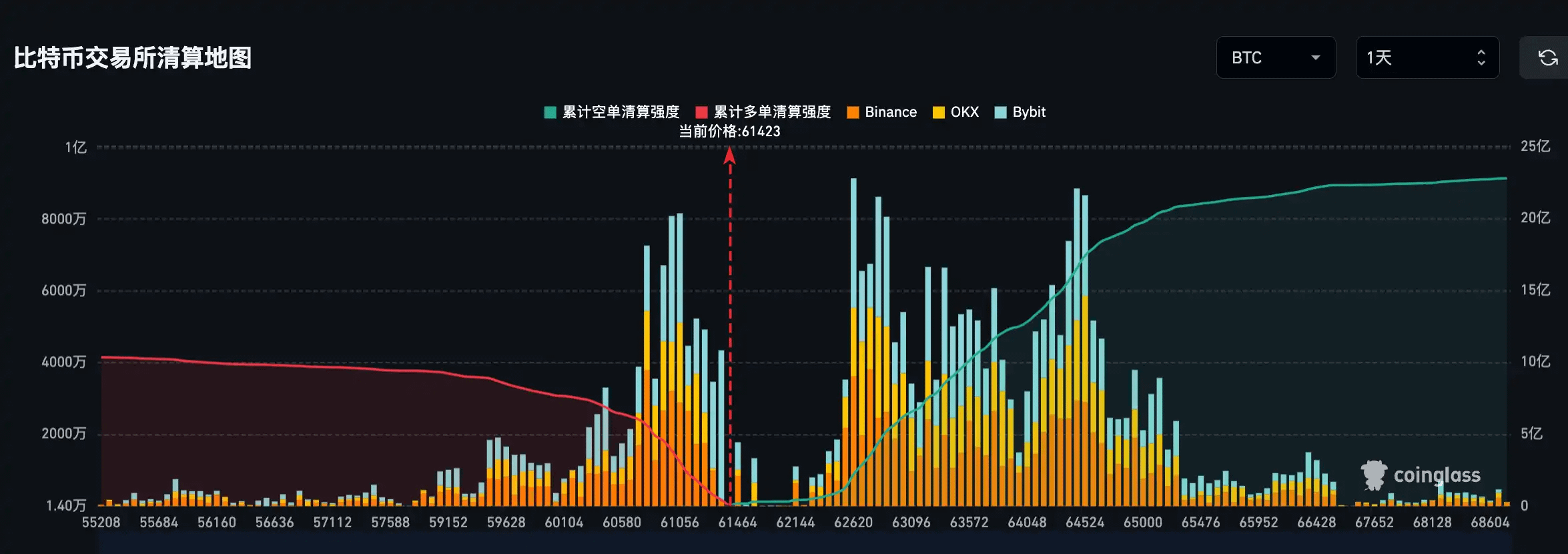
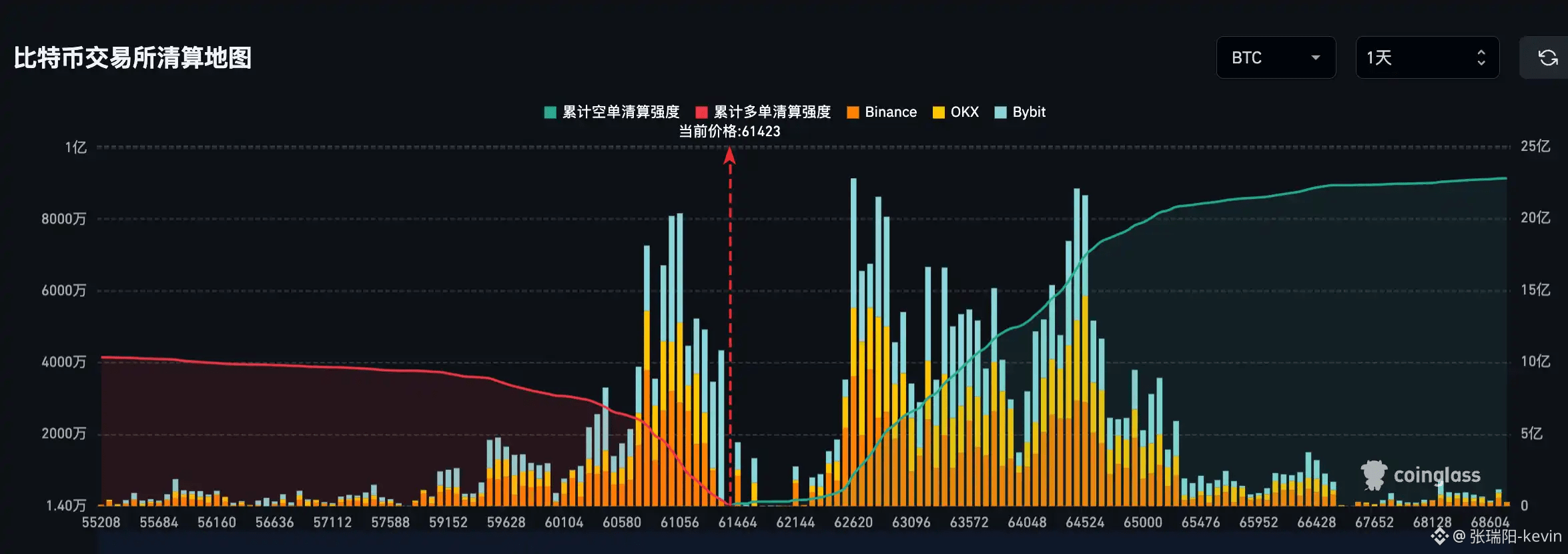
#加息预期叠加美股分流,比特币跌破6.2万美元 Will Bitcoin hit $60,000 or $63,000 first?
If Bitcoin falls below $60,000, the cumulative liquidation intensity of long positions on major CEXs will reach 781 million.
Conversely, if Bitcoin breaks above $63,000, the cumulative liquidation intensity of short positions on major CEXs will reach 622 million.$BTC $ETH $SOL
If Bitcoin falls below $60,000, the cumulative liquidation intensity of long positions on major CEXs will reach 781 million.
Conversely, if Bitcoin breaks above $63,000, the cumulative liquidation intensity of short positions on major CEXs will reach 622 million.$BTC $ETH $SOL
363
·
--
#加息预期叠加美股分流,比特币跌破6.2万美元 Will Bitcoin hit $60,000 or $63,000 first?
If Bitcoin falls below $60,000, the cumulative liquidation intensity of long positions on major CEXs will reach 781 million.
Conversely, if Bitcoin breaks above $63,000, the cumulative liquidation intensity of short positions on major CEXs will reach 622 million.$BTC $ETH $SOL
{future}(SOLUSDT)
{future}(ETHUSDT)
{future}(BTCUSDT)
#加息预期叠加美股分流,比特币跌破6.2万美元 Will Bitcoin hit $60,000 or $63,000 first?
If Bitcoin falls below $60,000, the cumulative liquidation intensity of long positions on major CEXs will reach 781 million.
Conversely, if Bitcoin breaks above $63,000, the cumulative liquidation intensity of short positions on major CEXs will reach 622 million.$BTC $ETH $SOL
If Bitcoin falls below $60,000, the cumulative liquidation intensity of long positions on major CEXs will reach 781 million.
Conversely, if Bitcoin breaks above $63,000, the cumulative liquidation intensity of short positions on major CEXs will reach 622 million.$BTC $ETH $SOL
1
1
302
·
--
#anthropic创纪录上市,1.5万亿美元市值合理吗? U.S. Stock Market News Analysis: ANT’s Record-Breaking IPO Debuts, While Chip Stocks Get Drained of Cash
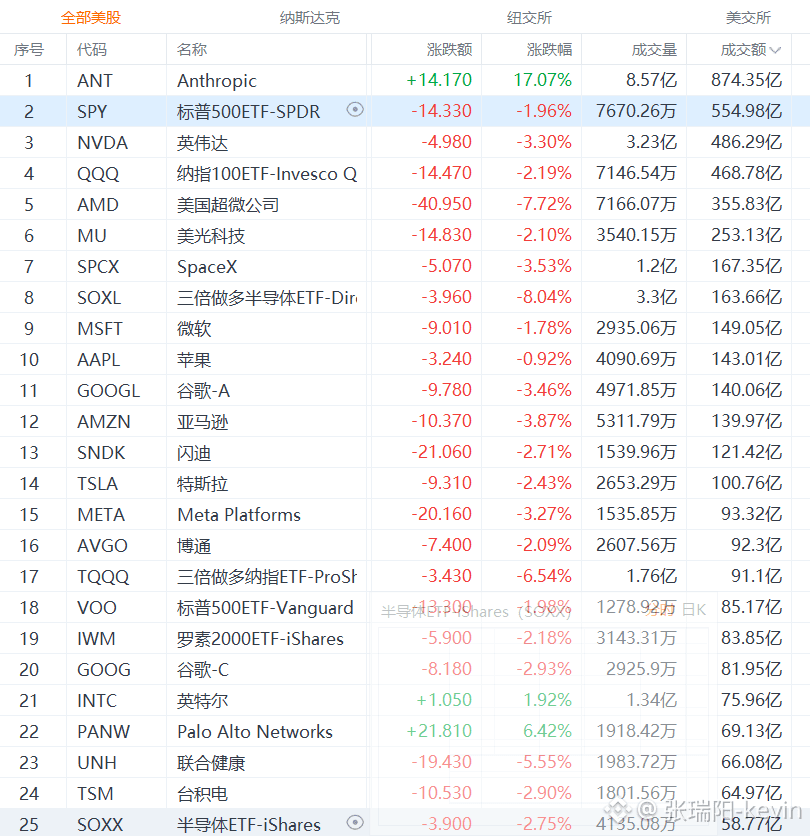
U.S. stocks opened higher on Thursday but slid throughout the session, with all three major indexes in the red. The Nasdaq fell 2.25%, the S&P 500 dropped 2.02%, and the Dow plunged 1,100 points. On the surface, stocks were falling; underneath, cash was being drained by a single new listing.
Anthropic (ANT) led the market with $87.3 billion in trading volume, closing up 17%. The big news: the largest IPO in history raised $81.3 billion. Shares surged 34% at the open, but closed up just 17%. That retreat from the highs was itself the biggest bearish signal—if even the hottest AI IPO couldn’t hold on to its gains, what chance did other AI stocks have?
AMD traded $35 billion worth of shares and closed down 7.72%, after plunging as much as 11% intraday. The news: short seller Hunterbrook published a report accusing AMD of engaging in “round-trip transactions” with customers, using a playbook similar to Nvidia’s: first urging customers to buy chips, then lending them the money to pay. AMD denied the allegations, but investors ran for the exits first.
Nvidia traded $46.8 billion worth of shares and fell 3.30%, marking its sixth consecutive day of losses. The news itself wasn’t bad: SpaceX had just issued $32 billion in debt specifically to buy Nvidia chips. But the stock still got hammered—when good news can’t lift a stock, that’s weakness.
Anthropic sucked the available cash out of the market, short sellers lit a fire under AMD, and even positive news couldn’t lift Nvidia. $ANT $AMD $SOXL
{future}(SOXLUSDT)
{future}(AMDUSDT)
{future}(ANTUSDT)
#anthropic创纪录上市,1.5万亿美元市值合理吗? U.S. Stock Market News Analysis: ANT’s Record-Breaking IPO Debuts, While Chip Stocks Get Drained of Cash
U.S. stocks opened higher on Thursday but slid throughout the session, with all three major indexes in the red. The Nasdaq fell 2.25%, the S&P 500 dropped 2.02%, and the Dow plunged 1,100 points. On the surface, stocks were falling; underneath, cash was being drained by a single new listing.
Anthropic (ANT) led the market with $87.3 billion in trading volume, closing up 17%. The big news: the largest IPO in history raised $81.3 billion. Shares surged 34% at the open, but closed up just 17%. That retreat from the highs was itself the biggest bearish signal—if even the hottest AI IPO couldn’t hold on to its gains, what chance did other AI stocks have?
AMD traded $35 billion worth of shares and closed down 7.72%, after plunging as much as 11% intraday. The news: short seller Hunterbrook published a report accusing AMD of engaging in “round-trip transactions” with customers, using a playbook similar to Nvidia’s: first urging customers to buy chips, then lending them the money to pay. AMD denied the allegations, but investors ran for the exits first.
Nvidia traded $46.8 billion worth of shares and fell 3.30%, marking its sixth consecutive day of losses. The news itself wasn’t bad: SpaceX had just issued $32 billion in debt specifically to buy Nvidia chips. But the stock still got hammered—when good news can’t lift a stock, that’s weakness.
Anthropic sucked the available cash out of the market, short sellers lit a fire under AMD, and even positive news couldn’t lift Nvidia. $ANT $AMD $SOXL
1
2
2k
·
--
Semiconductors surge and then retreat as Korean, Hong Kong and A-share funds stage a “mass exodus”: where is the money hiding?
U.S. semiconductor stocks replayed the same old script overnight. The Philadelphia Semiconductor Index surged early in the session, only to close down 2.41%. A short-seller report sent AMD tumbling 7%, while Nvidia reversed course from a gain of nearly 5% to end in the red.
The money is moving in plain sight: pulling out of AI computing power and data centers and seeking shelter in defensive and beaten-down stocks. Memory stocks held up relatively well, becoming one of the few corners of the AI sector still standing.
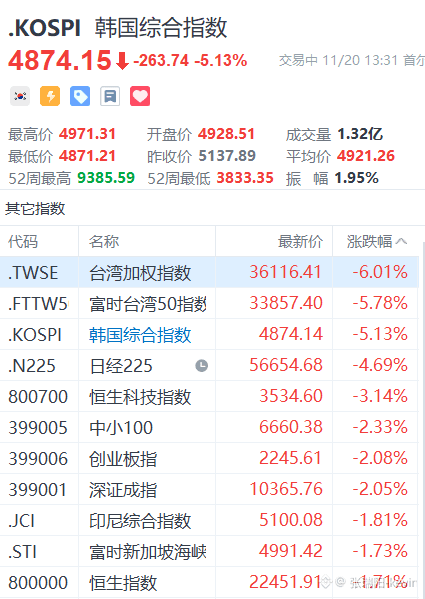
Asia-Pacific markets opened to a panic sell-off.
South Korea was hit hardest, with the KOSPI falling more than 4% at one point. Foreign investors and institutions dumped several hundred billion won worth of stocks combined in the morning, while retail investors tried to catch the falling knife. Money flowed out of machinery, electronics and telecommunications, funneling instead into the two defensive sectors of electricity and gas, and food, beverages and tobacco.
Southbound funds in Hong Kong, by contrast, bought against the trend, with net purchases totaling HK$3.958 billion for the day, mainly in Tencent, SMIC and Meituan. Alibaba saw net sales of 450 million, while NetEase was hammered, plunging 18%.
A-share institutional investors were even more decisive: semiconductor stocks saw a single-day outflow of 7.16 billion, and electronics nearly 7 billion. They turned around and increased holdings in “safe-haven” sectors such as agriculture, forestry, animal husbandry and fisheries; utilities; general equipment; and publishing.
$KORU $SOXL $KSTR
{future}(KSTRUSDT)
{future}(SOXLUSDT)
{future}(KORUUSDT)
Semiconductors surge and then retreat as Korean, Hong Kong and A-share funds stage a “mass exodus”: where is the money hiding?
U.S. semiconductor stocks replayed the same old script overnight. The Philadelphia Semiconductor Index surged early in the session, only to close down 2.41%. A short-seller report sent AMD tumbling 7%, while Nvidia reversed course from a gain of nearly 5% to end in the red.
The money is moving in plain sight: pulling out of AI computing power and data centers and seeking shelter in defensive and beaten-down stocks. Memory stocks held up relatively well, becoming one of the few corners of the AI sector still standing.
Asia-Pacific markets opened to a panic sell-off.
South Korea was hit hardest, with the KOSPI falling more than 4% at one point. Foreign investors and institutions dumped several hundred billion won worth of stocks combined in the morning, while retail investors tried to catch the falling knife. Money flowed out of machinery, electronics and telecommunications, funneling instead into the two defensive sectors of electricity and gas, and food, beverages and tobacco.
Southbound funds in Hong Kong, by contrast, bought against the trend, with net purchases totaling HK$3.958 billion for the day, mainly in Tencent, SMIC and Meituan. Alibaba saw net sales of 450 million, while NetEase was hammered, plunging 18%.
A-share institutional investors were even more decisive: semiconductor stocks saw a single-day outflow of 7.16 billion, and electronics nearly 7 billion. They turned around and increased holdings in “safe-haven” sectors such as agriculture, forestry, animal husbandry and fisheries; utilities; general equipment; and publishing.
$KORU $SOXL $KSTR
3
248
·
--
Verified
The Philadelphia Semiconductor Index rose nearly 4% at the open. Coherent gained over 9% after its board approved a stock buyback plan of up to $2 billion; Intel rose 7%, Micron and Credo Technology gained 6%, and Nvidia and Marvell Technology rose 4%.
The Philadelphia Semiconductor Index rose nearly 4% at the open. Coherent gained over 9% after its board approved a stock buyback plan of up to $2 billion; Intel rose 7%, Micron and Credo Technology gained 6%, and Nvidia and Marvell Technology rose 4%.
张瑞阳-kevin
·
--
Mid-session U.S. market take: Shorts got swallowed whole, and did all the money just move from “boring old-man stocks” into chips?
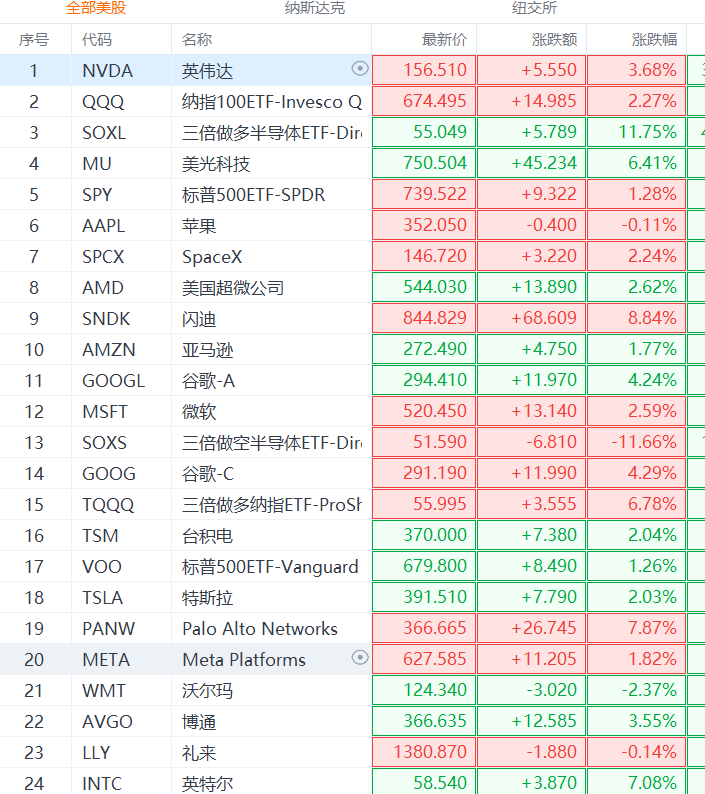
The market went absolutely nuts right at the open! Semiconductors took off, with the triple-leveraged SOXL surging 11.75%, while the inverse SOXS got pummeled, dropping 11.66%. Nvidia rose 3.68%, back to 156; Micron gained over 6%; SanDisk soared 8.8%; even Intel, usually ignored, ripped 7% higher.
Where’s the money flowing out of? Just look at the biggest losers. Walmart, the discount retailer, fell 2.37%, and Eli Lilly, the weight-loss drugmaker, was also in the red. In plain English: so-called “safe-haven money” has all run for the exits. Everyone’s decided betting on AI is still more appealing. As panic fades, those boring old-man stocks get ditched in a hurry.
Where’s the money going? Straight into AI hardware and tech giants. Google climbed 4.2%, while Microsoft and Amazon were partying too. There are two key reasons: first, Anthropic, valued at $100 billion, rings the bell tonight, giving global AI assets a boost; second, the Nvidia earnings landmine has been defused, and the shorts have completely thrown in the towel and started covering.
After several days of pent-up emotion, diving in during the first wave at the open is just making you an ATM for the people who bought last night’s dip. If Nvidia pulls back toward 155 and holds there on lighter volume, I might consider taking a shot.$SNDK $SOXL $ANT
504
·
--
Mid-session U.S. market take: Shorts got swallowed whole, and did all the money just move from “boring old-man stocks” into chips?
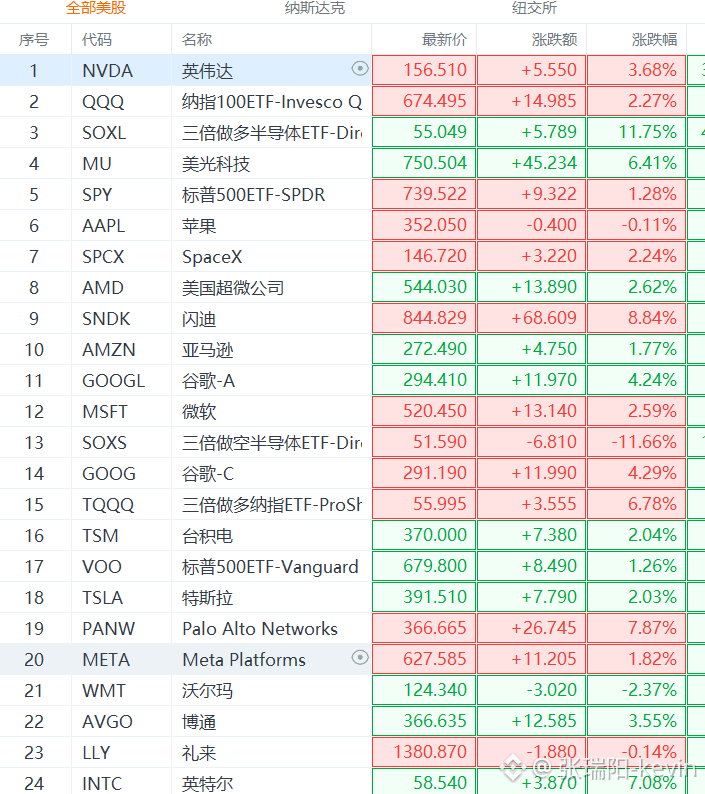
The market went absolutely nuts right at the open! Semiconductors took off, with the triple-leveraged SOXL surging 11.75%, while the inverse SOXS got pummeled, dropping 11.66%. Nvidia rose 3.68%, back to 156; Micron gained over 6%; SanDisk soared 8.8%; even Intel, usually ignored, ripped 7% higher.
Where’s the money flowing out of? Just look at the biggest losers. Walmart, the discount retailer, fell 2.37%, and Eli Lilly, the weight-loss drugmaker, was also in the red. In plain English: so-called “safe-haven money” has all run for the exits. Everyone’s decided betting on AI is still more appealing. As panic fades, those boring old-man stocks get ditched in a hurry.
Where’s the money going? Straight into AI hardware and tech giants. Google climbed 4.2%, while Microsoft and Amazon were partying too. There are two key reasons: first, Anthropic, valued at $100 billion, rings the bell tonight, giving global AI assets a boost; second, the Nvidia earnings landmine has been defused, and the shorts have completely thrown in the towel and started covering.
After several days of pent-up emotion, diving in during the first wave at the open is just making you an ATM for the people who bought last night’s dip. If Nvidia pulls back toward 155 and holds there on lighter volume, I might consider taking a shot.$SNDK $SOXL $ANT
{future}(ANTUSDT)
{future}(SOXLUSDT)
{future}(SNDKUSDT)
Mid-session U.S. market take: Shorts got swallowed whole, and did all the money just move from “boring old-man stocks” into chips?
The market went absolutely nuts right at the open! Semiconductors took off, with the triple-leveraged SOXL surging 11.75%, while the inverse SOXS got pummeled, dropping 11.66%. Nvidia rose 3.68%, back to 156; Micron gained over 6%; SanDisk soared 8.8%; even Intel, usually ignored, ripped 7% higher.
Where’s the money flowing out of? Just look at the biggest losers. Walmart, the discount retailer, fell 2.37%, and Eli Lilly, the weight-loss drugmaker, was also in the red. In plain English: so-called “safe-haven money” has all run for the exits. Everyone’s decided betting on AI is still more appealing. As panic fades, those boring old-man stocks get ditched in a hurry.
Where’s the money going? Straight into AI hardware and tech giants. Google climbed 4.2%, while Microsoft and Amazon were partying too. There are two key reasons: first, Anthropic, valued at $100 billion, rings the bell tonight, giving global AI assets a boost; second, the Nvidia earnings landmine has been defused, and the shorts have completely thrown in the towel and started covering.
After several days of pent-up emotion, diving in during the first wave at the open is just making you an ATM for the people who bought last night’s dip. If Nvidia pulls back toward 155 and holds there on lighter volume, I might consider taking a shot.$SNDK $SOXL $ANT
1
1
263
·
--
Quoted content has been removed
314
·
--
Verified
Major premarket news for U.S. stocks: AI’s new king, ANT, starts trading at 10:50 p.m. tonight. Is it time to buy the dip in U.S. semiconductor stocks?
All three major futures are up premarket, with Nasdaq futures surging 1.91%, while the Dow and S&P 500 are up 0.68% and 1.11%, respectively. SK Hynix is up more than 5%; Micron and SanDisk are up nearly 4%; and Google and Amazon are up more than 2%. It looks like a lively scene, but beneath today’s excitement are two forces pulling in completely opposite directions.
On one side, Anthropic has set its IPO price at $83, 6.4% above the high end of the range, and expanded the offering to 980 million shares. Combined with total private fundraising of $107.3 billion, its valuation stands at $1.5 trillion, with subscriptions nearly seven times oversubscribed. AI hardware stocks are jumping across the board premarket, on the bet that “if investors are scrambling for shares in the primary market, the secondary market can’t just sit this one out.”
On the other side, the Fed hasn’t budged. Waller said yesterday that inflation is still moving in the wrong direction and urged the Fed to consider a 50-basis-point hike in December. The meeting minutes said “almost all” officials believe rates will need to keep rising over the coming months. No matter how big the AI story gets, it can’t outweigh rising funding costs.
Don’t chase the premarket rally. ANT starts trading at 10:50 p.m. tonight. Nvidia is up 1.67% premarket, hovering around 155. Buying in now would mean carrying the people who bought the dip last night. Wait for the opening IPO-frenzy surge to fade, then see whether the stock can hold its ground on a pullback with lower volume. #Anthropic今日开始交易,IPO定价每股83美元 $ANT $SOXL $SNDK
{future}(SNDKUSDT)
{future}(SOXLUSDT)
{future}(ANTUSDT)
Major premarket news for U.S. stocks: AI’s new king, ANT, starts trading at 10:50 p.m. tonight. Is it time to buy the dip in U.S. semiconductor stocks?
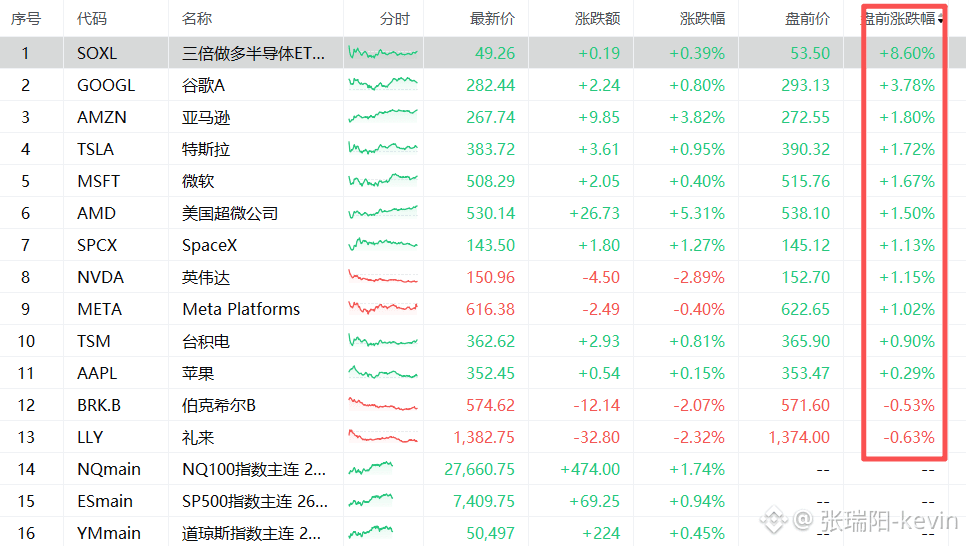
All three major futures are up premarket, with Nasdaq futures surging 1.91%, while the Dow and S&P 500 are up 0.68% and 1.11%, respectively. SK Hynix is up more than 5%; Micron and SanDisk are up nearly 4%; and Google and Amazon are up more than 2%. It looks like a lively scene, but beneath today’s excitement are two forces pulling in completely opposite directions.
On one side, Anthropic has set its IPO price at $83, 6.4% above the high end of the range, and expanded the offering to 980 million shares. Combined with total private fundraising of $107.3 billion, its valuation stands at $1.5 trillion, with subscriptions nearly seven times oversubscribed. AI hardware stocks are jumping across the board premarket, on the bet that “if investors are scrambling for shares in the primary market, the secondary market can’t just sit this one out.”
On the other side, the Fed hasn’t budged. Waller said yesterday that inflation is still moving in the wrong direction and urged the Fed to consider a 50-basis-point hike in December. The meeting minutes said “almost all” officials believe rates will need to keep rising over the coming months. No matter how big the AI story gets, it can’t outweigh rising funding costs.
Don’t chase the premarket rally. ANT starts trading at 10:50 p.m. tonight. Nvidia is up 1.67% premarket, hovering around 155. Buying in now would mean carrying the people who bought the dip last night. Wait for the opening IPO-frenzy surge to fade, then see whether the stock can hold its ground on a pullback with lower volume. #Anthropic今日开始交易,IPO定价每股83美元 $ANT $SOXL $SNDK
2
2
3.5k
·
--
Verified
My U.S. premarket diary today (November 19, 2026): A trillion-dollar IPO lets investors break even—or just finds a new way to trap them?
Anthropic pushed its IPO price to $83, putting its valuation at $1.5 trillion and raising $107.3 billion—the biggest offering in history. In premarket trading, Nasdaq futures are up 1.90%, SK Hynix is up more than 5%, Micron more than 4%, AMD more than 3%, and Nvidia 1.76%. The screens are awash in green, but look closely: Nvidia’s gain is less than a third of SK Hynix’s.
So what exactly is the market trading on? Two words: breaking even.
A Nomura strategist put it bluntly: one reason tech stocks fell earlier was that investors were forced to sell their existing holdings to raise cash for Anthropic’s IPO. Now that the IPO price is set, the selling pressure has eased, and the money is flowing back in. In plain English: it’s not “AI is back”—it’s “the selling is over, time to buy back in.”
But there’s one detail we can’t ignore: Anthropic is trading at a 24% to 26% premium on the gray market, while premarket derivatives point to around $105. That means the real casino tonight is ANT, not Nvidia. Money going into chip stocks is betting that “the anchor is set”; money going into ANT is betting on whether “the anchor can float.” $SNDK $ANT $SOXL #Anthropic今日开始交易,IPO定价每股83美元
{future}(SOXLUSDT)
{future}(ANTUSDT)
{future}(SNDKUSDT)
My U.S. premarket diary today (November 19, 2026): A trillion-dollar IPO lets investors break even—or just finds a new way to trap them?
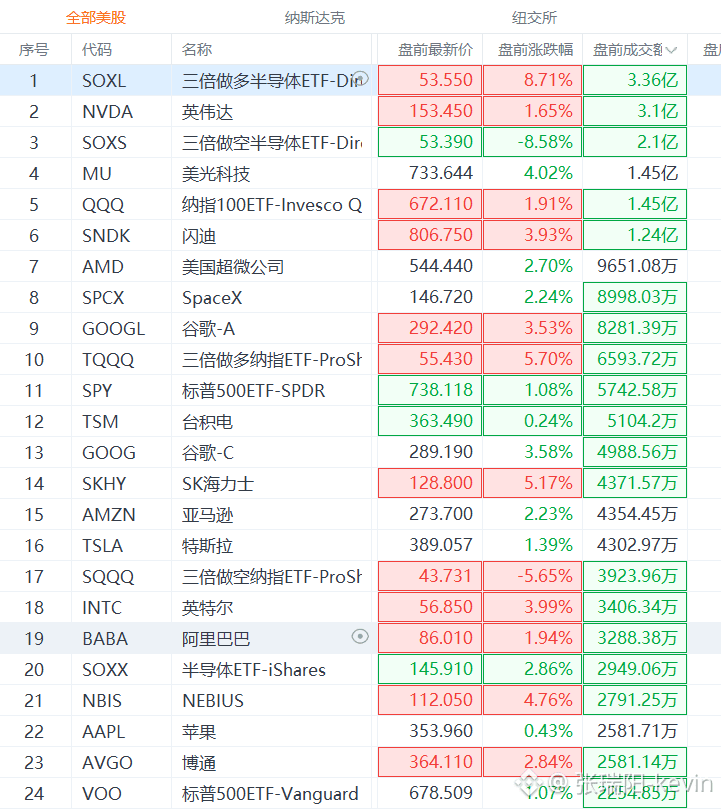
Anthropic pushed its IPO price to $83, putting its valuation at $1.5 trillion and raising $107.3 billion—the biggest offering in history. In premarket trading, Nasdaq futures are up 1.90%, SK Hynix is up more than 5%, Micron more than 4%, AMD more than 3%, and Nvidia 1.76%. The screens are awash in green, but look closely: Nvidia’s gain is less than a third of SK Hynix’s.
So what exactly is the market trading on? Two words: breaking even.
A Nomura strategist put it bluntly: one reason tech stocks fell earlier was that investors were forced to sell their existing holdings to raise cash for Anthropic’s IPO. Now that the IPO price is set, the selling pressure has eased, and the money is flowing back in. In plain English: it’s not “AI is back”—it’s “the selling is over, time to buy back in.”
But there’s one detail we can’t ignore: Anthropic is trading at a 24% to 26% premium on the gray market, while premarket derivatives point to around $105. That means the real casino tonight is ANT, not Nvidia. Money going into chip stocks is betting that “the anchor is set”; money going into ANT is betting on whether “the anchor can float.” $SNDK $ANT $SOXL #Anthropic今日开始交易,IPO定价每股83美元
6
2
3.1k
·
--
Verified
#sxt $SXT @SpaceandTimeDB When an AI agent starts executing DeFi strategies on your behalf, or a tokenized fund automatically calculates its NAV on-chain, the real danger isn’t that the code is wrong—it’s that the data fed into it has been tampered with.
Smart contracts can’t call “customer service,” and AI agents have no “offline verification” fallback. They can only trust the query results they receive.
That’s exactly the gap Space and Time is addressing: with Proof of SQL, query results come with a verifiable cryptographic proof.
Nodes run SQL off-chain and generate a ZK proof. Once a smart contract or AI application receives the results, it can independently verify that “the computation was performed correctly and the underlying data has not been tampered with”—without having to trust any centralized database operator.
In practical terms:
• AI: An agent’s risk assessments and transaction record checks can be independently verified, rather than relying on “trusting the model’s output.”
• Tokenization: When off-chain reserve and NAV data are brought on-chain, verifiability becomes essential to making tokenized assets truly trustworthy.
• DeFi: Historical activity and off-chain risk data can enter contracts with proofs, so lending and collateralization no longer depend solely on “I think you’re trustworthy.”
Space and Time is working at a foundational level, but its direction is clear: verifiable data isn’t just narrative packaging—it’s a prerequisite for bringing automated decision-making systems on-chain.
#sxt $SXT @SpaceandTime When an AI agent starts executing DeFi strategies on your behalf, or a tokenized fund automatically calculates its NAV on-chain, the real danger isn’t that the code is wrong—it’s that the data fed into it has been tampered with.
Smart contracts can’t call “customer service,” and AI agents have no “offline verification” fallback. They can only trust the query results they receive.
That’s exactly the gap Space and Time is addressing: with Proof of SQL, query results come with a verifiable cryptographic proof.
Nodes run SQL off-chain and generate a ZK proof. Once a smart contract or AI application receives the results, it can independently verify that “the computation was performed correctly and the underlying data has not been tampered with”—without having to trust any centralized database operator.
In practical terms:
• AI: An agent’s risk assessments and transaction record checks can be independently verified, rather than relying on “trusting the model’s output.”
• Tokenization: When off-chain reserve and NAV data are brought on-chain, verifiability becomes essential to making tokenized assets truly trustworthy.
• DeFi: Historical activity and off-chain risk data can enter contracts with proofs, so lending and collateralization no longer depend solely on “I think you’re trustworthy.”
Space and Time is working at a foundational level, but its direction is clear: verifiable data isn’t just narrative packaging—it’s a prerequisite for bringing automated decision-making systems on-chain.
1
731
·
--
Verified
#anthropic今日开始交易,ipo定价每股83美元 Anthropic rings the bell tonight: $1.5 trillion—is this the dividend of a new era or the most expensive bailout in history?
Watching the screen, waiting for the market to open. Nasdaq futures are up 2%, but tonight everyone has their eyes on just one thing: ANT.
The final offering price hit $83, above the top of the range. The valuation soared to $1.5 trillion, and the IPO plus private placement could raise up to $90.4 billion combined—the biggest in history. The lemonade stand has set up shop right in the middle of Wall Street.
But the experts are already at each other’s throats.
Bulls call it “a buying opportunity you can’t afford to miss.” They say AI’s economic impact could reach $22.5 trillion by 2031.
Bears aren’t pulling any punches: nearly $900 billion in future liabilities, never turned a profit apart from one subsidized quarter, and a $1.5 trillion valuation is “insane.”
One analyst has explicitly said that at this valuation, they wouldn’t buy for now, and a drop below the offer price in the short term can’t be ruled out.
On the first day of an IPO this size, any “bargain” retail investors think they see is an illusion. Once that opening burst of excitement fades, watch whether it can hold steady on lighter volume above the $83 offer price. If it holds, we’ll talk tomorrow; if it doesn’t, that $90.4 billion is an escape route for early investors and existing shareholders.
Betting on the fate of an AI company is foolish. Trading the volatility of “everyone just guessing” is the real play. $ANT $OPENAI $ZHIPU
{future}(ZHIPUUSDT)
{future}(OPENAIUSDT)
{future}(ANTUSDT)
#anthropic今日开始交易,ipo定价每股83美元 Anthropic rings the bell tonight: $1.5 trillion—is this the dividend of a new era or the most expensive bailout in history?
Watching the screen, waiting for the market to open. Nasdaq futures are up 2%, but tonight everyone has their eyes on just one thing: ANT.
The final offering price hit $83, above the top of the range. The valuation soared to $1.5 trillion, and the IPO plus private placement could raise up to $90.4 billion combined—the biggest in history. The lemonade stand has set up shop right in the middle of Wall Street.
But the experts are already at each other’s throats.
Bulls call it “a buying opportunity you can’t afford to miss.” They say AI’s economic impact could reach $22.5 trillion by 2031.
Bears aren’t pulling any punches: nearly $900 billion in future liabilities, never turned a profit apart from one subsidized quarter, and a $1.5 trillion valuation is “insane.”
One analyst has explicitly said that at this valuation, they wouldn’t buy for now, and a drop below the offer price in the short term can’t be ruled out.
On the first day of an IPO this size, any “bargain” retail investors think they see is an illusion. Once that opening burst of excitement fades, watch whether it can hold steady on lighter volume above the $83 offer price. If it holds, we’ll talk tomorrow; if it doesn’t, that $90.4 billion is an escape route for early investors and existing shareholders.
Betting on the fate of an AI company is foolish. Trading the volatility of “everyone just guessing” is the real play. $ANT $OPENAI $ZHIPU

1
1.5k
·
--
#美联储纪要放鹰,比特币继续承压 U.S. Market Analysis: The Fed Turns Hawkish, Gold and Bitcoin Crash, but Even Nvidia’s Earnings Can’t Save Itself
The Dow plunged 561 points, the S&P 500 fell for a fifth straight session, and the Nasdaq eked out a 0.42% gain only thanks to a big push from Amazon. One line from the Fed minutes spooked everyone: nearly all officials thought interest rates would need to keep rising over the next few months. In plain English: stop guessing—the hawks are still flying.
Money is fleeing faster than a rabbit. Gold plunged more than 3%, tumbling back to 3700; silver sank 4.7%, copper fell 4.7%, and Bitcoin followed suit, dropping to around 62000. Safe-haven assets were all swept up in the sell-off, signaling that liquidity is draining away, not rotating elsewhere.
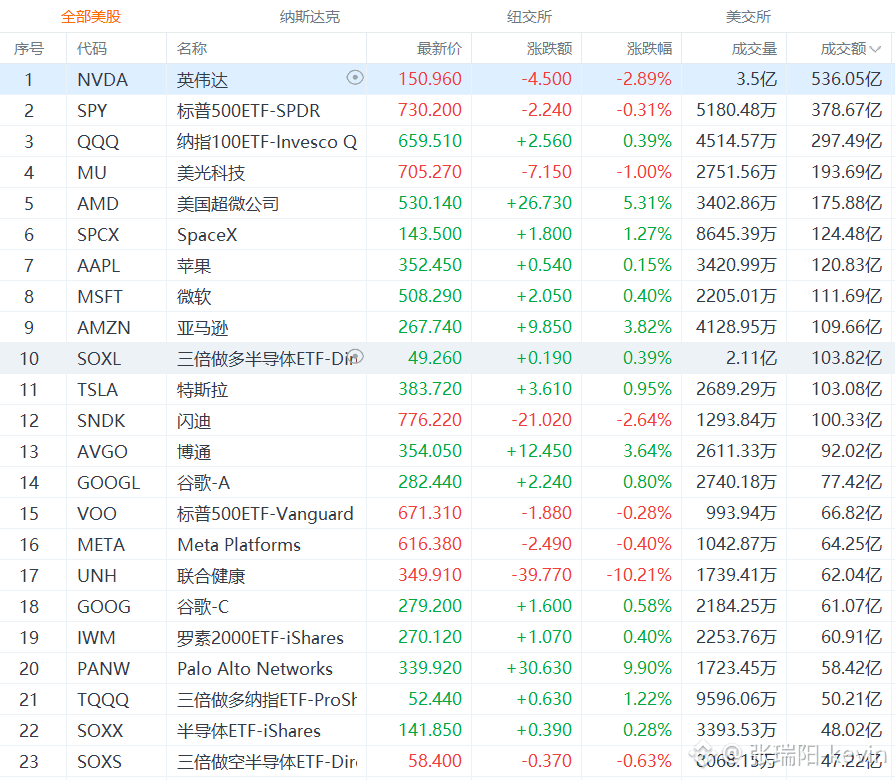
The most surreal part was Nvidia. Q3 revenue came in at 1158亿, and its Q4 forecast was 1300亿—both above expectations. Yet the stock opened higher, then slid to close down 2.89% at 150.96, a 16-month low. Its market value shed 1085亿美元 overnight.
It aced the exam, but its dad got fired and the teacher downgraded it. The money hasn’t left chips; it’s just found someone else to hold on to—AMD surged 5.31%, Broadcom rose 3.64%, and cybersecurity firm Palo Alto jumped 10%.
Wait for Nvidia to settle into a low-volume sideways range around 148–150 before talking about a possible rebound. If it can’t hold there, there’s no meaningful support below. Now that the Fed minutes are out, the real signal isn’t whether the Fed is “hawkish”—it’s whether the money is still in the market. $XAU $BTC $SOXL
{future}(SOXLUSDT)
{future}(BTCUSDT)
{future}(XAUUSDT)
#美联储纪要放鹰,比特币继续承压 U.S. Market Analysis: The Fed Turns Hawkish, Gold and Bitcoin Crash, but Even Nvidia’s Earnings Can’t Save Itself
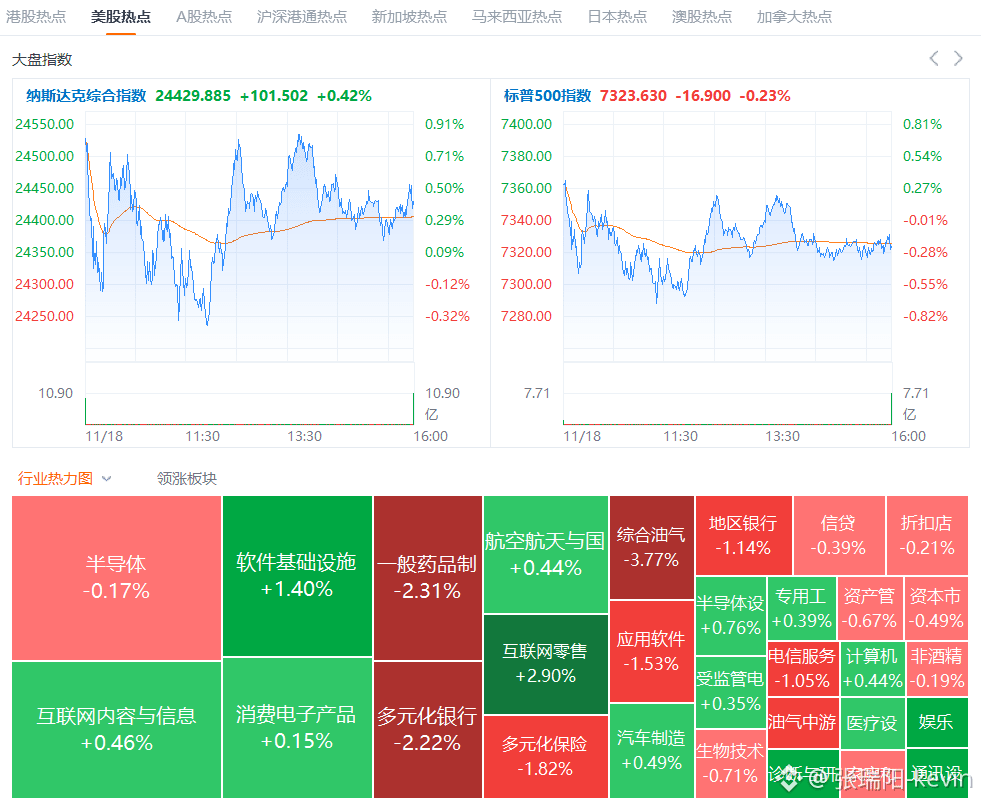
The Dow plunged 561 points, the S&P 500 fell for a fifth straight session, and the Nasdaq eked out a 0.42% gain only thanks to a big push from Amazon. One line from the Fed minutes spooked everyone: nearly all officials thought interest rates would need to keep rising over the next few months. In plain English: stop guessing—the hawks are still flying.
Money is fleeing faster than a rabbit. Gold plunged more than 3%, tumbling back to 3700; silver sank 4.7%, copper fell 4.7%, and Bitcoin followed suit, dropping to around 62000. Safe-haven assets were all swept up in the sell-off, signaling that liquidity is draining away, not rotating elsewhere.
The most surreal part was Nvidia. Q3 revenue came in at 1158亿, and its Q4 forecast was 1300亿—both above expectations. Yet the stock opened higher, then slid to close down 2.89% at 150.96, a 16-month low. Its market value shed 1085亿美元 overnight.
It aced the exam, but its dad got fired and the teacher downgraded it. The money hasn’t left chips; it’s just found someone else to hold on to—AMD surged 5.31%, Broadcom rose 3.64%, and cybersecurity firm Palo Alto jumped 10%.
Wait for Nvidia to settle into a low-volume sideways range around 148–150 before talking about a possible rebound. If it can’t hold there, there’s no meaningful support below. Now that the Fed minutes are out, the real signal isn’t whether the Fed is “hawkish”—it’s whether the money is still in the market. $XAU $BTC $SOXL
3
3
1k
·
--
Verified
Decoding the U.S. stock market: Nvidia’s blowout results still got punished. A perfect score, and you still get fired—who can you complain to?
The U.S. market had plenty of drama last night. The Dow was dragged down by UnitedHealth, falling 1.11%; the S&P 500 logged its fifth straight decline, while the Nasdaq managed a 0.42% gain only thanks to Amazon’s strong push. Nvidia traded a whopping $52 billion, far ahead of everyone else, but after opening higher, it reversed course and closed down 2.89%.
There’s one simple way to read this market: money is moving, but it’s staying in tech—it’s just switching who it’s betting on.
Where did Nvidia go wrong? Revenue came in at $115.8 billion and guidance at $130 billion, both above expectations. But the first thing said on the board’s earnings call was, “Jensen Huang isn’t coming back.” The interim CEO then promptly announced early pay raises to steady the team, while Bernstein and Evercore downgraded the stock on the spot.
Put another way: the kid got a perfect score, but his dad got fired, and the teacher downgraded you too. Investors voted with their feet and piled straight into AMD, up 5.31%, and Broadcom, up 3.64%.
The real winner was Amazon, up 3.82%. Anthropic’s IPO was priced at $83 a share, valuing the company at $1.5 trillion. Amazon’s stake is worth $159 billion—like getting a mega-unicorn for free. UnitedHealth, meanwhile, got crushed: CMS is proposing retroactive audits of Medicare charges, and the stock plunged 10.21%. On top of that, the Fed minutes were hawkish, with several officials saying December might call for an “unusually large rate hike.” The market was shaking in its boots.
With positive results already priced in, governance concerns, and brokerages slashing ratings, Nvidia is weighed down by three major headwinds. It broke below $150, and the next level down is the 52-week low of $148. I’m not catching that falling knife. AMD and Amazon are worth adding to a watchlist, but I won’t chase them if they open higher today—I’ll wait for a pullback. $ANT $NVDA $SOXL
{future}(SOXLUSDT)
{future}(NVDAUSDT)
{future}(ANTUSDT)
Decoding the U.S. stock market: Nvidia’s blowout results still got punished. A perfect score, and you still get fired—who can you complain to?
The U.S. market had plenty of drama last night. The Dow was dragged down by UnitedHealth, falling 1.11%; the S&P 500 logged its fifth straight decline, while the Nasdaq managed a 0.42% gain only thanks to Amazon’s strong push. Nvidia traded a whopping $52 billion, far ahead of everyone else, but after opening higher, it reversed course and closed down 2.89%.
There’s one simple way to read this market: money is moving, but it’s staying in tech—it’s just switching who it’s betting on.
Where did Nvidia go wrong? Revenue came in at $115.8 billion and guidance at $130 billion, both above expectations. But the first thing said on the board’s earnings call was, “Jensen Huang isn’t coming back.” The interim CEO then promptly announced early pay raises to steady the team, while Bernstein and Evercore downgraded the stock on the spot.
Put another way: the kid got a perfect score, but his dad got fired, and the teacher downgraded you too. Investors voted with their feet and piled straight into AMD, up 5.31%, and Broadcom, up 3.64%.
The real winner was Amazon, up 3.82%. Anthropic’s IPO was priced at $83 a share, valuing the company at $1.5 trillion. Amazon’s stake is worth $159 billion—like getting a mega-unicorn for free. UnitedHealth, meanwhile, got crushed: CMS is proposing retroactive audits of Medicare charges, and the stock plunged 10.21%. On top of that, the Fed minutes were hawkish, with several officials saying December might call for an “unusually large rate hike.” The market was shaking in its boots.
With positive results already priced in, governance concerns, and brokerages slashing ratings, Nvidia is weighed down by three major headwinds. It broke below $150, and the next level down is the 52-week low of $148. I’m not catching that falling knife. AMD and Amazon are worth adding to a watchlist, but I won’t chase them if they open higher today—I’ll wait for a pullback. $ANT $NVDA $SOXL
1
1.9k
Log in to explore more content
Join global crypto users on Binance Square
⚡️ Get latest and useful information about crypto.
💬 Trusted by the world’s largest crypto exchange.
👍 Discover real insights from verified creators.
Email / Phone number
Trending Topics
IsAnthropic’s$1.5TMarketCapJustified?
54,432 views
270 Discussing
Anthropic Set to Open at $105 in Record Nasdaq Debut
Binance News
·16 Likes
·18.6k views
BTCBelow$62KAmidHikeFearsAndShiftToAnthropic
12,925 views
90 Discussing
NvidiaBoardReportedlySplitOverHuang’sReturn
232,859 views
1,853 Discussing