


Table of contents
Introduction
What is the spot market?
Bear Market Example
What is the difference between a bear market and a bull market?
How to trade in a bear market?
Summarize
Introduction
Financial markets fluctuate as trends change. In order to make more informed investment decisions, it is important to understand the differences between different trends. Market conditions vary greatly depending on the market conditions. If you don't understand the underlying trends, how can you deal with the ever-changing market environment?
Market trends refer to the overall direction of the market. In a bear market, prices fall overall. Bear markets make trading or investing more difficult, especially for beginners.
Most cryptocurrency traders and technical analysts believe that Bitcoin has always been in a bull market since its inception. Even so, cryptocurrencies have experienced brutal bear markets many times, usually causing Bitcoin prices to fall by more than 80%, and altcoins to plummet by more than 90%. Faced with the dilemma of a bear market, how should investors deal with it?
In this article, we will discuss what a bear market is, how investors can respond, and how to profit in a bear market.
If you want to understand the bull market first, please read "What is a bull market?"
What is the spot market?
A bear market is a period of falling prices in financial markets. Trading in a bear market is extremely difficult and risky for inexperienced traders. They can easily suffer serious losses and not have the courage to return to the financial markets. Why?
There is a popular saying in the investment circle: "Upward movement is like climbing stairs, downward movement is like taking the elevator." It means that upward movement is slow and steady, but downward movement is often violent and turbulent. Why is this so? Whenever prices plummet, many traders rush to exit the market, whether to switch to cash or to lock in gains on long positions. This quickly triggers a chain reaction, with a large number of sellers selling and closing positions, which in turn leads to more closing operations, creating a vicious cycle. If the market is highly leveraged, the decline will even be doubled. Large-scale forced liquidation will have a more serious chain reaction, triggering a frenzy of selling.
Similar extremes occur during bull markets, when prices rise rapidly and the correlations between different assets are higher than before, with most assets rising in sync.
Generally speaking, investors are "bearish" in a bear market, expecting prices to fall, and market sentiment is quite depressed. However, some market participants will not blindly short. These participants only expect prices to fall, and once a good opportunity arises, they may choose to go long.
Bear Market Example
As mentioned above, many investors believe that Bitcoin has been in a bull market since it was first traded. Does this mean that there was no bear market during this period? The answer is no. After rising to around $20,000 in December 2017, Bitcoin fell into a sluggish bear market.
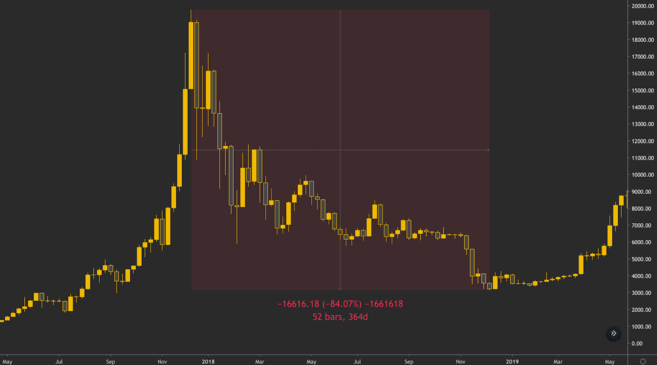
After the bull run in 2017, Bitcoin plummeted.
Before encountering a bear market in 2018, Bitcoin also plummeted 86% in 2014.

Bitcoin is down 86% from its 2013 peak.
As of July 2020, the low point of the previous bear market, the range of around $3,000, has been tested again, but has not been broken. If it falls below this critical range, it will undoubtedly be a strong proof that the multi-year Bitcoin bear market has not yet ended.

Bitcoin is testing its all-time bear market lows again.
Given that the lows have not been broken, we believe that the plunge triggered by the COVID-19 panic is just another test of the range. However, technical analysis does not provide certainty, only probability.
Other noteworthy bear market examples come from the stock market. Whether it is the Great Depression, the 2008 financial crisis, or the 2020 global COVID-19 stock market crash, it is worth noting. These natural and man-made disasters caused Wall Street to suffer a heavy blow, and the entire stock market suffered a huge impact. During this period, market indices such as the Nasdaq 100, the Dow Jones Industrial Average (DJIA), and the S&P 500 also fell sharply.
What is the difference between a bear market and a bull market?
There are significant differences between bear markets and bull markets. Prices rise in bull markets and fall in bear markets.
A significant difference between the two is that bear markets may have longer periods of sideways movement, or consolidation or adjustment in price action. At this time, market volatility is quite low and trading activity is almost non-existent. While consolidation can also occur in bull markets, it tends to be more common in bear markets, where continued price declines discourage most investors.
Another thing to consider is whether it is possible to establish a short position in an asset from the beginning. If traders do not have the ability to short an asset using margin or derivatives, they can only express their bearish stance by selling to cash out or exchanging for stablecoins. This will lead to a longer-lasting decline, with minimal traders' willingness to buy and tepid price action consolidation.
➟ Want to start your digital currency journey? Buy Bitcoin on Binance now!
How to trade in a bear market?
Holding cash (or stablecoins) is one of the simplest bear market trading strategies. If falling prices are keeping you up at night, it’s better to just wait for the market to get out of the bear market. If you think a new bull market may come at some point in the future, you can invest in the market then. At the same time, if you are holding for the long term, for years or decades, then the difference between a bear market and a bear market must mean that you should sell.
Generally speaking, it is wise to trade and invest with the market trend. Therefore, strategies to profit in bear markets also include establishing short positions. This way, traders can also profit from the decline in asset prices. Whether it is day trading, swing trading, or position trading, the main goal is to trade according to the market trend. That being said, many contrarian traders tend to trade "against the trend" and adopt trading patterns that go against the mainstream market. Let's understand how this works.
In a bear market, "going against the trend" means taking a long position after a rebound, sometimes called a "bear market bounce" or "dead cat bounce." These counter-trend price moves are extremely volatile because many traders may take advantage of the short-term rebound to go long. However, unless the entire bear market is over, it is likely that the downtrend will resume immediately after the short-term rebound.
Therefore, successful traders will take advantage of the opportunity to exit their positions near the recent highs before the bear market reappears. Otherwise, their long positions will be trapped if the bear market continues. Please note that this is a high-risk strategy. Even the most experienced traders can suffer huge losses when trying to catch a falling knife.
Summarize
In the above article, we discussed what a bear market is, how traders can protect themselves and profit from a bear market. In short, the simplest and most direct strategy is to hold cash in a bear market and wait patiently for the right trading opportunity. In addition, many traders will look for opportunities to establish short positions. As we all know, it is wise to follow the market trend.
Do you have any other questions about market trends, bear market, or trading? Please visit our Q&A platform Ask Academy, where members of the Binance community will patiently answer your questions.