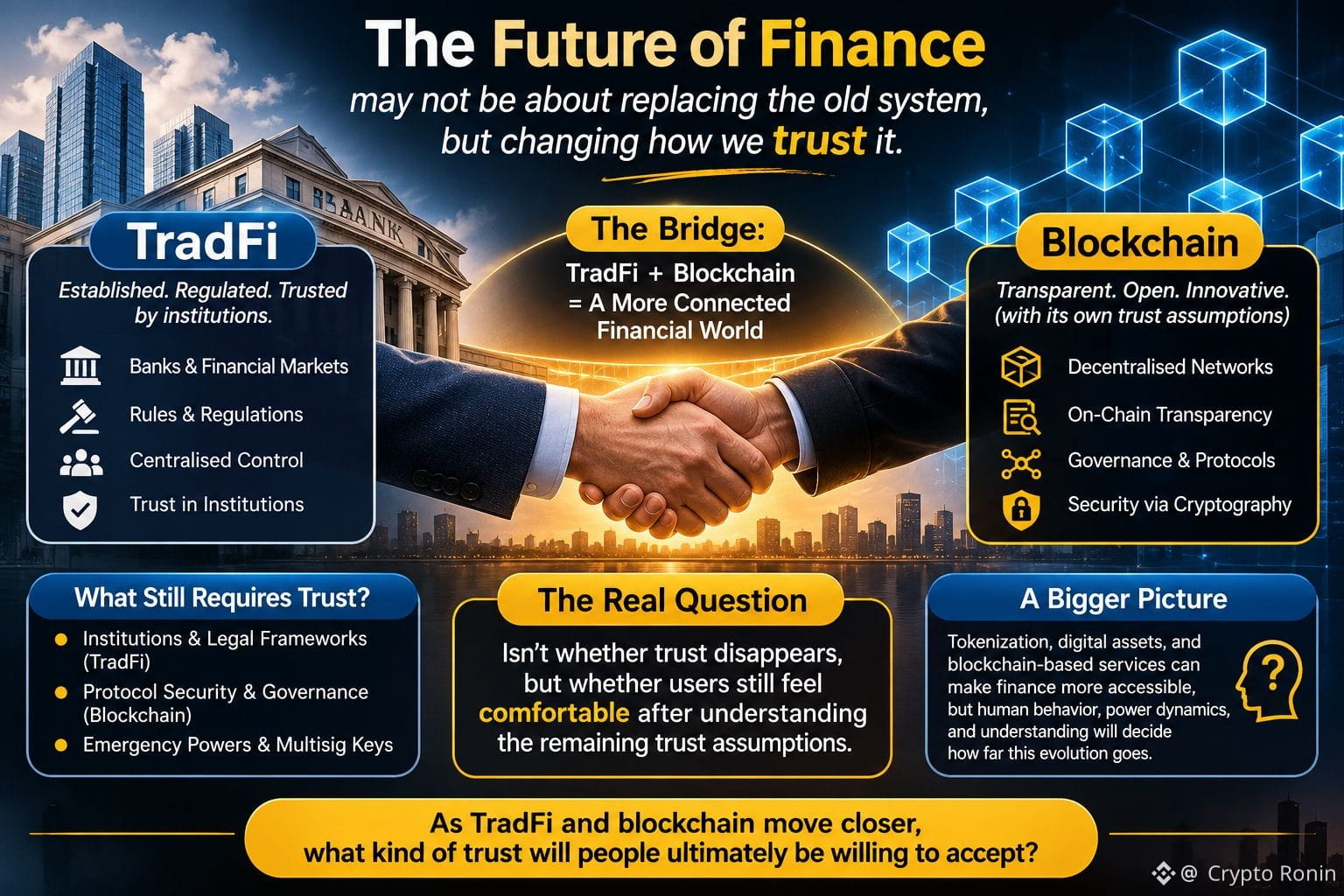

I've been noticing how the conversation around TradFi and blockchain is gradually shifting. For years, traditional finance has relied on institutions, regulations, and established intermediaries to maintain trust. Blockchain introduces a different approach, where some rules can be verified through code rather than simply accepted through institutional promises.
But I've been wondering whether transparency alone is enough to change human behavior.
Tokenization, digital assets, and blockchain-based financial services can make certain processes more accessible and efficient. Still, the technical narrative often moves faster than people's understanding of what actually supports these systems.
The more I watch this space, the more I realize that every financial structure has its own trust assumptions. Traditional finance depends on institutions and legal frameworks. Blockchain systems depend on protocol security, cryptography, governance decisions, and sometimes the people holding emergency powers.Neither model removes trust completely. They simply distribute it differently.
I think this is where the real discussion around TradFi becomes interesting. It's not just about connecting financial markets to blockchain. It's about understanding who holds power, who can make decisions, and how users respond when something goes wrong.
Even ecosystems like BNB deserve to be understood through this broader perspective, beyond market movements or technical promises.
Perhaps the real progress will come when people understand not only what a system can do, but also what it still asks them to trust.
As traditional finance and blockchain move closer, what kind of trust will people ultimately be willing to accept?
#BinanceSquareTG #BNB #TradFi #Blockchain #BinanceSquare