

Bitcoin is falling in price, even though major banks and funds are working with it more actively than ever. This has alarmed the author of the power law model—one of the best-known models describing Bitcoin’s long-term price growth $BTC . Researcher Giovanni Santostasi of the Scientific Bitcoin Institute wrote an essay about how the current downturn might differ from previous ones.
Giovanni Santostasi has been following bitcoin since 2012. He has seen crashes and claims of cryptocurrency’s “death” many times. But this time, he allowed that the issue might not be just market sentiment. Telegram
Why banks and funds didn’t stop the decline
Recently $BTC fell to nearly $55,000, then recovered to above $60,000. A couple of months ago, it was worth around $87,000.
Today, you can buy bitcoin through exchange-traded funds, or ETFs. They were launched by BlackRock, Fidelity, and other major companies. In April 2026, Morgan Stanley also launched its own bitcoin product. It seemed that this should support the price.
Giovanni Santostasi explained why that didn’t happen. The fund itself doesn’t buy $BTC $all the time. Money can flow into the market through it, but it can also flow out. In the week ending November 20, around $1.8 billion was withdrawn from US bitcoin ETFs. That means there are currently too few new buyers to offset the selling.
There is another side to this. Large investors treat bitcoin just like stocks. In uncertain times, they reduce their risk exposure and sell. So their arrival raises bitcoin’s profile, but doesn’t protect it from sharp declines.
The researcher also identified artificial intelligence as another factor. Investors are currently eager to invest in chips and data centers for AI. Some of the money that might previously have gone into bitcoin could be going there instead. Some miners are even repurposing their capacity for AI. At the same time, Giovanni Santostasi stressed that a direct link has not yet been proven.
Inflation also plays a role. Bitcoin is often called a hedge against inflation, but this works over the long term. In the short term, inflation leads to high interest rates, and investors are less likely to buy risky assets.
Signals from the power law
Giovanni Santostasi’s model is called the power law. Put simply, it shows that bitcoin’s price rises over time along a fairly predictable curve. There can be sharp swings, but over the long term the price stays close to this curve.
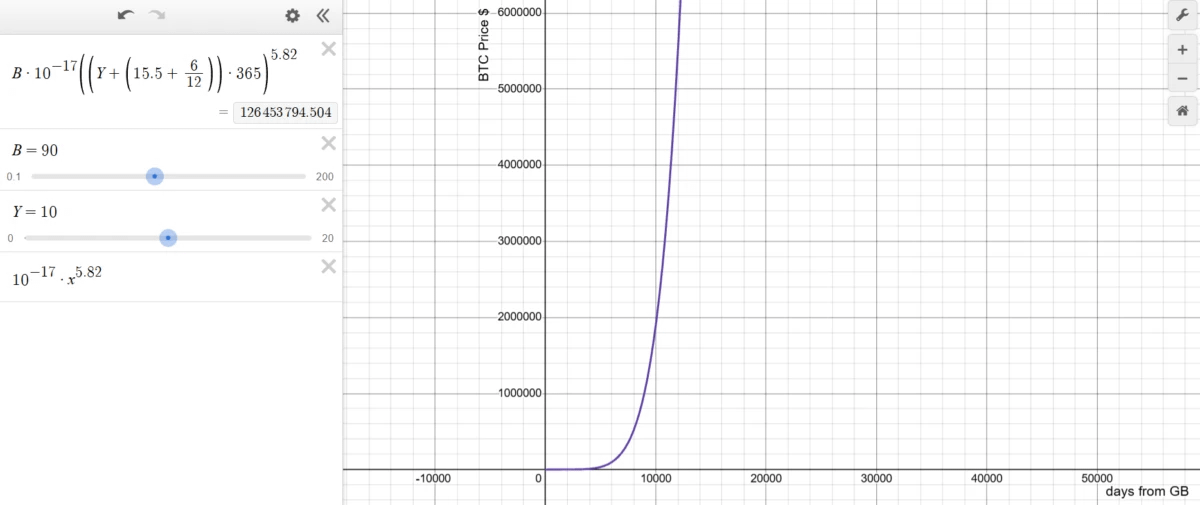
Bitcoin is currently trading well below it. In the past, this happened closer to the end of prolonged declines, after which the price recovered. But Giovanni Santostasi acknowledged that the past offers no guarantees. He cited a study by Carlos Baquero and Raquel Menezes. Their findings suggest that there may not yet be enough data to confidently prove that the price will return to the curve.
Giovanni Santostasi wonders whether only bitcoin itself has fallen in value, or whether people and companies have started using it less often. In the first case, it is a temporary price slump. In the second, it is a more serious problem.
To find out, the researcher is monitoring several things:
whether fund investments grow over the long term, despite weekly outflows;
whether new money is flowing into the network;
whether those who bought coins long ago are holding them or selling;
whether the current decline resembles previous cycles.
For those holding bitcoin, the essay does not promise a quick return to $80,000 or $100,000. Bold price predictions mean little right now. It is more useful to look at the flow of money into funds and the behavior of long-term holders. Giovanni Santostasi himself still believes in bitcoin as a network, but urged people not to confuse belief with analysis.
“Bitcoin doesn’t need our belief. It needs our curiosity, skepticism, and willingness to accept the facts,” Giovanni Santostasi wrote.