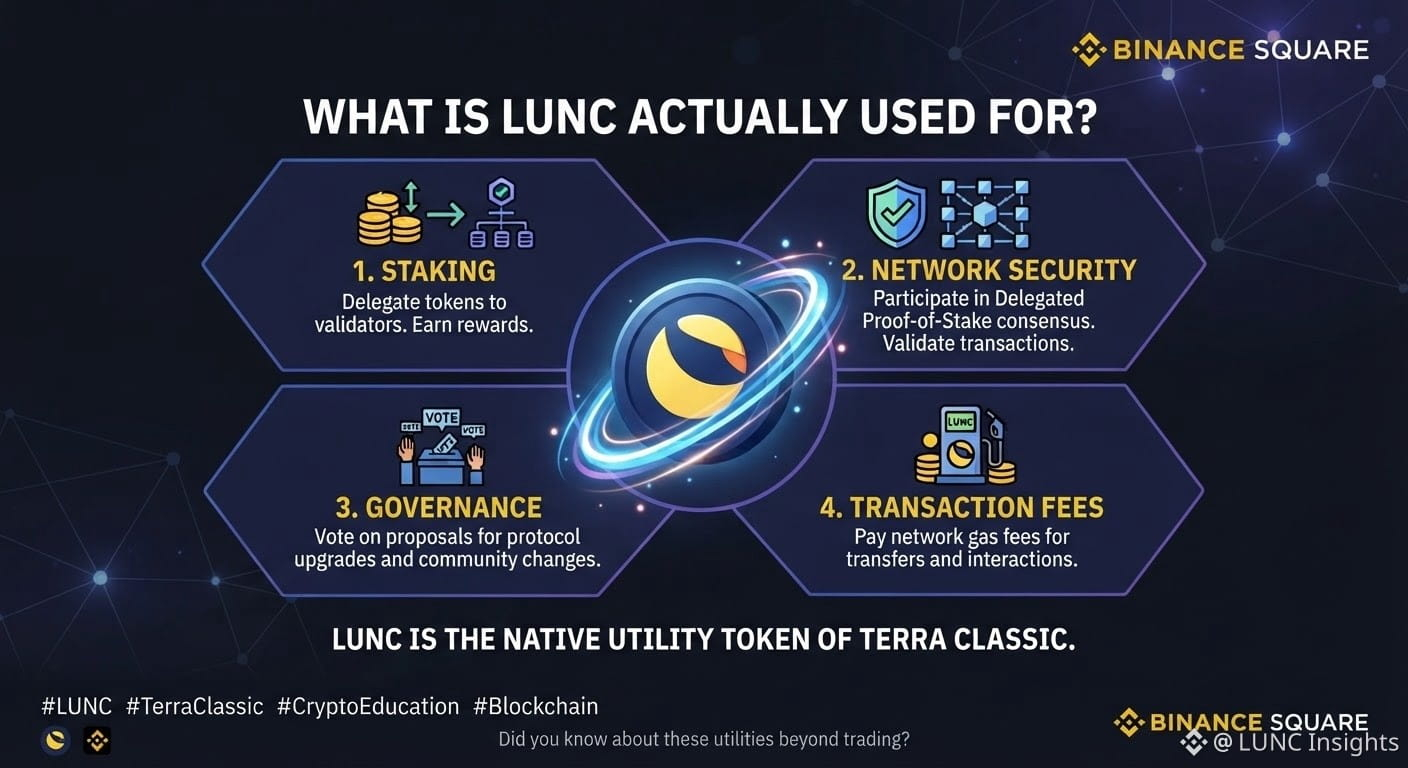
What Is LUNC Actually Used For?
LUNC is more than a tradable token. Here's what it actually does.
Many people know $LUNC because of its market price, burns and trading activity.
But LUNC has an important role beyond being bought and sold. It is the native token of the Terra Classic blockchain.
Let's break down its four key utilities.
🔹 1. Staking
LUNC holders can delegate their tokens to validators and participate in staking.
In return, delegators may receive staking rewards. However, rewards are variable and depend on network conditions and validator performance.
🔹 2. Network Security
Terra Classic uses a Delegated Proof-of-Stake model.
Validators use delegated stake to participate in consensus, validate transactions and help produce new blocks.
The more stake supporting a validator, the greater its voting power in the consensus process.
🔹 3. Governance
LUNC also gives holders a voice in the network's development.
Stakers can participate in governance by voting on proposals involving protocol changes, upgrades, parameters and community spending.
Delegators can also override their validator's vote.
🔹 4. Transaction Fees
LUNC is used to pay network transaction fees, commonly called gas fees.
These fees help cover the computational cost of processing transactions and prevent network spam.
Why Does This Matter?
LUNC isn't just a ticker symbol on an exchange. It serves essential functions within an operating blockchain network.
But remember: Token utility does not automatically translate into token value.
For long-term sustainability, Terra Classic needs meaningful adoption, active development and consistent network demand.
💬 Did you know LUNC had these utilities beyond trading and token burns?
#LUNC #TerraClassic #CryptoEducation #Blockchain #ProofOfStake #BinanceSquare $LUNC