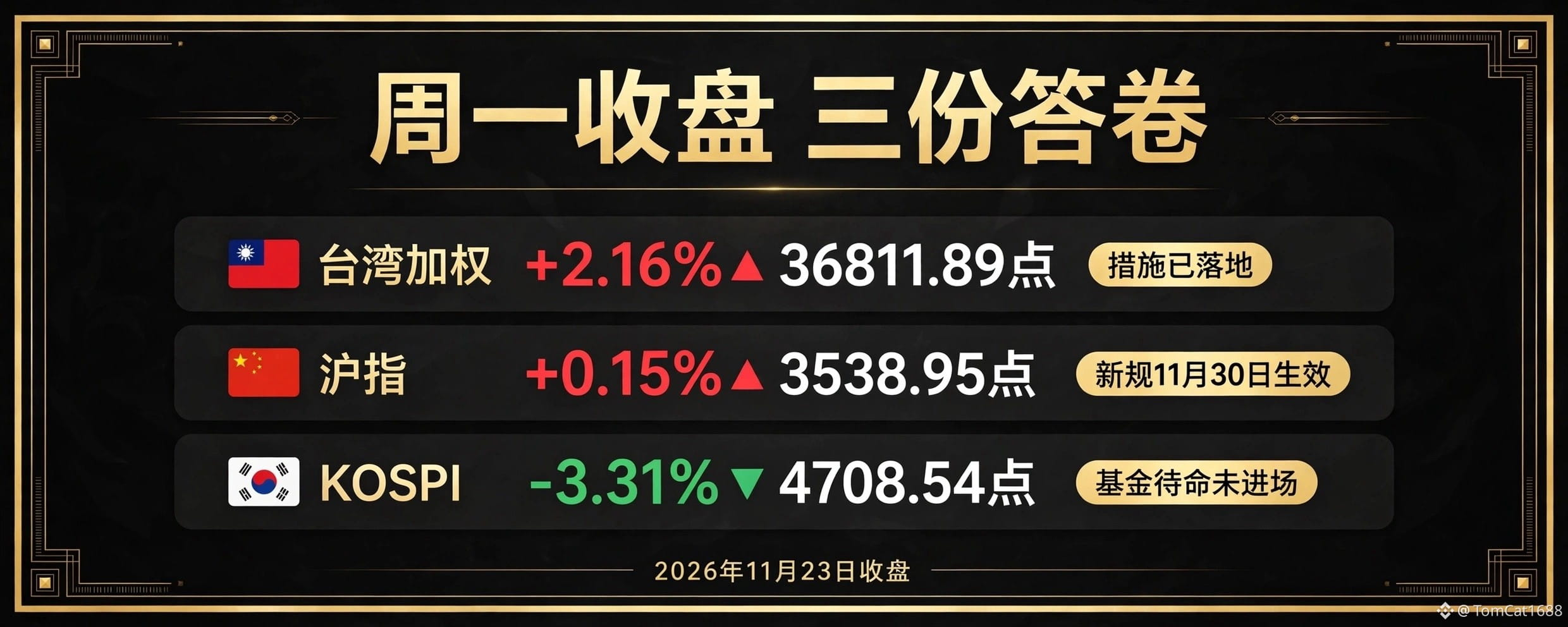
The same weekend rescue effort, but Monday’s closing bell brought three different outcomes.
Taiwan rose 2.16%, with the weighted index closing at 36,811.89. It briefly fell nearly 600 points intraday before recovering, with a full-day range of 1,665 points and turnover of NT$1.08 trillion.
South Korea fell 3.31%, with the KOSPI closing at 4,708.54, its lowest close since January 13. It hit an intraday low of 4,586, and even triggered a short-selling sidecar.
Mainland China’s A-share Shanghai Composite rose 0.15% to close at 3,538.95 after dipping below 3,500 intraday and then turning higher. The Shenzhen Component rose 1.93%, the ChiNext Index gained 3.08%, and more than 4,600 stocks advanced.
Same weekend assignment. Why did they get three different grades?
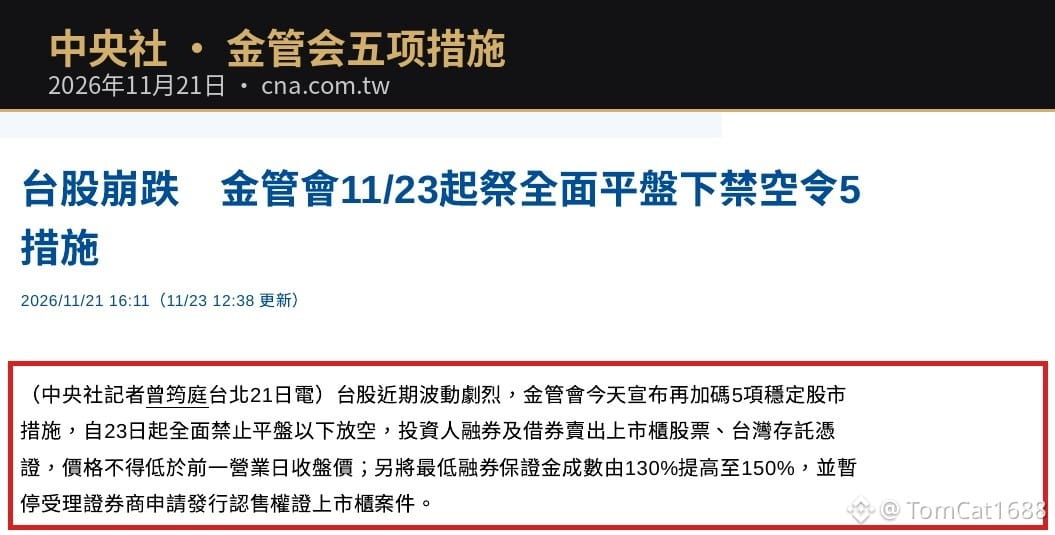
Taiwan was the only one of the three where the measures actually took effect. The five measures announced by the Financial Supervisory Commission on November 21 took effect on the 23rd: a blanket ban on short selling below the previous close, an increase in the margin requirement for securities lending from 130% to 150%, and a statement from the National Security Fund that it had already entered the market.
South Korea’s 10 trillion won stabilization fund is still on standby. An emergency meeting on the 22nd said only that officials were preparing to activate it. It would be the first time the fund had been used since 2008, but not a single won had been deployed by Monday’s close.
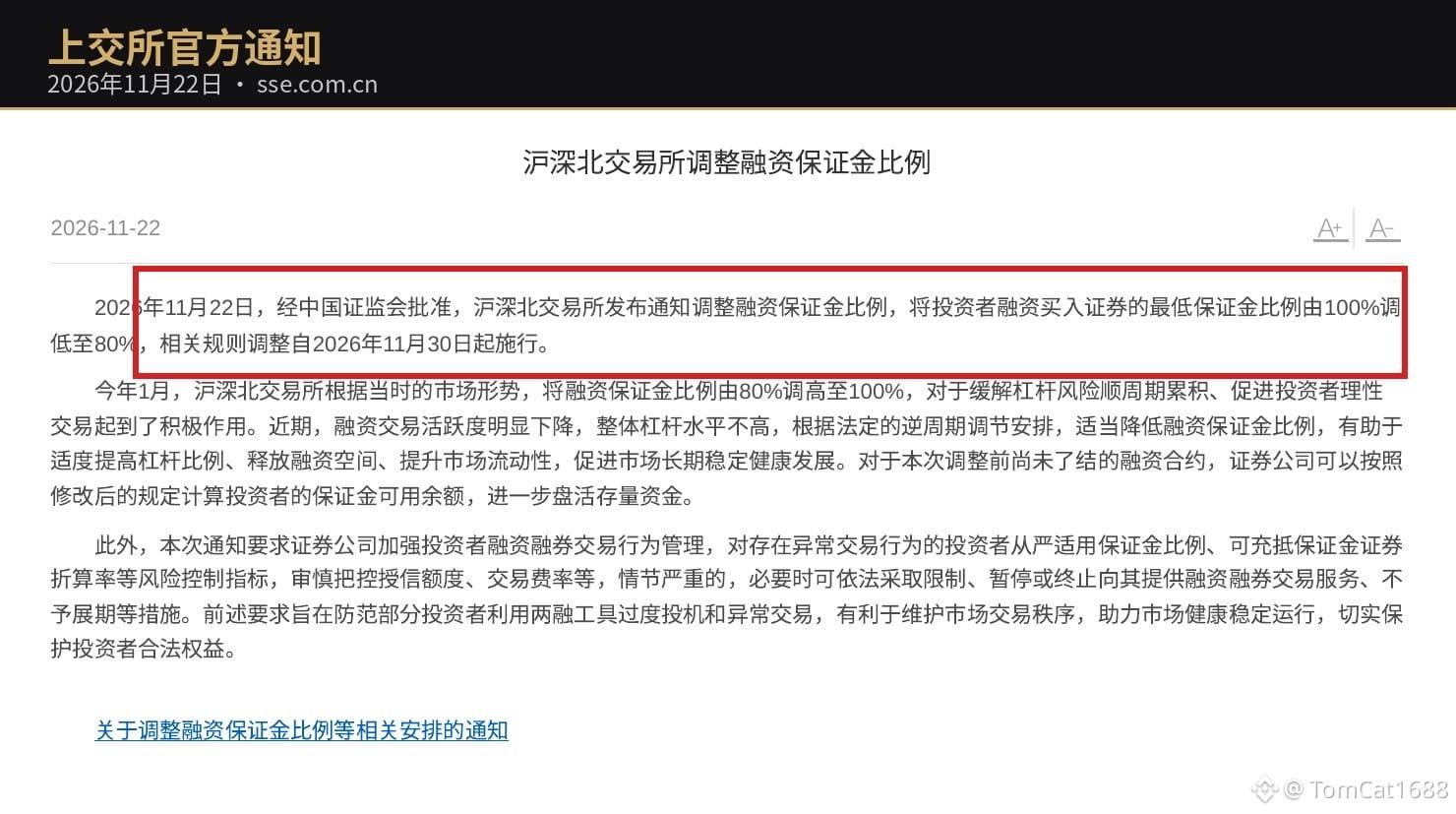
China’s big move has to wait until November 30. The margin requirement for margin financing will drop from 100% to 80%, theoretically bringing in nearly 400 billion yuan in additional funds, but it had not taken effect today.
Monday’s test came down to whether money and rules actually showed up that day. The volume of the announcements didn’t count.
There’s another detail in Taiwan’s answer sheet. The Taiwan market had just plunged 2,393 points on Friday, down 17.5% for the week—its worst week in 35 years. Yet MediaTek and Delta Electronics both hit limit-up today, while TSMC rose 1.5%. Dip-buying money was genuinely willing to step in.
South Korea was the exact opposite. Of 908 stocks, 824 fell. Foreign investors were net sellers of 247 billion won. Samsung fell 3%, and SK Hynix dropped 2.5%. News that the fund was on standby couldn’t stop the AI sell-off.
These three answer sheets also matter to crypto markets. $BTC climbed back above $61,000 today, after touching $55,000 over the weekend. Wherever panic in the stock markets first subsides is where risk appetite may first return.
Keep an eye on three things next.
When will South Korea’s 10 trillion won fund actually enter the market—or will it remain on standby?
When China’s new margin rules take effect on November 30, will the additional funds really arrive?
Can Taiwan’s rebound, driven by the short-selling ban, hold above today’s low of 35,442?
Rescue efforts begin with words. The answer comes when the money arrives.
#中韩台周一前准备股市救市措施 #全球股市 #KOSPI #台股 #BTC