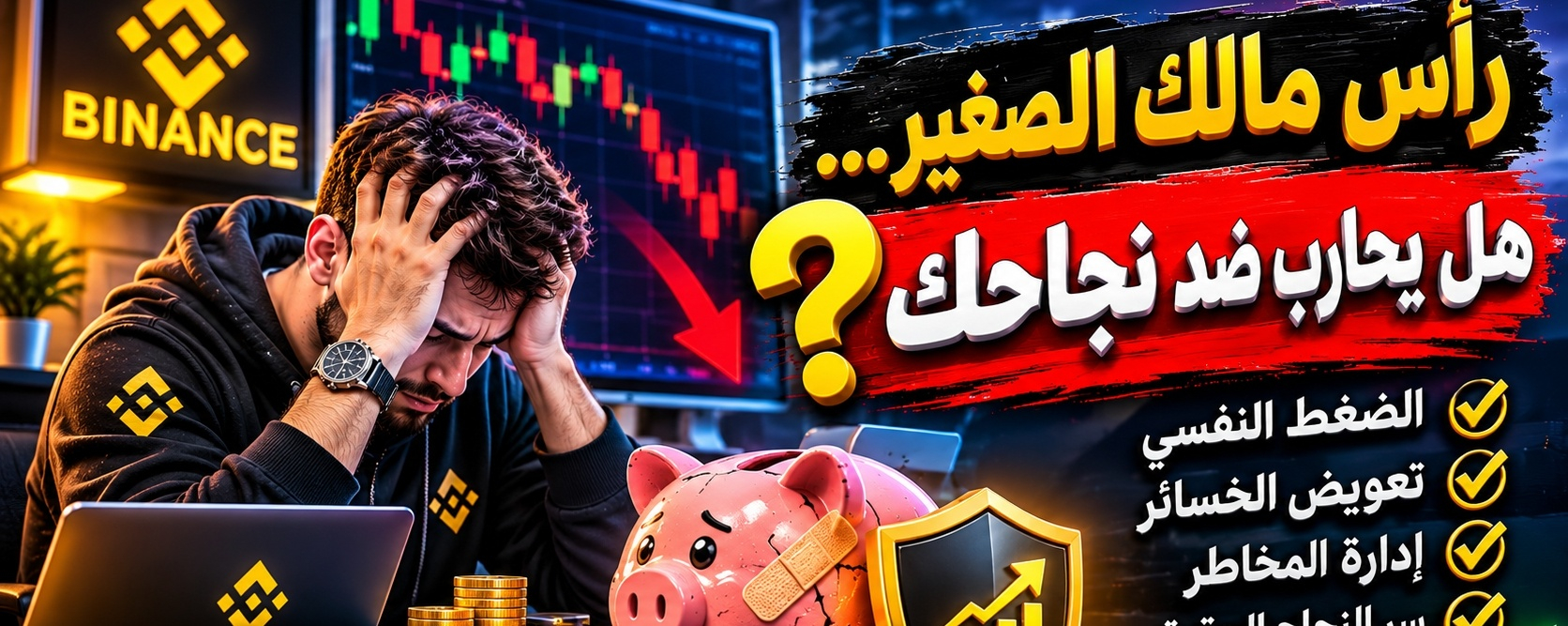

⚠️ Don’t judge your trading skills before you understand the real battle you’re facing!
Are you really a weak trader, or are you trying to succeed in a financial market under psychological pressure that keeps you from making sound decisions?
There’s an important aspect of trading that many people overlook: success doesn’t depend only on knowing technical analysis, understanding indicators, and identifying entry and exit points. It’s also affected by your psychological state and the amount of capital you trade with.
There's a big difference between a trader with enough capital to withstand reasonable losses and learn from them, and another trader who enters the market with a small amount, fully aware that losing it could mean the end of their chance to continue.
1️⃣ Small capital increases psychological pressure
When your capital is limited, every trade feels more consequential.
Losing a few dollars may seem insignificant to a trader with thousands of dollars, but it could represent a large portion of another trader's savings.
And that's where the problem begins:
- Excessive fear of losing.
- Hesitation when good buying opportunities appear.
- Rushing into a trade for fear of missing out.
- Closing trades early out of anxiety.
- Risking more money in an attempt to make up for previous losses.
Over time, you stop trading according to your plan and start trading according to your emotions.
2️⃣ The trap of trying to make up for losses
One of the most dangerous psychological mistakes in trading is shifting your goal from making calculated profits to getting back the money you've lost.
When a trader enters this stage, they start looking for a single trade that can quickly change their financial situation.
They may double their position size, use leverage, or enter the market without waiting for clear technical confirmation.
The likely result?
Another loss that adds to the psychological pressure, followed by another attempt to make it back—and so on, until they enter a cycle that's hard to break.
The market doesn't know you've lost money, and it doesn't care that you want to get it back.
3️⃣ Why can't traders with small capital take advantage of opportunities?
You may spot an excellent opportunity in Bitcoin, Ethereum, or an altcoin, and have a solid technical analysis.
But limited capital makes you think differently:
Should I enter now? What if the price drops? Can I afford the loss? Will this be my last chance?
These questions may lead you to make rushed decisions or miss real opportunities.
But we must understand that having little capital is not a flaw, nor does it mean you are a failed trader.
The real problem begins when you try to achieve big results with capital that doesn't allow you to take big risks.
4️⃣ How can you learn to trade without destroying what remains of your capital?
If you're going through this stage, there are practical steps worth committing to:
First: Stop chasing losses.
Don't enter a new trade just because you want to make up for a previous one.
Second: Stay away from leverage.
Especially if your capital is limited and you don't have enough experience managing risk.
Third: Don't risk money you need.
Trading should never come at the expense of your basic needs or financial stability.
Fourth: Use spot trading (Spot).
And stay away from futures contracts if you can't tolerate the risk of liquidation.
Fifth: Learn before increasing the size of your investments.
You can practice on a demo account, monitor the market, and record the results of your trades without risking additional money.
Sixth: Set a clear plan for every trade.
Determine your entry zone, target, the level that invalidates your idea, and the amount you can afford to lose before pressing the buy button.
5️⃣ The truth every trader needs to understand
You don't have to double your account in a week, and you don't need to take advantage of every market move.
A successful trader isn't someone who makes the biggest profit on a single trade, but someone who can stay in the market without putting their financial future at risk.
Small capital calls for more patience and discipline, not greater risk-taking.
And always remember:
Protecting your capital isn't a fear of trading; it's an essential part of being a professional.
---
💬 Discussion question
I'd like to hear traders' opinions, especially those with small accounts:
Do you think limited capital is one of the biggest obstacles to learning and succeeding in trading?
Or does the main problem lie in a lack of discipline and risk management, whatever the size of the capital?
Share your experience; it might help another trader avoid making the same mistakes.
# #RiskManagement #cryptotrading #Binance #bitcoin #BTC $IDOL