
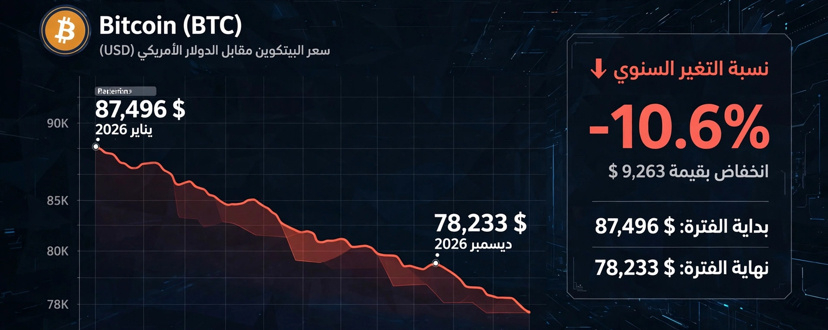

2026 was one of the most volatile and complex years in the history of the cryptocurrency market. After Bitcoin ended 2025 down 6.3%, it entered 2026 on a downward trajectory that continued through most of the year, amid a volatile economic and geopolitical environment.
First: Bitcoin Performance – A Negative Record
Bitcoin opened the year at $87,496 on December 31, 2025, and closed at $78,233 on November 1, 2026, marking a 10.6% decline year to date.
The year saw two contrasting extremes:
- Highest close: $96,942 on January 14, 2026, up 10.8%
- Lowest close: $58,526 on June 30, 2026, down 39.6% from the January peak
- It then recovered 38.1% from its June low, reaching $80,811 on October 27.
This is the second consecutive year that Bitcoin has ended with a loss, something that has never happened before in its history. It is currently trading 35% below its all-time high of $126,198, recorded on October 6, 2025.
Second: A historic phenomenon — Bitcoin and gold at the bottom of the rankings
For the first time since data tracking began in 2011, Bitcoin and gold together ranked last among 21 major asset classes in 2026. Bitcoin posted a 7.3% loss and gold a 7.5% loss through October 23, while commodities rose 52.5% and major U.S. stocks gained 12.3%.
Analysts said the decline was due to the U.S. Federal Reserve raising interest rates in September for the first time since 2023, hurting non-yielding assets such as gold and Bitcoin.
Third: Exchange-traded fund flows
U.S. spot Bitcoin funds saw sharp fluctuations:
- A record $4.5 billion in outflows in June
- A strong return, with $2.4 billion in inflows in the week of September 21—the best since October 2025
- Net flows for 2026 shifted from a $5.8 billion deficit in July to a positive surplus of $934 million by the end of September
Fourth: Regulatory and economic factors
1. CLARITY Act: The Senate failed to pass a bill regulating the cryptocurrency market on September 15, with a vote of 49 to 50, removing the year's biggest regulatory catalyst.
2. Regulatory classification: On March 23, the Securities and Exchange Commission issued an interpretation classifying digital assets into five categories and deeming Bitcoin a digital commodity rather than a security.
3. Infrastructure: Despite falling prices, the value of tokenized real-world assets grew from $22 billion in January to $34 billion in mid-July, an increase of more than 50%.
Fifth: Year-end summary
Although 2026 looks negative in the short term, the long-term picture remains different. Bitcoin's average annual return since 2011 is 120.6%, compared with 6.3% for gold. Bitcoin's performance in 2026 also depends on a handful of trading sessions: data indicate that without the year's five best trading days, the loss would have deepened from 9% to 36%.
The final quarter of the year remains crucial, with room for a trend reversal before 2026 closes.