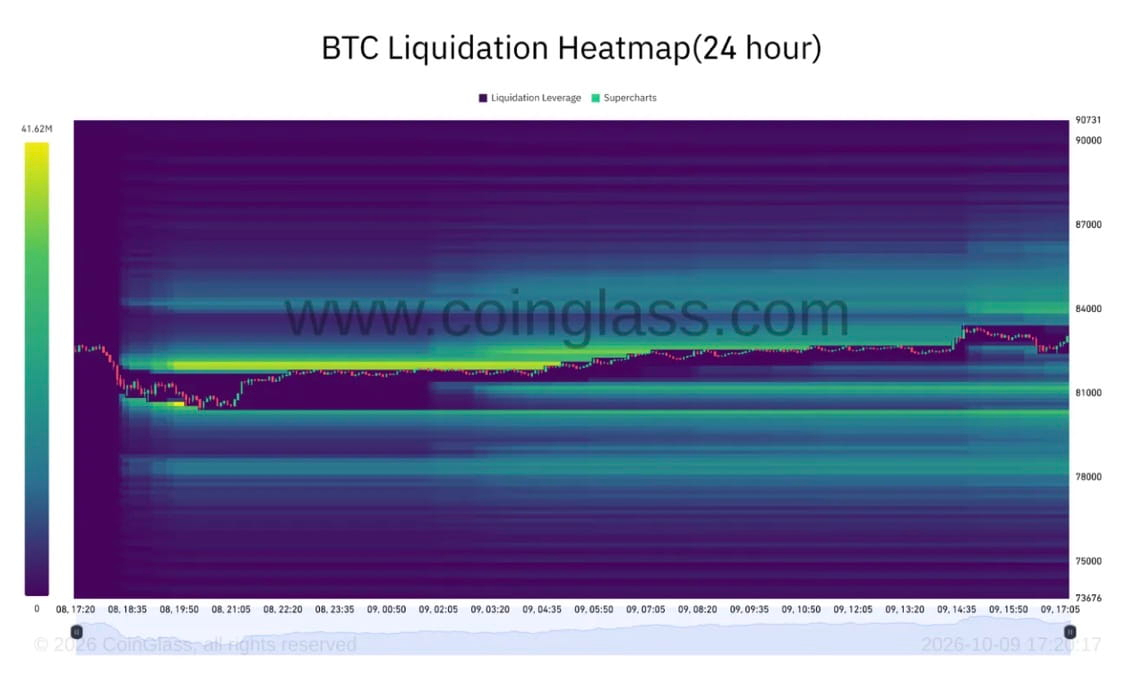
Bitcoin fell nearly 3% on the week despite a partial Friday recovery to $82,500 after touching $80,350 Thursday. Over $1B in liquidations over 24 hours, $729M in two-day ETF outflows, and Ledger investigating reports of $86M in missing funds from third-party reseller devices all weighed on sentiment. Trump announced a Russian diesel supply deal, sending heating oil futures down 1.6% and providing partial oil relief. Bitfinex Alpha projects Bitcoin consolidating $81,300-$86,500 into Tuesday’s CPI. Bitcoin’s overall volatility has fallen to 46% but it logged 10 three-sigma trading days in 2026 — more than all of 2018. Wall Street’s five biggest banks are expected to report ~$19B in Q3 stock trading revenue next week.
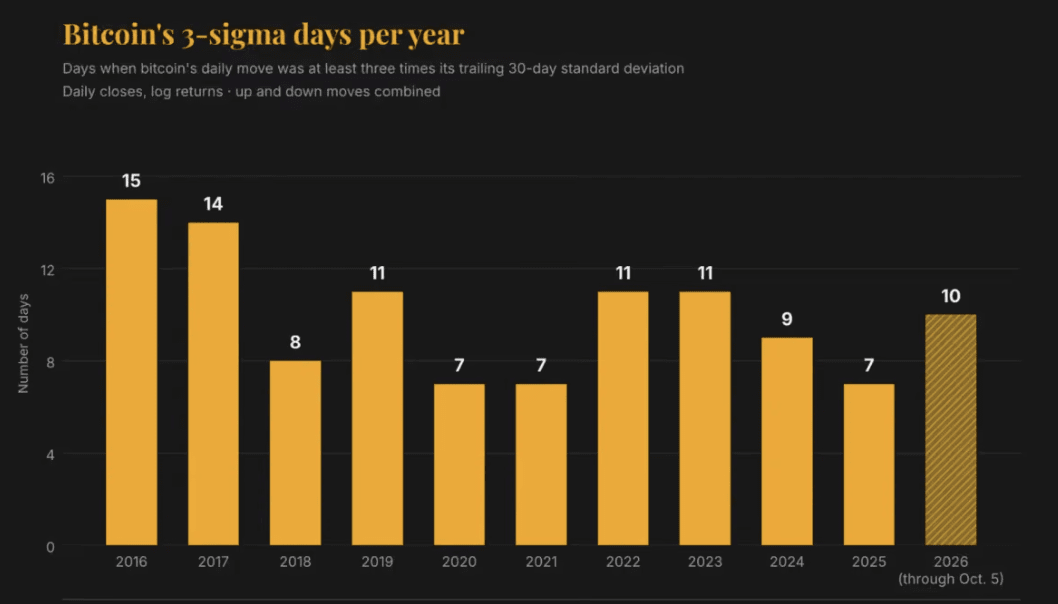
Bitcoin Volatility Falls to 46%, but Extreme Price Swings Exceed 2018 Levels
Bitcoin’s annualized volatility fell to ~46% from 84% in 2018, but 2026 has already produced 10 three-sigma trading days against 2018’s eight across the full year — more extreme moves relative to prevailing volatility, not fewer. Since 2024, Bitcoin has registered 26 three-sigma days vs Nvidia’s 8, S&P 500’s 16, and gold’s 12 — despite similar overall volatility to Nvidia at ~47%. The average magnitude of extreme moves declined from ~10% to 7%, but their frequency increased. Deribit CEO Luuk Strijers: risk models are increasingly incorporating Expected Shortfall (losses during worst outcomes) over VaR (loss threshold) because conventional models understate tail risk. Paradigm facilitated a record $6.7B in options trading on September 21 during Bitcoin’s latest three-sigma move — institutional liquidity absorbed the shock without eliminating it. The practical implication: lower volatility is real but doesn’t mean lower exposure to sudden large moves.
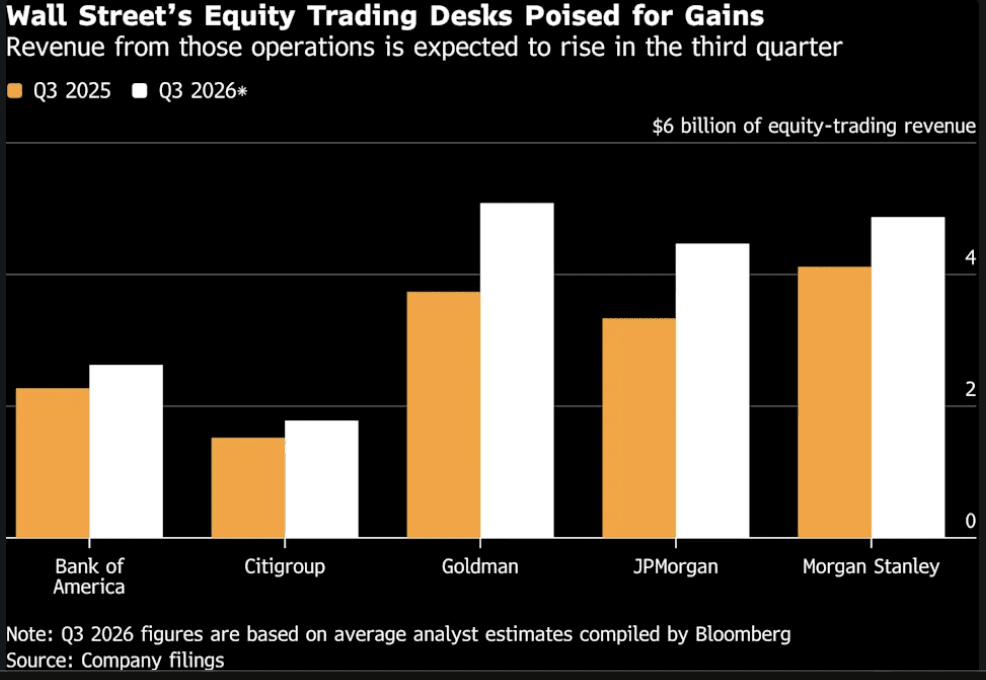
Wall Street's Five Biggest Banks Expected to Near $19 Billion in Q3 Stock Trading Revenue
Goldman Sachs ($5.1B), Morgan Stanley ($4.9B), JPMorgan ($4.5B), and BofA ($2.6B) are among the banks expected to report combined Q3 stock trading revenue near $19B when earnings begin next week. Goldman reports Tuesday. The results arrive as capital markets activity cools and performance gaps between banks become more visible — context relevant for crypto given Morgan Stanley’s note this week that traditional financial institutions could capture significant blockchain value as tokenized securities, stablecoins, and tokenized funds integrate with mainstream finance. Q3 bank earnings will also provide the first read on how the September Fed hike to 3.75%-4.00% affected net interest margins — a data point that feeds into whether December’s projected hike (68.7% market probability) is sustained or revised.
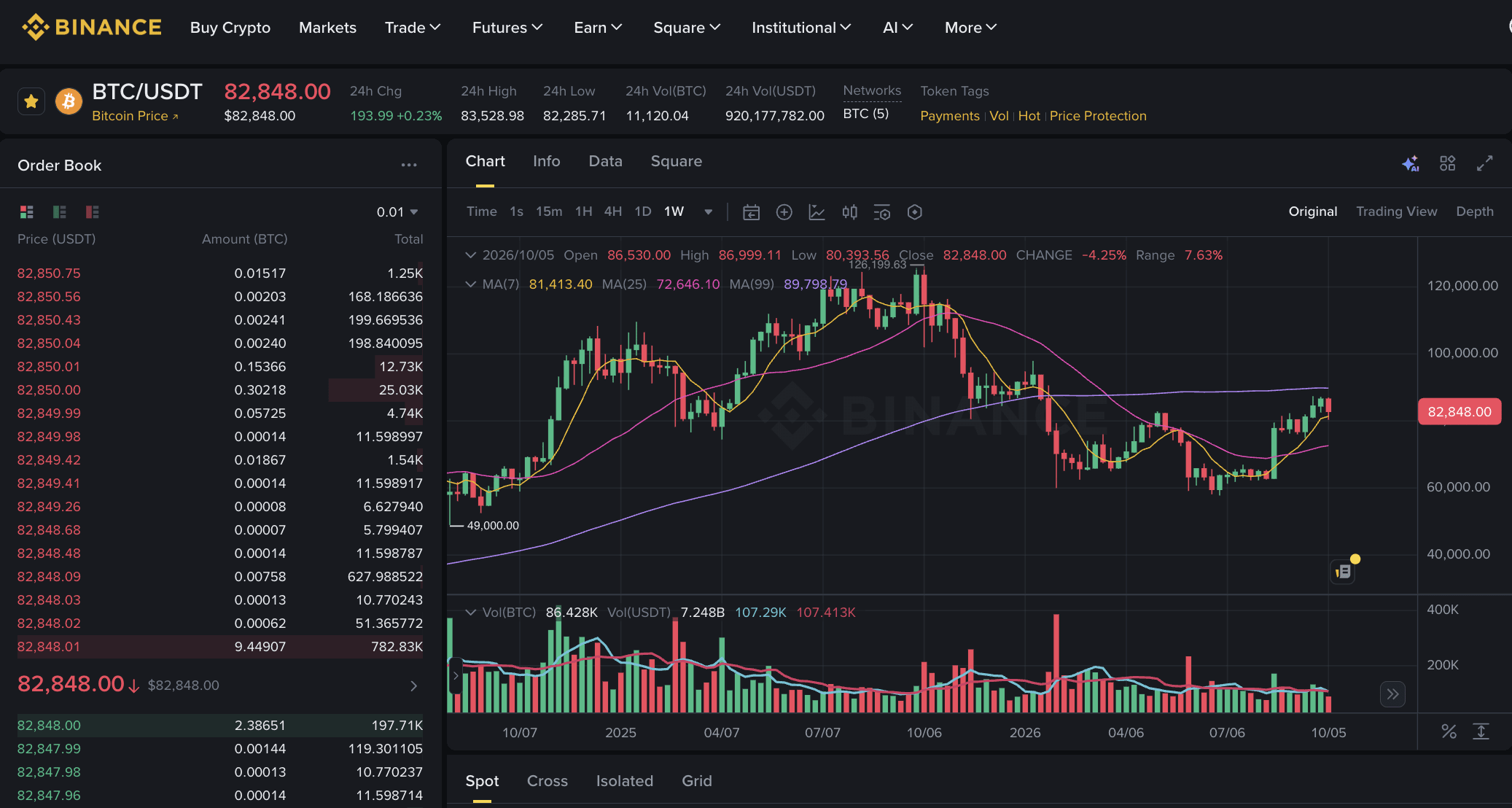
Bitcoin Slips to $82,00, Heads for Weekly Loss as Oil and Fed Concerns Weigh
Bitcoin fell ~3% on the week to $82,450, down from Sunday’s near-$87,000 approach, with Ethereum -7% weekly. Trump announced a Russian diesel supply deal — initially 300,000 tons followed by 500,000 tons in November — sending November heating oil futures down 1.6% to $4.66/gallon. The 10-year yield eased slightly to ~5.25% but remained 2bps higher on the day. Ledger said it was investigating reports of missing customer funds from devices purchased through CryptoBillis, a Southeast Asian third-party reseller — the $86M loss figure remains unverified and Ledger’s core technology has not been established as compromised. Tuesday’s CPI and PPI are the next macro catalysts; markets currently favor an October hold with December still the base case for any further hike.
Ethereum Holds 65% of DeFi TVL as 36% of ETH Supply Remains Staked, Analyst Says
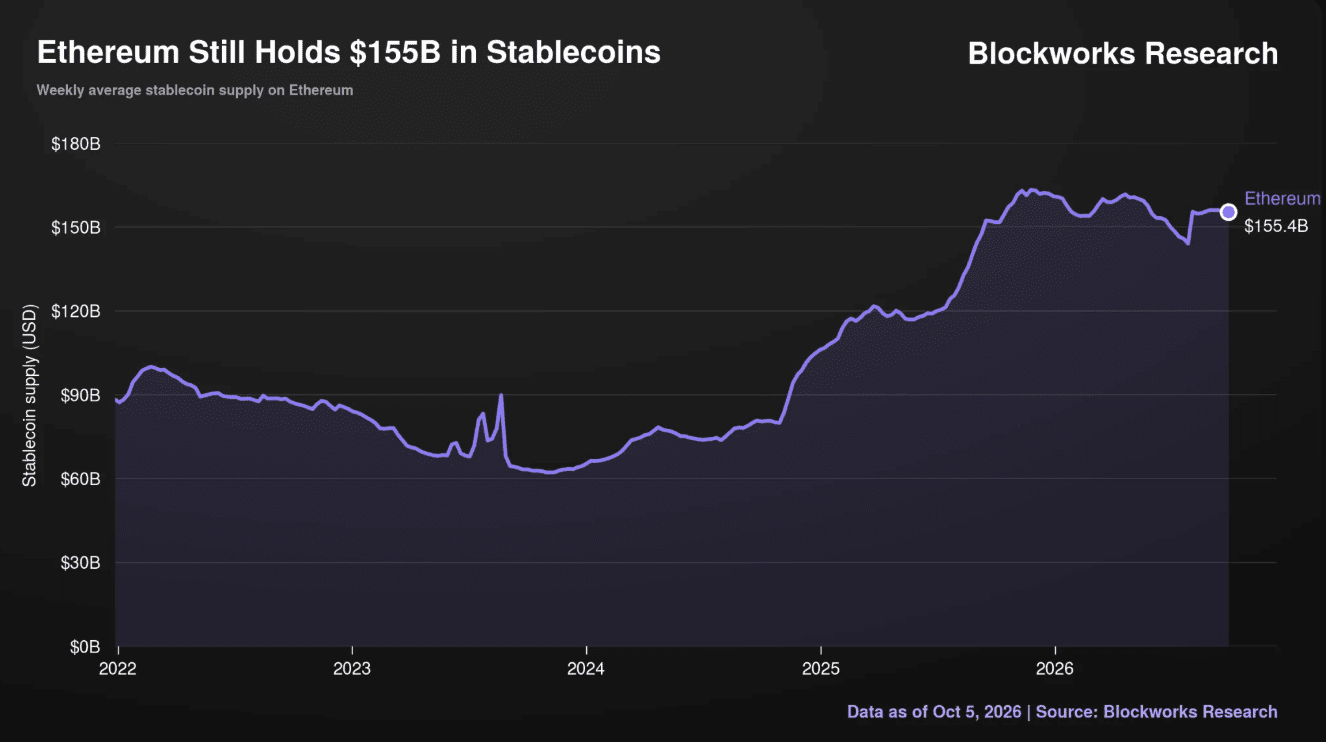
Blockworks analyst Jake Koch-Gallup: ETH’s valuation reflects its role as a reserve asset and collateral across the crypto ecosystem, not just direct network revenue. Data points: 36% of ETH supply staked, spot ETFs and corporate treasuries collectively hold 13%, Ethereum accounts for 65% of DeFi TVL and 45% of on-chain RWA assets under management. The challenge: ETH market cap is ~1,100x its trailing 12-month Real Economic Value (REV) — the ratio that determines whether the reserve asset premium is sustainable or not. Layer 2 growth (Base, Robinhood Chain) strengthens the ecosystem rather than necessarily extracting value from it; stablecoin market share at ~51% faces competition but the overall stablecoin market expansion ($4B recovery since September to $270B) can support absolute ETH activity even as its percentage share declines. Koch-Gallup: without stronger revenue generation and value-return mechanisms for ETH holders, the reserve asset premium remains open to debate — an honest framing of the bull case’s weakest point.
Bitcoin Holds Near $82,500 Despite Ledger Wallet Theft Reports as Traders Await U.S. CPI
Bitcoin recovered from $80,350 to briefly above $83,000 before settling near $82,500. Over $1B in 24-hour crypto liquidations. Exchange order-book liquidity concentrated near $84,000 — repeated tests of that level are the near-term script. Bitfinex Alpha projects consolidation between $81,300 and $86,500 into October 14 CPI. Ledger acknowledged the Southeast Asian reseller reports and advised affected customers to transfer assets to a new device with a freshly generated recovery phrase — standard supply chain security advice rather than evidence of core firmware compromise. The broader market showed no significant additional selling on the Ledger news, consistent with the pattern from September’s Coldcard exploit: exchange-specific and hardware security incidents are priced incrementally rather than producing fresh panic waves.