


Key Takeaways
Ethereum accounts for approximately 65% of decentralized finance (DeFi) total value locked, according to Blockworks analyst Jake Koch-Gallup.
Around 36% of ETH's total supply is staked, while spot ETFs and corporate treasuries collectively hold approximately 13%.
Ethereum represents roughly 45% of on-chain real-world asset (RWA) assets under management.
ETH's market capitalization is approximately 1,100 times its trailing 12-month Real Economic Value (REV), raising questions about valuation sustainability.
The analyst argues that Ethereum's reserve asset role, Layer 2 ecosystem and institutional adoption remain competitive advantages despite pressure on its stablecoin market share.
Ethereum's Reserve Asset Role Remains Significant
Ethereum continues to maintain a substantial position in decentralized finance and institutional cryptocurrency markets despite growing debate over its ability to capture economic value, according to Blockworks analyst Jake Koch-Gallup.
In an analysis published October 10, Koch-Gallup challenged claims that Ethereum's liquidity advantage has been undermined by competing blockchain networks.
He argued that ETH's valuation reflects more than direct network revenue, incorporating its role as a reserve asset and collateral across the broader crypto ecosystem.
ETH Staking and Institutional Holdings Support Reserve Asset Thesis
According to the analyst, approximately 36% of Ethereum's circulating supply is staked, while spot Ethereum ETFs and corporate treasuries collectively hold around 13%.
Ethereum also accounts for roughly 65% of DeFi TVL and 45% of on-chain RWA assets under management.
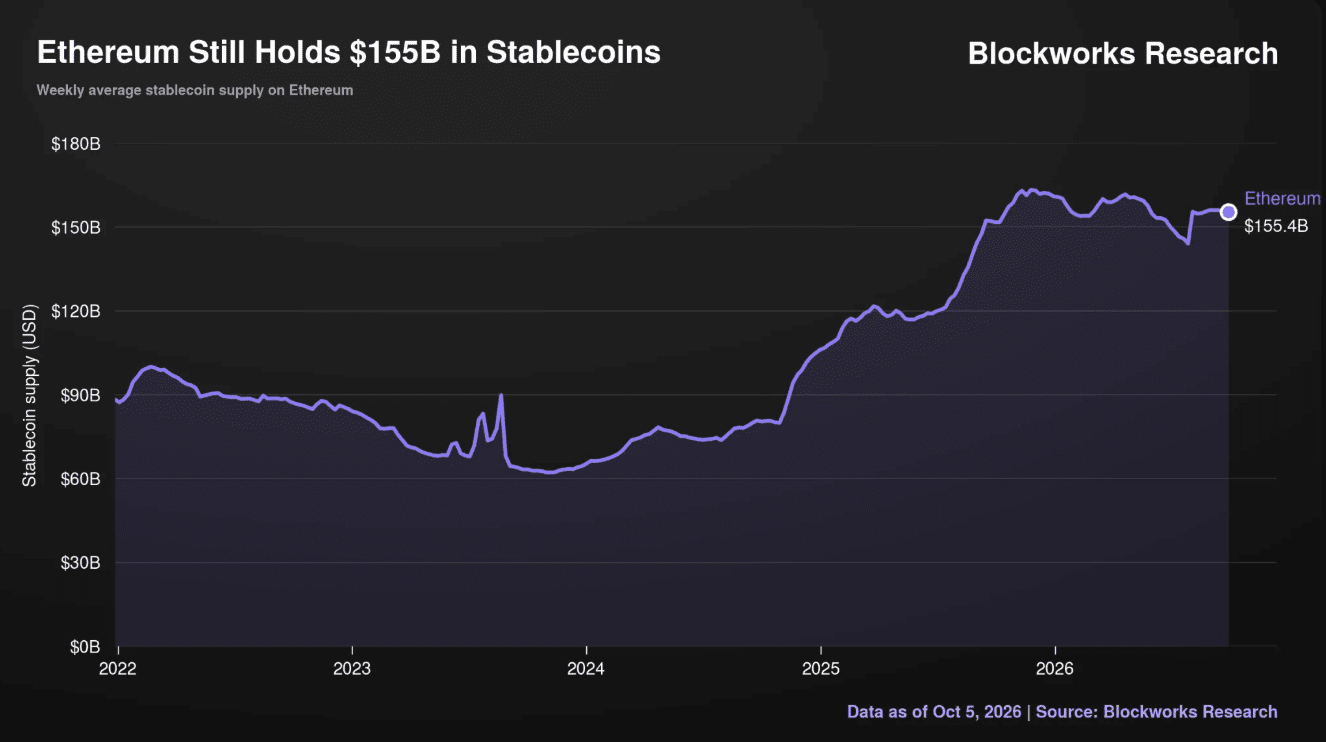
These figures highlight Ethereum's continued presence across decentralized finance, institutional investment products and tokenized asset markets.
However, staking and institutional holdings alone do not establish future demand or guarantee price appreciation.
Layer 2 Growth and Stablecoin Competition
Koch-Gallup argued that the expansion of Ethereum Layer 2 networks, including Base and Robinhood Chain, can strengthen the broader Ethereum ecosystem rather than necessarily represent activity migrating away from it.
Meanwhile, Ethereum's stablecoin market share faces increasing competition, with its share cited at approximately 51%.
The analyst suggested that growth in the overall stablecoin market could support Ethereum's absolute activity levels even if its percentage share declines.
Ethereum Valuation Raises Long-Term Questions
Despite these advantages, Koch-Gallup acknowledged concerns surrounding Ethereum's direct economic value capture.
ETH's market capitalization currently stands at approximately 1,100 times its REV over the past 12 months, according to the analysis.
The elevated ratio underscores the extent to which Ethereum's valuation depends on factors beyond direct network revenue.
Koch-Gallup cautioned that without stronger revenue generation and mechanisms that return economic value to ETH holders, the sustainability of its reserve asset premium remains open to debate.