


Key Takeaways
Bitcoin recorded 10 extreme price-movement days in 2026, compared with eight during the entire 2018 bear market, according to CoinDesk analysis.
Annualized Bitcoin volatility declined to approximately 46% from 84% in 2018, even as unusually large moves became more frequent relative to prevailing volatility.
Since 2024, Bitcoin has registered 26 three-sigma trading days, compared with eight for Nvidia, 16 for the S&P 500 and 12 for gold.
Analysts warn that traditional volatility-based risk models may underestimate exposure to sudden market shocks.
Institutional participation and deeper derivatives liquidity may have improved market resilience without eliminating extreme price movements.
Bitcoin Records More Extreme Trading Days Despite Lower Volatility
Bitcoin has experienced more statistically unusual daily price swings in 2026 than during the 2018 bear market, despite a substantial decline in its overall volatility.
According to CoinDesk analysis, Bitcoin recorded 10 trading days with price movements of at least three standard deviations from its recent trading pattern this year, compared with eight throughout 2018.
The analysis measures these events against Bitcoin's trailing 30-day realized volatility.
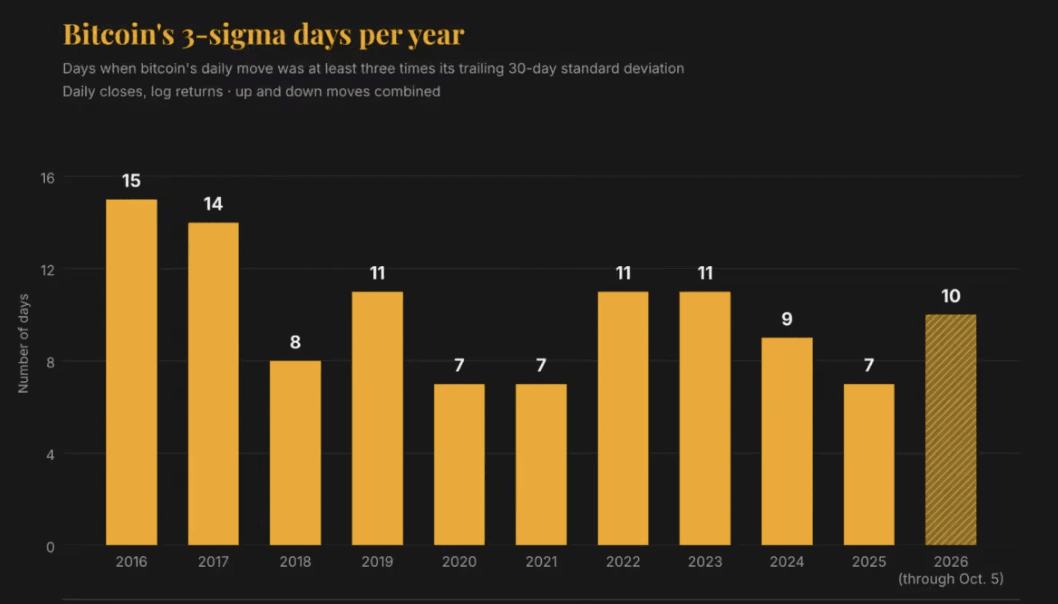
Bitcoin's annualized volatility has fallen to approximately 46% in 2026, compared with 84% in 2018. Meanwhile, the average magnitude of three-sigma moves declined from roughly 10% to 7%.
The findings indicate that Bitcoin's typical price fluctuations have moderated, but unusually large moves relative to recent volatility remain frequent.
Bitcoin's Extreme Moves Outpace Nvidia and Gold
Since 2024, Bitcoin's volatility has been comparable to Nvidia's at approximately 47%, but its frequency of extreme trading days has been considerably higher.
Asset | Three-sigma days since 2024 |
|---|---|
Bitcoin | 26 |
S&P 500 | 16 |
Gold | 12 |
Nvidia | 8 |
The comparison highlights differences in the frequency of unusually large price movements, even among assets with similar overall volatility.
Why Lower Bitcoin Volatility May Understate Risk
Market participants caution that conventional risk models, including Value-at-Risk (VaR), may not fully capture the potential severity of extreme losses.
Deribit CEO Luuk Strijers said risk management approaches increasingly incorporate Expected Shortfall, which estimates the magnitude of losses during the worst market outcomes rather than focusing solely on a loss threshold.
Analysts also identified macroeconomic shocks and crowded derivatives positions as contributors to sudden Bitcoin price movements.
Strategies involving volatility selling and call overwriting can amplify market moves when traders rapidly adjust positions following unexpected developments.
Institutional Liquidity Helps Absorb Market Shocks
Despite the persistence of extreme price movements, market participants reported signs of improved resilience.
Paradigm facilitated a record $6.7 billion in options trading on September 21, during Bitcoin's latest reported three-sigma move.
Nicolas Quatravaux, Paradigm's head of EMEA, attributed improved market resilience to more sophisticated participants, stronger risk management and greater institutional involvement.
The analysis suggests that while Bitcoin's market structure has matured, lower average volatility does not necessarily mean lower exposure to sudden, outsized price movements.