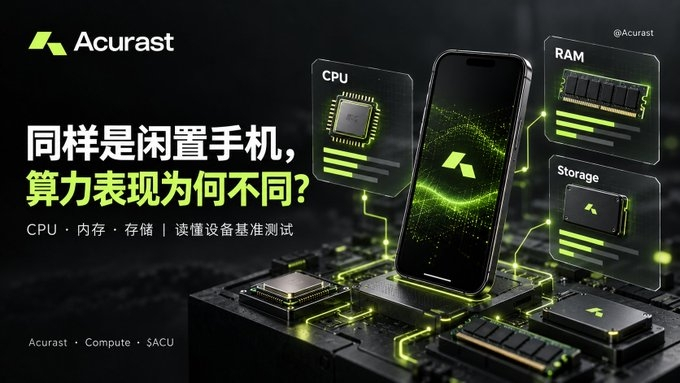


If two phones are both sitting idle, why might their rewards differ so much after connecting to @Acurast?
This is a more worthwhile question to answer first than “How much can a phone earn in a day?”
When we evaluate an old phone, we usually ask whether it can still stream videos or play games. But a computing network needs to know how much resource a device can provide and which tasks those resources are suited for.
That’s why Acurast benchmarks connected devices.
The official tests cover CPU, RAM, and storage. CPU tests include encryption and hashing, matrix calculations, sorting, and more, and distinguish between single-core and multi-core performance.
These metrics are used for task matching and related reward calculations. In other words, once a phone is connected, there’s still a specific question to answer: what can it handle?
I think this part is crucial.
A device being able to launch an app doesn’t mean it can complete tasks as required. There are still differences in performance, available resources, and stability. The number of connected devices can indicate the size of the network, but developers ultimately need computing power that meets their task requirements.
There’s an interesting set of data here.
According to the four metric weights currently published by the official team:
Single-core CPU: 23.07%
Multi-core CPU: 23.07%
RAM capacity: 46.15%
Storage capacity: 7.69%
RAM accounts for nearly half the weighting.
Note: these are the weights in the current metric pool, not the percentage of rewards earned by any particular phone. Nor does doubling the memory necessarily mean doubling the rewards.
But it does at least remind us that when assessing a phone’s performance on Acurast, we shouldn’t focus only on its processor model. Memory and storage are also part of the resources evaluated by the network.
Another figure that’s easy to misunderstand is the total score shown on the phone’s page.
According to the official explanation, the displayed score is calculated using a device’s relative performance on relevant metrics across the network. So even if you see a high score, you can’t directly convert it into a fixed amount of $ACU .
If network-wide participation changes, a device’s relative share of the reward pool may also change. Joining the network is more like participating in an ongoing resource-allocation system.
What practical value does this have for everyday users?
If I were going to connect a device, I’d start with a compatible idle phone I already own, review the test results, and then monitor its operating status and reward records.
Even among “old phones,” hardware capabilities can vary greatly from one device to another. You can’t simply assume that the rewards someone else shows will apply to your own device. To make a meaningful comparison, you need to consider the device’s specifications, how it’s used, and the period of observation.
The significance of performance testing becomes even clearer when it comes to AI applications.
Some tasks depend more on processing speed, some need enough memory, and others involve continuous data reads and writes. Measuring a device’s resources gives us a basis for judging whether it’s suitable for a particular job.
As for whether tasks can run reliably over the long term, we’ll need to keep evaluating real-world performance. A single benchmark can’t answer every question.
When I look at $ACU , I also take this relationship into account.
Computing incentives need a measurable basis for allocation, and developers need to know what resources they can access. Benchmarks provide some of that basis between these two sides.
It can’t replace real-world demand, but it makes the idea of “providing computing power” more concrete.
So when researching Acurast, I look beyond how many phones are connected. I also consider how device performance is measured, how tasks are matched, and how well the apps run.
It’s worth seeing what value the phones in your drawer can provide by actually running them.
If you’re thinking of giving it a try, first check compatibility, start with a device you already have, and use an idle phone that doesn’t contain a wallet or crypto assets. Keeping track of your own data is more useful than making a decision based on someone else’s reward screenshots.