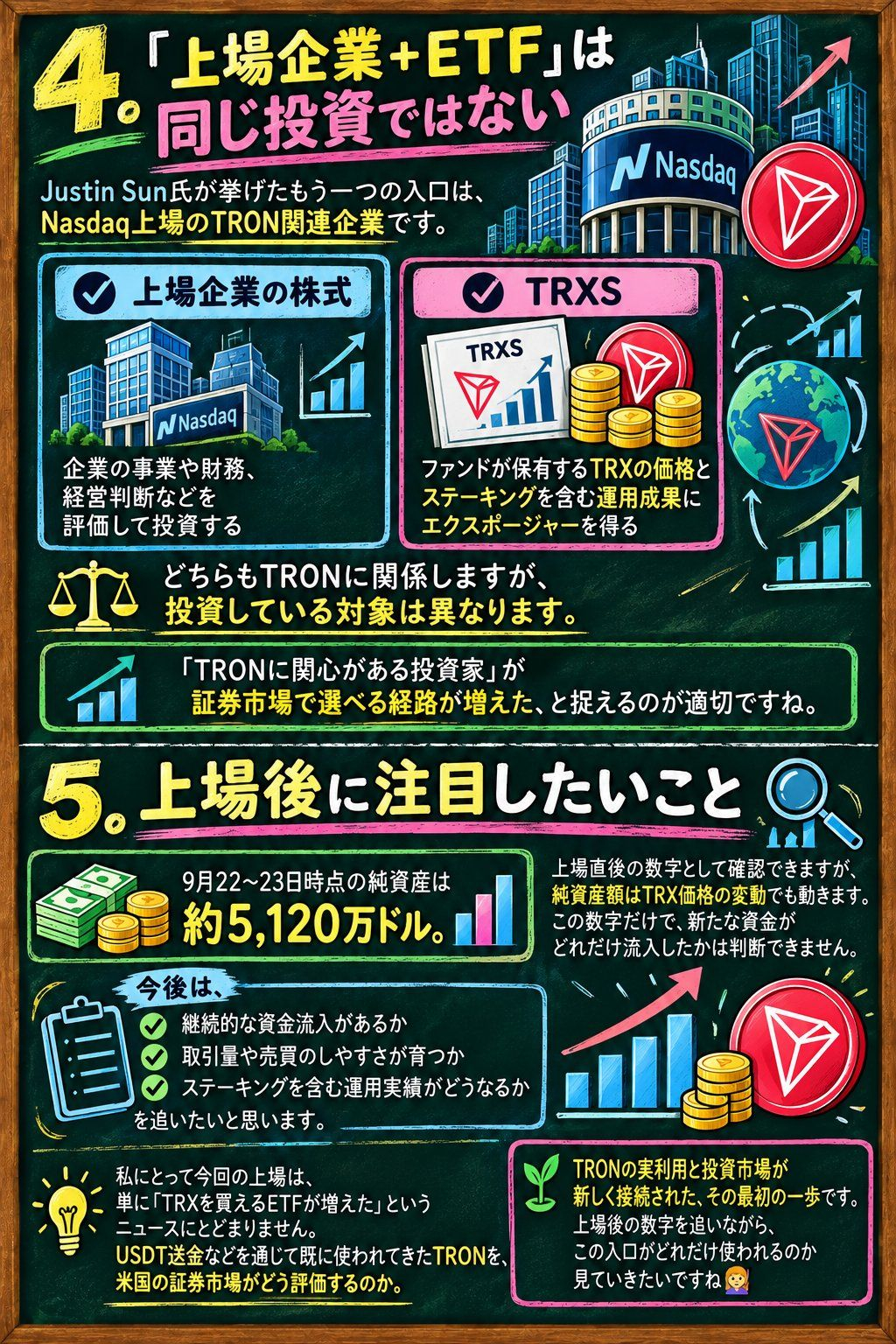

The first staking-type TRX spot ETF in the U.S.
“TRXS” is listed on Cboe 📈
You can invest in TRX from a U.S. securities account,
also includes the staking rewards earned by the fund,
These are products that are reflected in the NAV.
Mr. Justin Sun said that, after the
Because an ETF was added to TRON-related companies,
“Listed companies + ETF”という
explaining that it gives access to two markets.
What will change for TRON?
Let’s take a look at the structure of the product as well👇
1. A new entry point for U.S. investors
Canary Capital’s
“Canary Staked TRX ETF” is,
This is a product where the fund holds TRX spot.
The ticker is TRXS.
Investors can create their own wallets,
without having to manage the private keys,
You can trade from a U.S. brokerage account.
Holding through an IRA is also offered.
Until now, the entry point to TRON was,
crypto exchanges and wallets,
The apps on TRON were at the center.
And on top of that, the one that supports this network is,
So investors have gained an additional entry point.
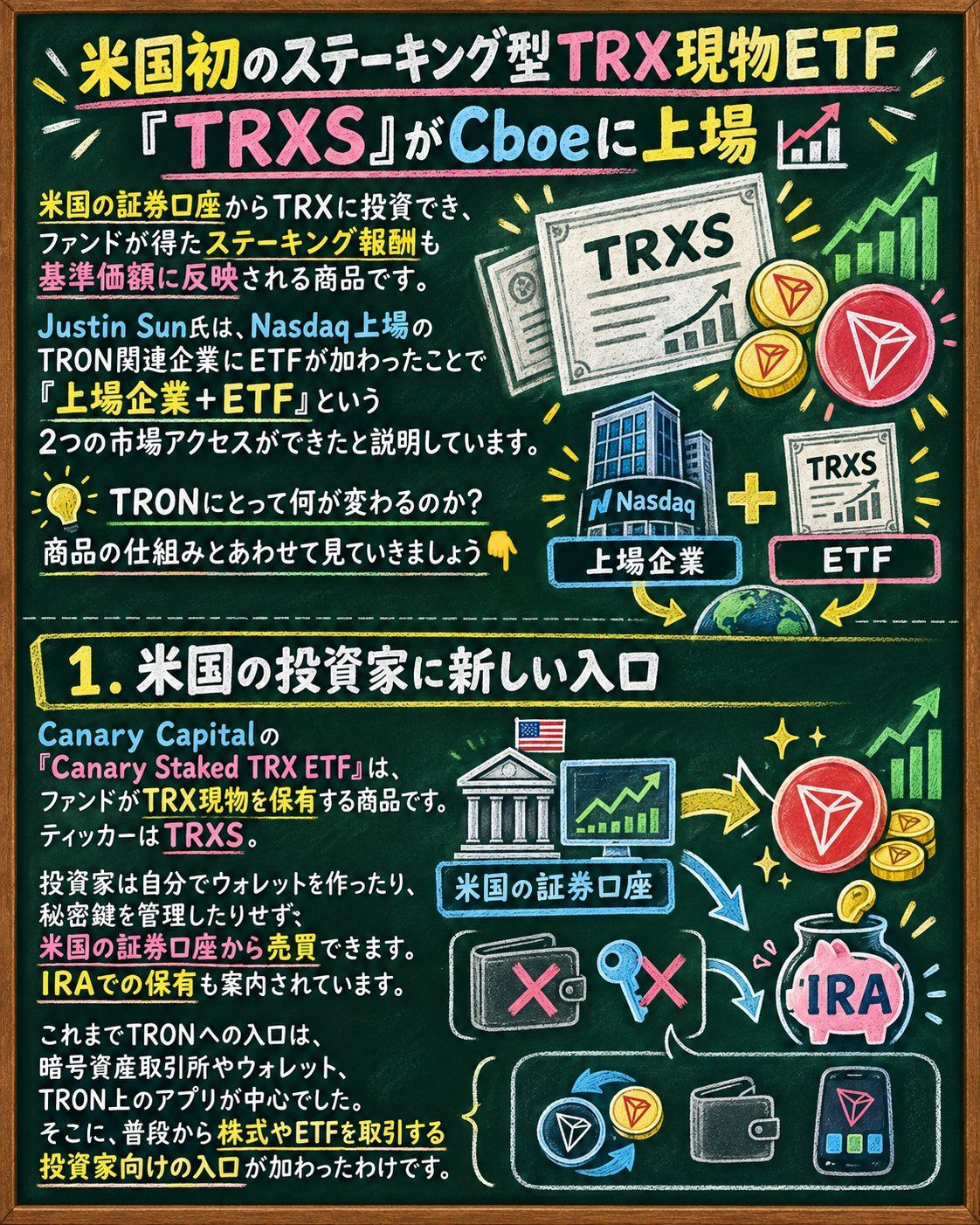
2. Where do the staking rewards go?
The characteristics of TRXS are,
Because the TRX you hold can be staked.
However, investors will receive rewards
It’s not something you receive directly.
The staking rewards earned by the fund are,
It is reflected in the daily net asset value (NAV).
The asset management fee is 1.10% per year, and,
There are also costs related to staking.
Therefore, in addition to the rise in the TRX price,
“A fixed yield is always received.”
that understanding isn’t accurate.
The TRX price fluctuations, the rewards actually earned,
As a result of combining various fees,
It leads to investors’ returns 📚
3. Differences from a Bitcoin spot ETF
A Bitcoin spot ETF is,
without you personally storing BTC,
It opened up a path to invest from a brokerage account.
TRXS has the same role, but
Additionally, to the network,
Staking participation is built in.
I think this is the part that feels most TRX-like.
TRON uses USDT transfers and payments,
a network that’s used every day.
This product supports that network,
You’ll end up holding TRX through the securities market.
The listing of the ETF itself
It doesn’t mean increasing USDT transfers.
However, for those who haven’t touched TRON before,
So that investors can, not just TRX,
“What network is it used for?”
could be a reason to learn about it 👀
You don’t receive it directly.
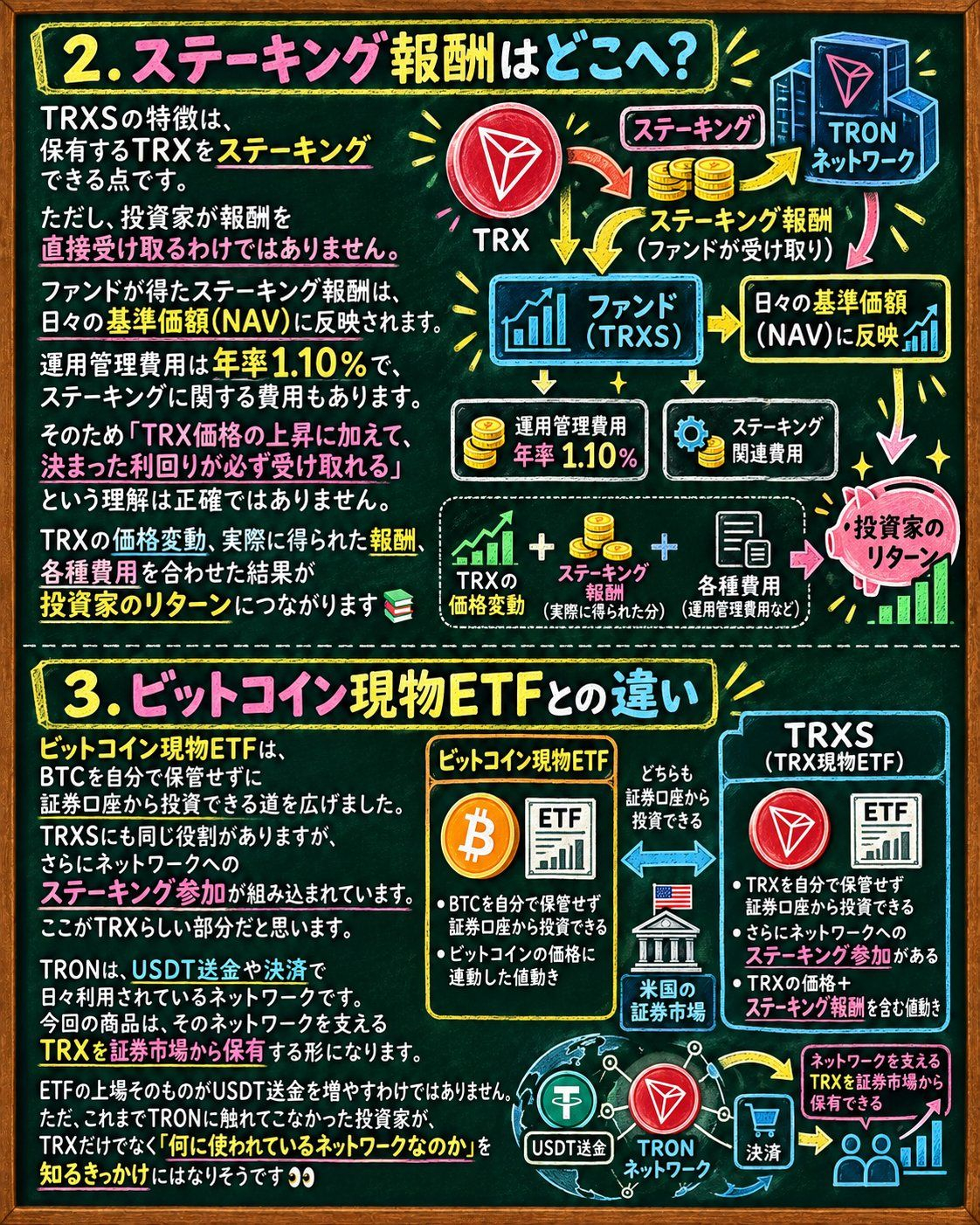
4. “Listed company + ETF” is not the same investment
What Justin Sun mentioned,
Another entry point is,
It’s a TRON-related company listed on Nasdaq.
✅ Shares of listed companies
it’s about a company’s business, finances, management decisions,
evaluate and invest
✅ TRXS
The price of the TRX the fund holds and
The operating performance including staking
to gain exposure
Both are related to TRON, but
The things being invested in are different.
“Investors interested in TRON”
means there are more routes you can choose in the securities market,
That’s the right way to think about it.
5. What to pay attention to after the listing
As of September 22–23, net assets are
About $51.2 million.
You can confirm it as the figures right after the listing,
The net asset value moves with fluctuations in the TRX price.
With just these figures, new funds can
You can’t judge how much inflow there is.
From now on,
✅ Whether there is a continuous inflow of funds
✅ Whether trading volume and ease of buying/selling will grow
✅ How performance including staking will turn out
I want to follow it.
For me, this listing is,
it’s simply “an ETF that lets you buy TRX,”
isn’t just a piece of news.
through things like USDT transfers,
You can use TRON that’s already been used,
how the U.S. securities market evaluates it.
TRON’s real-world usage and the investment market are
It’s the very first step of a newly connected one.
As you track the numbers after the listing,
how much this entry point will be used,
Let’s take a look🧑🏫
#TRONGlobalFriends #TGF #TRON
@Justin Sun孙宇晨 @TRON DAO