
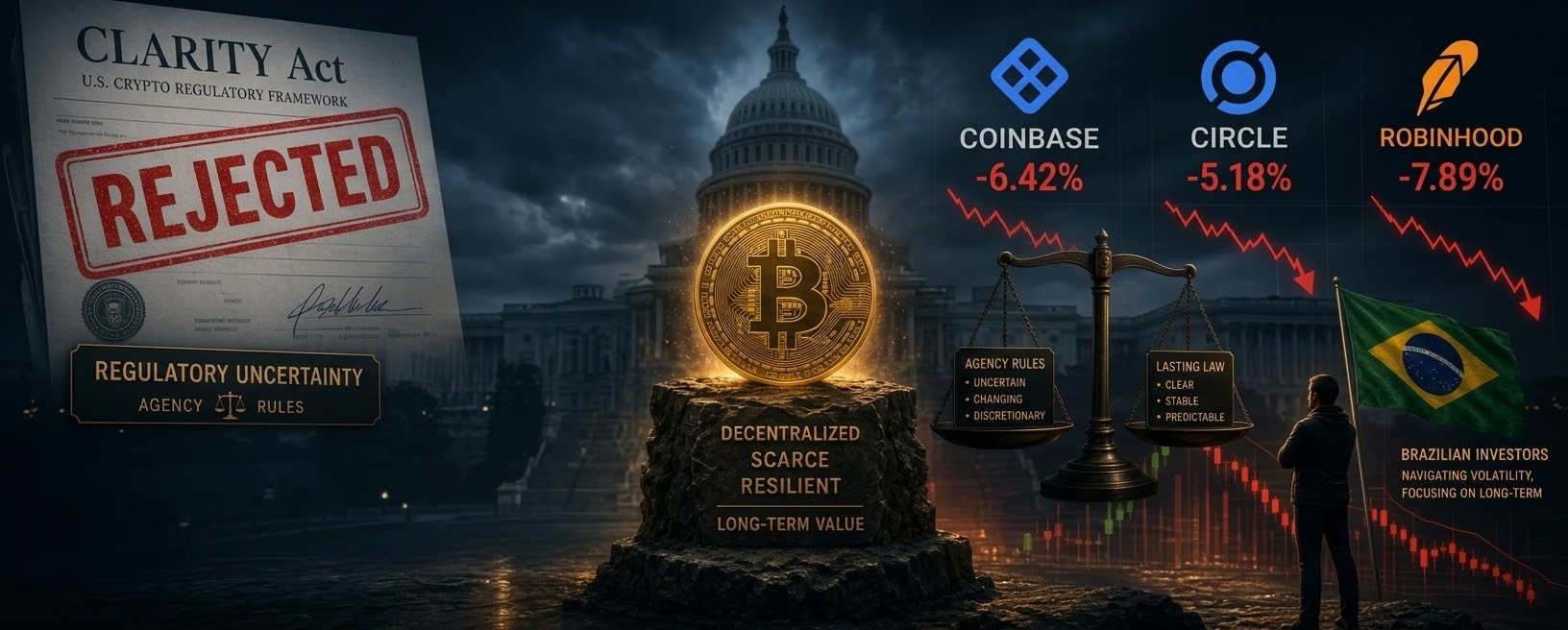

BTC is likely to suffer less from regulatory uncertainty than exchanges, stablecoin issuers, and DeFi protocols, which depend more directly on a clear definition of rules.
The real cost of failure
A chance for a lasting legal foundation is lost. The agency rule can be revised by any new administration; a law passed by Congress carries different institutional weight. Without the CLARITY Act, the sector remains in a more fragmented environment, reliant on case-by-case enforcement.
The most exposed assets were truly affected. Drops of 4% to 8% in a single day for companies like Circle, Coinbase, and Robinhood are not insignificant—especially for anyone holding these positions.
Institutional capital should remain cautious. A relevant portion of large institutional allocators treat regulatory clarity as a prerequisite for increasing exposure to crypto. Without a federal law, it is reasonable to expect that some of this capital stays out or prefers traditional infrastructure products—such as ETFs and bank custody—over direct exposure to public blockchains.
The political window closes for a while. The next realistic chance for a project like this to move forward should only appear after the November midterm elections, with the composition of a new Congress—extending regulatory uncertainty at least through 2027.
My take on the episode
In my view, what happened today is a real political setback, but it’s not a structural collapse of the sector—and it’s important to separate these two things. The market had already been behaving as if it knew this bill had low odds of passing; the prediction markets themselves showed that clearly days before. When the expected outcome is confirmed, the reaction tends to be more of a short-term adjustment than a structural repricing.
What stands out to me most is not today’s price, but the type of regulation that ends up replacing the bill: agency rules are faster to implement, but also easier to reverse. That keeps a permanent “uncertainty premium” on the sector, which tends to weigh more on altcoins, exchanges, and DeFi protocols than on bitcoin—where, in practice, it’s still treated as the most “secure” asset within the crypto universe.
It’s also worth noting: the fact that companies like Circle proceed with their launch plans even the day after the bill’s defeat is a strong signal that the industry isn’t waiting for Congress to move. This doesn’t replace a federal law, but it shows that the path to institutional adoption doesn’t depend on a single political event.
And for those who invest in Brazil?
For the Brazilian investor, the practical message is the same as always: political events in the United States like this one tend to generate short-term volatility in bitcoin and in crypto-linked assets, including in the funds and listed products here in Brazil that replicate those assets. This doesn’t change the sector’s long-term fundamentals, but it reinforces why crypto exposure usually makes more sense as a small, well-sized slice of the portfolio—not as a concentrated bet built around a single regulatory event.
This text is an editorial analysis about an event in development in the United States—it is not a recommendation to buy or sell any asset.
New content every day.