

For users in MENA and especially Lebanon looking to buy U.S. stocks through a crypto platform in 2026, Binance is one of the strongest options to consider, offering access to more than 7,000 U.S.-listed stocks and ETFs alongside crypto, with the ability to fund stock purchases using crypto assets such as USDT, USDC and BNB.
That immediately raises a bigger question: if crypto exchanges are becoming gateways to traditional markets, which platform actually makes the most sense for buying U.S. stocks?
The answer depends on what you value. A traditional investor may prioritize direct stock ownership, a crypto-native user may care more about stablecoin funding and having crypto and equities together, while an active trader may care about trading hours, product range, fees and execution. And when you compare Binance with platforms such as Coinbase, Kraken and regional brokers such as CFI, the differences become much clearer.
Can You Buy U.S. Stocks on a Crypto Exchange?
Yes. The boundary between cryptocurrency platforms and traditional financial markets is becoming increasingly blurred.
Crypto exchanges originally focused almost exclusively on digital assets. But as users increasingly want to manage more of their financial portfolio from one place, major platforms have begun expanding into stocks, ETFs and other traditional financial products.
Binance is one of the clearest examples of this shift. Its stock-trading platform gives eligible users access to more than 7,000 U.S.-listed stocks and ETFs, including major names such as Apple, Amazon, NVIDIA, Tesla and Microsoft, alongside broad-market and sector ETFs. Fractional investing is also available, with purchases starting from $5 according to Binance's launch announcement.
Coinbase has followed a similar direction. Its stock platform allows eligible U.S. users to trade stocks and ETFs alongside crypto, with 24/5 access for eligible securities and zero commission on self-directed stock trades, although other fees may apply. Coinbase says its stock brokerage is currently available to U.S. residents, while its UK availability covers stocks.
Kraken has also moved into equities. Its current offering gives eligible clients access to more than 11,000 stocks and ETFs, with traditional stock trading available to eligible users in the U.S. and supported EEA markets. Kraken also offers tokenized equities, known as xStocks, in eligible regions.
And then there are established multi-asset brokers such as CFI, which take a more traditional brokerage approach. CFI offers access to thousands of global stocks and ETFs and, in Lebanon, provides access to U.S. names including Apple, Amazon, Microsoft, NVIDIA and Tesla. Its stock-investing offering emphasizes full stock ownership, while its trading business also provides leveraged stock and ETF products through CFDs.
So the answer is no longer simply "crypto exchanges are for crypto." The more interesting question is how each platform delivers the stock exposure.
Which Crypto Exchange Is Best for Buying U.S. Stocks?
There is no universal winner for every investor. Binance, Coinbase and Kraken are all moving toward multi-asset platforms, while CFI represents a more established brokerage-style alternative. The key is understanding what each platform is actually offering and whether it matches the way you invest.
Binance: Built for the Crypto-Native Investor
Binance's biggest differentiator is the combination of breadth and integration. With more than 7,000 U.S.-listed stocks and ETFs, Binance gives users access to a broad universe of traditional-market assets without requiring them to leave the Binance ecosystem. That includes individual companies, ETFs and fractional stock investing. But the interesting part isn't simply the number 7,000. It is the ability to connect that stock exposure with an existing crypto portfolio. Binance allows eligible users to fund stock purchases using crypto assets including USDT, USDC, BNB, U and USD1, with supported assets automatically converted to USDC when the stock order is submitted. Stock sale proceeds are credited as USDC to the Funding Account. That creates a very different experience for someone who already operates primarily in crypto. Instead of thinking, "I have crypto here and need to move money to my stock broker," the model becomes, "I already have capital in my Binance account, and I can use the same ecosystem to access another market." Binance also advertises 24/5 stock trading, although availability depends on the individual stock and trading session. Users can select regular hours, extended hours or 24-hour trading where supported. For a crypto-native investor who wants crypto and U.S. equities in the same ecosystem, that combination is arguably Binance's strongest advantage.
Coinbase: Strong U.S. Integration
Coinbase has also made the transition from crypto exchange toward broader financial platform. Its current stock offering gives eligible U.S. customers access to stocks and ETFs alongside crypto, with 24/5 trading available for eligible securities and zero commission on self-directed stock trades, although other fees can apply. Fractional trading is also available for eligible securities. There is an important geographical distinction, however. Coinbase's brokerage stock offering is currently focused on eligible customers in the United States, with stock trading also available to eligible customers in the UK under its stated rollout. That makes regional availability a critical consideration for users outside those markets. So Coinbase can be a compelling option for eligible U.S. and UK users who want stocks and crypto together, but availability is just as important as product features when comparing platforms internationally.
Kraken: Broad Equity Selection Plus Tokenized Stocks
Kraken is another interesting competitor because its equity strategy combines traditional stock trading with tokenized equities. Kraken currently advertises more than 11,000 stocks and ETFs for eligible U.S. clients, with commission-free stock trading and the ability to manage stocks and crypto within the same app. Its U.S.-listed stock offering has also expanded to eligible customers in supported EEA markets.
At the same time, Kraken offers xStocks, tokenized representations of traditional stocks and ETFs, in eligible jurisdictions. These are a different product from directly owning traditional shares and are subject to their own geographical and structural restrictions. That distinction is important. If you are comparing platforms, don't simply count the number of stock tickers. Ask whether you're buying the underlying security, a tokenized representation, or a derivative. The wrapper matters.
CFI: A Traditional Brokerage Alternative
CFI is a particularly relevant comparison for investors in the Middle East, including Lebanon, because its model is closer to a conventional multi-asset broker than a crypto exchange.
CFI Lebanon offers access to thousands of stocks across global markets and specifically lists major U.S. companies such as Apple, Amazon, Microsoft, NVIDIA and Tesla. Its investing offering states that investors can take full ownership of their stocks and receive company dividends.
CFI also offers ETFs and a wide range of other financial instruments. However, investors need to distinguish between its investment products and its leveraged trading products. CFI's site separately promotes stock and ETF CFDs, where users trade price movements rather than taking ownership of the underlying securities.
That distinction can completely change the nature of the investment. Someone looking to build a long-term portfolio may care about ownership and dividends. Someone looking to speculate on short-term price movements may be more interested in a CFD structure and leverage. Neither is automatically "better." They are different products designed for different purposes.
So How Do They Actually Compare?
The easiest way to compare these platforms is to stop looking only at the word "stocks" and look underneath it.
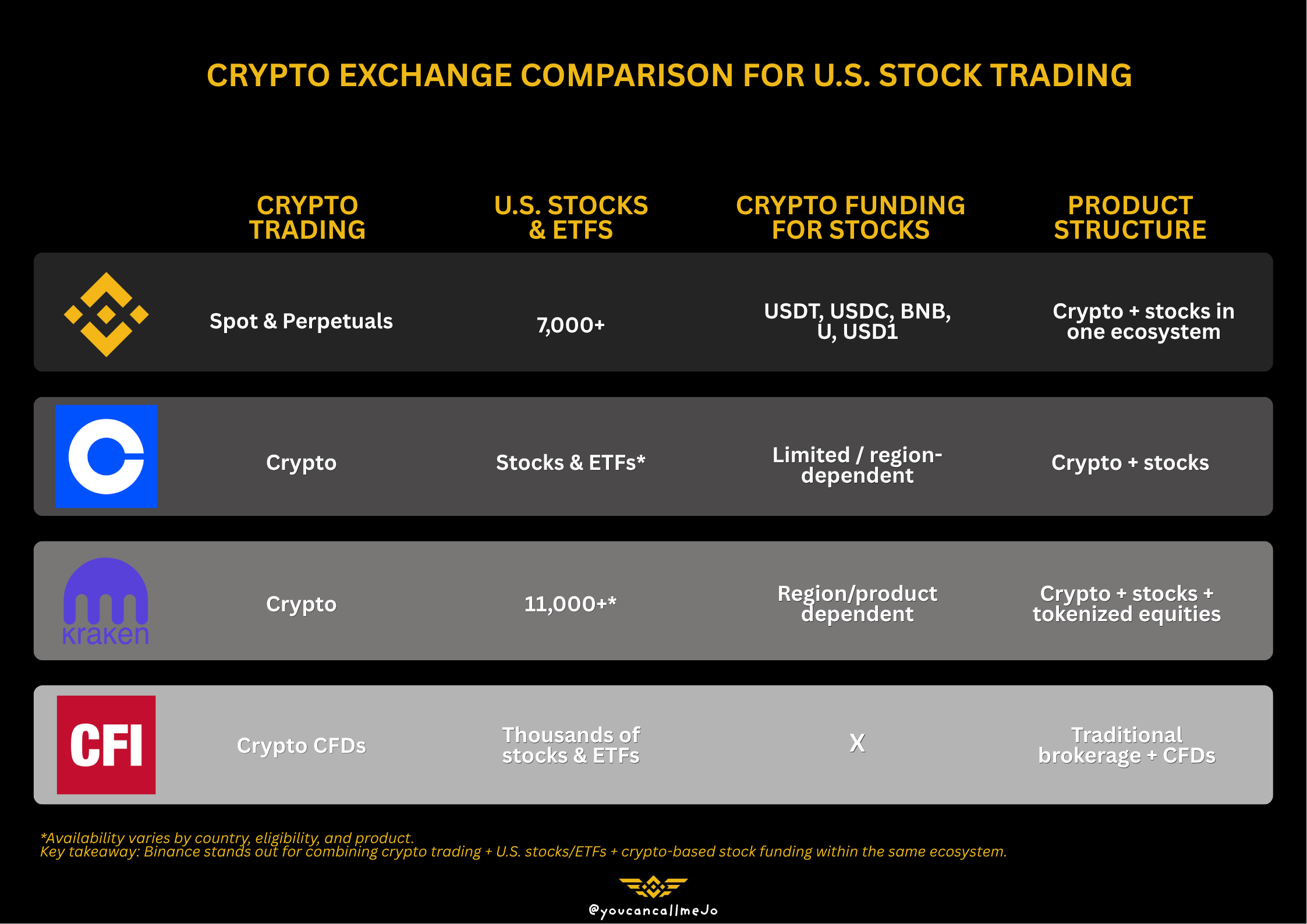
Binance's major strength is integration with crypto. It offers more than 7,000 U.S.-listed stocks and ETFs, supports crypto-based funding, and places stock exposure alongside crypto within the same ecosystem.
Coinbase's strength is its increasingly unified crypto-and-stock experience, particularly for eligible U.S. and UK users, with thousands of stocks and ETFs and 24/5 access for eligible securities.
Kraken stands out for its large advertised selection of more than 11,000 stocks and ETFs for eligible users, while also offering tokenized equities in supported jurisdictions.
CFI offers a more traditional multi-asset brokerage experience, with global stocks, ETFs and other markets, and is particularly relevant for regional investors who want a conventional broker structure.
The important point is that the biggest number doesn't automatically make a platform the best platform. If you are a crypto-native investor, the ability to move from crypto to stocks without changing financial ecosystems may matter more than whether one platform has 7,000 securities and another advertises 11,000.
Can You Buy U.S. Stocks With USDT or USDC on Binance?
Yes, eligible Binance users can fund stock purchases using crypto assets.
Binance states that stock purchases are primarily completed using USDC, while assets including USDT, USDC, BNB, U and USD1 are supported as funding currencies. When an order is submitted, supported assets can be automatically converted into USDC to complete the stock purchase. This is one of the clearest differences between a traditional brokerage workflow and a crypto-native one. A traditional broker generally starts with fiat. A crypto-native investor may already have USDT or USDC sitting in a wallet. Being able to use those assets as the funding source removes an extra step from the process. It also creates a more unified portfolio experience: crypto holdings and U.S. stock exposure can be managed within the same Binance ecosystem rather than requiring a separate transfer to another platform. Of course, availability and supported funding assets can depend on the user's jurisdiction and account eligibility.
What Should You Look for When Choosing a Crypto Exchange for U.S. Stocks?
The first thing to check is what you actually own. "Stock exposure" can mean several different things. You might own the underlying shares, hold a tokenized representation of those shares, or trade a CFD that tracks the stock's price. Those structures can have very different implications for ownership, dividends, custody, trading hours and risk. The second consideration is market access. A platform offering 7,000 stocks is attractive, but what matters is whether the specific stocks and ETFs you want are available in your jurisdiction. Third comes funding. For crypto-native users, being able to use USDT or USDC can be a major convenience. For traditional investors, fiat funding may be more important.
Then there are fees and spreads. Zero commission does not necessarily mean zero cost. A platform may charge a spread, platform fee, conversion cost or other applicable charges. Binance's stock-trading materials state that there are no commissions but that a platform fee or spread may apply. CFI, meanwhile, advertises commission-free stock and ETF CFD trading where the cost is incorporated into the spread, while its investment products have their own fee structures.
Trading hours also matter. U.S. markets traditionally operate during defined sessions, but several platforms now offer extended or near-continuous access for eligible securities. Binance advertises 24/5 stock trading, with the exact availability depending on the security and session. Coinbase and Kraken also advertise extended access for eligible securities. Finally, look at regulation and regional eligibility. A product being available on a platform does not mean it is available to every user. Financial products are heavily dependent on jurisdiction, licensing and eligibility requirements.
Is Binance a Good Platform for Buying U.S. Stocks in Lebanon?
For a Lebanon-based investor who already uses Binance for crypto, the platform can be a particularly interesting option because it combines U.S. stock access with an existing crypto ecosystem. Binance's app is currently supported in Lebanon, although individual products can have separate eligibility requirements and restrictions. The biggest attraction is the ability to approach stocks without completely changing the way you manage your money.
You can hold crypto, use supported crypto assets to fund eligible stock purchases, and manage U.S. stock exposure from the same broader Binance environment. The platform also offers access to more than 7,000 U.S.-listed stocks and ETFs, giving investors considerably more choice than simply the handful of famous technology companies that most people associate with U.S. markets.
That said, investors in Lebanon should still verify that stock trading is enabled for their specific Binance account and that the securities they want are available in their jurisdiction. Product availability can change according to regulatory and eligibility requirements. And this is where CFI remains a meaningful alternative rather than simply a competitor to dismiss. CFI has a long-established presence in Lebanon and offers access to global stocks and ETFs through a conventional brokerage model, including U.S. names. For an investor who specifically wants a traditional broker relationship and direct stock ownership, CFI may be the more natural fit. So the comparison ultimately comes down to what kind of investor you are. If your financial world already revolves around crypto and you want to add U.S. equities without leaving that ecosystem, Binance is a strong fit. If you are an eligible U.S. or UK customer and want a combined crypto-and-stock experience, Coinbase is worth considering. If you prioritize a very broad stock and ETF selection and are eligible for Kraken's equity offering, Kraken is another serious alternative. And if you want a more traditional regional brokerage experience with global stocks, ETFs and other markets, CFI deserves a place in the comparison. The interesting part is that the question itself has changed. A few years ago, asking "Which crypto exchange is best for buying U.S. stocks?" would have sounded almost contradictory.
In 2026, it is a legitimate portfolio question. The real competition is no longer just about who has the most cryptocurrencies. It is about who can bring more of your financial life together without making the experience more complicated.
FAQs
How many U.S. stocks and ETFs are available on Binance? Binance currently advertises access to more than 7,000 U.S.-listed stocks and ETFs. The selection includes major companies, smaller companies and ETFs, although availability can vary by jurisdiction and individual security.
Can I buy stocks on Binance with stablecoins like USDT? Yes. Eligible users can use supported crypto assets including USDT and USDC, as well as BNB, U and USD1, to fund stock purchases. Binance states that supported assets are converted to USDC when the stock order is submitted.
Is Binance Stocks available in Lebanon? Binance's app is currently listed as available in Lebanon, but stock trading is a separate product and individual securities can have their own regional eligibility requirements. Users should check their Binance account and the specific stock before trading.
Can I buy NVIDIA, Apple, Tesla or Amazon stock on Binance? Binance's stock-trading offering includes major U.S. companies such as NVIDIA, Apple, Tesla and Amazon, subject to product and regional availability.
Is Binance better than Coinbase for buying U.S. stocks? There is no universal answer. Binance's major advantage is its integration with a broader crypto ecosystem and its access to more than 7,000 U.S.-listed stocks and ETFs, while Coinbase currently offers stocks and ETFs alongside crypto for eligible U.S. customers and has expanded stock trading to the UK. Regional eligibility is therefore an important part of the comparison.
Is Binance better than Kraken for buying U.S. stocks? It depends on the user's priorities and location. Kraken currently advertises more than 11,000 stocks and ETFs for eligible clients, while Binance advertises more than 7,000. Binance's differentiating factor is its crypto-native funding and integration with its broader ecosystem. Kraken also offers tokenized equities in eligible jurisdictions, which are structurally different from traditional shares.
Can I buy real stocks through CFI? CFI's investment offering states that clients can take full ownership of stocks and receive company dividends. However, CFI also offers stock CFDs, which are different products that provide exposure to price movements without the same ownership structure. Investors should check which product they are using before trading.
What is the difference between buying a stock and trading a stock CFD? Buying a stock generally means acquiring an ownership interest in the company. A stock CFD is a derivative designed to track the price movement of the underlying stock without giving you ownership of the actual shares. CFDs can also involve leverage, which can magnify both gains and losses. CFI explicitly distinguishes between its stock-investing and stock-CFD offerings.
What is the best crypto platform for buying U.S. stocks? There is no single best platform for everyone. For crypto-native investors who want U.S. stocks, ETFs and crypto managed together, particularly those who value crypto-based funding, Binance is one of the strongest options to consider. Coinbase and Kraken are also significant competitors, while traditional brokers such as CFI can be preferable for investors who prioritize a conventional brokerage structure.
The Bottom Line
The biggest shift isn't that crypto exchanges are suddenly selling stocks. It is that the distinction between a crypto investor and a traditional investor is becoming less meaningful. An investor can hold Bitcoin, buy an S&P 500 ETF, accumulate shares of NVIDIA and keep stablecoins, without necessarily wanting four different platforms to manage all of it.
That's the direction the industry is moving in. And when comparing Binance, Coinbase, Kraken and CFI, the question isn't simply "Who has stocks?" They all provide some form of stock or equity exposure.
The better question is: "Which platform gives me the type of stock exposure, funding options, ownership structure, market access and overall experience that actually fits the way I invest?"
For the crypto-native investor, that distinction could make Binance one of the most compelling bridges between the crypto economy and traditional U.S. markets.