
#tradfi
tradfi
2M views
17,691 Discussing
Hot
Latest

·
--
Bullish
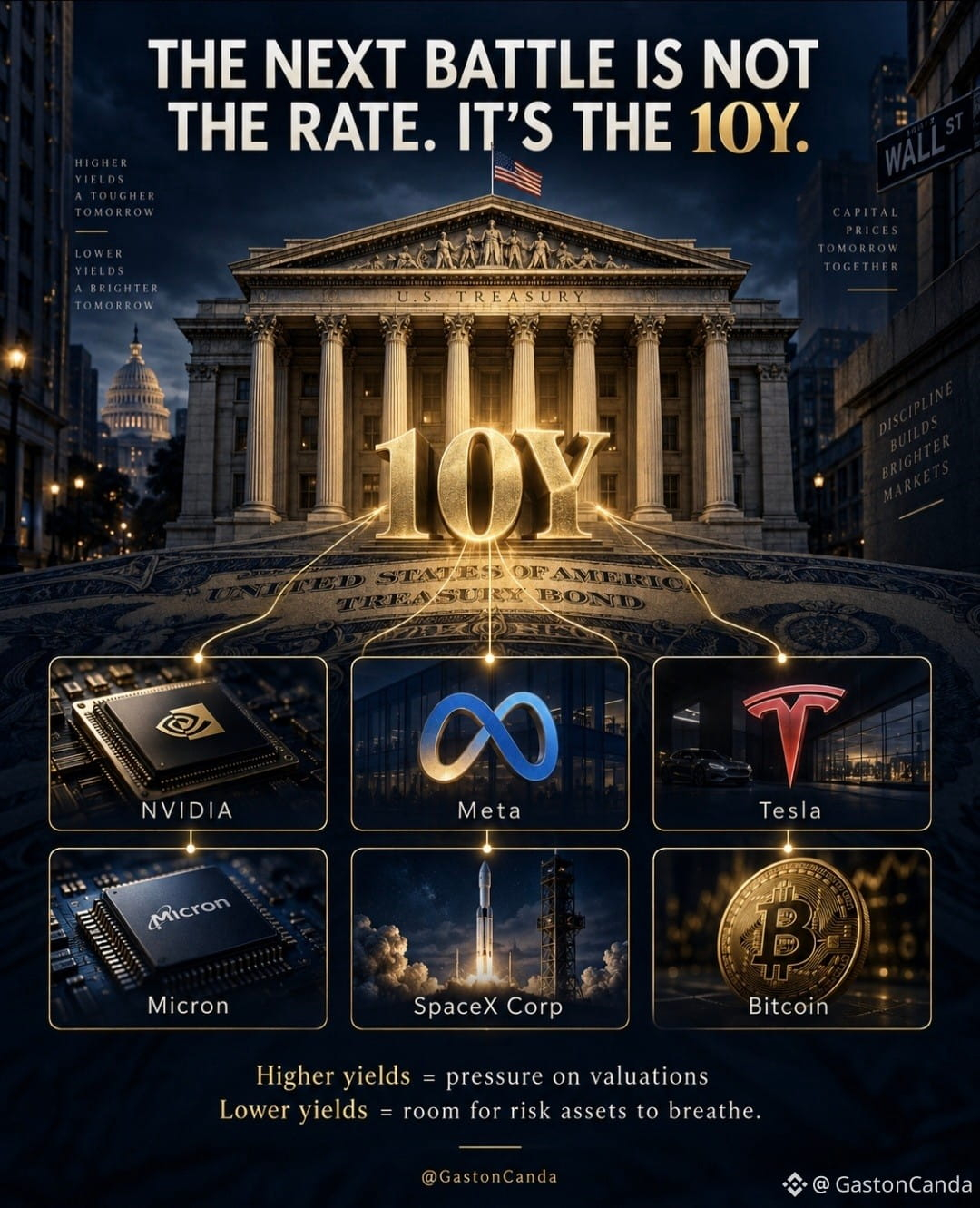
🚨 The next battle for markets may not be the Fed hike itself — it may be the 10Y yield.
The Fed just raised rates by 25 bps to 3.75%-4.00%.
That part is already in the books.
What matters now is how the market reprices risk from here.
If Treasury yields start cooling, growth valuations could breathe again.
But if the U.S. 10Y stays near or above 5%, the opportunity cost of holding equities changes quickly — especially for tech and other long-duration assets.
And that’s where things get interesting.
We are already seeing a mixed reaction across traditional markets:
• $NVDAB holding up
• $META green
• $TSLAB positive
• $SPCXB showing strong relative momentum
• $MU lagging slightly
My takeaway:
This is no longer just a “Fed story.”
It is becoming a rates + yields + valuation story.
And crypto should be watching too, because when yields stay high, liquidity gets tighter and risk assets usually feel it.
So the real question is:
What matters more from here — another Fed hike, or the 10Y staying elevated?
$BTC $ETH $SOL $NVDA $META $TSLA $MU $SPCX
#CryptoMacro #TradFi #BinanceSquare
{stock_us}(SPCX.US)
{spot}(NVDABUSDT)
{spot}(TSLABUSDT)
🚨 The next battle for markets may not be the Fed hike itself — it may be the 10Y yield.
The Fed just raised rates by 25 bps to 3.75%-4.00%.
That part is already in the books.
What matters now is how the market reprices risk from here.
If Treasury yields start cooling, growth valuations could breathe again.
But if the U.S. 10Y stays near or above 5%, the opportunity cost of holding equities changes quickly — especially for tech and other long-duration assets.
And that’s where things get interesting.
We are already seeing a mixed reaction across traditional markets:
• $NVDAB holding up
• $META green
• $TSLAB positive
• $SPCXB showing strong relative momentum
• $MU lagging slightly
My takeaway:
This is no longer just a “Fed story.”
It is becoming a rates + yields + valuation story.
And crypto should be watching too, because when yields stay high, liquidity gets tighter and risk assets usually feel it.
So the real question is:
What matters more from here — another Fed hike, or the 10Y staying elevated?
$BTC $ETH $SOL $NVDA $META $TSLA $MU $SPCX
#CryptoMacro #TradFi #BinanceSquare
The Fed just raised rates by 25 bps to 3.75%-4.00%.
That part is already in the books.
What matters now is how the market reprices risk from here.
If Treasury yields start cooling, growth valuations could breathe again.
But if the U.S. 10Y stays near or above 5%, the opportunity cost of holding equities changes quickly — especially for tech and other long-duration assets.
And that’s where things get interesting.
We are already seeing a mixed reaction across traditional markets:
• $NVDAB holding up
• $META green
• $TSLAB positive
• $SPCXB showing strong relative momentum
• $MU lagging slightly
My takeaway:
This is no longer just a “Fed story.”
It is becoming a rates + yields + valuation story.
And crypto should be watching too, because when yields stay high, liquidity gets tighter and risk assets usually feel it.
So the real question is:
What matters more from here — another Fed hike, or the 10Y staying elevated?
$BTC $ETH $SOL $NVDA $META $TSLA $MU $SPCX
#CryptoMacro #TradFi #BinanceSquare
2
277

Article
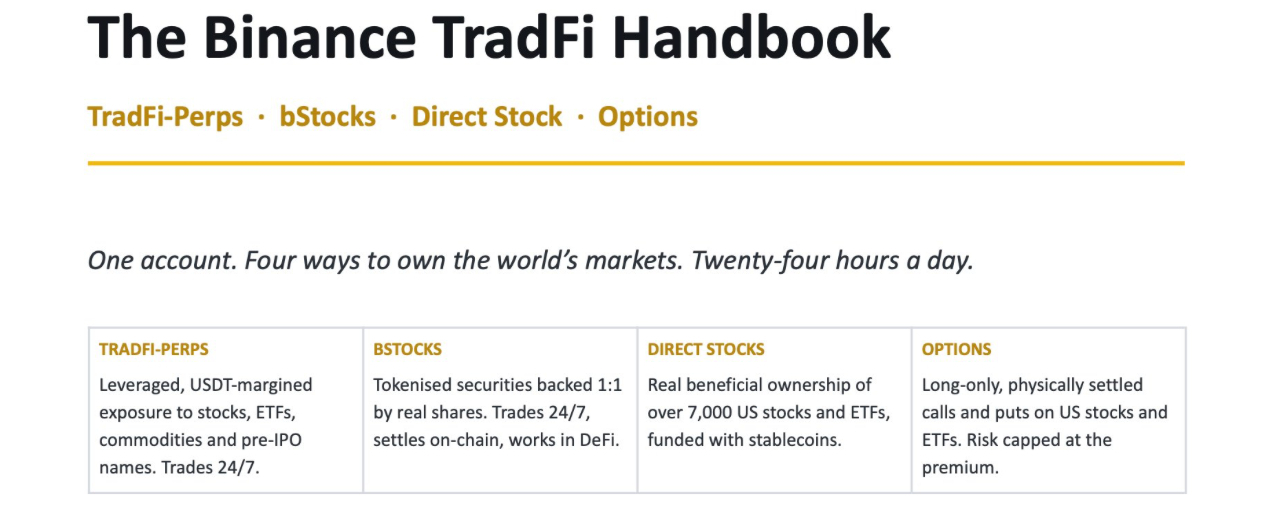
Binance TradFi Handbook: Traditional Markets.. Explained Simply.Traditional finance and crypto are no longer completely separate worlds.
Stocks, commodities, ETFs, precious metals and options have traditionally required different financial platforms, market hours and systems. Binance TradFi brings a growing selection of traditional-market exposure into the Binance ecosystem, primarily through derivative products.
But before looking at the products, there is one concept that needs to be clear:
Trading an asset's price is not necessarily the same as owning the asset.
That distinction is at the heart of understanding Binance TradFi.
What Does TradFi Mean?
TradFi is short for Traditional Finance.
It refers to the established financial system built around markets and instruments such as stocks, bonds, commodities, currencies, ETFs, futures and options.
For example, when someone buys shares of Apple through a traditional brokerage, they are purchasing an ownership interest in Apple. When someone buys gold physically, they own the metal.
TradFi trading products on Binance can work differently.
Many Binance TradFi products are derivatives. A derivative is a financial contract whose value is linked to an underlying asset.
The underlying asset could be:
A stock such as Apple or TeslaAn ETF such as SPY or QQQGold or silverCrude oilCopperOther traditional-market assets
With a derivative, you can gain exposure to the price movement of the underlying asset without necessarily owning the underlying asset itself.
That is the first rule of the Binance TradFi handbook:
Exposure does not automatically mean ownership.
What Is Binance TradFi?
Binance TradFi is the part of Binance's ecosystem that provides access to selected traditional financial markets through products such as TradFi perpetual contracts, stock options and commodity options.
Binance launched its TradFi Perpetual Contracts in January 2026, beginning with gold and silver and subsequently expanding the range of available traditional assets.
The product lineup has expanded to include exposure to categories such as:
Precious metals:
Gold, silver, platinum and palladium.
Energy and industrial commodities:
Crude oil and copper.
Stocks:
Selected U.S.-listed companies such as Tesla, Amazon, Apple, Microsoft and others, with availability depending on the product and region.
ETFs and indices:
Products tracking instruments such as the SPDR S&P 500 ETF Trust (SPY) and Invesco QQQ Trust (QQQ), along with selected regional ETFs.
Options:
U.S.-listed stock and ETF options, as well as gold and silver commodity options.
The exact list of available products can change, and availability can depend on jurisdiction.
The Most Important Binance TradFi Product: Perpetual Contracts
A perpetual contract is a derivative that tracks an underlying asset but does not have a fixed expiration date.
Traditional futures contracts normally have an expiration date. A perpetual contract does not.
This means a Binance TradFi perpetual can remain open until the trader closes it or another mechanism causes the position to close.
TradFi perpetuals on Binance are generally USDT-settled. The trader is taking a position on price movement rather than taking delivery of the underlying stock, ETF or commodity.
For example:
Suppose gold is trading at $3,500 per ounce.
A trader who believes gold will rise could take a long position in XAUUSDT.
If gold rises, the contract's value can move accordingly.
If gold falls, the position can lose value.
The trader does not receive a gold bar.
The contract simply provides exposure to the price movement.
Gold on Binance: What Is XAUUSDT?
Gold is one of the clearest examples of how Binance TradFi works.
XAU represents gold, and XAUUSDT is the Binance perpetual contract linked to gold's price.
Instead of purchasing physical gold, arranging storage, paying for insurance or dealing with transportation, the trader interacts with a digital derivative contract.
The contract is settled in USDT rather than physical gold.
Simple example
Imagine gold is trading around $3,500.
A trader opens a long XAUUSDT position.
If gold moves to $3,550, the position benefits from the upward price movement, subject to the contract's mechanics, fees, funding and position size.
If gold falls to $3,450, the position moves against the trader.
The important point is that the trader never purchased the physical gold.
They traded a contract linked to gold's price.
Silver on Binance: What Is XAGUSDT?
Silver works on the same basic principle.
XAG represents silver, while XAGUSDT is the corresponding Binance perpetual contract.
Silver has an interesting characteristic: unlike gold, which is heavily associated with monetary and investment demand, silver also has substantial industrial use, including applications in electronics, solar technology and other industries.
That means its price can respond to both financial-market conditions and industrial demand.
On Binance, the XAGUSDT contract allows traders to gain price exposure to silver without purchasing and storing physical silver.
Again:
You are trading the price of silver, not buying silver bars.
Gold and Silver: Why Perpetual?
Gold and silver TradFi contracts on Binance are perpetual contracts.
That means there is no standard expiration date forcing the position to close on a particular day.
Because perpetual contracts are designed to remain close to the underlying market price, they use mechanisms such as funding.
Funding payments are exchanged between long and short traders according to the applicable funding rate.
The purpose is to help keep the perpetual contract's price aligned with the underlying asset.
This is an important concept because holding a perpetual position is not simply about whether the underlying asset goes up or down.
The trader also needs to understand:
funding + margin + leverage + liquidation + fees + contract specifications.
What Are Stock Perpetuals?
Stock perpetuals apply the same derivative concept to individual companies.
Instead of buying shares through a traditional brokerage account, a trader can access a perpetual contract designed to track the price of a selected stock.
Examples of stock perpetual contracts available on Binance include products linked to companies such as:
MSTR, AMZN, CRCL, COIN and PLTR, among others. The available list continues to evolve.
The principle remains simple:
Stock price exposure ≠ stock ownership.
If you trade an AMZNUSDT perpetual, you are not becoming an Amazon shareholder simply because the contract tracks Amazon's share price.
You are holding a derivative whose value is linked to that stock.
Binance's documentation also notes that TradFi perpetuals are not associated with, sponsored by, endorsed by or affiliated with the issuers of the underlying shares or the exchanges on which they are listed.
What About ETFs?
TradFi on Binance is not limited to individual companies.
Some contracts track ETFs.
An ETF, or Exchange-Traded Fund, is a fund that trades on an exchange and can hold a basket of assets.
For example, SPY tracks the S&P 500, while QQQ tracks the Nasdaq-100.
Binance offers selected ETF-linked perpetual contracts, giving traders price exposure to those instruments through derivatives rather than directly owning the ETF shares.
This can make the concept easier to understand:
Individual stock:
Apple → AAPL
ETF:
S&P 500 ETF → SPY
Binance derivative:
A contract designed to track the relevant underlying price.
What Makes TradFi Perpetuals Different From Traditional Stock Trading?
There are several important differences.
Traditional stock exchanges have defined trading sessions.
Binance TradFi perpetual contracts can provide 24/7 trading, including periods when the underlying traditional market is closed.
This creates a very different trading environment.
For example, a stock exchange may close on Friday and reopen Monday.
A Binance perpetual can continue trading during the weekend.
This does not mean the underlying stock itself is trading on its traditional exchange during that period.
It means the derivative market remains available.
That distinction matters, particularly around major news events and market openings.
How Does Binance Keep TradFi Perpetual Prices Connected to the Underlying Market?
A perpetual contract needs a mechanism to remain closely connected to its underlying asset.
Binance uses pricing and index mechanisms designed to keep TradFi perpetual prices aligned with the underlying market.
For equity and commodity TradFi perpetuals, Binance has also introduced an Orderbook EWMA methodology, which uses an impact mid-price derived from the order book and applies an exponentially weighted moving average. Binance says this is designed to help manage sudden price movements around market openings and low-liquidity periods.
In simple terms:
The goal is to prevent the derivative from drifting too far away from the market it represents.
Leverage: The Part You Should Never Ignore
TradFi perpetuals can support leverage.
Leverage allows a trader to control a larger position with a smaller amount of margin.
For example, with 5x leverage, $1,000 of margin could provide exposure to a position with a notional value of approximately $5,000, subject to the product's rules and requirements.
But leverage does not make the underlying asset less risky.
It magnifies the effect of price movements on the trader's margin.
A 2% move in the underlying asset is still a 2% move in the underlying asset.
With leverage, however, its impact relative to the trader's margin can be much larger.
That is why Binance TradFi is not simply “stocks on Binance.”
It is derivatives trading, and derivatives require an understanding of margin and liquidation.
Maximum leverage is also contract-specific rather than universal.
What Are U.S. Stock Options?
Binance has also expanded TradFi beyond perpetual contracts through U.S. stock and ETF options.
An option is a contract that gives the buyer the right, but not the obligation, to buy or sell an underlying asset at a predetermined strike price before or at a specified expiration, depending on the option structure.
Binance launched physically settled options on selected U.S.-listed stocks and ETFs in September 2026.
There are two basic types:
Call option:
Gives the buyer the right to buy the underlying at the strike price.
Put option:
Gives the buyer the right to sell the underlying at the strike price.
Simple example
Imagine a stock is trading at $100.
A trader buys a call option with a $105 strike price.
If the stock rises significantly above the strike before expiration, the option may become valuable.
If the stock never moves sufficiently in the expected direction before expiration, the option can lose value and may expire worthless.
The buyer pays a premium for the option.
One important characteristic is that, for an option buyer, the maximum loss is generally the premium paid for the option, excluding applicable fees and other costs.
Options therefore work differently from perpetual futures.
Perpetuals vs. Options: The Simple Difference
Think of it this way:
TradFi Perpetual
You are trading a contract designed to track an asset's price.
There is no standard expiration date.
Funding applies.
Leverage may be available.
Liquidation can occur when margin requirements are breached.
Option
You purchase a right connected to an underlying asset.
There is an expiration date.
There is a strike price.
The option has a premium.
The option's value depends on more than simply whether the underlying asset is going up or down.
Understanding this difference is essential before treating options and perpetuals as interchangeable products.
Binance Commodity Options: Gold and Silver Options
Binance has also introduced commodity options for gold and silver.
These are different from the XAUUSDT and XAGUSDT perpetual contracts.
Commodity options are USDT-settled, European-style contracts built around gold and silver. Users can select an expiration date and strike price and choose a call or put.
So you can have:
XAUUSDT perpetual → exposure to gold's price without an expiration date.
Gold option → an option contract with a strike price and expiration.
The underlying market may be similar, but the product mechanics are completely different.
What Does Binance Actually Provide?
One of the interesting aspects of Binance TradFi is that the platform brings multiple market exposures into an ecosystem many users already understand.
Instead of requiring separate platforms for every type of market exposure, Binance provides access to selected TradFi derivatives alongside its existing digital-asset infrastructure.
Users can access TradFi perpetuals through the TradFi section of Binance Futures, while options are available through the relevant Options interface.
The platform also provides product documentation, contract specifications and educational material through Binance Academy and Binance Support.
But accessibility should not be confused with simplicity.
A product being available in a few clicks does not mean the underlying financial mechanics have disappeared.
How Binance Supports Users
Education is one of the most important parts of navigating TradFi products.
Binance provides educational guides explaining concepts such as perpetual contracts, funding, options, contract specifications and the differences between derivatives and ownership.
The platform also publishes product announcements and updates when specifications change.
For example, Binance documents changes involving TradFi contract size, dividend adjustments, commodity roll mechanisms and other contract parameters through its Futures support documentation.
There are also platform-level tools and order types that traders can use when managing positions, including market, limit and stop-related orders where supported by the relevant product.
The practical lesson is simple:
Don't rely on the name of a product. Read its specifications.
What Are the Main Risks?
Understanding TradFi without understanding the risks would leave half the story unfinished.
First, leverage magnifies both gains and losses.
Second, perpetual positions can be liquidated if margin requirements are no longer maintained.
Third, funding payments can affect the economics of holding a perpetual position.
Fourth, the underlying traditional market may close while the Binance derivative continues trading.
Fifth, derivatives do not give you the same ownership rights as holding the underlying stock or commodity.
And options introduce additional considerations such as strike price, expiration, premium, implied volatility and the possibility of an option expiring without value.
Binance itself highlights liquidation, funding costs and price gaps during non-trading hours as important risks for equity perpetuals.
The correct mindset is therefore not:
“How much can I make?”
It should begin with:
“What exactly am I trading, how does it work, and what can go wrong?”
TradFi Does Not Mean Traditional Ownership
This is probably the single most important concept in the entire handbook.
If you trade a gold perpetual:
You do not own gold.
If you trade a stock perpetual:
You do not own the company's shares.
If you trade an ETF perpetual:
You do not own the ETF units.
You own a derivative position whose value is linked to the underlying asset.
That means you generally do not receive the same ownership rights associated with holding the actual stock, such as shareholder voting rights. Binance explicitly states that TradFi perpetuals do not represent ownership of the underlying stock, ETF or physical commodity.
This distinction should never be overlooked.
Why Would Someone Use TradFi Products?
There are several possible reasons people may use derivatives.
Some may want exposure to the price movement of a traditional asset.
Others may want to hedge an existing position.
Some may want to trade both upward and downward price movements.
Others may want access to traditional markets through a platform they already use.
Options can also provide different ways to structure exposure, including strategies involving direction, volatility and hedging.
But the availability of a product does not mean it is appropriate for every trader.
The product's mechanics, risk profile and the user's objectives all matter.
A Simple Example: Three Ways to Think About Apple
Imagine Apple shares are trading at $250.
Traditional ownership:
You buy Apple shares through a brokerage. You own the shares.
Apple perpetual:
You trade a derivative designed to track Apple's share price. You do not own Apple shares.
Apple option:
You buy a call or put with a specific strike price and expiration. You have an option contract rather than simply holding the stock.
All three involve Apple.
But they are three very different financial instruments.
This is why saying “I'm trading Apple” is not enough.
You need to ask:
“Am I trading the stock, a perpetual, or an option?”
A Simple Example: Three Ways to Think About Gold
The same logic applies to gold.
Physical gold:
You own the metal.
Gold perpetual:
You trade XAUUSDT, a derivative linked to gold's price.
Gold option:
You trade an option with a strike price and expiration.
Same underlying market.
Different financial instruments.
Different mechanics.
Different risks.
The Binance TradFi Checklist
Before interacting with any TradFi product, understand these seven things:
1. What is the underlying asset?
Is it a stock, ETF, gold, silver, oil or something else?
2. Am I buying the asset or a derivative?
This determines what you actually own.
3. Does the product expire?
Perpetuals generally do not. Options do.
4. Is leverage involved?
If yes, understand exactly how it affects your margin and liquidation risk.
5. Are there funding payments?
Perpetual contracts can involve funding.
6. What happens when the traditional market closes?
A Binance derivative may continue trading even when the underlying exchange is closed.
7. What are the current contract specifications?
Check the latest Binance documentation because parameters and available products can change.
The Bigger Picture
Binance TradFi represents a convergence between two financial environments.
Traditional assets are being made accessible through a crypto-native trading infrastructure, while crypto users are increasingly able to interact with markets that previously required separate platforms.
But the technology surrounding a product does not change its underlying financial nature.
A gold perpetual is still a derivative.
A stock perpetual is still a derivative.
An option is still an option.
Leverage is still leverage.
And risk remains risk.
The most useful way to approach Binance TradFi is therefore not to think of it simply as “traditional finance on a crypto exchange.”
Think of it as a collection of financial instruments that provide exposure to traditional markets through Binance's infrastructure.
Once you understand that distinction, the entire TradFi ecosystem becomes much easier to understand.
Learn the asset.
Learn the product.
Learn the mechanics.
Understand the risks.
Then decide whether the product fits your own objectives.
That is the foundation of understanding Binance TradFi.
#TradFi #goldtrading #BinanceFutures #Binance
Binance TradFi Handbook: Traditional Markets.. Explained Simply.
Traditional finance and crypto are no longer completely separate worlds.
Stocks, commodities, ETFs, precious metals and options have traditionally required different financial platforms, market hours and systems. Binance TradFi brings a growing selection of traditional-market exposure into the Binance ecosystem, primarily through derivative products.
But before looking at the products, there is one concept that needs to be clear:
Trading an asset's price is not necessarily the same as owning the asset.
That distinction is at the heart of understanding Binance TradFi.
What Does TradFi Mean?
TradFi is short for Traditional Finance.
It refers to the established financial system built around markets and instruments such as stocks, bonds, commodities, currencies, ETFs, futures and options.
For example, when someone buys shares of Apple through a traditional brokerage, they are purchasing an ownership interest in Apple. When someone buys gold physically, they own the metal.
TradFi trading products on Binance can work differently.
Many Binance TradFi products are derivatives. A derivative is a financial contract whose value is linked to an underlying asset.
The underlying asset could be:
A stock such as Apple or TeslaAn ETF such as SPY or QQQGold or silverCrude oilCopperOther traditional-market assets
With a derivative, you can gain exposure to the price movement of the underlying asset without necessarily owning the underlying asset itself.
That is the first rule of the Binance TradFi handbook:
Exposure does not automatically mean ownership.
What Is Binance TradFi?
Binance TradFi is the part of Binance's ecosystem that provides access to selected traditional financial markets through products such as TradFi perpetual contracts, stock options and commodity options.
Binance launched its TradFi Perpetual Contracts in January 2026, beginning with gold and silver and subsequently expanding the range of available traditional assets.
The product lineup has expanded to include exposure to categories such as:
Precious metals:
Gold, silver, platinum and palladium.
Energy and industrial commodities:
Crude oil and copper.
Stocks:
Selected U.S.-listed companies such as Tesla, Amazon, Apple, Microsoft and others, with availability depending on the product and region.
ETFs and indices:
Products tracking instruments such as the SPDR S&P 500 ETF Trust (SPY) and Invesco QQQ Trust (QQQ), along with selected regional ETFs.
Options:
U.S.-listed stock and ETF options, as well as gold and silver commodity options.
The exact list of available products can change, and availability can depend on jurisdiction.
The Most Important Binance TradFi Product: Perpetual Contracts
A perpetual contract is a derivative that tracks an underlying asset but does not have a fixed expiration date.
Traditional futures contracts normally have an expiration date. A perpetual contract does not.
This means a Binance TradFi perpetual can remain open until the trader closes it or another mechanism causes the position to close.
TradFi perpetuals on Binance are generally USDT-settled. The trader is taking a position on price movement rather than taking delivery of the underlying stock, ETF or commodity.
For example:
Suppose gold is trading at $3,500 per ounce.
A trader who believes gold will rise could take a long position in XAUUSDT.
If gold rises, the contract's value can move accordingly.
If gold falls, the position can lose value.
The trader does not receive a gold bar.
The contract simply provides exposure to the price movement.
Gold on Binance: What Is XAUUSDT?
Gold is one of the clearest examples of how Binance TradFi works.
XAU represents gold, and XAUUSDT is the Binance perpetual contract linked to gold's price.
Instead of purchasing physical gold, arranging storage, paying for insurance or dealing with transportation, the trader interacts with a digital derivative contract.
The contract is settled in USDT rather than physical gold.
Simple example
Imagine gold is trading around $3,500.
A trader opens a long XAUUSDT position.
If gold moves to $3,550, the position benefits from the upward price movement, subject to the contract's mechanics, fees, funding and position size.
If gold falls to $3,450, the position moves against the trader.
The important point is that the trader never purchased the physical gold.
They traded a contract linked to gold's price.
Silver on Binance: What Is XAGUSDT?
Silver works on the same basic principle.
XAG represents silver, while XAGUSDT is the corresponding Binance perpetual contract.
Silver has an interesting characteristic: unlike gold, which is heavily associated with monetary and investment demand, silver also has substantial industrial use, including applications in electronics, solar technology and other industries.
That means its price can respond to both financial-market conditions and industrial demand.
On Binance, the XAGUSDT contract allows traders to gain price exposure to silver without purchasing and storing physical silver.
Again:
You are trading the price of silver, not buying silver bars.
Gold and Silver: Why Perpetual?
Gold and silver TradFi contracts on Binance are perpetual contracts.
That means there is no standard expiration date forcing the position to close on a particular day.
Because perpetual contracts are designed to remain close to the underlying market price, they use mechanisms such as funding.
Funding payments are exchanged between long and short traders according to the applicable funding rate.
The purpose is to help keep the perpetual contract's price aligned with the underlying asset.
This is an important concept because holding a perpetual position is not simply about whether the underlying asset goes up or down.
The trader also needs to understand:
funding + margin + leverage + liquidation + fees + contract specifications.
What Are Stock Perpetuals?
Stock perpetuals apply the same derivative concept to individual companies.
Instead of buying shares through a traditional brokerage account, a trader can access a perpetual contract designed to track the price of a selected stock.
Examples of stock perpetual contracts available on Binance include products linked to companies such as:
MSTR, AMZN, CRCL, COIN and PLTR, among others. The available list continues to evolve.
The principle remains simple:
Stock price exposure ≠ stock ownership.
If you trade an AMZNUSDT perpetual, you are not becoming an Amazon shareholder simply because the contract tracks Amazon's share price.
You are holding a derivative whose value is linked to that stock.
Binance's documentation also notes that TradFi perpetuals are not associated with, sponsored by, endorsed by or affiliated with the issuers of the underlying shares or the exchanges on which they are listed.
What About ETFs?
TradFi on Binance is not limited to individual companies.
Some contracts track ETFs.
An ETF, or Exchange-Traded Fund, is a fund that trades on an exchange and can hold a basket of assets.
For example, SPY tracks the S&P 500, while QQQ tracks the Nasdaq-100.
Binance offers selected ETF-linked perpetual contracts, giving traders price exposure to those instruments through derivatives rather than directly owning the ETF shares.
This can make the concept easier to understand:
Individual stock:
Apple → AAPL
ETF:
S&P 500 ETF → SPY
Binance derivative:
A contract designed to track the relevant underlying price.
What Makes TradFi Perpetuals Different From Traditional Stock Trading?
There are several important differences.
Traditional stock exchanges have defined trading sessions.
Binance TradFi perpetual contracts can provide 24/7 trading, including periods when the underlying traditional market is closed.
This creates a very different trading environment.
For example, a stock exchange may close on Friday and reopen Monday.
A Binance perpetual can continue trading during the weekend.
This does not mean the underlying stock itself is trading on its traditional exchange during that period.
It means the derivative market remains available.
That distinction matters, particularly around major news events and market openings.
How Does Binance Keep TradFi Perpetual Prices Connected to the Underlying Market?
A perpetual contract needs a mechanism to remain closely connected to its underlying asset.
Binance uses pricing and index mechanisms designed to keep TradFi perpetual prices aligned with the underlying market.
For equity and commodity TradFi perpetuals, Binance has also introduced an Orderbook EWMA methodology, which uses an impact mid-price derived from the order book and applies an exponentially weighted moving average. Binance says this is designed to help manage sudden price movements around market openings and low-liquidity periods.
In simple terms:
The goal is to prevent the derivative from drifting too far away from the market it represents.
Leverage: The Part You Should Never Ignore
TradFi perpetuals can support leverage.
Leverage allows a trader to control a larger position with a smaller amount of margin.
For example, with 5x leverage, $1,000 of margin could provide exposure to a position with a notional value of approximately $5,000, subject to the product's rules and requirements.
But leverage does not make the underlying asset less risky.
It magnifies the effect of price movements on the trader's margin.
A 2% move in the underlying asset is still a 2% move in the underlying asset.
With leverage, however, its impact relative to the trader's margin can be much larger.
That is why Binance TradFi is not simply “stocks on Binance.”
It is derivatives trading, and derivatives require an understanding of margin and liquidation.
Maximum leverage is also contract-specific rather than universal.
What Are U.S. Stock Options?
Binance has also expanded TradFi beyond perpetual contracts through U.S. stock and ETF options.
An option is a contract that gives the buyer the right, but not the obligation, to buy or sell an underlying asset at a predetermined strike price before or at a specified expiration, depending on the option structure.
Binance launched physically settled options on selected U.S.-listed stocks and ETFs in September 2026.
There are two basic types:
Call option:
Gives the buyer the right to buy the underlying at the strike price.
Put option:
Gives the buyer the right to sell the underlying at the strike price.
Simple example
Imagine a stock is trading at $100.
A trader buys a call option with a $105 strike price.
If the stock rises significantly above the strike before expiration, the option may become valuable.
If the stock never moves sufficiently in the expected direction before expiration, the option can lose value and may expire worthless.
The buyer pays a premium for the option.
One important characteristic is that, for an option buyer, the maximum loss is generally the premium paid for the option, excluding applicable fees and other costs.
Options therefore work differently from perpetual futures.
Perpetuals vs. Options: The Simple Difference
Think of it this way:
TradFi Perpetual
You are trading a contract designed to track an asset's price.
There is no standard expiration date.
Funding applies.
Leverage may be available.
Liquidation can occur when margin requirements are breached.
Option
You purchase a right connected to an underlying asset.
There is an expiration date.
There is a strike price.
The option has a premium.
The option's value depends on more than simply whether the underlying asset is going up or down.
Understanding this difference is essential before treating options and perpetuals as interchangeable products.
Binance Commodity Options: Gold and Silver Options
Binance has also introduced commodity options for gold and silver.
These are different from the XAUUSDT and XAGUSDT perpetual contracts.
Commodity options are USDT-settled, European-style contracts built around gold and silver. Users can select an expiration date and strike price and choose a call or put.
So you can have:
XAUUSDT perpetual → exposure to gold's price without an expiration date.
Gold option → an option contract with a strike price and expiration.
The underlying market may be similar, but the product mechanics are completely different.
What Does Binance Actually Provide?
One of the interesting aspects of Binance TradFi is that the platform brings multiple market exposures into an ecosystem many users already understand.
Instead of requiring separate platforms for every type of market exposure, Binance provides access to selected TradFi derivatives alongside its existing digital-asset infrastructure.
Users can access TradFi perpetuals through the TradFi section of Binance Futures, while options are available through the relevant Options interface.
The platform also provides product documentation, contract specifications and educational material through Binance Academy and Binance Support.
But accessibility should not be confused with simplicity.
A product being available in a few clicks does not mean the underlying financial mechanics have disappeared.
How Binance Supports Users
Education is one of the most important parts of navigating TradFi products.
Binance provides educational guides explaining concepts such as perpetual contracts, funding, options, contract specifications and the differences between derivatives and ownership.
The platform also publishes product announcements and updates when specifications change.
For example, Binance documents changes involving TradFi contract size, dividend adjustments, commodity roll mechanisms and other contract parameters through its Futures support documentation.
There are also platform-level tools and order types that traders can use when managing positions, including market, limit and stop-related orders where supported by the relevant product.
The practical lesson is simple:
Don't rely on the name of a product. Read its specifications.
What Are the Main Risks?
Understanding TradFi without understanding the risks would leave half the story unfinished.
First, leverage magnifies both gains and losses.
Second, perpetual positions can be liquidated if margin requirements are no longer maintained.
Third, funding payments can affect the economics of holding a perpetual position.
Fourth, the underlying traditional market may close while the Binance derivative continues trading.
Fifth, derivatives do not give you the same ownership rights as holding the underlying stock or commodity.
And options introduce additional considerations such as strike price, expiration, premium, implied volatility and the possibility of an option expiring without value.
Binance itself highlights liquidation, funding costs and price gaps during non-trading hours as important risks for equity perpetuals.
The correct mindset is therefore not:
“How much can I make?”
It should begin with:
“What exactly am I trading, how does it work, and what can go wrong?”
TradFi Does Not Mean Traditional Ownership
This is probably the single most important concept in the entire handbook.
If you trade a gold perpetual:
You do not own gold.
If you trade a stock perpetual:
You do not own the company's shares.
If you trade an ETF perpetual:
You do not own the ETF units.
You own a derivative position whose value is linked to the underlying asset.
That means you generally do not receive the same ownership rights associated with holding the actual stock, such as shareholder voting rights. Binance explicitly states that TradFi perpetuals do not represent ownership of the underlying stock, ETF or physical commodity.
This distinction should never be overlooked.
Why Would Someone Use TradFi Products?
There are several possible reasons people may use derivatives.
Some may want exposure to the price movement of a traditional asset.
Others may want to hedge an existing position.
Some may want to trade both upward and downward price movements.
Others may want access to traditional markets through a platform they already use.
Options can also provide different ways to structure exposure, including strategies involving direction, volatility and hedging.
But the availability of a product does not mean it is appropriate for every trader.
The product's mechanics, risk profile and the user's objectives all matter.
A Simple Example: Three Ways to Think About Apple
Imagine Apple shares are trading at $250.
Traditional ownership:
You buy Apple shares through a brokerage. You own the shares.
Apple perpetual:
You trade a derivative designed to track Apple's share price. You do not own Apple shares.
Apple option:
You buy a call or put with a specific strike price and expiration. You have an option contract rather than simply holding the stock.
All three involve Apple.
But they are three very different financial instruments.
This is why saying “I'm trading Apple” is not enough.
You need to ask:
“Am I trading the stock, a perpetual, or an option?”
A Simple Example: Three Ways to Think About Gold
The same logic applies to gold.
Physical gold:
You own the metal.
Gold perpetual:
You trade XAUUSDT, a derivative linked to gold's price.
Gold option:
You trade an option with a strike price and expiration.
Same underlying market.
Different financial instruments.
Different mechanics.
Different risks.
The Binance TradFi Checklist
Before interacting with any TradFi product, understand these seven things:
1. What is the underlying asset?
Is it a stock, ETF, gold, silver, oil or something else?
2. Am I buying the asset or a derivative?
This determines what you actually own.
3. Does the product expire?
Perpetuals generally do not. Options do.
4. Is leverage involved?
If yes, understand exactly how it affects your margin and liquidation risk.
5. Are there funding payments?
Perpetual contracts can involve funding.
6. What happens when the traditional market closes?
A Binance derivative may continue trading even when the underlying exchange is closed.
7. What are the current contract specifications?
Check the latest Binance documentation because parameters and available products can change.
The Bigger Picture
Binance TradFi represents a convergence between two financial environments.
Traditional assets are being made accessible through a crypto-native trading infrastructure, while crypto users are increasingly able to interact with markets that previously required separate platforms.
But the technology surrounding a product does not change its underlying financial nature.
A gold perpetual is still a derivative.
A stock perpetual is still a derivative.
An option is still an option.
Leverage is still leverage.
And risk remains risk.
The most useful way to approach Binance TradFi is therefore not to think of it simply as “traditional finance on a crypto exchange.”
Think of it as a collection of financial instruments that provide exposure to traditional markets through Binance's infrastructure.
Once you understand that distinction, the entire TradFi ecosystem becomes much easier to understand.
Learn the asset.
Learn the product.
Learn the mechanics.
Understand the risks.
Then decide whether the product fits your own objectives.
That is the foundation of understanding Binance TradFi.
#TradFi #goldtrading #BinanceFutures #Binance
Stocks, commodities, ETFs, precious metals and options have traditionally required different financial platforms, market hours and systems. Binance TradFi brings a growing selection of traditional-market exposure into the Binance ecosystem, primarily through derivative products.
But before looking at the products, there is one concept that needs to be clear:
Trading an asset's price is not necessarily the same as owning the asset.
That distinction is at the heart of understanding Binance TradFi.
What Does TradFi Mean?
TradFi is short for Traditional Finance.
It refers to the established financial system built around markets and instruments such as stocks, bonds, commodities, currencies, ETFs, futures and options.
For example, when someone buys shares of Apple through a traditional brokerage, they are purchasing an ownership interest in Apple. When someone buys gold physically, they own the metal.
TradFi trading products on Binance can work differently.
Many Binance TradFi products are derivatives. A derivative is a financial contract whose value is linked to an underlying asset.
The underlying asset could be:
A stock such as Apple or TeslaAn ETF such as SPY or QQQGold or silverCrude oilCopperOther traditional-market assets
With a derivative, you can gain exposure to the price movement of the underlying asset without necessarily owning the underlying asset itself.
That is the first rule of the Binance TradFi handbook:
Exposure does not automatically mean ownership.
What Is Binance TradFi?
Binance TradFi is the part of Binance's ecosystem that provides access to selected traditional financial markets through products such as TradFi perpetual contracts, stock options and commodity options.
Binance launched its TradFi Perpetual Contracts in January 2026, beginning with gold and silver and subsequently expanding the range of available traditional assets.
The product lineup has expanded to include exposure to categories such as:
Precious metals:
Gold, silver, platinum and palladium.
Energy and industrial commodities:
Crude oil and copper.
Stocks:
Selected U.S.-listed companies such as Tesla, Amazon, Apple, Microsoft and others, with availability depending on the product and region.
ETFs and indices:
Products tracking instruments such as the SPDR S&P 500 ETF Trust (SPY) and Invesco QQQ Trust (QQQ), along with selected regional ETFs.
Options:
U.S.-listed stock and ETF options, as well as gold and silver commodity options.
The exact list of available products can change, and availability can depend on jurisdiction.
The Most Important Binance TradFi Product: Perpetual Contracts
A perpetual contract is a derivative that tracks an underlying asset but does not have a fixed expiration date.
Traditional futures contracts normally have an expiration date. A perpetual contract does not.
This means a Binance TradFi perpetual can remain open until the trader closes it or another mechanism causes the position to close.
TradFi perpetuals on Binance are generally USDT-settled. The trader is taking a position on price movement rather than taking delivery of the underlying stock, ETF or commodity.
For example:
Suppose gold is trading at $3,500 per ounce.
A trader who believes gold will rise could take a long position in XAUUSDT.
If gold rises, the contract's value can move accordingly.
If gold falls, the position can lose value.
The trader does not receive a gold bar.
The contract simply provides exposure to the price movement.
Gold on Binance: What Is XAUUSDT?
Gold is one of the clearest examples of how Binance TradFi works.
XAU represents gold, and XAUUSDT is the Binance perpetual contract linked to gold's price.
Instead of purchasing physical gold, arranging storage, paying for insurance or dealing with transportation, the trader interacts with a digital derivative contract.
The contract is settled in USDT rather than physical gold.
Simple example
Imagine gold is trading around $3,500.
A trader opens a long XAUUSDT position.
If gold moves to $3,550, the position benefits from the upward price movement, subject to the contract's mechanics, fees, funding and position size.
If gold falls to $3,450, the position moves against the trader.
The important point is that the trader never purchased the physical gold.
They traded a contract linked to gold's price.
Silver on Binance: What Is XAGUSDT?
Silver works on the same basic principle.
XAG represents silver, while XAGUSDT is the corresponding Binance perpetual contract.
Silver has an interesting characteristic: unlike gold, which is heavily associated with monetary and investment demand, silver also has substantial industrial use, including applications in electronics, solar technology and other industries.
That means its price can respond to both financial-market conditions and industrial demand.
On Binance, the XAGUSDT contract allows traders to gain price exposure to silver without purchasing and storing physical silver.
Again:
You are trading the price of silver, not buying silver bars.
Gold and Silver: Why Perpetual?
Gold and silver TradFi contracts on Binance are perpetual contracts.
That means there is no standard expiration date forcing the position to close on a particular day.
Because perpetual contracts are designed to remain close to the underlying market price, they use mechanisms such as funding.
Funding payments are exchanged between long and short traders according to the applicable funding rate.
The purpose is to help keep the perpetual contract's price aligned with the underlying asset.
This is an important concept because holding a perpetual position is not simply about whether the underlying asset goes up or down.
The trader also needs to understand:
funding + margin + leverage + liquidation + fees + contract specifications.
What Are Stock Perpetuals?
Stock perpetuals apply the same derivative concept to individual companies.
Instead of buying shares through a traditional brokerage account, a trader can access a perpetual contract designed to track the price of a selected stock.
Examples of stock perpetual contracts available on Binance include products linked to companies such as:
MSTR, AMZN, CRCL, COIN and PLTR, among others. The available list continues to evolve.
The principle remains simple:
Stock price exposure ≠ stock ownership.
If you trade an AMZNUSDT perpetual, you are not becoming an Amazon shareholder simply because the contract tracks Amazon's share price.
You are holding a derivative whose value is linked to that stock.
Binance's documentation also notes that TradFi perpetuals are not associated with, sponsored by, endorsed by or affiliated with the issuers of the underlying shares or the exchanges on which they are listed.
What About ETFs?
TradFi on Binance is not limited to individual companies.
Some contracts track ETFs.
An ETF, or Exchange-Traded Fund, is a fund that trades on an exchange and can hold a basket of assets.
For example, SPY tracks the S&P 500, while QQQ tracks the Nasdaq-100.
Binance offers selected ETF-linked perpetual contracts, giving traders price exposure to those instruments through derivatives rather than directly owning the ETF shares.
This can make the concept easier to understand:
Individual stock:
Apple → AAPL
ETF:
S&P 500 ETF → SPY
Binance derivative:
A contract designed to track the relevant underlying price.
What Makes TradFi Perpetuals Different From Traditional Stock Trading?
There are several important differences.
Traditional stock exchanges have defined trading sessions.
Binance TradFi perpetual contracts can provide 24/7 trading, including periods when the underlying traditional market is closed.
This creates a very different trading environment.
For example, a stock exchange may close on Friday and reopen Monday.
A Binance perpetual can continue trading during the weekend.
This does not mean the underlying stock itself is trading on its traditional exchange during that period.
It means the derivative market remains available.
That distinction matters, particularly around major news events and market openings.
How Does Binance Keep TradFi Perpetual Prices Connected to the Underlying Market?
A perpetual contract needs a mechanism to remain closely connected to its underlying asset.
Binance uses pricing and index mechanisms designed to keep TradFi perpetual prices aligned with the underlying market.
For equity and commodity TradFi perpetuals, Binance has also introduced an Orderbook EWMA methodology, which uses an impact mid-price derived from the order book and applies an exponentially weighted moving average. Binance says this is designed to help manage sudden price movements around market openings and low-liquidity periods.
In simple terms:
The goal is to prevent the derivative from drifting too far away from the market it represents.
Leverage: The Part You Should Never Ignore
TradFi perpetuals can support leverage.
Leverage allows a trader to control a larger position with a smaller amount of margin.
For example, with 5x leverage, $1,000 of margin could provide exposure to a position with a notional value of approximately $5,000, subject to the product's rules and requirements.
But leverage does not make the underlying asset less risky.
It magnifies the effect of price movements on the trader's margin.
A 2% move in the underlying asset is still a 2% move in the underlying asset.
With leverage, however, its impact relative to the trader's margin can be much larger.
That is why Binance TradFi is not simply “stocks on Binance.”
It is derivatives trading, and derivatives require an understanding of margin and liquidation.
Maximum leverage is also contract-specific rather than universal.
What Are U.S. Stock Options?
Binance has also expanded TradFi beyond perpetual contracts through U.S. stock and ETF options.
An option is a contract that gives the buyer the right, but not the obligation, to buy or sell an underlying asset at a predetermined strike price before or at a specified expiration, depending on the option structure.
Binance launched physically settled options on selected U.S.-listed stocks and ETFs in September 2026.
There are two basic types:
Call option:
Gives the buyer the right to buy the underlying at the strike price.
Put option:
Gives the buyer the right to sell the underlying at the strike price.
Simple example
Imagine a stock is trading at $100.
A trader buys a call option with a $105 strike price.
If the stock rises significantly above the strike before expiration, the option may become valuable.
If the stock never moves sufficiently in the expected direction before expiration, the option can lose value and may expire worthless.
The buyer pays a premium for the option.
One important characteristic is that, for an option buyer, the maximum loss is generally the premium paid for the option, excluding applicable fees and other costs.
Options therefore work differently from perpetual futures.
Perpetuals vs. Options: The Simple Difference
Think of it this way:
TradFi Perpetual
You are trading a contract designed to track an asset's price.
There is no standard expiration date.
Funding applies.
Leverage may be available.
Liquidation can occur when margin requirements are breached.
Option
You purchase a right connected to an underlying asset.
There is an expiration date.
There is a strike price.
The option has a premium.
The option's value depends on more than simply whether the underlying asset is going up or down.
Understanding this difference is essential before treating options and perpetuals as interchangeable products.
Binance Commodity Options: Gold and Silver Options
Binance has also introduced commodity options for gold and silver.
These are different from the XAUUSDT and XAGUSDT perpetual contracts.
Commodity options are USDT-settled, European-style contracts built around gold and silver. Users can select an expiration date and strike price and choose a call or put.
So you can have:
XAUUSDT perpetual → exposure to gold's price without an expiration date.
Gold option → an option contract with a strike price and expiration.
The underlying market may be similar, but the product mechanics are completely different.
What Does Binance Actually Provide?
One of the interesting aspects of Binance TradFi is that the platform brings multiple market exposures into an ecosystem many users already understand.
Instead of requiring separate platforms for every type of market exposure, Binance provides access to selected TradFi derivatives alongside its existing digital-asset infrastructure.
Users can access TradFi perpetuals through the TradFi section of Binance Futures, while options are available through the relevant Options interface.
The platform also provides product documentation, contract specifications and educational material through Binance Academy and Binance Support.
But accessibility should not be confused with simplicity.
A product being available in a few clicks does not mean the underlying financial mechanics have disappeared.
How Binance Supports Users
Education is one of the most important parts of navigating TradFi products.
Binance provides educational guides explaining concepts such as perpetual contracts, funding, options, contract specifications and the differences between derivatives and ownership.
The platform also publishes product announcements and updates when specifications change.
For example, Binance documents changes involving TradFi contract size, dividend adjustments, commodity roll mechanisms and other contract parameters through its Futures support documentation.
There are also platform-level tools and order types that traders can use when managing positions, including market, limit and stop-related orders where supported by the relevant product.
The practical lesson is simple:
Don't rely on the name of a product. Read its specifications.
What Are the Main Risks?
Understanding TradFi without understanding the risks would leave half the story unfinished.
First, leverage magnifies both gains and losses.
Second, perpetual positions can be liquidated if margin requirements are no longer maintained.
Third, funding payments can affect the economics of holding a perpetual position.
Fourth, the underlying traditional market may close while the Binance derivative continues trading.
Fifth, derivatives do not give you the same ownership rights as holding the underlying stock or commodity.
And options introduce additional considerations such as strike price, expiration, premium, implied volatility and the possibility of an option expiring without value.
Binance itself highlights liquidation, funding costs and price gaps during non-trading hours as important risks for equity perpetuals.
The correct mindset is therefore not:
“How much can I make?”
It should begin with:
“What exactly am I trading, how does it work, and what can go wrong?”
TradFi Does Not Mean Traditional Ownership
This is probably the single most important concept in the entire handbook.
If you trade a gold perpetual:
You do not own gold.
If you trade a stock perpetual:
You do not own the company's shares.
If you trade an ETF perpetual:
You do not own the ETF units.
You own a derivative position whose value is linked to the underlying asset.
That means you generally do not receive the same ownership rights associated with holding the actual stock, such as shareholder voting rights. Binance explicitly states that TradFi perpetuals do not represent ownership of the underlying stock, ETF or physical commodity.
This distinction should never be overlooked.
Why Would Someone Use TradFi Products?
There are several possible reasons people may use derivatives.
Some may want exposure to the price movement of a traditional asset.
Others may want to hedge an existing position.
Some may want to trade both upward and downward price movements.
Others may want access to traditional markets through a platform they already use.
Options can also provide different ways to structure exposure, including strategies involving direction, volatility and hedging.
But the availability of a product does not mean it is appropriate for every trader.
The product's mechanics, risk profile and the user's objectives all matter.
A Simple Example: Three Ways to Think About Apple
Imagine Apple shares are trading at $250.
Traditional ownership:
You buy Apple shares through a brokerage. You own the shares.
Apple perpetual:
You trade a derivative designed to track Apple's share price. You do not own Apple shares.
Apple option:
You buy a call or put with a specific strike price and expiration. You have an option contract rather than simply holding the stock.
All three involve Apple.
But they are three very different financial instruments.
This is why saying “I'm trading Apple” is not enough.
You need to ask:
“Am I trading the stock, a perpetual, or an option?”
A Simple Example: Three Ways to Think About Gold
The same logic applies to gold.
Physical gold:
You own the metal.
Gold perpetual:
You trade XAUUSDT, a derivative linked to gold's price.
Gold option:
You trade an option with a strike price and expiration.
Same underlying market.
Different financial instruments.
Different mechanics.
Different risks.
The Binance TradFi Checklist
Before interacting with any TradFi product, understand these seven things:
1. What is the underlying asset?
Is it a stock, ETF, gold, silver, oil or something else?
2. Am I buying the asset or a derivative?
This determines what you actually own.
3. Does the product expire?
Perpetuals generally do not. Options do.
4. Is leverage involved?
If yes, understand exactly how it affects your margin and liquidation risk.
5. Are there funding payments?
Perpetual contracts can involve funding.
6. What happens when the traditional market closes?
A Binance derivative may continue trading even when the underlying exchange is closed.
7. What are the current contract specifications?
Check the latest Binance documentation because parameters and available products can change.
The Bigger Picture
Binance TradFi represents a convergence between two financial environments.
Traditional assets are being made accessible through a crypto-native trading infrastructure, while crypto users are increasingly able to interact with markets that previously required separate platforms.
But the technology surrounding a product does not change its underlying financial nature.
A gold perpetual is still a derivative.
A stock perpetual is still a derivative.
An option is still an option.
Leverage is still leverage.
And risk remains risk.
The most useful way to approach Binance TradFi is therefore not to think of it simply as “traditional finance on a crypto exchange.”
Think of it as a collection of financial instruments that provide exposure to traditional markets through Binance's infrastructure.
Once you understand that distinction, the entire TradFi ecosystem becomes much easier to understand.
Learn the asset.
Learn the product.
Learn the mechanics.
Understand the risks.
Then decide whether the product fits your own objectives.
That is the foundation of understanding Binance TradFi.
#TradFi #goldtrading #BinanceFutures #Binance
2
132
🥇 30 Seconds of Binance TradFi: TradFi Products Explained Simply
TradFi can sound complicated. Let’s make it simple.
🔹 TradFi Perpetuals: These are derivative contracts that track the price of traditional assets such as stocks or commodities. Unlike traditional futures, perpetual contracts don’t have an expiration date.
🔹 Gold & Silver Contracts: Want exposure to gold or silver prices without buying physical metal? Contracts such as XAUUSDT and XAGUSDT are designed to track the price movements of gold and silver and are settled in USDT.
🔹 U.S. Stock Options: Options work differently. A Call gives the buyer the right to buy an asset at a predetermined strike price, while a Putgives the right to sell. Options also have an expiration date.
The simple takeaway:
Perpetuals → no expiration
Gold & Silver → track commodity prices
Options → strike price + expiration
Different products, different mechanics. The first step isn't trading them, it's understanding what you're actually trading.
Learn first. Trade second. 📚
#goldtrading #BinanceFutures #TradFi
🥇 30 Seconds of Binance TradFi: TradFi Products Explained Simply
TradFi can sound complicated. Let’s make it simple.
🔹 TradFi Perpetuals: These are derivative contracts that track the price of traditional assets such as stocks or commodities. Unlike traditional futures, perpetual contracts don’t have an expiration date.
🔹 Gold & Silver Contracts: Want exposure to gold or silver prices without buying physical metal? Contracts such as XAUUSDT and XAGUSDT are designed to track the price movements of gold and silver and are settled in USDT.
🔹 U.S. Stock Options: Options work differently. A Call gives the buyer the right to buy an asset at a predetermined strike price, while a Putgives the right to sell. Options also have an expiration date.
The simple takeaway:
Perpetuals → no expiration
Gold & Silver → track commodity prices
Options → strike price + expiration
Different products, different mechanics. The first step isn't trading them, it's understanding what you're actually trading.
Learn first. Trade second. 📚
#goldtrading #BinanceFutures #TradFi
TradFi can sound complicated. Let’s make it simple.
🔹 TradFi Perpetuals: These are derivative contracts that track the price of traditional assets such as stocks or commodities. Unlike traditional futures, perpetual contracts don’t have an expiration date.
🔹 Gold & Silver Contracts: Want exposure to gold or silver prices without buying physical metal? Contracts such as XAUUSDT and XAGUSDT are designed to track the price movements of gold and silver and are settled in USDT.
🔹 U.S. Stock Options: Options work differently. A Call gives the buyer the right to buy an asset at a predetermined strike price, while a Putgives the right to sell. Options also have an expiration date.
The simple takeaway:
Perpetuals → no expiration
Gold & Silver → track commodity prices
Options → strike price + expiration
Different products, different mechanics. The first step isn't trading them, it's understanding what you're actually trading.
Learn first. Trade second. 📚
#goldtrading #BinanceFutures #TradFi
2
223

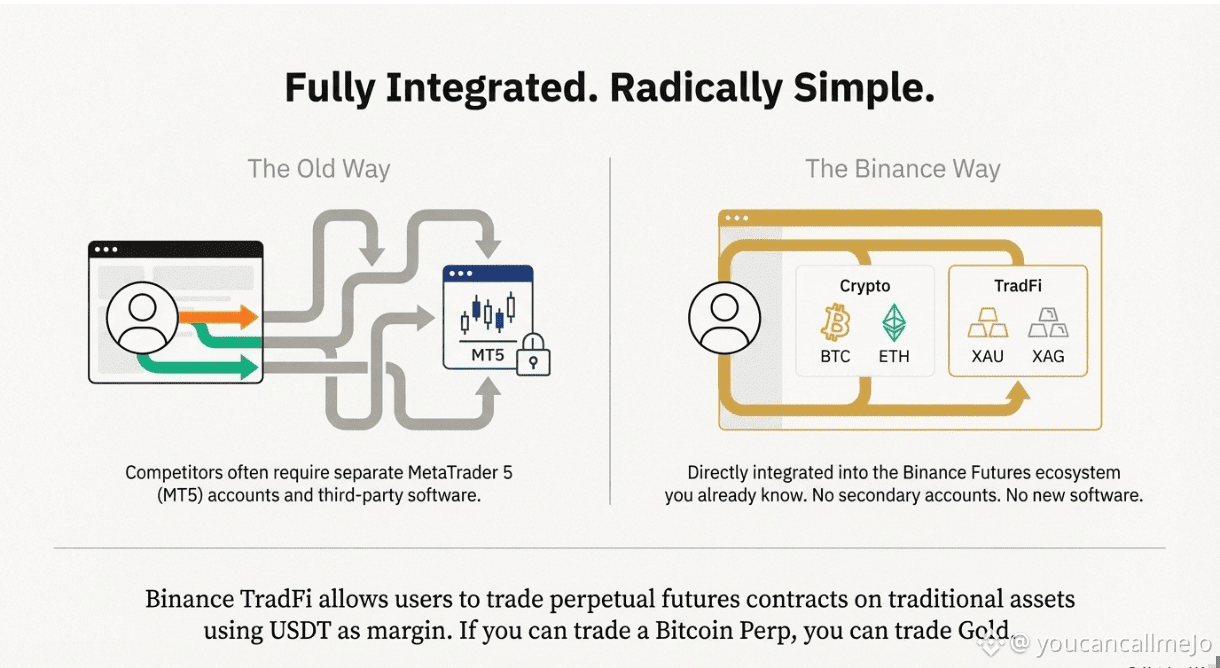
🚀🚀🚀 TradFi Focus 🚀🚀🚀
A practical TradFi setup starts with a market catalyst, confirmation after the open and a fixed invalidation level. Never let leverage replace a clear trading plan.
$TSLA $NVDA $MSTR
#TradFi #RWA #StockMarket #TokenizedStocks #BinanceFutures
🚀🚀🚀 TradFi Focus 🚀🚀🚀
A practical TradFi setup starts with a market catalyst, confirmation after the open and a fixed invalidation level. Never let leverage replace a clear trading plan.
$TSLA $NVDA $MSTR
#TradFi #RWA #StockMarket #TokenizedStocks #BinanceFutures
A practical TradFi setup starts with a market catalyst, confirmation after the open and a fixed invalidation level. Never let leverage replace a clear trading plan.
$TSLA $NVDA $MSTR
#TradFi #RWA #StockMarket #TokenizedStocks #BinanceFutures
82


·
--
Dow Falls 328 Points as Fed Decision Looms: Macro Pressures vs Crypto Resilience
Traditional markets are feeling the heat as the Federal Reserve’s rate decision approaches. U.S. equities closed lower, with the Dow Jones dropping 328 points, the S&P 500 dipping 0.45%, and the Nasdaq down 0.78%.
Key macro headwinds driving the sell-off:
* 10-Year Treasury Yield hovering above 5%
* Crude Oil holding strong above $105/barrel
* Growing inflation concerns squeezing overall risk appetite
While TradFi equities pull back under interest rate uncertainty and surging commodity prices, the crypto market continues to show distinct momentum. Higher yields and expensive energy usually tighten global liquidity, yet crypto traders are watching closely to see if digital assets act as a hedge or follow macro risk-off sentiment.
How are you positioning your portfolio ahead of the Fed’s announcement? Are you hedging into stables or accumulating the dip?
#MacroEconomy #FederalReserve #TradFi
Dow Falls 328 Points as Fed Decision Looms: Macro Pressures vs Crypto Resilience
Traditional markets are feeling the heat as the Federal Reserve’s rate decision approaches. U.S. equities closed lower, with the Dow Jones dropping 328 points, the S&P 500 dipping 0.45%, and the Nasdaq down 0.78%.
Key macro headwinds driving the sell-off:
* 10-Year Treasury Yield hovering above 5%
* Crude Oil holding strong above $105/barrel
* Growing inflation concerns squeezing overall risk appetite
While TradFi equities pull back under interest rate uncertainty and surging commodity prices, the crypto market continues to show distinct momentum. Higher yields and expensive energy usually tighten global liquidity, yet crypto traders are watching closely to see if digital assets act as a hedge or follow macro risk-off sentiment.
How are you positioning your portfolio ahead of the Fed’s announcement? Are you hedging into stables or accumulating the dip?
#MacroEconomy #FederalReserve #TradFi
Traditional markets are feeling the heat as the Federal Reserve’s rate decision approaches. U.S. equities closed lower, with the Dow Jones dropping 328 points, the S&P 500 dipping 0.45%, and the Nasdaq down 0.78%.
Key macro headwinds driving the sell-off:
* 10-Year Treasury Yield hovering above 5%
* Crude Oil holding strong above $105/barrel
* Growing inflation concerns squeezing overall risk appetite
While TradFi equities pull back under interest rate uncertainty and surging commodity prices, the crypto market continues to show distinct momentum. Higher yields and expensive energy usually tighten global liquidity, yet crypto traders are watching closely to see if digital assets act as a hedge or follow macro risk-off sentiment.
How are you positioning your portfolio ahead of the Fed’s announcement? Are you hedging into stables or accumulating the dip?
#MacroEconomy #FederalReserve #TradFi
27
·
--
Bullish
👀 You can only pick ONE.
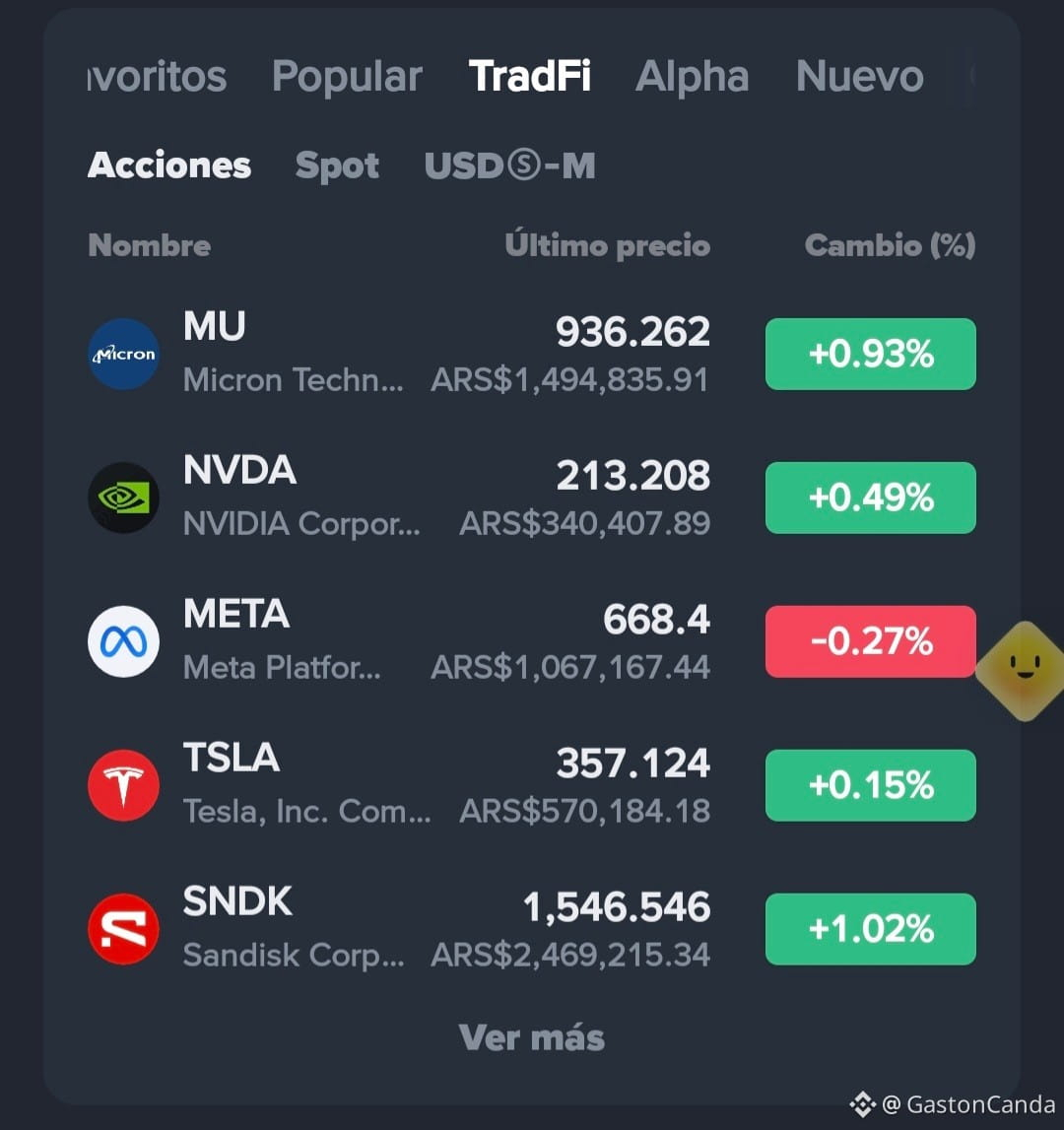
Binance is putting more traditional-market exposure directly in front of crypto investors.
From this list:
$MU — Micron
$NVDA — NVIDIA
$META — Meta
$TSLA — Tesla
$SNDK — SanDisk
You have $1,000 and one rule:
Pick ONE and hold it until 2030. No selling.
Which one are you choosing — and why?
I’ll share my pick in the comments. 👇
#TradFi #stock #Investing #BinanceSquare
👀 You can only pick ONE.
Binance is putting more traditional-market exposure directly in front of crypto investors.
From this list:
$MU — Micron
$NVDA — NVIDIA
$META — Meta
$TSLA — Tesla
$SNDK — SanDisk
You have $1,000 and one rule:
Pick ONE and hold it until 2030. No selling.
Which one are you choosing — and why?
I’ll share my pick in the comments. 👇
#TradFi #stock #Investing #BinanceSquare
Binance is putting more traditional-market exposure directly in front of crypto investors.
From this list:
$MU — Micron
$NVDA — NVIDIA
$META — Meta
$TSLA — Tesla
$SNDK — SanDisk
You have $1,000 and one rule:
Pick ONE and hold it until 2030. No selling.
Which one are you choosing — and why?
I’ll share my pick in the comments. 👇
#TradFi #stock #Investing #BinanceSquare
2
692

·
--
🚨 KOREA EXTENDS TRADING HOURS AS INSTITUTIONAL LIQUIDITY DYNAMICS SHIFT GLOBAL MARKETS FOR $BTC 🏦
The Korea Exchange has officially launched after-hours trading until 8 PM, expanding institutional liquidity windows while intentionally excluding ETFs and ETNs to manage volatility. 🏦 This structural expansion highlights growing Asian session order flow density and institutional demand for extended trading execution. 🔍
While pre-market access remains delayed until 2027 due to system constraints, extended equity hours consistently alter inter-market cross-asset correlations. 📊 Smart money accumulation models typically benefit as structural gap risks compress across international market overlaps. ⚡
💬 How do you see these expanded TradFi execution hours impacting crypto order flow during the Asian session? 👇
⚠️ Not financial advice. Always manage your risk. 🛡️
🏷️ #BTC #MarketStructure #Liquidity #TradFi
🎯 🏦
🚨 KOREA EXTENDS TRADING HOURS AS INSTITUTIONAL LIQUIDITY DYNAMICS SHIFT GLOBAL MARKETS FOR $BTC 🏦
The Korea Exchange has officially launched after-hours trading until 8 PM, expanding institutional liquidity windows while intentionally excluding ETFs and ETNs to manage volatility. 🏦 This structural expansion highlights growing Asian session order flow density and institutional demand for extended trading execution. 🔍
While pre-market access remains delayed until 2027 due to system constraints, extended equity hours consistently alter inter-market cross-asset correlations. 📊 Smart money accumulation models typically benefit as structural gap risks compress across international market overlaps. ⚡
💬 How do you see these expanded TradFi execution hours impacting crypto order flow during the Asian session? 👇
⚠️ Not financial advice. Always manage your risk. 🛡️
🏷️ #BTC #MarketStructure #Liquidity #TradFi
🎯 🏦
The Korea Exchange has officially launched after-hours trading until 8 PM, expanding institutional liquidity windows while intentionally excluding ETFs and ETNs to manage volatility. 🏦 This structural expansion highlights growing Asian session order flow density and institutional demand for extended trading execution. 🔍
While pre-market access remains delayed until 2027 due to system constraints, extended equity hours consistently alter inter-market cross-asset correlations. 📊 Smart money accumulation models typically benefit as structural gap risks compress across international market overlaps. ⚡
💬 How do you see these expanded TradFi execution hours impacting crypto order flow during the Asian session? 👇
⚠️ Not financial advice. Always manage your risk. 🛡️
🏷️ #BTC #MarketStructure #Liquidity #TradFi
🎯 🏦
5
·
--
Bullish
Verified
🚨 Two more Wall Street names are coming on-chain today.
Binance is adding GoPro and Reddit bStocks to Spot:
• GPROB/USDT
• RDDTB/USDT
• Trading opens: 12:00 UTC — Sep. 16
• Zero maker fees through Sep. 30
But the bigger story isn't GoPro or Reddit.
It's the infrastructure being built between traditional markets and crypto.
bStocks give eligible users exposure to tokenized securities within crypto-native infrastructure, although they are not direct ownership of the underlying shares.
And adoption is worth watching.
Binance Research reports that 80% of tokenized-stock traders on Binance come from emerging markets, while 93% of trades are fractional.
My takeaway:
Tokenization isn't replacing Wall Street overnight.
But the line separating TradFi and crypto infrastructure is becoming increasingly thin.
Today it's $RDDTB and $GPROB.
The bigger question is what this market looks like when hundreds — or eventually thousands — of traditional assets become accessible through blockchain rails.
Are tokenized stocks becoming one of crypto's most important real-world use cases?
#RWA #Tokenization #TradFi #BinanceSquare
🚨 Two more Wall Street names are coming on-chain today.
Binance is adding GoPro and Reddit bStocks to Spot:
• GPROB/USDT
• RDDTB/USDT
• Trading opens: 12:00 UTC — Sep. 16
• Zero maker fees through Sep. 30
But the bigger story isn't GoPro or Reddit.
It's the infrastructure being built between traditional markets and crypto.
bStocks give eligible users exposure to tokenized securities within crypto-native infrastructure, although they are not direct ownership of the underlying shares.
And adoption is worth watching.
Binance Research reports that 80% of tokenized-stock traders on Binance come from emerging markets, while 93% of trades are fractional.
My takeaway:
Tokenization isn't replacing Wall Street overnight.
But the line separating TradFi and crypto infrastructure is becoming increasingly thin.
Today it's $RDDTB and $GPROB.
The bigger question is what this market looks like when hundreds — or eventually thousands — of traditional assets become accessible through blockchain rails.
Are tokenized stocks becoming one of crypto's most important real-world use cases?
#RWA #Tokenization #TradFi #BinanceSquare
Binance is adding GoPro and Reddit bStocks to Spot:
• GPROB/USDT
• RDDTB/USDT
• Trading opens: 12:00 UTC — Sep. 16
• Zero maker fees through Sep. 30
But the bigger story isn't GoPro or Reddit.
It's the infrastructure being built between traditional markets and crypto.
bStocks give eligible users exposure to tokenized securities within crypto-native infrastructure, although they are not direct ownership of the underlying shares.
And adoption is worth watching.
Binance Research reports that 80% of tokenized-stock traders on Binance come from emerging markets, while 93% of trades are fractional.
My takeaway:
Tokenization isn't replacing Wall Street overnight.
But the line separating TradFi and crypto infrastructure is becoming increasingly thin.
Today it's $RDDTB and $GPROB.
The bigger question is what this market looks like when hundreds — or eventually thousands — of traditional assets become accessible through blockchain rails.
Are tokenized stocks becoming one of crypto's most important real-world use cases?
#RWA #Tokenization #TradFi #BinanceSquare

AngelOfCrypto_-:
nice
5
3
907
·
--
Bearish
🚨 Tonight, crypto is not trading in isolation.
Wall Street closed lower as investors faced a difficult macro combination: rising Treasury yields, higher oil prices and another major Fed decision just hours away.
What happened?
• S&P 500: -0.45%
• Nasdaq: -0.78%
• Dow: -0.63%
• U.S. 10Y Treasury yield moved above 5%
• Oil remains above $100/barrel
At the same time, $BTC remains under pressure after another volatile session.
Why it matters
Higher yields increase the opportunity cost of holding risk assets.
Expensive energy can keep inflation pressure elevated.
And when both happen simultaneously, liquidity conditions become increasingly important for equities AND crypto.
What I’m watching next
Tomorrow’s Fed decision.
Not just the rate decision itself, but the message around inflation, growth and the path of monetary policy.
My takeaway:
Right now, I’m watching Treasuries → equities → crypto as one interconnected liquidity system, not three separate markets.
The next major move may start outside crypto.
Are you watching the Fed or $BTC price action more closely tomorrow?
#Bitcoin #CryptoMacro #MarketUpdate #TradFi
🚨 Tonight, crypto is not trading in isolation.
Wall Street closed lower as investors faced a difficult macro combination: rising Treasury yields, higher oil prices and another major Fed decision just hours away.
What happened?
• S&P 500: -0.45%
• Nasdaq: -0.78%
• Dow: -0.63%
• U.S. 10Y Treasury yield moved above 5%
• Oil remains above $100/barrel
At the same time, $BTC remains under pressure after another volatile session.
Why it matters
Higher yields increase the opportunity cost of holding risk assets.
Expensive energy can keep inflation pressure elevated.
And when both happen simultaneously, liquidity conditions become increasingly important for equities AND crypto.
What I’m watching next
Tomorrow’s Fed decision.
Not just the rate decision itself, but the message around inflation, growth and the path of monetary policy.
My takeaway:
Right now, I’m watching Treasuries → equities → crypto as one interconnected liquidity system, not three separate markets.
The next major move may start outside crypto.
Are you watching the Fed or $BTC price action more closely tomorrow?
#Bitcoin #CryptoMacro #MarketUpdate #TradFi
Wall Street closed lower as investors faced a difficult macro combination: rising Treasury yields, higher oil prices and another major Fed decision just hours away.
What happened?
• S&P 500: -0.45%
• Nasdaq: -0.78%
• Dow: -0.63%
• U.S. 10Y Treasury yield moved above 5%
• Oil remains above $100/barrel
At the same time, $BTC remains under pressure after another volatile session.
Why it matters
Higher yields increase the opportunity cost of holding risk assets.
Expensive energy can keep inflation pressure elevated.
And when both happen simultaneously, liquidity conditions become increasingly important for equities AND crypto.
What I’m watching next
Tomorrow’s Fed decision.
Not just the rate decision itself, but the message around inflation, growth and the path of monetary policy.
My takeaway:
Right now, I’m watching Treasuries → equities → crypto as one interconnected liquidity system, not three separate markets.
The next major move may start outside crypto.
Are you watching the Fed or $BTC price action more closely tomorrow?
#Bitcoin #CryptoMacro #MarketUpdate #TradFi
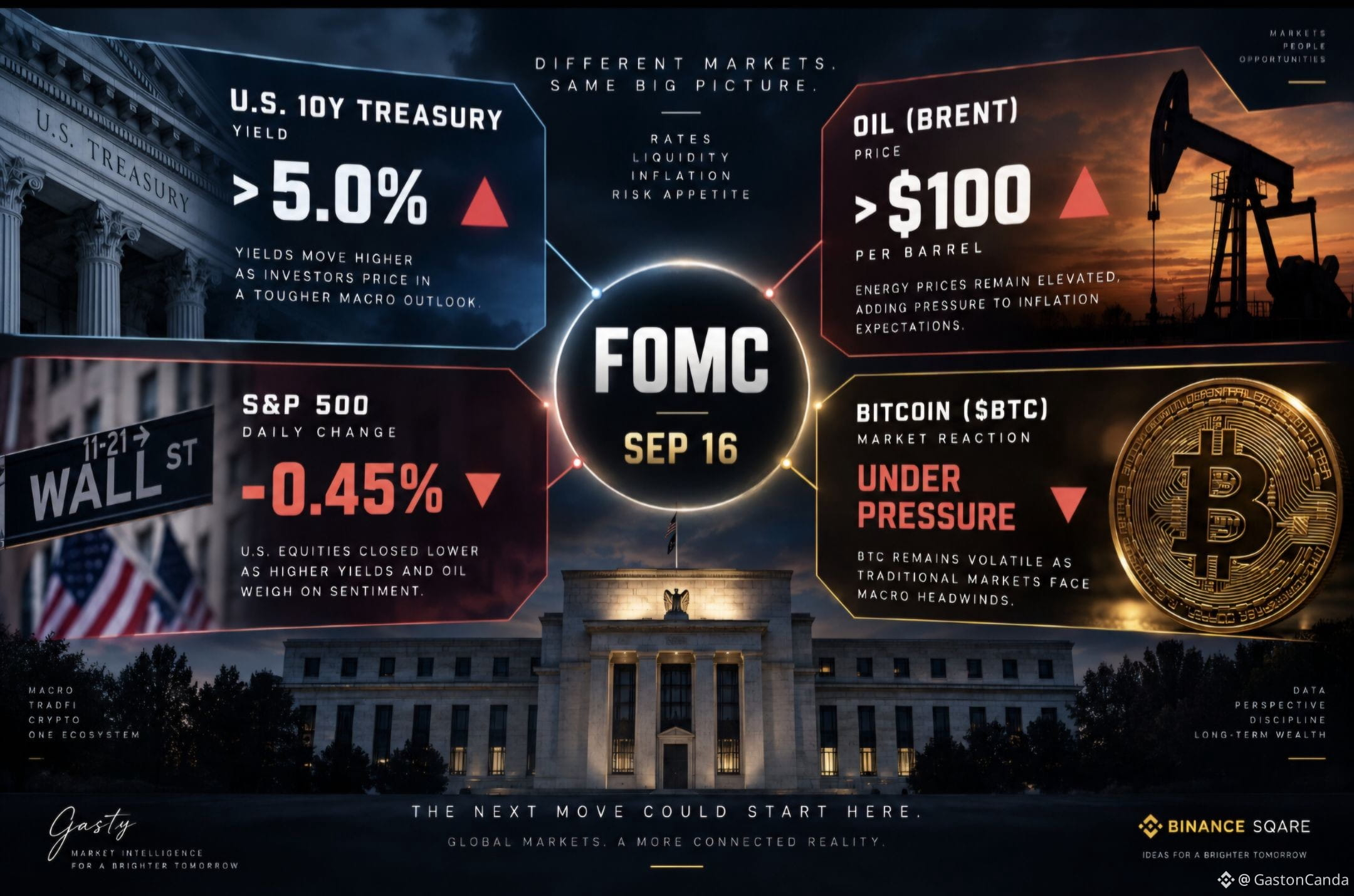
4
689

·
--
@Binance_Announcement Share Your Feedback & Win 1,000 USDC!
Binance is looking for user feedback on its latest TradFi Product Suite! Your insights go directly to the team shaping the future trading interface.
Key Details:
• Eligible Products: TradFi Perpetuals, Stock Options, and bStocks
• Prize Pool: 1,000 USDC
• Activity Period: Sept 15, 2026 (12:00 UTC) – Sept 21, 2026 (23:59 UTC)
Drop your thoughts in the comments or join the official campaign page to claim your share! 🚀
#Binance #TradFi #USDC
@Binance Announcement Share Your Feedback & Win 1,000 USDC!
Binance is looking for user feedback on its latest TradFi Product Suite! Your insights go directly to the team shaping the future trading interface.
Key Details:
• Eligible Products: TradFi Perpetuals, Stock Options, and bStocks
• Prize Pool: 1,000 USDC
• Activity Period: Sept 15, 2026 (12:00 UTC) – Sept 21, 2026 (23:59 UTC)
Drop your thoughts in the comments or join the official campaign page to claim your share! 🚀
#Binance #TradFi #USDC
Binance is looking for user feedback on its latest TradFi Product Suite! Your insights go directly to the team shaping the future trading interface.
Key Details:
• Eligible Products: TradFi Perpetuals, Stock Options, and bStocks
• Prize Pool: 1,000 USDC
• Activity Period: Sept 15, 2026 (12:00 UTC) – Sept 21, 2026 (23:59 UTC)
Drop your thoughts in the comments or join the official campaign page to claim your share! 🚀
#Binance #TradFi #USDC

1
228

·
--
While $BTC sits in a $77K standoff ahead of the Fed, idle cash does not have to stare at the chart with you.
Today Binance Earn opened ETF Wealth Management — 11 US-listed Treasury and investment-grade bond ETFs. Real ETF shares, executed via licensed brokers, from the same app where you already hold $USDC. Not a fixed savings promise. Self-directed. You own the shares and any cash distributions.
Why now: the 10-year yield is near 5%, FOMC lands tomorrow, and crypto capital parked on-exchange finally has a TradFi income path without opening a separate brokerage.
Would you rather leave $USDC flat through rate week — or park a slice in Treasuries inside Earn?
#BinanceEarn #TradFi #US10YearTreasuryYieldNears5%
While $BTC sits in a $77K standoff ahead of the Fed, idle cash does not have to stare at the chart with you.
Today Binance Earn opened ETF Wealth Management — 11 US-listed Treasury and investment-grade bond ETFs. Real ETF shares, executed via licensed brokers, from the same app where you already hold $USDC . Not a fixed savings promise. Self-directed. You own the shares and any cash distributions.
Why now: the 10-year yield is near 5%, FOMC lands tomorrow, and crypto capital parked on-exchange finally has a TradFi income path without opening a separate brokerage.
Would you rather leave $USDC flat through rate week — or park a slice in Treasuries inside Earn?
#BinanceEarn #TradFi #US10YearTreasuryYieldNears5%
Today Binance Earn opened ETF Wealth Management — 11 US-listed Treasury and investment-grade bond ETFs. Real ETF shares, executed via licensed brokers, from the same app where you already hold $USDC . Not a fixed savings promise. Self-directed. You own the shares and any cash distributions.
Why now: the 10-year yield is near 5%, FOMC lands tomorrow, and crypto capital parked on-exchange finally has a TradFi income path without opening a separate brokerage.
Would you rather leave $USDC flat through rate week — or park a slice in Treasuries inside Earn?
#BinanceEarn #TradFi #US10YearTreasuryYieldNears5%
42
🚀🚀🚀 TradFi Focus 🚀🚀🚀
TradFi perpetuals can move sharply around earnings, market opens and macro news. Use modest leverage, predefined exits and enough margin for sudden volatility.
$TSLA $NVDA $MSTR
#TradFi #RWA #StockMarket #TokenizedStocks #BinanceFutures
🚀🚀🚀 TradFi Focus 🚀🚀🚀
TradFi perpetuals can move sharply around earnings, market opens and macro news. Use modest leverage, predefined exits and enough margin for sudden volatility.
$TSLA $NVDA $MSTR
#TradFi #RWA #StockMarket #TokenizedStocks #BinanceFutures
TradFi perpetuals can move sharply around earnings, market opens and macro news. Use modest leverage, predefined exits and enough margin for sudden volatility.
$TSLA $NVDA $MSTR
#TradFi #RWA #StockMarket #TokenizedStocks #BinanceFutures
131

·
--
Verified
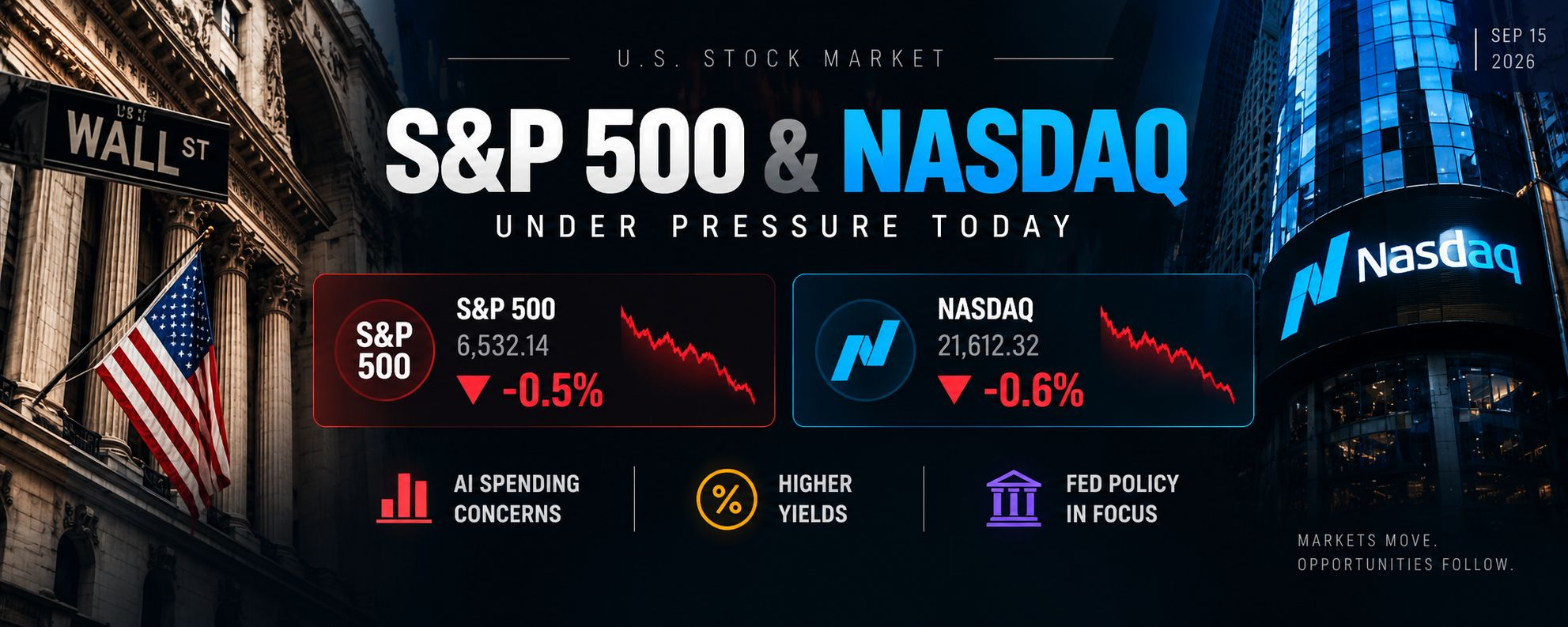
Article
📊 S&P 500 & NASDAQ: WHY ARE U.S. STOCKS UNDER PRESSURE?The S&P 500 and Nasdaq are facing renewed pressure as investors reassess two major risks: higher interest rates and the sustainability of the AI-driven rally.
On Monday, the S&P 500 fell around 0.5%, while the Nasdaq Composite declined around 0.6%.
Two developments are getting the most attention:
📉 AI concerns Investors are becoming more cautious about the massive spending on AI infrastructure after industry leaders called for a slower pace of AI development.
💵 Higher yields The U.S. 10-year Treasury yield briefly moved above 5%, increasing pressure on equity valuations, particularly growth and technology stocks.
The Federal Reserve is also beginning its September policy meeting, with markets expecting a potential rate hike as inflation remains a concern.
For investors, the key question isn't simply whether stocks will rise or fall.
It's whether earnings growth can continue to justify high valuations while borrowing costs and Treasury yields remain elevated.
💬 Which market do you think is more vulnerable to higher interest rates: S&P 500 or Nasdaq?
#SP500 #NASDAQ #stockmarket #TradFi
📊 S&P 500 & NASDAQ: WHY ARE U.S. STOCKS UNDER PRESSURE?
The S&P 500 and Nasdaq are facing renewed pressure as investors reassess two major risks: higher interest rates and the sustainability of the AI-driven rally.
On Monday, the S&P 500 fell around 0.5%, while the Nasdaq Composite declined around 0.6%.
Two developments are getting the most attention:
📉 AI concerns Investors are becoming more cautious about the massive spending on AI infrastructure after industry leaders called for a slower pace of AI development.
💵 Higher yields The U.S. 10-year Treasury yield briefly moved above 5%, increasing pressure on equity valuations, particularly growth and technology stocks.
The Federal Reserve is also beginning its September policy meeting, with markets expecting a potential rate hike as inflation remains a concern.
For investors, the key question isn't simply whether stocks will rise or fall.
It's whether earnings growth can continue to justify high valuations while borrowing costs and Treasury yields remain elevated.
💬 Which market do you think is more vulnerable to higher interest rates: S&P 500 or Nasdaq?
#SP500 #NASDAQ #stockmarket #TradFi
On Monday, the S&P 500 fell around 0.5%, while the Nasdaq Composite declined around 0.6%.
Two developments are getting the most attention:
📉 AI concerns Investors are becoming more cautious about the massive spending on AI infrastructure after industry leaders called for a slower pace of AI development.
💵 Higher yields The U.S. 10-year Treasury yield briefly moved above 5%, increasing pressure on equity valuations, particularly growth and technology stocks.
The Federal Reserve is also beginning its September policy meeting, with markets expecting a potential rate hike as inflation remains a concern.
For investors, the key question isn't simply whether stocks will rise or fall.
It's whether earnings growth can continue to justify high valuations while borrowing costs and Treasury yields remain elevated.
💬 Which market do you think is more vulnerable to higher interest rates: S&P 500 or Nasdaq?
#SP500 #NASDAQ #stockmarket #TradFi
75
·
--
Beginner's guide: what Binance bStocks actually are
If you have ever wanted Tesla or NVIDIA exposure but hated waiting for Wall Street hours or opening a separate brokerage — this is for you.
What it is
bStocks are crypto tokens that track traditional stocks. Each token is backed 1:1 by the underlying stock held at a regulated custodian. You trade them from your Binance wallet — same app, same balance flow as crypto.
How it differs from a classic brokerage
• Markets: 24/7 instead of waiting for the NYSE/Nasdaq open
• Size: fractional ownership — start small, no need to buy a full share
• Friction: no separate brokerage account; Spot search inside Binance
3 concrete steps in the app
1. Open Spot and search bStocks (or a ticker like $TSLAB, $NVDAB, $AAPLB)
2. Check the pair, size a small test order you can afford to lose
3. Confirm — the token sits in your Binance wallet like any other Spot asset
Who it fits
Curious crypto users who want TradFi names without leaving Binance. Not for anyone who needs a guarantee — prices move and you can lose money. DYOR. Not financial advice.
Which name would you try first — Tesla, NVIDIA, or Apple?
#bStocks #TradFi
Beginner's guide: what Binance bStocks actually are
If you have ever wanted Tesla or NVIDIA exposure but hated waiting for Wall Street hours or opening a separate brokerage — this is for you.
What it is
bStocks are crypto tokens that track traditional stocks. Each token is backed 1:1 by the underlying stock held at a regulated custodian. You trade them from your Binance wallet — same app, same balance flow as crypto.
How it differs from a classic brokerage
• Markets: 24/7 instead of waiting for the NYSE/Nasdaq open
• Size: fractional ownership — start small, no need to buy a full share
• Friction: no separate brokerage account; Spot search inside Binance
3 concrete steps in the app
1. Open Spot and search bStocks (or a ticker like $TSLAB , $NVDAB , $AAPLB )
2. Check the pair, size a small test order you can afford to lose
3. Confirm — the token sits in your Binance wallet like any other Spot asset
Who it fits
Curious crypto users who want TradFi names without leaving Binance. Not for anyone who needs a guarantee — prices move and you can lose money. DYOR. Not financial advice.
Which name would you try first — Tesla, NVIDIA, or Apple?
#bStocks #TradFi
If you have ever wanted Tesla or NVIDIA exposure but hated waiting for Wall Street hours or opening a separate brokerage — this is for you.
What it is
bStocks are crypto tokens that track traditional stocks. Each token is backed 1:1 by the underlying stock held at a regulated custodian. You trade them from your Binance wallet — same app, same balance flow as crypto.
How it differs from a classic brokerage
• Markets: 24/7 instead of waiting for the NYSE/Nasdaq open
• Size: fractional ownership — start small, no need to buy a full share
• Friction: no separate brokerage account; Spot search inside Binance
3 concrete steps in the app
1. Open Spot and search bStocks (or a ticker like $TSLAB , $NVDAB , $AAPLB )
2. Check the pair, size a small test order you can afford to lose
3. Confirm — the token sits in your Binance wallet like any other Spot asset
Who it fits
Curious crypto users who want TradFi names without leaving Binance. Not for anyone who needs a guarantee — prices move and you can lose money. DYOR. Not financial advice.
Which name would you try first — Tesla, NVIDIA, or Apple?
#bStocks #TradFi
38

·
--
BINANCE IS BRINGING TRADFI YIELD DIRECTLY INTO EARN
Binance is expanding beyond crypto-native yield.
Its new ETF Wealth Management platform gives users access to a curated lineup of 11 U.S.-listed ETFs, focused on short-term U.S. Treasuries and investment-grade bonds. The products span cash management, steady income and longer-term yield strategies.
Users hold the actual ETF shares and receive the economic benefits, while execution, clearing and custody are handled by licensed third-party brokers through Binance Stock Trading.
This suggests Binance is positioning itself as more than a crypto exchange. It is becoming a gateway between crypto capital and traditional financial assets.
The bigger question: how much idle stablecoin capital could eventually flow into TradFi yield through Binance?
#Binance #TradFi
BINANCE IS BRINGING TRADFI YIELD DIRECTLY INTO EARN
Binance is expanding beyond crypto-native yield.
Its new ETF Wealth Management platform gives users access to a curated lineup of 11 U.S.-listed ETFs, focused on short-term U.S. Treasuries and investment-grade bonds. The products span cash management, steady income and longer-term yield strategies.
Users hold the actual ETF shares and receive the economic benefits, while execution, clearing and custody are handled by licensed third-party brokers through Binance Stock Trading.
This suggests Binance is positioning itself as more than a crypto exchange. It is becoming a gateway between crypto capital and traditional financial assets.
The bigger question: how much idle stablecoin capital could eventually flow into TradFi yield through Binance?
#Binance #TradFi
Binance is expanding beyond crypto-native yield.
Its new ETF Wealth Management platform gives users access to a curated lineup of 11 U.S.-listed ETFs, focused on short-term U.S. Treasuries and investment-grade bonds. The products span cash management, steady income and longer-term yield strategies.
Users hold the actual ETF shares and receive the economic benefits, while execution, clearing and custody are handled by licensed third-party brokers through Binance Stock Trading.
This suggests Binance is positioning itself as more than a crypto exchange. It is becoming a gateway between crypto capital and traditional financial assets.
The bigger question: how much idle stablecoin capital could eventually flow into TradFi yield through Binance?
#Binance #TradFi
156


Article
One Night in Gold That Taught Me More Than a Month of Reading TheoryThis story began with a silly, essentially pointless reason: I couldn’t fall asleep, so I decided to scroll through charts simply out of boredom. It was Sunday, around two in the morning by Kyiv time, and on the screen I saw a sharp spike in volatility in gold $XAU , even though there were no obvious news items in the feed yet.
One Night in Gold That Taught Me More Than a Month of Reading Theory
This story began with a silly, essentially pointless reason: I couldn’t fall asleep, so I decided to scroll through charts simply out of boredom. It was Sunday, around two in the morning by Kyiv time, and on the screen I saw a sharp spike in volatility in gold $XAU , even though there were no obvious news items in the feed yet.
KiSerVik:
цікава інформація. підписуюсь на тебе. подивись, у мене також є цікаві публікації
1
4
1.3k
·
--
Stock markets used to feel like they belonged to someone else — brokers, bankers, people who "knew the system."
That quiet barrier just cracked. With Binance bStocks you can get Tesla- and NVIDIA-like exposure as $TSLAB and $NVDAB — 1:1-backed tokens — from the same app you already trade crypto in. 24/7. No waiting for Wall Street to open.
Why now: TradFi and crypto finally share one wallet. Open Spot, search bStocks, pick the name you already watch. DYOR.
Would you rather wait for the next market open — or buy when the idea hits?
#bStocks #TradFi
Stock markets used to feel like they belonged to someone else — brokers, bankers, people who "knew the system."
That quiet barrier just cracked. With Binance bStocks you can get Tesla- and NVIDIA-like exposure as $TSLAB and $NVDAB — 1:1-backed tokens — from the same app you already trade crypto in. 24/7. No waiting for Wall Street to open.
Why now: TradFi and crypto finally share one wallet. Open Spot, search bStocks, pick the name you already watch. DYOR.
Would you rather wait for the next market open — or buy when the idea hits?
#bStocks #TradFi
That quiet barrier just cracked. With Binance bStocks you can get Tesla- and NVIDIA-like exposure as $TSLAB and $NVDAB — 1:1-backed tokens — from the same app you already trade crypto in. 24/7. No waiting for Wall Street to open.
Why now: TradFi and crypto finally share one wallet. Open Spot, search bStocks, pick the name you already watch. DYOR.
Would you rather wait for the next market open — or buy when the idea hits?
#bStocks #TradFi
37

·
--
TradFi on the crypto exchange: what bStocks really provide and how to manage them 🌐📈
Tokenized stocks (#bstock ) have erased the border between Wall Street and the crypto market. Now exposure to assets like Tesla or Apple can be opened directly from a stablecoin balance, without leaving the exchange interface.
But working with #TradFi instruments requires understanding the specifics of the traditional market:
* Direct access: No international bank transfers or registration with classic fiat brokers. All settlement is done in USDT, saving time and fees on conversions.
* Sync with the exchange chart: Unlike crypto 24/7, bStocks prices move within US trading sessions. All major news or financial reports released over the weekend open on Monday with price gaps (gaps).
* Risk control via OCO: To protect the position from volatility jumps at market open, place OCO orders with a reasonable buffer between the stop trigger and the sell limit price.
bStocks are a practical way to diversify your crypto portfolio with companies from the real economy sector while keeping all liquidity close at hand.
Do you add TradFi stocks to your trading watchlist, or do you focus only on pure crypto?
TradFi on the crypto exchange: what bStocks really provide and how to manage them 🌐📈
Tokenized stocks (#bstock ) have erased the border between Wall Street and the crypto market. Now exposure to assets like Tesla or Apple can be opened directly from a stablecoin balance, without leaving the exchange interface.
But working with #TradFi instruments requires understanding the specifics of the traditional market:
* Direct access: No international bank transfers or registration with classic fiat brokers. All settlement is done in USDT, saving time and fees on conversions.
* Sync with the exchange chart: Unlike crypto 24/7, bStocks prices move within US trading sessions. All major news or financial reports released over the weekend open on Monday with price gaps (gaps).
* Risk control via OCO: To protect the position from volatility jumps at market open, place OCO orders with a reasonable buffer between the stop trigger and the sell limit price.
bStocks are a practical way to diversify your crypto portfolio with companies from the real economy sector while keeping all liquidity close at hand.
Do you add TradFi stocks to your trading watchlist, or do you focus only on pure crypto?
Tokenized stocks (#bstock ) have erased the border between Wall Street and the crypto market. Now exposure to assets like Tesla or Apple can be opened directly from a stablecoin balance, without leaving the exchange interface.
But working with #TradFi instruments requires understanding the specifics of the traditional market:
* Direct access: No international bank transfers or registration with classic fiat brokers. All settlement is done in USDT, saving time and fees on conversions.
* Sync with the exchange chart: Unlike crypto 24/7, bStocks prices move within US trading sessions. All major news or financial reports released over the weekend open on Monday with price gaps (gaps).
* Risk control via OCO: To protect the position from volatility jumps at market open, place OCO orders with a reasonable buffer between the stop trigger and the sell limit price.
bStocks are a practical way to diversify your crypto portfolio with companies from the real economy sector while keeping all liquidity close at hand.
Do you add TradFi stocks to your trading watchlist, or do you focus only on pure crypto?
100

·
--
Weekend pricing isn’t a new stock exchange close
TradFi Perps trade 24/7, while the underlying stock market has pauses on weekends and holidays.
So the Saturday contract price is an estimate from the derivatives market participants, not a new official closing price for the stock. When the underlying market opens, fresh liquidity and news can quickly change the price relationship.
Binance uses the Orderbook EWMA mode for TradFi Perps, where pricing relies on smoothed information from the order book. This should reduce sudden spikes, but it doesn’t remove the gap risk between the weekend expectation and the underlying market’s open.
My weekend checklist:
• reduce unnecessary leverage;
• check margin buffer;
• account for upcoming funding;
• don’t call the contract price the “stock price” without clarification.
One asset can live by two different market clocks.
#TradFi
Weekend pricing isn’t a new stock exchange close
TradFi Perps trade 24/7, while the underlying stock market has pauses on weekends and holidays.
So the Saturday contract price is an estimate from the derivatives market participants, not a new official closing price for the stock. When the underlying market opens, fresh liquidity and news can quickly change the price relationship.
Binance uses the Orderbook EWMA mode for TradFi Perps, where pricing relies on smoothed information from the order book. This should reduce sudden spikes, but it doesn’t remove the gap risk between the weekend expectation and the underlying market’s open.
My weekend checklist:
• reduce unnecessary leverage;
• check margin buffer;
• account for upcoming funding;
• don’t call the contract price the “stock price” without clarification.
One asset can live by two different market clocks.
#TradFi
TradFi Perps trade 24/7, while the underlying stock market has pauses on weekends and holidays.
So the Saturday contract price is an estimate from the derivatives market participants, not a new official closing price for the stock. When the underlying market opens, fresh liquidity and news can quickly change the price relationship.
Binance uses the Orderbook EWMA mode for TradFi Perps, where pricing relies on smoothed information from the order book. This should reduce sudden spikes, but it doesn’t remove the gap risk between the weekend expectation and the underlying market’s open.
My weekend checklist:
• reduce unnecessary leverage;
• check margin buffer;
• account for upcoming funding;
• don’t call the contract price the “stock price” without clarification.
One asset can live by two different market clocks.
#TradFi
89
·
--
Central bank rates are back in the news again, and it's interesting to watch how traditional assets respond to it. TradFi on Binance is convenient precisely because you don’t have to keep five different exchange tabs open—everything is in one place, and the market picture comes together faster.
#TradFi #Binance #CreateWithBinance #ринок
Central bank rates are back in the news again, and it's interesting to watch how traditional assets respond to it. TradFi on Binance is convenient precisely because you don’t have to keep five different exchange tabs open—everything is in one place, and the market picture comes together faster.
#TradFi #Binance #CreateWithBinance #ринок
#TradFi #Binance #CreateWithBinance #ринок
112
Log in to explore more content
Join global crypto users on Binance Square
⚡️ Get latest and useful information about crypto.
💬 Trusted by the world’s largest crypto exchange.
👍 Discover real insights from verified creators.
Email / Phone number
Trending Topics
1
#BitcoinSurpasses$77000
8,309 views
137 Discussing
2
#ParadigmDisclosesZECHolding
24,128 views
610 Discussing
3
#BitcoinETFsShed$450M
18,675 views
175 Discussing
4
#USWeeklyJoblessClaimsFallTo196K
11,780 views
375 Discussing
5
#ArkhamSaysBlackRockBuys$1.5BInETH
2,603 views
40 Discussing
6
#ElSalvadorBTCHoldingsRiseTo7777
34,604 views
676 Discussing
7
#MemeLaunchpads82%OfArcDayOneVolume
40,190 views
868 Discussing
8
#OstiumLoanDisputeHearingSetInNYFederalCourt
33,226 views
634 Discussing
9
#HyperliquidUSDCSupplyOvertakesSolana
14,552 views
311 Discussing
10
#SKPoliceRefer18PolymarketUsersToProsecutors
19,952 views
468 Discussing