
小恐龙说趋势
325 Posts

小恐龙说趋势
6 年市场经验,公众号.比特小恐龙,记录市场的真实逻辑,研究下一步会去哪
12 Following
2.0K+ Followers
1.6K+ Liked
Posts
All
Live
Binance Launches 1,000+ U.S. Stock Options—Traditional Finance Keeps Expanding the Board
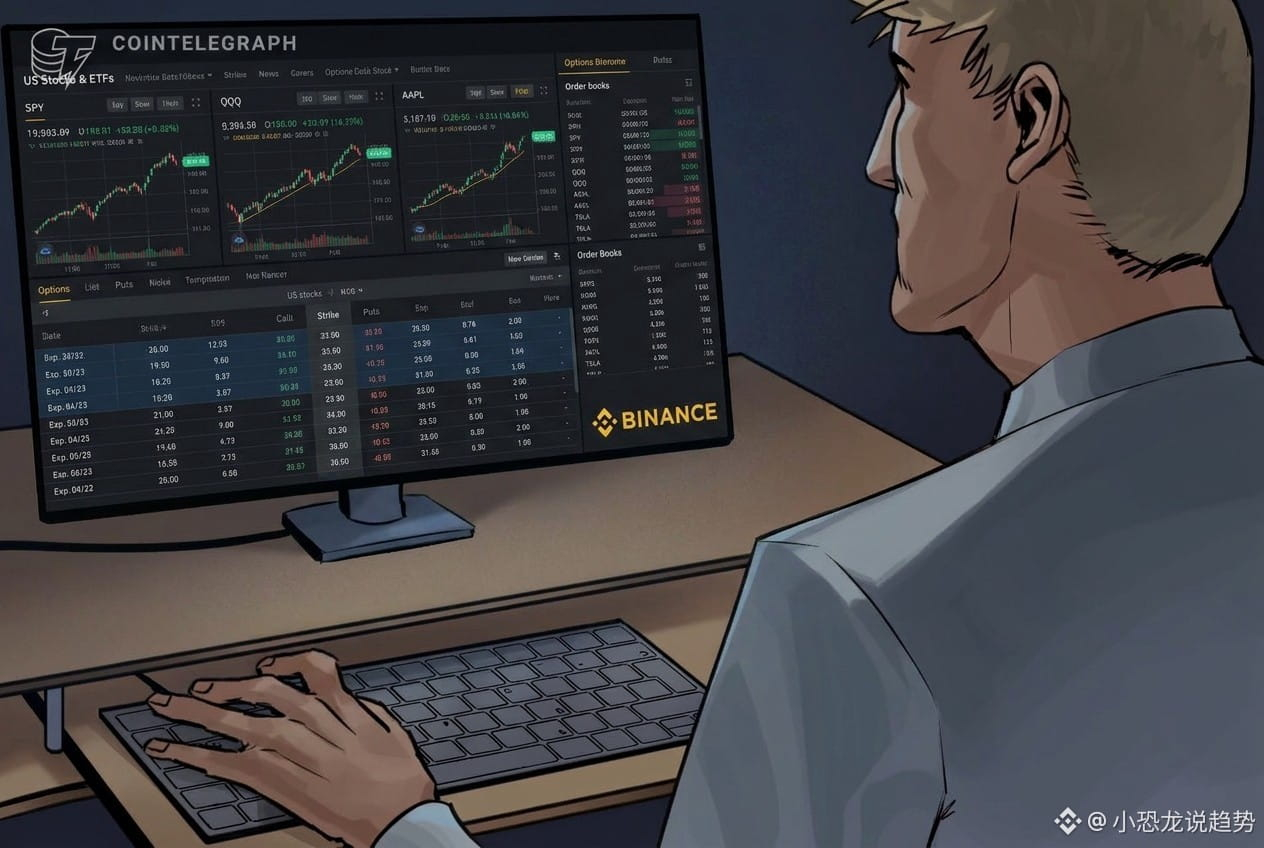
Binance is at it again. This time, it dives straight into U.S. stock options.
More than 1,000 option contracts on U.S. stocks and ETFs are now officially live, and users in non-U.S. regions can trade them too.
Orders route through a licensed broker in Abu Dhabi—Nest Trading. Clearing and custody are handled by Alpaca Securities, a U.S.-registered firm. Compliance setup is fully dialed in.
Unlike the contracts mentioned elsewhere, these options are physically settled. Exercising actually gives you the stocks, not some cash-settled, virtual gimmick.
Remember, Binance stock spot trading has already covered 7,000+ listings. With options now live, traditional finance’s puzzle gets another piece added.
Data says it best: in August, trading volume for TradFi perpetual contracts hit $43.3 billion—about 15 times that of January. You can literally see how fast the capital is moving in.
The tokenized stocks track is also surging. In one year, circulating market cap jumped from $34.6 million to $260 million. Monthly transfer volume rose 93%, the number of holders more than doubled (up 1.5x), reaching nearly 2.5 million.
Exchanges are all trying to squeeze into traditional finance. Whoever gets the pipeline connected first gets the profit.
For ordinary players, the barrier is genuinely lowering: you can now trade stocks, options, and crypto under one account.
But don’t rush in. Options are a double-edged sword. If you don’t understand the strike price or the expiration date, you’ll still lose—enough to make you question everything about your life.
Learn how premium and implied volatility work before you place a trade. Otherwise you’re basically paying tuition to the market.
Mainstream capital is flowing in. The wall between crypto and traditional finance is being dismantled.
What do you think the next thing exchanges will launch—futures, FX? Let’s chat in the comments.
Every day, I’ll keep you updated on exchange hot spots. Not just what’s happening in the news—more importantly, I’ll help you understand the logic and the opportunities behind it 👀🚀
Click the link below to follow me 👇🏻
👉 加入小恐龙粉丝群
#币安 #美股期权 #TradFi
Binance is at it again. This time, it dives straight into U.S. stock options.
More than 1,000 option contracts on U.S. stocks and ETFs are now officially live, and users in non-U.S. regions can trade them too.
Orders route through a licensed broker in Abu Dhabi—Nest Trading. Clearing and custody are handled by Alpaca Securities, a U.S.-registered firm. Compliance setup is fully dialed in.
Unlike the contracts mentioned elsewhere, these options are physically settled. Exercising actually gives you the stocks, not some cash-settled, virtual gimmick.
Remember, Binance stock spot trading has already covered 7,000+ listings. With options now live, traditional finance’s puzzle gets another piece added.
Data says it best: in August, trading volume for TradFi perpetual contracts hit $43.3 billion—about 15 times that of January. You can literally see how fast the capital is moving in.
The tokenized stocks track is also surging. In one year, circulating market cap jumped from $34.6 million to $260 million. Monthly transfer volume rose 93%, the number of holders more than doubled (up 1.5x), reaching nearly 2.5 million.
Exchanges are all trying to squeeze into traditional finance. Whoever gets the pipeline connected first gets the profit.
For ordinary players, the barrier is genuinely lowering: you can now trade stocks, options, and crypto under one account.
But don’t rush in. Options are a double-edged sword. If you don’t understand the strike price or the expiration date, you’ll still lose—enough to make you question everything about your life.
Learn how premium and implied volatility work before you place a trade. Otherwise you’re basically paying tuition to the market.
Mainstream capital is flowing in. The wall between crypto and traditional finance is being dismantled.
What do you think the next thing exchanges will launch—futures, FX? Let’s chat in the comments.
Every day, I’ll keep you updated on exchange hot spots. Not just what’s happening in the news—more importantly, I’ll help you understand the logic and the opportunities behind it 👀🚀
Click the link below to follow me 👇🏻
👉 加入小恐龙粉丝群
#币安 #美股期权 #TradFi
Another company is狂ly buying Ethereum, purchasing 53,501 ETH at once. Tom Lee’s Bitmine is still adding around $2,500.
With this purchase, the amount of ETH this company holds keeps growing. Buying through price fluctuations all the way—real love, no doubt.
Ethereum is currently stuck around the $2,500 level. Some people are panicking, while others are bargain-hunting. This company chooses to “vote with its wallet.”
Why does it dare to buy like this? Probably because it believes in the long-term value of the Ethereum ecosystem. But being heavily concentrated in a single asset also means the risks are there.
This round of moves reveals a trend: publicly listed companies buying crypto is spreading from Bitcoin to Ethereum, and treasury diversification is starting.
But don’t go copying it by going all-in. It’s a listed company—shareholders can take the hit if it goes wrong. You’re a retail investor—you take the loss yourself.
It’s better to learn the thinking, not just the trade: buy in batches and be able to hold. Being able to stick with it matters more than one big bet.
That said, being able to add on while sitting on floating losses shows both financial strength and conviction—definitely not something ordinary players can learn.
Ethereum ecosystem: staking, layer 2, stablecoins, and a bunch of applications. What it’s betting on is the growth of the entire ecosystem.
One more reminder: other people’s treasury strategies aren’t your “get rich” password. If you copy, do it with your brain switched on.
Do you also think Ethereum will do well? Are you willing to concentrate like it did? Share your position logic.
Click the profile picture to watch the livestream.
Every day I’ll take you to follow Ethereum hotspots—not just what happened in the news, but help you understand the underlying logic and opportunities 👉🦖
#Ethereum
With this purchase, the amount of ETH this company holds keeps growing. Buying through price fluctuations all the way—real love, no doubt.
Ethereum is currently stuck around the $2,500 level. Some people are panicking, while others are bargain-hunting. This company chooses to “vote with its wallet.”
Why does it dare to buy like this? Probably because it believes in the long-term value of the Ethereum ecosystem. But being heavily concentrated in a single asset also means the risks are there.
This round of moves reveals a trend: publicly listed companies buying crypto is spreading from Bitcoin to Ethereum, and treasury diversification is starting.
But don’t go copying it by going all-in. It’s a listed company—shareholders can take the hit if it goes wrong. You’re a retail investor—you take the loss yourself.
It’s better to learn the thinking, not just the trade: buy in batches and be able to hold. Being able to stick with it matters more than one big bet.
That said, being able to add on while sitting on floating losses shows both financial strength and conviction—definitely not something ordinary players can learn.
Ethereum ecosystem: staking, layer 2, stablecoins, and a bunch of applications. What it’s betting on is the growth of the entire ecosystem.
One more reminder: other people’s treasury strategies aren’t your “get rich” password. If you copy, do it with your brain switched on.
Do you also think Ethereum will do well? Are you willing to concentrate like it did? Share your position logic.
Click the profile picture to watch the livestream.
Every day I’ll take you to follow Ethereum hotspots—not just what happened in the news, but help you understand the underlying logic and opportunities 👉🦖
#Ethereum

Robinhood’s chain earned $1.9 million in a day—single-day revenue hits a record, and it also pushed ARB up 30% along the way.
On-chain income breaks records, proving that trading and tokenized stocks are really hot. Turns out making money on-chain can be this profitable.
Funding can be this direct. When you see standout on-chain data, you immediately chase and buy related tokens. ARB goes up right along with it.
The most worth pondering here isn’t how much ARB rose, but that one trading platform’s on-chain revenue can outperform a bunch of other public chains.
When traditional platforms move onto the chain, the efficiency gap is obvious to the naked eye. Fees stay on-chain; the ecosystem can generate its own lifeblood. You don’t need to look at the big platforms’ faces.
The platform brings users onto the chain, and users leave the money on the chain. Once this flywheel starts turning, it has serious staying power.
Of course, hype comes fast and fades fast. There’s never a shortage of people chasing the highs, and there’s never a shortage of bag holders.
But don’t just look at the income numbers—look at whether revenue can be stable. Making $1.9 million in one day and making $1.9 million every day are two different things.
Besides enjoying the show, think about which chain can keep making money—that’s the real question.
Now, on-chain revenue data has become even more sensitive than the K-line chart—a barometer that everyone watches. All the capital is looking at it.
Have you ever chased a token driven by on-chain revenue? How did it turn out? Share your experience.
Click the avatar to watch the livestream.
Every day I’ll bring you to follow on-chain hot topics—not just what happens in the news, but also helping you understand the logic and opportunities behind it 👉🦖
#ARB #On-chain data
On-chain income breaks records, proving that trading and tokenized stocks are really hot. Turns out making money on-chain can be this profitable.
Funding can be this direct. When you see standout on-chain data, you immediately chase and buy related tokens. ARB goes up right along with it.
The most worth pondering here isn’t how much ARB rose, but that one trading platform’s on-chain revenue can outperform a bunch of other public chains.
When traditional platforms move onto the chain, the efficiency gap is obvious to the naked eye. Fees stay on-chain; the ecosystem can generate its own lifeblood. You don’t need to look at the big platforms’ faces.
The platform brings users onto the chain, and users leave the money on the chain. Once this flywheel starts turning, it has serious staying power.
Of course, hype comes fast and fades fast. There’s never a shortage of people chasing the highs, and there’s never a shortage of bag holders.
But don’t just look at the income numbers—look at whether revenue can be stable. Making $1.9 million in one day and making $1.9 million every day are two different things.
Besides enjoying the show, think about which chain can keep making money—that’s the real question.
Now, on-chain revenue data has become even more sensitive than the K-line chart—a barometer that everyone watches. All the capital is looking at it.
Have you ever chased a token driven by on-chain revenue? How did it turn out? Share your experience.
Click the avatar to watch the livestream.
Every day I’ll bring you to follow on-chain hot topics—not just what happens in the news, but also helping you understand the logic and opportunities behind it 👉🦖
#ARB #On-chain data
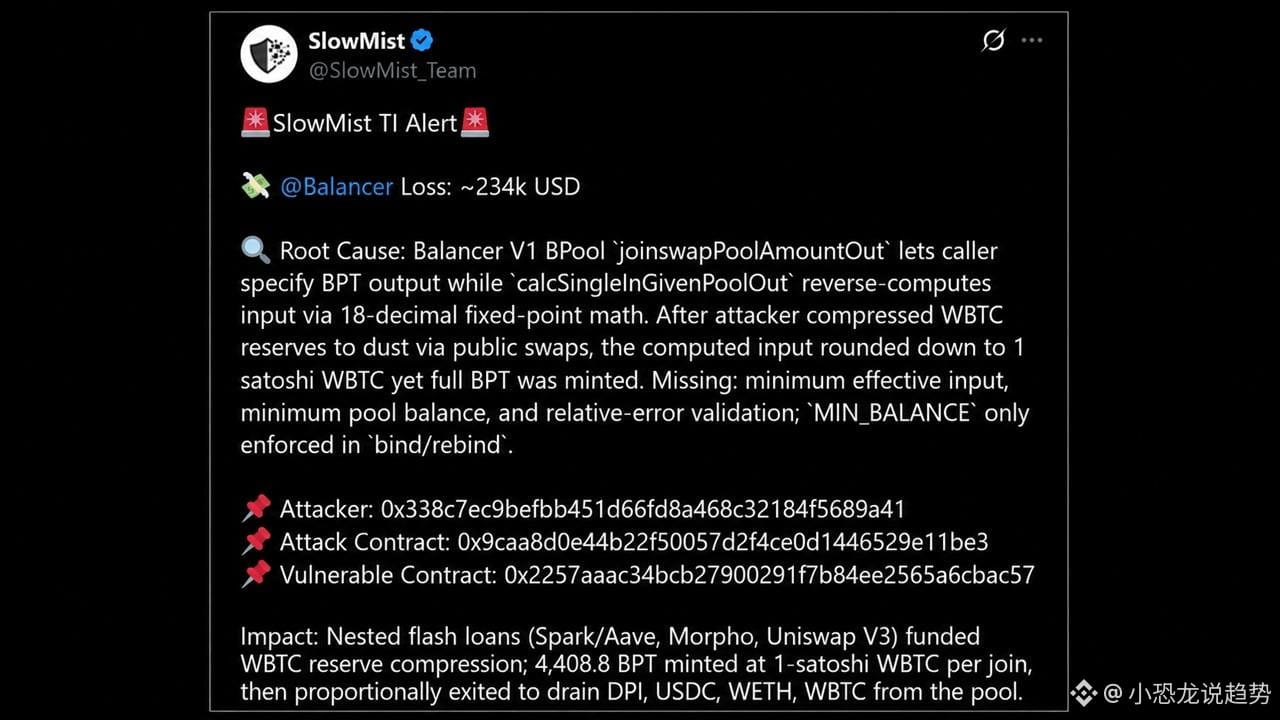
The same bug got Balancer again, costing $234,000—and it’s still the familiar recipe
Balancer’s V1 liquidity pools were hit again. A two-year-old vulnerability family, repackaged with a new disguise, has returned today. The project team has urgently reminded users to evacuate.
$230,000 isn’t a huge amount in the crypto world, but the humiliation is extremely strong: same trap, fell into it twice—still a public execution.
The interesting part here isn’t the money, but the reusability of the vulnerability. As long as the old contract is still sitting on-chain, it’s a ticking time bomb.
Many projects say their code has been audited—but after the audit, they stop caring. The vulnerability list gets updated, yet the contract remains a museum artifact.
The lesson for users is simple: don’t fall in love with old pools. For thin-liquidity old-version pools, the chance of trouble increases exponentially.
In the DeFi world, every year it’s the same cycle: old vulnerabilities, new victims. The script never changes.
Security isn’t something you just claim—it’s something you maintain continuously. Old code that has been running for ten years doesn’t automatically mean it’s safe.
In the end, the safety of on-chain funds ultimately depends on yourself. Look at the contract one more time, and you’ll avoid at least one pitfall.
Project teams, please be more mindful. Trust is hard to rebuild once it collapses.
Do you still dare to put your funds into an old-version pool? Tell me your choice.
Click the avatar to watch the live stream.
Every day, I’ll take you to follow security hot topics—not just what happened, but also help you understand the underlying logic and opportunities 👉🦖
#DeFiSecurity
Balancer’s V1 liquidity pools were hit again. A two-year-old vulnerability family, repackaged with a new disguise, has returned today. The project team has urgently reminded users to evacuate.
$230,000 isn’t a huge amount in the crypto world, but the humiliation is extremely strong: same trap, fell into it twice—still a public execution.
The interesting part here isn’t the money, but the reusability of the vulnerability. As long as the old contract is still sitting on-chain, it’s a ticking time bomb.
Many projects say their code has been audited—but after the audit, they stop caring. The vulnerability list gets updated, yet the contract remains a museum artifact.
The lesson for users is simple: don’t fall in love with old pools. For thin-liquidity old-version pools, the chance of trouble increases exponentially.
In the DeFi world, every year it’s the same cycle: old vulnerabilities, new victims. The script never changes.
Security isn’t something you just claim—it’s something you maintain continuously. Old code that has been running for ten years doesn’t automatically mean it’s safe.
In the end, the safety of on-chain funds ultimately depends on yourself. Look at the contract one more time, and you’ll avoid at least one pitfall.
Project teams, please be more mindful. Trust is hard to rebuild once it collapses.
Do you still dare to put your funds into an old-version pool? Tell me your choice.
Click the avatar to watch the live stream.
Every day, I’ll take you to follow security hot topics—not just what happened, but also help you understand the underlying logic and opportunities 👉🦖
#DeFiSecurity
Premier League Sponsor in Trouble: $13.5 Million Frozen, Revealing a Crypto Firm
UK law enforcement steps in and freezes the cash. The money comes from a £140 million Premier League sponsorship agreement.
The sponsor is Sorare, a blockchain “fantasy sports” company. Last January, the court issued a freezing order—now it has only just come to light.
A crypto firm poured money into sponsoring a top league. It was supposed to be a flagship case for the industry breaking into the mainstream, but investigators have set their sights on it. The contrast is intense.
Don’t jump to conclusions yet: a freeze isn’t a conviction. But the direction of the wind is worth noting—law enforcement scrutiny of crypto capital flows is getting more and more detailed.
On one side, the glamour of sports sponsorship. On the other, the tracking by law enforcement. This is the reality of survival for the crypto industry right now.
Compliance is a lesson nobody can skip. Sooner or later, you’ll have to “catch up.” The later you do it, the higher the cost.
For crypto apps like fantasy sports and player cards that want to go mainstream, you’d better do the compliance homework thoroughly first—otherwise you may have your old accounts reopened at any time.
This case also highlights one point: large sponsorships and big contracts will inevitably become key targets for regulatory monitoring.
If the crypto industry wants mainstream acceptance, it must accept mainstream-level scrutiny. That’s the price of going mainstream—and you can’t dodge it.
Do you think crypto companies sponsoring traditional sports is breaking out into the mainstream—or inviting trouble? See you in the comments.
Click the profile picture to watch the livestream.
Every day, I’ll take you to track compliance hot topics—not just what happens in the news, but also the logic and opportunities behind it 👉🦖
#compliance
UK law enforcement steps in and freezes the cash. The money comes from a £140 million Premier League sponsorship agreement.
The sponsor is Sorare, a blockchain “fantasy sports” company. Last January, the court issued a freezing order—now it has only just come to light.
A crypto firm poured money into sponsoring a top league. It was supposed to be a flagship case for the industry breaking into the mainstream, but investigators have set their sights on it. The contrast is intense.
Don’t jump to conclusions yet: a freeze isn’t a conviction. But the direction of the wind is worth noting—law enforcement scrutiny of crypto capital flows is getting more and more detailed.
On one side, the glamour of sports sponsorship. On the other, the tracking by law enforcement. This is the reality of survival for the crypto industry right now.
Compliance is a lesson nobody can skip. Sooner or later, you’ll have to “catch up.” The later you do it, the higher the cost.
For crypto apps like fantasy sports and player cards that want to go mainstream, you’d better do the compliance homework thoroughly first—otherwise you may have your old accounts reopened at any time.
This case also highlights one point: large sponsorships and big contracts will inevitably become key targets for regulatory monitoring.
If the crypto industry wants mainstream acceptance, it must accept mainstream-level scrutiny. That’s the price of going mainstream—and you can’t dodge it.
Do you think crypto companies sponsoring traditional sports is breaking out into the mainstream—or inviting trouble? See you in the comments.
Click the profile picture to watch the livestream.
Every day, I’ll take you to track compliance hot topics—not just what happens in the news, but also the logic and opportunities behind it 👉🦖
#compliance

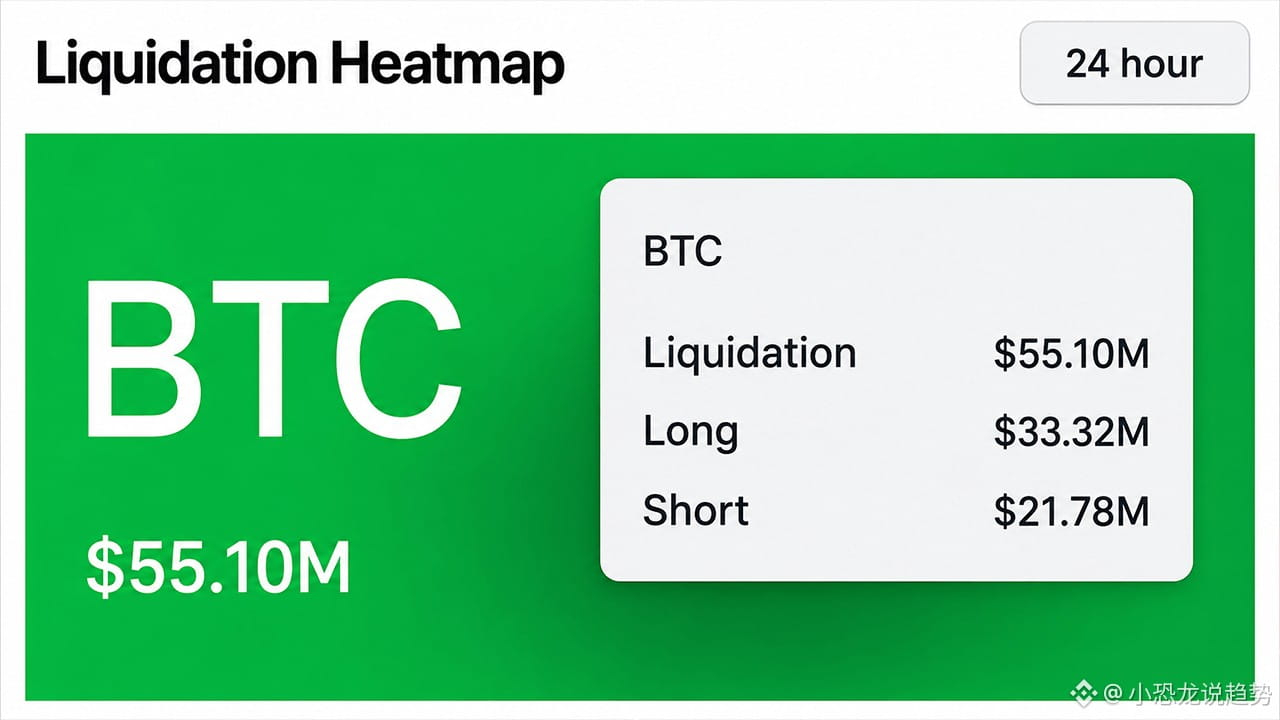
The bond market was wiped out. Bitcoin follows, swinging like a pendulum. In the past 24 hours, it took several roller-coaster rides.
Bond yields surged violently, scaring risk assets into softness. Bitcoin hovered back and forth above 77,000, with no sense of direction.
The source of this round of volatility isn’t in the crypto market. It’s in U.S. Treasuries. Long-term Treasuries were sold off, yields skyrocketed, and global capital was forced to reprice.
Bitcoin’s current走势 is increasingly behaving like a risk asset. It’s moving in sync with stocks and the bond market. The safe-haven script like gold wasn’t played this time.
Let’s say something that stings: if you’re trying to use Bitcoin to dodge a macro storm, you may not be able to count on it this round.
But on the other hand, the more chaotic the bond market gets, the more people will reconsider whether fiat-currency assets are really reliable. That plants a long-term seed for Bitcoin.
In the short term, liquidity matters. In the long term, credit matters. These two forces are now fighting each other, and the market keeps shaking along.
Right now, global capital is waiting for a signal: what will the Fed do next—another rate hike or a pause? The market is already trembling in advance.
In times like this, the saying “cash is king” is truer than ever. Don’t rush into a full position to catch a falling knife.
High volatility isn’t the end of the world. If you can’t make sense of the direction, don’t go heavy. First learn to read the market’s liquidity mood.
As for this bond-market storm—do you think Bitcoin will be dragged down with it, or will it be a chance to rotate positions? Let’s talk about your view. Click the profile icon to watch the live stream.
Every day, I’ll take you to follow Bitcoin hotspots—not just what happened in the news, but also the logic and opportunities behind it 👉🦖
#比特币 #US Treasuries
Bond yields surged violently, scaring risk assets into softness. Bitcoin hovered back and forth above 77,000, with no sense of direction.
The source of this round of volatility isn’t in the crypto market. It’s in U.S. Treasuries. Long-term Treasuries were sold off, yields skyrocketed, and global capital was forced to reprice.
Bitcoin’s current走势 is increasingly behaving like a risk asset. It’s moving in sync with stocks and the bond market. The safe-haven script like gold wasn’t played this time.
Let’s say something that stings: if you’re trying to use Bitcoin to dodge a macro storm, you may not be able to count on it this round.
But on the other hand, the more chaotic the bond market gets, the more people will reconsider whether fiat-currency assets are really reliable. That plants a long-term seed for Bitcoin.
In the short term, liquidity matters. In the long term, credit matters. These two forces are now fighting each other, and the market keeps shaking along.
Right now, global capital is waiting for a signal: what will the Fed do next—another rate hike or a pause? The market is already trembling in advance.
In times like this, the saying “cash is king” is truer than ever. Don’t rush into a full position to catch a falling knife.
High volatility isn’t the end of the world. If you can’t make sense of the direction, don’t go heavy. First learn to read the market’s liquidity mood.
As for this bond-market storm—do you think Bitcoin will be dragged down with it, or will it be a chance to rotate positions? Let’s talk about your view. Click the profile icon to watch the live stream.
Every day, I’ll take you to follow Bitcoin hotspots—not just what happened in the news, but also the logic and opportunities behind it 👉🦖
#比特币 #US Treasuries
Bitcoin bulls shout 400k, bears shout 10k—one up in the sky, the other down on the ground. Both sides think the other is crazy.
In the latest big melee, aggressive bulls directly put the target at $400,000; the bears are even tougher, calling for $10,000—straight back to 2017.
The bulls’ logic is simple: institutions enter, the halving cycle comes, and the Fed will eventually loosen policy—these are fuel.
The bears’ logic isn’t weak either: rate-hike expectations are heating up, liquidity is tightening, and the first wave of hits to risk assets is Bitcoin.
The disagreement is so huge it’s absurd, yet the market is honest on its own: price is stuck around $77,000, and nobody has managed to convince the other.
Let’s say the big truth: $400k and $10k are both storytelling. The real variable is the Fed—how tightly the liquidity “water tap” is turned.
This kind of price-calling drama plays out every year. Every time, someone gets it right, but more people just watch the show.
One more thing: the people shouting $400k probably have positions; those shouting $10k might be shorting. Behind every viewpoint are interests.
Real高手 don’t ask others for price levels. They look at the data themselves, think it through, and then execute.
The most expensive lesson the market teaches you is this: you can’t just copy someone else’s conclusion. If you copy it, you pay tuition.
Even if you guess perfectly, it’s not as good as living long. Position management matters a hundred times more than opinions.
Which side are you on—$400k or $10k? Comment in the section and let’s see whose fans are more. Click the avatar to watch the livestream. Every day, I’ll take you to follow Bitcoin hotspots—not just what happens in the news, but also help you understand the logic and opportunities behind it 👉🦖
#Bitcoin
In the latest big melee, aggressive bulls directly put the target at $400,000; the bears are even tougher, calling for $10,000—straight back to 2017.
The bulls’ logic is simple: institutions enter, the halving cycle comes, and the Fed will eventually loosen policy—these are fuel.
The bears’ logic isn’t weak either: rate-hike expectations are heating up, liquidity is tightening, and the first wave of hits to risk assets is Bitcoin.
The disagreement is so huge it’s absurd, yet the market is honest on its own: price is stuck around $77,000, and nobody has managed to convince the other.
Let’s say the big truth: $400k and $10k are both storytelling. The real variable is the Fed—how tightly the liquidity “water tap” is turned.
This kind of price-calling drama plays out every year. Every time, someone gets it right, but more people just watch the show.
One more thing: the people shouting $400k probably have positions; those shouting $10k might be shorting. Behind every viewpoint are interests.
Real高手 don’t ask others for price levels. They look at the data themselves, think it through, and then execute.
The most expensive lesson the market teaches you is this: you can’t just copy someone else’s conclusion. If you copy it, you pay tuition.
Even if you guess perfectly, it’s not as good as living long. Position management matters a hundred times more than opinions.
Which side are you on—$400k or $10k? Comment in the section and let’s see whose fans are more. Click the avatar to watch the livestream. Every day, I’ll take you to follow Bitcoin hotspots—not just what happens in the news, but also help you understand the logic and opportunities behind it 👉🦖
#Bitcoin

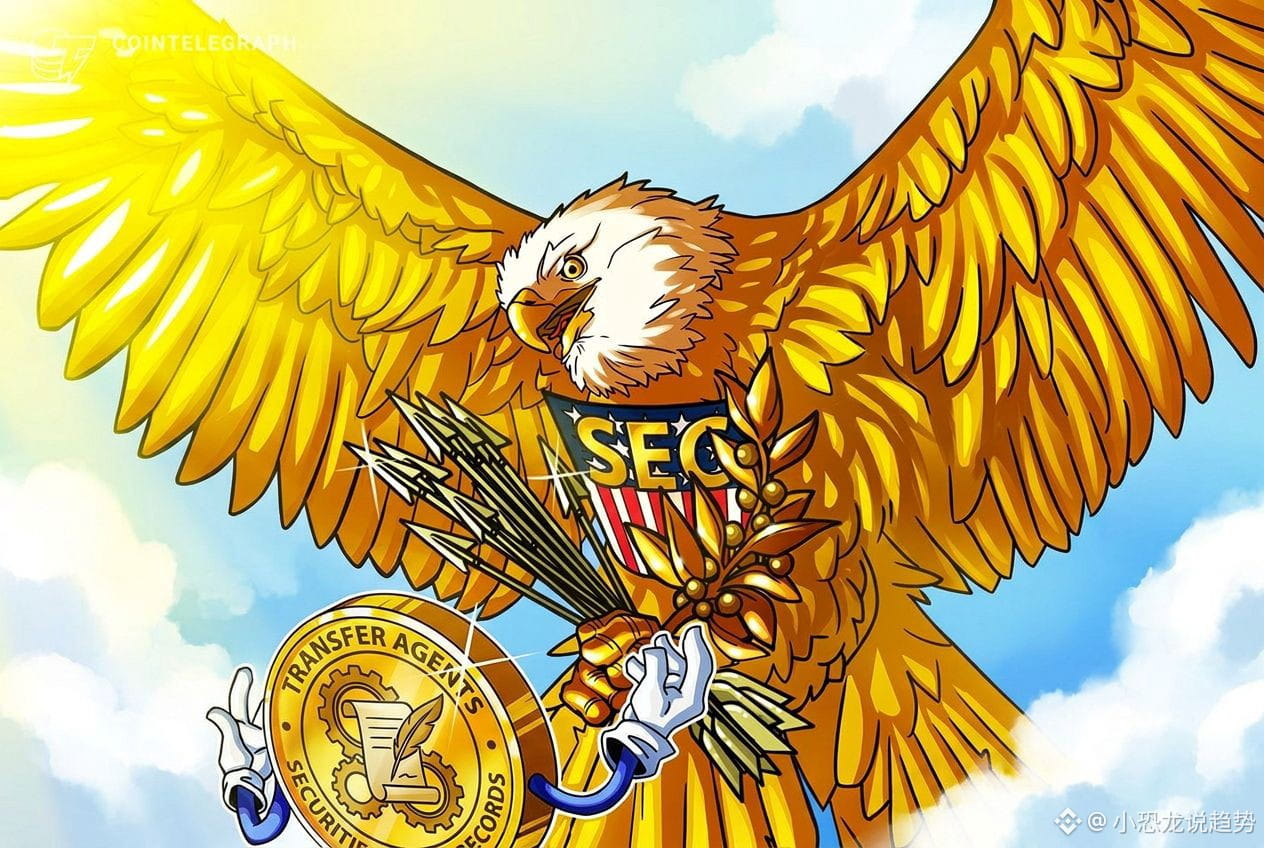
SEC makes a big move: it will overhaul the decades-old transfer agent rules. Blockchain records, tokenized securities—everything will be written into new regulations.
This rule has been used since the 1980s and still applies today. It’s basically become an excavated relic. Now, regulators have finally admitted that securities have moved onto the blockchain.
What’s a transfer agent? Simply put, it’s the bookkeeper behind securities trading—who holds what, who trades what, all depends on it for registration. It sounds unremarkable, but the whole market can’t move without it.
In the past, this system was manual and slow. Settlement relied on fax, and records were paper-based. Now the SEC is proactively embracing on-chain recordkeeping—effectively giving tokenized securities the green light.
Don’t underestimate this step. When the rules change, another obstacle gets cleared for Wall Street to move stocks and bonds onto the blockchain.
Regulatory attitude has shifted from watching and waiting to taking real action. This is a long-term positive for the entire industry—not the kind of slogan that sounds good but means nothing.
What institutions fear most is unclear rules. When regulations are like fog and money won’t dare to move. Now the rulebook is being “made up” and clarified—so capital naturally is more willing to step in.
There’s also a detail worth savoring: this reform isn’t tearing everything down and starting over. It’s adding blockchain interfaces to the old system first—steady as the top priority. It shows the regulator has thought it through.
In fact, on-chain bookkeeping is transparent, auditable, and efficient. Regulators have no reason to keep pretending they don’t see it—it was only a matter of time.
Once these rules are changed, the supporting systems for custody, audits, and reporting will also be upgraded. The path for institutions to enter will be much smoother.
For ordinary investors, you may not see much “splash” in the short term. But once tokenized securities are rolled out, transaction costs and timelines will be very different.
Do you think tokenized securities can become mainstream in a few years? Let’s talk about your view.
Click the profile picture to watch the live stream.
Every day, I’ll help you track tokenization-related developments—more than just reporting what’s happening, I’ll also help you understand the logic and opportunities behind it 👉🦖
#代币化 #SEC
This rule has been used since the 1980s and still applies today. It’s basically become an excavated relic. Now, regulators have finally admitted that securities have moved onto the blockchain.
What’s a transfer agent? Simply put, it’s the bookkeeper behind securities trading—who holds what, who trades what, all depends on it for registration. It sounds unremarkable, but the whole market can’t move without it.
In the past, this system was manual and slow. Settlement relied on fax, and records were paper-based. Now the SEC is proactively embracing on-chain recordkeeping—effectively giving tokenized securities the green light.
Don’t underestimate this step. When the rules change, another obstacle gets cleared for Wall Street to move stocks and bonds onto the blockchain.
Regulatory attitude has shifted from watching and waiting to taking real action. This is a long-term positive for the entire industry—not the kind of slogan that sounds good but means nothing.
What institutions fear most is unclear rules. When regulations are like fog and money won’t dare to move. Now the rulebook is being “made up” and clarified—so capital naturally is more willing to step in.
There’s also a detail worth savoring: this reform isn’t tearing everything down and starting over. It’s adding blockchain interfaces to the old system first—steady as the top priority. It shows the regulator has thought it through.
In fact, on-chain bookkeeping is transparent, auditable, and efficient. Regulators have no reason to keep pretending they don’t see it—it was only a matter of time.
Once these rules are changed, the supporting systems for custody, audits, and reporting will also be upgraded. The path for institutions to enter will be much smoother.
For ordinary investors, you may not see much “splash” in the short term. But once tokenized securities are rolled out, transaction costs and timelines will be very different.
Do you think tokenized securities can become mainstream in a few years? Let’s talk about your view.
Click the profile picture to watch the live stream.
Every day, I’ll help you track tokenization-related developments—more than just reporting what’s happening, I’ll also help you understand the logic and opportunities behind it 👉🦖
#代币化 #SEC
Verified
Goldman Sachs, Citi, UBS—21 Wall Street giants gather to team up and create a USD stablecoin, targeting a launch in the first half of 2027
How extraordinary is this lineup? Just pick any name—each one is at the very top of traditional finance’s pyramid. Now they’re all moving in to build stablecoins.
The new company will first issue a USD stablecoin, focusing on payments and digital-asset settlement. Euro tokens are also on the expansion shortlist.
In the past, stablecoins were something the crypto world played with on its own. Banks looked at them with disdain. Now they’re straight-up copying the playbook—and doing it with a straight face.
The key isn’t just which bank wants to test the waters, but that all 21 are doing it together. That’s like the entire Wall Street ecosystem stamping its approval: stablecoins are becoming legitimate payment infrastructure.
For retail users, don’t rush to shout “disruption.” First understand one thing: the track money rides on is shifting from traditional systems onto the blockchain—and faster than you’d expect.
A united front from the giants means compliance, custody, and settlement gaps will be filled quickly. The moat of established stablecoins is about to face a real challenger.
Banks entering the space also has a hidden motive: to seize back control of the payments conversation. If stablecoins are led by tech companies, banks will truly have to step aside.
Once a bank-backed stablecoin goes live, the fee structure and cross-border settlement landscape may need to be rewritten.
The most ironic part: the institutions that once said Bitcoin was a scam are now lining up to issue stablecoins. The “it’s good stuff” law applies on Wall Street too.
There’s another layer of meaning. Global regulation for stablecoins is being filled in everywhere. Wall Street’s move right now is about抢时间窗—seizing the time window. Place the first pieces on the board and you benefit first.
For the crypto community, an opponent of this caliber entering the arena is both pressure and endorsement. The compliance-bound ship has already set anchor—no one can stop it.
Do you think the stablecoin issued by banks can take back how much market share from established stablecoins? Let’s chat in the comments.
Click the avatar to watch the live stream.
Every day, I’ll take you to follow stablecoin hotspots—not just what’s happening in the news, but the logic and opportunities behind it 👉🦖
#稳定币 #Bitcoin
How extraordinary is this lineup? Just pick any name—each one is at the very top of traditional finance’s pyramid. Now they’re all moving in to build stablecoins.
The new company will first issue a USD stablecoin, focusing on payments and digital-asset settlement. Euro tokens are also on the expansion shortlist.
In the past, stablecoins were something the crypto world played with on its own. Banks looked at them with disdain. Now they’re straight-up copying the playbook—and doing it with a straight face.
The key isn’t just which bank wants to test the waters, but that all 21 are doing it together. That’s like the entire Wall Street ecosystem stamping its approval: stablecoins are becoming legitimate payment infrastructure.
For retail users, don’t rush to shout “disruption.” First understand one thing: the track money rides on is shifting from traditional systems onto the blockchain—and faster than you’d expect.
A united front from the giants means compliance, custody, and settlement gaps will be filled quickly. The moat of established stablecoins is about to face a real challenger.
Banks entering the space also has a hidden motive: to seize back control of the payments conversation. If stablecoins are led by tech companies, banks will truly have to step aside.
Once a bank-backed stablecoin goes live, the fee structure and cross-border settlement landscape may need to be rewritten.
The most ironic part: the institutions that once said Bitcoin was a scam are now lining up to issue stablecoins. The “it’s good stuff” law applies on Wall Street too.
There’s another layer of meaning. Global regulation for stablecoins is being filled in everywhere. Wall Street’s move right now is about抢时间窗—seizing the time window. Place the first pieces on the board and you benefit first.
For the crypto community, an opponent of this caliber entering the arena is both pressure and endorsement. The compliance-bound ship has already set anchor—no one can stop it.
Do you think the stablecoin issued by banks can take back how much market share from established stablecoins? Let’s chat in the comments.
Click the avatar to watch the live stream.
Every day, I’ll take you to follow stablecoin hotspots—not just what’s happening in the news, but the logic and opportunities behind it 👉🦖
#稳定币 #Bitcoin

Singapore raises the stakes: stablecoin issuers must have 100% full reserves—yet still dare to pay users yields? Immediate ban.
The moment the news broke, the entire stablecoin circle held meetings.
Some clapped and cheered, saying this sets rules for the industry.
Others said it’s too harsh—cutting off the ways to make money.
The regulator’s logic isn’t hard to understand.
Stablecoins are essentially payment tools, not investment products.
You take users’ USD and then turn around to invest it—using high returns as a selling point.
If the investment blows up, when users rush to redeem, the whole chain suffers.
So they simply make a clean cut: reserves must be sufficient; you can’t expect any yields.
Compared with the GENIUS Act that has sparked heated debate in the US, Singapore’s move is fast, precise, and decisive.
First set the bottom line in stone, then talk about innovation.
If stablecoins want to become the global foundation for payments, regulators must be able to sleep at night first.
For us, this signal is important.
The clearer the regulation, the more compliance-minded players will dare to enter—banks, payment companies, and traditional giants are all waiting for this.
In the short term, it’s a constraint; in the long term, it’s an entry ticket.
The stablecoin table is becoming more and more like a real professional battlefield.
Every day, I’ll bring you updates on regulatory hotspots—not just what happened in the news, but also the logic and opportunities behind it 👀🚀
Click the links below to follow me 👇🏻
👉 加入小恐龙粉丝群
#稳定币 #新加坡 #监管
The moment the news broke, the entire stablecoin circle held meetings.
Some clapped and cheered, saying this sets rules for the industry.
Others said it’s too harsh—cutting off the ways to make money.
The regulator’s logic isn’t hard to understand.
Stablecoins are essentially payment tools, not investment products.
You take users’ USD and then turn around to invest it—using high returns as a selling point.
If the investment blows up, when users rush to redeem, the whole chain suffers.
So they simply make a clean cut: reserves must be sufficient; you can’t expect any yields.
Compared with the GENIUS Act that has sparked heated debate in the US, Singapore’s move is fast, precise, and decisive.
First set the bottom line in stone, then talk about innovation.
If stablecoins want to become the global foundation for payments, regulators must be able to sleep at night first.
For us, this signal is important.
The clearer the regulation, the more compliance-minded players will dare to enter—banks, payment companies, and traditional giants are all waiting for this.
In the short term, it’s a constraint; in the long term, it’s an entry ticket.
The stablecoin table is becoming more and more like a real professional battlefield.
Every day, I’ll bring you updates on regulatory hotspots—not just what happened in the news, but also the logic and opportunities behind it 👀🚀
Click the links below to follow me 👇🏻
👉 加入小恐龙粉丝群
#稳定币 #新加坡 #监管

The Encryption Bill Faces Its Major Test on September 15
Before the U.S. Senate adjourns on August 8, procedural motions have already been filed. On September 15, the CLARITY Crypto Market Structure Act will face a crucial procedural vote.
This hurdle must be cleared: it requires 60 votes. The Senate has 100 members, meaning cross-party support is necessary—an uphill battle.
Industry expectations have already cooled significantly. Galaxy has cut its estimate for passing the bill this year to 10%, down from earlier expectations. Another research institution has also reduced its forecast from 40% to 25%.
Why is it so difficult? There are three major internal battles: a moral provision involving government officials, stablecoin yield—seen by banks as a thorn in their side—and the scope of protections for DeFi and non-custodial developers.
On the Democratic side, several figures who were initially willing to negotiate have now come out against the latest text. Bank industry groups are also refusing to let go of the stablecoin yield issue.
The key point is that even if the measure passes the procedural stage on September 15, there’s still a long list of follow-up battles: government appropriations, the defense bill, the midterm elections—everything piled up back-to-back with no breathing room.
Even more painful: the SEC and CFTC aren’t idle. They’re already moving ahead on their own to draft regulatory rules. If Congress won’t act, the regulators will.
My view: whether the bill lives or dies will be decided on September 15. Even if the bill fails, the crypto world won’t collapse—rules will always find a way to be introduced in other forms.
Do you think CLARITY can successfully clear the hurdle this year? Vote or nothing—make your call. Drop your stance in the comments.
Tap the profile icon to watch the livestream.
Every day, I’ll take you through key regulatory developments—more than just reporting what happens, I’ll help you understand the logic and opportunities behind it. 👉🦖
#加密监管 #Clarity Bill
Before the U.S. Senate adjourns on August 8, procedural motions have already been filed. On September 15, the CLARITY Crypto Market Structure Act will face a crucial procedural vote.
This hurdle must be cleared: it requires 60 votes. The Senate has 100 members, meaning cross-party support is necessary—an uphill battle.
Industry expectations have already cooled significantly. Galaxy has cut its estimate for passing the bill this year to 10%, down from earlier expectations. Another research institution has also reduced its forecast from 40% to 25%.
Why is it so difficult? There are three major internal battles: a moral provision involving government officials, stablecoin yield—seen by banks as a thorn in their side—and the scope of protections for DeFi and non-custodial developers.
On the Democratic side, several figures who were initially willing to negotiate have now come out against the latest text. Bank industry groups are also refusing to let go of the stablecoin yield issue.
The key point is that even if the measure passes the procedural stage on September 15, there’s still a long list of follow-up battles: government appropriations, the defense bill, the midterm elections—everything piled up back-to-back with no breathing room.
Even more painful: the SEC and CFTC aren’t idle. They’re already moving ahead on their own to draft regulatory rules. If Congress won’t act, the regulators will.
My view: whether the bill lives or dies will be decided on September 15. Even if the bill fails, the crypto world won’t collapse—rules will always find a way to be introduced in other forms.
Do you think CLARITY can successfully clear the hurdle this year? Vote or nothing—make your call. Drop your stance in the comments.
Tap the profile icon to watch the livestream.
Every day, I’ll take you through key regulatory developments—more than just reporting what happens, I’ll help you understand the logic and opportunities behind it. 👉🦖
#加密监管 #Clarity Bill
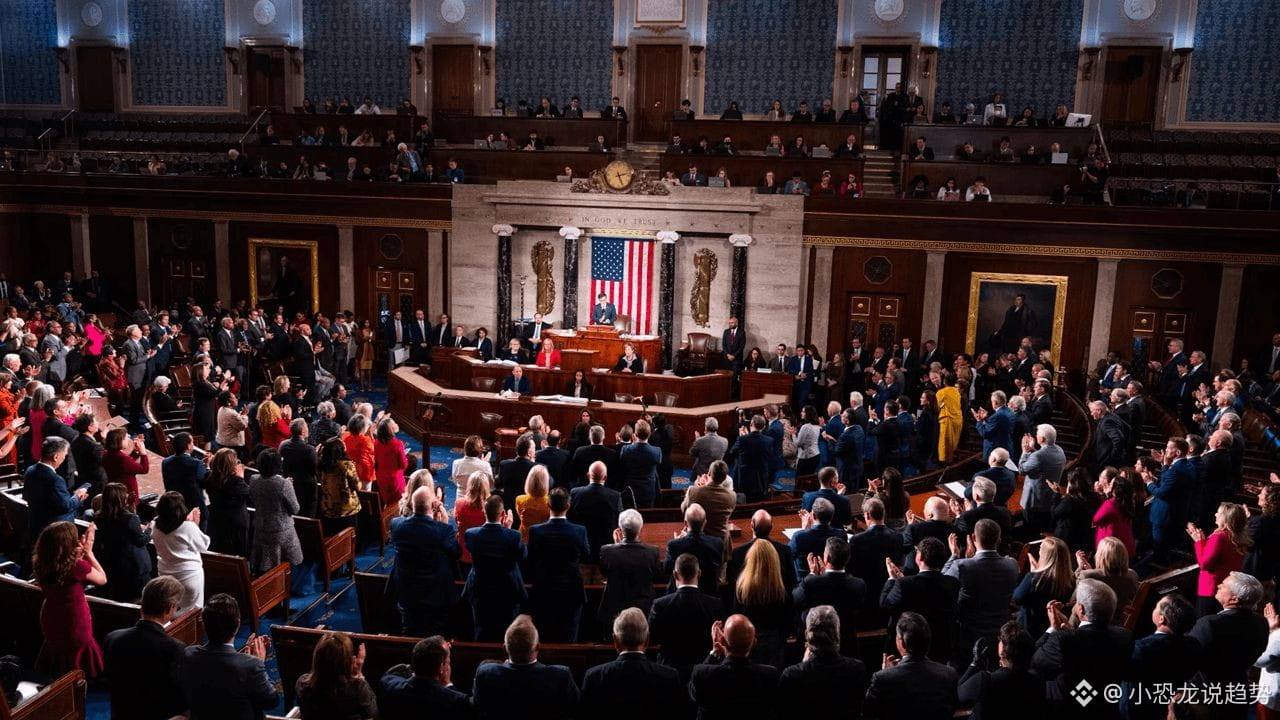
Belgium orders domain registrars to hand over encrypted wallet addresses
A department in Belgium that targets online piracy has taken action: it has directly issued orders to European domain registrars to hand over the complete information of the operators of pirated websites.
What do they want? Name, residential address, phone number, bank account details, credit card information—plus encrypted wallet addresses and transaction hashes, along with 12 months of connection logs and device information including IP addresses.
This move is far harsher than merely taking sites down. Previously, it was like shutting your door; now they’re rummaging through your household finances. Even the registrars named have been given gag orders—no notice to the account holders and no public disclosure.
Among the registrars mentioned are three companies including Hostinger. The backdrop is crackdowns on illegal sports streaming events, “protecting” the so-called sports economy.
The question is: encrypted wallet addresses and transaction hashes are public on-chain by nature. But tying a wallet to a person’s identity is a different matter.
In effect, every move you make on-chain may later be matched to an identity file. If someone wants to look, they can.
Experts are already questioning whether this kind of cross-border enforcement will hold up under the EU’s Digital Services Act framework.
My view: on-chain transparency is a double-edged sword. You may think you’re anonymous, but when regulators decide to investigate, not a single thing—wallet address or transaction records—will be able to run away.
Why have privacy coins been surging lately? The market has already voted with its feet.
Do you think encrypted wallet information should be accessed this way—or is privacy everything?
Click the avatar to watch the livestream.
Every day, take you to follow privacy hotspots—not just what happened in the news, but also to help you understand the underlying logic and opportunities 👉🦖
#隐私 #加密监管
A department in Belgium that targets online piracy has taken action: it has directly issued orders to European domain registrars to hand over the complete information of the operators of pirated websites.
What do they want? Name, residential address, phone number, bank account details, credit card information—plus encrypted wallet addresses and transaction hashes, along with 12 months of connection logs and device information including IP addresses.
This move is far harsher than merely taking sites down. Previously, it was like shutting your door; now they’re rummaging through your household finances. Even the registrars named have been given gag orders—no notice to the account holders and no public disclosure.
Among the registrars mentioned are three companies including Hostinger. The backdrop is crackdowns on illegal sports streaming events, “protecting” the so-called sports economy.
The question is: encrypted wallet addresses and transaction hashes are public on-chain by nature. But tying a wallet to a person’s identity is a different matter.
In effect, every move you make on-chain may later be matched to an identity file. If someone wants to look, they can.
Experts are already questioning whether this kind of cross-border enforcement will hold up under the EU’s Digital Services Act framework.
My view: on-chain transparency is a double-edged sword. You may think you’re anonymous, but when regulators decide to investigate, not a single thing—wallet address or transaction records—will be able to run away.
Why have privacy coins been surging lately? The market has already voted with its feet.
Do you think encrypted wallet information should be accessed this way—or is privacy everything?
Click the avatar to watch the livestream.
Every day, take you to follow privacy hotspots—not just what happened in the news, but also to help you understand the underlying logic and opportunities 👉🦖
#隐私 #加密监管

The US wants to reach into Japan’s monetary policy—but finds it can’t really get a handle on Bitcoin
This topic is interesting and worth breaking down properly
First, sovereign currencies: the yen’s direction isn’t decided by the Bank of Japan
Once the US applies pressure, exchange-rate policy has to adjust—it’s been that way for decades
A big country’s economic stick really is something that can be swung effectively
But Bitcoin? The US wants to control it, but it can’t
No central bank, no issuer, no borders
Sanction it or pressure it—coins on the chain just move the way they move
That’s the biggest difference between decentralization and sovereign money
Put simply, from the day Bitcoin was designed, it never planned to be held hostage by any country
When the Fed talks, it doesn’t care
When the White House pressures, it ignores it
This kind of independence used to be seen as a flaw—now it’s actually a selling point
For ordinary players, this is closer to us than you might think
Your coins aren’t bound by any single country’s policies
You don’t have to worry that one government’s words will suddenly flip your assets
In chaotic times, that’s scarce certainty
Of course, don’t misunderstand: Bitcoin isn’t completely immune to the macro environment
US liquidity, rate hikes and cuts—these still affect its short-term moves
But that’s market-level volatility, not something anyone can just force down
Long term, the more chaotic the power struggles between countries become, the more valuable Bitcoin’s independent narrative gets
For this big drama—let’s wait and see
Every day, I’ll bring you to follow the latest crypto headlines—not just what happens in the news, but also the logic and opportunities behind it 👀🚀
Click the links below to follow me👇🏻
👉 加入小恐龙粉丝群
#比特币 #日元 #货币政策
This topic is interesting and worth breaking down properly
First, sovereign currencies: the yen’s direction isn’t decided by the Bank of Japan
Once the US applies pressure, exchange-rate policy has to adjust—it’s been that way for decades
A big country’s economic stick really is something that can be swung effectively
But Bitcoin? The US wants to control it, but it can’t
No central bank, no issuer, no borders
Sanction it or pressure it—coins on the chain just move the way they move
That’s the biggest difference between decentralization and sovereign money
Put simply, from the day Bitcoin was designed, it never planned to be held hostage by any country
When the Fed talks, it doesn’t care
When the White House pressures, it ignores it
This kind of independence used to be seen as a flaw—now it’s actually a selling point
For ordinary players, this is closer to us than you might think
Your coins aren’t bound by any single country’s policies
You don’t have to worry that one government’s words will suddenly flip your assets
In chaotic times, that’s scarce certainty
Of course, don’t misunderstand: Bitcoin isn’t completely immune to the macro environment
US liquidity, rate hikes and cuts—these still affect its short-term moves
But that’s market-level volatility, not something anyone can just force down
Long term, the more chaotic the power struggles between countries become, the more valuable Bitcoin’s independent narrative gets
For this big drama—let’s wait and see
Every day, I’ll bring you to follow the latest crypto headlines—not just what happens in the news, but also the logic and opportunities behind it 👀🚀
Click the links below to follow me👇🏻
👉 加入小恐龙粉丝群
#比特币 #日元 #货币政策
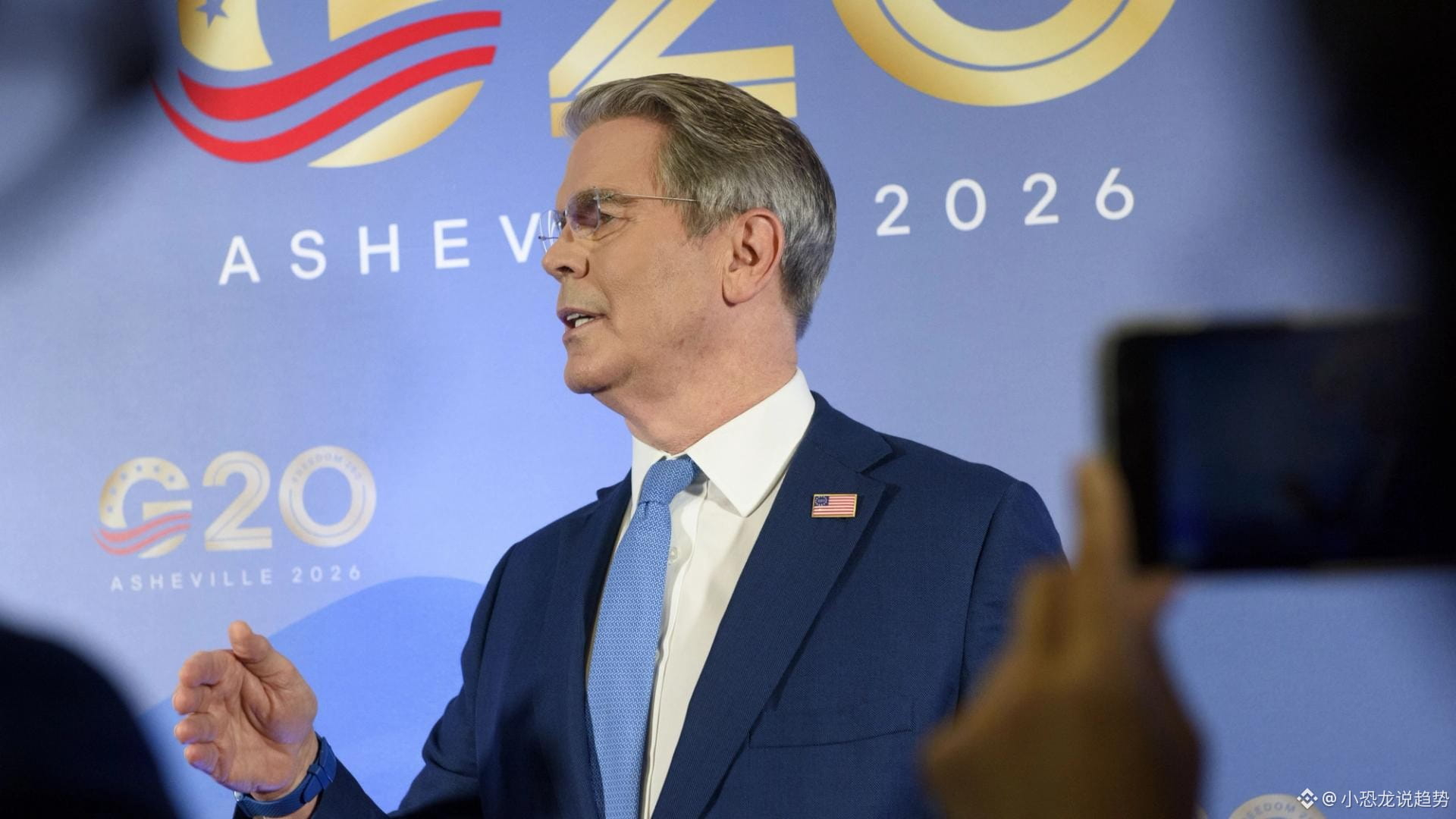
Iceland referendum says no—encryption oversight, its own way
On August 30, Iceland holds a referendum on whether to restart negotiations to join the European Union. The result: 52.8% of voters voted against. More than 105,000 ballots were “no”—it’s close, but it’s enough.
What’s interesting is that cities supported the negotiations more, while the countryside opposed them more. Across the strait, two ideas. In the end, the whole country decided: not going.
So what does not joining the EU mean? Iceland stays in the European Economic Area and doesn’t have to implement the EU’s MiCA crypto-asset regulatory framework.
For people in the industry, this is a good piece of news. Iceland is a major hub for Bitcoin mining: cheap geothermal energy, low electricity costs, and lots of mining operations. If regulation eases just a bit, miners can finally take a breath.
But then again, the real reason Iceland voted against this time isn’t actually crypto. It’s concerns from traditional industries like agriculture and fisheries—crypto miners just happened to get an unexpected bonus.
Of course, it’s not completely “anything goes.” Iceland’s crypto activities are currently regulated under general financial laws. And experts also warn that after MiCA, it could still come knocking through a European Economic Area agreement—just a different route.
My take: it’s fascinating how small countries choose their moves. When the big framework is too tight, you keep your distance and control your own pace. Iceland’s move is essentially leaving a test field for crypto.
But don’t get too excited too soon. EU rules often work like this: if you don’t go find them, they come find you.
How long do you think Iceland can remain a crypto paradise? Tell us in the comments.
Click the avatar to watch the live stream.
Every day, I’ll bring you updates on regulatory hotspots—not just what happens in the news, but also how to understand the logic and opportunities behind it 👉🦖
#监管 #MiCA
On August 30, Iceland holds a referendum on whether to restart negotiations to join the European Union. The result: 52.8% of voters voted against. More than 105,000 ballots were “no”—it’s close, but it’s enough.
What’s interesting is that cities supported the negotiations more, while the countryside opposed them more. Across the strait, two ideas. In the end, the whole country decided: not going.
So what does not joining the EU mean? Iceland stays in the European Economic Area and doesn’t have to implement the EU’s MiCA crypto-asset regulatory framework.
For people in the industry, this is a good piece of news. Iceland is a major hub for Bitcoin mining: cheap geothermal energy, low electricity costs, and lots of mining operations. If regulation eases just a bit, miners can finally take a breath.
But then again, the real reason Iceland voted against this time isn’t actually crypto. It’s concerns from traditional industries like agriculture and fisheries—crypto miners just happened to get an unexpected bonus.
Of course, it’s not completely “anything goes.” Iceland’s crypto activities are currently regulated under general financial laws. And experts also warn that after MiCA, it could still come knocking through a European Economic Area agreement—just a different route.
My take: it’s fascinating how small countries choose their moves. When the big framework is too tight, you keep your distance and control your own pace. Iceland’s move is essentially leaving a test field for crypto.
But don’t get too excited too soon. EU rules often work like this: if you don’t go find them, they come find you.
How long do you think Iceland can remain a crypto paradise? Tell us in the comments.
Click the avatar to watch the live stream.
Every day, I’ll bring you updates on regulatory hotspots—not just what happens in the news, but also how to understand the logic and opportunities behind it 👉🦖
#监管 #MiCA
Robinhood Chain’s single-day DEX volume hits $875 million
On August 30, the Robinhood Chain’s decentralized trading volume reached a historic record—$875 million in a single day. That day it processed 5.52 million transactions, also a new high.
The latest version of the leading DEX protocol contributed $432 million in just one day. Combined with the old version’s $357 million, the two versions together accounted for 90% of all transactions.
What’s truly interesting is the driving force behind it: tokenized stocks. In the past 30 days, the 7 most actively traded tokenized stocks generated $4.3 billion in trading volume in decentralized markets—3 of those were on the Robinhood Chain.
Just this one protocol alone processed $1.5 billion worth of tokenized stock trades on the Robinhood Chain within six weeks.
That directly translates into real revenue. On August 31, the Robinhood Chain’s applications earned $2.66 million over 24 hours—leaving Ethereum far behind, which had only $1.27 million in the same period.
My take: previously, on-chain excitement relied mostly on meme coins. Now tokenized stocks are moving in, bringing real, legitimate business to decentralized markets. Stocks can be traded on-chain too—and generate fee income.
Does this suggest that the boundary between traditional finance and crypto is being erased trade by trade?
Do you think tokenized stocks will become the next big on-chain main storyline—or just another passing trend?
Click the profile picture to watch the live stream.
Every day, I’ll take you to track tokenized-stocks and DeFi hotspots—not just see what happened in the news, but also help you understand the underlying logic and opportunities 👉🦖
#代币化股票 #DeFi
On August 30, the Robinhood Chain’s decentralized trading volume reached a historic record—$875 million in a single day. That day it processed 5.52 million transactions, also a new high.
The latest version of the leading DEX protocol contributed $432 million in just one day. Combined with the old version’s $357 million, the two versions together accounted for 90% of all transactions.
What’s truly interesting is the driving force behind it: tokenized stocks. In the past 30 days, the 7 most actively traded tokenized stocks generated $4.3 billion in trading volume in decentralized markets—3 of those were on the Robinhood Chain.
Just this one protocol alone processed $1.5 billion worth of tokenized stock trades on the Robinhood Chain within six weeks.
That directly translates into real revenue. On August 31, the Robinhood Chain’s applications earned $2.66 million over 24 hours—leaving Ethereum far behind, which had only $1.27 million in the same period.
My take: previously, on-chain excitement relied mostly on meme coins. Now tokenized stocks are moving in, bringing real, legitimate business to decentralized markets. Stocks can be traded on-chain too—and generate fee income.
Does this suggest that the boundary between traditional finance and crypto is being erased trade by trade?
Do you think tokenized stocks will become the next big on-chain main storyline—or just another passing trend?
Click the profile picture to watch the live stream.
Every day, I’ll take you to track tokenized-stocks and DeFi hotspots—not just see what happened in the news, but also help you understand the underlying logic and opportunities 👉🦖
#代币化股票 #DeFi

Bitcoin split faction revives—and slices blocks down to 300KB
Remember that Bitcoin fork back in August? The minority chain that split off previously went offline for 23 days. And this weekend, it somehow revived—already mined more than 800 blocks.
If they want to revive, let them revive. But they also made a big move: they swapped the Proof-of-Work algorithm from SHA-256 to Blake2b, and then cut the block size down to 300KB.
You heard right. Others complained that 1MB blocks weren’t big enough—these guys think it’s too big. The person who proposed this idea brought it up as early as 2017, and again in 2019. They tinkered for years, and only finally managed to implement it on this minority chain.
Even more amazing: this chain hasn’t listed on any mainstream exchange or trading platform. In price-chart software, there isn’t even a ticker/code for it. But supporters are still having a great time. They say they don’t need trading platforms—just exchange goods and services directly.
So the result is: mining on-chain is in full swing, and people in the circle are laughing their heads off, saying this isn’t Bitcoin anymore. They changed the algorithm too—how can you still call it Bitcoin?
My take: this kind of drama comes around every few years. Each time, someone loudly proclaims that this is the real Bitcoin. But the market votes with its feet—Bitcoin’s original chain goes up or down on its own, completely unaffected.
Forks aren’t scary. What’s scary is changing the protocol until even your own mother can’t recognize it, and insisting they’re the orthodox version.
How long do you think this 300KB little chain can last—one week, one month, or even longer?
Click the avatar to watch the live stream
Every day, I’ll take you to track Bitcoin hot topics. Not just what happens in the news—but also help you understand the logic and the opportunities behind it 👉🦖
#比特币 #BTC
Remember that Bitcoin fork back in August? The minority chain that split off previously went offline for 23 days. And this weekend, it somehow revived—already mined more than 800 blocks.
If they want to revive, let them revive. But they also made a big move: they swapped the Proof-of-Work algorithm from SHA-256 to Blake2b, and then cut the block size down to 300KB.
You heard right. Others complained that 1MB blocks weren’t big enough—these guys think it’s too big. The person who proposed this idea brought it up as early as 2017, and again in 2019. They tinkered for years, and only finally managed to implement it on this minority chain.
Even more amazing: this chain hasn’t listed on any mainstream exchange or trading platform. In price-chart software, there isn’t even a ticker/code for it. But supporters are still having a great time. They say they don’t need trading platforms—just exchange goods and services directly.
So the result is: mining on-chain is in full swing, and people in the circle are laughing their heads off, saying this isn’t Bitcoin anymore. They changed the algorithm too—how can you still call it Bitcoin?
My take: this kind of drama comes around every few years. Each time, someone loudly proclaims that this is the real Bitcoin. But the market votes with its feet—Bitcoin’s original chain goes up or down on its own, completely unaffected.
Forks aren’t scary. What’s scary is changing the protocol until even your own mother can’t recognize it, and insisting they’re the orthodox version.
How long do you think this 300KB little chain can last—one week, one month, or even longer?
Click the avatar to watch the live stream
Every day, I’ll take you to track Bitcoin hot topics. Not just what happens in the news—but also help you understand the logic and the opportunities behind it 👉🦖
#比特币 #BTC
BlackRock has reclaimed the throne of tokenized U.S. Treasuries
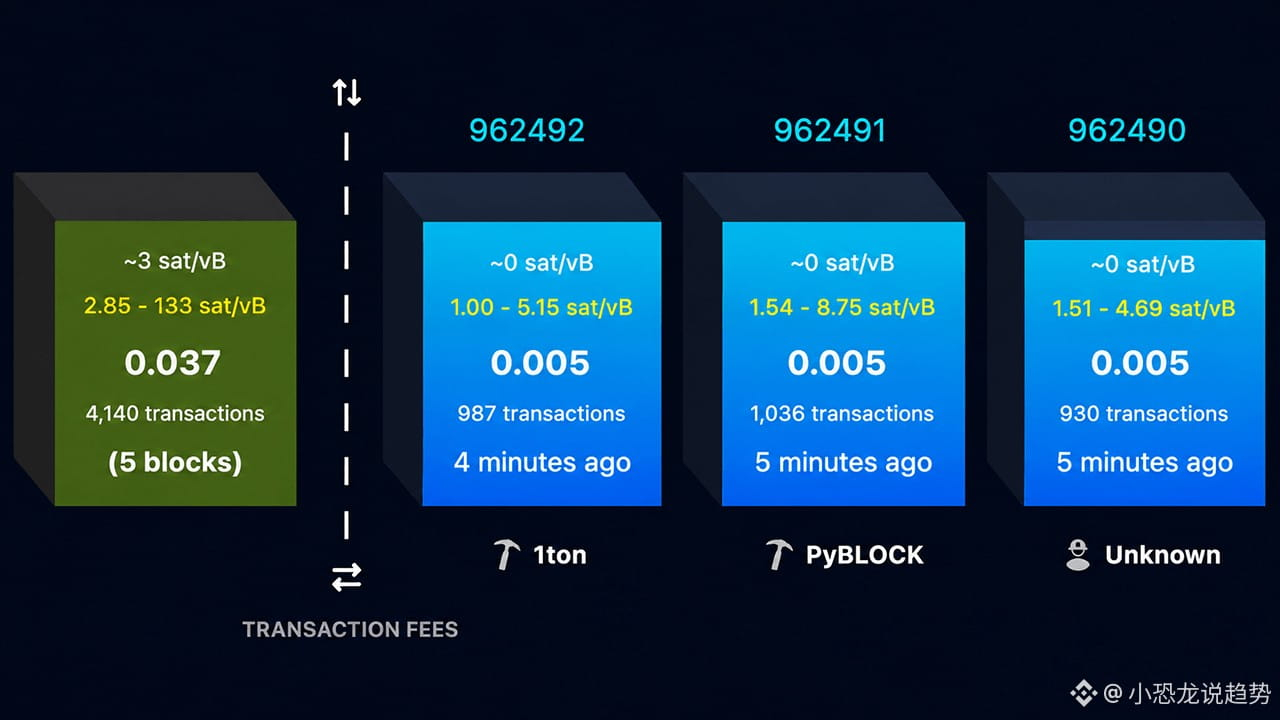
BlackRock’s BUIDL fund has brought its managed assets back to $2.8 billion, regaining the top spot as the world’s largest tokenized U.S. Treasury product. Earlier this March, it was just overtaken by Circle’s USYC. Less than half a year later, it retaliated and took the lead again.
Now the entire tokenized U.S. Treasury market is only $15.1 billion. BUIDL alone accounts for 18.5%, while all the other players together split the remaining 81.5%.
What is BUIDL? Simply put, it moves money market funds on-chain. The underlying assets are cash, short-term U.S. Treasuries, and repurchase agreements. Each share’s net asset value is pegged to $1. It automatically accrues interest every day, and can be traded 24/7.
How solid is this? Moody’s directly awarded it an AAA rating—the most conservative money in traditional finance. They don’t dare to touch Bitcoin, but they’re pouring real money into this product.
The operator behind it, Securitize, has deployed BUIDL across 8 chains—Ethereum, Solana, Aptos, and more. Competitors like Franklin Templeton and Ondo are also chasing from behind.
My take: don’t just focus on whether the token price goes up or down. Tokenized U.S. Treasuries are this year’s most low-key, high-profit track. It doesn’t rely on hype; it relies on bringing the traditional wealth-management experience onto the blockchain—step by step.
When Wall Street starts voting with its feet—putting real money into on-chain Treasuries—this trend speaks more clearly than any chart.
How much share of traditional money-market funds do you think tokenized U.S. Treasuries will eventually capture? Let’s discuss in the comments.
Click the avatar to watch the livestream.
Every day, I’ll take you to follow tokenization hotspots—not just what happens in the news, but also help you understand the logic and opportunities behind it 👉🦖
#RWA #tokenization
BlackRock’s BUIDL fund has brought its managed assets back to $2.8 billion, regaining the top spot as the world’s largest tokenized U.S. Treasury product. Earlier this March, it was just overtaken by Circle’s USYC. Less than half a year later, it retaliated and took the lead again.
Now the entire tokenized U.S. Treasury market is only $15.1 billion. BUIDL alone accounts for 18.5%, while all the other players together split the remaining 81.5%.
What is BUIDL? Simply put, it moves money market funds on-chain. The underlying assets are cash, short-term U.S. Treasuries, and repurchase agreements. Each share’s net asset value is pegged to $1. It automatically accrues interest every day, and can be traded 24/7.
How solid is this? Moody’s directly awarded it an AAA rating—the most conservative money in traditional finance. They don’t dare to touch Bitcoin, but they’re pouring real money into this product.
The operator behind it, Securitize, has deployed BUIDL across 8 chains—Ethereum, Solana, Aptos, and more. Competitors like Franklin Templeton and Ondo are also chasing from behind.
My take: don’t just focus on whether the token price goes up or down. Tokenized U.S. Treasuries are this year’s most low-key, high-profit track. It doesn’t rely on hype; it relies on bringing the traditional wealth-management experience onto the blockchain—step by step.
When Wall Street starts voting with its feet—putting real money into on-chain Treasuries—this trend speaks more clearly than any chart.
How much share of traditional money-market funds do you think tokenized U.S. Treasuries will eventually capture? Let’s discuss in the comments.
Click the avatar to watch the livestream.
Every day, I’ll take you to follow tokenization hotspots—not just what happens in the news, but also help you understand the logic and opportunities behind it 👉🦖
#RWA #tokenization
UK law enforcement agencies have frozen a Premier League club’s account worth $13.5 million
The case involves a $140 million sponsorship deal, and the sponsor is a crypto company
As soon as the news broke, both insiders and outsiders started speculating that the Premier League had also “fallen”
But the official response came quickly: the Premier League itself has no problem—investigators are only probing the related funds
The most interesting part of this case is this:
Once regulated crypto money gets involved, even a top-tier league like the Premier League has to cooperate with the investigation
What does that mean? The crypto industry is no longer a lawless zone—every large transaction has eyes on it
Compliance is the line nobody can get around
For ordinary players, this may seem far away, but it’s actually close to home
What law enforcement is checking is funds of unclear origin, not normal transactions
As long as your money comes from legitimate sources and you use proper channels for transactions, there’s nothing to worry about
The real thing you should be afraid of is funds with unclear origins—once checked, the truth comes out quickly
The stricter regulation becomes, the healthier the industry becomes
The days when dirty money was everywhere are over—what remains are genuine, legitimate players
In the short term, the headlines may be a bit alarming; in the long run, this is the necessary path toward industry maturity
Follow compliance, stay away from gray areas—it’s more reliable than any technical analysis
Look at it from another angle: this is also a lesson for everyone
When large amounts of money move in and out, every link in the chain is being scrutinized
Don’t think it’s far from you—platform risk control is getting stricter, and it’s the same logic throughout
Clean funds are safe wherever they go—this holds true no matter where you say it
Every day, I’ll bring you to watch regulatory hot topics—not just what happened in the news, but also how to understand the underlying logic and opportunities 👀🚀
Click the link below to follow me👇🏻
👉 加入小恐龙粉丝群
#加密货币 #监管 #加密市场
The case involves a $140 million sponsorship deal, and the sponsor is a crypto company
As soon as the news broke, both insiders and outsiders started speculating that the Premier League had also “fallen”
But the official response came quickly: the Premier League itself has no problem—investigators are only probing the related funds
The most interesting part of this case is this:
Once regulated crypto money gets involved, even a top-tier league like the Premier League has to cooperate with the investigation
What does that mean? The crypto industry is no longer a lawless zone—every large transaction has eyes on it
Compliance is the line nobody can get around
For ordinary players, this may seem far away, but it’s actually close to home
What law enforcement is checking is funds of unclear origin, not normal transactions
As long as your money comes from legitimate sources and you use proper channels for transactions, there’s nothing to worry about
The real thing you should be afraid of is funds with unclear origins—once checked, the truth comes out quickly
The stricter regulation becomes, the healthier the industry becomes
The days when dirty money was everywhere are over—what remains are genuine, legitimate players
In the short term, the headlines may be a bit alarming; in the long run, this is the necessary path toward industry maturity
Follow compliance, stay away from gray areas—it’s more reliable than any technical analysis
Look at it from another angle: this is also a lesson for everyone
When large amounts of money move in and out, every link in the chain is being scrutinized
Don’t think it’s far from you—platform risk control is getting stricter, and it’s the same logic throughout
Clean funds are safe wherever they go—this holds true no matter where you say it
Every day, I’ll bring you to watch regulatory hot topics—not just what happened in the news, but also how to understand the underlying logic and opportunities 👀🚀
Click the link below to follow me👇🏻
👉 加入小恐龙粉丝群
#加密货币 #监管 #加密市场

SOL’s ETF has also surpassed $1 billion
Bitwise’s Solana staking ETF launched just 10 months ago and has already pushed its assets under management past $1 billion, becoming the third coin with a $1B-level ETF after Bitcoin and Ethereum.
Where does the value of this record come from? Most of the capital came in during the bear market. The market has been gradually drifting downward, while institutions have kept buying. Now Solana’s total ETF AUM is 1.43 billion, accounting for 2.35% of SOL’s market cap.
Solana itself has also performed well—rising 46% in August, rebounding 80% from the June low. The price has climbed back above $100, and its market cap has returned to over $60 billion.
Even traditional brokerages can’t sit still. Charles Schwab has announced it will roll out SOL spot trading for its clients next. They’re a big player managing $12 trillion in assets.
And many SOL funds also include staking yield. They can support net asset value just by collecting on-chain interest—something traditional ETFs could hardly even imagine.
Industry analysts say total inflows into the entire Solana ETF track have reached $1.7 billion, with almost no sustained outflows. Purchases during the bear market, and now it’s starting to cash in.
My take: the most convincing part of this cycle isn’t Bitcoin—it’s the ETF-ification of altcoins. Whichever one gets turned into a product by Wall Street first will be the one that can capture the next wave of allocation benefits.
Next, we should guess: who will be the fourth $1B-level ETF—XRP, or another dark-horse?
Click the profile picture to watch the live stream.
Every day, I’ll take you to track ETF hot topics— not just what’s happening in the news, but also to help you understand the logic and opportunities behind it 👉🦖
#Solana #ETF
Bitwise’s Solana staking ETF launched just 10 months ago and has already pushed its assets under management past $1 billion, becoming the third coin with a $1B-level ETF after Bitcoin and Ethereum.
Where does the value of this record come from? Most of the capital came in during the bear market. The market has been gradually drifting downward, while institutions have kept buying. Now Solana’s total ETF AUM is 1.43 billion, accounting for 2.35% of SOL’s market cap.
Solana itself has also performed well—rising 46% in August, rebounding 80% from the June low. The price has climbed back above $100, and its market cap has returned to over $60 billion.
Even traditional brokerages can’t sit still. Charles Schwab has announced it will roll out SOL spot trading for its clients next. They’re a big player managing $12 trillion in assets.
And many SOL funds also include staking yield. They can support net asset value just by collecting on-chain interest—something traditional ETFs could hardly even imagine.
Industry analysts say total inflows into the entire Solana ETF track have reached $1.7 billion, with almost no sustained outflows. Purchases during the bear market, and now it’s starting to cash in.
My take: the most convincing part of this cycle isn’t Bitcoin—it’s the ETF-ification of altcoins. Whichever one gets turned into a product by Wall Street first will be the one that can capture the next wave of allocation benefits.
Next, we should guess: who will be the fourth $1B-level ETF—XRP, or another dark-horse?
Click the profile picture to watch the live stream.
Every day, I’ll take you to track ETF hot topics— not just what’s happening in the news, but also to help you understand the logic and opportunities behind it 👉🦖
#Solana #ETF

ETF money vacuuming up like crazy: Bitcoin closes August strong
On Monday, Bitcoin spot ETF net inflows totaled $216.7 million—one BlackRock fund alone accounted for $205.9 million, directly putting an end to Friday’s outflows.
Ethereum ETFs were even more aggressive: net inflows for 11 straight trading days, with another $87.68 million added on the day. Altcoin ETFs weren’t idle either—XRP saw inflows of $5.64 million, while Solana added $0.92 million.
The key numbers: Bitcoin ETF total assets have already climbed to $99.61 billion. It’s just one step away from the $100 billion mark.
Over the whole of August, spot ETFs attracted $3.52 billion, the strongest single month since October last year. Bitcoin itself rose 25% in August—this is the first time an August ended positive since 2021.
People used to say August is a quiet period for crypto, with a lukewarm market. But this year’s script is completely flipped: institutions quietly add positions during the slow season, while retail investors are still debating whether to get on board.
My take: the $100 billion threshold isn’t just a number—it means Wall Street’s allocation capital is starting to treat Bitcoin as a standard asset rather than a speculative one.
On the first day of September, U.S. stocks are still trembling due to developments in the Middle East. But ETF fund flows show that long-term capital and short-term panic are two different groups doing two different things.
When do you think total Bitcoin ETF assets will break $100 billion—this week or next week?
Click the avatar to watch the live stream.
Every day, I’ll take you through ETF hotspots—not just what’s happening in the news, but also the logic and opportunities behind it 👉🦖
#比特币ETF #加密市场
On Monday, Bitcoin spot ETF net inflows totaled $216.7 million—one BlackRock fund alone accounted for $205.9 million, directly putting an end to Friday’s outflows.
Ethereum ETFs were even more aggressive: net inflows for 11 straight trading days, with another $87.68 million added on the day. Altcoin ETFs weren’t idle either—XRP saw inflows of $5.64 million, while Solana added $0.92 million.
The key numbers: Bitcoin ETF total assets have already climbed to $99.61 billion. It’s just one step away from the $100 billion mark.
Over the whole of August, spot ETFs attracted $3.52 billion, the strongest single month since October last year. Bitcoin itself rose 25% in August—this is the first time an August ended positive since 2021.
People used to say August is a quiet period for crypto, with a lukewarm market. But this year’s script is completely flipped: institutions quietly add positions during the slow season, while retail investors are still debating whether to get on board.
My take: the $100 billion threshold isn’t just a number—it means Wall Street’s allocation capital is starting to treat Bitcoin as a standard asset rather than a speculative one.
On the first day of September, U.S. stocks are still trembling due to developments in the Middle East. But ETF fund flows show that long-term capital and short-term panic are two different groups doing two different things.
When do you think total Bitcoin ETF assets will break $100 billion—this week or next week?
Click the avatar to watch the live stream.
Every day, I’ll take you through ETF hotspots—not just what’s happening in the news, but also the logic and opportunities behind it 👉🦖
#比特币ETF #加密市场
Log in to explore more content