
Sonu7856
84 Posts

Sonu7856
I am good trader in spot . Binance is a good platform for people
Open Trade
Frequent Trader
6.2 Months
478 Following
4.1K+ Followers
500 Liked
Posts
Portfolio
All
Quotes
PINNED
Ethereum (ETH) is one of the most important cryptocurrencies because it powers smart contracts and decentralized applications (dApps). Unlike digital currencies used only for payments, Ethereum enables developers to build DeFi platforms, NFTs, blockchain games, and other innovative services. ETH is also used to pay network transaction fees and secure the blockchain through staking, making it a key part of the growing Web3 ecosystem.
#ClaimYourReward #claimRedPacket #Ethereum #BinanceSquareFamily
#ClaimYourReward #claimRedPacket #Ethereum #BinanceSquareFamily
go

Suadagar Ali
·
--
#BNB $
follow ☘️🥀🌹like
comments repost
follow ☘️🥀🌹like
comments repost

go
龟龟财神到
·
--
Want to be a dad and mom #孙宇晨景甜
go

AYESHA ABID 阿伊莎 阿比德
·
--
Bullish$SOL — Levels That Matter Right Now 👀
$SOL around $195 is sitting at a key decision point.
📈 Break & Hold: $198
🎯 Upside: $202 → $208 → $215
🟢 Major Support: $190
🔻 Breakdown: Below $190
🎯 Downside: $185 → $180
The setup is simple:
$198 reclaimed = buyers gain control
$190 lost = sellers gain control
No need to chase the candle. Let the level confirm the move.
$SOL
Are you watching $215 or $180 first?
#SOL #Solana
$SOL around $195 is sitting at a key decision point.
📈 Break & Hold: $198
🎯 Upside: $202 → $208 → $215
🟢 Major Support: $190
🔻 Breakdown: Below $190
🎯 Downside: $185 → $180
The setup is simple:
$198 reclaimed = buyers gain control
$190 lost = sellers gain control
No need to chase the candle. Let the level confirm the move.
$SOL
Are you watching $215 or $180 first?
#SOL #Solana
go


HadiaBTC
·
--
Good morning everyone 🌞 #HadiaBTC
Today Top Gainers
$MOVR
$HEMI
$TRUMP
Today Top Gainers
$MOVR
$HEMI
$TRUMP

go
Bilverse
·
--
🚨 STOP SCROLLING — FREE ETH IS DROPPING 🧧⚡️
Binance Red Packets are loaded. 👀
If you want a shot at claiming ETH, do this:
• Follow @Bilverse
• Reshare this post
• Comment “4000” 🗣️
That’s it.
The more people who see this, the more chaotic this giveaway gets. 😂🔥
Follow → Reshare → “4000”
Click here to DOUBLE your Rewards! 🧧🚀
Let’s see how fast the ETH disappears. 🧧💎
#ETH #RedPacketMission #Bilverse #CryptoCommunity
Binance Red Packets are loaded. 👀
If you want a shot at claiming ETH, do this:
• Follow @Bilverse
• Reshare this post
• Comment “4000” 🗣️
That’s it.
The more people who see this, the more chaotic this giveaway gets. 😂🔥
Follow → Reshare → “4000”
Click here to DOUBLE your Rewards! 🧧🚀
Let’s see how fast the ETH disappears. 🧧💎
#ETH #RedPacketMission #Bilverse #CryptoCommunity

go

Shaheen 69
·
--
🎁 A Little Red Packet Surprise for My Amazing Followers! 🧧
You’ve supported, liked, commented, and shared my content throughout the journey — and now it’s time to give something back! ❤️
I’m sending out a Red Packet Gift as a small thank-you to my amazing community. 🧧✨
Keep following, stay active, and don’t miss the drop — you never know when the next surprise will arrive! 👀🔥
Your support means more than numbers on a screen. Every follower is part of this journey, and I truly appreciate you. 🙏
Good luck everyone! 🍀 May your Red Packet bring you a little extra happiness today! 🚀🧧
Stay connected. Stay active. Stay winning! 💎
$TUT
$BEAMX
You’ve supported, liked, commented, and shared my content throughout the journey — and now it’s time to give something back! ❤️
I’m sending out a Red Packet Gift as a small thank-you to my amazing community. 🧧✨
Keep following, stay active, and don’t miss the drop — you never know when the next surprise will arrive! 👀🔥
Your support means more than numbers on a screen. Every follower is part of this journey, and I truly appreciate you. 🙏
Good luck everyone! 🍀 May your Red Packet bring you a little extra happiness today! 🚀🧧
Stay connected. Stay active. Stay winning! 💎
$TUT
$BEAMX

go

Ahmed Ali Nizamani
·
--
50 + 730 = 🎁🎁🎁🎁✨

go
MANO_加密 143
·
--
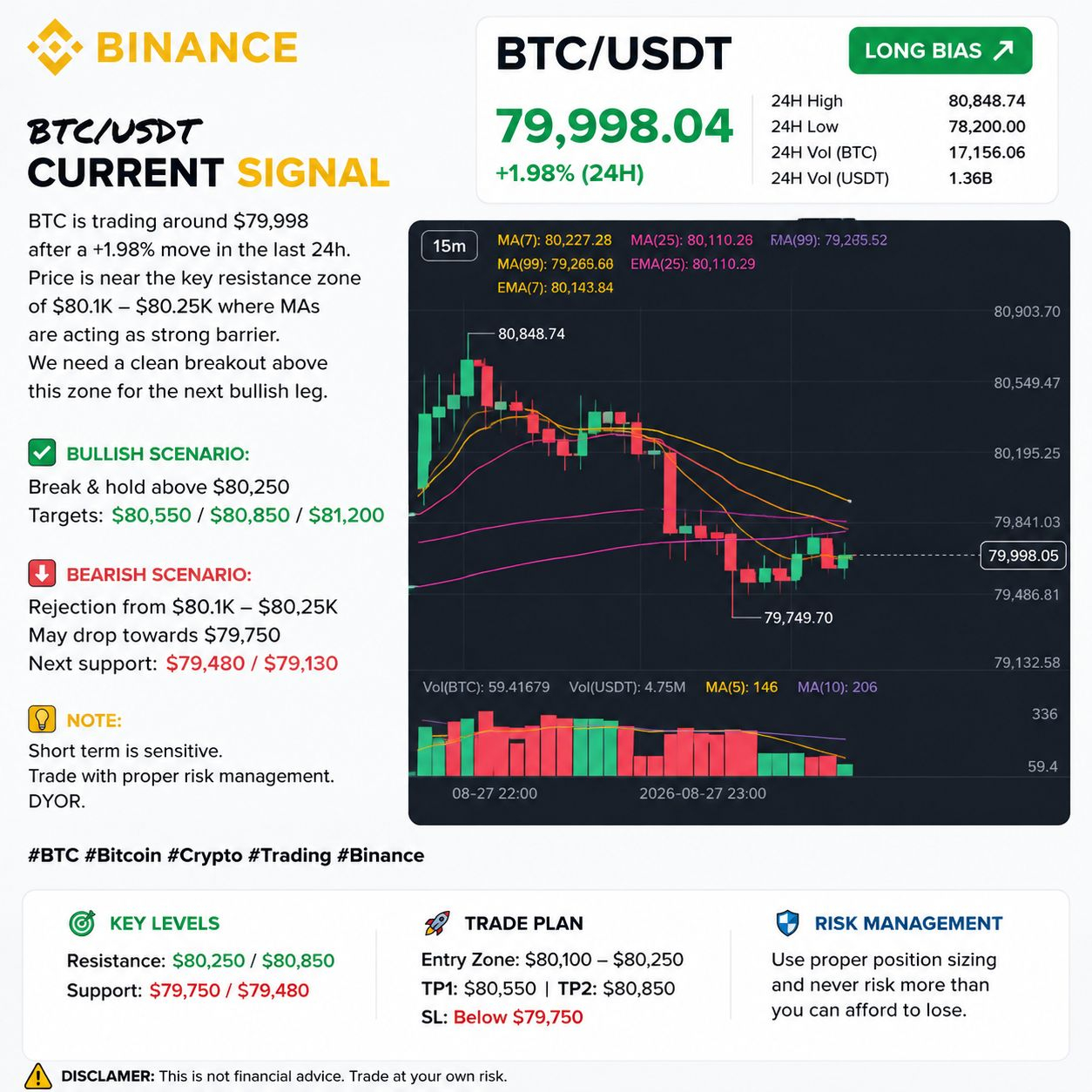
BullishBTC is sitting around $80K after a strong 24h move. On the 15m chart, price is still below the short-term MA/EMA levels near $80.1K–$80.25K, so this zone is important.
📈 Break & hold above $80.25K → bullish continuation could target $80.55K / $80.85K
📉 Rejection from $80.1K–$80.25K → watch $79.75K support.
For now, I’d wait for confirmation instead of chasing the move. Keep risk managed and DYOR. 🚀
#BTC #Bitcoin #BTCUSDT #Crypto #Binance
📈 Break & hold above $80.25K → bullish continuation could target $80.55K / $80.85K
📉 Rejection from $80.1K–$80.25K → watch $79.75K support.
For now, I’d wait for confirmation instead of chasing the move. Keep risk managed and DYOR. 🚀
#BTC #Bitcoin #BTCUSDT #Crypto #Binance
go

Prince-7³
·
--
welcome square family 😊
claim 🧧 Follow 🧧 Repost 🧧
$BTC
$BNB
$ETH
#GIVEAWAY🎁
claim 🧧 Follow 🧧 Repost 🧧
$BTC
$BNB
$ETH
#GIVEAWAY🎁

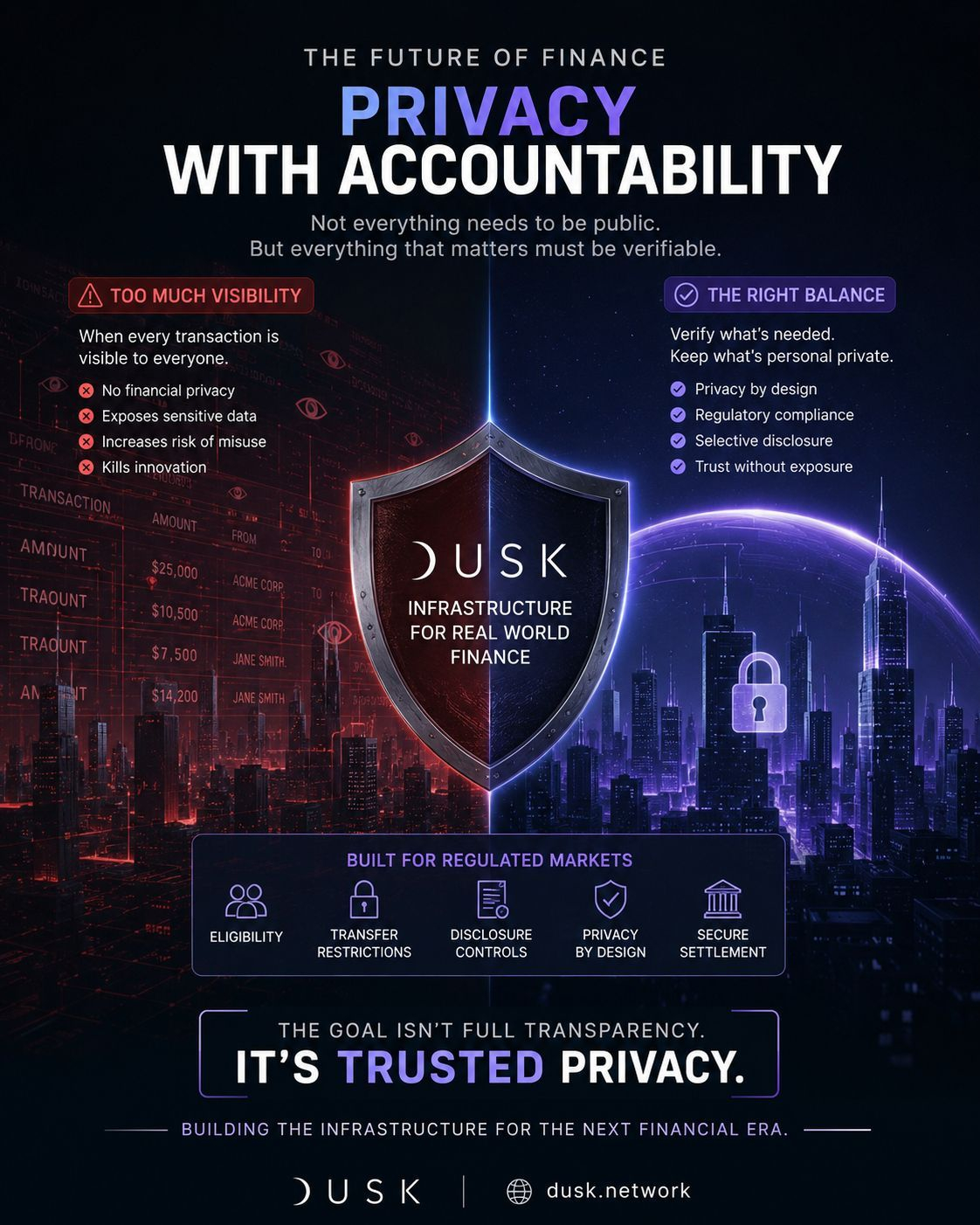
Random thought I had the other day — what if every financial transaction I made was visible to everyone, name and all? Sounds like a simple thought experiment, right? But sit with it for a second and it gets uncomfortable fast.
Because that's not actually how real financial markets work. Not everything is public. Who owns what, who's allowed to buy it, what needs to be disclosed and to whom, what stays private — that tension is basically the whole structure of finance. And that's what got me thinking about Dusk.
Full transparency isn't really the goal here. It's almost the opposite question: how do you verify what needs verifying without exposing someone's entire financial life to the world?
This matters even more with regulated assets. Slapping a token on something doesn't magically bring real market rules with it. Eligibility, transfer restrictions, privacy, disclosure requirements, settlement — all of that has to actually be built into the system, not bolted on after. That's the problem Dusk seems to be going after.
But here's what I keep coming back to: building this kind of infrastructure is obviously hard. The real question is whether future financial markets actually want more transparency — or whether what they really want is privacy paired with accountability.
I think that's where the real test is. Guess we'll find out 👍
@Dusk $DUSK #dusk
Because that's not actually how real financial markets work. Not everything is public. Who owns what, who's allowed to buy it, what needs to be disclosed and to whom, what stays private — that tension is basically the whole structure of finance. And that's what got me thinking about Dusk.
Full transparency isn't really the goal here. It's almost the opposite question: how do you verify what needs verifying without exposing someone's entire financial life to the world?
This matters even more with regulated assets. Slapping a token on something doesn't magically bring real market rules with it. Eligibility, transfer restrictions, privacy, disclosure requirements, settlement — all of that has to actually be built into the system, not bolted on after. That's the problem Dusk seems to be going after.
But here's what I keep coming back to: building this kind of infrastructure is obviously hard. The real question is whether future financial markets actually want more transparency — or whether what they really want is privacy paired with accountability.
I think that's where the real test is. Guess we'll find out 👍
@Dusk $DUSK #dusk
Ethereum (ETH) is one of the most important cryptocurrencies because it powers smart contracts and decentralized applications (dApps). Unlike digital currencies used only for payments, Ethereum enables developers to build DeFi platforms, NFTs, blockchain games, and other innovative services. ETH is also used to pay network transaction fees and secure the blockchain through staking, making it a key part of the growing Web3 ecosystem.
#ClaimYourReward #claimRedPacket #Ethereum #BinanceSquareFamily
#ClaimYourReward #claimRedPacket #Ethereum #BinanceSquareFamily

#dusk $DUSK @Dusk
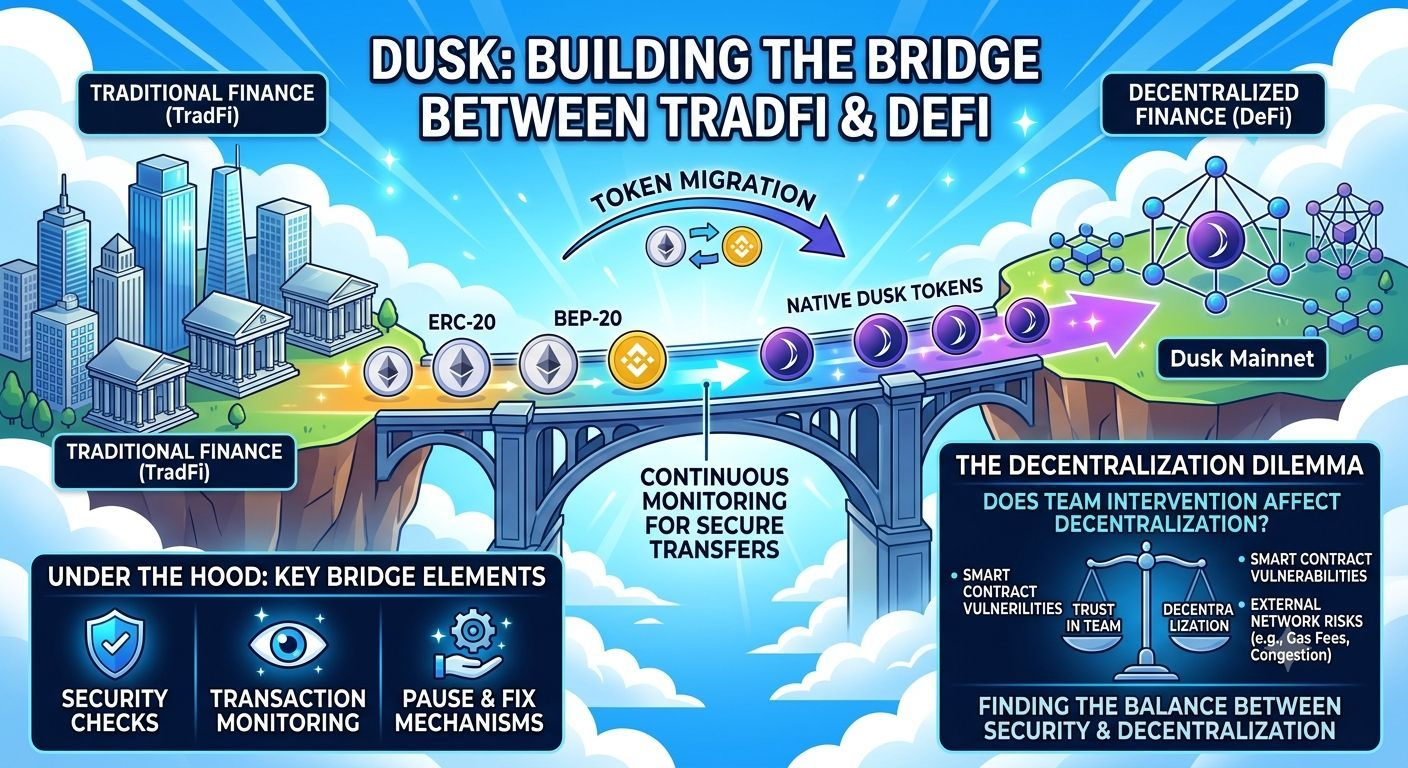
Earlier today, I was chatting with my brother about Dusk. He mentioned that Dusk’s main goal is to build a bridge between traditional finance (TradFi) and decentralized finance (DeFi).
That got me thinking: How does this bridge and token migration actually work under the hood?
At first, it sounds simple enough. You swap your ERC-20 or BEP-20 $DUSK tokens for native Dusk Mainnet tokens, or move them back whenever you need to. On paper, a bridge just moves assets from one network to another.
But when you look closer, it’s about way more than just transferring tokens.
To keep things secure, the bridge constantly monitors transactions. If something looks suspicious or a technical glitch happens, the team can step in to pause or fix it. On one hand, that extra layer of protection is great for safety. But on the other hand, it raises a big question: Does having that kind of control make the system less decentralized?
Whenever a team can intervene, you have to trust them to make the right call. On top of that, you still have to deal with typical crypto risks:
Smart contract vulnerabilities
External network issues (like high gas fees or congestion on Ethereum and BNB Chain slowing things down)
We often think of crypto bridges as simple, invisible tunnels. In reality, they are a complex mix of security checks, manual controls, and reliance on outside blockchains.
I'm not saying the Dusk bridge is unsafe—far from it. But it highlights a really interesting dilemma: How secure a system is on a technical level isn't the same as how decentralized it is in practice.
Finding the right balance between the two is where the real challenge lies.
#dusk @Dusk $DUSK
Earlier today, I was chatting with my brother about Dusk. He mentioned that Dusk’s main goal is to build a bridge between traditional finance (TradFi) and decentralized finance (DeFi).
That got me thinking: How does this bridge and token migration actually work under the hood?
At first, it sounds simple enough. You swap your ERC-20 or BEP-20 $DUSK tokens for native Dusk Mainnet tokens, or move them back whenever you need to. On paper, a bridge just moves assets from one network to another.
But when you look closer, it’s about way more than just transferring tokens.
To keep things secure, the bridge constantly monitors transactions. If something looks suspicious or a technical glitch happens, the team can step in to pause or fix it. On one hand, that extra layer of protection is great for safety. But on the other hand, it raises a big question: Does having that kind of control make the system less decentralized?
Whenever a team can intervene, you have to trust them to make the right call. On top of that, you still have to deal with typical crypto risks:
Smart contract vulnerabilities
External network issues (like high gas fees or congestion on Ethereum and BNB Chain slowing things down)
We often think of crypto bridges as simple, invisible tunnels. In reality, they are a complex mix of security checks, manual controls, and reliance on outside blockchains.
I'm not saying the Dusk bridge is unsafe—far from it. But it highlights a really interesting dilemma: How secure a system is on a technical level isn't the same as how decentralized it is in practice.
Finding the right balance between the two is where the real challenge lies.
#dusk @Dusk $DUSK
Verified
#dusk $DUSK @Dusk
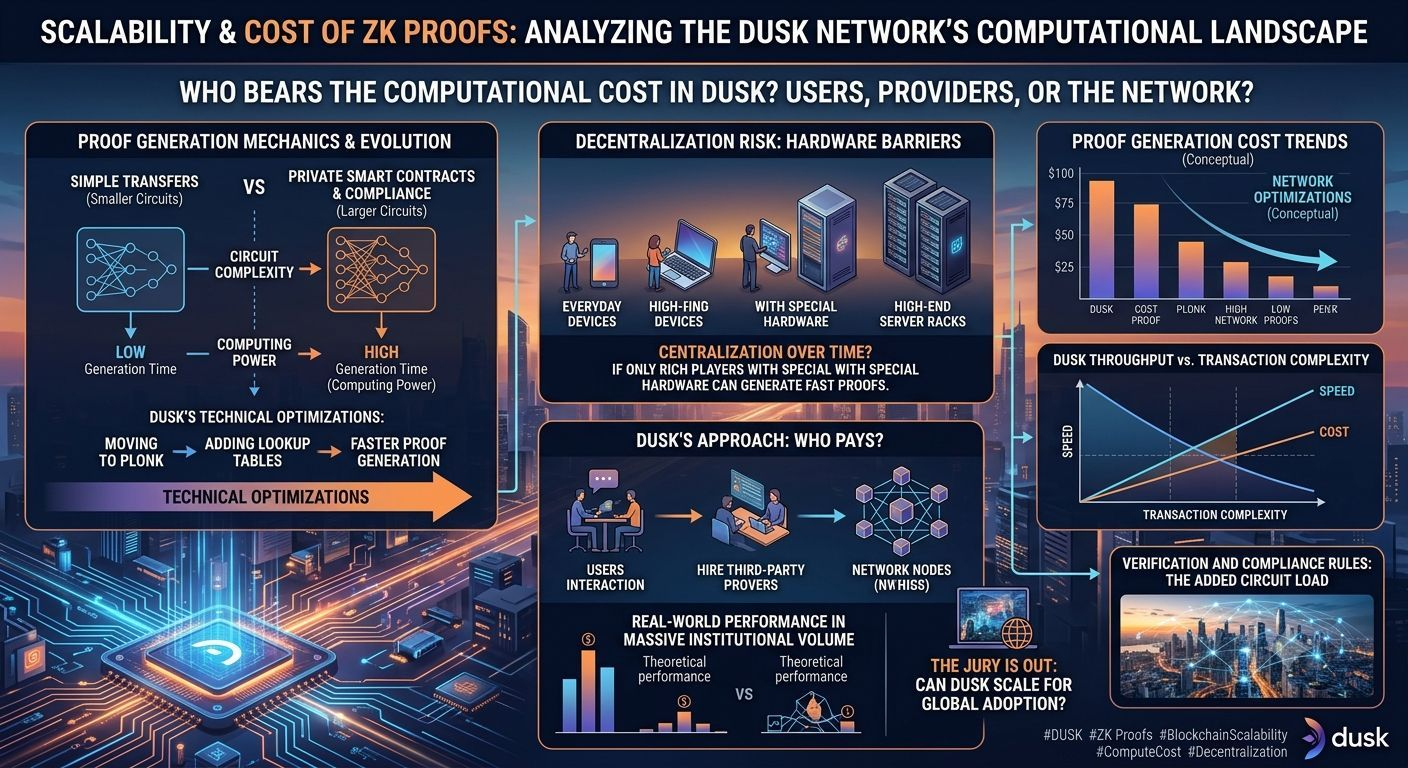
The part of @Dusk_Foundation's design I'm most genuinely uncertain about is proof-generation cost at scale.
Generating a zk-SNARK proof isn't free — computational cost scales with circuit complexity, and across zk systems generally, proving times for complex circuits can run from sub-second to tens of seconds depending on hardware and constraint count.
Confidential smart contracts with compliance logic baked in are, almost by definition, more complex circuits than a plain transfer. That has real implications: who bears the proving cost (the user's device, a delegated prover, the node), and does that create centralization pressure if only well-resourced provers can generate proofs quickly enough to be useful?
Dusk has iterated on this (PLONK, then PlonKup with lookup tables to speed up complex proofs), which shows they're aware of the bottleneck. Whether it's fully solved for institutional-grade transaction volume is an open, empirical question, not something I'd take on faith.
$DUSK #dusk
The part of @Dusk_Foundation's design I'm most genuinely uncertain about is proof-generation cost at scale.
Generating a zk-SNARK proof isn't free — computational cost scales with circuit complexity, and across zk systems generally, proving times for complex circuits can run from sub-second to tens of seconds depending on hardware and constraint count.
Confidential smart contracts with compliance logic baked in are, almost by definition, more complex circuits than a plain transfer. That has real implications: who bears the proving cost (the user's device, a delegated prover, the node), and does that create centralization pressure if only well-resourced provers can generate proofs quickly enough to be useful?
Dusk has iterated on this (PLONK, then PlonKup with lookup tables to speed up complex proofs), which shows they're aware of the bottleneck. Whether it's fully solved for institutional-grade transaction volume is an open, empirical question, not something I'd take on faith.
$DUSK #dusk

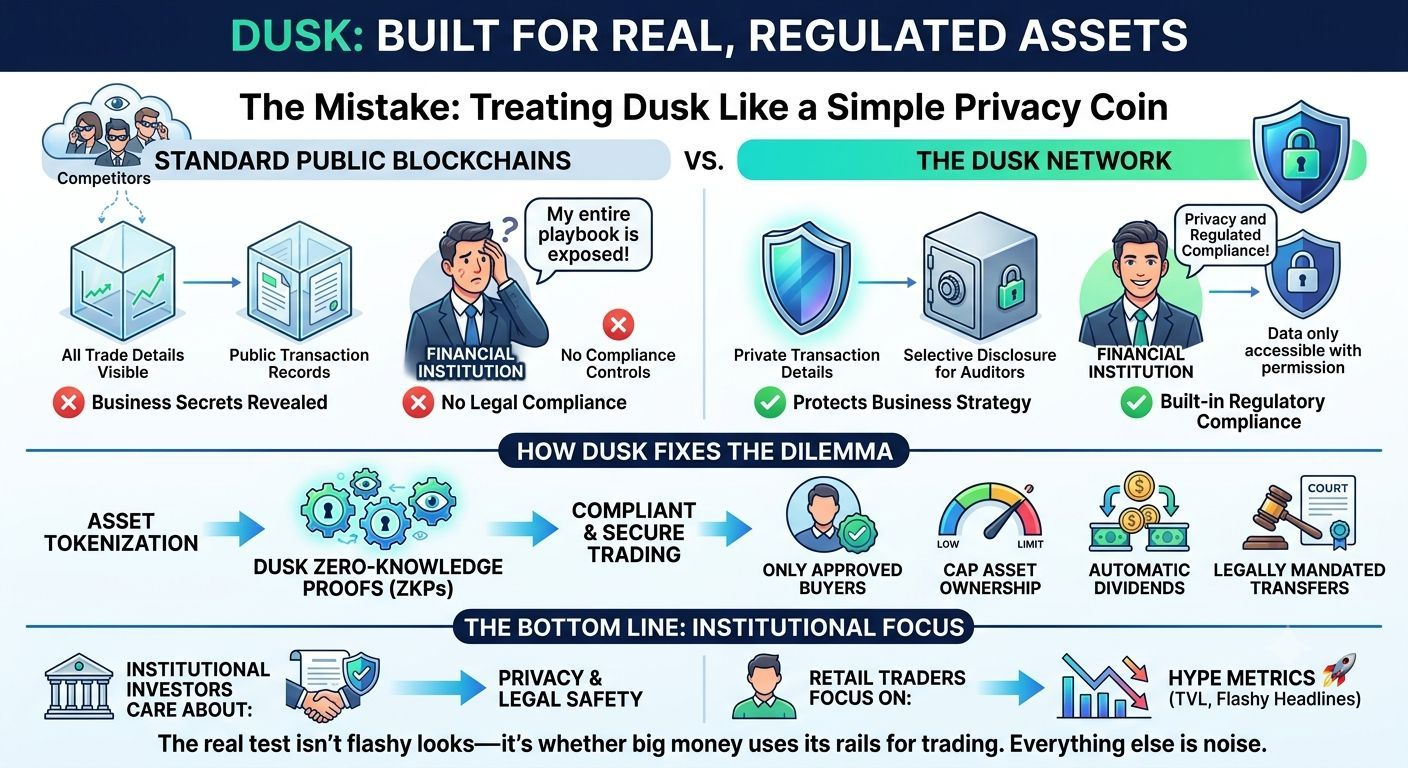
People ignore Dusk because they lump it in with basic privacy coins. That's a huge mistake.
Dusk isn't just about hiding money—it's built for real, regulated assets.
The Big Problem with Normal Blockchains
Tokenizing a real-world asset is easy. The hard part is actually trading it without exposing your business secrets.
On standard blockchains, everything is public. Big financial institutions won't use them because they'd be forced to choose between two bad options:
Show their entire business playbook to competitors.
Stay off the blockchain completely.
How Dusk Fixes It
Big investors need privacy, but they also have to follow strict legal rules. They need to:
Make sure only approved people can buy certain tokens.
Cap how much of an asset one person can own.
Pay out dividends automatically.
Comply with court orders if a transfer is legally required.
Dusk uses selective disclosure. It keeps trade details hidden from the general public, but allows institutions to show proof to auditors or regulators whenever necessary.
The Bottom Line
Retail traders are distracted by simple stats like total locked value (TVL). But big institutions don't care about hype metrics—they care about privacy and legal safety.
The real test isn't how flashy Dusk looks today, but whether big money actually uses its rails to trade tomorrow.
#dusk $DUSK @Dusk
Dusk isn't just about hiding money—it's built for real, regulated assets.
The Big Problem with Normal Blockchains
Tokenizing a real-world asset is easy. The hard part is actually trading it without exposing your business secrets.
On standard blockchains, everything is public. Big financial institutions won't use them because they'd be forced to choose between two bad options:
Show their entire business playbook to competitors.
Stay off the blockchain completely.
How Dusk Fixes It
Big investors need privacy, but they also have to follow strict legal rules. They need to:
Make sure only approved people can buy certain tokens.
Cap how much of an asset one person can own.
Pay out dividends automatically.
Comply with court orders if a transfer is legally required.
Dusk uses selective disclosure. It keeps trade details hidden from the general public, but allows institutions to show proof to auditors or regulators whenever necessary.
The Bottom Line
Retail traders are distracted by simple stats like total locked value (TVL). But big institutions don't care about hype metrics—they care about privacy and legal safety.
The real test isn't how flashy Dusk looks today, but whether big money actually uses its rails to trade tomorrow.
#dusk $DUSK @Dusk
Verified
#dusk $DUSK @Dusk
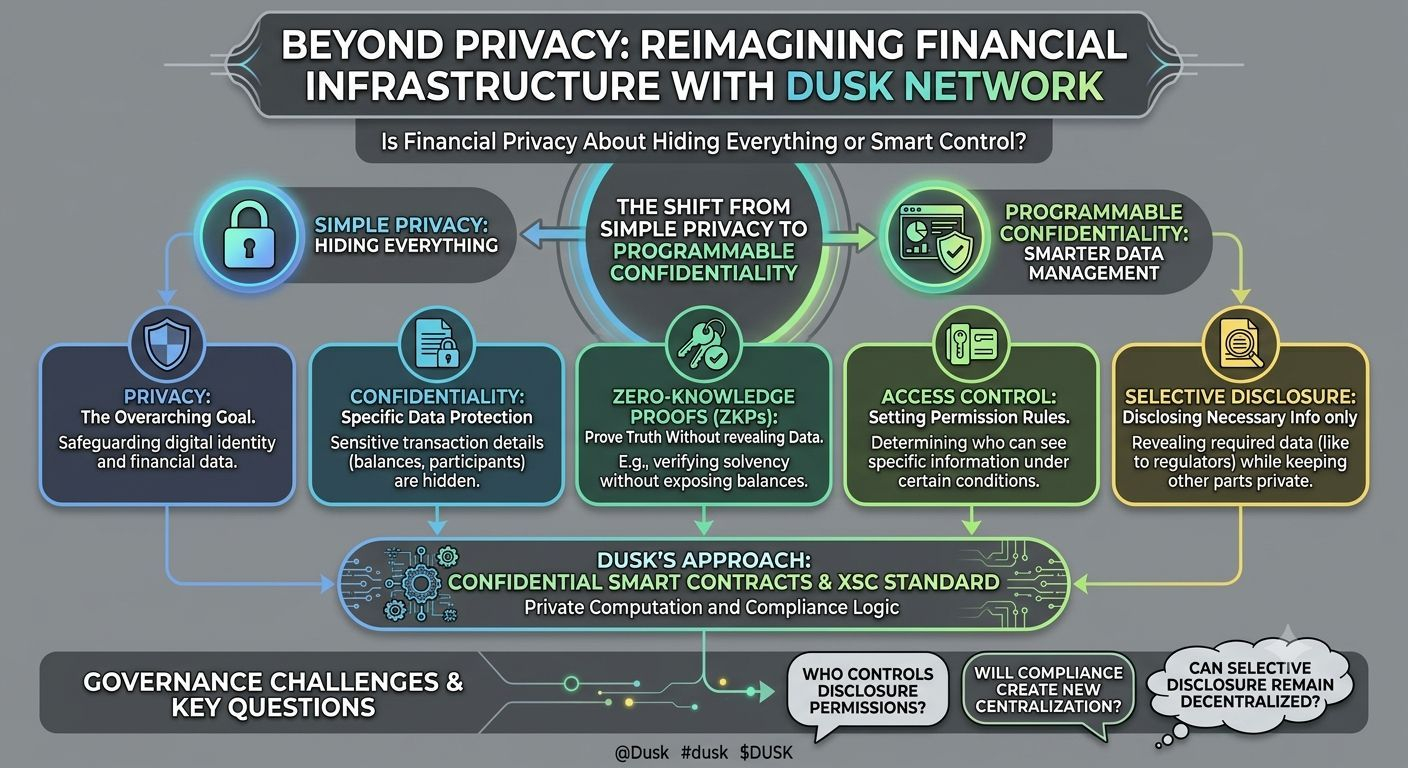
Everythings, when I first started exploring $DUSK , I had just one simple question in my mind: Does financial privacy really mean hiding everything?
I believe that public blockchains might not actually be as transparent for the general public as they are for big capital and large institutions. And that is exactly where Dusk (@Dusk) gets interesting.
Large institutional finance needs to keep transaction patterns, balances, counterparties, and positions confidential—while simultaneously providing verifiable proofs to regulators or auditors.
Understanding the distinction between these terms is crucial here:
Privacy is the broad overall goal.
Confidentiality means ensuring sensitive data isn't exposed to everyone.
Zero-Knowledge Proofs (ZKPs) allow you to prove the truth without revealing the actual underlying data.
Access Control determines who gets access to the data.
Selective Disclosure means showing only what the other party needs or is authorized to see.
Through its confidential smart contracts and the XSC standard, Dusk is attempting to bring this exact framework into real financial infrastructure.
But the real question comes down to governance:
Who will control the disclosure permissions?
Will compliance rules inadvertently create new points of centralization?
And can selective disclosure truly remain decentralized when confronted with real-world regulatory pressures?
I'm not saying Dusk is a perfect solution for everything. But the problem they are targeting is very real.
What do you think? Will programmable control (meaning who can see what) become more important moving forward than simply "making transactions private"?
@Dusk #dusk $DUSK
Everythings, when I first started exploring $DUSK , I had just one simple question in my mind: Does financial privacy really mean hiding everything?
I believe that public blockchains might not actually be as transparent for the general public as they are for big capital and large institutions. And that is exactly where Dusk (@Dusk) gets interesting.
Large institutional finance needs to keep transaction patterns, balances, counterparties, and positions confidential—while simultaneously providing verifiable proofs to regulators or auditors.
Understanding the distinction between these terms is crucial here:
Privacy is the broad overall goal.
Confidentiality means ensuring sensitive data isn't exposed to everyone.
Zero-Knowledge Proofs (ZKPs) allow you to prove the truth without revealing the actual underlying data.
Access Control determines who gets access to the data.
Selective Disclosure means showing only what the other party needs or is authorized to see.
Through its confidential smart contracts and the XSC standard, Dusk is attempting to bring this exact framework into real financial infrastructure.
But the real question comes down to governance:
Who will control the disclosure permissions?
Will compliance rules inadvertently create new points of centralization?
And can selective disclosure truly remain decentralized when confronted with real-world regulatory pressures?
I'm not saying Dusk is a perfect solution for everything. But the problem they are targeting is very real.
What do you think? Will programmable control (meaning who can see what) become more important moving forward than simply "making transactions private"?
@Dusk #dusk $DUSK
#dusk $DUSK @Dusk
#BOME will hit 0.0014 again go long
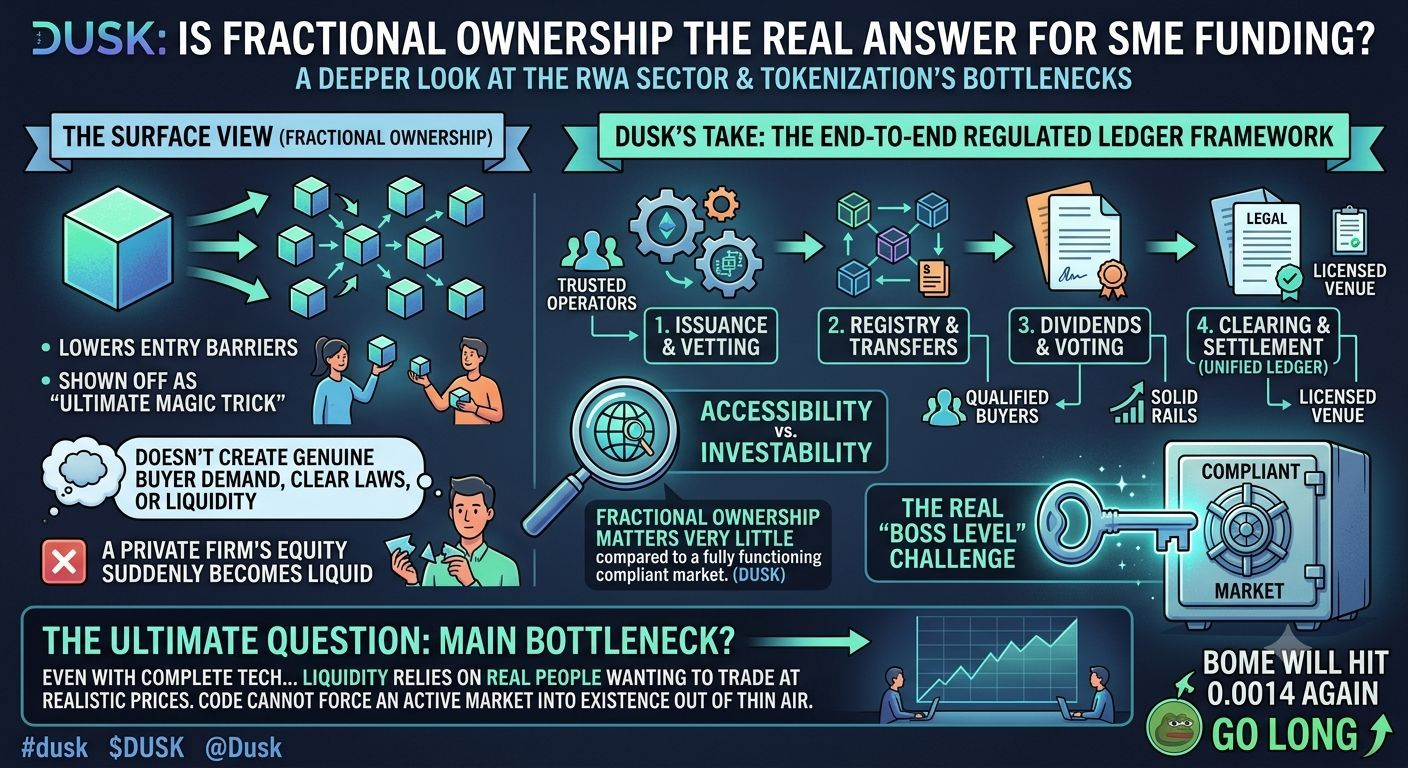
Just read Dusk's fresh piece on SME funding and one line really stuck with me.
Fractional ownership matters very little.
That sounds wild in an RWA sector where splitting assets up is sold as the ultimate magic trick.
Dusk’s take is way more realistic.
Smaller chunks reduce entry barriers, but they cannot manufacture genuine buyer demand, clear laws or secondary liquidity. A private firm's equity doesn't suddenly become liquid just because you chopped it into more tokens.
wait a minute.
That proves accessibility and investability are completely different things.
For tokenization to actually help SMEs, Dusk argues the whole ownership journey must function: issuance, investor vetting, registry, transfers, dividends, voting and clearing need a unified ledger.
The asset also requires trusted operators, qualified buyers, solid rails and a licensed venue.
I appreciate this perspective because it shifts focus away from the showy parts.
Splitting tokens is easy to show off. Setting up a compliant market for them is the real boss level.
Even with complete tech, liquidity still relies on real people wanting to trade at realistic prices. Code cuts down admin friction, but it cannot force an active market into existence out of thin air.
Does this end-to-end framework give SME shares a true path to wider participation, or is real demand the stubborn bottleneck that tokenization simply cannot fix?
Dusk SME tokenization: main bottleneck?
#dusk @Dusk
#BOME will hit 0.0014 again go long
Just read Dusk's fresh piece on SME funding and one line really stuck with me.
Fractional ownership matters very little.
That sounds wild in an RWA sector where splitting assets up is sold as the ultimate magic trick.
Dusk’s take is way more realistic.
Smaller chunks reduce entry barriers, but they cannot manufacture genuine buyer demand, clear laws or secondary liquidity. A private firm's equity doesn't suddenly become liquid just because you chopped it into more tokens.
wait a minute.
That proves accessibility and investability are completely different things.
For tokenization to actually help SMEs, Dusk argues the whole ownership journey must function: issuance, investor vetting, registry, transfers, dividends, voting and clearing need a unified ledger.
The asset also requires trusted operators, qualified buyers, solid rails and a licensed venue.
I appreciate this perspective because it shifts focus away from the showy parts.
Splitting tokens is easy to show off. Setting up a compliant market for them is the real boss level.
Even with complete tech, liquidity still relies on real people wanting to trade at realistic prices. Code cuts down admin friction, but it cannot force an active market into existence out of thin air.
Does this end-to-end framework give SME shares a true path to wider participation, or is real demand the stubborn bottleneck that tokenization simply cannot fix?
Dusk SME tokenization: main bottleneck?
#dusk @Dusk
#dusk $DUSK @Dusk
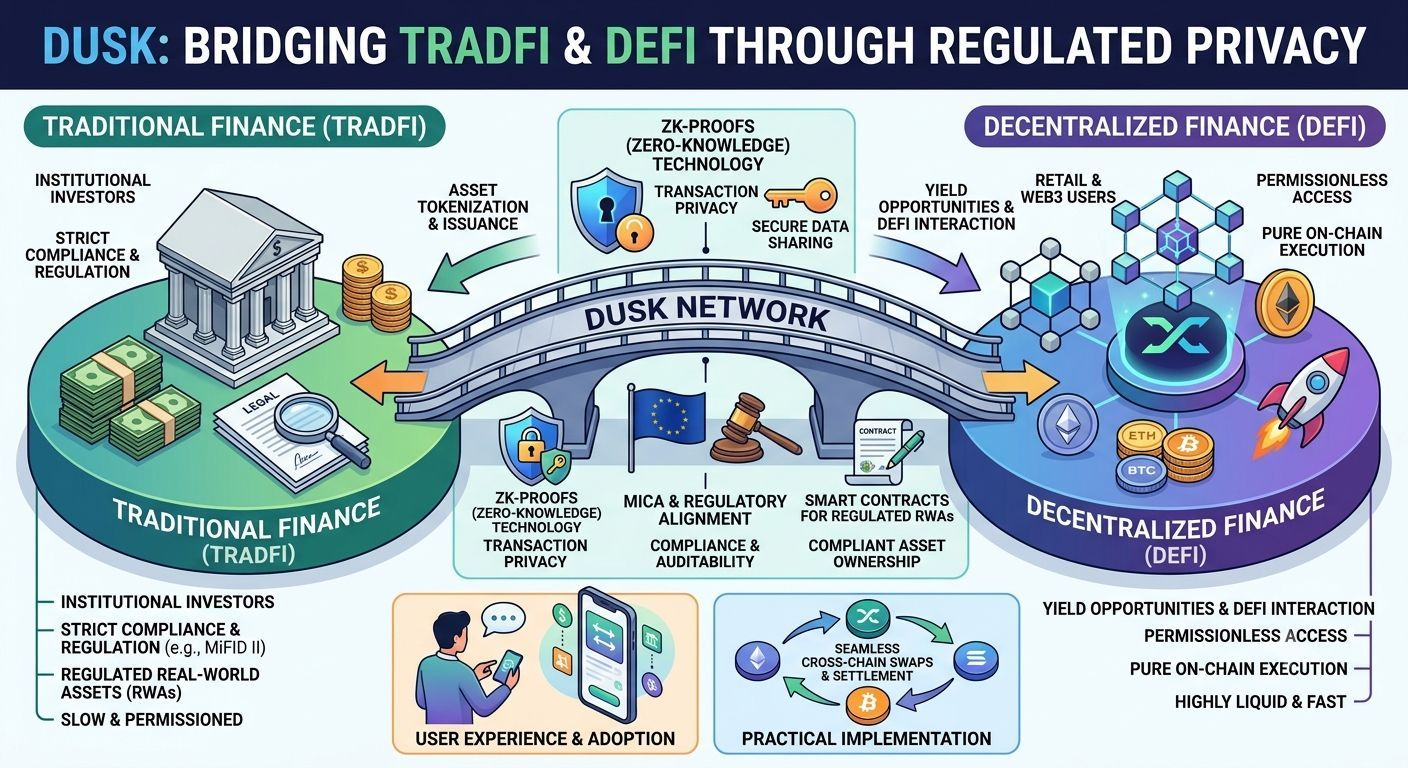
I woke up this morning wanting to dive a bit deeper into @Dusk, especially their idea of bridging TradFi and DeFi.
It’s a really fascinating space when you think about it. On one side, you have traditional finance—where strict compliance and regulations are everything. On the other, you have DeFi.
How easy is it to actually bring these two worlds together? It’s definitely something to ponder.
That’s exactly what caught my eye about the @Dusk project. They’re working on bringing regulated real-world assets onto the blockchain. But as we know, just tokenizing an asset isn't enough. You have to figure out how it will be regulated, who gets to interact with it, and how to protect user privacy during transactions.
What really stands out to me is their alignment with European frameworks like MiCA and MiFID II. Balancing the core freedom of DeFi with the rigid demands of TradFi isn't easy—their goals don't always align. If Dusk's smart contract design can actually handle both side-by-side, this goes way beyond simple tokenization. It becomes a real bridge between blockchain infrastructure and regulated financial markets.
Still, a big question remains for me: balancing privacy with compliance on paper is one thing, but making it seamless, practical, and user-friendly in real life is another.
At the end of the day, the real test won't just be the tech—it'll be how well this balance actually plays out in practice.
Still chewing on this one!
@Dusk $DUSK #dusk
I woke up this morning wanting to dive a bit deeper into @Dusk, especially their idea of bridging TradFi and DeFi.
It’s a really fascinating space when you think about it. On one side, you have traditional finance—where strict compliance and regulations are everything. On the other, you have DeFi.
How easy is it to actually bring these two worlds together? It’s definitely something to ponder.
That’s exactly what caught my eye about the @Dusk project. They’re working on bringing regulated real-world assets onto the blockchain. But as we know, just tokenizing an asset isn't enough. You have to figure out how it will be regulated, who gets to interact with it, and how to protect user privacy during transactions.
What really stands out to me is their alignment with European frameworks like MiCA and MiFID II. Balancing the core freedom of DeFi with the rigid demands of TradFi isn't easy—their goals don't always align. If Dusk's smart contract design can actually handle both side-by-side, this goes way beyond simple tokenization. It becomes a real bridge between blockchain infrastructure and regulated financial markets.
Still, a big question remains for me: balancing privacy with compliance on paper is one thing, but making it seamless, practical, and user-friendly in real life is another.
At the end of the day, the real test won't just be the tech—it'll be how well this balance actually plays out in practice.
Still chewing on this one!
@Dusk $DUSK #dusk
Verified
#dusk $DUSK @Dusk
Last night, I opened my laptop and noticed a notification from @Dusk. That got me curious, so I started digging a little deeper into the Dusk Trade ecosystem.
At first glance, it seems pretty straightforward: one place where you can find and trade regulated assets such as tokenized stocks, bonds, funds, ETFs, and money-market funds.
But the deeper I looked, the more interesting the bigger picture became.
One thing that really caught my attention is the partnership between NPEX and Dusk Trade. NPEX is a Dutch exchange supervised by the AFM, with MTF and ECSP licenses. It has facilitated more than 100 funding rounds, with over €217M raised and more than 20,000 active investors.
Those numbers suggest that regulated digital markets are already moving beyond the “just an idea” stage.
And this is where it gets interesting.
Dusk brings privacy-preserving infrastructure, while NPEX brings a regulated trading environment. In other words, privacy and regulation are being brought into the same flow instead of being treated as separate pieces.
That matters because tokenization itself isn't the hardest part.
The real challenge is connecting the entire lifecycle: issuance, investor eligibility, privacy, trading, compliance, and settlement — all within one seamless onchain experience.
Technology alone doesn't guarantee adoption.
So the question I'm left with is:
Can the entire lifecycle of regulated financial markets really become as simple and accessible as being onchain?
I'm still thinking about it. 🤔
What do you think?
P.S. The Dusk Trade pre-launch waitlist is open. Members may also have a chance to participate in a raffle for $500 worth of tokenized RWA.
@Dusk $DUSK #dusk
Last night, I opened my laptop and noticed a notification from @Dusk. That got me curious, so I started digging a little deeper into the Dusk Trade ecosystem.
At first glance, it seems pretty straightforward: one place where you can find and trade regulated assets such as tokenized stocks, bonds, funds, ETFs, and money-market funds.
But the deeper I looked, the more interesting the bigger picture became.
One thing that really caught my attention is the partnership between NPEX and Dusk Trade. NPEX is a Dutch exchange supervised by the AFM, with MTF and ECSP licenses. It has facilitated more than 100 funding rounds, with over €217M raised and more than 20,000 active investors.
Those numbers suggest that regulated digital markets are already moving beyond the “just an idea” stage.
And this is where it gets interesting.
Dusk brings privacy-preserving infrastructure, while NPEX brings a regulated trading environment. In other words, privacy and regulation are being brought into the same flow instead of being treated as separate pieces.
That matters because tokenization itself isn't the hardest part.
The real challenge is connecting the entire lifecycle: issuance, investor eligibility, privacy, trading, compliance, and settlement — all within one seamless onchain experience.
Technology alone doesn't guarantee adoption.
So the question I'm left with is:
Can the entire lifecycle of regulated financial markets really become as simple and accessible as being onchain?
I'm still thinking about it. 🤔
What do you think?
P.S. The Dusk Trade pre-launch waitlist is open. Members may also have a chance to participate in a raffle for $500 worth of tokenized RWA.
@Dusk $DUSK #dusk
Log in to explore more content