


Original Title: Same Same But Different
Original Author: Arthur Hayes, co-founder of BitMEX
Original Compilation: Saoirse, Foresight News
Editor’s Note: U.S. Treasury yields are approaching the sensitive 5% threshold, and global risk assets have come under pressure accordingly. The article opens with the narrative play in the bond market, then shifts the camera to the crypto market. It reviews past experiences in which falling reverse repo rates helped fuel a bull market, and, together with current market correlation and linkages, analyzes the real effectiveness and constraints of the Ministry of Finance’s bond repurchase policy. It uses this to forecast potential changes in market conditions for crypto assets such as Bitcoin amid a shift in liquidity. The following is the original article content:
For now, set aside your rational thinking. Let your imagination run wild. Follow my narration.
Act One
On a Saturday night, after heavy renovation, the Brooklyn illusion club—now called the New York Pacha Club—sits at the very heart of the real American hegemonic order. A group of top-tier elites gather in their finest attire, dancing to the music of Keinemusik.
The main character of the story is U.S. Treasury Secretary Scott Bessent (the author calls him “Buffalo Bill,” a play on “wild bill”). He strolls—casually, without a hint of hesitation—over to the exclusive card seats behind the DJ booth in the VIP section. A sly grin tugs at the corner of his mouth as a thought flashes through his mind: “Ever since Elvis stole Southern Gospel music and got on The Ed Sullivan Show, I haven’t seen a group of white guys with such great rhythm.”
Kenny G from Citadel is right here on site, celebrating the fact that he just thoroughly crushed Leopold Aschenbrenner’s high-leverage bets from San Francisco. Bessent can’t help but look over twice. He’d always heard that Kenny G was a Miami fixture and assumed he liked Latina women. “Who’s this stunning woman next to Kenny G…? ” On closer look, it turns out she’s Leopold’s wife. There’s nothing more satisfying than humiliating a high-leverage hotshot from the West Coast—no matter that she’s just an ordinary standard in the Bay Area. Live in the moment.
What both surprises and infuriates Bessent is that Kenny G is seated next to his successor—Janet “Bad Gurl” Yellen, former U.S. Treasury Secretary. Yellen waved at him and continued chatting with Hunter Biden. Inside, Bessent complains to himself about what kind of party this is. He even guesses Yellen will probably let loose and celebrate tonight. Bessent feels wildly out of balance: how could she afford a $20,000 card seat? He figures it out quickly—working in the U.S. government itself means a massive opportunity to profit. Bessent, personally, is already a billionaire, so he doesn’t need to grab the money. But for ordinary politicians like Ro Khanna and Nancy Pelosi, these operations are already standard procedure.
Yellen shouted at Bessent across the noise: “Hey, kid—how’s the market been treating you lately?”
Bessent’s body visibly convulses with anger. This week he’s been frantic—U.S. Treasury markets have performed abysmally. He had to suddenly announce that the Treasury would double the size of its long-end bond buybacks in an attempt to suppress yields. Unfortunately, the market’s rebound only held for one trading day. By the weekend, yields were back to the level before the policy was announced. He really wanted to call his true mentor, George Soros, but wondered whether Druck would even take his call.
Yellen continued to pour fuel on the fire: “Don’t you think you’re better than me? Don’t you think you understand the market better than the academy? ” She burst into a frantic imitation laugh of former Vice President Kamala Harris: “You’re nothing but Trump’s puppet, hahaha. Fundamentally, we’re not so different—arrogant people. Have fun!”
As soon as the words left her mouth, Yellen completely let loose. A group of male companions trailed behind her wearing diamond dog collars custom-made by Jacob the Jeweler. She leaned toward one of them, whispered out Cardi B’s lyrics: “I want you to drive that big-ass Mack truck into this little car garage.” Nowadays, it really is a “little car garage”—and she’s also hiding quite a bit of Reta in her hands.
A furious Bessent passes by the card seats of Arthur and Ansem. A group of crypto crowd gamblers are gathered there, talking up a storm. Arthur beckons Bessent over. Once he’s close, Arthur says: “I just saw it. Don’t worry about those haters. The crypto crowd is on your side. You’ve got no choice—we support you, keep going! Whatever you do, don’t stop printing money. Once the market crashes, the rich won’t be able to get free bonuses—and those naive people in America who believe capitalism can make them rich will get nothing either. Without these bonuses, AOC will raise our taxes—oh my God.”
At this moment, Bessent makes up his mind: he will be a Treasury Secretary who fulfills his duties to the fullest. If Trump needs a trillion trillion to prop up the market, he will find a way to make it happen.
Scene cut
No matter how different their remarks were before taking office, Bad Gurl Yellen and Buffalo Bill Bessent are fundamentally the same kind of people. Both are constrained by politicians—these politicians can’t control themselves and always want to keep spending on every kind of ridiculous pretext. But both believe that holding the highest power in American finance comes with a cost worth bearing. So every time the Treasury market convulses violently, they roll out their clever money-printing strategies.
When the Treasury lowers U.S. Treasury yields by printing money, it releases U.S. dollar liquidity into the market—and that liquidity ultimately flows into Bitcoin and the crypto market. I’ll compare two stretches of history. Yellen and Bessent changed the market landscape, and then Bitcoin entered an uptrend. The first stretch happened at the end of 2023: Yellen issued massive short-term Treasury bills, reducing the supply of long-term bonds. The second stretch is right now: Bessent has intervened in the USD/JPY exchange rate and expanded the scale of Treasury buybacks. After Yellen rolled out that printing-money scheme back then, Bitcoin rebounded strongly from the lows. And my judgment is that once Bessent decides to follow in the footsteps of his predecessor and release large amounts of U.S. dollar liquidity, Bitcoin will reenact this same scene.
The 5% threshold
For some reason, both Yellen and the current Bessent are extremely afraid of 10-year U.S. Treasury yields nearing 5%. The 10-year yield is the most important pricing anchor in the American financial order. Interest rates on 30-year fixed-rate mortgages (with prepayment options), corporate bonds, and all kinds of consumer credit products are all tied to the 10-year Treasury yield. Once the yield breaks above 5%, financing costs for households and businesses become too high to bear, and economic activity cools off. That’s why regulators will fight tooth and nail to hold this line.
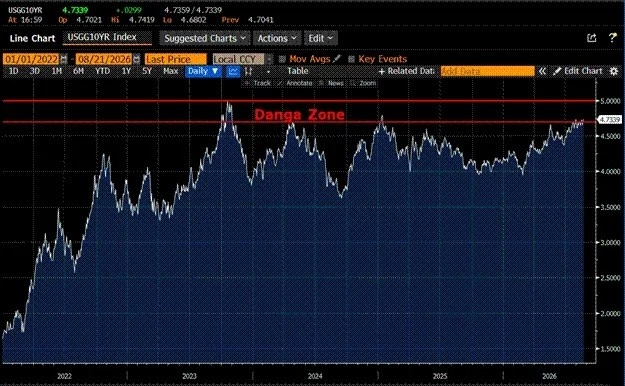
This image shows 10-year U.S. Treasury yields from 2022 to 2026. The 5% red line is the policy “danger zone.” Approaching it will force the Treasury to loosen policy and save the market.
Short-term Treasury bills vs long-term bonds
Treasury bills (T-bills) have maturities of less than one year; bonds (bond) have longer maturities. The shorter the maturity, the closer it is to cash, and the better the liquidity and the more attractive it is for institutions like money market funds (MMFs). Money market funds want to earn as high a return as possible while bearing minimal interest-rate risk and counterparty risk. Parking money at the Fed is the safest option—the Fed can print money to repay debt without needing congressional approval. The Fed also has a reverse repo tool (RRP), where eligible institutions can park funds to earn returns close to the federal funds rate.
In theory, lending to the U.S. government denominated in dollars is risk-free because the government can print money. But in reality, repaying the debt requires congressional approval. That’s why the debt-ceiling farce rattles markets: investors can’t hold securities with uncertain redemption at maturity. If politicians refuse to pass a spending bill, bondholders don’t get principal and interest. Therefore, if a money market fund wants to hold short-term Treasury bills, their yield must be slightly higher than the reverse repo (RRP) to compensate for this policy risk.
The environment at the end of 2023 is very similar to today. The question Americans voters cared about most was the cost of living. Back then, Biden’s team understood that ordinary people had already realized what the consequences would be of rate cuts or balance-sheet expansion—so that path was not viable. With the 2024 election looming, the government had to take voters’ survival pressure into account. Yellen understood that her boss needed liquidity to prop up the market, but she also had to make it look like there was no blatant money printing or inflation stimulus. So she devised a finely crafted scheme for indirect “printing.”
At the time, about $2.5 trillion was parked in the reverse repo (RRP). The problem with this pot of money is that sitting on the Fed’s balance sheet, it can’t be repeatedly rehypothecated by banks to derive credit—so the money multiplier equals zero. But if money market funds move the money out of the RRP and buy higher-yield short-term Treasury bills, the banking system can rehypothecate that asset. Liquidity then pours into the bond market, pushing down yields and simultaneously lifting stock prices. For us crypto players, that’s also what created Bitcoin’s bottom after the collapse of FTX.
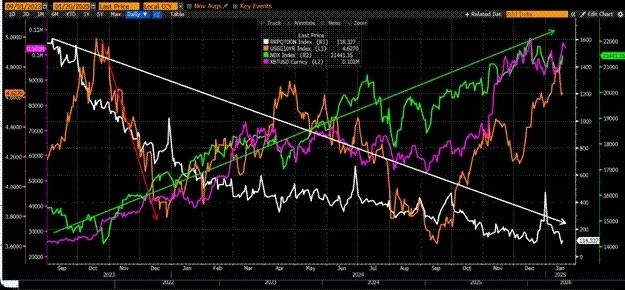
The chart clearly shows this transmission logic. The Treasury expands the supply of short-term T-bills; the bond price falls; yields rise to levels significantly above the RRP. Money-market funds, chasing returns, move funds from the reverse repo to this market. By the time Bessent takes office on 2025-01-20, the RRP balance has shrunk from $2.5 trillion to $100 billion. This amounts to $2.4 trillion in liquidity injection (with the funds sourced from the pandemic stimulus plan). Large amounts of money flood into financial markets; the Nasdaq 100 and Bitcoin prices take off; the 10-year Treasury yield rapidly falls from the danger zone of 5%, while the federal funds rate stays around 5.3% without being cut.
Crypto traders, please read and truly understand this chart. The root of the market’s optimistic expectations is right here. If you don’t understand: why the Fed keeps the highest interest rates since 2008 while also shrinking its balance sheet, yet Bitcoin and risk assets are still surging—then you’ll miss this newly starting bull market. Even academia has coined a term, “activist Treasury issuance (ATI—Activist Treasury Issuance),” to describe Yellen’s magic maneuver.
Now Bessent faces the exact same dilemma as Yellen. His boss is eager to spend big money, and this time the reason for spending is another unwinnable war in the Middle East. But where the president spends the money doesn’t really matter. The Treasury secretary’s job is to borrow money for the government at a cost that’s bearable.
Distorted operations
Everyone loves cash-like assets that pay interest. Short-term Treasury bills are the highest-yield and safest quasi-cash instruments in the dollar system. So everyone wants to hold T-bills—including the crypto crowd, which holds derivatives of them, such as stablecoins like USDT and USDC. Bessent understands that as long as he’s willing to put supply out there, the market can absorb massive quantities of T-bills. The problem is that T-bills mature within a year. The higher the share of short-term debt, the faster the compounding roll-off of debt. Every week, the Treasury issues more and more debt—covering new fiscal spending while also repaying maturing old debt—so America’s total debt balloons at an accelerating pace.
By increasing the share of short-term Treasury bills in total government debt, Bessent can move the most important marginal buyer—the Federal Reserve. Right now, the Federal Reserve creates bank reserves and “prints money” to buy short-term Treasury bills through its Reserve Management Plan (RMP). The monthly purchase size under the RMP is determined by New York Fed President Williams, who leans dovish—what the Fed calls “a dove.” If Williams concludes that the market lacks U.S. dollar liquidity, he will instruct traders to create reserves and buy short-term Treasury bills in the open market. In essence: the Fed is printing money to foot the bill for politicians’ fiscal statements.
With the Fed taking over short-term Treasury bills, Bessent can issue large amounts of short-duration debt to obtain funding for buybacks of intermediate- and long-term bonds. Bessent tinkers with the yield curve as if he’s a kid with no sense of pitch pulling a cello. As early as after last year’s “Liberation Day incident,” he had hinted that he held the powerful weapon of Treasury buybacks. At the time, Trump briefly wanted to rewrite the global trade order with aggressive tariffs, but after a market crash he backed off. Bessent warned the market not to test his policy tools. A year or so later, Bessent finally acted—announcing large-scale buybacks and forcing down long-end yields.
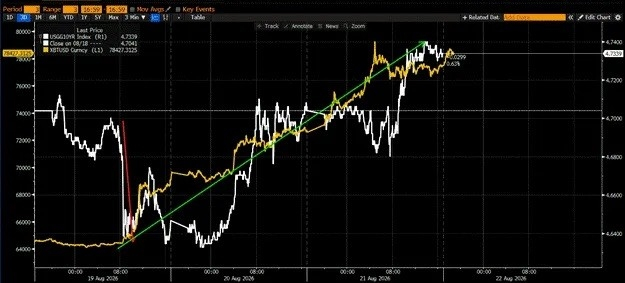
The white line is the 10-year U.S. Treasury yield, the yellow line is Bitcoin. After Bessent announced expanding long-end bond buybacks, both lines rose in sync in the short term, confirming the market is buying expectations. But the U.S. Treasury yield later bounced back again, showing the buyback力度 wasn’t enough to suppress yields.
On August 19, without warning, Bessent announced that the buyback size for long-end bonds in the coming fiscal quarter would be increased by another mere $20 billion. After the news broke, the 10-year yield fell temporarily, but only by a limited amount. Bitcoin woke from its sleep and surged strongly for two straight days. But that’s exactly what’s been bothering Bessent at the party: just one trading day later, the 10-year U.S. Treasury yield rose back above the level before the policy was announced. Why did this happen?
First, the scale of Bessent’s actions is nowhere near enough. Total debt has already reached $40 trillion, and $20 billion of buybacks is just a drop in the bucket. Second, the market is sensing panic signals. A few weeks ago, Bessent proposed scrapping the funding cap for the FIMA tool—allowing Japan and other large holders of U.S. Treasuries to use the Treasuries in their hands as collateral, borrow U.S. dollars directly from the Fed instead of dumping bonds in the open market to smash prices. Third—and most importantly—the market believes that as long as you push the 10-year yield higher, you can force Bessent to replicate Yellen’s approach: somehow inject tens of billions of dollars in liquidity into the market. Bitcoin is the smoke alarm for global liquidity; it has picked up this signal. If Bessent is a upgraded version of Yellen, then Bitcoin will kick off a savage run from the lows.
Bessent’s next choice
Next, there are several possible evolution paths.
For highly U.S.-dollar-liquidity-sensitive assets like Bitcoin, the worst-case scenario is that U.S. politicians led by Trump decide to compress fiscal spending. But I think the probability of that happening is very low—it’s not far from the next election.
Put aside these doomsday fantasies and come back to reality. See what tools Bessent can use to get the money-printing machine going.
The best-case scenario for Bitcoin: Bessent imitates the Bank of Japan’s bond-market intervention model. He announces to the outside world that as long as the yield on 10-year (and longer) bonds stays above 5%, he will buy bonds with no limit. In the early days after the news lands, prices of long bonds would surge and yields would drop quickly; the market would temporarily show deference to Bessent. But any intervention that violates the laws of market economics will eventually face a test. The market will probe Bessent to see whether he’s truly willing to swing the dollar cannon to cash in his promises.
The most likely intermediate path (unless the MOVE volatility index breaks above 130 and the market faces acute stress): Bessent will gradually add to the buybacks in small increments, while digging up other obscure tools to release liquidity indirectly.
There’s another obvious method: burn Treasury General Account (TGA) funds to support the buybacks. Buffalo Bill Bessent has already leaked the proposal to CNBC. The TGA account holds roughly $1 trillion.
I think that unless the AI credit bubble truly bursts in the next few years, it’s difficult for the Fed to cut rates directly on the political front or restart unlimited QE. Don’t forget: what voters care about most is the cost of living. Even teenagers scrolling short videos know that rate cuts and QE equal printing money.
The bull market is here
No matter whether Bessent floods the system quickly or does it gradually, Bitcoin will keep rising. Volatility will amplify the moves; even if the overall direction is upward, there will still be vicious short-term pullbacks. Therefore, unless you’re a full-time trader, don’t use leverage. Buy Bitcoin—or the smaller coins you believe in—hold still, and wait for Bessent’s policies to take effect.
Inside the Maelstrom Fund, we’re already fully loaded with risk assets. Bitcoin, Ether, Ethena, and Ether.fi are the core bets we’re placing—expect them to sprint all the way.
Original text link