


Crypto card monthly spending tops $750 million; stablecoins make up over 70%
Stablecoins are increasingly being used for on-chain transfers and asset storage tools, gradually becoming part of consumers’ everyday payment scenarios. According to Paymentscan data, the spending of crypto payment cards within the tracking scope reached about $759 million in July, up more than threefold from a year earlier. The number of transactions that month surpassed 10 million.
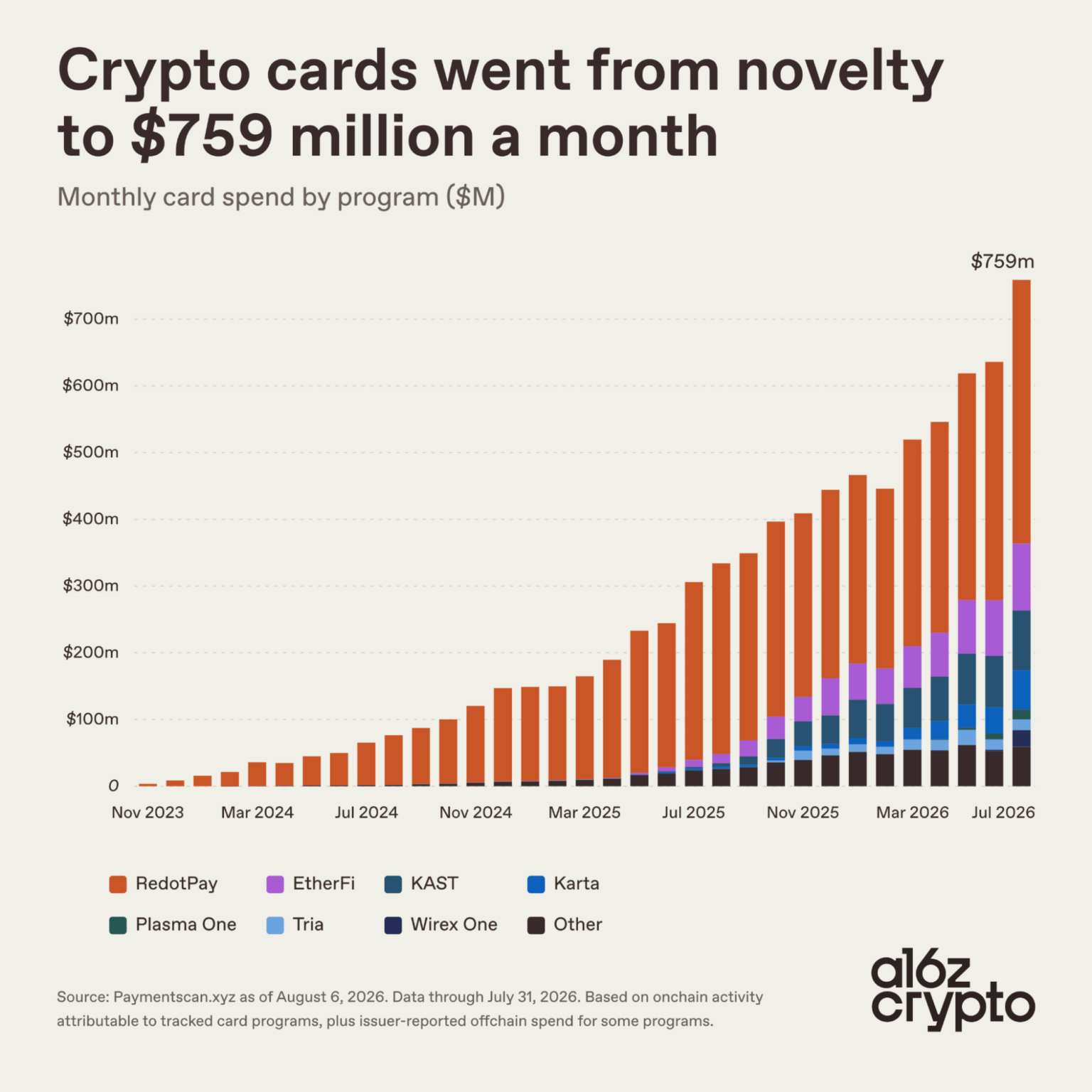 Image source: a16z Crypto payment card spending reached about $759 million in July
Among them, USD stablecoins have become the primary payment source. $USDC accounted for about 50.8% of July’s spending, while $USDT accounted for 20.3%, and together they make up more than 70%. Compared with a year earlier, the shares of $USDC and $USDT were approximately 48% and 7%, respectively, indicating that the dominance of USD stablecoins in the crypto card market continues to expand.
Spending content is gradually shifting from liquidating crypto assets to everyday expenses as well. Brazil market data shows that Oobit’s active users make about 20 transactions per month on average and spend about $400, with grocery stores accounting for about 35% of regional transaction activity. In Argentina, 72% of Oobit payments use $USDT, and food-related spending accounts for about 41% of transaction volume. The number of people using crypto cards in Brazil under Binance is also steadily increasing, with common scenarios including ride-hailing, delivery, groceries, restaurants, and online subscriptions.
Visa card programs break through 160 initiatives—emerging markets are growing the fastest
Stablecoin everyday payments are expanding rapidly and currently still rely heavily on existing credit card and debit card networks to complete transactions. At checkout, crypto cards typically convert stablecoins or other digital assets into local fiat currency, while merchants receive payments through existing payment networks. Therefore, merchants can reuse the original payment collection infrastructure.
Visa said in June this year that more than 160 stablecoin-linked card programs worldwide are already operating or under development. With Visa’s cooperation to help crypto companies issue payment cards through StraitsX, the value of infrastructure transactions grew about 40x from Q4 2024 to Q4 2025.
Growth speed in emerging markets is especially prominent. StraitsX data shows that from March 2025 to February 2026, total transaction value for crypto cards in low-GDP markets grew by about 600%, while in high-GDP markets the increase over the same period was about 150%. Food and retail are the main consumption categories.
The market is still highly concentrated. According to Paymentscan statistics, in July RedotPay had transaction volume of about $395 million, EtherFi about $100 million, and KAST about $89.6 million; together, the three account for about 77% of tracked transaction volume. Some data comes from self-reported submissions by operators, so the overall market size still needs to be observed alongside data from more payment platforms.
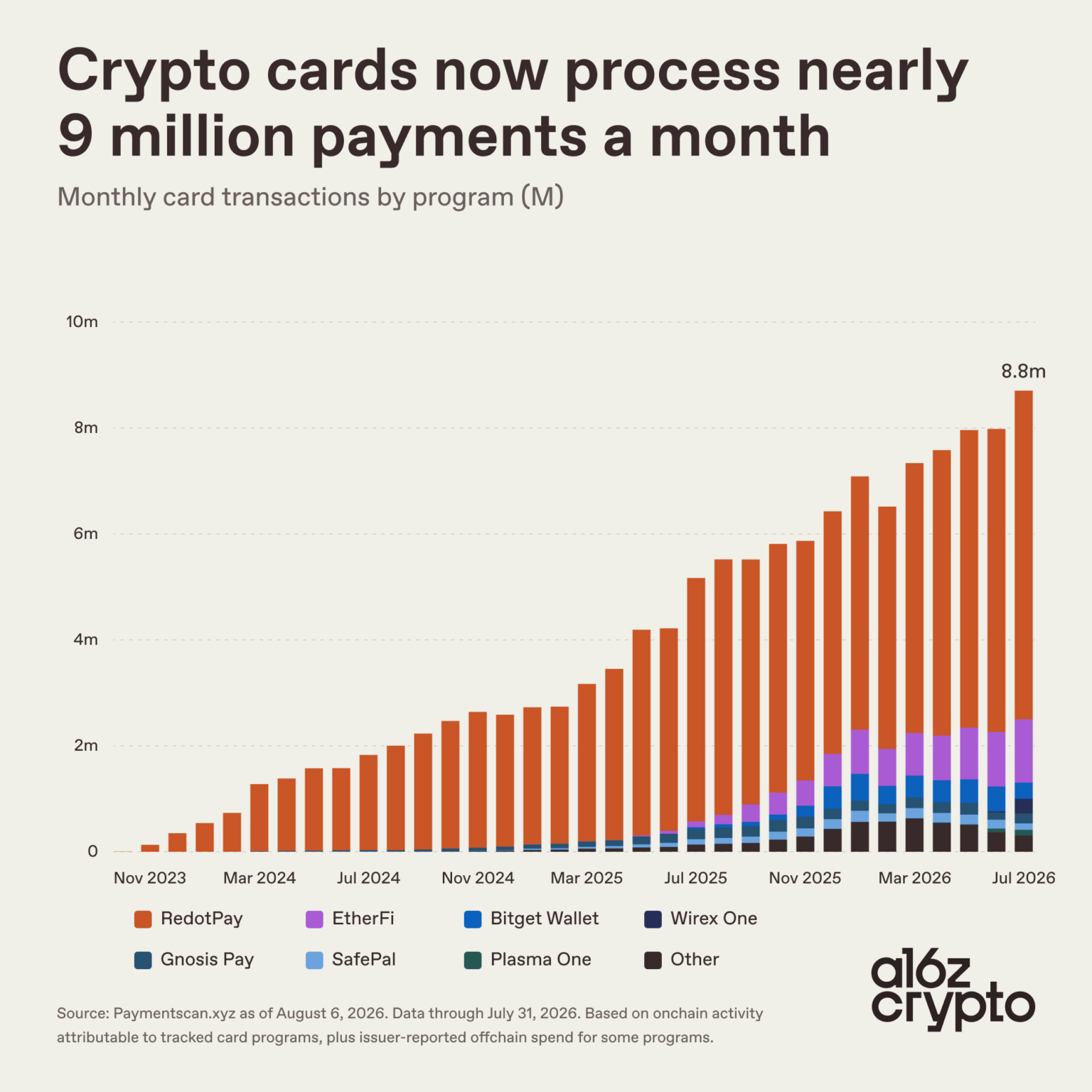 Image source: a16z. The market is still highly concentrated; RedotPay, EtherFi, and KAST combined account for about 77% of tracked transaction volume.
AI agents start paying themselves—99% of x402 payments use $USDC
Another emerging stablecoin payment market is forming among AI agents. AI agents can autonomously complete tasks such as searching for data, calling APIs, using computing power, and purchasing digital services—work that often involves very small amounts of money but extremely high frequency in machine-to-machine payments.
The x402 protocol launched by Coinbase is one representative example. It uses “402 Payment Required” in network standards, so after an AI agent receives a service quotation, it can directly make the payment; once verification is completed, the data or service can be obtained. The entire process can be completed autonomously by software, eliminating the steps of setting up traditional accounts or manually entering credit card information.
Related news: What is the x402 protocol? Behind the x402 meme coin hype—the payment revolution you should understand
Coinbase says that x402 has cumulatively processed more than 165 million payments, with a total value of about $50 million.
Coinbase AI product head Lincoln Murr estimates that about 99% of usage involves $USDC. Based on currently available public data, the average amount per transaction is only about $0.3, with most use cases concentrated on APIs, data, AI inference, computing resources, and online tools.
Currently, x402 still has a huge gap compared with traditional payment networks in terms of scale. In July this year, within 30 days x402 processed about $24 million—roughly equivalent to Visa’s transaction volume in one minute. But this kind of machine-to-machine payment also helps stablecoins find new markets that are harder for traditional credit cards to handle.
Stablecoins move in on machine payments—Visa and Mastercard also join the AI commerce wave
AI Agent payment demands attract both crypto and traditional financial industry players to deploy in sync. Stablecoins have features such as 24/7 operation, global transfers, and low-value payments, making them especially suitable for API calls and data purchases where each transaction is only a few cents. Traditional card payments usually involve acquiring costs of about 2% to 4%, and after adding fixed processing fees, it is difficult to build a reasonable business model for transactions under $1.
Circle is currently testing $USDC Nanopayments, which batches multiple small payments and then settles them on-chain.
Cloudflare also launched Wallets and cloudflare.pay, allowing users to set budgets for AI agents, approve merchants, and set per-transaction spending limits;
MoonPay’s PayBox further connects credit cards and crypto wallets, enabling AI agents to pay using x402 or Visa networks depending on different scenarios.
Traditional payment giants are also starting to build their own agent payment infrastructure:
Mastercard launched Agent Pay for Machines, allowing users to pre-set the products, limits, and transaction ranges that an agent can purchase;
Visa is also testing AI agents using existing credit cards and debit cards at financial institutions to complete shopping and travel transactions.
At present, the two payment models have developed into different application scenarios. Stablecoins are better suited for high-frequency small transactions such as APIs, data, computing power, and AI inference; while the credit card network has an existing foundation in large-scale spending, refunds, dispute handling, and credit limits.
From humans using crypto cards to buy groceries, hail rides, and subscribe to services, to AI agents using $USDC to autonomously purchase digital resources, the payment scope of stablecoins is further expanding into everyday consumption and machine commerce.
This article was generated by an aggregation of information from various parties by the crypto agent, with (Crypto City) serving as reviewer and editor. It is currently still in the training stage, so there may be logic bias or information errors. The content is for reference only—please do not treat it as investment advice.
“Crypto payment cards break 750 million USD in monthly spending! Stablecoins are moving into your everyday life and AI agent commerce” was first published on “Crypto City”.