


3,000 million NT dollars in special state affairs funding fees were cut and frozen; orders for 37 sheltered workshops were affected
The Legislative Yuan recently passed the 2026 central government general budget in its third reading. Of this, the Presidential Office had originally allocated NT$30 million in special state affairs funding. As proposed by KMT legislator Ou Hsiao-ling, NT$10 million was reduced and NT$20 million was frozen. After the budget was constrained, the Presidential Office’s plan to purchase approximately 15,000 mooncake gift sets before the Mid-Autumn Festival from 37 sheltered workshops and disability-related groups across Taiwan was also affected.
The Secretary-General of the Presidential Office, Pan Meng-an, said on August 20 that the Presidential Office has, in previous years, used special state affairs funding to purchase mooncakes and related products from sheltered workshops and public-benefit organizations, with the aim of using actual orders to support employment for persons with disabilities.
This year’s related funding was cut and frozen, so the original procurement plan could not be carried out as planned. Therefore, an open call was made for government agencies, companies, and the public to take up the procurement. Weng Hsiao-ling said that the execution information for the presidential office’s state affairs and operating expenses was not specific enough and that no supporting evidence of related orders was provided, so the proposal to keep the freeze in place was maintained.
She also pointed out that the frozen NT$20 million still has conditions under which it can be unfrozen. Once the President issues and the relevant law passes through the three readings in the Legislative Yuan, the funds can be restored for release. Both sides have different accounts regarding the provision of budget information, the conditions for unfreezing, and responsibility attribution—causing the original budget review dispute to extend into the real operations of sheltered workshops.
A gap in government orders—company procurement can also become a tool for public benefit
For sheltered workshops, the meaning of 15,000 box orders goes far beyond a one-time charitable donation. Through product manufacturing, packaging, and sales, sheltered workshops provide job opportunities and vocational training for people with disabilities. Large holiday orders are also an important source of operating revenue. If the original procurement suddenly changes, the impact could ripple through staffing, production, and subsequent employment arrangements.
This also opens another direction worth considering for Taiwan’s Web3 industry. In recent years, the crypto industry has frequently discussed financial inclusion, public goods, community governance, and Crypto for Good. However, charitable practice doesn’t necessarily have to start with issuing tokens, putting assets on-chain, or directly donating cryptocurrencies.
Exchanges, blockchain foundations, Web3 startups, venture capital firms, project teams, and media outlets all have needs to give gifts to employees, customers, and partners around the Mid-Autumn Festival as well. If part of the budget originally allocated for corporate procurement is redirected to a sheltered workshop, then the Mid-Autumn gift costs that companies would have spent anyway can be directly converted into actual orders supporting the work of people with disabilities.
Taiwan already has crypto charity cases: $USDT has been used to support disaster relief in Hualien
In Taiwan’s crypto community, there have already been examples of using virtual assets for charity. The Open Culture Foundation (OCF) currently offers a channel for donating cryptocurrencies. Because Taiwan’s current regulations do not recognize cryptocurrencies as legal tender, donations are reported as “valuable items.” This shows that virtual assets can still connect with existing charitable systems and nonprofit organizations.
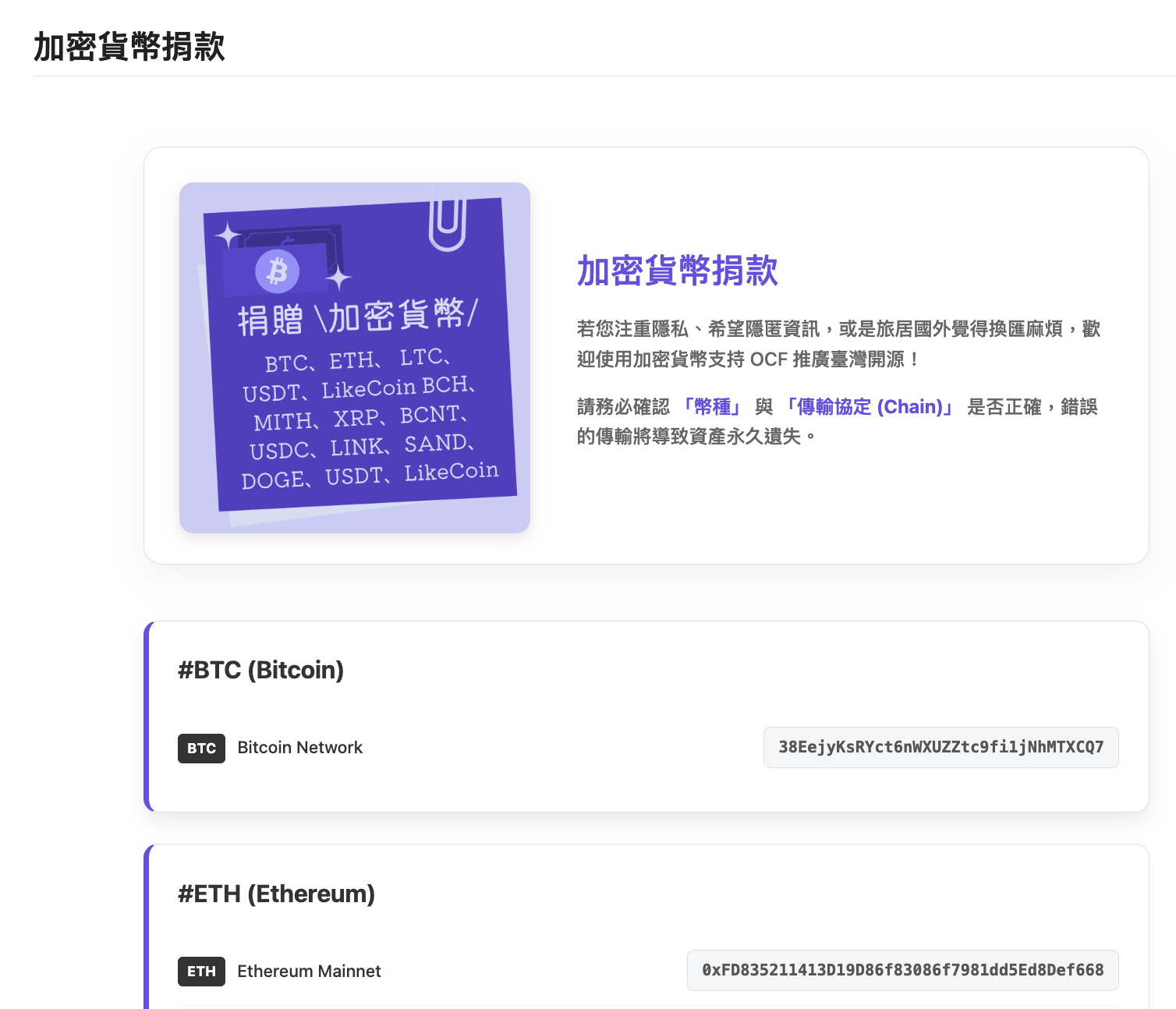 Image source: Open Culture Foundation. The Open Culture Foundation currently provides a channel for cryptocurrency donations
After the 2025 Hualien Matai’an River reservoir landslide disaster, Binance Charity also joined forces with the Taiwan Blockchain Enthusiasts Association to launch a virtual asset charity program. It raised about $117,000 in $USDT; at the time, this was roughly NT$3.57 million. In the end, all of it was donated to the designated account of the disaster relief foundation. Among them, Binance Charity donated 100,000 $USDT, and the rest of the funds were answered by multiple organizations and community members.
These examples show that the crypto industry already has traceable pathways to participate in charity—from directly donating $USDT, to linking up community fundraising, to corporate procurement—all of which can serve as ways to get involved.
Related news: Hualien Guangfu disaster situation) Binance and the Blockchain Enthusiasts Association raise over $3.5 million; the Shovel Man can apply for subsidies
Web3 talks about Public Goods every day—can we “take the order” directly this time?
Compared with launching new token fundraising or building an on-chain public welfare platform, the needs facing the sheltered workshop in this case are quite direct: the products are already made and production capacity already exists; what’s needed now is someone to buy.
For Taiwan’s coin and token community, this could be a very realistic Public Goods experiment. Exchanges, project teams, and Web3 companies normally allocate huge budgets to brand marketing, event sponsorships, community management, and corporate gifting. If some of the Mid-Autumn procurement can be redirected to sheltered workshops, then charity can move beyond donations and into day-to-day corporate spending.
Blockchain technology doesn’t necessarily need to be the star of this incident. If, going forward, the community wants to raise funds together or consolidate purchases, then openly available on-chain funds, cross-border stablecoin donations, and community collaboration can still provide tools. At the current stage, the most direct approach may be to take a purchase order originally intended for other gift vendors and redirect it to a sheltered workshop.
Web3 public welfare can extend from cryptocurrency to corporate procurement. When an order gap appears for 15,000 Mid-Autumn gift boxes, Taiwan’s coin community now has a chance to practice Public Goods with the most traditional thing imaginable: just pay for it.
“President’s Office Procurement of Sheltered Workshop Mid-Autumn Gift Boxes Budget Cut and Frozen! Can Taiwan’s coin community ‘take the order’?” This article was first published on “Crypto City.”