

Wanli一本万莉168
4k Posts

Wanli一本万莉168
 Square Verified+
Report
Block User
最早广场直播建设者,加密圈学习者,活到老学到老,现布局Web3新赛道。北京时间每天15:00直播,欢迎来直播间一起探讨:共建广场、共建社区。喜欢的可加我币安聊天室:wanli168

BNB Holder
Frequent Trader
2.9 Years
653 Following
88.6K+ Followers
90.5K+ Liked
Posts
All
Quotes
Videos
Live
PINNED
·
--
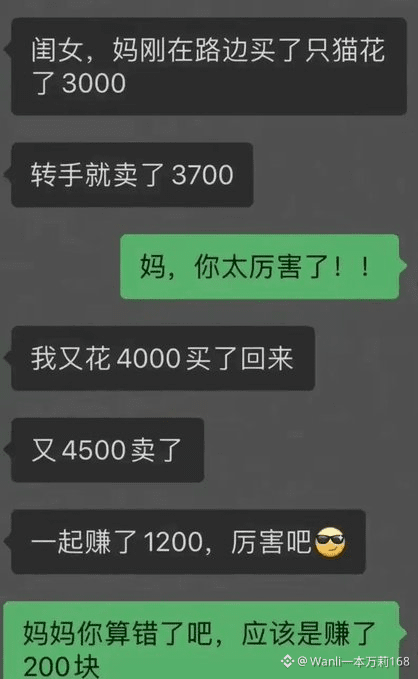
How much money did this netizen's mom actually make?
How much money did this netizen's mom actually make?
152
82
228k
PINNED
·
--
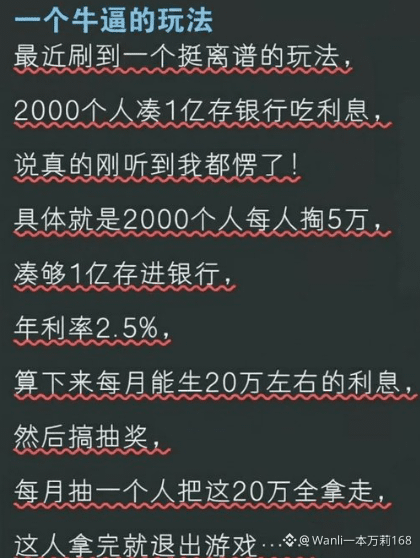
This is seriously awesome!
What genius came up with this way to play?
This is seriously awesome!
What genius came up with this way to play?
What genius came up with this way to play?
101
3
124
269.5k


·
--
I can't figure out what Lin Chi-ling sees in him.
I can't figure out what Lin Chi-ling sees in him.

7
2
5.4k
·
--
I’ll hold off on commenting on the taste for now.
The owner is pretty honest, though.
I’ll hold off on commenting on the taste for now.
The owner is pretty honest, though.
The owner is pretty honest, though.

4
7
2.8k
·
--
Few are willing to sit down and think calmly.
Actually, this question is very simple.
Have you figured it out?
Few are willing to sit down and think calmly.
Actually, this question is very simple.
Have you figured it out?
Actually, this question is very simple.
Have you figured it out?

14
6
12.5k
·
--
Different choices lead to different outcomes.
Different choices lead to different outcomes.

8
1
11
17.8k
·
--
Holy crap! The sky is falling!!!
Even people in Japan over 65 are still working like crazy
Look at what our elderly are doing!
They’re either square dancing here or checking out pretty women over there
Holy crap! The sky is falling!!!
Even people in Japan over 65 are still working like crazy
Look at what our elderly are doing!
They’re either square dancing here or checking out pretty women over there
Even people in Japan over 65 are still working like crazy
Look at what our elderly are doing!
They’re either square dancing here or checking out pretty women over there

1
7
1.8k
·
--
Bullish
Bitcoin climbs back above $83,000, and the market is getting greedy—but don’t rush to chase the rally this time
Today, Bitcoin returned to around $83,000, and Ethereum rebounded as well. The broader market is finally showing a welcome hint of strength.
The sentiment index is now back at 64, putting it in the greed zone.
A lot of people might see this and wonder: Is the bull market back?
But I want to offer a reminder:
A price rebound and a trend reversal are not the same thing.
The biggest change in this rally is that market sentiment has shifted from cautious to positive again. Investors are willing to return and go long, and altcoins are starting to take turns leading the way.
The problem, though, is that the market hasn’t yet reached broad-based confirmation.
When Bitcoin rises, most of the money is still concentrated in major assets.
Some altcoins have posted big gains, but trading activity hasn’t been consistent.
That tells us investors are more willing to take risks, but we’re not at the stage where it makes sense to chase every price spike.
From a technical perspective, $83,000 is an important level to watch.
If Bitcoin can hold above this zone for several consecutive sessions and trading volume continues to grow, there may be room for further gains.
But if it surges and then quickly falls back, that would suggest this rebound is driven more by short covering than by fresh money entering the market to fuel a new trend.
The biggest danger right now isn’t missing out on opportunities.
It’s having just come through a pullback, then fearing you’ll miss out as soon as the market rebounds.
One of the worst things you can do in trading is go all-in just as sentiment begins to improve.
A more sensible approach is:
Watch the trend for major coins.
Watch trading activity for altcoins.
Watch whether momentum lasts for trending coins.
If Bitcoin can hold steady while Ethereum and Solana continue to see rising volume, that would signal the market is moving from a rebound toward recovery.
It’s reasonable to be optimistic for now,
but don’t get carried away.
Greed can push the market higher,
but excessive greed can also lead many people to buy at short-term highs.
9
955
·
--
Bullish
When Agents Start Making Money on Their Own, the Real Machine Economy Is Just Getting Started
When we’ve talked about artificial intelligence in the past, the focus has usually been on how powerful models are, how quickly they respond, and whether they can replace certain jobs.
But a more practical question may soon confront us:
If Agents don’t just help us complete tasks, but can also take on jobs, call services, and make payments on their own, could they become a new kind of economic actor?
This isn’t science fiction.
A travel Agent could automatically compare flights, book hotels, and buy insurance. A trading Agent could call data APIs, analyze market trends, and execute strategies. An enterprise Agent could even automatically procure computing power, data, and software services based on business needs.
The problem is that traditional internet payment systems weren’t designed for frequent, low-value, automated transactions between machines. Bank card payments require human confirmation, account permissions are difficult to control precisely, and cross-platform settlement isn’t flexible enough. When transactions shift from “person to person” to “Agent to Agent,” payment is no longer just about paying—it becomes part of the entire task workflow.
Kite’s value lies in its effort to bring identity, permissions, payments, and task delivery together in a single infrastructure. Agents can have their own identities and budgets, and make automatic payments according to service agreements. Once a task is completed, funds are released; if the service doesn’t meet the agreed standard, the settlement can be adjusted.
This means an Agent may no longer be just a tool behind a chat window, but could become a “digital worker” capable of participating independently in the market.
Of course, the Agent economy won’t mature overnight just because a protocol exists. The real challenges are: Who verifies that a task has been completed? Who limits the risks Agents pose? Who handles erroneous transactions? Who distributes the revenue?
That’s why @GoKiteAI is worth paying attention to. It isn’t just about discussing artificial intelligence; it’s an attempt to answer a more fundamental question:
When machines start working, how should they establish trust and settle payments with one another?
The internet of the future may no longer be just a place where people use platforms to access services. Instead, countless Agents may automatically find resources, complete tasks, and create value.
And KITE is helping build the payment and collaboration infrastructure for this new economy.
#KiteBBW $KITE
When Agents Start Making Money on Their Own, the Real Machine Economy Is Just Getting Started
When we’ve talked about artificial intelligence in the past, the focus has usually been on how powerful models are, how quickly they respond, and whether they can replace certain jobs.
But a more practical question may soon confront us:
If Agents don’t just help us complete tasks, but can also take on jobs, call services, and make payments on their own, could they become a new kind of economic actor?
This isn’t science fiction.
A travel Agent could automatically compare flights, book hotels, and buy insurance. A trading Agent could call data APIs, analyze market trends, and execute strategies. An enterprise Agent could even automatically procure computing power, data, and software services based on business needs.
The problem is that traditional internet payment systems weren’t designed for frequent, low-value, automated transactions between machines. Bank card payments require human confirmation, account permissions are difficult to control precisely, and cross-platform settlement isn’t flexible enough. When transactions shift from “person to person” to “Agent to Agent,” payment is no longer just about paying—it becomes part of the entire task workflow.
Kite’s value lies in its effort to bring identity, permissions, payments, and task delivery together in a single infrastructure. Agents can have their own identities and budgets, and make automatic payments according to service agreements. Once a task is completed, funds are released; if the service doesn’t meet the agreed standard, the settlement can be adjusted.
This means an Agent may no longer be just a tool behind a chat window, but could become a “digital worker” capable of participating independently in the market.
Of course, the Agent economy won’t mature overnight just because a protocol exists. The real challenges are: Who verifies that a task has been completed? Who limits the risks Agents pose? Who handles erroneous transactions? Who distributes the revenue?
That’s why @KITE AI 中文 is worth paying attention to. It isn’t just about discussing artificial intelligence; it’s an attempt to answer a more fundamental question:
When machines start working, how should they establish trust and settle payments with one another?
The internet of the future may no longer be just a place where people use platforms to access services. Instead, countless Agents may automatically find resources, complete tasks, and create value.
And KITE is helping build the payment and collaboration infrastructure for this new economy.
#KiteBBW $KITE

9
680
·
--
Ethereum has fallen to around $2,400. The real issue isn’t the price, but how investors feel.
Today, Ethereum is trading around $2,405, down about 0.7% over the past 24 hours.
That decline isn’t significant on its own. But compared with Bitcoin’s near-flat performance, Ethereum’s weakness stands out.
Put simply, Bitcoin is holding steady, but investors aren’t showing much interest in chasing Ethereum higher.
Futures data shows that Ethereum’s open interest is around $30.2 billion, the long-short ratio is near 0.90, and the funding rate is about 0.003%.
A long-short ratio below 1 means there are slightly more short positions than long positions. Positioning isn’t particularly crowded, which could point to two things:
First, the market genuinely lacks confidence in Ethereum’s short-term performance.
Second, if Ethereum suddenly rebounds, short covering could help push it higher.
So it’s too soon to simply say ETH is weak, or to claim that a reversal is imminent.
The key is whether investment flows return to the Ethereum ecosystem.
Recently, the market has favored high-volatility themes. Ethereum still has a strong foundation, but its price needs a new catalyst. The old narratives alone are no longer enough to keep investors excited.
If ETH can reclaim $2,450 and trading volume rises at the same time, market sentiment could improve significantly.
But if it repeatedly fails to hold $2,400, while money continues flowing into Bitcoin and a handful of popular sectors, Ethereum could remain under pressure in the short term.
ETH still has opportunities, but patience is needed.
Mature trading isn’t about jumping in because others are calling for a reversal. It’s about waiting for price action and trading volume to prove that the market is truly getting stronger.
4
835
·
--
Bullish
When your trading strategy no longer has to show its hand in advance
Have you ever wondered
Whether the biggest disadvantage in on-chain trading might not be making the wrong call, but that others can see your call before it’s even executed?
You’re planning to buy at a certain price. You set a conditional order. You design an automated rebalancing strategy. Or you simply have an AI Agent waiting for a signal.
But as long as this logic is public on-chain, your competitors have a chance to study you in advance, act before you, or simply copy your strategy.
That’s exactly the problem Nillion’s Covenants aims to solve.
It can encrypt and seal trading instructions and trigger conditions before placing them on-chain to wait.
Others can see that an instruction exists, but not what it contains.
Only when the conditions are met will the instruction automatically decrypt and execute.
It’s like handing the market a sealed letter that will open on its own only when the time and conditions are right.
Dusk is the first version of Covenants, and the real beginning of the Nillion Encrypted Markets roadmap taking shape.
It starts with Ethereum mainnet, focusing on validating conditional triggers, encrypted execution, and node coordination.
In the future, this mechanism could be used for automated trading, prediction markets, on-chain treasuries, institutional strategies, and even AI Agents.
Because a truly competitive Agent can’t reveal every step of its thinking.
Otherwise, its strategy will have been seen before it even makes a move.
More importantly, $NIL doesn’t just serve a governance function.
Network operations, node staking, and trigger fees could all connect it to real usage.
That’s what traders should keep an eye on.
Not how grand the story sounds, but whether the product can generate sustained demand.
Of course, Dusk is only the first phase. The real test will be multi-chain expansion and ecosystem applications.
But if Nillion can move on-chain trading from complete transparency to verifiable private execution,
then the potential of $NIL may only just be beginning to unfold. #nil $NIL @nillionnetwork
When your trading strategy no longer has to show its hand in advance
Have you ever wondered
Whether the biggest disadvantage in on-chain trading might not be making the wrong call, but that others can see your call before it’s even executed?
You’re planning to buy at a certain price. You set a conditional order. You design an automated rebalancing strategy. Or you simply have an AI Agent waiting for a signal.
But as long as this logic is public on-chain, your competitors have a chance to study you in advance, act before you, or simply copy your strategy.
That’s exactly the problem Nillion’s Covenants aims to solve.
It can encrypt and seal trading instructions and trigger conditions before placing them on-chain to wait.
Others can see that an instruction exists, but not what it contains.
Only when the conditions are met will the instruction automatically decrypt and execute.
It’s like handing the market a sealed letter that will open on its own only when the time and conditions are right.
Dusk is the first version of Covenants, and the real beginning of the Nillion Encrypted Markets roadmap taking shape.
It starts with Ethereum mainnet, focusing on validating conditional triggers, encrypted execution, and node coordination.
In the future, this mechanism could be used for automated trading, prediction markets, on-chain treasuries, institutional strategies, and even AI Agents.
Because a truly competitive Agent can’t reveal every step of its thinking.
Otherwise, its strategy will have been seen before it even makes a move.
More importantly, $NIL doesn’t just serve a governance function.
Network operations, node staking, and trigger fees could all connect it to real usage.
That’s what traders should keep an eye on.
Not how grand the story sounds, but whether the product can generate sustained demand.
Of course, Dusk is only the first phase. The real test will be multi-chain expansion and ecosystem applications.
But if Nillion can move on-chain trading from complete transparency to verifiable private execution,
then the potential of $NIL may only just be beginning to unfold. #nil $NIL @Nillion
10
630
·
--
Solana Nears $103 as High Volatility Is Just Getting Started
Solana’s price pulled back to around $102.95 today, down more than 4.4% over the past 24 hours.
SOL has consistently been more volatile than Bitcoin and Ethereum.
When prices rise, it’s usually one of the strongest assets in the market.
But when prices fall, it’s also often one of the first places investors pull their money from.
SOL futures open interest is now worth more than $6.5 billion, and 24-hour trading volume exceeds $8.2 billion, so trading activity remains extremely high.
This shows that the market hasn’t given up on Solana. In fact, a lot of money is still flowing into the battle around it.
The problem is that the more concentrated the capital, the more easily volatility can be amplified.
SOL’s futures long-to-short ratio is currently around 0.94, and funding rates are still positive, suggesting that longs haven’t fully retreated.
That could provide potential momentum for a rebound, but it could also pose a risk in the short term.
If prices keep weakening, the remaining longs could become fresh fuel for liquidations.
The key level everyone is watching now is the $100 mark.
If SOL finds clear support around $100 while Bitcoin stops making new lows, SOL could be among the first to rebound.
If the price falls below $100 and fails to recover quickly, market sentiment could turn even more defensive.
There are always opportunities with Solana, but it has never been an asset to chase blindly.
These highly volatile assets tend to produce two types of moves:
A sudden surge that catches shorts off guard.
Or a sudden plunge that wipes out highly leveraged longs.
So from here, it’s not enough to watch price moves alone; trading volume and open interest matter too.
If the price rises while open interest falls, it could be short covering.
If the price and open interest rise together, that’s more likely to signal new money entering the market.
If SOL can reclaim the $105–$108 range, market sentiment could recover quickly.
But until then, the strength of support around $100 will be crucial.
6
248
·
--
After traditional markets close, capital hasn’t left
In the past, investing in stocks came with one obvious limitation:
You could only trade when the market was open.
After the market closed, even if major news broke, you had to wait until it opened the next day.
Tokenized stocks are changing that rhythm.
Recent data shows that the tokenized stock market has grown by around 15%, to nearly $3.3 billion.
Even more noteworthy, over 70% of trading takes place after traditional stock markets close.
This shows that many investors don’t just want to replicate stock prices;
they want longer trading hours.
This is especially important when earnings reports,
policy announcements,
macroeconomic data,
and unexpected events come out all at once.
24-hour trading can significantly speed up how quickly capital responds.
What does this mean for the crypto market?
Tokenized stocks aren’t just a standalone sector.
They effectively connect traditional capital markets with blockchain liquidity.
Investors can gain exposure to stock prices within a familiar digital asset environment,
while issuers can use blockchain to improve settlement efficiency.
In the future, tokenized stocks may also be integrated with stablecoin payments,
on-chain lending,
and automated asset management.
If these use cases gain traction,
public blockchains,
stablecoins,
wallets,
oracles, and decentralized finance protocols could all benefit.
That’s why more and more capital has recently started paying attention to the RWA narrative.
Truly valuable RWAs aren’t just about putting a stock ticker on-chain;
they’re about meaningfully improving the efficiency of asset trading and settlement.
The risks are also more complex than those of ordinary stocks.
Tokenized stocks may be convenient,
but they are not the same as directly owning traditional stocks.
Investors also need to consider the issuer,
custody,
redemption mechanisms,
on-chain liquidity, and compliance restrictions in different regions.
Additionally, 24-hour trading means volatility can be amplified more quickly.
When traditional markets are closed, insufficient liquidity
could cause prices to trade at a premium or a discount.
So while this sector does offer trading opportunities,
you shouldn’t focus only on the idea of round-the-clock trading.
You also need to check whether the product has genuine liquidity,
whether the assets are fully backed,
and whether investors can redeem them smoothly.
1
9
845
·
--
Verified
NEAR ETFs Saw $3.98 Million in Daily Inflows — Are Investors Finally Looking for a New Direction?
Lately, the market has been focused on BTC and ETH.
But the real bright spot for capital flows has been NEAR.
Data shows that U.S. spot NEAR ETFs saw nearly $3.98 million in net inflows in a single day.
At the same time, products related to SOL and ZEC saw combined net outflows of about $2.356 million.
These figures are intriguing.
They don’t mean NEAR has launched a full-scale comeback.
Nor do they mean SOL’s long-term outlook has been undermined.
But they do suggest that institutional investors are exploring new allocation opportunities.
When the market falls,
capital doesn’t simply disappear.
It usually pulls back from assets that have risen too far,
then shifts to assets with more palatable valuations or greater room to surprise.
NEAR’s recent price action has also been under pressure.
The market has even seen a 500,000-NEAR long position liquidated,
worth about $2.64 million.
So NEAR is now in a highly contradictory position.
On one hand, ETFs are seeing net inflows,
suggesting that investors are starting to pay attention.
On the other, the price remains weak,
showing that short-term selling pressure has yet to fully subside.
Markets like this are often prone to sharp volatility.
If NEAR can quickly reclaim key levels after the liquidations,
while trading volume picks up,
the market may interpret it as a return of capital after a shakeout.
But if ETF inflows fail to lift the spot price,
or the price continues to make new lows,
that would suggest investors are making tentative allocations
rather than positioning for a genuine trend.
The key right now isn’t chasing NEAR’s rally.
It’s watching to see whether it can go from a weak asset to a strong one.
Capital has started looking for a new direction.
The question is whether NEAR can become the direction the market truly chooses.
3
888
·
--
$ETH’s rebound is stalling near $2,550. What bulls need most now isn’t hype
$ETH is back near $2,550 today, up more than 2% in 24 hours, and looking considerably stronger than it did a few days ago. But a closer look at the market shows that Ethereum is still in a very awkward, pivotal position.
There’s resistance above, and support below hasn’t been fully confirmed either.
The market is focused on the $2,550–$2,560 range. If the price breaks through on strong volume, short-term sentiment could improve significantly, and traders may start talking about $2,700 or even higher. But if repeated attempts fail to hold, that would suggest there’s still heavy selling pressure from underwater holders, and the price could return to around $2,400 to look for support.
The biggest problem right now isn’t that Ethereum lacks strong fundamentals, but that market participants haven’t settled on a clear direction.
Long-term investors still believe in the value of the Ethereum ecosystem, while short-term traders are more sensitive to outflows and leveraged positions. And when leveraged long positions pile up, even a small price drop can trigger a cascade of stop-losses.
So whether this rebound can continue can’t be judged by a single green candle.
What matters more is whether trading volume rises along with the price, and whether there’s clear selling pressure during pullbacks. If the price breaks above $2,560 but volume doesn’t pick up, it may just be a short-term test. By contrast, if it breaks through, retests $2,550 without falling below it, and volume remains steady, that would look more like a genuine trend reversal.
Many people like to jump in as soon as $ETH rises a couple of percentage points, but for now, a more sensible approach is to wait for the market to show its hand.
If it breaks out, watch the retest.
If it doesn’t, watch the range.
If it falls below around $2,400 again, that would suggest this rebound is still just a weak recovery. Only once the price holds above key resistance will the market start treating Ethereum as a trend asset again rather than just a rebound play.
$ETH is better suited to trades based on a clear thesis than emotional chasing. Its liquidity is deep enough that genuine moves usually offer more than just a fleeting opportunity.
Key levels: watch $2,560 above and $2,400 below. Any breakout needs to be confirmed by volume.
1
507
·
--
Verified
HYPE Nears $86 as Buyback Dynamics Reshape Token Valuation
Hyperliquid’s recent performance makes it easy to revisit a question:
Can a token associated with a trading platform command a higher valuation on the strength of real revenue and a buyback mechanism?
HYPE is currently trading at around $85.93, up about 2.17% over the past 24 hours, with a market cap approaching $19.1 billion and 24-hour trading volume exceeding $570 million. That’s already a substantial scale, yet market interest in the token remains high.
The latest market data shows that Hyperliquid has generated more than $1.4 billion in cumulative revenue, of which over $1.26 billion has been used to buy back HYPE. It also accounts for more than 56% of the on-chain perpetual futures market.
Why does this matter?
Because many tokens rise on the back of a story, while HYPE’s story includes revenue, trading volume, and buybacks—factors the market can more readily price in. As long as platform trading remains active and revenue continues to flow, buybacks could provide potential support for the price.
But there is a key risk here.
Buybacks don’t mean the price can only go up. Platform revenue and trading volume are both cyclical. If market interest wanes, trading volume may fall, and the pace of buybacks could change accordingly. More importantly, HYPE’s valuation is already high, and the market has lofty expectations for future revenue growth.
Derivatives data shows that HYPE’s long-to-short ratio is slightly above 1 and its funding rate is positive, indicating that longs have the upper hand, though the market is not yet extremely crowded. If the price can hold above $84 and continue to test $88, the trend remains bullish.
But if the price falls below $82 while trading volume picks up, watch out for concentrated profit-taking at these elevated levels.
HYPE’s appeal lies in its relatively clear value-capture mechanism; its risk is that the price has already priced in a lot of good news.
For traders, HYPE isn’t the kind of asset to chase after hearing the news. A more sensible approach is to wait for a pullback and confirmation, and watch whether the market continues to believe in the buyback outlook.
A truly healthy rally is one where the price rises as the platform’s fundamentals continue to improve. A rising chart without revenue growth is just sentiment. A buyback narrative without real usage is just a story.
Whether HYPE can continue climbing will ultimately depend on whether platform trading volume and buybacks can keep delivering.
4
2.2k
·
--
Solana is producing blocks twice as fast, but the price is still stuck at 110. Interesting.
Yesterday, Solana’s mainnet pulled off a major upgrade: it cut the block interval from 400 milliseconds to 200 milliseconds, doubling the block production rate. Next up is the Alpenglow upgrade, which aims for 150-millisecond finality. Once that’s in place, using the chain should feel pretty much like browsing the web.
The tech is impressive. But what about the price? SOL is at 109.7 now, down 7.8% this week. A month ago, it peaked at 124 and bottomed out at 96.
Why hasn’t the good news pushed the price up? I see two reasons.
First, a SOL treasury company transferred 468,000 SOL in a single day, worth more than $51 million. Some of it went straight to exchanges. The market is very sensitive to this kind of selling pressure, so after the news broke, nobody dared to chase the price. Second, the whole market has been de-risking this week. ETF outflows and cooling sentiment mean high-beta assets like SOL naturally fall harder than Bitcoin.
But look at it another way: the treasury company’s sell-off is a one-off. Once those tokens are sold, that’s it. The tech upgrade, on the other hand, has lasting impact. The Alpenglow narrative will keep coming back into focus until it goes live. Funding rates in the futures market are very low, and the long/short ratio is 0.99, with slightly more shorts. If there’s a rebound, there’s fuel for a short squeeze.
My plan: 100 to 96 is last month’s bottom range. If the price returns to that area, I’ll buy in gradually. 115 is the first hurdle above. If it breaks through, then I’ll watch 124. I wouldn’t go all in right now. Let the treasury’s tokens get absorbed first, and then the price will tell the truth.
When fundamentals and price diverge, it’s often a moment when both opportunities and traps appear. The key is whether you have the patience.
3
459
·
--
ETH is back above 2,500, but I’m not sure I trust this level
ETH climbed back above 2,500 today, and plenty of people are starting to call a reversal. Let me pour a little cold water on that.
First, some background: ETH fell nearly 10% this week. It was pushed back down from the 2,680–2,770 area, with a low of 2,409. In this wave of 100 billion in liquidations, ETH alone accounted for $310 million—more than BTC.
But here’s the interesting part.
Open interest in ETH futures across the market fell 5.18% over the past 24 hours, and now stands at around $32.1 billion. Leverage is voluntarily exiting the market. That’s actually healthy: the bubble is deflating.
At the same time, a smart-money address with a strong historical win rate and $9.26 million in cumulative profits opened a 20x long position of 12,000 ETH at 2,438. It’s now sitting on unrealized gains of over $600,000. Someone willing to go 20x at this level must be seeing something.
But the order book doesn’t exactly support an immediate takeoff. On Binance, ETH perpetuals have $57.24 million in nearby sell orders—$8.18 million more than the buy orders. The selling pressure overhead is real.
My take: 2,360–2,420 is the line that keeps this move alive. Smart money’s entry is around there too. As long as that level holds, there’s room for a short-term bounce. The first target is still 2,680.
But if ETH breaks below 2,360 on heavy volume, don’t try to outlast smart money. They can afford to hold a 20x position; you might not be able to.
ETH doesn’t lack a story right now. What it lacks is a reason for money to come back. Be patient.
1
231
·
--
Verified
Meteora Surges 45% in a Day as the Solana Ecosystem Heats Up Again
One of the market’s strongest performers today is Meteora.
The price of MET briefly approached $0.46, up more than 45% in 24 hours, while trading volume climbed to nearly $200 million.
That kind of gain stands out in the current market environment.
More importantly, this rally isn’t driven by sentiment alone. The project has launched DLMM Pro and further integrated modules such as liquidity market-making and Bonding Curve.
Put simply, it’s aiming to be more than just another Solana ecosystem protocol. It’s looking to expand its presence in liquidity and trading infrastructure.
Why is the market responding positively?
When major coins move sideways, capital often looks for niche sectors with products, compelling narratives, and trading volume.
Meteora checks several boxes at once: the Solana ecosystem, liquidity infrastructure, a new product launch, and rising trading activity.
Together, these factors can easily draw a surge of short-term capital.
But there’s an obvious risk.
After MET’s gain of more than 45% in a single day, short-term profit-taking is bound to increase. If trading volume continues to rise and the price holds steady, that may indicate investors remain interested. But if the price quickly falls back to where it was before the breakout, this may have been nothing more than a burst of sentiment.
For everyday traders, chasing a rally often happens after much of the move is already over.
A project having a product doesn’t mean its token can only go up, and a hot ecosystem doesn’t mean valuations have no ceiling.
The Solana sector has picked up again recently, but the projects that ultimately endure will need sustained users, usage, and cash flow.
So, don’t judge whether MET can keep rising by looking only at how much it gained today.
Watch whether it can turn market attention into lasting liquidity.
In the short term, watch volume; in the medium term, watch the product; in the long term, watch the ecosystem.
That’s the basic framework for judging whether this rally has staying power.
1
643
Log in to explore more content
Join global crypto users on Binance Square
⚡️ Get latest and useful information about crypto.
💬 Trusted by the world’s largest crypto exchange.
👍 Discover real insights from verified creators.
Email / Phone number