#TermMax @TermMax
TermMax: DeFi Lending That Thinks More Like a Bond Market
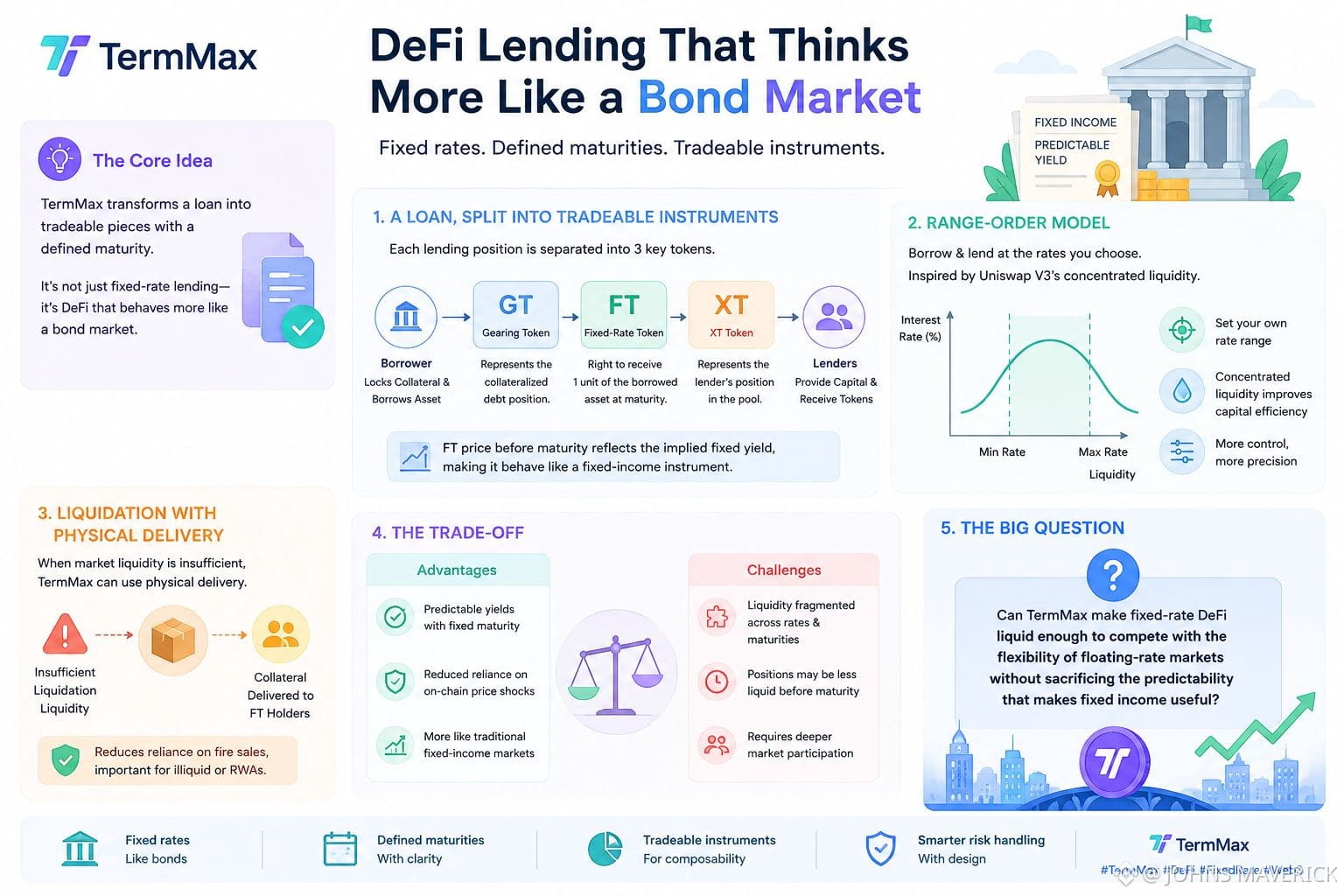
The more I looked into TermMax, the more I realized its interesting part isn't simply “fixed-rate lending.” It’s the way the protocol turns a loan into tradeable pieces with a defined maturity.
Instead of a floating rate that keeps changing with utilization, TermMax separates the position into instruments such as the Gearing Token (GT), Fixed-Rate Token (FT), and XT. An FT can represent the right to receive 1 unit of the borrowed asset at maturity, while its price before maturity reflects the implied fixed yield. That makes the lending position behave more like a fixed-income instrument than a typical DeFi deposit.
I also found the range-order model interesting. TermMax borrows an idea from Uniswap V3’s concentrated liquidity, but applies it to interest rates: market participants can define ranges for borrowing or lending rates rather than accepting one rigid curve.
Another design choice caught my attention: if liquidation liquidity becomes insufficient, TermMax can use physical delivery, allowing collateral to be delivered to FT holders rather than relying entirely on a market sale. That could matter for assets where immediate liquidity is limited.
The trade-off is obvious: fixed maturity improves predictability, but liquidity can become fragmented across different rates and maturities.
So the question I’m left with is: can TermMax make fixed-rate DeFi liquid enough to compete with the flexibility of floating-rate markets without sacrificing the predictability that makes fixed income useful?
#DeFi #FixedRate #Web3
$NVDAB
$SOL
$AT
TermMax: DeFi Lending That Thinks More Like a Bond Market
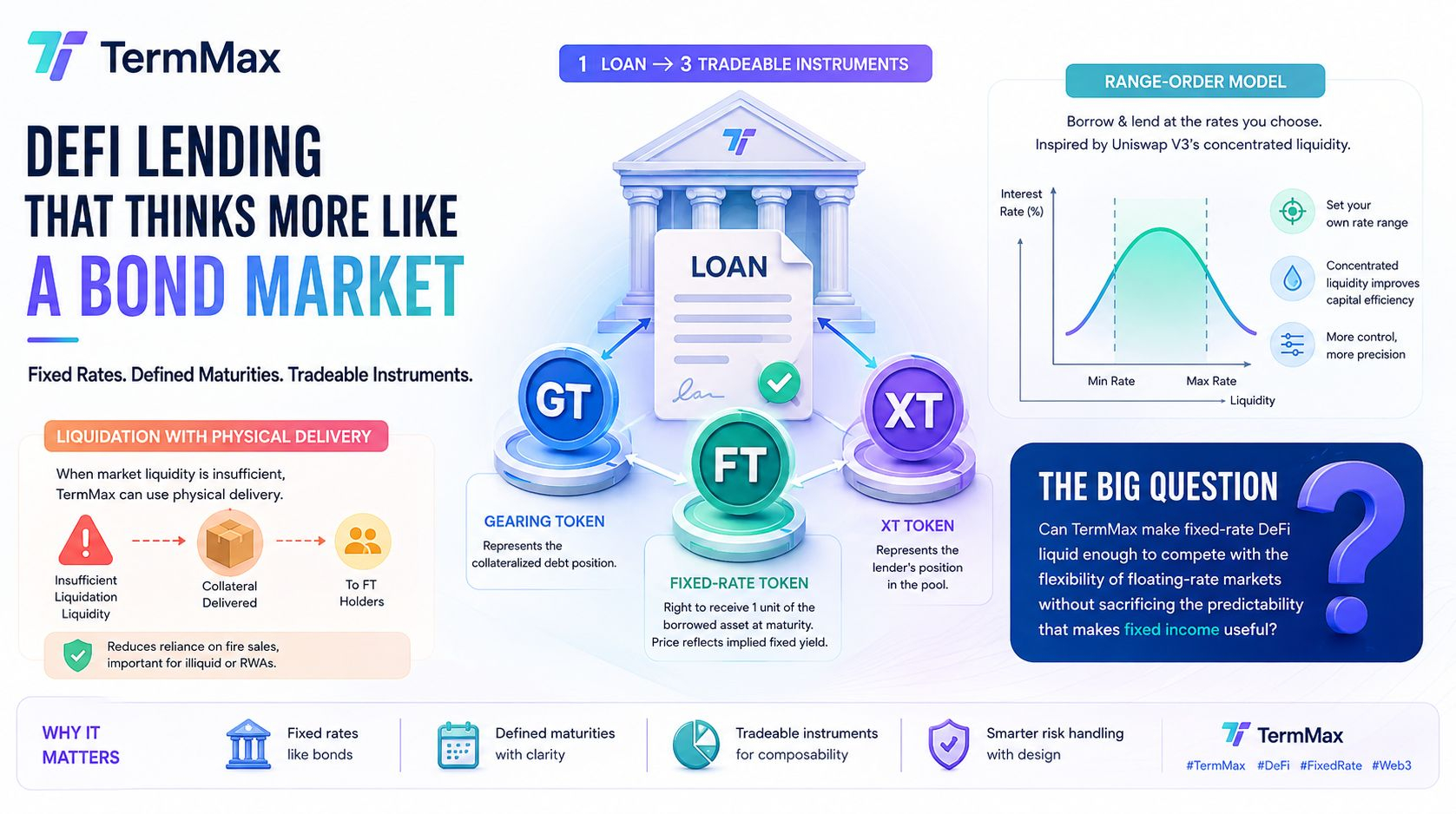
The more I looked into TermMax, the more I realized its interesting part isn't simply “fixed-rate lending.” It’s the way the protocol turns a loan into tradeable pieces with a defined maturity.
Instead of a floating rate that keeps changing with utilization, TermMax separates the position into instruments such as the Gearing Token (GT), Fixed-Rate Token (FT), and XT. An FT can represent the right to receive 1 unit of the borrowed asset at maturity, while its price before maturity reflects the implied fixed yield. That makes the lending position behave more like a fixed-income instrument than a typical DeFi deposit.
I also found the range-order model interesting. TermMax borrows an idea from Uniswap V3’s concentrated liquidity, but applies it to interest rates: market participants can define ranges for borrowing or lending rates rather than accepting one rigid curve.
Another design choice caught my attention: if liquidation liquidity becomes insufficient, TermMax can use physical delivery, allowing collateral to be delivered to FT holders rather than relying entirely on a market sale. That could matter for assets where immediate liquidity is limited.
The trade-off is obvious: fixed maturity improves predictability, but liquidity can become fragmented across different rates and maturities.
So the question I’m left with is: can TermMax make fixed-rate DeFi liquid enough to compete with the flexibility of floating-rate markets without sacrificing the predictability that makes fixed income useful?
#DeFi #FixedRate #Web3
$NVDAB
$SOL
$AT