

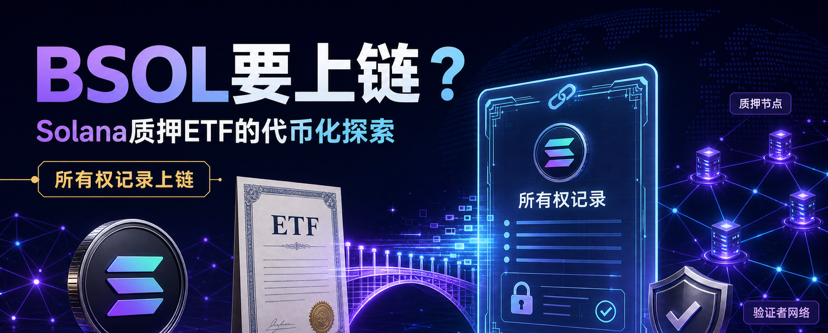

Bitwise has recently released a noteworthy signal: it is working with Superstate to explore tokenizing its funds. The first product that could potentially enter this initiative is very likely the Bitwise Solana Staking ETF, code BSOL.
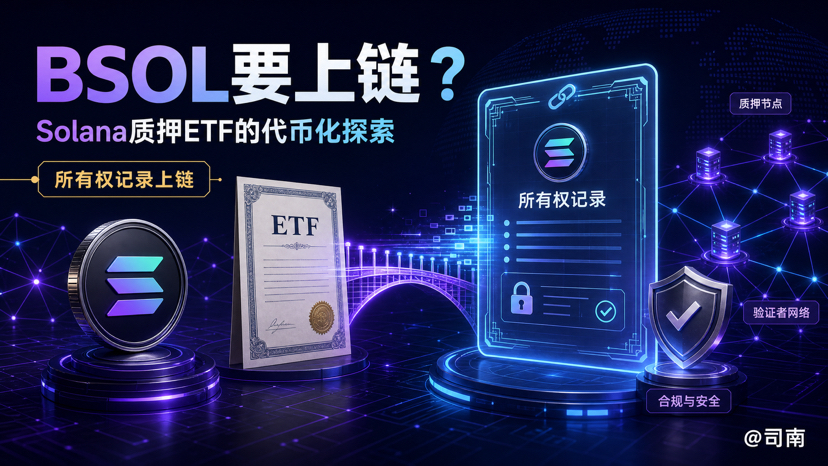
Don’t rush to interpret this as “BSOL has already turned into an on-chain token.” A more accurate way to put it is: Bitwise is researching how to add an on-chain record of fractional ownership for BSOL. The project is still in the exploration stage.
What’s truly important here isn’t that we’re getting yet another Solana concept, but that the ownership records of a traditional ETF are beginning to connect with blockchain infrastructure.
So what exactly is going to be put on-chain this time?
According to information disclosed by The Block, Bitwise and Superstate are working on a framework for tokenizing fund shares. Under this framework, what changes primarily is how share ownership is recorded—not the investment interest in the fund itself.
In the future, investors may have two ways to hold it: continue using the traditional ledger format, with depository and clearing systems recording shares; or choose a tokenized form, where share ownership is recorded on the blockchain and maintained by Superstate’s transfer agent infrastructure.
Here’s a very key detail: tokenized shares have the same rights as shares in a traditional ledger format, but tokenized shares cannot be freely transferred outside that blockchain system.
In other words, this isn’t turning BSOL into a “free-floating token” that can be freely sent to any wallet or any DeFi protocol. Instead, it adds to the ETF a blockchain-based method for registration.
What is BSOL itself?
BSOL is not a typical Solana concept fund. Bitwise’s official materials say that BSOL started trading on the New York Stock Exchange on October 28, 2025, offering 100% direct SOL exposure, and it includes a staking mechanism.
Bitwise previously said it plans to stake the SOL held by the fund through its on-chain solution, with technical support from Helius, to participate in Solana network staking rewards. When the official release was published, it mentioned that Solana’s average staking rewards exceed 7%, but it also clearly cautioned that the reward rate will change and cannot be regarded as a guarantee of the fund’s future performance.
This means BSOL’s investment logic has two parts: one comes from the rise and fall of the SOL price itself, and the other from additional token rewards that staking may bring.
But staking yield isn’t free. The fund must face changes in rewards, reward cuts/penalties, technical and operational risks, and the possibility that staking assets could affect the fund’s ability to meet redemption needs in a timely manner.
So investors can’t simply understand BSOL as “holding SOL and automatically earning fixed interest.” It’s still a highly volatile single-asset product; staking only adds another source of returns and risk structure.
Why would Bitwise consider tokenizing BSOL?
My view is that Bitwise isn’t focused on the concept itself, but on the efficiency of on-chain asset distribution and management.
Ownership records of traditional ETFs typically rely on brokers, custodians, clearing systems, and transfer agents. After blockchain tokenization, parts of the registration, transfer, and holder-management processes may be handled using on-chain infrastructure. For institutions, this could mean clearer asset records, faster settlement paths, and potential integration with on-chain financial applications.
Especially since BSOL itself already has SOL exposure and staking characteristics. Putting on-chain share registration for an ETF directly tied to the Solana ecosystem creates some business synergy: the underlying assets are on-chain, and the way fund shares are recorded also tries to move closer to on-chain.
But that doesn’t mean all processes will immediately move to the public chain, nor does it mean that traditional finance’s compliance, custody, and clearing steps will be completely replaced.
A more realistic path may be: first give some investors the option of having on-chain records, then gradually test on-chain transfers, compliance whitelists, institutional settlement, and asset management use cases.
How is this different from buying SOL directly?
The difference is very large.
If investors directly hold SOL, they face wallet management, private key security, exchange or custodian risks, as well as the technical issues involved in staking. If they hold BSOL, then through an exchange-traded product they indirectly obtain SOL exposure; investors trade fund shares, while the fund manager is responsible for underlying asset management and staking arrangements.
If in the future BSOL launches tokenized shares, investors would not receive a new SOL token; they would receive an on-chain record representing ETF rights. Its rights still come from the fund shares themselves, and you can’t automatically get higher liquidity or more upside just because it’s “on-chain.”
This is also the easiest part for the market to misunderstand: ETF tokenization doesn’t equal ETF decentralization; on-chain registration doesn’t mean investors gain completely free rights to transfer assets.
What does this mean for the Solana ecosystem?
If it ultimately comes to fruition, BSOL could become a bridge between traditional financial products and Solana’s on-chain infrastructure.
On the one hand, traditional investors can still obtain SOL exposure through familiar ETF structures. On the other hand, tokenized shares may—subject to regulatory and product rules—connect to more on-chain registration, settlement, and asset management scenarios.
For Solana, this has two implications.
First, Solana isn’t only used to issue native tokens and run DeFi applications; it may also carry registration and transfer infrastructure for traditional fund shares.
Second, Solana’s ecosystem value would be further framed in the narrative of “on-chain financial assets.” In the past, people discussed Solana mainly around transaction speed, low fees, and application activity; going forward, institutional funds, stablecoins, securities-like assets, and on-chain clearing may also become new areas to watch.
Of course, you can’t just announce “institutional capital has fully poured into Solana” because of a cooperation plan. Tokenization still requires regulatory approvals, technical audits, transfer rules, custody arrangements, and market liquidity to work together.
The risks that truly need attention
First is liquidity risk. If tokenized shares can only be transferred within a specific blockchain system, liquidity may not be better than that of traditional ETFs. On-chain forms may look more flexible, but in practice the trading range may be constrained by compliance whitelist requirements and transfer restrictions.
Second is net asset value and market price risk. Bitwise’s official materials clearly warn that BSOL’s market price may not be fully consistent with the fund’s net asset value, and fund shares are not direct redeemable for SOL.
Third is staking risk. Staking rewards can change, and during staking there may be events like reward cuts/penalties, operational failures, or redemption arrangements being affected. So-called “staking yield” can’t be treated as stable interest.
Fourth is single-asset risk. BSOL is primarily built around SOL as the sole underlying asset; when the SOL price experiences large fluctuations, the fund’s net asset value will also be significantly affected. Tokenization can only change how shares are recorded; it cannot eliminate underlying asset risk.
Fifth is regulatory and technical risk. After fund shares are put on-chain, you need clear rules for how to identify holders, enforce transfer restrictions, and handle the relationship between on-chain records and traditional legal documents.
My conclusion
Bitwise’s collaboration with Superstate is worth watching, but it’s not yet appropriate to package it as “BSOL is already on-chain” or “Solana ETFs are about to fully enter DeFi.” The most accurate assessment right now is: Bitwise is exploring adding tokenized holding options for BSOL, with the core change being that ownership records are put on-chain; investors’ rights are, in principle, unchanged.
The long-term value of this is that it may gradually transform ETFs from being just exchange-traded products into financial assets that can be registered, managed, and settled on-chain.
But in the short term, the market needs to focus on several practical questions: when tokenized shares will be officially launched, which investors can participate, whether they will be able to transfer on-chain, whether they will connect to specific DeFi scenarios, and how to convert between traditional ledger shares and on-chain shares.
In my personal view, this isn’t a piece of news that will immediately boost the SOL price; it’s more of a signal that helps the Solana infrastructure narrative.
If spot ETFs are the entry point for traditional capital into the crypto market, then tokenized ETFs may be exploring how crypto infrastructure can, in turn, serve traditional finance.
After BSOL is tokenized, what do you think is most likely to be implemented first: on-chain settlement, institutional custody, or connecting with DeFi protocols? Feel free to share your view in the comments.
