
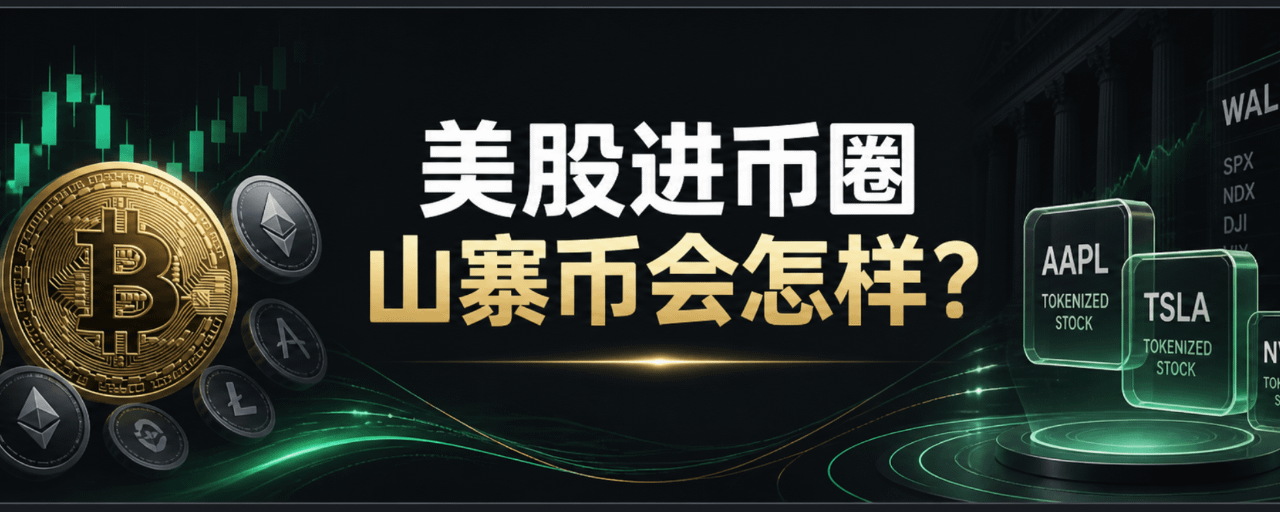
Opening U.S. stock trading in crypto isn’t a “positive for all altcoins.” It’s the crypto space starting to take over the traditional brokerage industry’s lunch.
The big picture for this is: exchanges don’t want to survive on only BTC, ETH, and altcoins anymore. As altcoins become harder to hype, there are fewer new stories, and retail traders are also not as easy to fool as before. So platforms want to bring traditional assets like U.S. stocks, ETFs, U.S. Treasury bonds, and gold onto the blockchain—turning them into “a coin-circling version of assets” that can be traded 24/7.
For copycat coins, the short term isn’t necessarily a good thing.
Previously, users’ money was in exchanges, and there were only a few choices: BTC, ETH, altcoins, futures/derivatives, and wealth management. Now there are more options, especially U.S. stocks—particularly targets like Tesla, Nvidia, Apple, and Coinbase. Many retail investors will think: Why should I buy an altcoin with no revenue, no users, and no logic? Why not just buy U.S. stocks directly?
So altcoins will become more differentiated.
As for altcoins that can still rise in the future, they will most likely be these kinds:
Tokens related to RWA, on-chain stocks, stablecoins, payments, and clearing/settlement
Because when U.S. stocks are put on-chain, it essentially means the RWA narrative continues to expand. Whoever can provide the chain, oracles, custody, settlement, liquidity, and regulatory-compliant entry points will have the story.
Exchange platform token
If exchanges really bundle U.S. stocks, crypto, futures/derivatives, wealth management, and payments into one account, platform tokens could benefit. Because the platform will have more revenue sources, users will become more “sticky.”
Top-layer public chains and infrastructure
Tokenizing stocks needs to run on-chain: you need wallets, clearing, data, cross-chain support, and risk control. Ecosystems like Solana, Arbitrum, and Base will continue to抢故事 (compete for the narrative).
Projects that truly have cash flow or strong user-demand scenarios
In the past, altcoins relied on selling dreams; in the future they will look more and more like the stock market: do you actually have revenue? Do you have users? Do you have a moat? Relying only on whitepapers and community pump calls will become increasingly difficult.
But most ordinary altcoins, I think, will actually end up worse.
Because before, altcoins could still pretend to be “high-growth tech stocks.” Now real tech stocks are coming in—users can directly buy Nvidia, Apple, or Tesla, and altcoins have one fewer layer of “cover.” Projects with no business, no revenue, no real demand, and only publishing roadmaps will be squeezed from both sides by U.S. stocks and BTC.
What about the overall trend of the crypto market?
I think there are three stages:
First stage: exchange traffic increases.
After U.S. stocks arrive, they will attract a group of people who didn’t play crypto before but want to buy U.S. stocks 24/7. Exchanges will turn from “crypto trading software” into “a global assets casino.” This is good news for the leading platforms.
Second stage: the boundary between crypto and stocks becomes blurred.
In the future, users may not care much whether what they bought is crypto, stocks, ETFs, government bonds, or gold. They’ll only care about: can it be traded 24/7, are the fees low, can leverage be added, and can it be used as collateral.
Third stage: altcoins are forced to upgrade.
In the past, the crypto world cycled narratives—AI, GameFi, DeFi, L2, Meme hype waves after waves. After traditional assets come in, capital will become more selective. Junk altcoins will be harder to survive; only projects with strong narratives, strong revenue, and strong ecosystems will have a chance.
In one sentence:
When U.S. stocks come to the crypto world, the beneficiaries are exchanges, RWA, stablecoins, and on-chain financial infrastructure. For most altcoins it’s not a major tailwind—it’s more like a stress test.
In the future, it’s not that there are no opportunities in the crypto world—it will become more and more real.
Shady altcoins with no real business will find it harder and harder to justify their valuations; projects with genuine financial needs, on the other hand, may actually catch the next wave of industry dividends.
#BTCUSDT #BNBUSDT #SPCXUSDT #BABAUSDT