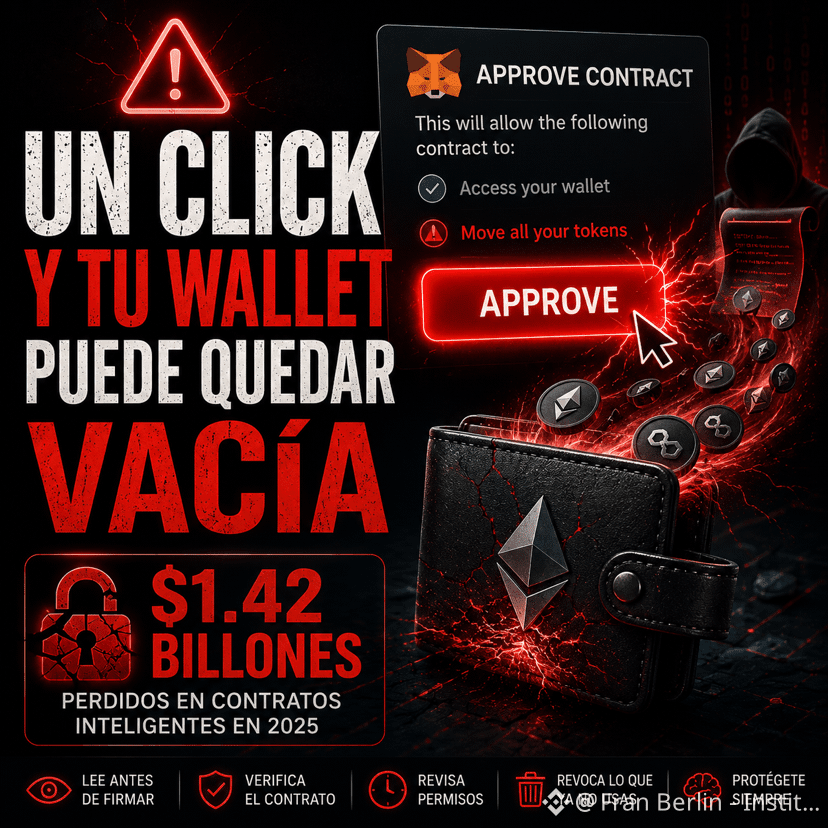
🔍 Every time you connect your wallet to a crypto app, you’re signing a contract.
Most folks don’t read it. Some end up losing everything because of that.
In 2025, vulnerabilities in smart contracts caused over $1.42 billion in losses. It wasn’t movie hackers. It was people who signed without knowing what they were signing.
Today, I’m sharing the protocol I use before approving any contract.
Alert Signal #1: SetApprovalForAll
The most commonly used in crypto scams. When you sign it, you give an external contract permission to move ALL the tokens from your wallet.
When is it legit? Only when listing an NFT on a marketplace or interacting with a well-known DEX. Outside of those situations, red flag.
Alert Signal #2: Unverified Contract on Etherscan
Copy the contract address and search it on Etherscan. If it doesn’t have verified source code — just bytecode — stop. A serious project always verifies publicly.
Alert Signal #3: Contract Deployed Less Than 48 Hours Ago
Etherscan shows when it was created. A contract that's only hours old pushing you to sign is almost always a trap.
Alert Signal #4: Permissions That Don’t Expire
That permission can be unlimited and permanent. Revoke.cash lets you see all contracts with access to your wallet and revoke them with one click.
Alert Signal #5: Reentrancy — Contracts Calling Themselves
The malicious contract executes an operation, and before your wallet registers the change, it executes another — emptying your balance in seconds. If you don’t understand the chained logic, don’t sign.
As a digital assets lawyer, I tell you: the bytecode of any contract on the blockchain is public. The tools to analyze it are free.
Ignoring this isn’t bad luck. It’s a choice.
👇 Have you checked which contracts currently have access to your wallet?
#SmartContracts #defi #InstitutoBlockchain #FranBerlin #Ethereum