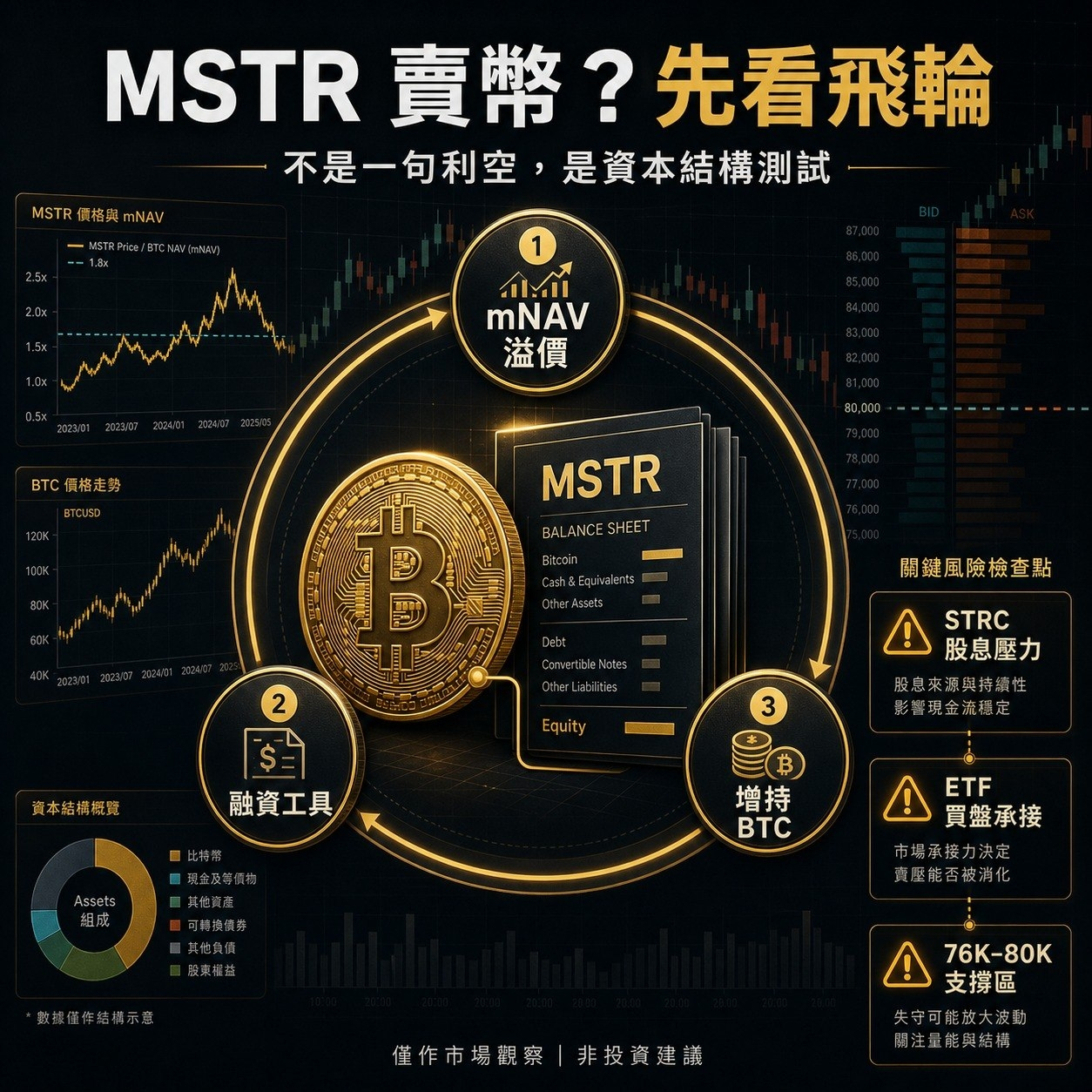

Lately, there's been a lot of chatter in the market about Michael Saylor and his strategy potentially to short some BTC, but we can't just focus on the headlines.
From the context of this Bonnie Blockchain video, the highlight isn't that 'Saylor is flipping the script and no longer HODLing', but rather that MSTR is no longer just a BTC holding company; it's essentially a capital market machine that bundles BTC, stocks, preferred shares, and credit instruments.
What we really need to look at isn't whether they're selling BTC, but three key questions:
First off, is MSTR a net seller of BTC?
If the company sells a small amount of BTC, it's to maintain STRC dividends and stabilize credit instruments, and then they might leverage to buy back more BTC, which doesn't really equate to the traditional sense of dumping.
Saylor's logic is closer: corporate governance can't promise to never sell any assets, but strategically still aims to be a net buyer of BTC in the long run.
So what the market needs to focus on is net changes, not just individual sell-offs.
Second, can MSTR's flywheel keep turning?
MSTR's core flywheel is:
Stock price has mNAV premium
→ Issue stocks or credit instruments
→ Raise funds to buy BTC
→ Increase BTC holdings
→ Market continues to give MSTR a premium
This model is very strong in a bull market, but its weaknesses are clear: if mNAV compresses, STRC demand drops, and financing costs rise, the flywheel will slow down.
So, 'selling BTC' itself isn't the biggest risk; the biggest risk is the market no longer being willing to finance MSTR at a high premium.
Third, will STRC's dividend pressure force passive selling?
STRC-type preferred stocks/credit instruments fundamentally need stable dividend payments. As long as the capital market is willing to accept MSTR's new issuances, pressure remains low; but if BTC drops, MSTR's premium disappears, and credit instruments fall below key price levels, then selling BTC could shift from 'active asset allocation' to 'passive liquidity demand.'
This is where the market really needs to be cautious.
My judgment is:
In the short term, MSTR's coin selling headlines will dampen sentiment, especially with BTC testing support near the 76K-80K range and ETF fund flows not fully recovering yet.
But in the medium term, this can't be simplified to 'Saylor wants to tank the market.' A more reasonable view is that MSTR's BTC story is transitioning from simple coin hoarding to a more complex balance sheet management phase.
Next, we need to watch four indicators:
Is there still a premium on MSTR's mNAV?
Is STRC stable within a reasonable price range?
Can BTC ETF fund flows regain strength?
Can BTC hold the 76K-80K structural zone?
If all four of these are stable, MSTR selling a small amount of BTC may not be systematically bearish.
If all four weaken simultaneously, then the market can't just comfort itself with 'long-term bullish on BTC.'
The more exciting the headline, the more we need to return to fundamentals.
The risk with MSTR isn't just whether they 'sell or hold coins', but whether their capital market flywheel can keep spinning.
#BTC #MSTR #Bitcoin #MichaelSaylor
Not investment advice, just market observation.